Vigorón: Warm Yuca, Crisp Pork and Cold, Sour Cabbage on One Plate
Three layers that stay distinct: yuca cooked soft all the way through, salty and crisp pork chicharrón, and a cold cabbage salad sharp with vinegar. Make each part separately and stack them only at the end.
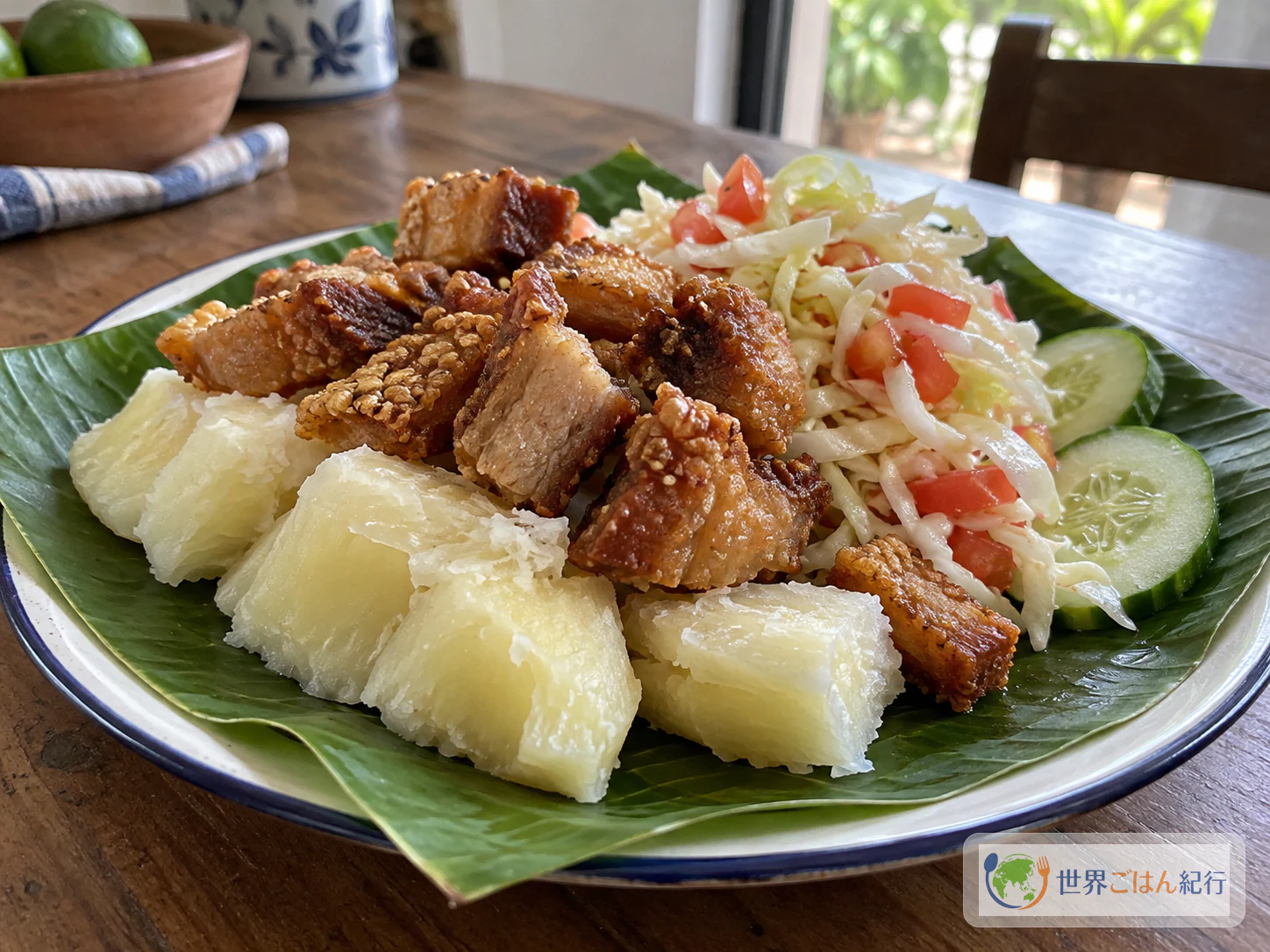
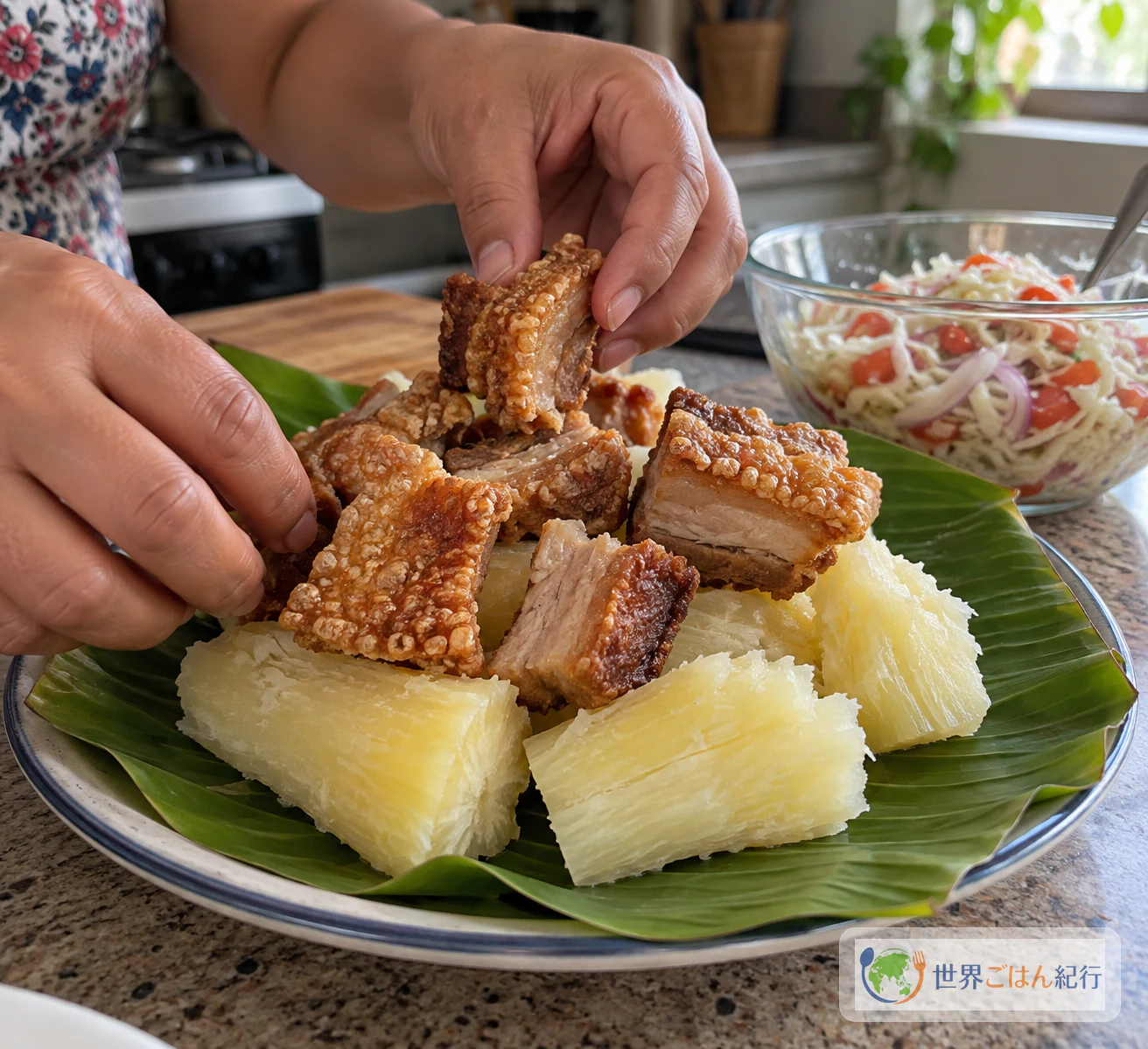
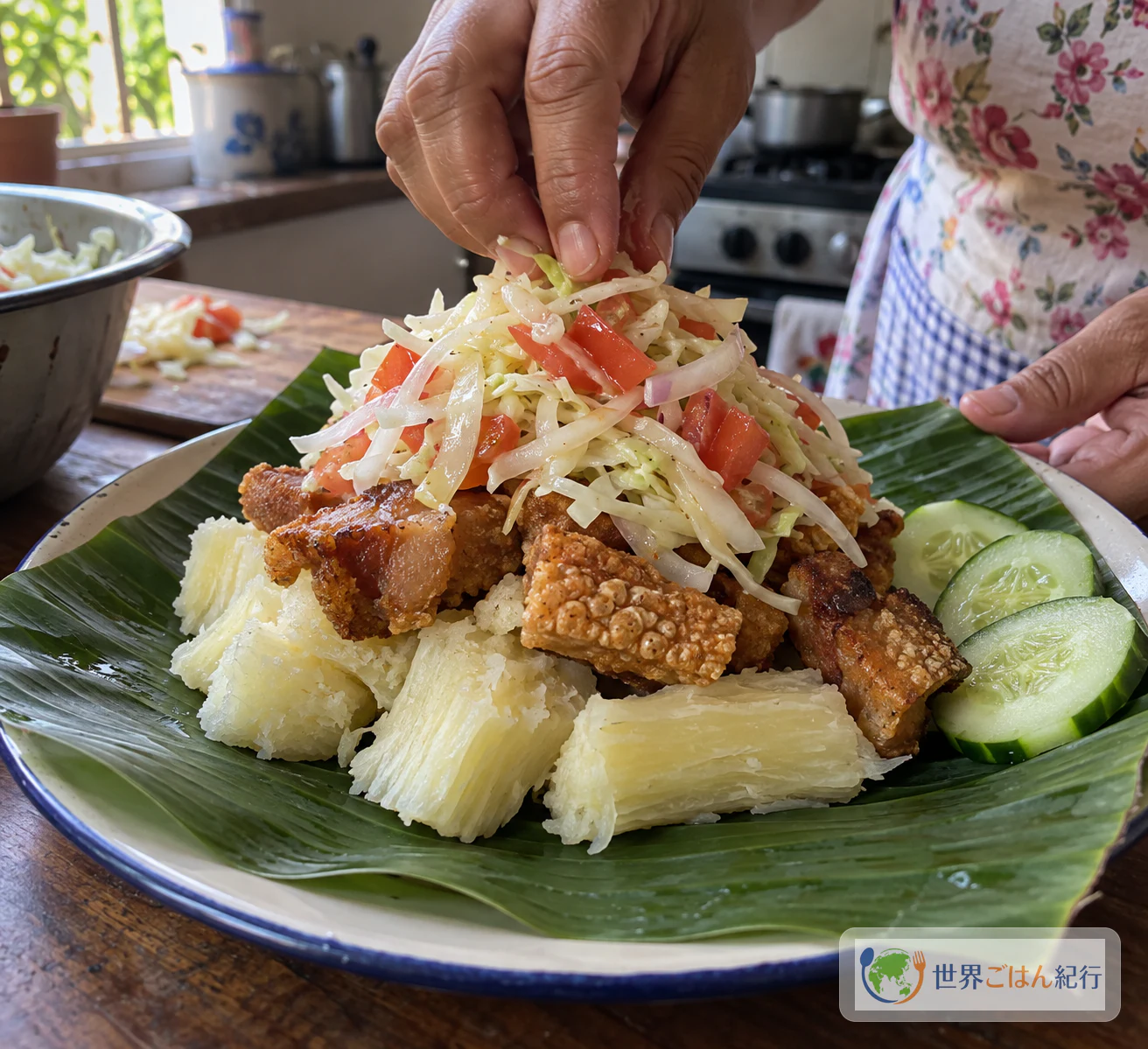
At the bottom of the plate sits warm boiled yuca, soft and starchy. On top goes pork chicharrón, salty and crisp, and over that a heap of finely shredded cabbage, tomato and onion, cold and sour with vinegar. Vigorón is a dish from Nicaragua built on exactly that contrast of temperature and texture, and it is linked above all with the city of Granada.
The recipe here follows the six-serving ingredient list published by Maxi Palí Nicaragua: yuca boiled with garlic and salt, a salad of cabbage, tomato and onion dressed with vinegar, salt and optional chile, and the plate assembled in the order yuca, chicharrón, salad. The amounts are kept in their own units and counts rather than converted to grams, because the list gives no weights or sizes. This recipe as a whole has not been kitchen-tested by Sekai Gohan, so the method tells you what to look for at each stage instead of promising times.
The two things worth getting right are safe yuca prep (peeled completely, cooked through, cooking water discarded) and timing the salad so it reaches the plate crisp rather than sitting in its own liquid.
The dish is written both Vigorón and Vigoron; the accent is the only difference, and nothing found suggests they are separate dishes.
A Granada Specialty, Served on a Leaf
Vigorón is presented as a dish of Granada. Nicaragua's national tourism map lists "Vigorón de Granada" in its guide to the municipality of Granada, and a 2022 recipe collection published by ASDENIC and Interteam describes the dish as coming from Granada. Those are the limits of what can be said about its region: they tie it to Granada without establishing that the whole country makes it one way.
The same collection includes a home recipe in which yuca is boiled until soft, cabbage and tomato are combined with something sour, and everything is served on a chagüite (a banana leaf) in the order yuca, charrasca, salad. That contributor's version uses charrasca and limón where the Maxi Palí version uses chicharrón, cucumber, vinegar and optional chile, a reminder that households make it differently. The collection also mentions vigorón being eaten at breakfast, lunch and dinner, and shared with family and friends.
The ASDENIC collection credits María Luisa Lacayo, known as "Loquita," with creating the dish in 1914. It does not cite an earlier record for this, so it is best read as the story that collection tells rather than settled history.
A separate recipe from Buena Onda Mini Market, a Latin grocery in Barcelona, describes the same structure (yuca, pork chicharrón, cabbage, tomato, vinegar, chile and a banana leaf) and talks about the contrast of hot yuca with cold salad and eating it mixed together by hand. Its own amounts are not used here.
About the amounts
The Maxi Palí page has two lists that disagree. Its shopping list reads as 1 head of garlic and 1 medium onion, while its ingredient list gives 1/2 head of garlic and 1/4 medium onion. This recipe uses the ingredient list. The page's finished-dish photo also shows carrot and beet as an optional garnish, but they are not in the ingredient list, so they are left out here. The chicharrón is listed as 1/2 libra; the page says nothing more about the cut or the product, so no weight equivalent is given.
Why the yuca needs care
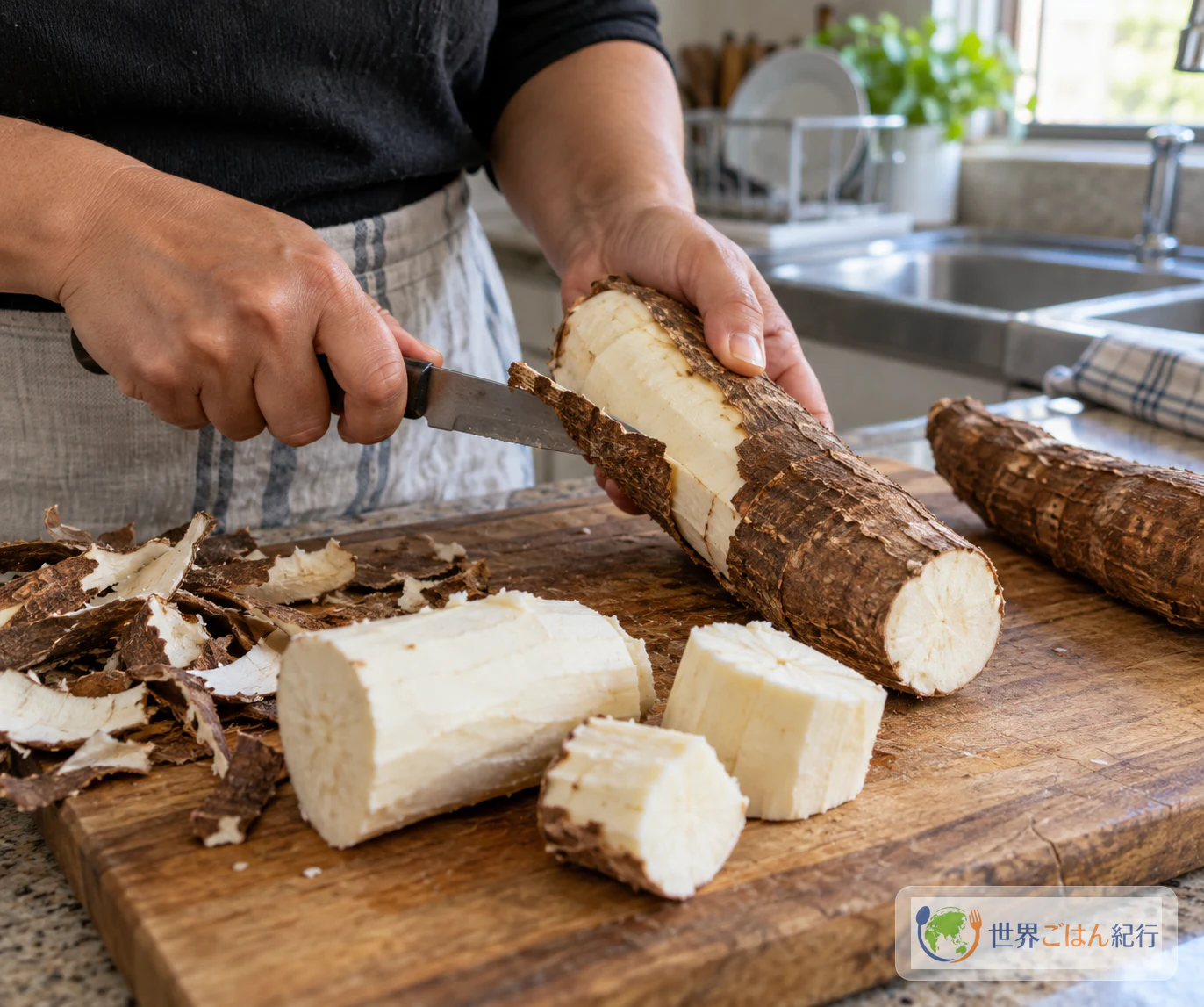
The FAO notes that cassava (yuca) contains cyanogenic glycosides in amounts that vary widely by variety and other factors, and that they tend to be concentrated in the peel. That is the reason for the handling rules in this recipe: buy yuca sold for eating, remove the peel completely, cook it thoroughly and throw away the cooking water. A lack of bitterness is not a safety test.
Ingredients for 6 Servings
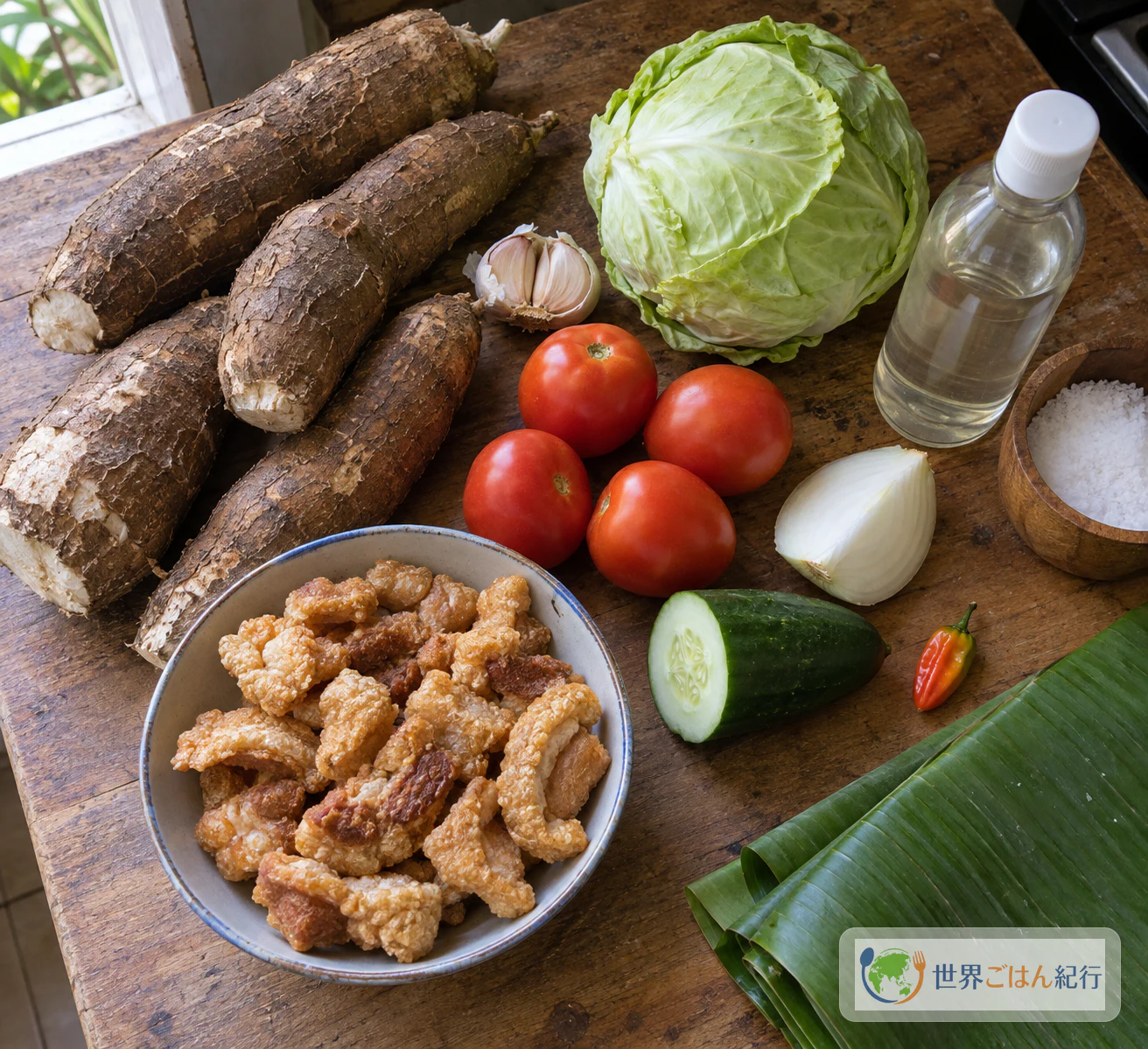
Banana leaf is optional, for lining the plate. Use only leaves sold for food, never leaves from ornamental plants. This dish contains pork. Chicharrón seasonings and production lines vary, so check the label of whatever you buy.
Equipment
- Sturdy vegetable peeler or small knife, for the thick yuca peel
- Large pot
- Colander
- Sharp knife for shredding cabbage
- Cutting board
- Mixing bowl
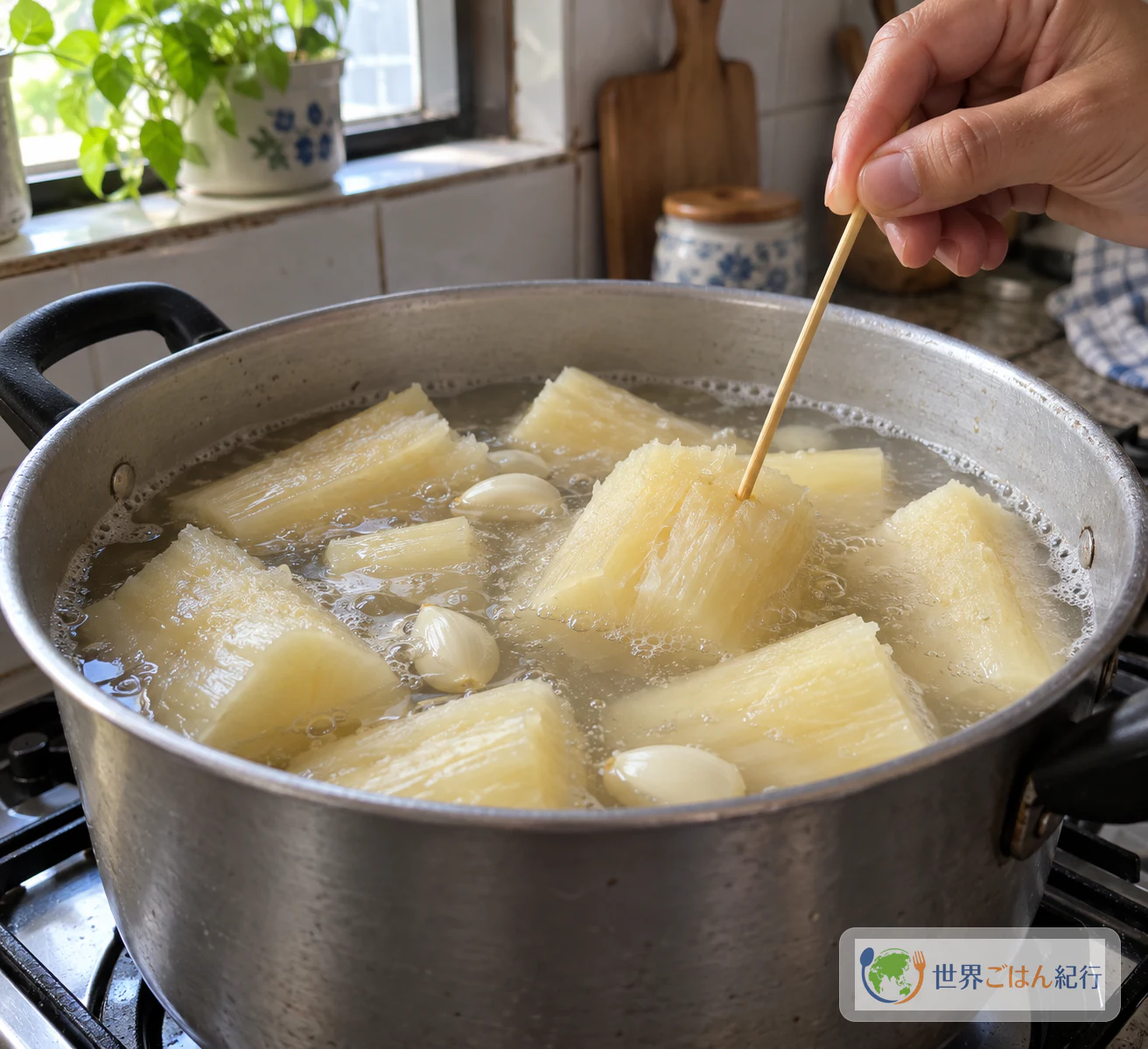
- Bamboo or wooden skewer, for testing the yuca
- Plates, lined with banana leaf if you have it
Choosing Yuca, Chicharrón and Vinegar
Yuca. Fresh yuca roots or frozen peeled yuca can be found at Latin American, Brazilian and some international or frozen-food grocers, though availability varies. Frozen yuca is a practical swap rather than the same ingredient; cook it according to its package directions. Potatoes or taro change the texture and flavor of the base, so treat them as a different dish rather than a substitute.
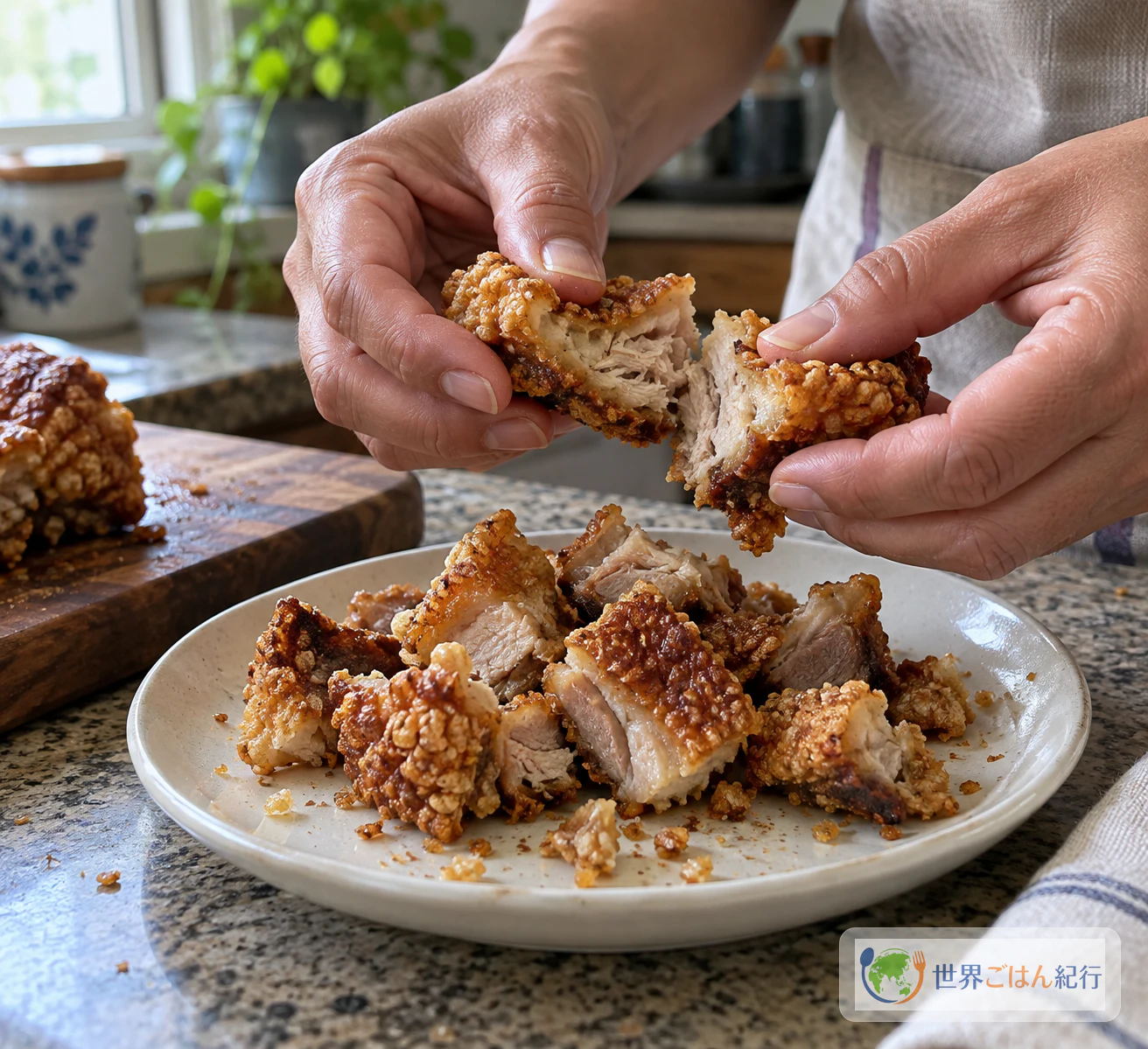
Chicharrón. Products sold as chicharrón range from skin-only pork rinds to fried pieces with meat attached. Skin-only rinds are lighter and crunchier; meaty pieces are more filling and may be closer to what is eaten locally, but read the label and don't assume any product is the same as the one used in Nicaragua. Bacon, stir-fried pork belly or fried batter bits taste and eat differently and are not recommended.
Vinegar. No particular vinegar is required. A plain white or grain vinegar gives a straight, clean sourness; apple cider vinegar adds a fruity note. Sweetened vinegars add sugar the salad does not otherwise have.
Banana leaf. It adds presentation and a little aroma. Without it, serve on a plate; the flavors and method stay the same.
How to Make Vigorón
This recipe as a whole has not been kitchen-tested by Sekai Gohan. Judge the yuca by touch, not by the clock, and dress the salad close to serving time.
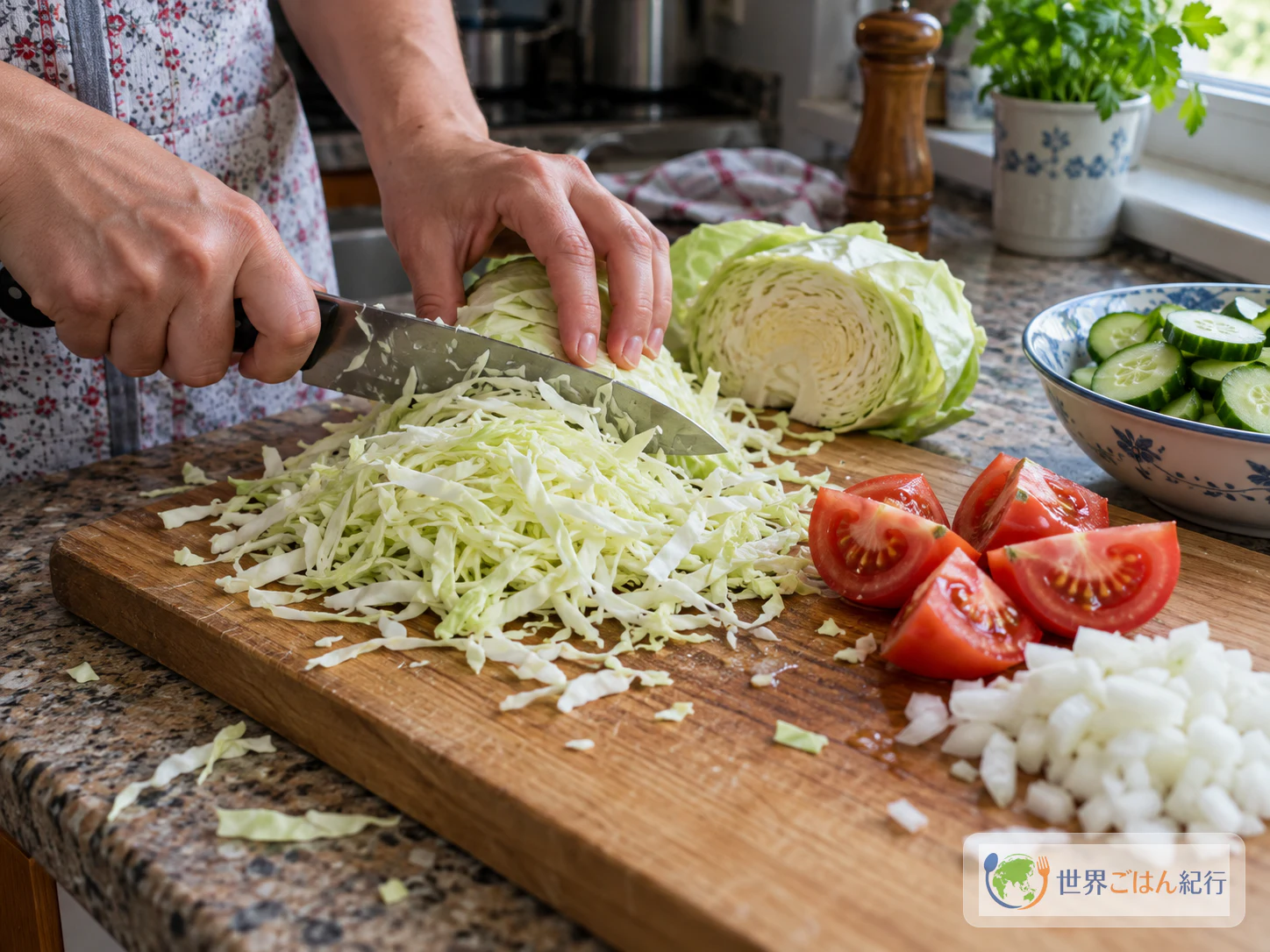
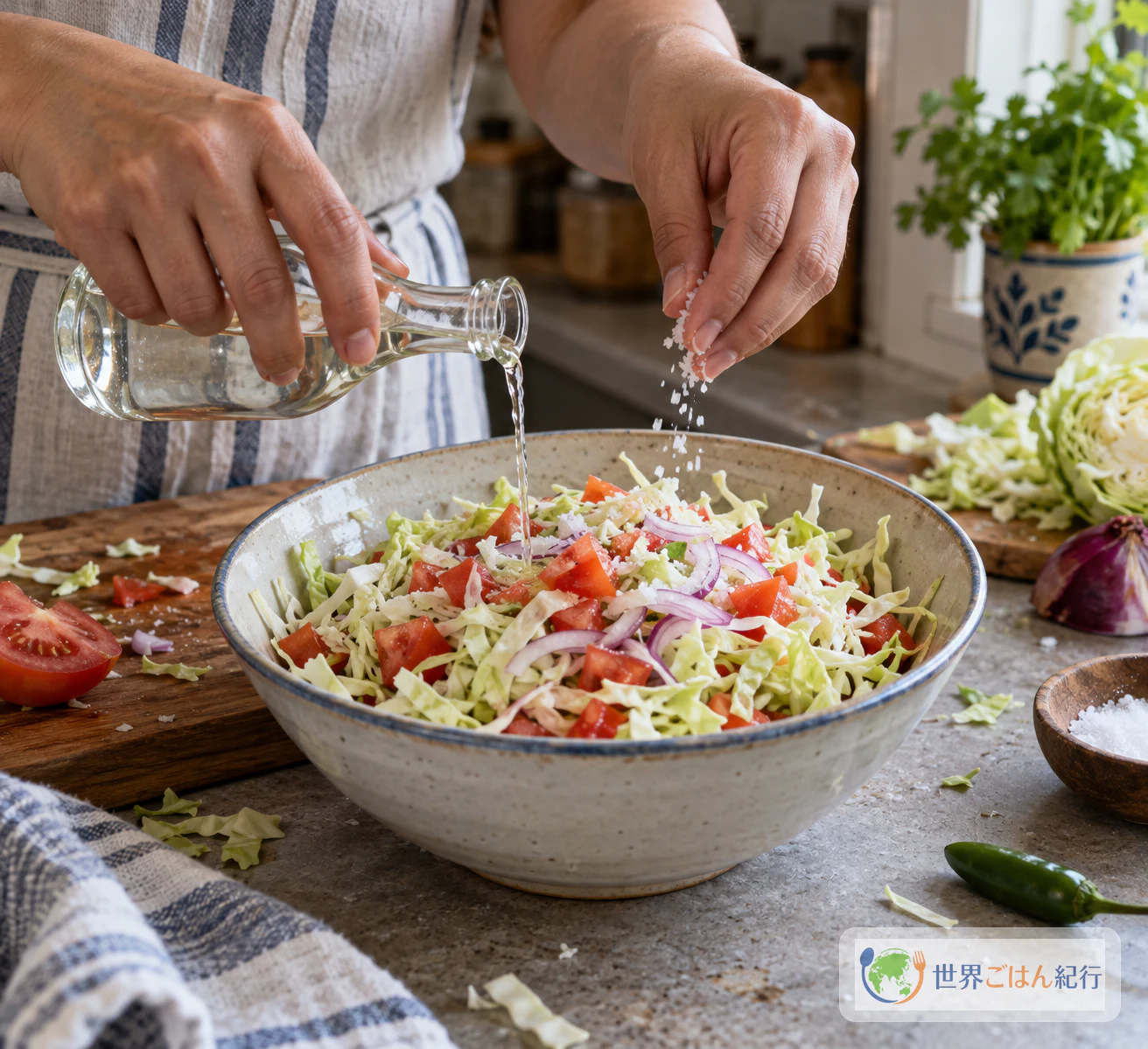
The order is: prep and boil the yuca, cut the vegetables, dress the salad, ready the chicharrón, then stack everything and serve straight away.
Never eat yuca raw or undercooked. Use yuca sold for eating, remove all of the thick peel, and don't eat peel or raw scraps. Cook until soft all the way to the center, and discard the cooking water; don't reuse it for anything else.
Fixing Problems on the Plate
| Problem | Likely cause | What to do |
|---|---|---|
| Yuca is hard in the center | Pieces of uneven size, or not cooked long enough | Keep cooking until a skewer passes through the thickest piece. Don't serve yuca that is soft outside but firm inside |
| Yuca falls apart | Overcooked or stirred in the pot | Lift it out as soon as the skewer passes through, and don't stir it while it boils |
| Salad is watery | Dressed too early with salt and vinegar | Dress it just before serving, and don't pour the bowl's liquid onto the plate |
| Chicharrón goes soft | Salad sat on it too long | Keep the chicharrón separate until assembly and serve as soon as the salad goes on |
| Base tastes different from yuca | Potato or another root used instead | Expect a different texture and flavor; treat it as a separate variation |
Variations That Change the Dish
Change the vinegar. Apple cider vinegar brings a fruity note; a plain white or grain vinegar is sharper and more direct. Adjust the amount of vinegar and taste before adding more salt.
Serve the chile on the side. Chiles vary in heat, so rather than mixing it all into the salad, set it out for each person to add.
Choose the chicharrón by how meaty it is. Skin-heavy pieces make a lighter, crunchier plate; pieces with meat attached make it more substantial. Both are different products you can buy, not exact matches for the local version.
Skip the banana leaf. Serve directly on a plate. You lose a little aroma and presentation, but the layers and flavors stay the same.
Use frozen yuca. Cook it according to its package directions and test it with a skewer the same way. Check for any remaining peel or hard, woody core before cooking.
Leftovers and Safety
Store the yuca, chicharrón and salad separately, and refrigerate them right away. The chicharrón loses its crispness in storage. When reheating, go by the condition of what you stored and any package directions for the chicharrón; don't reheat the vinegar salad. As in every step, yuca must be eaten fully cooked, with its peel removed and its cooking water discarded.
Frequently Asked Questions
Most questions come back to the base: if the yuca is soft to the center and the salad goes on at the last moment, the rest is easy to adjust.
Are Vigorón and Vigoron different dishes?
No evidence found suggests they are. The two spellings differ only in the accent mark.
Why are the amounts not given in grams?
The Maxi Palí recipe counts its ingredients (4 medium yuca, 1/2 head of garlic, 1 medium cabbage) and gives the chicharrón as 1/2 libra, without weights or sizes, so the amounts are kept as written rather than converted. That page's shopping list also shows 1 head of garlic and 1 medium onion; this recipe follows its ingredient list, which gives 1/2 head and 1/4 medium onion.
Can I use potatoes instead of yuca?
You can make a home variation that way, but the starch and flavor of the base change, so it is no longer the same dish.
Do I need a banana leaf?
No. The ASDENIC home recipe serves vigorón on a chagüite (banana leaf) as a traditional option, but a plate works fine.
Does it have to be spicy?
No. Maxi Palí lists chile as optional.
How long should the yuca boil?
There is no reliable fixed time; it depends on the size and freshness of the yuca, whether it is fresh or frozen, and your pot. Cook until a skewer slides through the thickest piece with no hard center.
Was vigorón really created in 1914?
The ASDENIC and Interteam recipe collection says María Luisa Lacayo, known as "Loquita," created it in 1914, but it does not point to an earlier record, and no independent confirmation was found.
Sources
- Maxi Palí Nicaragua (Walmart Nicaragua), "Vigorón." The six-serving ingredient list (1/2 libra chicharrón, 4 medium yuca, 1/2 head garlic, 1 medium cabbage, 4 tomatoes, 1/4 onion, 1/2 cucumber, vinegar to taste, optional chile, salt), boiling the yuca with garlic and salt until soft, the salad of cabbage, tomato, onion, vinegar, chile and salt, and the serving order of yuca, chicharrón, salad. Also the difference between its shopping list and ingredient list. https://www.maxipali.com.ni/ideas-mama-lucha-pali-y-maxi-pali-nicaragua/vigoron
- ASDENIC / Interteam, "Recetario Interteam 2022." The description of vigorón as a dish from Granada, a home recipe served on a chagüite (banana leaf) in the order yuca, charrasca, salad, mentions of eating it at different meals and sharing it with family and friends, and its account of María Luisa Lacayo ("Loquita") creating the dish in 1914. https://www.asdenic.org/wp-content/uploads/2023/01/recetario-Interteam-2022.pdf
- Mapa Nacional de Turismo de Nicaragua, "Municipio de Granada." The listing of Vigorón de Granada in the guide to Granada. https://www.mapanicaragua.com/municipio-de-granada/
- Food and Agriculture Organization of the United Nations (FAO), "Roots, tubers, plantains and bananas in human nutrition: Toxic substances and antinutritional factors." Cyanogenic glycosides in cassava, their variation by variety and concentration in the peel, as the basis for peeling, thorough cooking and discarding the cooking water. https://www.fao.org/4/t0207e/T0207E08.htm
- Buena Onda Mini Market, "Vigorón Nicaragüense." An independent recipe used to cross-check the structure of yuca, pork chicharrón, cabbage, tomato, vinegar, chile and banana leaf, and the description of hot yuca with cold salad eaten mixed by hand. https://buenaondaminimarket.com/recetas/vigoron-nicaraguense