
Pachamanca begins with the "earth pot"
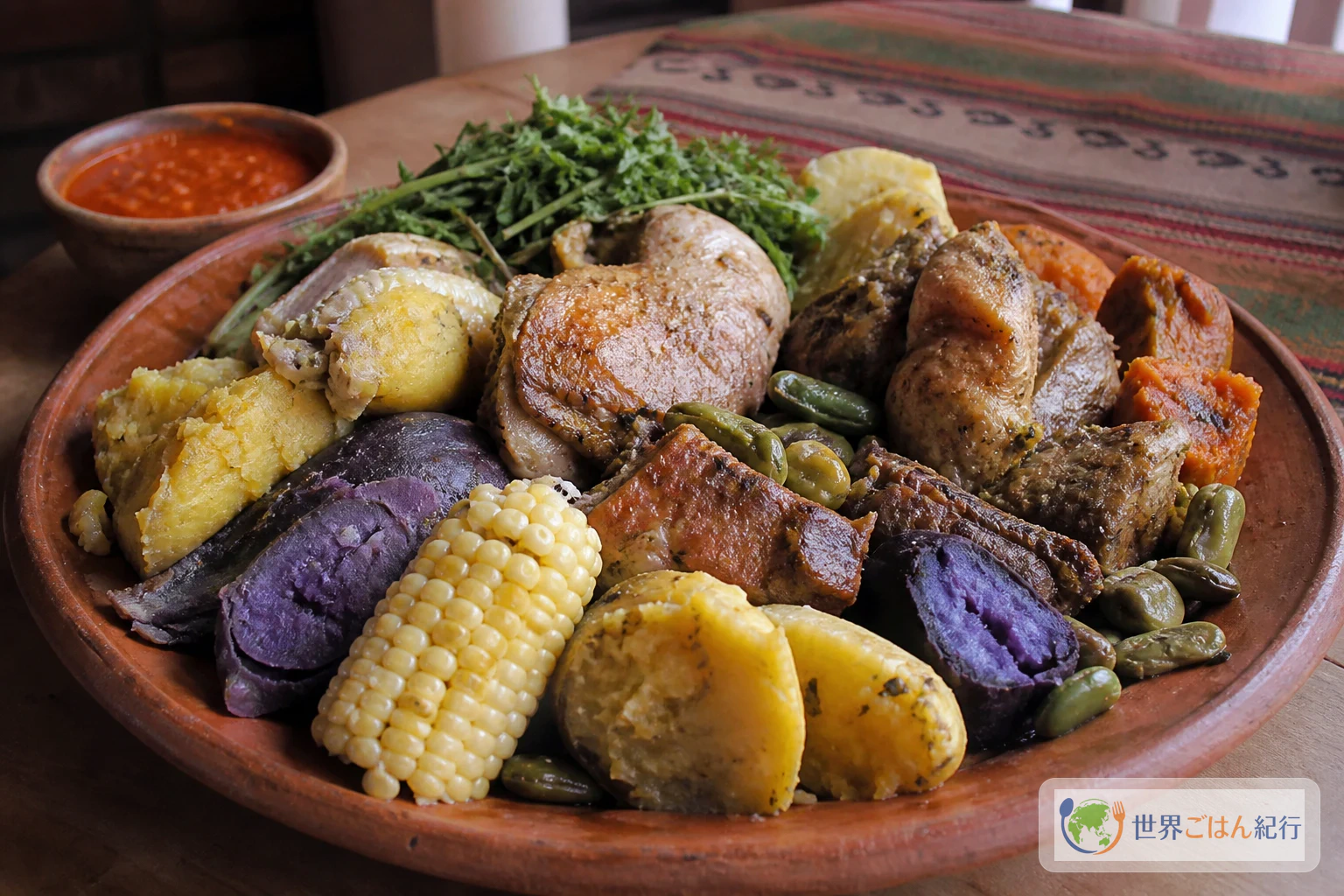
From the name alone, pachamanca may look like a plate of meat and potatoes piled together. What actually lies at its center is not the boldness of the ingredients but the order in which heat is stored in stones and the ingredients are layered and steam-roasted in the earth.
In Quechua, pacha means earth and manka means pot, and pachamanca is translated as "earth pot." Peru's government tourism information presents this cooking method as continuing since before the Inca and as a food culture that expresses Peruvian identity. In the Ministry of Culture's cultural heritage database, the procedure itself, cooking ingredients in a hole in the ground lined with heated stones, is recorded as cultural heritage by RDN 471/INC-2003 of 8 July 2003.
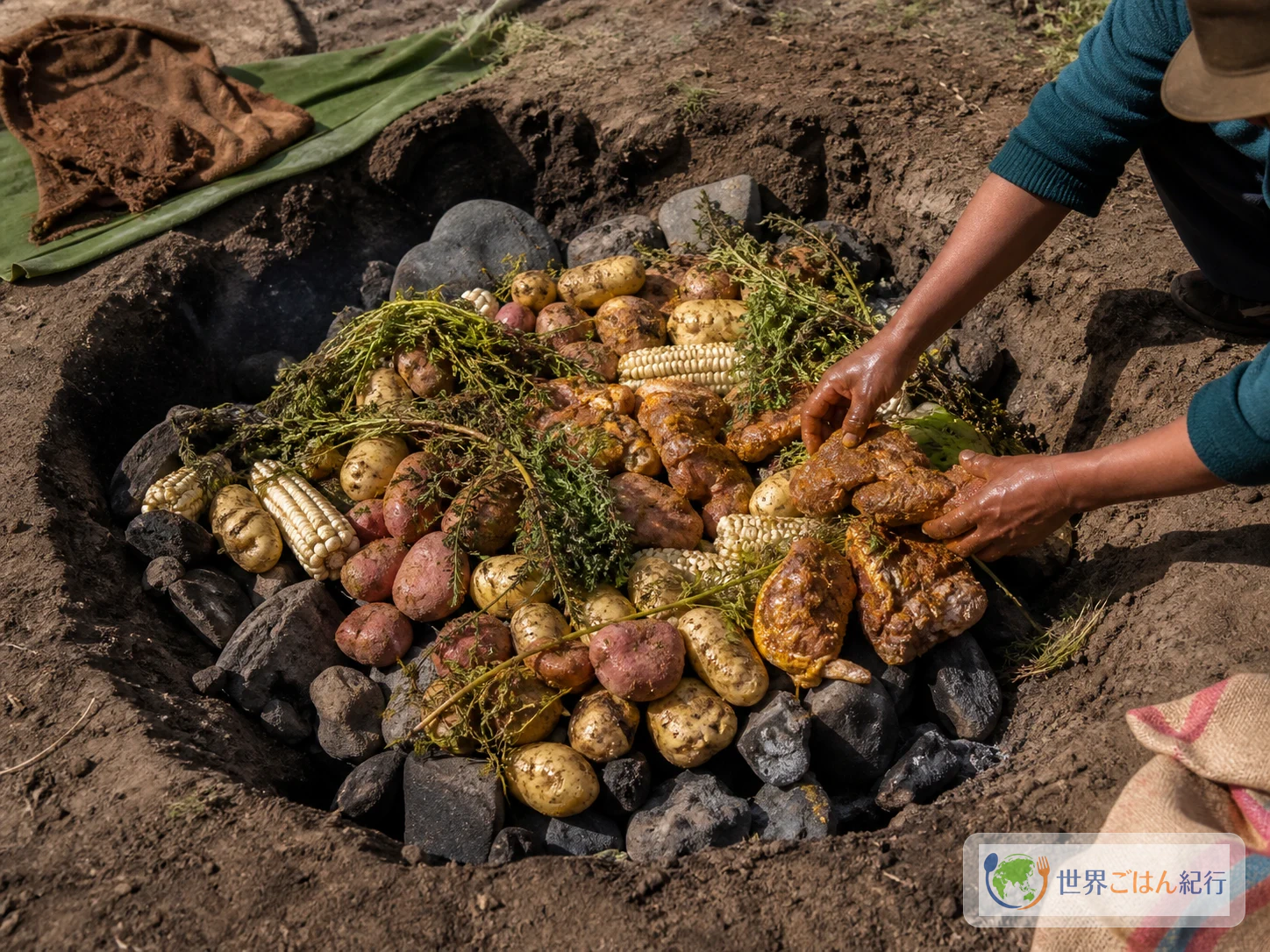
Peru's government tourism information and Ministry of Agriculture and Irrigation material say that cooking with heated stones was practiced around the Andean site of Telarmachay 7,000 to 8,000 years ago. Rather than competing on how old the number is, this is a dish in which to look at how the wisdom of putting not only meat but potatoes, sweet potatoes, corn, fava beans and local herbs into the fire together connects farming and the table.
On site, the meal begins with digging the hole and heating the stones. Some people marinate the meat, some add firewood, some wash the potatoes and corn, and after the lid is on, they prepare the big platter while waiting for it to cook. Pachamanca becomes the center of festivals and gatherings because the time until the dish is done is part of the meal. In 2015, the first Sunday of every February was designated as "Pachamanca Day."
In a home kitchen there is no need to recreate the earth pit. What a home version should keep is the herb sauce, the layers of ingredients, a lid that keeps steam in, and checking that the meat is cooked to the center. The aroma of earth and firewood will be fainter, but you can still create the flow in which, when you open the pot, the meat juices have circulated to the potatoes and the sweetness of the corn meets the green of the herbs.
Looking at the overview of Peruvian cuisine, you can see that coastal seafood, Andean potatoes and tropical ingredients from the east live together in one country. Pachamanca is the dish that gathers the mountain ingredients and communal cooking onto one plate.
The version made in a home oven is not the same cooking experience as the earth-pit original. Rather than trying to raise fidelity by adding soil or firewood, sealing in steam and matching the texture of herbs and potatoes is less likely to fail at home.
The differences in meat and herbs show the terrain and ingredients of each region
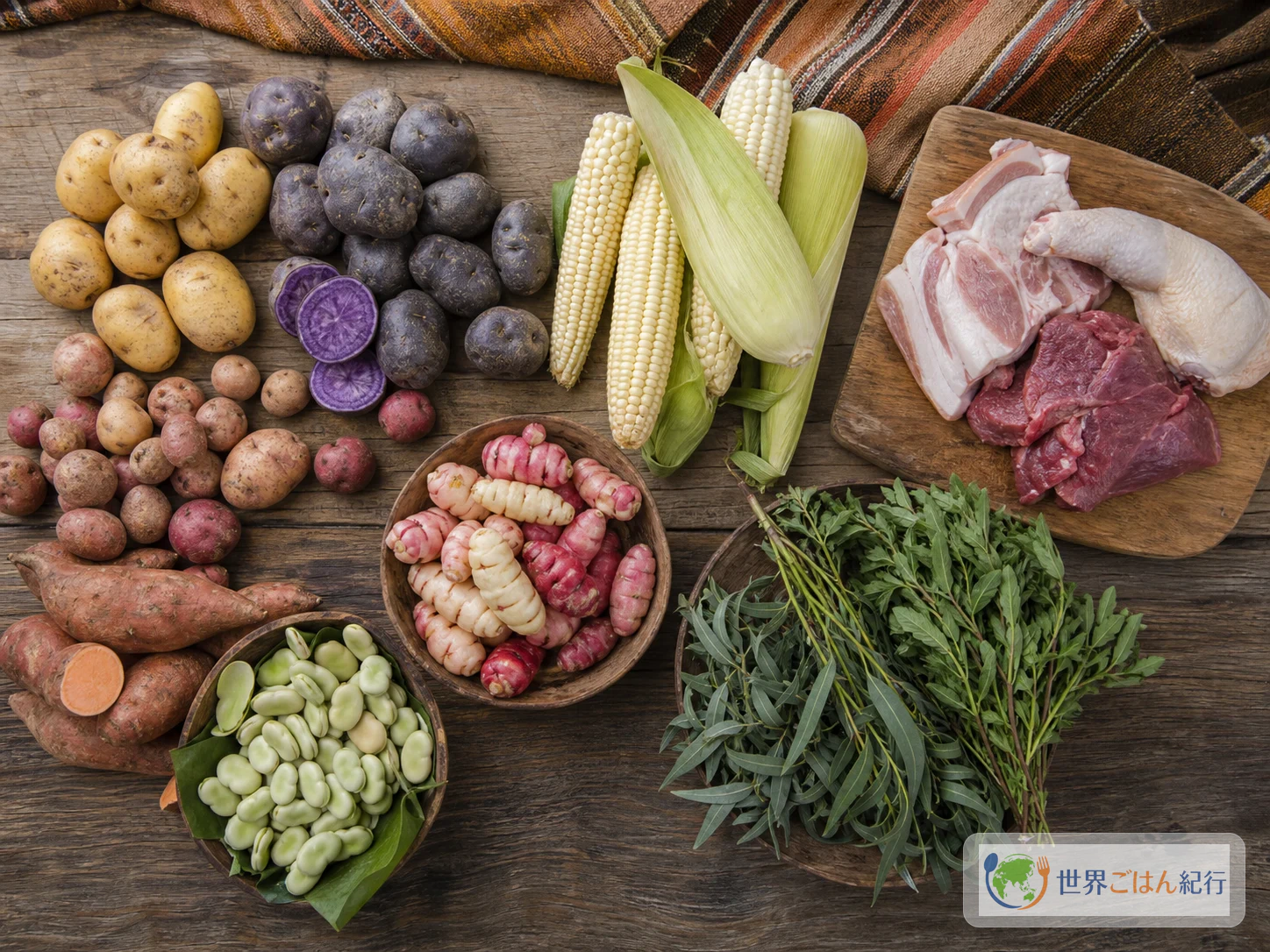
It is hard to put down a single "this is the right one" ingredient list for pachamanca because the altitude and crops of the Andes differ by region. Looking at the regional differences presented by Peru's government tourism information, even with the same dish name, which meat is central, which herbs are used and what is served alongside all change.
| Region | Meat and ingredient tendencies | Examples of seasoning and accompaniments |
|---|---|---|
| Junín | Guinea pig, alpaca, pork, lamb, beef. Potatoes, beans, corn, oca, sweet potatoes | Red chili, paico, achiote, chincho. Sweet and salted humita, and cheese alongside |
| Cusco | Pork and lamb. Potatoes, corn, humita | Salt, huacatay, chincho |
| Ayacucho | Beef, pork, chicken. Potatoes, beans, sweet potatoes | Garlic, cumin, yellow chili, chincho, chicha de jora |
| Huánuco | Pork, sweet potatoes, yuca, potatoes | Chincho, and a sauce of hot chili and onion |
The proportions here lean toward the Ayacucho direction: beef, pork and chicken together, with yellow chili in the herb sauce. If you can get huacatay and chincho, you come closer to the local green aroma, but they are often not found even at import grocers. Huacatay has a mint-like greenness with a slightly dark bitterness, so combining fresh mint and cilantro lets you substitute while keeping the outline of the dish.
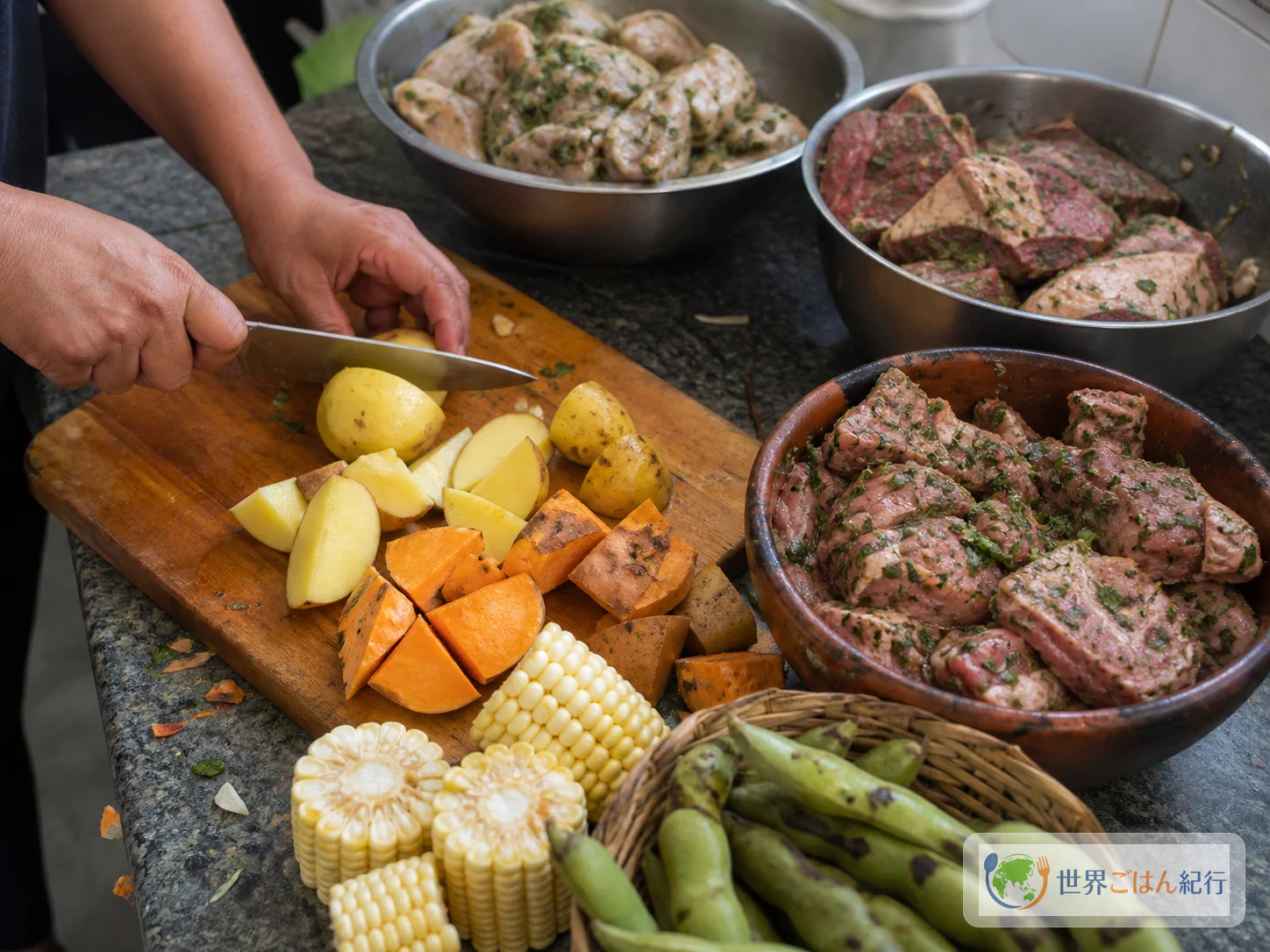
In some regions the fava beans are cooked in the pod, the corn in rounds and the potatoes with skin on. Preparation here favors ease of eating, but if you cut the potatoes too small they break down before the meat is done, so keep them about 4 cm. The idea is not to replace local varieties exactly but to match them in a shape that cooks in a similar way.
The Ministry of Agriculture and Irrigation explains that pachamanca is a dish that uses the diversity of regional crops, herbs and livestock, and also a food culture that supports family farming and rural production. Adding more ingredients does not make it more local. The mechanism of bringing what grows nearby and cooking it in one pit is the foundation of the regional differences.
At home, replace the earth with a seal
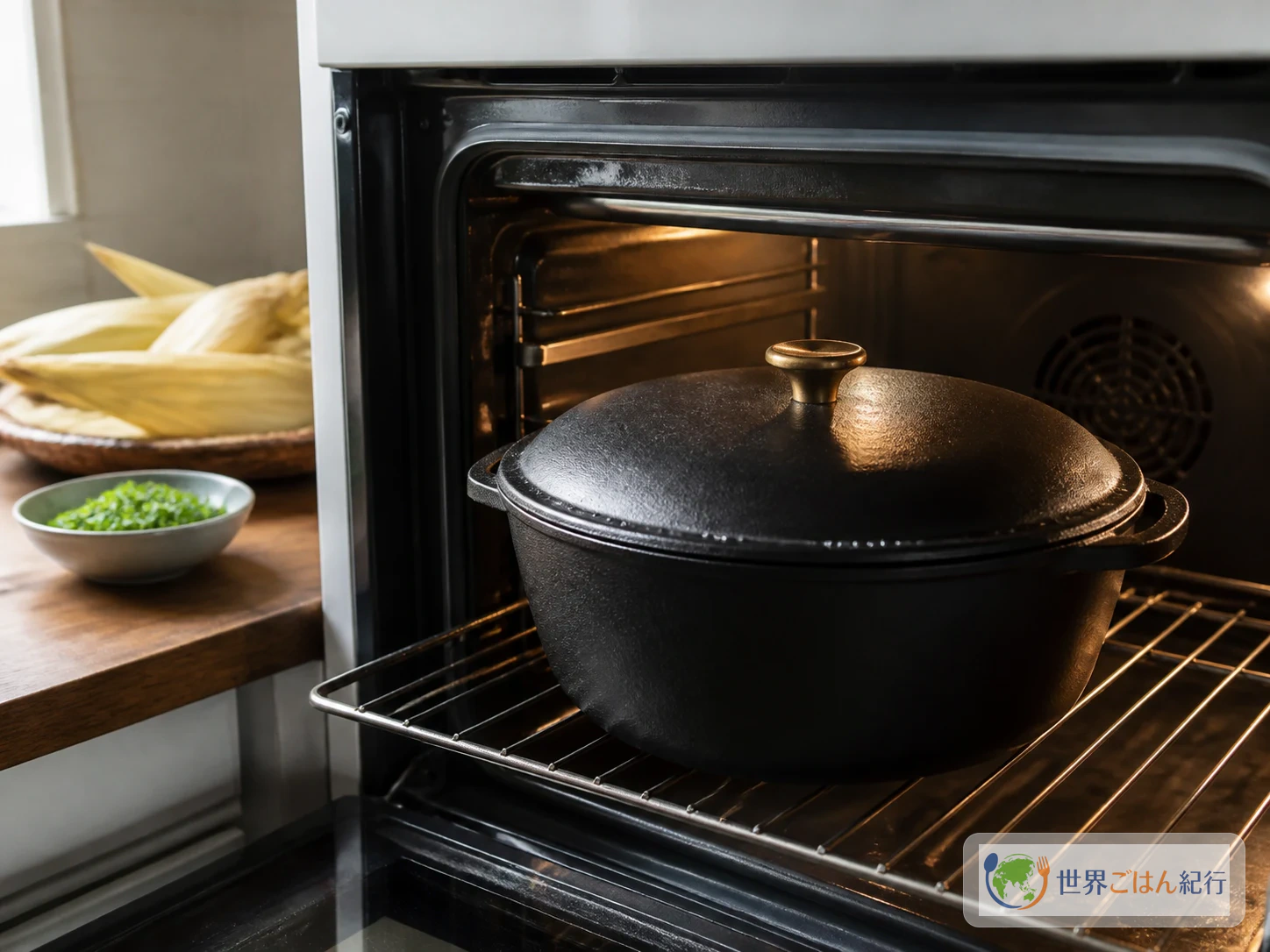
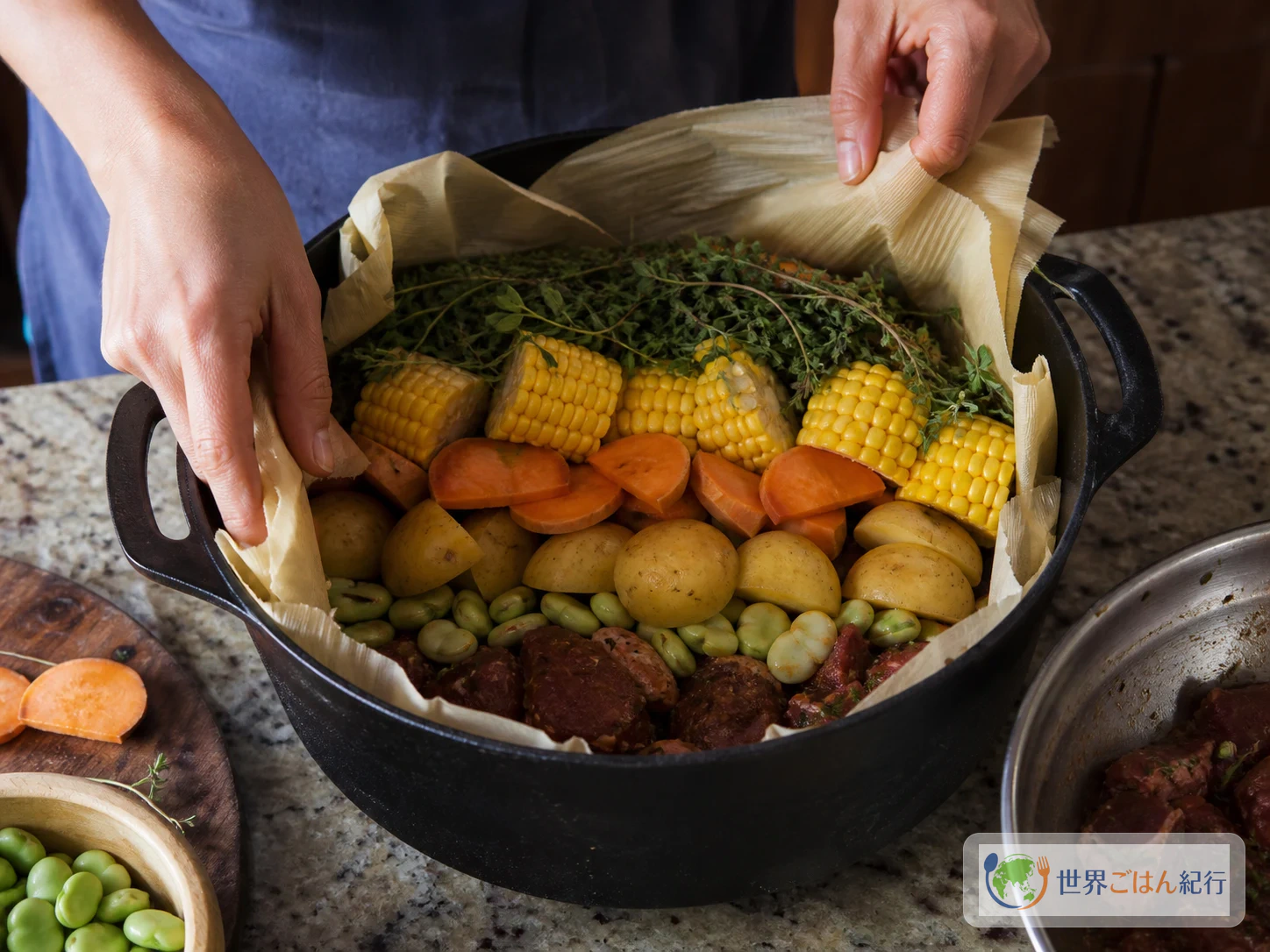
The earth-pit pachamanca covers the ingredients with heated stones, leaves and earth, in that order, and cooks slowly without letting heat escape. English-language cooking sources also separate the traditional method using stones from home methods heating a lidded pot on the stove. SBS Food's recipe puts water in the bottom of the pot, layers chicken, sweet potatoes, potatoes and corn in that order, covers them with corn husks or parchment, and cooks over low heat.
Here we adopt putting a lidded cast-iron pot into a 180°C oven. Rather than adding a lot of water to stew it, the design puts a little water on the bottom of the pot to make steam and return the juices from the ingredients on the inside of the lid. The aroma of earth and the radiant heat of stones cannot be reproduced, but it lands where the meat is less likely to dry out and the potatoes take up the herb sauce.
A heavy pot suits people who will cook dishes with the lid kept closed for a long time many times. If you try it only once a year, an oven-safe lidded pot or a deep baking dish is fine. If you use a pot you already have, check that it is oven-safe to 180°C, that the lid does not lift, and that it can be filled to about seven-tenths for four servings. If you find a heavy pot hard to lift every day, it is more realistic not to force a purchase and to choose a baking dish that is easy to handle.
Do not adopt the step of putting stones from a riverbed or garden into the pot and heating them in a home oven. In a kitchen you cannot judge the type of stone or the water it holds. Bring out the pachamanca character through the herbs, layers, seal and combination of ingredients.
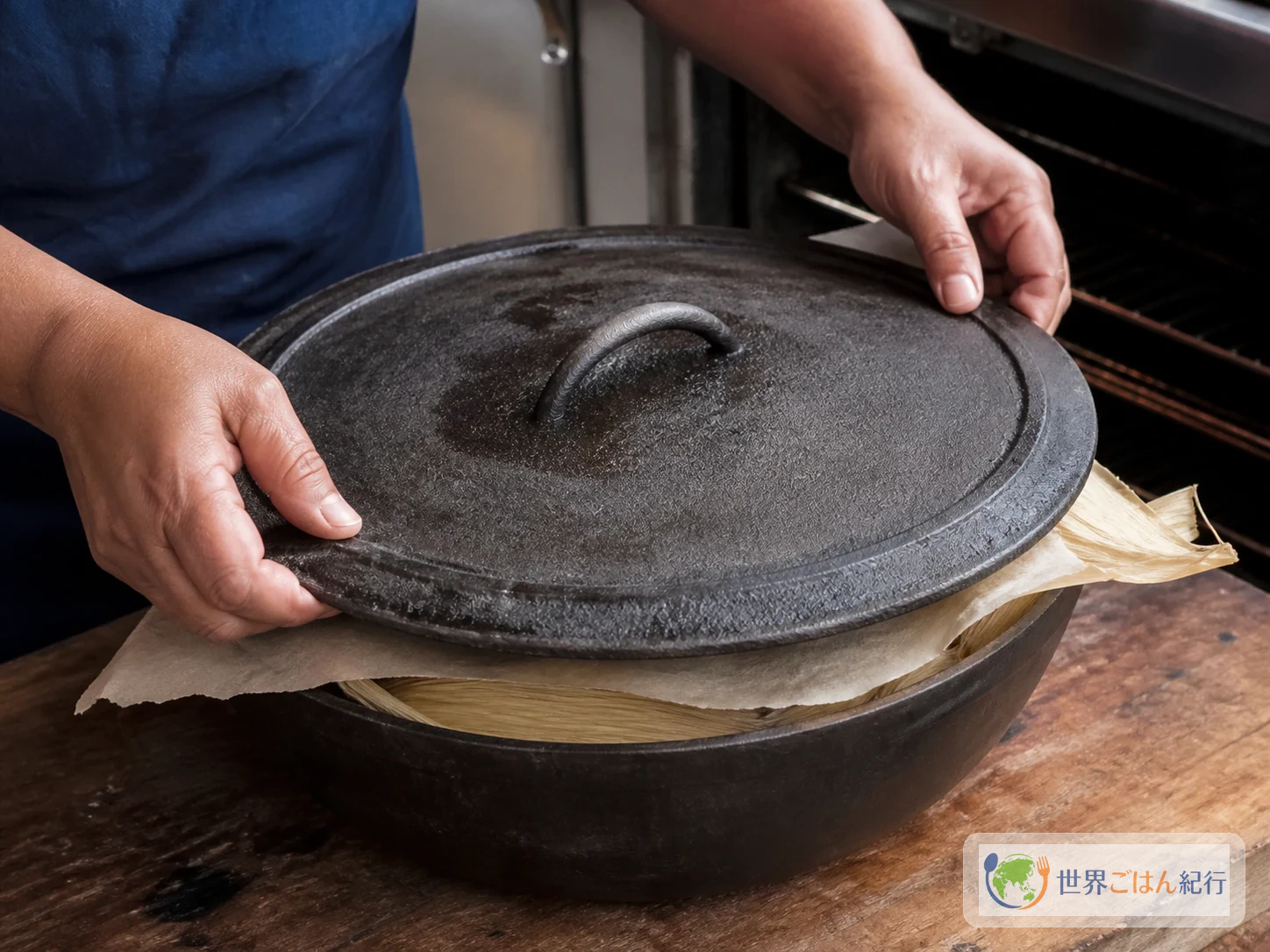
If making it in an ordinary baking dish, put in the ingredients, use parchment as a drop lid, and cover that with aluminum foil and the dish's lid. If the lid lifts, moisture escapes, so run the paper along the inside of the pot and press the foil down to the rim. Do not open it right after taking it out of the oven; leave it 10 minutes to let the meat juices and steam settle, and the potatoes are less likely to break when you move them to plates.
Ingredients (serves 4)
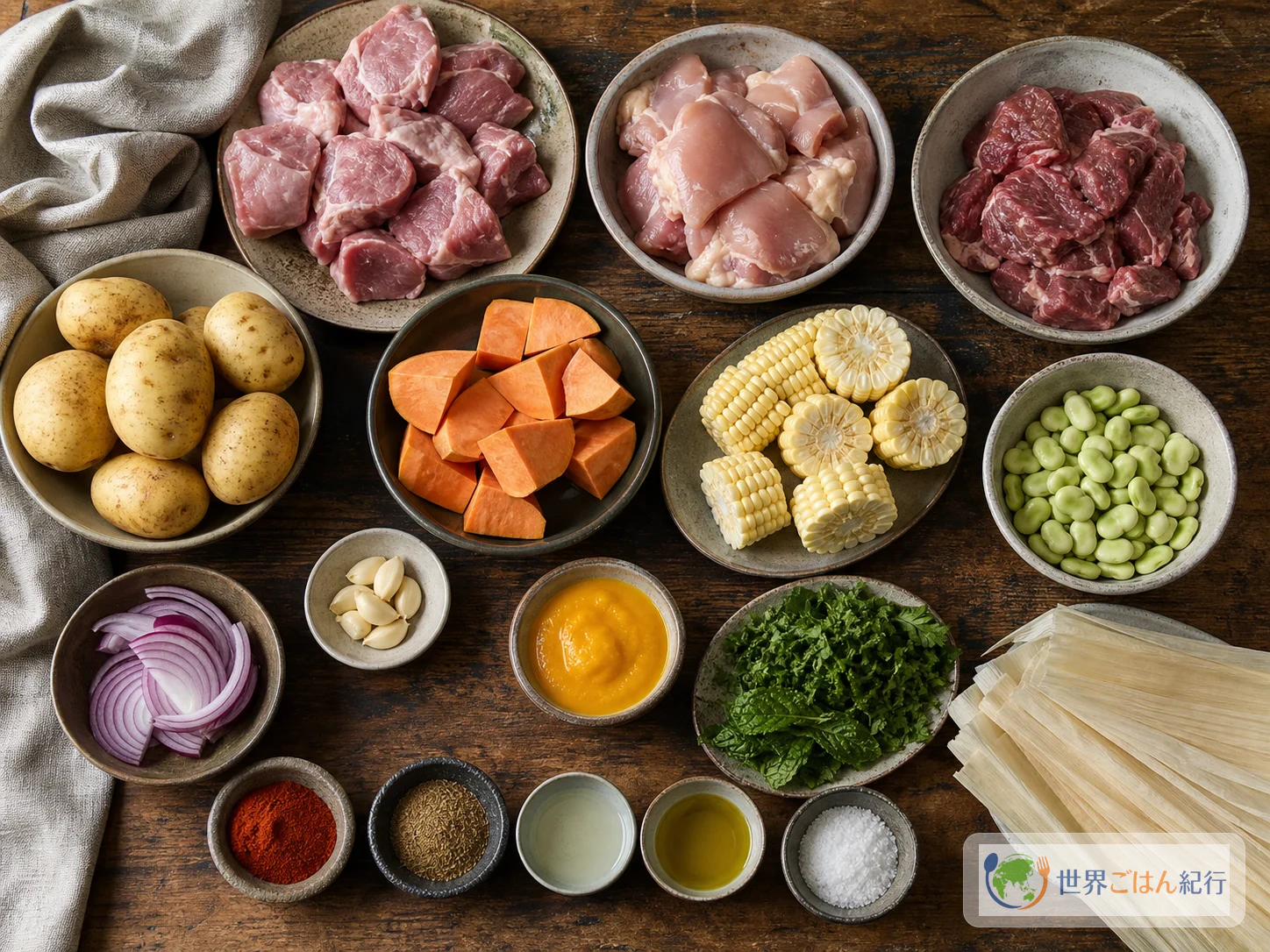
With three kinds of meat you get the range of a local festive dish, but if you would rather not buy more, two kinds, 300 g pork and 300 g chicken, are fine. Replacing the beef with 200 g lamb moves it toward Junín and Cusco. Cut all of it into 4 cm cubes to match the way it cooks.
If there is no fresh huacatay, make it with 30 g mint and 20 g cilantro. With mint alone the cooling note comes forward, so mix in cilantro to make up the green bitterness. Adding a lot of dried mint flattens the aroma, so if fresh herbs are difficult, still keep a little cilantro.
Yellow chili is worth buying once because, beyond heat, its fruit-like aroma links the herbs and the fat of the meat. If you use only the 30 g of this recipe, ordinary chili or yellow bell pepper can stand in and the dish still holds. If you choose a product, check the contents and ingredient label, look at the strength of the heat, and start with 30 g.
Allergies and hygiene
This recipe contains meat, cilantro and fava beans. Some people with legume allergies avoid fava beans, and some people react to plants of the parsley family, which includes cilantro. The formulation of salt, acidulants and preservatives in aji amarillo paste differs by product, so check the label before deciding how much to use. Keep the cutting board for raw meat separate from the plates you serve vegetables on.
Method: steam-roast without breaking the layers
Put all the ingredients in the pot at once and the flavor of the meat comes out, but the potatoes break down and the center of the chicken lags. In the home version of pachamanca, matching the size of the meat, layering from the bottom of the pot up and opening the lid fewer times decide the result.
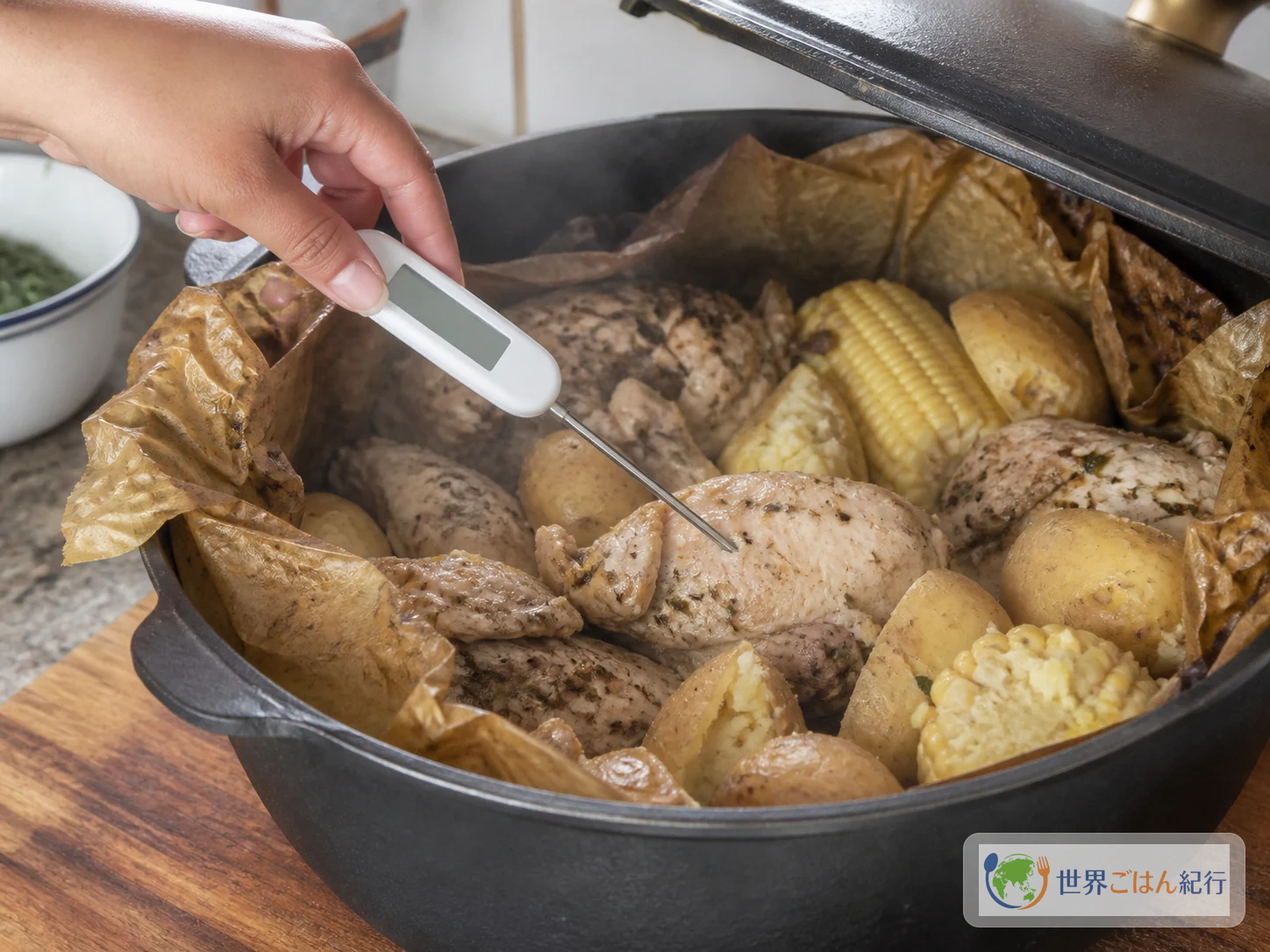
Public food safety information gives the standard of 74°C for chicken and 63°C with a 3-minute rest for cuts of meat. Because this is a pot dish that includes chicken, however, at home the decision is aligned to heating the whole to 74°C. Using a thermometer saves you from deciding doneness by the color of the surface alone.
Tips for keeping the heat and the herbs right
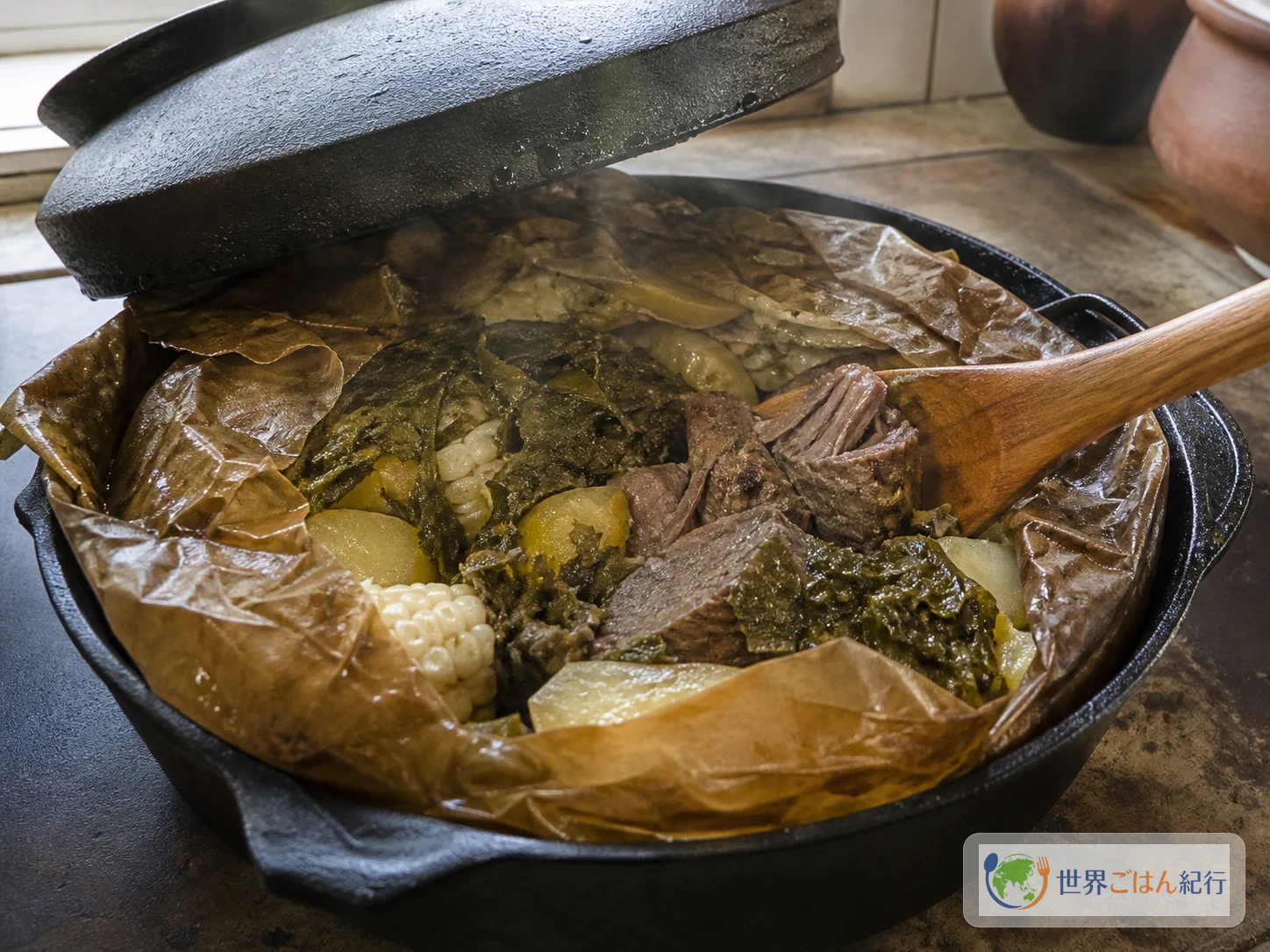
Keep the sauce thick enough to stay on the meat
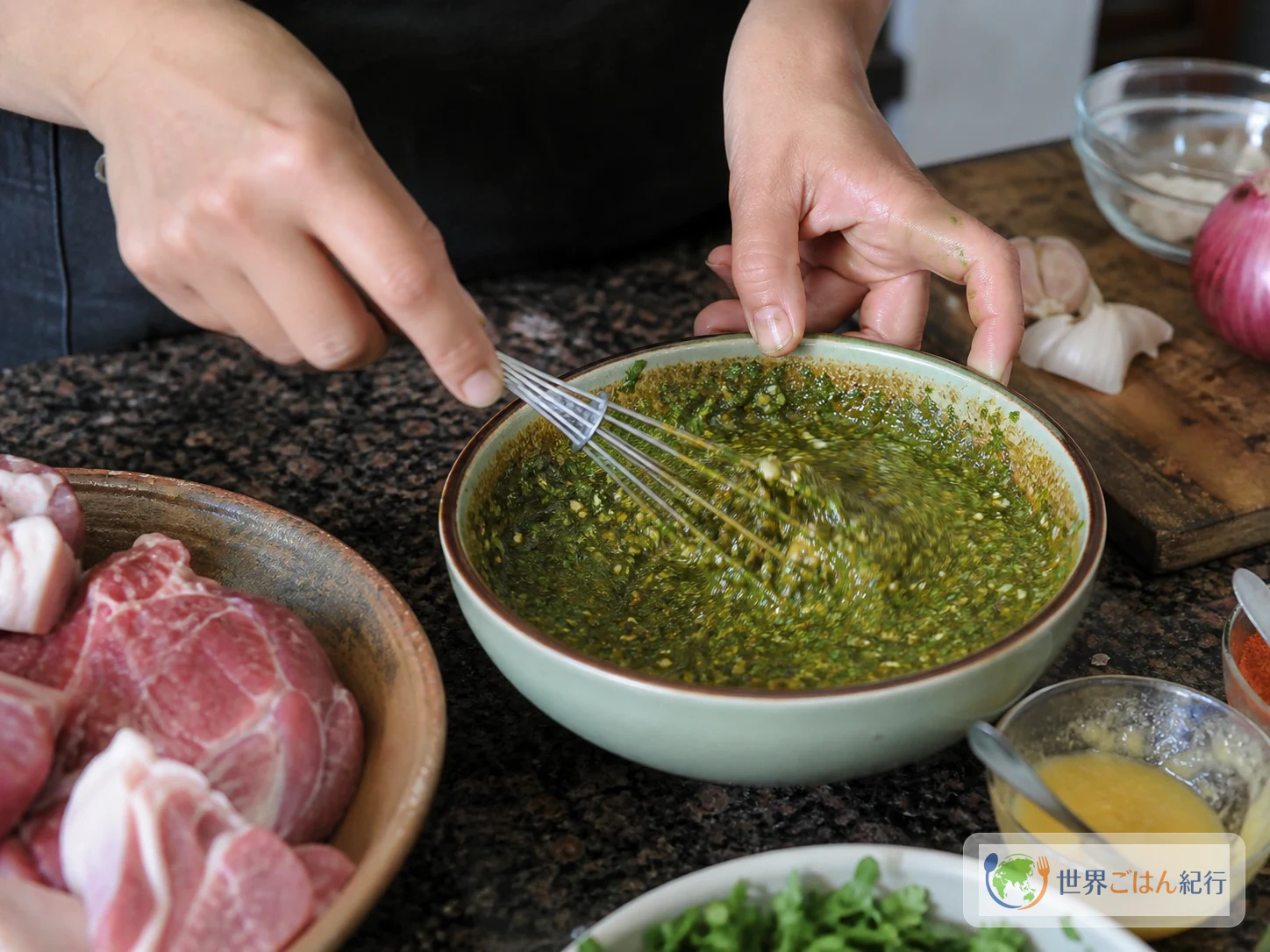
If you thin the herb sauce too much with water, liquid collects on the bottom of the pot and the meat stews before it roasts. Make it thick enough that the chopped herbs and paste cling to the meat, and put the 100 ml water only on the bottom of the pot. If the sauce runs, take the meat out for now, wipe the surface water, add a little more herb and return it.
If you make the herb sauce by knife, the chopped widths of mint, cilantro, onion and garlic may not match, and it can be hard to adjust the thickness that stays on the surface of the meat. If you will make herb sauces and pastes many times, a small food processor that chops small amounts evenly gives a reason to choose it. Check the capacity, blade structure and attached bowl. For just this one pot a knife is enough, so if you do not want to add storage space and washing, you can make it without buying one.
Do not take it out by the time of 100 minutes alone; look together at 74°C at the center of the chicken, a skewer going into the potatoes, and the aroma of herbs and meat juices rising when the lid is opened. If the pot was cold, the meat large, or the ingredients packed in, extra cooking is needed.
Do not pack the layers too full
If you push ingredients into the pot to the brim, the potatoes on top are soft but only the meat on the bottom lacks steam. Stop at seven-tenths, and divide the remaining ingredients into a baking dish and bake them with the same sauce. Dividing into another container is not a failure that thins the flavor; it is an action that makes room for heat to circulate in the pot.
Open it fewer times
In a home oven, every time you open the lid partway, steam and heat escape. This is not a dish for looking at the browning. Do not touch it until 90 minutes, and check once after 100 minutes with the thermometer and a skewer. If it is dry, add 50 ml boiling water from the edge of the pot, put the lid back and heat 10 minutes.
Do not mix cutting sizes of the meat
Cut only the chicken small and the juices run out and the surface turns hard. Use 4 cm as the standard for pork and beef too, and for bone-in meat or large pieces, treat it as a different recipe and extend the cooking time. When using lamb, do not slice thinly the sinewy parts of the shoulder; coat them well with the sauce and cook slowly.
Moving regional ways of eating to a home table
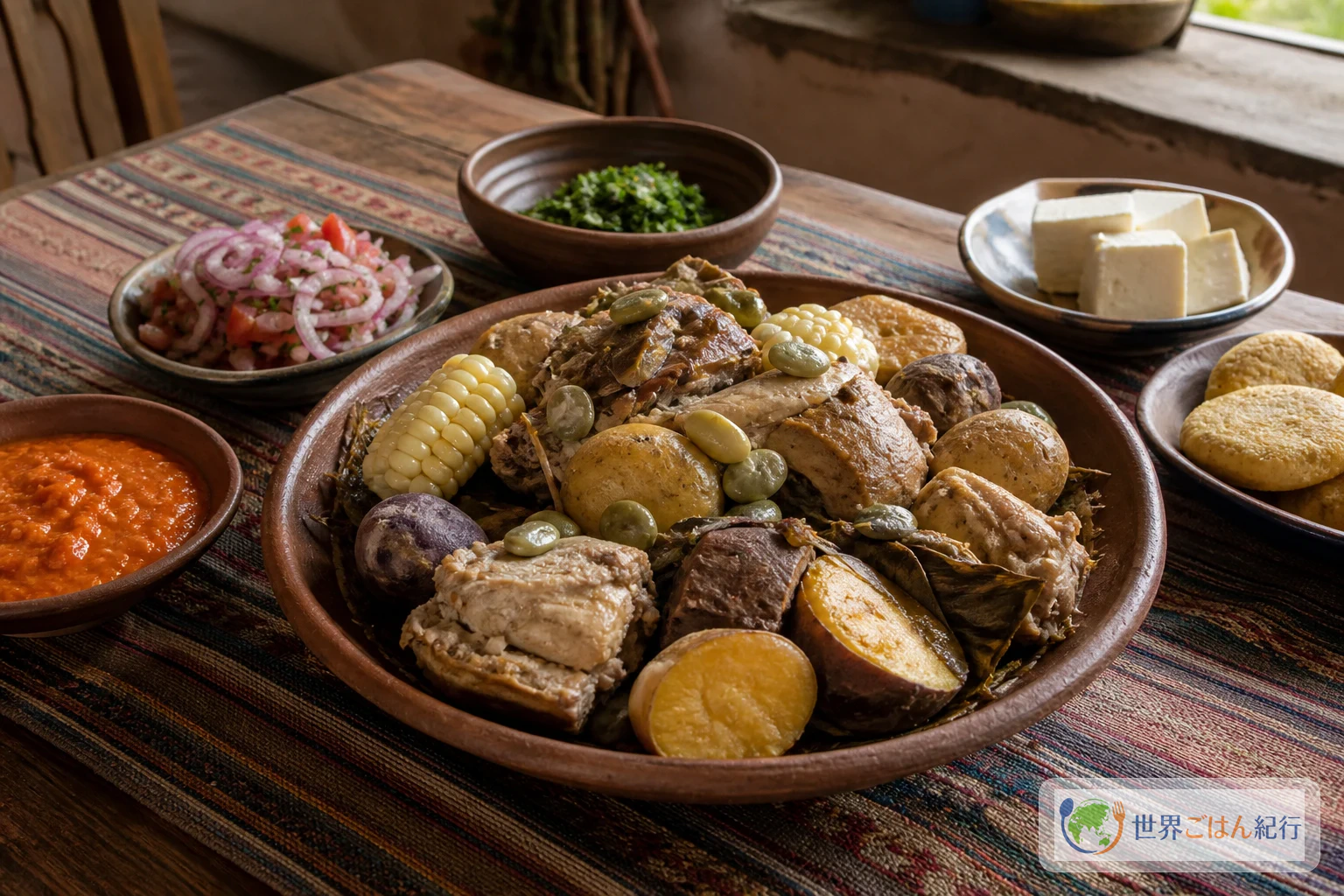
Pachamanca is not a dish with only meat at the center of the plate. Potatoes, sweet potatoes, corn and beans are portioned out together with the meat juices and herb sauce, and the eater adds heat or sourness. In the Ayacucho example introduced by Peru's government tourism information, humita, a cheese sauce, and a hot sauce of rocoto and huacatay are the accompaniments.
At home you can choose the regional direction like this.
- Use lamb and small potatoes: replace the beef with lamb shoulder and use two kinds of potatoes, and the composition comes closer to the mountain tables of Cusco and Junín. If the aroma of the lamb is strong, increase the mint a little.
- Add yuca: to lean toward Huánuco, replace half the sweet potatoes with frozen yuca. Large pieces tend to stay raw at the center, so thaw and cut to 4 cm.
- Serve the aji on the side: to give a range of heat, reduce the aji in the sauce to 20 g and put the rest in a small dish. People who dislike heat can still eat the taste of the herbs and meat.
- Lean the herb sauce toward green: when you can get huacatay, replace half the mint. Too much cilantro turns grassy, so cap it at 20 g.
- Make a festival day with the accompaniments: put humita, cheese and an onion and tomato salsa criolla on separate plates. Sourness enters the rich meat and the taste changes within the plate.
If you want to know more about yellow sauce as an accompaniment, the Peruvian papa a la huancaína is a useful reference. It is a different dish from chupe de camarones, which layers seafood and dairy, but the idea of putting potatoes and heat at the side of the table is shared.
Storage and common questions
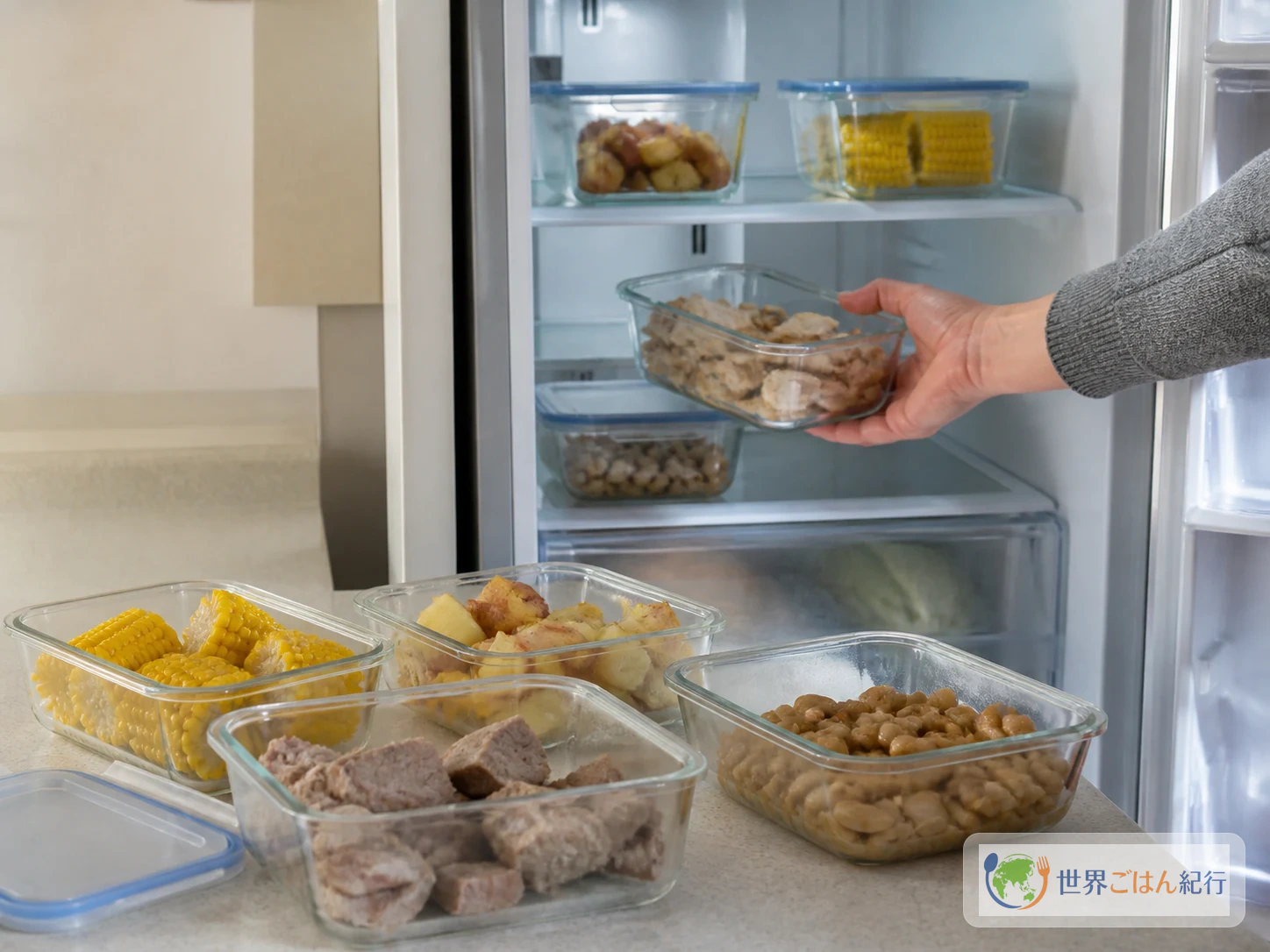
Putting the whole pot in the refrigerator slows cooling at the center, so divide leftover meat and vegetables into shallow containers. Once cooled slightly, cover and refrigerate, and plan to finish within the next day. Reheat in a pot or the microwave until hot to the center, and check the 74°C given by food safety information. Storing the meat and potatoes separately keeps the potatoes from absorbing too much of the juices and makes the next day's texture easier to adjust.
Is it not pachamanca unless it is buried in the earth?
It will not have the same aroma as the original earth-pit cooking, but at home there is a way to reproduce pachamanca's layers and herb sauce in a pot. SBS Food also explains the earth-pit technique and then carries a home recipe using a lidded pot. What matters is not borrowing the name for a different stew but keeping how the heat is sealed in and how the ingredients are layered.
Does the flavor change without huacatay or chincho?
It does. Huacatay has a distinctive bitterness in its green aroma, and chincho is also used as a local herb. But just because you cannot reproduce the full aroma elsewhere, leaving out the herbs removes the axis of the dish. Combining mint and cilantro and using a little yellow chili makes a greenness that meets the fat of the meat.
Can I use only two kinds of meat?
You can make it with pork and chicken, or pork and lamb. Three kinds give variety at the table, but it matters more to keep the total meat at 800 g and match the cutting and cooking. If you leave out the chicken, do not treat the beef and pork as single-piece roasts; check the temperature to the center and then rest.
How do I fix it if the ingredients are hard or too wet?
If hard, add 50 ml boiling water from the edge of the pot, put the lid back, and heat at 180°C for 10–15 minutes. If too wet, move the meat and potatoes to a plate without breaking them, simmer only the sauce in the pot without the lid for 5 minutes, and return them. Adjusting by adding more water from the start thins the flavor of the herb sauce too.
Can it be frozen?
The cooked meat can be frozen, but potatoes and fava beans tend to turn watery after thawing, so if texture comes first, eat the refrigerated portion first. To freeze, divide into thin single servings and thaw only what you will reheat. Do not eat it cold; heat it thoroughly to the center.
Sources
- Pachamanca: An Ancient Feast of Flavors and Tradition (PROMPERÚ) (accessed and checked: 2026-08-12)
- Día de la Pachamanca impulsa la biodiversidad y el desarrollo de la agricultura familiar (Peru Ministry of Agriculture and Irrigation) (accessed and checked: 2026-08-12)
- Declaratorias del Patrimonio Cultural de la Nación (Peru Ministry of Culture) (accessed and checked: 2026-08-12)
- Chicken and potato pachamanca (SBS Food / Virgilio Martinez) (accessed and checked: 2026-08-12)
- Pachamanca (Peruvian Pot) (accessed and checked: 2026-08-12)
- Pachamanca a la olla (Oster Perú) (accessed and checked: 2026-08-12)
- Cook to a Safe Minimum Internal Temperature (FoodSafety.gov) (accessed and checked: 2026-08-12)


