
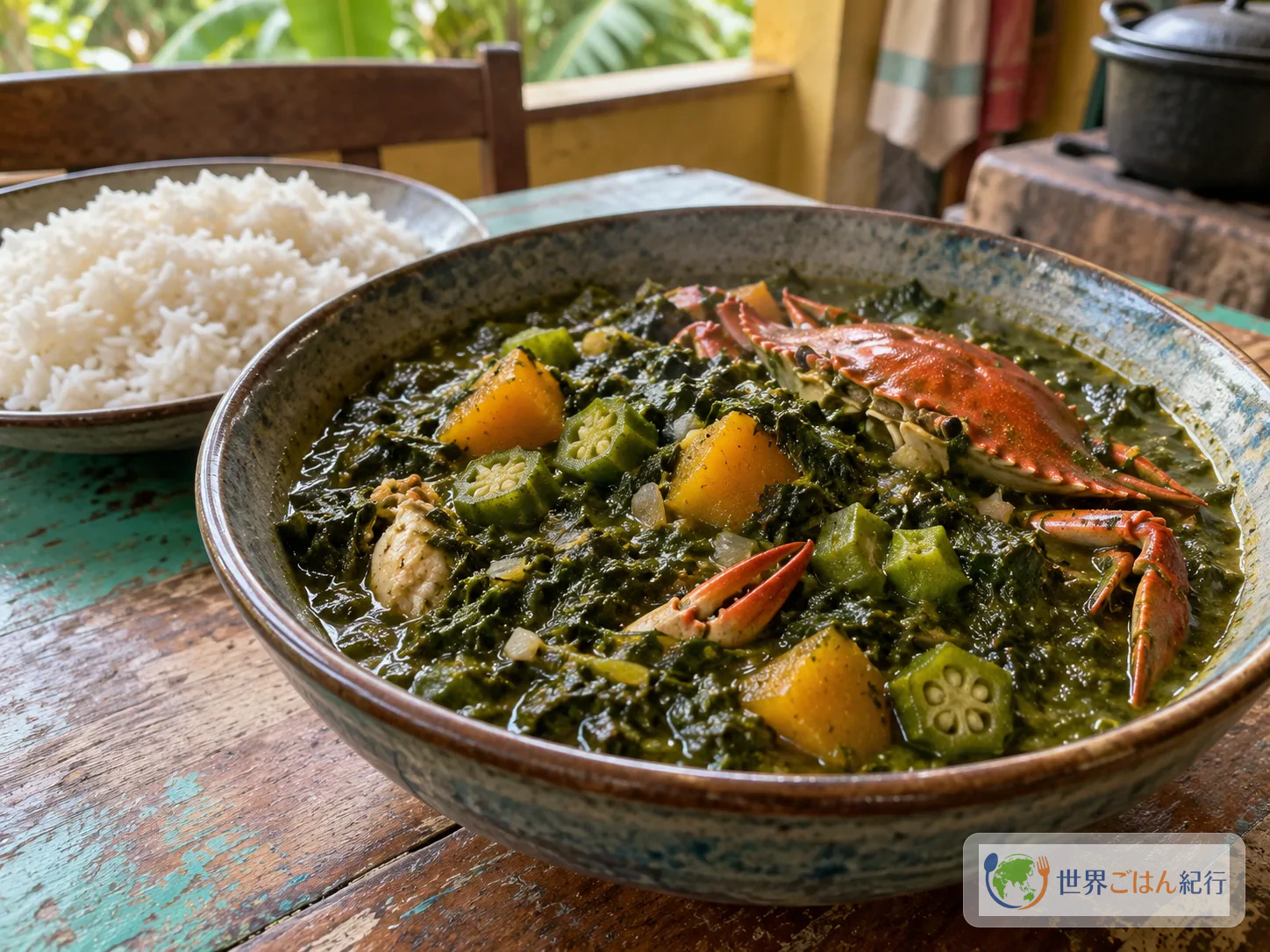
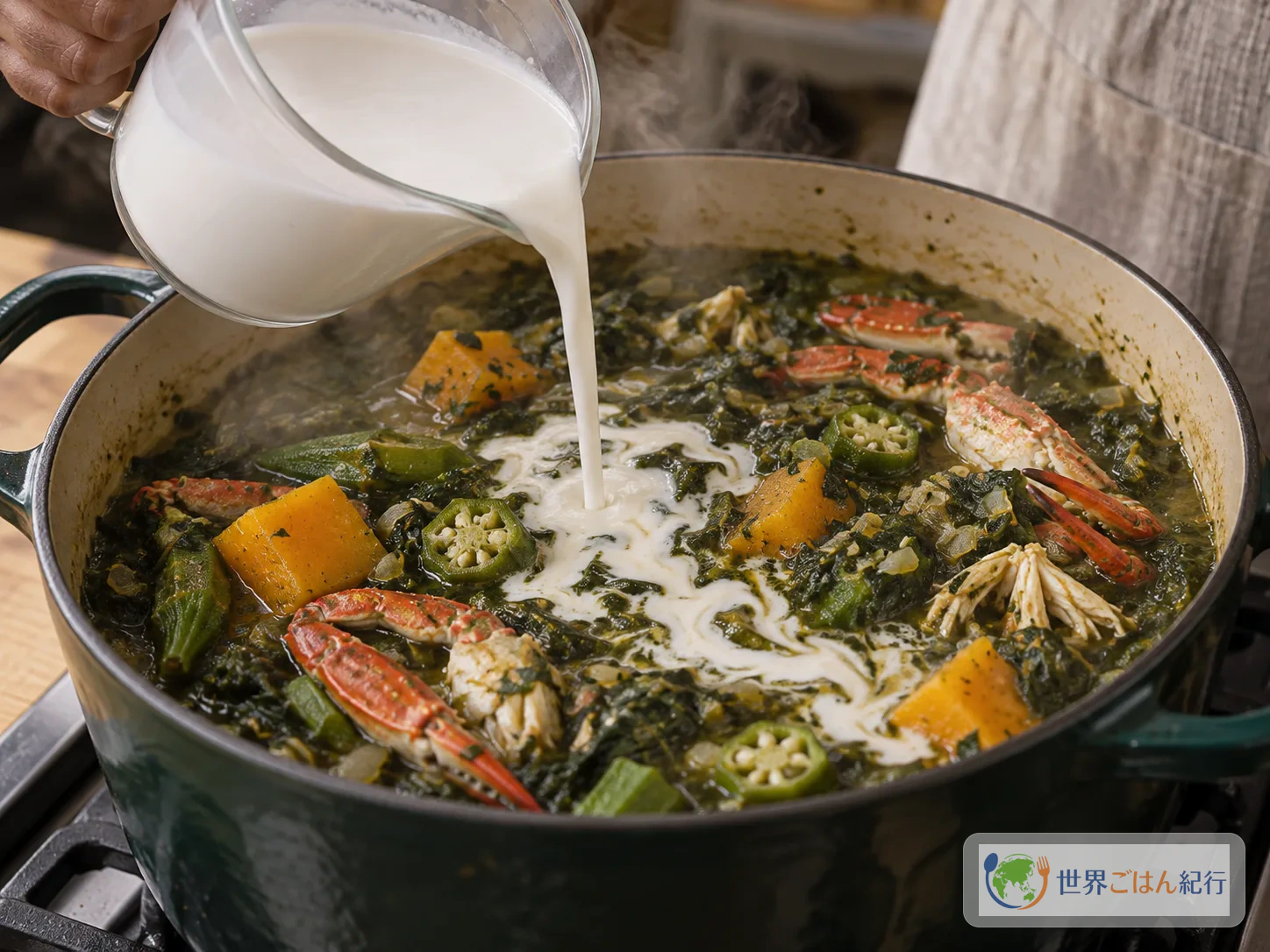
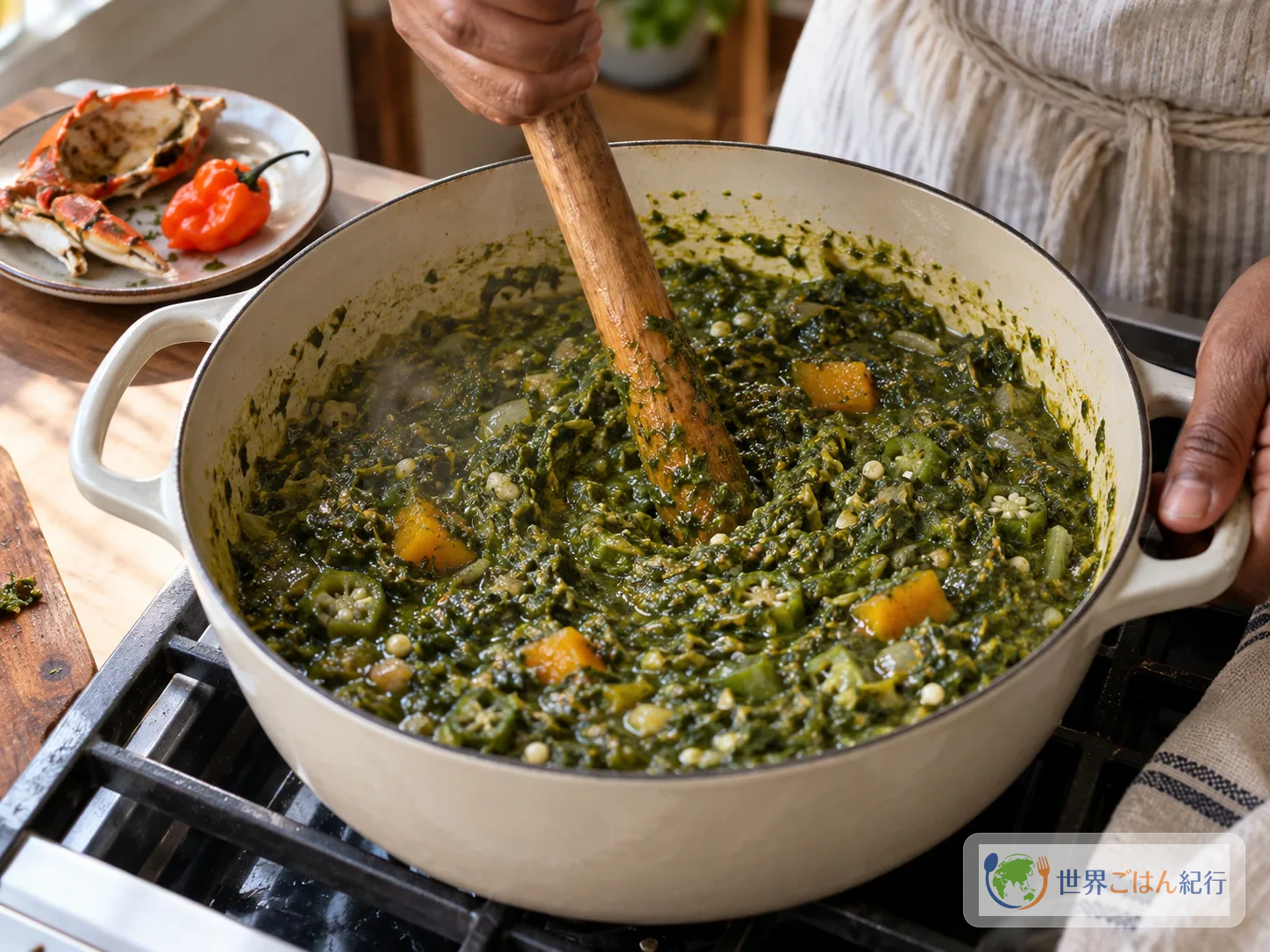
In the typical Trinidadian home table one imagines, there is the Sunday pot. Lift the lid off a deep pot and a thin film of oil shines on the surface while the smell of green leaves rises. A ladle scoops the green stew and pours it, thick and slow, over cooked rice. Dasheen leaves, okra, pumpkin, coconut milk, and crab or salted meat have all gone soft together in one pot. Swizzle it with a wooden spoon to break up the leaves, and the broth turns a deep, smooth green. The body of the okra, which strings when you lift a spoonful, holds the leaves and the coconut together. It works on a plate or in a bowl, so it is a pot that serves as rice topping or as soup.
Callaloo, in Trinidad and Tobago, is a stew or thick soup built on dasheen leaves and okra. Versions add crab or salted meat; some days it is poured over rice, and some days it is served as a soup before the meal. Four things trip people up in a home kitchen: how to find dasheen leaves, how to recognize safe ones, how to get the body from the okra, and how hot a whole hot chile makes the pot. The table described here is a typical scene put together from sources. It is not a record of any particular household or restaurant.
To get close to the original, use young dasheen leaves sold for eating. If you want availability and safe prep first, use spinach. With spinach the leafy aroma and body are lighter, and the color and texture will not match callaloo in Trinidad. Even so, keep the coconut milk and okra, the crab or salted meat, and the finish that makes the whole pot smooth. First, let's look at the island life this dish lives in: its origins, the Sunday table and the differences around the Caribbean.
Callaloo layers an island's history in one pot
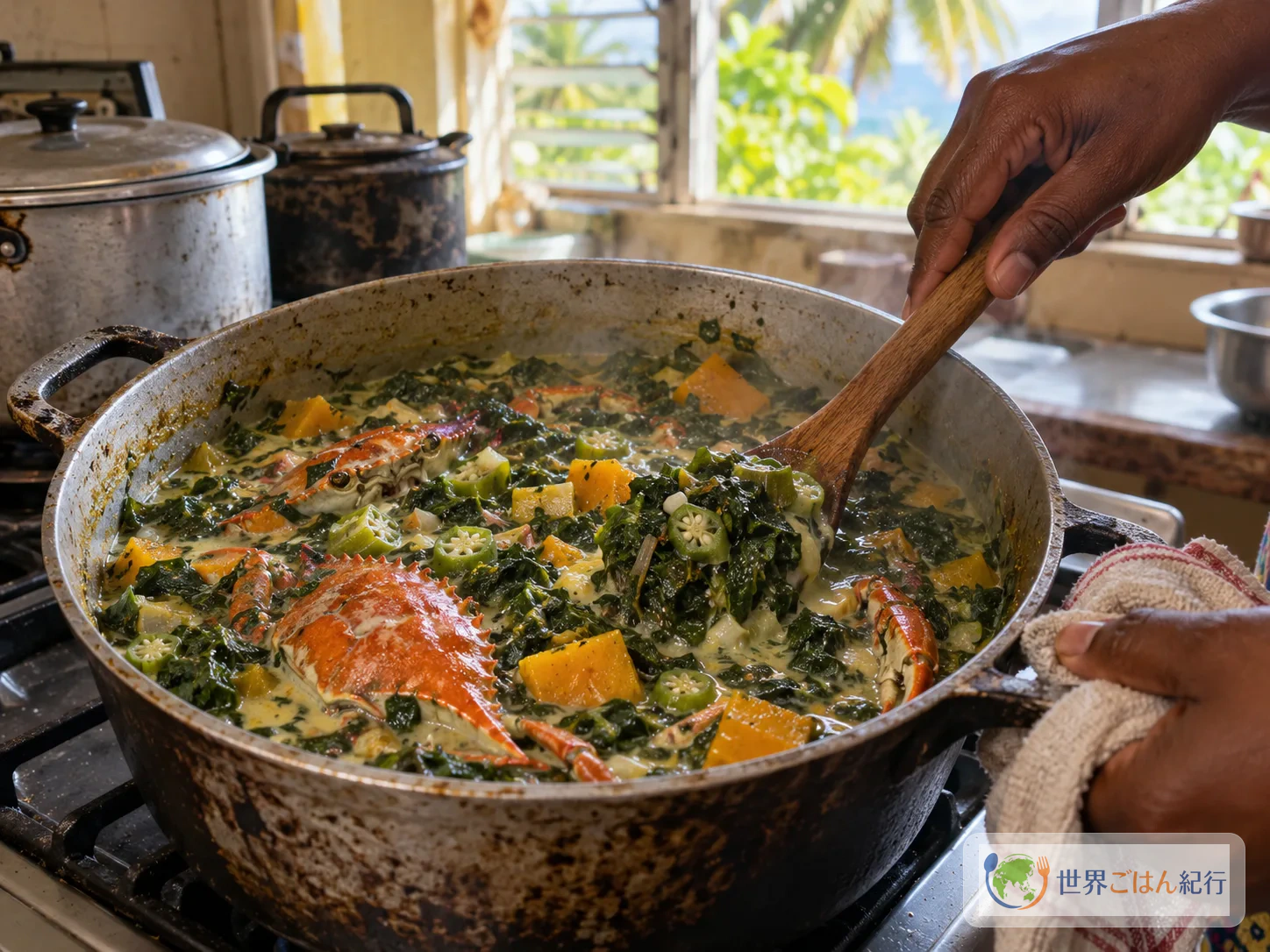
In 1783 the Cedula of Population drew French Catholic planters, free people of color and people of African descent to Trinidad. People arrived from Martinique, Guadeloupe, Saint-Domingue, Grenada, Saint Lucia and elsewhere, and the agricultural knowledge of enslaved Africans was layered on top. What the National Archives material tells us is this background of population, labor and movement. It is not evidence that any single cook invented callaloo. So rather than pinning down one origin, it is better to keep a certain distance and see how the combination of leaves, okra, coconut, salted meat and crab lines up with the island's history.
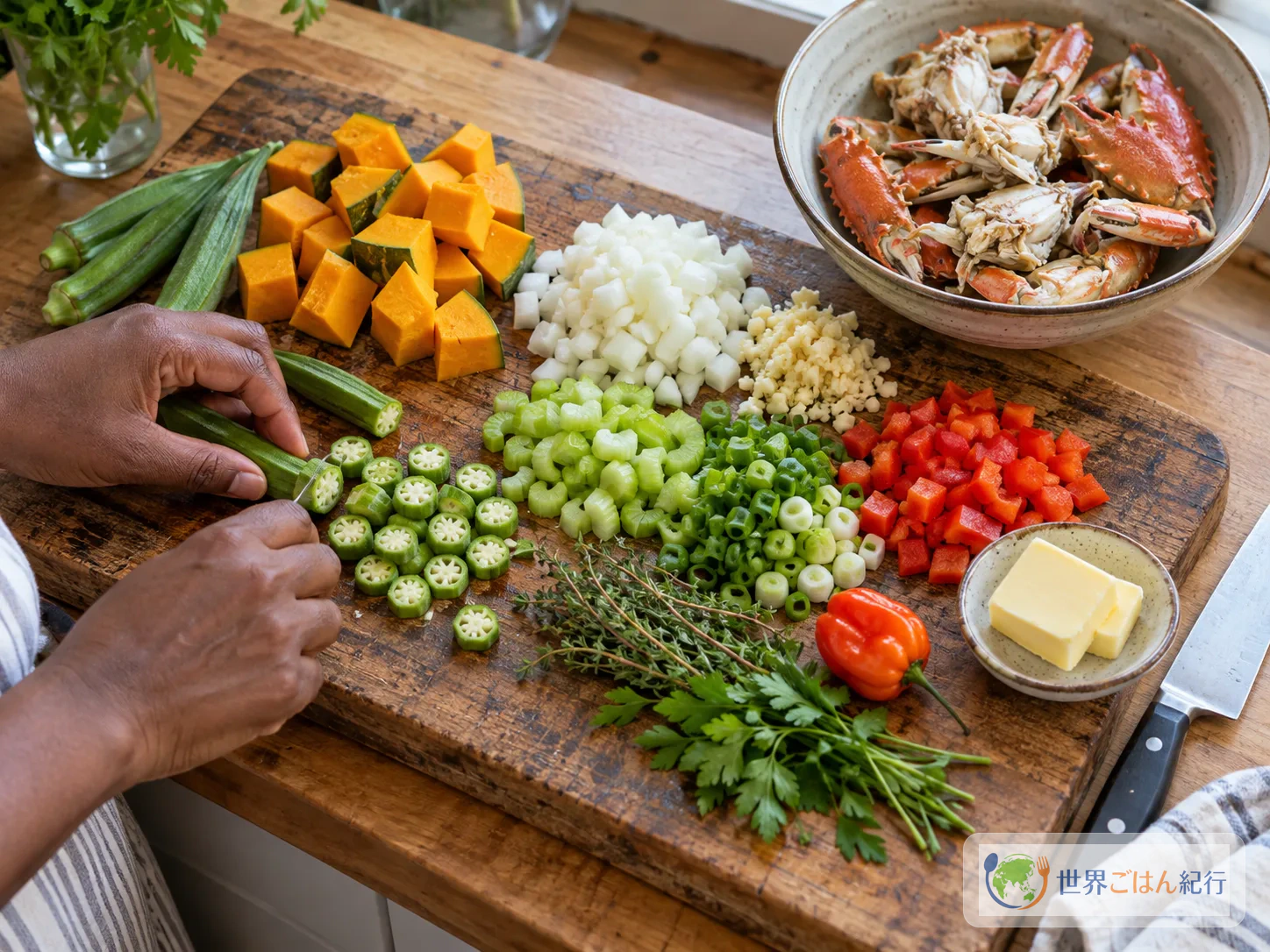
On the local table, it is a Sunday dish. A paper from the University of Trinidad and Tobago calls callaloo a typical Sunday dish and contrasts it with Saturday's sancoche. The ingredients it lists are dasheen leaves, okra, coconut milk, pumpkin, habanero, salted pig tail or smoked ham bone, and crab. Because it is a dish in which leaves and fillings are cooked until completely soft into a thick puree, ingredients that began separate become one in the pot. That sense of unity suits a Sunday table where the family gathers around the same pot. Rather than declaring it a "national dish" that stands for every household, it is closer to the truth to take it as one typical way of eating.
There are two ways to serve it. The Tobago tourism board presents callaloo as a dish poured over rice and eaten with meat or chicken, or served as a soup. For rice, leave a little of the liquid and finish it as a thick sauce; for soup, add water or coconut milk 50 mL at a time to adjust the flow. What does not change either way is that you do not add so much water that it turns into a different dish. As long as the body of the leaves and okra remains, thick or thin, it is the same callaloo.
In Trinidad and Tobago, "callaloo" is not only the name of a plant; it is also the name of the representative dish that contains okra and dasheen. In Jamaica, by contrast, callaloo widely refers to an amaranth-type leafy green, so the same English name does not mean the same ingredients or the same dish. The leaf is also called dasheen bush or callaloo bush locally.
Same name, but not one leaf and not one pot
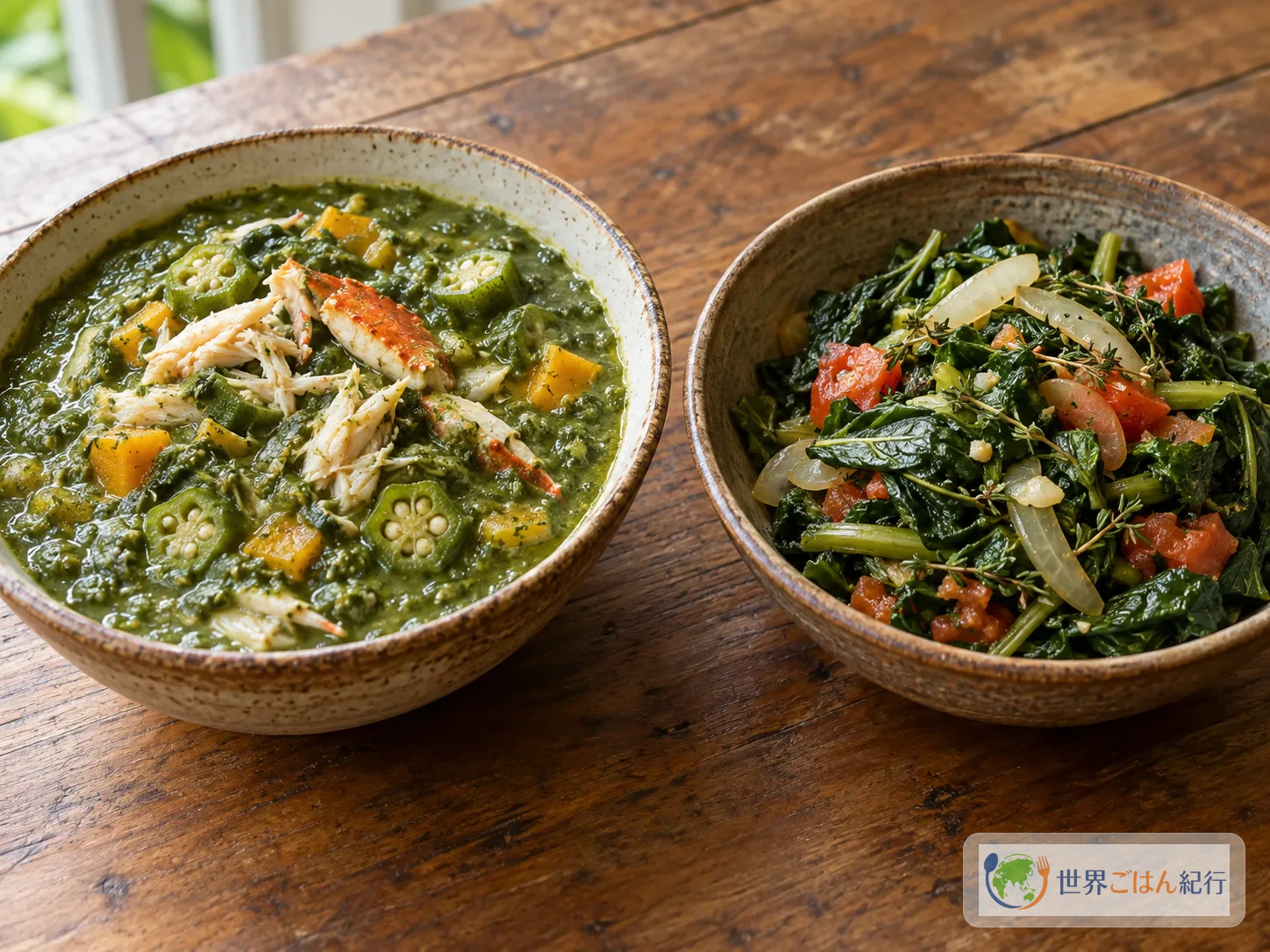
Cross the Caribbean and the contents of the pot with the same name change. A botanical review describes Trinidad and Tobago's callaloo as a dish containing okra and dasheen (Colocasia esculenta), and says that in Jamaica callaloo is tied to amaranth. Spellings such as callaloo, calaloo and callalou, and what they refer to, vary from island to island, so people talk past each other unless a country is named. A different leaf makes a different callaloo. Dasheen and amaranth differ in aroma, body and finish. Bringing the Jamaican version into the Trinidadian one as a substitute will not give you the same dish. It is best to approach it as the same name, a different pot.
Recipes also differ from home to home and island to island. The Tobago tourism board recipe combines 12 dasheen leaves, 8 okra and 2 cups of coconut milk with pumpkin, aromatics, thyme and chile, and simmers over low heat. Once soft, it is blended to taste. The Trinidad and Tobago Newsday recipe uses dasheen leaves, okra, pumpkin, crab, butter and coconut milk. It simmers for about 30 minutes first, adds the coconut milk and cooks about 10 minutes more, then removes the crab and chile and swizzles. The fillings branch in many directions: crab, salted pork, salted pig tail, smoked ham bone, or vegetables only. So no single formula can be called the authentic taste.
In a home kitchen, make these substitutions. If you use taro leaves, choose only young leaves labeled by the seller as edible, and prep and cook them as the steps say. Spinach is easy to get and works with a short blanch, but it does not reproduce the thickness, aroma and body of dasheen leaves. Okra supplies the body, so do not leave it out. Pumpkin brings sweetness and color, and coconut milk brings roundness to the broth. If you cannot find Scotch bonnet, use a small amount of habanero, whose heat is easy to check, or green chile. There is also a method of adding the chile whole to the pot, moving only its aroma into the stew.
Dasheen is one of the English names for a type of taro, and in Trinidad the leaves are called dasheen bush or callaloo bush. Ochro is the local spelling of okra, so the ingredient table says "okra" for readers to find easily. Pimento pepper can refer to a mild aromatic pepper, so the substitutes column lists a sweet bell pepper.
To the same island's breakfast
If you are curious about Trinidad's street food and its ties to Indo-Caribbean cooking, take a look at Trinidad's doubles (in Japanese). Callaloo is a pot dish the family gathers around on Sunday. Doubles is a street food of fried bread topped with chickpeas, eaten in the hand. Even in the same country, the time of day and the texture are completely different.
Ingredients (serves 4)
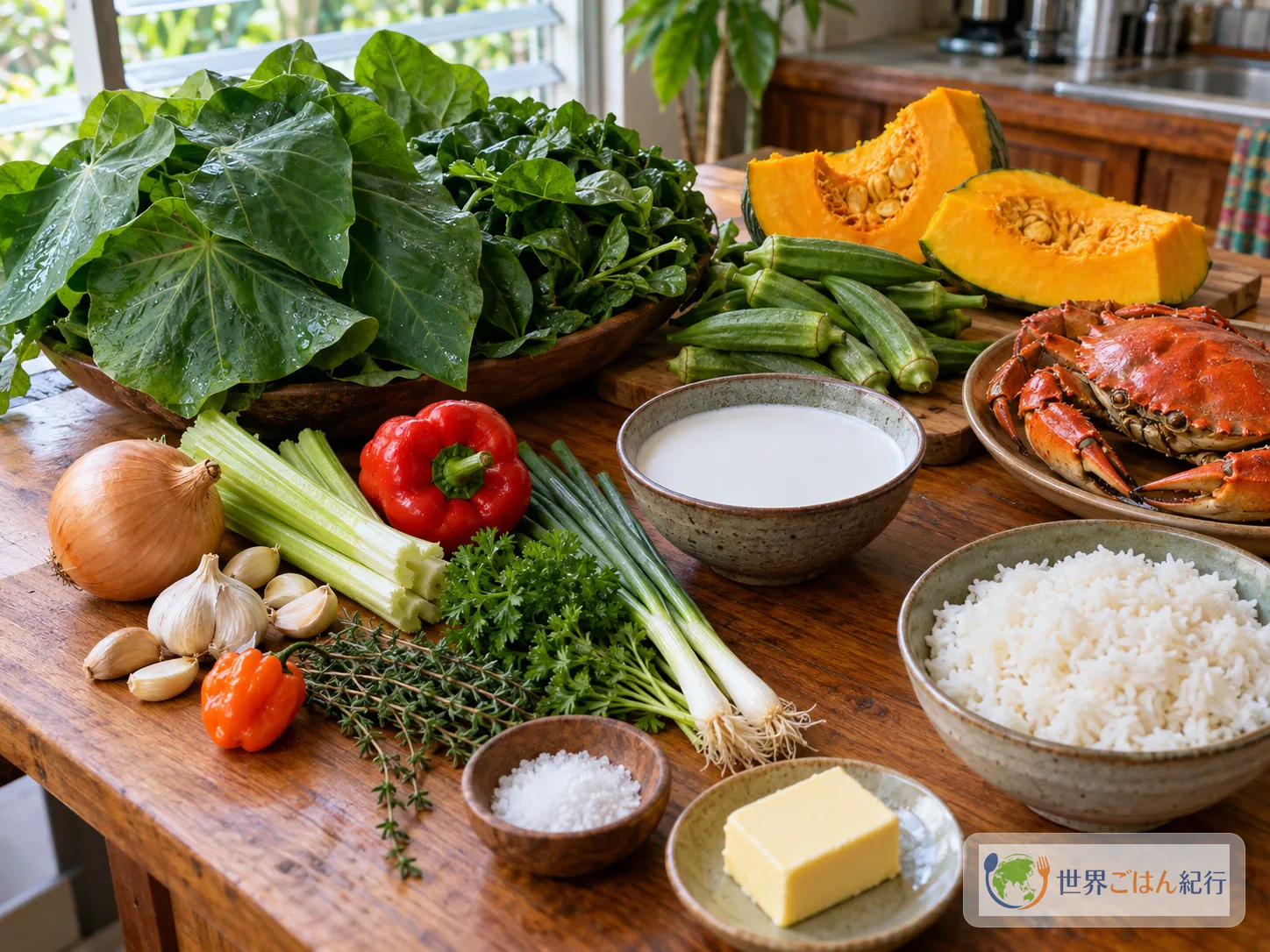
Quantities are for 4 servings, a thick stew eaten with rice. For leaves, the table separates 300 g of edible taro leaves for a version closer to the original from 300 g of spinach for easier availability. When choosing taro leaves, always pick leaves with an edible label. The standard crab is 2 swimming crabs for cooking (about 300 g in total). If you swap in 200 g of salted pork, a desalting step is added. Coconut milk is the base of the broth, so use all 400 ml of coconut milk and adjust the thickness with water at the end. And one more thing: okra is the foundation of the body. Except for the chile, the quantities are written as numbers. Salt changes depending on whether you use salted meat, so adjust it by tasting at the end.
Coconut milk is easy to find in a canned or carton form at most grocery stores and Asian or Caribbean markets. Check that the size is around 400 ml and look at the ingredient list, whether it is a rich type, and whether it is unsweetened. For a single batch of callaloo, a nearby shop is enough. Buying in bulk only makes sense if you will use the rest in curries or desserts. Dasheen leaves, crab, okra and pumpkin depend on freshness and prep, so choose them fresh from the produce or seafood counter.
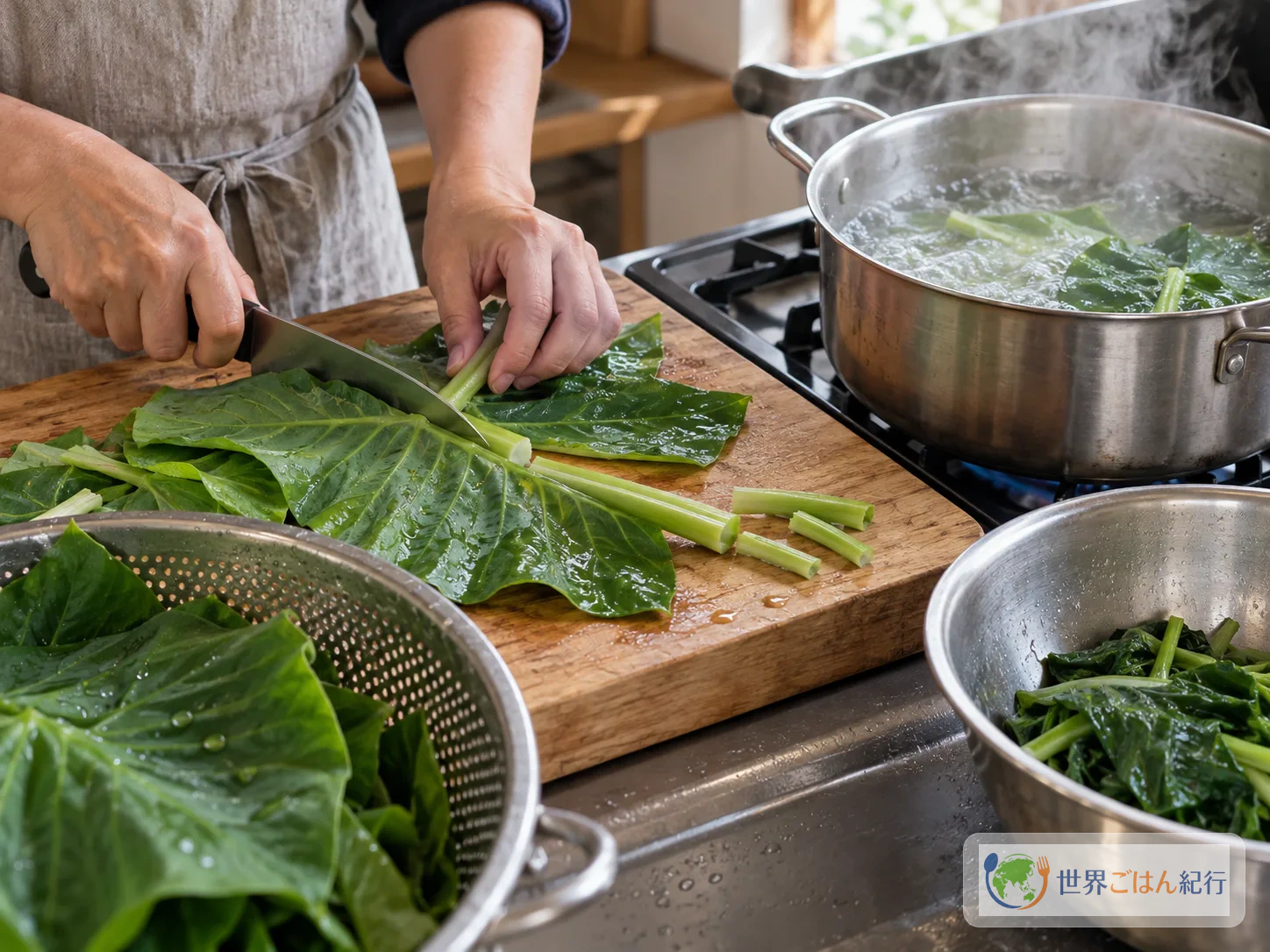
Never eat taro leaves raw. Do not use leaves picked in the wild, leaves of unknown origin, or leaves without an edible label. Even taro leaves sold for eating cannot skip the prep and thorough cooking. When you replace them with spinach, cook it in this recipe too. Crab is a crustacean allergen. If you want to avoid it, switch to the salted pork version or the vegetable version, as the ingredient table says. Allergens change with coconut, dairy (butter), and whether fish or meat is included, so check the labels of what you buy before using it.
Method
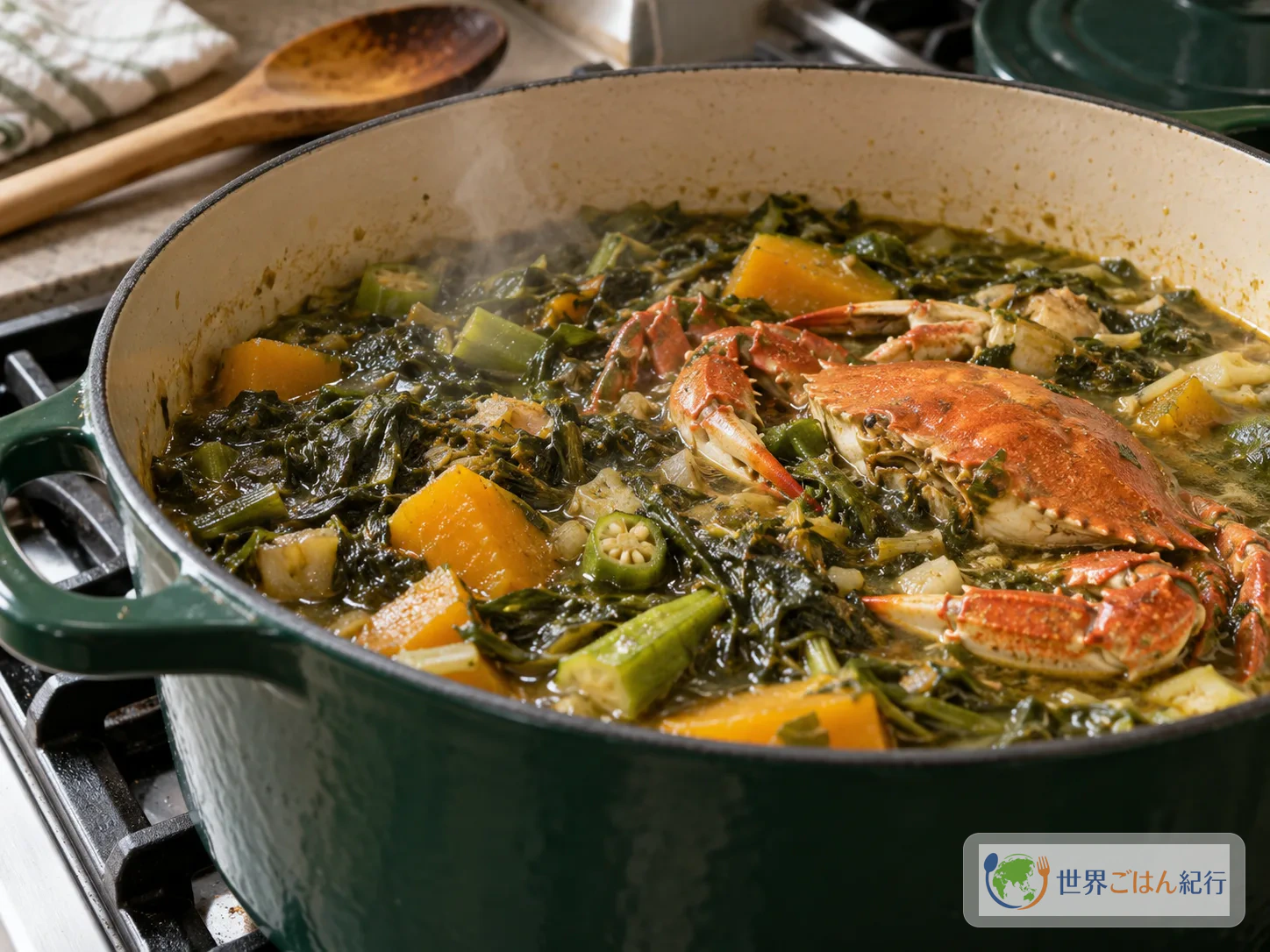
The order is: prep the leaves, prepare the aromatics and fillings, simmer in water until soft, add the coconut milk, then remove the crab and chile and swizzle. Built around the Tobago tourism board's low-heat cooking and Newsday's two-stage heating of about 30 minutes plus about 10 minutes, it is adjusted for four servings. The only difference between taro leaves and spinach is the time of the first prep; the later simmering is the same. Taro leaves need a parboil of more than 30 minutes. Once in the pot, simmer on low for about 30 minutes, and add the coconut milk for the last 10 minutes. If the liquid runs short, add water 50 ml at a time. If you add too much water at the start, it turns into a thin soup.
Do not fill a container with a tightly closed lid with hot liquid and run it. Use an immersion blender that works in the pot, or let it cool a little and process in small batches. Do not put shells, bones, thyme sprigs or the whole chile into the blades.
How to tell before you turn off the heat
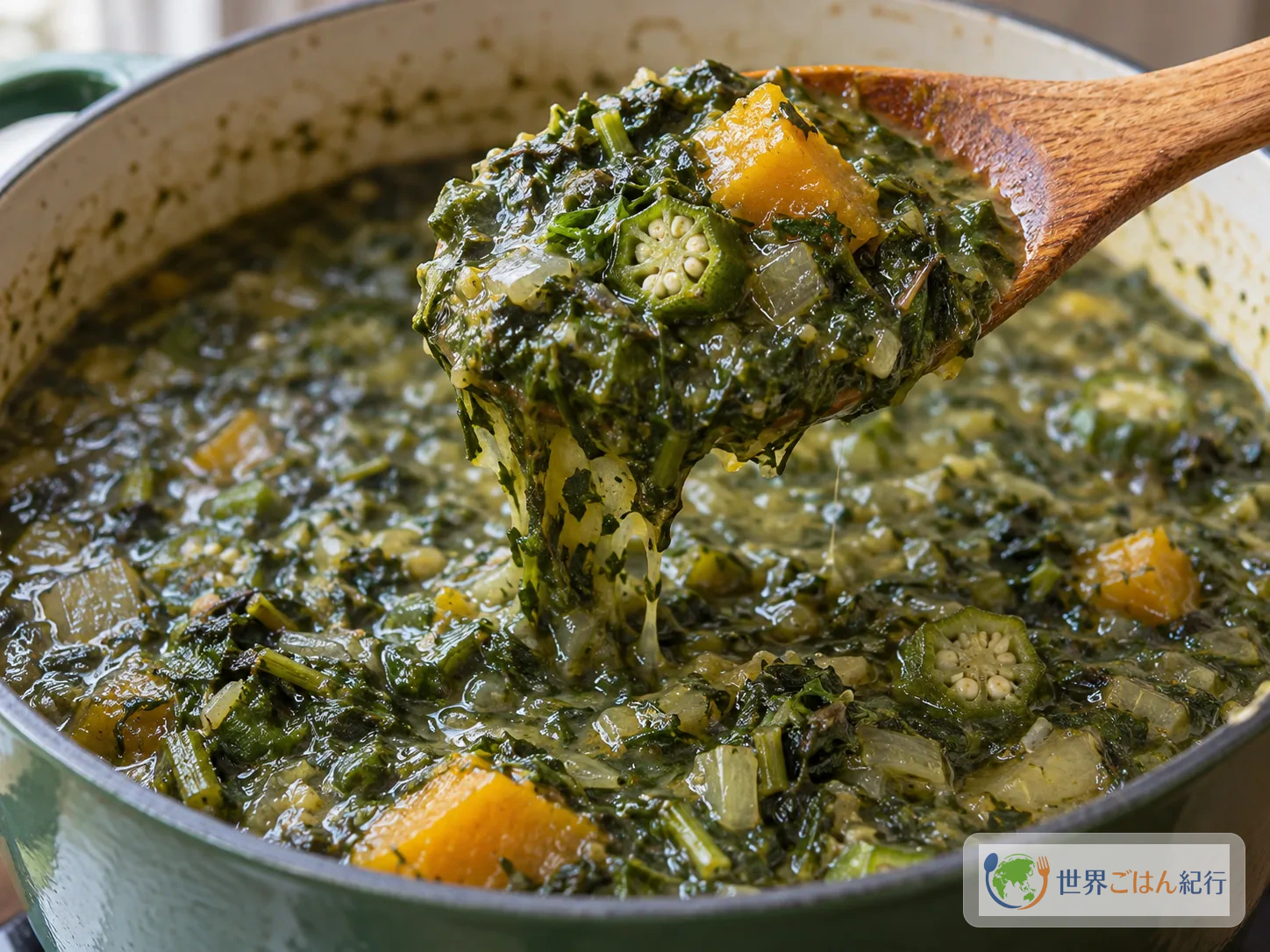
Start with the leaves. If no strings remain when pressed with a wooden spoon, they are soft enough, and you can tell by sight and feel before tasting. Next, the okra. If body comes out around the seeds of the rounds, the broth does not run like water, and a wooden spoon track stays for about 1 second, the body is enough. Last, the coconut milk. Keep to low heat for the final 10 minutes. A hard boil or a long reduction is what makes it separate.
Put the Scotch bonnet in whole. To keep the heat down, take it out at 5 minutes, and leave it to the end only when you want it hot. Heat is controlled by the whole chile, as a rule. If you scatter cut chile from the start, the whole pot suddenly turns hot and is hard to recover. If it gets too hot, add 50 ml of coconut milk and 30 g of mashed pumpkin, warm it over low heat for 3 minutes, then readjust the salt.
For rice or for soup can be chosen from the same pot. For rice, it should fall slowly and thickly from a spoon, without liquid spreading too far at the bottom of the plate. For soup, add water or coconut milk 50 ml at a time until it flows continuously when you tilt the spoon. If you thin it too much, reduce uncovered over low heat for 2–3 minutes to bring back the body of the okra. Don't add potato starch, which creates a different kind of stickiness.
When swapping crab for pork or vegetables
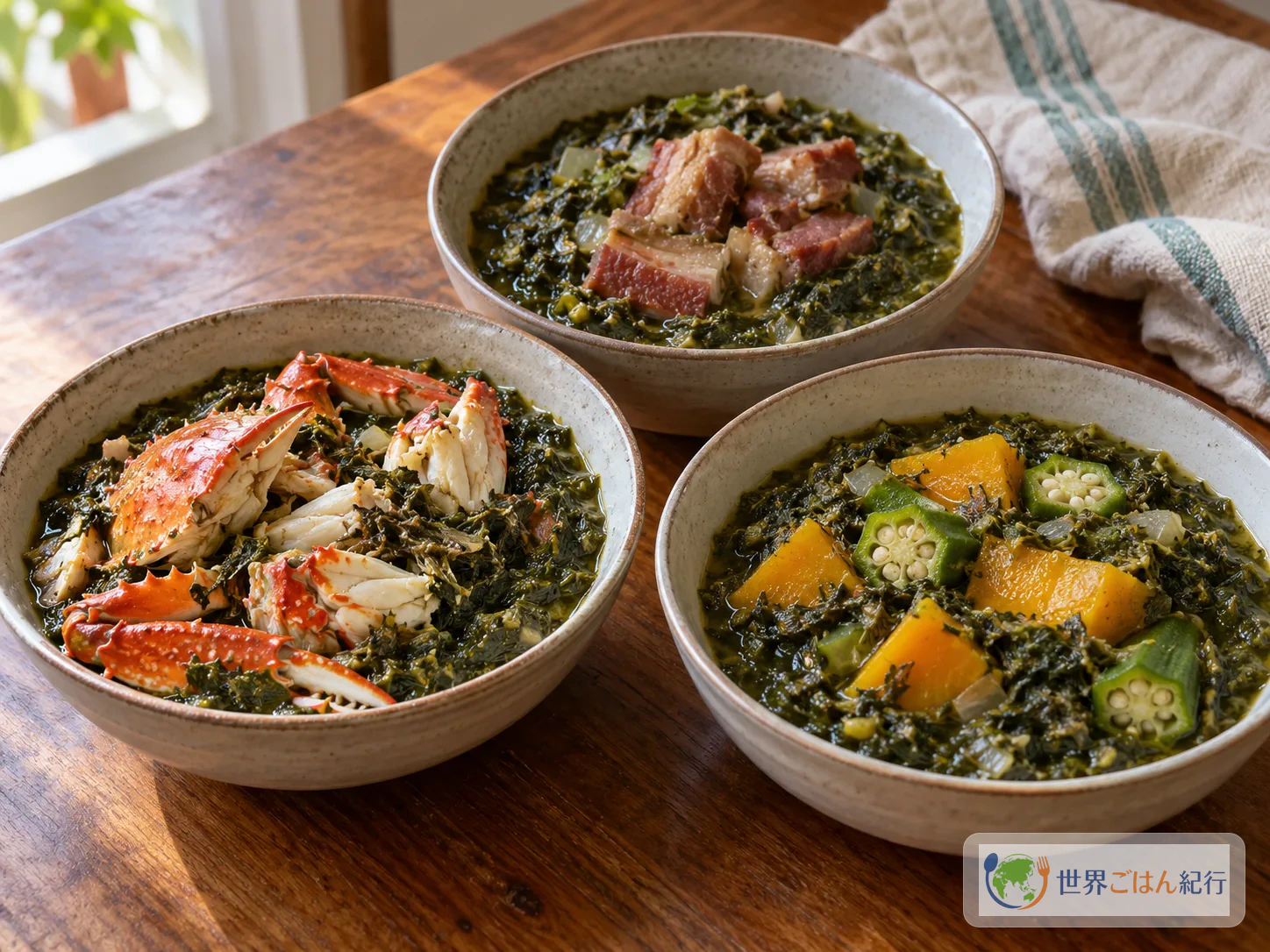
The crab version brings forward the sea's savoriness and the scent of the shell. To avoid overcooking the crab, check the state of the meat at the stage when you add the coconut milk, after the 30 minutes of simmering. In the salted pork version, the saltiness of the meat moves into the broth. Soak and parboil as the ingredient list says, and taste as if you will add salt after with salted meat. The vegetable-only version, with neither crab nor pork, raises the pumpkin and okra to 200 g each and adds salt to taste, starting from 2 g. This is not an authentic recipe, but a variation the editors devised for home cooks. It cannot be called the same taste as the authentic crab version. The vegetable version is a different way to eat it, with the sweet aroma of leaves and coconut in the lead. Even when the filling changes, the core stays the same: leaves and okra as the frame, simmered soft and mashed.
For the spinach version, squeeze the water out well after the parboil, and the coconut milk won't be diluted and it turns into a green puree in a short time. With komatsuna or water spinach, the texture and aroma change. If you use something in place of dasheen leaves, it is honest to call it a "leafy green version." Wild taro leaves, unidentified leaves from the garden, and houseplant leaves are not substitutes.
Across the African diaspora, callaloo has changed shape as a dish with leaves as the star. In Trinidad and Tobago, dasheen and okra are central. There is Jamaican callaloo with amaranth, and there are places that call okra by another name, so even under the same name the ingredients differ from island to island. This difference is not a matter of better or worse. It is the result of the available leaves and the table's cooking methods overlapping the name.
Scooping it over Sunday rice
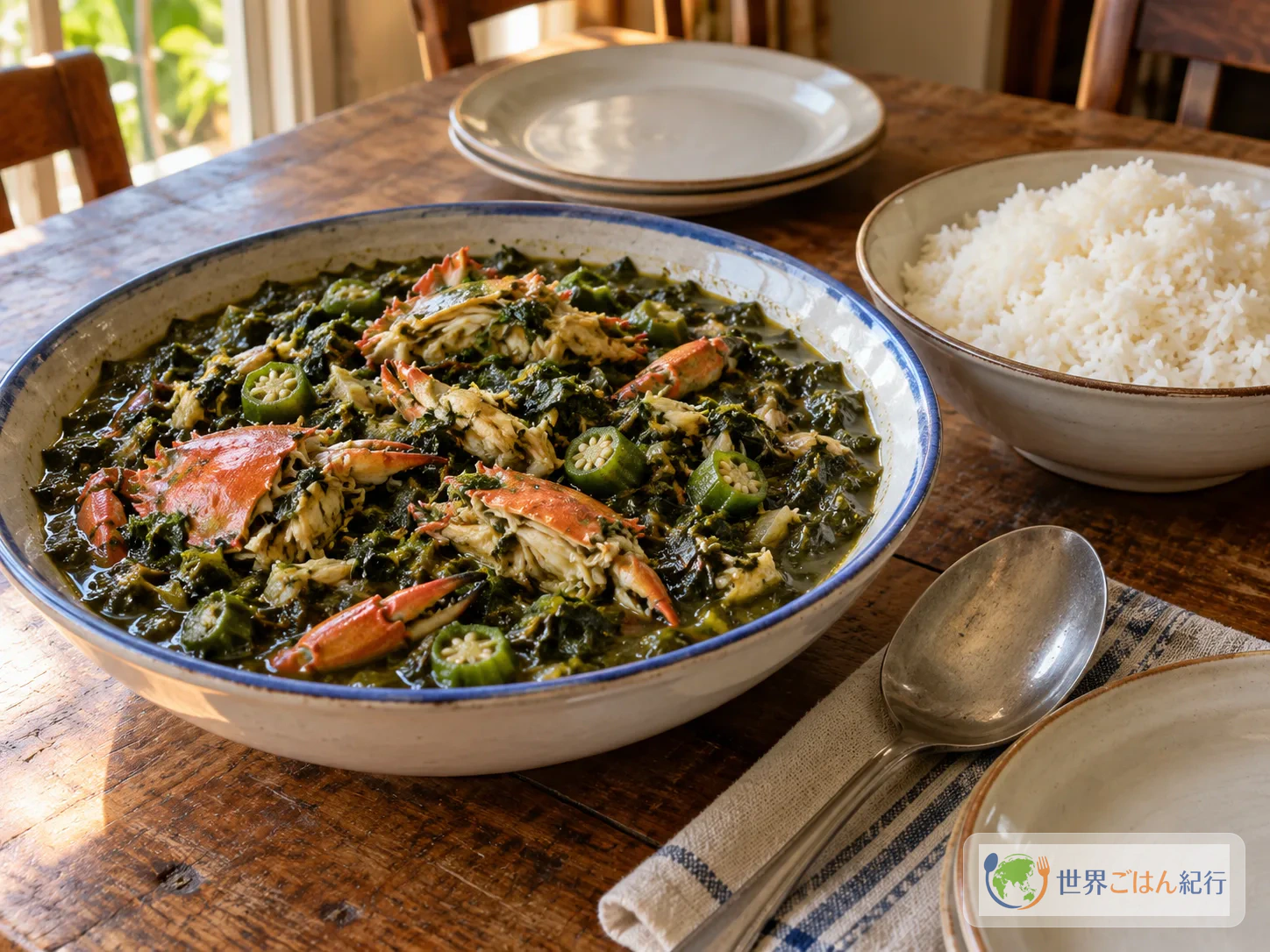
On one plate, put about 150 g of cooked rice and pour 180–220 ml of callaloo from the side. Put the crab meat or salted pork back on top. The guide is 150 g of rice to 180–220 ml of stew. The ways the Tobago tourism board presents, with rice and meat or chicken, or as a soup, can be chosen from one pot. A sour pickle or raw vegetables on the side cut the roundness of the coconut nicely. That said, it is not essential to the way it is eaten locally.
Do not return food that has been served to the pot. Once the heat has gone, cool it in a shallow container, then move it to a clean container and refrigerate. The guide is to finish the crab version by the next day, and when reheating, heat it through to the center and plate one serving at a time. If you freeze it, take out the crab meat and freeze only the broth and leaf portion. After thawing, add a little coconut milk and warm over low heat to bring the separation back together more easily. This is a cooking guide, not a quality guarantee. If it smells sour, has an unusual stickiness or the container is bulging, throw it out without eating.
Frequently asked questions
What if I can't find dasheen leaves?
If you cannot find edible taro leaves at an import grocery or online, make it with 300 g of spinach. Blanch it for 1 minute and squeeze out the water. The flavor will be lighter and cannot be called the same as dasheen leaves. Do not use a leaf whose name you don't know as taro leaves.
Is callaloo the same dish as Jamaican callaloo?
Even with the same English name, the main ingredient differs by country. The Trinidad and Tobago version is dasheen leaves and okra, while in Jamaica the name is widely used for amaranth leaves. When searching, enter the dish name together with the country name, and check the leaves and steps.
What can I use instead of crab?
If you switch to 200 g of salted pork, desalt and parboil it, and adjust the salt last. If you want to avoid crustaceans, leave out the crab and make the vegetable version with more pumpkin and okra. You cannot say that swapping the crab stock for another fish gives the same taste.
Can callaloo be made ahead?
The crab version keeps in the refrigerator until the next day as a guide. Cool it in a shallow container before reheating. When you reheat, add water or coconut milk in amounts under 50 ml at a time, and keep it from boiling hard over low heat to bring the thickness back. If there is any unusual change such as a fishy or sour smell, do not eat it.
Can I use taro leaves picked from my own garden?
Only use leaves with an edible label and a seller you can identify. Do not use taro leaves picked from a garden, roadside or field, or anything you cannot identify. Wild taro has needle-like calcium oxalate crystals that irritate the mouth and throat. Do not assume that cooking makes wild leaves safe.
Sources
- Callaloo | Tobago — Tobago Tourism Agency. Checked for ingredients, low-heat cooking and serving over rice or as soup (accessed and checked 30 September 2026).
- Flavours from our past — Trinidad and Tobago Newsday. Checked for historical background, a crab recipe and the about-30-minute plus about-10-minute steps (accessed and checked 30 September 2026).
- Our African Legacy: Roots and Routes — National Archives of Trinidad and Tobago. Checked for the 1783 Cedula of Population and the background of migration (accessed and checked 30 September 2026).
- Caribbean Journal Of Teacher Education & Pedagogy — University of Trinidad and Tobago. Checked for the Sunday dish, branching ingredients and the African diaspora context (accessed and checked 30 September 2026).
- The Gradual Loss of African Indigenous Vegetables in Tropical America — Economic Botany. Checked for the difference in what callaloo refers to in Trinidad and Tobago and Jamaica (accessed and checked 30 September 2026).
- Lost Crops of Africa: Volume II: Vegetables — National Academies Press. Used as supplementary confirmation of the leaves and regional naming of Caribbean callaloo (accessed and checked 30 September 2026).
- Pacific Food Guide: Taro — University of Hawai'i at Manoa. Checked for choosing young taro leaves, not eating them raw and the prep of boiling and discarding the water (accessed and checked 30 September 2026).
- Calcium Oxalate – the Stinging Crystals in Plants — Centre for Food Safety, Hong Kong Department of Health. Checked for the safety boundary of not foraging or using wild taro (accessed and checked 30 September 2026).
- Produce Safety Rule comments: taro — material posted on Regulations.gov. Used as supplementary confirmation of taro cooking time (accessed and checked 30 September 2026).


