
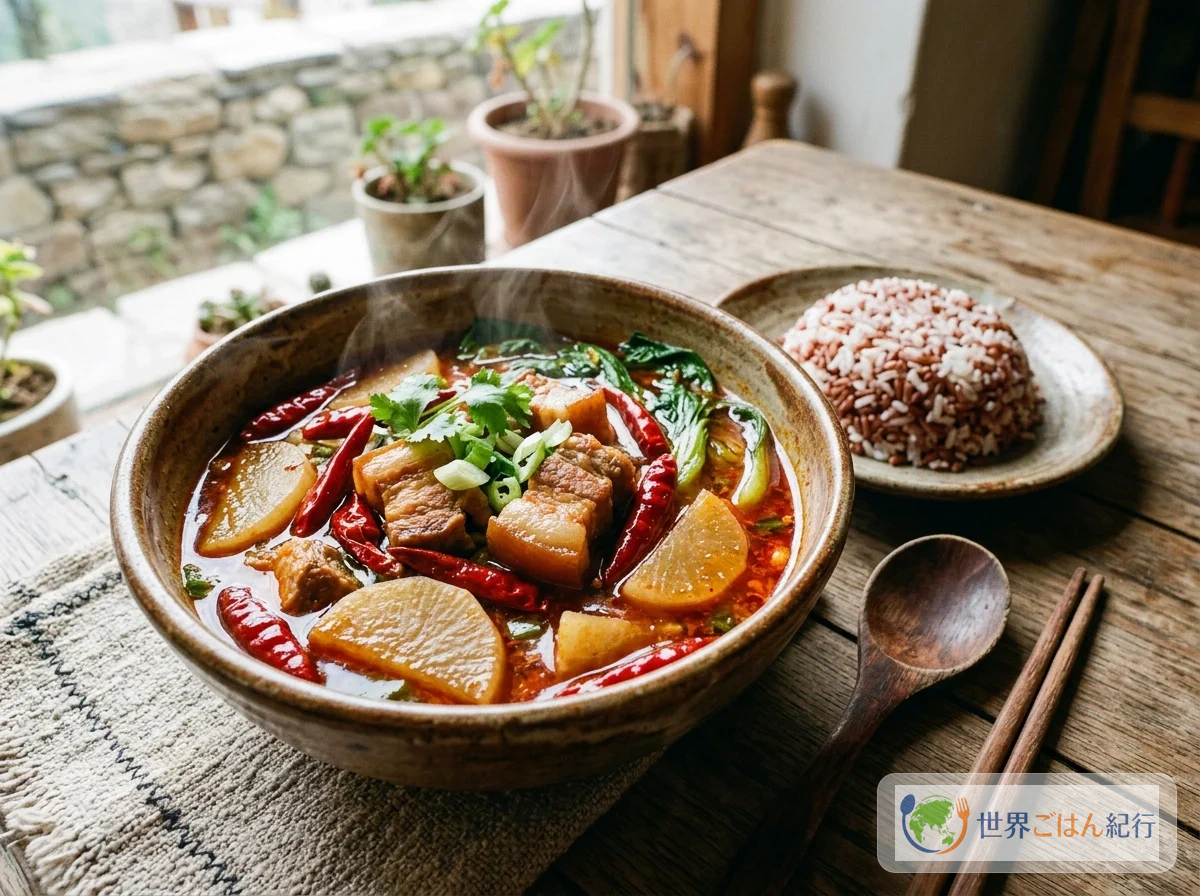
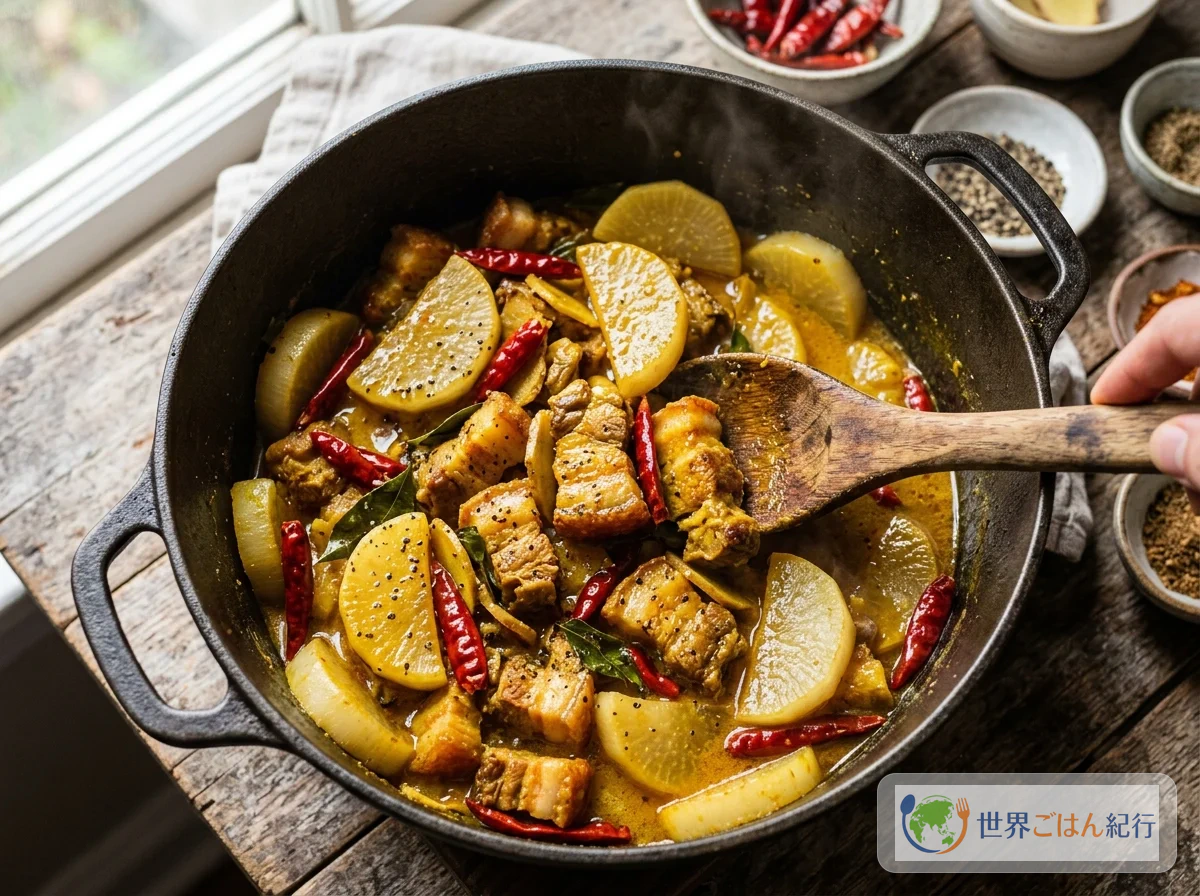
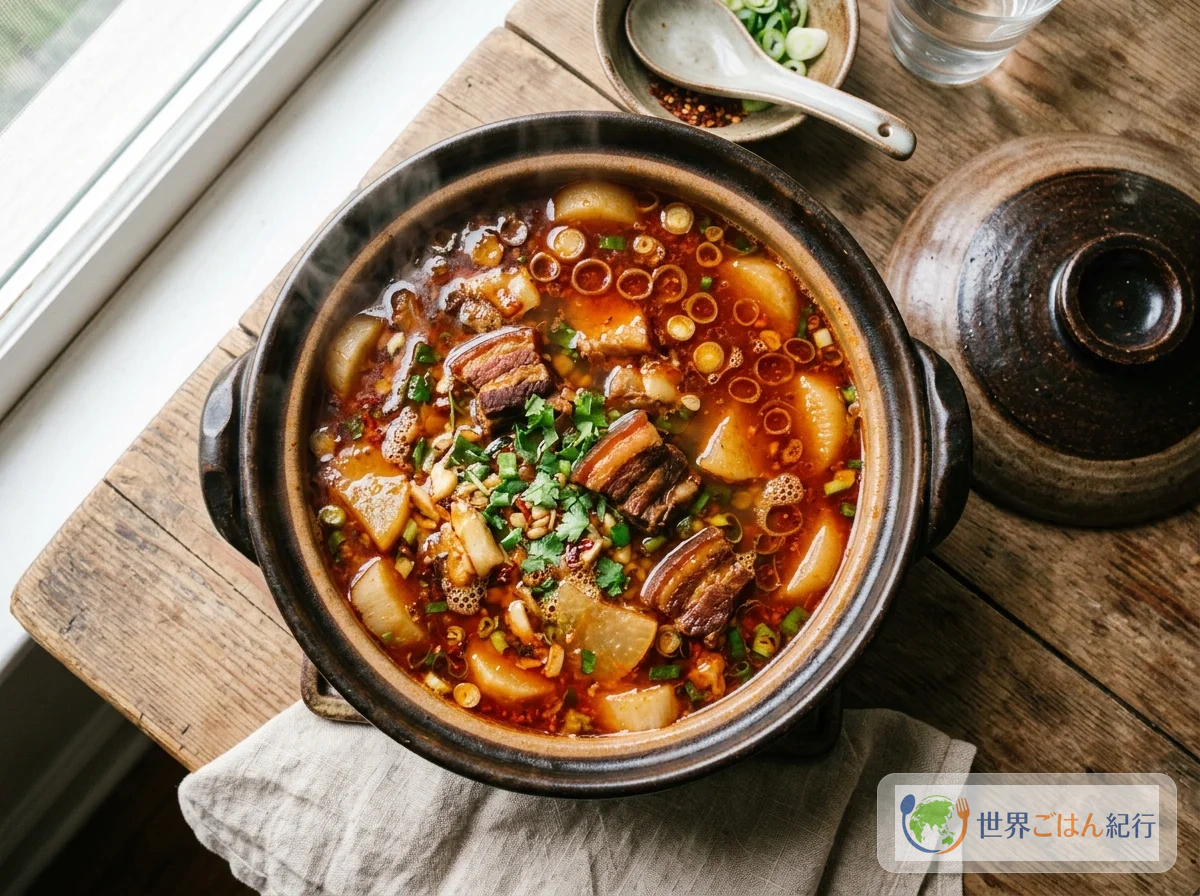
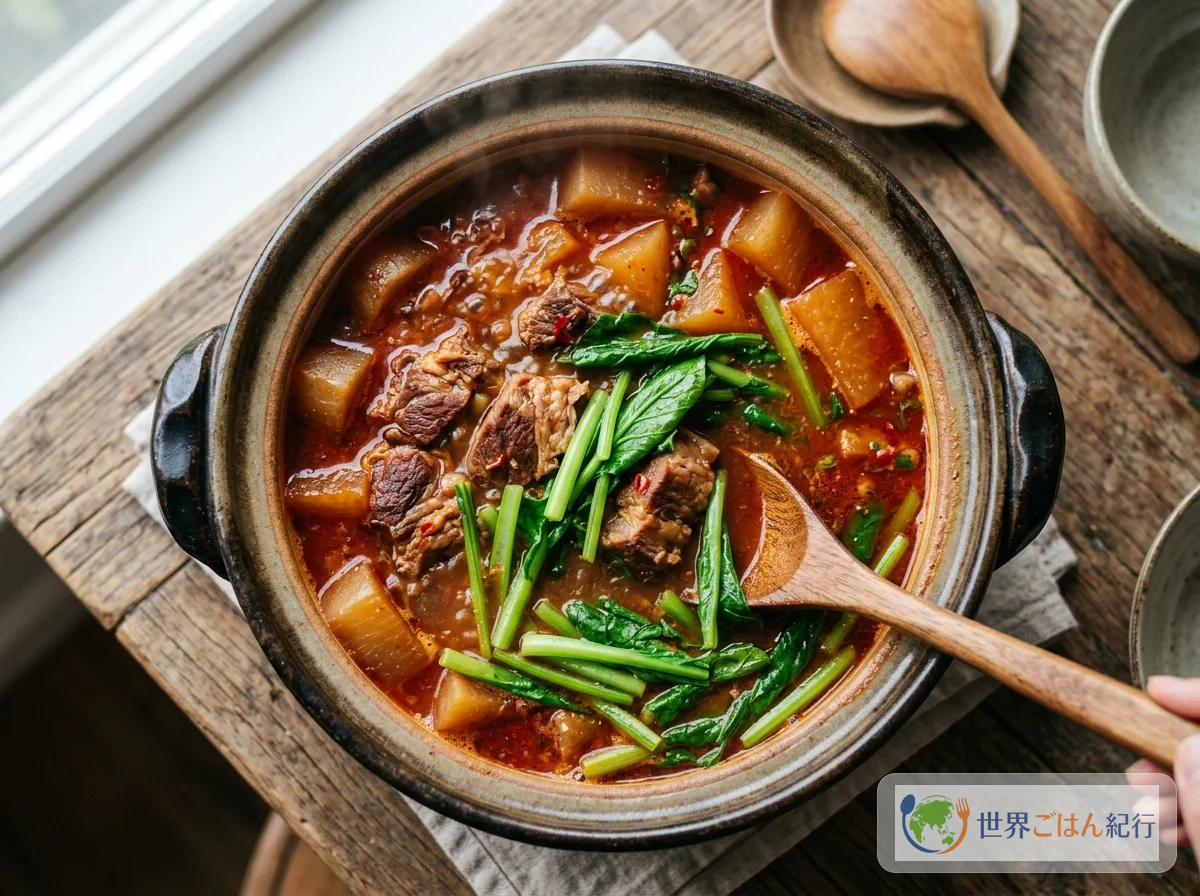
A kitchen in a mountain village, a winter evening. In a heavy pot the fat of the pork belly melts slowly, and dried red chilies give up their color to it. What rises is the sweet smell of fat and the dry, sharp scent of chili. Phaksha paa, made in Bhutanese homes, is a stew of pork, dried red chilies, and radish, and it appears both at celebrations and on restaurant menus. Because it uses fatty pork, it has long been valued as a food that warms the body in the cold season. Say a red dish stewed in pork fat and you already have a rough picture.
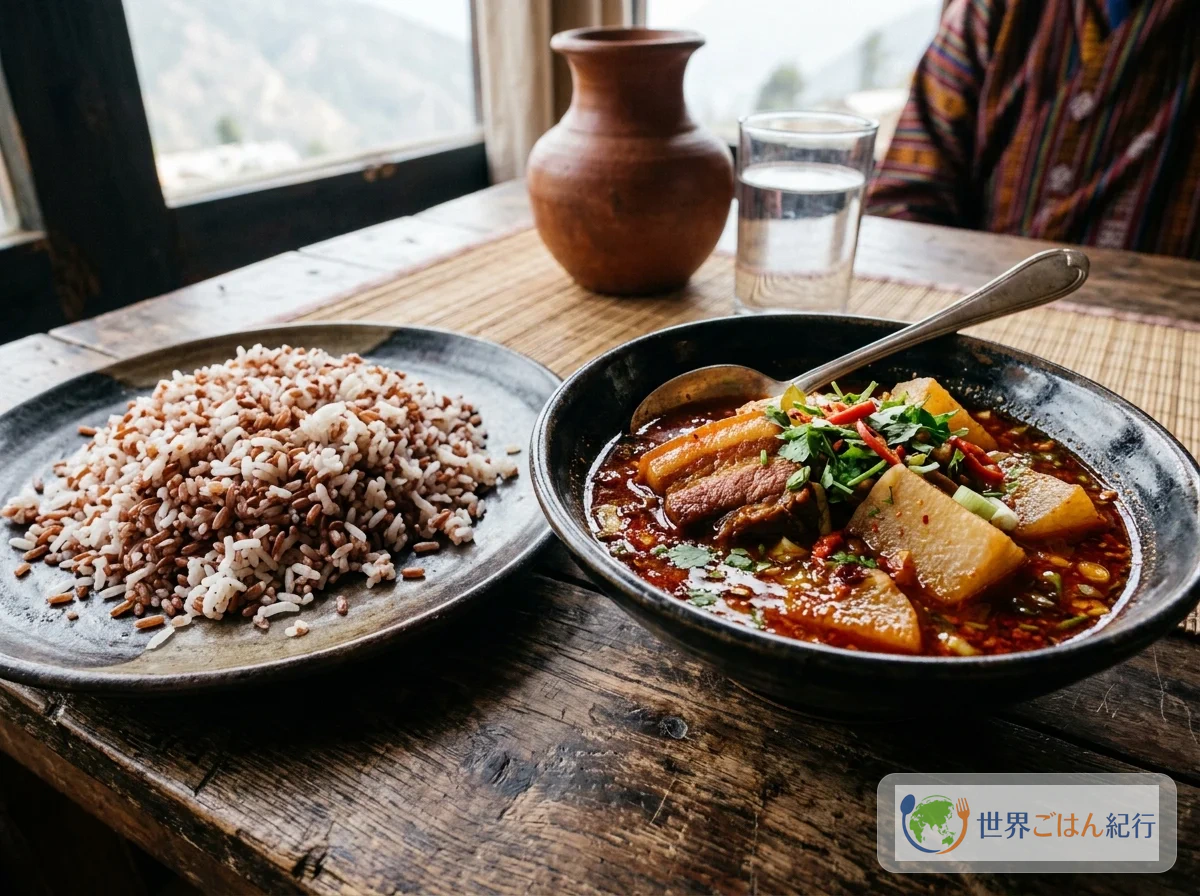
Bhutan's best-known dish is ema datshi, chilies and cheese. Served with red rice, the meat dish set alongside it on the same table can be phaksha paa. It is the second dish behind the national favorite, you might say. In a home kitchen, you can make it with pork belly, daikon, and dried red chilies, so you can get close to the flavor. Two things deserve care: how you measure the heat, and the heat under a pot full of fat. It is a beginner recipe with 15 minutes of prep and 50 minutes of cooking, about 1 hour 5 minutes in all. To see how a Bhutanese meal is laid out, take a look at ema datshi as well.
The first thing you probably wonder about is the heat. In this article, 6 dried red chilies is the guide for a properly spicy home version. If you do not like heat, use 4, and remove the seeds to be milder still. The English recipe used as a reference calls for 2 to 3 dried red chilies per pound (about 450 g) of pork, but here 6 chilies to 400 g of pork is set as the standard for "properly spicy." That adjustment is the editors'. The basic rule is to set the heat by the number of chilies and the seeds; stew them with the seeds and it gets hotter by that much.
The Bhutanese table and the origins of the dish: when pork fat melts in a mountain kitchen
At the center of the Bhutanese table is red rice. It has a texture like brown rice and a nutty flavor, and it is described as a rice variety grown at high altitude. Red rice is the staple, but the lineup varies by region. In the Bumthang region buckwheat is eaten, in the east maize, and rice is eaten throughout the country. Meats include beef (yak), dried beef, pork, pork fat, and mutton. In the cold season, soups and stews of meat, rice, fiddlehead ferns, lentils, and dried vegetables, seasoned with chili and cheese, are preferred.
Within that, the fattier cuts of pork are welcomed. They are especially valued in cold weather because fat becomes winter energy. Some dishes use dried or smoked pork, and you will see explanations that the background is a way of preserving meat from the days before refrigerators. But the origin and history of phaksha paa itself are not clear. Here, take it as a winter stew that grew up in daily life.
The spelling varies: Phaksha Paa, Phagshapa, Phagshaphu, and others. Wikipedia lists Phagshaphu as a dish of "pork, radish, and chili." If you come across one of these on a local menu or in a search, treat it as the same family of dish.
A close relative is Sikam Paa, which combines dried pork and chilies. It is a separate dish; sikam means sun-dried pork belly. Bhutan has a number of other pork dishes as well, such as Noshahuentsu (pork with spinach) and Phagshaphintshom (pork with rice noodles).
A pork-and-radish stew called Phagshapa is also described for Tibetan cuisine in English-language sources. Nothing can be said here about its relationship to Bhutan.
Households and regions differ too. Many households add greens such as spinach or turnip leaves. Some sources also add ginger, spinach, or other vegetables. It is sometimes eaten with hoentay, the buckwheat dumplings that are a specialty of Bumthang. The blog The Food Dictator has a version that adds dried pork (jerky), but that is the author's own variation and not the standard recipe. Chilies are also used fresh in some versions and dried in others; this article centers on the version with dried red chilies.
Ingredients (serves 4)
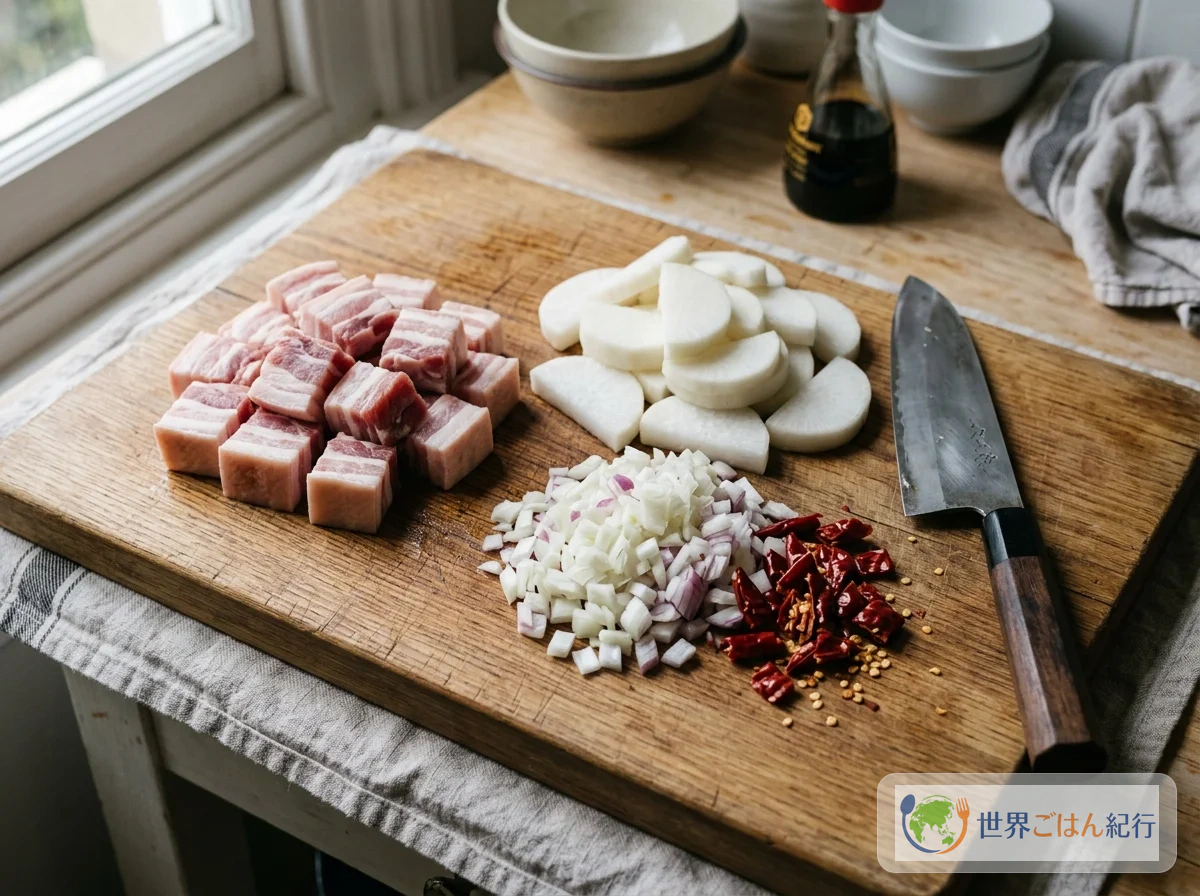
When shopping, look at the pork belly first. Since fat is the star of this dish, choose a block with clearly defined layers of fat and lean. Thin slices fall apart in the stew, so cut thick cubes. The English recipes used as references are based on pork belly or shoulder, radish, dried red chilies, onion, garlic, ginger, and turmeric. The quantities were adjusted by the editors for home cooking. Red rice can be cooked mixed into white rice, so you can try it from 2 tablespoons. Sichuan peppercorns and asafetida are optional; use turmeric and ghee if they are easy to get. Look for the spices online or at specialty shops; the radish, pork, and chilies are all available at an ordinary supermarket.
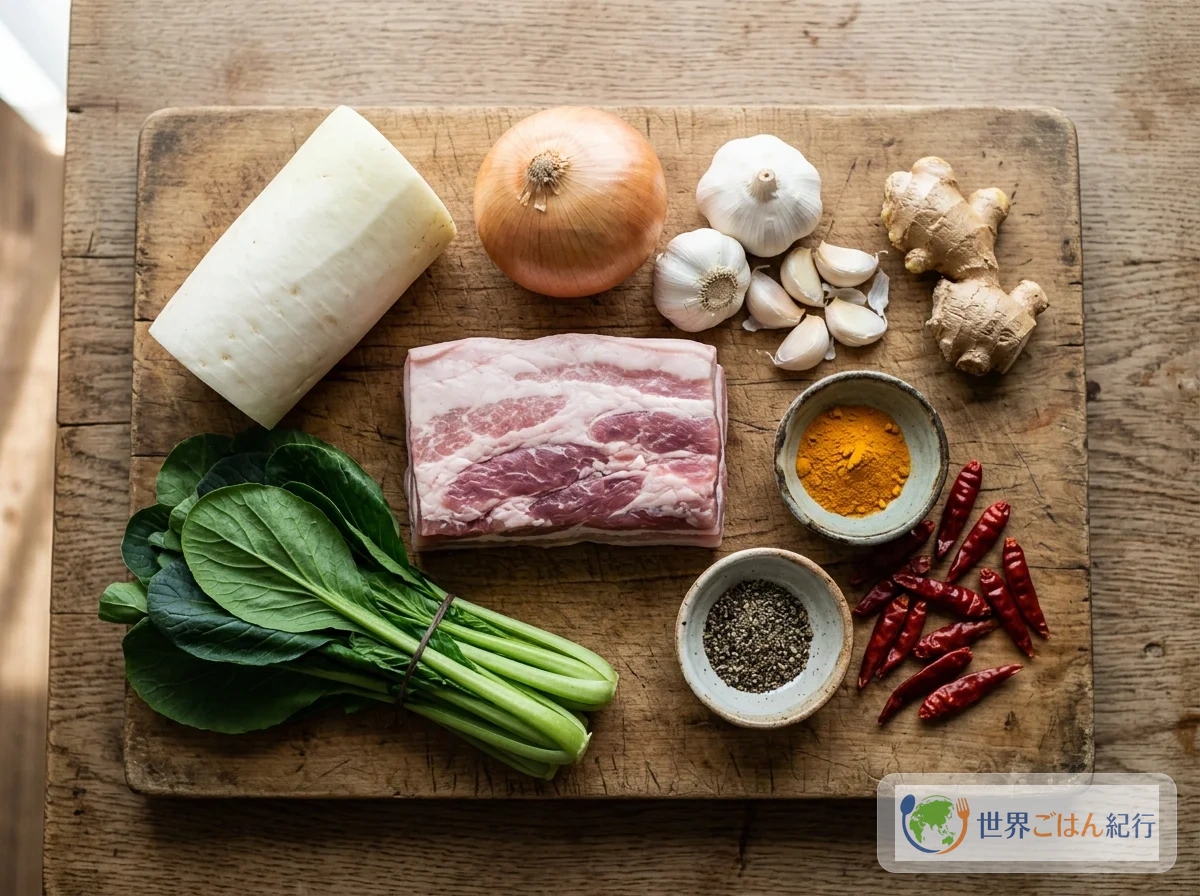
The minimum set is pork belly, daikon, dried red chilies, onion, garlic, ginger, and salt. You can make it with just these. Adding turmeric brings out color and a yellowish red broth that looks Bhutanese. Red rice only gets mixed into white rice, so you need very little. The items hardest to find locally are, in order, red rice, asafetida, Sichuan peppercorns, and ghee. Try online shops or specialty stores.
Method
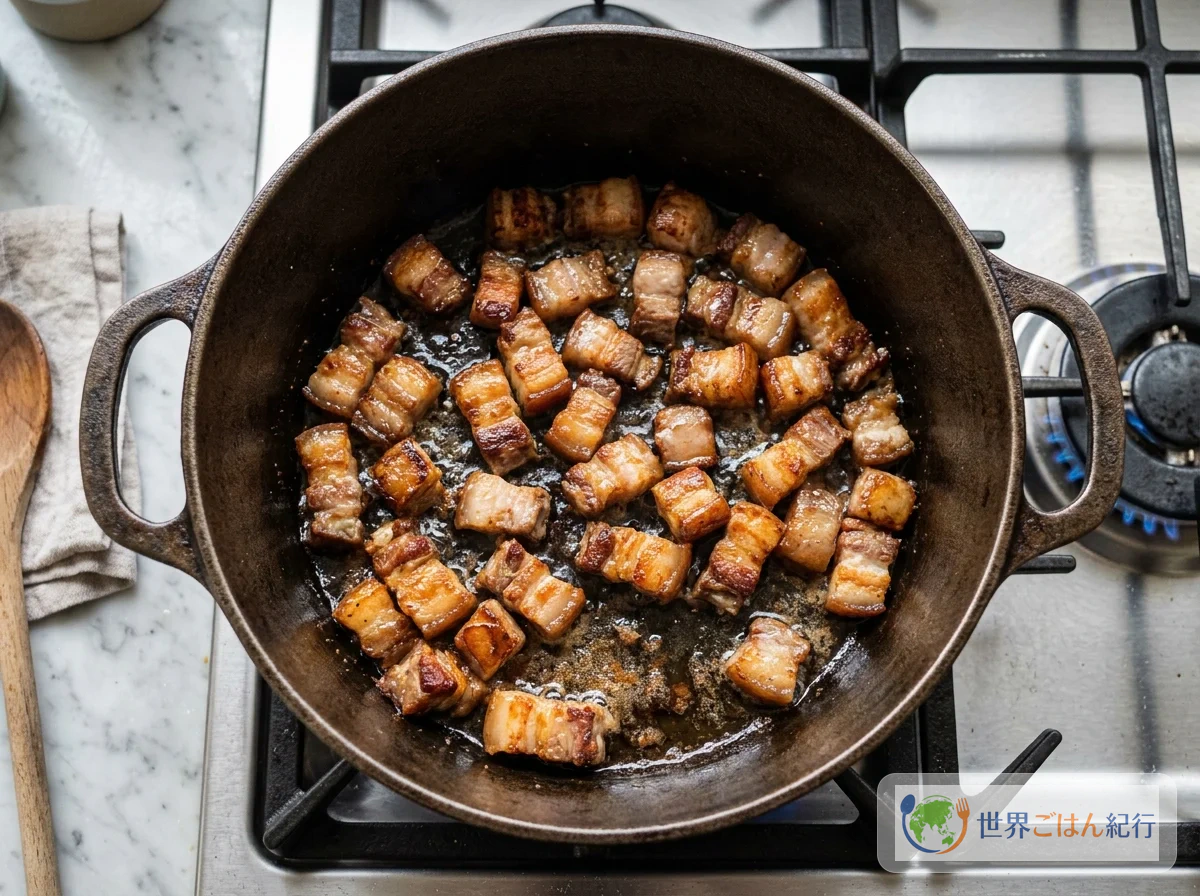
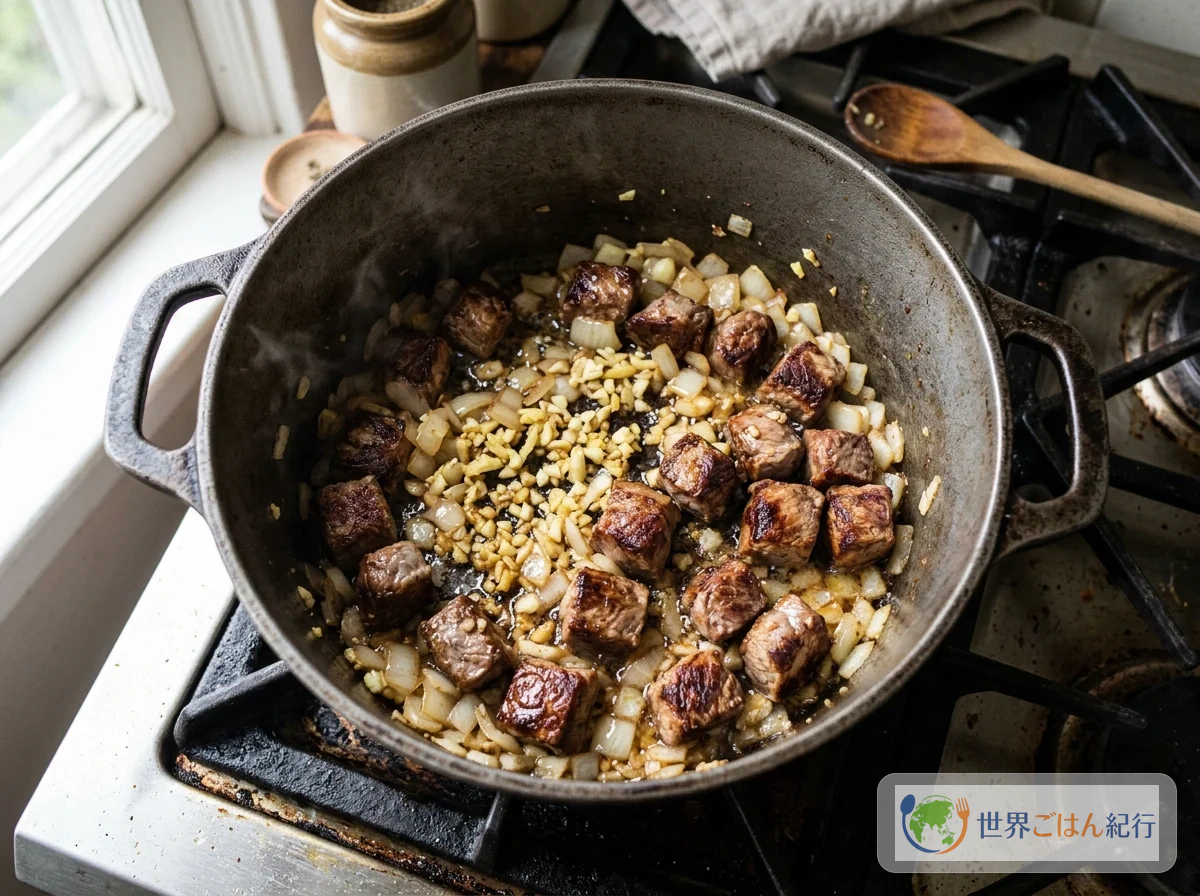
There are seven steps in all. Fry the onion and aromatics in the fat rendered from browning the pork belly, add the chilies and daikon, and stew in water. You add no new oil; frying in the pork's fat alone is the flow of this dish, and ghee is just an optional addition. Chilies turn bitter if they scorch, so fry them only briefly with the daikon. Do not burn the chilies; keep that one thing in mind and begin.
Do not add new oil; fry the onion and daikon in the fat rendered from the pork belly. This is the heart of the flavor, and the fat is the base of the taste. Only if there is too much fat, leave 2 tablespoons and remove the rest.
First make it with the standard 6 chilies (with seeds). If it is too hot, remove the seeds next time; if it is not hot enough, add chopped dried chili at the end. The heat keeps changing as it simmers, so judge with a taste at the finish.
Pork fat spatters while browning. Cover the pot halfway and do not lean in close. After handling chili seeds or powder with bare hands, avoid touching your eyes or nose, and wash your hands well after cooking. For children and people who dislike heat, set aside a portion made first in a separate pot with fewer seedless chilies. Cook the pork thoroughly through to the center.
How to recover when it goes wrong
Trouble usually comes down to how the fat renders, the amount of water, or scorched chilies. You can always add water later, so if it runs short, do not panic; add a little at a time. Look it up by symptom.
| Symptom | Cause | Recovery |
|---|---|---|
| The pork is dry | Boiled hard for too long | Lower the heat, add 50 ml of water, cover, and cook 10 minutes |
| The broth is greasy and heavy | The belly was very fatty | Ladle off 2 to 3 tablespoons of surface fat |
| Too hot to eat | Cooked with the seeds or too many chilies | Add 100 ml of water and more daikon, or dilute with rice or boiled egg |
| Not hot enough | Too few chilies | Chop dried chilies, add them, and simmer 5 minutes |
| The daikon is hard | Cut too thick or cooked too briefly | Cover and cook on low for 10 more minutes |
| The chilies are bitter | They scorched while frying | Remove what you can, add water, and cook again |
Choosing ingredients in a home kitchen
Ordinary pork belly is enough. Fattier pork is used locally, so here belly is chosen. For the daikon, the Japanese kind is close to the local flavor, and using the sharper tip end adds a faint heat. Japanese dried red chilies (takanotsume) are close to the dried chilies used, but they are strong, so adjust the heat by the number of chilies. Coarse Korean chili flakes make it milder but change the flavor.
Red rice gives color and flavor when cooked mixed into white rice. If you have none, brown rice or ancient-grain rice substitutes, though the flavor changes somewhat. Asafetida and Sichuan peppercorns are optional and deepen the aroma. If you have no ghee, use butter; the direction of the flavor shifts a little.
There are a few easy variations. For less heat, use 4 chilies with the seeds removed and finish with pepper. To move toward the local taste that uses dried pork, add store-bought pork jerky or smoked bacon, 100 g (following the variation by the author of The Food Dictator). The greens can be switched for spinach, bok choy, or turnip leaves. I do not recommend a proper vegan version, because pork fat is the heart of the flavor.
Serving and storing
You can pour it over red rice or put it beside the rice as a side dish. Setting it next to other dishes such as ema datshi is also a pleasant way to eat. It keeps 3 days in the refrigerator, and the fat sets when cold but returns when reheated. The flavor settles by the next day, so making a large batch is fine. To reheat, add 2 tablespoons of water and warm over low heat for 5 minutes. I do not recommend freezing, because the texture of the daikon suffers.
Frequently asked questions
Q1. Can I make it with cuts other than pork belly?
You can mix in pork shoulder. The sources also use shoulder. But with less fat, the richness decreases.
Q2. Can I use fresh chilies instead of dried?
You can add shishito peppers or green chilies. The heat and flavor change. For how to use shishito peppers, see the ema datshi article.
Q3. I cannot get red rice
You can make it with brown rice, ancient-grain rice (a red and black rice blend), or white rice.
Q4. How hot is it?
The standard 6 chilies gives a "properly spicy" result. With 4 it is medium, and with the seeds removed it is milder still.
Q5. Are there allergens?
The main ingredients contain no major allergens. If you use ghee (dairy), take care with a milk allergy. For store-bought spices, check the ingredient labels.
Sources
The following were checked on 30 September 2026 (JST).
- Bhutanese cuisine - Wikipedia — red rice, buckwheat, maize, staples and meats, stews of the cold season, and dish names such as Phagshaphu and Sicum paa (accessed 2026-09-30)
- Phaksha Paa Recipe - Foodie Atlas — the basic ingredients of pork belly or shoulder, radish, dried red chilies, onion, garlic, ginger, and turmeric, and about 30 minutes of simmering (accessed 2026-09-30)
- Bhutanese Phaksha Paa - The Food Dictator — a variation adding dried pork and spices, about 35 minutes of simmering, and red rice on the side (accessed 2026-09-30)
- Bhutanese Cuisine: 20 Must-Try Dishes in Bhutan - Druk Asia — the red-rice table, the pairing with ema datshi, and eating it with hoentay (buckwheat dumplings) (accessed 2026-09-30)
Related articles
- Ema datshi: The national dish that sits on the same red-rice table. A vegetable dish of chilies and cheese that pairs very well with the pork stew.
- Dal bhat: The Himalayan set meal of neighboring Nepal. Compare it as a table built around rice with dishes laid alongside.


