


The set meal behind every Nepali day
"Dal bhat power, 24 hour": it's a phrase well known on Nepal's trekking trails. Dal bhat is the staple eaten again and again as the main meal of the day in Nepali homes, and adults and children alike draw their strength for the day from the same plate. In this country, "dal bhat" is sometimes used almost as a synonym for "a meal."
Dal bhat (दालभात) is a Nepali set meal built around a lentil soup, "dal," and rice, "bhat," served on one plate with side dishes such as a vegetable dish, "tarkari," a pickle or relish, "achar," and stir-fried greens, "saag." It resembles the Indian thali, but Nepali dal bhat carries the know-how and nutritional sense of people who live in the high Himalaya.
Legumes and rice are known as a pairing that makes up for each other's missing amino acids. Rice supplies the methionine that lentils are low in, and lentils supply the lysine that rice is low in, so it's easy to get your essential amino acids without eating meat, which is one reason dal bhat took root as the meal of people who work with their bodies.
In Nepali, "dal (दाल)" means lentil soup and "bhat (भात)" means cooked rice. The whole set including the side dishes is sometimes called dal bhat tarkari (दालभात तरकारी). Similar meals are eaten outside Nepal, in northern India, Bhutan and Bangladesh. For South Asian food culture as a whole, see the introduction to South Asian cuisine (in Japanese).
Ingredients (serves 2)

Some supermarkets sell it simply as "red lentils." If you can't find it, look in international grocery stores, Indian or Nepali grocers, or online. Yellow moong dal (split mung beans) also makes a good dal bhat.
Method
Cook the dal (lentil soup)
The dal decides the flavor of dal bhat. Nepali dal is simpler than Indian dal, and the cooking aims to bring out the gentle flavor of the lentils themselves.
Wash the masoor dal in water 2–3 times, rinsing until the water runs clear. No soaking is needed. Because masoor dal (red lentils) is skinless, you can cook it right after washing, which is a big advantage.
Put the lentils, 600 ml water and the turmeric in a pot over high heat. When it boils, skim off the foam, turn the heat to low and simmer for 15–20 minutes. Cook until the lentils have completely broken down into a soup. If too much water cooks off along the way, add about 100 ml.
Once the lentils are cooked, add the tomato, garlic and ginger and simmer 5 minutes more. Season with salt.
The tarka (tempering) is always done to finish the dal. It's a completely different technique from frying spices first and then cooking the lentils. Adding spices to very hot fat releases their essential oils all at once, and they go into the dal at the peak of their aroma. Too much fenugreek turns strongly bitter, so stick to 1/4 tsp.
Make the tarkari (vegetable curry)
Tarkari means "vegetable dish" in Nepali. The tarkari for dal bhat is made with whatever vegetables are in season, so there are endless versions. Here is a basic one with potato, cauliflower and green beans.
Heat the oil in a frying pan and stir-fry the potato over medium heat for 3 minutes. When the surface turns translucent, add the cauliflower and green beans and sprinkle in the turmeric, ground cumin, ground coriander and salt. Add 3 tbsp water, cover, and steam-cook over low heat for 8–10 minutes. It's done when a skewer slides easily into the potato.
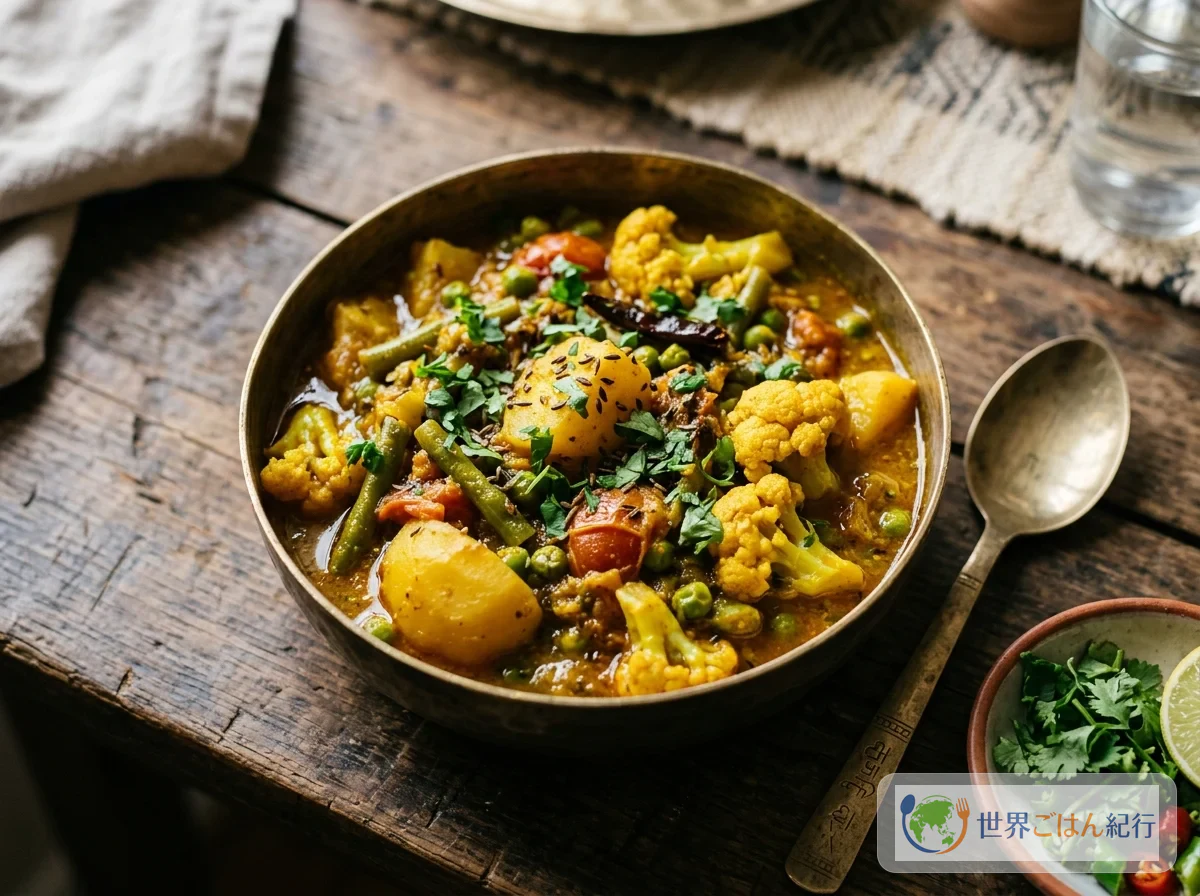
They look alike, but Nepali tarkari is lighter on spice than Indian sabzi and lets the vegetables' own flavor lead. The main spices are the basic three, turmeric, cumin and coriander; complex spice blends with garam masala or cardamom, as in Indian cooking, are used less. This simplicity is part of dal bhat's charm. It shares the "let the ingredients speak" philosophy of Middle Eastern tabbouleh (in Japanese).
Make the achar (tomato pickle)
Achar is an essential condiment for dal bhat. Its sourness and heat sharpen the gentle flavors of the rice and dal and whet the appetite. Nepal has dozens of achars, but here is the most basic one, tomato achar.
Dry-toast the white sesame seeds and grind them lightly in a mortar. Coarsely chop the tomato and toss it with the green chile, lemon juice, salt and ground coriander. Mix in the ground sesame and it's done. It's a fresh achar that needs no cooking.
Plating: building a world on a thali
Dal bhat has its own way of being served. Heap the rice in the center of a large plate (a thali) and arrange the dal, tarkari and achar around it, in small bowls or directly on the plate.
In Nepal, dal bhat is traditionally eaten with the right hand. You pour dal over the rice, mix in a little tarkari and achar at a time, and gather the rice with your right fingertips to bring it to your mouth. Of course, a spoon is perfectly fine at your own table.
Plate the rice
Mound the rice in the center of a large plate, which takes about a minute. Keep basmati light and fluffy so you don't crush the grains; with short-grain rice, loosen it lightly with a rice paddle, then shape it into a mound 5–6 cm high. Leaving about 3 cm of space around it for the bowls and side dishes keeps it from collapsing when you pour on the dal.

Arrange the side dishes
Pour the hot dal into a small bowl or one corner of the plate and arrange the tarkari and achar around it, which takes about 2 minutes. The Nepali way is to keep the dal steaming hot and pour it over the rice just before eating. Spacing the side dishes so their colors don't overlap makes it easier to mix them in a little at a time as you eat.

When you order dal bhat at a Nepali eatery or trekking lodge, refills of dal and rice are free. As you near the end of your plate, someone comes over with the pot and asks, "Dal? Bhat?" The Nepali way is to accept without hesitation. This culture of free refills is what keeps the "dal bhat power" going.
The history of the dish: food wisdom shaped by the Himalaya
The history of dal bhat is inseparable from farming in Nepal. On the southern flanks of the Himalaya, Nepal has used climate zones created by huge differences in altitude to grow rice in the lowlands and corn, millets, legumes and vegetables in the hills and mountains.
Dal bhat is described as having grown up in farming villages as an affordable, nourishing meal to sustain hard agricultural work. But rice was not always available. In the hills and mountains, dhido, a stiff dough of buckwheat or corn flour stirred into hot water, was the traditional staple.
Nepal as a country took shape in the late 18th century, after King Prithvi Narayan Shah of the Gorkha Kingdom conquered the Kathmandu Valley and unified the surrounding states. In a country home to many peoples and languages, dal bhat today is a meal shared across regions and ethnic groups.
In modern Nepal, too, dal bhat is eaten across social classes, ethnicities and religions. Hindus, Muslims and Buddhists, Tamang, Newar and Chhetri: all eat the same dal bhat. The type of lentil, the tarkari and the seasoning of the achar vary endlessly by region and household, but the structure of "dal + bhat + side dishes" never changes.

Cooking tips: five techniques for perfect dal bhat

1. Don't fear the tarka
What transforms the flavor of dal bhat is the tarka (tempering; also spelled tadka). It's the technique of putting spices into very hot fat to extract their essential oils, then pouring that over the finished dal.
People often say they're afraid of the oil spattering, but the trick is to make it in a separate small pan, not in the dal pot. Heat the ghee in a small skillet and add the cumin seeds. When they start to pop and crackle, add the mustard and fenugreek seeds, followed by the garlic and red chile, and as soon as the edges of the garlic color, pour it into the dal.
Dal without tarka is just "salty soup." Only with the tarka does it become "Nepali dal."
2. Judge the consistency of the dal
The thickness of Nepali dal varies a lot from home to home and by taste.
| Consistency | What it looks like |
|---|---|
| Thin | Runny, like miso soup |
| Medium | Flows slowly off a spoon |
| Thick | Thick and creamy, like a potage |
If it's your first time, aim for medium. When you scoop it with a spoon, it should flow off slowly. If it's too thin, simmer it down; if too thick, add hot water.
3. Don't skimp on the ghee
In Nepali cooking, ghee (clarified butter) plays an even bigger role than olive oil does elsewhere. As the base of the tarka, as butter spooned straight over the rice, as the frying fat for the tarkari, ghee turns up all over a plate of dal bhat.
If you don't have ghee, melt butter in the microwave and use the clear top layer for a quick ghee. Or swap the 1 tbsp of ghee for "2 tsp butter + 1 tsp vegetable oil" and you still get plenty of richness.
4. More rice is the right amount
If you serve rice in a typical side-dish portion, it's far too little for dal bhat. Compared with nasi goreng (in Japanese) or nasi lemak (in Japanese), the amount of rice in dal bhat is overwhelming. In Nepal, at least two rice bowls' worth is heaped in the center of the thali. Because you pour on dal and mix in tarkari as you eat, the plate doesn't balance unless there's plenty of rice.
Basmati rice cooks into separate grains that the dal clings to, getting you closer to the texture you'd find in Nepal. If you use short-grain rice, cook it a little firm. In rice-centered South Asian dishes like biryani (in Japanese), the quality of the basmati makes a big difference to the result.
5. Change things up with achar
One of the joys of dal bhat is that the flavor changes as you eat. Start with just dal and rice, then mix in tarkari, and add achar partway through. The balance of heat, sourness and savoriness keeps shifting, so you never get bored.
Besides tomato achar, Nepal has many other achars.
| Achar | Ingredients | Flavor |
|---|---|---|
| Golbheda ko achar | Tomato, sesame | Sour and toasty (the recipe in this article) |
| Timur ko achar | Timur (Nepali Sichuan pepper), lemon | Tingling heat, similar to Japanese sansho |
| Mula ko achar | Daikon radish, spices | Crunchy. A winter staple |
| Badam ko achar | Peanuts, chile | Rich, nutty heat |
Dal bhat variations: a national meal that changes by region and people
Nepal stretches about 900 km from east to west, and its elevation ranges from 60 m to 8,848 m (Everest). This remarkable geographic diversity has produced countless variations of dal bhat.
The Terai (southern plains)
The Terai of southern Nepal is a subtropical plain bordering India and the country's largest grain-growing region. Dal bhat here is the style closest to the Indian thali, and is often described as having thinner dal and more pronounced spices. It may be served with papad (thin lentil crackers).

The Kathmandu Valley (Newar food culture)
The Newar are the indigenous people of the Kathmandu Valley, with a rich food culture of their own. Newar dal bhat sometimes uses a soup of nine mixed beans called kwati. Kwati is always served on the day of Janai Purnima (the sacred thread festival).
In Newar homes, chiura (beaten, flattened rice) is also sometimes eaten instead of bhat. Chiura needs no cooking and keeps well, so it's handy as a midday meal during farm work. On a day you want to go further into Newar cooking, with meat as well, read about pukala (in Japanese), eaten with chiura, for a glimpse of Nepal's festive side beyond lentils and rice.
The hills and mountains
In highlands unsuited to rice, dhido, a dough of buckwheat, corn or millet flour stirred into hot water, can take the place of bhat. It's still eaten with dal, tarkari and achar; only the staple changes to the local grain.
Even the "dal bhat" at trekking lodges differs from lodge to lodge in the lentils, the side dishes and the heat. The same name with slightly different contents from place to place is the mark of true home cooking.
Thakali cooking: the pinnacle of Nepali food
No discussion of Nepali food is complete without the Thakali. Originally from Thak Khola, along the Kali Gandaki River between the Annapurna and Dhaulagiri ranges, they have a long history of running inns and eateries along the trade routes and are known as excellent cooks.
In cities like Kathmandu, many dal bhat restaurants advertise Thakali food, and they are popular with locals too.
Shopping guide: gathering the ingredients for dal bhat
The ingredients for dal bhat are almost all available at a supermarket and a spice shop. As long as you have masoor dal (red lentils) and cumin seeds, you can make a basic dal bhat.
Where to find the key ingredients
| Ingredient | Where to look |
|---|---|
| Masoor dal (red lentils) | International grocers, Indian grocers, online |
| Cumin seeds | Supermarket spice aisle |
| Ground turmeric | Supermarket spice aisle |
| Ghee | International grocers, online |
| Fenugreek seeds | Indian grocers, online spice shops |
| Basmati rice | International grocers, online |

Lentils and whole spices come in large bags at Indian or Nepali grocers and specialist online shops, which works out cheaper if you'll make this often. To try it in small amounts first, the supermarket spice aisle is plenty.
Substitution techniques
| Ingredient | Substitute | How the result differs |
|---|---|---|
| Masoor dal | Moong dal (split mung beans) | Slightly sweeter. Breaks down the same way |
| Masoor dal | Brown lentils | Don't break down as easily. Add 10 minutes of cooking time |
| Ghee | Butter + vegetable oil | Slightly less rich, but works fine |
| Basmati rice | Short-grain rice (cooked a little firm) | Stickier texture, but delicious |
| Fenugreek | None (can be omitted) | Less authentic, but still works well |
| Timur (Nepali Sichuan pepper) | Sichuan pepper (Chinese) | Similar tingle. Timur is more citrusy and fresh |
Frequently asked questions

Q1. Don't people get tired of eating dal bhat every day?
It's hard to tire of because its components (the type of lentil, the tarkari, the achar) change daily. Monday might be masoor dal with potato tarkari, Tuesday moong dal with cauliflower tarkari, Wednesday chana dal with radish achar. It's all "dal bhat," but in practice a different dish every day, much as a Japanese meal of rice, miso soup and side dishes changes from day to day.
Q2. Can I use curry powder in dal bhat?
You can, but it becomes something other than Nepali dal bhat. Curry powder is a ready-made blend of many spices with its flavor already set, which doesn't fit the Nepali philosophy of letting the ingredients speak. Using only the three spices turmeric, cumin and coriander gets you closer to the original flavor.
Q3. Can I use a pressure cooker?
Of course. Pressure cookers are widely used in Nepali homes too. With masoor dal, 5 minutes at pressure plus natural release is all it takes. A pressure cooker is especially handy when you use firmer legumes such as moong dal or chana dal.
Q4. What's the difference between dal bhat and an Indian thali?
The structure is similar, but Nepali dal bhat is generally lighter on spice and puts the ingredients first. Indian thalis are known for complex spicing with garam masala, cardamom, cloves and more, while Nepali dal bhat centers on the basic three: turmeric, cumin and coriander. Another notable feature in Nepal is the eatery custom of free refills of dal and rice.
Q5. Can vegetarians and vegans eat it?
Dal bhat is vegetarian as it is. Swap the ghee for vegetable oil and it's fully vegan. Everyday dal bhat centers on vegetable tarkari, and some households add a meat dish (masu) on some days. For other dishes built on plant protein, see hummus (in Japanese) and falafel (in Japanese).
Dal bhat and trekking: fuel for the Himalaya
Nepal means Himalayan trekking, and food on a trek means dal bhat.
On famous routes such as Everest Base Camp and the Annapurna Circuit, dal bhat is served at almost every lodge. The higher you go, the more the food has to be carried up by people and pack animals, and meal prices climb too. Through all of that, dal bhat is the go-to choice as a filling standby that comes with refills.
Besides dal bhat, trekking menus include momo (Nepali dumplings) and chow mein (fried noodles), but for nutrition and staying power, dal bhat is the one to rely on. As another hearty dish tied to a long-distance food culture, Ethiopia has stamina food like doro wat (in Japanese).
The advice from experienced trekkers is "Order the dal bhat." There are three reasons.
- Refills are often available, so you can eat properly
- It's familiar and easy on the stomach, easy to eat even when your appetite drops up in the mountains
- It's easy to get balanced nutrition: protein from lentils + carbohydrates from rice + vegetable side dishes
Related articles: legume dishes of the world and the South Asian table
If dal bhat has caught your interest, try these articles too.
More South Asian food: If dal bhat is everyday food, biryani, South Asia's spiced layered rice (in Japanese) is for special days. The introduction to South Asian cuisine (in Japanese) gives an overview of the region's food culture.
Legume dishes of the world: Feijoada (in Japanese) is a Brazilian national dish built on the same "beans + rice" pairing. Hummus (in Japanese) is the Middle East's chickpea classic, another high point of legume cooking.
Asia through aroma: Gapao rice (in Japanese) brings the same Asian "rice + topping" style with Thai heat.
In summary: a simple set meal with real depth
On paper, dal bhat is just "lentil soup and rice." But when the aroma of the tarka, the seasonality of the tarkari and the sourness and heat of the achar come together on one plate, you understand why this dish remains Nepal's everyday meal.
Try recreating a Himalayan table with ingredients from your own kitchen. With 150 g of red lentils and a pinch of cumin seeds, your kitchen is already in Nepal. To continue a journey through the world's "legumes + grain" set meals, try feijoada (Brazil's black bean stew, in Japanese) and injera (Ethiopia's fermented flatbread, in Japanese) as well.
Sources
Books and papers:
- Pathak, J. (2007). Taste of Nepal. Hippocrene Books. A comprehensive cookbook of Nepali home cooking
Reports and articles:
- Finn Church Aid (2024). "Nepal runs on the power of dal bhat." (checked 22 October 2026) Dal bhat as the everyday meal, its side dishes, and "24 hour dal bhat power"
- World Travel Guide. "Nepal Food and Drink." (checked 22 October 2026) Dal bhat as a set meal of rice, lentil soup, vegetable dish and pickle; eating with the right hand
- Wikipedia. "Dal bhat." (checked 22 October 2026) The dal, bhat and tarkari structure; dhido in the hill regions
- Wikipedia. "Prithvi Narayan Shah." (checked 22 October 2026) The 18th-century unification of Nepal
| Item | Value |
|---|---|
| Energy | 520 kcal |
| Protein | 18 g |
| Fat | 12 g |
| Carbohydrates | 82 g |
| Dietary fiber | 8 g |
| Salt | 1.7 g |
Combining legumes and rice makes it easy to get a good balance of essential amino acids from plant foods alone.


