


The scent of okra in the kitchen: India's dry sabzi
Cut okra and a fine strand of stickiness stays on the board. In many places the sliminess of this vegetable is something to enjoy, but in India's bhindi fry it is taken in a slightly different direction. Wipe the pods well dry and cook them in a wide pan without touching them too much. The stickiness then becomes not a gummy film but a thin film that the spices cling to.
Bhindi fry (Bhindi fry / Bhendi fry) is a home dish of the Indian subcontinent in which okra is stir-fried with onion, tomato, cumin, turmeric, coriander, amchur and more. In Hindi okra is "भिंडी (bhindi)," and in Marathi and some regions it is also written "bhendi." In the English-speaking world it is also called okra fry, bhindi masala and ladies' finger fry, and is loved as an everyday sabzi that goes with roti or rice.
The difficulty cooking it elsewhere is water more than seasoning. Cutting right after washing, covering to steam, salting early, adding a lot of tomato. Any one of these makes okra string quickly and clump at the bottom of the pan. Conversely, dry the okra, spread it over medium heat at first, and leave the acidity and salt for the second half, and even a home pan gets quite close to the local texture.
This article aims between the dry bhindi fry of North India and a bhindi masala dry in which onion and tomato cling a little. It cooks off the vegetable water like aloo gobi (in Japanese) but is not simmered as much as chana masala. Add raita and roti for dinner and the okra alone is the center of the plate.
This article uses the easily searched "Bhindi fry" as the main name. Local-language and English spellings include Bhindi fry, Bhendi fry and Bhindi masala dry. It is treated as a dry home stir-fry, separate from bharwan bhindi (stuffed) and kurkuri bhindi (battered and fried).
Ingredients (serves 4)

Amounts for 4 as a side dish, or a light main with roti and dal. The heat is kept mild, so you can raise the chili powder at the end. Slender, young okra has fewer fibers and finishes toasty in a short time.
Main ingredients
Basic bhindi fry uses no wheat, dairy, egg, meat or fish. But commercial spice mixes, garam masala, and any naan or roti served with it may contain wheat, dairy and nuts. Check the labels when buying.
Ingredients that cause hesitation when shopping
With bhindi fry, the difference comes less from the okra itself than from the ingredients that move aroma into the oil. Okra, onion and tomato are fine from an ordinary supermarket. The ones worth seeking are the spices that can be reused again and again and are easy to get wrong on the shelf.
Cumin seeds: the aroma the moment they go into the oil is the signal of this dish. It can be made with ground cumin alone, but when whole seeds are made to sputter, the okra becomes a proper sabzi rather than just curry-flavored.
Ground coriander is plainer than chili or garam masala, but it is the base that rounds off the green aroma of okra. It is also easy to use in khichdi and samosa, so if you keep cooking Indian food it is a spice that rarely goes to waste.
Amchur is dried mango powder. Lemon can substitute, but because it is a powdered acidity the finish does not turn watery. Just a little sprinkled on bhindi fry, aloo gobi or a bean salad takes out the heaviness.
For the first time cumin seeds, ground coriander, turmeric and garam masala are enough. Lemon can stand in for amchur. If you will make bhindi fry often, adding amchur, which keeps the finish from turning watery, can come in that order.
Method
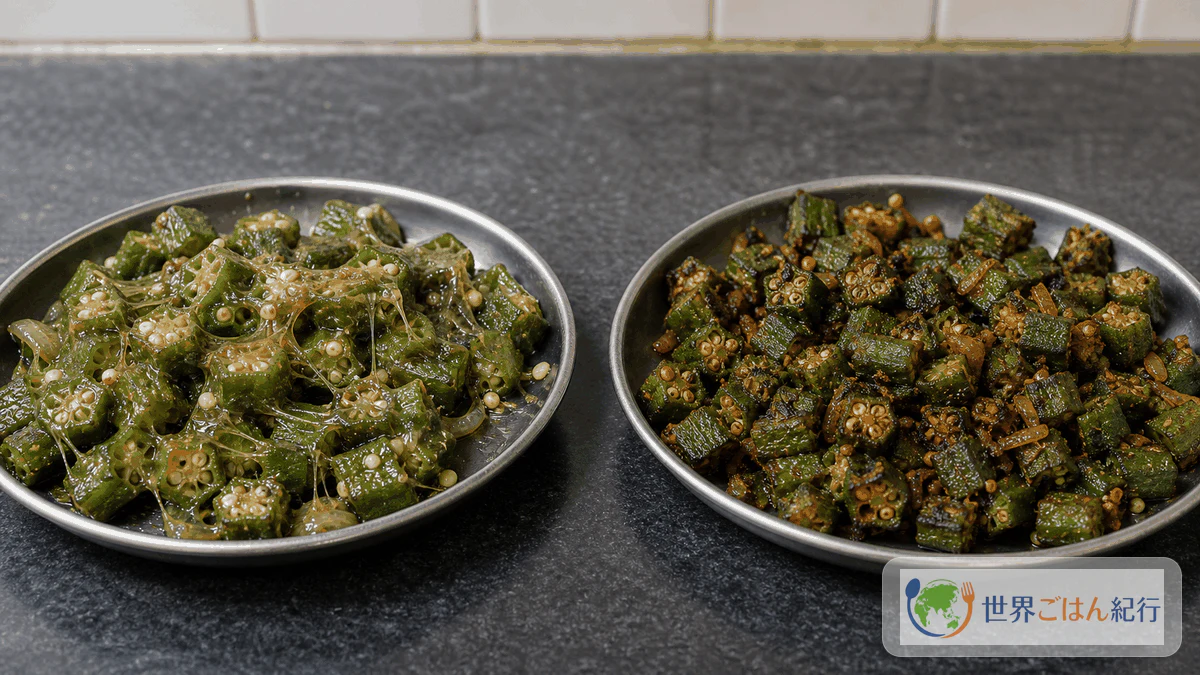
Bhindi fry is not a dish to cook all at once over high heat. First let the water escape over medium heat, then lower the heat once the powdered spices go in. Touching the okra too much releases the seeds and increases the stickiness, so the number of times you stir is part of the dish.
You want to soften okra quickly, but covering from the start returns steam and increases the stickiness. In a household pan, keeping "5 minutes spread over medium heat" and "6 minutes drying over medium-low heat" greatly reduces failure.
What to keep and what to change in a home kitchen
Bhindi fry is home cooking, so there is some range in the ingredients. But if you change everything it becomes "curry-fried okra." What to protect is the management of the okra's moisture, the cumin that releases aroma in oil, and the acidity added last.
| Where you hesitate | Local-leaning | Realistic elsewhere | Effect on the result |
|---|---|---|---|
| Okra | Slender, young bhindi | Ordinary supermarket okra is fine | Thick ones have hard seeds, so slice them thinner on the diagonal |
| Washing | Wash then dry completely | Wipe with a cloth and leave 10 minutes | Skipping this increases the stickiness |
| Aroma | Cumin seeds sputtered in oil | At least have whole cumin | With curry powder alone the aroma is flat |
| Acidity | Amchur | 2 tsp lemon juice | Add the lemon after turning off the heat |
| Tomato | A small amount, semi-dry | Can be omitted | Too much makes it watery and better suited to rice |
| Heat | Green chili and chili powder | Omit the chili | Even for children the aroma remains |
| Frozen okra | Not much used | Fry hard without thawing | It releases water, so the texture falls |
Okra at the supermarket turns over quickly in summer, but sometimes water droplets cling inside the bag. Rather than cutting it straight from the bag, wrapping it first in a cloth changes the result by itself. Condensation also forms right after taking it from the refrigerator, so the 10 minutes before cutting works better than you'd expect.
Amchur can be substituted. Lemon, lime or a little rice vinegar all add acidity. But vinegar tends to bring an East Asian aroma, and lemon increases moisture. The strength of powdered amchur is that it adds acidity while staying dry. Think of it less as getting closer to the local taste than as a practical tool for keeping okra from getting sticky, and it becomes easier to buy.
Looking at regional differences, even for the same stir-fried okra the amount of moisture changes depending on what it is paired with. Bhindi fry in the North Indian lean is dried so it can be picked up with roti, with less onion and tomato. Bhendi fry around Maharashtra, in some homes using peanut or coconut, brings toastiness and sweetness a little forward. Moving toward South India's vendakkai poriyal and vendakkai varuval, curry leaves, mustard seeds and coconut appear, and the taste sits close to rice and sambar.
| Name / direction | Center of aroma | Staple it pairs with | If leaning toward it elsewhere |
|---|---|---|---|
| Bhindi fry / bhindi masala dry | Cumin, coriander, amchur | Roti, chapati, rice | The formula in this article. Make it a dry sabzi |
| Bhendi fry | Cumin, sometimes peanut or coconut | Roti, rice | Add 1 tbsp crushed peanuts at the finish |
| Vendakkai poriyal | Mustard seeds, curry leaves, coconut | Rice, sambar | Reduce the cumin and add a little finely grated coconut at the end |
| Kurkuri bhindi | Batter, chili, chaat masala | Snack, side dish | A different dish. Keep it apart from the stir-fry in this article |
This recipe takes the dry finish of the North Indian lean, which goes with both roti and rice. To lean toward South India, replace some of the cumin seeds with mustard seeds and put curry leaves in the oil. But curry leaves are hard to find in many places, so for the first round don't force a search and give priority to the step of drying the okra.
Eating, storage and linking to the menu

The easiest way to eat it is wrapped in chapati or roti. Dry bhindi fry does not drip, and the onion and okra hold together, so it is easy to handle even on a weeknight dinner. If putting it on rice, placing it beside khichdi or dal matches the softness of the beans with the toastiness of the okra.
On days you have made it a little hotter, putting raita beside it pulls the plate together. On a meat day it is also handy as a vegetable plate for tandoori chicken or side dishes that go with tandoori chicken. It is lighter than aloo gobi (in Japanese), which includes potato, and quicker than the bean chana masala, so it fills the gaps in an Indian menu.
For storage, 2 days refrigerated is the guide. Let it cool slightly before putting it in an airtight container, and keep droplets from forming on the inside of the lid. For reheating a pan is better than a microwave. Lay 1 tsp oil and warm over medium-low heat for 3 to 4 minutes, driving off the moisture at the bottom of the pan, and the texture returns close to freshly made.
I don't recommend freezing. On thawing the cells of the okra break down and stickiness and water come out easily. If there is leftover, wrapping it in a thin omelet the next morning, putting it on toast, or chopping it and mixing it with a little yogurt as a sandwich filling uses the texture better.
FAQ
What is the most important tip for reducing the sliminess of okra?
Dry it before cutting. After washing, wipe off the water with the pods whole, leave 10 minutes and then cut. If you wash after cutting, water enters through the cut ends and the stickiness tends to remain even after frying.
Can I make it with frozen okra?
You can, but the texture falls. It releases water when thawed, so put it frozen into a wide pan, drive off the water over medium heat and then combine with the onion and spices. Frozen sliced okra breaks easily, so reduce the number of times you stir.
Is it more authentic to leave out the tomato?
Both exist. For a dry bhindi fry, no tomato; leaning toward a masala dry with onion and tomato, add a little. In a household pan, a lot of tomato brings the water back, so holding it to 1 is easier to handle.
What can I substitute if I have no amchur?
Add 2 tsp lemon juice after turning off the heat. Vinegar also gives acidity, but the aroma tends toward East Asian, so lemon or lime suits better. To avoid making it watery, just toss lightly after adding the lemon juice.
Can I make a non-spicy bhindi fry for children?
Leave out the green chili and chili powder and make it with only cumin, coriander, turmeric and garam masala. Even without heat, sputtering the cumin seeds in oil keeps the aroma. Adults can add chili powder or lemon just before eating, which makes it easy to split.
Does the color go bad if made ahead?
It turns a slightly darker green. For storage, drive off the water before putting it in the container, and rewarm in a pan before eating. If using lemon, leave it out of the make-ahead portion and sprinkle it on just before eating, which keeps the color and texture better.


