The Story of Raita: A White Side Dish That Lets You Enjoy Spicy Food to the End
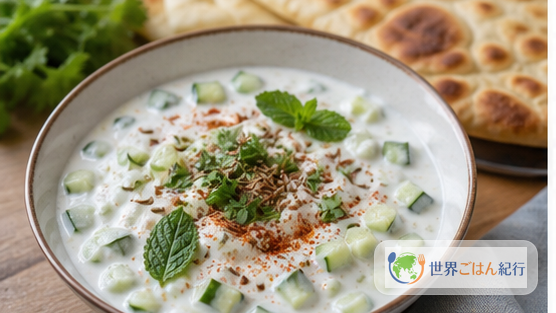
On a day when you have made curry or tandoori chicken, a single white bowl on the table brings reassurance. Red oil, grilled spices, hot rice. And beside them, the cool aroma of yogurt and cucumber. Take a spoonful and the heat on your tongue quietly drains away, and the next bite tastes good again. Raita is a side dish that turns the Indian table from a meal where you "put up with the heat" into one you can enjoy to the end.
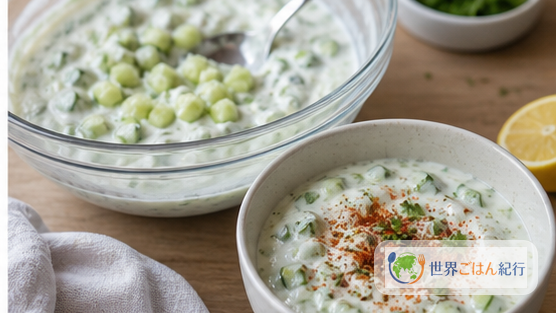
Raita (रायता / raita) is a standard accompaniment around India, yogurt mixed with vegetables, herbs, and spices. English-language explanations of Indian food describe raita as a "palate-cooler," a dish whose job is to cool the mouth heated by spicy food. Bon Appétit's guide to Indian condiments also presents raita, unlike chutney, as a side dish for which you need not choose a fixed pairing with each dish but may freely choose the kind that tempers the heat just right.
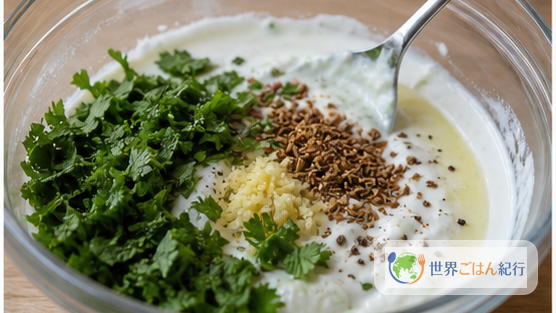
When you make raita outside India, the common failures are that it is watery, the flavor is blurred, and the cucumber's grassy smell grows stronger the next day. The causes gather around the thickness of the yogurt, the timing of the salt, and the water in the cucumber. The ingredients will take shape just by mixing, but if you lightly draw water from the cucumber, dry-toast the cumin, and combine them shortly before eating, the outline of a cold white side dish becomes clear.
In how to make tandoori chicken (in Japanese) and seven side dishes for tandoori chicken (in Japanese), raita was used as a "side dish that cools the heat." In this article, that raita stands on its own as a basic form you can take to biryani, samosas, dal, grilled vegetables, and kebabs. A cold raita also makes it easier to keep eating spicy South Indian meat dishes with strong black pepper and curry leaf, such as Kerala beef fry. Raita is also an easy dish to start with as an entry point to an overview of Indian cuisine.
The base is the North Indian-leaning raita of "cucumber, yogurt, mint, and cumin." It assumes ordinary unsweetened plain yogurt from a grocery store, and sorts out whether to drain it, how to use Greek yogurt, a soy yogurt substitute, and the limits of making it ahead.
Raita Is Not Only a Sauce That Erases Heat
If you think of raita only as "yogurt served with curry," it inevitably becomes a thin supporting player. At a real table, it is a dish with a finer set of jobs. It receives the sting of chili. It cools the charred aroma of tandoor cooking. It cuts the oil left on the grains of biryani. It adds moisture to the potato filling of samosas. If chutney and achar are there to add flavor, raita is there to restore the rhythm of eating.
So raita does not have to be the same thickness every time. For naan or samosas, make it a little firmer, like a dip. Over biryani, thin it so that it just thinly coats the grains. Beside a spicy meat dish, strengthen the mint and lemon to cool the mouth. Beside lentils or khichdi, add aroma with cumin and black salt. Reproducing it in your own kitchen, too, you are less likely to fail by deciding thickness and aroma according to how you want to make that day's main dish easier to eat, than by searching for "the correct dish."
With this way of thinking, raita stops being a leftover side. If you find yogurt in the refrigerator before making curry, cut a cucumber, dry-toast cumin, and chop a few herbs. That one small bowl makes a place to rest the mouth between bites of a spicy main.
What to Keep and What to Replace in Your Own Kitchen
Raita as an Indian home dish is not fixed to a single finished form. Some households chop the cucumber finely; others grate it to a texture close to the yogurt. There are days with strong mint, days with coriander, days when aroma is added with black salt or chaat masala. What they share is that it is placed beside a spicy main or an oily rice dish and lowers the temperature of the table.
Three things to keep in your own kitchen are to use unsweetened yogurt, to check the cucumber's moisture beforehand, and to bring out the aroma of the cumin. Miss these and it tastes sweet like a dessert, water appears in the refrigerator, or it becomes just a thin yogurt sauce. The herbs, on the other hand, can be replaced. If you have no mint, use shiso; if you dislike cilantro, use green onion; if you have no black salt, ordinary salt is fine. At a table where someone avoids dairy, it is more practical to add lemon and a little oil to unsweetened soy yogurt than to force ordinary yogurt.
| What to keep close to the original | Replacement elsewhere |
|---|---|
| Use unsweetened, tart yogurt | Ordinary unsweetened plain rather than low-fat. If thick, thin with water |
| Draw a little water from the cucumber with salt | Start with 5 mm cubes rather than grating, which keeps it from getting watery |
| Make the cumin the core of the aroma | Dry-toast the seeds. If you have none, mix powder into the yogurt |
| Herbs create the coolness | Choose from mint, cilantro, shiso, and green onion whatever suits the table |
Ingredients (serves 4): Gather Them at an Ordinary Grocery Store
There are few ingredients in raita. That is why the tartness of the yogurt, the water of the cucumber, and the aroma of the cumin come through directly. Rather than lining up expensive spices, first choose unsweetened plain yogurt and take care not to cut the cucumber too fine. Grating it finely gives unity but also releases the water all at once. At first, a rough chop is easier to handle.
The basic recipe contains dairy. If you avoid dairy, use unsweetened soy yogurt, and if the tartness is weak, add 1 tsp lemon juice. Raita is a side dish that is not heated. Use clean utensils, do not leave it at room temperature for long, and finish it in the refrigerator within the same day to the next day as a guide.
Work Out the Thickness Backward from the Main Dish
When raita seems watery, it is often less the ingredients themselves than a mismatch between how you eat it and its thickness. Beside biryani, if it is too firm it will not coat the rice; beside samosas, if it is too loose the crust soon turns damp. Beside tandoori chicken, a sweet yogurt blurs the aroma of the grilled spices. Before you make it, decide what dish it will sit next to.
| How it is eaten | Target thickness | Handling the yogurt |
|---|---|---|
| Spooned over biryani | Flows slowly off the spoon | Use 300 g ordinary yogurt as is. If firm, 1 tbsp water |
| Dipped with samosas | Scoops up and does not drip easily | 250 g Greek yogurt, or drain ordinary yogurt for 10 minutes |
| Beside tandoori chicken | Holds in a small bowl but is not heavy | 300 g ordinary yogurt, pressing the cucumber's water out well |
| Beside dal or khichdi | Spreads lightly over rice | Add 1–2 tbsp water or milk, go easy on the salt |
Using Greek yogurt makes it thicker, but it is not always right. At an Indian table, rice, lentils, oil, sourness, and heat are all moving at once. Lean toward Greek yogurt only on days you want a thick dip, and on days you serve it with a rice dish, lightly adjusting ordinary plain yogurt is easier to handle.
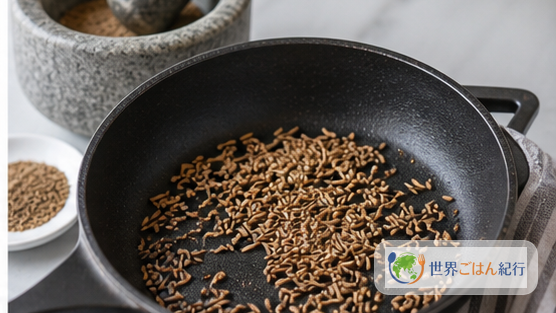
The ingredient most worth buying for raita is cumin. It is the core of the slightly earthy, warm aroma that lies deep within curry powder. Toast and crush it, and it gives an outline to the white taste of yogurt.
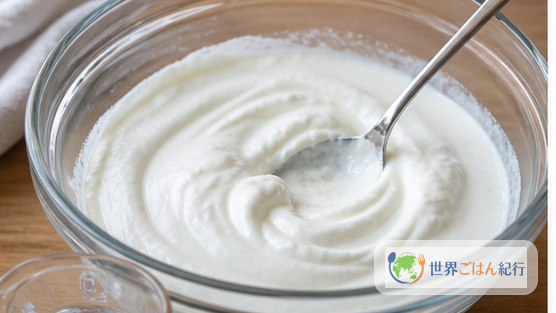
For yogurt, ordinary plain is easier to handle than low-fat. On days you want it rich, choose Greek yogurt; on days you want it light, as if drinking it, choose ordinary yogurt.
Even on days you find chopping herbs a bother, adding either mint or cilantro gives it the profile of Indian food. Leftover mint can go into chutney or lemon water.
Method: Steps That Keep It from Getting Watery
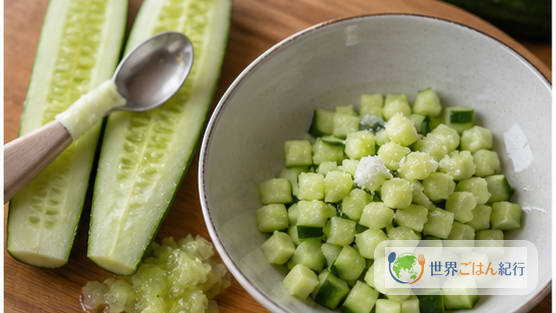
Raita uses almost no heat. If any, it is only the short time dry-toasting the cumin. The steps are simple, but the order of mixing changes the result. Salt the cucumber to draw out water. Smooth the yogurt first. Bring out the aroma of the cumin. Combine at the end. If you keep to this flow, a limp watery layer is less likely to appear even after a short rest in the refrigerator.
If you squeeze hard because you want to remove water, the cucumber's crunch shrinks. Salting, resting 5 minutes, and pressing the surface water with paper is enough. Take water out a little more firmly only if you want to keep it until the next day.
Cooking Tips: Handling the Yogurt, Salt, and Cumin
Raita looks like a dish of "just mixing," but the difference between good raita and vague raita lies in small things. If the yogurt is too cold, the aroma closes; if left too long at room temperature, there is a safety concern. Make it right after taking it out of the refrigerator, and return it to the refrigerator for 10 minutes after finishing. That is about right to handle at home.
Made with Greek yogurt, it becomes rich and suited to dipping. On the other hand, if you want to spoon it over biryani or khichdi, a slightly looser one blends into the rice. Add 1 tbsp each of water, milk, or the juice squeezed from the cucumber to thick yogurt to suit how you eat it.
Separate the salt that draws water from the cucumber from the salt that sets the flavor of the yogurt. Putting it all in at the start can make it taste salty once chilled. Keep the finishing salt modest, especially on days the main dish is rich.
On days you have no cumin seeds, you can make it with 1/2 tsp ground cumin. But ground cumin loses its aroma easily, so mixing it into the yogurt blends better than sprinkling it at the end. If you are going to buy more, seeds keep their aroma longer.
Some regions and households put garlic in raita, but raw garlic can taste sharper the colder it gets. Beside tandoori chicken or kebabs, leave the garlic out or use only a tiny amount. With a rice dish like biryani, ginger is gentler.
BBC Good Food's cucumber raita shows a flow of combining yogurt with mint and coriander, removing the cucumber seeds, and mixing just before eating. The idea of keeping the cucumber separate until the last when making ahead is practical in home kitchens elsewhere too. Make the yogurt base in the morning and mix in the cucumber before dinner, and you can keep it from getting watery.
Variations
Once you have learned the basic cucumber raita, change it a little to suit the main dish. Raita is not a dish that steals the lead. It is a side dish for cooling heat, cutting fat, and making rice and bread easier to eat. So when you vary it, you will not be lost if you think not about "what to add" but about "where the main dish needs help."
Boorani-style raita for biryani
Mix into 300 g yogurt 1/4 clove grated garlic, 2 tsp lemon juice, 1/2 tsp cumin, and 1/3 tsp salt. Leave out the cucumber and make it a smooth sauce. Beside Hyderabadi-style biryani, letting the garlic aroma rise just a little makes it easier to receive the fat of the rice and the spices.
Mint raita for tandoori chicken
Double the mint in the basic raita and add 1 tsp lemon juice. The red marinade of tandoori chicken is strong in sourness, chili, and char, so the coolness of mint suits it well. It is also a form that fits easily into the minimal set in seven side dishes for tandoori chicken (in Japanese).
Tomato-cucumber raita for samosas
Halve the cucumber and add 80 g seeded tomato and 20 g red onion. Placed beside fried samosas (in Japanese), it softens the heaviness of the oil. If the onion is sharp, soak it in water for 5 minutes, drain it well, and then mix it in.
Black salt raita for dal and khichdi
In addition to cumin, add a pinch of black salt. It has a slightly sulfurous aroma that suits lentil-and-rice dishes such as khichdi and dal bhat. Black salt has a strong aroma, so really start with a tiny amount.
Vegan raita with soy yogurt
To 300 g unsweetened soy yogurt, add 3 tsp lemon juice, 1 tsp olive oil, and 1/3 tsp salt. Without the richness of dairy, adding a little oil rounds out the mouthfeel. The cilantro, mint, and cucumber can stay at the same amounts.
If you have leftover mint and cilantro, add lemon juice, salt, a little sugar, and water to make something like mint chutney. It can go with tandoori chicken, samosas, and roti canai, so even if you buy a whole bunch of herbs, it is easier to use it all.
Pairing and Shopping
Raita tends to be left over as "I made it but don't know what to pair it with." If you decide the main dish first, the thickness and flavor you need become clear. For biryani, smooth with a little garlic. For tandoori chicken, stronger mint and lemon. For samosas, add texture with tomato and onion. For dal, add aroma with black salt and cumin. You adjust by looking at the strength of the main dish.
Beside a steamed snack, it also goes well with dhokla (in Japanese), made from a fermented rice-and-lentil batter. To receive the sweet-sour tempering, a basic raita with finely cut cucumber and a little moisture left is easier to use.
| Main dish | Direction of the raita | What to add |
|---|---|---|
| Tandoori chicken | More mint, stronger lemon | Shiso, cilantro, black pepper |
| Biryani | Smooth, a little garlic | Ginger, black salt, fried onion |
| Samosas | More vegetables, stronger sourness | Tomato, red onion, a little chili |
| Khichdi | Less salt, more cumin | Black salt, shiso, mint |
| Kebabs and grilled meat | Richer, more herbs | A little garlic, sumac, lemon |
If you are unsure what to buy, "yogurt, cucumber, and cumin" are enough to start. Mint and cilantro bring aroma when you have them, but they are not required. If you keep cooking Indian food, having small jars of garam masala, cumin, turmeric, and chili powder lets you reuse them for samosas (in Japanese) and khichdi too.
Raita kept in a storage container can also be used the next day for sandwiches or grilled vegetables. To avoid the smell of yogurt transferring, a glass container is handy.
Basmati rice is not an ingredient of raita itself. But on days you make biryani or a spiced rice pilaf, the place for raita becomes suddenly clear. If you are thinking as far as placing a white bowl beside a rice dish, it is worth looking at them together.
A small sprinkle of garam masala at the finish leaves an Indian-style afterglow on the coldness of the yogurt. It can also go to samosas, khichdi, and tandoori chicken, so for those who have made do with curry powder alone, there is a reason to keep it on its own.
Storage and Making Ahead: Best on the Same Day
Raita is a cold side dish, so it looks suited to making ahead. But from the moment cucumber and yogurt are mixed, water gradually comes out. The color of the herbs fades too. In terms of taste, the easiest time to eat it is between 10 minutes and 2 hours after making it.
For safety, as FoodSafety.gov and the FDA advise, it is important not to leave perishable foods containing dairy at room temperature for long. As a guide, return it to the refrigerator within 2 hours at room temperature, or within 1 hour outdoors on a hot day or in a hot place. The refrigerator should be at 4°C or below as a guide.
If you make it ahead, divide it like this. The base of yogurt, cumin, salt, lemon, and herbs can be made the night before. Cut the cucumber without salting it and refrigerate it in a separate container. Ten minutes before eating, salt the cucumber, press out the water, and mix it into the base. This way, watery liquid is less likely to appear even the next day.
I do not recommend freezing. The yogurt separates and turns grainy after thawing. If you have leftovers, use them the next morning as sandwich sauce, a dip for grilled vegetables, or beside a spiced omelet. If water has come out, pour off the liquid on top lightly and add a little cumin and lemon to recover it.
When bringing back raita that has released water, look at the liquid on top before mixing. If the liquid is nearly clear, pour it off lightly; if it is liquid that keeps the white of the yogurt, mix it back in. If the flavor has gone thin, add cumin and lemon first, not salt. Rebuilding it with salt alone tends to leave only saltiness once chilled.
Do not eat it if the sour smell is stronger than usual, there are bubbles on the surface, a bitterness has appeared, or the herbs have turned black. Raita uses inexpensive ingredients. Making small amounts each time is safer than forcing yourself to finish it.
Background of the Dish: The Indian Table Is Completed by Its Side Dishes
When you reproduce Indian cooking at home, your attention inevitably goes only to the main dishes: curry, tandoori chicken, samosas, biryani. All have strong names and bring satisfaction just from making them. But read recipes from India and the English-speaking world, and beside the main dish raita, chutney, achar, kachumber, papad, and rice or bread naturally line up. Rather than pushing spicy food through as spicy, putting out a little at a time of what is cold, sour, strongly aromatic, and crunchy is what completes the whole table.
Bon Appétit's guide to Indian condiments sorts chutney, raita, achar, and kachumber as having separate roles. Raita in particular is a yogurt side dish that cools the mouth heated by spicy food. In Japanese recipes it tends to be explained only as "yogurt served with curry," but in fact it is a refuge for the palate and a regulating role that makes the next bite taste good.
Looking at several BBC Good Food raita recipes also shows how wide the range is by household: cucumber, mint, coriander, garam masala, ginger, tomato, onion, and more. In other words, raita is not a dish that "must use these ingredients." It is a dish you change according to the heat and oil of the main dish, whether it is rice or bread, and the season in which you eat it.
In restaurants leaning toward North India, you see white raita served beside biryani and tandoor dishes. At home, it may be set as a small bowl in a corner of the table with cooked rice, roti, stewed lentils, fried food, and herb chutney. With a cold side dish, it becomes easier to receive not only the heat of chili but also the aroma of oil and charcoal. So raita is less a supporting player that erases heat than a tool for setting the pace of eating.
In your own kitchen, cucumber and yogurt are easy to get, and cumin has come to be found on supermarket spice shelves. Learn raita first and you will not be lost for the last move at the table, whether it is a tandoori chicken day, a samosa day, or a day of stewed lentils.
How It Differs from Similar White Side Dishes
Dishes that combine cucumber and yogurt are not unique to India. Greece's tzatziki, Turkey's cacık, and Bulgaria's tarator and snezhanka also combine cold dairy with cucumber, garlic, and herbs. By ingredients alone they look alike, but their positions at the table differ a little.
Tzatziki tends to bring garlic and olive oil forward and is strongly a dip served with grilled meat and pita. Bulgarian tarator leans toward being thinned with water and drunk like a cold soup, and snezhanka toward a white salad firmed with strained yogurt. Raita sits between them, a dish placed beside rice, lentils, grilled foods, and fried foods with a strong role of receiving heat and oil.
What people are unsure about in a home kitchen is how much garlic to put in. In tzatziki and some Middle Eastern and Balkan yogurt side dishes the garlic asserts itself, but in raita it is easier to reuse when kept to an amount that does not interfere with the aroma of the main dish. Especially beside biryani or tandoori chicken, it is enough if the coldness of the yogurt, the aroma of cumin, and the bite of the cucumber come first. Rather than treating the world's white side dishes as the same thing, looking at the thickness each is meant to be served with will also steady how you make raita.
FAQ
Q1. How many days ahead can I make raita?
It is best on the same day. If you prepare the day before, make only the base of yogurt, cumin, salt, lemon, and herbs, and mix in the cucumber just before eating. With the cucumber in, water comes out easily, and even refrigerated, up to the next day is the guide.
Q2. Is it too thick if I make it with Greek yogurt?
As is, it leans toward a dip. If you want to spoon it over biryani or khichdi, thin it by adding 1 tbsp each of water, milk, or the juice squeezed from the cucumber. For naan or samosas, it is good left firm.
Q3. Can I make it if I don't like mint or cilantro?
Yes. Shiso, green onion, or just chopped cucumber works. If you leave out the herbs, use a little more cumin and make up the aroma with lemon juice so it does not blur.
Q4. What do I do with a dairy allergy?
You can substitute unsweetened soy yogurt. Without the richness of dairy, adding 1 tsp olive oil and a little lemon juice rounds it out. However, if you have a soy allergy, avoid soy yogurt too.
Q5. How is raita different from chutney?
Raita is a cold side dish based on yogurt, whose role is to cool the heat. Chutney is a sauce made with herbs, fruit, chili, and sourness, with a strong role of adding flavor. With tandoori chicken, cool with raita and add aroma with mint chutney, and the roles divide.
Q6. Can raita and tzatziki be made the same way?
They can be made with similar ingredients, but the flavor is placed differently. Tzatziki often brings out garlic, olive oil, and sourness clearly and leans toward a dip for meat and bread. Raita leans toward a side dish that receives a spicy main with cumin, mint, and cucumber. If you serve it with Indian food, it comes together more easily with less garlic and more cumin.
With Raita, Indian Food Doesn't Tire You Out
Raita is not a difficult dish. Smooth the yogurt, draw a little water from the cucumber, and bring out the aroma of the cumin. Get that far and you have a cold side dish that can sit beside spicy food. When the aroma of tandoori chicken is rising in the kitchen, or after you have fried samosas, taking raita out of the refrigerator settles the temperature of the table one notch.
At first, cucumber, yogurt, cumin, and lemon are enough. Once you are used to it, increase the mint, add tomato, use black salt, or switch to soy yogurt. Changing it a little at a time to suit the main dish, raita becomes not just an accompaniment but a small tool for continuing to cook Indian food at home.
If you are making something next, the clearest choice is to serve this raita with tandoori chicken (in Japanese). For a lighter day, khichdi; for a snack or starter, samosas (in Japanese). If you would like to widen your South Asian table, choose the next dish from the overview of Indian cuisine.
Sources
- BBC Good Food "Raita" https://www.bbcgoodfood.com/recipes/raita (accessed 2026)
- BBC Good Food "Cucumber raita" https://www.bbcgoodfood.com/recipes/chunky-cucumber-raita (accessed 2026)
- Bon Appetit "The Essential Guide to Indian Condiments" https://www.bonappetit.com/test-kitchen/primers/article/indian-condiments-chutney-pickles-raita (accessed 2026)
- FoodSafety.gov "4 Steps to Food Safety" https://www.foodsafety.gov/keep/basics/clean/index.html (accessed 2026)
- FDA "Are You Storing Food Safely?" https://www.fda.gov/consumers/consumer-updates/are-you-storing-food-safely (accessed 2026)
- Wikipedia "Tzatziki" https://en.wikipedia.org/wiki/Tzatziki (accessed 2026)
- Wikipedia "Snow White salad" https://en.wikipedia.org/wiki/Snow_White_salad (accessed 2026)