
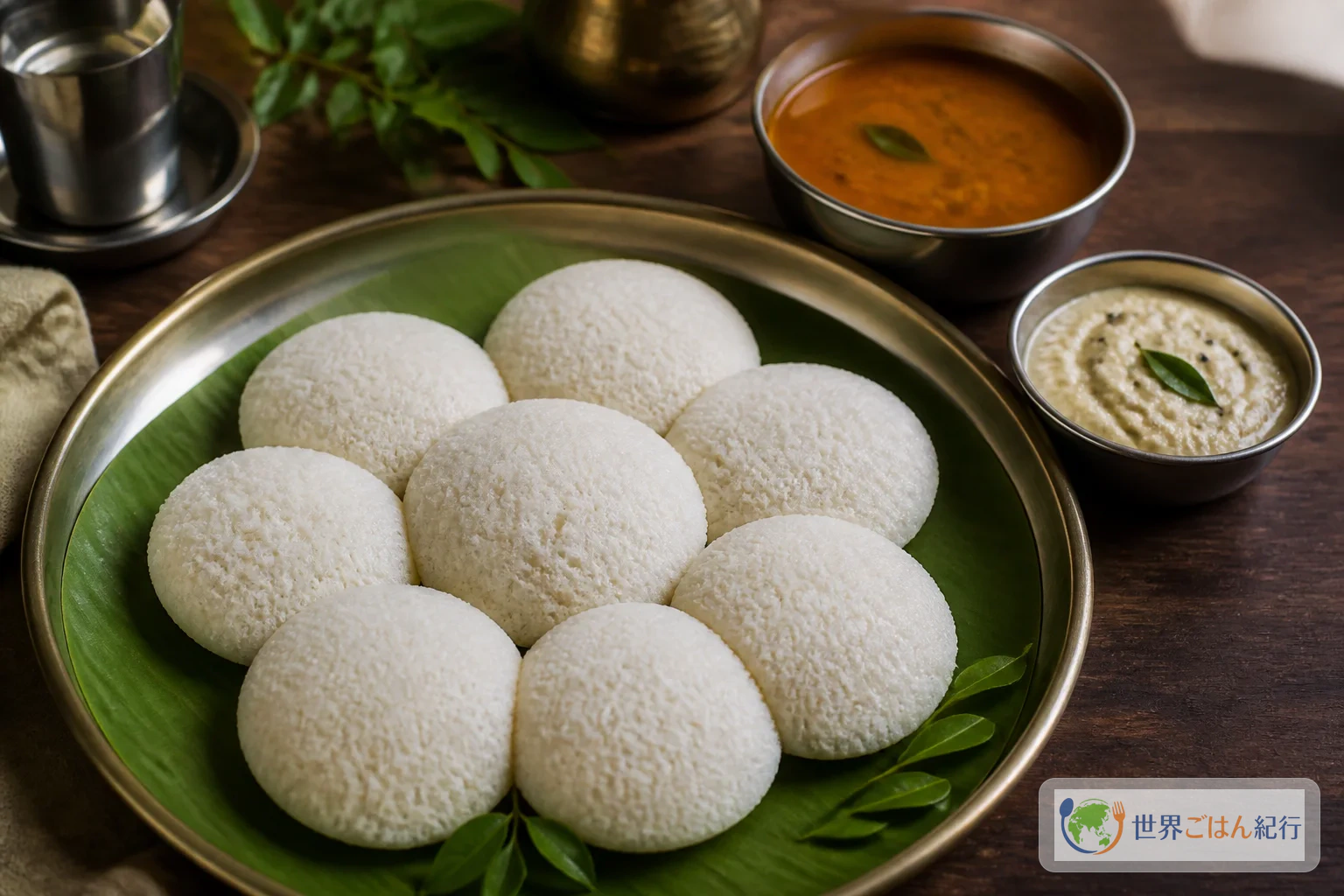
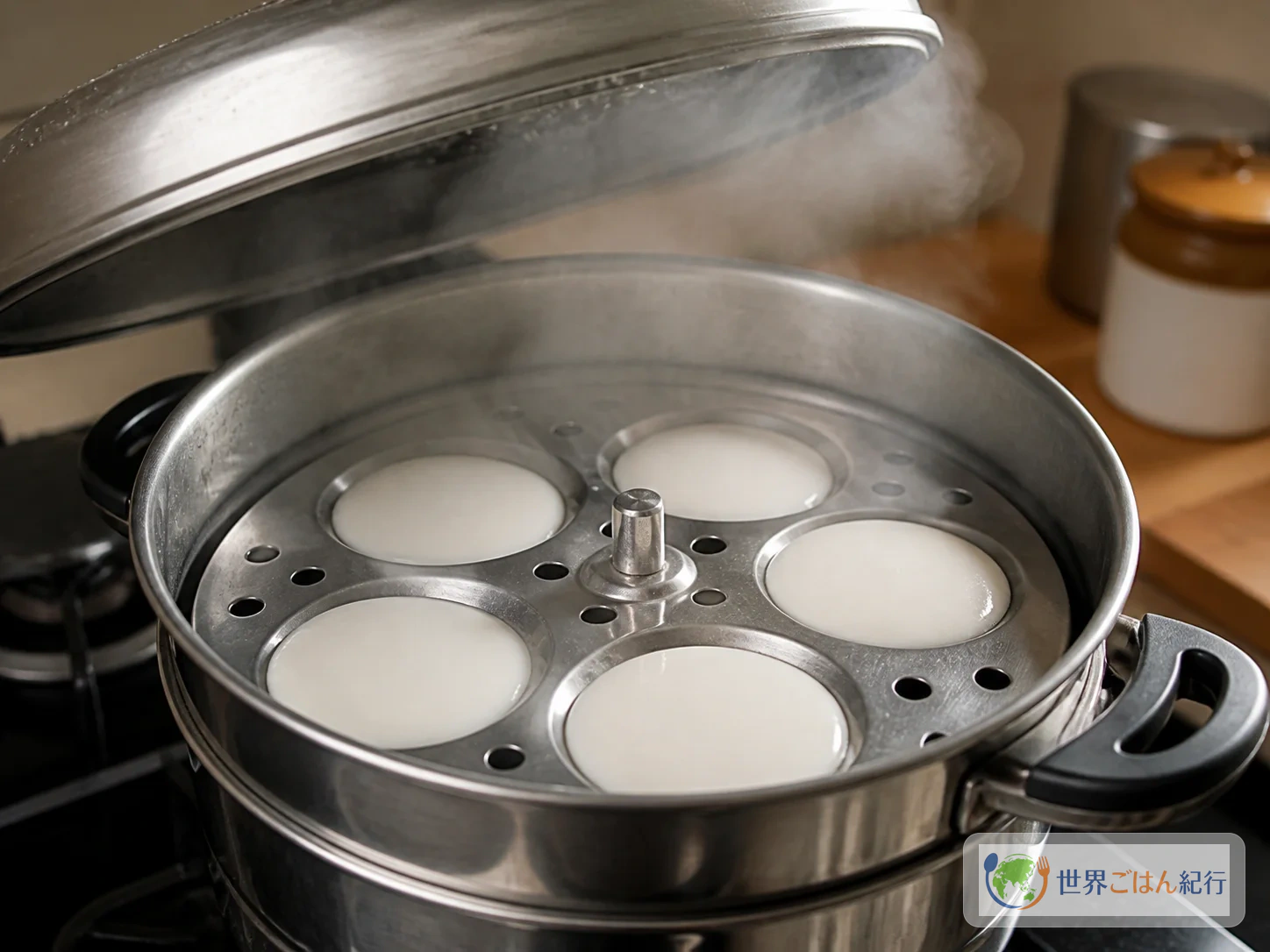
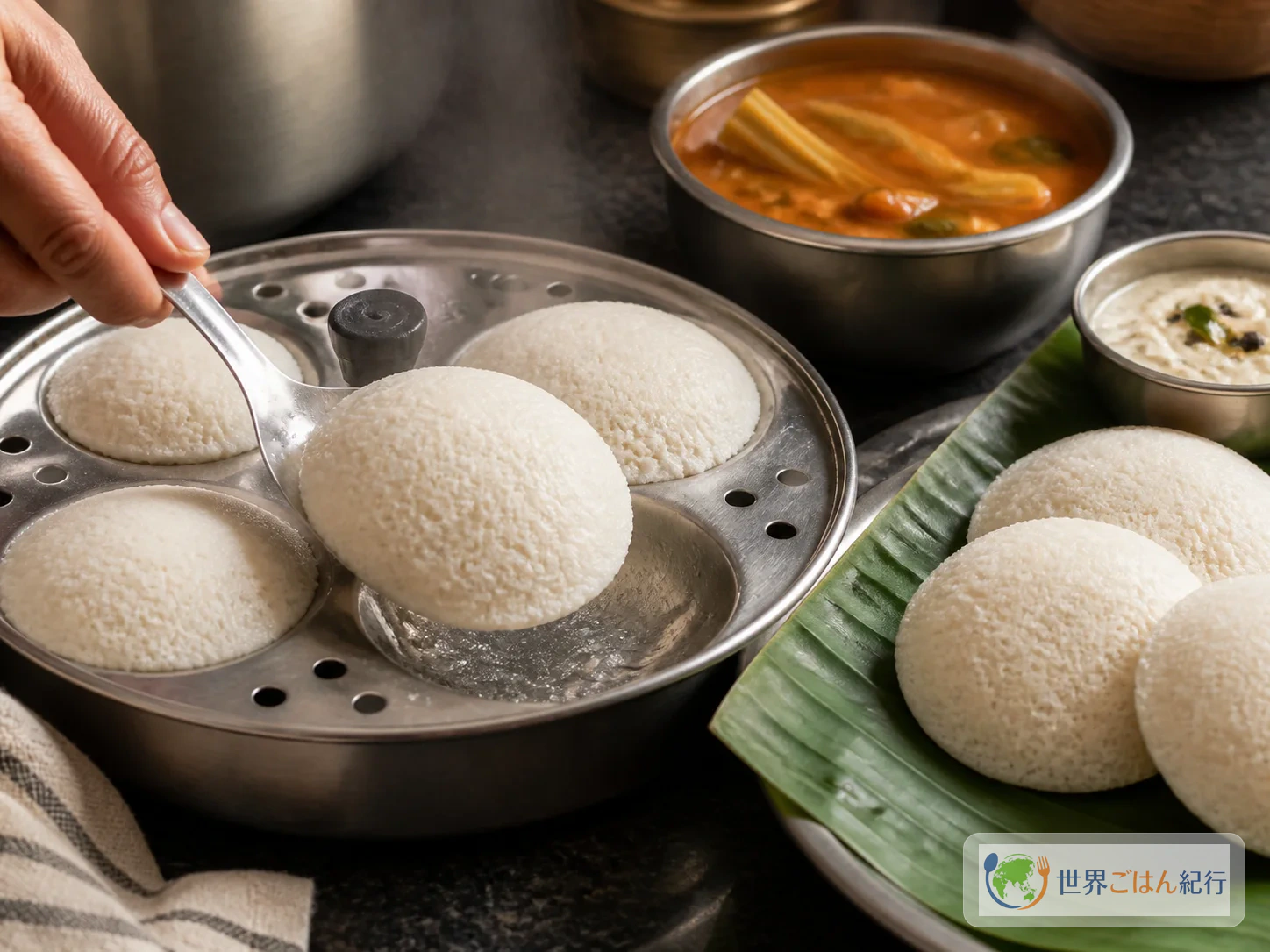
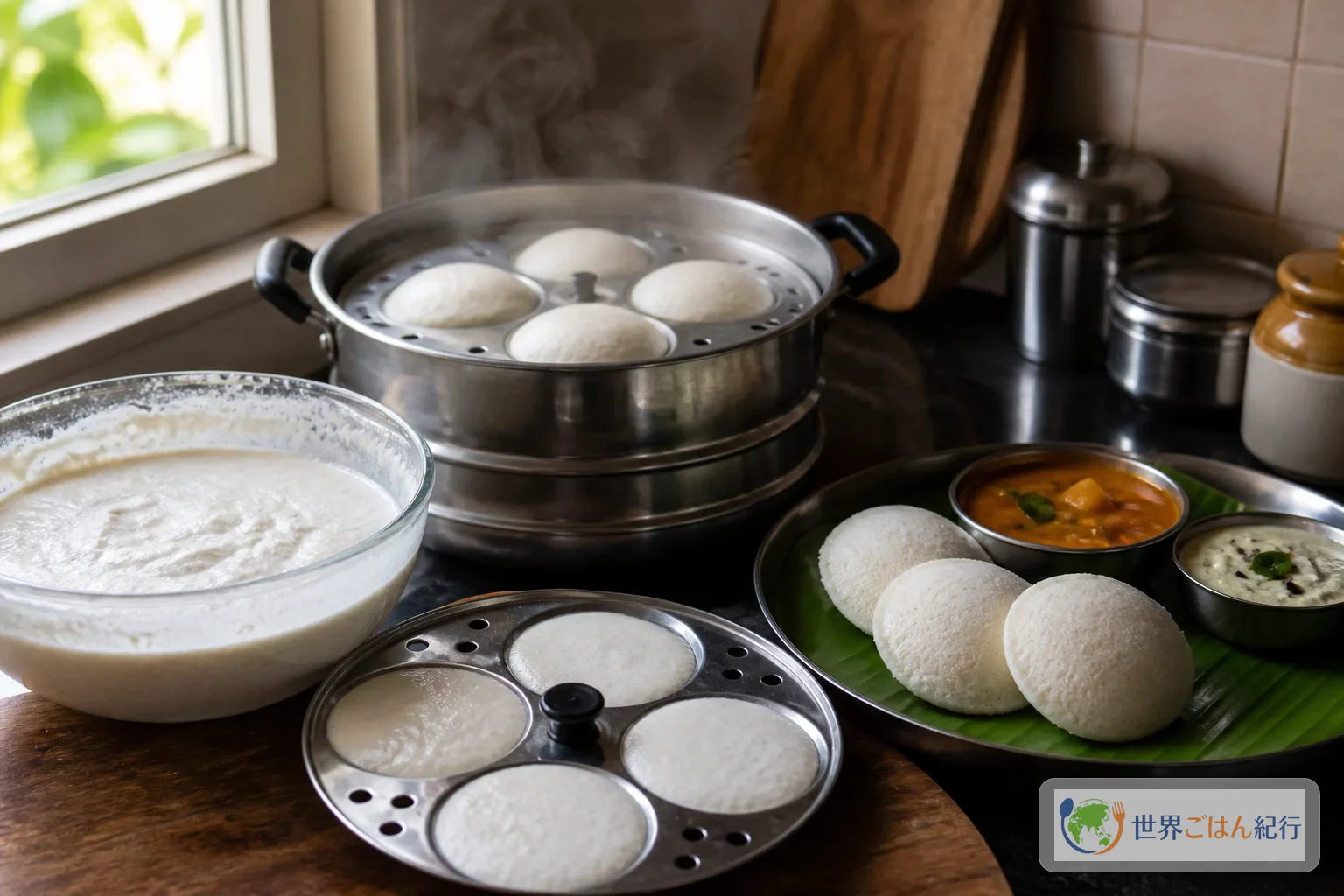
When you lift the lid of the steamer, the moisture held in the rice-and-lentil batter escapes as white steam. The surface looks dry, yet it springs slowly back when you press it lightly. Put a spoon in and you find no baked crust, only a soft crumb full of tiny air bubbles.
Idli (இட்லி) is a South Indian dish made by soaking and grinding rice and skinned urad dal separately, fermenting the batter, and steaming it. It can share a batter with dosa, but it is not spread thin on a griddle. Steam keeps it thick, so the stickiness of the lentils and the bubbles of fermentation become the texture itself.
Whether idli succeeds depends on not over-stirring the fermented batter and steaming it in the mold at an even thickness. Rather than chasing the clock, watch for rise, bubbles, sourness and the spring of the steamed cake, in that order, and you can adjust for any season or climate.
About 16 small idli, serving 4. It is an intermediate recipe because you start the day before, but it uses no special starter. If you have skinned urad dal and can grind the rice and lentils separately, a home blender will do.
Idli at the Table, and How It Changes by Region
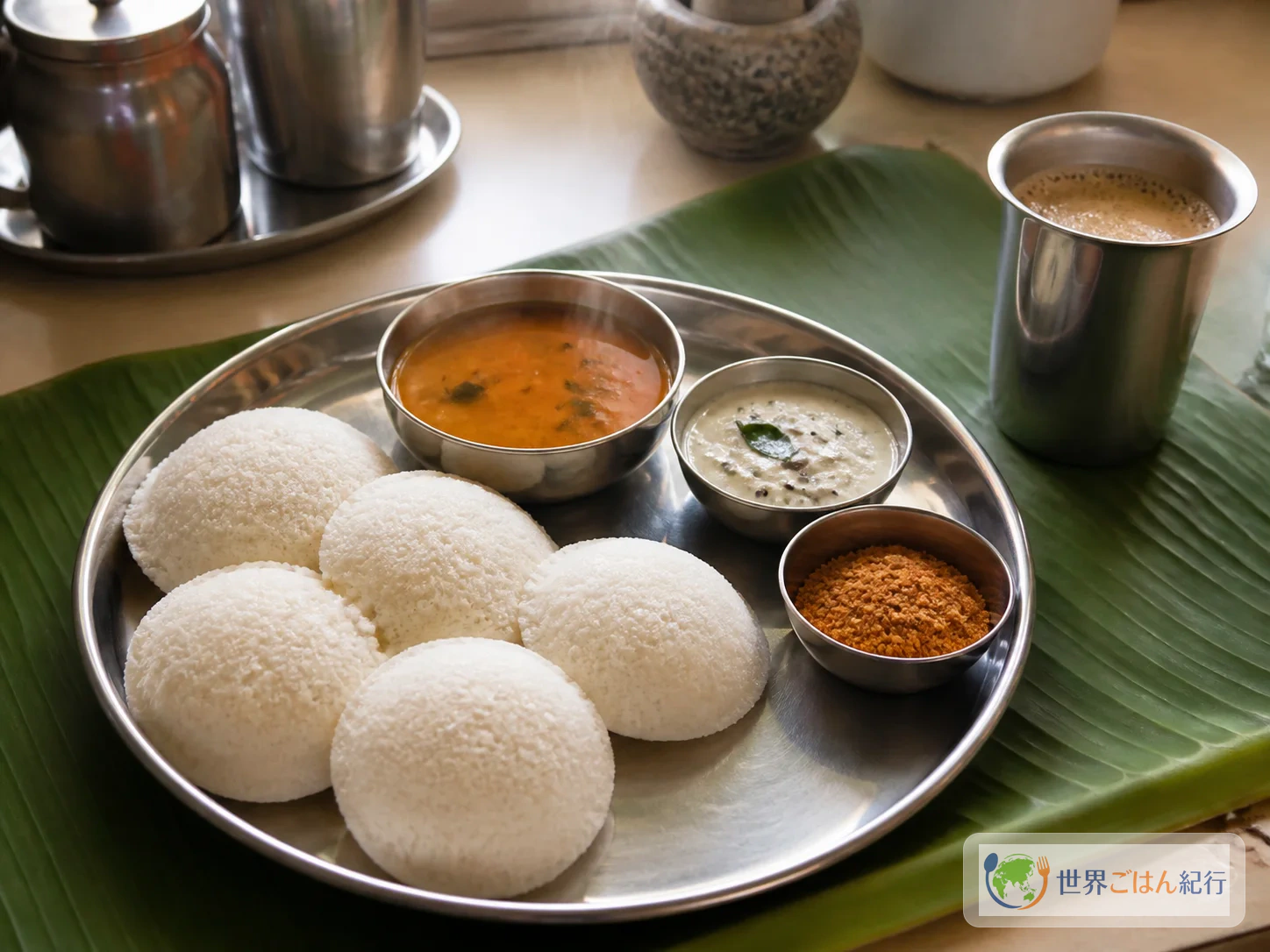
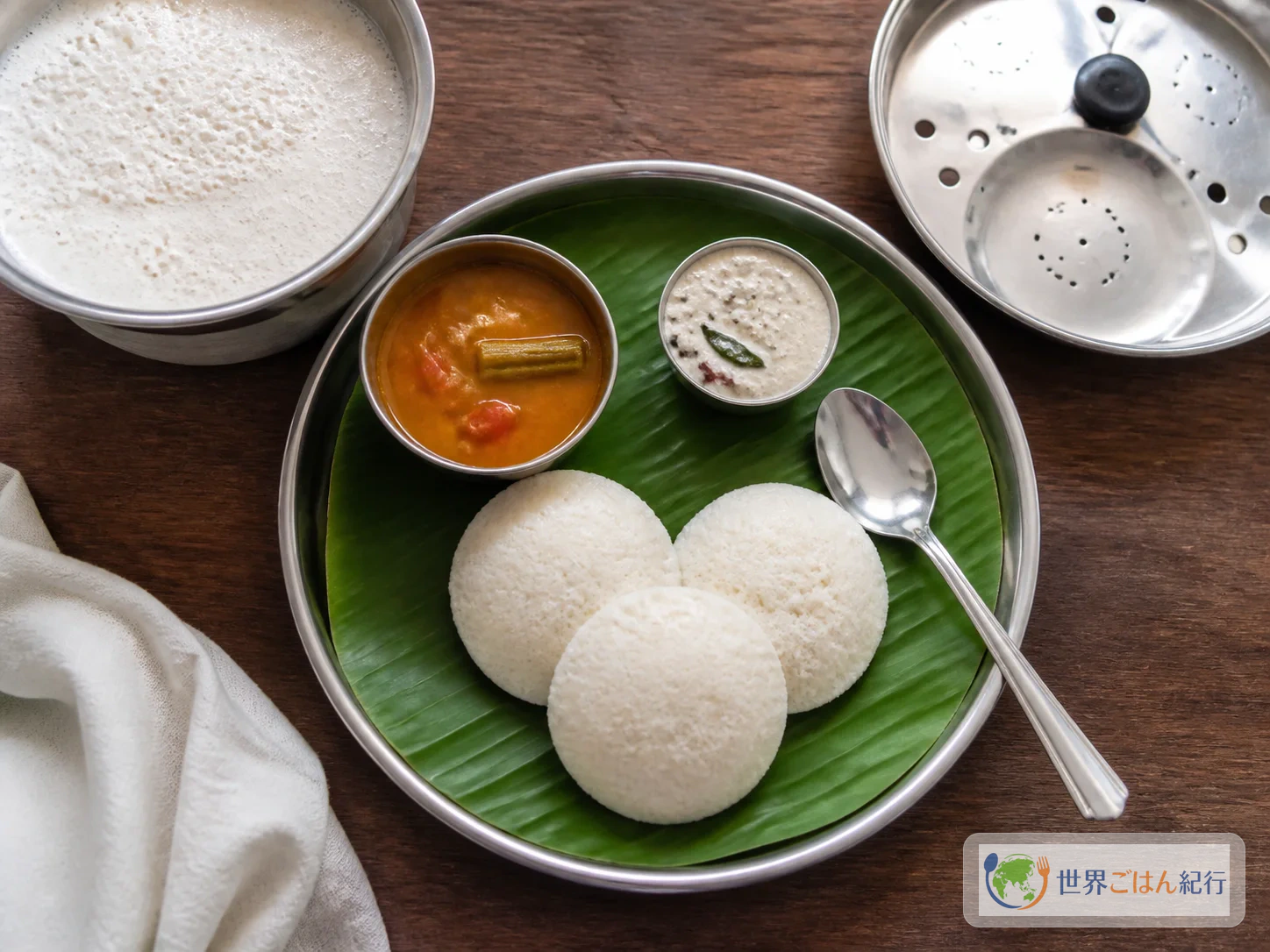
In South India, idli is a breakfast or snack rather than a dish whose flavor is complete on its own. It comes with sambar, coconut chutney and a spicy powder called podi. The batter itself tastes mainly of salt and a mild tang, so it works as a soft base for scooping up lentil and vegetable stews. Karnataka Tourism also presents idli as something enjoyed with coconut chutney, sambar and filter coffee.
Fermenting idli batter is not simply leaving it to sit until the water dries off. Research reports that a mixture of rice and black urad dal ferments spontaneously, with changes in microorganisms (mainly lactic acid bacteria), acid production and leavening by gas bubbles during fermentation. That is why steaming an under-fermented batter tends to give a heavy, rice-flour dumpling texture. At the other extreme, over-fermented batter with large collapsed bubbles tastes only sour once steamed.
Regional differences are about more than the rice-to-lentil ratio
Size, steaming method, vessel and accompaniments all change from region to region. Rather than reducing the names to a single right answer, decide which form you want to bring into your own kitchen, and the substitutions become easier to choose.
| Name / region | Form found locally | What to do at home |
|---|---|---|
| Plain idli | Small, thick rounds served with sambar and chutney | Steam in a small mold for 8–10 minutes. The easiest form for a first batch |
| Thatte idli / Bidadi (Karnataka) | A large, thick idli made on a plate-like mold, equal to 2–3 ordinary idli | Even out the thickness before enlarging the diameter. Extend the steaming to about 15 minutes |
| Kanchipuram idli (Tamil Nadu) | Rice or semolina with spices and vegetables, sometimes served with ghee | Add a little cumin, black pepper and ginger for a more fragrant dish than breakfast idli |
| Ramassery idli (Kerala) | Flat and round; traditionally steamed in a cloth-covered, sieve-like steamer | Don't hunt for the special clay vessel. Make thin idli on a small plate, and don't over-steam |
| Kotte kadubu / hittu (around Mangalore) | Batter poured into leak-resistant cones made from jackfruit leaves and steamed | To try the leaf aroma, fold food-grade banana leaf small. Make sure the vessel is sealed first |
Thatte idli of Karnataka is described as a specialty of Bidadi, between Bengaluru and Mysuru, and is larger in both circumference and thickness than ordinary idli. For Ramassery idli in Palakkad, Kerala, the cloth-and-sieve steaming method itself shapes the texture. Kotte kadubu from around Mangalore is distinguished by small vessels made of jackfruit leaves. These regional differences are not decoration: they show up in the texture as differences in the vessel that holds the batter and in how the steam reaches it.
Ingredients and Where to Find Them
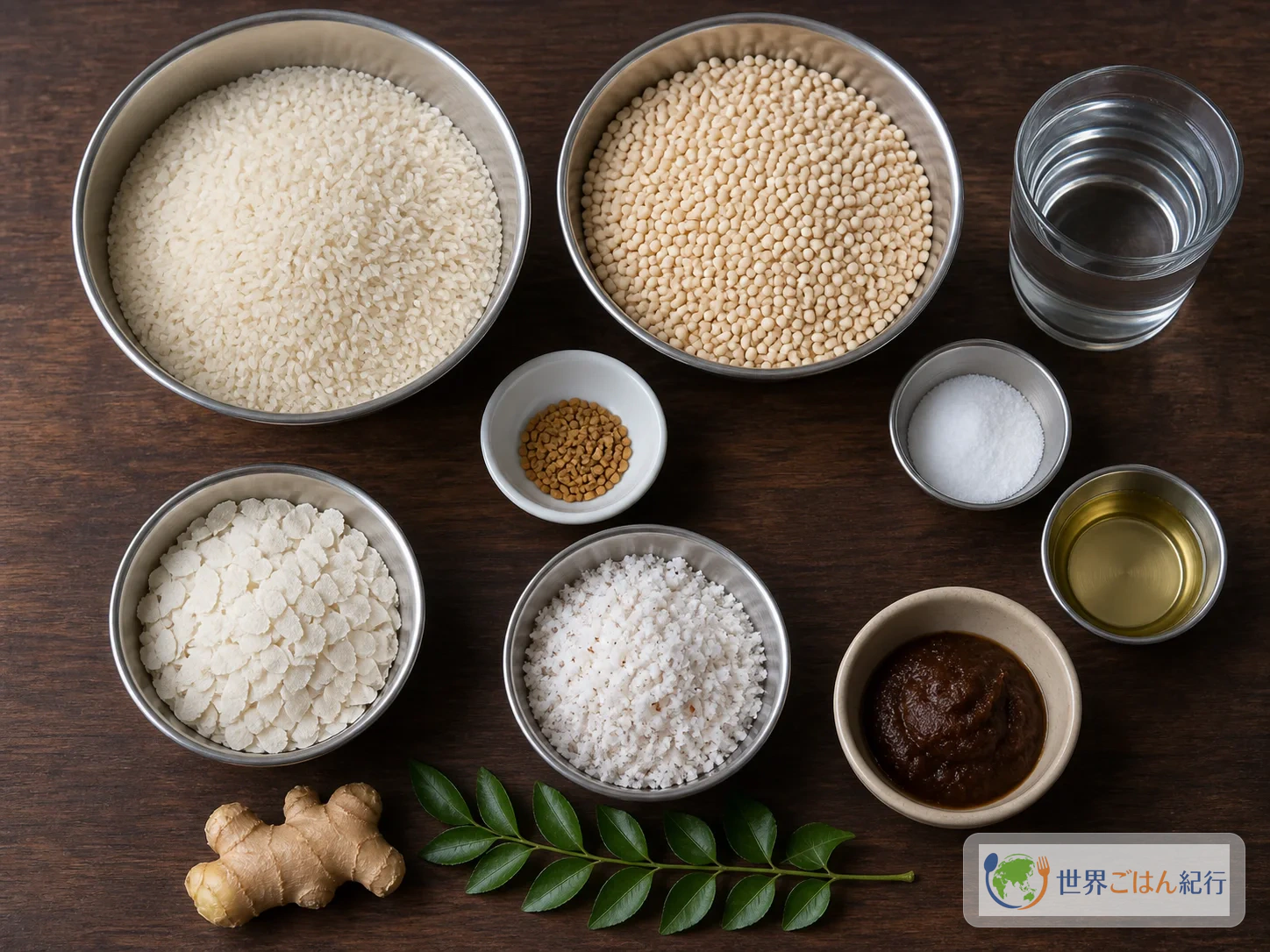
This makes 16 small idli, serving 4. The batter expands as it steams, so fill the molds only to about 70 to 80 percent. Idli rice is easiest to use, but parboiled rice or an ordinary low-starch short-grain rice also works. Avoid using glutinous rice alone, because it lacks the lightness to hold the lentil bubbles.
Urad dal is the key ingredient that keeps idli from becoming a steamed rice-flour cake. If you swap in red lentils or chickpeas, the dish may hold together as a lentil dish, but the stickiness and the way the bubbles form will change. If you make it with rice alone, do not add all the water at the start. Judge by how the batter grinds, and add water 1 tablespoon at a time.
You need only 2 g of fenugreek, so if you are making idli just once, look for a small amount at a nearby Indian or imported-foods store. If you will also use it for dosa, sambar and lentil stews, choose a package labeled seeds or whole, and don't confuse it with ground fenugreek or the dried leaves.
Tamarind is not an ingredient for the idli batter. It is the seasoning that links sambar's sourness to the sweetness of rice and lentils, so for a first try, dilute a little in water and add it after the vegetables and lentils have cooked. Commercial concentrates vary in strength, so check on the label whether it is paste or concentrate, and look at the ingredients and quantity. If you are making this only once, lemon juice can supply the acidity, though its bright sourness is not the same as the round sourness of tamarind.
The batter contains legumes, and the accompaniments use coconut, mustard and spices. Check the ingredient labels on anything you buy. If the fermented batter shows pink, black or green discoloration, mold or a putrid smell, discard it; do not use it even after cooking. Fermentation is not a process that guarantees keeping quality.
Judging Fermentation: Watch the Batter, Not the Clock
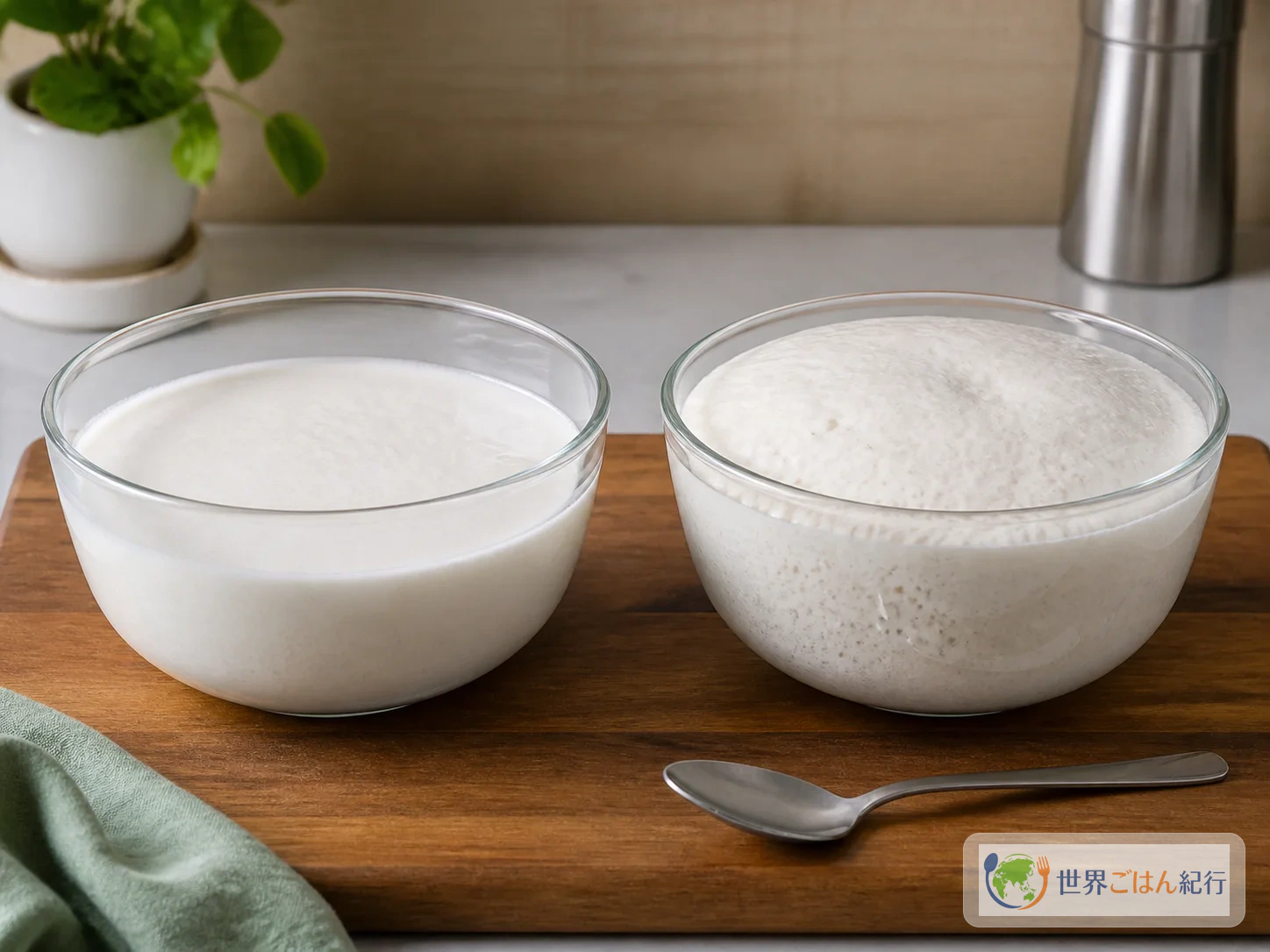
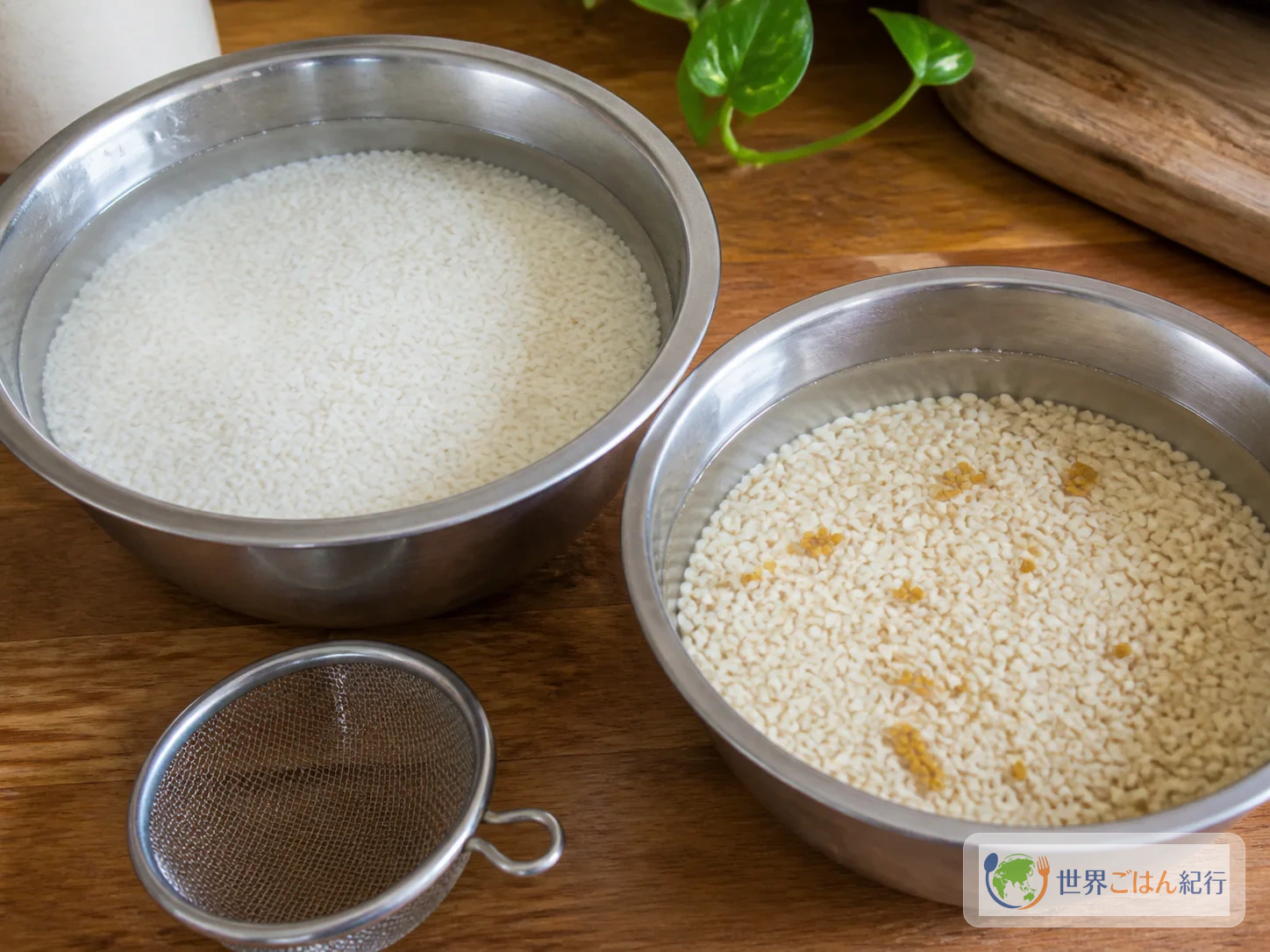
Soak the rice and the urad dal separately for 4 to 6 hours. The traditional process summarized in research is the same: soak rice and skinned black urad separately, grind them separately, combine, add salt, ferment overnight at room temperature, and steam in dedicated molds for 5 to 8 minutes. Home molds differ in depth from the small local ones, so adjust the steaming time to thickness in the steps below.
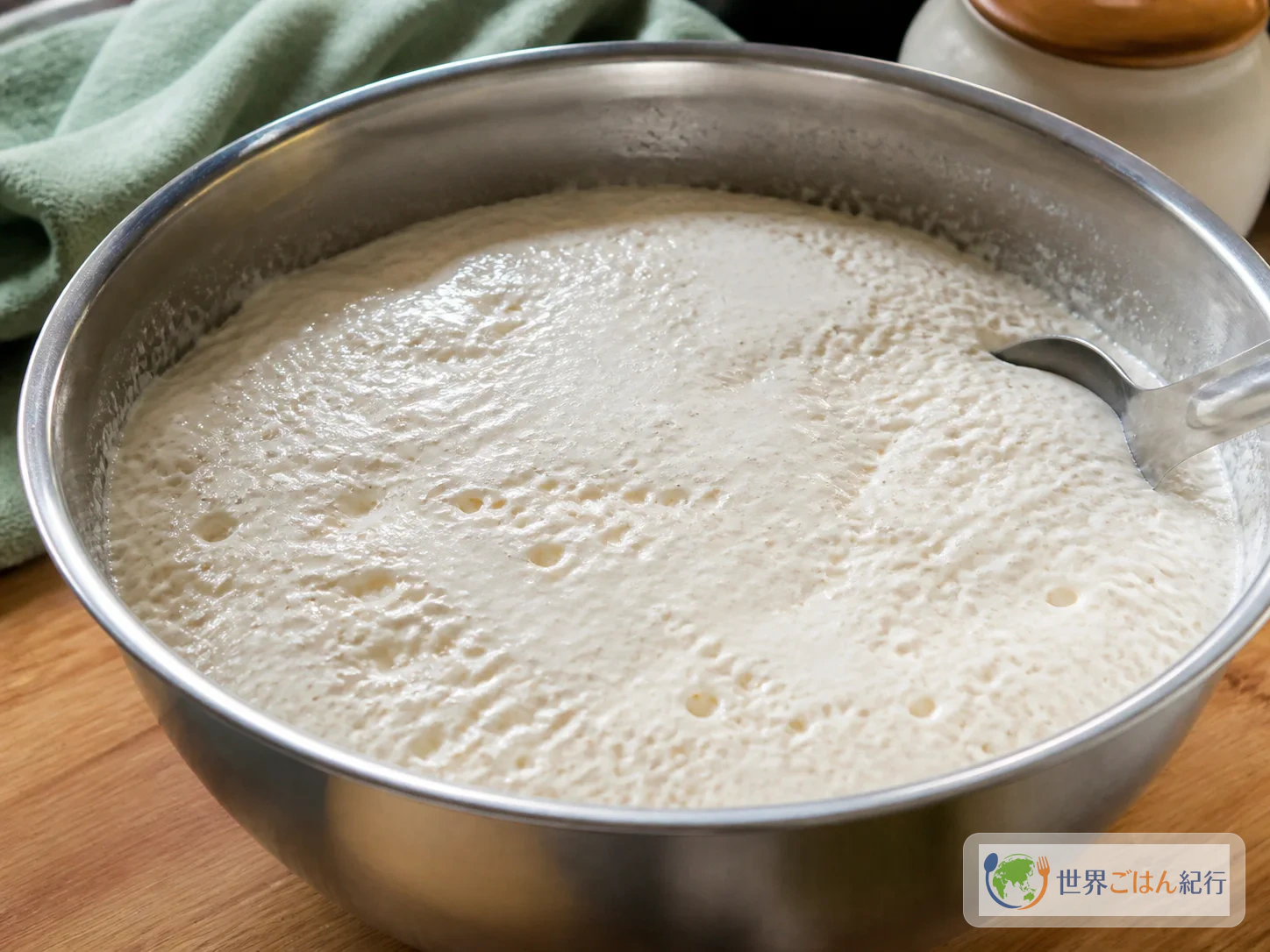
At room temperature, plan on 8 to 14 hours at 25–30°C. Studies have measured changes in volume, acidity and pH over fermentation time under conditions of 20–26°C, but your rice, blender, container and room will not match theirs. If a winter batch shows little movement after 12 hours, move it to a spot around 30°C and extend by 2 to 4 hours.
There are three signs that fermentation is done. The volume has grown by about 1.3 to 1.5 times and fine bubbles show on the surface and sides. A spoon pushed in leaves a mark that fills back slowly. And there is a mild, yogurt-like sourness, with no smell of alcohol or spoilage. If there are few bubbles but the volume has increased a little and the aroma has developed, the room may just be cool.
Steaming under-fermented batter gives a dense crumb. First add 2 to 3 hours at about 30°C; if nothing changes, it is less wasteful to cook it as a thick pan-cooked uttapam or as thin dosa. Conversely, batter that has sunk and turned sharply sour should be refrigerated and cooked the same day. If there is mold or a putrid smell, don't repurpose it for another dish.
Method: Soak, Ferment, Steam
Where to Go Back to When It Goes Wrong
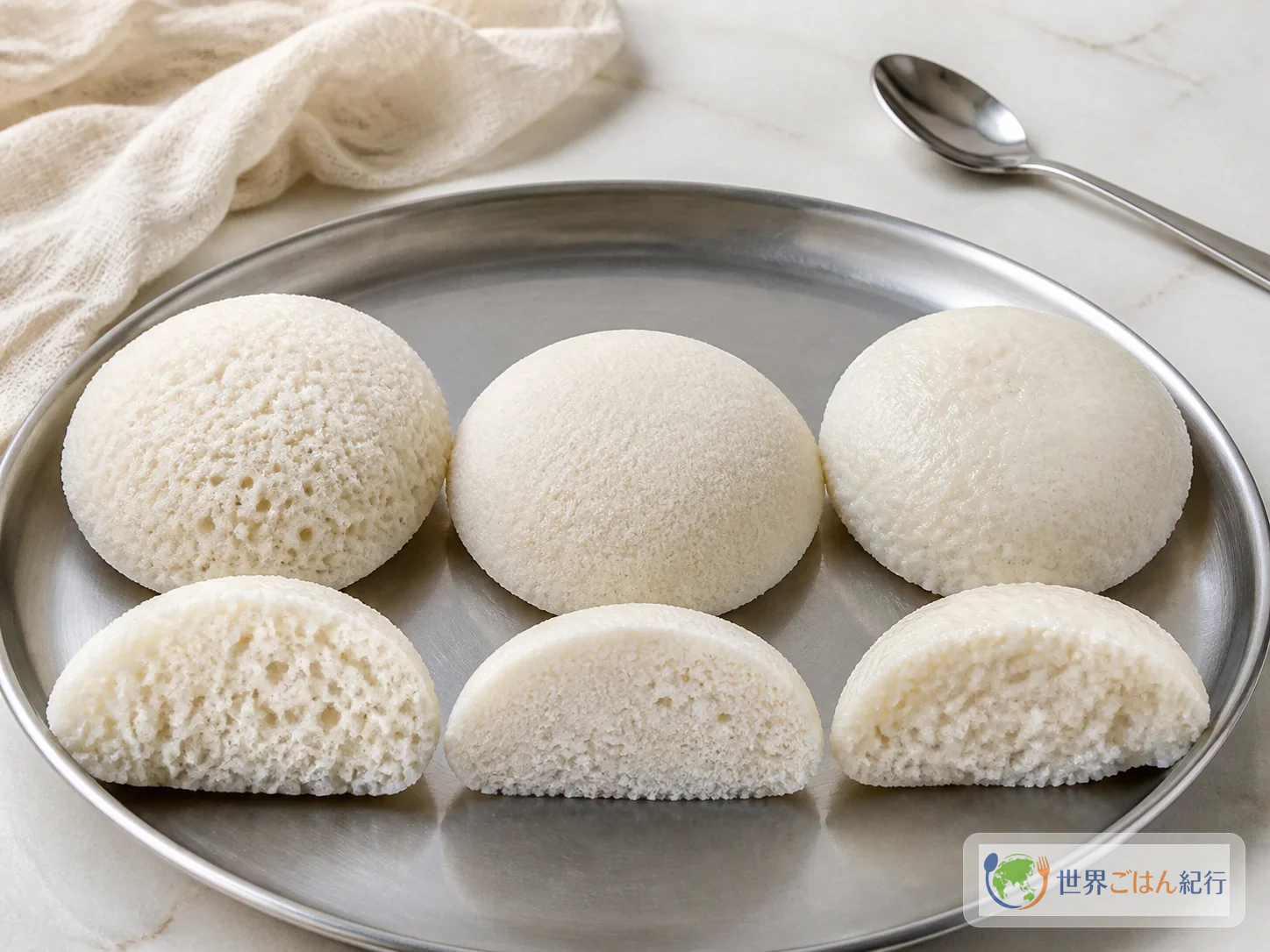
Rather than steaming all 16 at once, steam a single test idli first to tell whether the fault is in fermentation or steaming. Once the steam in the steamer is steady, take out the test idli after 7 minutes and check the center.
| Symptom | Likely cause | How to fix it |
|---|---|---|
| Doesn't rise, dense | Under-fermented, urad dal under-ground | Add 2 to 3 hours at about 30°C. If nothing changes, make small dosa or uttapam |
| Strongly sour, batter has sunk | Over-fermented, room too warm | Refrigerate and steam the same day. Discard if there is a sharp off smell or discoloration |
| Only the center is raw | Molds overfilled, too thick | Fill molds to 70 to 80 percent and steam 2 to 3 minutes more. Extend the time for large molds |
| Sticky surface | Lid condensation, unmolded right after steaming | Turn off the heat and leave 2 minutes. Catch lid drips with a cloth |
| Won't release from the mold | Too little oil, cooled too long | Run a wet thin spatula around the edge and lift from the bottom |
| Weak lentil aroma, heavy | Too little urad dal, rice batter too fine | Next time don't cut the lentils, and leave some grit in the ground rice |
If the batter has only turned a little sour, serve it with a stronger sambar and the flavor comes back into focus. Baking soda to cover a failed ferment does not fix the way bubbles form in true idli. If the batter is in bad condition, choose between using it for a different dish and discarding it.
Aromatics for the Sambar
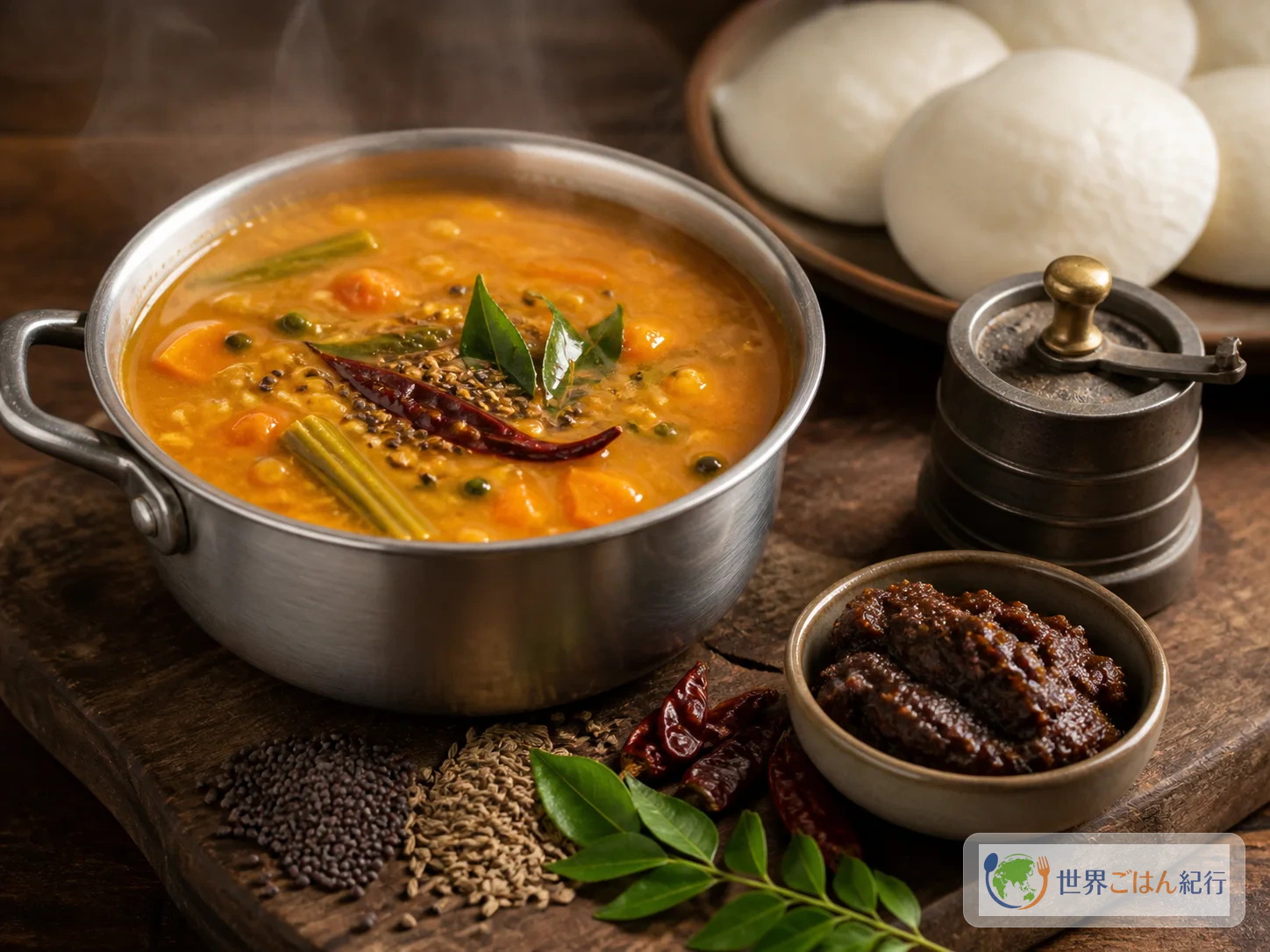
The idli batter itself needs no spice aroma. When you make sambar, roughly crushing small amounts of cumin, black pepper and fenugreek seeds keeps grains of fragrance intact, which simmering with powders alone does not. If you own a mortar, you don't need to buy anything: lightly crack the spices with a knife, then crush them.
A spice mill is worth having if you will keep making sambar, chana masala and lentil stews, not just idli. Whichever you use, look for one that lets you keep a coarse grind of dried chilies and cumin instead of turning them to powder at once, and a container that is easy to wash.
If you already keep your spices ground, or will make idli just once, a mortar lets you adjust the coarseness more easily and there is nothing to buy. A tool will not fix under-fermented batter or the wrong steaming thickness. If the only job is crushing a few spices, use what you already have.
Five Variations: Keep the Fermentation, Move Toward a Region
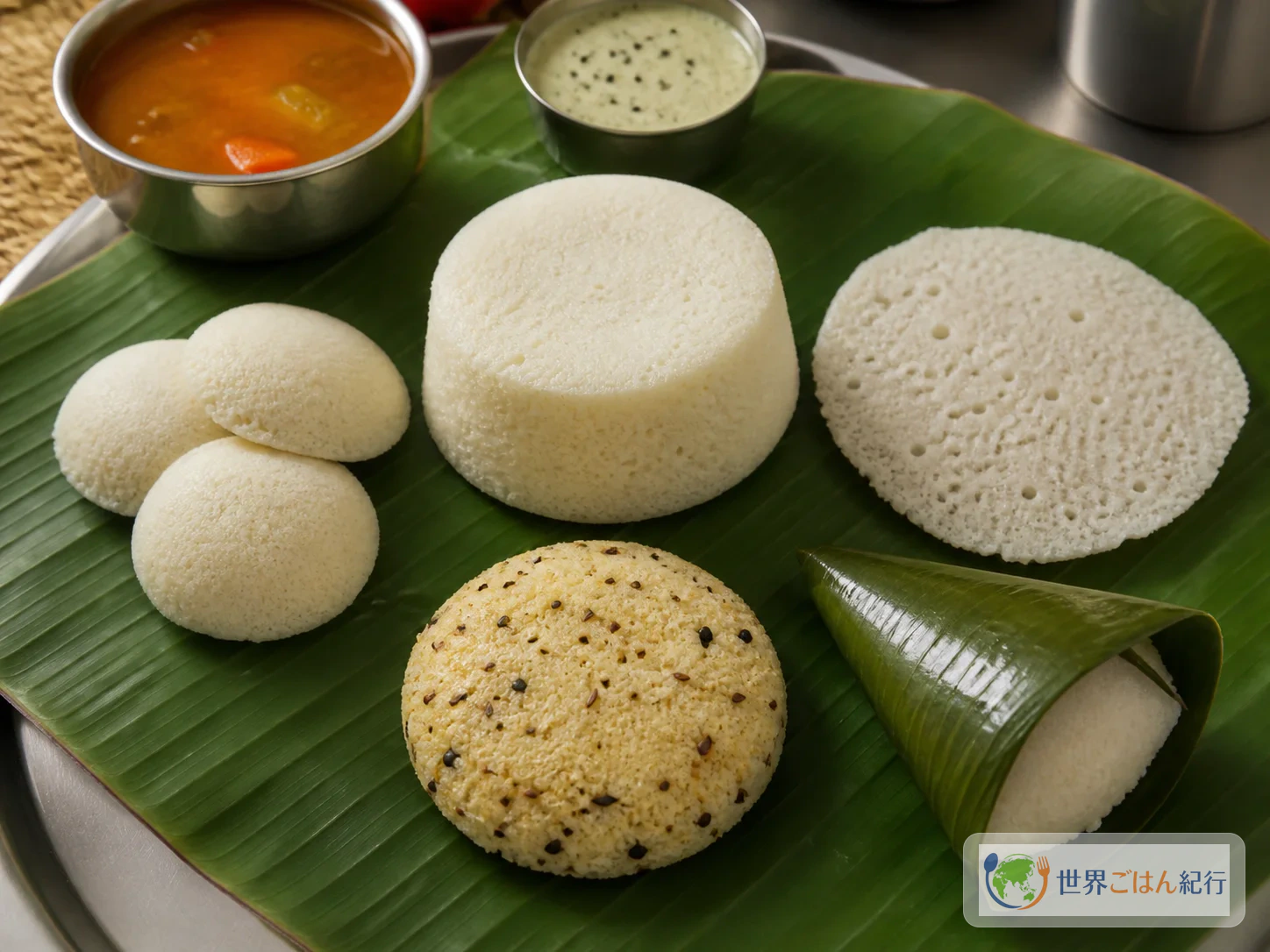
Varying idli does not mean replacing all the rice and lentils with other flours. Keep the bubbles of the fermented batter and change one thing at a time: the vessel, spices, grain or steaming thickness. That connects most easily with both local regional differences and your own kitchen.
- Thick, thatte idli style: Pour batter into small plates 12 to 14 cm across, with an even thickness of about 3 cm. Steam about 15 minutes and check that a skewer comes out dry to the center. One piece gives the satisfying bulk of 2 to 3 ordinary idli.
- Kanchipuram style, with more aroma: Add a little cumin, coarsely crushed black pepper and ginger to the batter, and drizzle a few drops of ghee on the steamed idli. Because the aroma is stronger, make the coconut chutney a little milder.
- Ramassery style, flat: Spread the batter thin in small plates and shorten the steaming to 6 to 8 minutes. The way water reaches it differs from the traditional cloth-covered vessel, so flattening alone will not reproduce the same texture. Unmold as soon as the surface is dry.
- Kotte kadubu style, with leaf aroma: Fold an edible leaf into a cone or small cup, check that it doesn't leak, and pour in a small amount of batter. Without jackfruit leaves you can try banana leaf for a similar direction of aroma, but the result changes with the leaf.
- Mixing in some millet: Replace 20 to 25 percent of the rice with millet or other small grains. Swapping all of it makes water content and grain feel hard to read, so for a first batch, when you want to keep the feel of the fermented batter, change only part.
Kanchipuram-style idli made with semolina, and rava idli, are prepared differently from basic idli, which soaks and ferments rice. Making instant rava idli on a morning when you can't wait for fermentation is reasonable, but on a day when you want to taste the sourness and the lentil aroma, starting the basic batter the day before is the more satisfying route.
Storage and a Morning Schedule
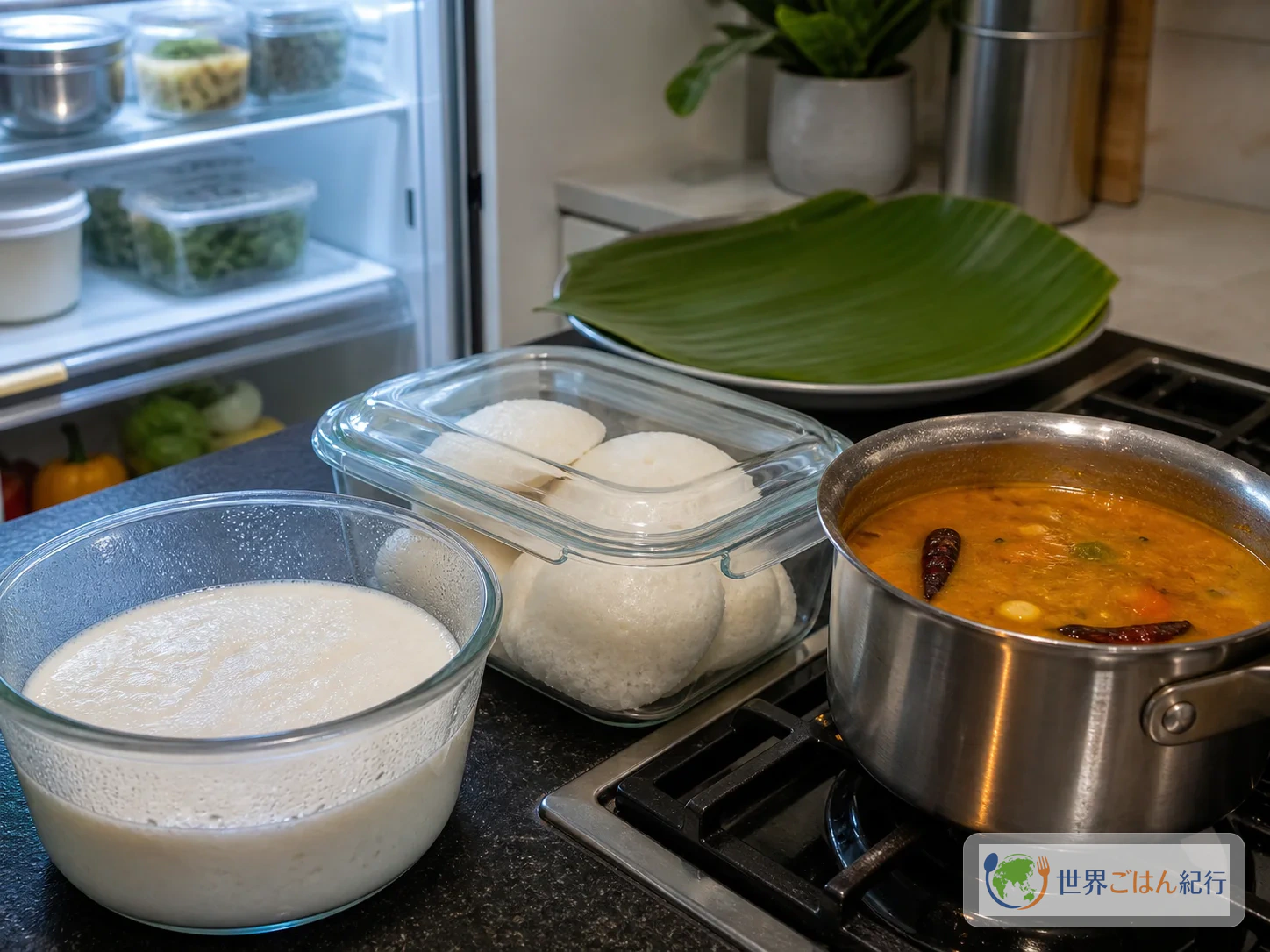
Once fermentation is finished, take out only what you need and refrigerate the rest in a clean container. Souring continues slowly even in the refrigerator, so plan to steam it all within 2 days. Freezing batter separates the water and makes it hard to keep the bubbles, so for a first time don't freeze it; adjust the quantity instead.
Let steamed idli lose their heat, don't leave them long at room temperature, and refrigerate them. As a cooked food made with rice and lentils, follow the US FoodSafety.gov standard for leftovers: refrigerate at 4°C or below and use within 3 to 4 days. To reheat, sprinkle a little water so they don't dry out and warm them in a steamer for a few minutes, which brings back the springiness that chilling tightened. Don't eat any with an off smell or a changed surface.
For breakfast, the schedule that works reliably is to soak the morning before, grind in the evening, ferment from night to morning and steam in the morning. For dinner, soak the previous night, grind in the morning and ferment until evening. Sambar can be cooked the day before and refrigerated, then reheated on the day while you adjust the tamarind. Chutney loses its aroma quickly, so make it just before eating.
Frequently Asked Questions
Can I use urad dal flour?
You can, but the stickiness and how water enters are harder to read than with soaked and ground skinned lentils. If you use flour, follow the package instructions and add water starting low, adjusting so the fermented batter does not run. For a first batch, whole-grain urad dal, where you can see the state of the lentils, is better.
Can I grind the batter in a blender alone?
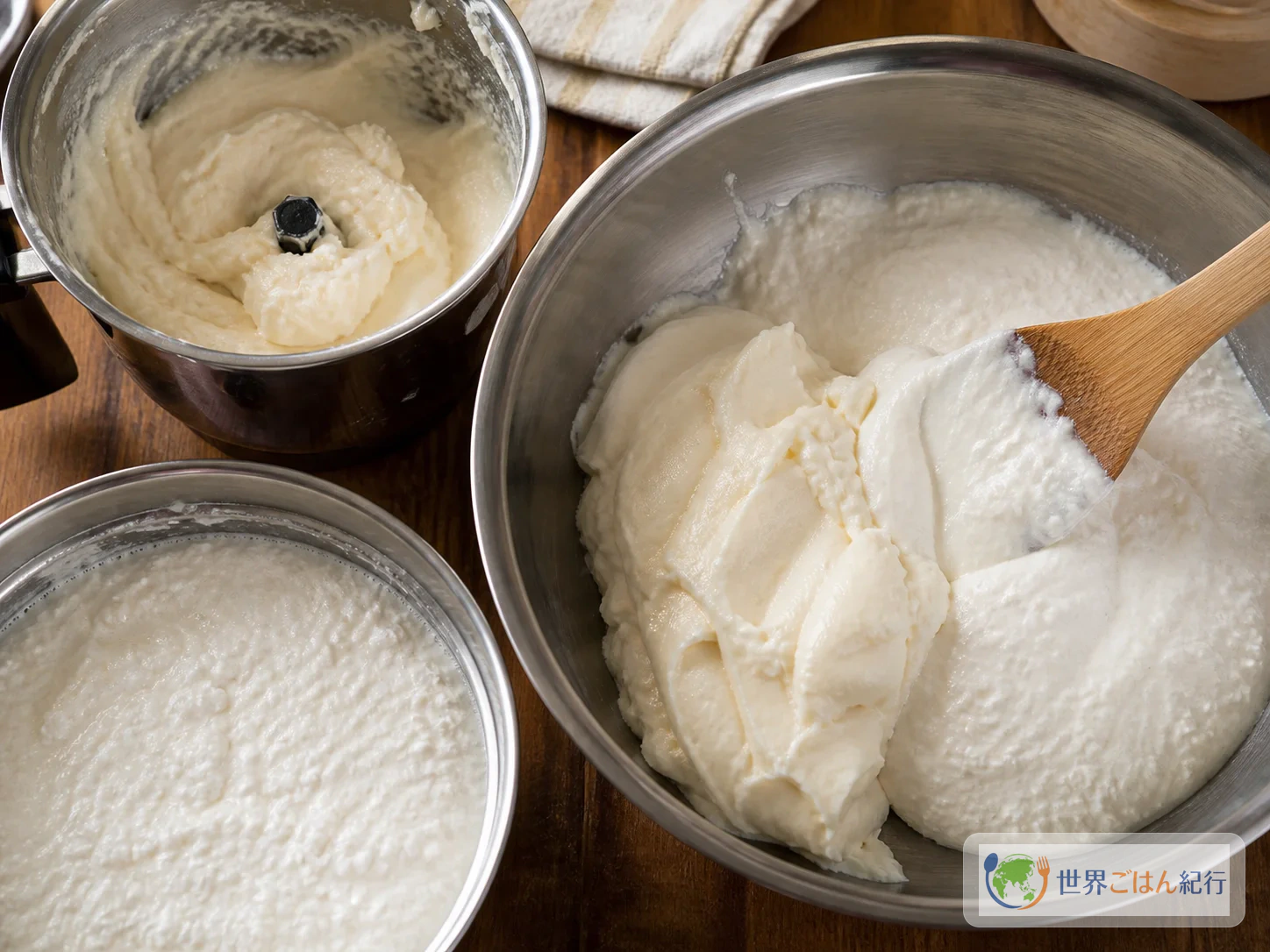
Yes, if you repeat short pulses with rests. Stop when the motor gets hot so the batter does not become too warm. Aim for white and smooth urad and rice that keeps a fine grit, and don't grind everything together in one container from the start.
Can I eat sour idli?
If the sourness is mild, like yogurt, it goes well with sambar and chutney. If it has a boozy smell that stays in the nose, a putrid smell, surface discoloration or mold, don't eat it. The standard is whether anything is wrong with the batter, not whether cooking can mask the sourness.
What if I don't have an idli mold?
Oil small heatproof dishes that fit in your steamer and divide the batter to a thickness of 2 to 3 cm. One large layer takes longer to cook through, so for the first time several small dishes make the state easier to read. If you make thick idli like thatte idli, extend the steaming time until a skewer comes out dry.
What is the difference between idli and dosa?
They may share a fermented rice and urad dal batter, but idli is poured into molds and steamed, while dosa is spread thin on a cooking surface. The thickness of the batter and the finish are different. If you want a thin, crisp, fragrant result, the same fermented batter can go to dosa. For another steamed dish that shows the sourness of rice and lentils in a different form, dhokla from Gujarat is worth a look.
Can you explain how to make the sambar for idli in more detail?
Cook the vegetables and toor dal until soft, then season with tamarind, sambar powder and salt. Finally heat mustard seeds and curry leaves in oil and pour over the pot. If you dunk your idli in it, make the sambar a little thinner than a curry and don't make it too sour at first. A sour, light lentil soup such as rasam (in Japanese) goes well alongside.
Sources
- Diversity and Succession of Microbiota during Fermentation of the Traditional Indian Food Idli (PubMed). Used to confirm natural fermentation of idli, changes in microorganisms centered on lactic acid bacteria, and acid production and leavening. Accessed and checked: 20 August 2026 (JST).
- Preparation of idli batter, its properties and nutritional improvement during fermentation (PMC). Used to confirm the basic process of soaking and grinding rice and black urad dal separately and steaming after fermentation, along with proportions and temperature conditions. Accessed and checked: 20 August 2026 (JST).
- Thatte Idli | Bangalore Tatte Idli (Karnataka Tourism). Used to confirm the shape, size, relation to Bidadi, steaming time and accompaniments of thatte idli. Accessed and checked: 20 August 2026 (JST).
- Kanchipuram where silk weaves a tale (Incredible India). Used to confirm the rice or semolina, spices, vegetables and ghee of Kanchipuram idli. Accessed and checked: 20 August 2026 (JST).
- Food guide - 10 must-try local dishes in Mangalore (Incredible India). Used to confirm the leaf-wrapped kotte kadubu / hittu of the Mangalore area and its accompaniments. Accessed and checked: 20 August 2026 (JST).
- Ramassery, Palakkad | Kerala Tourism. Used to confirm the flat shape of Ramassery idli, the cloth-and-sieve steamer and accompaniments. Accessed and checked: 20 August 2026 (JST).
- Cold Food Storage Chart (FoodSafety.gov). Used to confirm the guideline of using refrigerated leftovers within 3 to 4 days. Accessed and checked: 20 August 2026 (JST).


