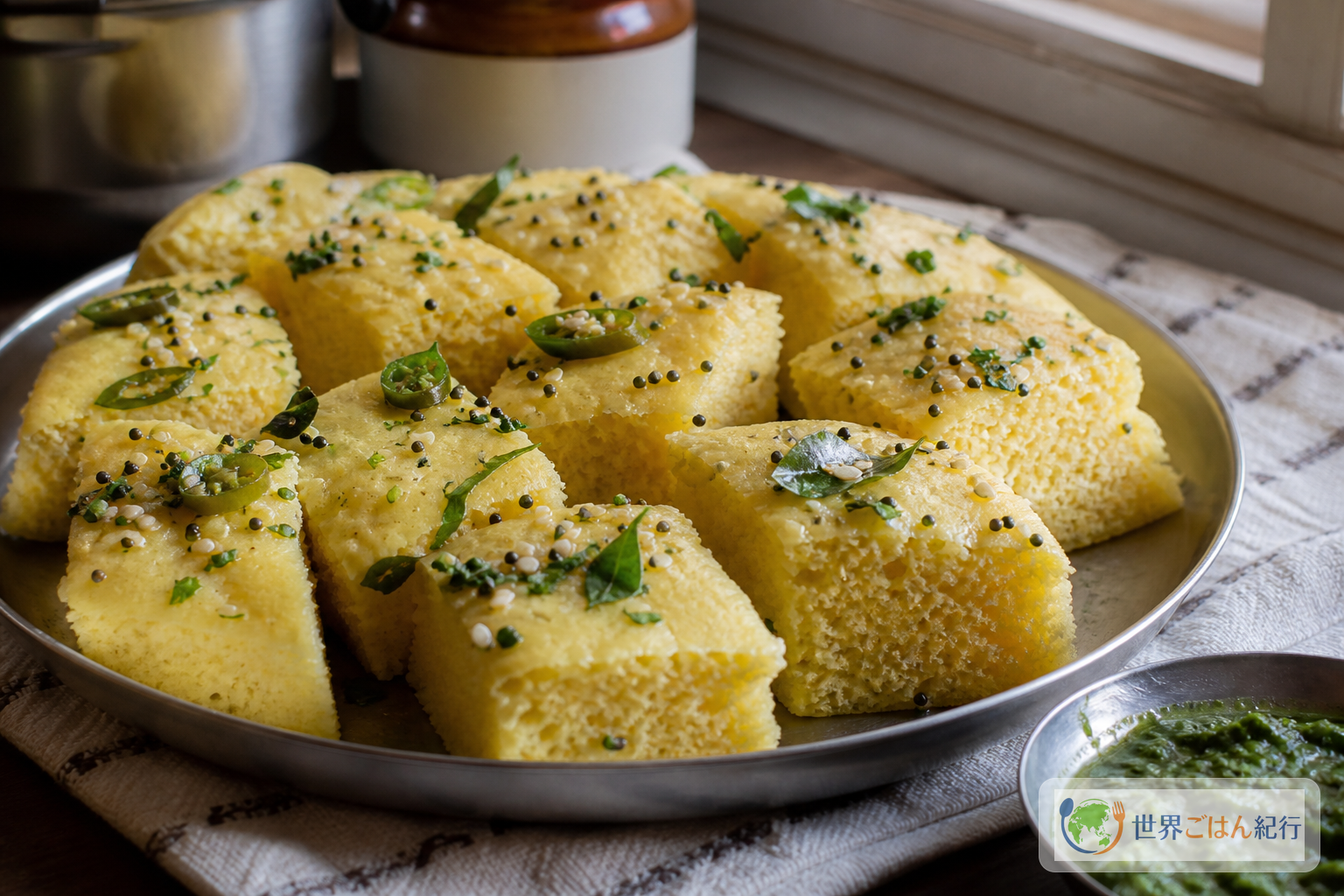
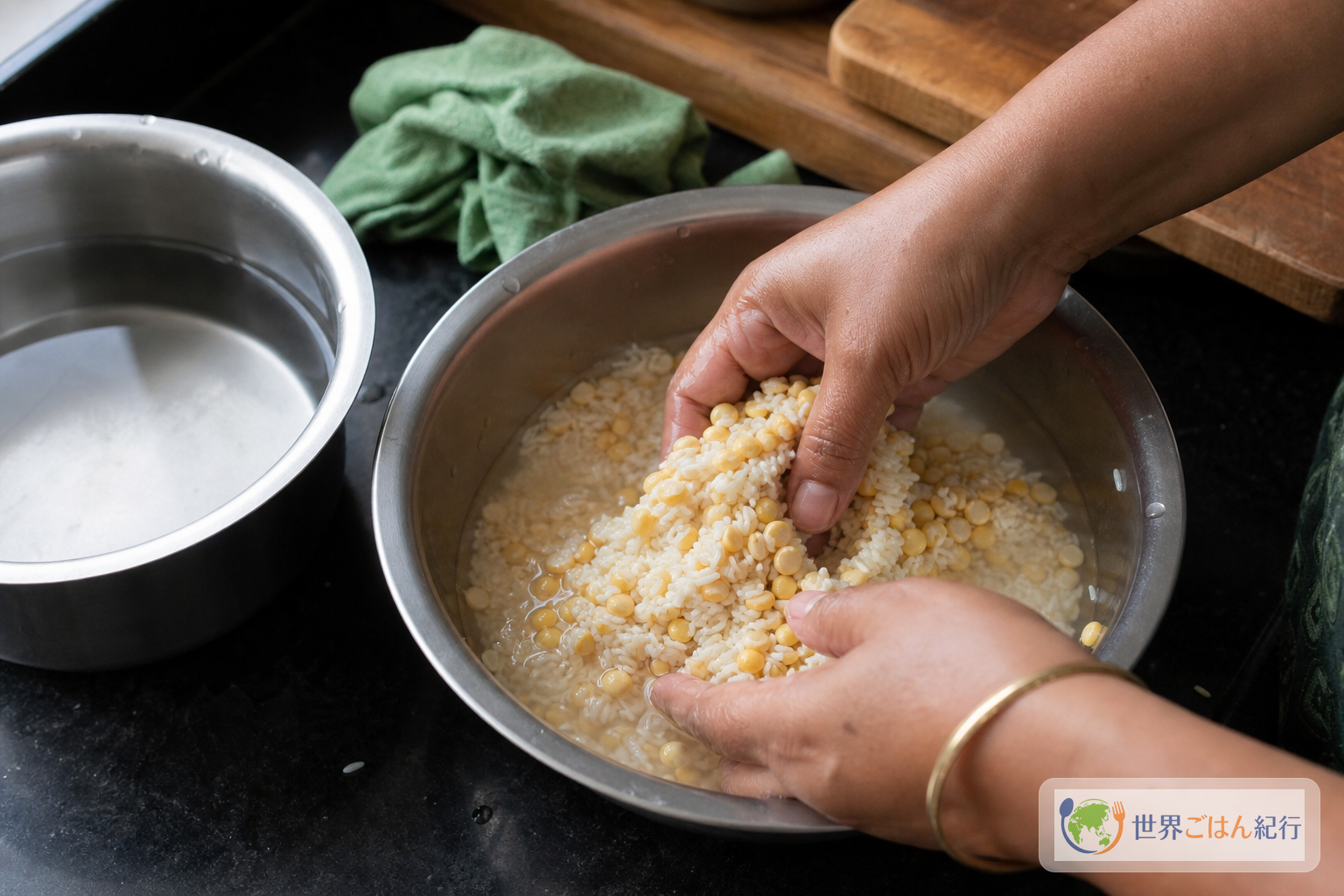
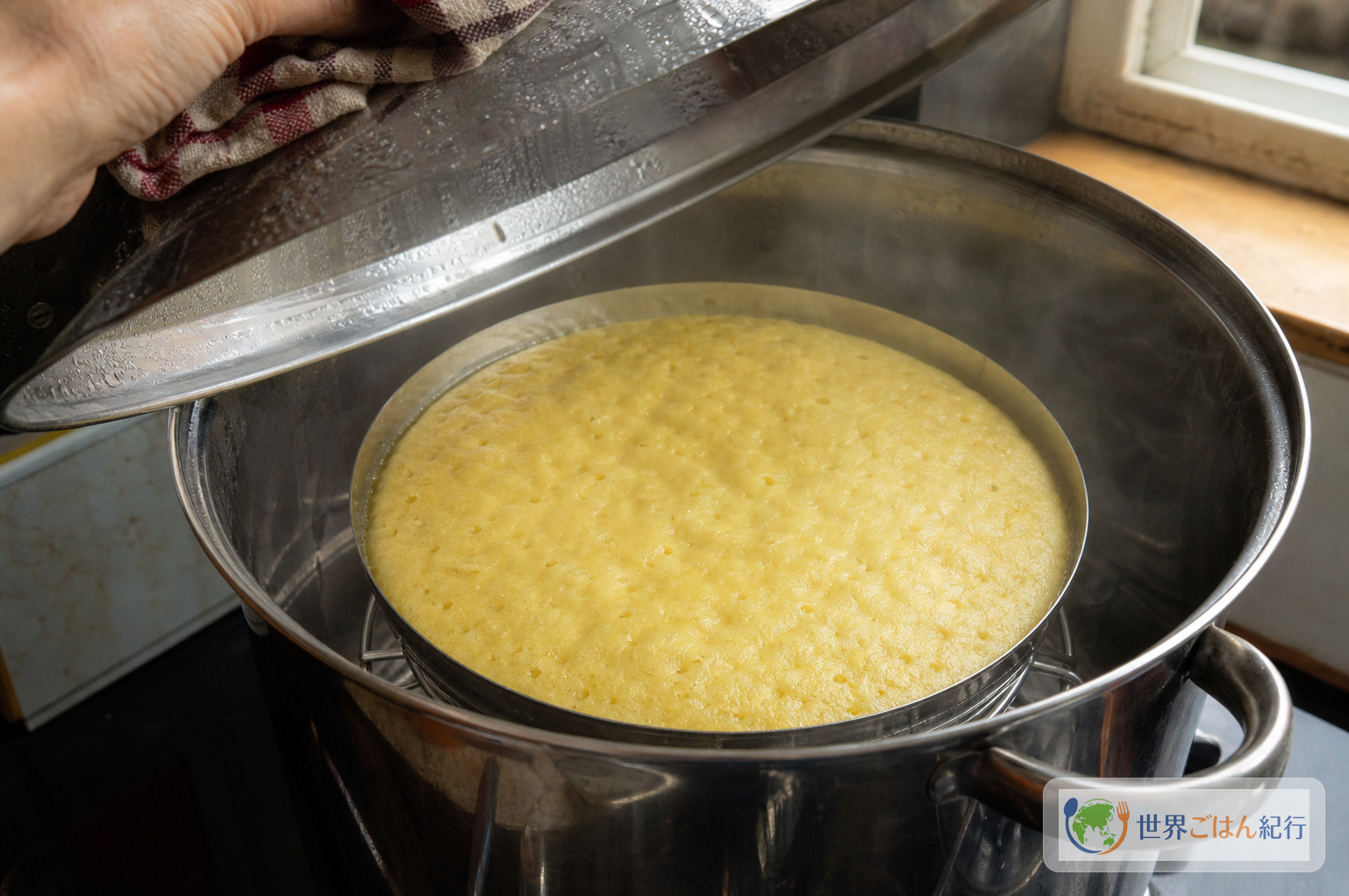
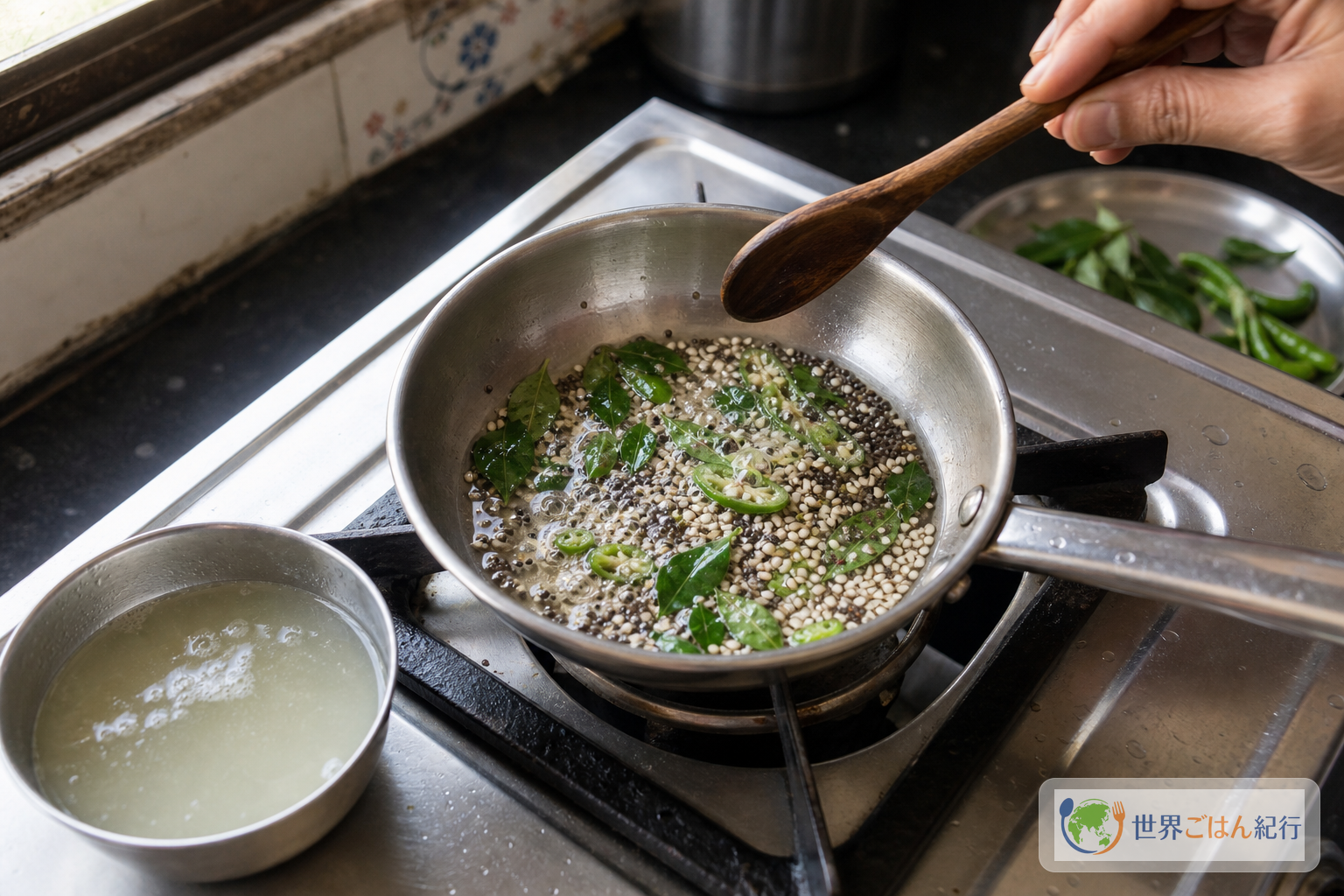
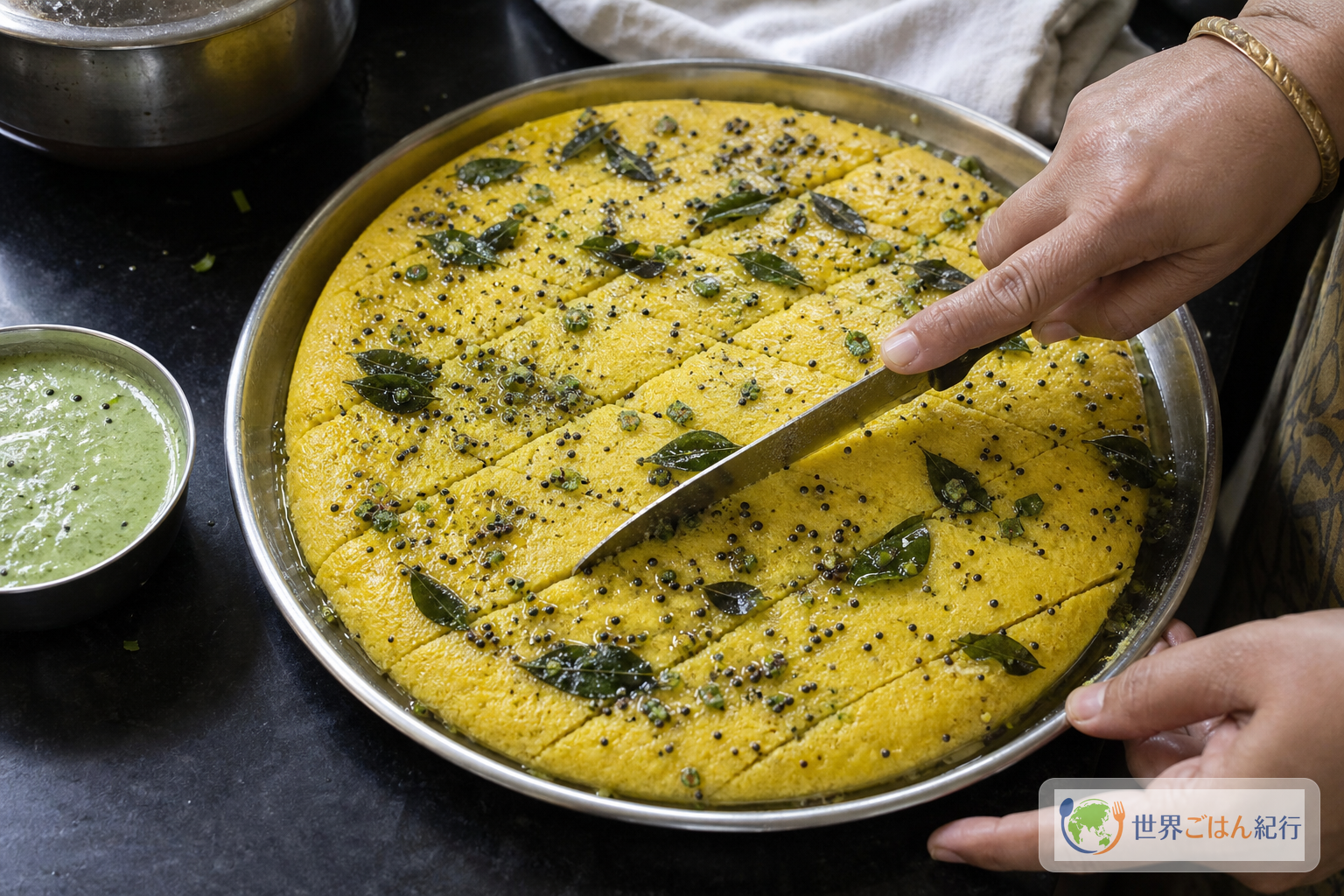
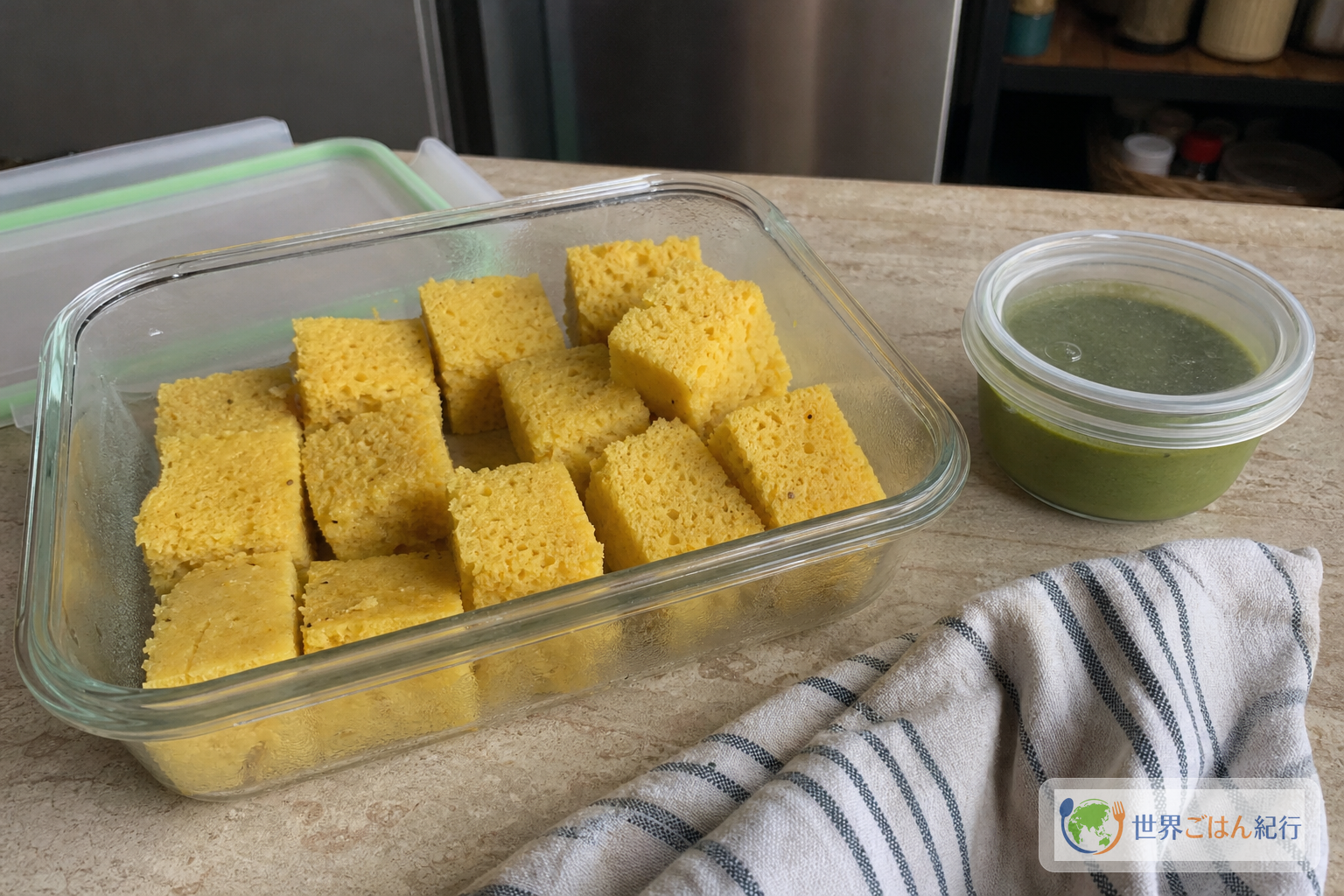
Lift the lid of the steamer and the pale yellow surface of the batter is dotted with tiny holes. Press it with a finger and it does not stay down; it slowly springs back. Drop mustard seeds into hot oil and, after the crackle, the aroma of green chilies and curry leaves rises, and a sweet-sour syrup soaks into the steamed cake.
Dhokla is a steamed dish of fermented batter from Gujarat in western India. Rice and lentils are soaked, ground, and left until they turn tangy. A leavening agent is added at the end before steaming, so even though it starts as rice, the result has a light springiness unlike rice from a cooker.
The usual stumbling blocks are these: is it the same as khaman, is fermentation really necessary, and how do you know when the batter is steamed through? What we make here is the tangy fermented dhokla from rice and lentils, close to what Gujarat calls khatta dhokla. It takes a different path in both ingredients and aroma from the instant khaman leavened with besan.
If you want it for breakfast, the safe plan is to start soaking at noon the day before. Judge fermentation by the state of the batter, not the clock. Once you have that sense, you can make it with a 20 cm metal pan and a pot, with no special mold.
This is the basic formula aiming for a fluffy texture with some tang preserved. On days you cannot wait for fermentation, you can decide on the instant version in the variations at the end. The yield is 24 pieces of about 3.5 cm squares.
Khaman Sits Next to Dhokla
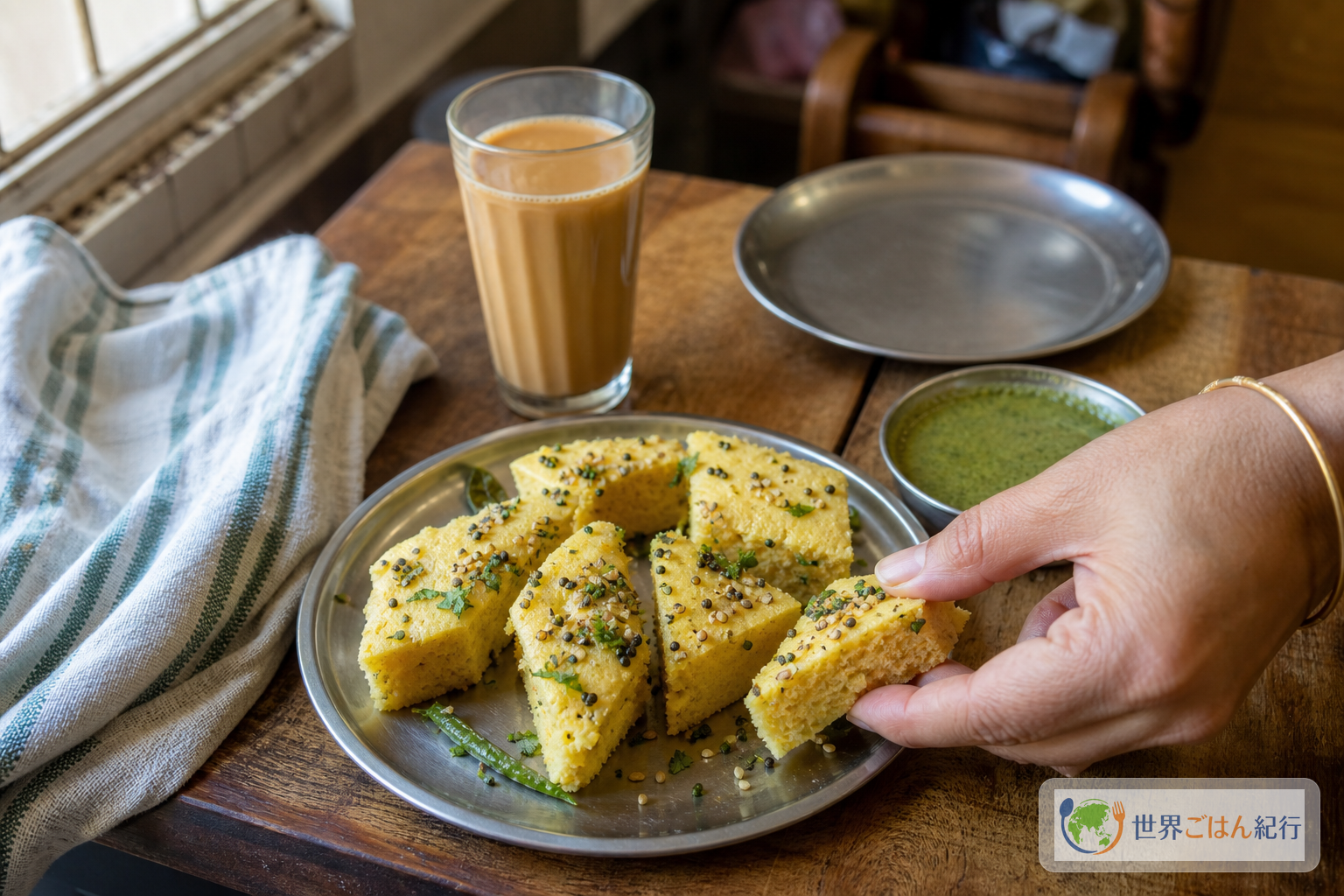
At the Gujarati table you meet dhokla as one of the light snacks called farsan. It might be a breakfast dish, cut small and set out at tea time, or something served to visitors. Rather than drawing a firm line between meal and snack, it is a dish you pick at according to how hungry you are.
This form, cut small and served with accompaniments, shapes the impression of dhokla. The batter itself is built on salt and tang, with no heavy oil like fried food. Instead, tempering is poured over the steamed surface. The toasty mustard seeds, the green aroma of curry leaves, and the sweet-sour of sugar and lemon come together on a plain slice of the cake.
So is everything yellow and fluffy dhokla? Separating it from khaman makes it clearer what to buy. The Gujarat Tourism site introduces khaman as made only from besan, chickpea flour, and lighter and softer than dhokla. Dhokla more often refers to a formula in which rice and lentils are soaked and fermented, and its color and texture are not one thing.
The names waver from shop to shop and home to home. Some guides call anything made with besan dhokla too, so it is more accurate not to decide what is on the plate from the name alone. This batter keeps the sweetness of the rice grain, the stickiness of the lentils, and the tang of fermentation. Compared with khaman, made quickly from besan and baking soda, it is a similar steamed cake that takes more time in the preparation.
In research papers, dhokla is treated as one of India's fermented foods alongside idli and dosa, with notes on regional variation in which grains and legumes are combined. Dhokla, in other words, is less a single fixed blueprint than a dish whose core of rice, lentils, fermentation, and steaming each household has rearranged. To recreate it elsewhere, protecting the state of the fermented batter and the steamed thickness will serve you better than searching for the exact local mold.
| What to tell apart | Fermented dhokla | Khaman | Notes for the home cook |
|---|---|---|---|
| Main batter | Rice and lentils, soaked and ground | Mainly besan | Dhokla if you can prepare the day before |
| Flavor axis | Mild tang, lentil aroma | Light sweetness, baking-soda lift | If you want tang, wait for fermentation |
| Texture | Fine and slightly springy | Soft and airy | Steam at 1.5–2 cm thick |
| Preparation | Soaking and 8–12 hours of fermentation | An instant formula is possible | On a day without time, do not force it into the same dish |
Ingredients
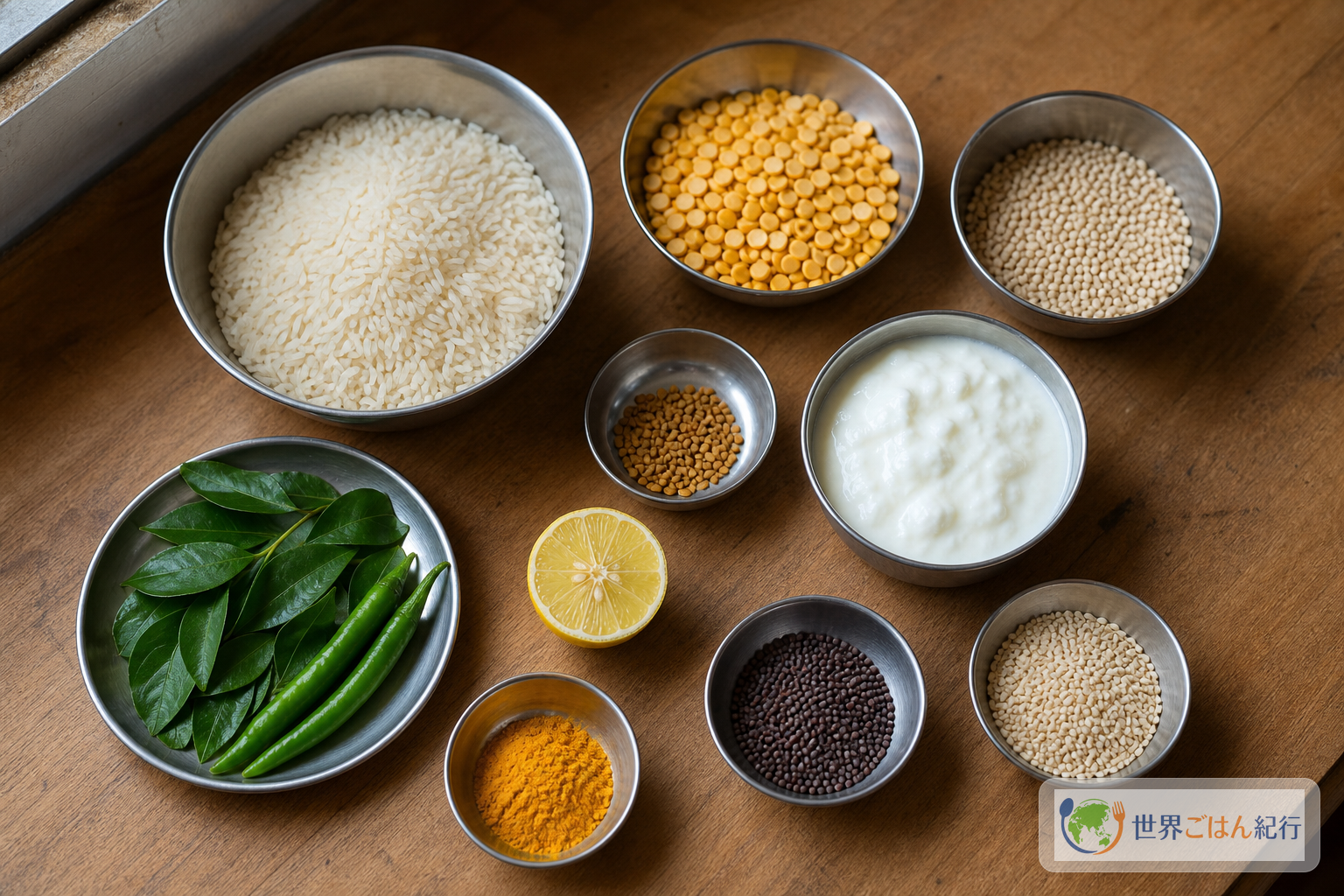
This makes one 20 cm square pan or a pan 20–22 cm across, serving 4. The steamed cake weighs about 650 g and yields around 24 pieces at 3.5 cm square. A thicker batter cooks more slowly in the center, so if you change the pan size, keep the height the same.
This recipe uses legumes, mustard, dairy, and coconut. Discard fermented batter if it becomes too sour, shows pink or black spots, or has a spoiled smell. Keep the unsteamed batter in a clean container, and do not leave it at room temperature in a casual way.
You use only 2 g of fenugreek seeds. Even so, a sweet, dry aroma remains deep in the fermented batter and keeps the steamed lentil aroma from going flat. If you buy it, choose a small sealed packet, or a quantity suited to a person who will also use it in other Indian cooking. If you only want to try 2 g, or cannot store spices in a freezer or sealed jar, it is better to look for a small amount at a nearby import or spice shop.
What to Keep, What to Change in a Home Kitchen
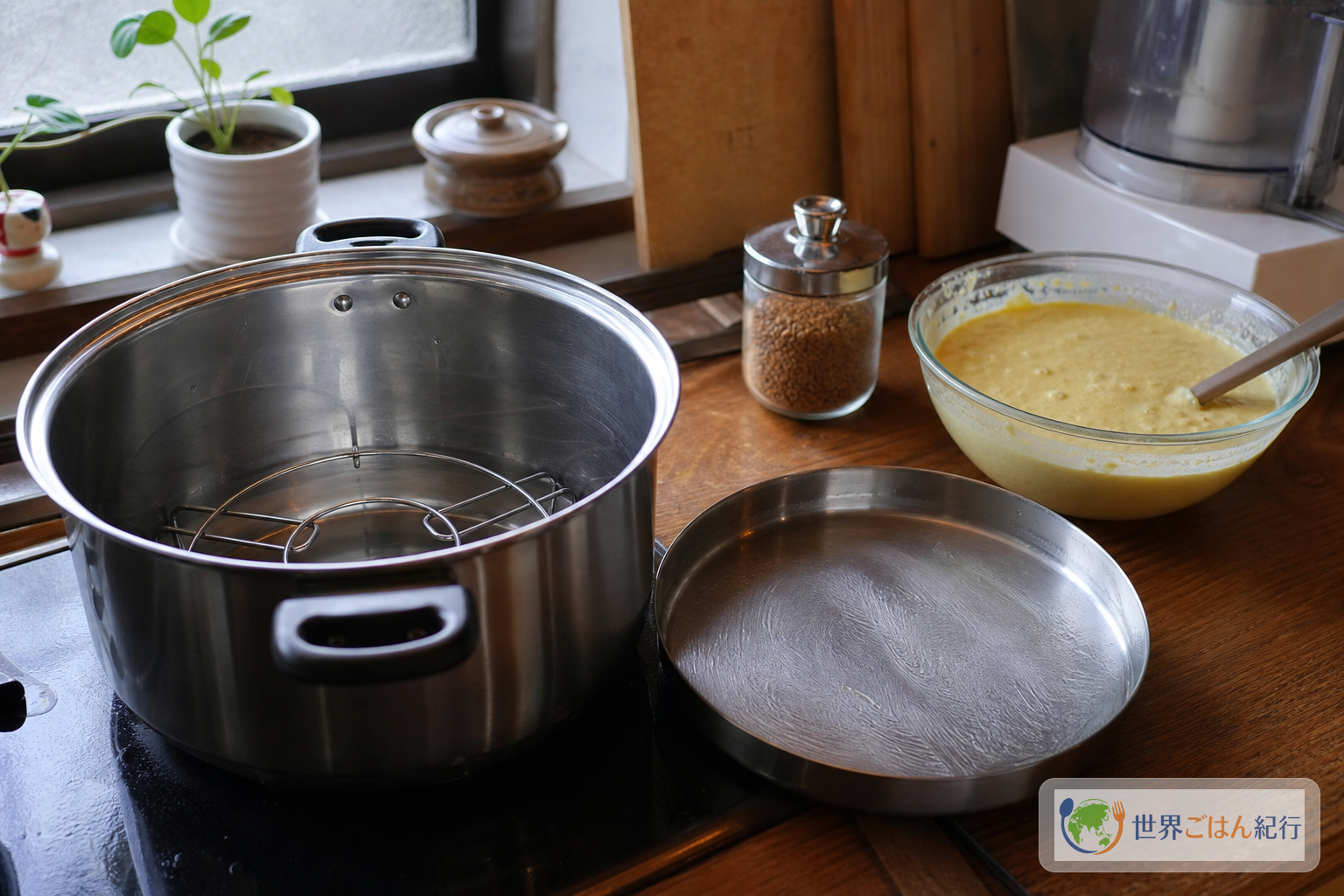
If you start looking for a dedicated steamer, the shopping becomes bigger than the cooking. Decide first what to keep and what to change.
Keep these: soaking and grinding the rice and lentils, the tang from fermentation, steaming at an even thickness, and pouring the tempering at the end. You may change: a large Indian thali plate for a 20 cm metal pan, using a deep pot with a steaming rack instead of a tava, and frozen curry leaves. Rice cooker steam functions differ by model, so a pot with strong steam is easier to read.
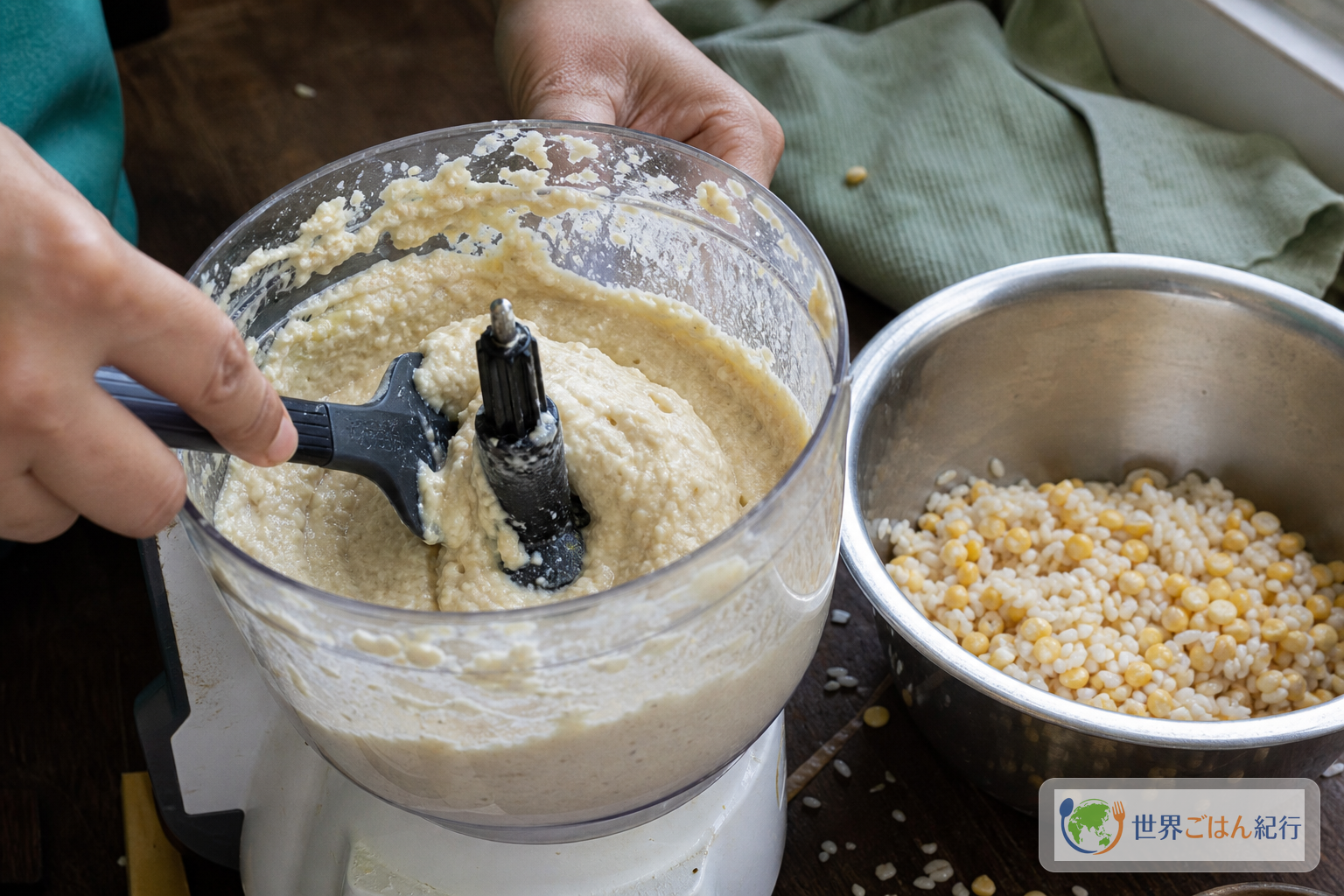
For grinding, do not cram all the rice and lentils in at once. If you have a home blender, do the soaked ingredients in 2–3 batches, adding enough water for the blades to turn. If you already own a blender that handles this, you need no new equipment.
For people who grind small amounts often, a food processor helps. The condition for buying is that it can make a batter with coarse rice grains evenly in small batches and that you will also use it for onions and chutney beyond dhokla. If you will make this once, have little storage, or already own a strong blender, skip it.
Instructions
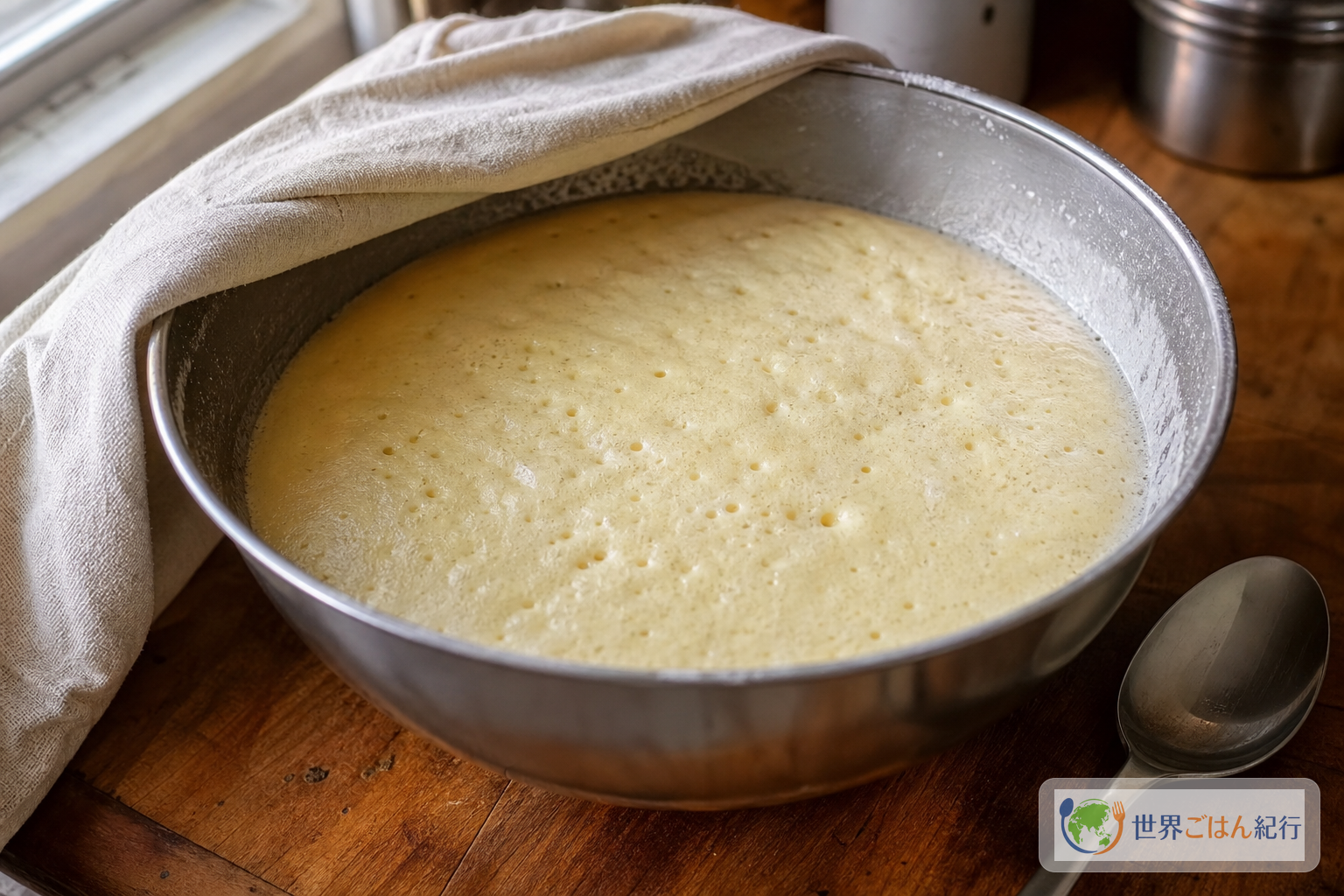
Apart from fermentation time, the work from soaking to steaming takes about 55 minutes. Judge the fermented batter not only by the surface but by the height seen from the side of the bowl and by the smell. When the room is below 20°C, plan on 10–14 hours; above 28°C, 6–8 hours, and steam before it overinflates.
Reading Whether It Is Steamed Through
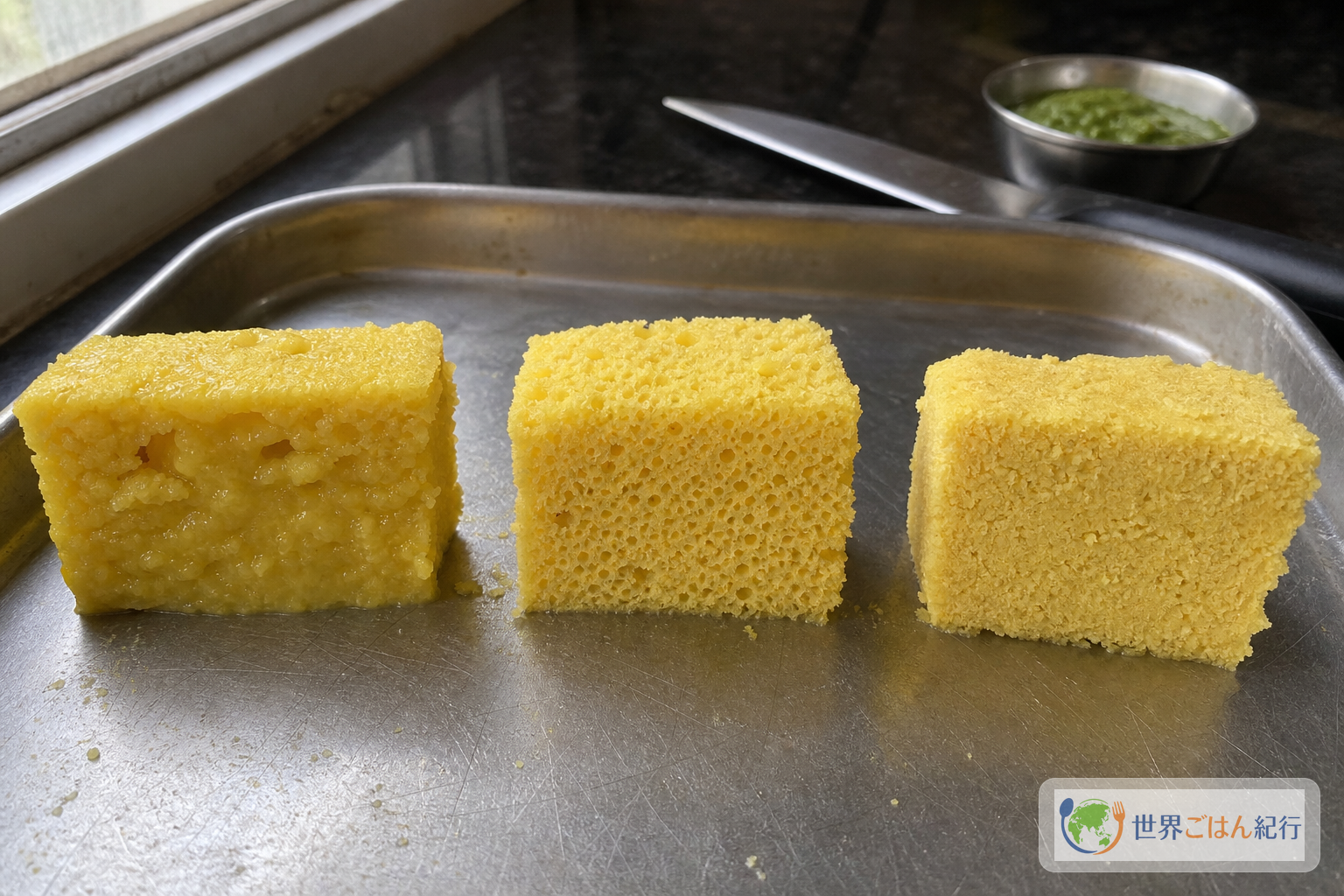
If you judge dhokla only right after it comes out of the steamer, you will misjudge. The surface sets early, so look at the moistness of the center, the height of the sides, and the holes in the cut cross section together.
| State | What is happening | Fix |
|---|---|---|
| Center is liquid and clings to the skewer | The pan is too big, or the steam is weak | Cover and add 3 minutes at a time over high heat, retesting with the skewer |
| Cross section is dense and heavy like mochi | Underfermented, batter too thick, or the foam was crushed | Next time extend fermentation by 2 hours, add 10 ml more water, and mix briefly |
| Surface cracks and tastes bitter | Too much baking soda, steam too strong, or lemon juice unevenly mixed | Before steaming, turn the whole batter from the bottom for 30 seconds only. Do not increase the amount |
| Strong sourness lingers | Fermented too far in a warm place | Next time move it somewhere cool and steam before it rises to 1.5 times |
| The syrup drops to the bottom | Poured before cutting, or the liquid had cooled | Cool 8 minutes, cut, and pour the syrup while it is boiling hot |
Fermented batter does not look the same in the same amount of time every time. Room temperature, the sourness of the yogurt, and how dry the rice is all change. Use the timer to remind you of the next job, and leave the final judgment to bubbles and smell. If after 12 hours it has barely risen, trying to rescue it with more baking soda only makes it bitter. First move it to around 28°C and wait 2 hours. If still no tang or bubbles appear, check the yogurt next time.
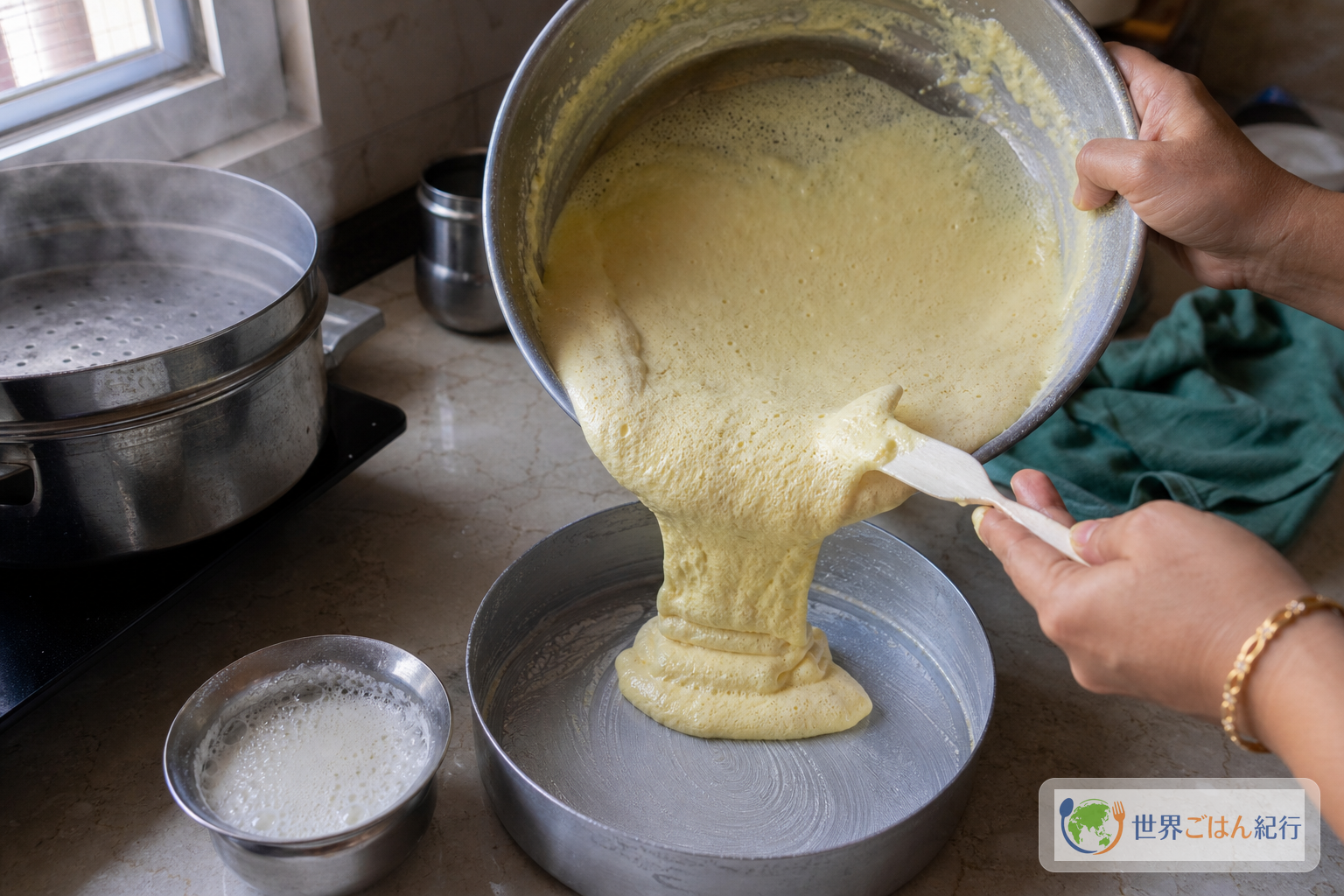
Spreading it into a 24 cm pan tends to bring the thickness below 1.5 cm, so start checking from 15 minutes. Conversely, putting it all into a deep 18 cm pan goes above 2.5 cm, and only the outside sets while the center remains. If unsure, divide between two 20 cm pans.
Add the next ingredients as soon as a few mustard seeds pop. If you add water after they turn black, the bitterness spreads through the whole syrup. Curry leaves go in when the oil is hot, so always keep the lid half-open.
You can lean toward an instant khaman with 150 g besan, 100 g yogurt, 120 ml water, 5 g salt, 1 g turmeric, 2 g baking soda, and 15 ml lemon juice. This is a different dish from the fermented dhokla here. It is an option for a day without time to wait for the rice and lentil aroma, so you do not force it into the same name.
Returning It to the Gujarati Table
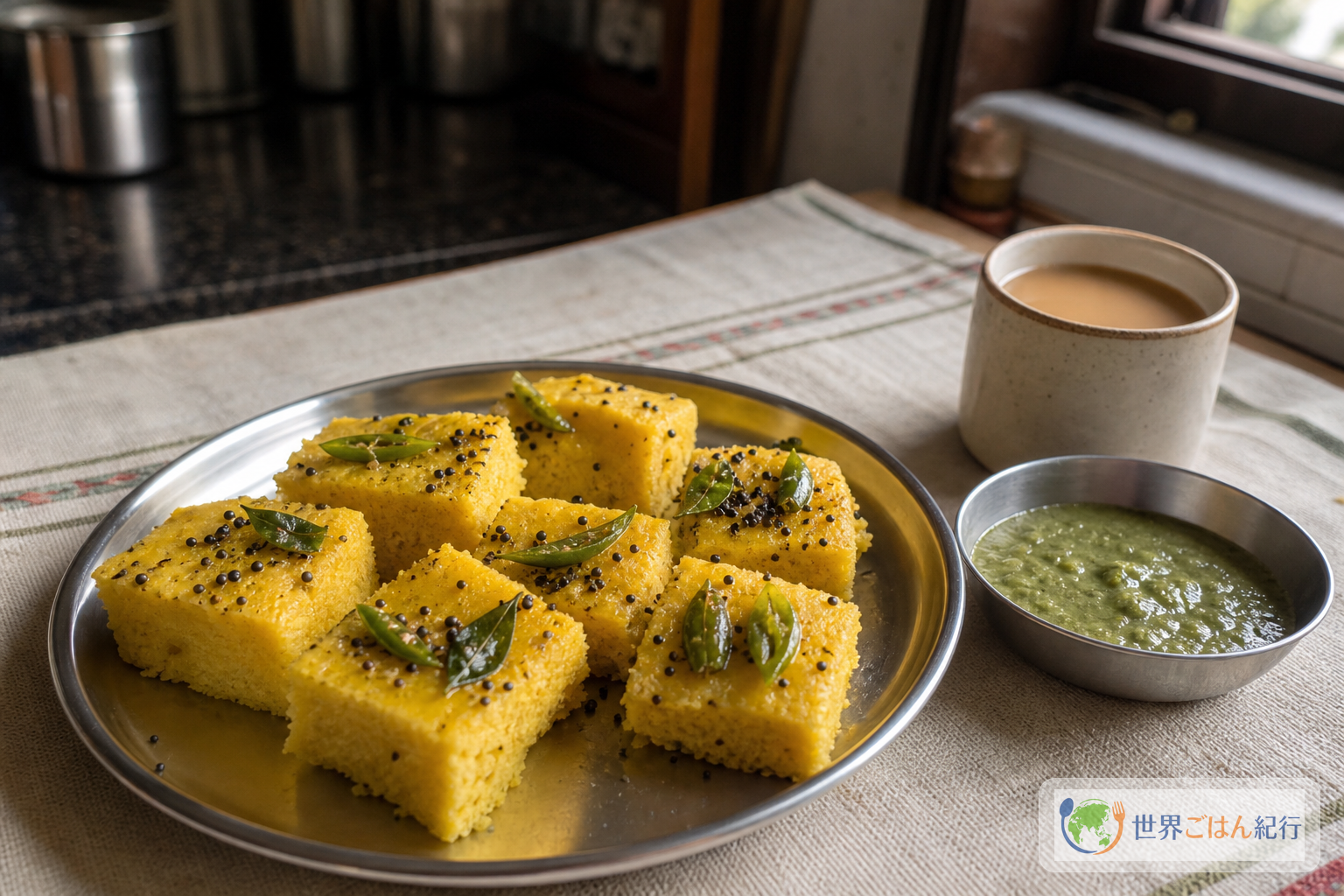
If you set out only to finish the steamed cake, the flavor tends to stay one-note to the last piece. The farsan character of the dish is decided by what is placed beside the plain batter and at what hour it is eaten.
For breakfast, 5–6 pieces per person, 1 tbsp green chutney, and a small cup of sweet chai make a light but not unsatisfying set. As a side dish at lunch, add cucumber or tomato for more tang. For dinner, rather than stacking it with a lentil curry, a cool yogurt sauce like raita is easier to eat.
In Gujarati home cooking there is a sense of treating sweetness on the same plate as saltiness and sourness. The 12 g sugar in the tempering is not there to make it sweet like a dessert. It rounds the sourness of rice and lentils and links the sharp edges of mustard and lemon. Remove it all, and only the sourness of fermentation comes forward; increase it, and the boundary with the chutney disappears. Make it as written the first time and adjust to your family's taste from the next.
Tracing its origins, dhokla has not survived as a single fixed recipe. The paper in the sources lists examples using wheat, corn, or kodo millet in place of rice, and soybeans, peas, or pigeon peas in place of Bengal gram. With the Gujarati table of western India as the starting point, there are regional and household differences in ingredients, so when reproducing it elsewhere, do not treat this formula as the one right answer, and use the tang of fermentation and the steamed thickness as your guide.
To compare another Indian fermented dish, move on to dosa, where rice and lentils are cooked thin on a griddle, and the difference from a steamed dish becomes clear. Among Gujarati flour dishes, thepla (in Japanese), kneaded with fenugreek aroma, also connects as something to set beside the chai. Dhokla finds its place not as a dish that fills you up alone, but as a small base for scooping something up or catching something.
Variations Keep the Fermented Core
After making the basic version once, change the thickness before the flavor. Spread thin and the syrup on top seems more; thick and the lentil aroma stays in the center. Changing the cut and the accompaniments to suit the occasion keeps the dhokla character better than adding fillings.
White khatta dhokla
Omit the 1 g turmeric, and make the tempering with 10 g sugar and 12 ml lemon juice. The color is white and the tang comes slightly more forward. It suits a batter that is more fermented, so steam it when the bubbles on the surface have turned fine.
A breakfast version with less green chili
Replace the green chili in the tempering with 2 shishito peppers. The heat is weaker, but a green aroma passes into the oil. If you eat it with children, serving the chutney separately lets you share from the same steamed pan.
Small steamed cakes from leftover batter
You can also set aside only 200 g of the fermented batter and not steam everything at once. Refrigerate the rest and use it within 24 hours. Refrigeration deepens the tang, so add the baking soda and lemon juice just before steaming, put it in an 18 cm pan at 1.5 cm thick, and start checking from 15 minutes. If you will keep it more than 2 days, it is easier to manage as cooked dhokla in the refrigerator than to stretch the batter.
Storage and FAQ
How long can I keep it?
Let steamed dhokla cool slightly, then refrigerate in a shallow airtight container. Keep the chutney in a separate container and put it in the refrigerator within 2 hours. Use refrigerated dhokla within 3 days as a guide, and steam for 5 minutes before eating to bring back the moisture. Do not eat anything left long at room temperature or with an off smell other than tang. As a general food-safety guide, refrigerate cooked leftovers promptly and use them within 3–4 days.
Can I eat batter that has not fermented properly?
If it only has few bubbles and a mild aroma, you can move it to around 28°C and check every 2 hours. If there are pink or black spots, a spoiled smell, or sliminess, do not try to rescue it by cooking; discard it. Merely adding more baking soda to an underfermented batter does not make up for the tang or the lentil aroma.
I have no steamer. Can I use an ordinary pot?
Yes, with 2 cm of water and a steaming rack in a deep pot, as long as the pan does not touch the water. If water gets into the pan the batter collapses, so use a combination where the bottom of the pan does not sit lower than the rack. If water drips from the lid, wrap the lid in a cloth. Keep hot water boiled separately for topping up so you do not have to lower the heat.
Can I use rice flour or chickpea flour?
Rice flour alone will not give the lentil stickiness that this soaking and fermenting gives. With chickpea flour alone you get an instant steamed cake leaning toward khaman. To approximate it elsewhere, soaking and grinding raw rice is closer than using rice flour, and if you use washed rice, soak it thoroughly.
I don't like mustard seeds. Can I omit them?
You can, but the toasty aroma of the tempering is weaker. Replacing them with 1/2 tsp cumin seeds preserves the aroma of the oil. Whole-grain mustard or tube mustard changes the moisture and tang, so it is not a same-amount substitute.
Chana dal and urad dal are legumes, and yogurt is dairy. For the chutney with mustard seeds or coconut, those with allergies should check the ingredient labels individually. If someone at home needs to avoid an ingredient, check the labels of the substitutes as well and avoid sharing the same cooking utensils.
Sources
- Khaman | Gujarat Tourism (differences in dhokla and khaman ingredients and texture)
- Traditional Fermented Food Products and IPR | Indian Journal of Traditional Knowledge (India's fermented grain and lentil dishes, and an overview of dhokla and khaman)
- Khatta Dhokla Recipe | Tarla Dalal (reference for ingredients and steaming for khatta dhokla)
- What Is the Difference Between Khaman And Dhokhla? | NDTV Food (supplementary source on names and ingredient differences)
- Cold Food Storage Charts | FoodSafety.gov (general guide for refrigerating cooked food)
Because the local name of this dish is not fixed to one thing, looking at the differences in ingredients and process makes the choices easier. Fermented batter changes its look with temperature and container. Even if the first pan is a little dense, once you know whether to change the soaking time, the fermentation height, or the steamed thickness next time, dhokla will grow in your kitchen.