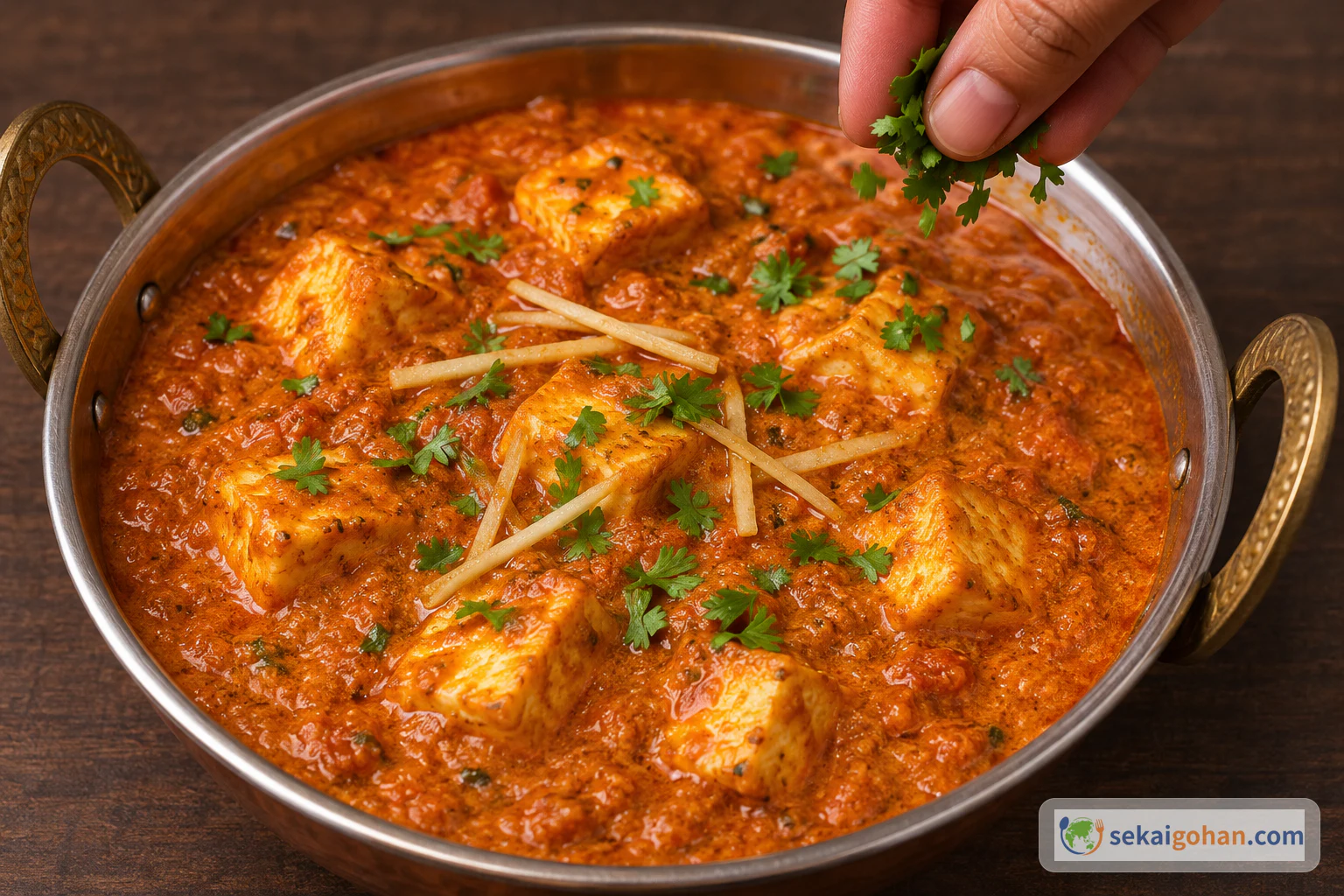
Khoya Paneer: Two Dairy Products and a Strained Tomato Base
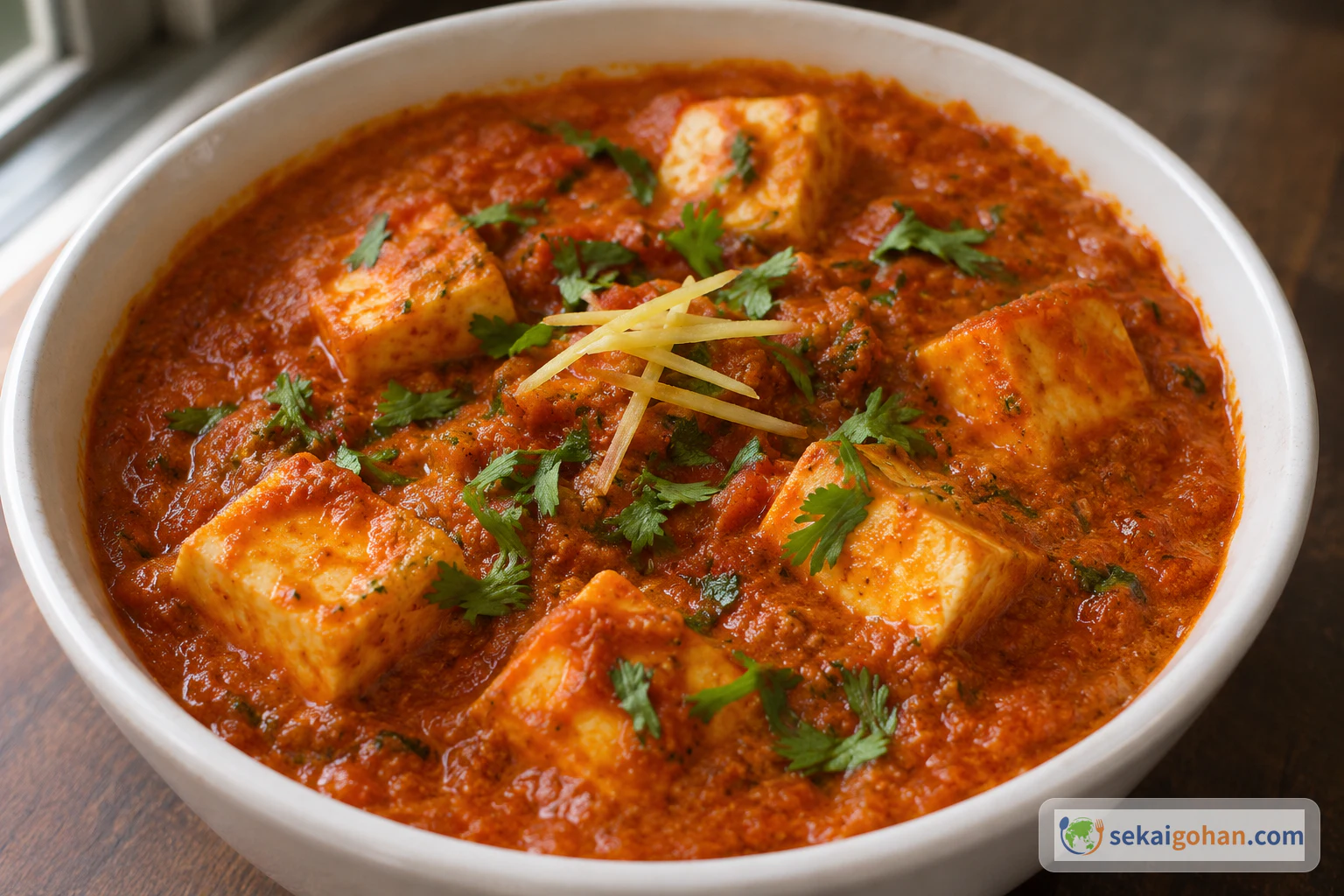
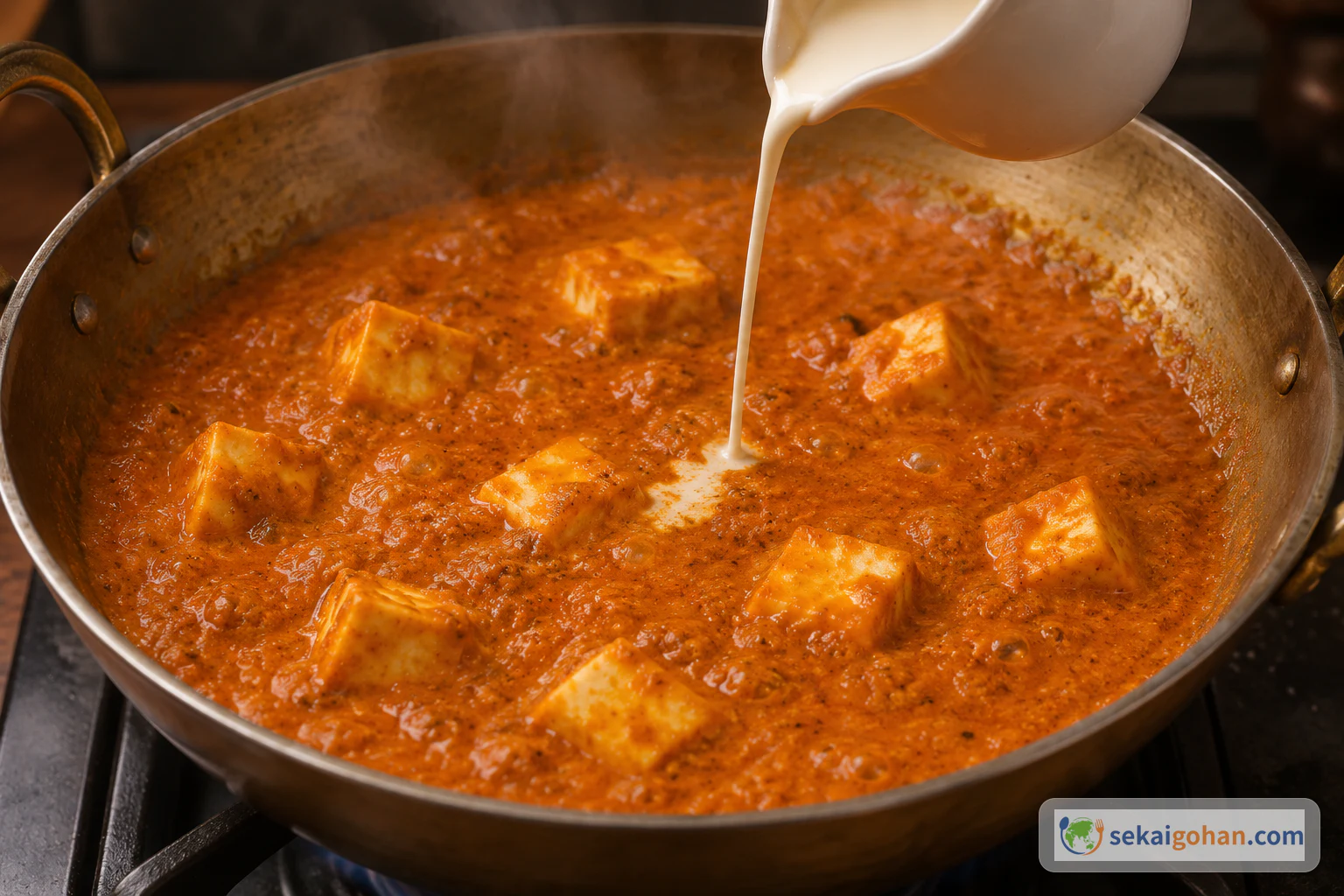
A smooth, seedless tomato puree, khoya cooked in ghee only until it turns slightly pink, and paneer cubes that stay whole in the curry. The whole cardamom goes in at the start and the ground cardamom at the end.
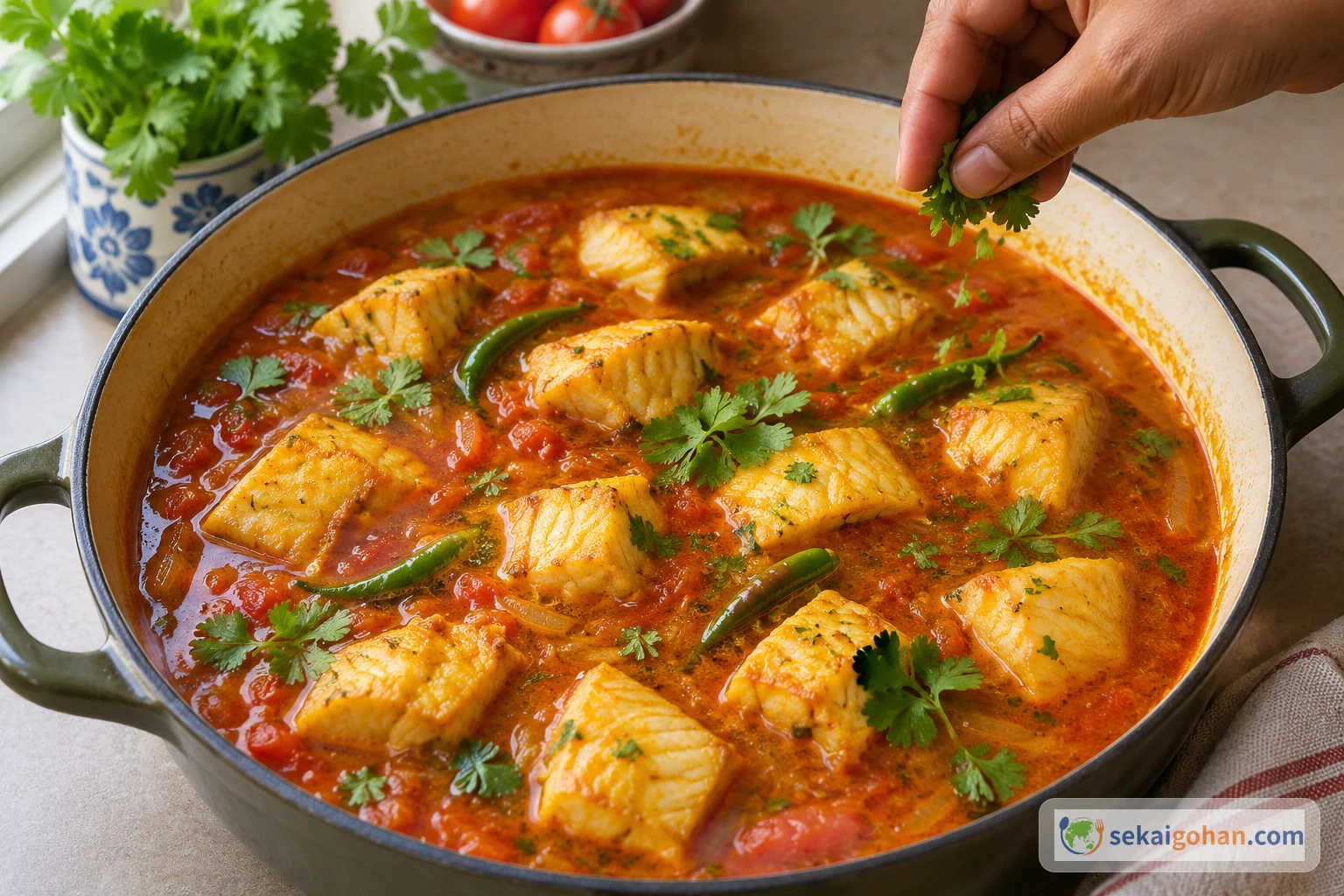
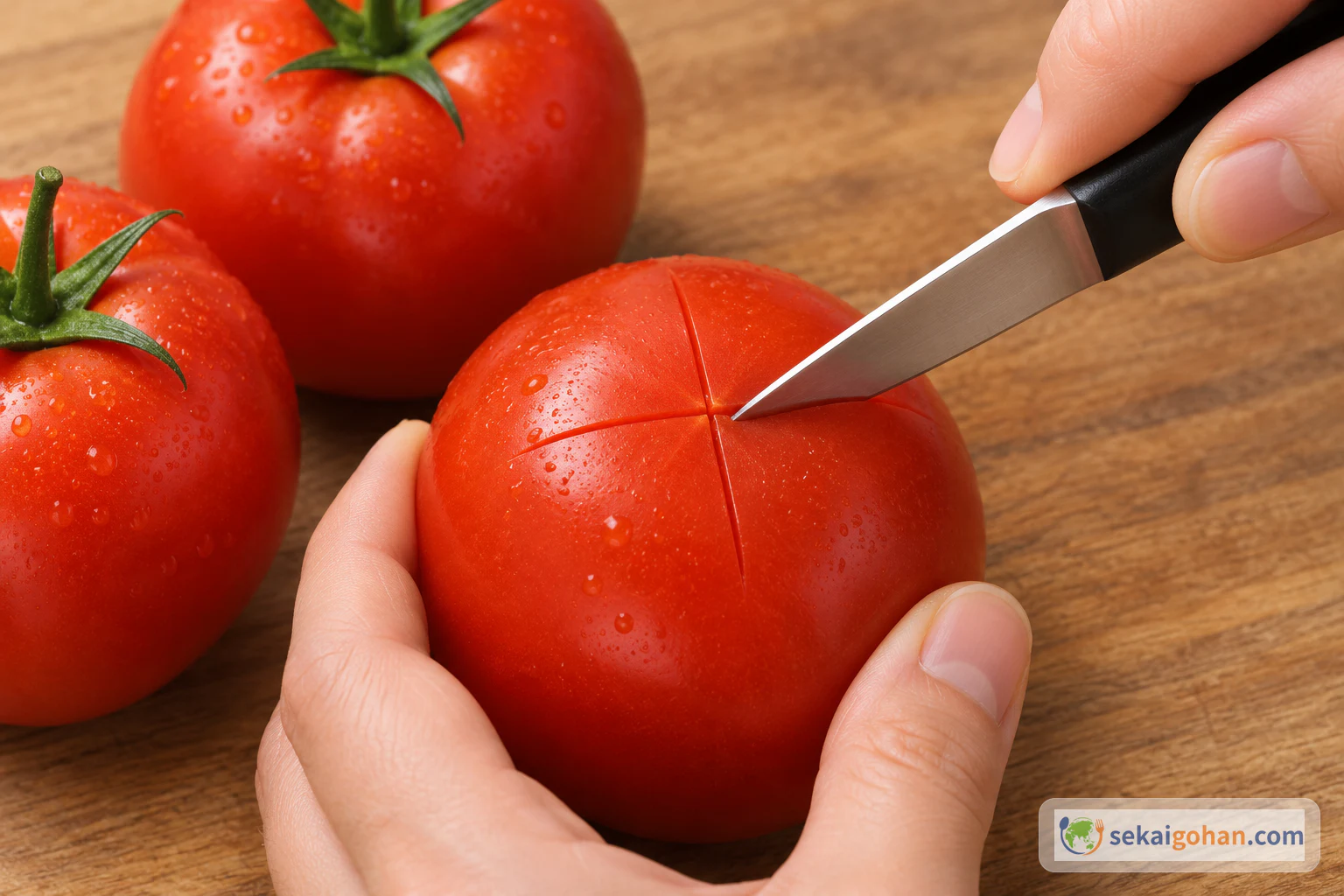
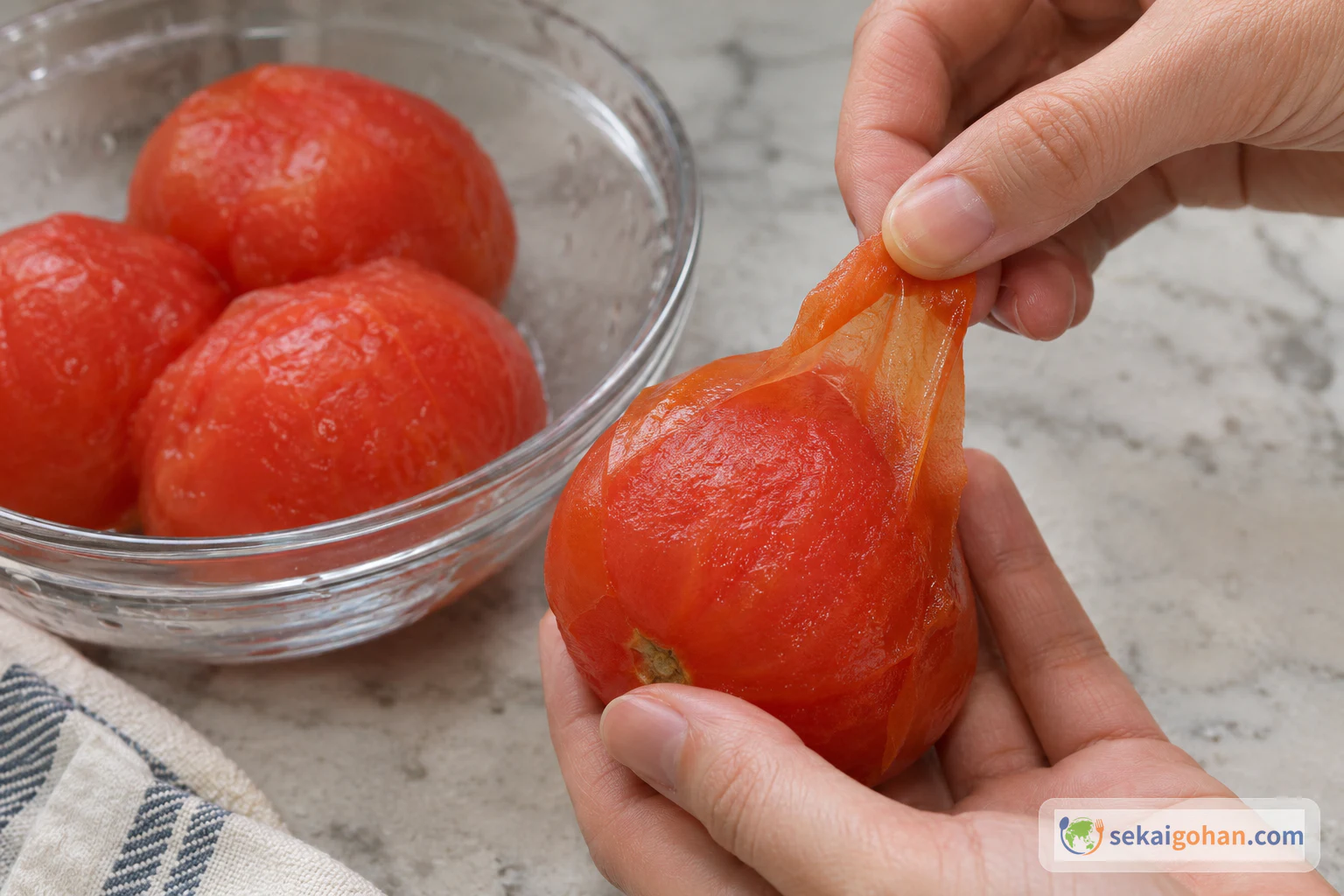
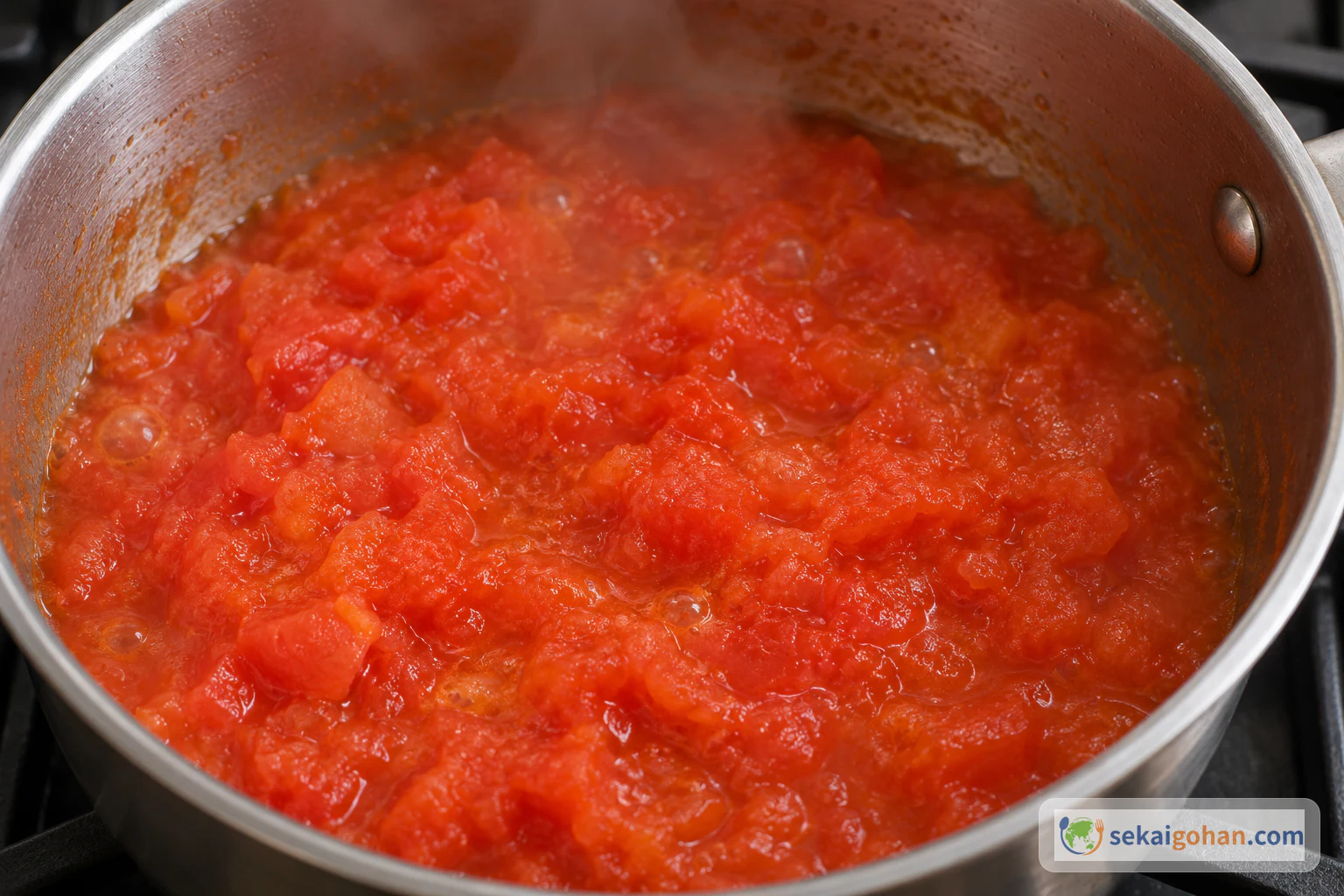
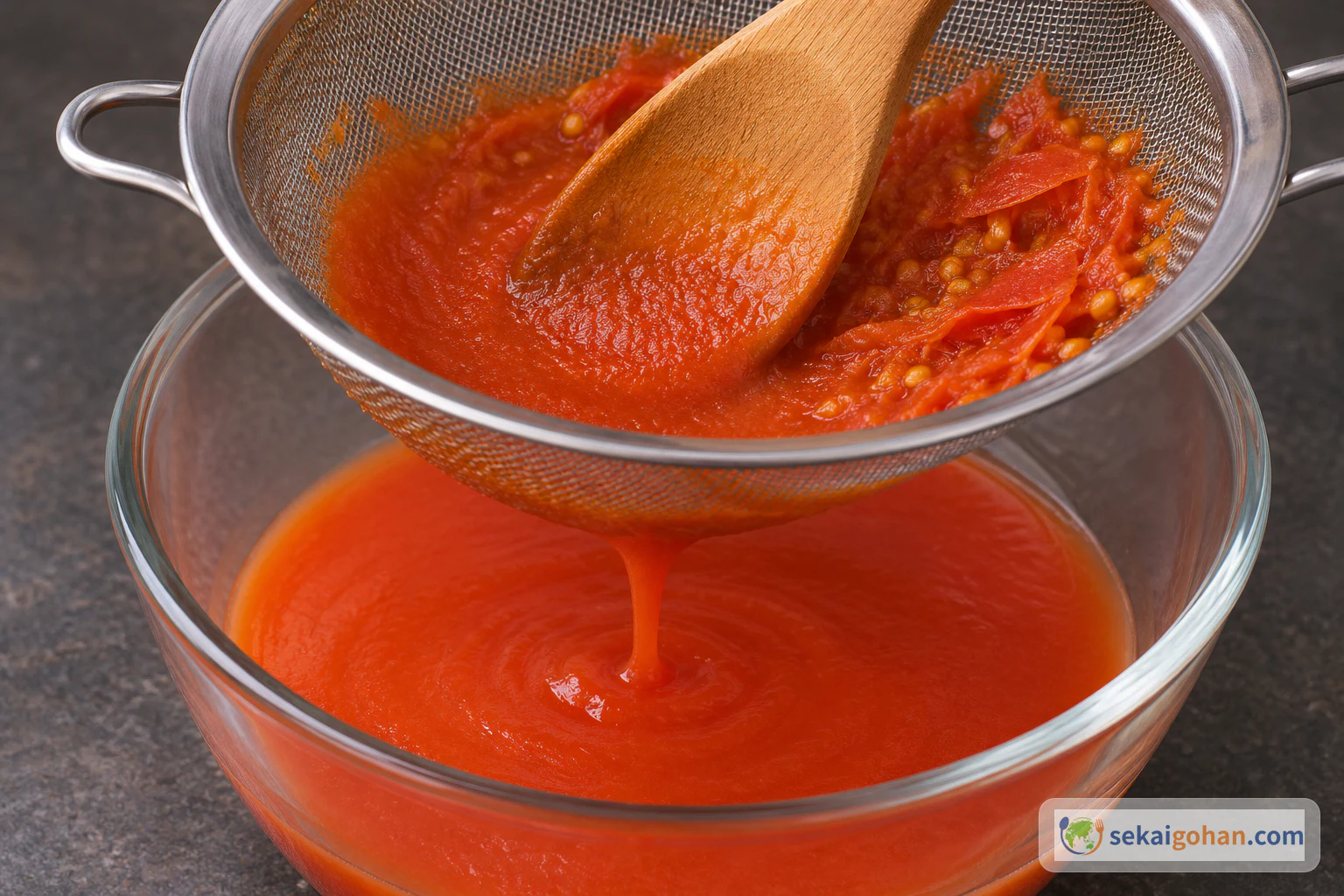
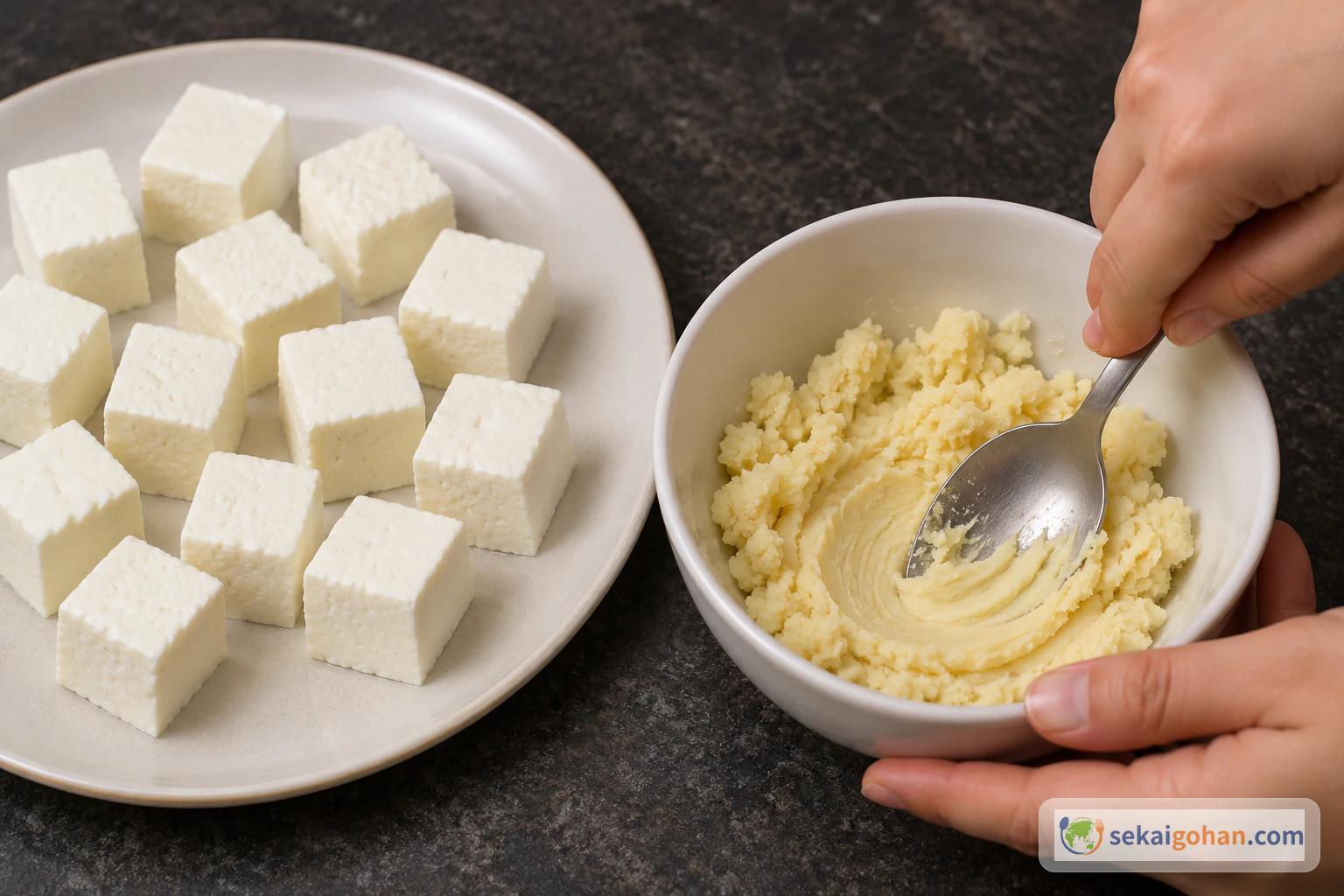
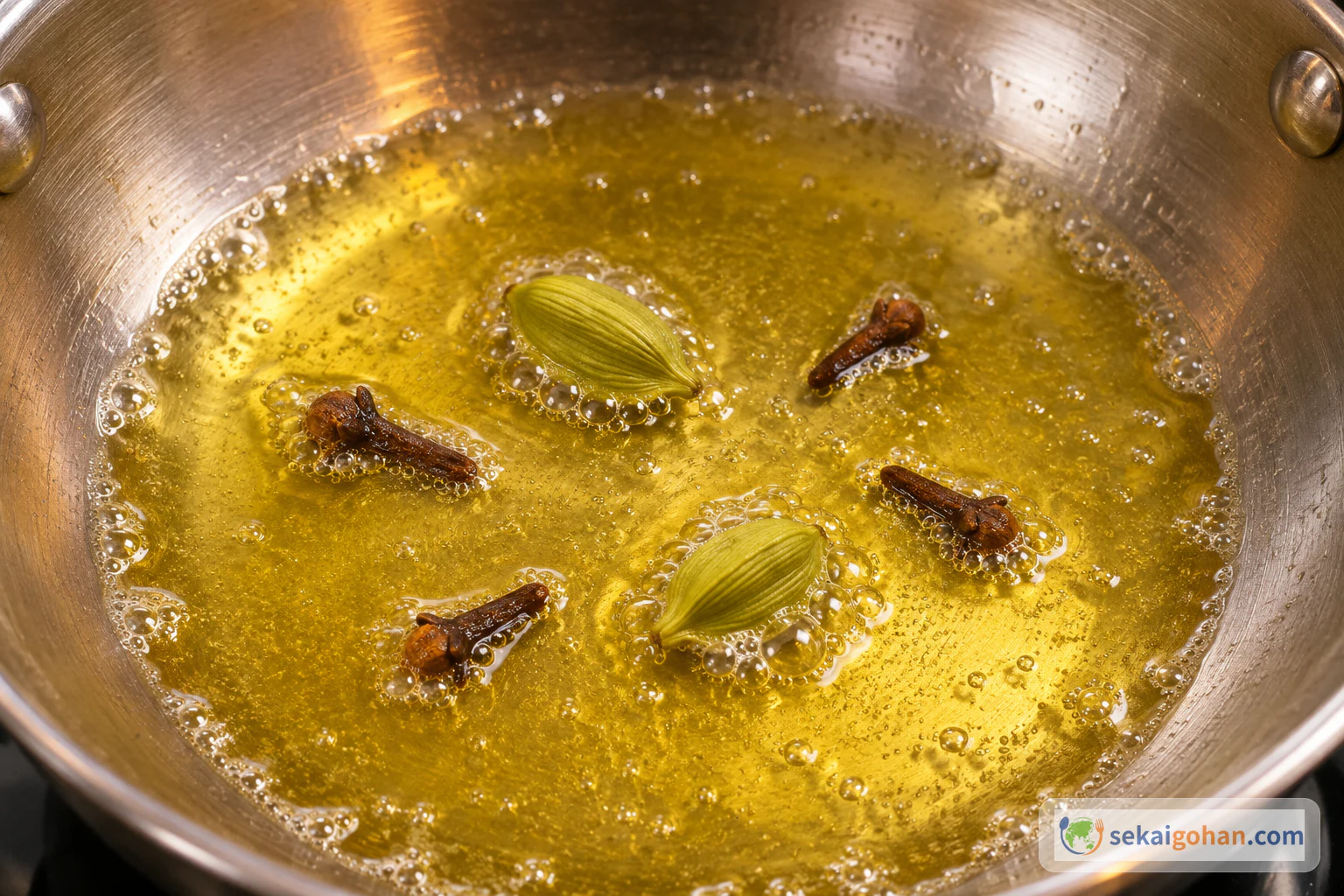
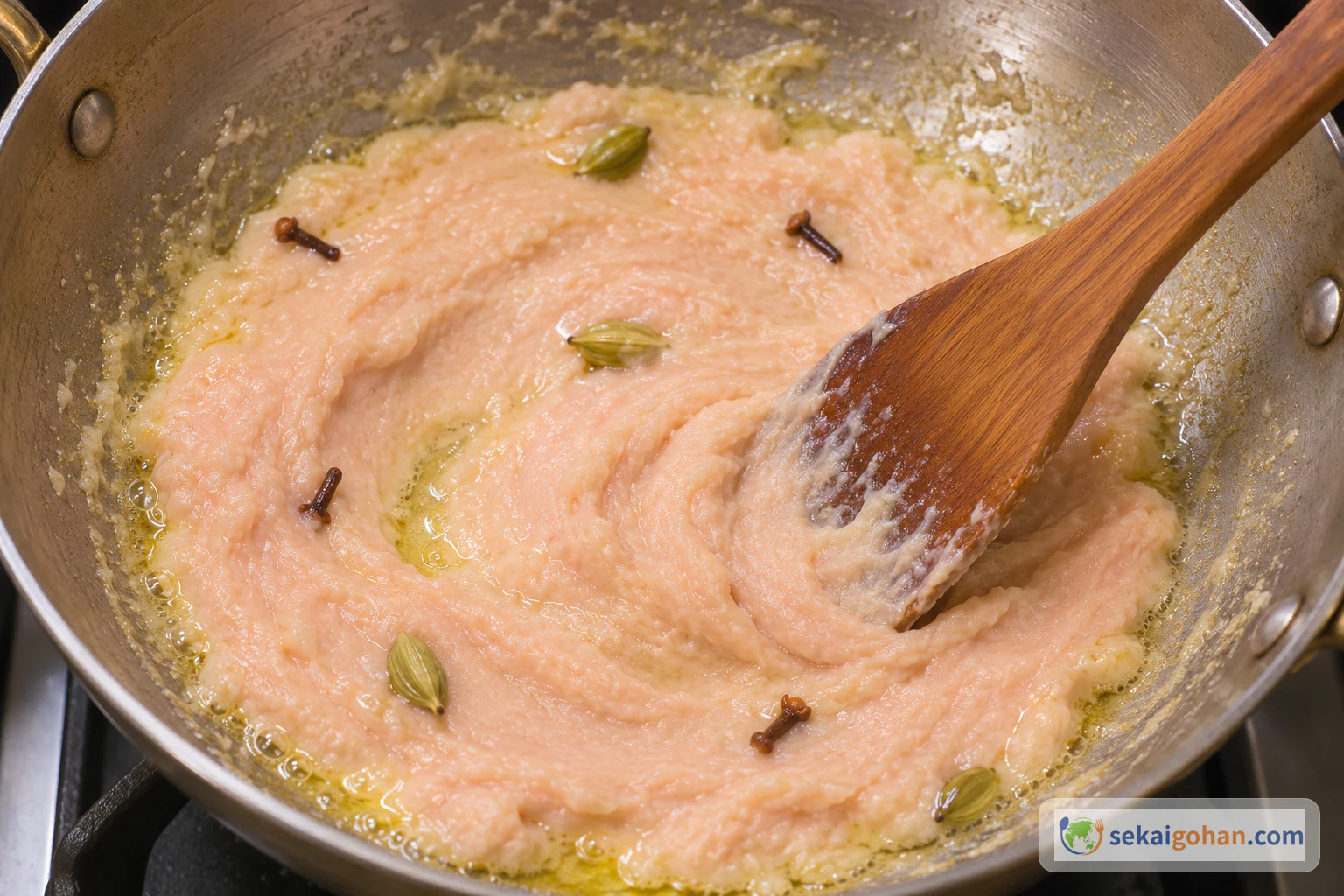
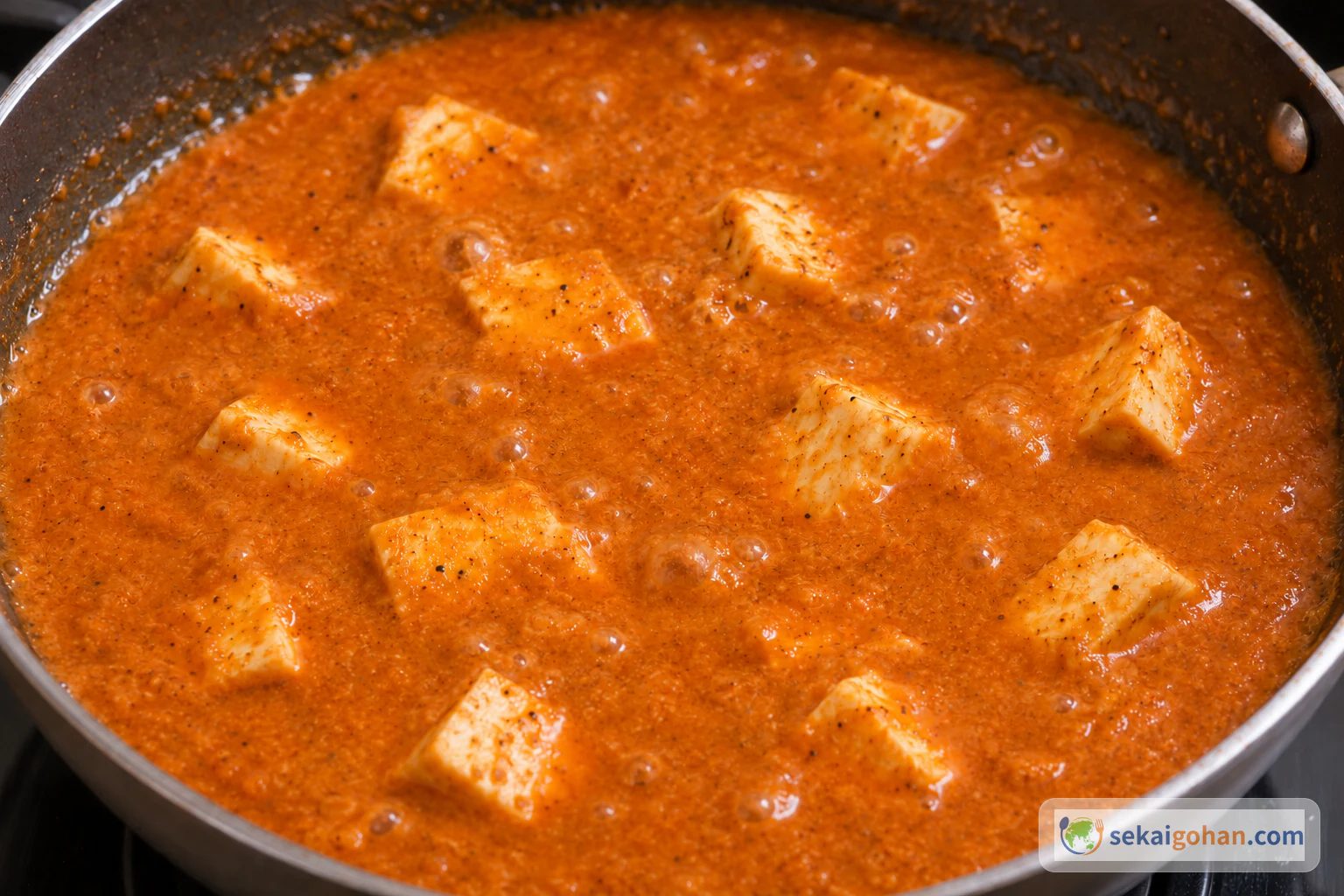
Six ripe red tomatoes are scored, slipped into boiling water for 30 seconds and peeled. They are chopped, cooked down until soft and pulpy, then pureed and pressed through a sieve. In a separate pan, whole green cardamom and cloves crackle in ghee, and smooth-mashed khoya goes in until it takes on a faint pink color. The tomato puree, spices, water and cubes of paneer follow, and a little cream with ground cardamom finishes the pot.
Khoya paneer is a curry from India built on two dairy products named in its title. Chef Pankaj Bhadouria describes it on her own recipe site as paneer cubes in a khoya and tomato based curry, for 4 servings. This article follows that recipe, using the fresh-tomato route with six large ripe red tomatoes. Sekai Gohan has not kitchen-tested this recipe; the amounts, order and times below follow Pankaj Bhadouria's published method.
Khoya is also written khoa, and the same dairy product is called mawa. The rock salt used here is sendha namak.
What Khoya Paneer Is: Khoya Cooked First, Paneer Simmered Last
Khoya and paneer are different dairy products, and this dish uses both. A 2020 dairy-processing training compendium published by ICAR-National Dairy Research Institute (ICAR-NDRI), Karnal, includes a chapter by Kaushik Khamrui, "Technology of Khoa, Chhana and Paneer." That chapter identifies khoa, khoya and mawa as names for a milk product made by partially dehydrating milk. It describes paneer as milk coagulated with heat and acid, then drained and pressed. So khoya is concentrated milk solids, while paneer is a pressed fresh cheese. In this curry the khoya dissolves into the sauce, and the paneer stays in cubes.
The recipe here is a tomato-based version. It is not the only form that goes by the name khoya paneer. NDTV Food publishes a recipe of the same name credited to Gurpreet Singh of Punjab Grill. That version is for 2 servings and uses cashew nuts, 500 g paneer, desi ghee, khoya, curd, green cardamom, green chillies, ginger, salt and coriander. Boiled cashews are ground to a paste, green chillies and cardamom crackle in ghee, the cashew paste, whisked curd and salt cook for 10 minutes, and khoya and paneer go in at the end. The two recipes share a name and some ingredients but differ in base, amounts and order. This article does not mix them: no cashews or curd go into the tomato version below.
Pankaj Bhadouria's page lists 20 minutes for preparation and 15 minutes for cooking and marks the recipe as intermediate. Separately, the method gives its own times for each stage: 30 seconds for blanching, 8–10 minutes for cooking the tomatoes, 30 seconds for the whole spices, a couple of minutes for the pastes, 10 minutes of low simmering and 2 minutes after the cream. Those are kept as written for each stage here, and no new overall time is worked out from them.
Ingredients (Serves 4)
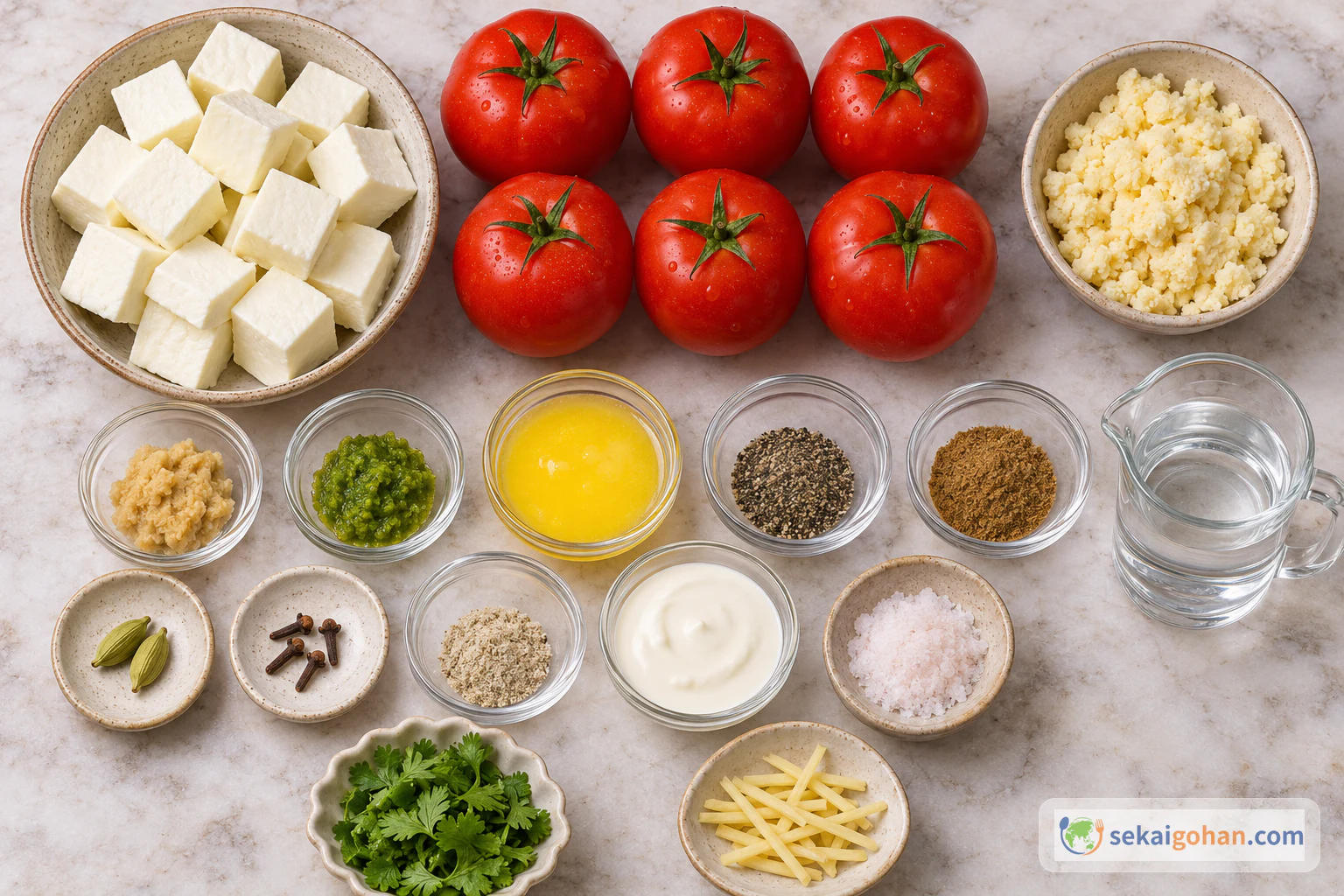
Keep the whole cardamom and the ground cardamom separate, and keep the ginger paste separate from the ginger cut for garnish. Each goes in at a different stage.
Equipment
- Paring knife and cutting board
- Pot of boiling water and a slotted spoon
- Saucepan for cooking the tomatoes
- Blender or other tool for pureeing
- Fine-mesh sieve and a bowl
- Small bowl and spoon for mashing the khoya
- Pan or kadai for the curry
- Spatula
Choosing Khoya, Paneer and Tomatoes
Khoya: Look for plain, unsweetened khoya (also sold as mawa or khoa) at an Indian grocery. Condensed milk and cream cheese are not the same product, and no substitute is given here.
Paneer: You need 200 g, cut into 1-inch cubes. Cut it before you start the curry so it is ready at step 9.
Tomatoes: Use six large, ripe, red tomatoes. A ready-made tomato puree also exists as a shortcut, covered under variations below, but it is not used in this version. Do not add both.
Salt: Rock salt (sendha namak) is added to taste when the tomato puree goes in.
This dish contains milk in three forms: paneer, khoya and cream. Keep paneer, khoya and cream refrigerated according to their package instructions until you use them. Take care with the pot of boiling water when blanching the tomatoes and with the hot ghee when the whole spices crackle.
Method: From Fresh Tomatoes to a Finished Curry
Steps 1–4 turn the tomatoes into a smooth puree. Step 5 gets the paneer and khoya ready. Steps 6–11 build the curry in one pan.
Fixing Slips Along the Way
Most problems in this recipe come from order: what goes into the pan when. Before you start, line up the ingredients in the order of steps 6–10.
| What happened | Likely cause | What to do |
|---|---|---|
| The puree has bits of skin or seeds | Not strained, or the sieve was too coarse | Press it through a fine-mesh sieve again before step 9 |
| The tomatoes are still in chunks | Not cooked long enough to turn pulpy | Keep cooking until soft and pulpy before pureeing |
| The khoya is darkening past pink | Cooked too long in the ghee | Add the pastes as soon as it turns slightly pink |
| The ground cardamom went in with the whole spices | The two cardamoms were mixed up | The whole pods belong in step 6, the powder in step 10; keep them in separate bowls next time |
| Unsure about salt | No fixed amount | Add rock salt a little at a time in step 9 and taste |
| You added ready puree as well as fresh tomatoes | Two tomato options were combined | Use only one tomato base; this version uses the six fresh tomatoes |
Variations Within the Recipes Themselves
Ready-made tomato puree. Pankaj Bhadouria's recipe lists 1/2 cup of ready tomato puree as an alternative to preparing fresh tomatoes. This article uses the six fresh tomatoes and does not claim the two amounts give the same result. If you try the shortcut, use it instead of the fresh tomatoes, never in addition.
A cashew-and-curd khoya paneer. The Punjab Grill recipe on NDTV Food is a separate dish under the same name: a cashew paste and whisked curd base, with khoya and paneer added at the end, for 2 servings. If that is the style you want, follow that recipe as a whole rather than adding its cashews or curd to the tomato version here.
Serving and Leftovers
Neither recipe specifies an accompaniment. Serving it with rice or flatbread is only our editorial suggestion, not part of the recipe.
For leftovers, follow general household food-safety guidance from Japan's Ministry of Health, Labour and Welfare. Do not leave the finished curry at room temperature for a long time. Using clean utensils, divide what is left into shallow containers so it cools quickly, then refrigerate it. Reheat thoroughly before eating. This is general guidance for home cooking; we do not give a specific number of days for khoya paneer.
Frequently Asked Questions
What is the difference between khoya and paneer?
The ICAR-NDRI dairy chapter by Kaushik Khamrui defines khoa (khoya, mawa) as a milk product made by partially dehydrating milk. Paneer, by contrast, is milk coagulated with heat and acid, then drained and pressed. In this curry the khoya melts into the sauce, and the paneer stays in cubes.
Can I use condensed milk or cream cheese instead of khoya?
They are not the same product as khoya, and neither recipe offers a substitute. Plain, unsweetened khoya from an Indian grocery is what this recipe uses.
Can I use ready-made tomato puree?
Pankaj Bhadouria's recipe lists 1/2 cup of ready tomato puree as an alternative. This article follows the fresh-tomato route and does not claim the two are equivalent. Use one or the other, not both.
How long does it take?
The recipe page lists 20 minutes for preparation and 15 minutes for cooking. Each stage of the method also has its own time, and those are given in the steps. We have not worked out a separate overall time from them.
Why are there two kinds of cardamom?
The whole green cardamom pods are crackled in ghee at the start to flavor the fat. The ground cardamom goes in with the cream at the end. They are separate ingredients with separate jobs.
Is the 30 seconds in boiling water a food-safety step?
No. The 30-second blanch is only to loosen the tomato skins for peeling. It is not a temperature or time for making the dish safe.
Has this recipe been tested?
Sekai Gohan has not kitchen-tested this recipe. It follows Pankaj Bhadouria's published amounts and method.
Sources
- Pankaj Bhadouria, "Khoya Paneer," Pankaj Bhadouria official recipe site. The recipe followed here: the dish described as paneer cubes in a khoya and tomato based curry, 4 servings, the ingredients and amounts, the ready tomato puree alternative, the order of steps and each stage's time, and the listed 20 minutes preparation, 15 minutes cooking and intermediate level. https://www.pankajbhadouria.com/khoya-paneer
- NDTV Food, "Khoya Paneer Recipe," credited to Gurpreet Singh, Punjab Grill. A separate recipe under the same name, using cashew nuts, curd, paneer, khoya and green cardamom for 2 servings; used only for comparison. https://food.ndtv.com/recipe-khoya-paneer-951305
- Kaushik Khamrui, "Technology of Khoa, Chhana and Paneer," in Online Training for Master Trainers on Dairy Processing, ICAR-National Dairy Research Institute (ICAR-NDRI), Karnal, 2020; hosted by NIFTEM-T. Used only for the definitions of khoa (khoya, mawa) and paneer. https://niftem-t.ac.in/olapp/pmfme/upload/mt_handbook_milk.pdf
- Ministry of Health, Labour and Welfare (Japan), "家庭での食中毒予防" (Preventing food poisoning at home). General household guidance on refrigerating chilled foods, avoiding long room-temperature holding, cooling leftovers in shallow containers and reheating thoroughly. https://www.mhlw.go.jp/stf/seisakunitsuite/bunya/kenkou_iryou/shokuhin/syokuchu/01_00008.html