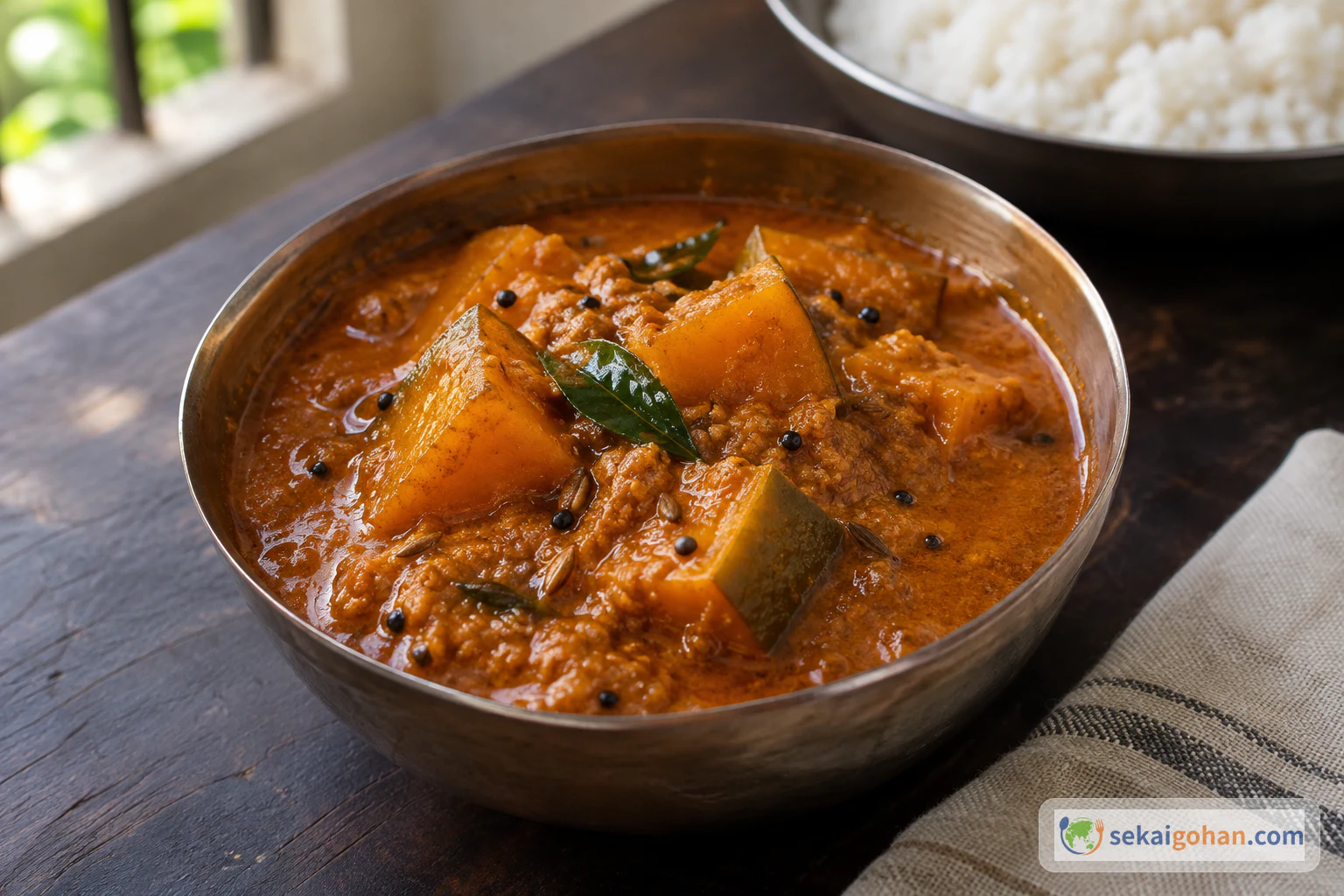
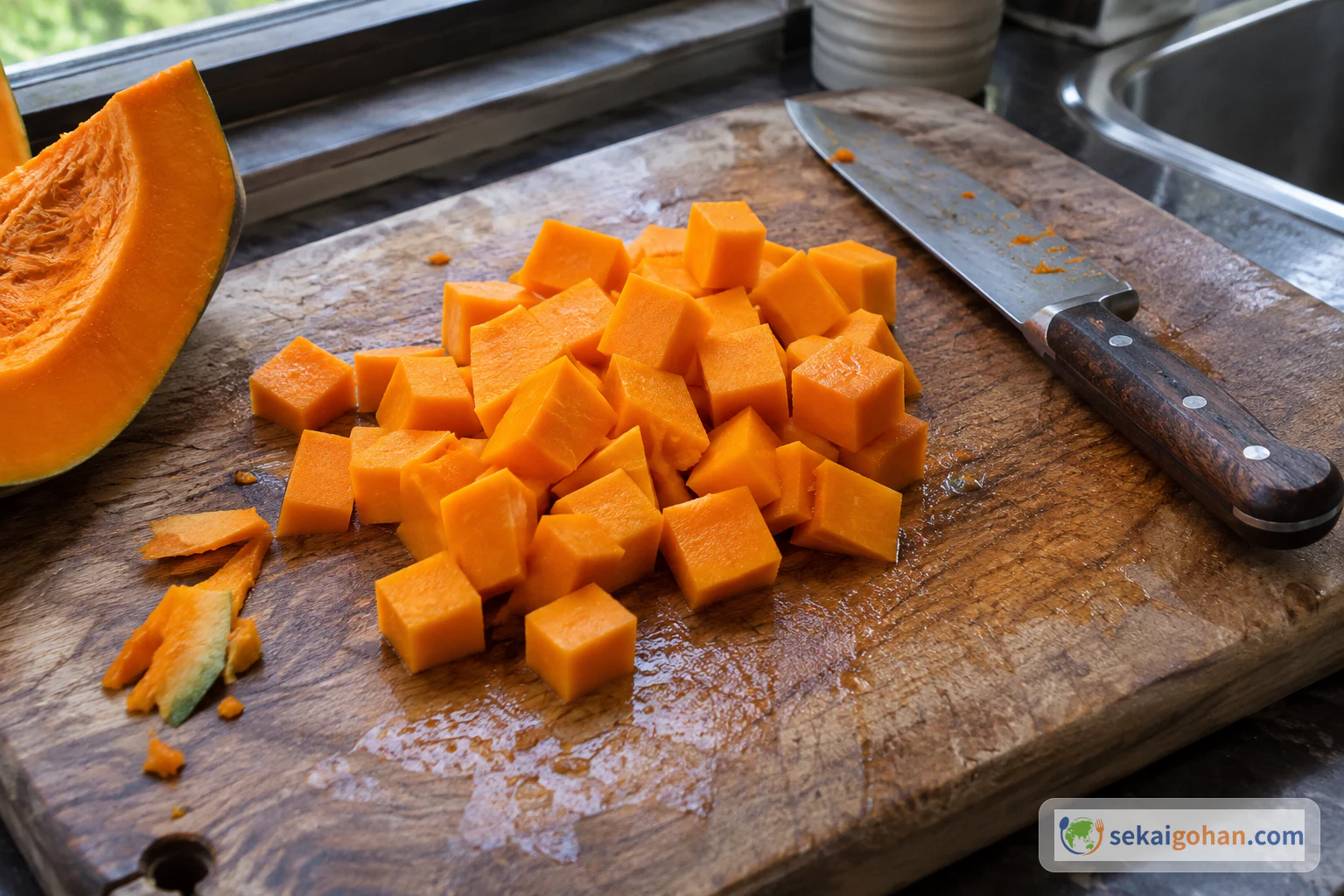
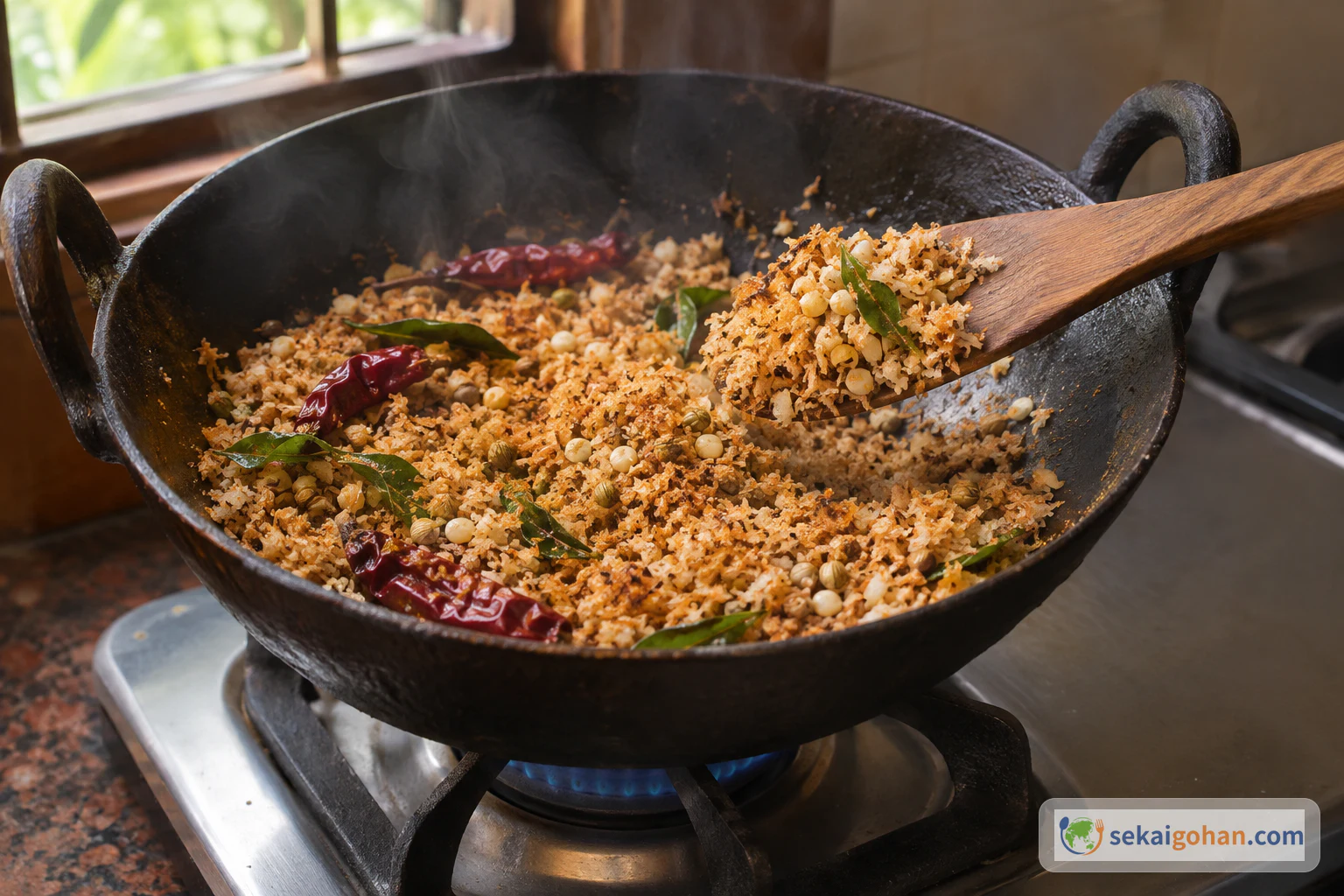
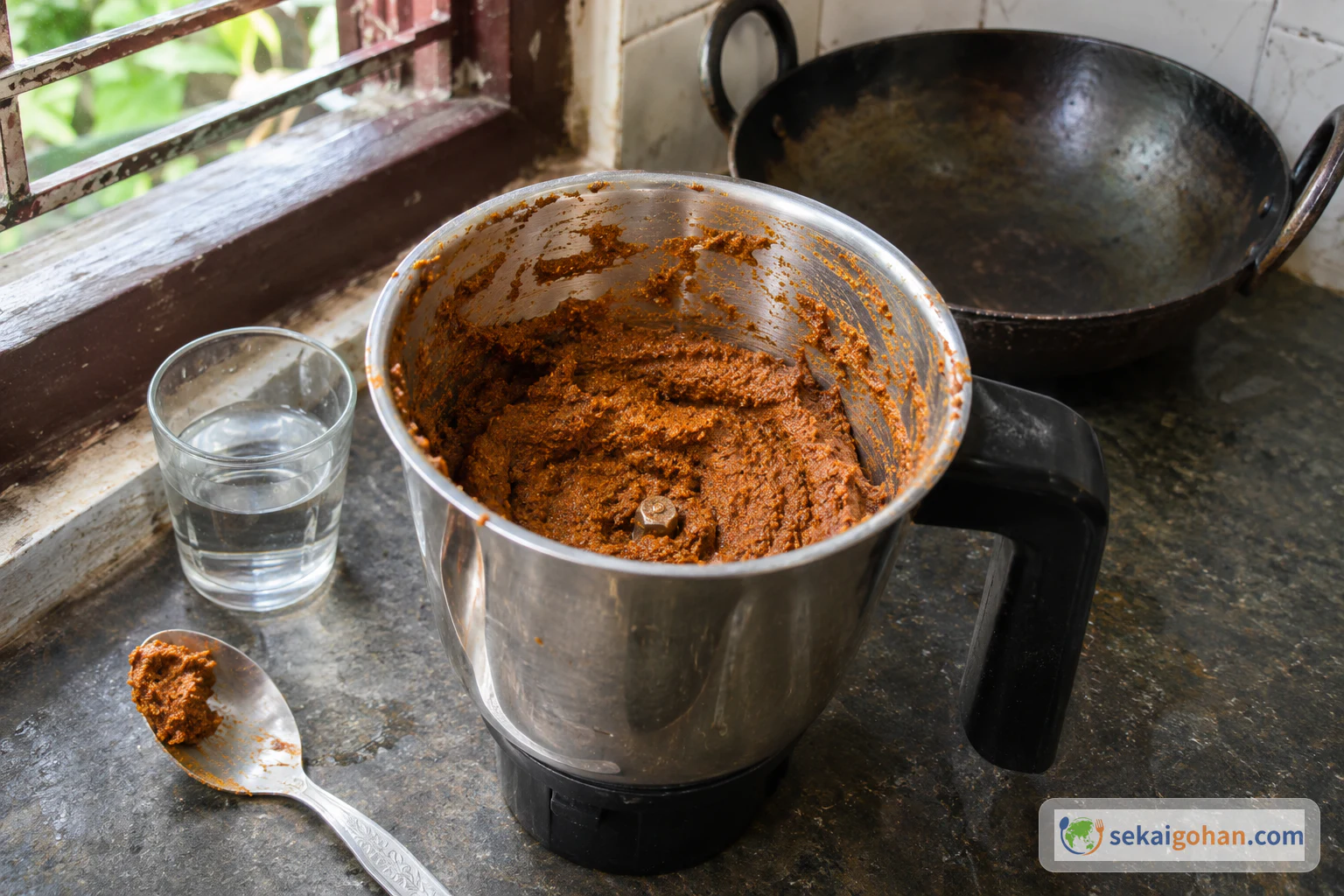
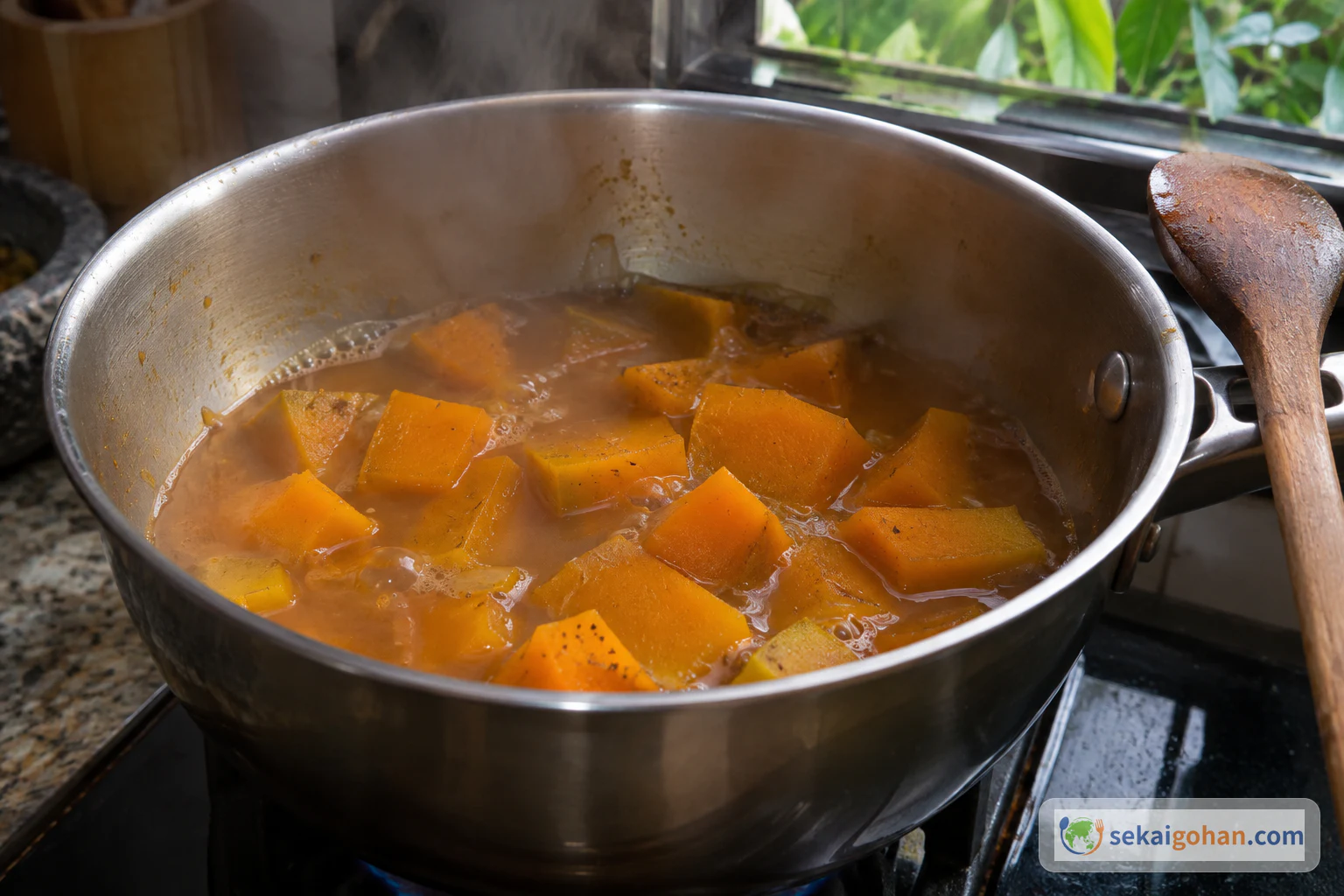
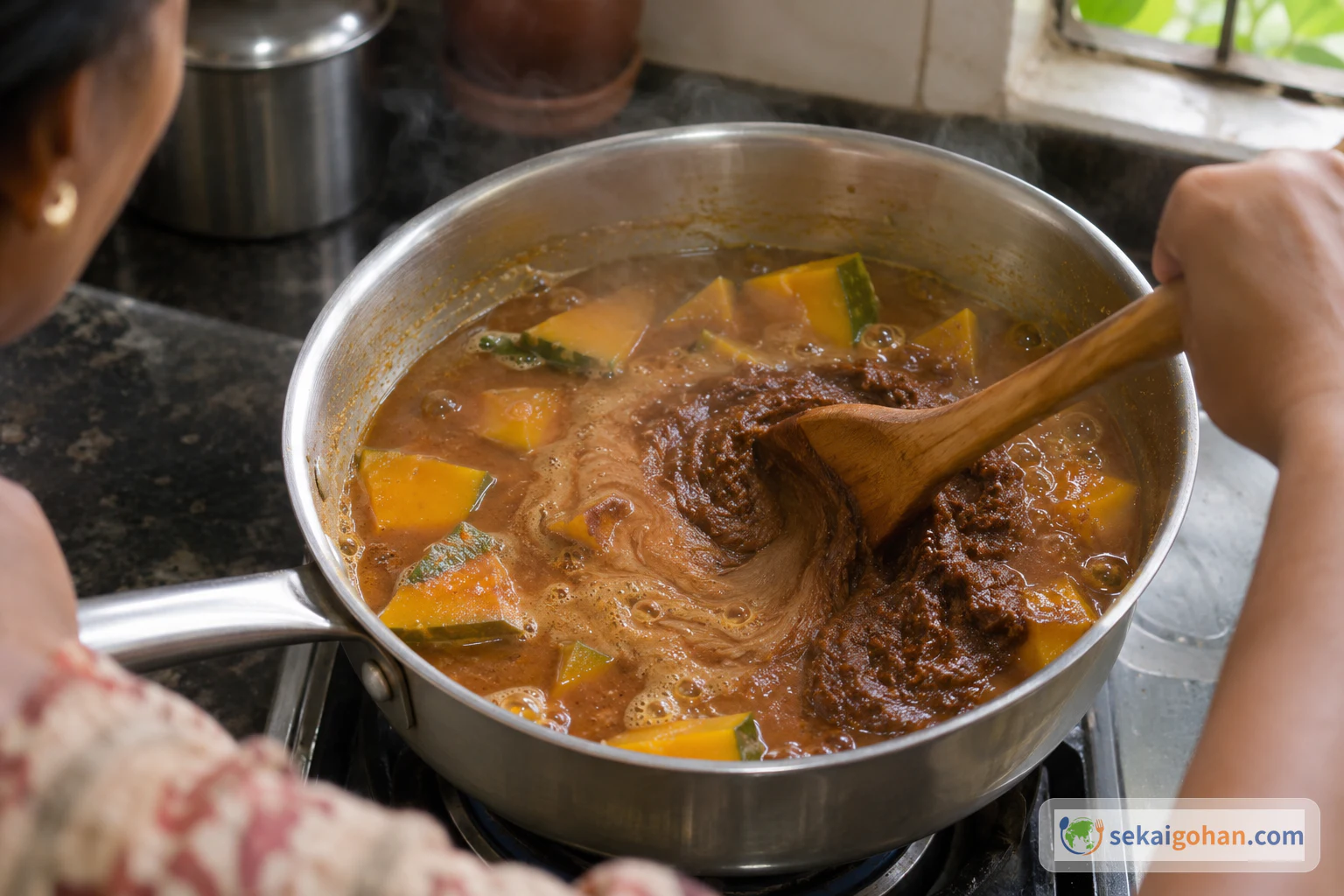
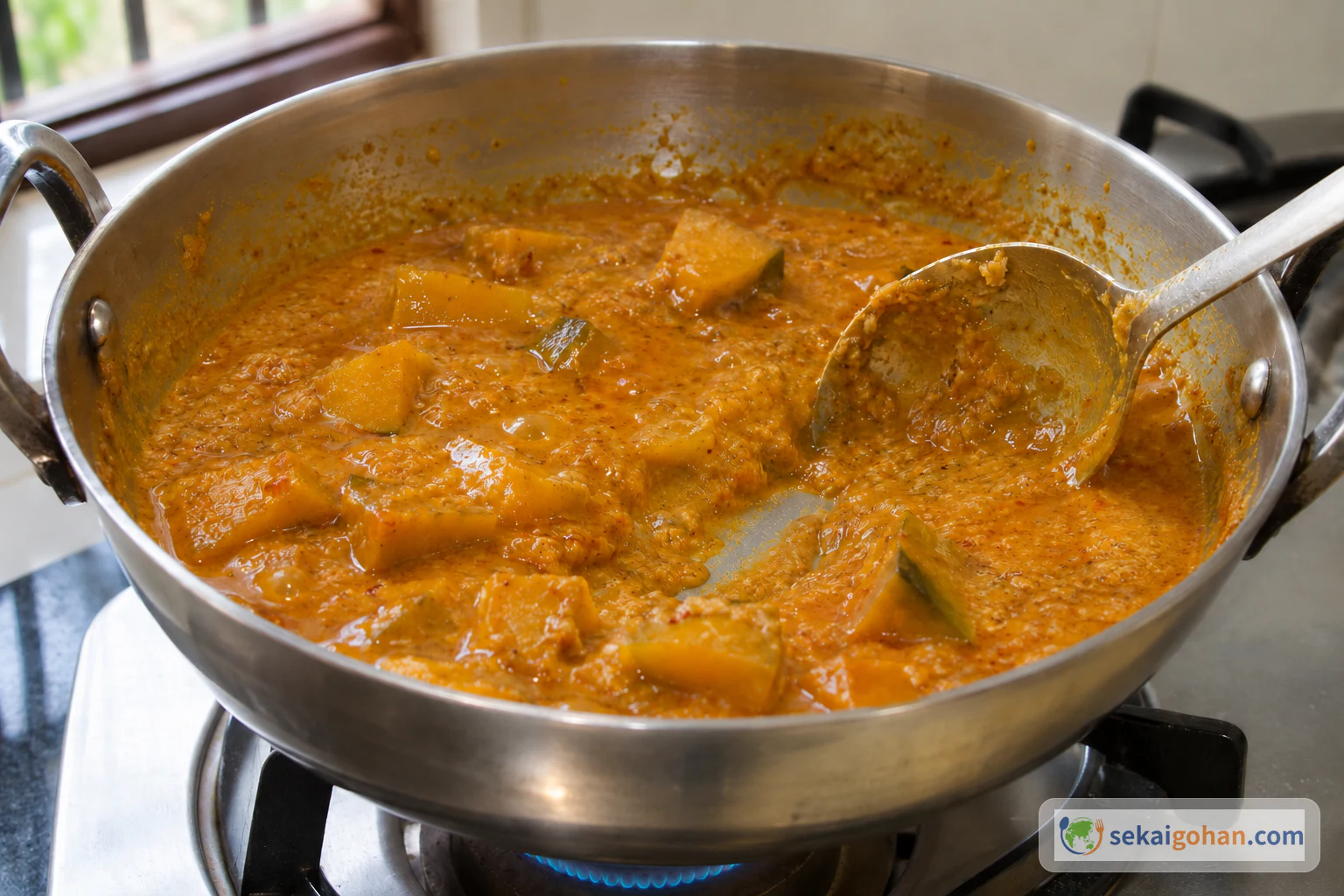
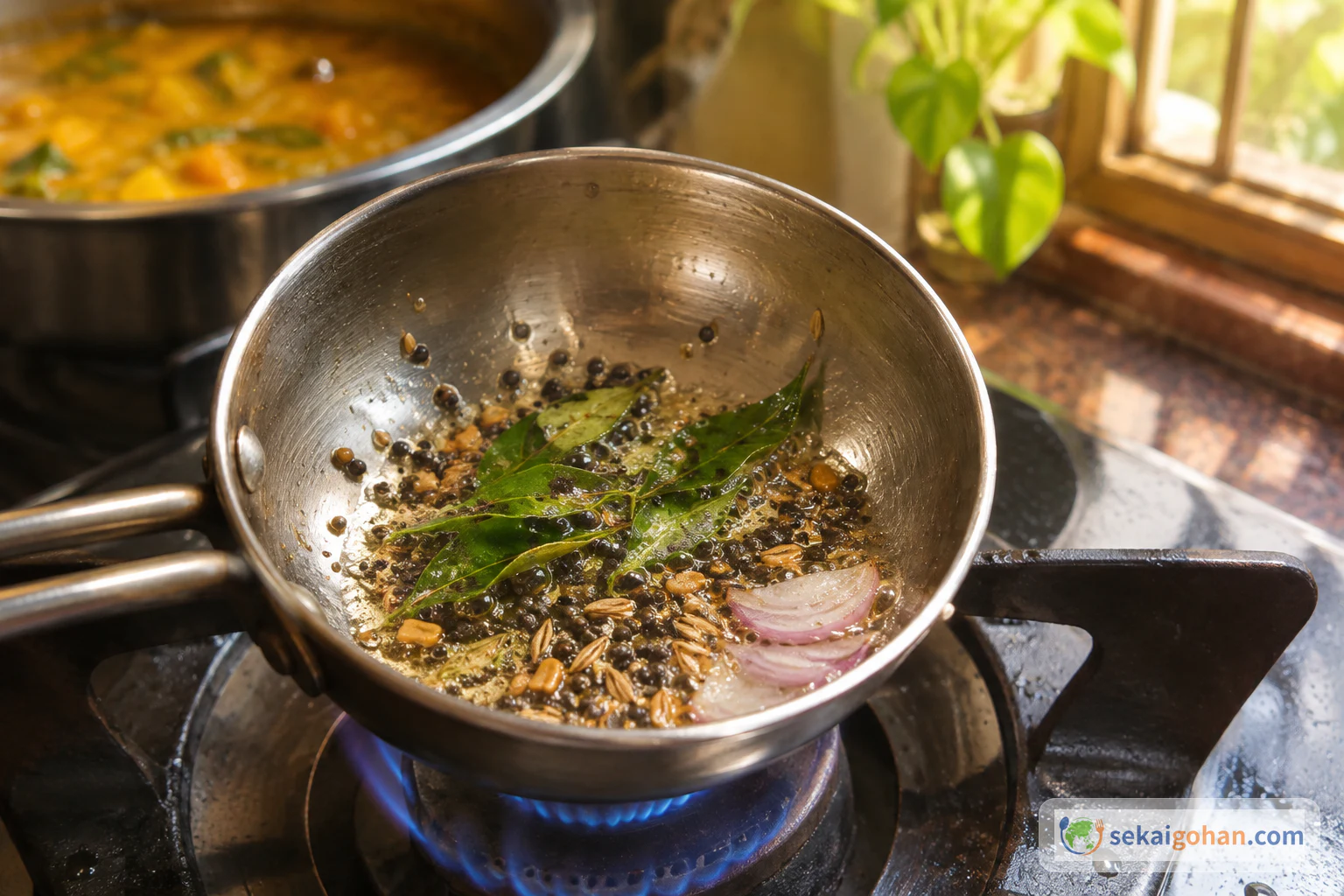
For twenty minutes the grated coconut moves around a dry iron pan, slowly turning from white to gold, and the smell of toasted coriander and dark red chillies fills the kitchen. That roasted coconut is ground into a brown paste and stirred into pumpkin that has been simmering in tamarind water. The cubes go soft and orange inside a muddy, glossy sauce. Mathanga pulinkari comes from Kerala and is eaten hot over rice. It tastes sour first, then sweet from the pumpkin, then deep and toasty from the coconut, and it finishes with the crackle of mustard seeds and curry leaves poured over the top.
Pulinkari: a sour curry with a changing vegetable
The name explains the dish. In Malayalam, mathanga means pumpkin and puli means tamarind, or sourness. So a pulinkari is a curry built on sourness, and the vegetable in it can change. In Kerala, on the southwest coast of India, it is made with raw plantain, yam, cucumber, radish or ash gourd as well as pumpkin. In Thalassery, in the north of the state, the ash gourd (winter melon) pulincurry is the favourite. Pumpkin is one choice in a large family, and its sweetness meets the tamarind.
In Malayalam script the dish is മത്തങ്ങ പുളിങ്കരി. In English it shows up as pulinkari, pulincurry or puli curry, and "tangy pumpkin curry" is a plain description of the same pot.
On the feast leaf and at the everyday table
At Onam, Kerala's harvest festival, the sadya is served on a banana leaf. Many dishes are laid out side by side, and pulinkari has its own place among them. The older feast is usually remembered as resting on four curries, the naalu-curry: kalan, olan, erissery and pulissery. Sambar, rasam and avial came later. A newspaper article on the old sadya quotes K P Padmanabha Menon's History of Kerala (1937), which describes sambar as a recent arrival in Malabar from the east coast and essentially the Malabar pulinkari with a slight variation. The same article quotes the food historian Tanya Abraham, who says the arrival of chillies and tamarind influenced Kerala dishes and that the older feast used local crops, pumpkin among them.
The rest of the year, pulinkari is a home dish. It goes on the table with a plate of rice, and the recipe moves from one cook to the next, the way most household curries do. Each district shapes it differently. In Thrissur, pulinkari is built on toor dal with a seasonal vegetable and a coconut paste ground with cumin. There, mango takes the place of tamarind when the vegetable is cucumber or drumstick, jackfruit seeds often go in, and the curry rests a little before serving. Other households leave out coconut entirely and cook only dal, vegetable and tamarind, and pumpkin is the first vegetable they reach for. The version here uses no dal. Its body comes from coconut roasted until brown and ground with coriander and chillies, which gives the sauce its rust colour and its depth.
How it differs from its neighbours
Kerala has several coconut and pumpkin dishes that look alike in a photograph. Erissery cooks pumpkin with black-eyed beans, coconut and cumin and uses no tamarind, so it tastes sweet and mild where pulinkari is sour. Pulissery gets its sourness from yogurt instead. Olan is a pale curry simmered in coconut milk. Kalan is yogurt cooked down until thick. Pulinkari is the one where tamarind leads.
Ingredients
All the flavour of the dish comes from the paste, so the coconut, coriander and chillies are where the shopping matters. Three tablespoons of coriander seeds and seven dried chillies make a strong masala. Curry leaves go in twice, one sprig roasted into the paste and one crackled in the tempering, so keep them as two separate sprigs. Water also has three separate jobs.
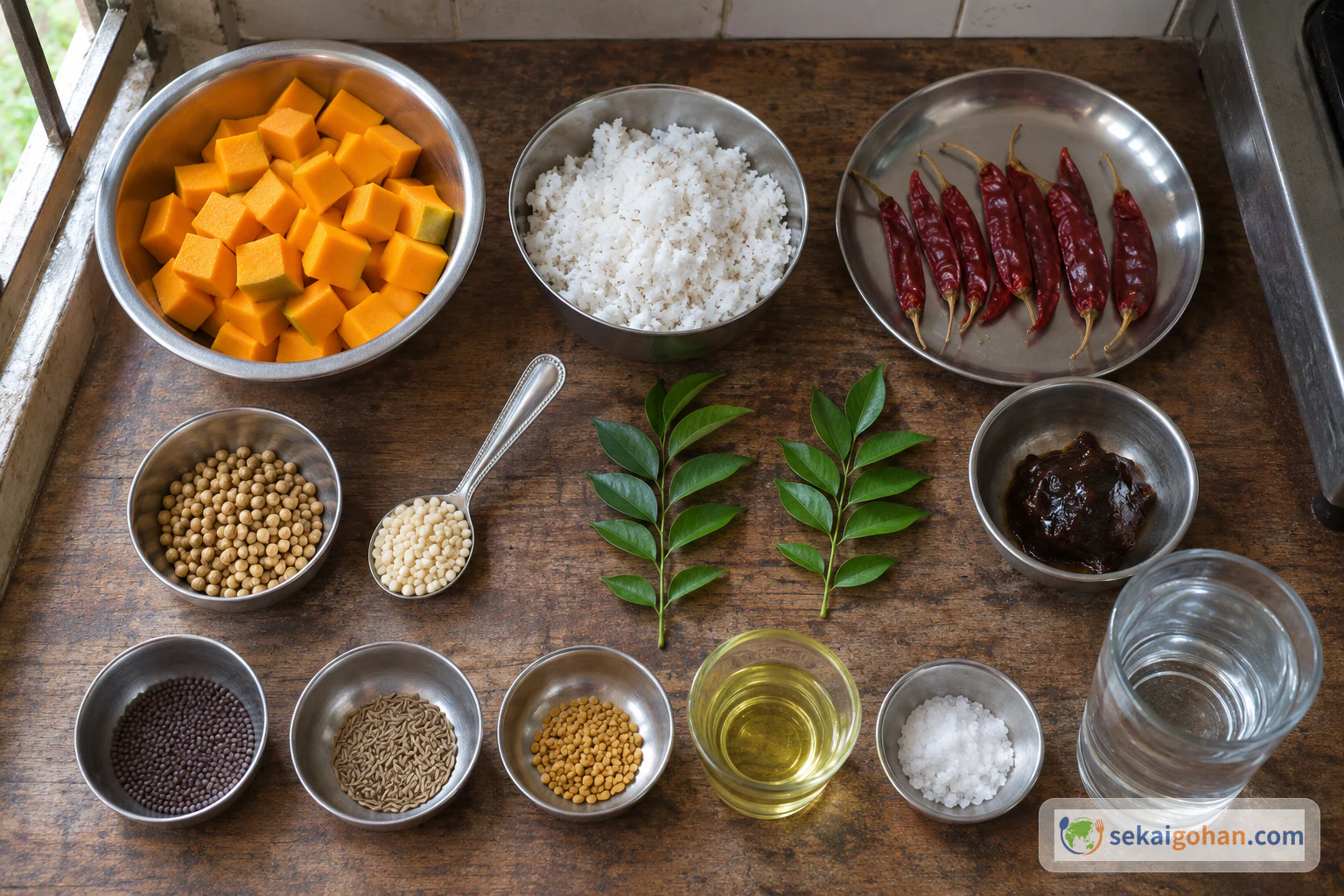
This curry contains urad dal (a legume), mustard seeds and coconut. Check the labels on frozen coconut, tamarind paste and spice packs for other allergens and shared-facility statements.
Equipment
- Heavy iron kadai, wok or thick-based skillet for dry-roasting
- Mixer-grinder, blender or mortar and pestle
- Small saucepan
- Small pan for the tempering
- Wooden spatula
Choosing and substituting
Frozen grated coconut is the best choice. It roasts evenly and grinds into a rich, smooth paste. Unsweetened dried coconut works, but the aroma and richness are weaker and the paste is grainier. Find frozen grated coconut in the freezer at an Indian or Southeast Asian grocer.
Tamarind comes as a concentrated paste or as a fibrous block, and the two differ a lot in strength. Use the paste as the measure. If you only have a block, soak a piece in hot water, strain it, and add the juice a little at a time while tasting. Brands of paste vary as well, so taste the cooking liquid before the coconut goes in.
Fresh curry leaves are ideal, and frozen or dried leaves make a fair substitute. Bay leaves smell completely different, so leave them out. Buy urad dal at an Indian grocer or online; it gives the paste its body, so keep it in. Black mustard seeds are the usual choice. Yellow ones work but have less bite. Sliced red onion can replace the shallots. Use any neutral oil for the tempering.
For the pumpkin, a dense, sweet variety such as kabocha can be used. It is sweeter and has less moisture than the yellow pumpkin cooked in Kerala, so the sourness comes across differently, which is one more reason to taste for tamarind.
Method
Cut the pumpkin first, then make the paste, because the roast takes the longest and needs your hands the whole time. When the paste is ground, the pumpkin goes into the tamarind water, and the rest moves quickly. The low simmer at the end gives you a few free minutes to set out the tempering pan and spices, so the tempering is still sizzling when it hits the curry.
When it goes wrong
| What you see | Why | What to do |
|---|---|---|
| The curry tastes bitter | The coconut or spices scorched during the roast, or the fenugreek darkened in the tempering | Bitterness from a burnt roast cannot be fixed. Next time roast on low-medium and keep stirring, and pour the tempering while the fenugreek is still golden |
| Too sour | Your tamarind is stronger than average | Add tamarind a little at a time and taste. Keep milk and extra coconut out of the pot, because they turn it into a different dish |
| Too hot | Seven dried chillies make a fiery paste | Eat it with more rice this time and use fewer chillies next time |
| Thin or floury sauce | Too much water in the paste, or not enough simmering | Simmer on low until it thickens. Raising the heat makes it split |
| The coconut separated and the sauce looks oily | The heat was too high, or the curry boiled hard while reheating | Warm it gently on low and stir. Keep the bubbles small from here on |
Serving, variations and storage
At the table
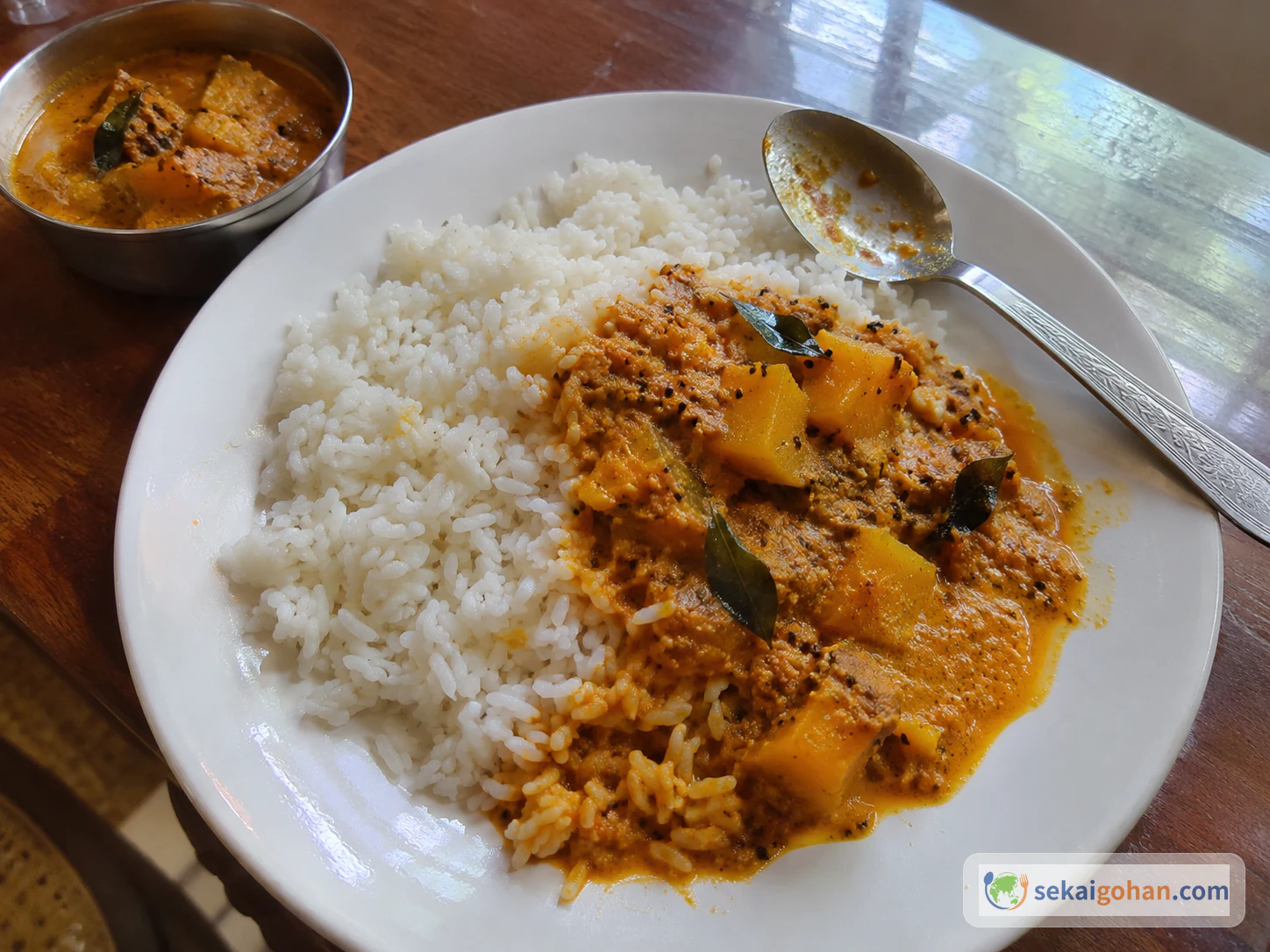
Serve pulinkari hot, spooned over plain rice. Let the sauce soak into the rice and mix in some of the tempering as you eat, so the mustard seeds and curry leaves end up in every mouthful. On a sadya it is one dish among many on the banana leaf. At home, a bowl of it next to rice makes a full plate, with a sour, sweet and roasted side that goes well with milder dishes. Chapati or thin roti are good alternatives to rice, but rice is the everyday pairing in Kerala.
Variations
- Leave patches of skin on the pumpkin. An editorial idea for kabocha, not part of the base recipe: pare the rind in strips and leave some on for a little more texture.
- Finish with coconut oil. An editorial idea, not part of the base recipe: stir 1 tsp coconut oil into the curry just before serving to bring out the roasted-coconut aroma.
- Swap pumpkin for ash gourd. The winter-melon pulincurry is a favourite in Thalassery. Cut it into cubes of the same size and taste for tamarind.
Storing leftovers
Coconut spoils quickly, so let the curry cool, then refrigerate it promptly in a clean, covered container and finish it by the next day. To reheat, add a splash of water and warm it over low heat, stirring, until it is hot all the way through, without letting it boil hard. Gentle heat keeps the coconut from splitting.
Frequently asked questions
What can I use if I have no tamarind?
Pulinkari is built on tamarind, and nothing else tastes quite the same. Mango as the sour element belongs to the Thrissur style, which uses dal and cucumber or drumstick, so it makes a different curry. Lemon juice brings a sharper, citrus smell. Buy tamarind paste for this dish if you can.
Can I use ground coriander instead of seeds?
Whole seeds are better. Ground coriander has less aroma, and in a long dry roast it scorches easily and turns bitter.
How do I make it milder?
Use 3 or 4 dried chillies instead of 7. The tamarind and roasted coconut then come forward. The mustard seeds in the tempering still bring a little bite.