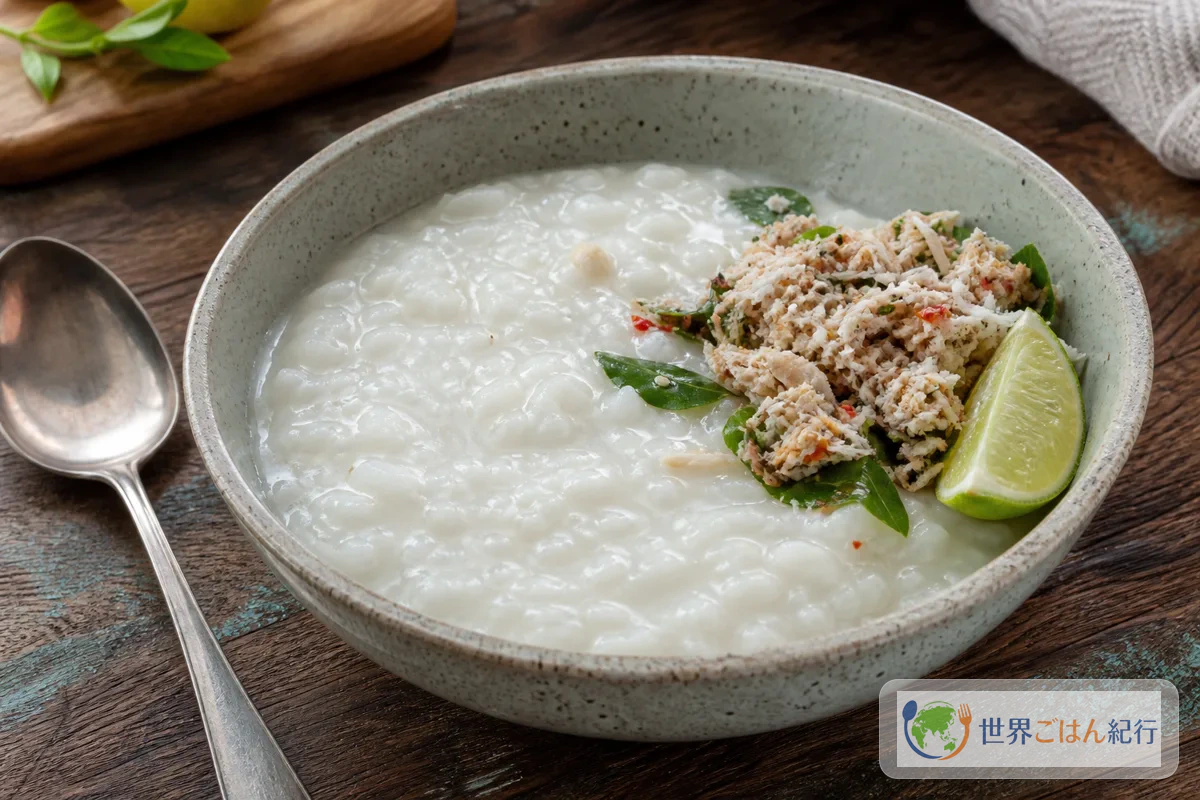
A little tuna and coconut beside steaming rice porridge
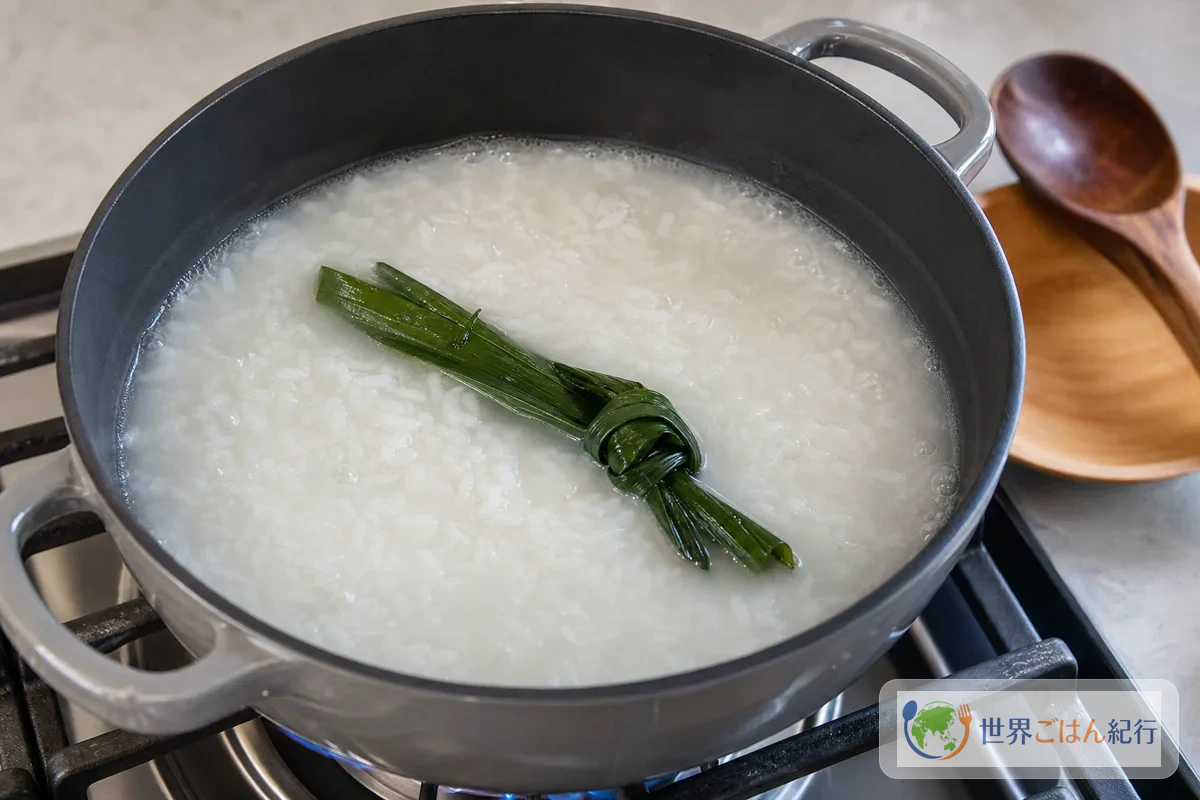
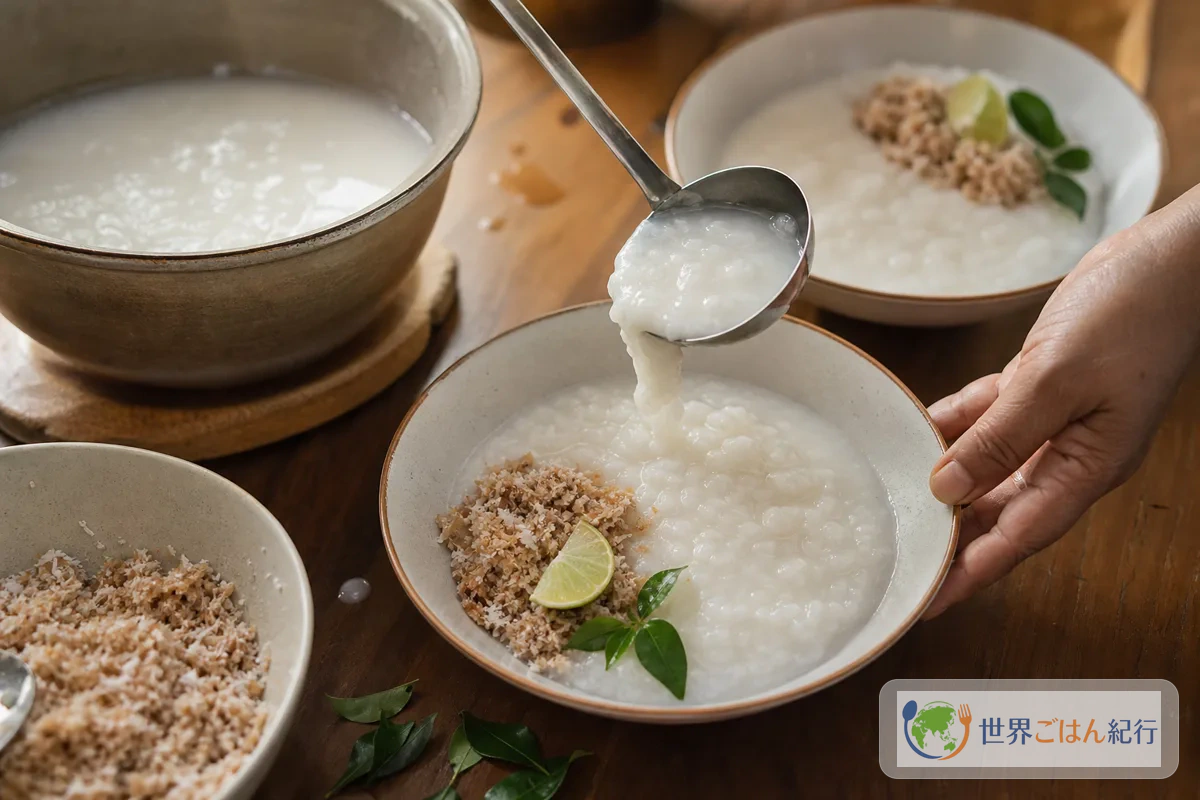
Put rice on low heat in the morning kitchen and the pot slowly turns quietly white and cloudy. Tie in a single pandan leaf and a green, sweet fragrance rises, quite unlike rice from a rice cooker. Spoon hot rice porridge into a bowl, set a spoonful of coarse tuna-and-coconut relish beside it, and, with no fuss at all, it suddenly feels like a breakfast on a Maldivian island.
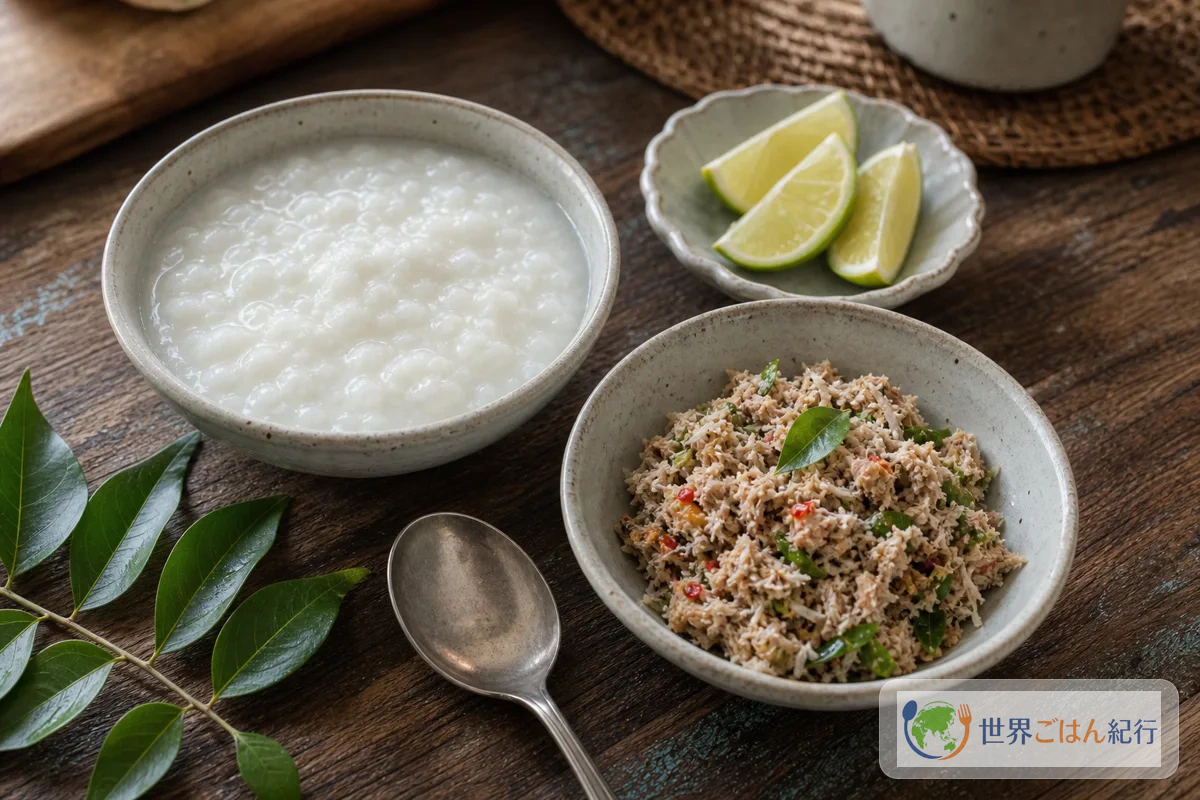
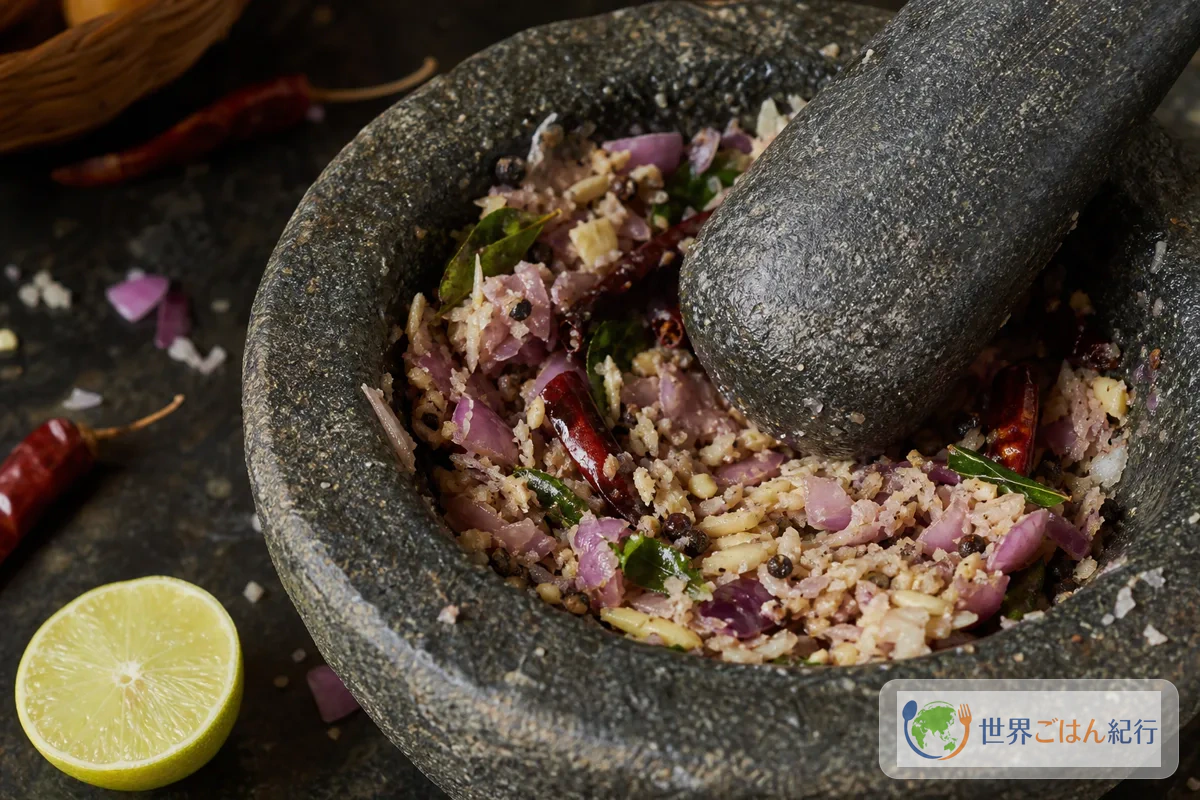
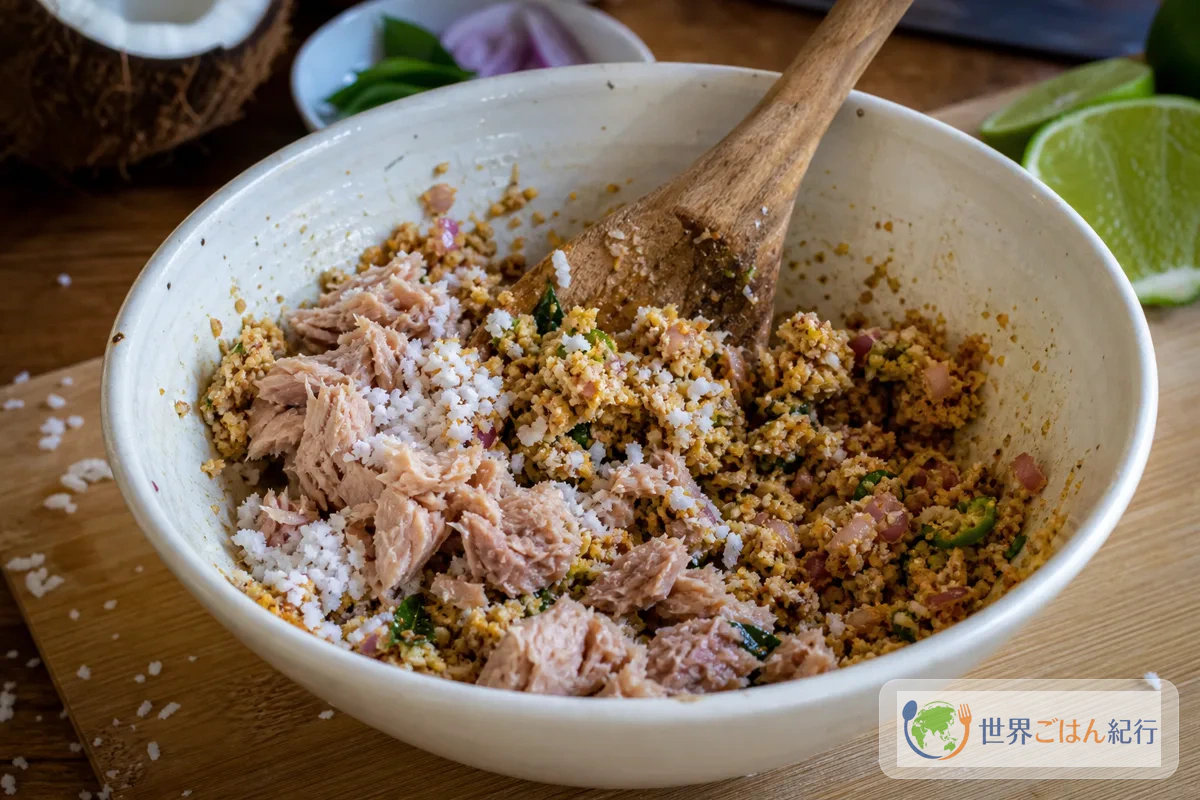
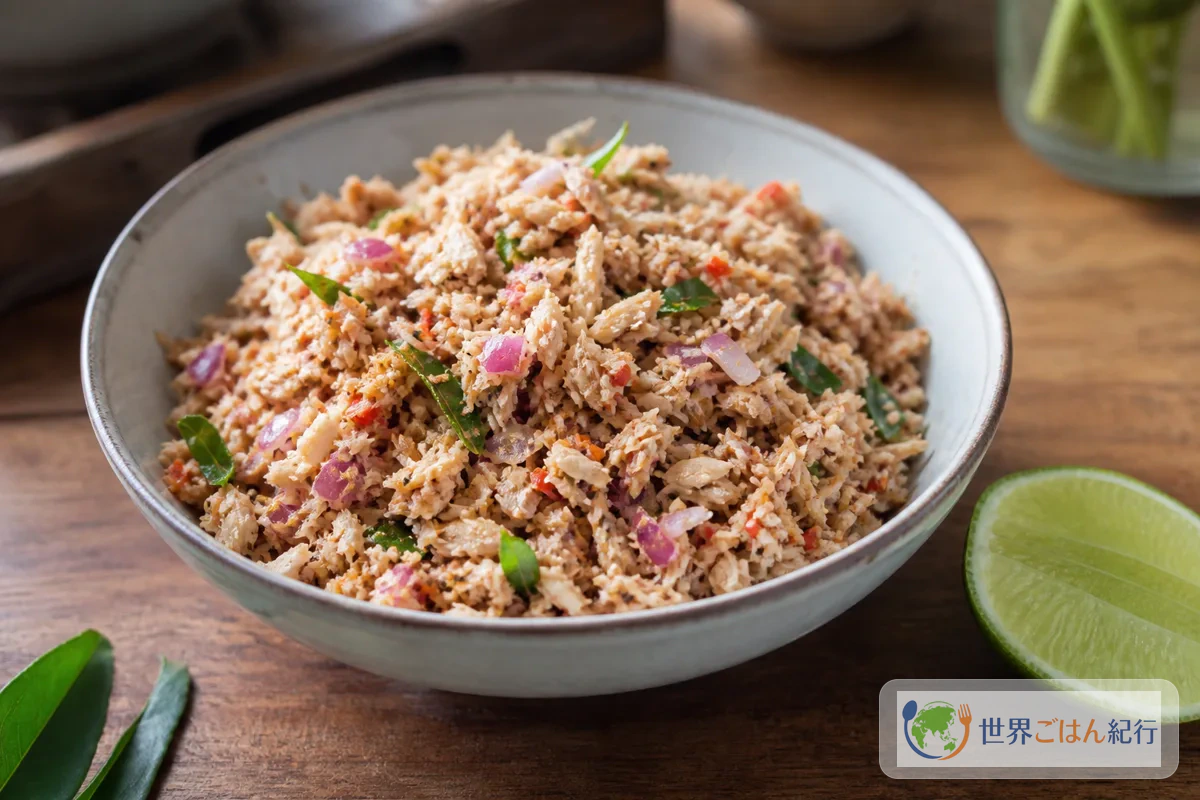
Maskurolhi is a coarse, sambol-like dish of tuna, coconut, onion, chili and lime, served in the Maldives alongside the rice porridge baiypen (bai pen). By name it is easily confused with masroshi, in which tuna is wrapped in roshi and baked, but what we are making here is not a wrapped bake.
The short English Wikipedia entry says maskurolhi is a Maldivian dish eaten with baiypen. A pre-Ramadan meal feature from the local food media LonuMedhu also places baiypen with fish and coconut sides at the early-morning table. In other words, the star is not a showy dish but a way of eating in which the gentleness of rice is combined, bit by bit, with the saltiness of fish.
What is hard in a home kitchen is getting the local smoked and dried fish. Here canned tuna is combined with bonito flakes, and unsweetened desiccated coconut is rehydrated in place of freshly grated coconut. What to protect: a softly cooked rice porridge, coarse tuna, the acidity of lime, and a way of eating that doesn't spread the heat through the whole pot.
Masroshi is introduced as a snack in which tuna and coconut are wrapped in roshi dough and baked. Maskurolhi is closer to a coarse side dish served with the rice porridge baiypen. Because the names are similar, this article sticks to the maskurolhi eaten with baiypen.
How it is eaten
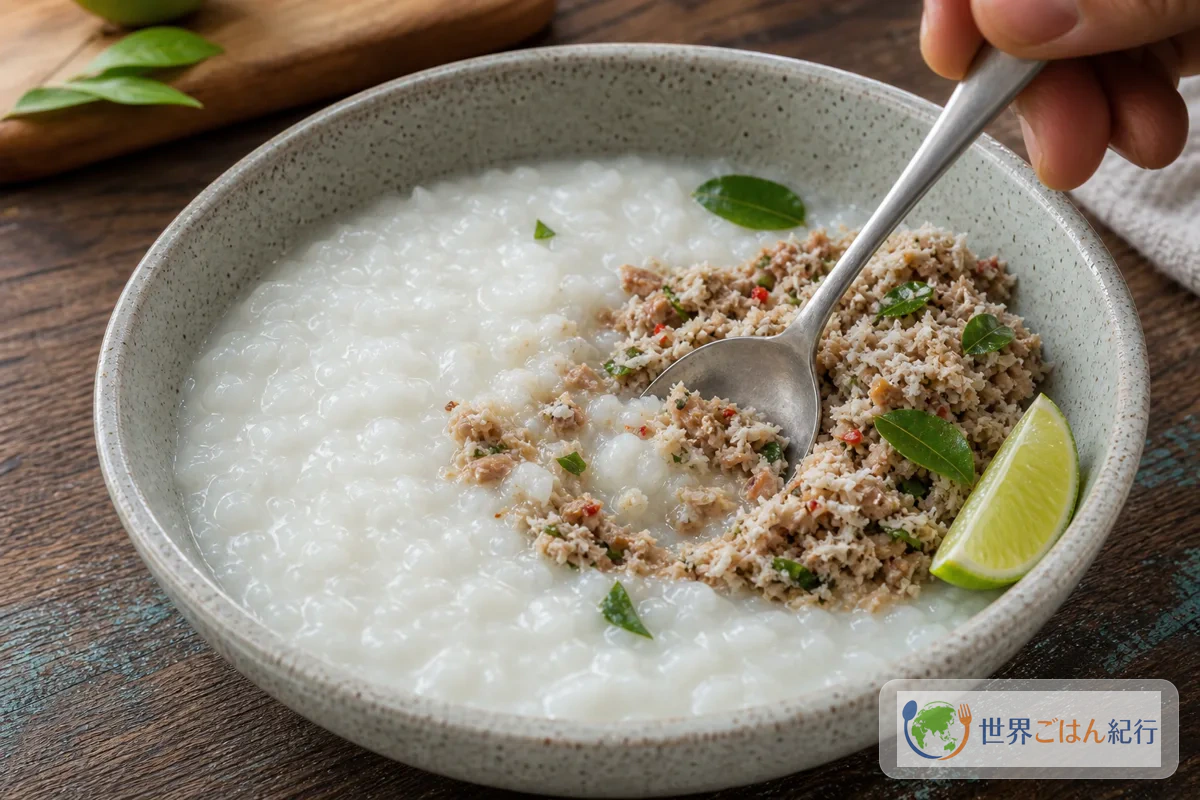
The Maldives is an island nation, so fish and coconut are at the center of the table. Mas huni, often featured in tourism material, is also a breakfast of tuna, coconut, onion and chili eaten with roshi. Maskurolhi uses similar ingredients, but differs in that it is mixed a little at a time into baiypen, the white rice porridge.
Baiypen is a quiet porridge that you could eat with salt alone. If you mix tuna into the porridge itself, the fish smell spreads through everything and it can feel like a congee for a day when you're unwell. Make the maskurolhi separately and mix it a little at a time at the edge of the plate, and the sweetness of white rice, the richness of coconut, the saltiness of fish and the acidity of lime come in turn in your mouth.
It suits breakfast or a late-night bowl. With the heat reduced it is easy to serve to children and older relatives, and only those who want it can add chili. Among related South Asian dishes, Sri Lanka's kiribath (in Japanese) is a celebration dish of rice and coconut, and India's avial (in Japanese) coats vegetables in the texture of coconut. Maskurolhi is easiest to understand as the lightest morning vessel among them.
Ingredients (serves 4)
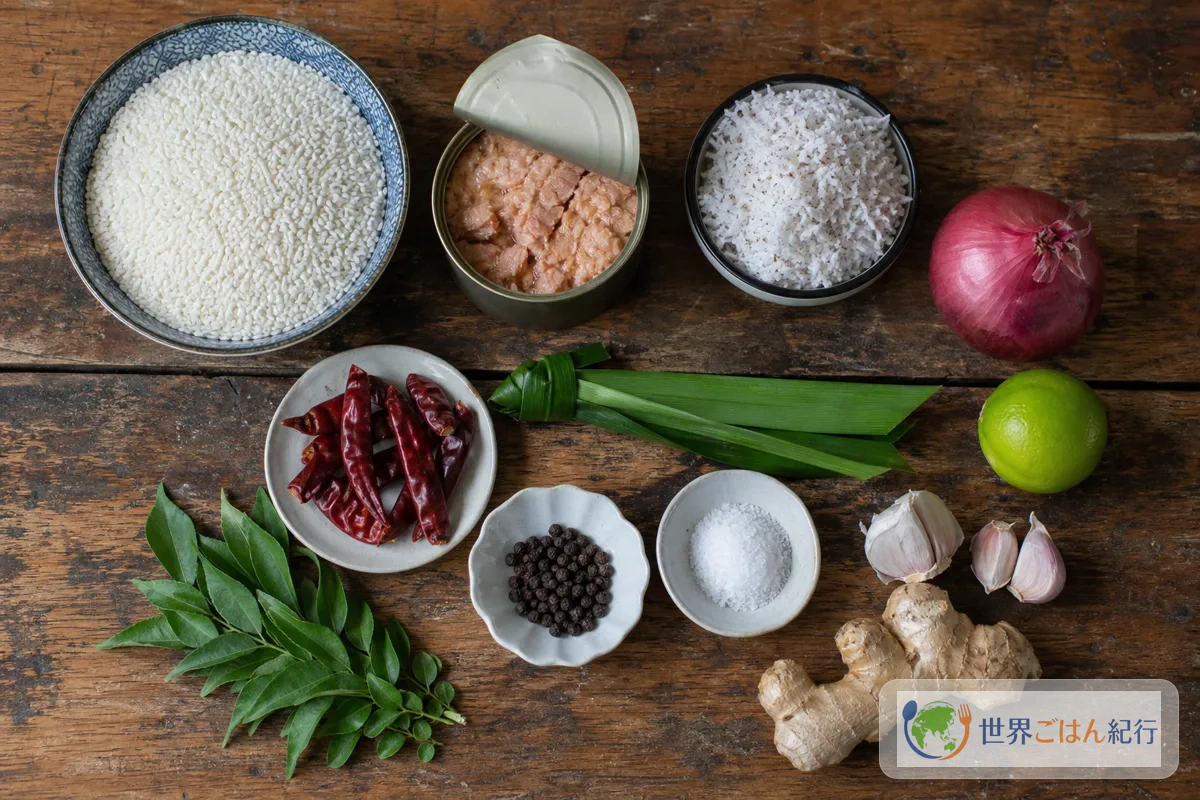
This amount serves 4 at breakfast or 3 as a late-night meal. If the baiypen is too thin it can't hold the maskurolhi, and if it is too thick it becomes like rice dumplings. Plan on 1.1 L water for 1 gō (180 ml) of rice, then adjust to the thickness you like at the end.
This dish uses fish, coconut and chili. If you have concerns about fish or coconut, avoid it. At a table with someone sensitive to heat, halve the chili and serve the maskurolhi on a separate plate for easy adjustment.
What to shop for
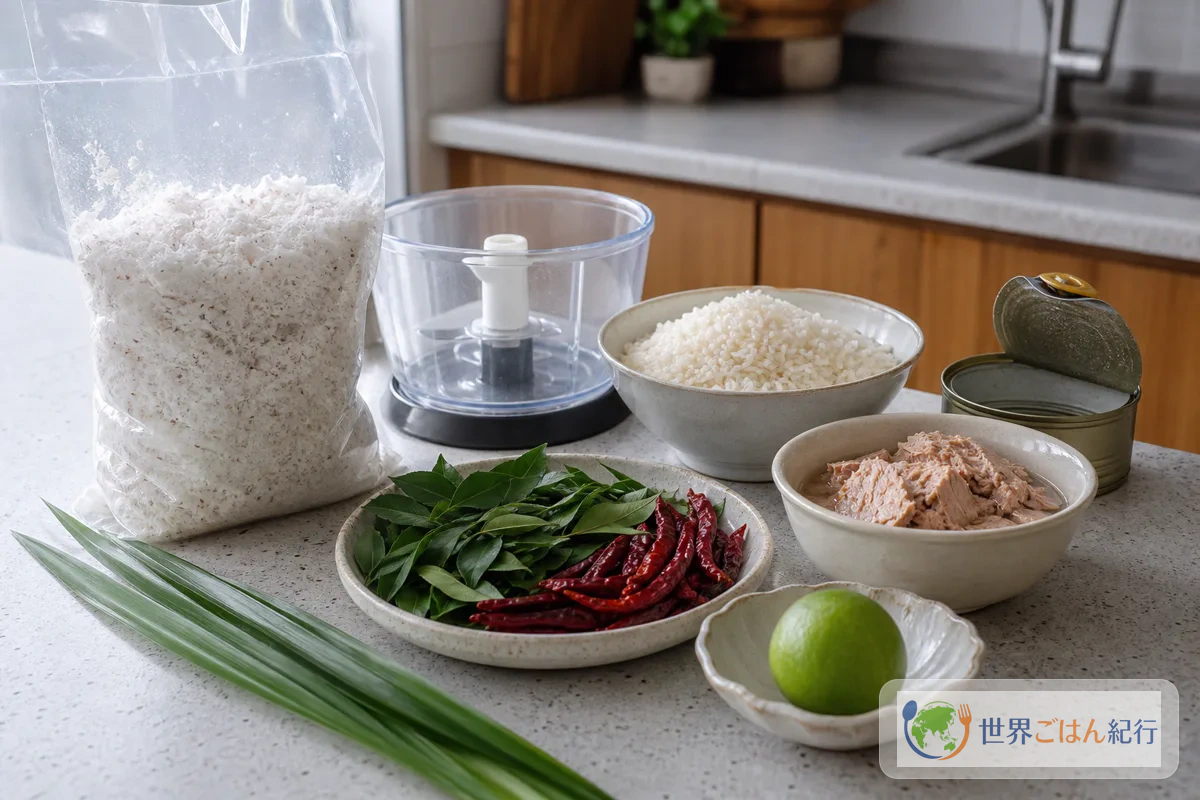
Rice, canned tuna, onion and lime can be bought nearby. What is worth looking for online or at an import grocery are unsweetened fine desiccated coconut, curry leaves, pandan leaf and a small food processor that chops coarsely. Pandan is only an aromatic aid, so it's fine to omit it the first time if you can't find it.
Unsweetened desiccated coconut is what gives this dish its grain. If you substitute canned coconut milk alone, the maskurolhi becomes too moist, like tuna mayo melting over the porridge. Look for "unsweetened" and "fine" at import grocery stores or baking supply shops.
Curry leaves are not essential, but a small amount pulls the flavor toward South Asia. Leftovers can go into kukul mas curry or avial (in Japanese).
On a day when crushing chili from scratch feels like too much, use just 1 tsp of sambal oelek and stretch it with onion, tuna, coconut and lime to get close. Avoid sweet chili sauce, which is a different thing.
Since nothing is wrapped and baked, you don't need a griddle. Instead, a tool that can stop before the onion and coconut get too fine makes the result steadier. You can chop with a knife, but if you make this often in the morning, a small food processor is handy.
Method: simmer the baiypen and serve a coarse sambol beside it
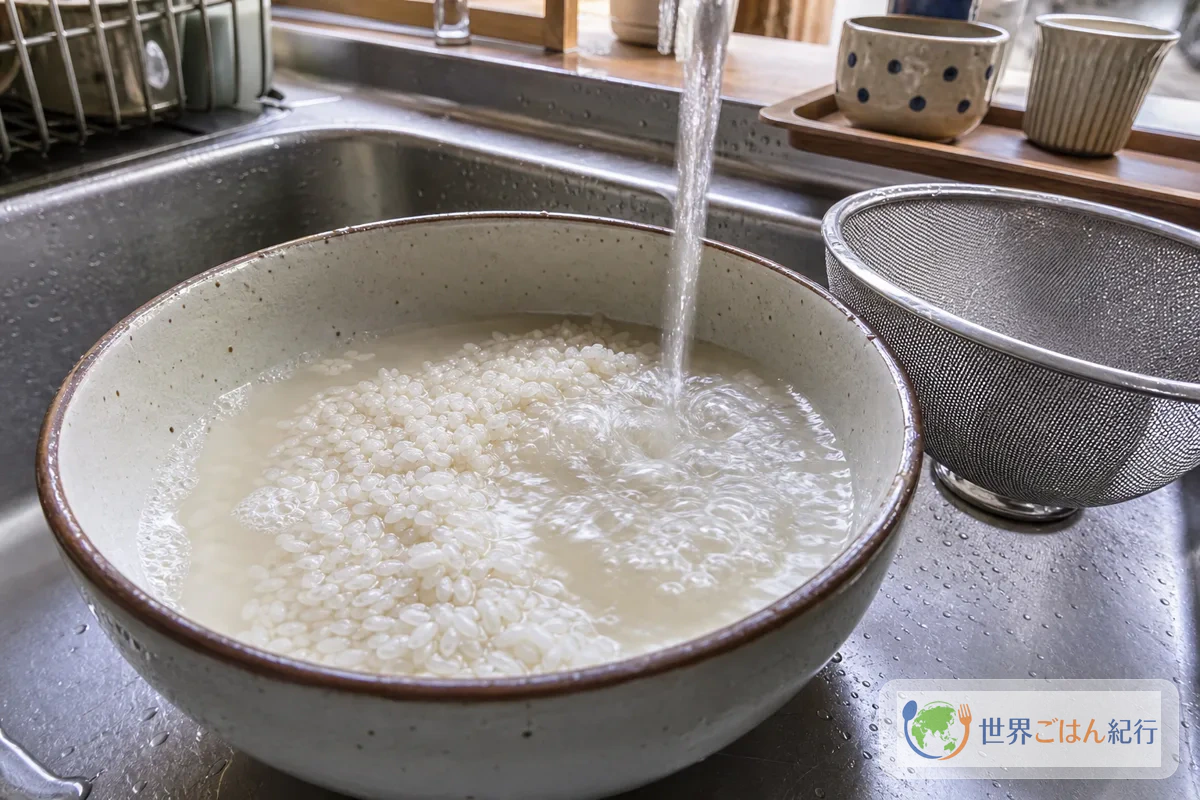
Trying to finish the baiypen and maskurolhi at the same time gets hectic. Put the rice on, lower it to low heat, and chop the aromatics while it simmers. The maskurolhi needs no heat, so it is enough to combine it at the end while watching the thickness of the porridge.
Choices for getting close to the original in a home kitchen
| Question | Closer to local | Practical home option | Direction to avoid |
|---|---|---|---|
| Fish | Smoked or dried tuna-type material | Canned tuna combined with bonito flakes | Turning it into tuna mayo |
| Coconut | Freshly grated coconut | Unsweetened desiccated coconut rehydrated in hot water | Moistening with coconut milk only |
| Rice porridge | Cooked thin as baiypen | Short-grain rice simmered soft on low heat | Briefly warming cooked rice in water |
| Heat | Coarsely crushed fresh chili | Dried chili or a little sambal oelek | Sweet chili sauce |
| How to eat | Porridge and side served separately | Mix a little at a time at the edge of the bowl | Mixing tuna through the whole pot |
The most important thing to protect in a home kitchen is not to over-mix. If you put all the tuna and coconut into the porridge, the white porridge has nowhere to go. Maskurolhi is, after all, a side. Its lightness as a breakfast lies in being able to adjust salt and acidity in your own bowl.
The other point is the form of the coconut. Canned coconut milk can be used in small amounts in the baiypen, but the body of the maskurolhi needs grains. The grains absorb the moisture of the tuna and loosen softly over the porridge.
Where it goes wrong
| Symptom | Cause | Fix |
|---|---|---|
| Porridge is watery | Low-heat simmer was too short | Uncover and add 5 minutes on low heat so the grains open |
| Porridge is heavy | Too little water, stirred the bottom too much | Add 100 ml hot water and warm on low heat for 3 minutes |
| Maskurolhi is sticky | The coconut's moisture wasn't squeezed out | Add 2 g bonito flakes or 2 tsp unrehydrated coconut |
| Fishy smell | Too much tuna liquid, not enough lime | Drain again, and add 1 tsp lime and a little black pepper |
| Too hot | Chili seeds were left in | Add 1 tbsp coconut and 1 tbsp tuna |
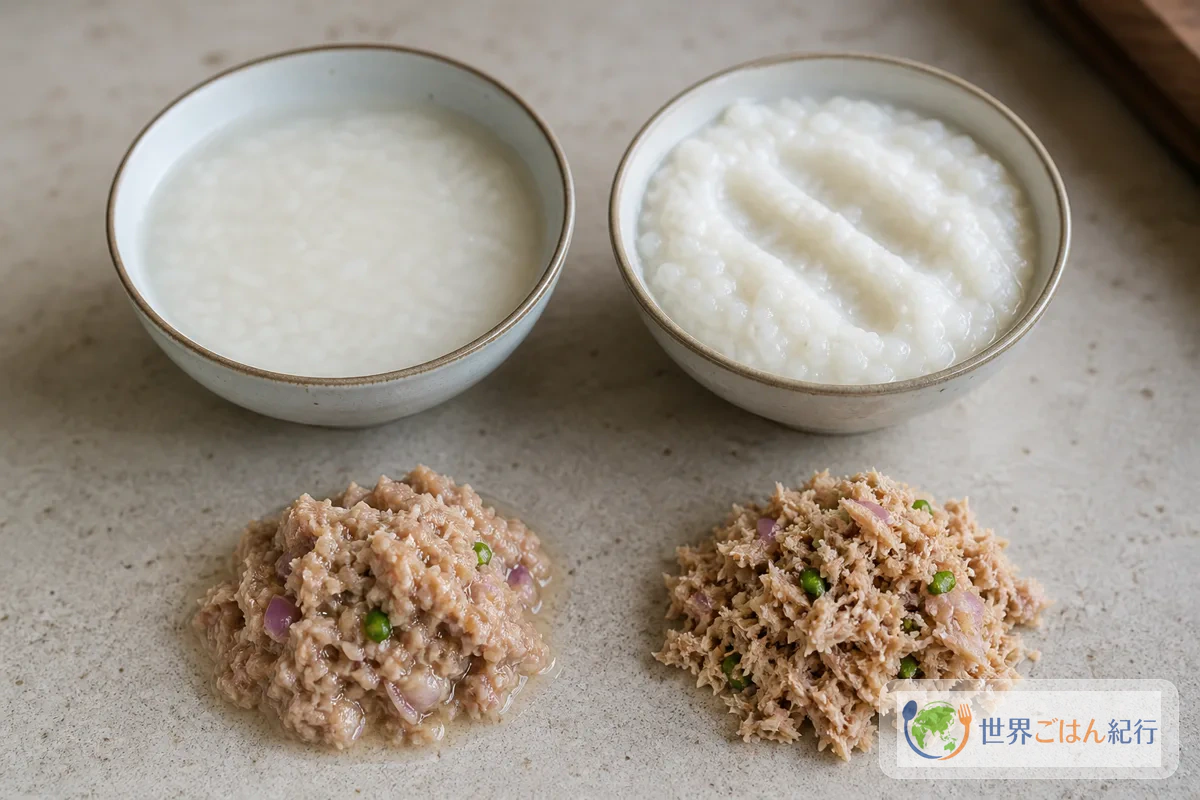
The dividing line between success and failure is moisture. Baiypen should be soft, but if it is thin like soup the maskurolhi sinks. Maskurolhi can be moist, but if liquid collects at the bottom it is too heavy. Keep a loose white porridge against coarse tuna and coconut. Preserve that contrast.
Storage and the next day
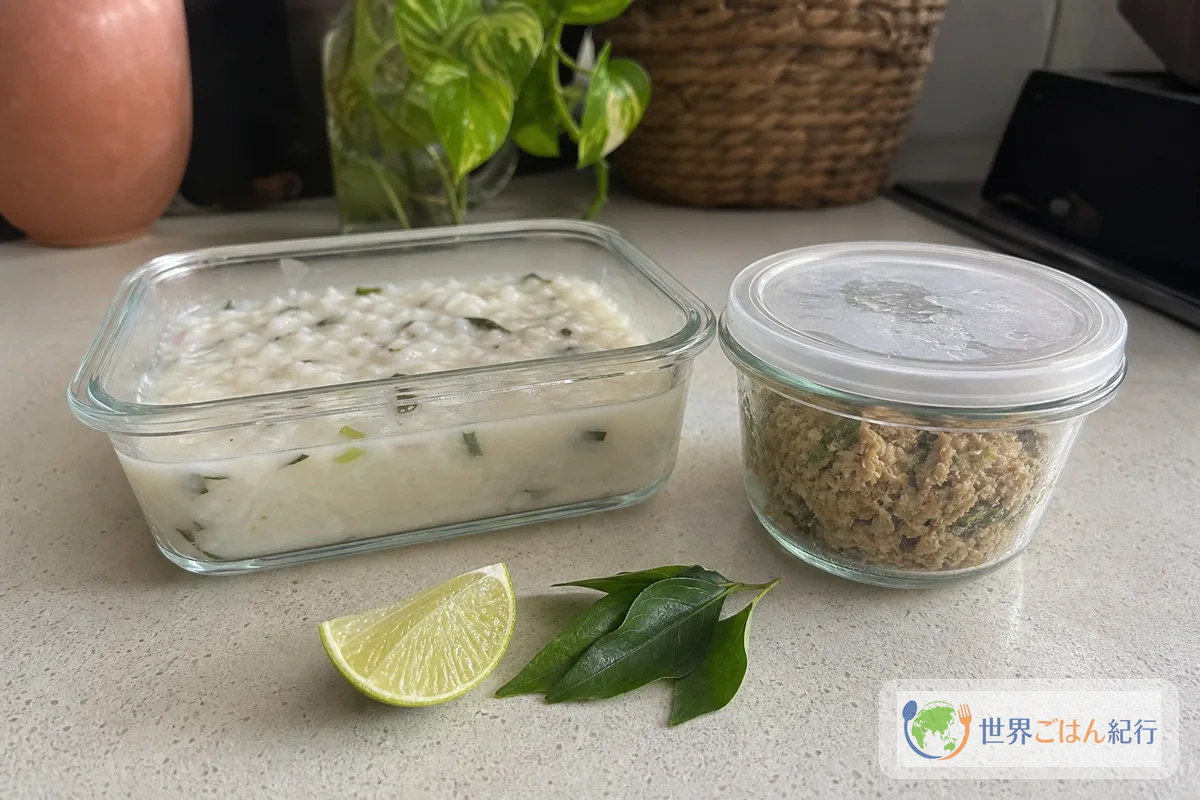
Once the baiypen has cooled slightly, move it to a shallow container and finish it in the refrigerator by the next day. Rice porridge firms up when cold, so when reheating add 80 ml water per portion and warm on low heat for 4 to 5 minutes. In a microwave, heat at 600 W for 1 minute 30 seconds, stirring once halfway.
Maskurolhi uses fish and onion, so the same day in the refrigerator is safest. If you carry it to the next day, put it in a clean small jar and finish it within 24 hours. Do not reheat it. After taking it from the refrigerator, add 1/2 tsp lime juice and break up any firm tuna before serving with the porridge.
Leftover maskurolhi can also go on thin toast or rice. Mixing in mayonnaise, however, moves away from a Maldivian breakfast. To keep the direction, finish with lime, black pepper and a little chili.
FAQ
Can I make just the maskurolhi?
Yes. But it is a salty, sour side, so it is easier to eat with a vessel such as white rice porridge, white rice or thin roshi. If eating it alone, reduce the salt to 1/4 tsp and start with 1 tbsp lime.
What if I don't have desiccated coconut?
Freshly grated coconut is ideal, but unsweetened desiccated coconut is the practical choice. If you really have none, toss the tuna with 2 tbsp coconut milk and 2 g bonito flakes. It won't have the grain, though, and the maskurolhi character is weaker. Next time, look for an unsweetened product at a baking supply or import grocery store.
Should the canned tuna be in water or oil?
Water-packed is lighter for breakfast; oil-packed gives richness. If using oil-packed, using all the oil from the can makes it heavy, so keep only 1 tbsp and drain the rest. With oil-free cans, adding 1 tsp rice bran oil keeps it from being dry.
Can I make it without heat?
Yes. Omit the chili and increase the black pepper to 1/3 tsp. Removing all heat weakens the outline, so adding 1/4 tsp sambal oelek only to the adults' bowls is the safest approach.
Is pandan leaf required?
No. It is an aid to make the baiypen fragrant. If you can't find it, leave it out and make the porridge with only rice and salt. Substituting bay leaf or vanilla leads to a different aroma, so it is more natural to leave them out.
Local sources consulted
- Wikipedia, "Maskurolhi": https://en.wikipedia.org/wiki/Maskurolhi
- LonuMedhu, "Haaru: Maldivian Suhoor": https://lonumedhu.com/blog/haaru-maldivian-suhoor
- Visit Maldives, "Maldivian Gastronomy": https://visitmaldives.s3.amazonaws.com/5oBv9OoG/v9inzimo.pdf
- Wikipedia, "Maldivian cuisine": https://en.wikipedia.org/wiki/Maldivian_cuisine
What to cook next
To continue with a rice-and-coconut breakfast, move on to Sri Lanka's kiribath (in Japanese), where the same white rice becomes a celebration dish. If you like the feel of coconut grains clinging to vegetables, South India's avial (in Japanese) is the next dish. For a gentle table of fish and rice, Bangladesh's ilish bhuna (in Japanese) is also fun for comparing how aroma is built.