


Crack an Egg onto It, and a Sheet of Rice Flour Becomes a Meal
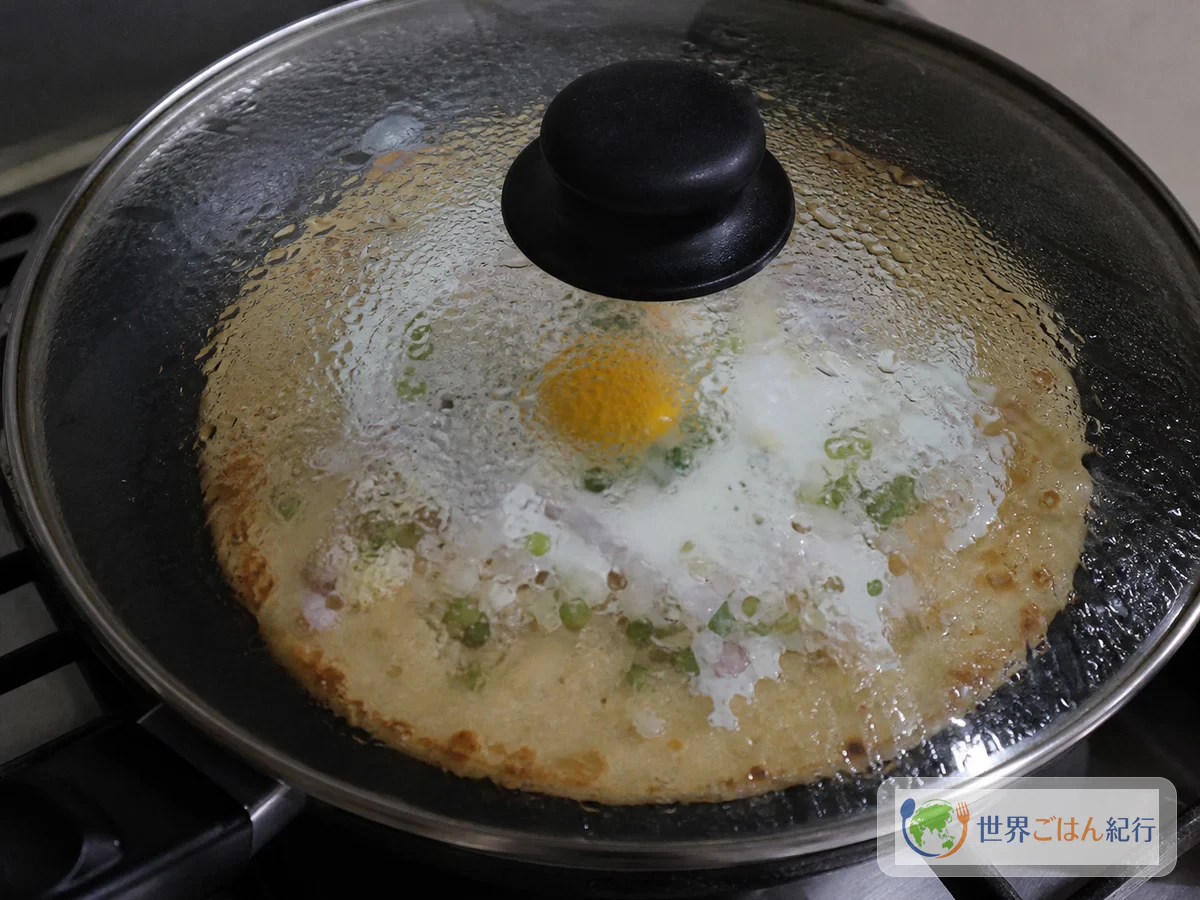
Pour white batter into a pan. Set one egg in the center and spiced minced meat around it. Cover, and the rice-flour edge slowly dries while the egg white turns opaque. Chatamari lives on the border between a crepe and a plated dish.
The question when you first make it is how thin to go. Too thick and the center turns heavy; too thin and it tears before the toppings go on. This recipe bakes six small rounds about 15 cm across. Measure about 60 ml of batter for each rather than ladling by eye, and add the toppings when the surface changes from glossy to matte.
The Nepal Tourism Board's recipe book also describes mixing rice flour with warm water into a smooth batter, pouring 60 to 70 ml onto a griddle, covering it, and cooking for 4 to 5 minutes. It also lists variations with egg, cheese, meat or vegetables, so the topping is not fixed to one combination. Taking the Nepal Tourism Board recipe book as the base, I arranged it for a home kitchen by cooking only the minced chicken first.
Two things are worth deciding before you cook. One is whether to buy timur, with its citrus note and tingle, to deepen the Nepali character, or to try Sichuan pepper first and decide later. The other is whether to do the chopping with a knife or bring in a tool you will use for other dishes. If you are making chatamari only once, you do not have to buy either.
What Chatamari Is at the Table in the Kathmandu Valley

Chatamari is a rice-flour pancake known as a dish of the Newar people of the Kathmandu Valley. Lalitpur Metropolitan City's intangible heritage documentation describes it as a Newar specialty that can be an appetizer, a snack or a main dish, and is also popular at festivals and celebrations such as Sithi Nakha. The Lalitpur report also records the current way of eating it with egg, cheese, meat or vegetables on top.
English-language articles sometimes call it "Nepali pizza." As a metaphor for its look it is easy to grasp, but believing that cheese is essential narrows the dish. A round with an egg in the center, a round with finely spread meat and a plain chatamari with no toppings all go by the same name. Home recipes also explain how to make it without toppings. Looking at a home chatamari recipe, you can see that the thin rice-flour batter comes first and the toppings change to suit the table. That is the big difference from pizza.
Research on Newar cooking presents chatamari as a dish eaten at festivals and rituals, and describes versions with egg, meat and vegetables. The cooking flow in the same paper also includes frying onion, garlic, ginger and minced meat, then adding tomato to make the topping. Reading Traditional cereal-based dishes of the Newari community of Nepal shows that chatamari is not just a thin griddle cake but a dish that brings a grain batter and its topping together in one sheet.
In a home kitchen, this "all in one sheet" nature is convenient. Instead of cooking rice and making a separate main, you finish the egg and topping on the batter. The order of work cannot be skipped, though. If you leave watery raw toppings on a thick base, the surface cooks while the center lags. In this home version, fry the topping first to drive off moisture, so you only have to watch the cooking of the batter and egg.
Ingredients: Six Chatamari, 15 cm Each

This serves 4. Plan on one per person for a light lunch, or one to two per person with side dishes for dinner. Use ordinary packaged rice flour made from non-glutinous rice. Glutinous rice flour alone makes the batter sticky and hard to spread, so avoid it the first time.
For the relish, just dice the tomato into 5 mm cubes and mix with lemon juice, salt, chili and timur. Even if the edge of the chatamari is toasty, the topping retains moisture. A little sour relish added bit by bit keeps the sweetness of the rice flour and the aroma of the meat from feeling heavy.
Cook the minced chicken thoroughly to the center. Japan's Ministry of Health, Labour and Welfare advises heating meat to at least 75°C at the center for at least 1 minute. When you fry the topping first, cook until the meat loses all its pink and the juices run clear; if you can measure the core temperature, confirm 75°C for 1 minute. Cook eggs until the white is set. Wash knives, cutting boards and bowls that touched raw meat separately from those for other foods.
Buy Timur, or Start with Sichuan Pepper?
Timur is a spice from Nepal. Government documents give its scientific name as Zanthoxylum armatum and describe it as a spice used in Nepal. Academic studies record its grapefruit-like aroma and a lingering tingle in the mouth. A research report on Zanthoxylum armatum is also helpful. In chatamari it overlaps with black pepper and cumin and shapes the outline of the aroma. You don't need to add much on the first try.
If you are making it only once, the efficient order is to use just a little Sichuan pepper to check the direction of the flavor, and move to timur only if you want to keep cooking Nepali food. When you shop, make sure it is the whole cooking spice (the dried fruit itself), and that the quantity suits how you will use it.
Method: Cook Thin and Finish the Egg Under the Lid
With chatamari, what matters more than making the batter thin is keeping it thin yet still movable. After mixing the batter, let it rest, and cool the topping before use. Putting a hot topping on makes the egg set first and leaves only the surface of the batter damp.
If the batter cracks right after pouring, add 1 tbsp water and mix again. Conversely, if the edge stays white and wet and won't move, the batter is too thick or the heat too low. For the next round only, reduce the batter to 50 ml and preheat 30 seconds longer. Changing everything at once hides the cause, so correct it with a single round first.
Tell When It Is Done by Sound and Color
Even without a thermometer, several changes can be followed by eye. Just after pouring, the batter is glossy and sways like a liquid when you move the pan. After about 30 seconds the edge goes matte, and after covering, the clarity of the egg white disappears. When you slip in the spatula and the underside doesn't stick to the pan and shows a light brown color, move on to the next one.
| State | What is happening | What to fix on the next one |
|---|---|---|
| Batter doesn't spread and is thick | Too little water, or pan too hot | Add 10 ml water and lower the heat to medium-low |
| Edge burns first | Preheat too strong, circle too small | Preheat less and spread 60 ml |
| Egg is still raw | Lid not sealing well, topping too thick | Spread the topping thinner and extend 1 minute on low |
| Bottom cooked but top watery | Tomato moisture remains | Fry the topping again until no liquid collects |
| Won't lift with the spatula | Too little oil, or touched before the surface dried | Wait until the gloss is gone, then slide the spatula in from the edge |
| Tingle is too strong | Too much timur or Sichuan pepper | Use half next time and adjust with sourness at the end |
What makes chatamari fun is that it is edible even if the surface is not perfectly even. A thin crisp edge and a slightly soft center. Under the topping it holds steam, and only around the egg is it moist. If that contrast remains, variations in browning are not a failure.
How to Eat It, and Five Variations: Change the Topping on One Sheet

After cooking, leave it in the pan for just 1 minute before moving it to a plate. Cut at once and the egg runs; leave it too long and the rice-flour edge hardens. Serving the tomato relish on a separate plate to match bite by bite, rather than spooning it over the center, lets you notice the sweetness of the rice flour, the aroma of the meat and the tingle of the timur in turn.
A guide for changing the topping
| Variation | Topping | How to judge the result |
|---|---|---|
| Plain | No topping, only salt and timur | Good for a day when you want to see the aroma of the batter |
| Egg only | Cilantro, scallion, egg | Spread a thin topping and cover for less time |
| Vegetable | Mushroom, potato, beans, onion | Fry to drive off moisture before using |
| Buffalo-style | Minced beef or beef-and-pork mix | Fry the mince first; wipe off excess fat |
| With cheese | A little cheese and tomato | Melted fat scorches the edge, so use low heat |
| With greens | Spinach, scallion, cilantro | Chop raw leaves finely and don't overload |
For the vegetable version, finely chop 150 g tofu and 150 g mushrooms, fry them and season with salt, cumin and black pepper. Press the water out of the tofu and fry until the mushrooms release no more liquid, then put it on the batter. If you put raw vegetables straight on, they release water about when the egg sets, and the batter tears.
Egg-only chatamari is light, nearer to breakfast. Rather than combining two eggs on one sheet, set one egg per sheet, which lets the white spread more easily under the lid. A simple split is to sprinkle timur at the end only on the adults' portions and use only black pepper for the children's.
To broaden a Nepali meal a little, serve it with the tomato achar of momo or the lentils of dal bhat. Using chatamari in place of the staple and adding a small amount of a dish with broth settles the sheet of rice flour as a meal.
Knife, or a Tool for Chopping?
For this quantity, 60 g onion, 8 g ginger and 1 clove of garlic are fine with a knife. Chopping too far into a paste makes the topping release water. Use a knife if you are making it once, and consider a tool only if you will cook Nepali food many times; that is the judgment that suits chatamari.
The condition for buying a small food processor is that you plan to make the filling for momo, the aromatics for chatamari and the tomato relish a few times and want to shorten the chopping each time. When you use it, don't run it continuously: pulse 2 to 3 seconds at a time and stop while grains of onion remain. Reasons to pass are that you only want to make this topping, you want fewer dishes to wash, or you want to keep the texture of knife-chopped pieces.
Check the capacity, how easily the blade comes out, and whether it is dishwasher safe. A large capacity does not guarantee even chopping of small amounts. Measure the quantity you cook and your storage space first, and if it doesn't fit, don't buy it. That decision is fine.
Storage, Allergens and FAQ
Once cooked chatamari has lost its heat, move it to a shallow container and plan to eat it by the next day in the refrigerator. To reheat, add a little water to a pan, cover and warm over low heat, which helps bring the batter back. The texture of the egg changes from freshly cooked, so rather than make it ahead as the star, fry the topping in advance and cook the batter just before eating.
Batter alone lets flour settle at the bottom when refrigerated, so always stir it again before use. Cool the topping before sealing it and use it by the next day. If freezing, portion the batter and the fried topping separately, and thaw the topping and check its moisture before cooking. I don't recommend freezing finished chatamari with egg for long, because the yolk and batter change texture.
Q1. Which rice flour should I choose?
Choose one labeled rice flour whose ingredient is non-glutinous rice. Glutinous rice flour alone is very sticky and gets heavy when spread into a thin 15 cm round. Coarse flour makes the batter gritty, so a fine type is easier at first.
Q2. Can I make it without timur?
Yes. Use black pepper as the backbone and add less than a pinch of Sichuan pepper. A lot of Sichuan pepper leans toward Chinese cooking, which is strong as a substitute for timur. A sour tomato relish tightens the flavor even with few spices.
Q3. Can I make it in a pan without a lid?
You can substitute loosely draped aluminum foil. Steam escapes easily, though, so lower the heat, extend the cooking by 1 to 2 minutes and check that no clear egg white remains. If it can't be sealed, the safe approach is to cook the egg separately and place it on a plain chatamari afterward.
Q4. Can I put raw minced chicken on top?
I don't recommend it. Some recipes top with raw filling, but in a home pan, differences in thickness and heat are easy to get, and the egg may set while the center of the meat lags. Frying the topping first and watching only the batter and egg under the lid makes the first attempt easier to reproduce.
Q5. Can I make it without meat?
Yes. Use egg alone, or fried mushrooms, beans, potato or tofu. What these share is driving off the vegetable moisture and placing the topping thin. If using cheese, check for dairy ingredients and keep to an amount whose melted fat won't run to the edge.
Q6. When is it eaten?
It can be a snack, an appetizer or a main dish. The Lalitpur document also describes several ways of eating it, so there is no need to limit it to morning or night. Bake small ones and share among several people, and you get a table that lines up different toppings.
Sources
- Nepal Tourism Board, Experience Nepal: Globalizing Nepalese Heritage Cuisine. Used to check the chatamari ingredients, the 60 to 70 ml of batter, covering and cooking for 4 to 5 minutes, and topping variations (accessed 23 July 2026)
- Lalitpur Metropolitan City, Report on Intangible Heritage of Lalitpur Festival. Used to check its place as a Newar dish, when it is eaten and its relation to Sithi Nakha (accessed 23 July 2026)
- EUREKA: Life Sciences, Traditional cereal-based dishes of the Newari community of Nepal and their preparation process. Used to check the cultural background of chatamari and the cooking flow with minced meat, aromatics and tomato (accessed 23 July 2026)
- Century Spices & Snacks, Chatamari Recipe: Authentic Newari Food. Used to check plain chatamari without toppings and the thickness of the rice-flour batter (accessed 23 July 2026)
- Nepal Tourism Board, Food and Culinary. Used to check the urbanized Newar cuisine of the Kathmandu Valley and timmur as a Nepali spice (accessed 23 July 2026)
- National Institutes of Health, PubMed Central, The Acute and Chronic Cognitive and Cerebral Blood-Flow Effects of Nepalese Pepper. Used to check the descriptions of timur's aroma and tingle (accessed 23 July 2026)
- Government of Nepal, Quality Standard: GACP of Timur (Zanthoxylum armatum). Used to check the scientific name and its description as a spice used in Nepal (accessed 23 July 2026)
- Ministry of Health, Labour and Welfare of Japan, Campylobacter food poisoning prevention (Q&A) (in Japanese). Used to check the standard of heating poultry to at least 75°C at the center for at least 1 minute (accessed 23 July 2026)


