
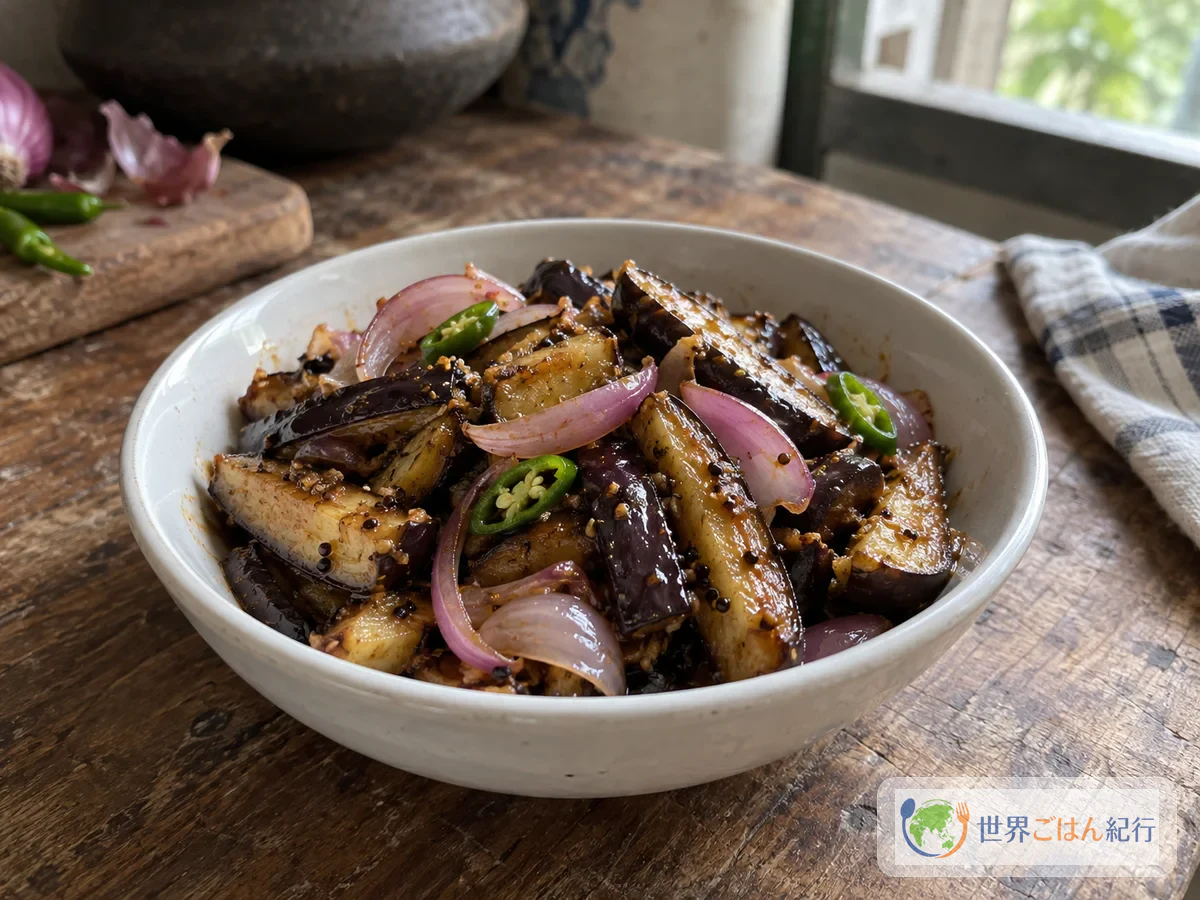
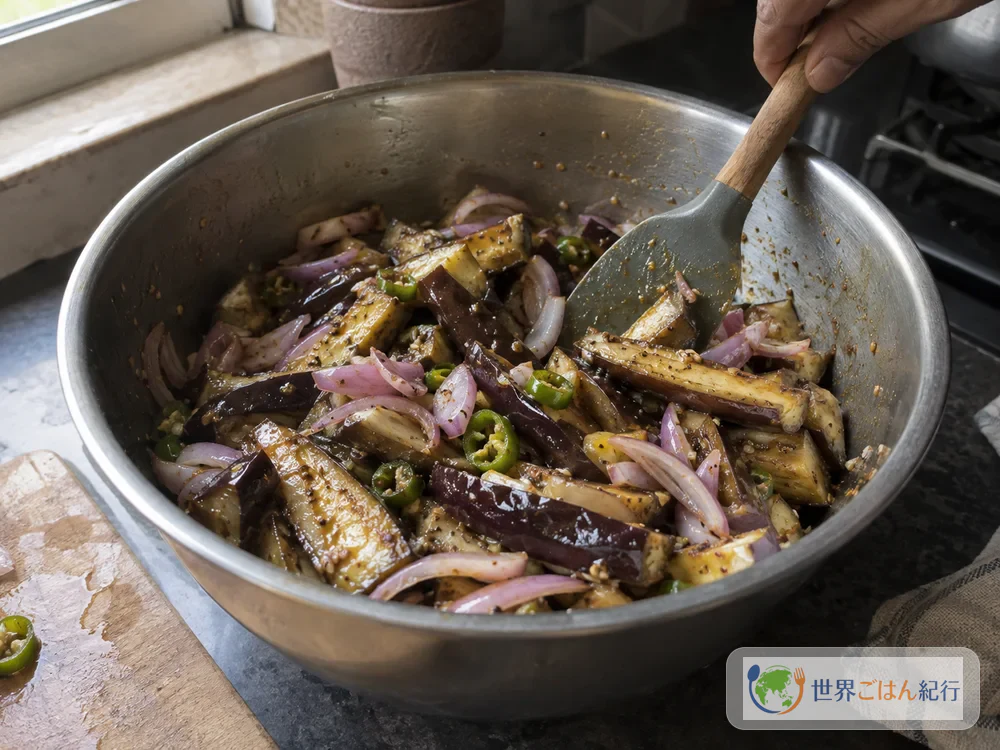
A small dish set right beside a mound of white rice. The scent of vinegar and mustard clings to fried eggplant, and the edges of the onion have turned translucent. At a Sri Lankan rice and curry spread or a celebration meal, a side like this sits next to the dal curry and the chicken curry. Wambatu moju is a dish of sweet-and-sour fried eggplant tossed in dressing. Unlike an eggplant curry swimming in sauce, the dressing only coats it lightly, so the toasty fried flavor and the tang come forward.
You can make it with ordinary eggplant just as it is. Cut it into sticks and fry them, drain off the oil thoroughly, then toss them in a dressing of vinegar, sugar and mustard. Fry first, then dress: that's the order this dish follows. It takes 45 minutes of work plus 30 minutes for the flavors to meld, 75 minutes in all, scaled for home cooks as a side dish for four.
A small plate of eggplant that brings a festive table together
It goes by several names. Wambatu moju, batu moju, brinjal moju and eggplant moju are all used for this eggplant side dish. Wambatu moju is the Sinhala name written in the Latin alphabet; in English, eggplant moju gets the idea across.
At the table it's less a star than a scene-stealing supporting player. It goes beside white rice or yellow rice, on the same table as dal curry or chicken curry, and Sri Lankan recipes give menu examples like that. Take a bite and the softness of the eggplant comes first, then the crunch of the onion, followed in turn by the tang of the vinegar, the sweetness of the sugar and the heat of the chile. It isn't a main dish to eat by the heap. It suits being spooned onto rice and other dishes a little at a time.
Sri Lankan cooks present it as a side dish for celebration menus. That said, there's nothing to support calling it indispensable to any particular holiday or wedding. It's a celebration dish that is also an everyday home side: that's where it sits. What makes this recipe convenient is that you can do the frying and the dressing as separate jobs. Of course, that doesn't mean it keeps well at room temperature. When you serve it, treat it as a side dish served in small portions.
In English it's sometimes described as a pickle or relish, and it's eaten as a vinegary side dish. However, the home-style proportions here are not a jarred preserve with tested acidity and shelf life. Don't think of it as the same thing as a shelf-stable pickle.
The same moju looks different from home to home
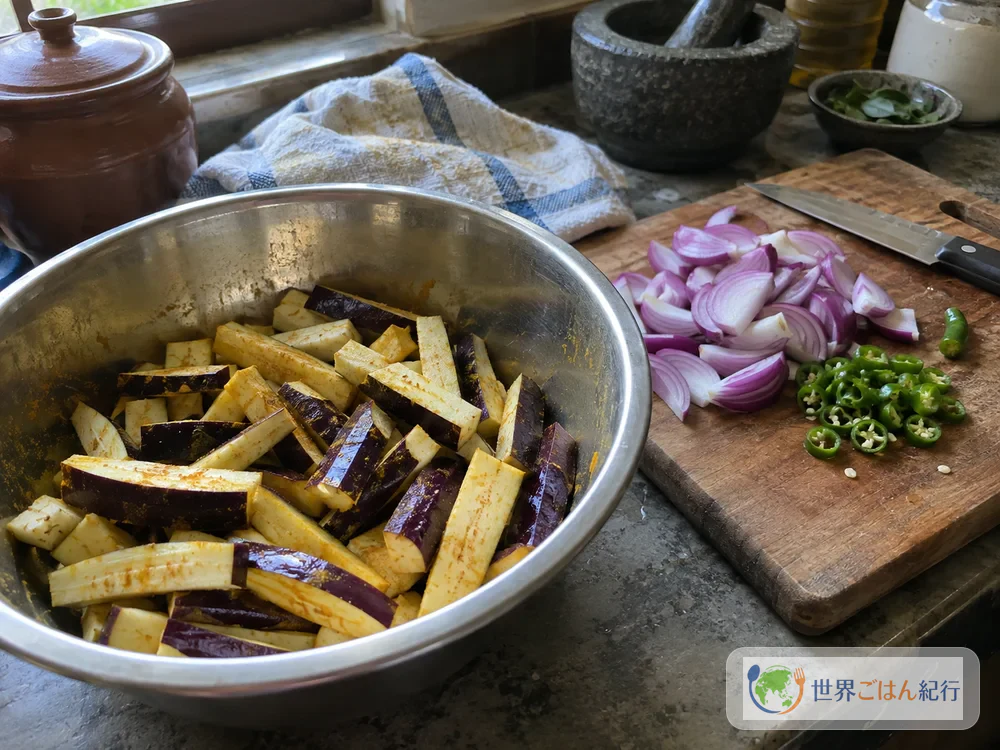
Recipes from Sri Lankan cooks come in two forms. One fries eggplant sticks and tosses them in mustard vinegar. The other cuts the eggplant into half-moons about 2 mm thick and fries them for a drier finish. The cut changes the texture a great deal; this recipe uses sticks to keep the soft interior of the eggplant. The frying times here are not meant for the thin-sliced version.
The proportions vary in other ways too. Some thin-sliced, drier versions use ketchup, Maldive fish and curry leaves, which are not included here. Even among home recipes using mustard, vinegar and fried vegetables, you'll find variations with different amounts of red onion, peppers or spices. We haven't been able to confirm regional differences such as every household in the north or south using the same formula. It's more natural to read this as each household's own proportions, or as the result of ingredients changing after people moved abroad, rather than a regional rule.
One story from food culture that crossed the sea: Diaspora Co. publishes a family recipe from the Eko Land Estate farm and ties moju to the 16th-century Portuguese colonial period. That's an origin theory presented by the company. The recipe on the same page is Sumithra Attanayake's recipe as adapted by Asha Loupy, not a single original formula handed down from long ago.
Gathering ingredients and aromas in a home kitchen
Weigh 500 g of eggplant after removing the stem end. Ordinary eggplant works. Regular purple eggplant is perfectly fine; cutting the sticks to an even thickness matters more to the result than worrying about the variety. Use 200 g of red onion. Small onions or shallots can be substituted by the same weight, and white or yellow onion works too, though the color and crunch change.
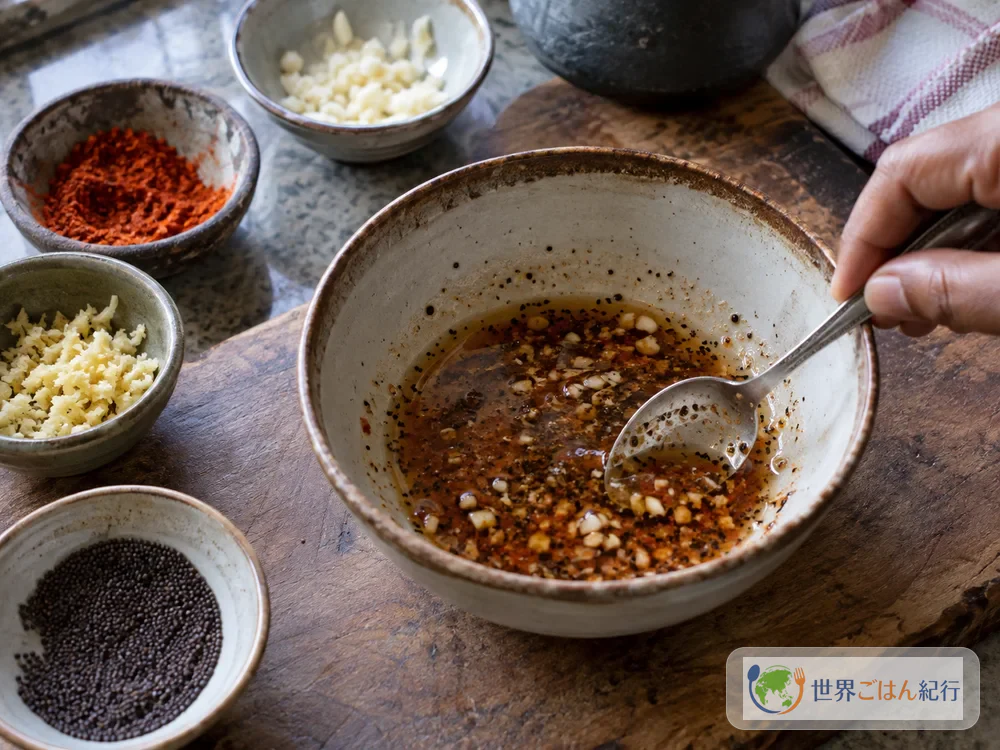
For the mustard, grind 1 1/2 tsp mustard seeds to a powder in a mortar. Grinding the seeds to a powder is the key; if you only crack them lightly, the seeds stay gritty. To use mustard powder instead, start with 1/2 tsp the first time. It's a home-style substitute that changes the character of the heat. Whole-grain mustard is already seasoned with vinegar and salt, so don't swap it in at the same amount.
For just 1 1/2 tsp, a mortar and pestle you already have is enough; there's no need to buy new equipment. If you'll be grinding whole spices often, a spice grinder is an option. Before buying, check that it can handle small amounts, and look at the minimum quantity and suitable ingredients in the manual. Not every model is good at grinding a small amount of mustard seed.
If all you have is whole-grain mustard, test 1 tsp of it in a separate small bowl of dressing before adding it to the main batch. Start with 30 ml vinegar and half the salt you'd use for the main dressing, then add more as you taste. We can't promise the result will be exactly the same as the basic version. The basic version is the one made from mustard seeds.
The basic home-style proportions are 45 ml distilled white vinegar or rice vinegar and 18 g sugar. Seasoned sushi vinegar already contains salt and sugar, so don't use it at the same amount. Use 20 g green chiles. For less heat, swap in 20 g shishito peppers and cut the chile powder from 1/4 tsp to 1/8 tsp; the sweet-and-sour character still comes through. Turmeric is 1/2 tsp.
Ingredients (serves 4)
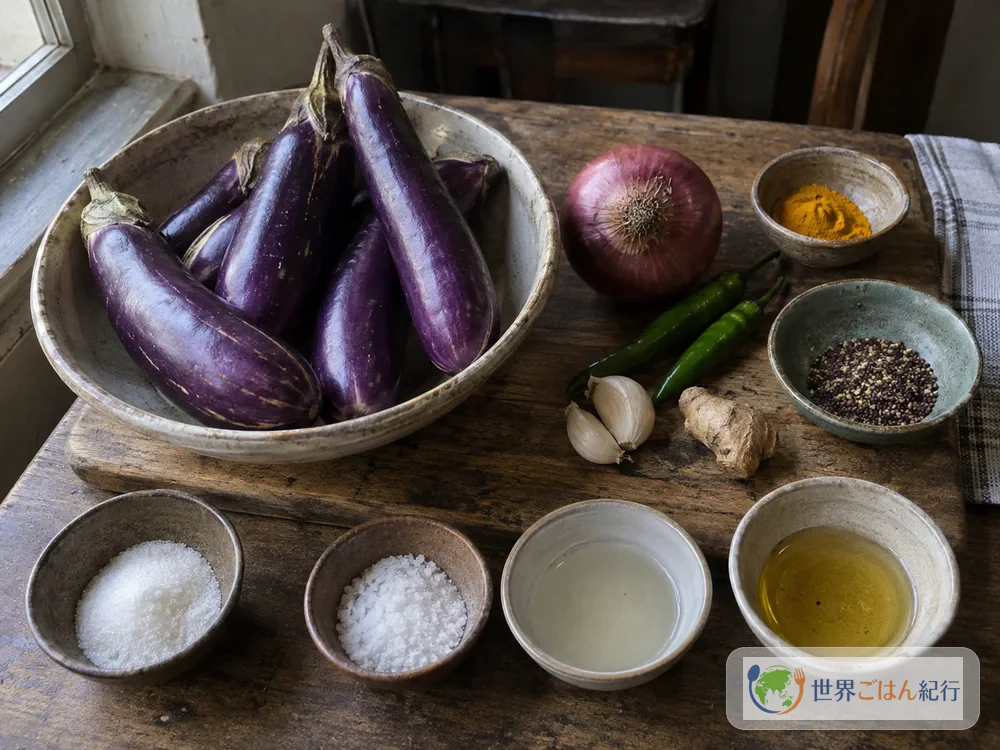
These are home-adjusted proportions for side dishes for 4. Rice and curry are not included. Allow 20 minutes of prep, 25 minutes of cooking and 30 minutes for the flavors to meld. You can fry the vegetables before making the dressing.
The 500 ml of oil is a guide for about 2 cm depth in an 18 cm pot; it varies with the shape of your pot. Follow the oil amount in your pot's manual first, and don't force the job into a shallow frying pan. Leave headroom in the pot: don't fill it with oil, and have a thermometer and a spider or slotted spoon ready. Never put ingredients into the oil while they're still wet.
Method
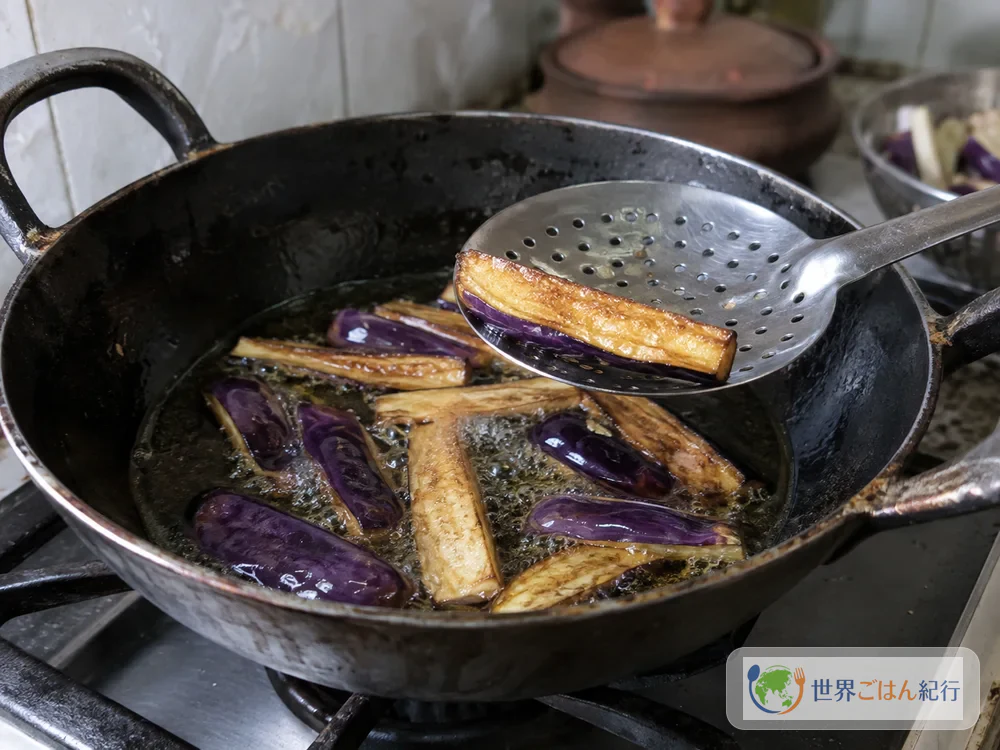
Before you start cutting, set up a frying station and a dressing station. Line up a tray lined with a rack or paper towels, a bowl for the dressing and the deep pot. Drain in a single layer. Frying times vary with thickness, the pot and how much you add at once. Don't rely on the clock alone; check the color and how soft the inside is.
If the color comes out uneven, add less at a time and wait for the oil temperature to recover before the next batch. Pull thin scraps out first. Don't extend the time and fry until black. Remove any burned pieces separately; don't try to cover the bitterness with the dressing.
Always blot off moisture from the surface of the ingredients. Lower the vegetables into the oil in small amounts from close to the surface, and keep your face and hands away from spatters. Don't step away from the pot while the oil is heating. Don't rub your eyes after handling chiles, and wash your hands after cooking.
Balancing sweetness, sourness and oiliness
The dressing tastes different on its own than it does coating the vegetables. Adjust with white rice alongside, adding a little at a time.
| Problem | How to fix it | What to avoid |
|---|---|---|
| Too sour | Dissolve sugar 1/2 tsp at a time in a little dressing in a separate bowl, then mix it back in | Adding a lot of sugar at once |
| Too sweet | Add vinegar 1 tsp at a time and taste with rice | Pouring in vinegar until it's soupy |
| Too oily | Before dressing, drain again on a rack. After dressing, skim excess oil off the surface with a clean spoon | Rinsing with water or squeezing hard |
| Eggplant fell apart | Don't mix any more; move it to small plates. Next time, check the stick thickness and how you mix | Reheating to try to restore the shape |
| Bitter from burning | Remove the burned black parts. Next batch, lower the temperature and time | Hiding the burned taste with sugar or vinegar |
If you're concerned about heat, it's easier to swap the green chiles for shishito peppers and halve the chile powder at the prep stage. Adjust the heat during prep. If the finished dish is too spicy, pick out the chile pieces and eat it with rice a little at a time. Adding sugar doesn't remove the compounds that make chiles hot.
If the eggplant seems to be soaking up too much oil, don't add a big batch next; bring the oil back to 170–180°C (340–355°F) on the thermometer before frying. Drain fried eggplant in a single layer. Returning already-fried eggplant to the oil again and again isn't recommended. Stop before the outside burns.
A table set with rice and curry
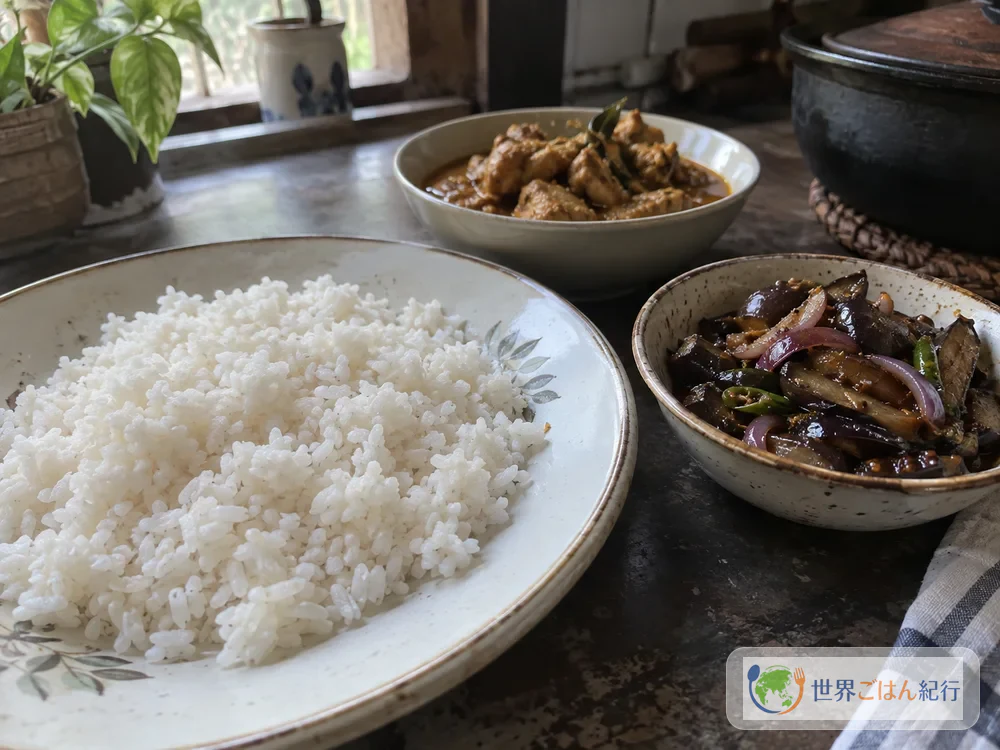
Rather than mixing moju through the whole plate, spoon it a little at a time beside the rice. That way you can adjust the sourness and heat bite by bite. Sri Lankan recipes give menu examples pairing it with chicken curry or dal curry. At home, start with a simple table of 2–3 dishes: rice, a curry and moju.
Eating it with pol roti also appears in Sri Lankan home recipes. Beyond the name of the dish and the pairing, we're not going to make up any rules here. Pairing a coconut flatbread with a tangy side dish is a nice idea for a home menu, so try it with bread too.
- For a chicken curry main, see kukul mas curry.
- For a coconut flatbread, see pol roti (in Japanese).
Storage and FAQ
Even with vinegar, this home-style version can't be kept at room temperature. Refrigerate it even though it contains vinegar. Transfer it to a clean, shallow container and chill it promptly to 4°C (40°F) or below. Follow the general food-safety guidance: no more than 2 hours total at room temperature, or 1 hour when it's above 32°C (90°F). Take out only what you'll eat, with a clean spoon. As a conservative home suggestion, we recommend finishing it by the next day, but this is not a tested shelf life.
Even in a jar, this is not a recipe that can be stored at room temperature. Anything left out longer than the time limits can't be rescued by refrigerating it again. Don't serve it to anyone with a mustard allergy. The basic version here contains no fish, but variations that add Maldive fish do.
Can I make it the day before?
If you make it the day before, refrigerate it promptly after frying and dressing, and finish it the next day. This is a home guideline. Take out only the portion you'll serve. Even if you'd like to take the chill off, avoid leaving the whole container out at room temperature for hours. The flavors melding overnight and the dish being safe are two separate matters.
Can I make it without deep-frying?
There are other recipes that use an air fryer, but the frying times and oil amounts here don't carry over. If you switch to pan-frying, the amount of oil, unevenness of browning and moisture in the eggplant all change. The method here is limited to frying in small batches in oil.
I don't have mustard seeds
As described in the ingredients section, try a small test batch with 1/2 tsp mustard powder or 1 tsp whole-grain mustard. It won't have the same aroma or texture as the basic version. With seasoned whole-grain mustard, cut back on the salt and vinegar when you test it.
Can I freeze it?
We haven't tested the texture or shelf life after freezing. We recommend making a small amount, refrigerating it and finishing it by the next day. Freezing also doesn't make a dish safe if it was left out at room temperature too long.
What do the nutrition figures represent?
The figures of about 167 kcal, 1.9 g protein, 12.7 g fat and 15.0 g carbohydrate per serving are a rough estimate assuming the main ingredients are 500 g eggplant, 200 g onion and 18 g sugar, with a total of 50 g of oil remaining in the dish. They're based on values from Japan's Ministry of Education, Culture, Sports, Science and Technology (MEXT) food composition database for raw eggplant, raw onion, white sugar and blended vegetable oil. Small amounts of spices, aromatics and vinegar aren't included, and neither is rice or curry. Oil absorption wasn't measured, so read this as an estimate that changes with oil absorption. It isn't a measured nutrition value for the whole dish or a fixed calorie count.
Sources
- ISLAND SMILE — Sri Lankan wambatu moju — Eggplant sticks, mustard-vinegar dressing, celebration menus, names. The mustard amount differs between its ingredient list and its method. (accessed and checked 7 October 2026)
- Hungry Lankan — Sri Lankan Eggplant Moju — A thin-sliced, drier variation and pairings. (accessed and checked 7 October 2026)
- Diaspora Co. — Wambatu Moju or Sri Lankan Eggplant Relish — The farm's family recipe, Japanese eggplant, origin theory, pairing with pol roti. (accessed and checked 7 October 2026)
- FoodSafety.gov — 4 Steps to Food Safety — Refrigerator temperature, time at room temperature, cooling in shallow containers. (accessed and checked 7 October 2026)
- 文部科学省 (MEXT) — なす、果実、生 — Rough nutrition estimate (raw eggplant). (accessed and checked 7 October 2026)
- 文部科学省 (MEXT) — たまねぎ、りん茎、生 — Rough nutrition estimate (raw onion). (accessed and checked 7 October 2026)
- 文部科学省 (MEXT) — 上白糖 — Rough nutrition estimate (white sugar). (accessed and checked 7 October 2026)
- 文部科学省 (MEXT) — 調合油 — Rough nutrition estimate (blended vegetable oil). (accessed and checked 7 October 2026)
- 東京消防庁 (Tokyo Fire Department) — 第2章 火災を防ぐ — Fire prevention for stoves and frying oil. (accessed and checked 7 October 2026)
- Food Standards Agency — Food allergy and intolerance advice for consumers — Allergens including mustard, and precautions at home. (accessed and checked 7 October 2026)


