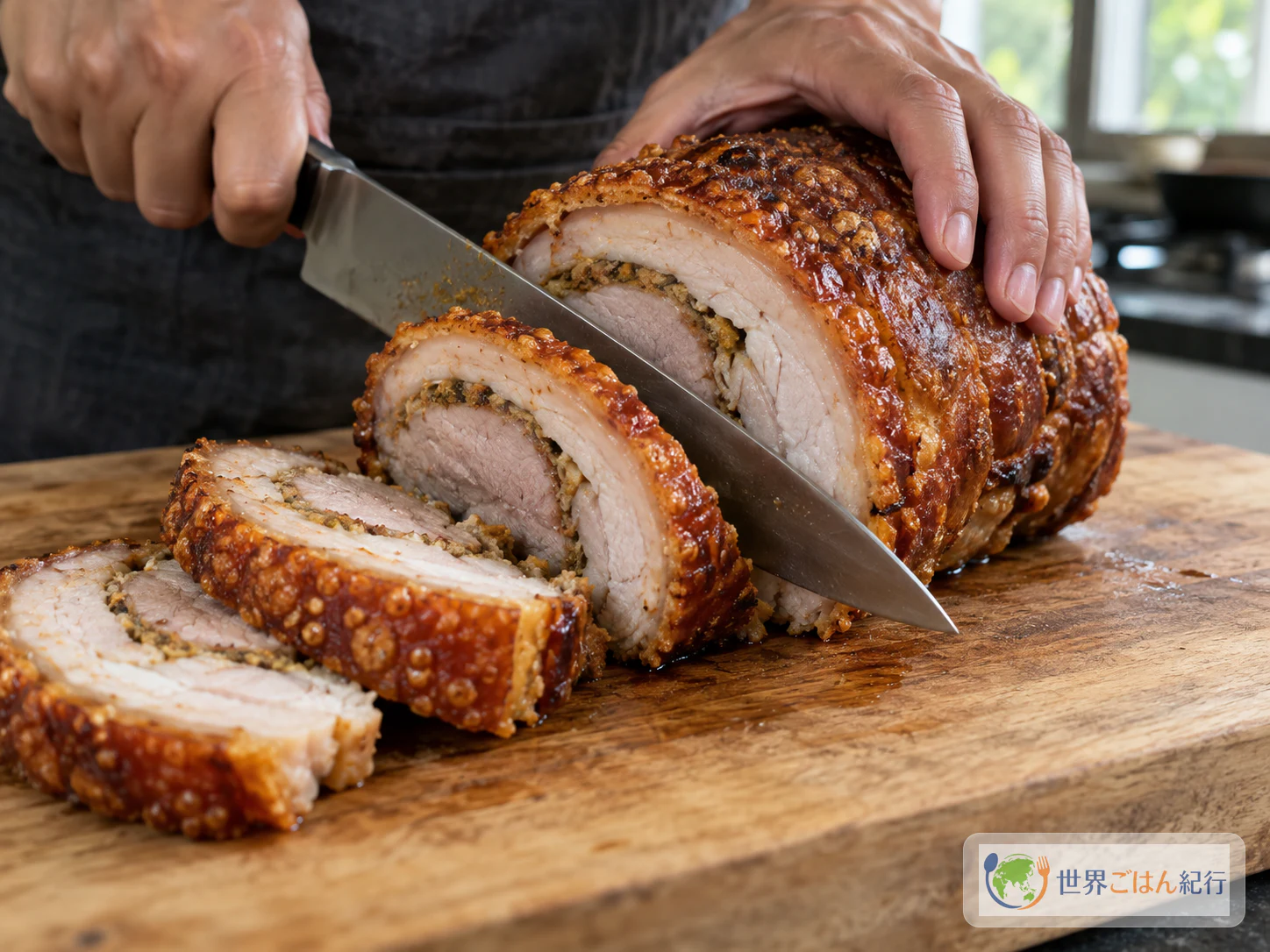
Babi Guling: From a Whole Roasted Pig to a Roll in Your Oven
Keep the spice paste inside on the meat side, dry the skin uncovered overnight in the refrigerator, and judge doneness with a thermometer rather than the clock.
Picture a Balinese celebration table. A whole pig, stuffed with spices and roasted as it turns, is carved for the people gathered around it. Picture the skin and the spice-scented meat on a plate beside rice. This is babi guling, also written be guling, a name tied to the turning of the pig as it roasts.
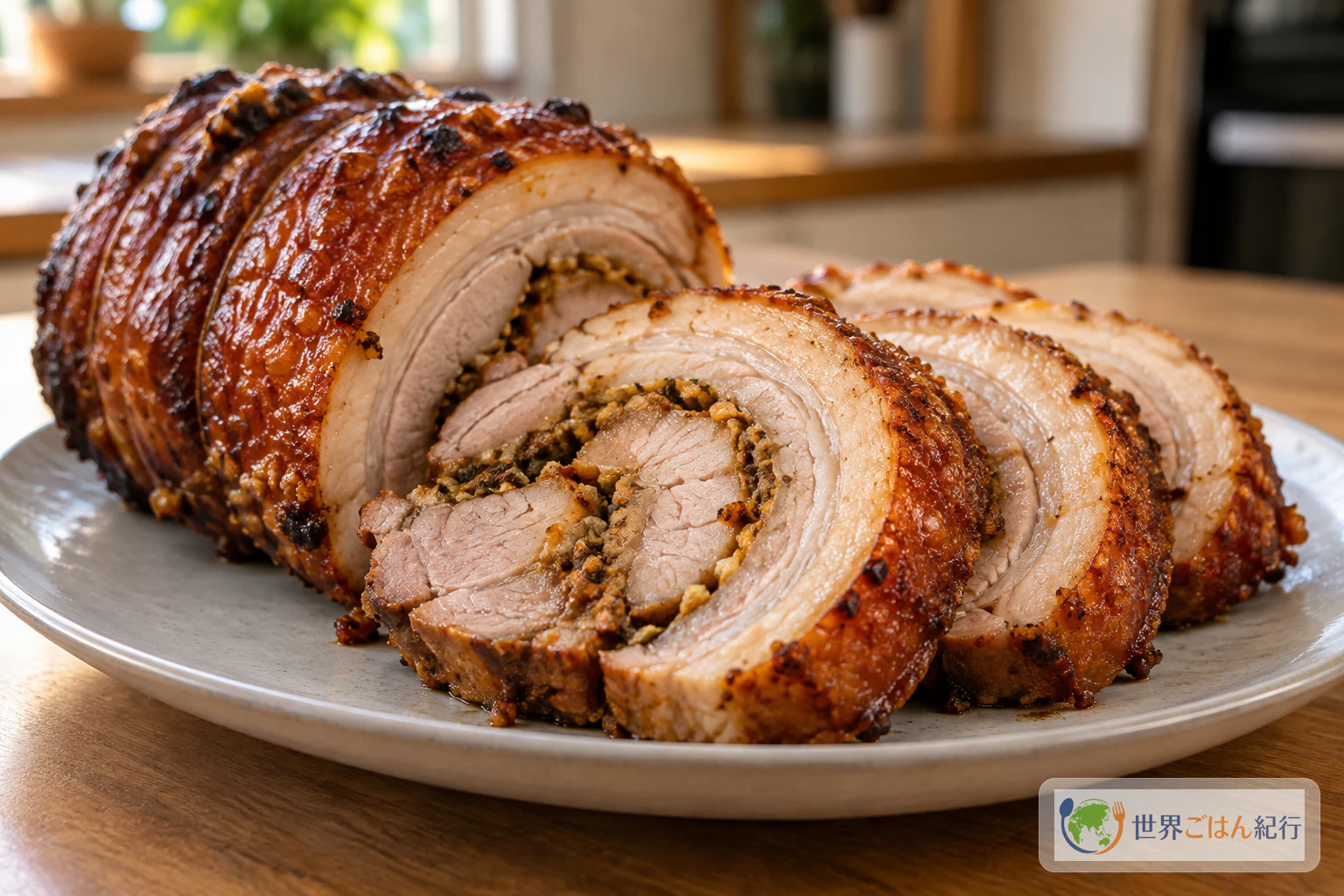
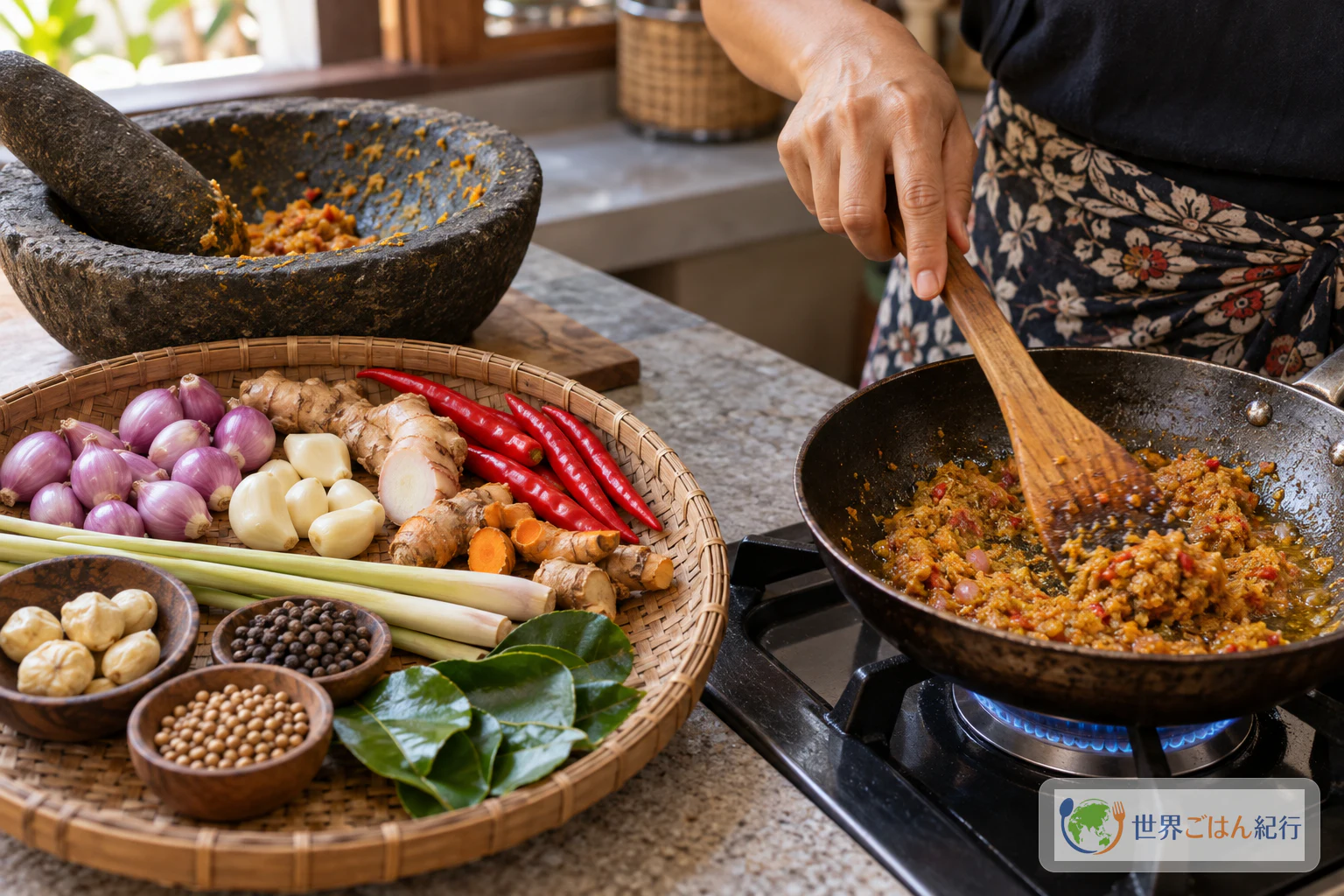
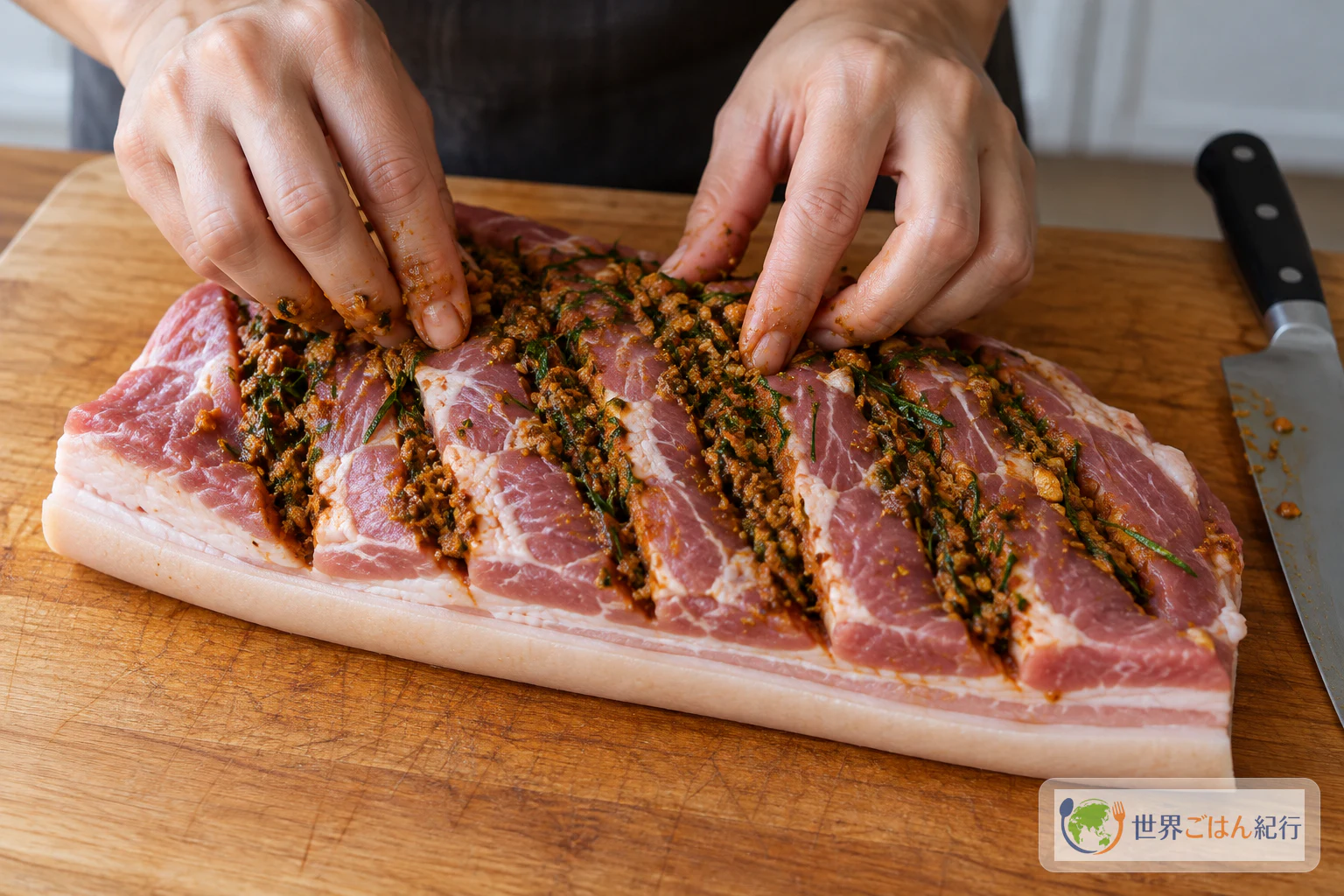
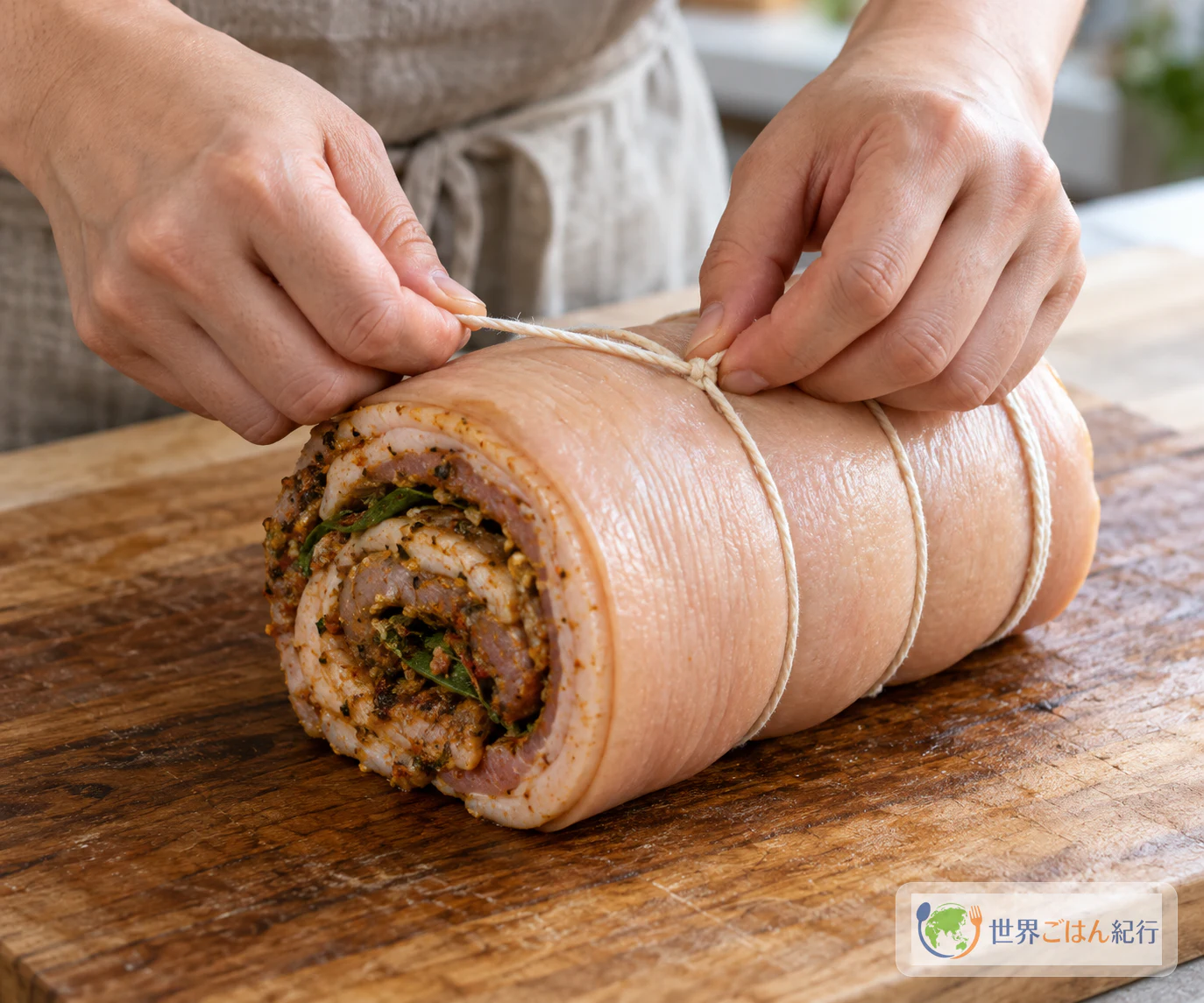
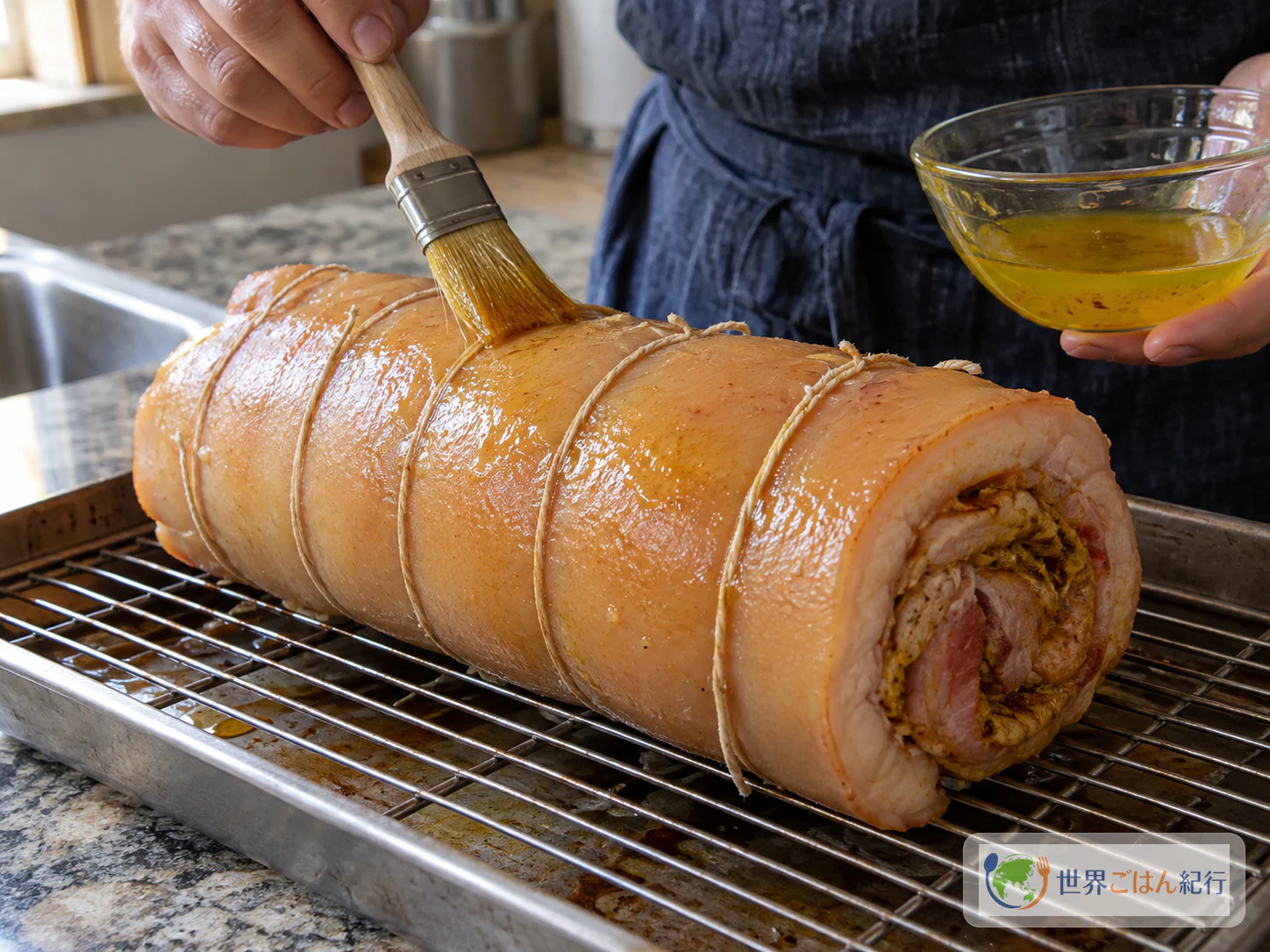
That scale doesn't fit in a home kitchen. A whole pig turned over a fire is communal work, while a domestic oven holds one compact roast. So this recipe isn't a miniature version of the whole pig. It is a home adaptation built from a different cut and a different way of roasting: skin-on pork belly, rolled around the paste and roasted in the oven. It keeps the pork fat and skin, the aromas of turmeric, ginger, galangal and lemongrass, and the heat of chillies.
About This Recipe: What Comes from Where
The ingredients, amounts, times and oven temperatures all come from one recipe, the home-style rolled pork belly published by Gurmestan. Its listed yield is 6 servings. We have not kitchen-tested this recipe, so the yield and times are published figures, not our own measurements.
We filled in two gaps in Gurmestan's recipe:
- Oil: the method fries the paste in 2 tbsp of oil, but the ingredient list leaves the oil out. We copied that amount from the method into our table.
- Salt: Gurmestan gives only a total of 1 tbsp, used in both the paste and on the skin, with no split. Our editors chose 1/2 tsp for the paste and 2 1/2 tsp for the skin, and this split has not been tested.
We based the salt split on how two other pork belly recipes divide their salt. Tony Tan's recipe in Gourmet Traveller uses 1 tsp in the paste and 1½ tbsp as a rub for a 2.5 kg roll. SunPork uses 1/2 tsp in the paste for 2 kg and a "generous amount" on the skin. Scaled to 1.5 kg, their paste salt comes to about 0.6 tsp and about 0.4 tsp, so we settled on 1/2 tsp. We borrowed only this idea of how to divide the salt, not their seasonings, times or roasting methods.
Gurmestan mentions rubbing salt on the skin in two places, the rolling step and a note on the skin. We treat these as one action, so all the skin salt goes on after rolling and none is added before roasting. Tony Tan also rubs salt into the meat, but we follow Gurmestan and salt only the skin.
Gurmestan also notes that kencur, an aromatic in general descriptions of Balinese base genep, can be left out if you can't find it. It isn't in this recipe's ingredient list, so we haven't added it. The swaps suggested below are our own editorial ideas, not Gurmestan's.
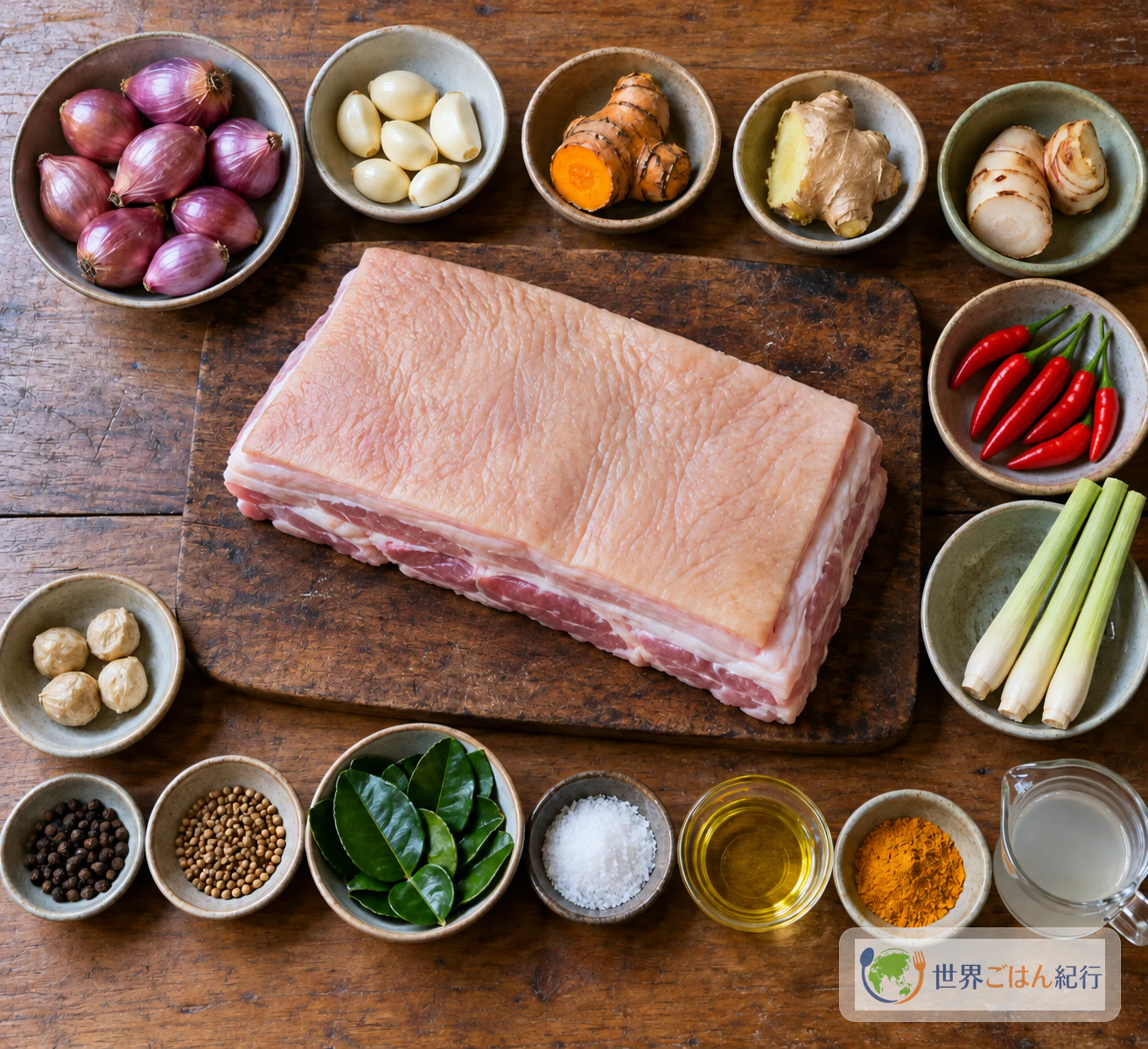
Ingredients for One 1.5 kg Roll
Equipment
- Mortar and pestle
- Small pan
- Sharp knife and cutting board
- Kitchen twine
- Wire rack and tray
- Paper towels
- Pastry brush
- Probe thermometer for the center of the roll
- Oven thermometer, to check your oven against 160°C and 230°C
Choosing and Swapping the Aromatics
The pork matters most. Without skin on the belly, you can't reproduce the crisp skin that defines this roast. The other notes below are editorial suggestions, and each one changes the flavor:
- Shallots: small red onions can stand in, but the aroma and moisture will change.
- Galangal: ginger can stand in, but it won't taste the same, even if you use more. Galangal is worth seeking out if you can find it.
- Fresh turmeric: we don't give a conversion to ground turmeric. The 1 tsp of ground turmeric in the table is a separate ingredient for the skin.
- Candlenuts and makrut lime leaves: we haven't settled on a substitute for either one.
- Coconut water: don't confuse it with coconut milk.
This dish is built on pork. It contains candlenuts, so check the product label for how they are classified, and it contains coconut water and chillies. Watch for cross-contact when you prepare the paste ingredients. Roasting time doesn't prove the pork is safe, so check the center with a thermometer.
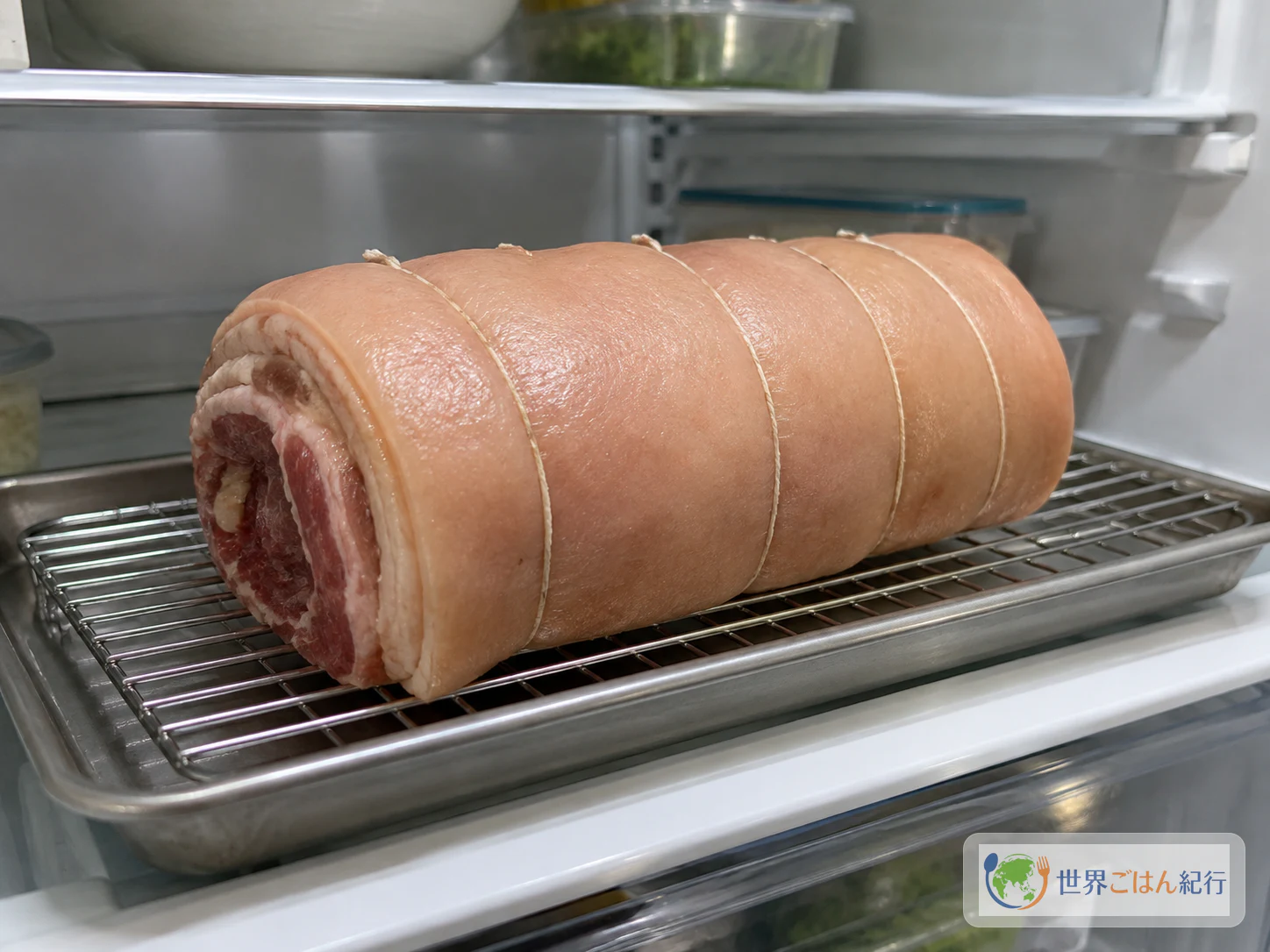
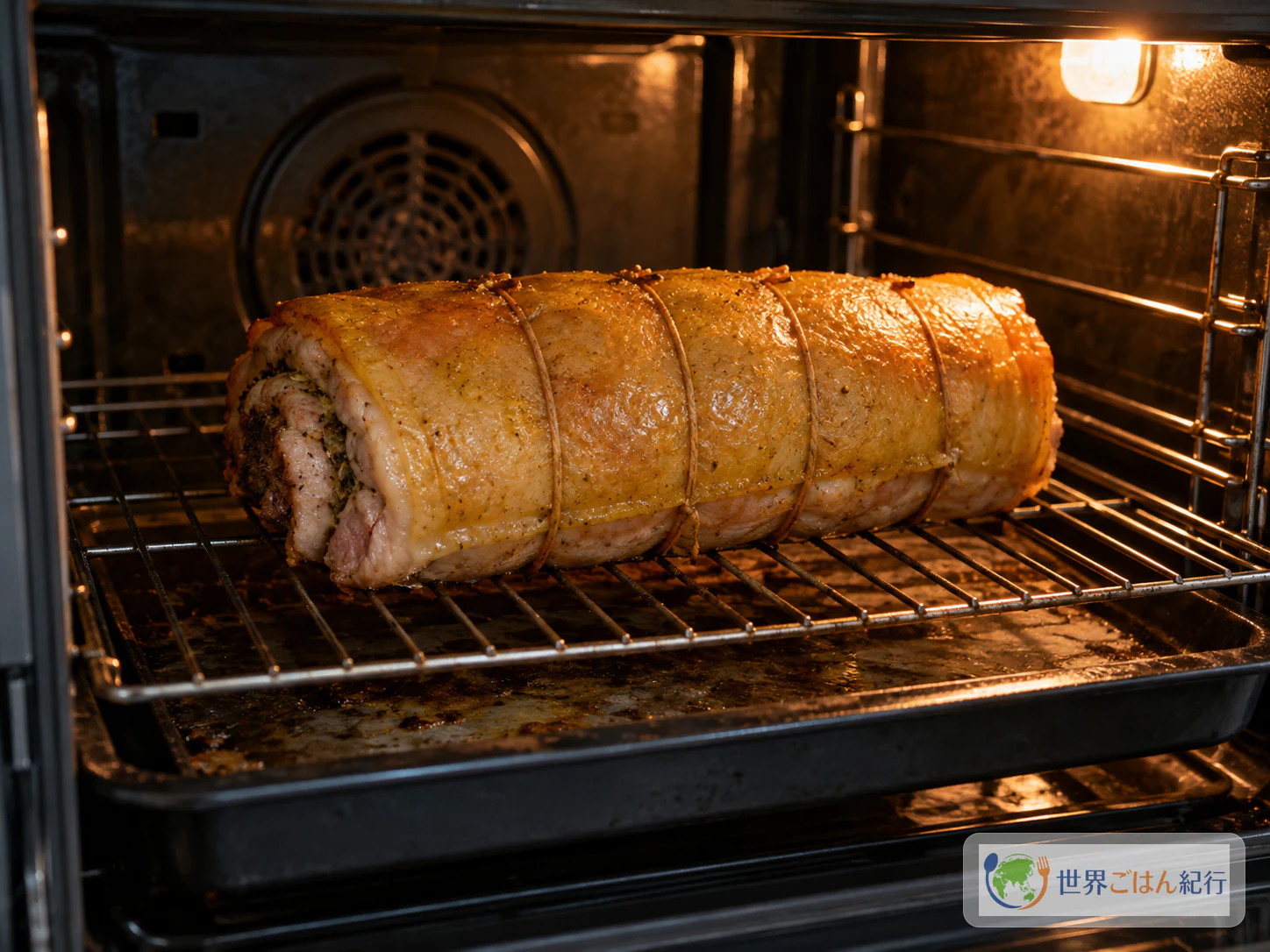
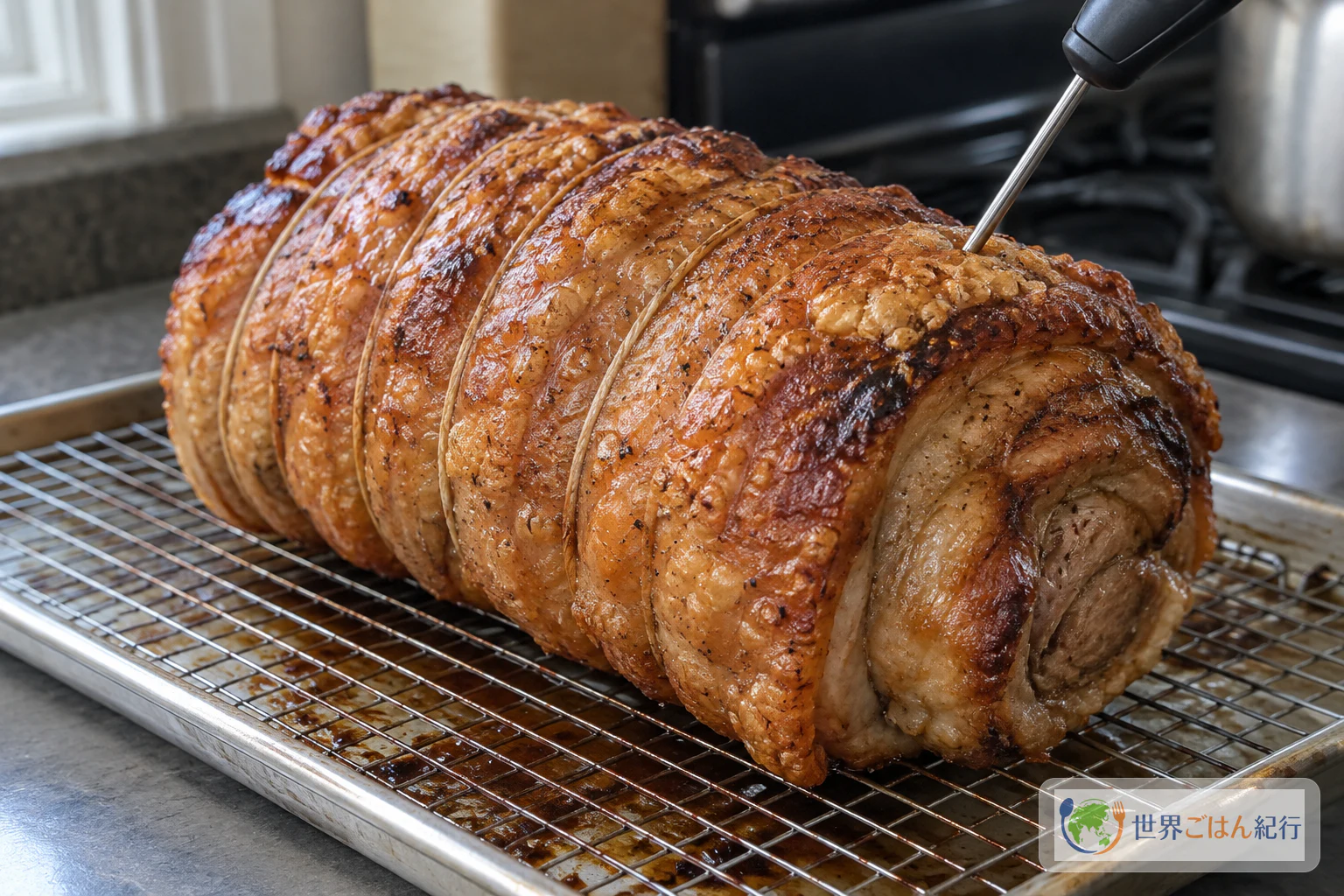
Method: Dry the Skin Overnight, Roast Low, Then Finish High
Start the day before you plan to eat, because the roll needs a night uncovered in the refrigerator. Wash your hands often while you work.
Serving: Rice, Lawar and Sambal Matah on the Side
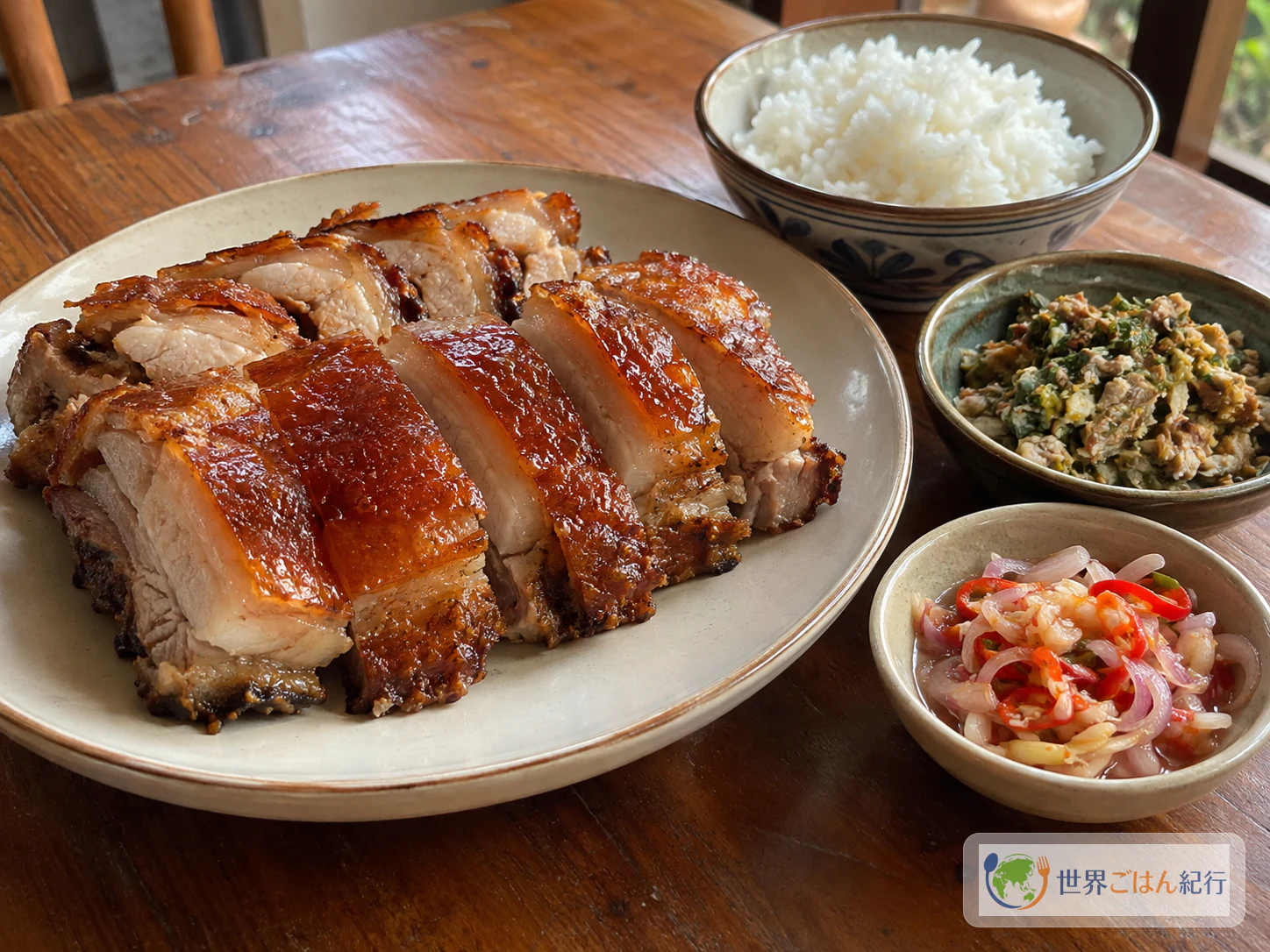
The roll is complete without any accompaniments. If you'd like to build a fuller plate, serve it with white rice, lawar and sambal matah in separate dishes. These are optional, and none of them is cooked into the pork.
When the Skin Goes Soft or the Paste Scorches
| Problem | Likely reason | What to do |
|---|---|---|
| The skin stays soft | Moisture is left on the skin | Dry the roll uncovered in the refrigerator overnight, and wipe the skin with paper towels before roasting |
| The skin doesn't puff where the paste touched it | Paste got onto the skin | Keep the paste on the meat side only; it gets in the way of the skin puffing |
| The center is undercooked | The roast was judged by time | Return the roll to the oven and measure again, until the center reaches 75°C for at least 1 minute. Tender meat doesn't tell you it's safe |
| Part of the skin browns too early | Heat varies between ovens | Change the roll's position, or turn it a little if needed. We don't give a fixed temperature or time for this because it hasn't been tested |
Variations That Change the Plate
- Milder heat: use fewer than 5–6 chillies. This is an editorial adjustment, and the paste will taste less hot and less bold.
- Without kencur: this recipe already leaves kencur out, so there's nothing to change.
- Aroma first: keep the galangal even if you have to swap other items, since its aroma is the one ginger can't match.
- Makrut lime leaves: we don't yet recommend a replacement. Any swap you try will change the citrus aroma.
- A fuller table: add rice with store-bought or separately made lawar and sambal matah. Keep them out of the roll's ingredients.
Leftovers and Reheating
Divide leftovers into small portions in shallow containers so they cool quickly, then refrigerate them at 10°C or below. Throw away anything that has been kept too long. We don't give a specific number of days because we couldn't confirm one in public guidance. When reheating, heat thoroughly, using 75°C or above as your guide.
From Ceremony to Warung: The Dish in Bali
Indonesia's Ministry of Tourism presents babi guling as a whole pig stuffed with spices and spit-roasted. Gurmestan describes it in the context of Balinese ceremonies and feasts, and also at warungs, the small eateries where it is eaten as a single plate. One warung plate Gurmestan describes includes rice, skin, lawar and urutan, a sausage of blood and spices. That's one example, and it doesn't mean every plate comes with the same sides. The ministry lists lawar as a Balinese dish in its own right.
We don't give a date for the dish's origin because our sources don't establish one. Names, ingredients and methods also vary by region and cook, so this recipe is one home version rather than the single authentic formula.
Crispy pork from Bali isn't always babi guling, either. The Indonesian Chef Association describes babi panggang garing as a separate dish, with its own ingredients, a parboiling step and a sweet soy finish. We haven't mixed any of that recipe into this one. To explore further, browse more dishes from Indonesia.
Frequently Asked Questions
Do I need a whole pig or a suckling pig?
No. The traditional picture is a whole pig stuffed with spices and spit-roasted, but this recipe uses a 1.5 kg skin-on pork belly, rolled and roasted in the oven. It's a home adaptation, not the same method.
Can I use ginger instead of galangal?
You can, but the result won't taste the same. Galangal has a citrus-and-pine aroma that ginger lacks. This is our editorial suggestion rather than a substitution given by Gurmestan.
How do I get crisp skin?
Dry the roll uncovered in the refrigerator overnight, wipe the skin with paper towels before roasting, and finish at 230°C until it puffs and turns glassy. Keep the paste off the skin. These steps give you the best chance of crisp skin, but results vary by oven, and we haven't tested this recipe.
What temperature should the center reach?
Check that the center reaches 75°C for at least 1 minute, the home-cooking guideline from Japan's Ministry of Health, Labour and Welfare. FoodSafety.gov in the US lists 63°C with a 3-minute rest for pork roasts, steaks and chops, but we don't use that figure here. Scoring and rolling the belly moves what was once the surface to the inside of the roast.
Are lawar and sambal matah required?
No. Gurmestan suggests rice, lawar and sambal matah as accompaniments, but none of them is an essential ingredient in the roll.
Sources
- Gurmestan, "Babi Guling recipe — Indonesian cuisine." The ingredients, amounts, method, times, temperatures and listed yield; the kencur note; serving suggestions; Balinese ceremonies, feasts and warung plates; and the difference between the whole pig and the home version. https://gurmestan.com/en/recipes/babi-guling/
- Indonesia Travel, Ministry of Tourism of the Republic of Indonesia, "13 Iconic Balinese Cuisines You Must Try in Bali." Babi guling as a whole pig stuffed with spices and spit-roasted, and lawar as a separate Balinese dish. https://www.indonesia.travel/gb/en/travel-ideas/gastronomy/10-iconic-cuisine-s-that-you-must-try-on-your-next-visit-to-bali
- Indonesian Chef Association / I Nyoman Picha, "Balinese Babi Panggang Garing | Crispy Balinese Pork Belly." Babi panggang garing as a separate dish whose ingredients, parboiling and sweet soy finish differ from this recipe. https://indonesianchefassociation.com/recipe/balinese-babi-panggang-garing-crispy-balinese-pork-belly
- Gourmet Traveller / Tony Tan, "Balinese roast pork (babi guling)." A reference for dividing salt between the paste and the rub; its seasonings and roasting method are not used here. https://www.gourmettraveller.com.au/recipe/chefs-recipes/balinese-roast-pork-babi-guling-7709/
- SunPork Fresh Foods, "Babi Guling Roast Pork Belly." A reference for using a little salt in the paste and a generous amount on the skin; its seasonings and roasting method are not used here. https://sunporkfreshfoods.com.au/recipes/babi-guling-roast-pork-belly/
- Ministry of Health, Labour and Welfare, Japan, "家庭での食中毒予防" (Preventing food poisoning at home). Heating to 75°C at the center for at least 1 minute, refrigeration at 10°C or below, handling raw meat and its juices, hand-washing, storing leftovers and reheating. https://www.mhlw.go.jp/stf/seisakunitsuite/bunya/kenkou_iryou/shokuhin/syokuchu/01_00008.html
- FoodSafety.gov, U.S. Department of Health and Human Services, "Cook to a Safe Minimum Internal Temperature." The US guideline of 63°C with a 3-minute rest for pork roasts, steaks and chops, and using a thermometer; for reference only, not the standard for this roll. https://www.foodsafety.gov/food-safety-charts/safe-minimum-internal-temperatures