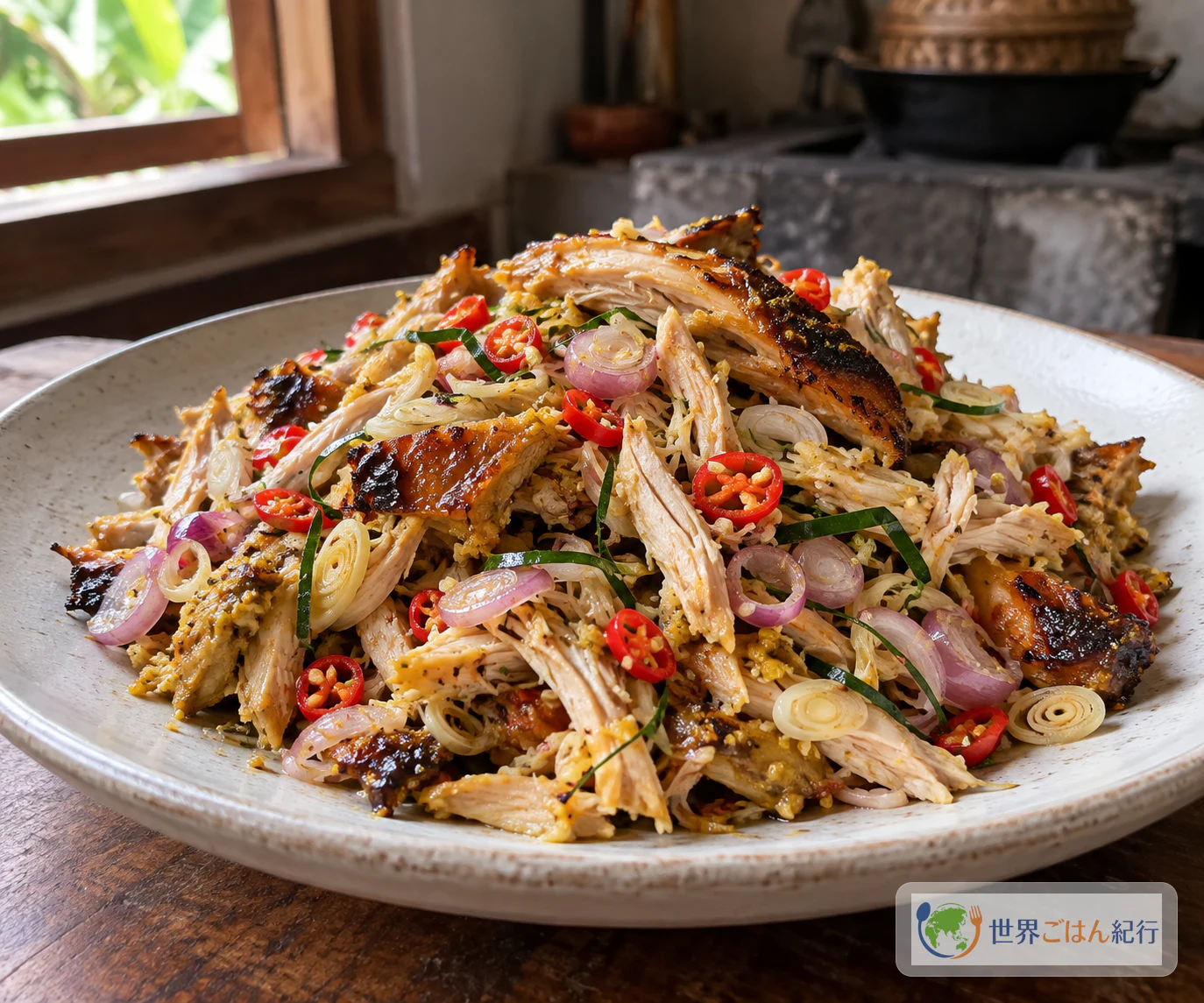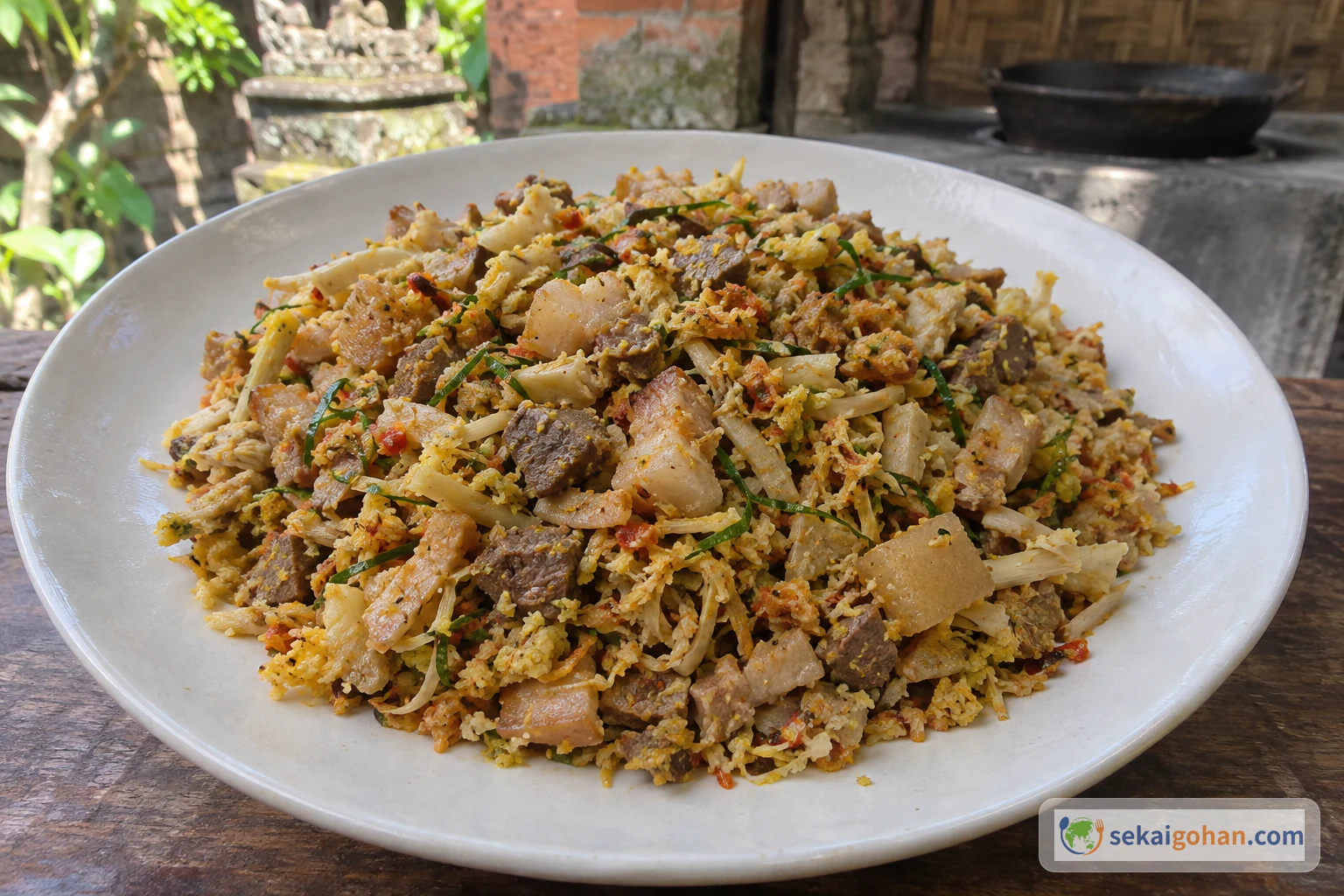
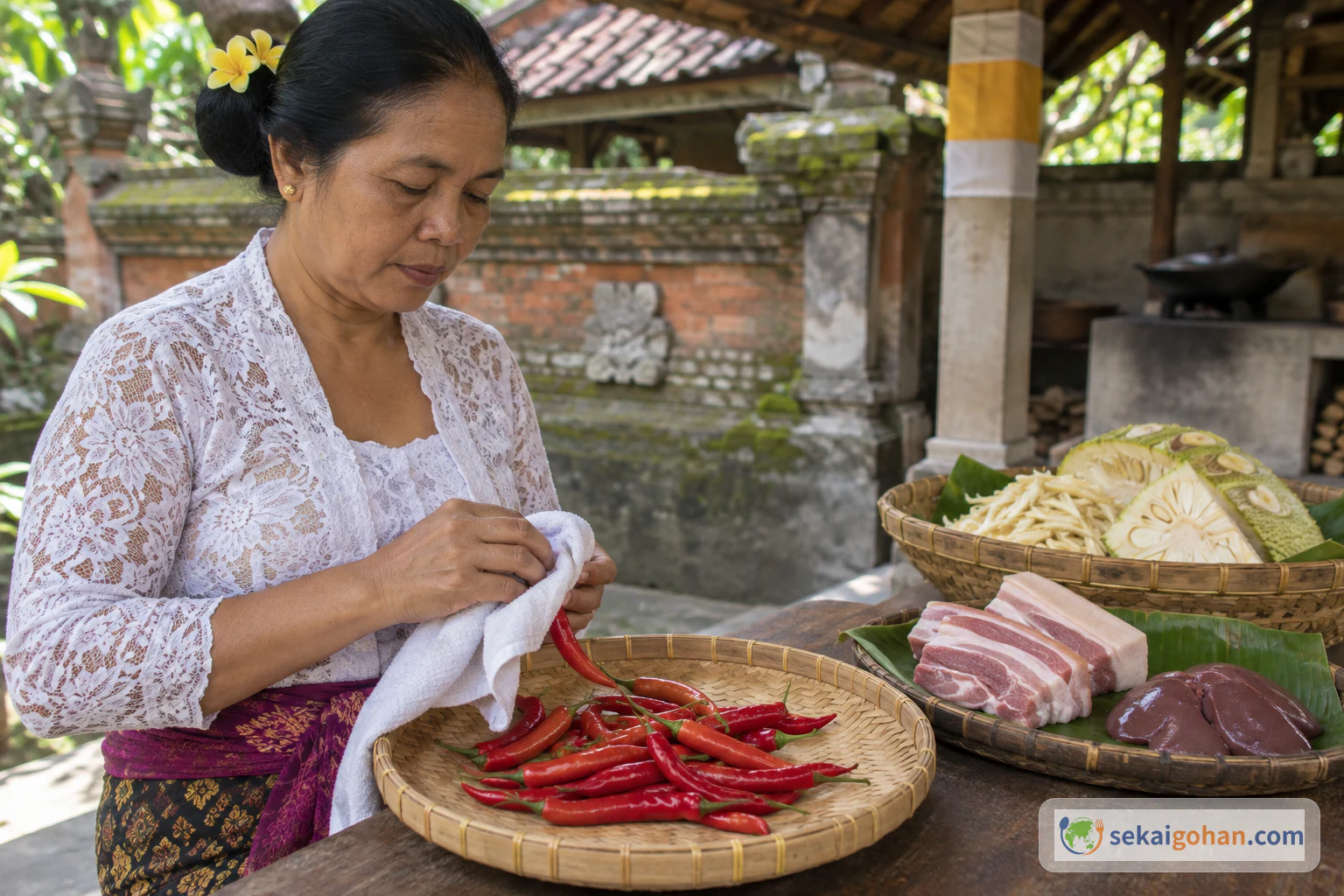
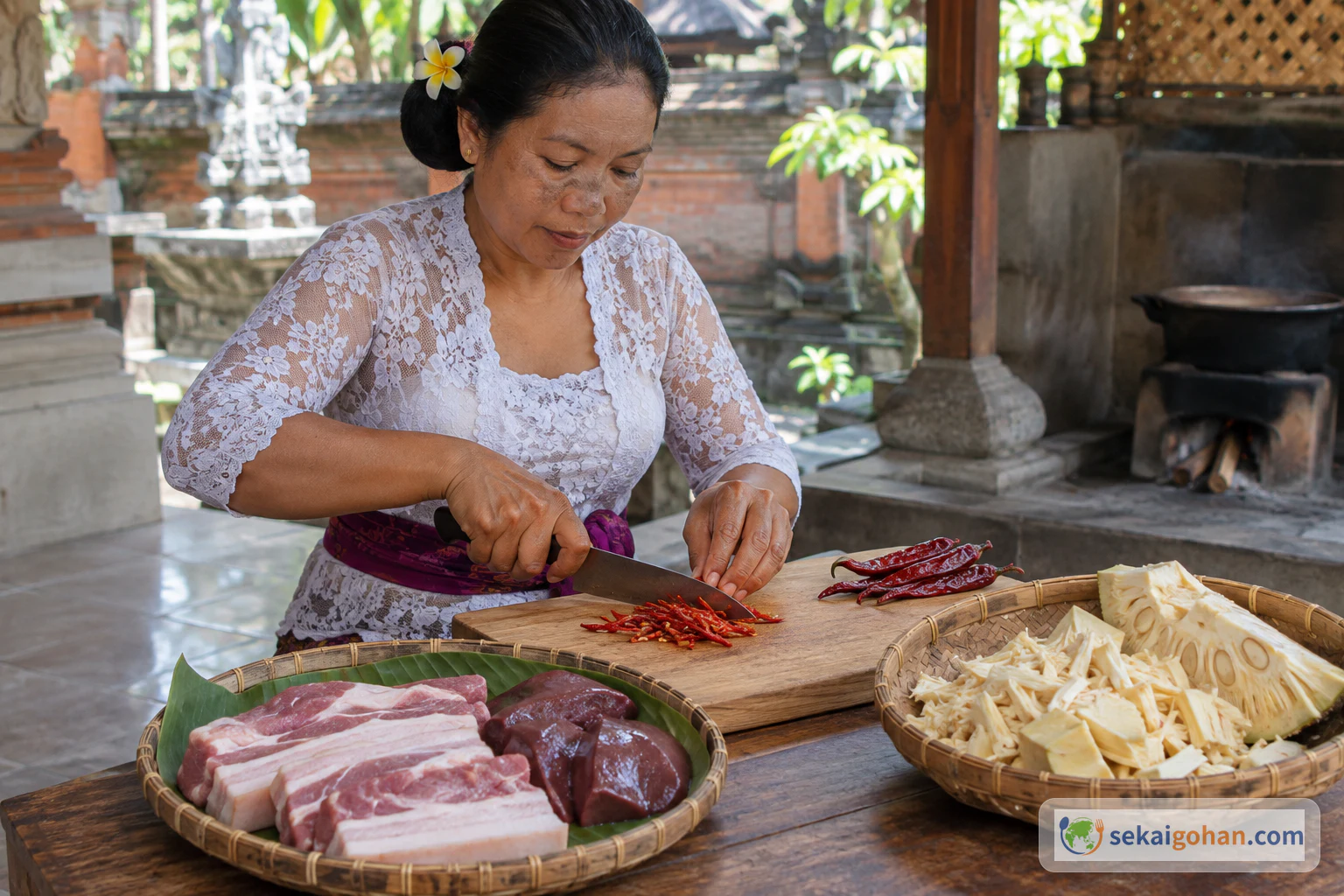
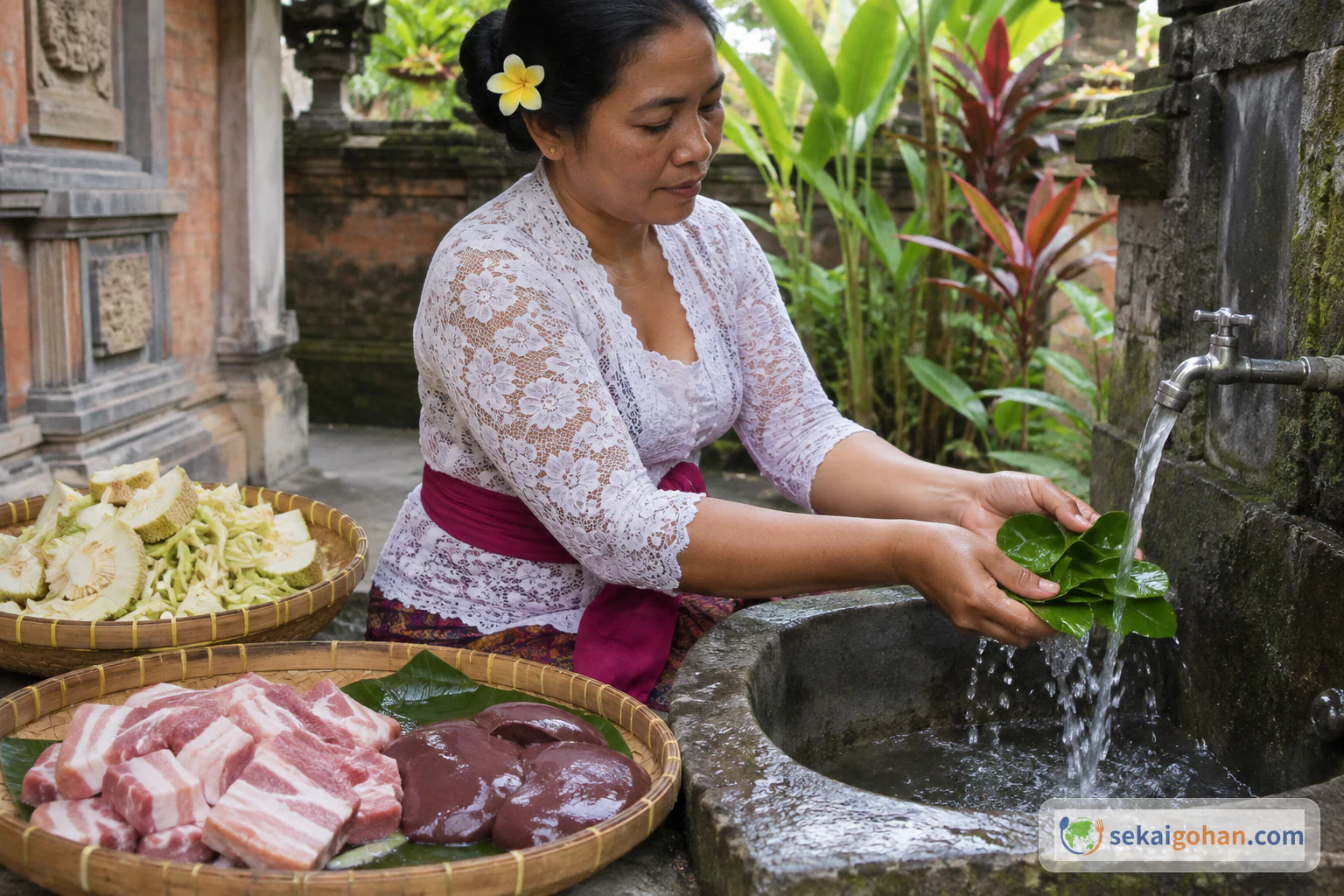
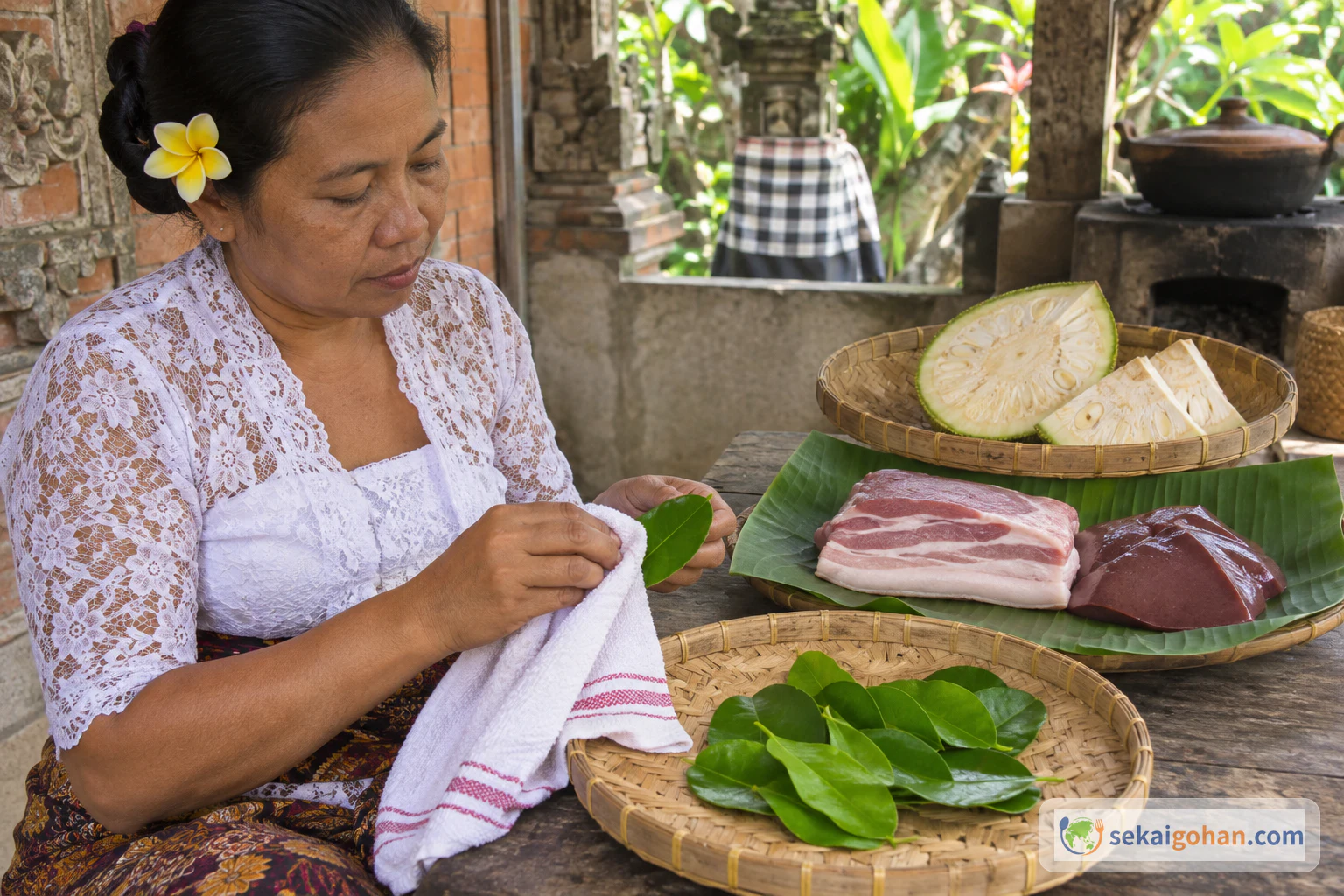
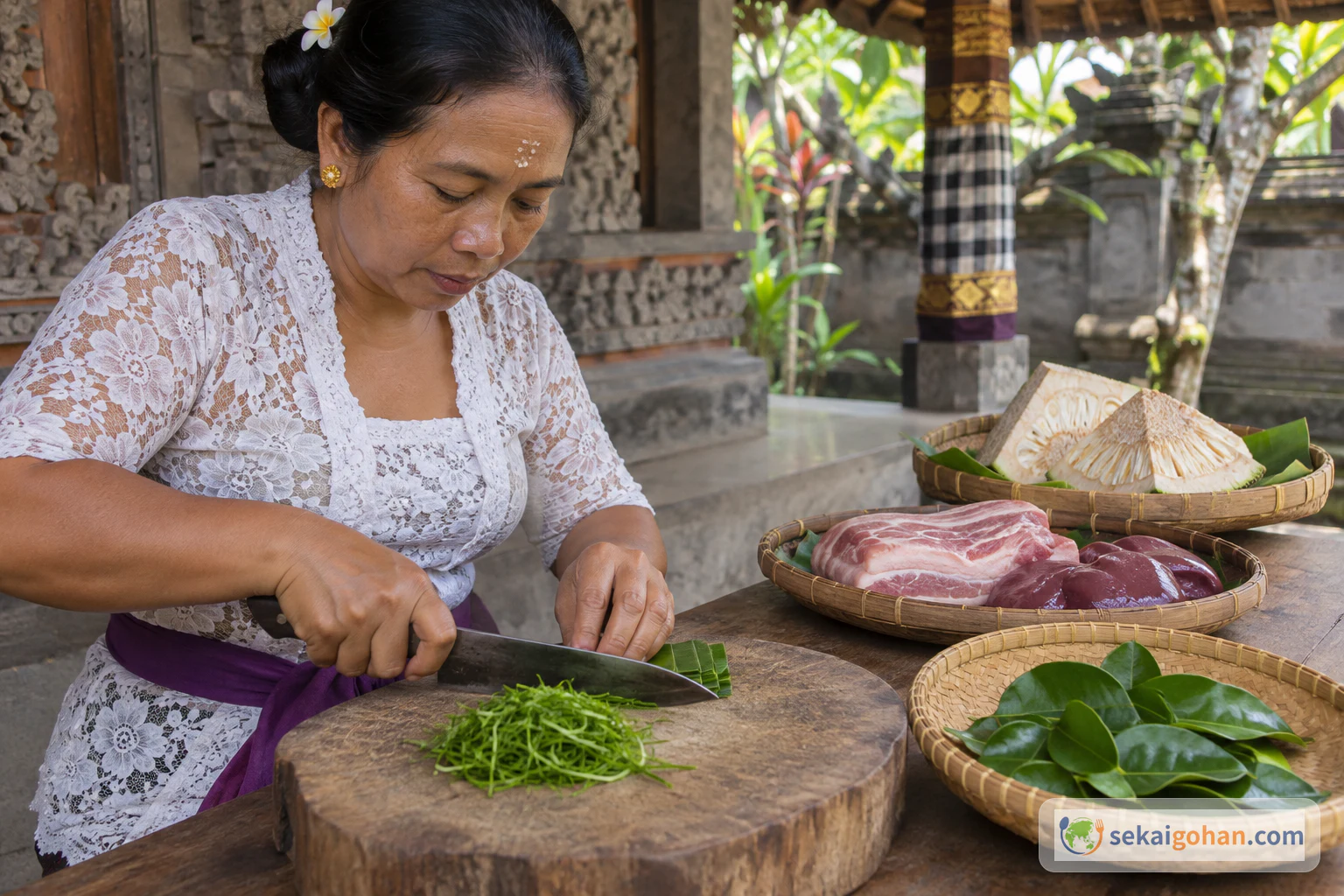
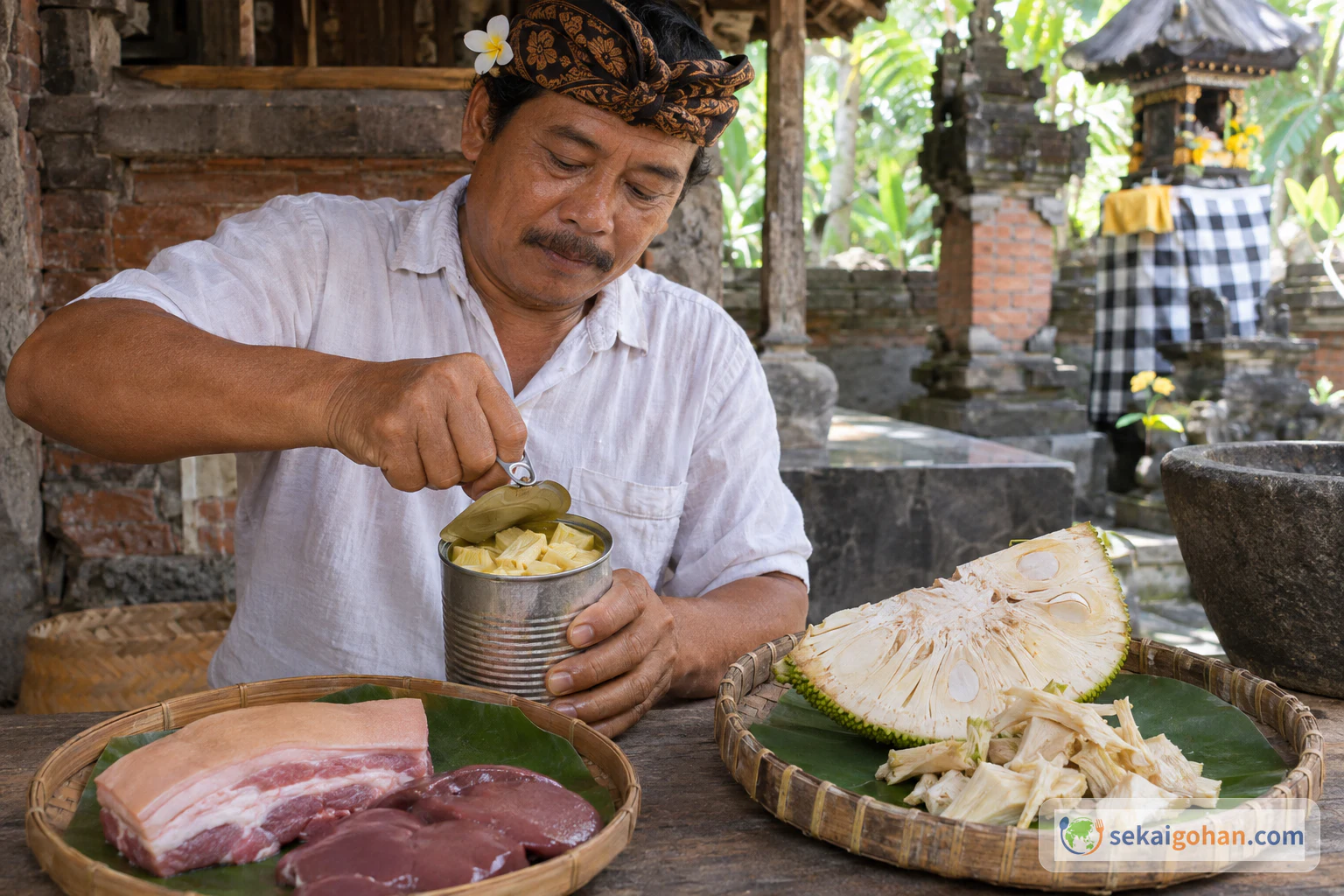
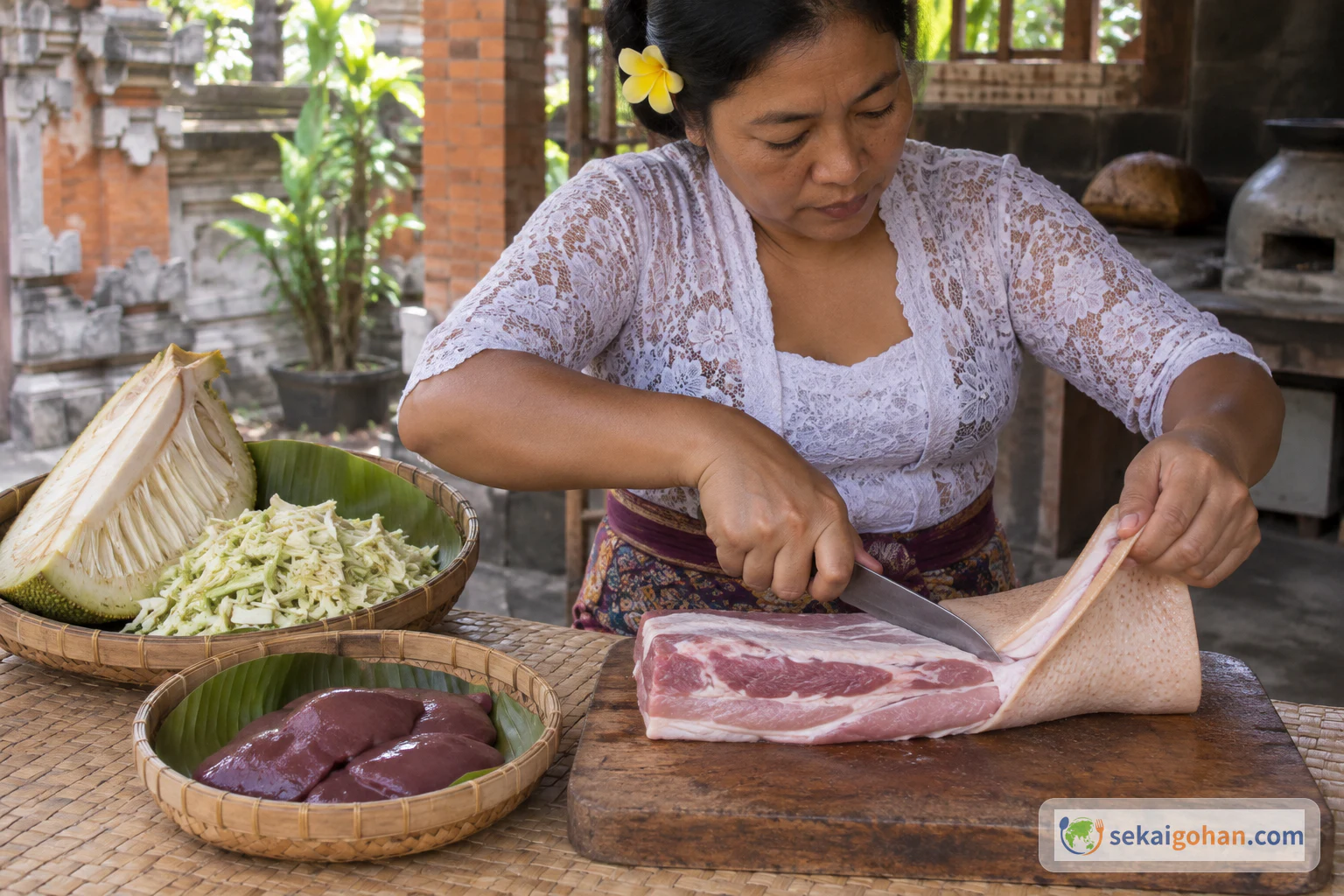
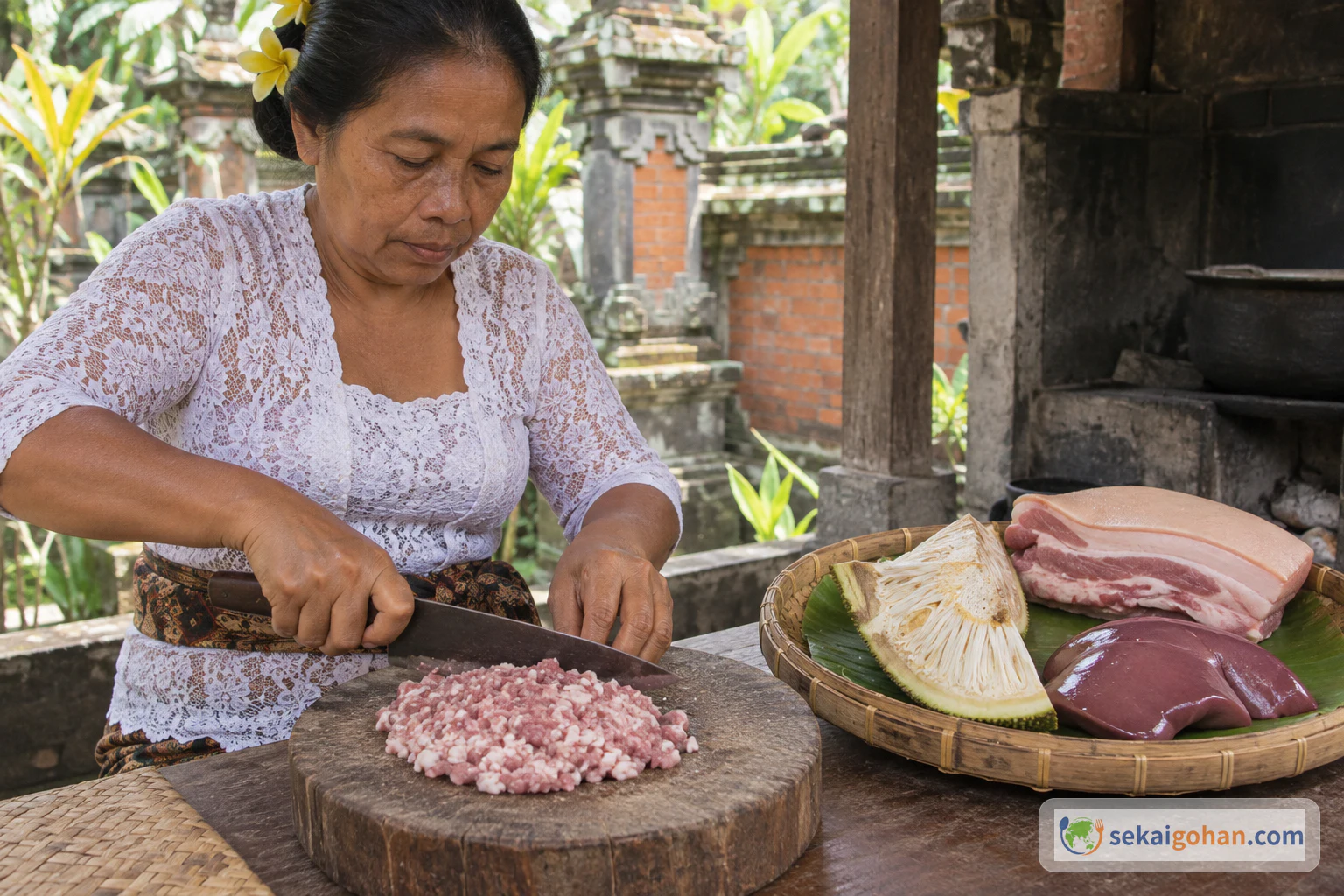
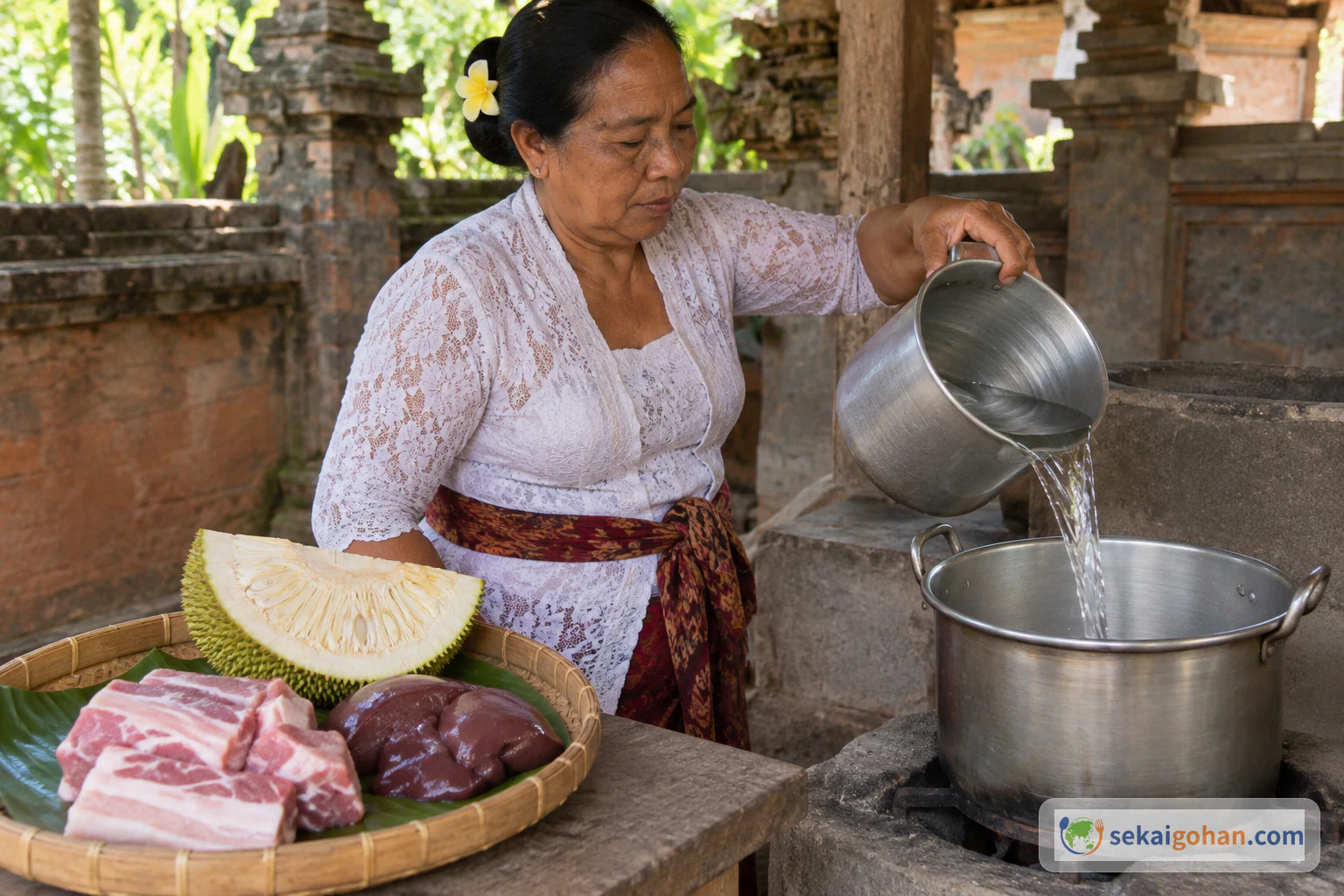
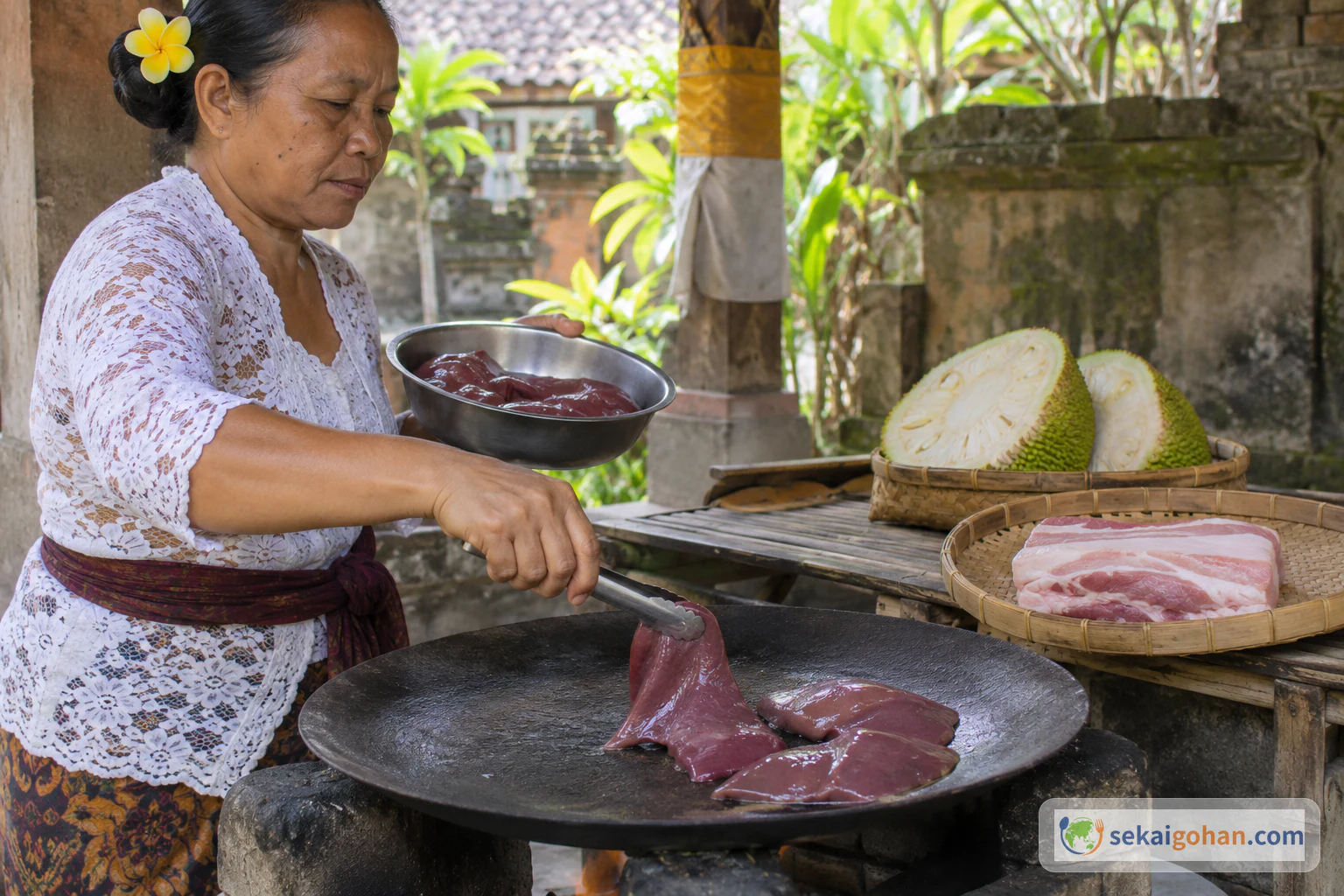
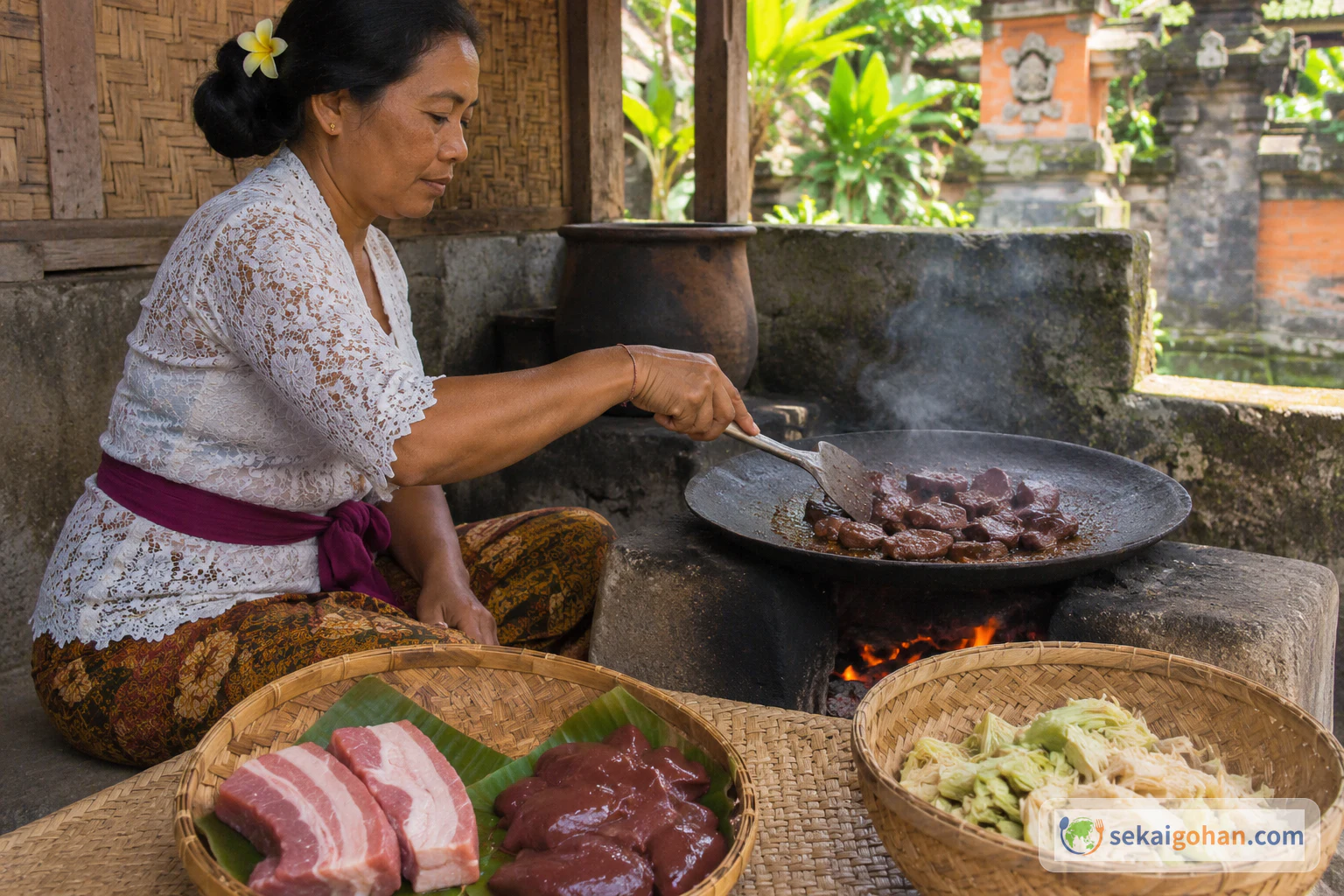
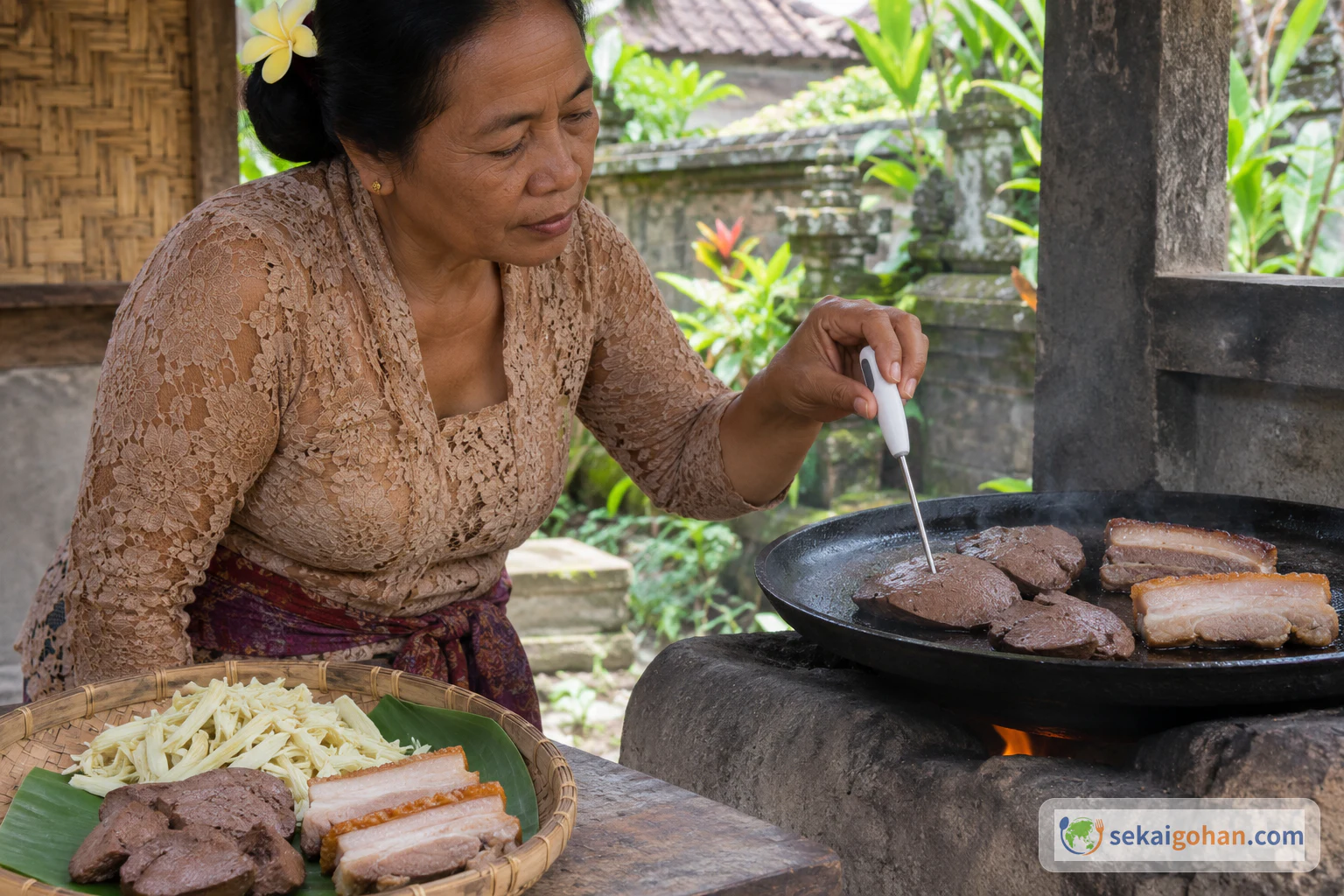
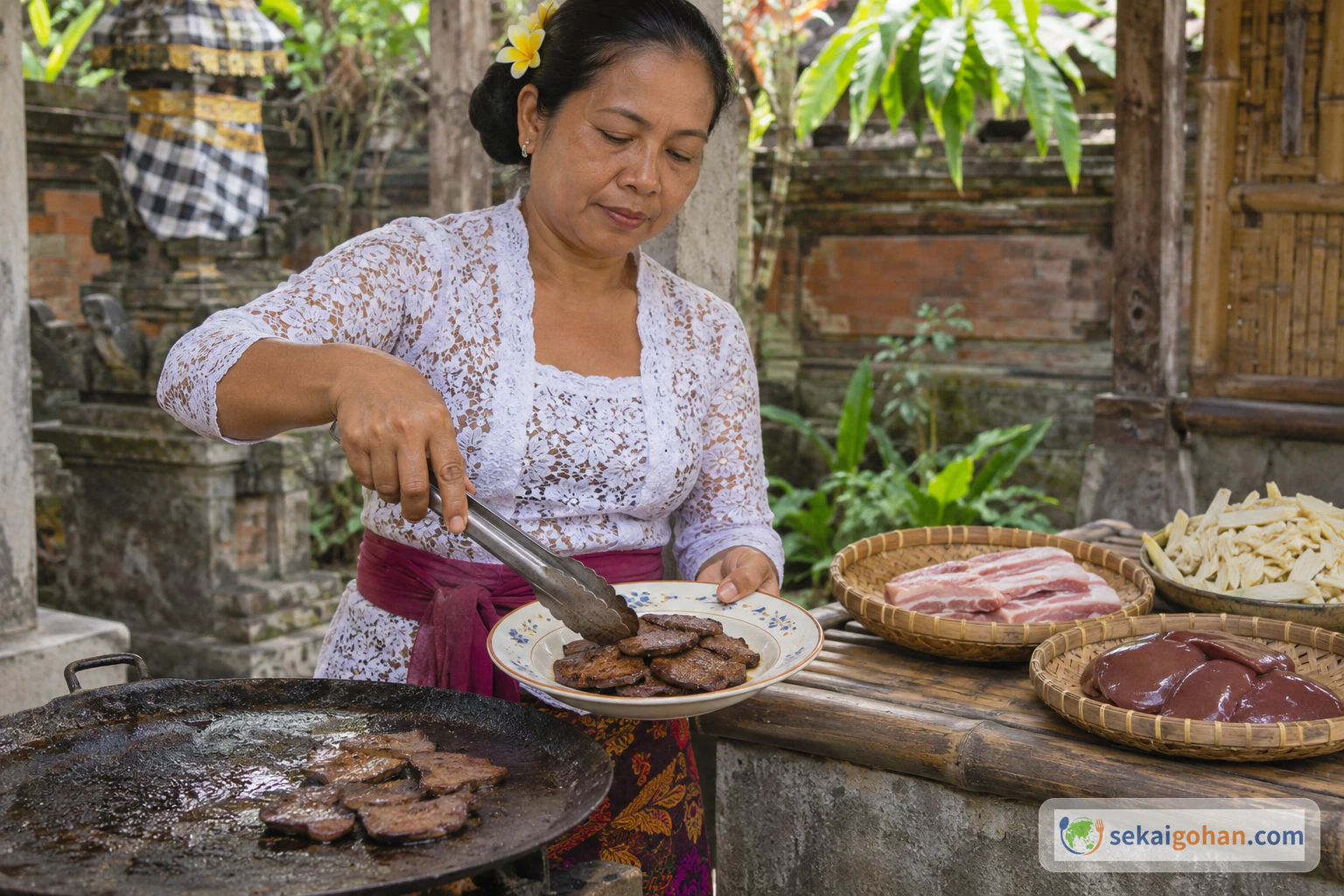
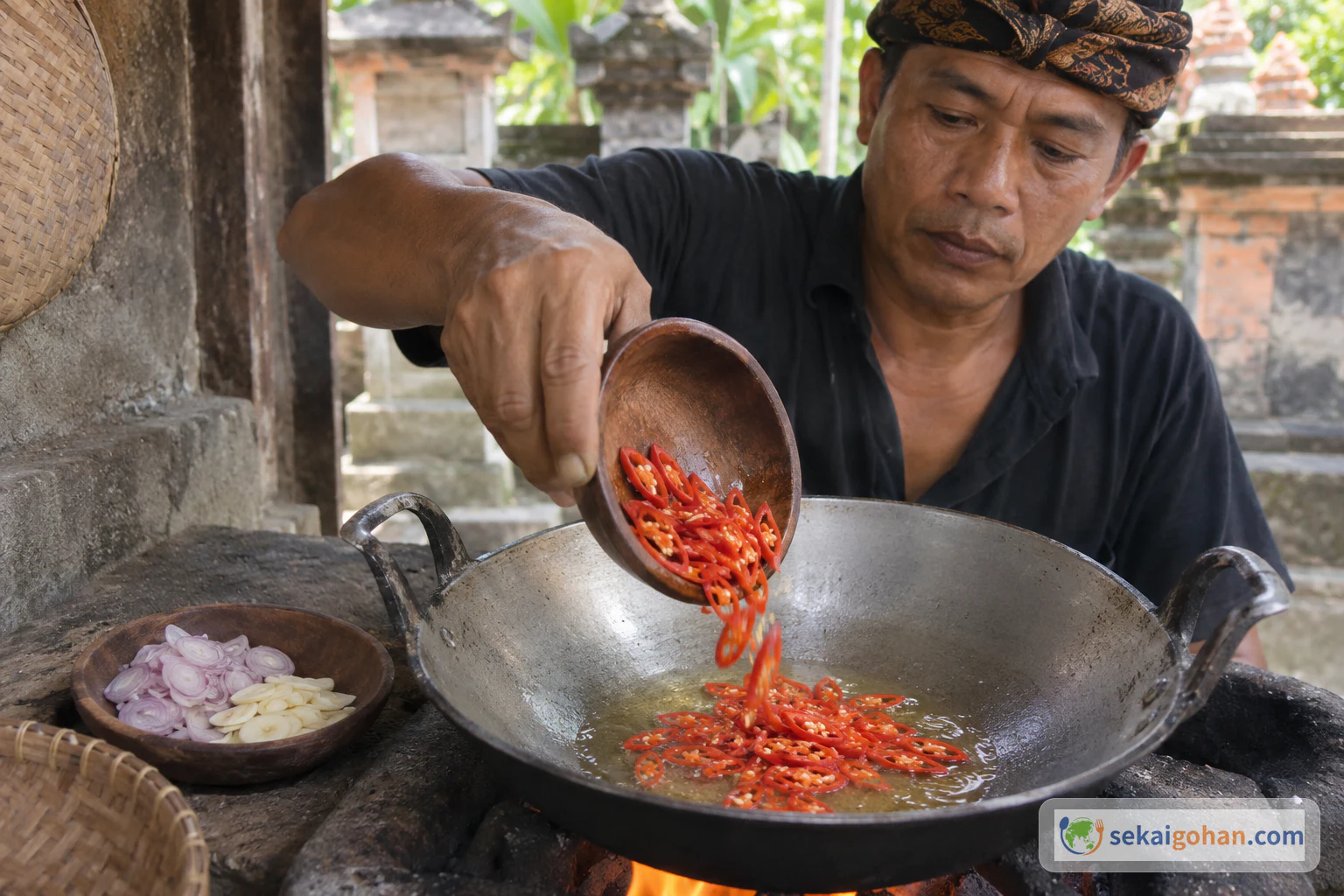
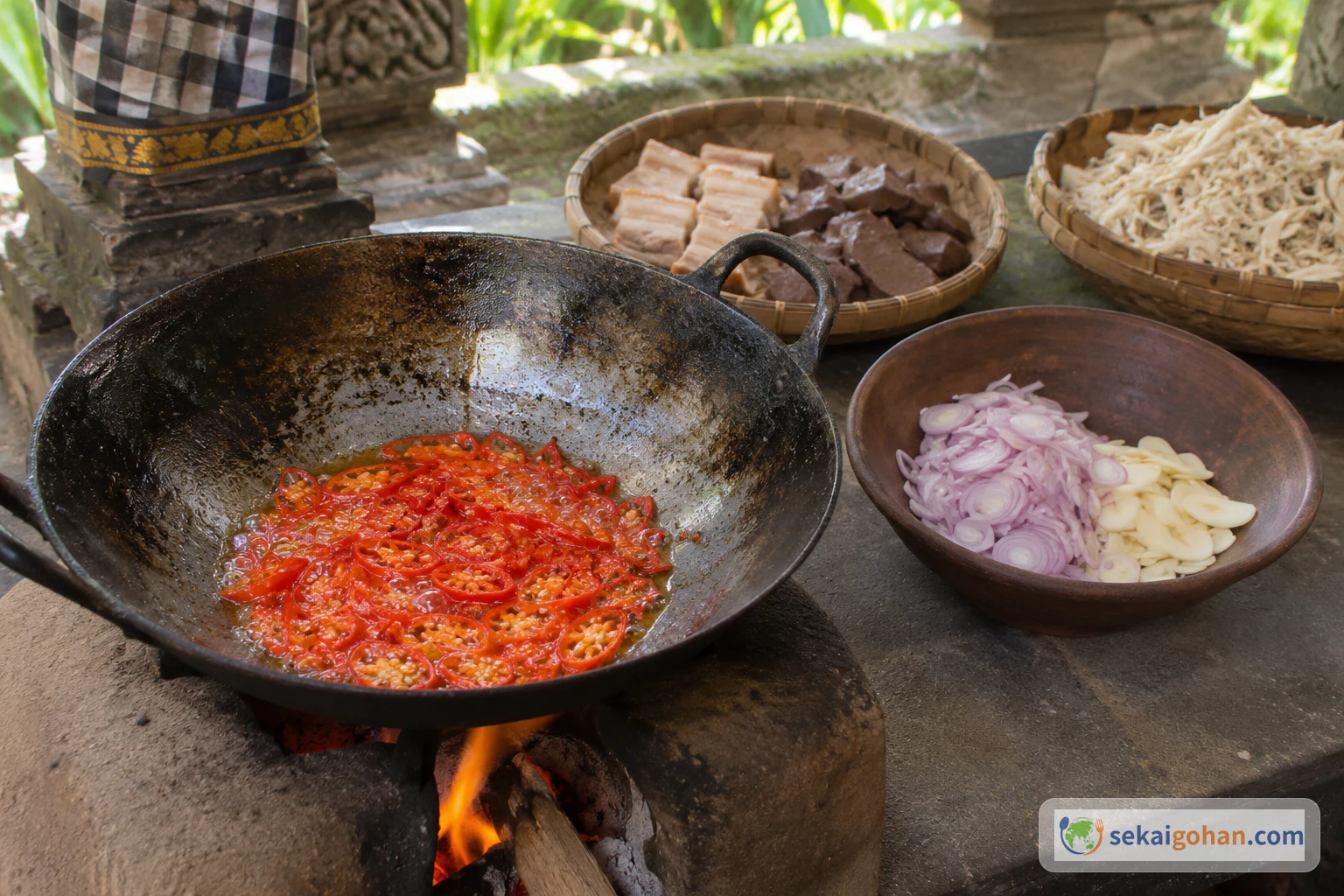
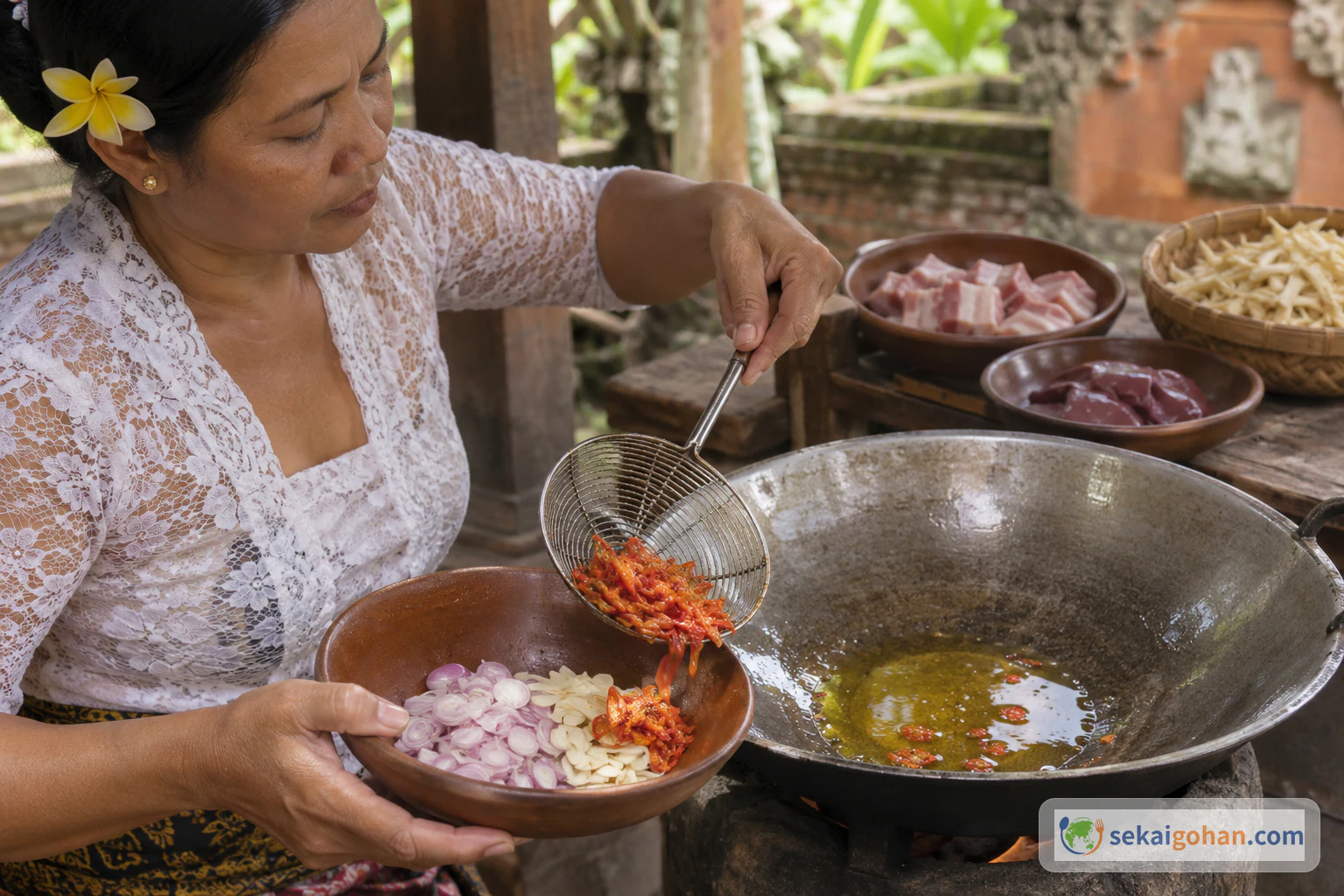
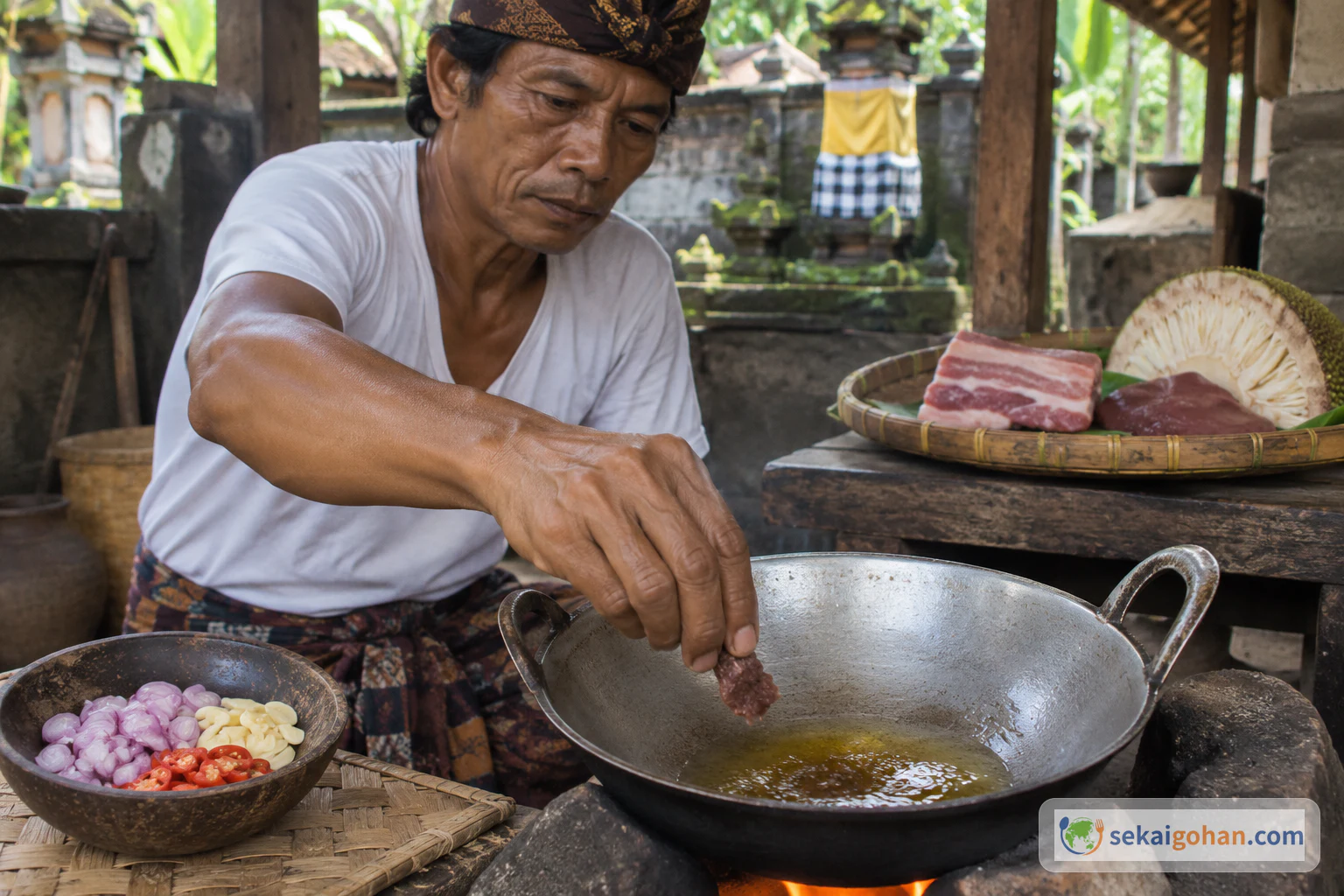
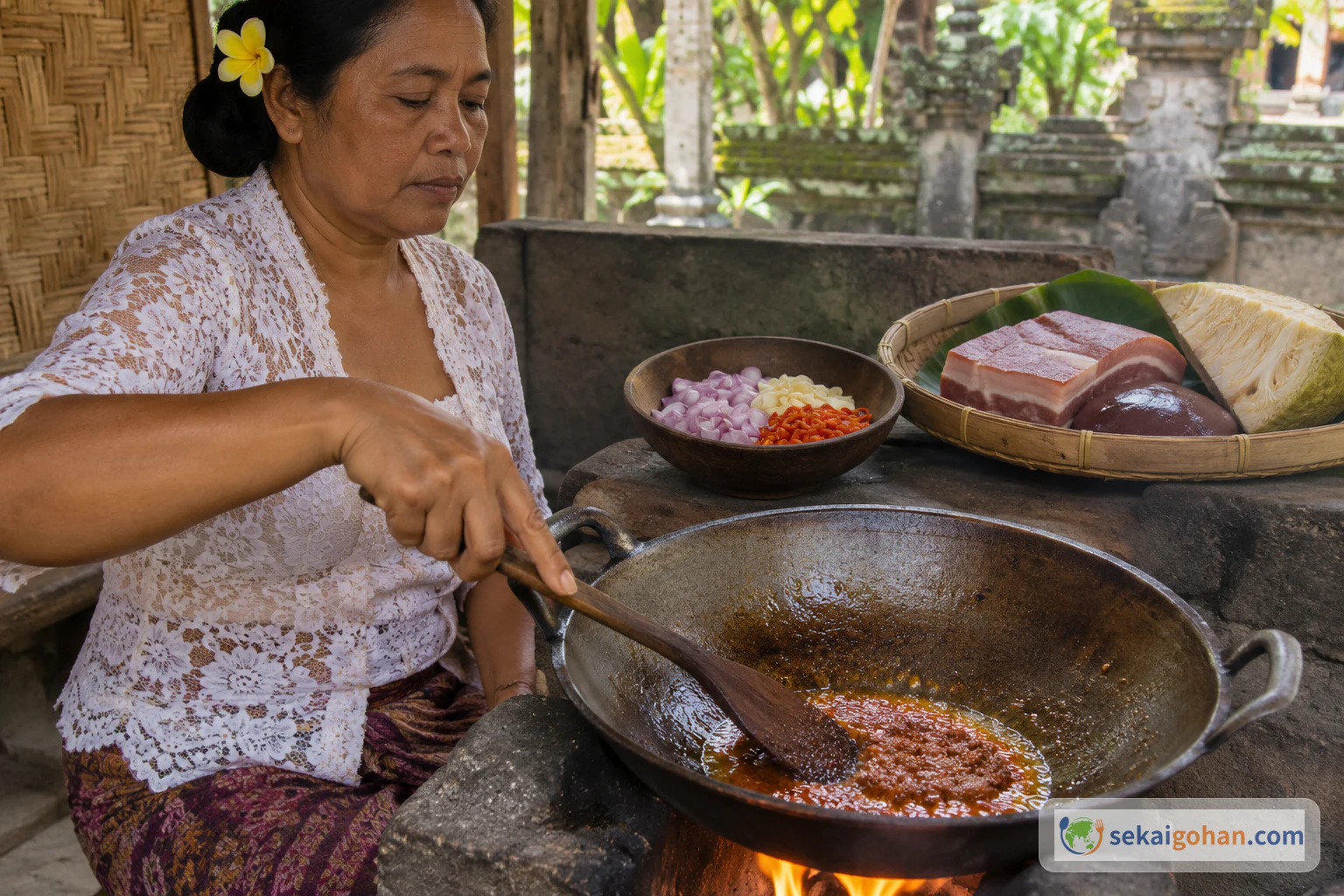
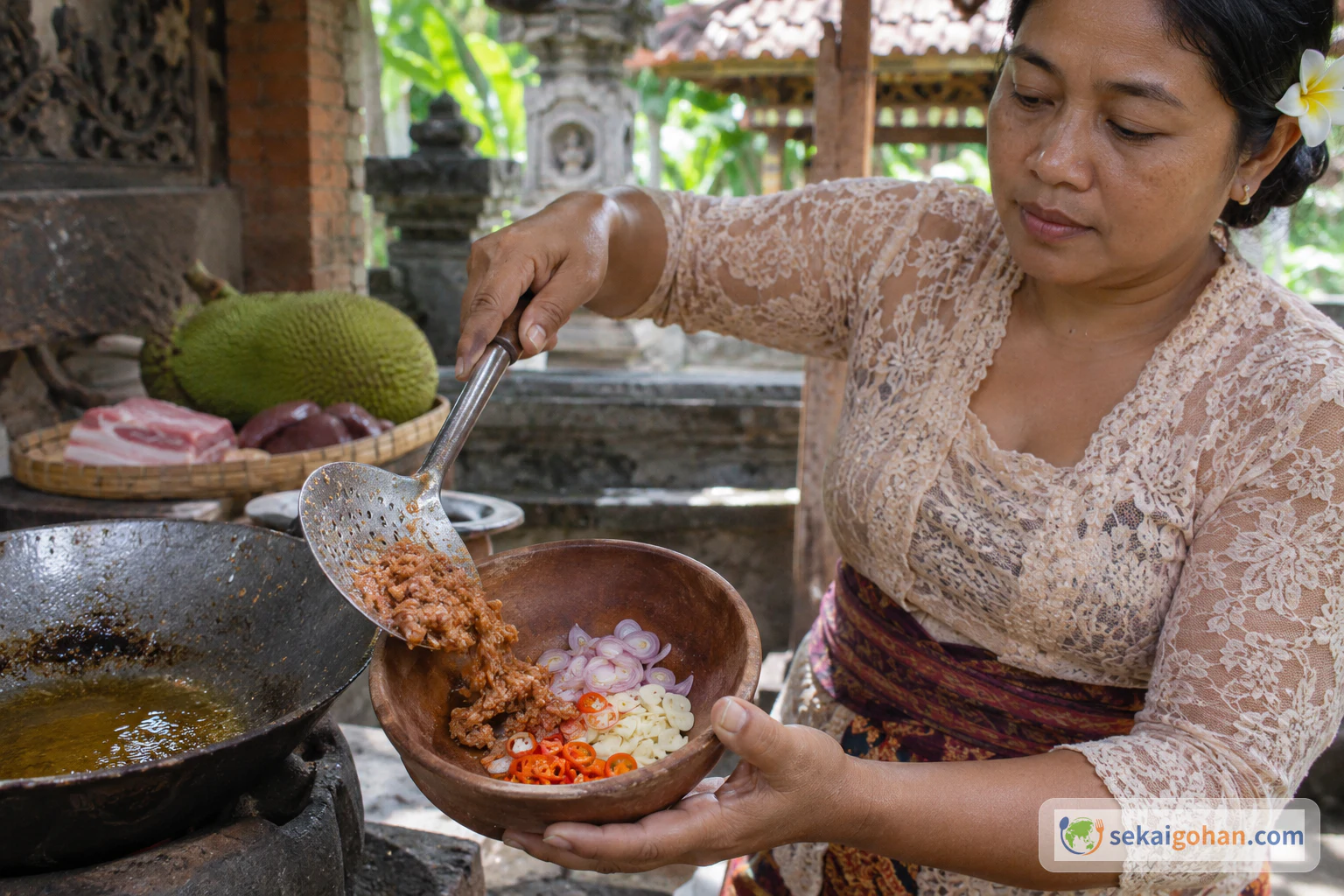
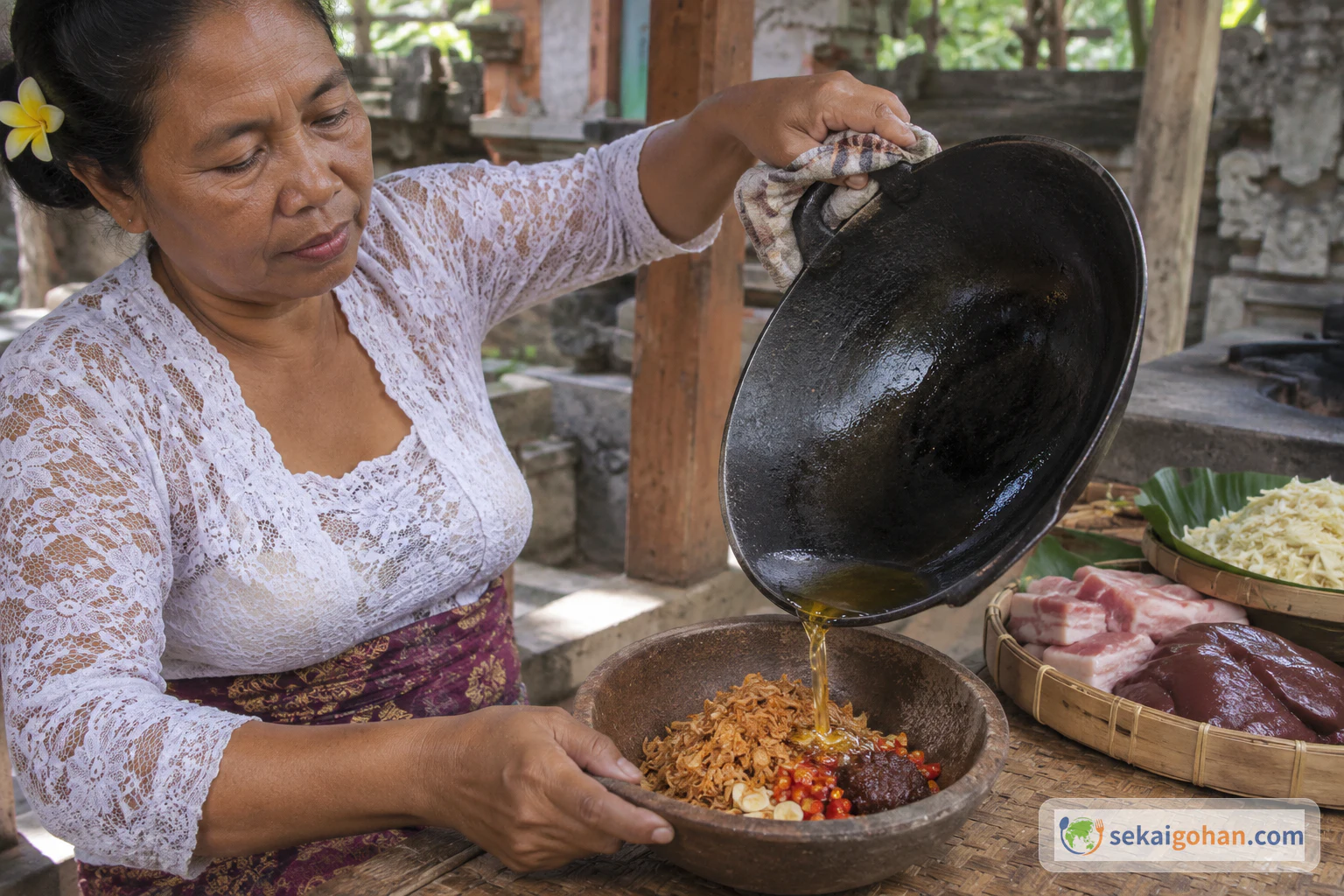
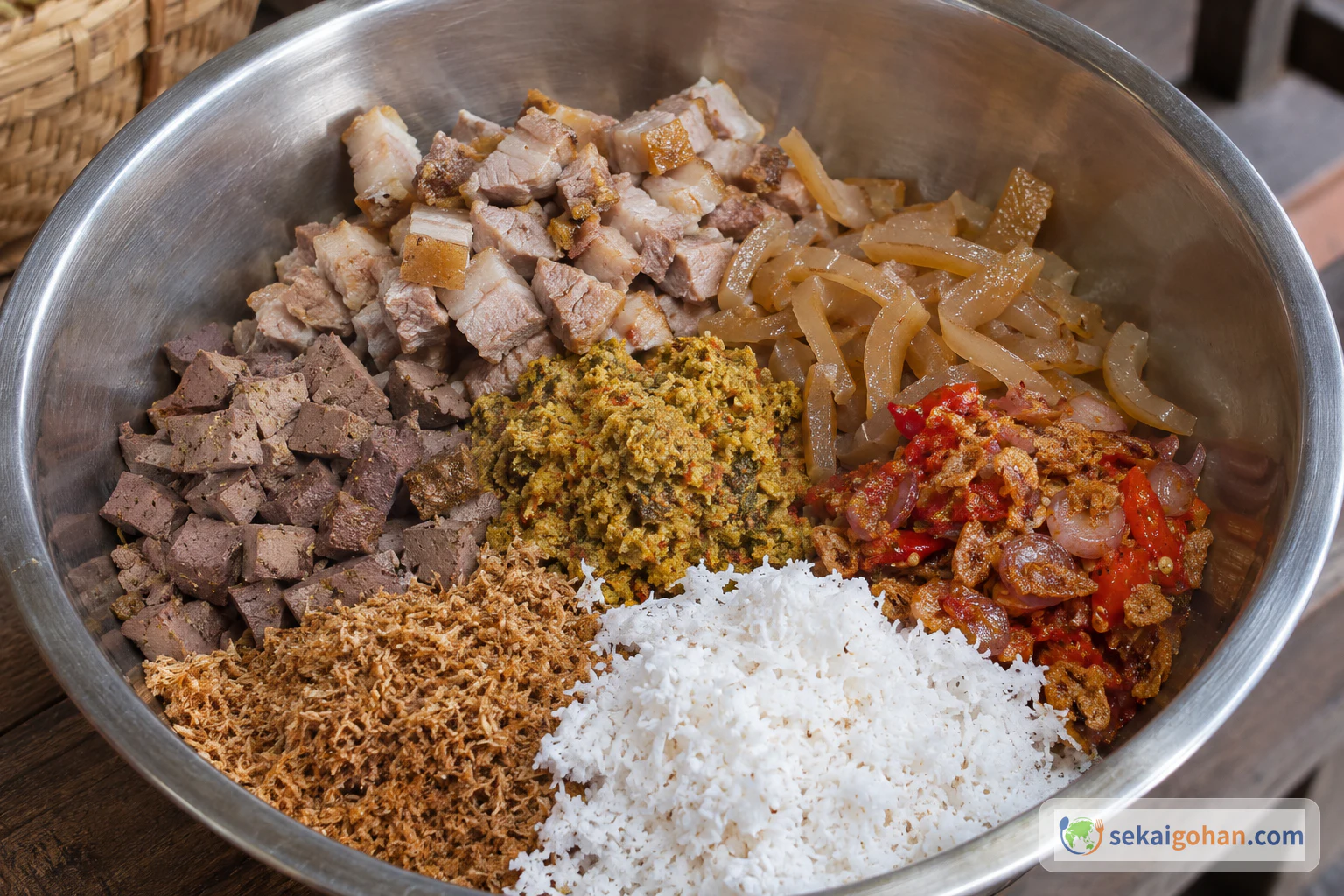
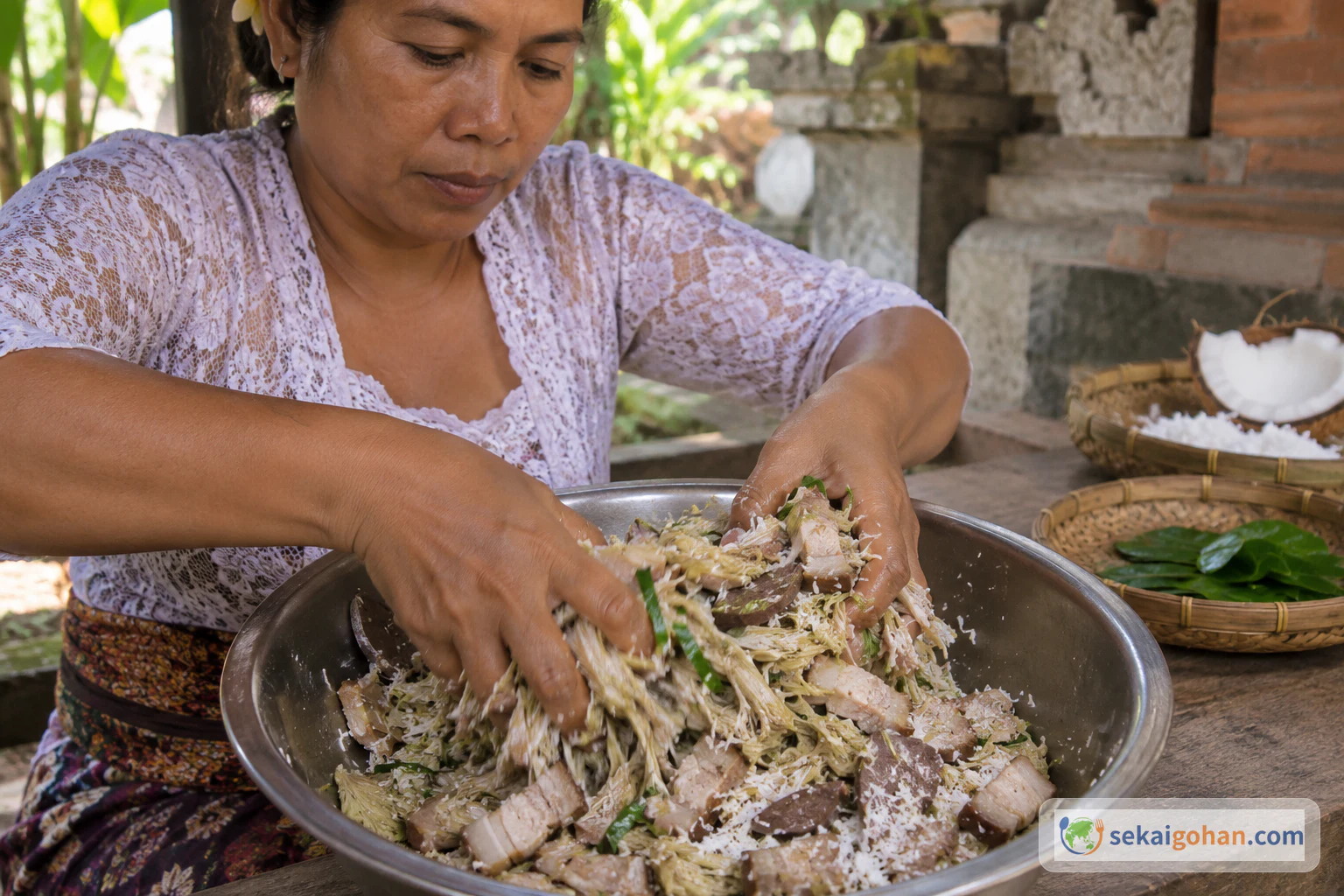
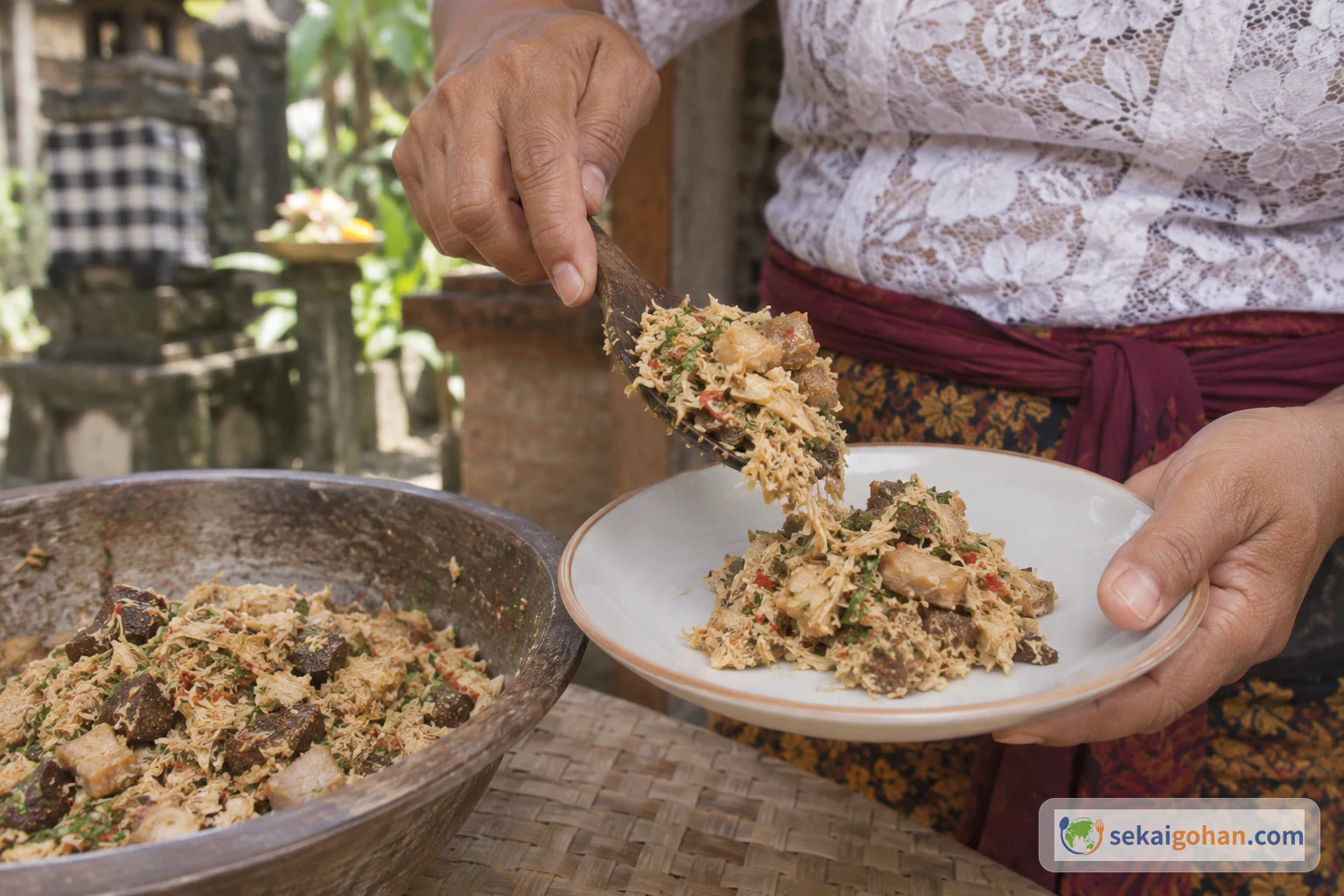
Finished lawar of pork and green jackfruit, made without blood, on a plain plate
Serves6 servings
CuisineIndonesian

Lawar: Balinese Pork, Liver and Green Jackfruit with Coconut and Sambal Embe

How to make a bloodless Balinese lawar of pork belly, pork skin, liver and green jackfruit, with base genep, fried sambal embe and two coconut preparations. Covers careful chopping, center-temperature checks, separate raw-meat tools, the coconut's thin brown skin, and how this version fits among other types of lawar.

Level: Intermediate

Cooking flow

Cooking steps

STEP 11 / 81

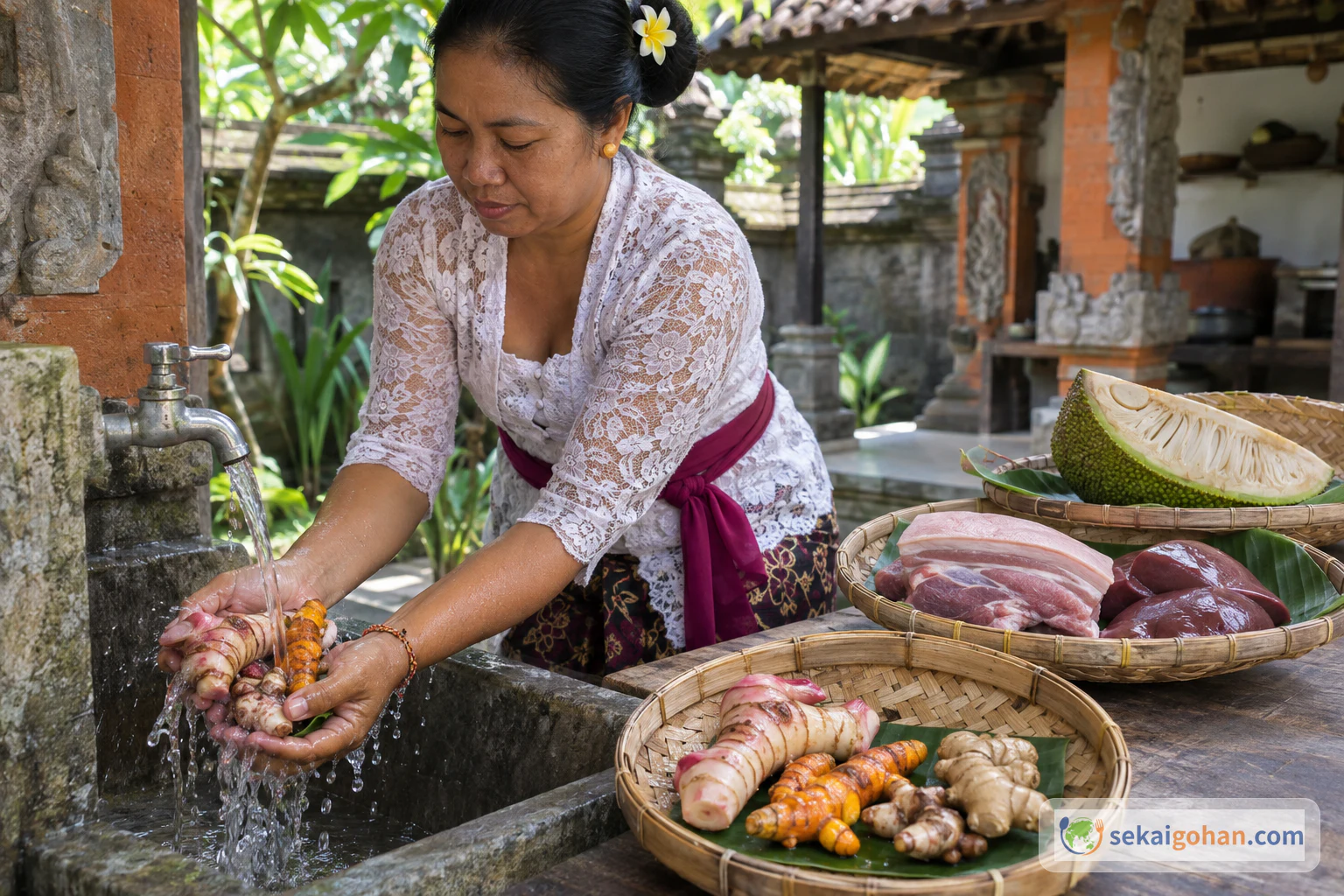
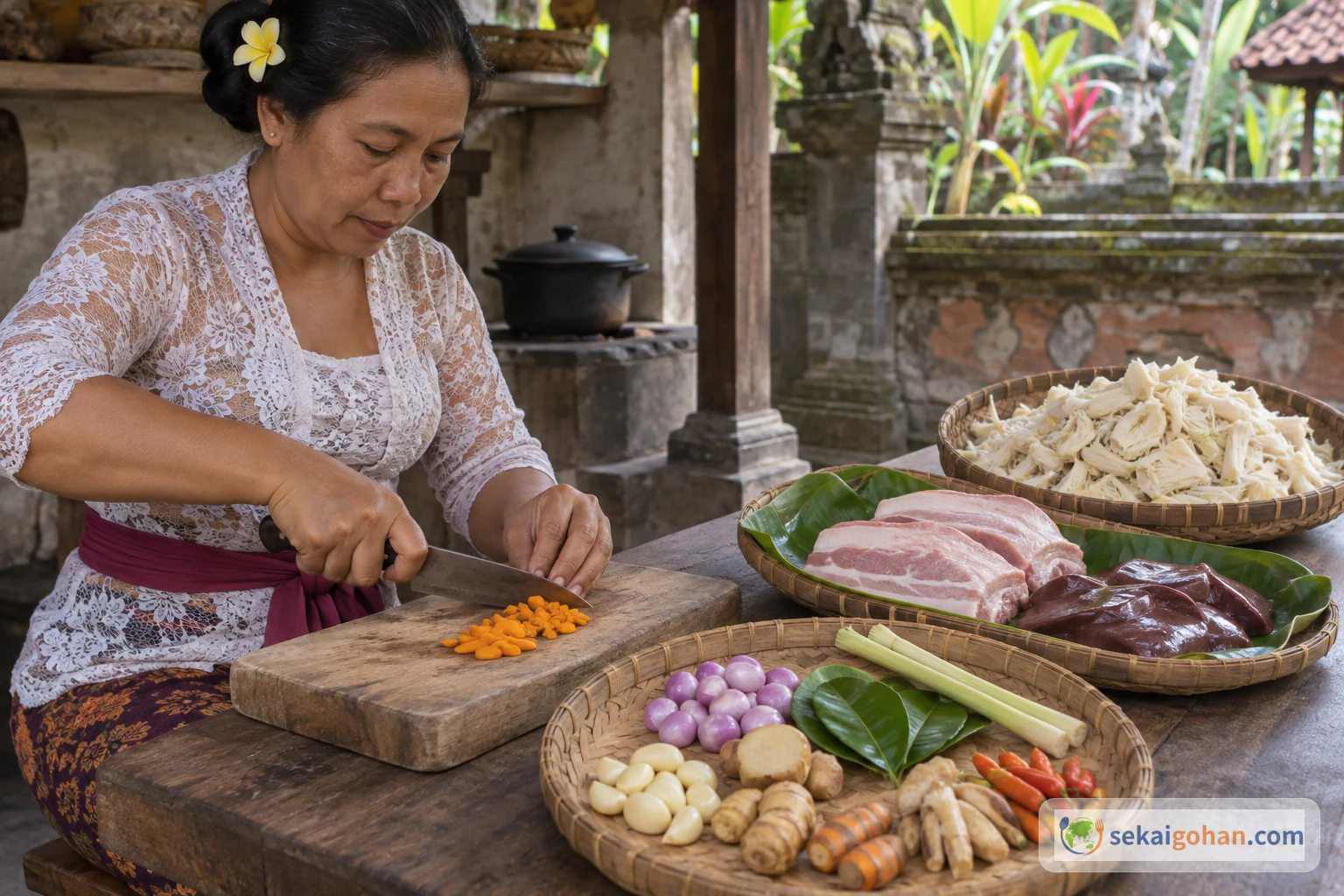
Wash the rhizomes

Rinsing the four rhizomes under running water

Rinse the galangal, turmeric, ginger and kencur under clean running water.

STEP 22 / 81

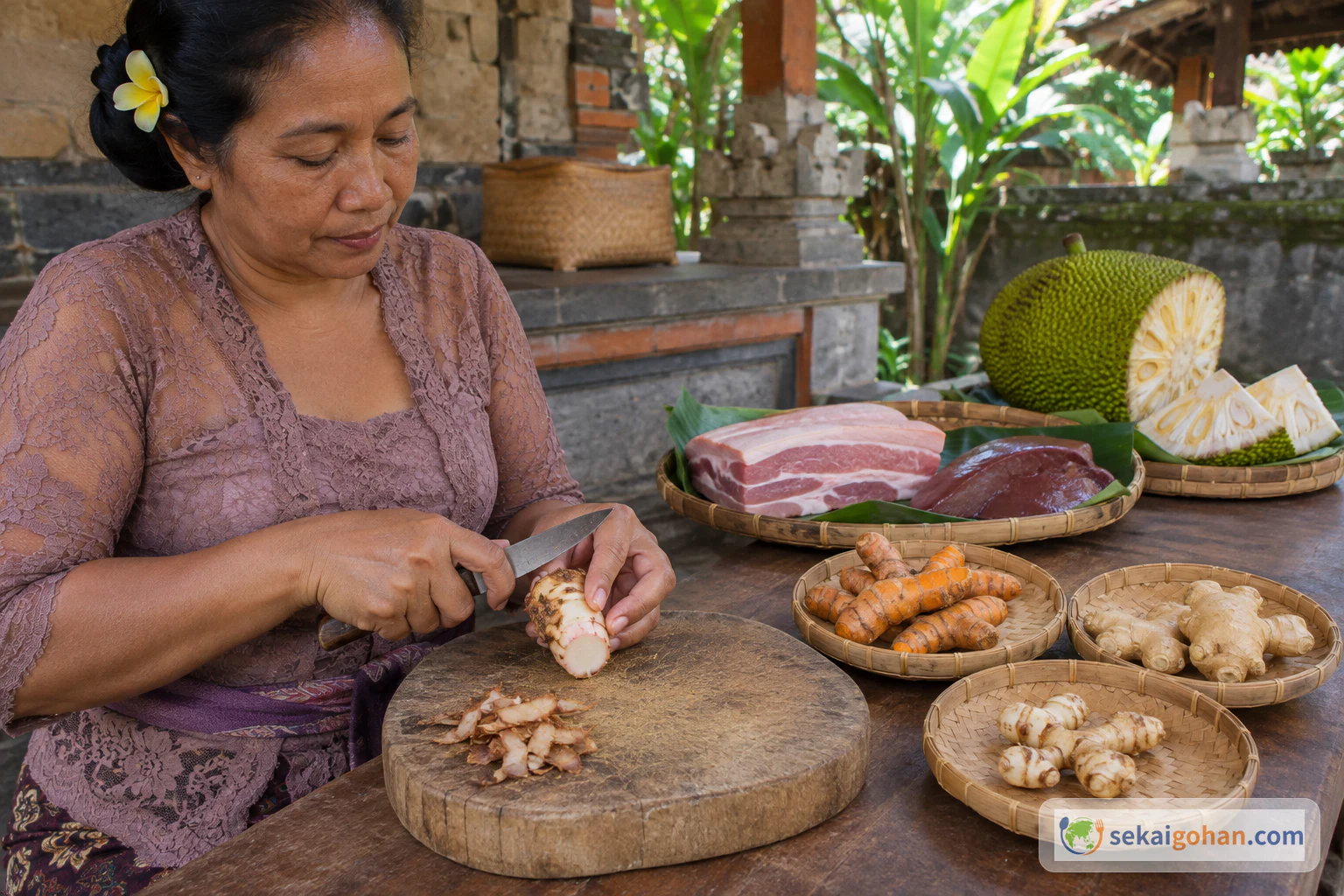
Trim the rhizomes

Thinly trimming only the necessary outer skin from a rhizome

On a produce board, trim away only the outer surface that needs removing, one piece at a time.

STEP 33 / 81

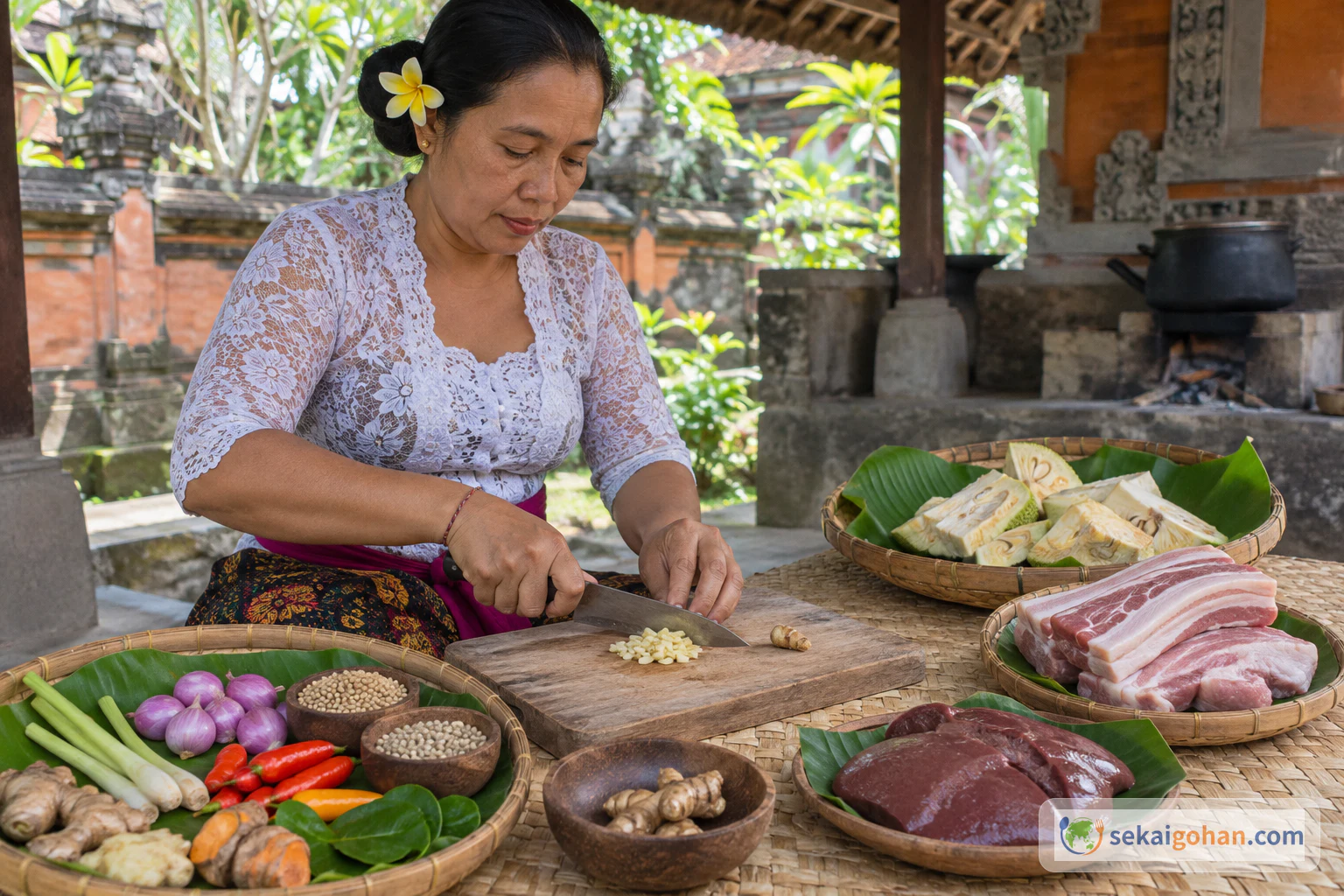
Chop the galangal

Chopping galangal on a board

Chop the 5 cm of galangal on its own and keep it separate from the other paste ingredients for now.

STEP 44 / 81

Chop the turmeric

Chopping turmeric on a board

Chop the 5 cm of turmeric on its own.

STEP 55 / 81

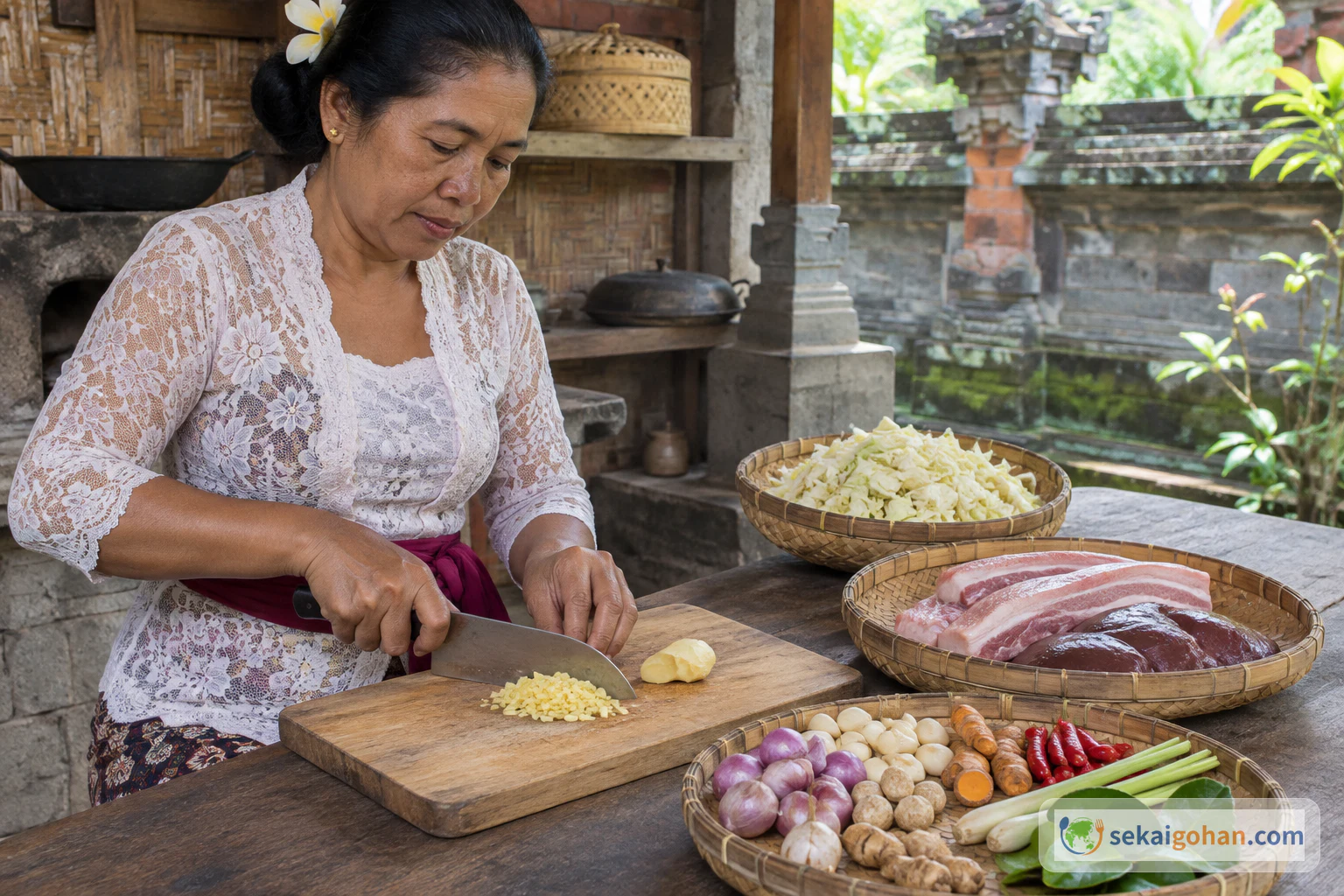
Chop the ginger

Chopping ginger on a board

Chop the 3 cm of ginger on its own.

STEP 66 / 81

Chop the kencur

Chopping kencur on a board

Chop the 5 cm of kencur on its own.

STEP 77 / 81

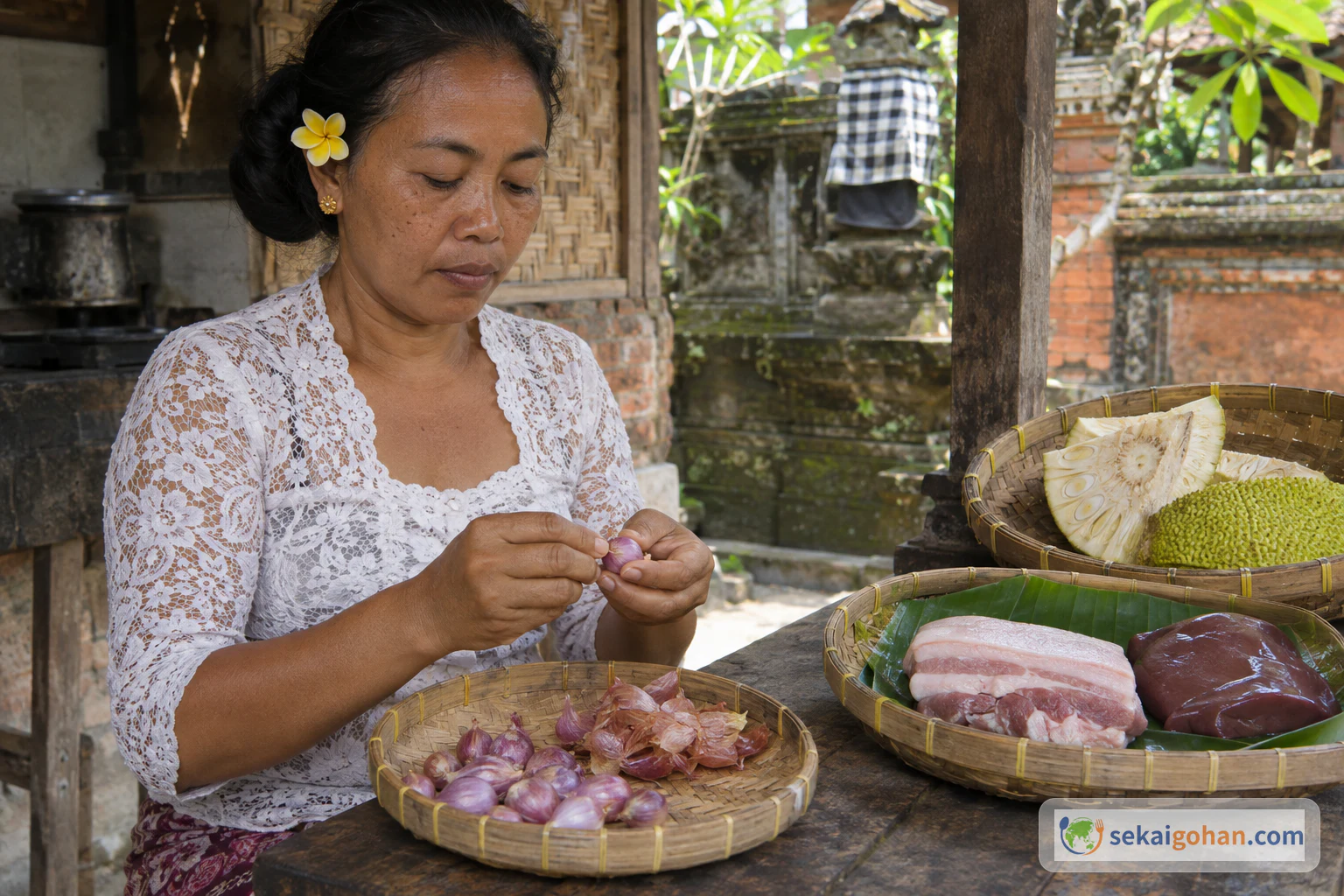
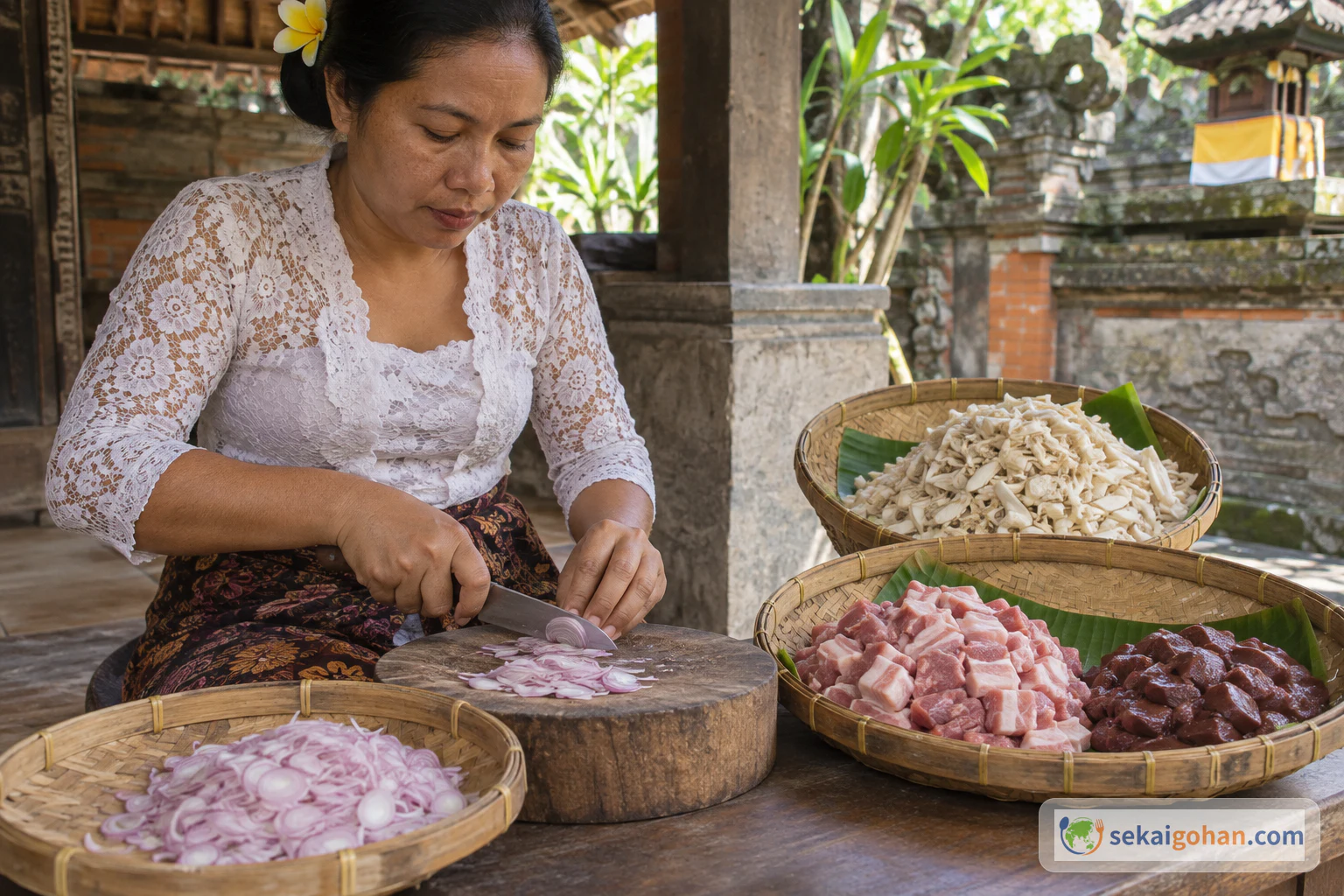
Peel the shallots

Peeling a shallot by hand

Peel the 4 shallots for the sambal embe.

STEP 88 / 81

Slice the shallots

Thinly slicing shallots

Slice the peeled shallots thinly and set them aside.

STEP 99 / 81

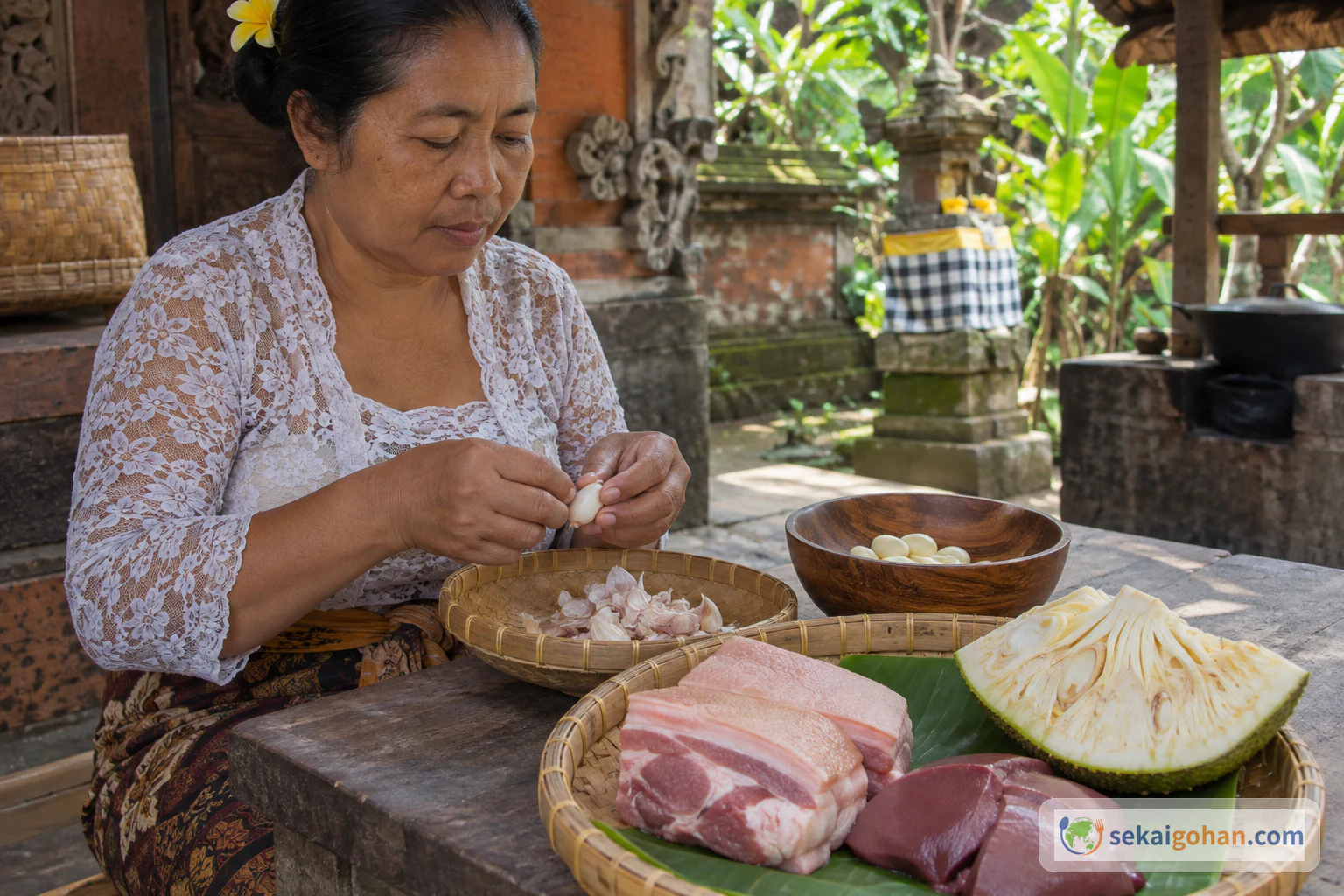
Peel the garlic

Peeling garlic by hand

Peel the 4 garlic cloves.

STEP 1010 / 81

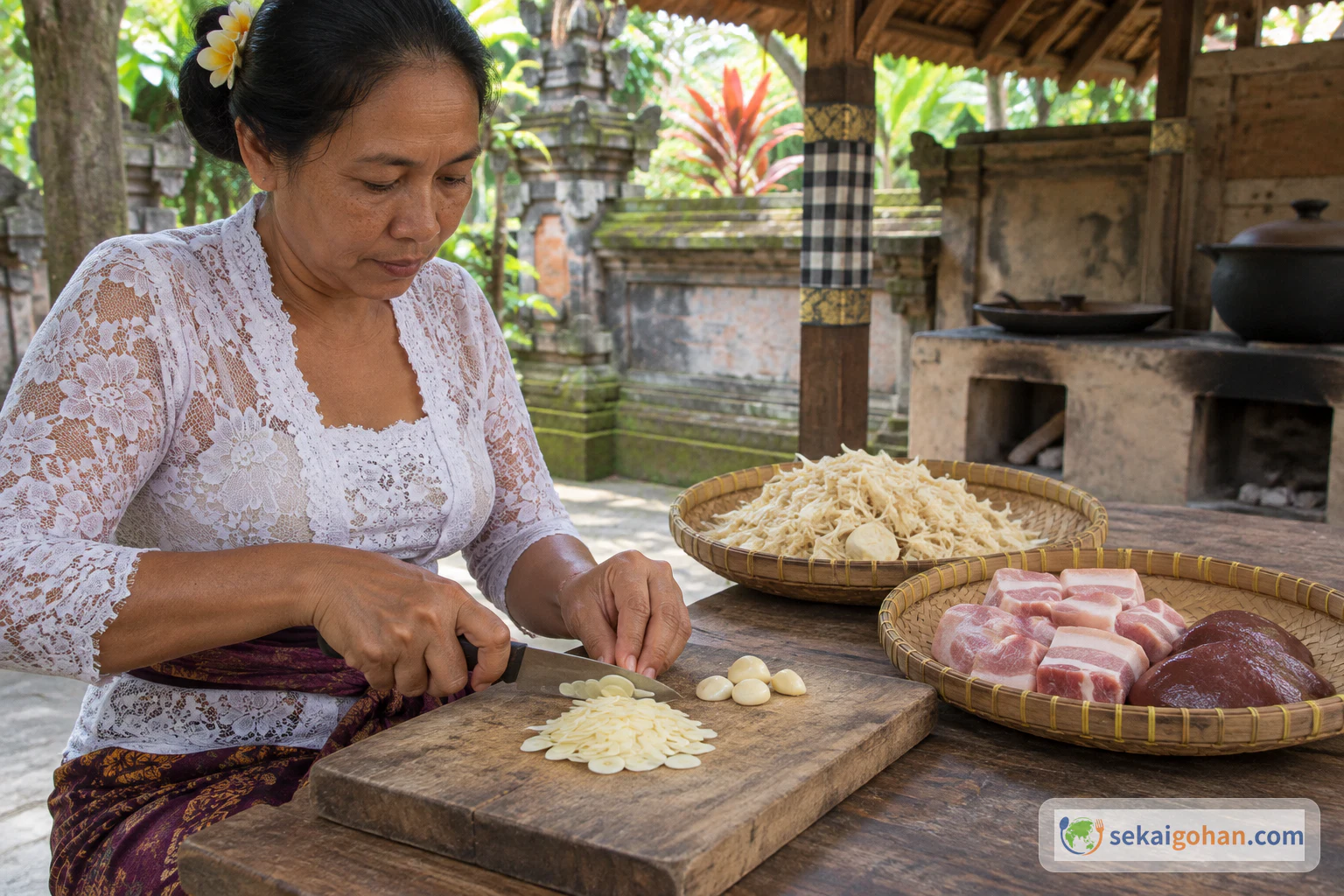
Slice the garlic

Thinly slicing garlic

Slice the peeled garlic thinly and keep it separate from the shallots.

STEP 1111 / 81

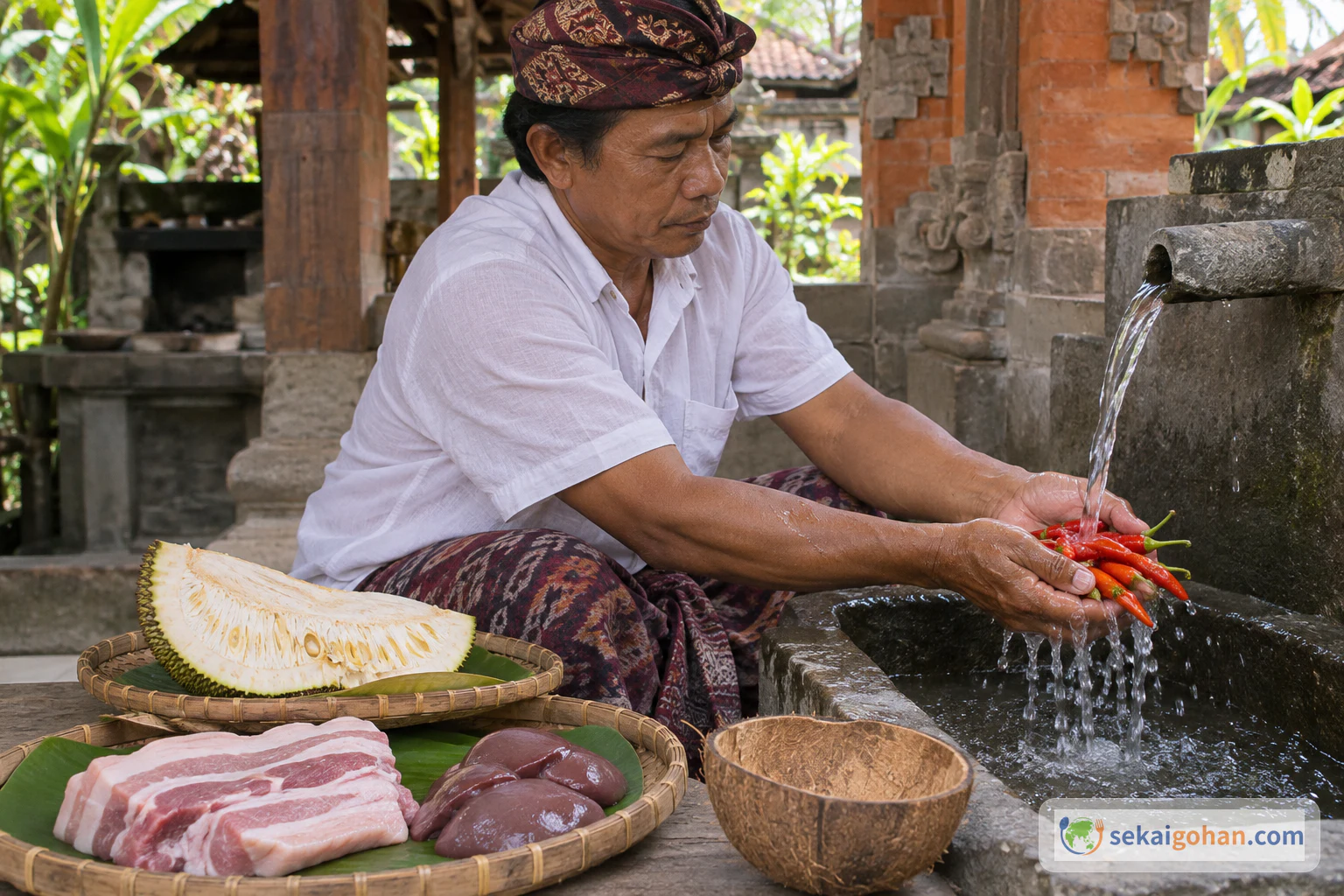
Wash the chilies

Rinsing fresh chilies under running water

Rinse the 5 chilies under clean running water.

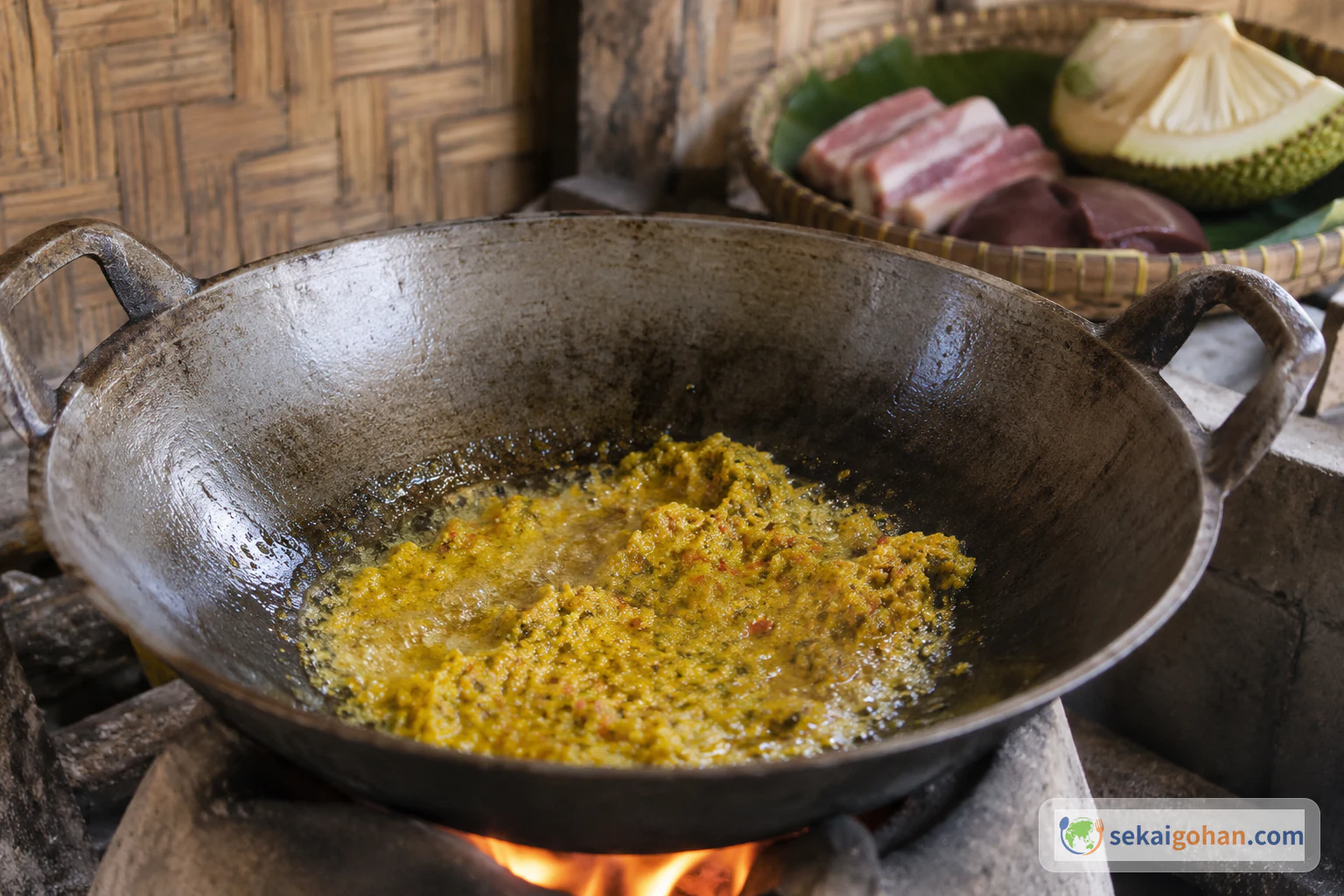
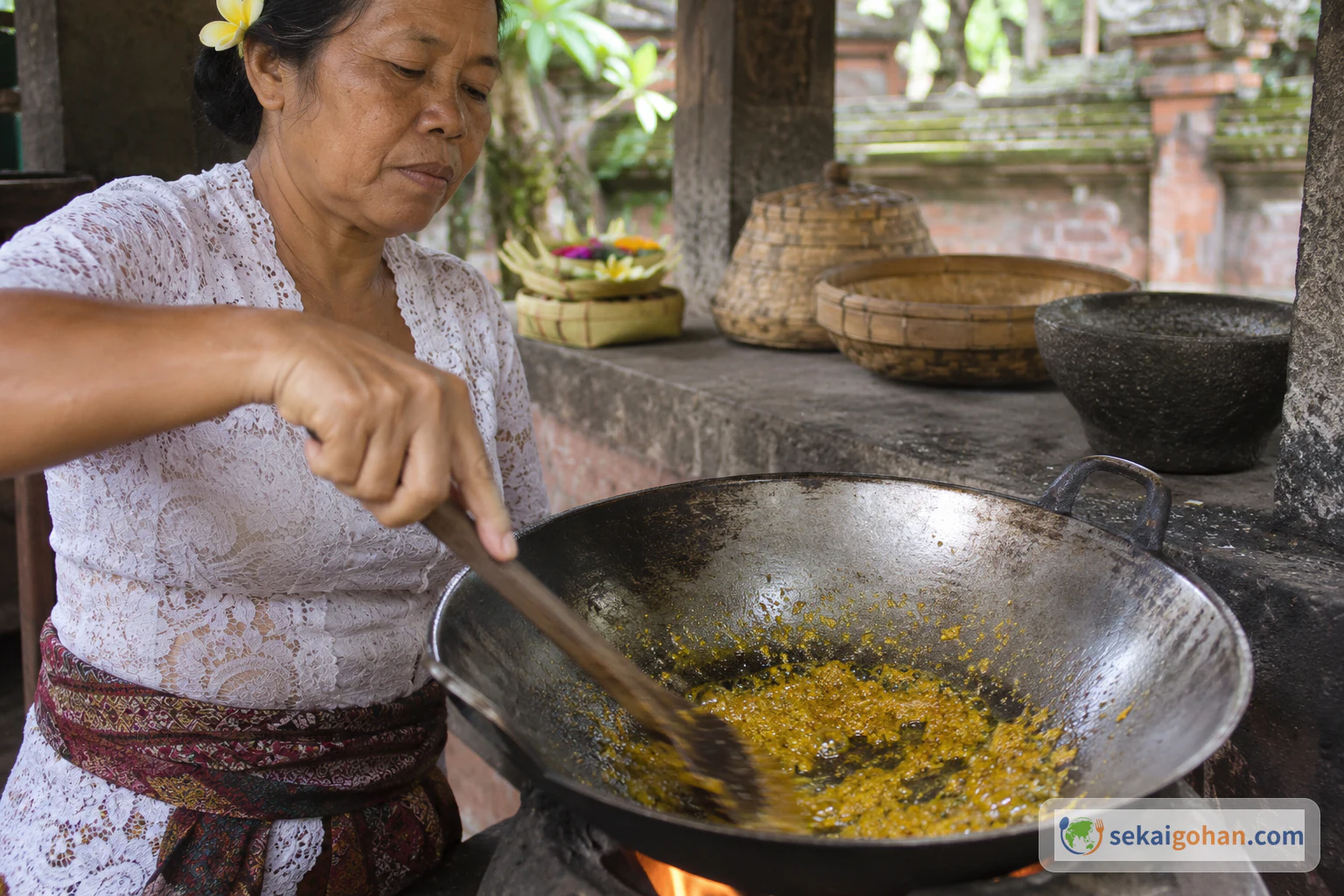
STEP 1212 / 81

Dry the chilies

Drying washed chilies with a clean towel

Dry the chilies with a clean towel.

STEP 1313 / 81

Slice the chilies

Thinly slicing chilies on a board

Slice the chilies thinly on a clean board and set them aside on their own.

STEP 1414 / 81

Wash the lime leaves

Rinsing kaffir lime leaves under running water

Wash the 4 kaffir lime leaves well under running water.

STEP 1515 / 81

Dry the lime leaves

Drying washed lime leaves with a clean towel

Wipe the leaves with a clean towel until no water remains.

STEP 1616 / 81

Slice the lime leaves

Finely slicing lime leaves into thin ribbons

Slice the dry leaves into fine ribbons on a clean board. Put them in a clean small bowl, away from raw meat. They stay raw.

STEP 1717 / 81

Open the jackfruit

Opening a can of green jackfruit

Open the 2 cans of green jackfruit and set them aside for step 43.

STEP 1818 / 81

Separate the pork skin

Separating the skin from the same piece of raw pork belly

Put the 500 g of pork belly on the raw-meat board. Slice it with the raw-meat knife and separate the skin from the meat. Do not add any extra skin. Keep the skin for step 29.

STEP 1919 / 81

Chop the pork finely

Finely chopping the pork after removing the skin

With the raw-meat knife, chop the meat until it is as fine as mince.

STEP 2020 / 81

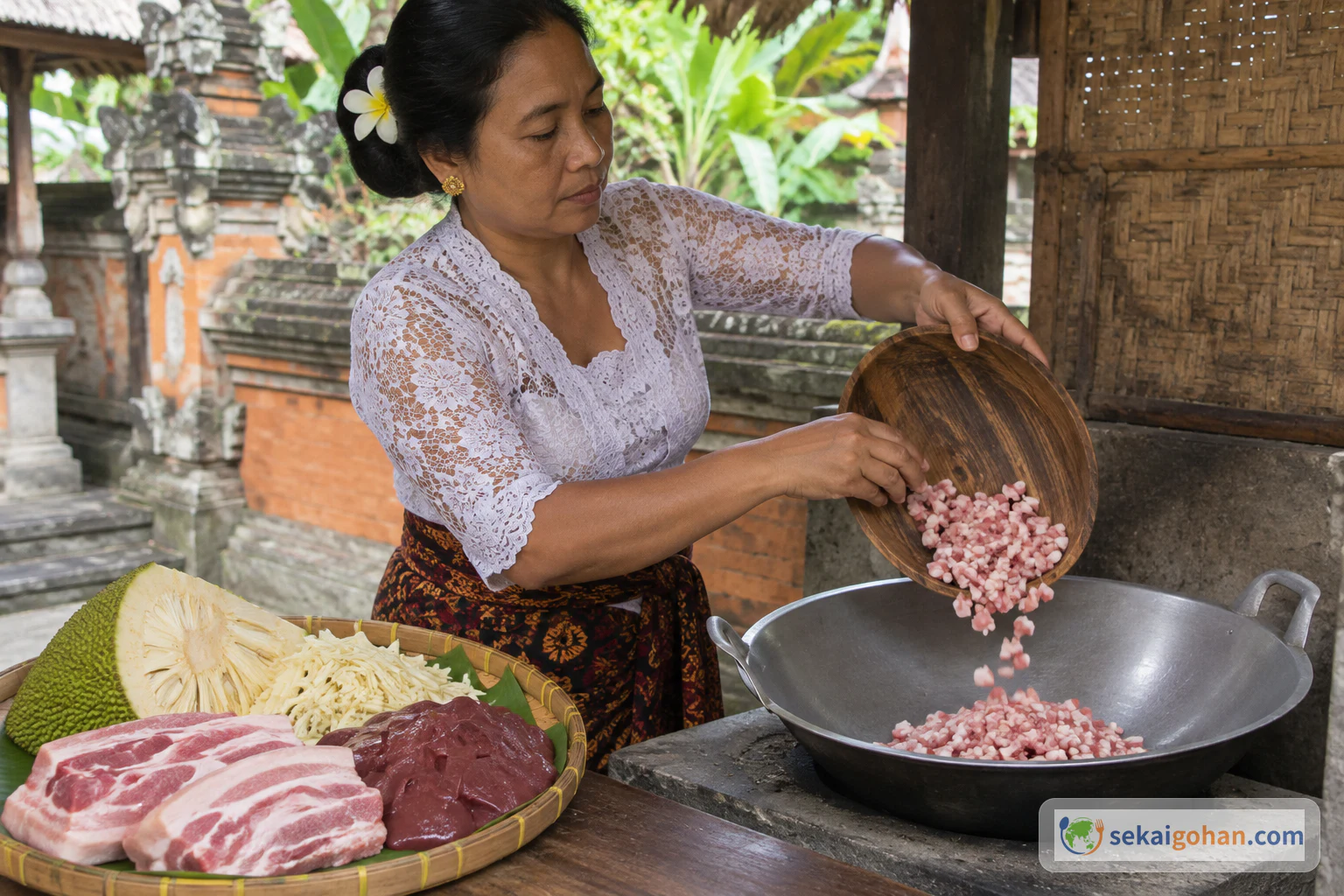
Put the pork in the wok

Putting the chopped pork into a wok

Put the chopped raw pork into a clean wok.

STEP 2121 / 81

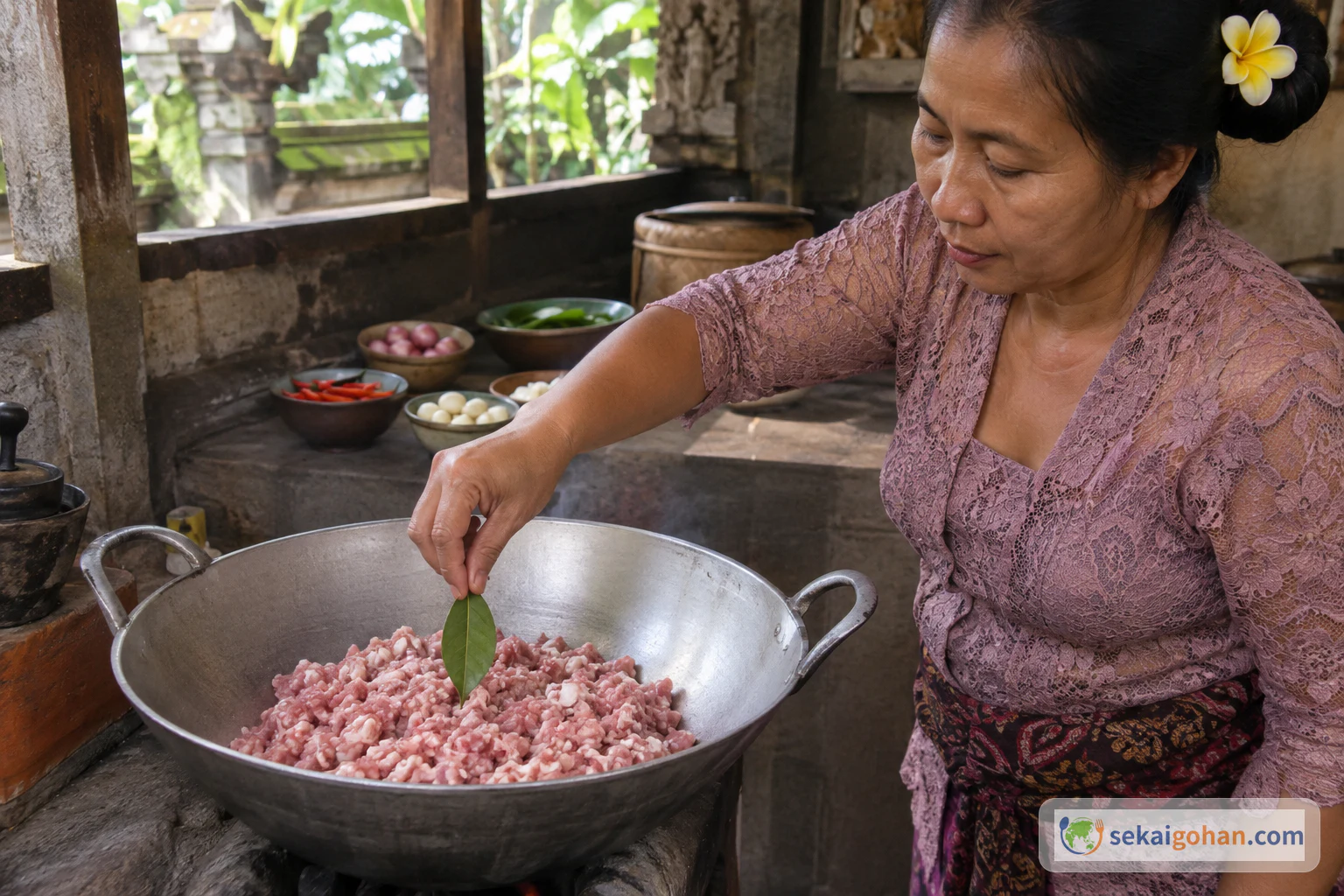
Add the bay leaf

Adding a bay leaf to the chopped pork

Add the bay leaf to the pork.

STEP 2222 / 81

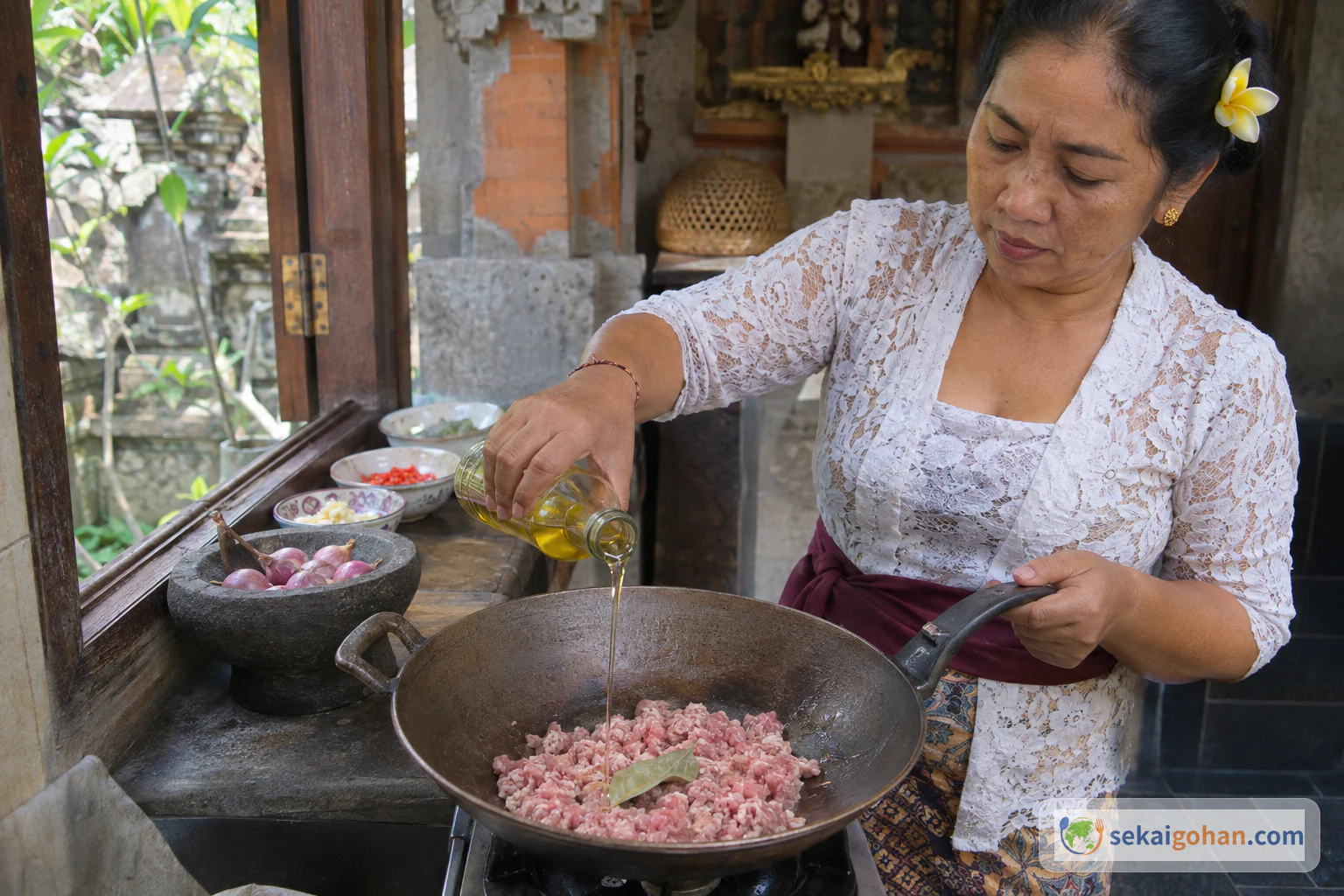
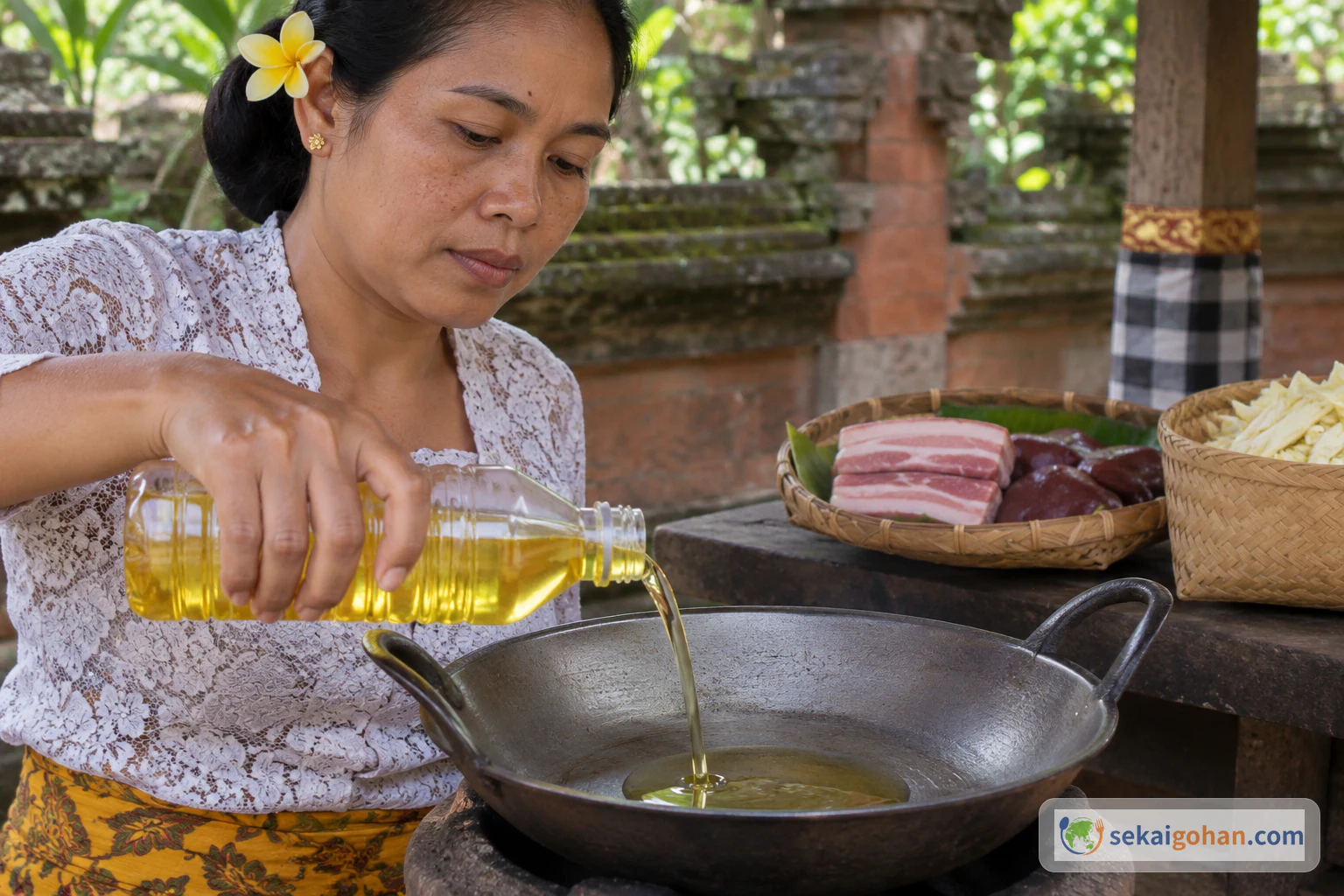
Add a little oil

Adding a little oil to the pork and bay leaf

Pour in a little vegetable oil.

STEP 2323 / 81

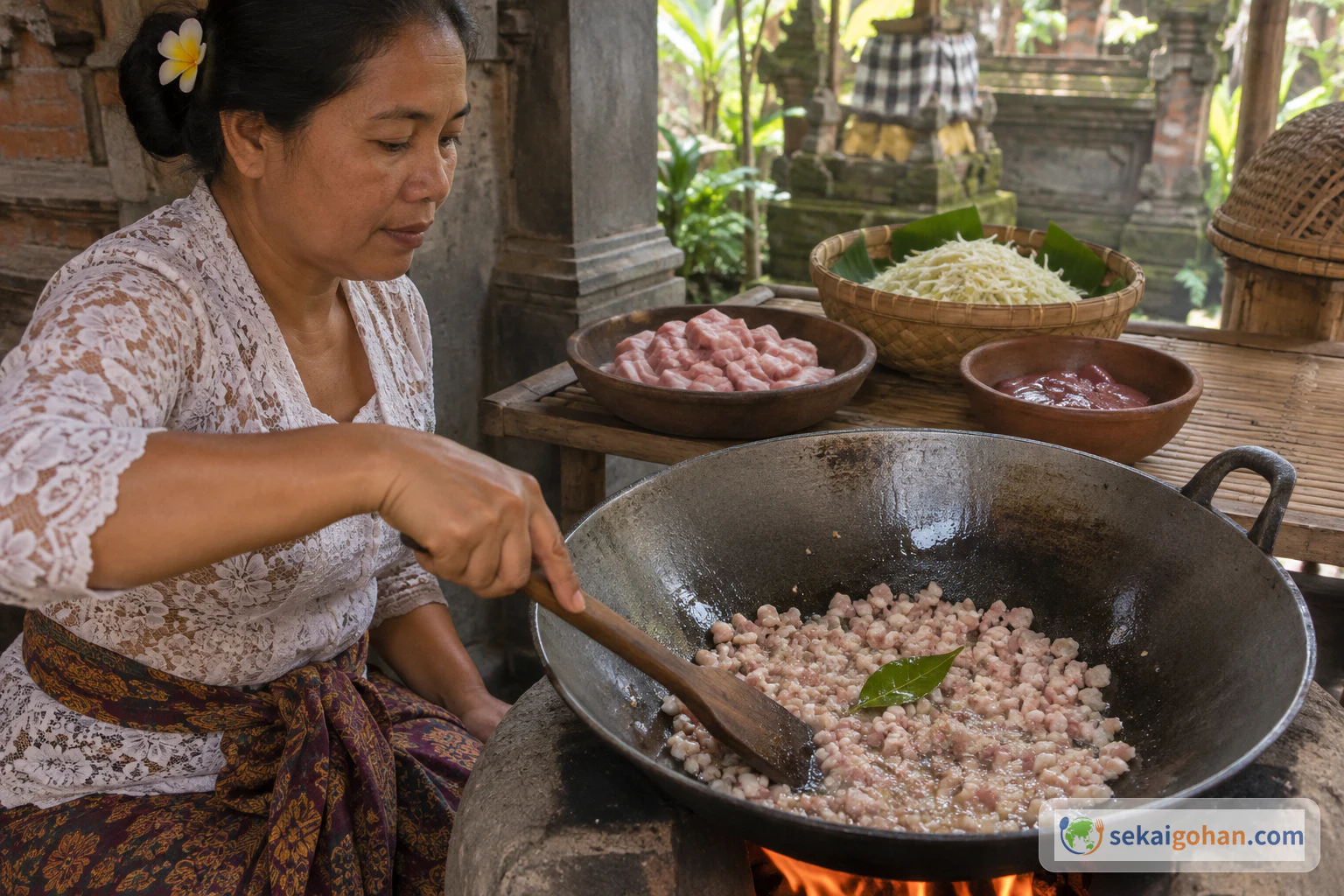
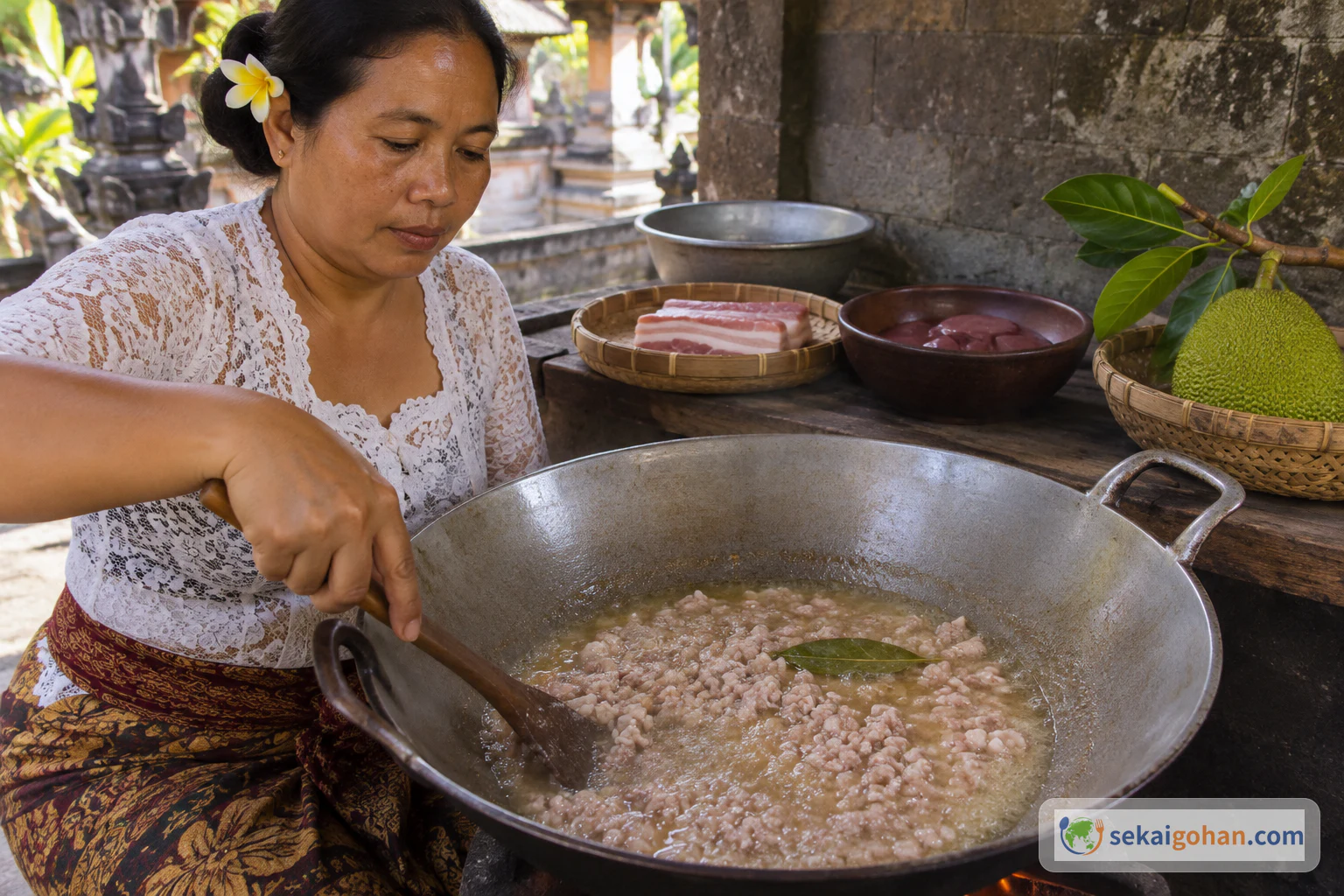
Stir-fry the pork

Stir-frying the pork and bay leaf in oil

Stir-fry for a few minutes. The pork isn't finished yet, so keep going through the simmer and the temperature check.

STEP 2424 / 81

Dissolve the stock

Dissolving half a stock cube in one cup of water

In a jug, stir the 1/2 stock cube into the 1 cup of water until it dissolves.

STEP 2525 / 81

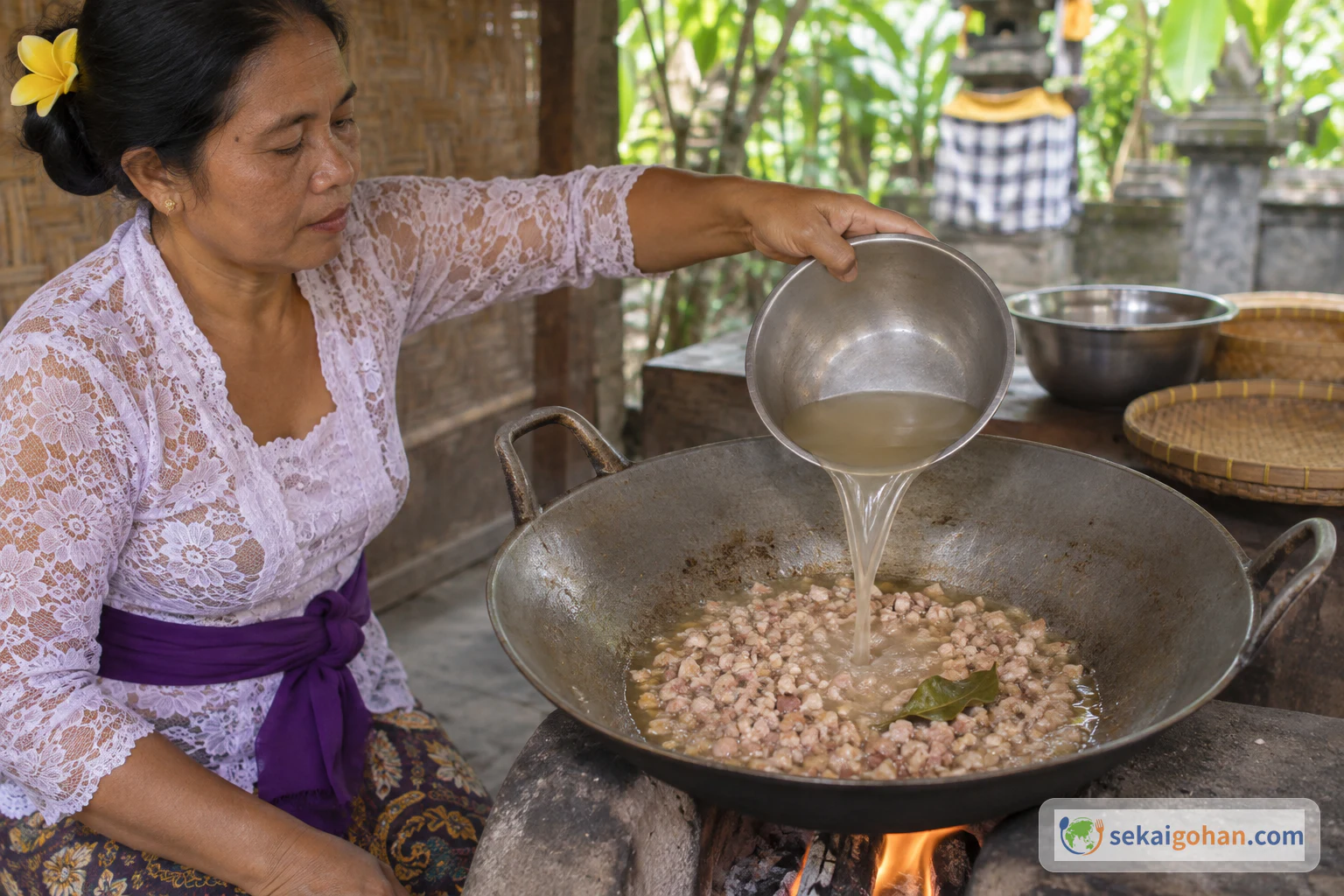
Add the stock to the pork

Pouring the stock over the stir-fried pork

Pour all of the stock into the wok.

STEP 2626 / 81

Simmer the pork

Simmering the pork in the wok with liquid

Simmer the pork in the stock, stirring from time to time.

STEP 2727 / 81

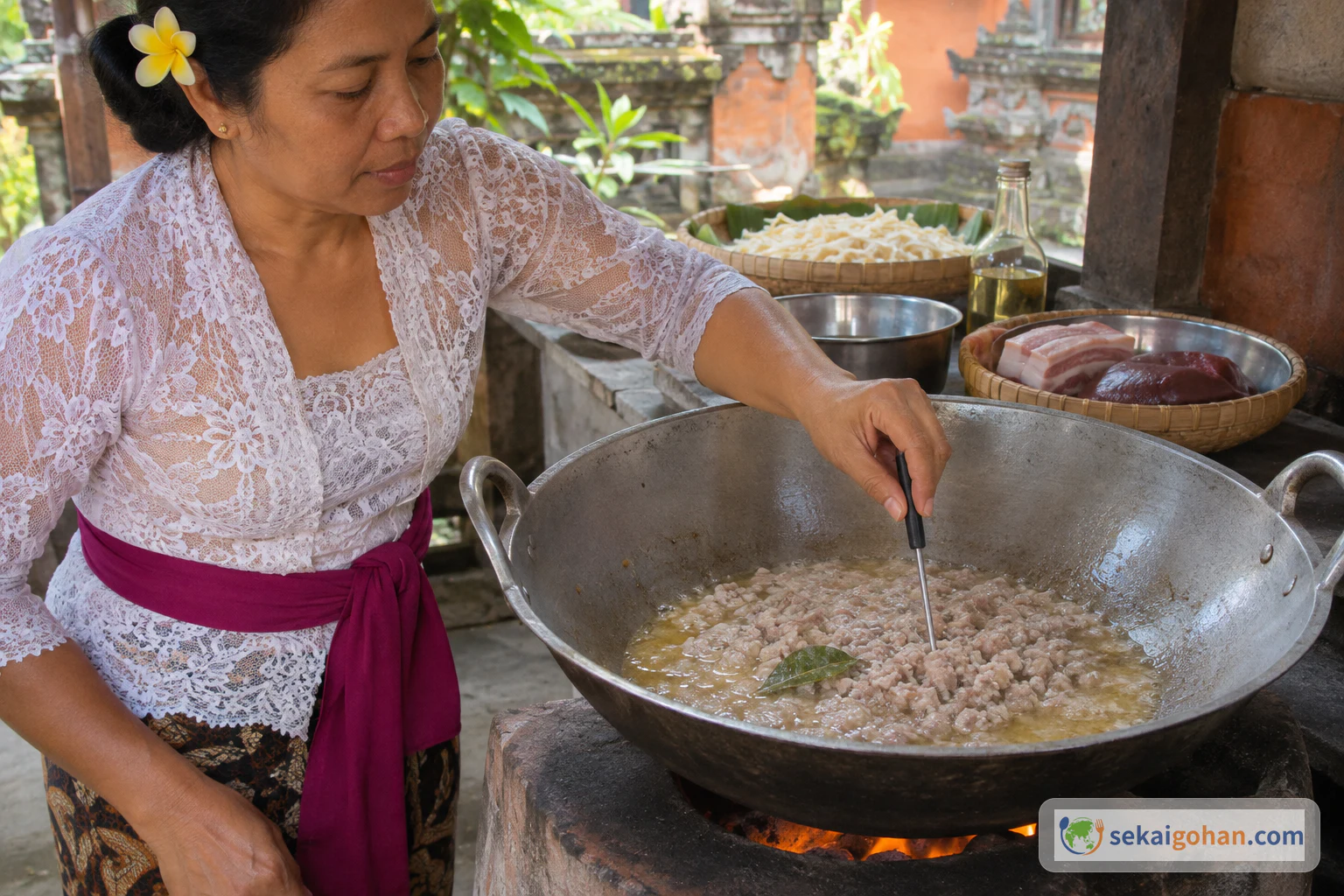
Check the pork temperature

Checking the center temperature of the pork with a probe

Gather the pork into a thick mound and insert a clean, fine-tip probe into the center. The center must stay at 75°C or above for at least 1 minute. If it doesn't, keep simmering and measure again. Move the cooked pork to a clean dish with clean utensils.

STEP 2828 / 81

Fill a pot for the skin

Pouring water into the pot for the pork skin

Pour clean water into a separate pot and bring it to a boil.

STEP 2929 / 81

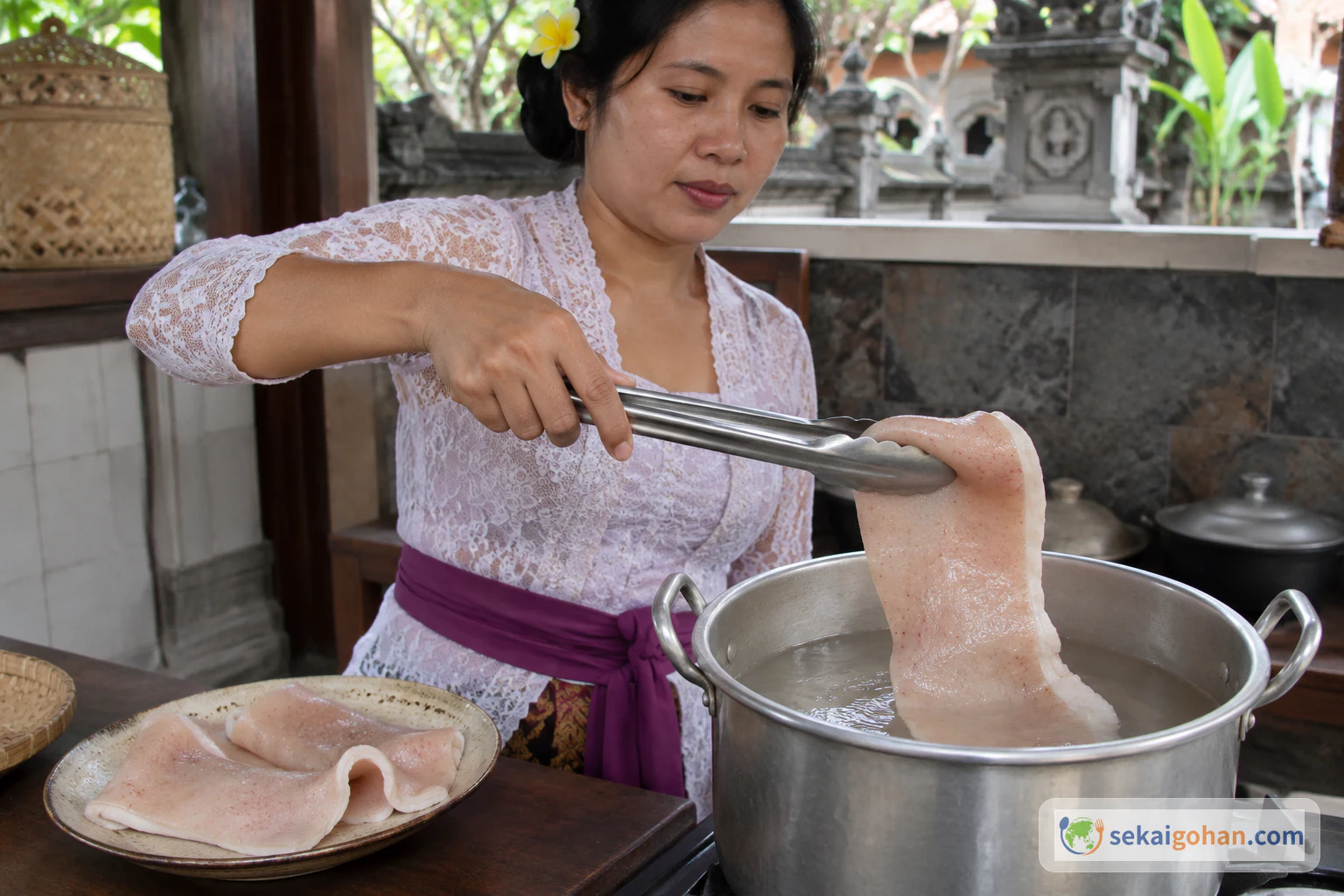
Add the skin

Lowering the separated pork skin into the pot

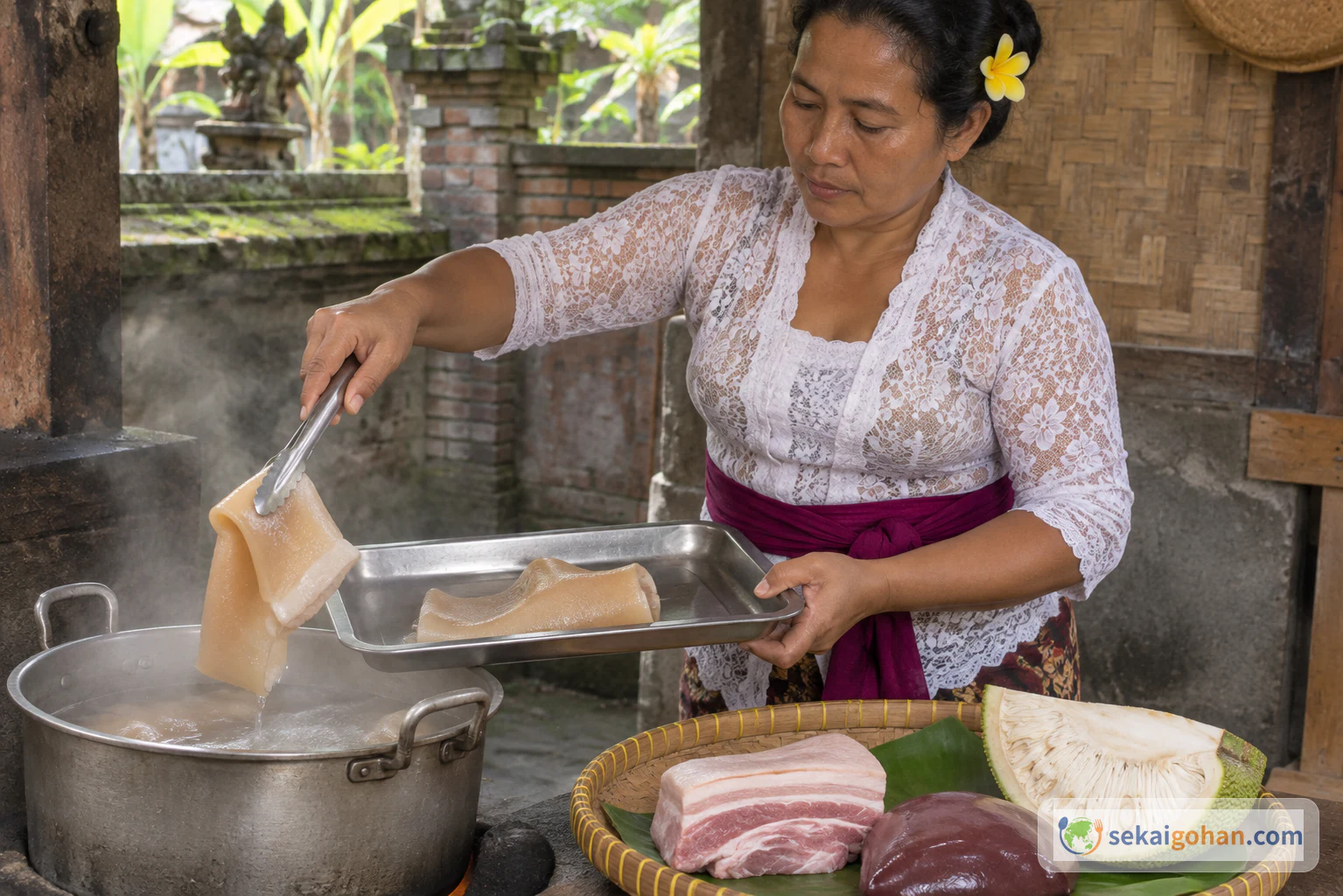
Use the raw-meat tongs to lower the separated skin into the water. Nothing else goes in this pot.

STEP 3030 / 81

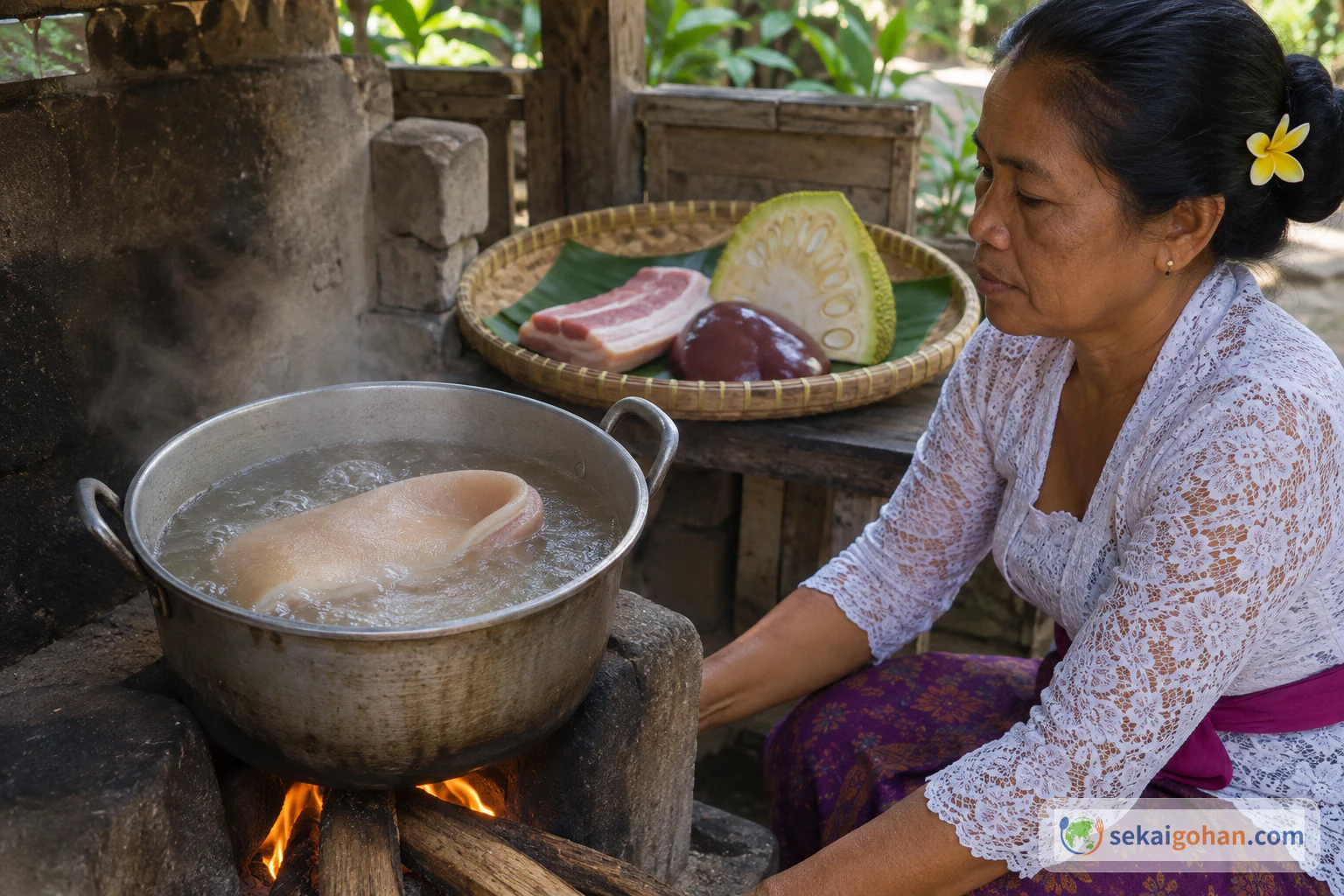
Boil the skin

Boiling pork skin until tender

Boil the skin until tender.

STEP 3131 / 81

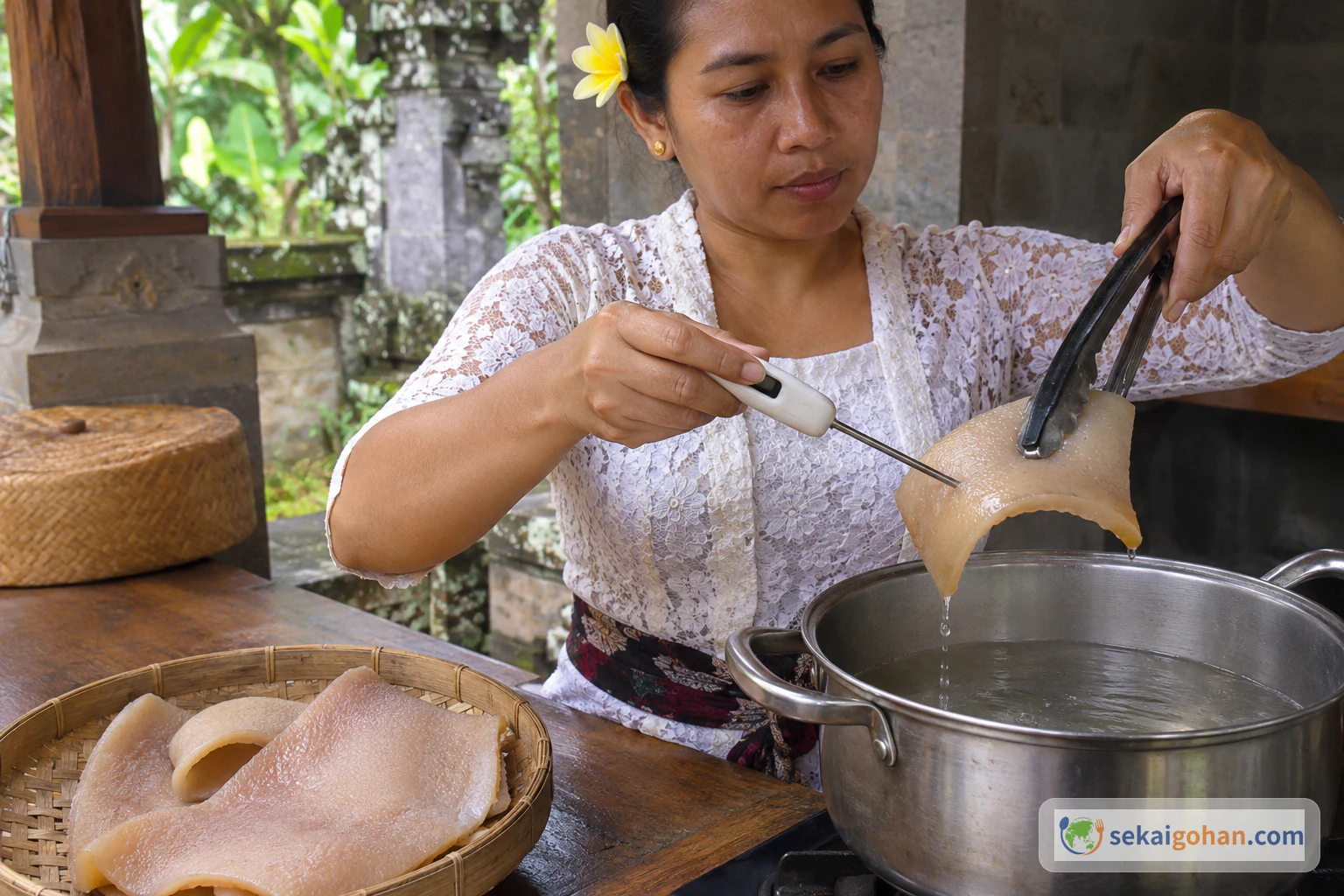
Check the skin temperature

Checking the heat in the thickest part of the pork skin

Hold the skin with clean tongs and insert a clean probe into the thickest part. The center must stay at 75°C or above for at least 1 minute. If it doesn't, return the skin to the boiling water and measure again.

STEP 3232 / 81

Lift out the skin

Lifting the boiled pork skin out of the water

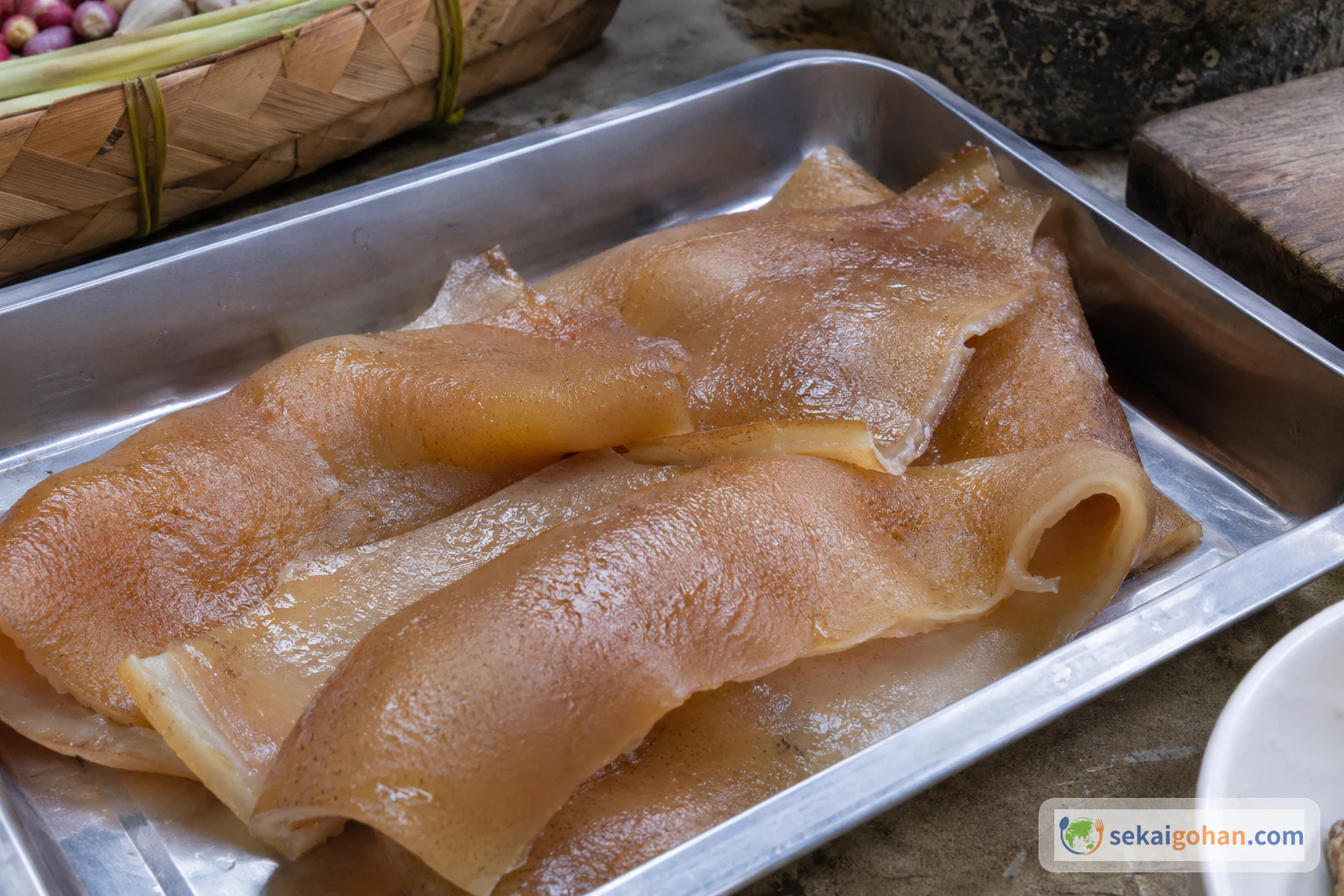
Use clean tongs to lift the skin from the water onto a clean tray.

STEP 3333 / 81

Cool the skin

Cooling the cooked pork skin on a tray

Let the skin rest briefly on the tray until it is cool enough to slice.

STEP 3434 / 81

Slice the skin

Thinly slicing the cooled pork skin

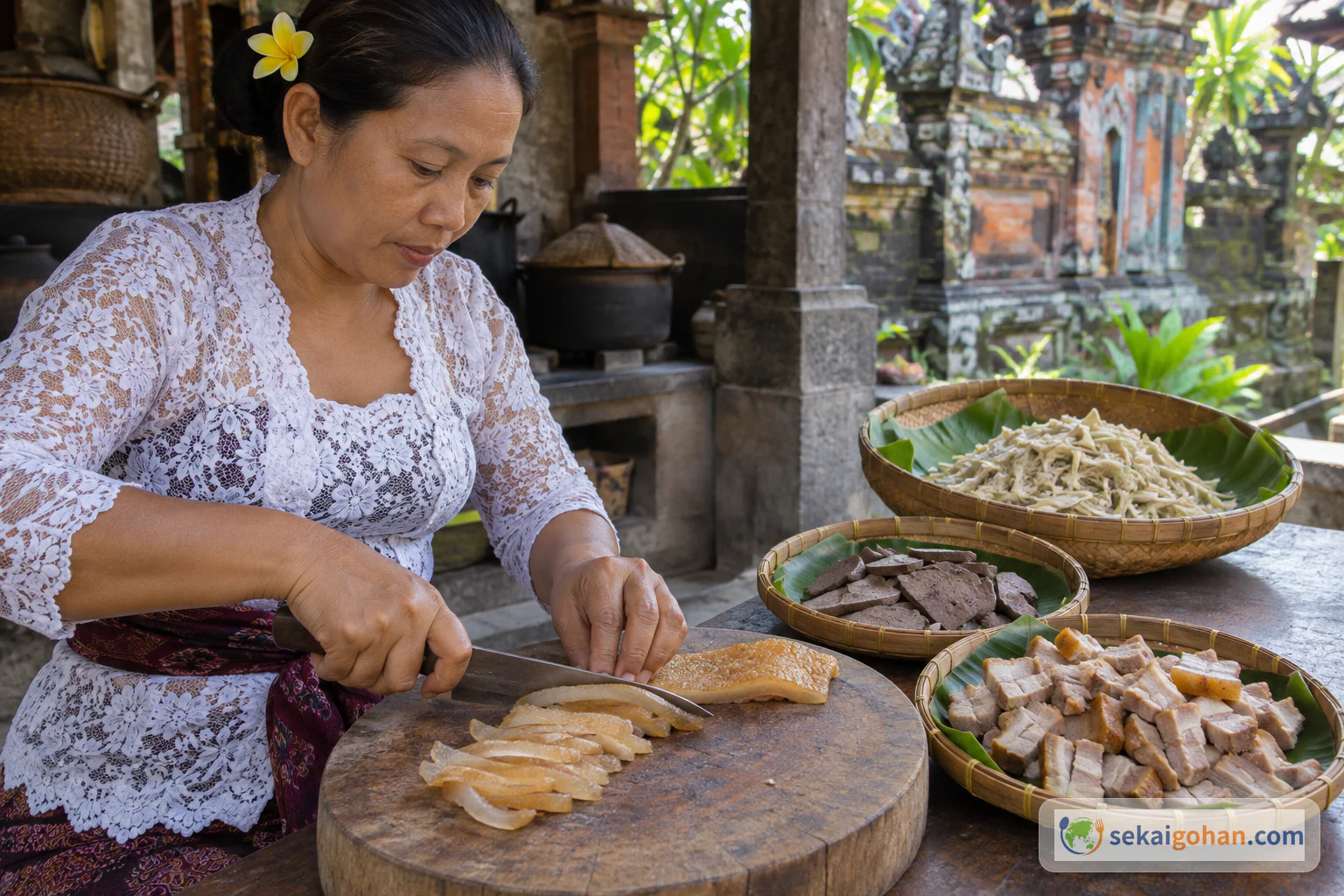
Slice the cooled skin thinly on a clean cooked-food board. Do not use the raw-meat board or knife.

STEP 3535 / 81

Heat the griddle

Heating the griddle for the liver

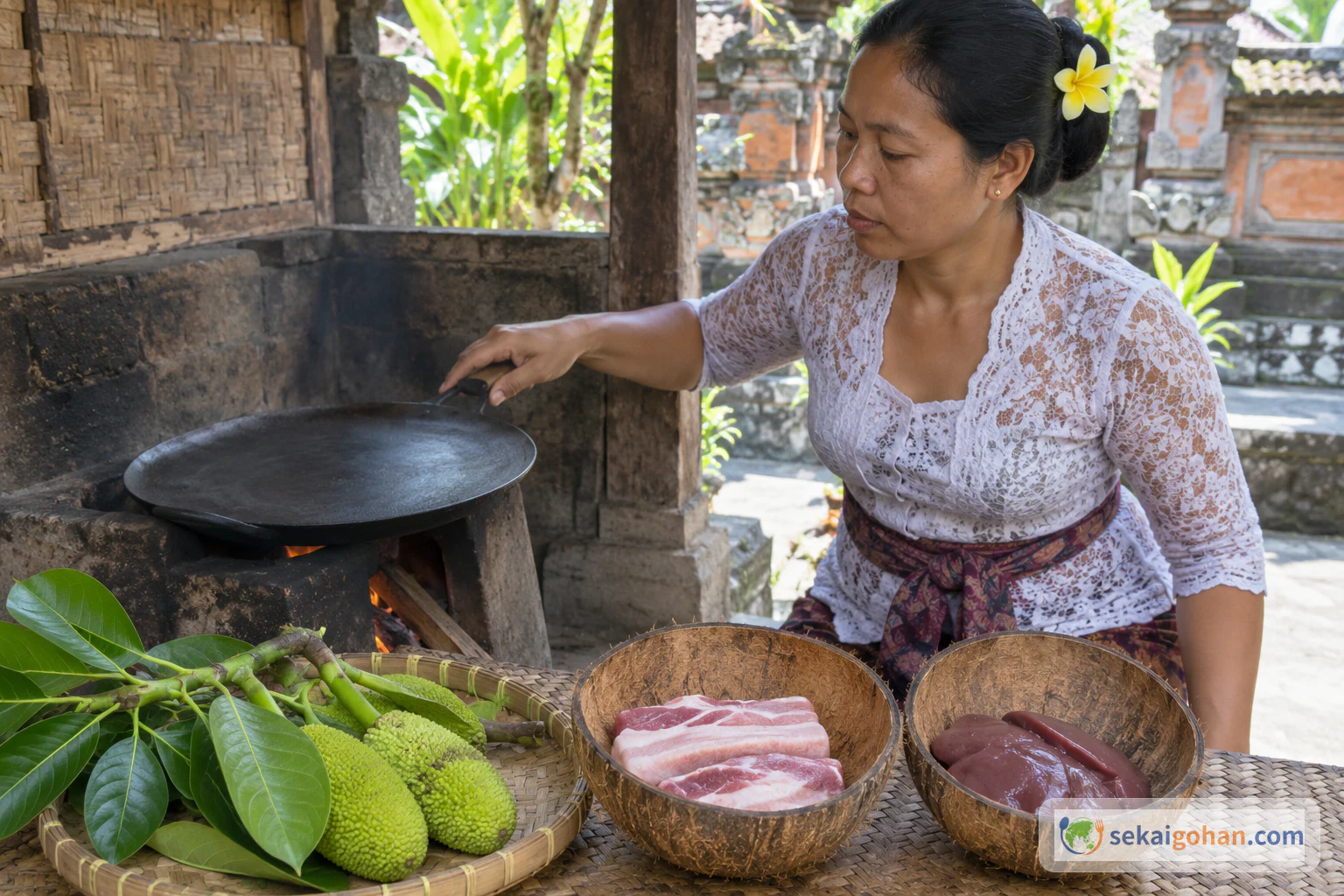
Heat a clean griddle or grill for the liver.

STEP 3636 / 81

Add the liver

Placing the liver on the griddle

Use raw-meat tongs to place the 200 g of liver on the griddle.

STEP 3737 / 81

Cook the liver

Cooking pork liver on the griddle

Cook the liver, turning it as needed.

STEP 3838 / 81

Check the liver temperature

Checking the center temperature of the liver

Insert a clean probe into the thickest piece. The center must stay at 75°C or above for at least 1 minute. If it doesn't, keep cooking and measure again.

STEP 3939 / 81

Move the liver to a plate

Moving the cooked liver to a clean plate

Use clean tongs to move the cooked liver to a clean plate.

STEP 4040 / 81

Cool the liver

Cooling the cooked liver on a plate

Let the liver rest briefly on the plate until it is cool enough to chop.

STEP 4141 / 81

Chop the liver

Finely chopping the cooled liver

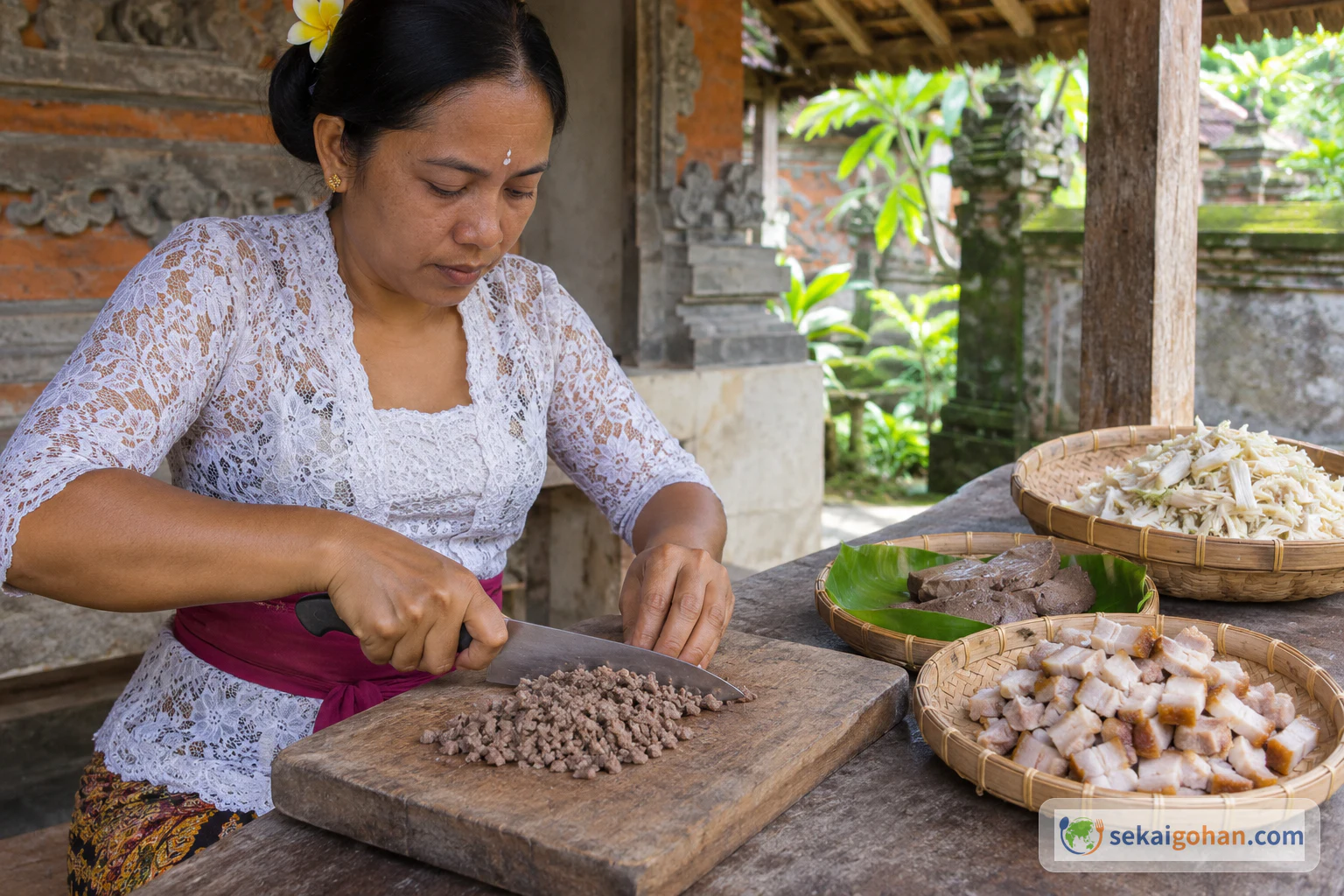
Chop the cooled liver finely with a clean cooked-food knife and board.

STEP 4242 / 81

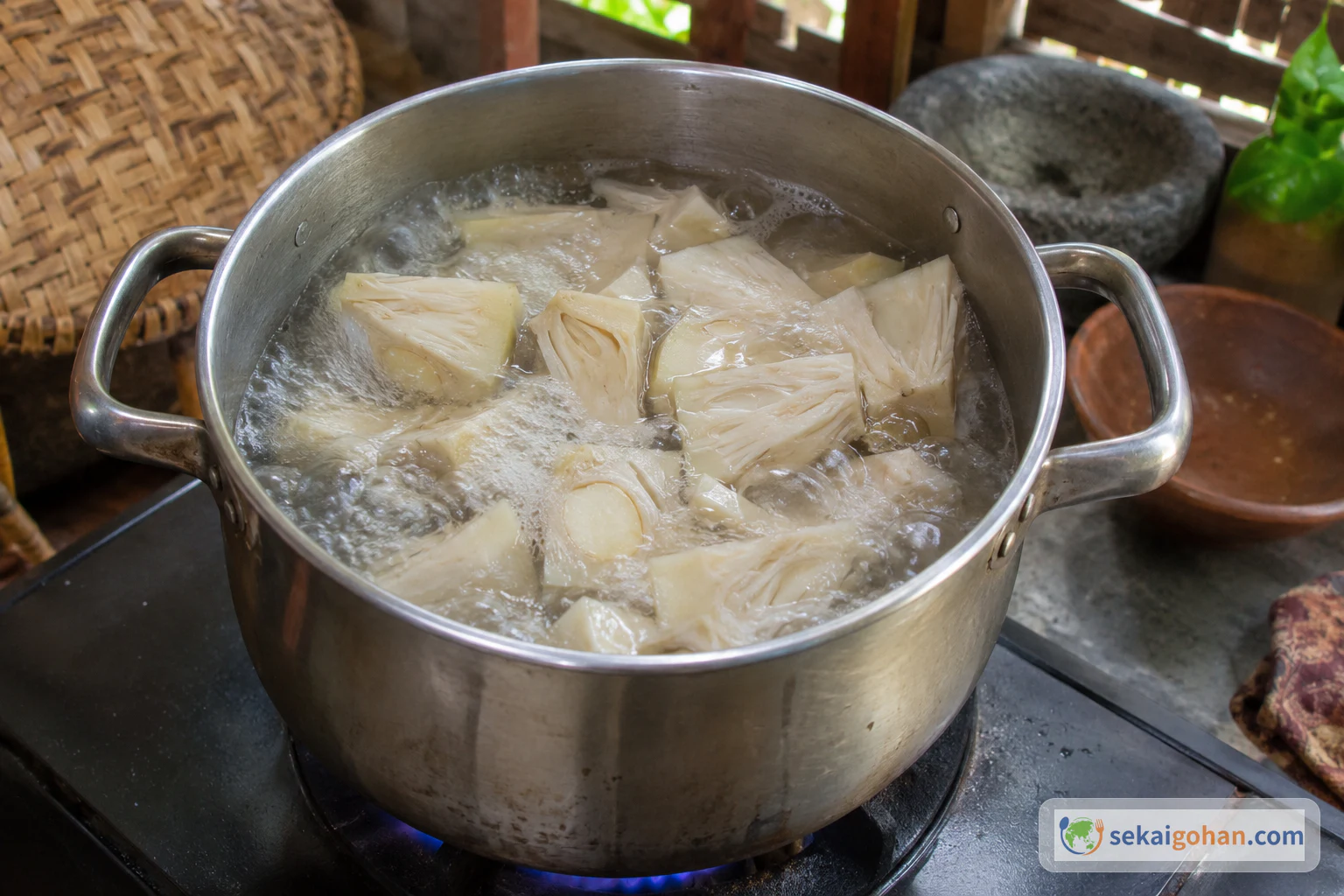
Boil water for the jackfruit

Boiling water for the green jackfruit

Bring a separate pot of plain water to a boil.

STEP 4343 / 81

Add the jackfruit

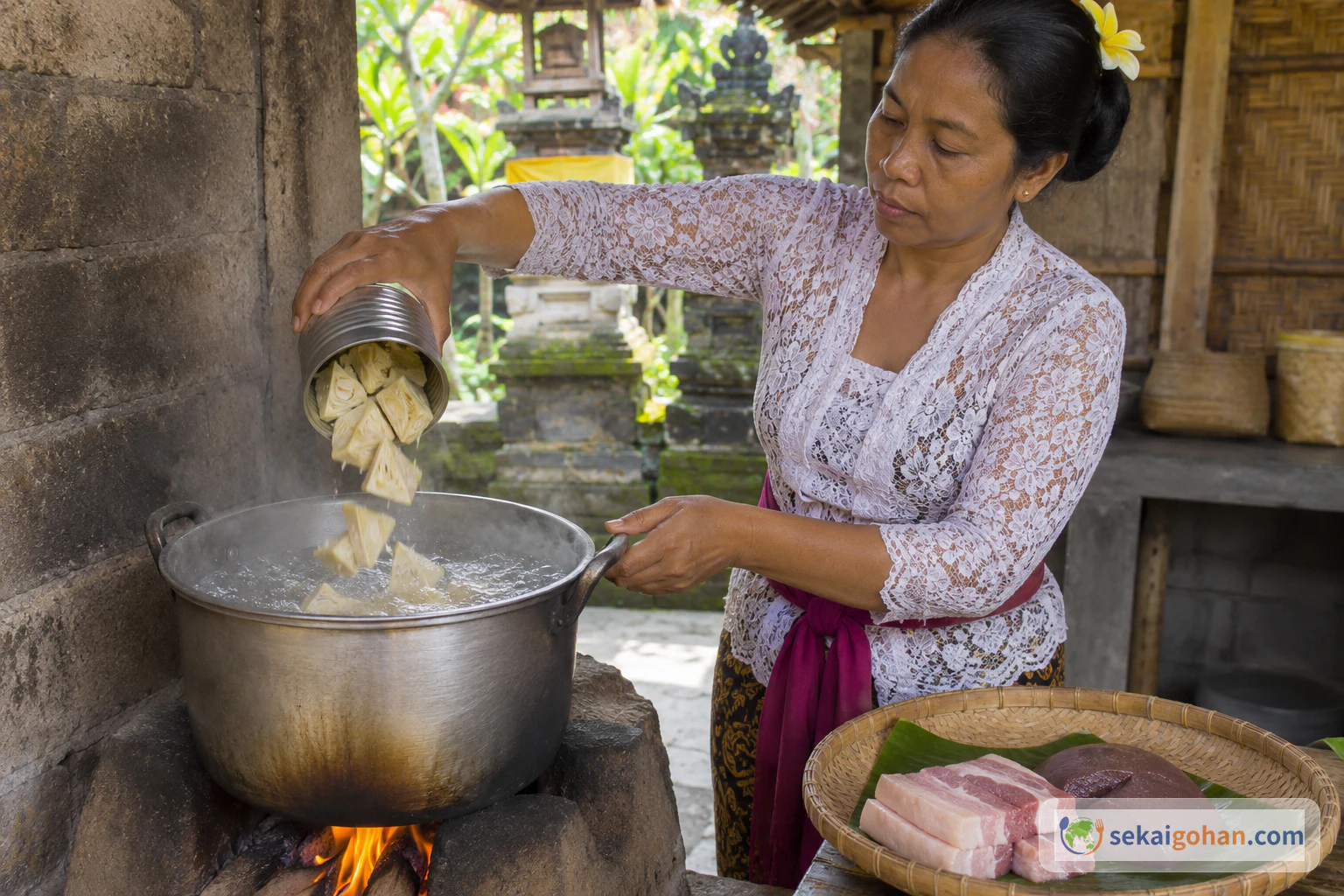
Putting the green jackfruit into boiling water

Put the canned green jackfruit into the boiling water.

STEP 4444 / 81

Boil the jackfruit

Briefly boiling the green jackfruit

Boil the jackfruit for a few minutes.

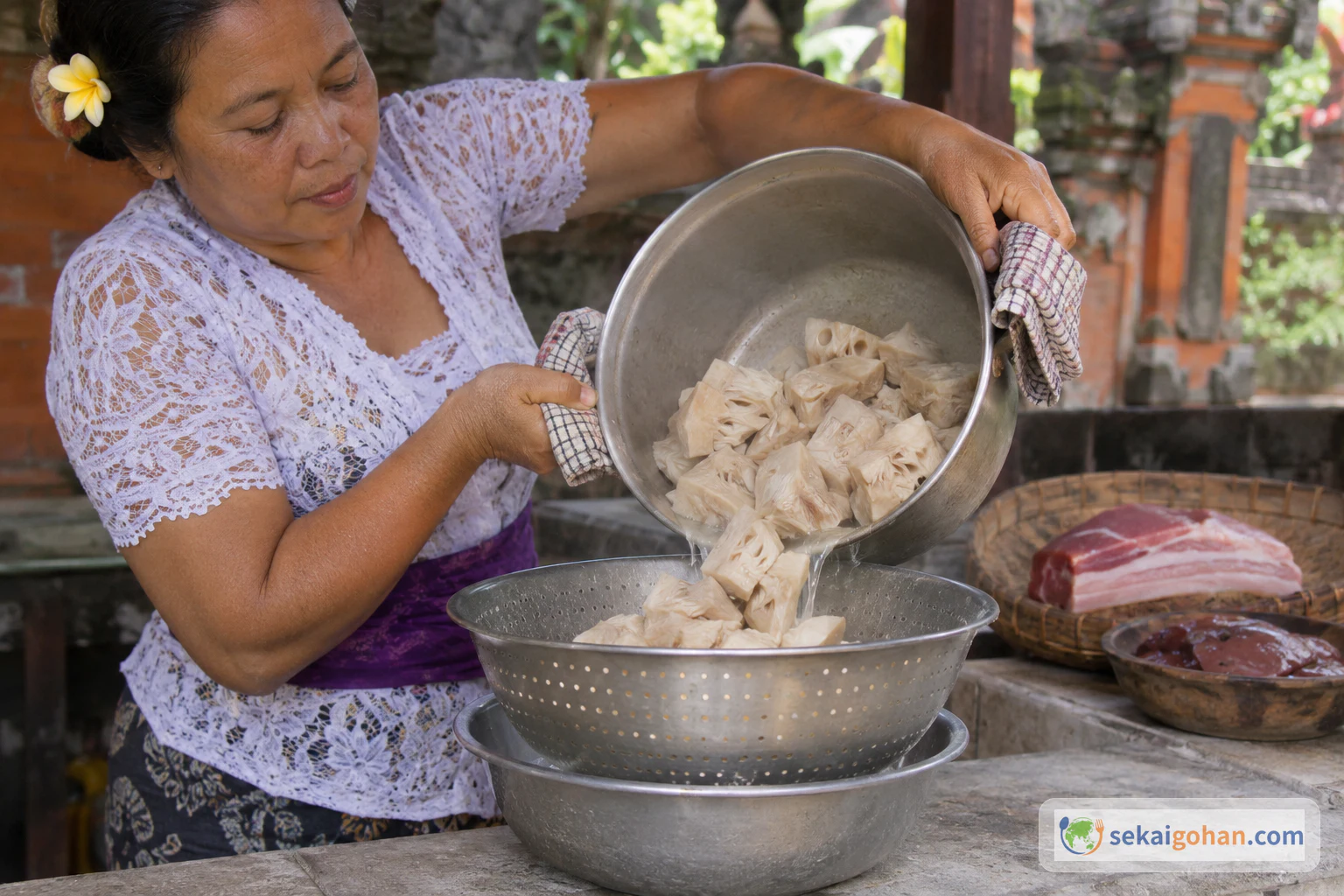
STEP 4545 / 81

Drain the jackfruit

Draining the boiled green jackfruit in a colander

Tip the jackfruit into a colander and let the water drain away.

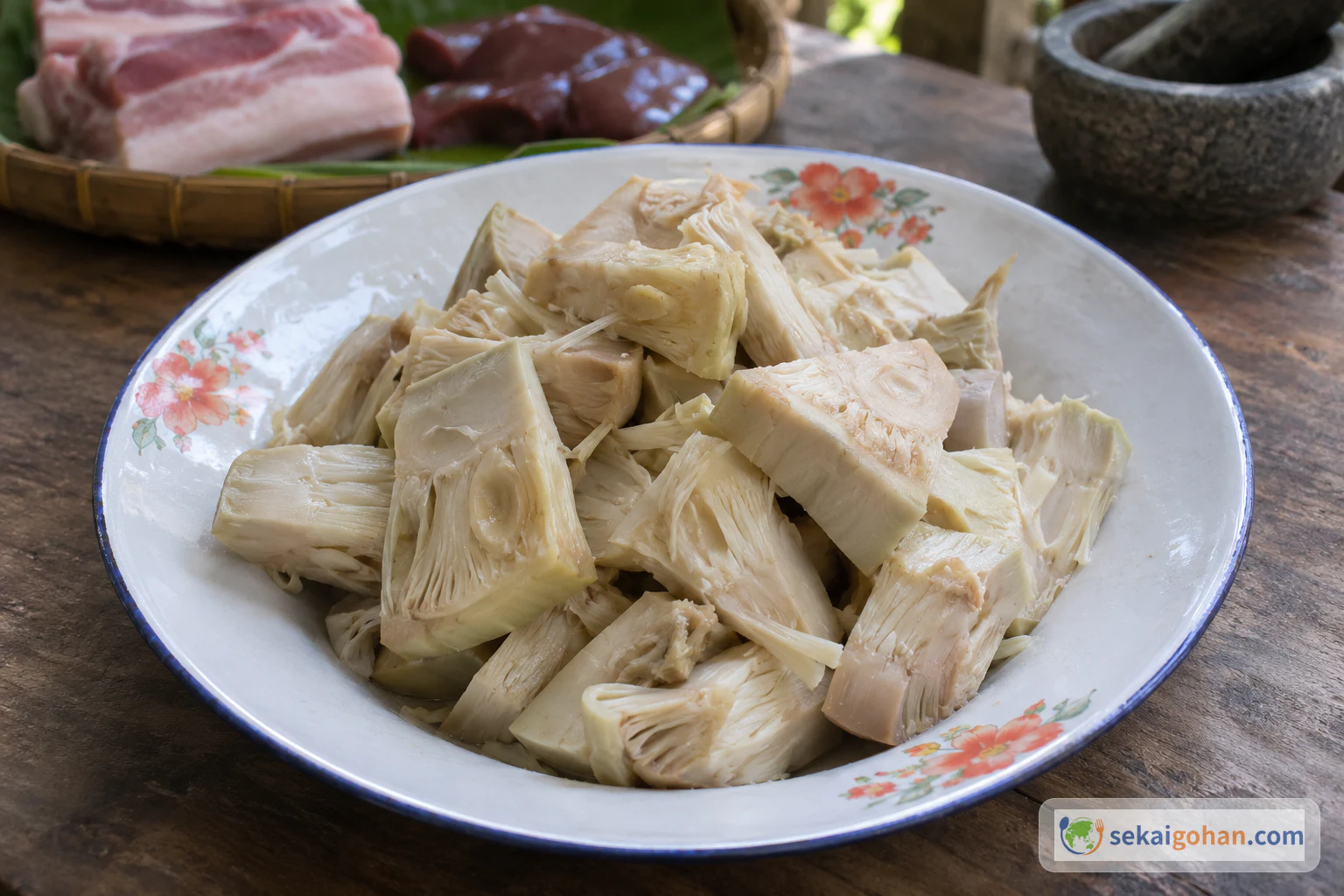
STEP 4646 / 81

Cool the jackfruit

Cooling the drained green jackfruit

Let the drained jackfruit rest briefly in a clean dish until it is cool enough to chop.

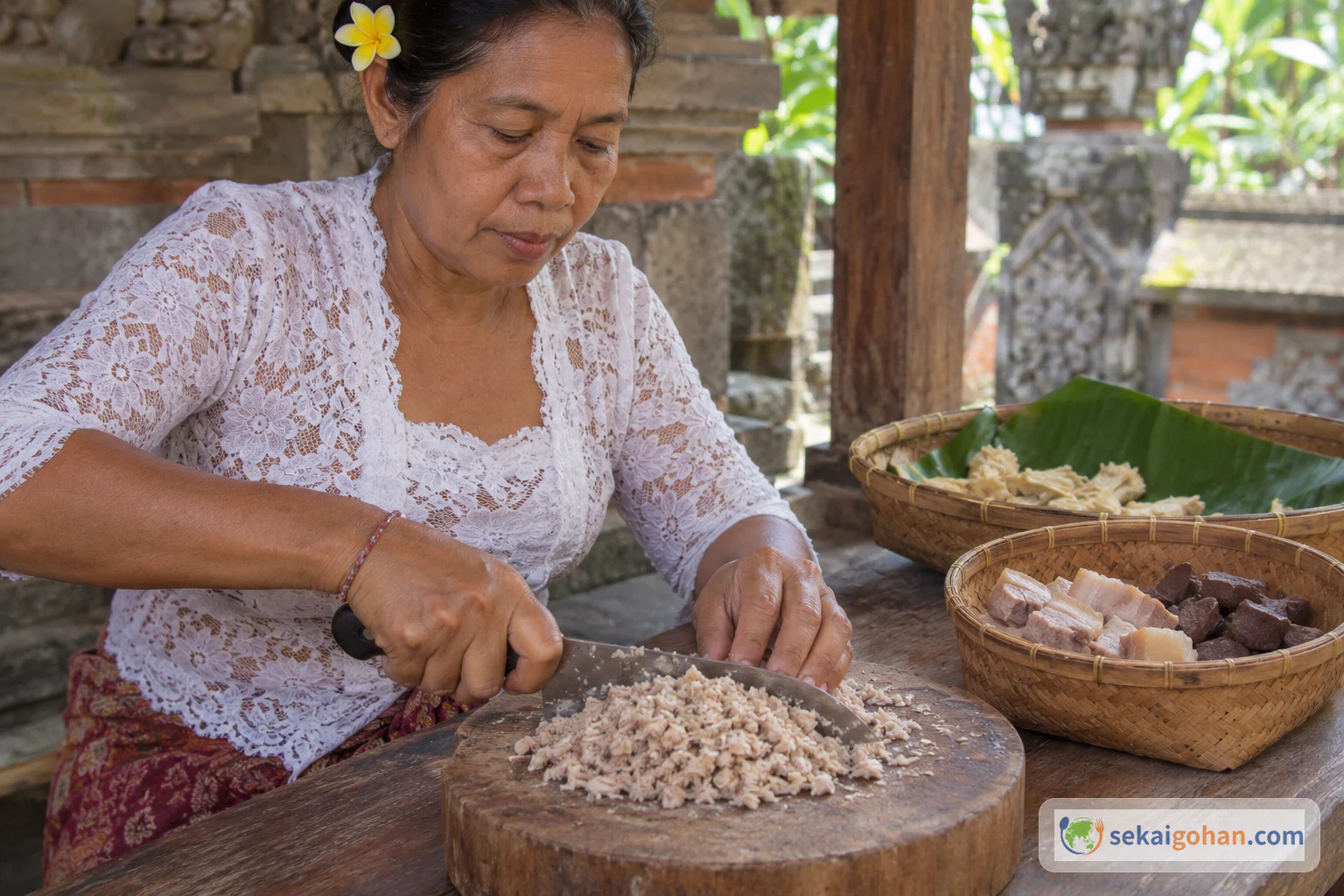
STEP 4747 / 81

Chop the jackfruit

Finely chopping the cooled green jackfruit

Chop the cooled jackfruit finely with a clean knife and board.

STEP 4848 / 81

Load the mortar

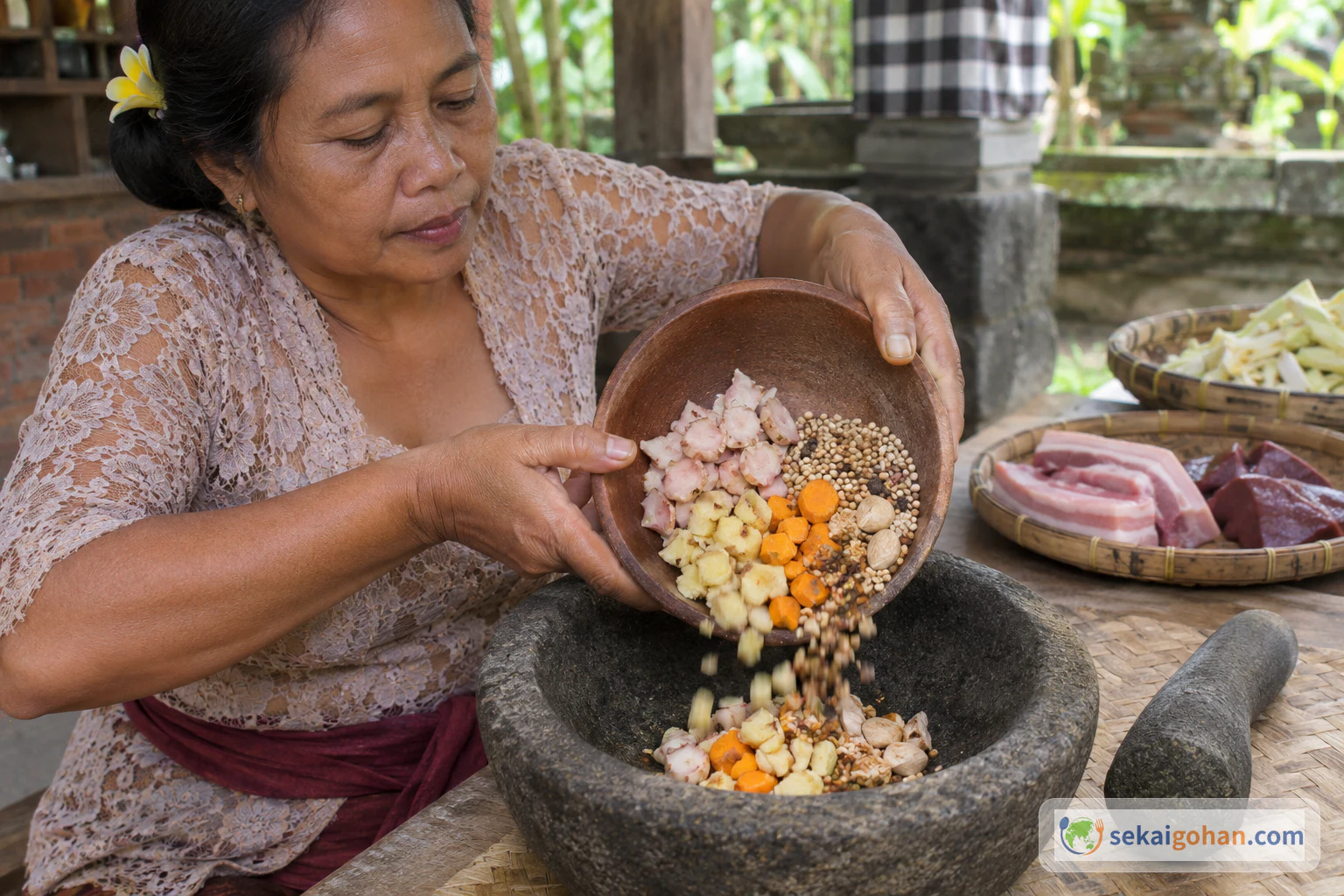
Adding the chopped rhizomes and measured spices to a mortar

Measure the coriander, sesame, black pepper, white pepper, cloves, candlenuts, cumin and nutmeg into one bowl. Add them to the mortar with the chopped galangal, turmeric, ginger and kencur.

STEP 4949 / 81

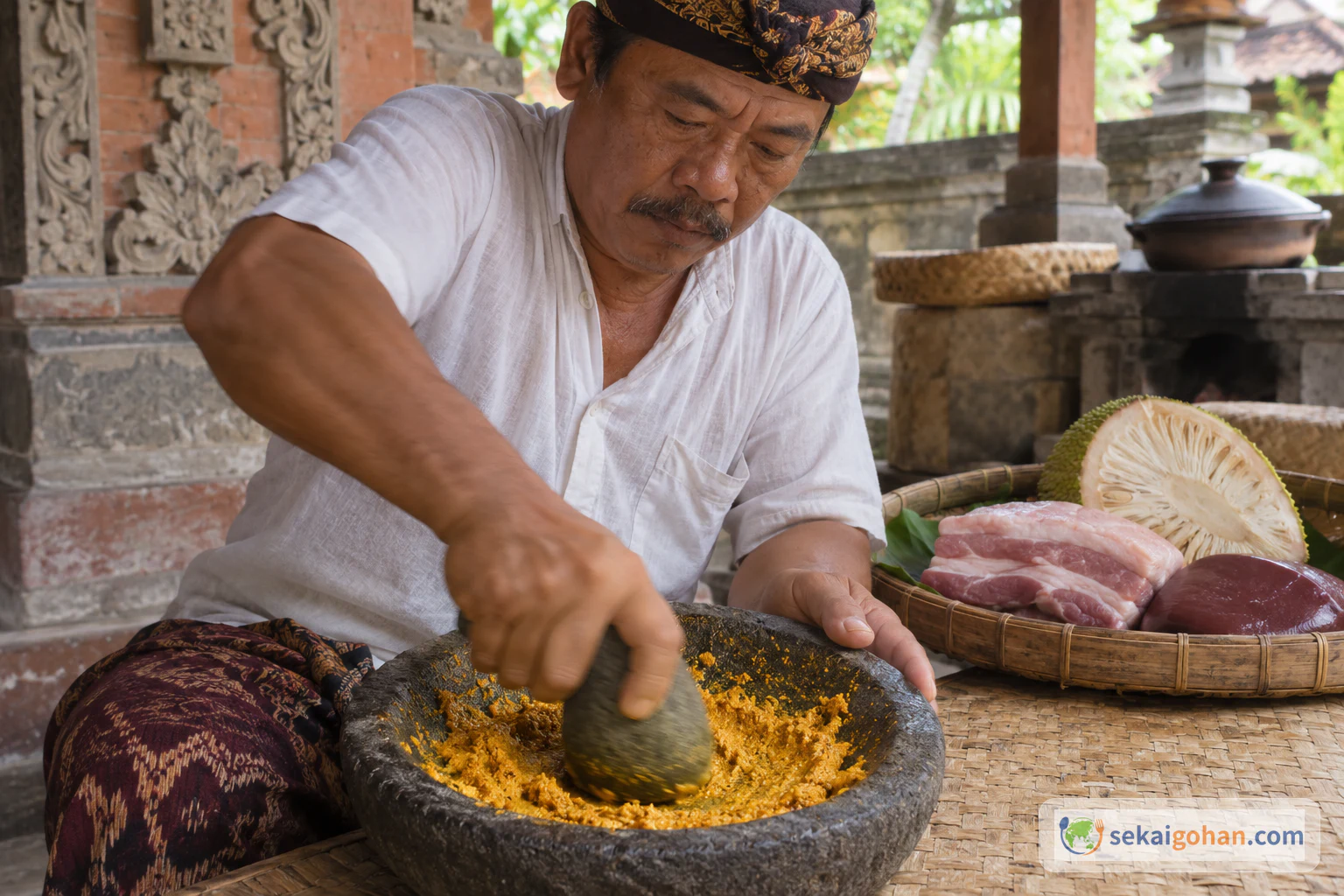
Grind the base genep

Grinding the base genep in a mortar

Grind everything into a paste. Do not taste it at this stage, because the candlenuts are still raw.

STEP 5050 / 81

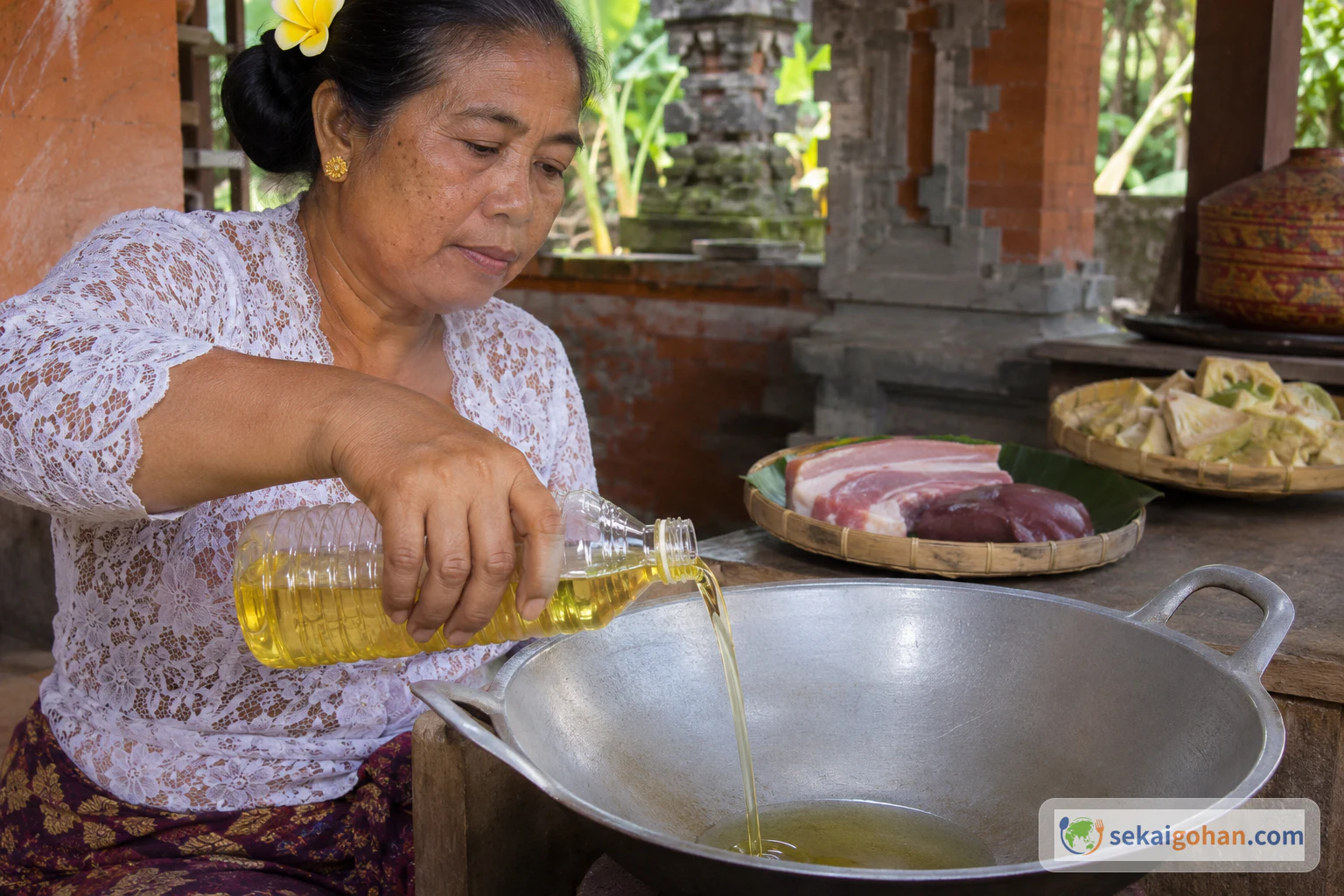
Add oil to the paste pan

Pouring oil into the pan for the paste

Pour vegetable oil into a clean pan.

STEP 5151 / 81

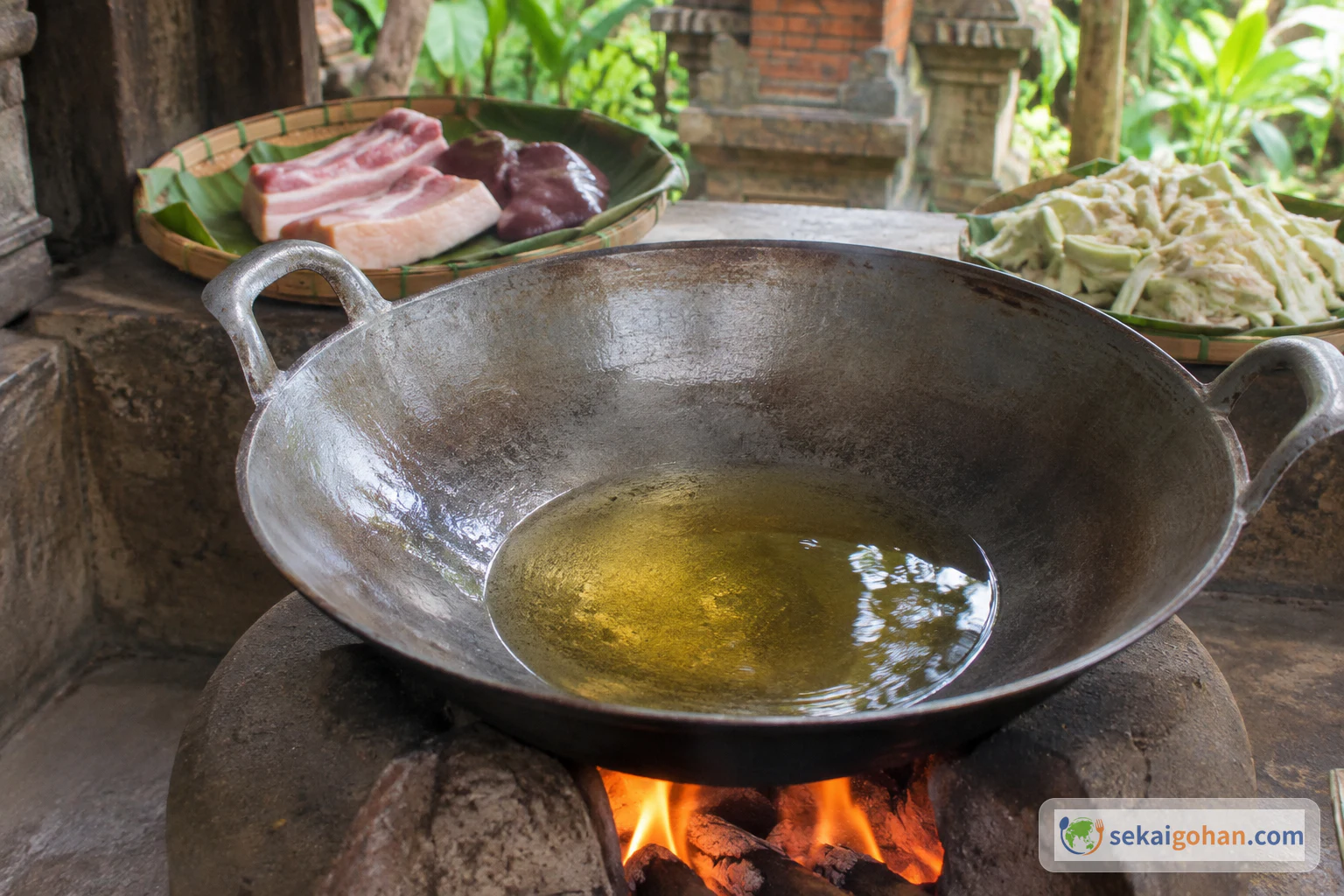
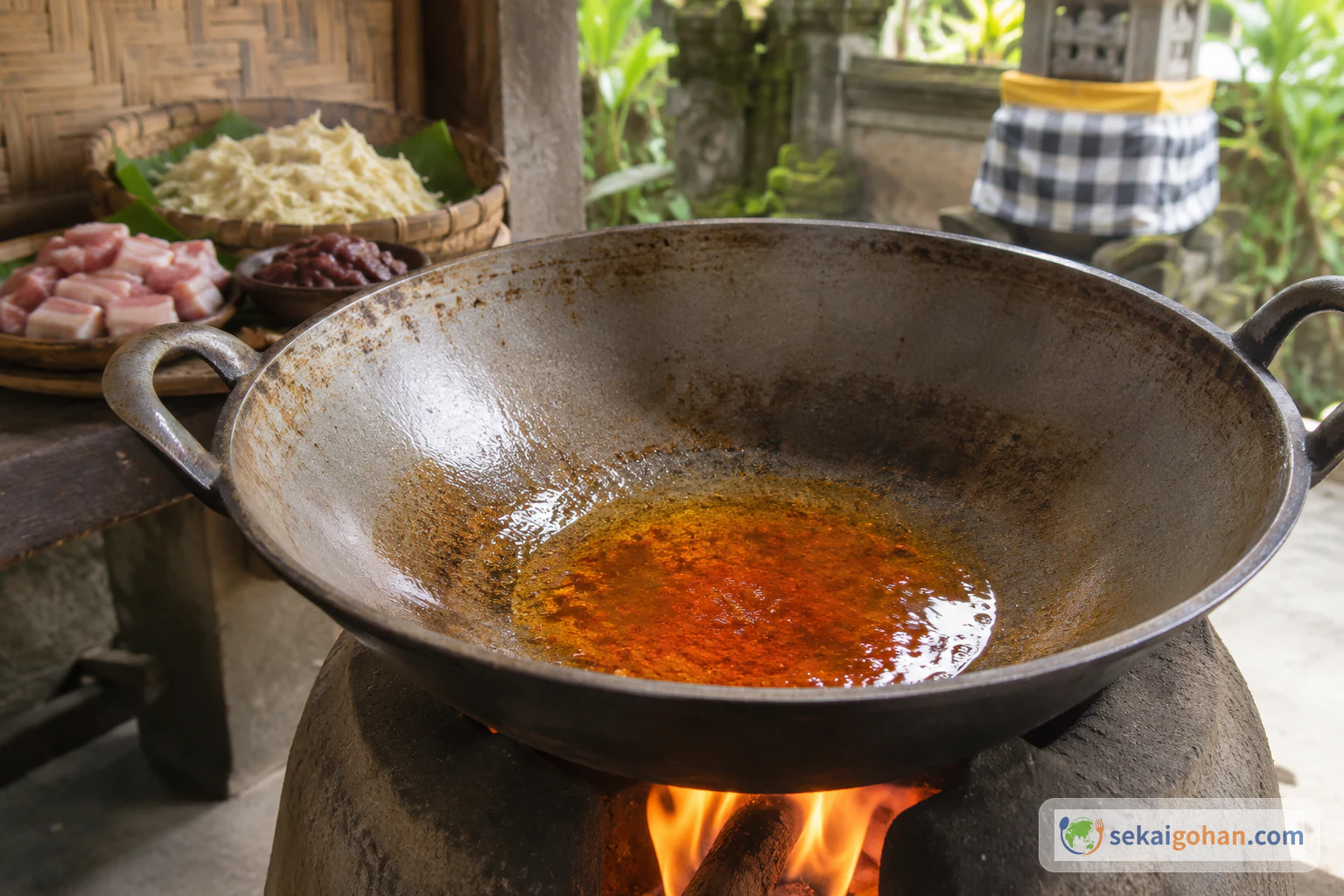
Heat the oil

Heating the oil for the paste

Heat the oil on its own.

STEP 5252 / 81

Add the paste

Adding the paste to the hot oil

Add the ground base genep to the hot oil.

STEP 5353 / 81

Fry the paste

Stir-frying the base genep in oil

Stir-fry the paste until it is thoroughly cooked, without letting it burn. Set it aside.

STEP 5454 / 81

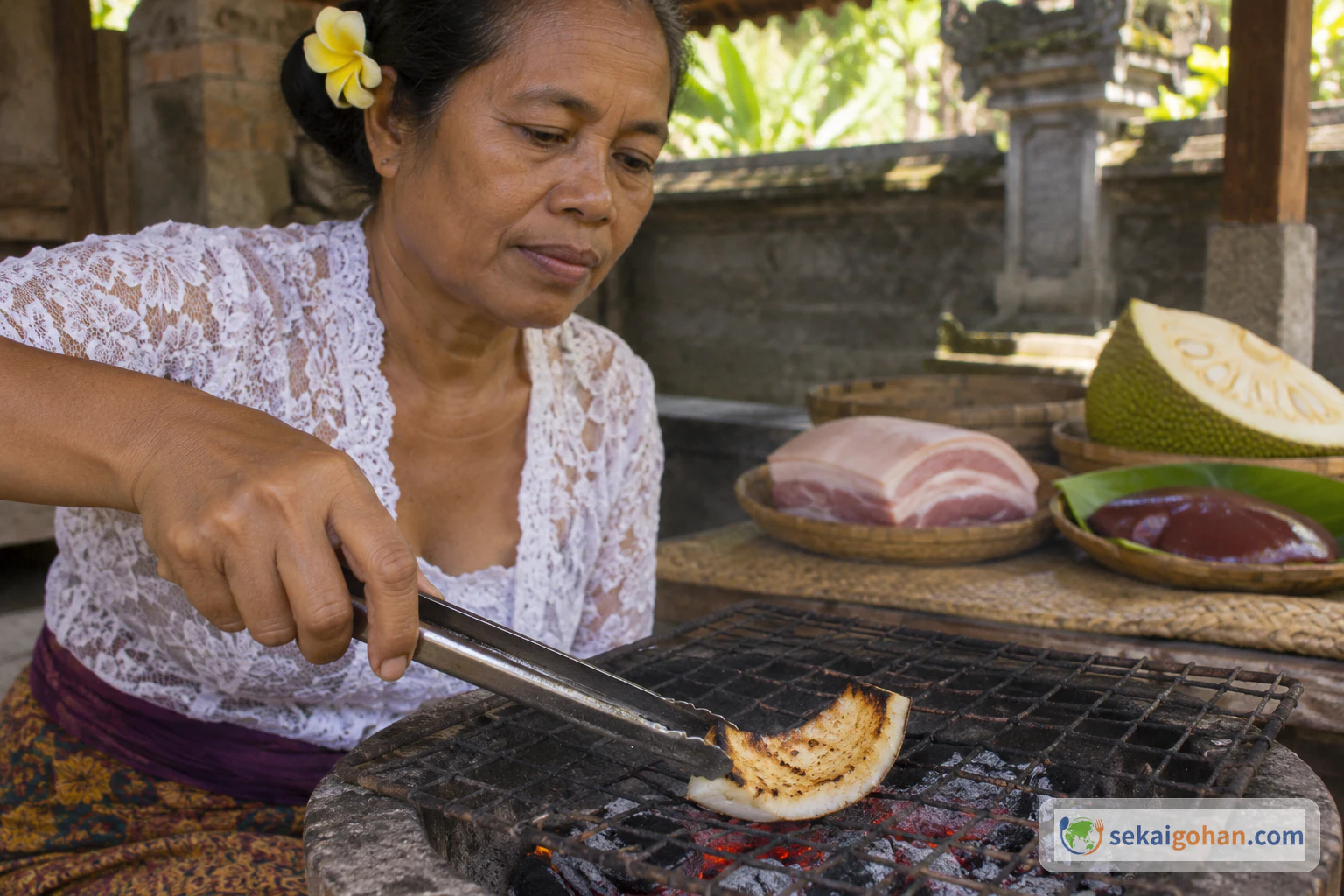
Grill the coconut

Grilling the edible part of the coconut

Grill the edible flesh of the half coconut until the surface turns brown. The hard shell and husk are not food.

STEP 5555 / 81

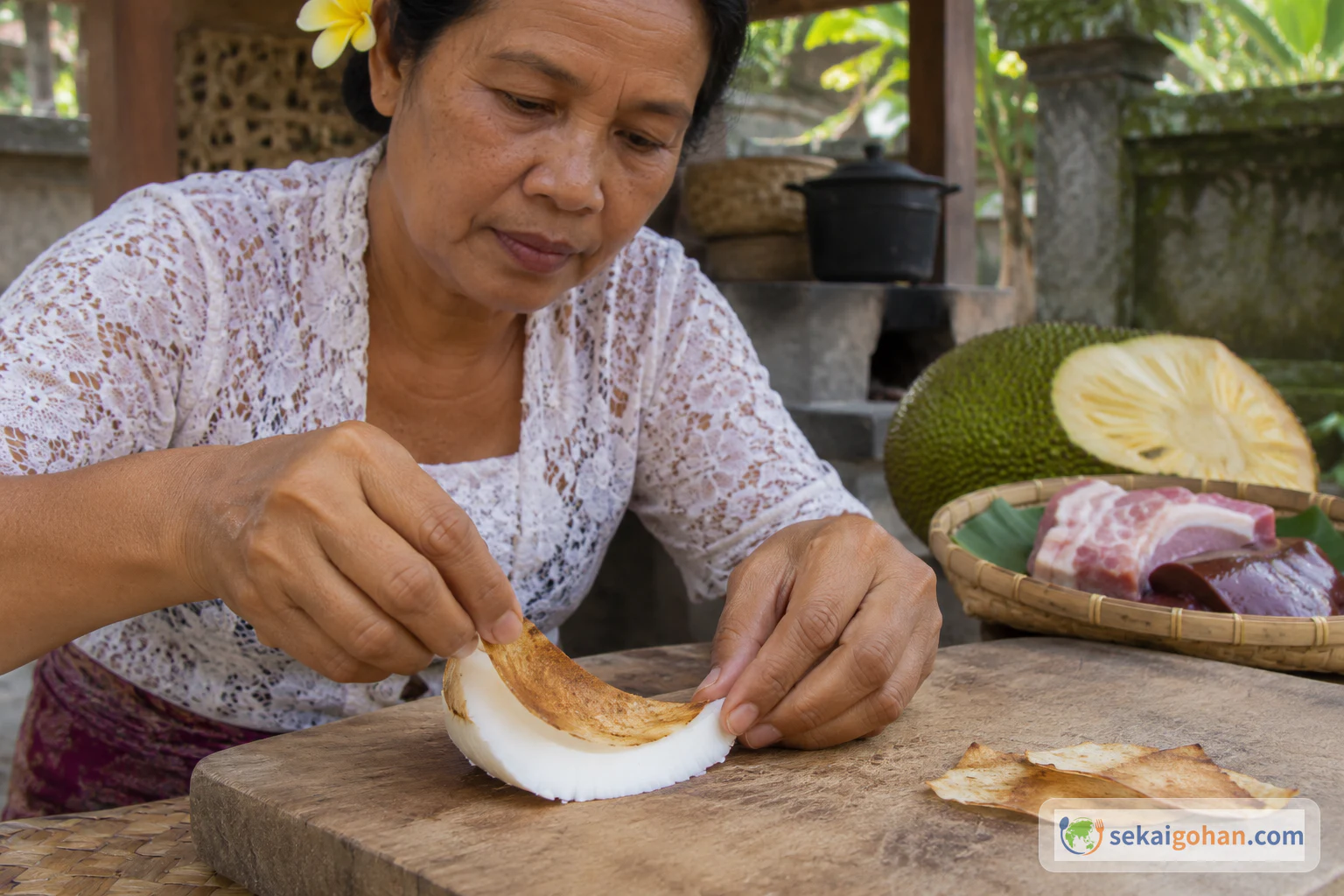
Cut off the brown skin

Separating the thin browned surface from the white coconut flesh

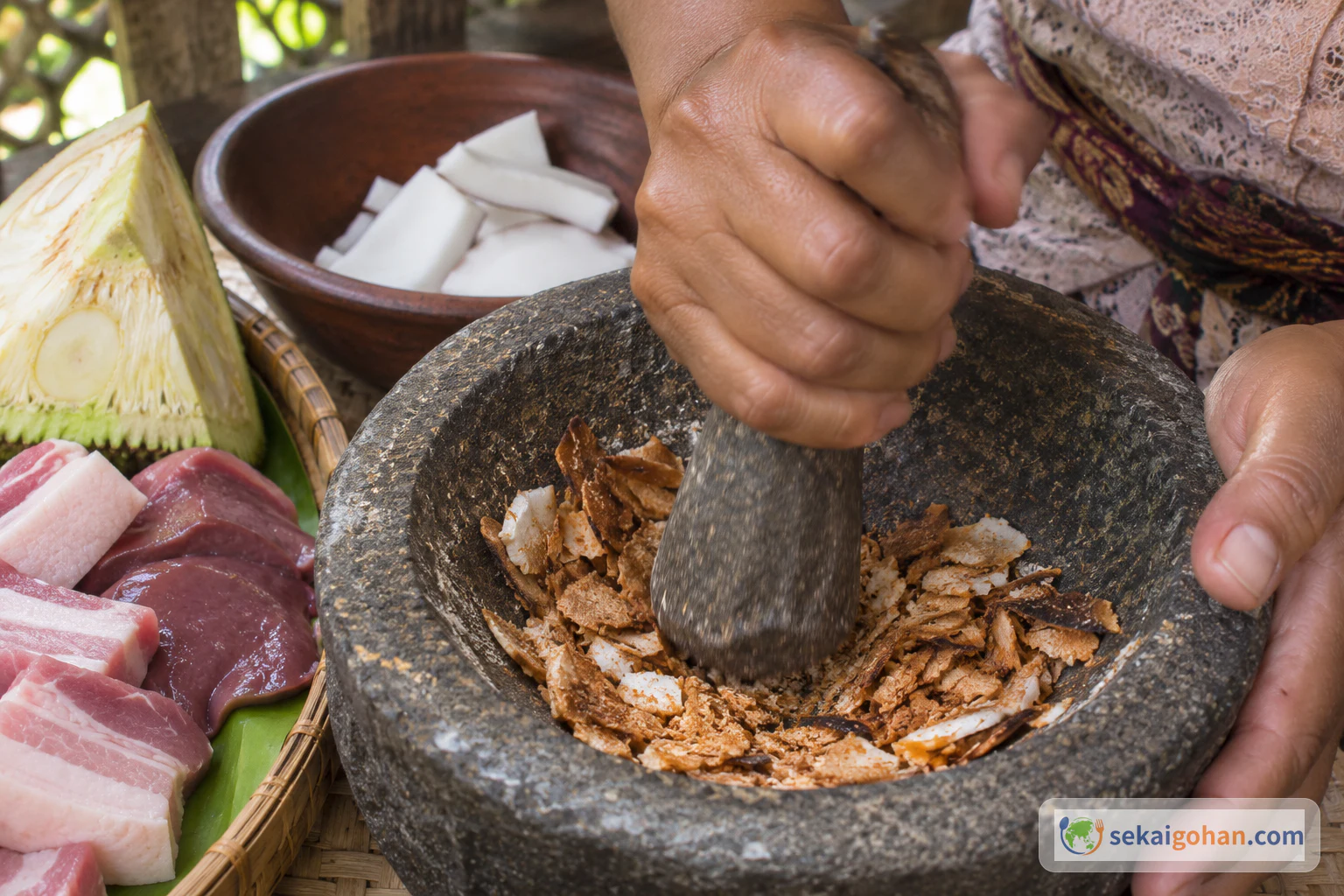
On a clean board, cut the thin browned skin away from the white flesh. Set the white flesh aside for step 59.

STEP 5656 / 81

Crush the brown skin

Crushing the separated browned coconut pieces

Crush only the browned pieces in a mortar. Keep the white flesh out of this batch.

STEP 5757 / 81

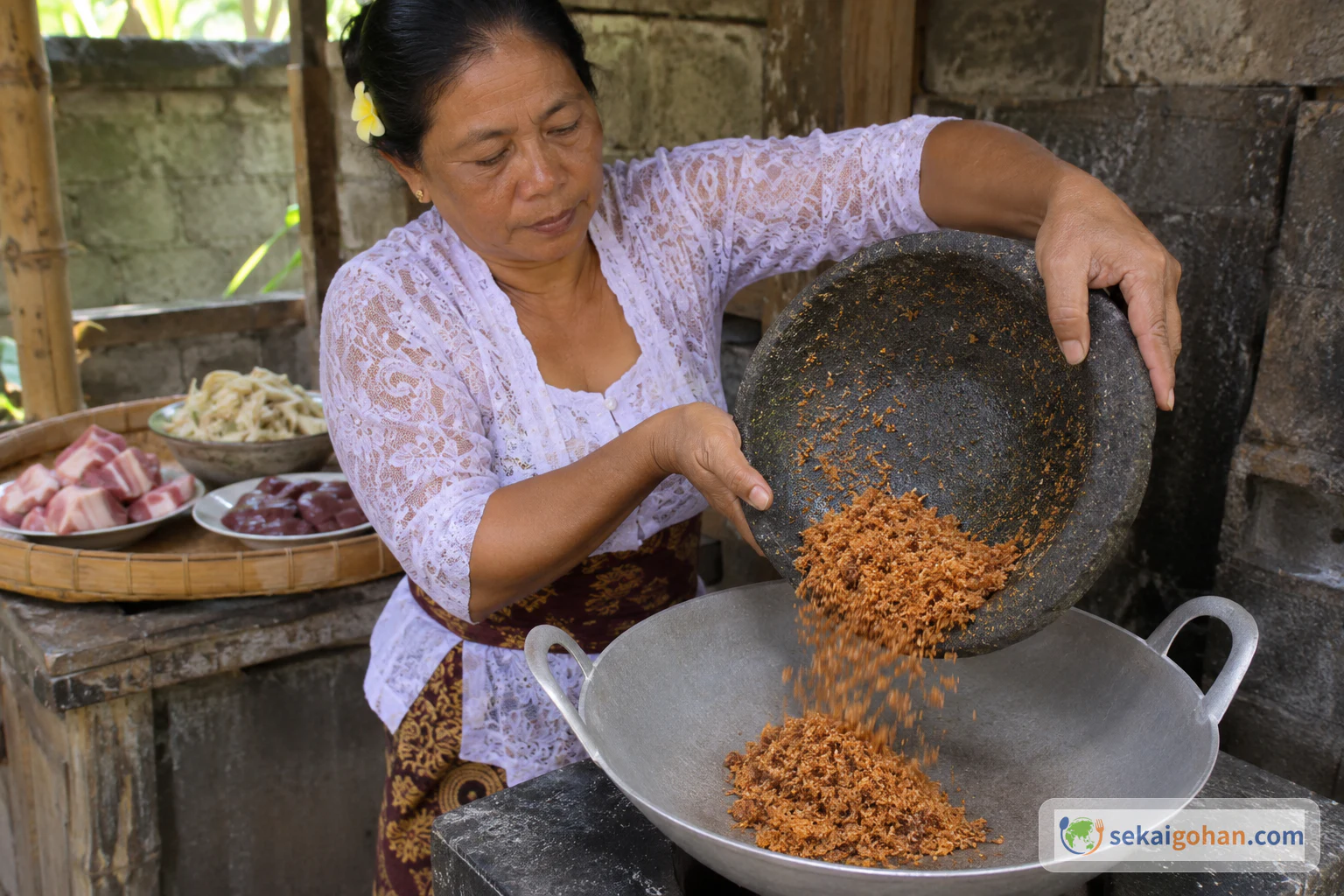
Add the brown coconut to a pan

Tipping the browned coconut pieces into a pan

Tip the crushed pieces into a clean pan. Do not add oil.

STEP 5858 / 81

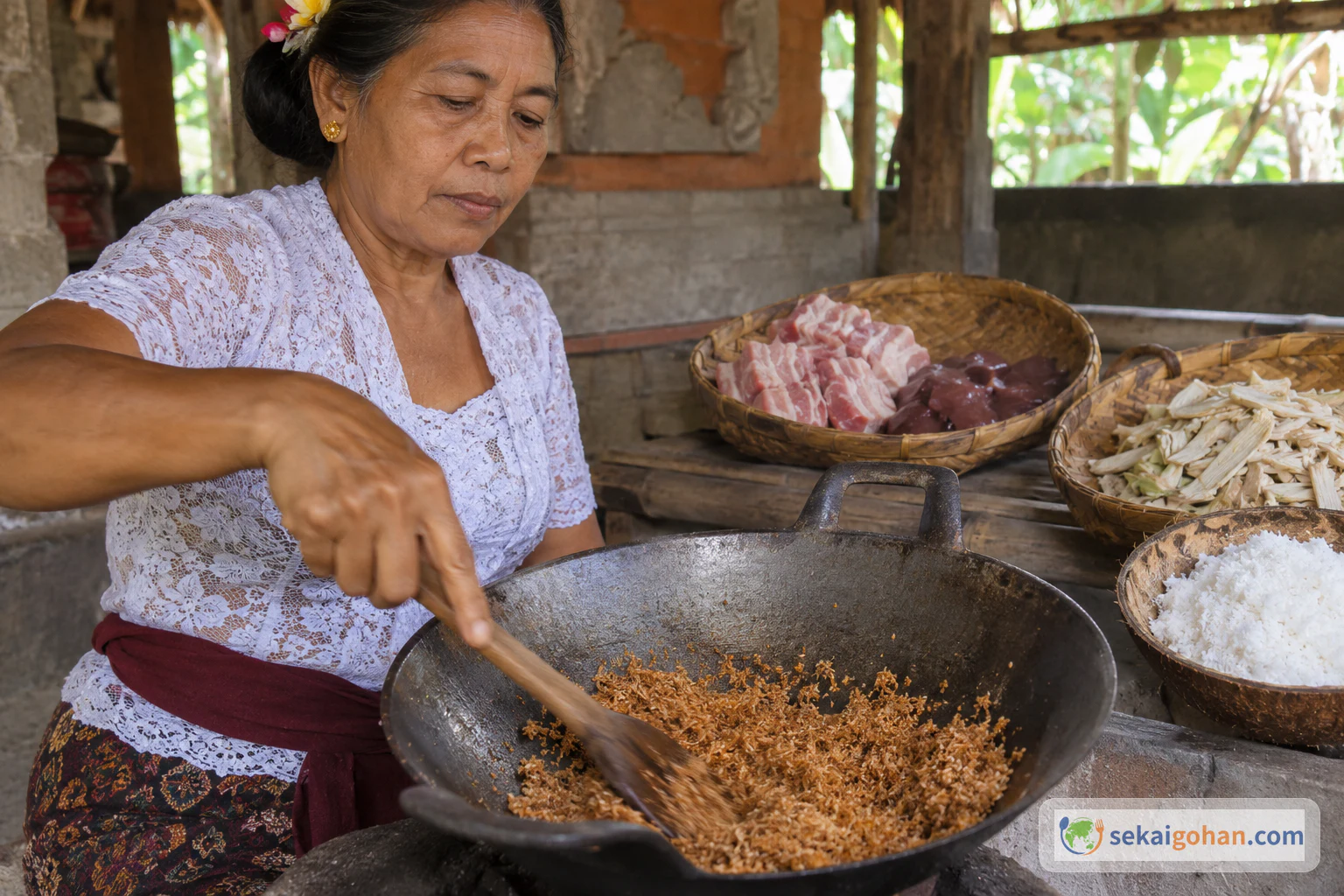
Stir-fry the brown coconut

Stir-frying the browned coconut pieces

Stir-fry the crushed pieces, then set them aside. Keep the white flesh out of the pan.

STEP 5959 / 81

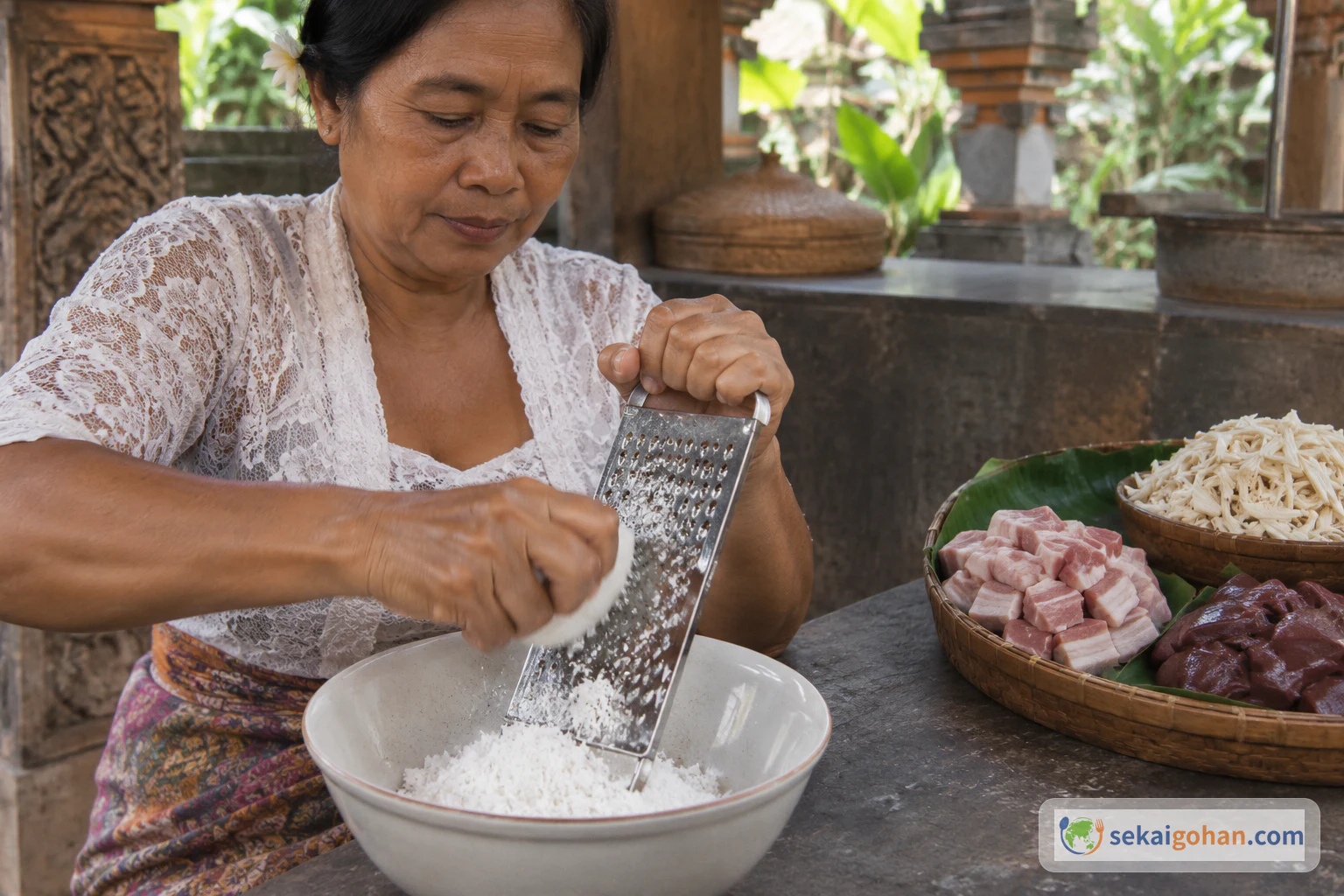
Grate the white coconut

Grating the remaining white coconut into a bowl

Take the remaining white flesh out of the shell if it is still attached, and rinse it lightly under running water. Grate it finely into a clean bowl. Do not heat it.

STEP 6060 / 81

Add oil to the sambal pan

Pouring frying oil into the sambal pan

Pour vegetable oil for frying into a clean pan. Put an empty bowl nearby to collect the fried ingredients.

STEP 6161 / 81

Heat the oil

Heating the oil for the sambal

Heat the oil on its own.

STEP 6262 / 81

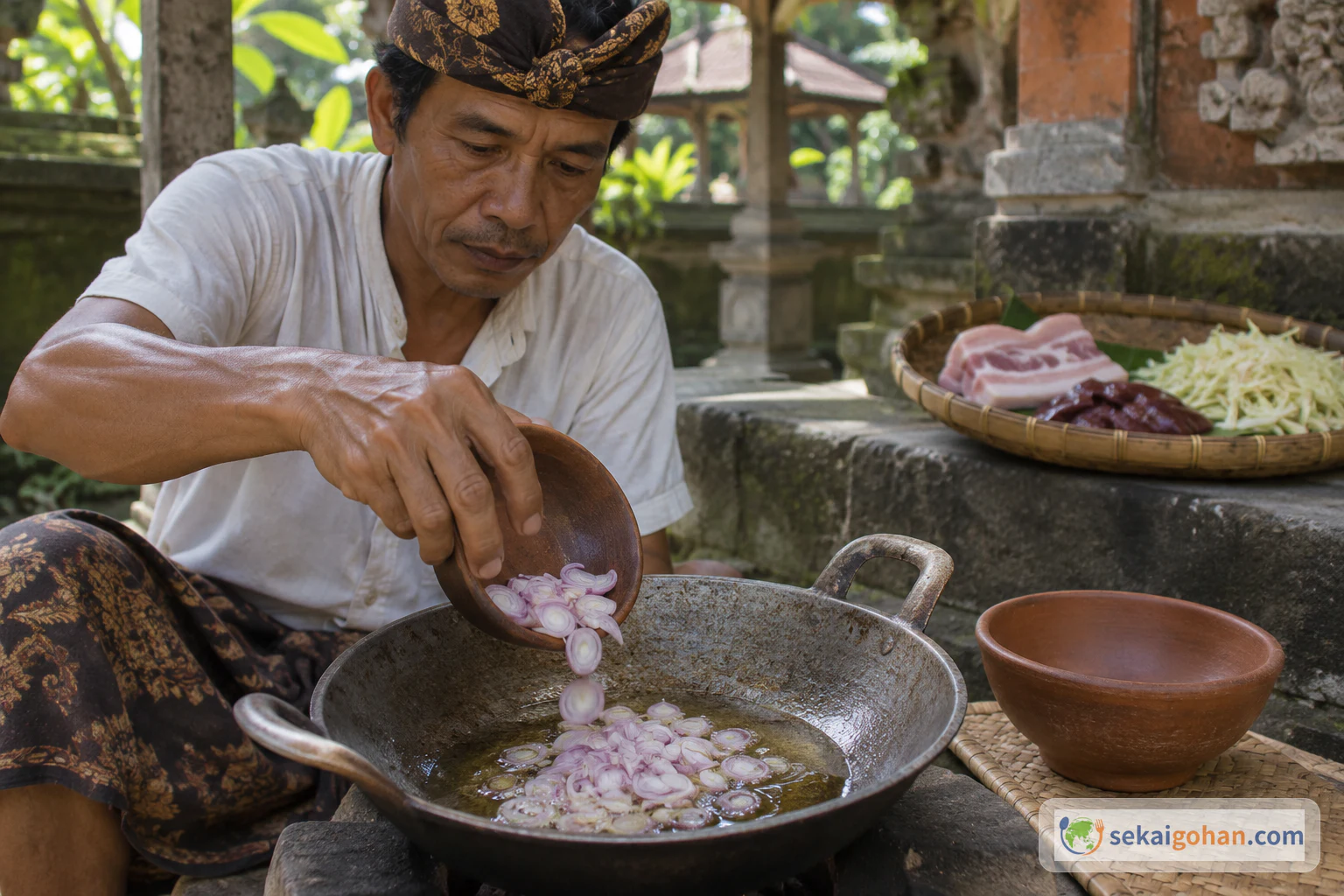
Add the shallots

Adding the shallots to the frying oil

Add the sliced shallots to the hot oil.

STEP 6363 / 81

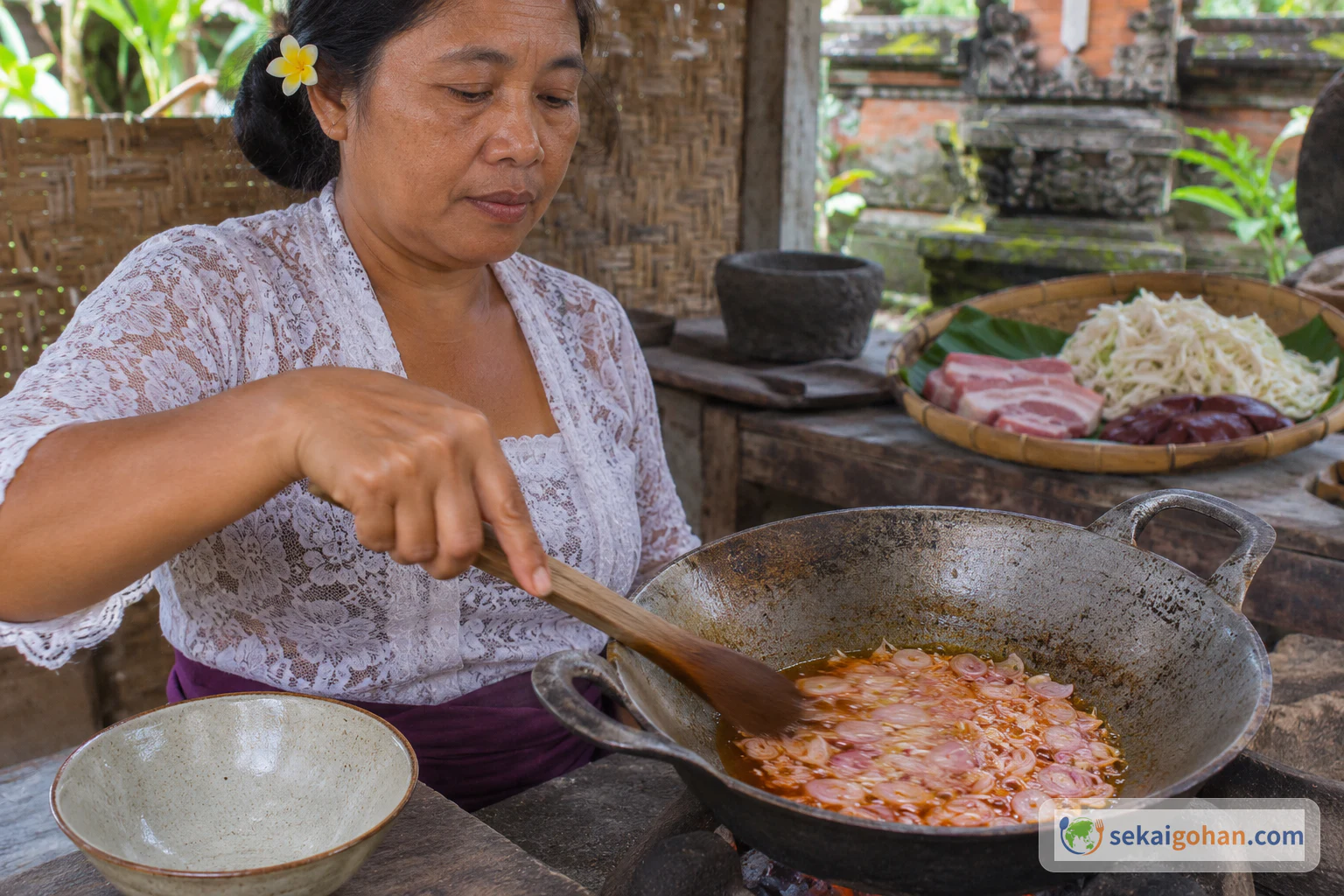
Fry the shallots

Frying only the shallots

Fry the shallots alone until cooked.

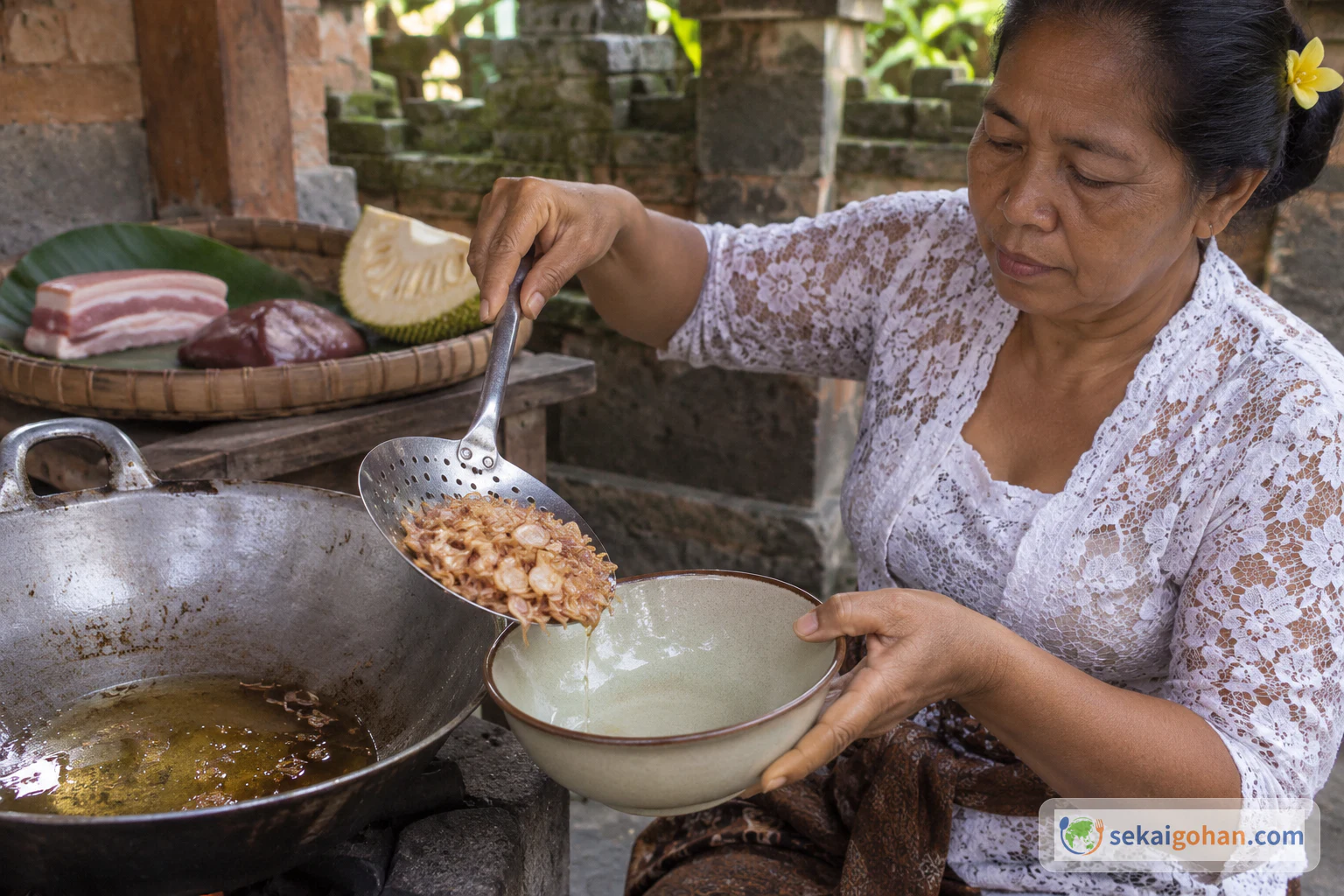
STEP 6464 / 81

Remove the shallots

Lifting the fried shallots out of the oil

Lift the shallots into the empty bowl, leaving the oil in the pan.

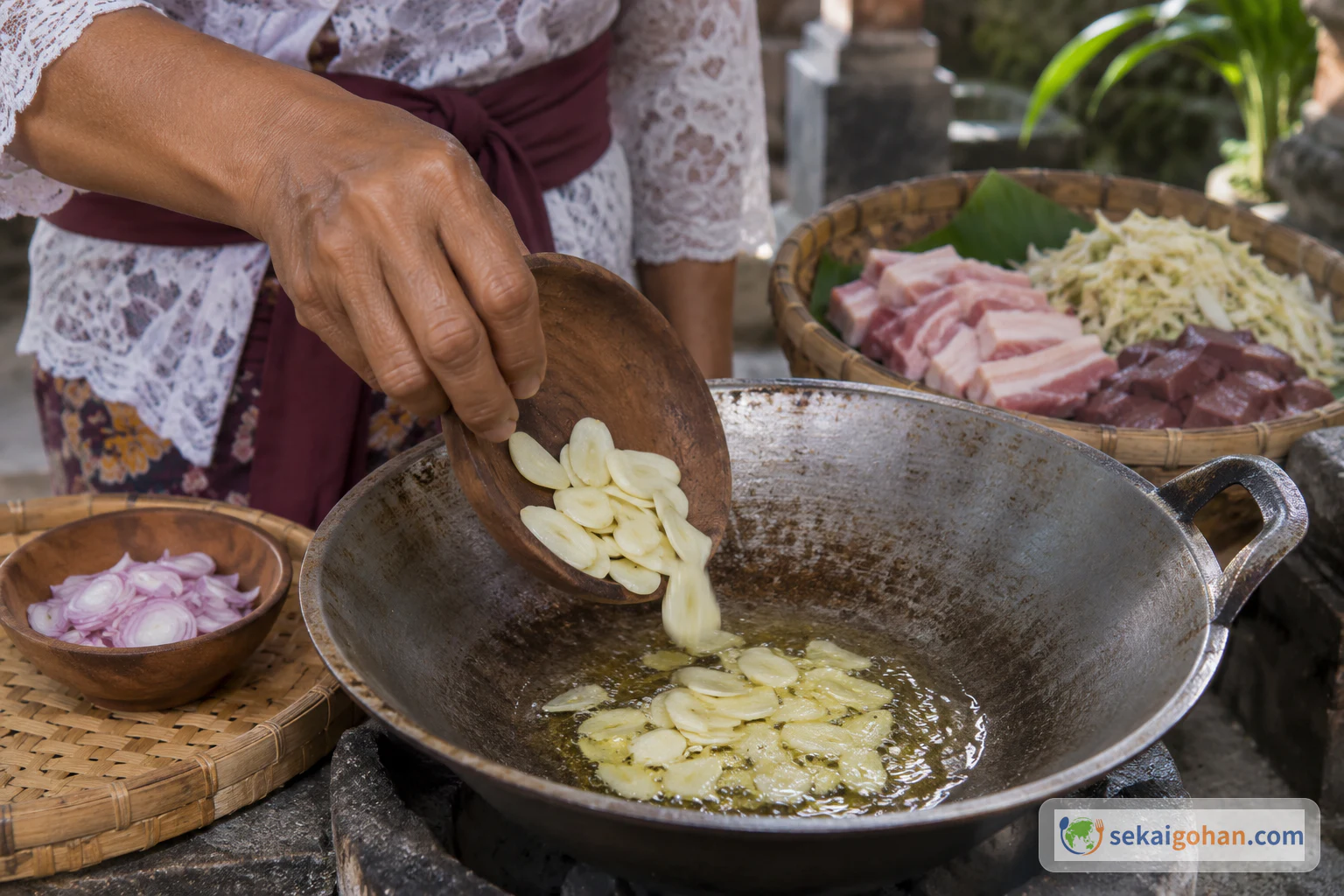
STEP 6565 / 81

Add the garlic

Adding the garlic to the frying oil

Add the sliced garlic to the same oil.

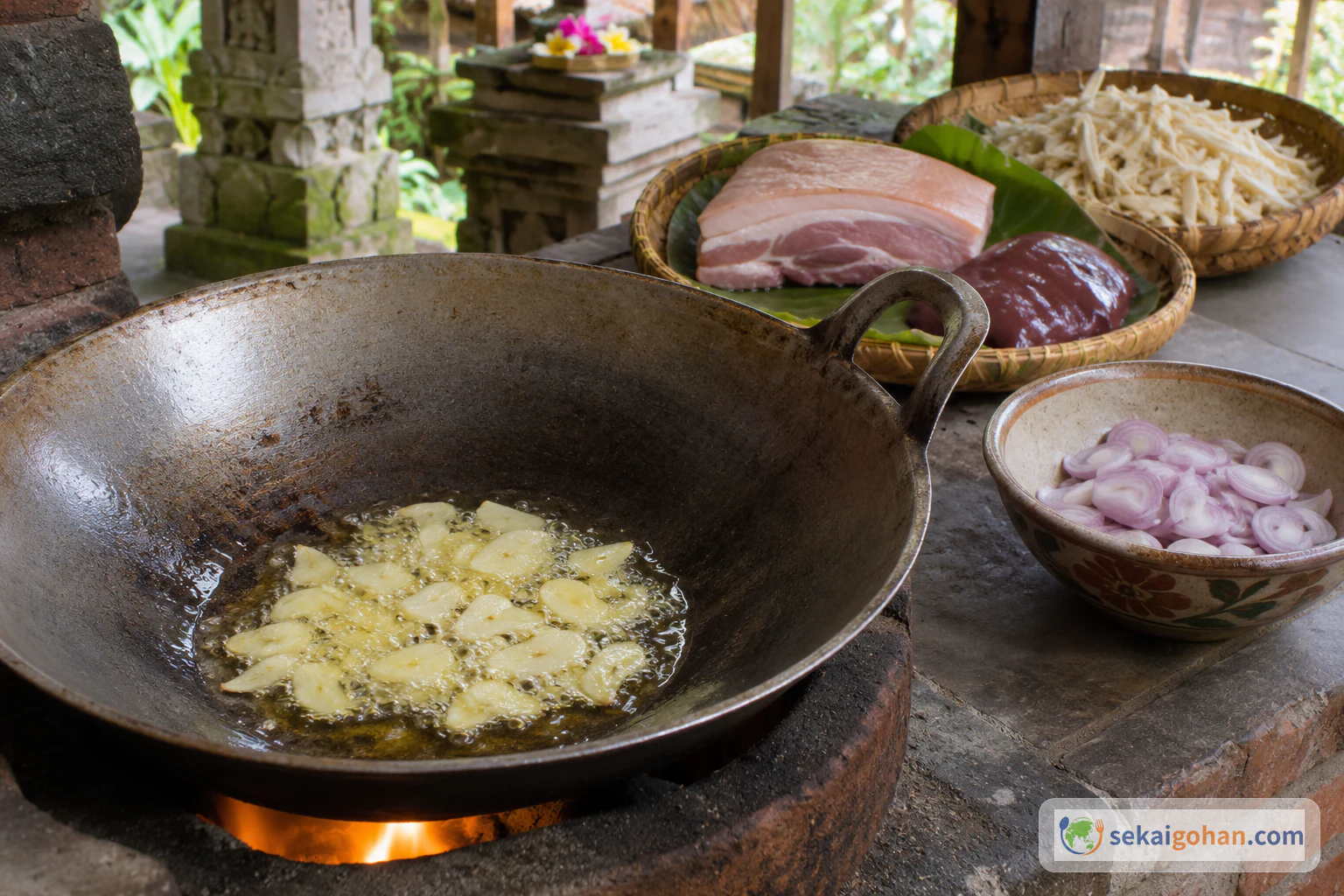
STEP 6666 / 81

Fry the garlic

Frying only the garlic

Fry the garlic alone until cooked.

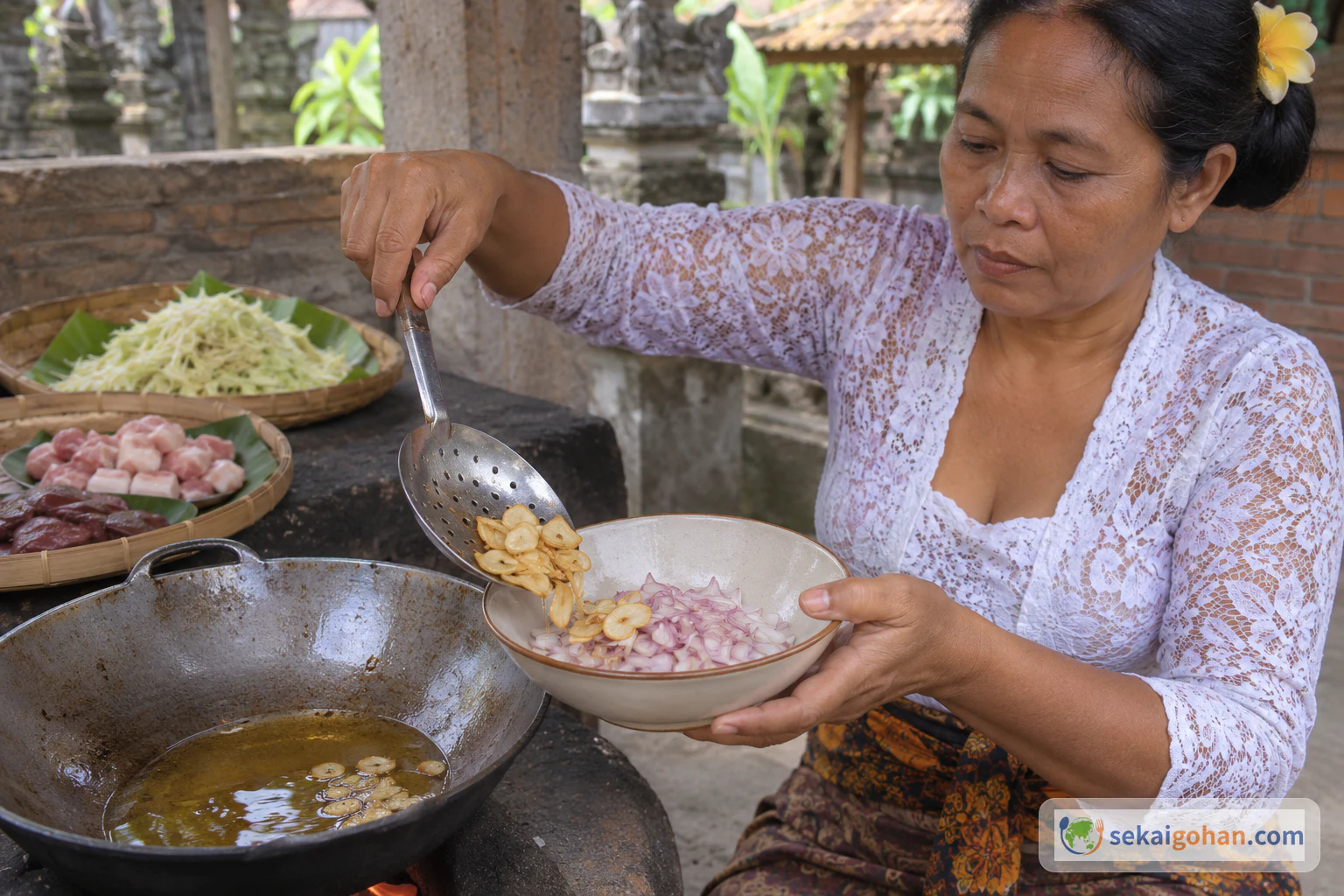
STEP 6767 / 81

Remove the garlic

Lifting the fried garlic out of the oil

Lift the garlic into the bowl with the shallots, leaving the oil in the pan.

STEP 6868 / 81

Add the chilies

Adding the chilies to the frying oil

Add the sliced chilies to the same oil.

STEP 6969 / 81

Fry the chilies

Frying only the chilies

Fry the chilies alone until cooked.

STEP 7070 / 81

Remove the chilies

Lifting the fried chilies out of the oil

Lift the chilies into the bowl with the shallots and garlic, leaving the oil in the pan.

STEP 7171 / 81

Add the shrimp paste

Adding the shrimp paste to the frying oil

Add the 1 tbsp of shrimp paste to the same oil.

STEP 7272 / 81

Fry the shrimp paste

Frying only the shrimp paste

Fry the shrimp paste alone until cooked.

STEP 7373 / 81

Remove the shrimp paste

Lifting the fried shrimp paste out of the oil

Lift the shrimp paste into the bowl with the shallots, garlic and chilies, leaving the oil in the pan.

STEP 7474 / 81

Add the frying oil to the sambal

Pouring the last of the frying oil into the sambal bowl

Pour the remaining frying oil over the ingredients in the bowl. This is your sambal embe.

STEP 7575 / 81

Gather the main ingredients

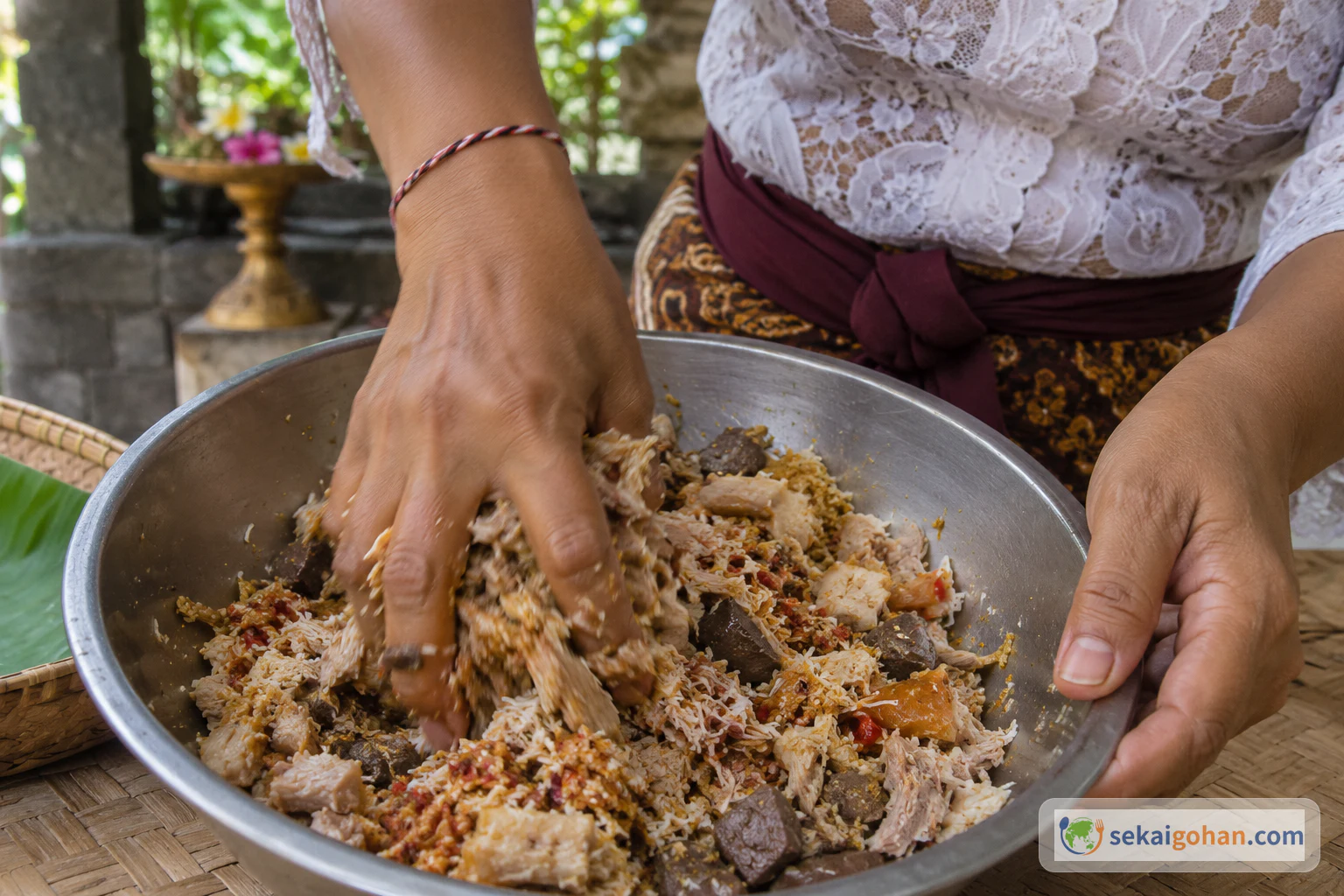
Combining the cooked meats, coconut and seasonings in a bowl

Put the cooked pork, sliced skin, chopped liver, fried brown coconut, grated white coconut, base genep and sambal embe into a clean mixing bowl. Hold back the jackfruit, lime leaves and salt.

STEP 7676 / 81

Mix

Mixing the meats with the coconut and seasonings

Wash your hands or use clean utensils, then mix everything in the bowl thoroughly.

STEP 7777 / 81

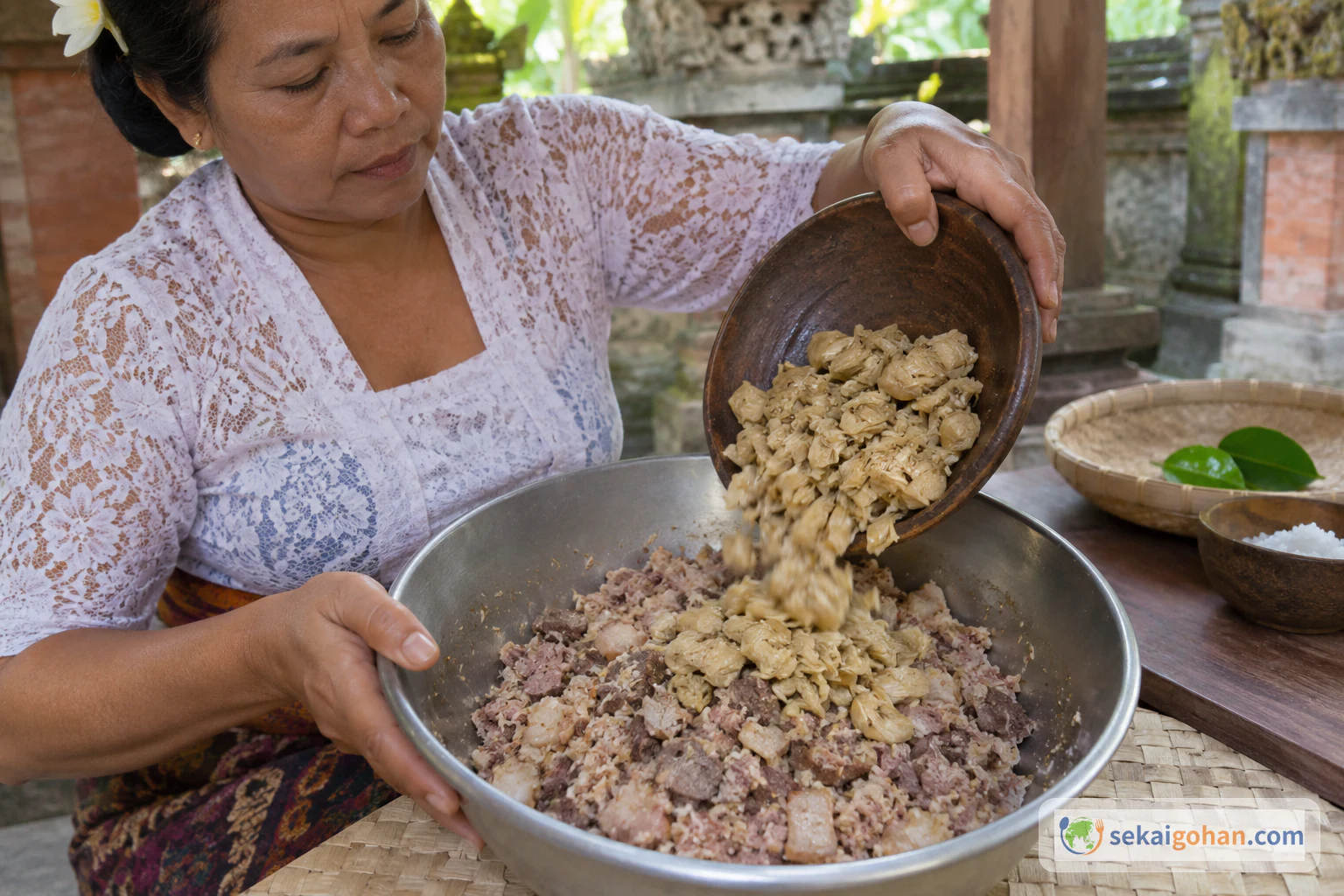
Add the jackfruit

Adding the chopped green jackfruit to the bowl

Add the chopped green jackfruit to the bowl.

STEP 7878 / 81

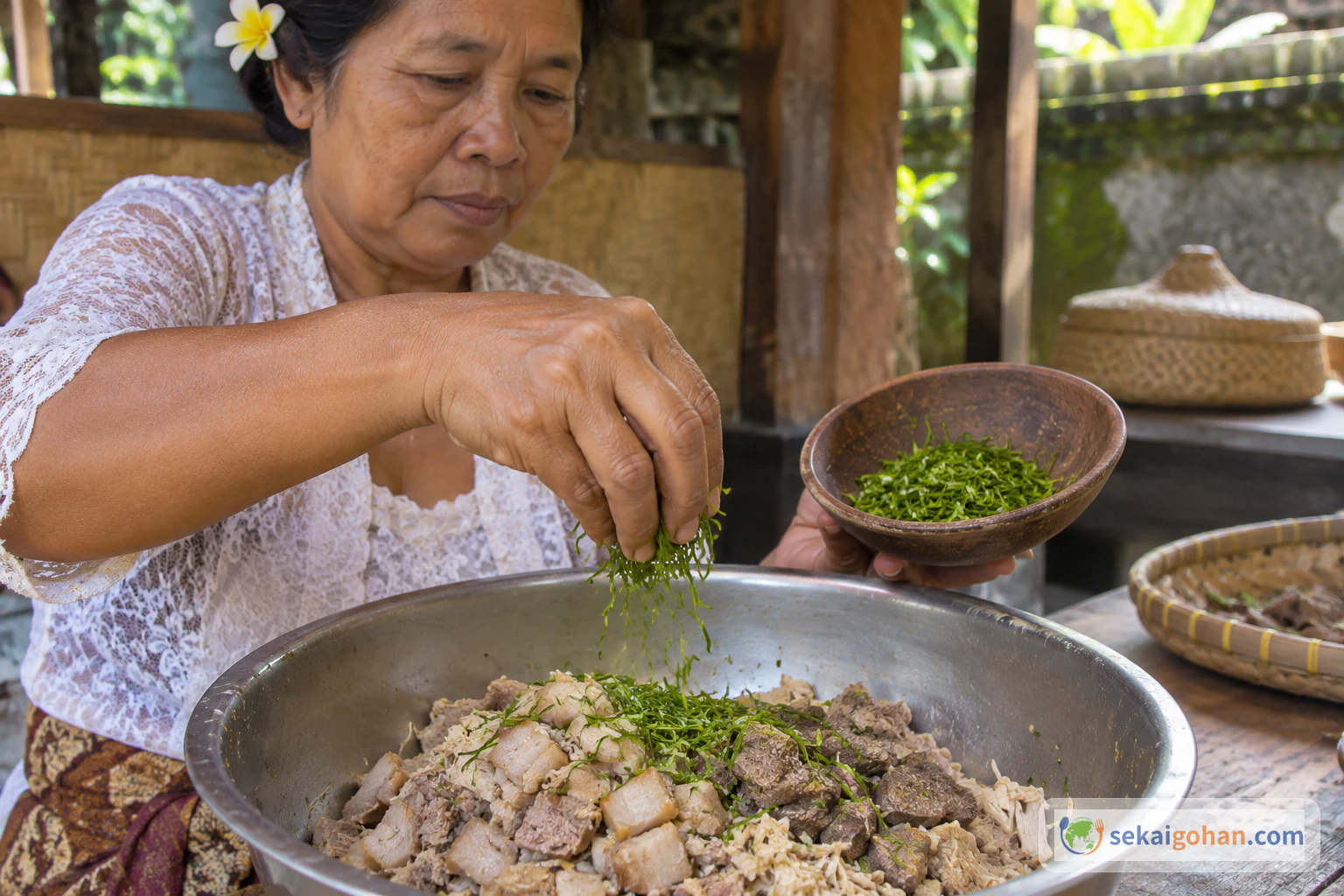
Add the lime leaves

Adding the raw sliced lime leaves to the bowl

Add the raw sliced lime leaves.

STEP 7979 / 81

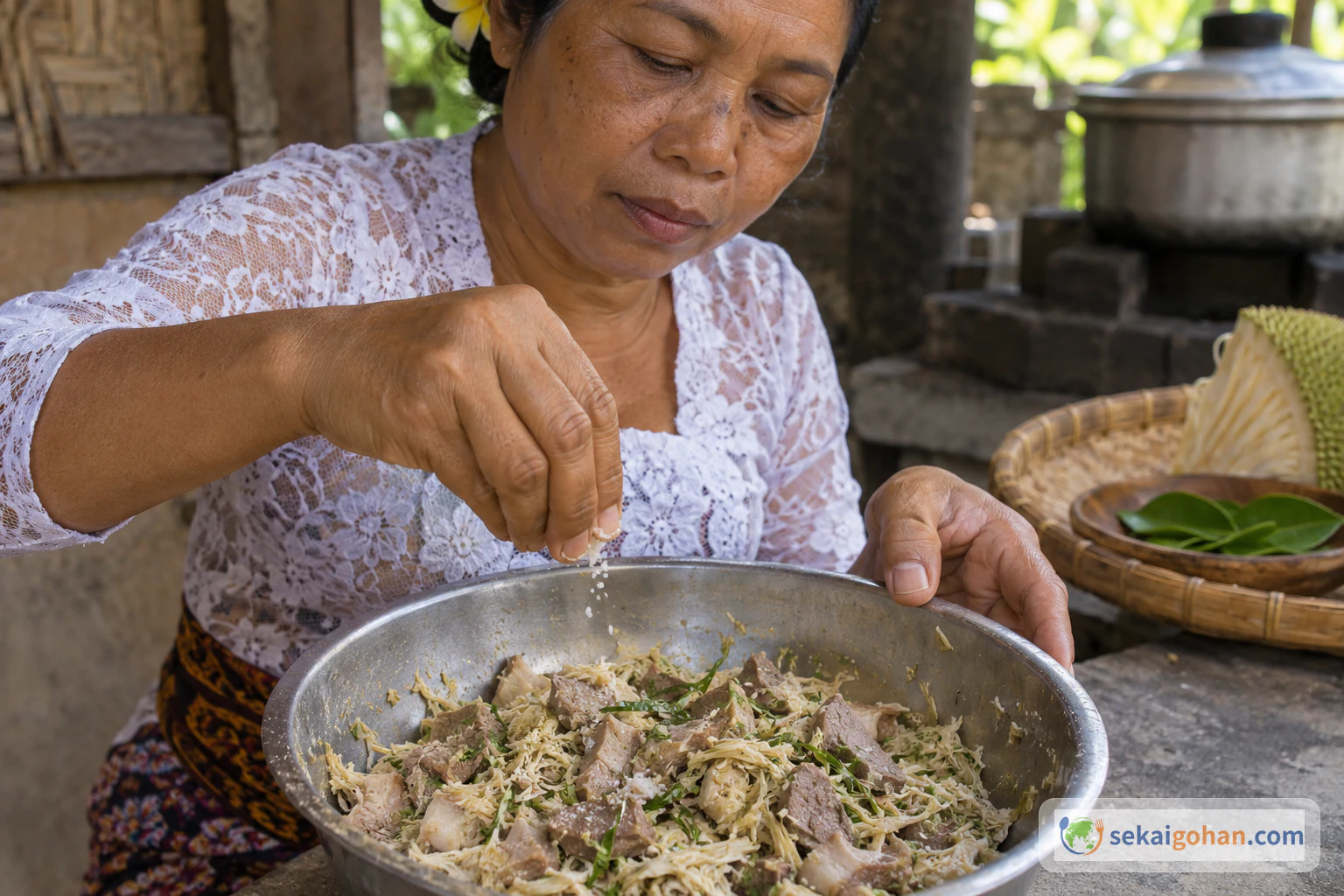
Add the salt

Adding a pinch of salt to the lawar

Add salt to taste.

STEP 8080 / 81

Toss

Tossing the finished lawar in the bowl

Toss everything together. Do not heat the mixture.

STEP 8181 / 81

Serve

Serving the freshly mixed lawar onto a plate

Spoon the freshly mixed lawar onto a clean dish and serve. If you like, add rice and sayur urab on the side, without mixing them in.

0 / 0
Ingredients

Ingredients

1 / 3

Main ingredients

Ingredient Amount Role
Pork belly, skin on 500 g Separate the skin from this same piece. Chop the meat finely and slice the cooked skin
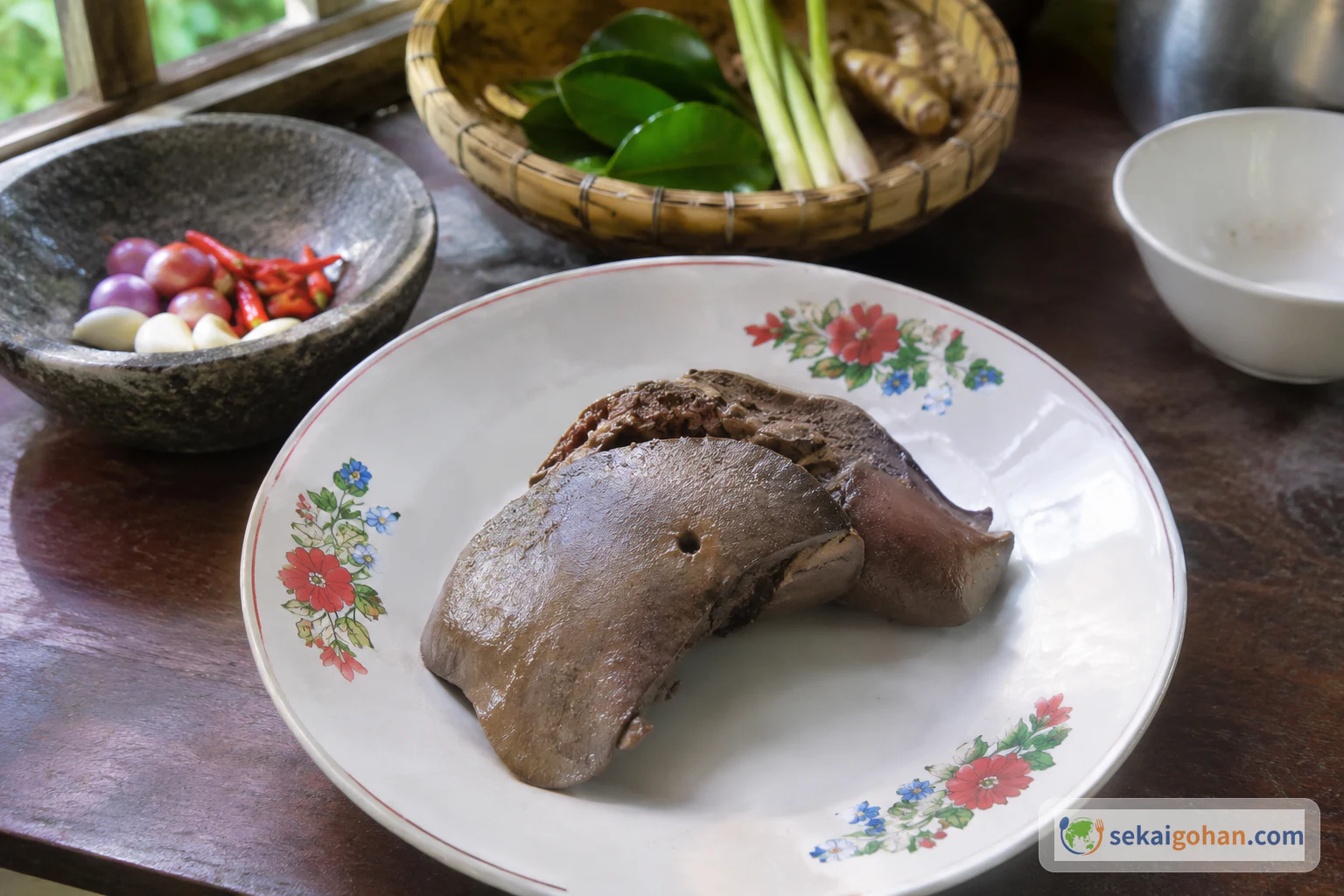
Pork liver 200 g Cooked on a griddle or grill, then finely chopped
Green jackfruit, canned 2 cans Boiled, drained, cooled and chopped
Coconut 1/2 Edible flesh only: thin brown skin fried, white flesh grated raw
Bay leaf 1 Stir-fried with the pork
Kaffir lime leaves 4 Washed, dried, finely sliced and added raw at the end
Vegetable stock 1/2 cube Dissolved in the 1 cup of water below
Water for the stock 1 cup Simmers the pork
Water for boiling as needed Plain water for the skin and the jackfruit, each in its own pot
Vegetable oil a little Stir-frying the pork
Salt to taste Added at the end
2 / 3

Base genep

Ingredient Amount Role
Galangal 5 cm Washed, chopped and ground into the paste
Turmeric 5 cm Washed, chopped and ground into the paste
Ginger 3 cm Washed, chopped and ground into the paste
Kencur 5 cm Washed, chopped and ground into the paste
Coriander seeds 1 tsp Ground into the paste
Sesame seeds 1 tsp Ground into the paste
Black pepper seeds 1/2 tsp Ground into the paste
White pepper seeds 1/2 tsp Ground into the paste
Cloves 2 Ground into the paste
Candlenuts 2 Ground into the paste. Do not taste raw
Cumin seeds 1/2 tsp Ground into the paste
Nutmeg powder 1/2 tsp Ground into the paste
Vegetable oil as needed Frying the paste until cooked
3 / 3

Sambal embe

Ingredient Amount Role
Shallots 4 Peeled, thinly sliced and fried first
Garlic cloves 4 Peeled, thinly sliced and fried second
Chilies 5 Washed, dried, thinly sliced and fried third
Shrimp paste 1 tbsp Fried last
Vegetable oil as needed Frying each ingredient. It all goes into the sambal at the end
0 / 0

Lawar Begins with Chopping: Pork, Liver, Green Jackfruit and Coconut

Before you start

Everything is prepared separately and only comes together in the last few steps. Sekai Gohan has not kitchen-tested this recipe, so this article describes no flavor or texture from our own cooking. Use a food thermometer for the pork, skin and liver.

The introduction to Wayan's lawar recipe on Wil and Wayan's Bali Kitchen describes mebat: a shared job in which people chop meat and spices finely while talking. That description comes from the authors' own recipe and experience, and we don't take it as a picture of every Balinese household. It is still a good way into the dish, because much of the work in this recipe happens with a knife and a board.

Lawar is not one fixed recipe. The same page notes that it can be made with many kinds of meat, and Indonesia Travel, the Ministry of Tourism's site, describes regional differences and a distinction between red and white lawar. This article follows one version only: Wayan's recipe for 6 servings, with skin-on pork belly, pork liver, canned green jackfruit, half a coconut, a cooked spice paste called base genep, and a fried sambal embe. It contains no blood. You can find more of the country's dishes on our Indonesia page.

What we added to Wayan's recipe

The ingredients and the order of the work follow Wayan's recipe. We made these additions and interpretations ourselves:

  • Stock: The ingredient list gives half a stock cube and 1 cup of water, but the method doesn't say where they go. We dissolve the cube in that same cup and use it to simmer the pork. There is no second cup.
  • Center temperature: Wayan's method stir-fries the pork for "a few minutes" and cooks the liver on a griddle or grill. We add a check of at least 75°C at the center, held for at least 1 minute, for the pork, skin and liver, based on a Japanese Ministry of Health, Labour and Welfare notice. This does not come from Wayan's recipe.
  • Washing: Wayan's method finishes with raw sliced kaffir lime leaves and unheated white coconut, and we keep both raw. We add washing the leaves under running water and drying them completely, and lightly rinsing the white coconut flesh before grating.
  • "Brown skin": Wayan's method says to grill the coconut until brown, then "cut the brown skin off, crush it, and stir fry it," without defining the term. Wikipedia describes a thin brown seed coat, about 0.2 mm thick, covering the white coconut meat. We read "brown skin" as that thin surface on the flesh side. This is our interpretation. Wikipedia does not state that the seed coat is safe to eat. The hard shell and husk are never food.
  • Unstated amounts: Wayan's recipe doesn't give the can size, the cup standard, the weight of the skin, or the amounts of oil and salt. We don't estimate or convert them.

Ingredients for 6 Servings
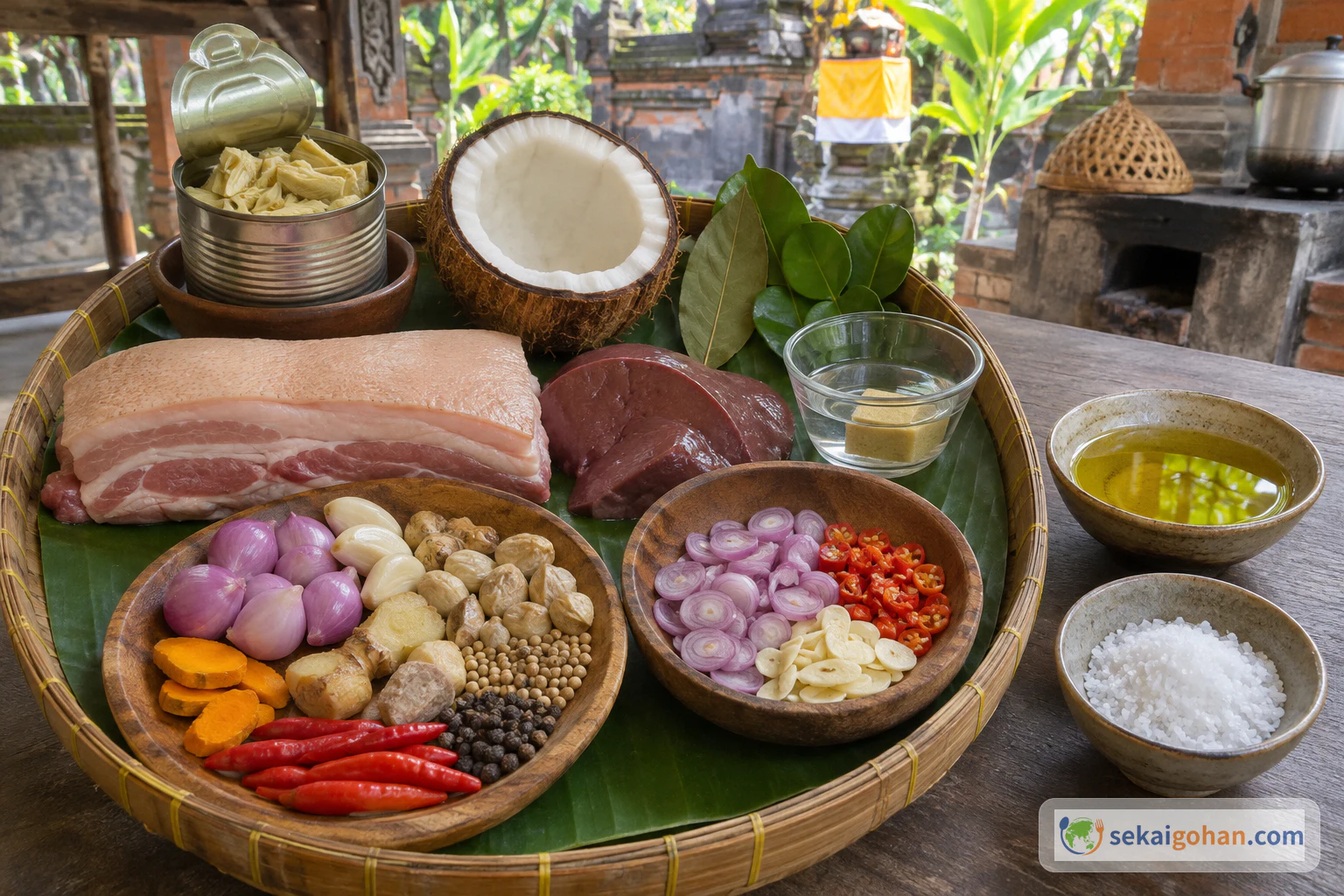
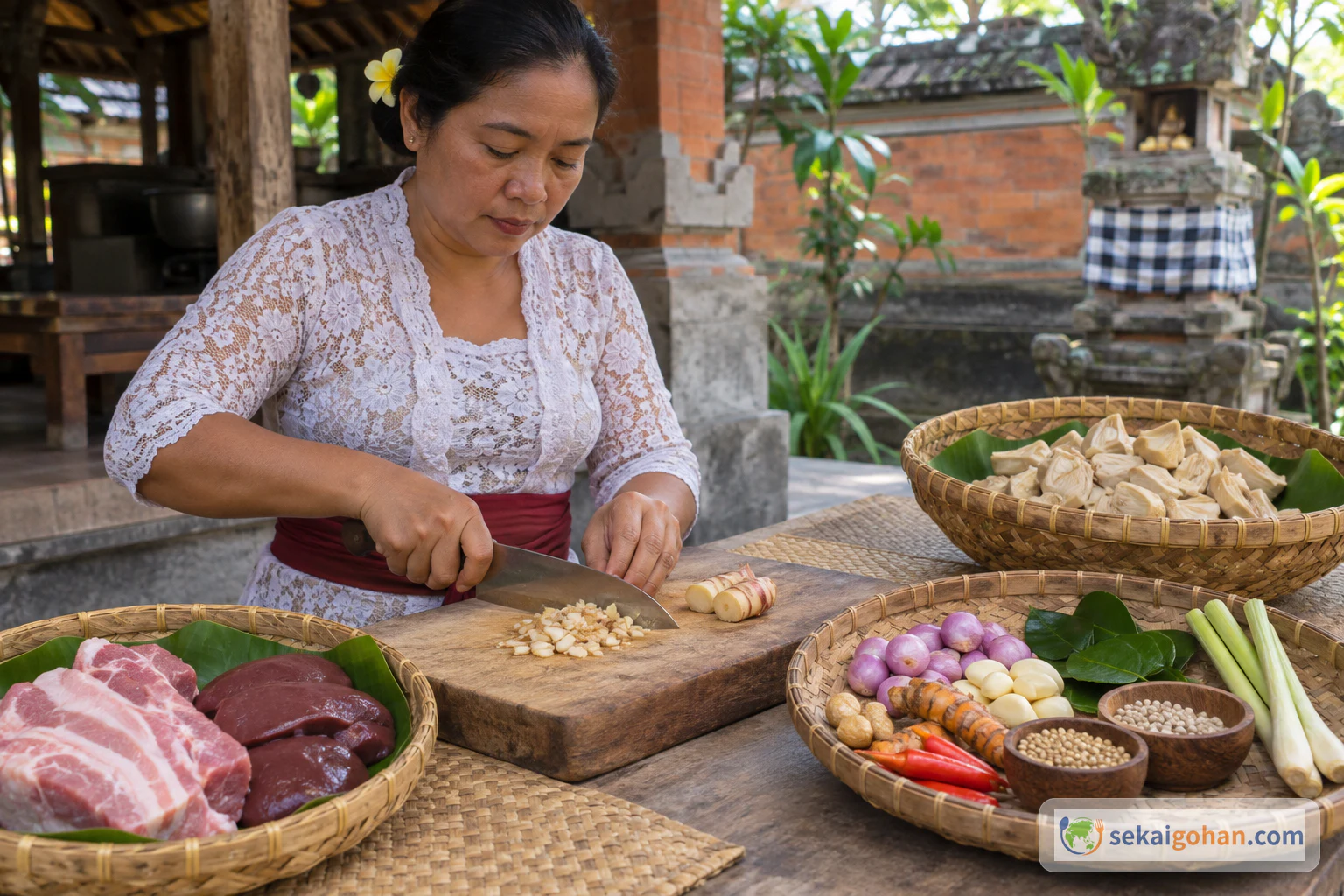
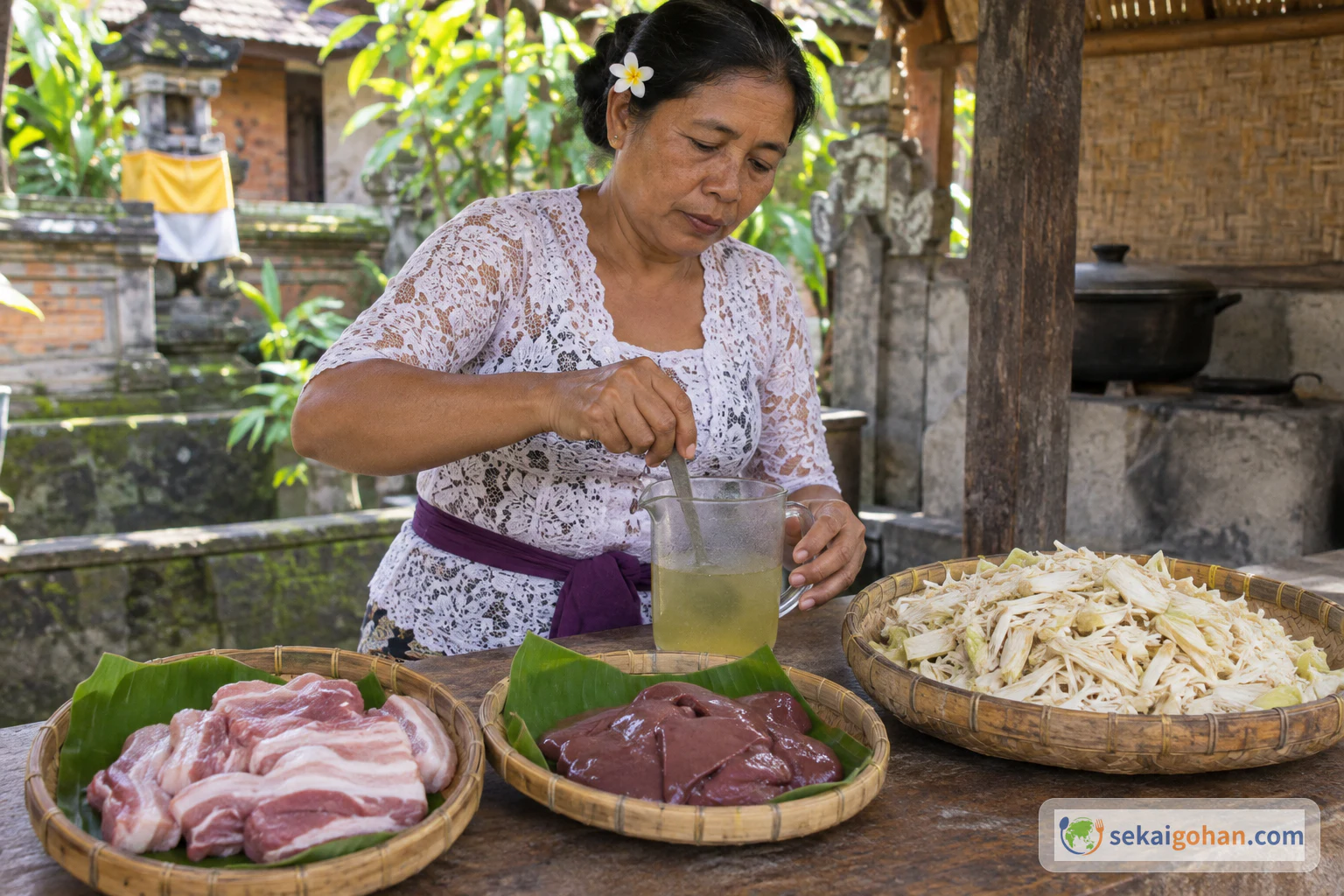
All the ingredients for lawar laid out before cooking

Choosing and Finding What You Need

Green jackfruit in cans, galangal, kencur, candlenuts, kaffir lime leaves and shrimp paste are the items most likely to need an Asian grocer or an online shop. Search by these common names.

  • Kencur: Shop by this name and check the product label. The FAQ explains why we don't swap in another plant name.
  • Rhizomes: The four are prepared separately and are not presented here as interchangeable. If you replace one, you are making a different version, and the flavor will change.
  • Green jackfruit: Choose canned green jackfruit and buy 2 cans of a size you can find.
  • Vegetable stock: Check the ingredients and allergens on the label.
  • Allergens: This recipe contains shrimp paste and sesame seeds.

Equipment

  • Heavy kitchen knife or cleaver for fine chopping
  • Sturdy mortar and pestle, or a food processor
  • Food thermometer with a clean, fine-tip probe
  • Dedicated board, knife, tongs and plate for raw pork and liver
  • Separate clean boards and knives for produce and cooked food
  • Wok for the pork
  • Griddle or grill for the liver and coconut
  • Separate pots for the skin and the jackfruit
  • Separate pans for the base genep, the coconut and the sambal
  • Colander, jug and grater
  • Clean bowls, plates and trays, plus one large mixing bowl

Raw Meat, Liver and Safe Heating

Pork, skin and liver

Japan's Ministry of Health, Labour and Welfare says pork (including offal) and pork liver should be heated through to the center, and states that pathogens are killed at 75°C or above for at least 1 minute at the center. Here, we apply that to the pork, the separated skin and the liver. Measure each one with a clean thermometer. Color, cooking time and photographs do not prove that food is safe.

Keep tools for raw meat and offal away from cooked food and raw produce. Wash your hands after touching raw meat or offal. If you refrigerate raw meat, keep its juices from dripping onto anything else.

The ministry's notice is written for restaurants, and we have applied it to home cooking as an added safety step. FoodSafety.gov also publishes a minimum-temperature chart that covers whole pork cuts and ground pork, but it is not specific to pork liver, so we use the ministry's notice, which names pork liver directly.

Method: Prepare Each Part Separately, Then Combine

How the steps are organized

Steps 1–17 prepare the produce. Steps 18–47 cook the pork, skin, liver and jackfruit. Steps 48–74 make the base genep, coconut and sambal. Steps 75–81 bring everything together.

When Something Goes Off Course

Problem What to check What to do
The pork, skin or liver doesn't hold 75°C for 1 minute The center of the pork mound, the thickest part of the skin, or the thickest piece of liver Keep cooking and measure again. Color and elapsed time can't replace this check
You are tempted to add more stock The recipe uses one cup of water, with the half cube dissolved in it Do not add a second measured cup to the recipe
The base genep starts to catch The heat under the pan Lower the heat and keep stirring until the paste is cooked through without burning
You can't tell which coconut part to use Whether it is hard shell or husk, or the thin brown surface on the white flesh Use only the thin brown surface and the white flesh. Never crush or eat the hard shell or husk
A sambal ingredient is still in the oil when the next is ready The pan should hold only one ingredient at a time Lift the earlier ingredient into the bowl before adding the next
A raw-meat tool is the one closest to hand during assembly The tools used for cooked food and raw produce Use a clean tool instead. Don't let raw-meat tools touch cooked food, lime leaves or coconut
The finished lawar needs more seasoning The salt, which has no set amount Add a little salt and toss again

Variations: Other Kinds of Lawar

Other lawar recipes exist, but we haven't blended them into this one. Each would need its own recipe.

Variation Who describes it How it relates to this recipe
Lawar with other meats Wil and Wayan's Bali Kitchen notes the range of lawar This article uses only pork belly, skin and liver
Red and white lawar Indonesia Travel describes this distinction Mentioned here as cultural background only, not as a label for this recipe
Lawar nangka Budaya Bali gives a separate example A different recipe, so its amounts and method are not used here
Lawar merah with blood A review by Prastowo et al. in the Journal of Ethnic Foods lists it This recipe contains no blood

Wayan's recipe suggests serving lawar with rice and sayur urab. Keep them on the side as accompaniments, not as ingredients.

Lawar in Its Wider Context

Indonesia Travel introduces lawar as a Balinese dish and points to differences between regions, while Budaya Bali shows that a separate recipe can be built around jackfruit. Prastowo and colleagues' review of Indonesian offal-based dishes includes an entry for lawar merah and also describes nglawar, the communal making of the dish. Wayan's page describes mebat in its own words as chopping and talking together.

These sources show a dish with many forms, often connected to shared work. They do not establish the history of this particular pork and jackfruit recipe, and the review is not a test of Wayan's recipe. We also make no claim here about lawar's origin or its full religious and ritual meaning.

Frequently Asked Questions

How many grams are in the 2 cans of jackfruit?

Wayan's recipe doesn't give a can size or weight, and we don't guess one. Use 2 cans of green jackfruit of a size you can find.

What can I use instead of kencur?

We don't offer an equivalent. In the comments on Wayan's recipe, one reader disputes equating kencur with "lesser galangal" and mentions Kaempferia galanga and sand ginger, while the site's replies refer to asking for it in shops as kencur and say it is sometimes called white ginger. That doesn't settle the plant's identity, so we keep the name kencur. If you use something else, treat the result as a different version.

Is this the same as red lawar?

No. Indonesia Travel distinguishes red and white lawar, and the review by Prastowo et al. lists lawar merah made with blood. This recipe has no blood, and we mention those types only for comparison.

How many minutes should I cook the liver?

We give no set time. Wayan's method says to griddle or grill it until cooked, and we add a center-temperature check. Measure the thickest piece and make sure it stays at 75°C or above for at least 1 minute. Browning doesn't prove the center is done.

Why do the lime leaves and white coconut stay raw?

Wayan's method adds them to the finished mixture without cooking, and we keep that finish rather than turning it into a cooked version. We add washing and drying the leaves and rinsing the coconut flesh. These are our handling additions, not a guarantee of safety. The pork, skin, liver and jackfruit are all cooked before they go in.

What exactly is the coconut's "brown skin"?

Wayan's method doesn't define the term. We read it as the thin brown surface on the flesh side, matching Wikipedia's description of a seed coat about 0.2 mm thick. This is our interpretation, and Wikipedia does not state that the seed coat is safe to eat. Under this interpretation, the hard shell and husk are not used as food.

Should I mix rice or sayur urab into the lawar?

No. Wayan's recipe suggests serving lawar with them, so keep them on the side. This article does not include a separate recipe for sayur urab.

Sources