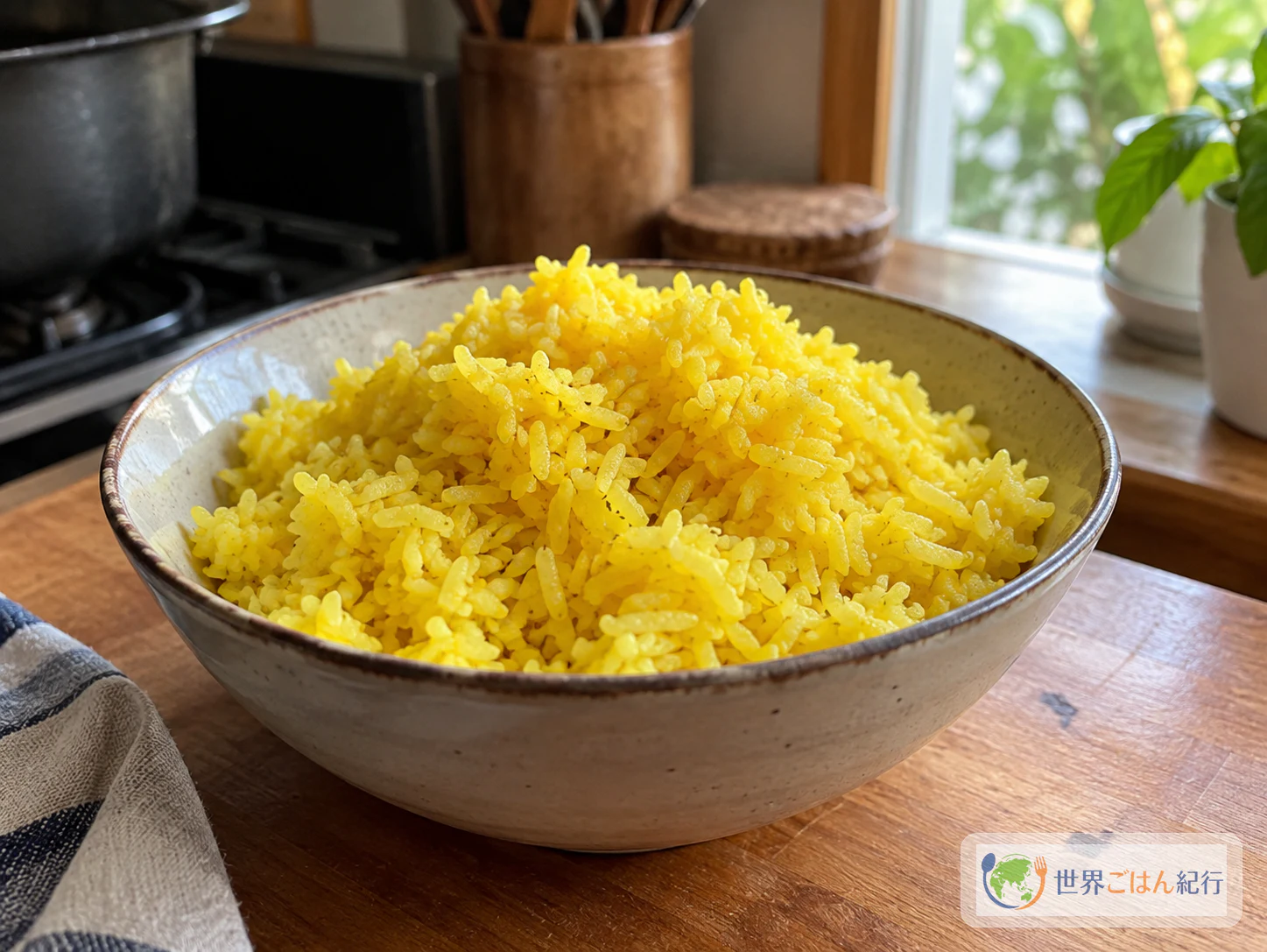
Nasi Kuning: Rice Colored with Fresh Turmeric and Steamed Twice
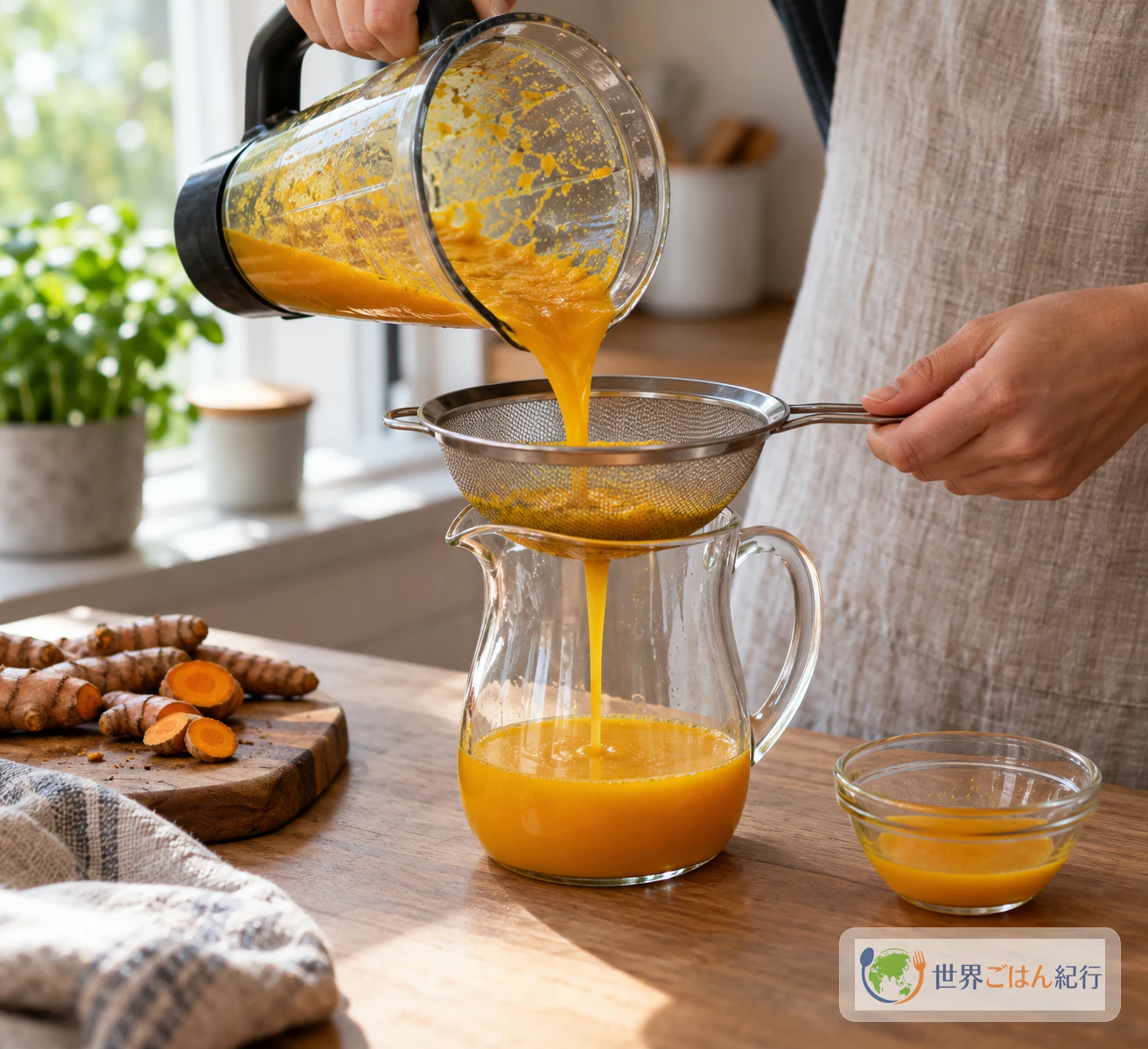
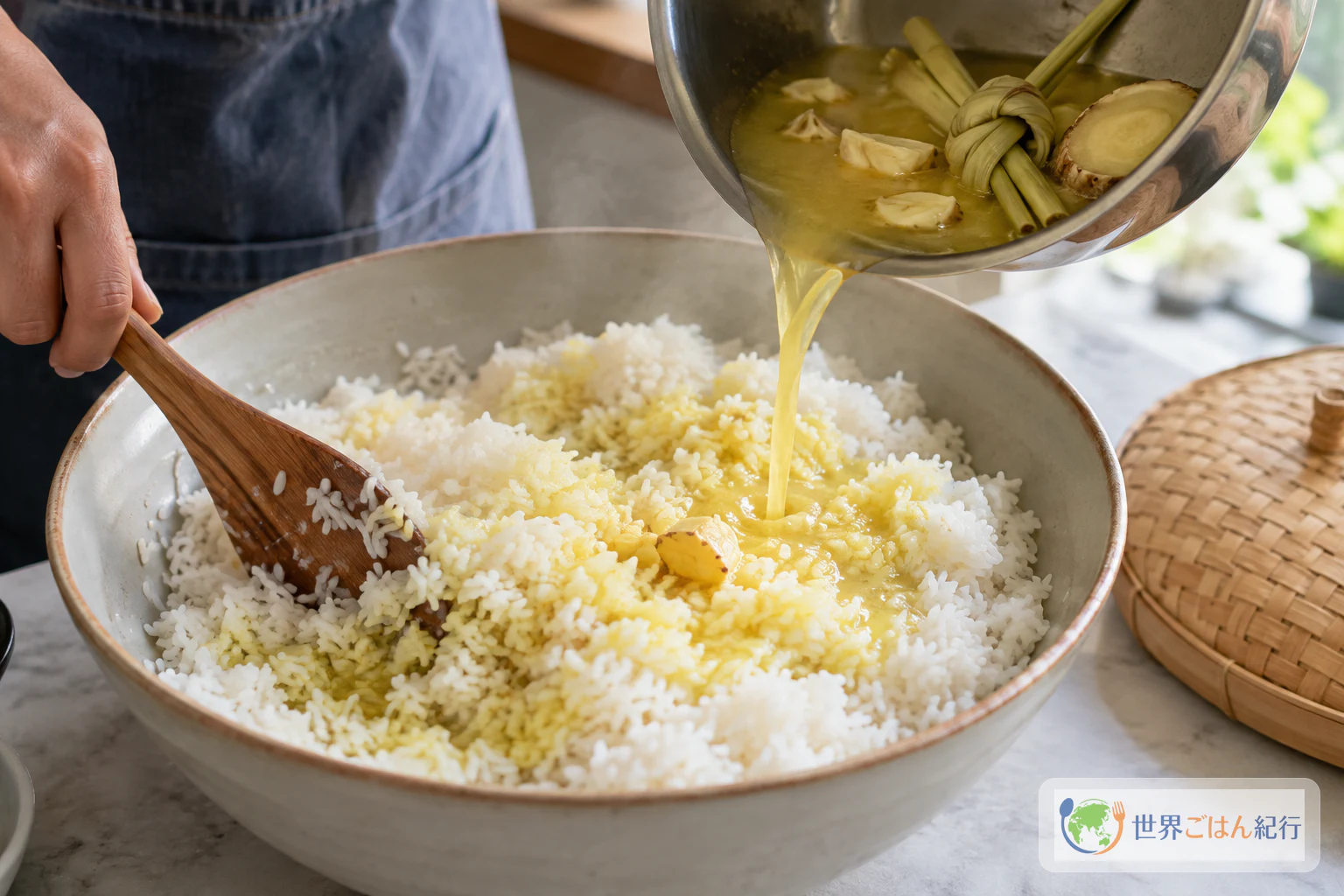
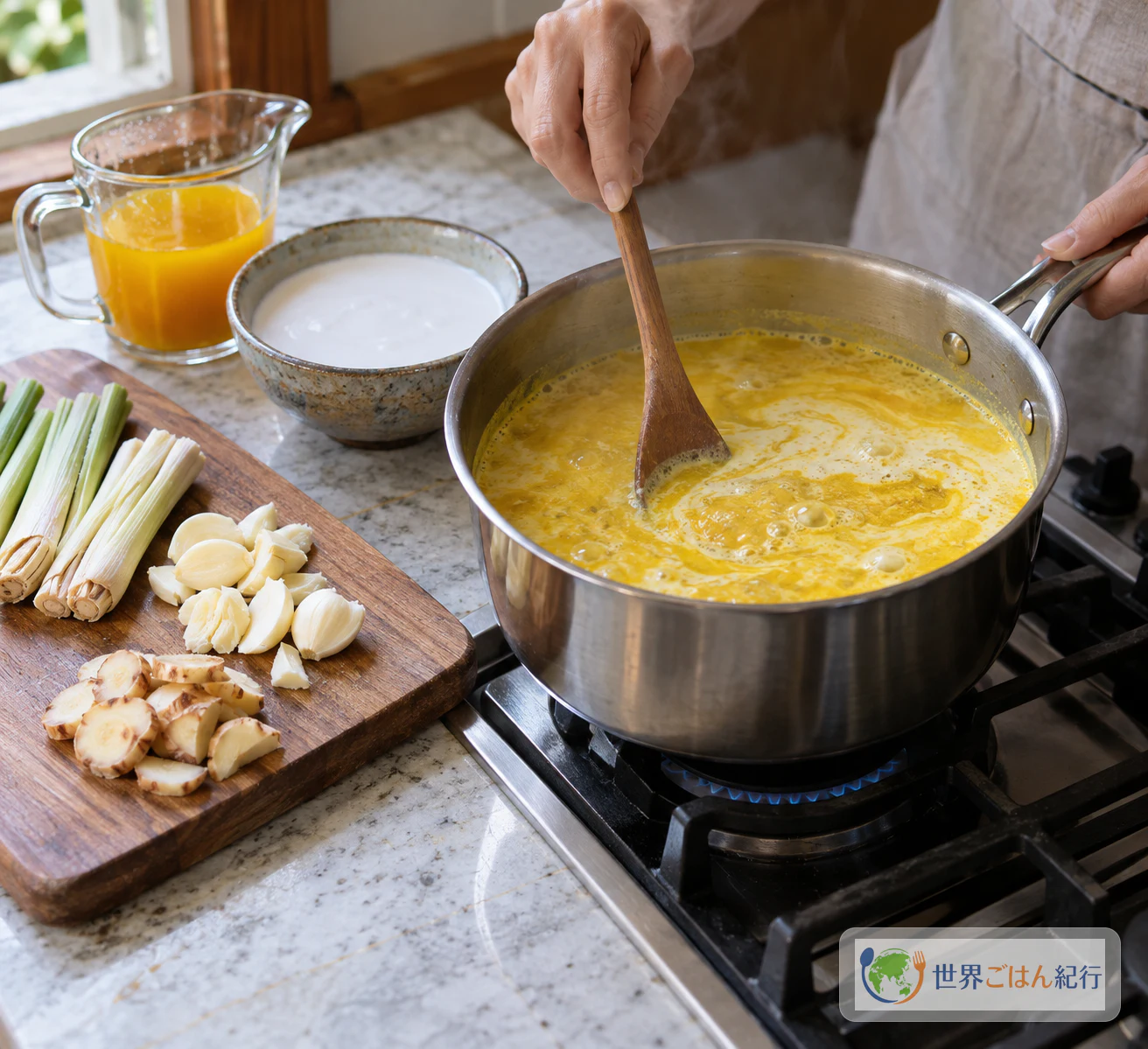
The color comes from turmeric water made from fresh turmeric root, and only 100ml of that liquid goes into the rice. The aroma comes from coconut milk, garlic, lemongrass and galangal. The rice is steamed once, soaks up the hot liquid, and is then steamed again until done.
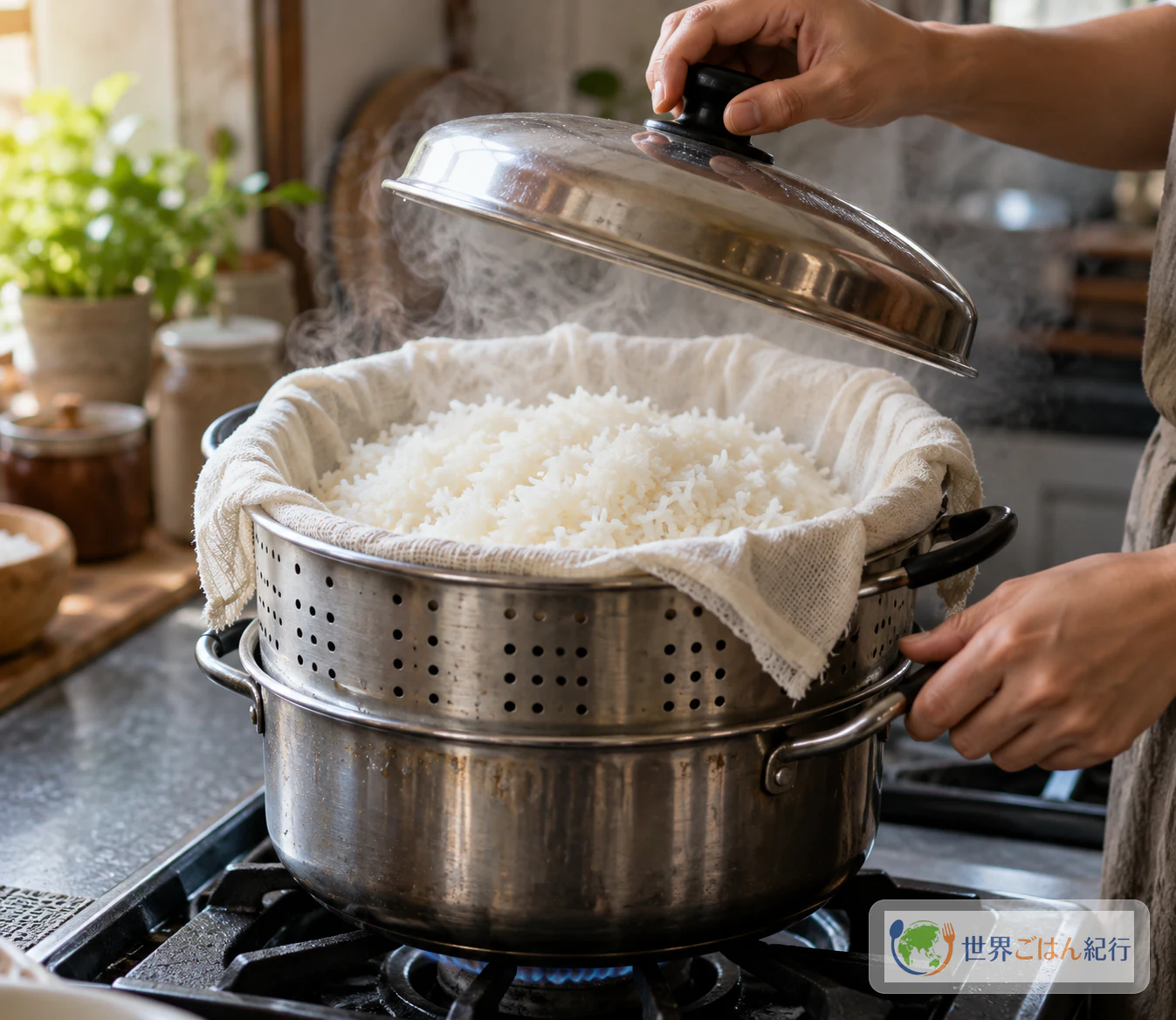
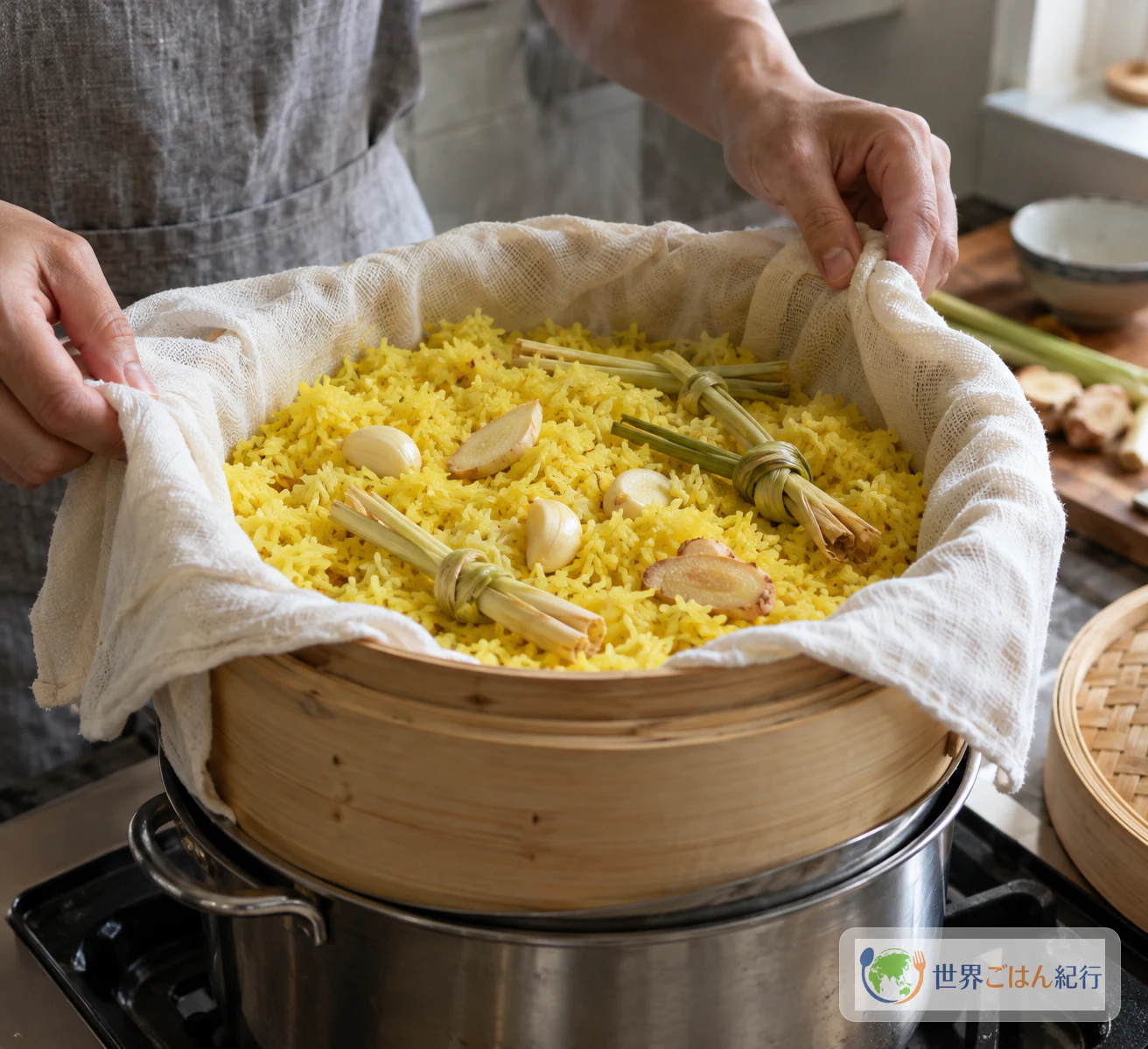
Nasi kuning means "yellow rice." The version here follows one recipe from Paon: Real Balinese Cooking by Tjok Maya Kerthyasa and I Wayan Kresna Yasa, as published by SBS Food. The rice is first steamed plain, then soaked in hot liquid tinted with turmeric and enriched with coconut milk, garlic, lemongrass, galangal and sea salt, and finally steamed a second time.
In the book, the yellow color of the rice carries meaning within a Balinese context. This article keeps that meaning tied to Bali rather than presenting it as a single story for all of Indonesia.
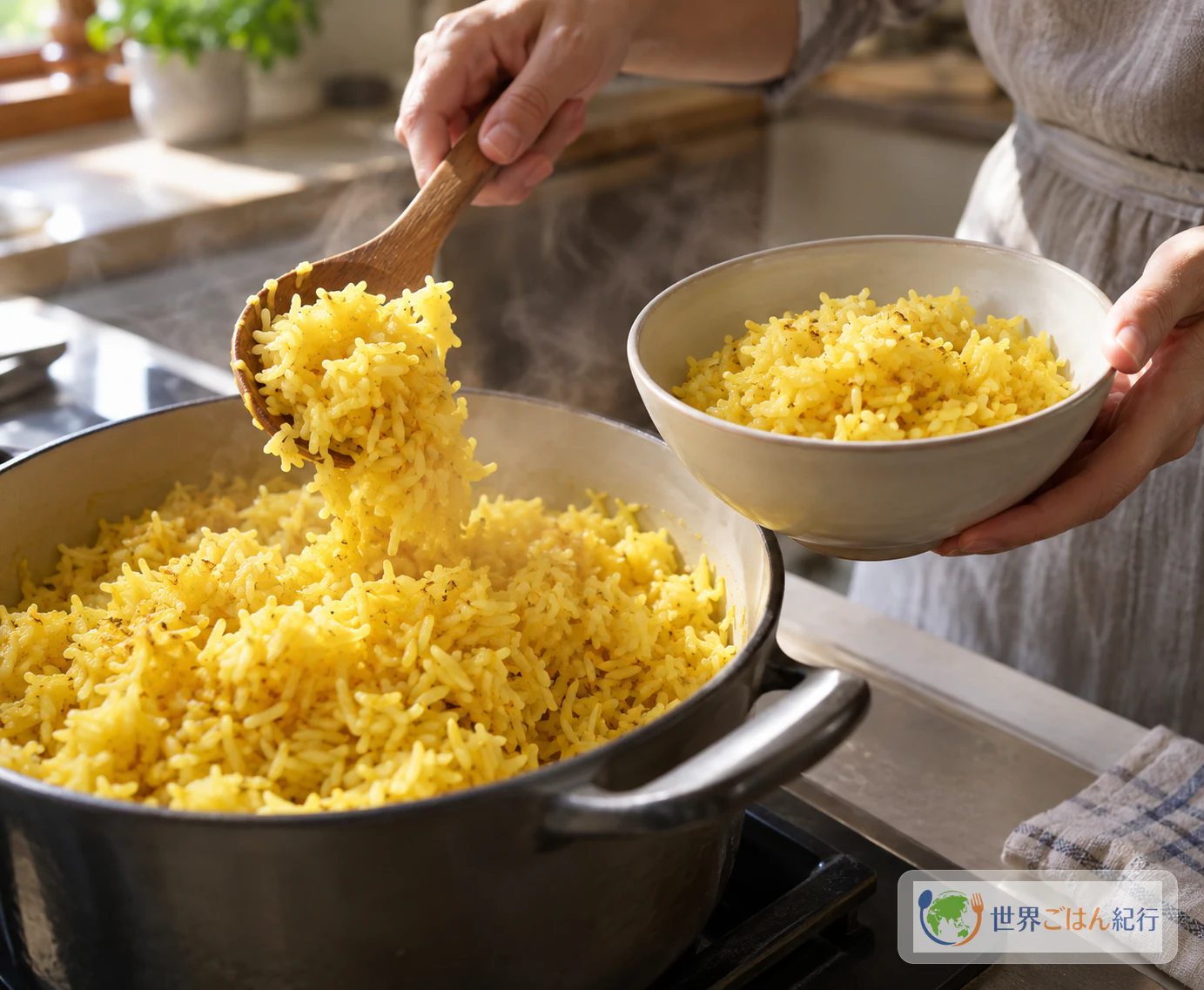
The recipe is written for 1kg of rice and gives a finished amount of about 2kg. The book also notes that the recipe is not suited to being made in a smaller quantity, so the amounts here are kept at the original scale. As a guide, the book gives about 20 minutes of preparation and 55 minutes of cooking; steamers and stovetops differ, so judge by the state of the rice rather than the clock alone.
This recipe uses water for three separate jobs: 500ml to make the turmeric water, 800ml as the cooking liquid for the rice, and additional water for soaking the rice and filling the steamer. Of the strained turmeric water you make, use only 100ml. Do not pour all of it into the rice, and do not confuse it with the 800ml of cooking liquid.
Nasi Kuning and Tumpeng: A Rice Dish and a Way of Presenting It
Nasi kuning is a way of cooking rice. Tumpeng is something different: a way of presenting rice and side dishes shaped into a cone. A page from BPSMP Sangiran, on the Indonesian Ministry of Education and Culture portal, describes tumpeng in exactly those terms and connects it mainly with selamatan gatherings in Java, Sunda, Madura and Bali. The same page offers its own interpretation of the cone's symbolism, and notes that while yellow rice is common for tumpeng, white rice and nasi uduk are also used.
So a cone is not a requirement for nasi kuning, and tumpeng is not always yellow. A paper in the Journal of Ethnic Foods discusses nasi tumpeng kuning in relation to Hindu beliefs, Mount Meru and symbolism; that is the paper's interpretation, not a settled account of where nasi kuning comes from. A recipe page from the Culinary Institute of America likewise gives its own explanation of color symbolism in Bali, which is best read as that document's account rather than a statement that applies across the country.
It is not accurate to say that nasi kuning is always eaten at celebrations, or that it is always served as a cone. This recipe makes the rice itself; how it is shaped and what it is served with are separate choices.
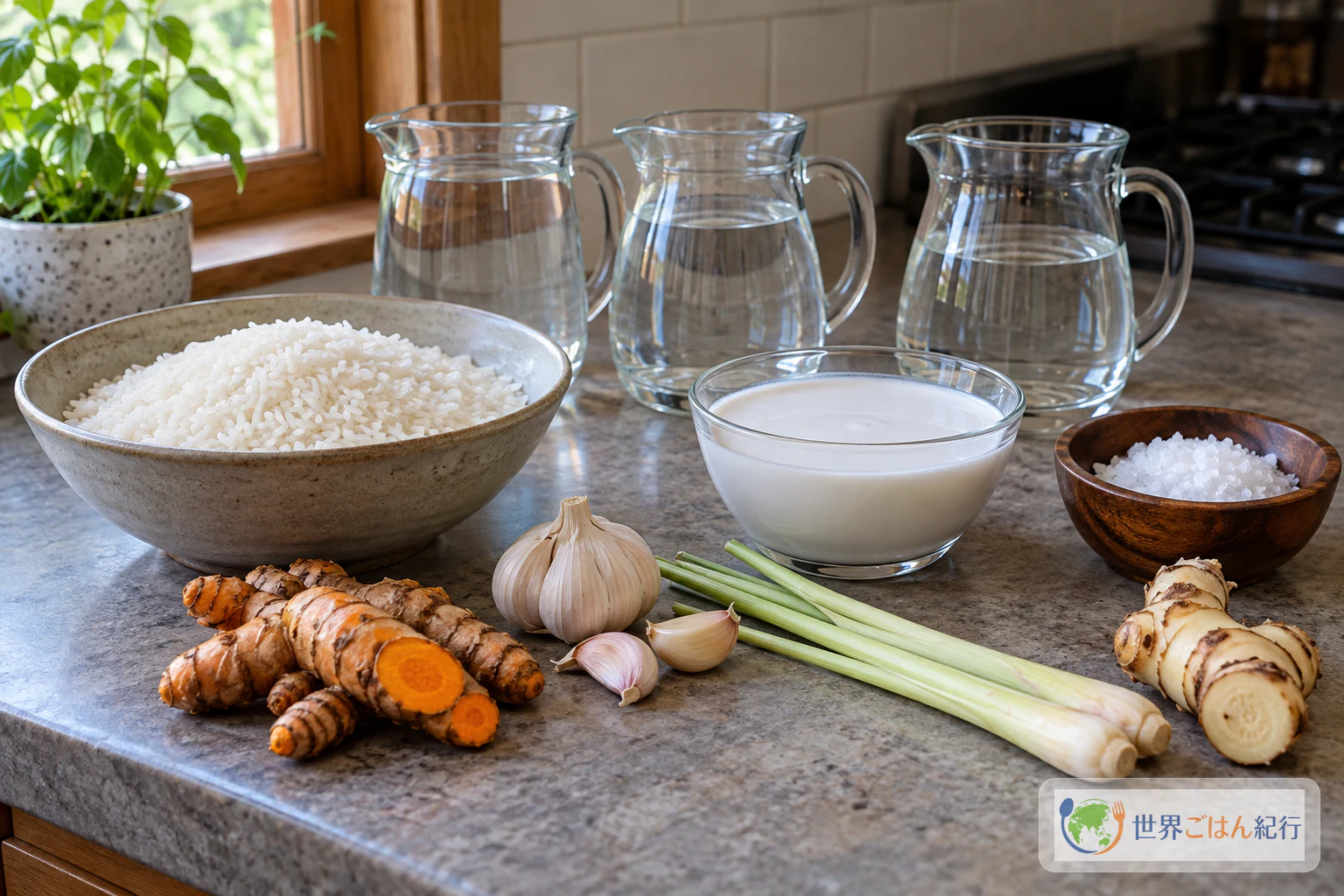
Ingredients for the Full 1kg Batch
Equipment
- Blender
- Fine strainer
- Measuring jug
- Steamer with a basket and lid
- Saucepan
- Large bowl and a cover for it
Choosing Ingredients and Substitutions
Fresh turmeric. Use fresh turmeric, measured by length, not weight. A ratio for replacing it with ground turmeric has not been confirmed, so this recipe gives none. Look for fresh turmeric root at Asian or Indian grocers.
Galangal and lemongrass. Galangal and ginger are not the same ingredient, and lemon juice is not a stand-in for lemongrass. If you use them, you are making a different-tasting variation, not this recipe.
Rice. Use white rice. Short-grain rice such as Japanese rice can be used, but it is stickier, so expect a different texture.
Coconut milk. Products differ, so check the label for ingredients and allergen information.
Method: Turmeric Water, First Steam, Absorbing, Second Steam
Get the steamer water ready before you steam. Keep the water level about 2.5cm below the steamer basket, so the boiling water does not touch the rice, and do not let the steamer boil dry. All times are guides; check how the rice is cooking as you go.
Troubleshooting
| What happened | Likely cause | What to do |
|---|---|---|
| The rice is too wet or the color too strong | All the turmeric water went in, or the waters were mixed up | Next time, use only 100ml of turmeric water and keep the 800ml cooking liquid and the soaking and steamer water separate |
| The bottom of the rice is soggy | The steamer water was touching the basket | Keep the water level about 2.5cm below the basket |
| The steamer ran dry | Not enough water for the full steaming time | Check the water level during each steaming and add hot water before it runs low |
| Liquid is still pooling in the bowl after about 20 minutes | The rice has not finished absorbing | Leave it covered until the liquid is absorbed before the second steam |
| The rice is still firm after the second steam | Steamers and heat differ | Keep steaming and check again until the rice is cooked through |
| The aroma is weak | Aromatics were not crushed or bruised | Crush the garlic, and bruise the lemongrass and galangal before adding them |
Variations and Other Published Versions
This article follows a single recipe from a Balinese cookbook. Other published recipes differ. The CIA's World Culinary Arts: Indonesia and Malaysia gives a nasi kuning that uses long-grain rice and a dressing made with shallot, garlic, chicken stock, coconut milk, lemongrass, salam leaf, pandan and turmeric water, also steamed in two stages. That document does not explain how to make its turmeric water, so it is not combined with the recipe here. If you are curious about those ingredients, treat them as a different recipe rather than additions to this one.
Serving
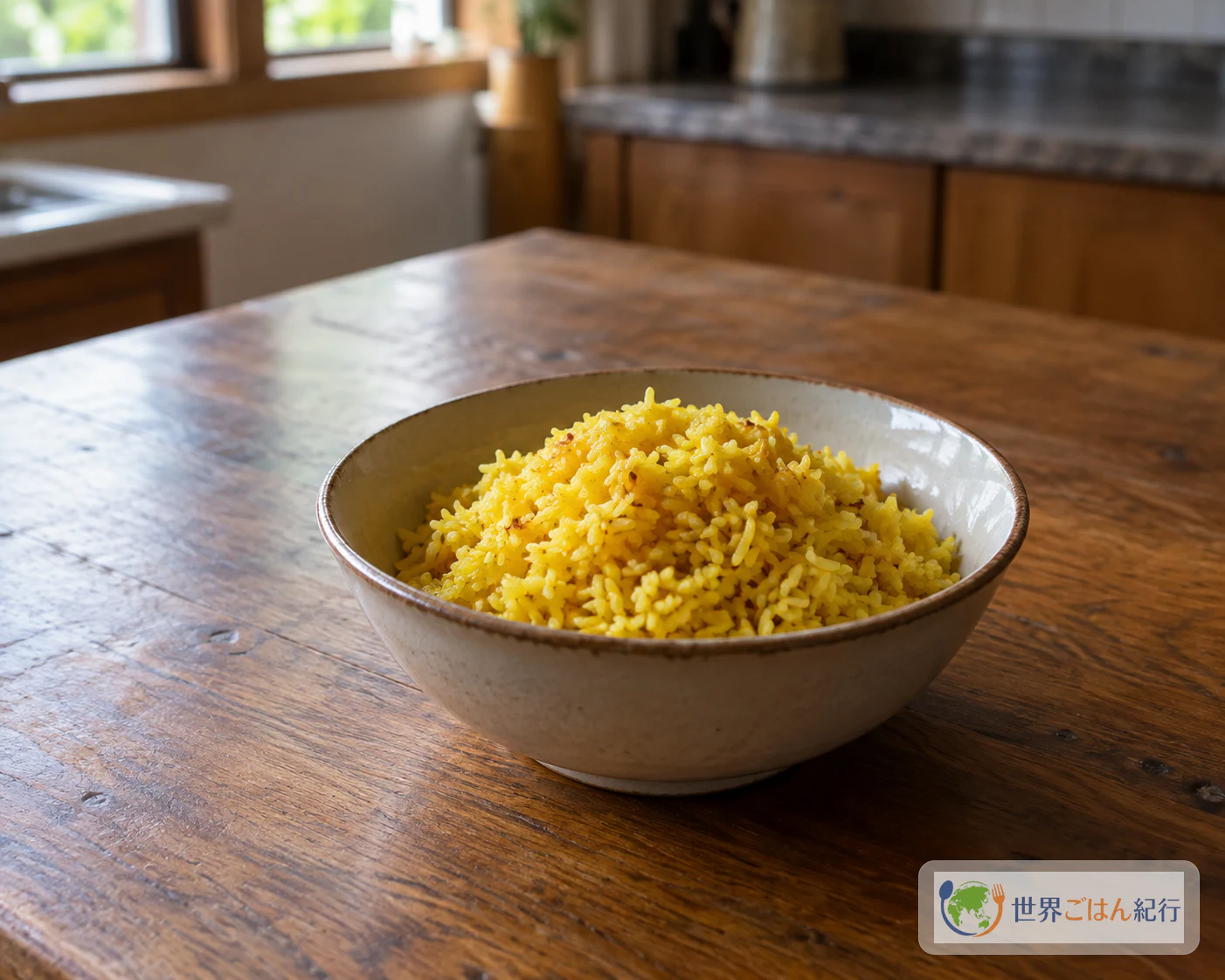
This recipe produces the yellow rice itself. Eggs, fried shallots and side dishes belong to other dishes and are not part of the base recipe. If you want to present it as a tumpeng, remember that the cone is a way of presenting rice and side dishes, not a requirement of nasi kuning.
Food Safety and Leftovers
Japan's Ministry of Health, Labour and Welfare home food-safety guidance recommends heating food until the center reaches 75°C for at least 1 minute, using separate utensils for raw and cooked foods, cooling leftovers quickly in shallow containers, and reheating them thoroughly. Put leftover nasi kuning in shallow containers, cool it quickly and refrigerate it. This is general guidance and does not guarantee a safe storage period for this dish, so no specific number of days is given here.
Frequently Asked Questions
Does nasi kuning have to be shaped into a cone?
No. The cone is tumpeng, a way of presenting rice and side dishes. Tumpeng is often made with yellow rice, but white rice and nasi uduk are also used, and nasi kuning can be served simply in a bowl.
Can I use ground turmeric instead of fresh?
A substitution ratio for ground turmeric has not been confirmed, so none is given here. The source uses fresh turmeric measured by length.
Why isn't the recipe scaled down?
The book notes that this recipe is not suited to being made in a smaller quantity. A reduced version has not been verified, so the full 1kg amount is kept.
Do I use all 500ml of the turmeric water?
No. The 500ml of water is for making the turmeric water. Of the strained liquid, use only 100ml in the rice, together with the separate 800ml of cooking water and 150ml of coconut milk.
Can I use ginger instead of galangal?
Ginger and galangal are different ingredients. Using ginger makes a variation with a different flavor, not this recipe.
For more dishes from the same country, see Indonesian recipes.
Sources
- Tjok Maya Kerthyasa and I Wayan Kresna Yasa, Paon: Real Balinese Cooking (Hardie Grant), "Nasi kuning (yellow rice)," published by SBS Food. The recipe followed here: ingredients, preparation and use of turmeric water, soaking, two-stage steaming and absorption, the finished amount of about 2kg, the preparation and cooking time guides, the note against making a smaller quantity, and the Balinese meaning of the color. https://www.sbs.com.au/food/recipe/nasi-kuning-yellow-rice/a1mfmil4h
- BPSMP Sangiran, Indonesian Ministry of Education and Culture portal, "Filosofi Tumpeng di BPSMP Sangiran." Tumpeng as rice and side dishes presented in a cone; yellow rice as common but white rice and nasi uduk also used; the selamatan context in Java, Sunda, Madura and Bali; and the page's interpretation of the cone's symbolism. https://kebudayaan.kemdikbud.go.id/bpsmpsangiran/filosofi-tumpeng-di-bpsmp-sangiran/
- "Indonesian food culture mapping: a starter contribution to promote Indonesian culinary tourism," Journal of Ethnic Foods (Springer Nature). The paper's discussion of nasi tumpeng kuning in relation to Hindu beliefs, Meru and symbolism. https://link.springer.com/article/10.1186/s42779-019-0009-3
- The Culinary Institute of America, World Culinary Arts: Indonesia and Malaysia (2014), "Yellow Rice / Nasi Kuning." A different published recipe with long-grain rice and a dressing, steamed in two stages, and the document's own statement on color symbolism in Bali. https://ciaprochef.com/wp-content/uploads/2024/04/WCA_IndonesiaMalaysia_Recipes.pdf
- Ministry of Health, Labour and Welfare (Japan), "家庭でできる食中毒予防の6つのポイント" (Six points for preventing food poisoning at home). General home guidance on heating to 75°C at the center for at least 1 minute, separating utensils, cooling in shallow containers and reheating. https://www.mhlw.go.jp/stf/seisakunitsuite/bunya/kenkou_iryou/shokuhin/syokuchu/01_00006.html