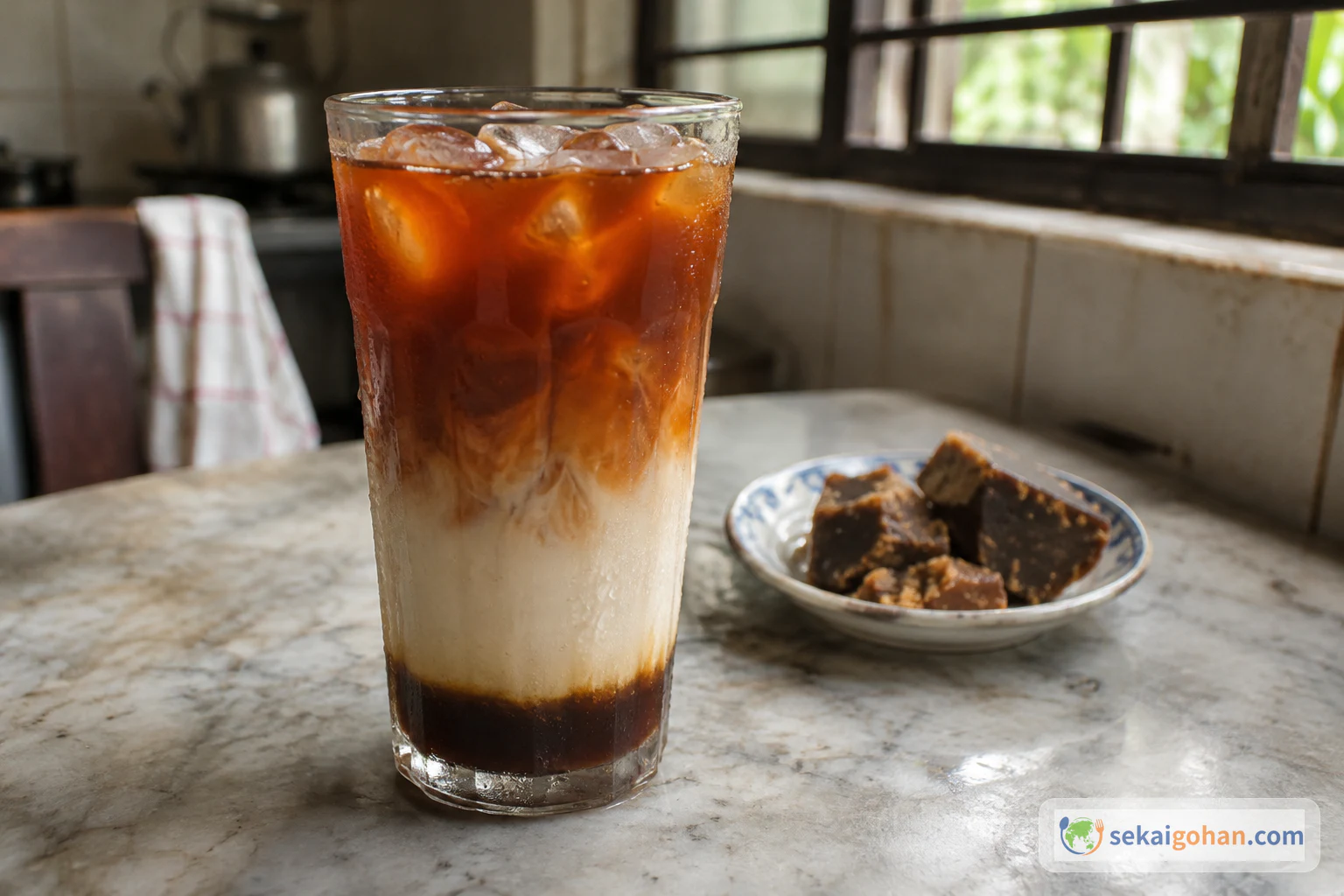
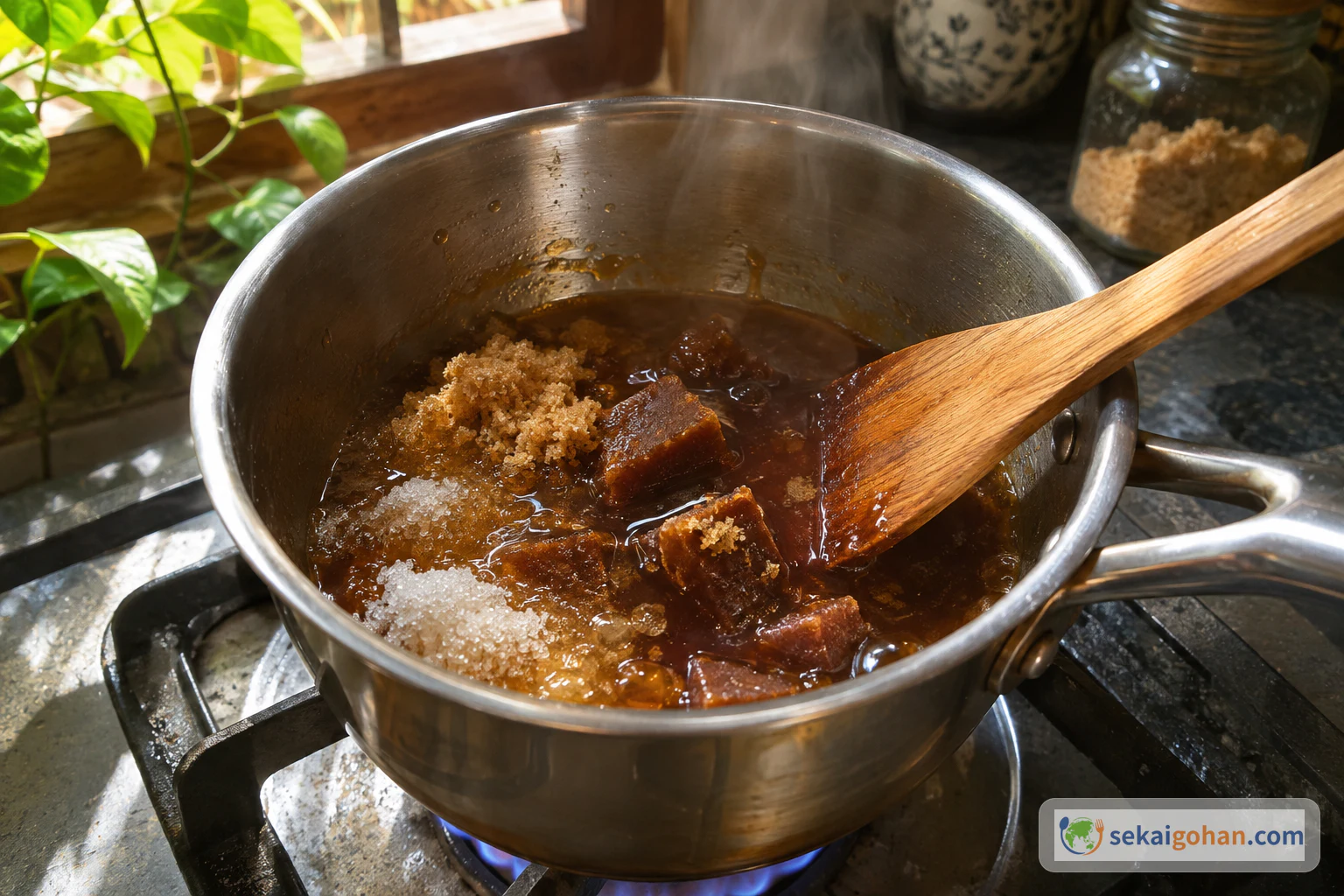
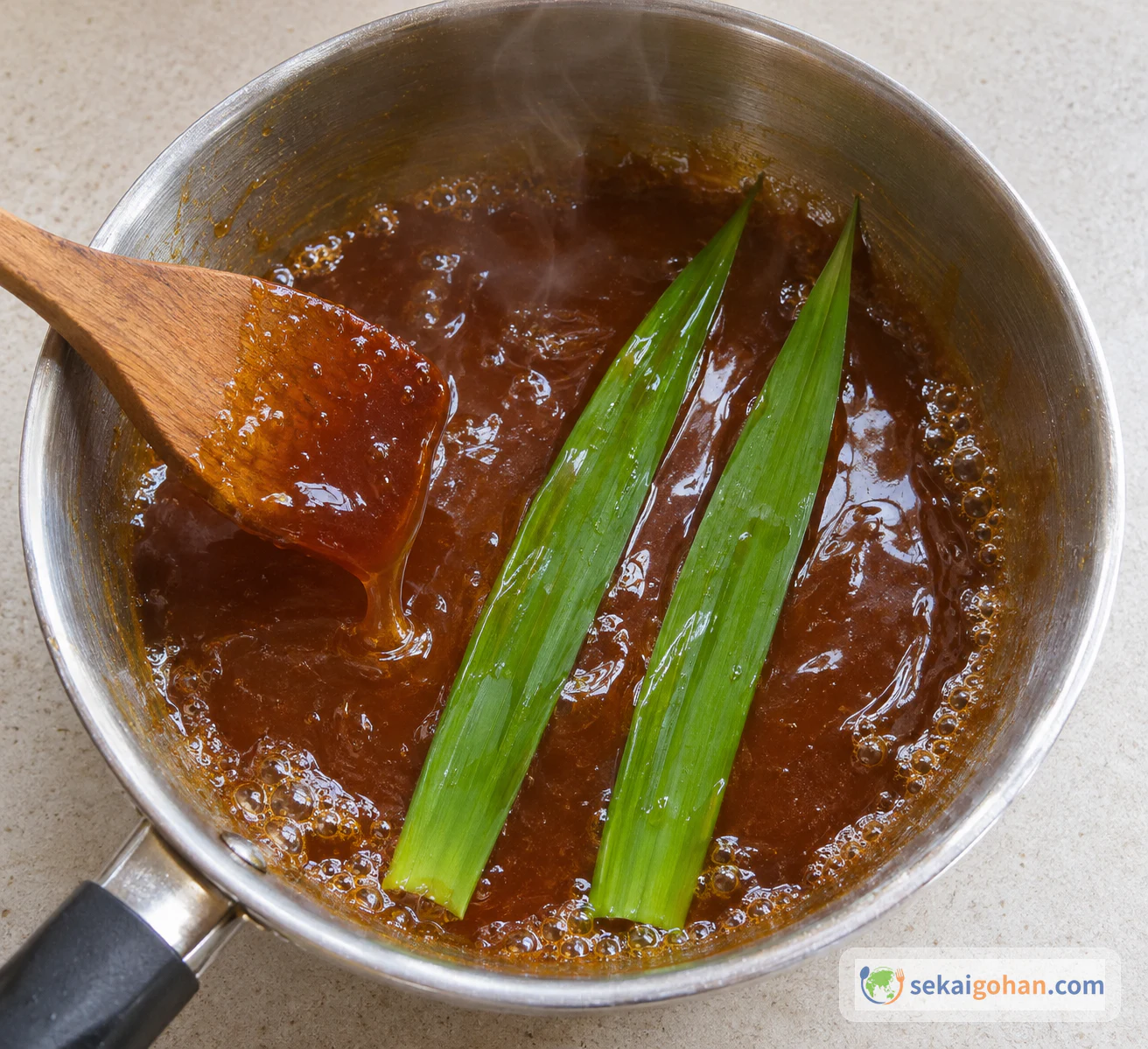
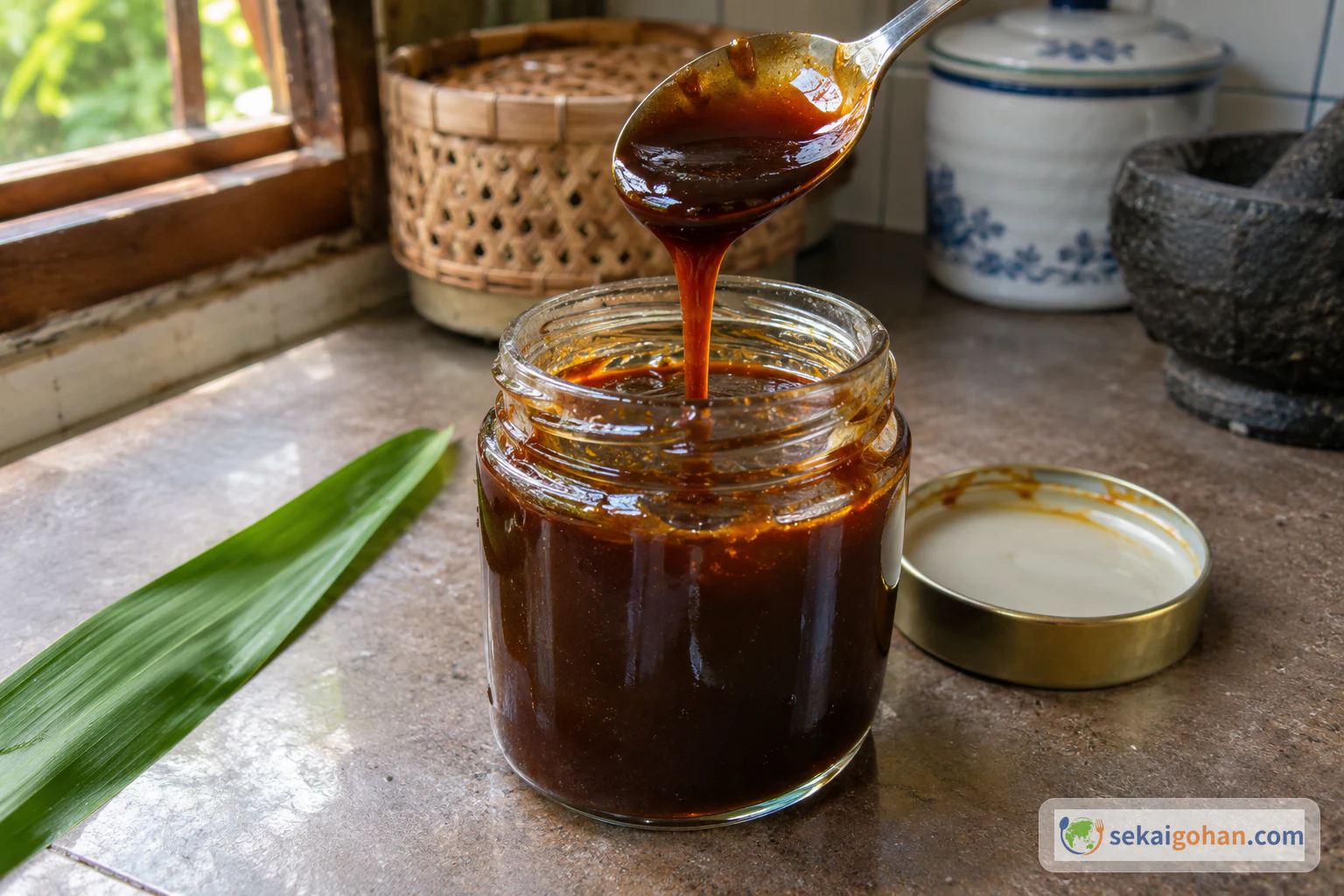
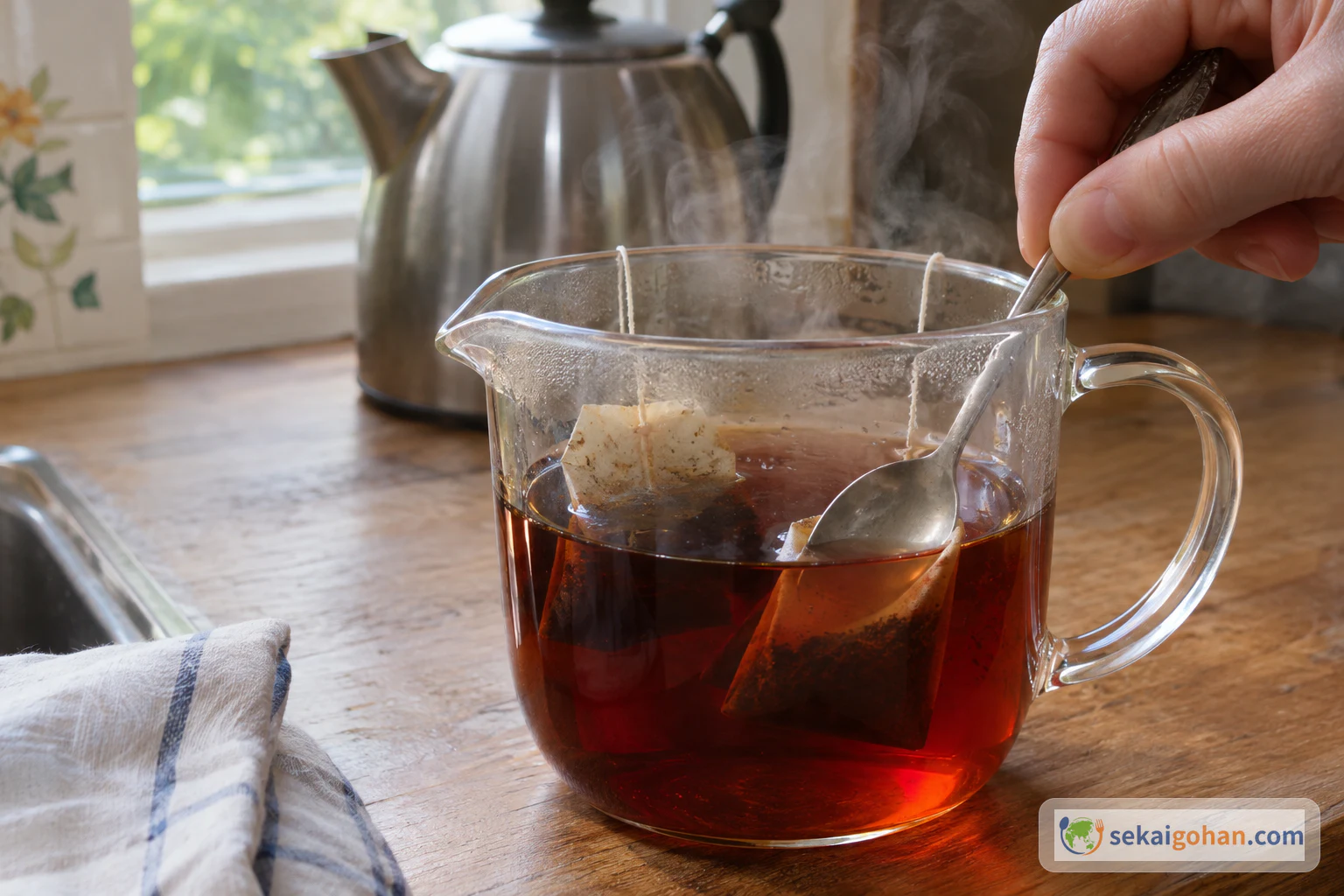
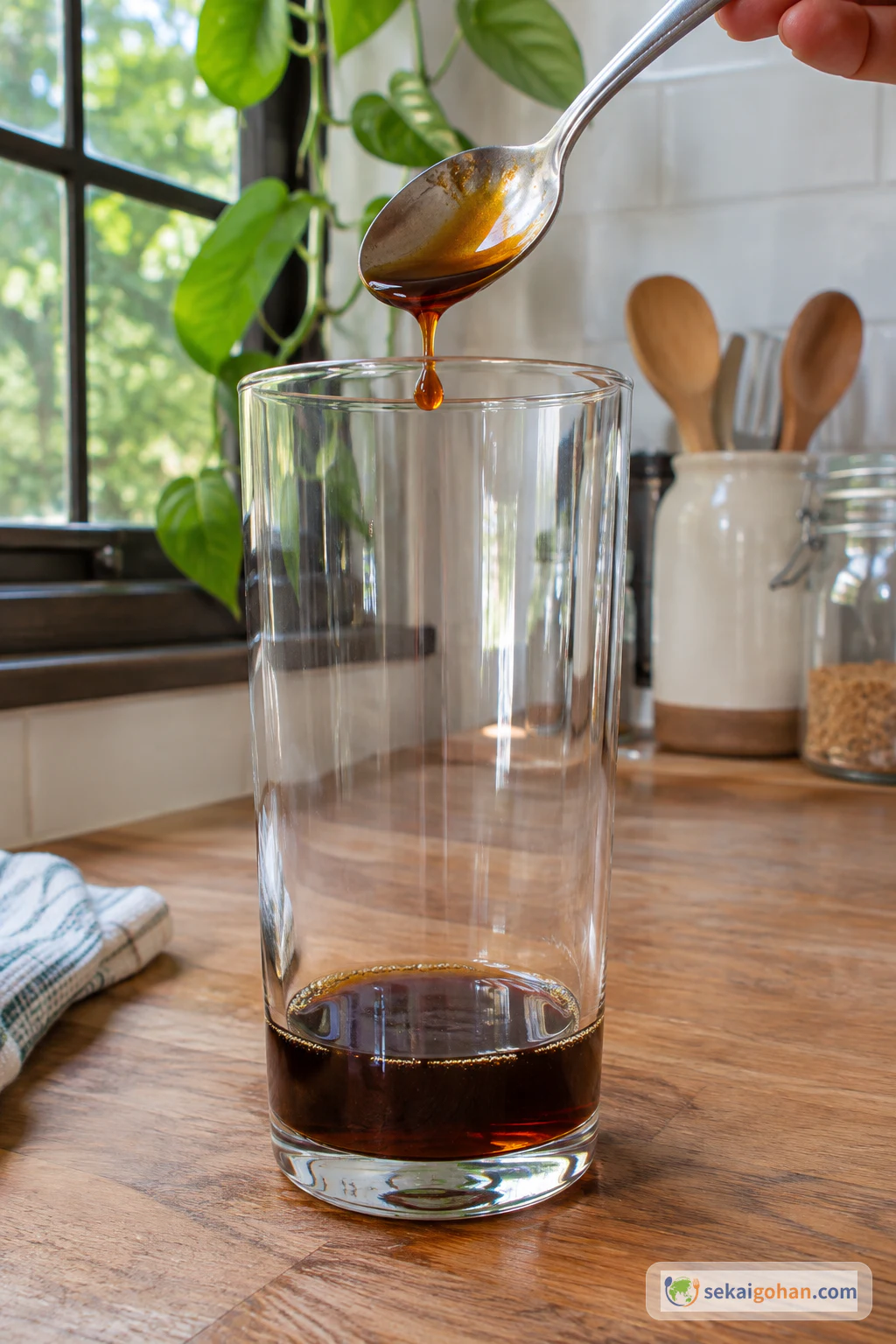
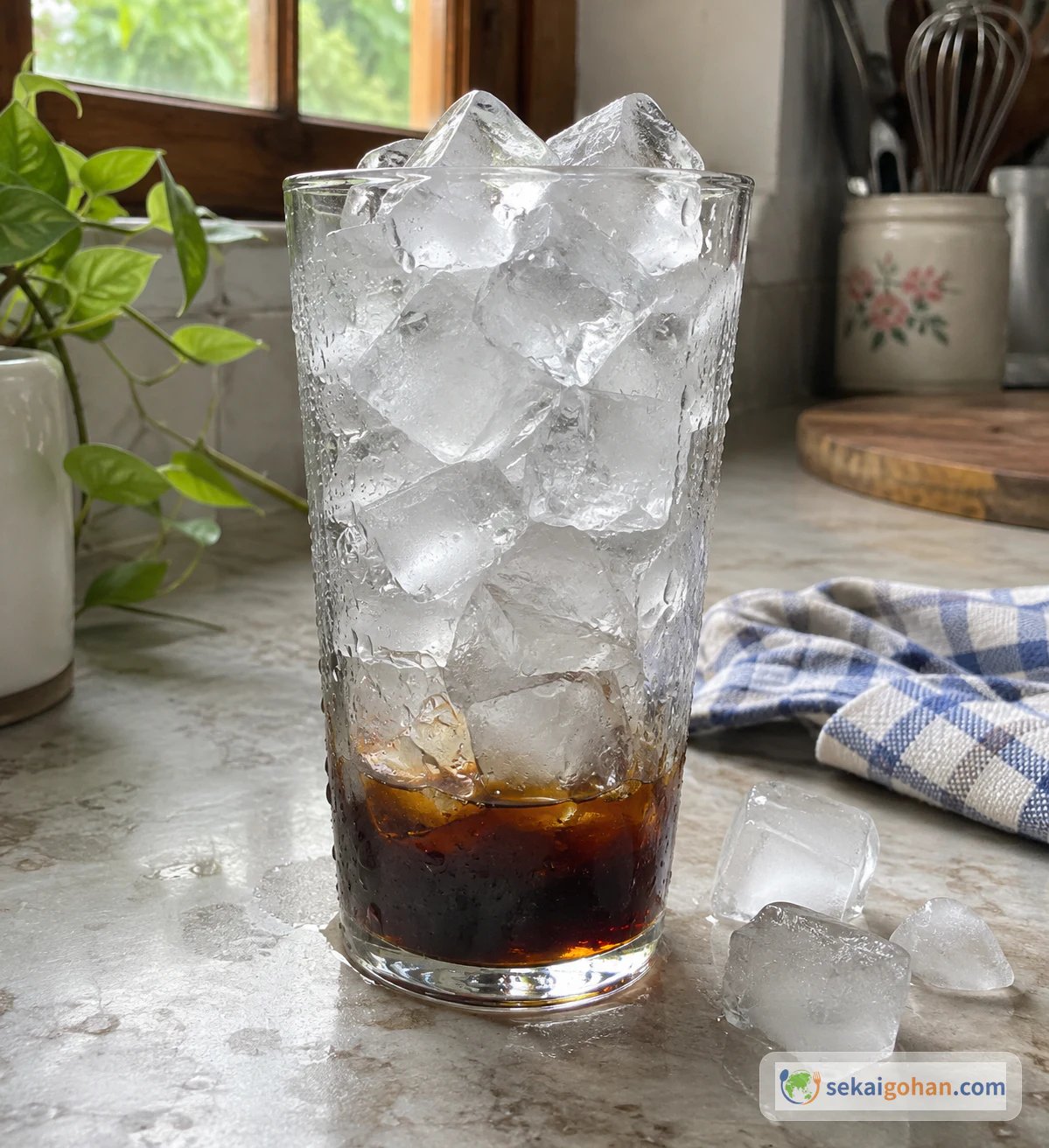
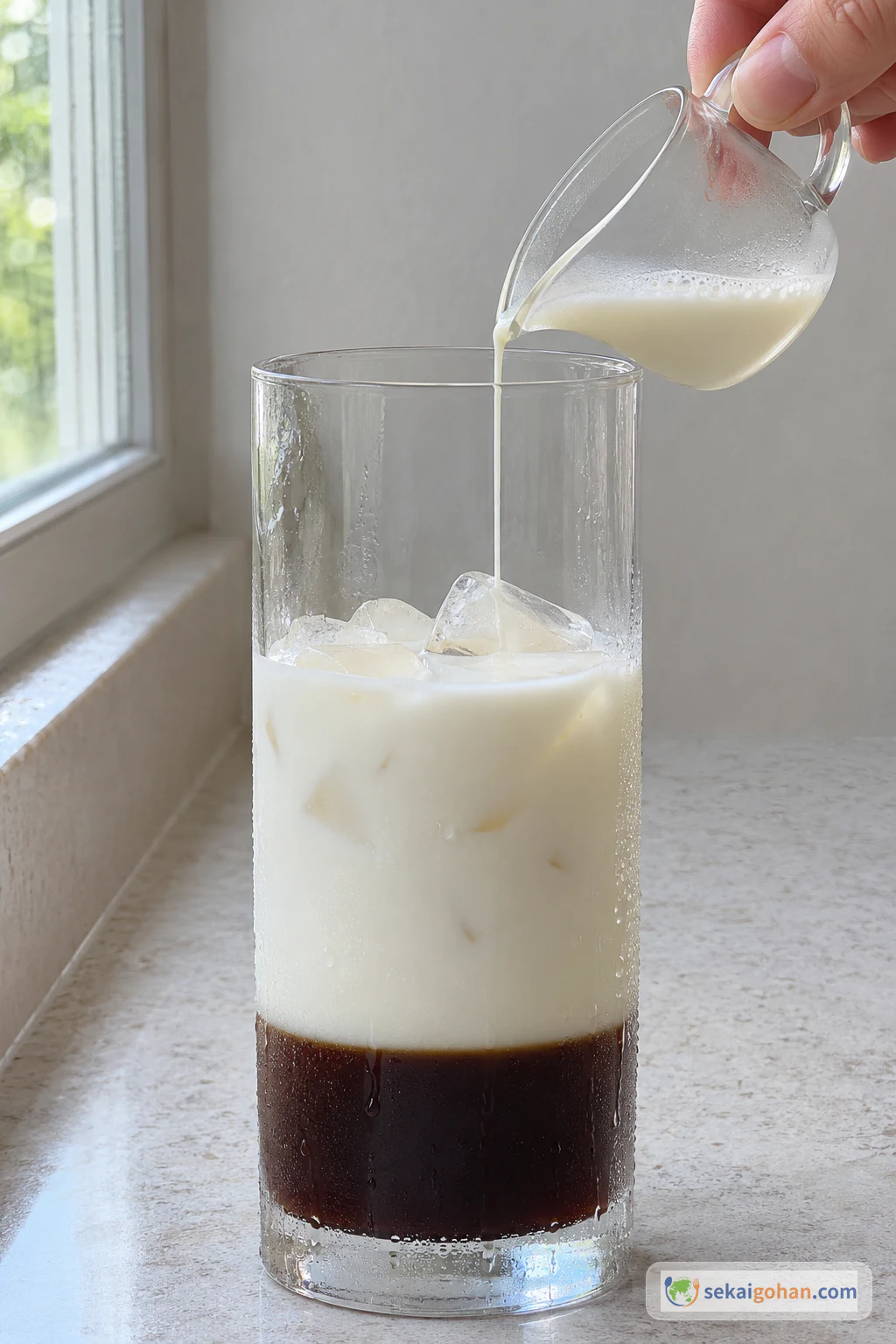
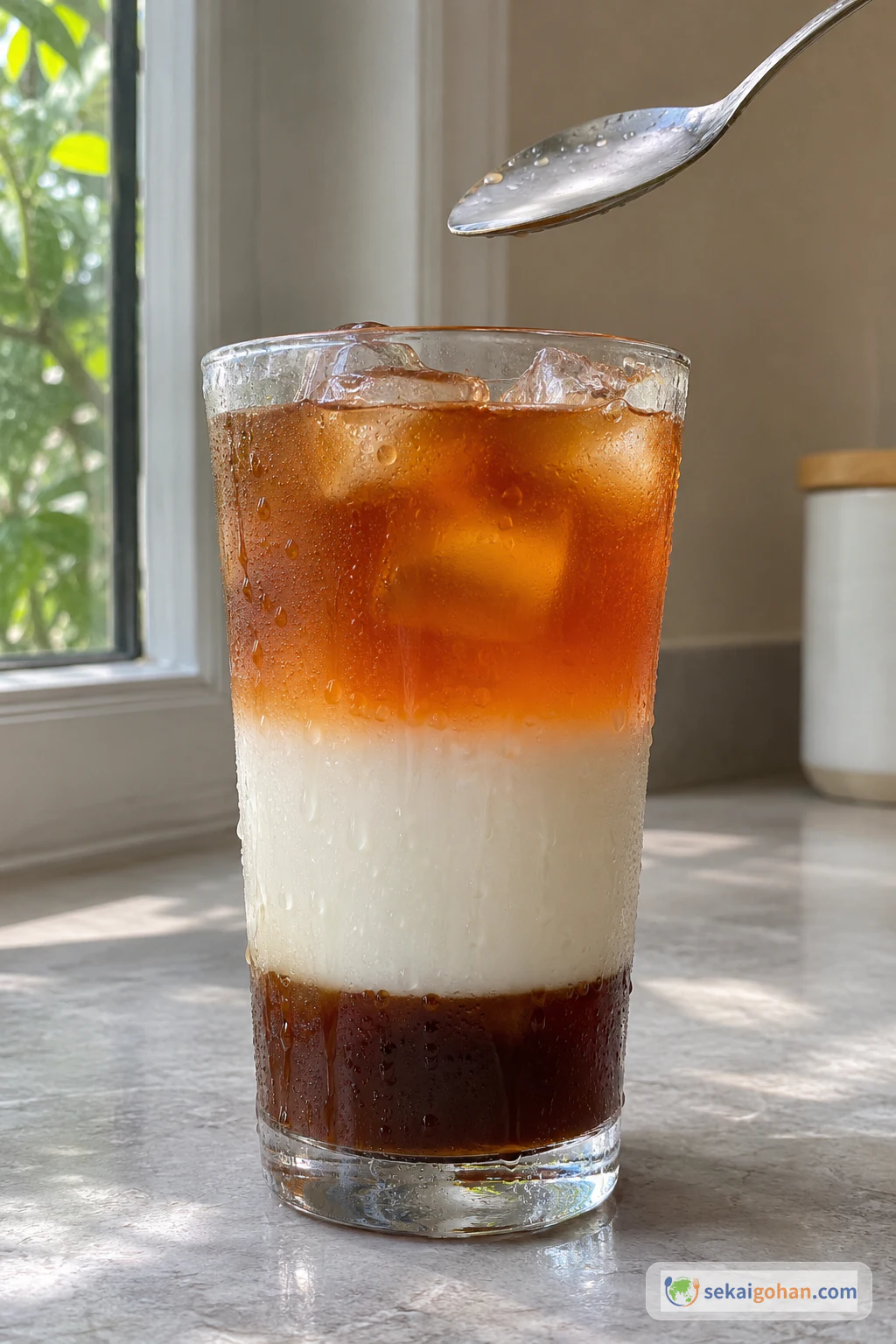
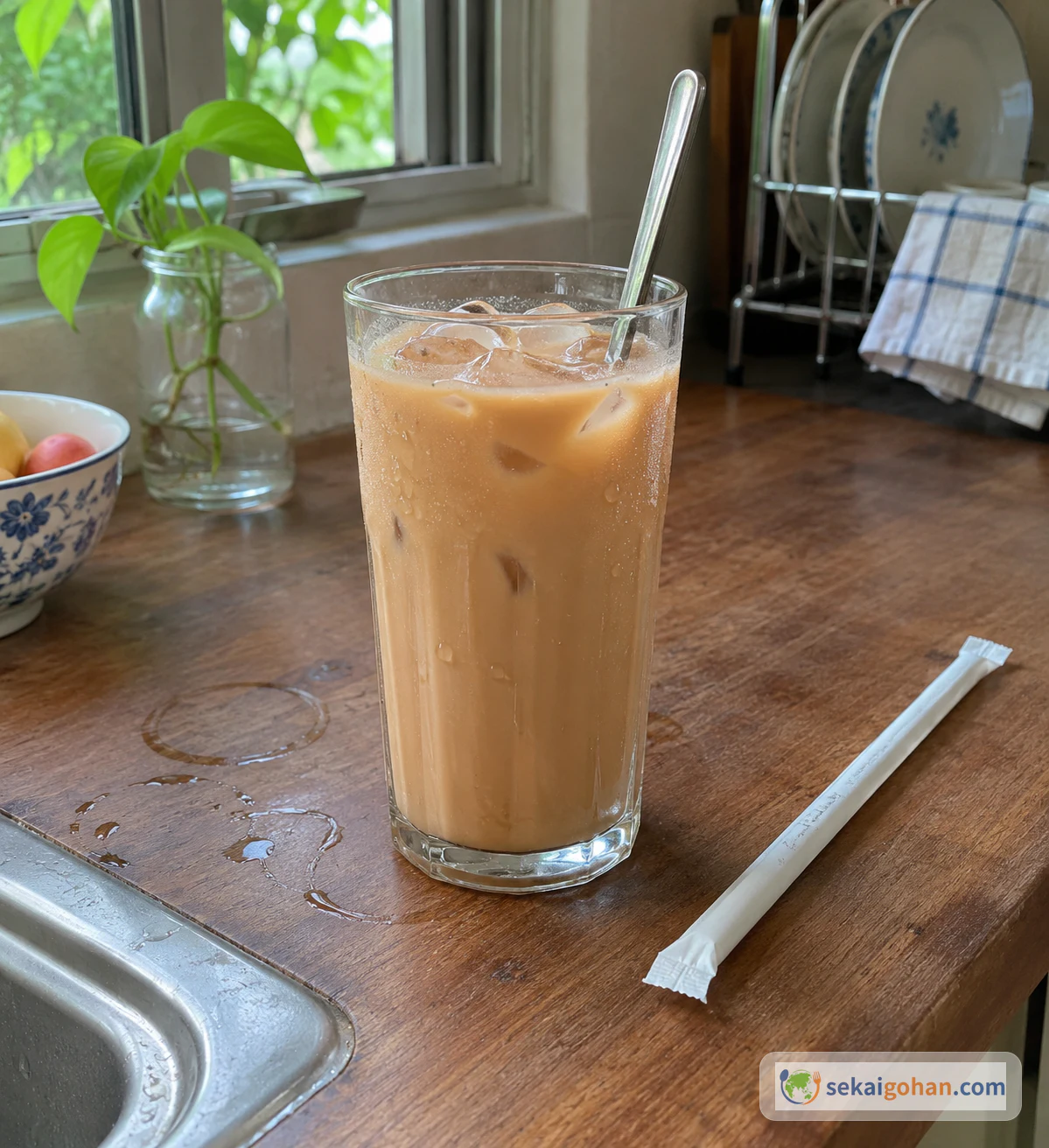
The glass comes to the table in three bands. At the bottom sits a dark syrup the colour of burnt caramel, in the middle a band of opaque white milk, and on top a deep amber tea, with ice through all three and water beading on the outside. You look at it for a moment, maybe take a picture, then push a long spoon down and stir until the three colours become one even milk-tea brown. That is Teh C Peng Special, the iced layered tea of Sarawak on the Malaysian side of Borneo. Once stirred it tastes of strong, slightly bitter black tea rounded by creamy unsweetened milk, with a palm sugar sweetness underneath that smells toasted and, when it is made with Sarawak's own sugar, carries a faint trace of salt.
Teh, C, Peng and the Kuching Food Court
You can read the whole drink in its name. Teh is Malay for tea. C means evaporated milk, which is unsweetened. Peng means ice, and special is the word for the three layers. In Malaysian coffee shops a plain "teh" comes with sweetened condensed milk, so the C changes the drink. Evaporated milk adds body and a white layer without adding sugar, and all the sweetness comes from the palm sugar syrup at the bottom of the glass.
People disagree about where the letters come from. C is most often traced to the Carnation brand of evaporated milk. Others link it to the Malay susu cair, which means evaporated milk, and one more account traces it to a Hainanese word for "fresh." Peng is usually given as the Hokkien word for ice, though some trace it to the Cantonese bīng (冰). Nobody has settled the question, and people order the drink the same way whichever story they believe.
Ordering at a kopitiam
The drink belongs to the kopitiam, the traditional coffee shop of Malaysia and Singapore. The word joins Malay kopi (coffee) with Hokkien tiam (shop), and many of these shops were opened by Hainanese immigrants. Orders are short codes stacked together, and hot is the default: ask for teh C and you get a hot cup of tea with evaporated milk. Add peng and it comes over ice. Ask for teh C peng special and you get the layered glass.
O means no milk (from the Hokkien for "black"). C means evaporated milk, with sugar added separately. Peng means iced. Kosong is Malay for "zero" or "empty" and means no sugar. Kaw or gau means strong, poh means weak, and siew dai means less sweet. Malaysian drinks are sweet by default, so people who want less sugar add kurang manis to the order.
Where it started and when it is drunk
The drink is usually traced to a food court at the 7th Mile Bazaar in Kota Sentosa, Kuching, where it was supposedly first poured. The drink then spread across Sarawak and over to Peninsular Malaysia. It is an everyday kopitiam order, and in Ramadan it is a favourite at buka puasa, the meal that breaks the fast at sunset. After a long, hot day without food or water, a tall glass of ice, milk and sugar is very welcome.
Teh tarik is a different drink. It is tea poured back and forth between two vessels until it foams, and it has no layers. If you are cooking more of the state's food, Sarawak laksa comes from the same part of the country. Beyond Sarawak, Malaysia has its own range of drinks and dishes.
Gula apong, Sarawak's sugar
In Sarawak the syrup is traditionally made with gula apong, a palm sugar made from the sap of the nipa palm (Nypa fruticans), which grows along the coast. Harvesters cut into the flower stalks and collect the sap in bamboo containers. The sap is then cooked and stirred for 6 to 8 hours, and about 10 litres of it boil down to roughly 1 kilogram of sugar. The result is golden brown and thick like molasses. It is sweet with a faint saltiness that comes from the salt the palm takes up. Coastal villages that no road reached once used it in place of sugar. Today small producers make it to order, and it also goes into Iban rice cakes such as penganan iri and penganan tatuk and into piring offerings.
On the peninsula and in Singapore, the same drink is usually made with gula melaka, a palm sugar made from the sap of coconut flower buds. It has a darker, deeper caramel flavour and none of the salt. The drink has the same name and the same three layers in both places, but each region uses a different sugar. The same coconut palm sugar shows up in sweets like kuih lapis.
Ingredients
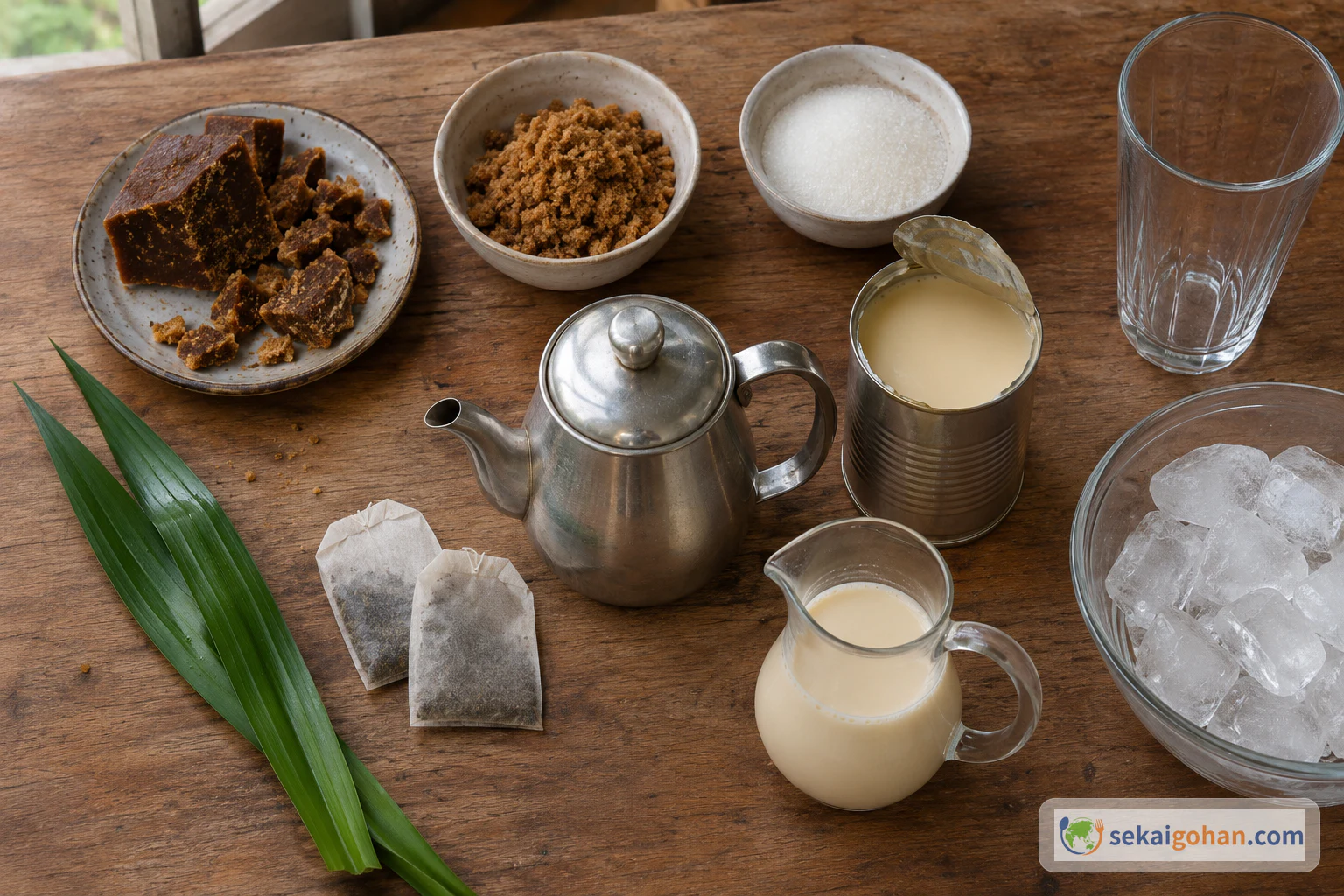
The syrup is made ahead and makes enough for several glasses. The tea, milk and ice are measured for one tall glass.
Buy unsweetened evaporated milk, not sweetened condensed milk. The tins look alike and often sit near each other on the shelf. Condensed milk makes the drink much sweeter. Check the label for the word "evaporated."
This drink contains milk (evaporated milk). It is also high in sugar and contains caffeine from a strong brew of black tea.
Equipment
- Small saucepan
- Wooden spatula
- Airtight jar or container for the syrup
- Heatproof jug or mug for brewing the tea
- Tall heatproof glass tumbler, chilled; roughly 15 fl oz (450 ml) is a handy size
- Measuring spoons
- Long spoon or straw for stirring
Choosing and Substituting
Palm sugar is sold at Southeast Asian grocers and online as gula melaka, palm sugar or coconut sugar. Buy the solid block, which you chop, rather than the liquid nectar. Gula melaka is the easiest to find and works well. It gives a darker, rounder caramel than gula apong, and you lose the faint salty note. With gula melaka, pick the darkest block you can find. Gula apong is the Sarawak choice if you can get it. Okinawan black sugar (kokuto) can also be used for the syrup. It is cane sugar with a deep mineral flavour, but it smells different and has none of the nipa palm's salt.
Pandan leaves are sold frozen or dried at Southeast Asian grocers, and both are fine. Without pandan the syrup still works but loses its green, vanilla-like fragrance.
Tea has to be strong enough to stand up to the milk and syrup. Ceylon tea and finely cut CTC tea bags brew dark and fast, and ordinary supermarket black tea bags work too.
What has to stay the same for the drink to taste right is strong tea, unsweetened evaporated milk and a palm sugar syrup with a toasted caramel smell. Those three give the drink both its colours and its flavour. The type of palm sugar and the pandan can change if they are hard to find.
Method
Make the syrup first, ahead of time, because it has to cool before you build the glass. Once the syrup is made, putting a glass together takes a few minutes. Brew the tea, put the glass in the freezer or fridge to chill, then pour the layers in order: syrup, ice, milk, tea. The order matters because each layer is a different density. The heavy syrup stays at the bottom, the ice keeps the milk from sinking into it, and the tea floats on top.
Melted sugar syrup sticks to skin and burns. Stir it with a long wooden spatula and keep your hands away from the pan. Hot tea poured over ice can crack thin glass, so use a heatproof tumbler.
When It Goes Wrong
| What you see | Why | What to do |
|---|---|---|
| The syrup and milk blur into one muddy band | The syrup is too thin, either undercooked or with too much water | Cook the next batch longer, until it is glossy and slightly looser than honey |
| The syrup has set hard in the jar | It was cooked too thick | Stir in a little water; next time take it off the heat sooner |
| The milk sinks straight into the syrup | It went in before the ice, or was poured too fast | Fill the glass with ice first, then pour the milk in a thin stream onto a cube |
| The tea clouds into the milk | The tea was poured hard from high up | Pour slowly from just above the milk, over the back of a spoon |
| The syrup tastes bitter or scorched | It caught on the bottom of the pan | Keep the heat at medium, then low, and scrape the bottom as you stir |
| The drink is too sweet | All the syrup was stirred in | Leave some syrup at the bottom when you stir; next time use less syrup |
Serving, Variations and Storage
At the table
This is a drink for hot afternoons, for the kopitiam table and for the evening meal that breaks the fast in Ramadan. Serve it as soon as it is poured, with a long spoon or straw so people can stir it themselves. Give each person their own glass, because the stirring is part of the drink. You could also serve it alongside a plate of nasi lemak or other Malaysian food.
Variations
- Gula apong or gula melaka. Make one syrup of each and pour them side by side. Gula apong has a lighter golden colour and a hint of salt. Gula melaka is darker with a deeper caramel flavour.
- Without pandan. Leaving out the leaves gives a plainer caramel syrup, which lets you taste the sugar itself.
- Less syrup. Using 3 tbsp or 2 tbsp of syrup instead of 4 lightens the drink. The bottom layer gets thinner, so pour the milk even more gently.
Storage
Drink the tea as soon as it is made; it does not keep once poured. Store the syrup in an airtight container. One recipe site says it keeps in the refrigerator for up to 5 days; that is the site's own guidance, not an official food-safety limit. Either way, you can make a glass whenever you want one.
Frequently Asked Questions
Can I drink teh C hot?
Yes. Hot is the default at the kopitiam: tea, evaporated milk and sugar in a cup, with no ice. The three layers only form in an iced glass, so a hot version is regular teh C, not the special.
How is it different from teh tarik?
Teh tarik is tea poured back and forth between two vessels until it has a foamy head. It has no layers and is made with a different technique. Teh C peng special is built in a glass from a separate syrup, milk and tea, and only mixed once it reaches the table.
Can I use store-bought palm sugar syrup?
Yes, a ready-made palm sugar syrup works. Check its thickness first. If it is thinner than honey it will not hold a separate bottom layer, and the syrup and milk will run together.
Is it suitable for children?
The tea is brewed strong, so the drink has a fair amount of caffeine and a lot of sugar. For children, during pregnancy, or for anyone sensitive to caffeine, think about how much they drink. A smaller glass, or leaving more syrup unstirred at the bottom, helps.