Bánh Khúc: Green Leaf Dough Inside a Coat of Sticky Rice
The leaf belongs in the dough, the mung bean and pork belong at the center, and the sticky rice belongs on the outside. Finish steaming only when the rice has no hard core and the center of a dumpling has reached a safe temperature.
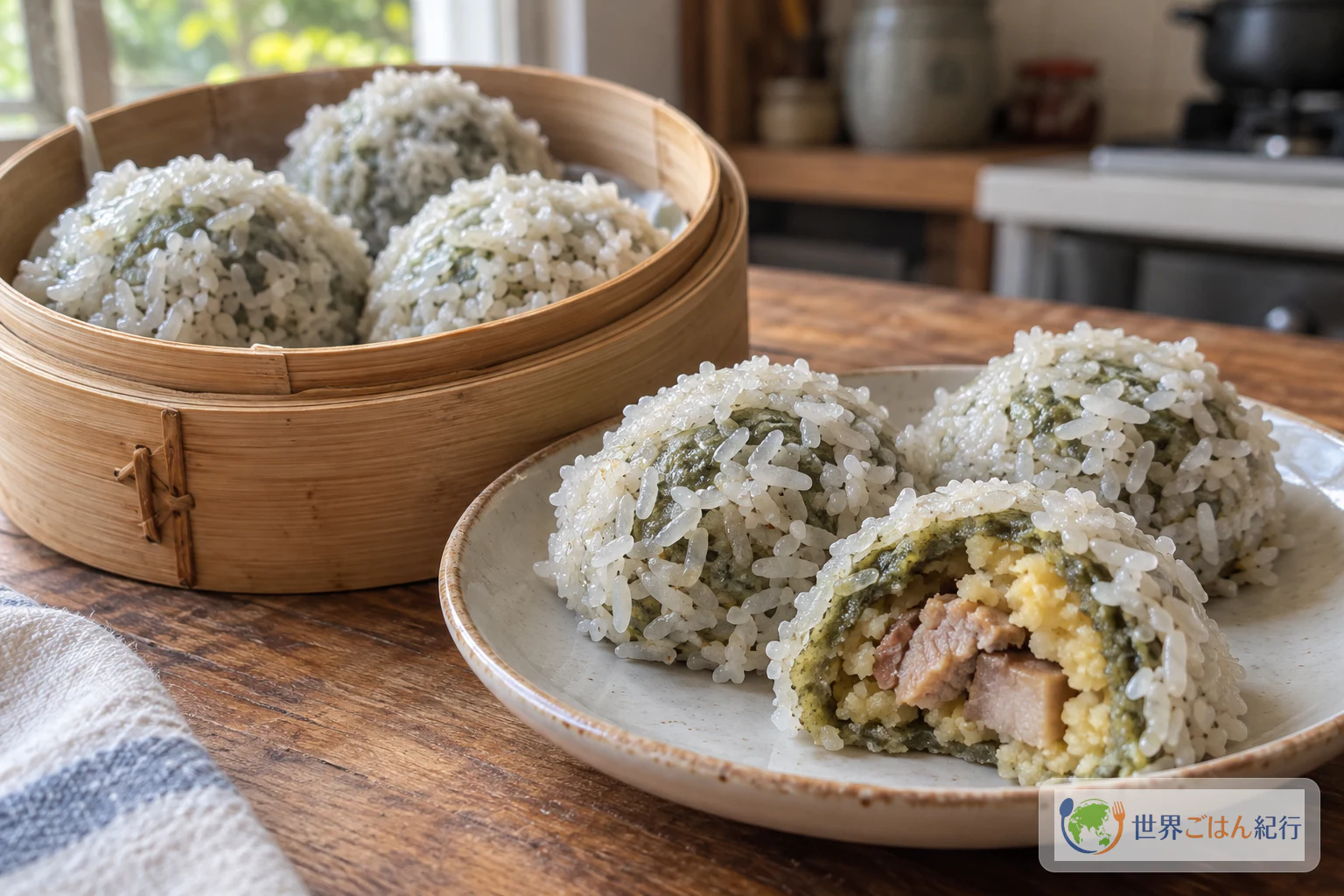
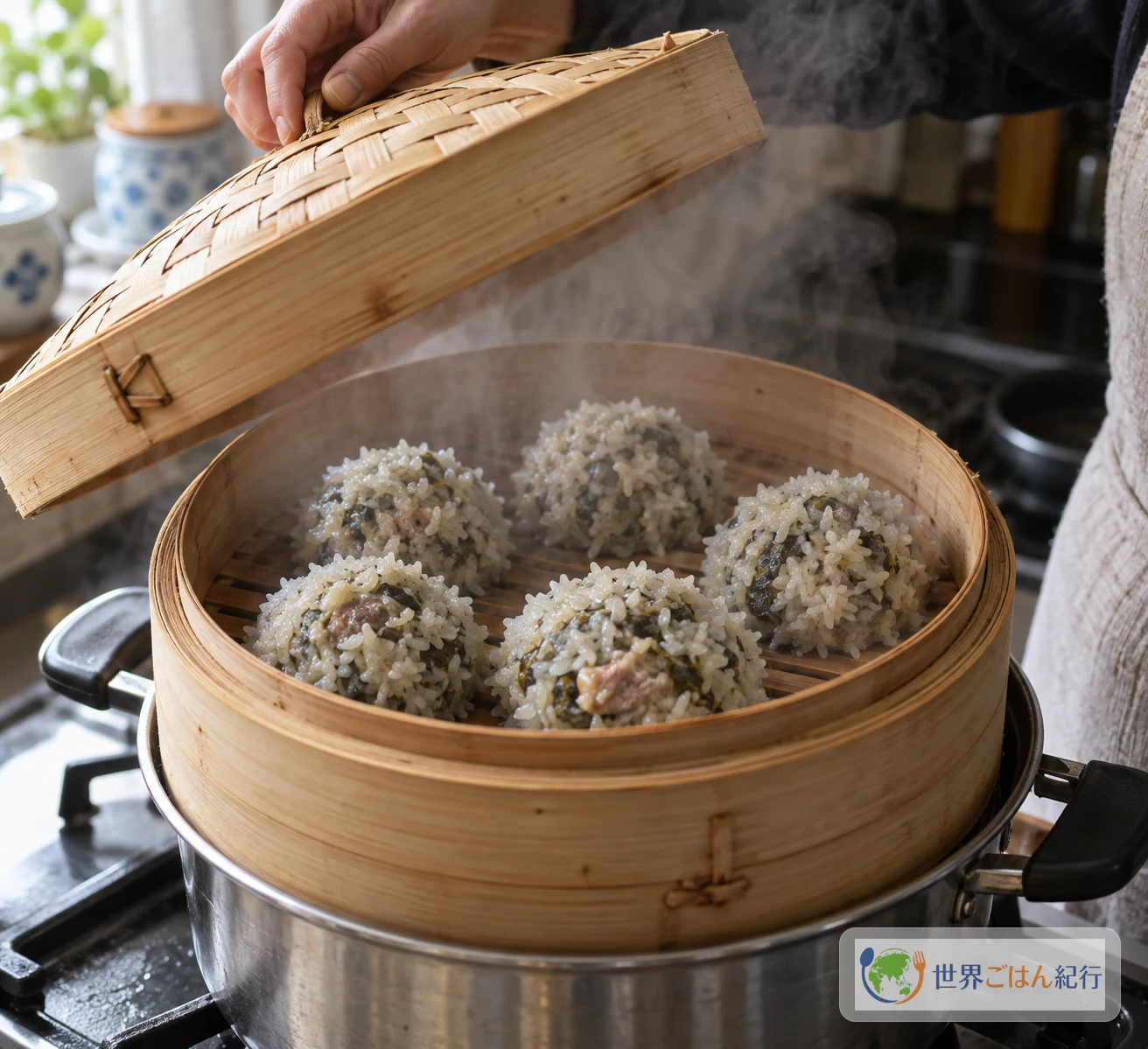
Picture the lid coming off a steamer: white grains of sticky rice cling to round dumplings, a muted green dough shows through the gaps, and the leaf's green, earthy scent rises with the steam. That picture follows from what goes into the dish. Inside each dumpling is a filling of ground mung beans and pork.
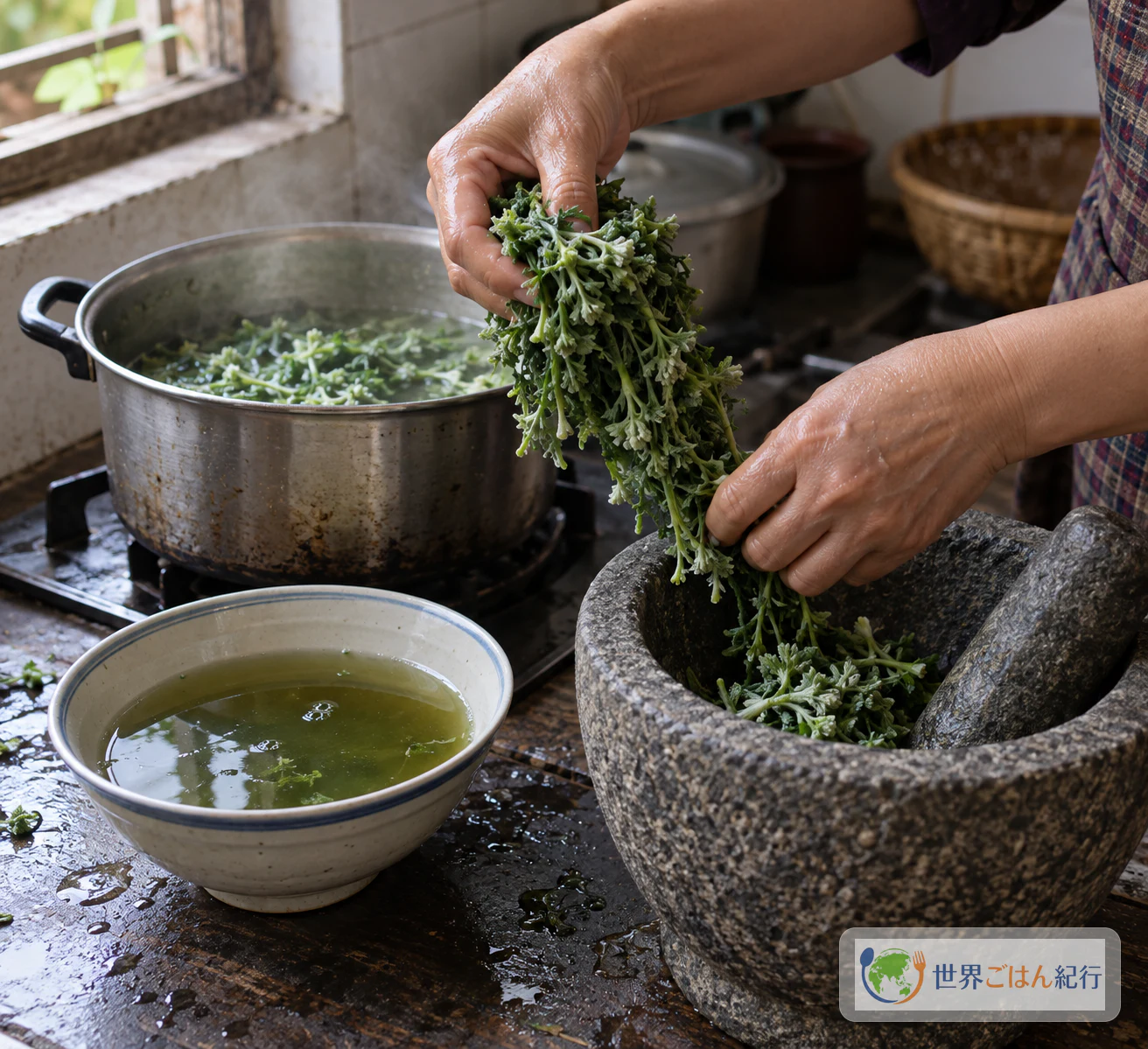
Bánh khúc, also called xôi khúc, is a dish of northern Vietnam. Its name is explained by the leaf worked into its dough, rau khúc or lá khúc, usually rendered in English as cudweed. It is not bánh chưng, the large, square, leaf-wrapped rice cake of Tết, even though both use sticky rice, mung beans and pork. There is no leaf wrapper here, because the leaf is in the dough itself.
The recipe below follows one measured Hanoi version, credited to chef Lê Đức Hải of Ngon Garden Restaurant and published by Việt Nam News. Diềm village in Bắc Ninh has its own well-known bánh khúc, which is compared further down but not blended into these amounts.
What Comes from the Chef, and What This Article Fills In
This combination of the chef's amounts and the additions below has not been test-cooked. Use the doneness checks in the method rather than relying on the clock.
All the ingredient amounts and the overall order come from the Việt Nam News recipe. Its published English leaves a few points open, and no Vietnamese text of it could be found. Three points are therefore filled in from other Vietnamese recipes and articles. These are editorial additions, not the chef's words.
- "Spice," 1/5 tsp. The recipe lists "Spice" with no composition, and the Vietnamese word behind it is unknown. Vietnamese recipes of the same type season the pork with pepper plus a measured seasoning: Gia đình & Xã hội lists "gia vị," while Eva and Dân trí list hạt nêm, and Vietnam Pictorial describes salt and pepper. This article keeps the 1/5 tsp and uses hạt nêm (a granulated seasoning), or salt if you have none. That is an inference, and it does not point to a warm spice blend such as five-spice.
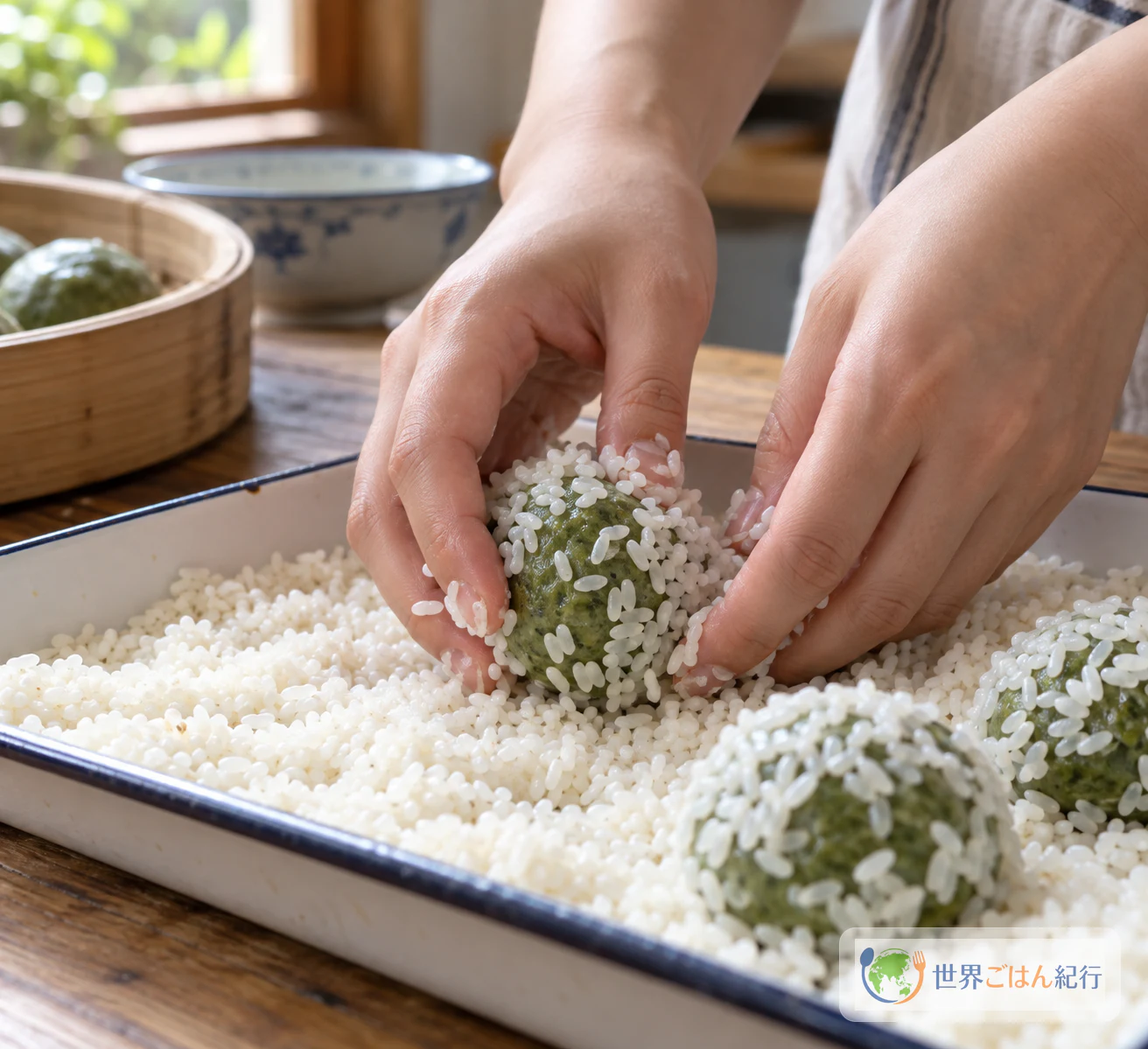
- The rice coat. The chef's English says only "covering with glutinous rice," without saying what state the rice is in. This article uses raw rice that has been soaked and drained, then cooked in the final steam. Báo Văn Hóa, Dân trí, Gia đình & Xã hội, Eva and Vietnam Pictorial all point that way, and Gia đình & Xã hội and Eva describe rolling the balls in it. VietNamNet's short description does mention "glutinous steamed rice," but it is brief and may describe the finished dumpling, so it is not followed here.
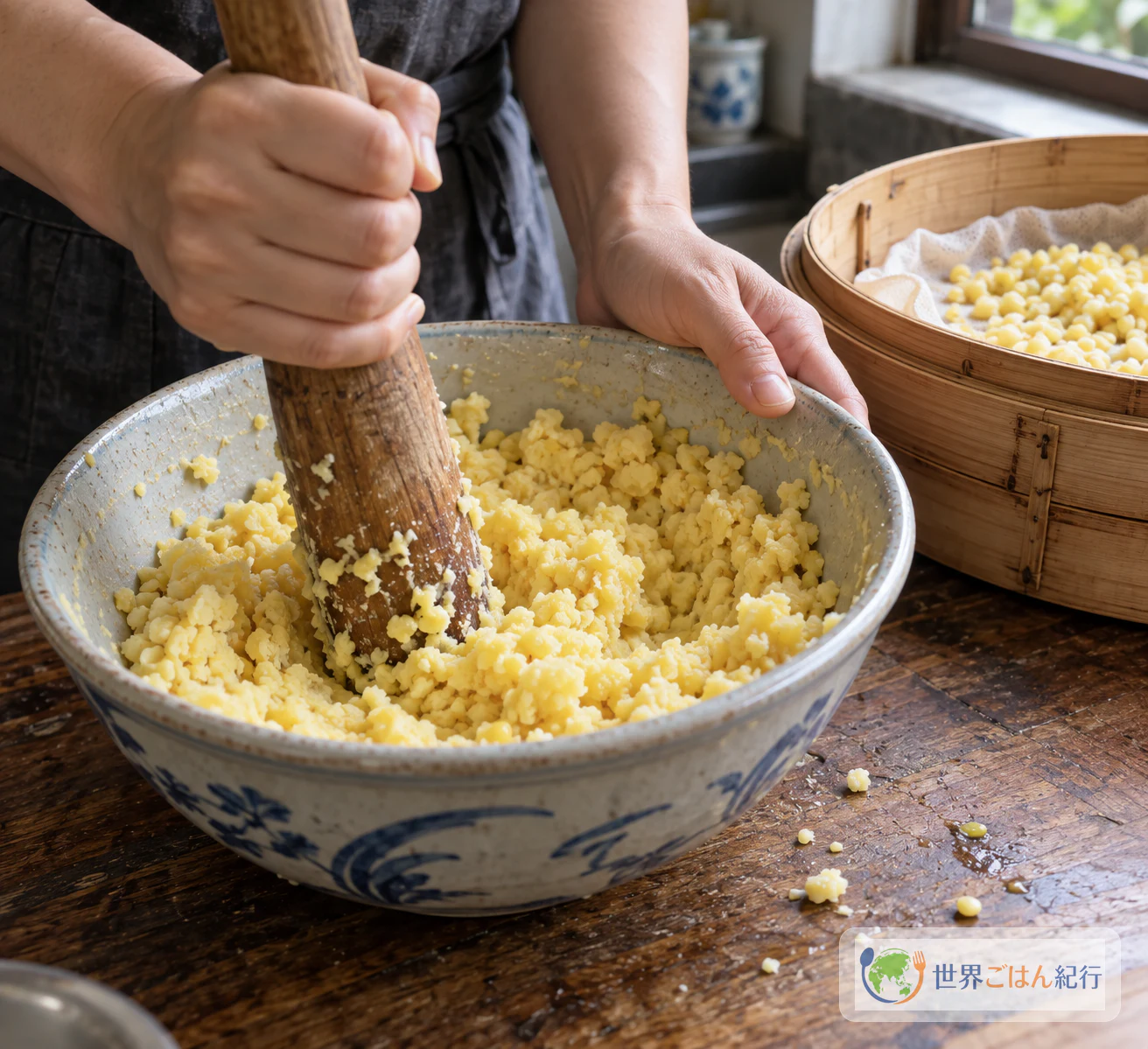
- The mung bean order. The English says to soak the beans and rice "and allow them to cool before steaming them," which does not work as a literal sequence. This article follows Dân trí's order for the beans: soak, steam, cool, then grind.
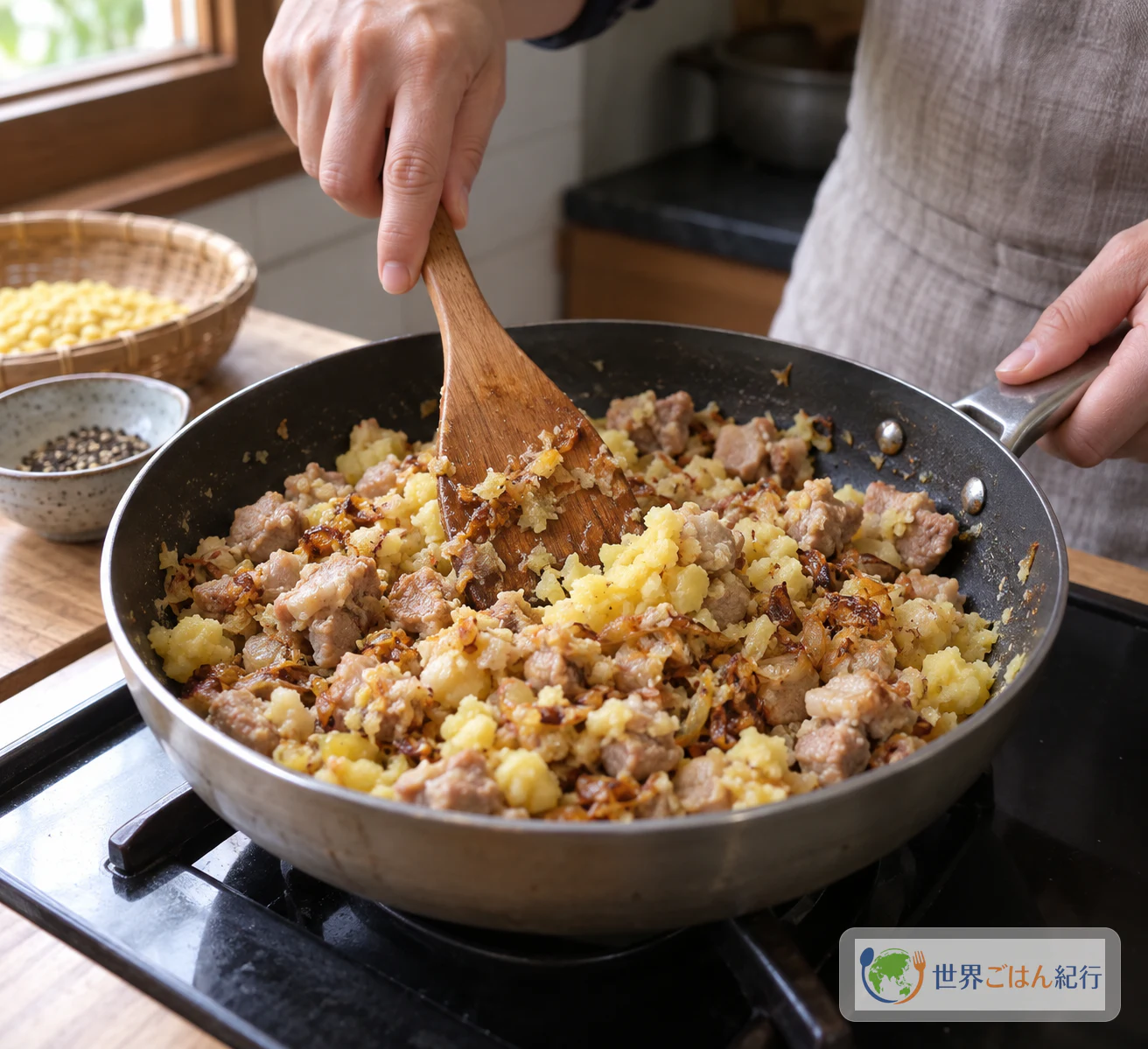
Some things stay unknown. The chef's recipe gives no number of dumplings or servings, only that each piece of dough is about the size of a duck egg. It lists no oil, though Dân trí and Eva use oil, so the amount here is left to the cook. "Dried onions" is read as hành khô, the item in the same place in Dân trí, Gia đình & Xã hội and Eva, but the chef's own Vietnamese word is unconfirmed. The way to cut the pork and the frying time are not given either.
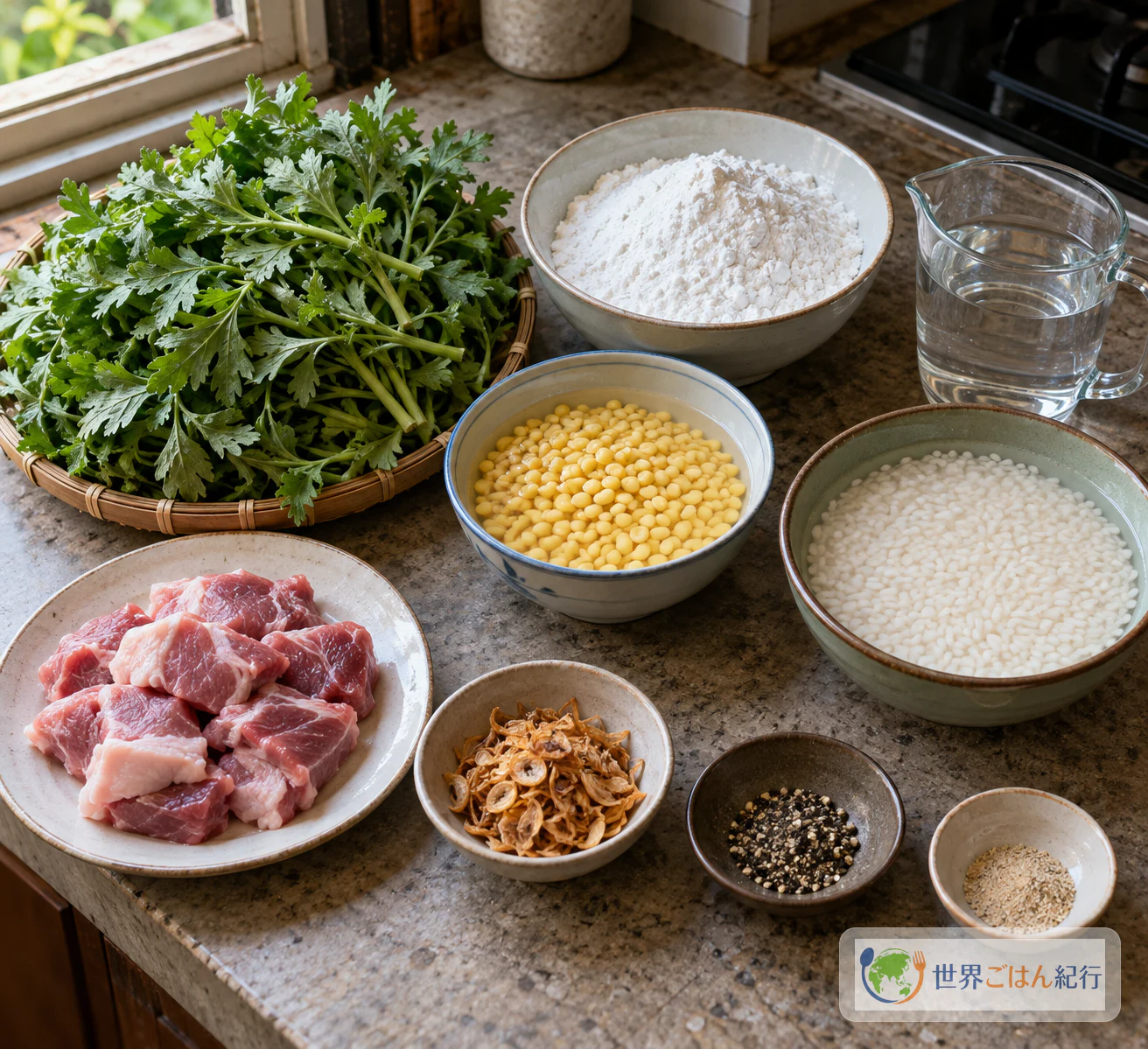
Ingredients: Leaf Dough, Filling and Rice Coat
Choosing and Substituting
- Cudweed leaves: These give the dish its identity. Crown daisy, spinach and mugwort differ in both scent and moisture, so they are not equal substitutes. A dumpling made with them is a different-smelling version, not the same dish in another color.
- Glutinous rice powder: Grind varies between flours, and other glutinous flours such as Japanese shiratamako may not behave the same in this dough, so don't treat them as a straight swap.
- Pork: Blade cuts are named differently from one country to another. Pork shoulder is a reasonable place to start, though it may not match exactly and the fat can differ.
- Mung beans: Buy peeled mung beans and don't confuse them with adzuki beans.
- Glutinous rice: Weigh the 300 g before soaking. Don't use the rice powder in its place.
- Hạt nêm: Ingredients differ by product, so read the label. Pork is the main allergen in this dish, and any seasoning you add should be checked as well.
Equipment
- Steamer, bamboo or metal
- Food processor, or mortar and pestle
- Pot for boiling the leaves
- Frying pan
- Food thermometer that can read the center of a dumpling
- Bowls for soaking and mixing
- Knife and cutting board, washed after contact with raw pork
Method: From Soaked Beans to the Final Steam
Pork must reach 75°C at the center for at least 1 minute. The color of the filling and the steaming time alone do not prove this, so check with a thermometer. Keep the pork in the refrigerator while it seasons, and put food in the refrigerator if you stop partway.
Serving and Leftovers
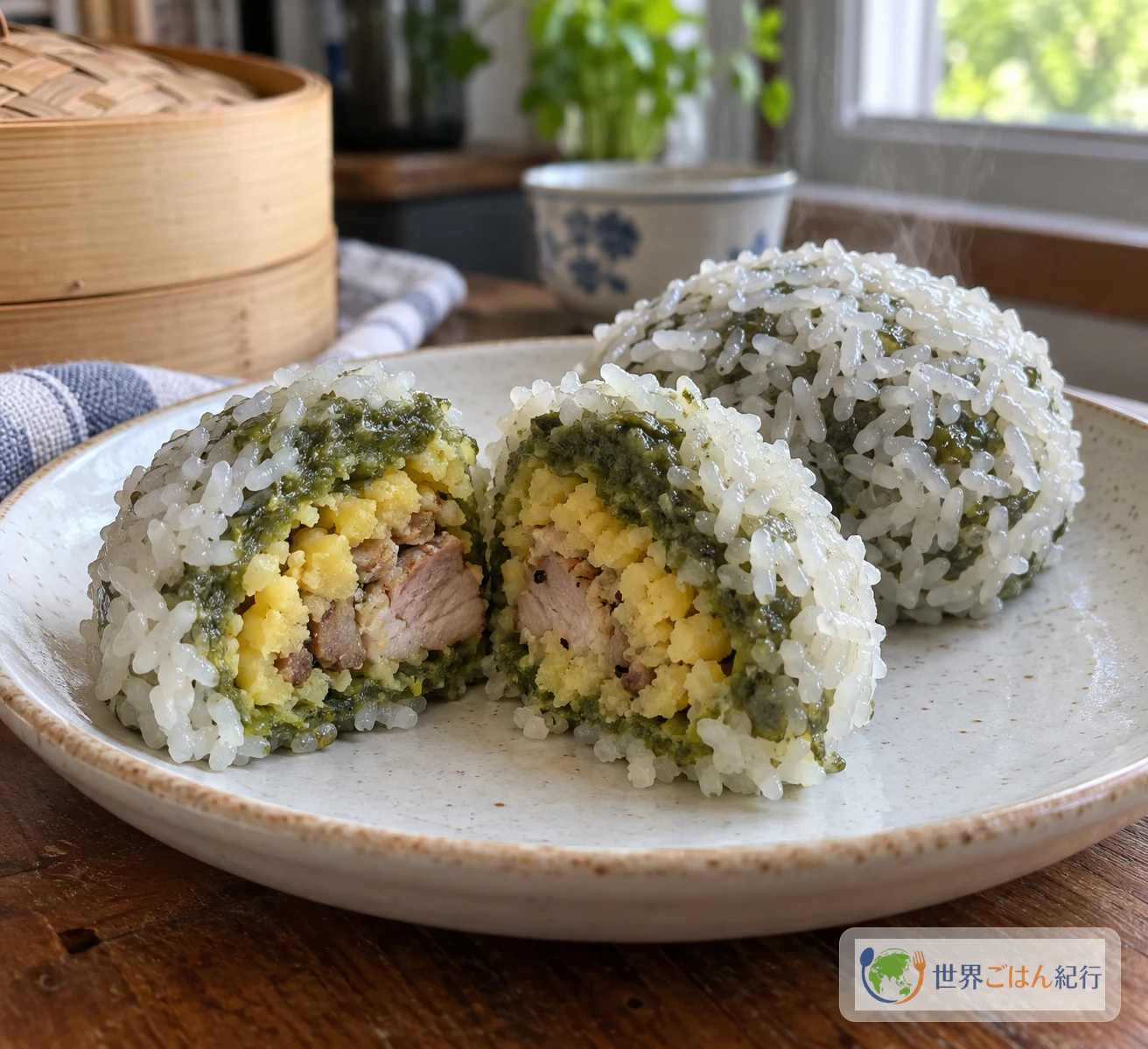
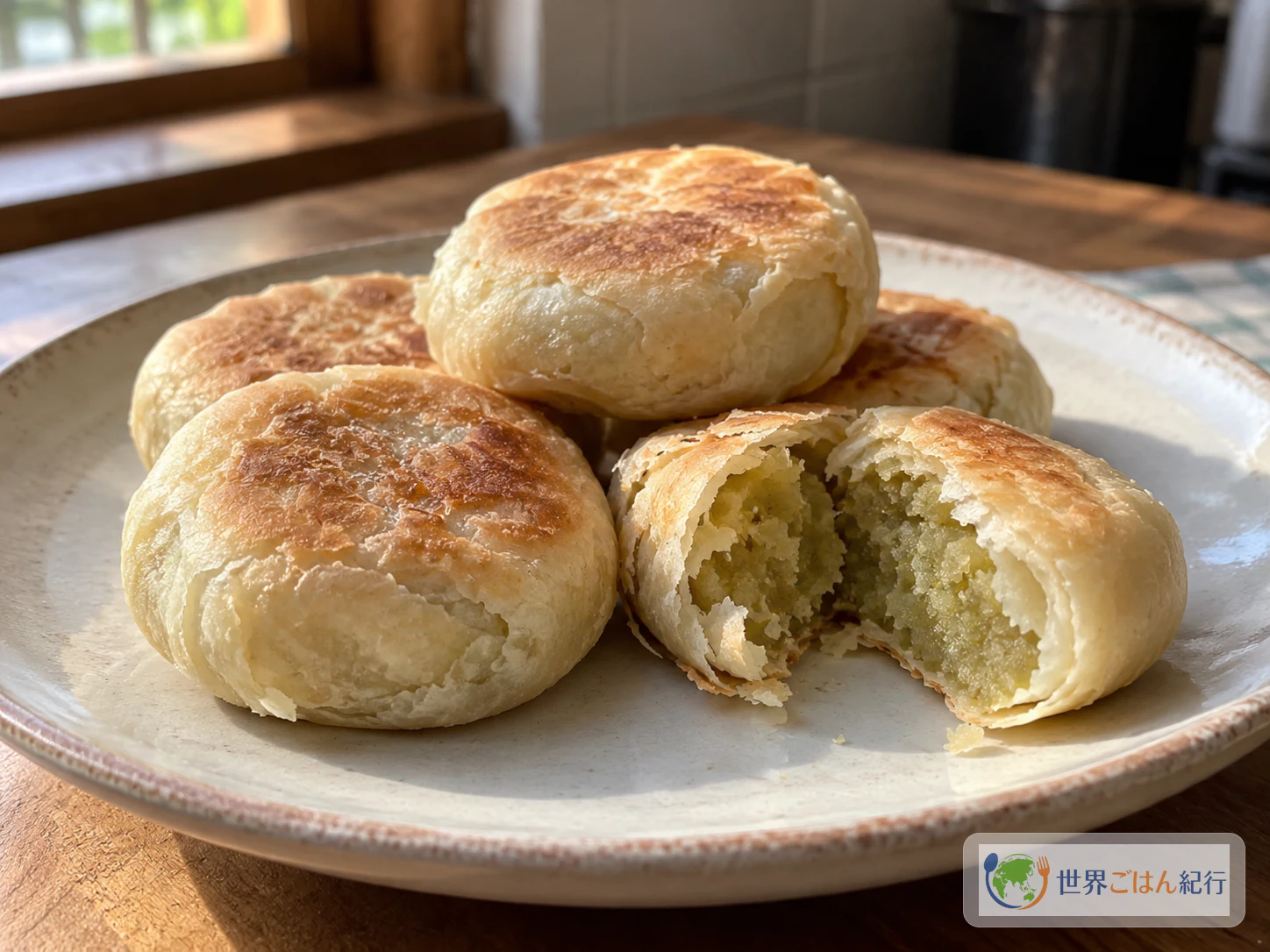
Splitting a dumpling shows the three layers: white rice, green dough, and the yellow mung bean filling with pork at its center.
Don't leave leftovers at room temperature for long. Divide them into shallow containers so they cool quickly, refrigerate at 10°C or below, and eat them soon. Reheat to 75°C or above. If anything seems at all doubtful, throw it away.
Troubleshooting
| Problem | What to do |
|---|---|
| The dough cracks or feels too dry | Work in a little more of the reserved cooking liquid, adding small amounts at a time |
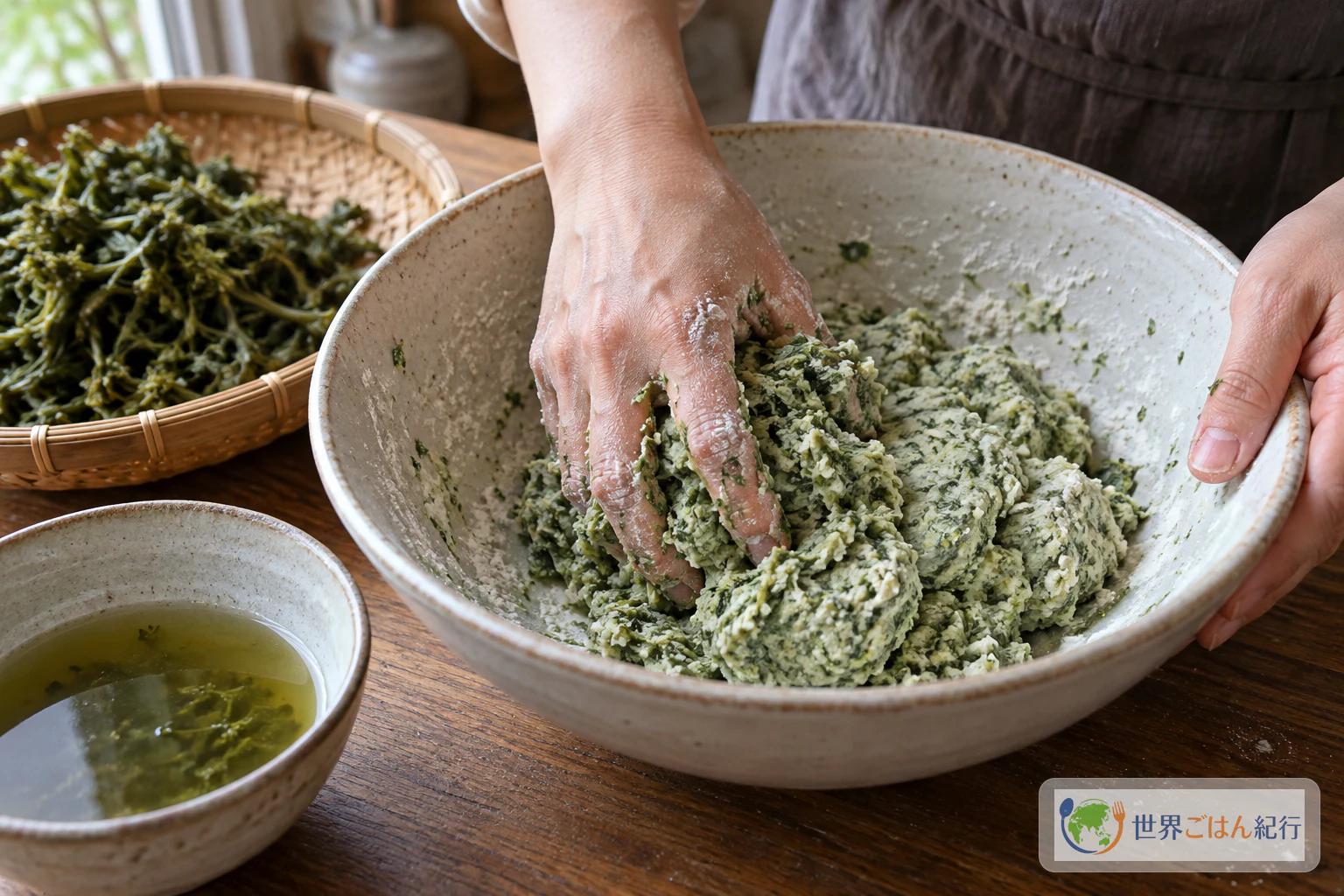
| The dough is watery | Work in a little more glutinous rice powder, adding small amounts at a time. Next time, add the liquid more gradually |
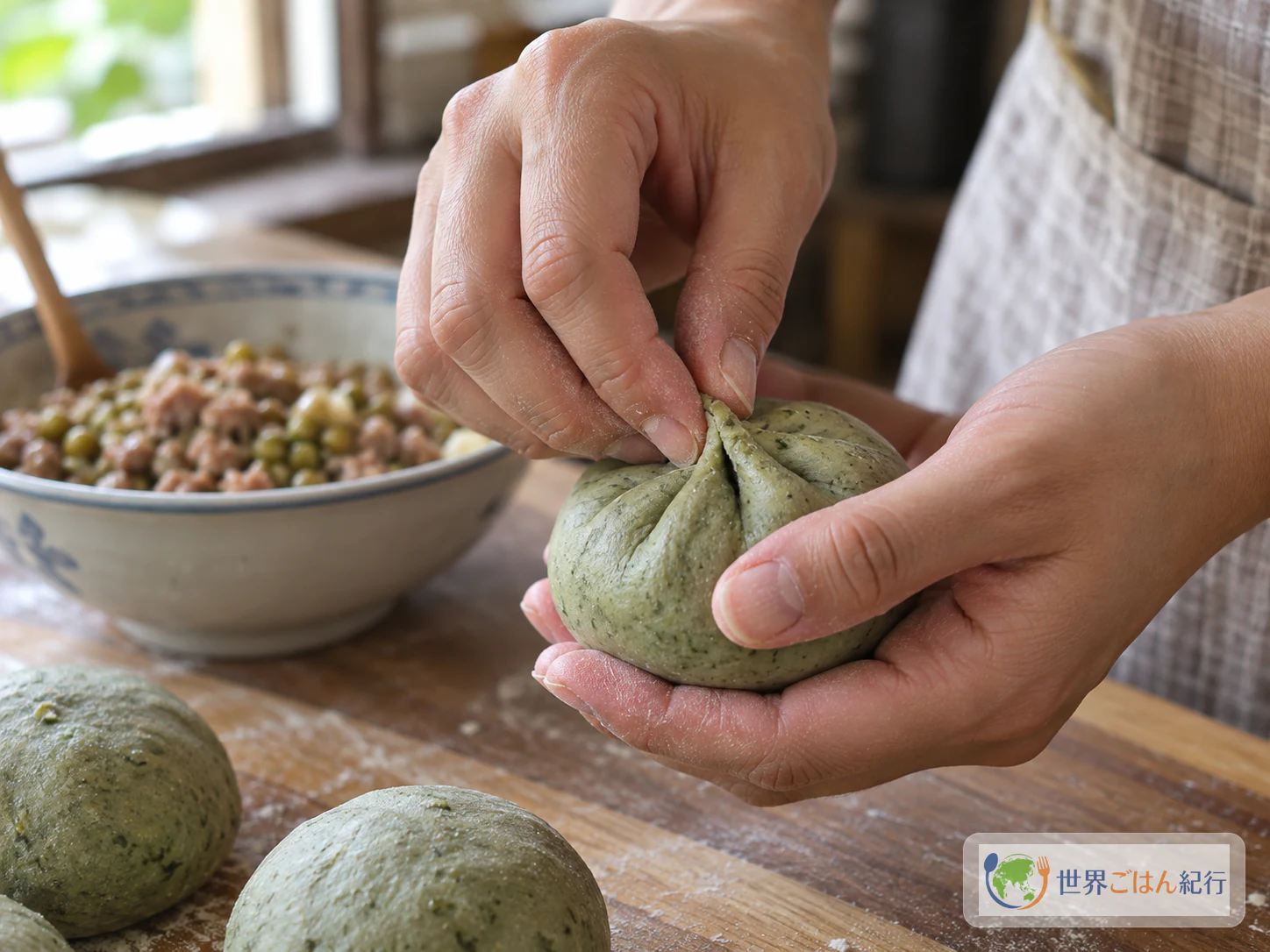
| The filling is hard to enclose | Use less filling in each piece of dough so the seam can close |
| The rice coat falls away | Roll the dumpling over the drained rice again so the whole surface is covered |
| The rice still has a hard core | Keep steaming and test another grain |
| The center is below 75°C | Keep steaming until the center holds 75°C for at least 1 minute. Don't go by color |
Variations to Keep Separate from the Base Recipe
These are directions to explore, not tested versions, and none comes with amounts of its own.
- A different leaf: Treat this as a new dumpling with a different scent. The ratio and moisture have to be worked out by trying it, and the name of the dish no longer describes it exactly.
- Frozen leaves: Freshness and water content may differ. Note the thawed weight and how much water you squeeze out, so you have something to adjust from.
- A different pork cut: Fat content changes the filling, so record which cut you used.
- Diềm-style dough: The 8:2 rice mixture described below belongs to a different recipe. Don't apply it to the 500 g of powder here.
- Different shaping: The half-moon form described below is another regional style, not a change to make within these amounts.
Same Name, Different Dumplings: Hanoi and Diềm Village
Bánh khúc is linked with northern Vietnam, and Báo Văn Hóa and Vietnam Pictorial both write about it as a Hanoi specialty. Diềm village, in the Kinh Bắc area of Bắc Ninh, has its own well-documented version. Thế giới Di sản and Vinpearl connect it with Quan họ singing and village occasions. Those accounts include village lore, and no start date for the dish has been established, so its history is best read as tradition rather than record.
| Point | Hanoi chef's recipe used here | Diềm village descriptions |
|---|---|---|
| Dough | 500 g glutinous rice powder with 500 g cudweed leaves | Sticky and ordinary rice in an 8:2 ratio, kneaded with cooked cudweed (Thế giới Di sản) |
| Filling | Mung bean and pork | Mung bean and pork |
| Shape | Balls of dough about the size of a duck egg before filling | Half-moon or rounded (Vinpearl) |
| Steaming | About 30 minutes | 2–3 hours (Thế giới Di sản); 30–40 minutes in one method (Vinpearl) |
| Serving | Not stated | Served hot |
These differences are why the two are not merged here. Taking one village's ratio and adding it to another cook's timing would produce a recipe that neither describes. For more dishes from the same country, see Vietnamese recipes.
Frequently Asked Questions
What is rau khúc?
It is the leaf that flavors the dough, also called lá khúc and usually translated as cudweed. Kotobank's encyclopedia entry gives cudweed as the English name for the Gnaphalium genus, which includes the Japanese plant hahakogusa. It has not been confirmed that rau khúc is that same species, so the two should not be treated as identical.
Is xôi khúc different from bánh khúc?
Xôi khúc is a closely related name, and this article uses the two as names for the same family of dumplings. The materials behind this article do not establish a firm line between them, so it does not claim that they are separate dishes.
Can I use another leaf?
You can make a dumpling with another leaf, but it won't have the same scent. Crown daisy, spinach and mugwort also differ in moisture, and no tested ratio is available for them. Where fresh rau khúc is sold internationally has not been surveyed.
Can I soak the mung beans and rice together?
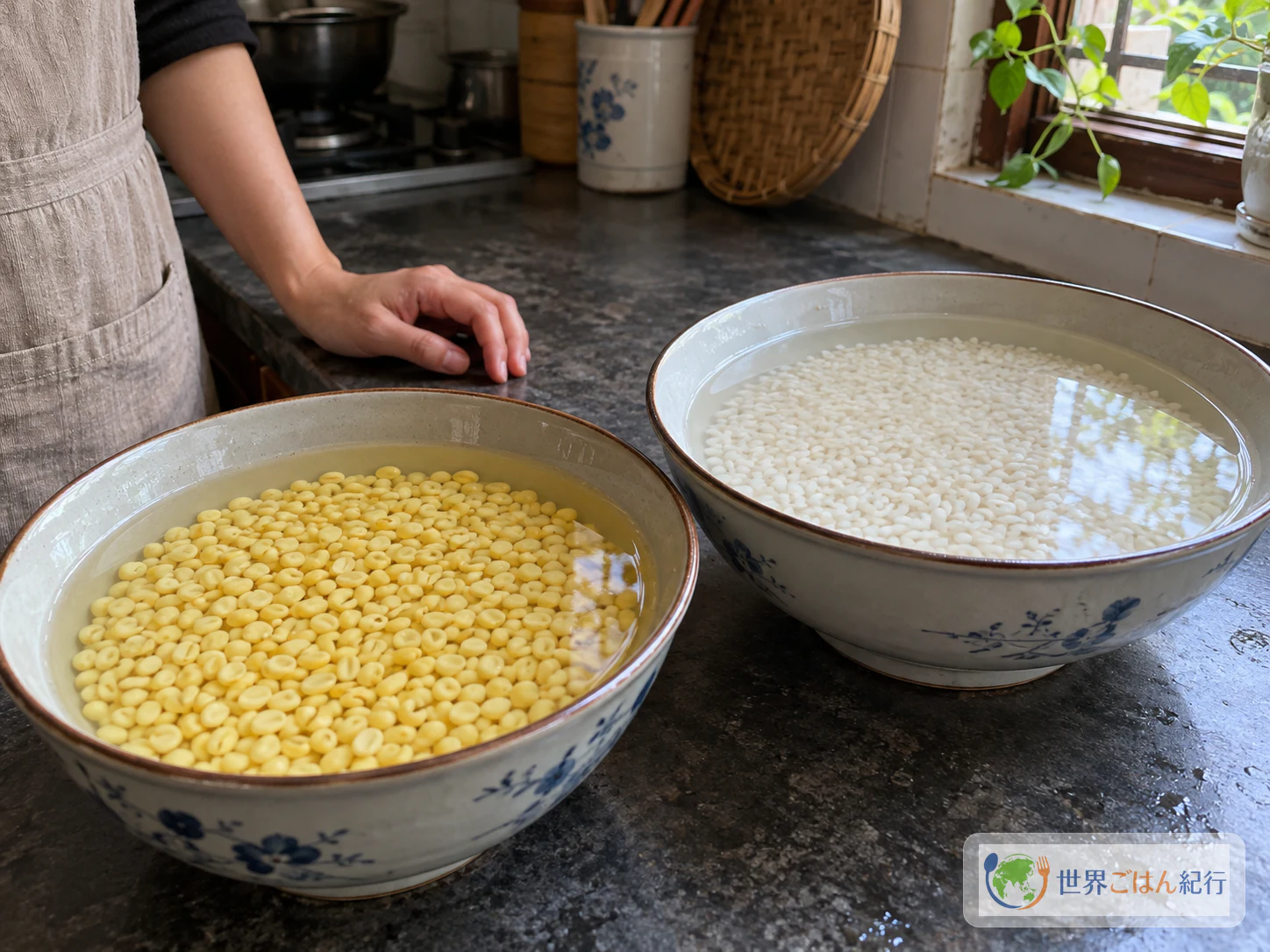
The chef's sentence names them together and gives 3–4 hours, without saying whether they share a bowl. They are soaked separately here because the beans go on to be steamed while the rice stays raw for the coat. Other recipes soak for longer: 4–6 hours in Eva, 6–7 hours or more in Dân trí, and 8 hours in Gia đình & Xã hội. Because those recipes differ in formula, their times do not carry over directly, so judge the finished rice by tasting it.
Why is there rice on the outside?
The chef's recipe doesn't explain it. A chewy grain coat around a soft dough and filling gives a clear contrast in texture, but that is a reading of the finished dumpling rather than a documented tradition.
How long should I steam it?
Start with the chef's roughly 30 minutes, then check the rice and the center temperature. Gia đình & Xã hội also gives about 30 minutes, while Dân trí gives 40–45 minutes, and Báo Văn Hóa and Vietnam Pictorial give about 45. Eva lists 25, 30 and 40 minutes across its methods, and notes that steaming 10–20 minutes longer helps the pork cook through. All of these are different formulas, so none guarantees the time for your dumplings or steamer.
What temperature makes the pork safe?
Japan's Ministry of Health, Labour and Welfare gives 75°C at the center for at least 1 minute as its home-cooking guide. Its page on pork also lists 63°C for at least 30 minutes, or 75°C for 1 minute, among its guides. This article uses 75°C for at least 1 minute. This is general food-safety guidance and does not vouch for a 30-minute steam, so use a thermometer.
Sources
- Việt Nam News, "Bánh Khúc (cudweed) cake," recipe credited to chef Lê Đức Hải, Ngon Garden Restaurant, Hà Nội. The main recipe: ingredient amounts, soaking, stuffing, coating and steaming for about 30 minutes. https://vietnamnews.vn/sunday/ong-taos-kitchen/771718/banh-khuc-cudweed-cake.html
- Thế giới Di sản, "Bánh khúc làng Diềm." Northern and Kinh Bắc context, the 8:2 rice ratio, hot serving and village occasions; used for regional comparison only. https://thegioidisan.vn/vi/banh-khuc-lang-diem.html
- Vinpearl, "Bánh khúc làng Diềm: nguồn gốc, cách làm bánh chuẩn vị." Diềm village shape and a 30–40 minute steaming method; used for regional comparison only. https://vinpearl.com/vi/banh-khuc-lang-diem-bac-ninh
- Báo Văn Hóa, "Bánh khúc - nét tinh túy riêng trong ẩm thực Hà Nội." Rice scattered outside and steamed about 45 minutes until white and sticky. https://baovanhoa.vn/am-thuc/banh-khuc-net-tinh-tuy-rieng-trong-am-thuc-ha-noi-11436.html
- Dân trí, "Chị em nội trợ chia sẻ công thức làm bánh khúc chuẩn vị Hà Nội." Drained rice without pre-steaming, the order for the mung beans, hạt nêm, use of oil and 40–45 minutes of steaming. https://dantri.com.vn/van-hoa/chi-em-noi-tro-chia-se-cong-thuc-lam-banh-khuc-chuan-vi-ha-noi-20211228133509192.htm
- Gia đình & Xã hội, "Cô sinh viên luật chia sẻ cách làm bánh khúc tuổi thơ ăn một lần là nhớ mãi." Measured "gia vị" beside pepper, rolling in drained soaked rice and about 30 minutes of steaming. https://giadinh.suckhoedoisong.vn/co-sinh-vien-luat-chia-se-cach-lam-banh-khuc-tuoi-tho-an-mot-lan-la-nho-mai-172231129092851429.htm
- Eva.vn, "3 Cách làm bánh khúc ngon, đơn giản chuẩn vị Hà Nội." Hạt nêm and pepper on the pork, rolling in soaked drained rice, and a range of steaming times. https://eva.vn/bep-eva/3-cach-lam-banh-khuc-ngon-don-gian-chuan-vi-ha-noi-c162a121536.html
- Vietnam Pictorial (VNA), "'Banh khuc' - a favourite specialty of Hanoi capital." Salt and pepper seasoning, soaked sticky rice and about 45 minutes of steaming. https://vietnam.vnanet.vn/english/print/‘banh-khuc-–-a-favourite-specialty-of-hanoi-capital-306095.html
- VietNamNet, "Introducing Banh khuc." The differing wording "grains of glutinous steamed rice," noted but not followed. https://vietnamnet.vn/en/introducing-banh-khuc-E109598.html
- Ministry of Health, Labour and Welfare, Japan, "豚のお肉や内臓を生食するのは、やめましょう" (on not eating raw pork or offal). Guides for cooking pork through to the center. https://www.mhlw.go.jp/stf/seisakunitsuite/bunya/kenkou_iryou/shokuhin/syouhisya/121004/index.html
- Ministry of Health, Labour and Welfare, Japan, "家庭でできる食中毒予防の6つのポイント" (six points for preventing food poisoning at home). Center temperature, refrigeration, handling raw meat, storing leftovers and reheating. https://www.mhlw.go.jp/www1/houdou/0903/h0331-1.html
- Kotobank, "ハハコグサ" (World Encyclopedia entry). The English name cudweed for the Gnaphalium genus only; it does not identify the species of rau khúc. https://kotobank.jp/word/%E3%81%AF%E3%81%AF%E3%81%93%E3%81%90%E3%81%95-3163557