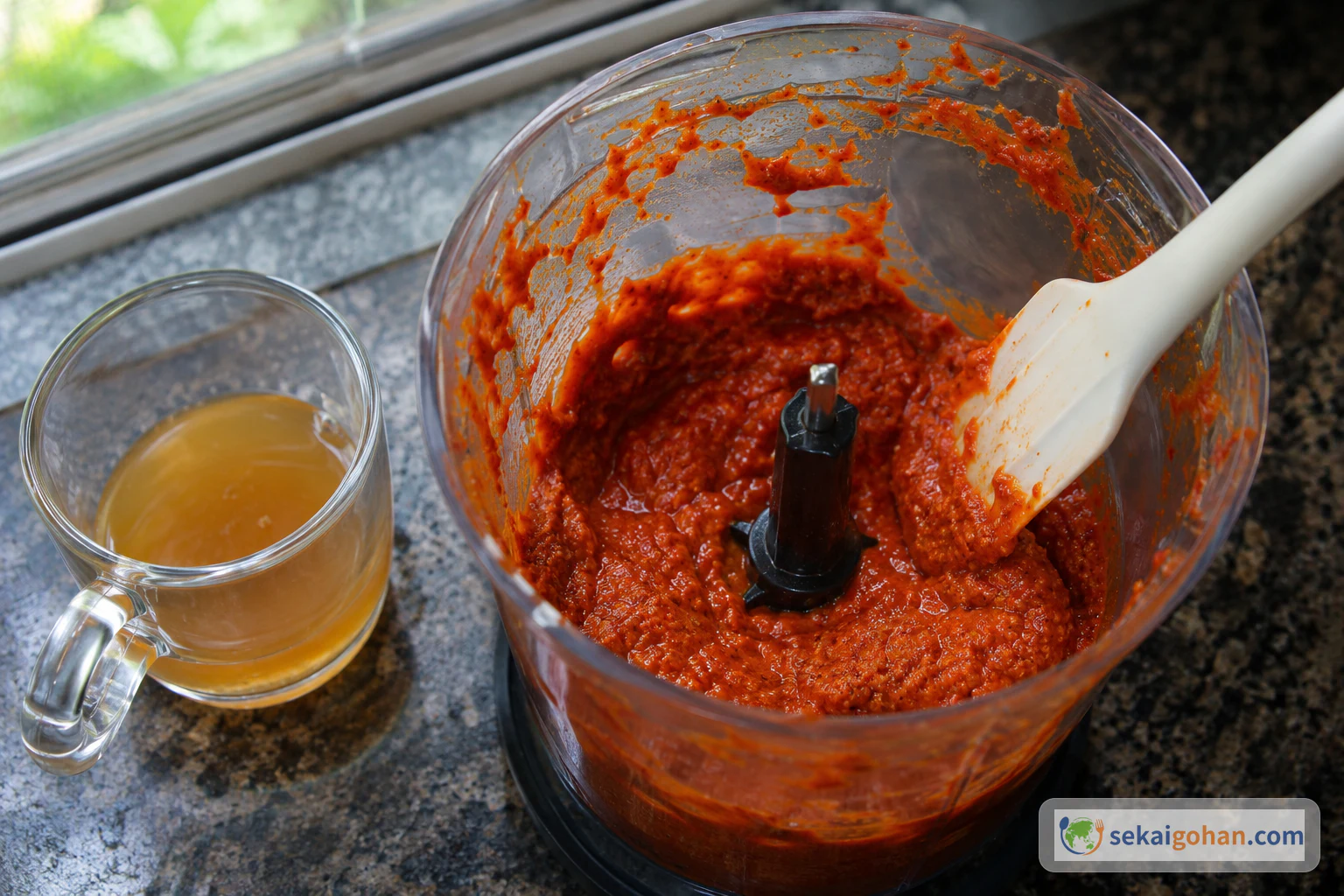
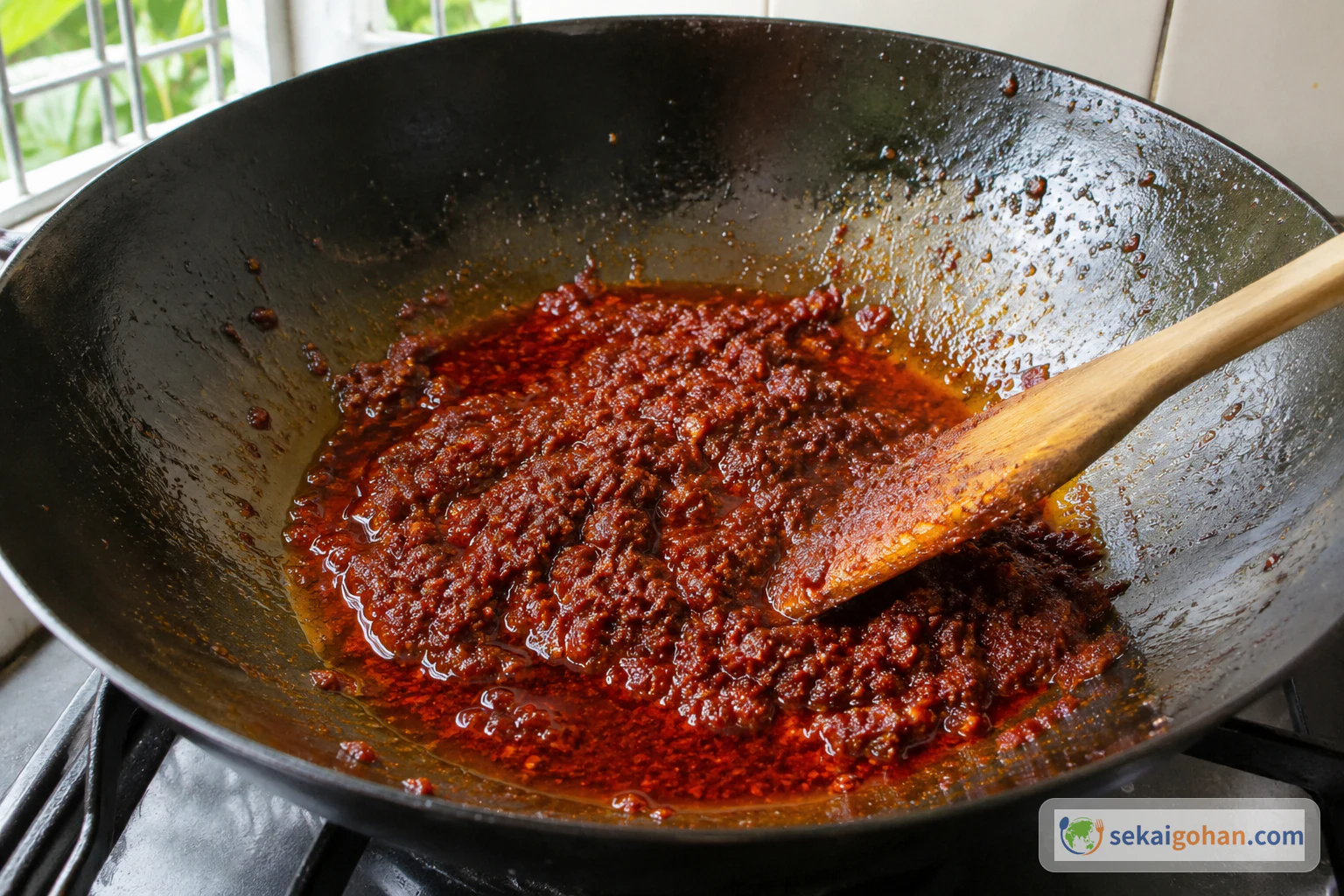
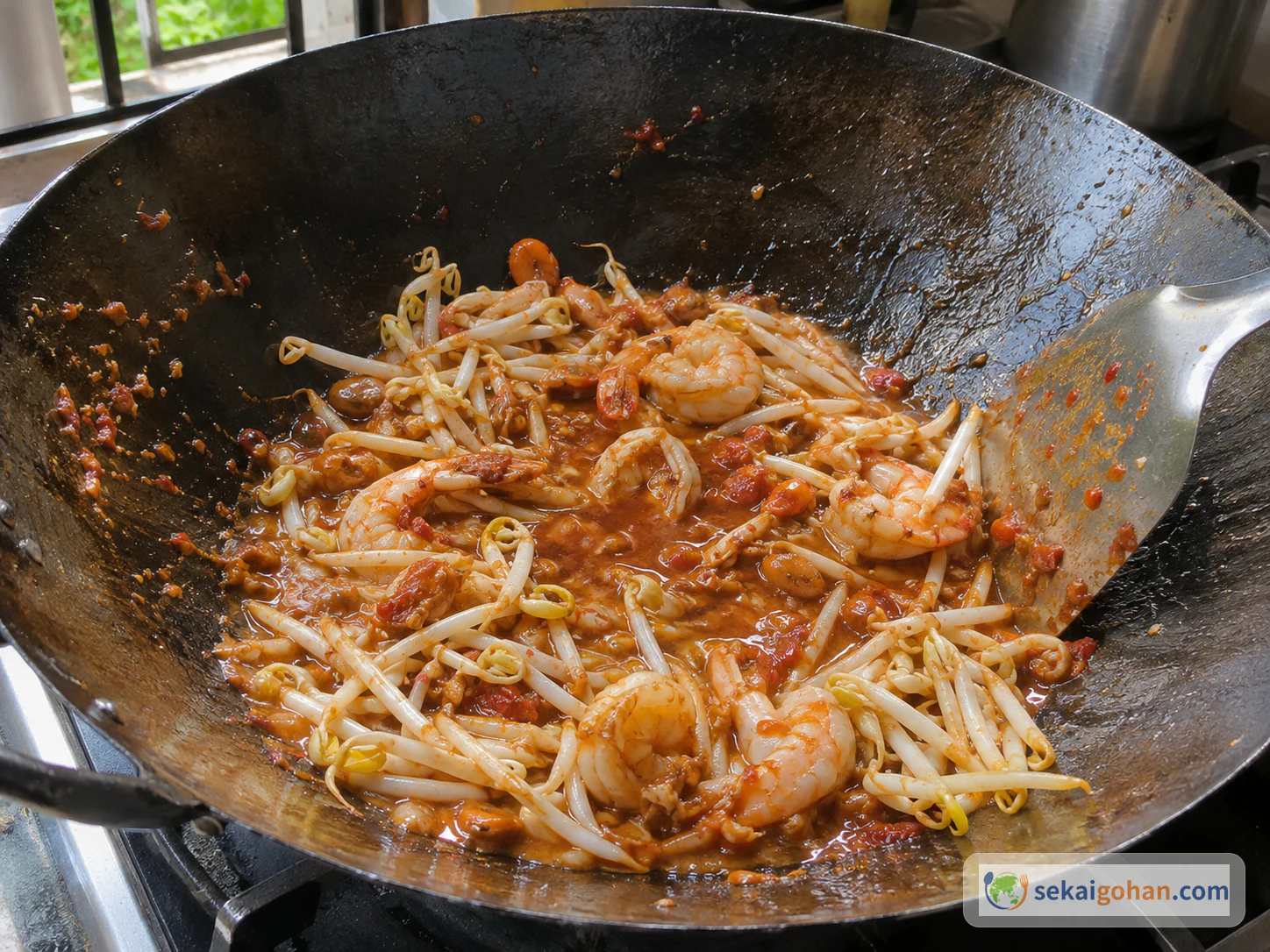
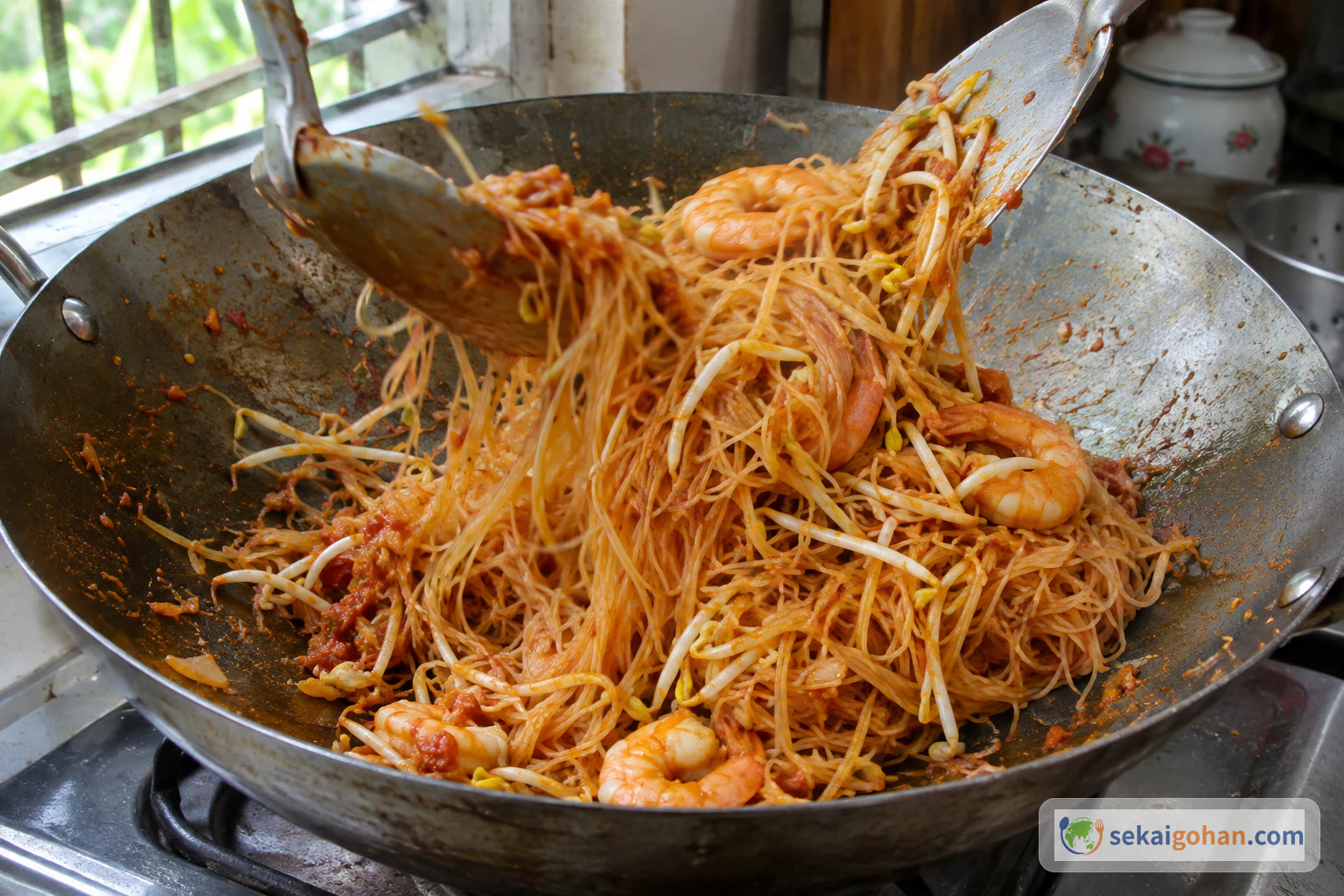
Somewhere in the middle of making mee siam, the paste in the wok stops behaving like a purée. It darkens to brick red, the oil slips out and pools around its edges, and the sharp smell of raw onion and dried shrimp turns round and savoury. Everything after that moment goes quickly: a brown sauce of tamarind and salted soybeans, a handful of prawns, then a tangle of thin rice noodles lifted through the pan until every strand is stained orange-red.
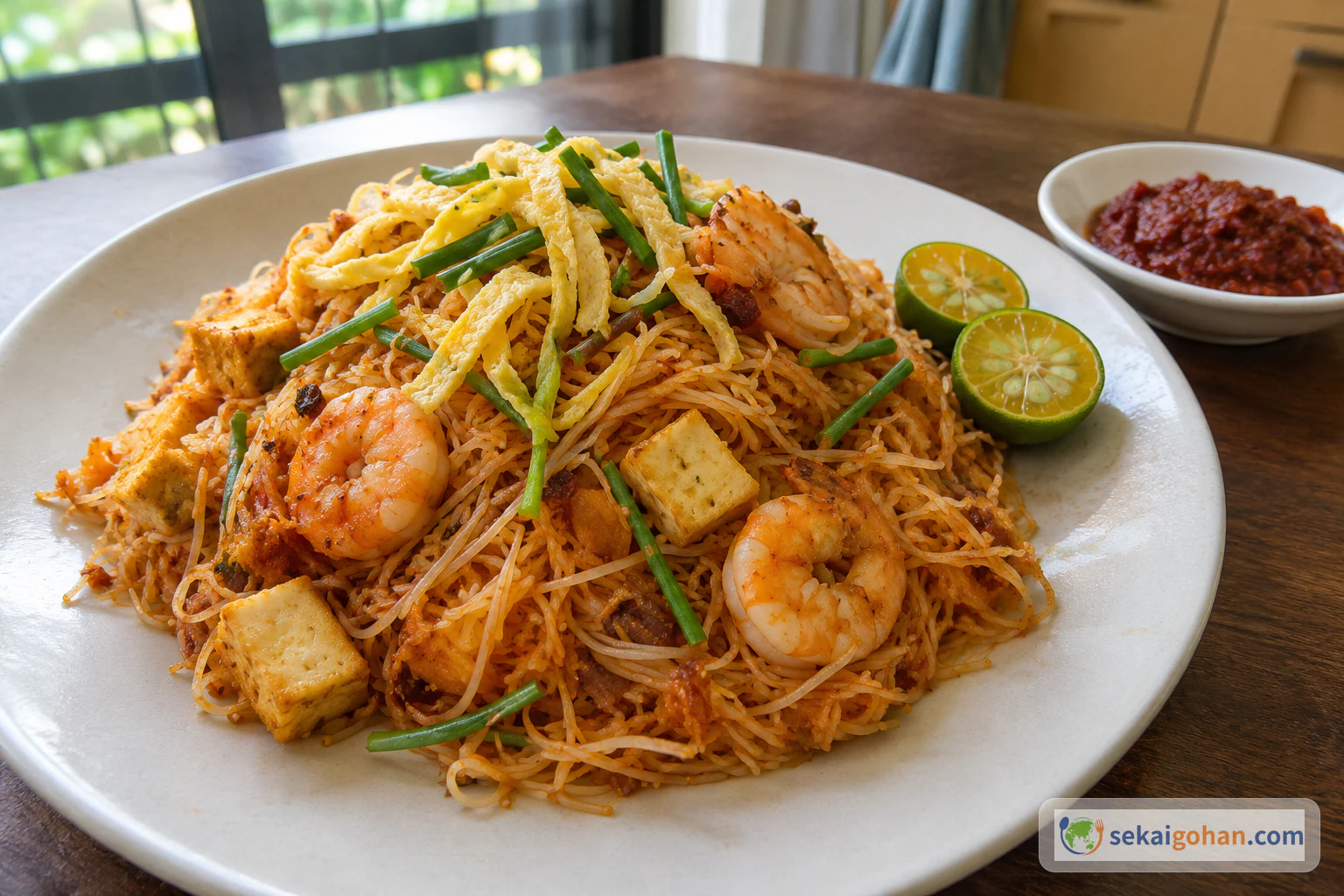
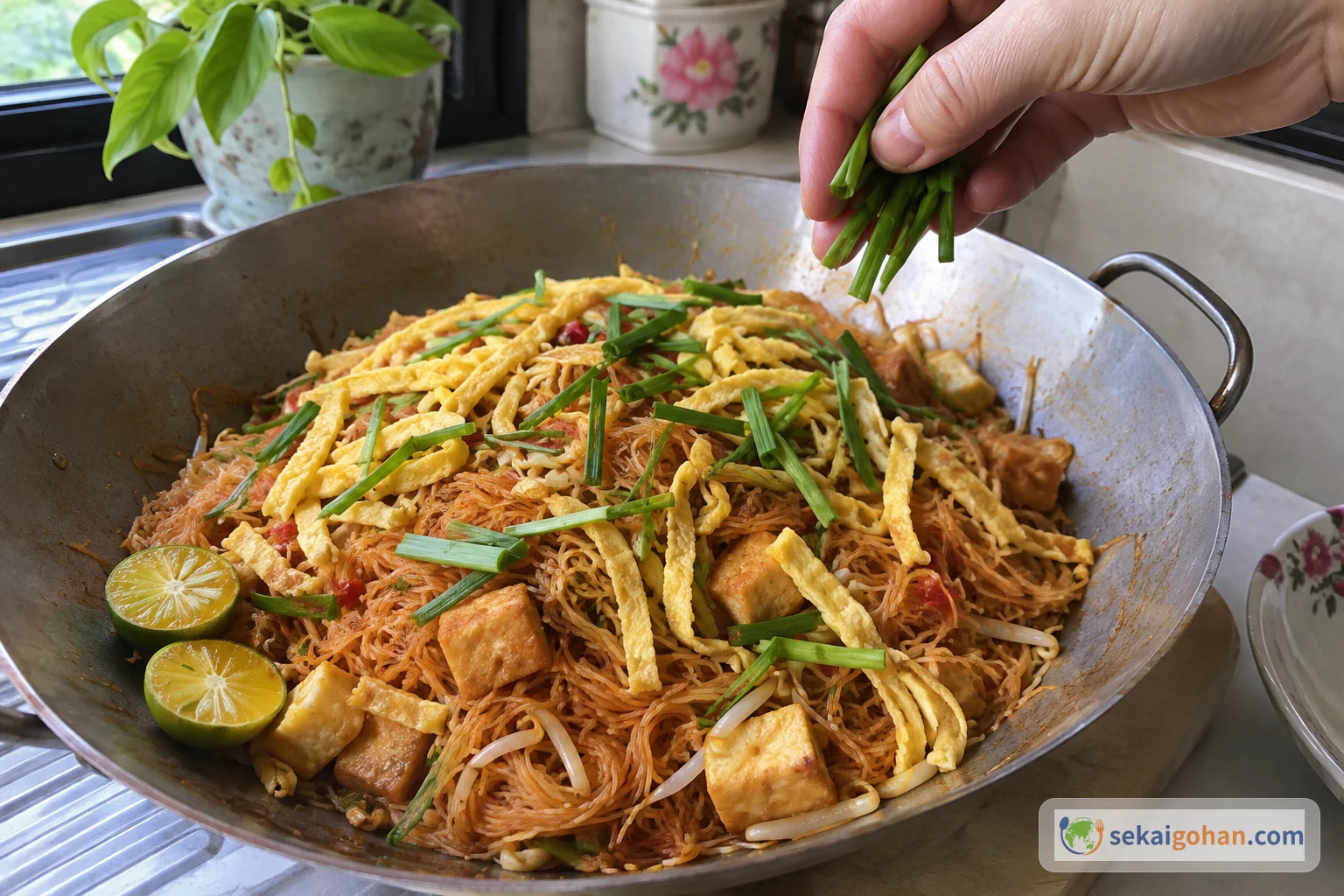
Mee siam goreng is the dry form of a noodle dish eaten across Malaysia and Singapore. It tastes sweet, sour and hot at once, with a salty, fermented depth underneath, and it reaches the table under ribbons of omelette and raw garlic chives with calamansi to squeeze over the top.
Siamese Noodles from Penang, Malay and Peranakan Kitchens
You find mee siam most often at Malay-run stalls and shops, and it belongs just as firmly to the Peranakan (Nyonya) table. One well-known home recipe calls it a Malay dish, while Nyonya cooks claim it as theirs, and the two versions differ very little. The food cultures of Penang, the Malay community and the Peranakans are all bound up in it, and it is a favourite in Singapore too. Where it was first made is not settled; one account places its birth in Penang.
The name looks north. The dish carries the mark of Thai influence on the cooking of northern Malaysia, and the flavour leans that way: tamarind for sourness, dried chilli for heat. Its backbone is local, though. Tamarind and taucheo, the salted fermented soybeans of Malaysian and Peranakan kitchens, lay down the sourness and the savoury base, and dried shrimp ground into the paste carries the whole thing.
Mee is noodles and Siam is the old name for Thailand, so mee siam is "Siamese noodles". Goreng means fried, which is the dry plate in this article; kuah (gravy) and basah (wet) name the version served in a pool of sauce.
One name, two plates
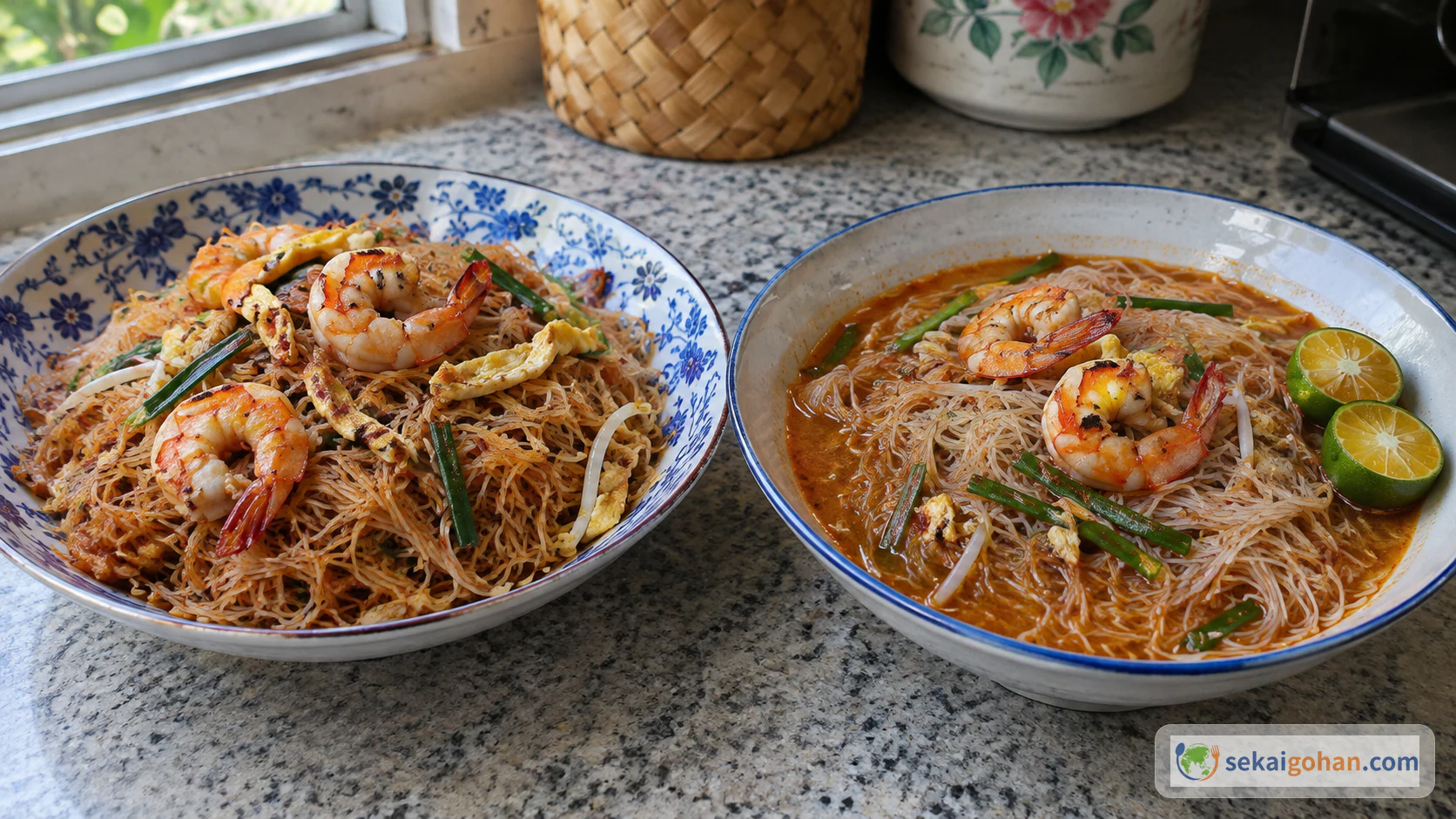
In many places the dry version is the more common one, and that is the plate cooked here. The gravy version, mee siam kuah or basah, gets a thin, reddish-brown gravy poured over the noodles: stock made from prawn shells, simmered with tamarind juice, lemongrass, galangal, candlenuts and taucheo. In parts of Malaysia that wet style goes by the name mee siam Singapore, and a Malaysian recipe site publishes it as Singapore mee siam, so the name has crossed the causeway and come back with a new label.
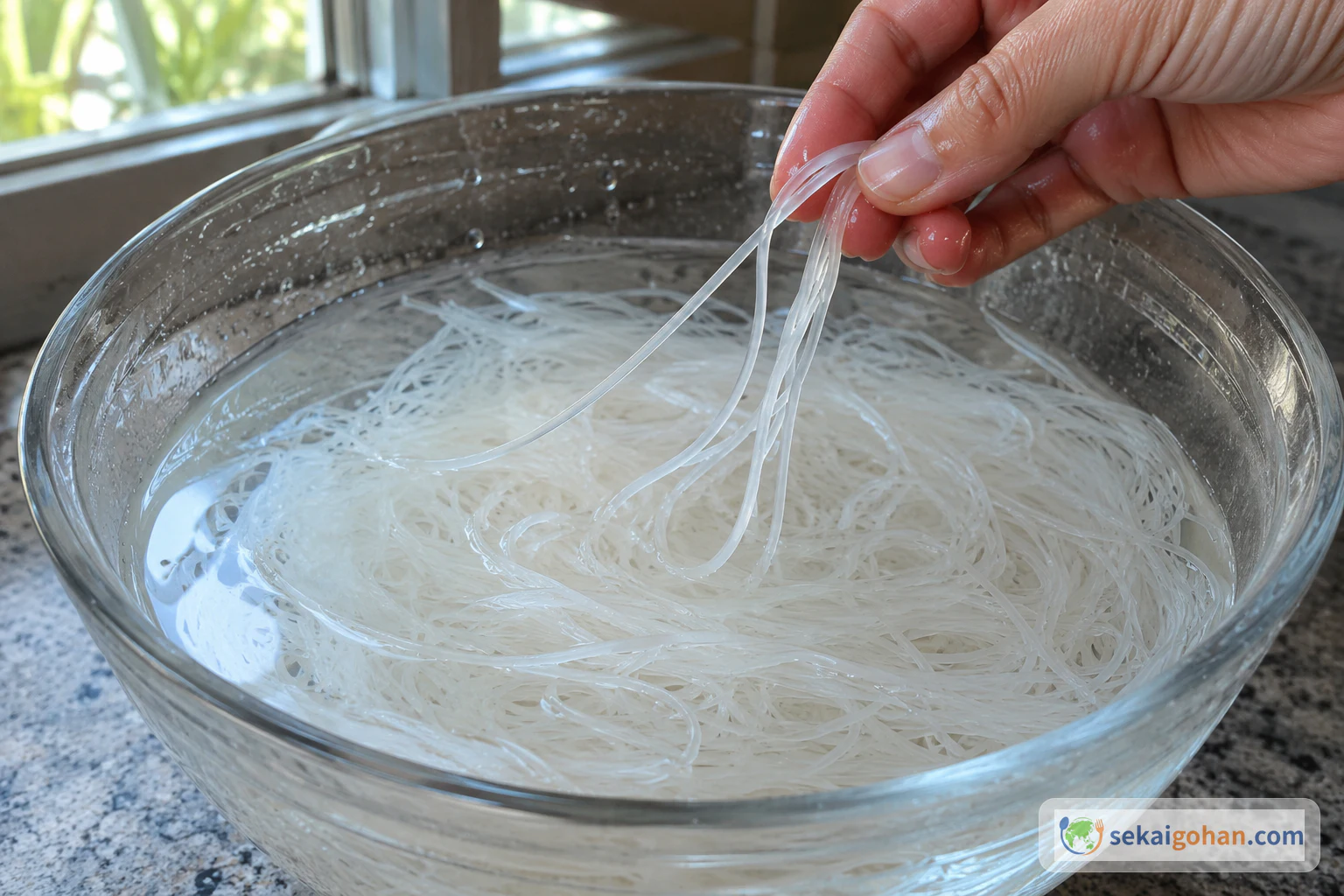
Even the noodles are handled differently. For the gravy plate they soften in hot water for a few minutes; for the dry plate they soak slowly in water at room temperature, because they still have a long toss in the wok ahead of them.
Its neighbours on the Malaysian table
Malaysia has more than one way to fry rice noodles. Char kway teow uses flat rice noodles and builds its flavour from dark soy and fierce heat, while mee siam builds everything into a slow-fried paste before the noodles ever go in. The tamarind sourness links it instead to Penang's assam laksa, a sour fish-broth noodle soup. For more dishes from the same kitchens, see Malaysia.
Ingredients (serves 4)
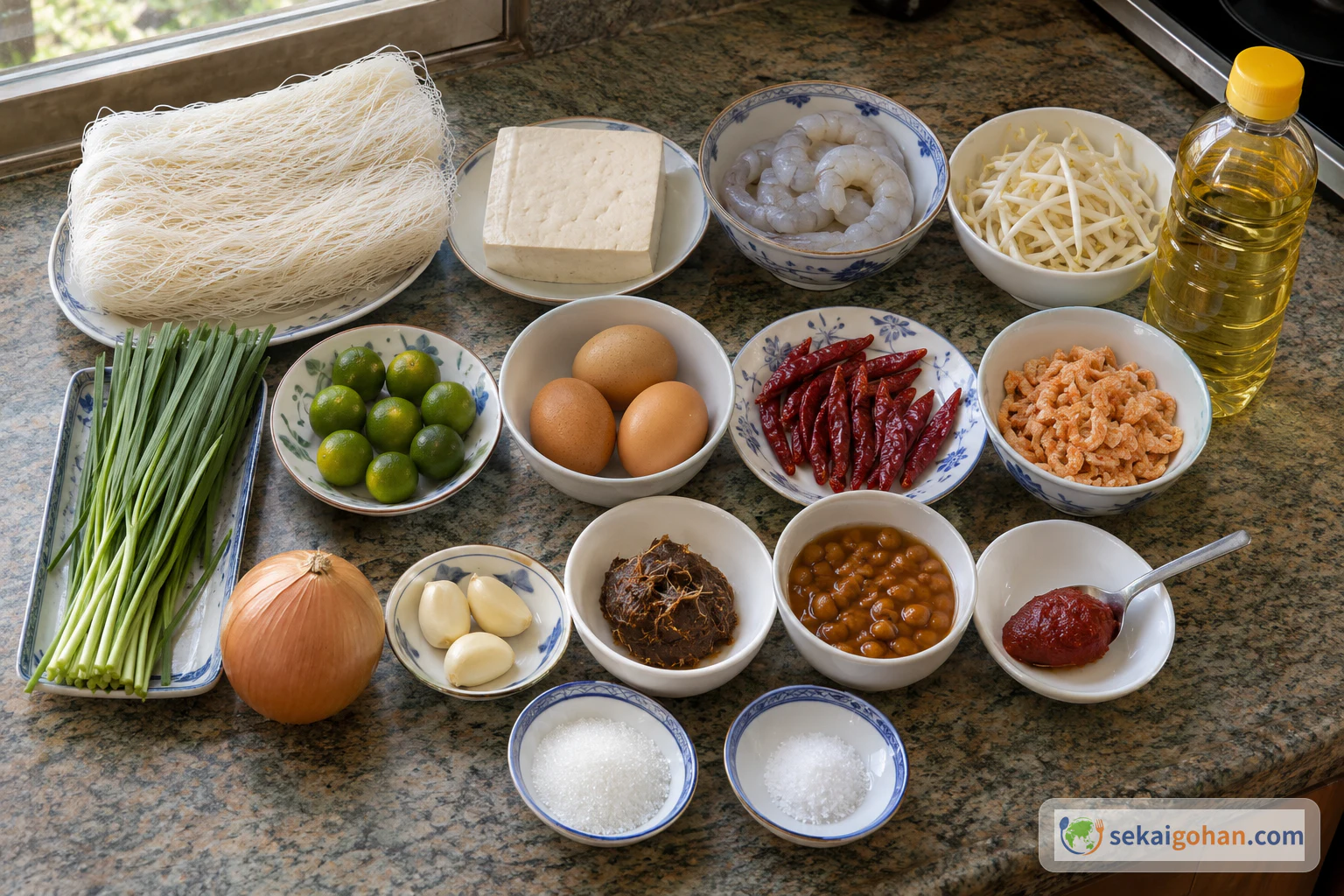
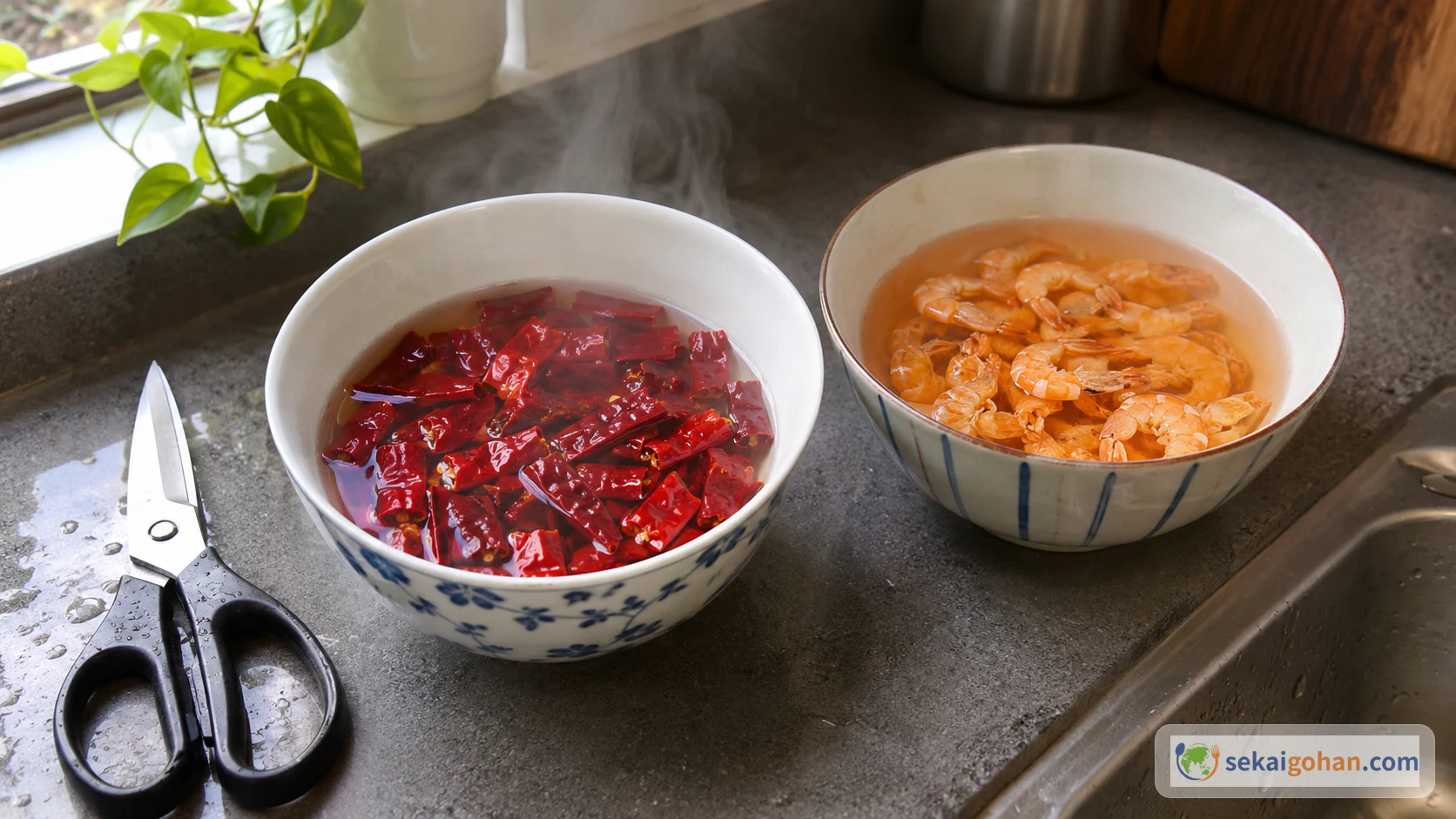
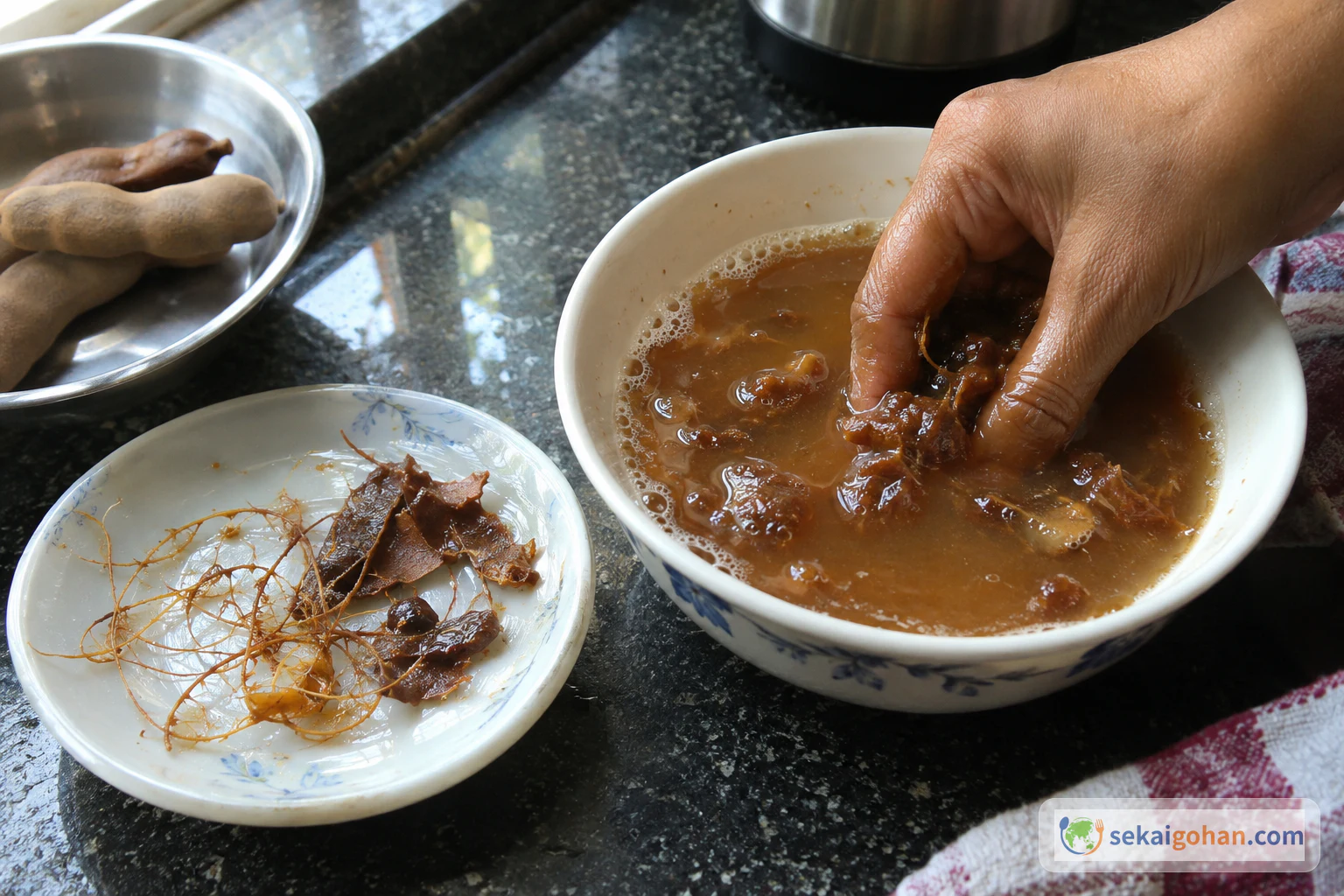
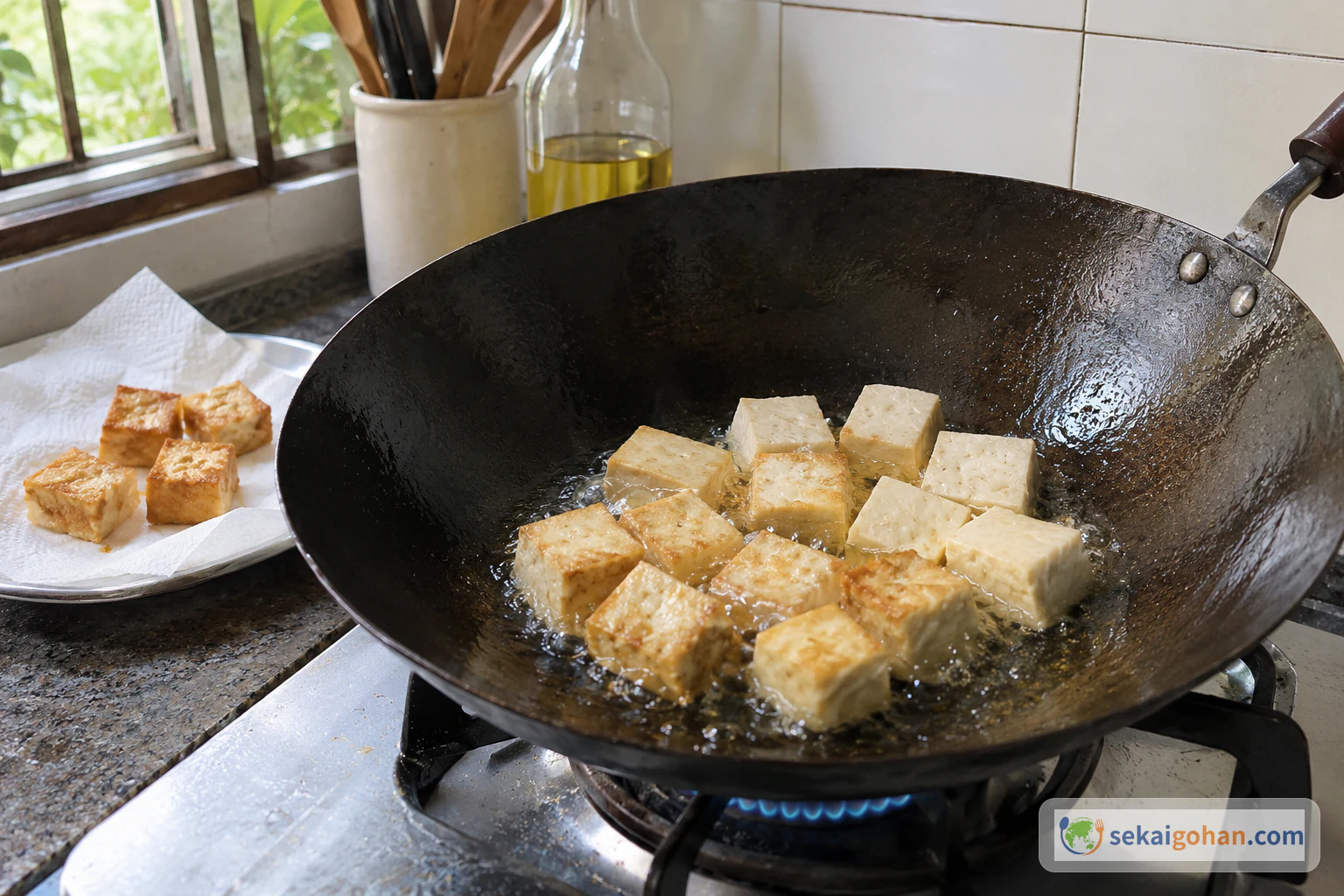
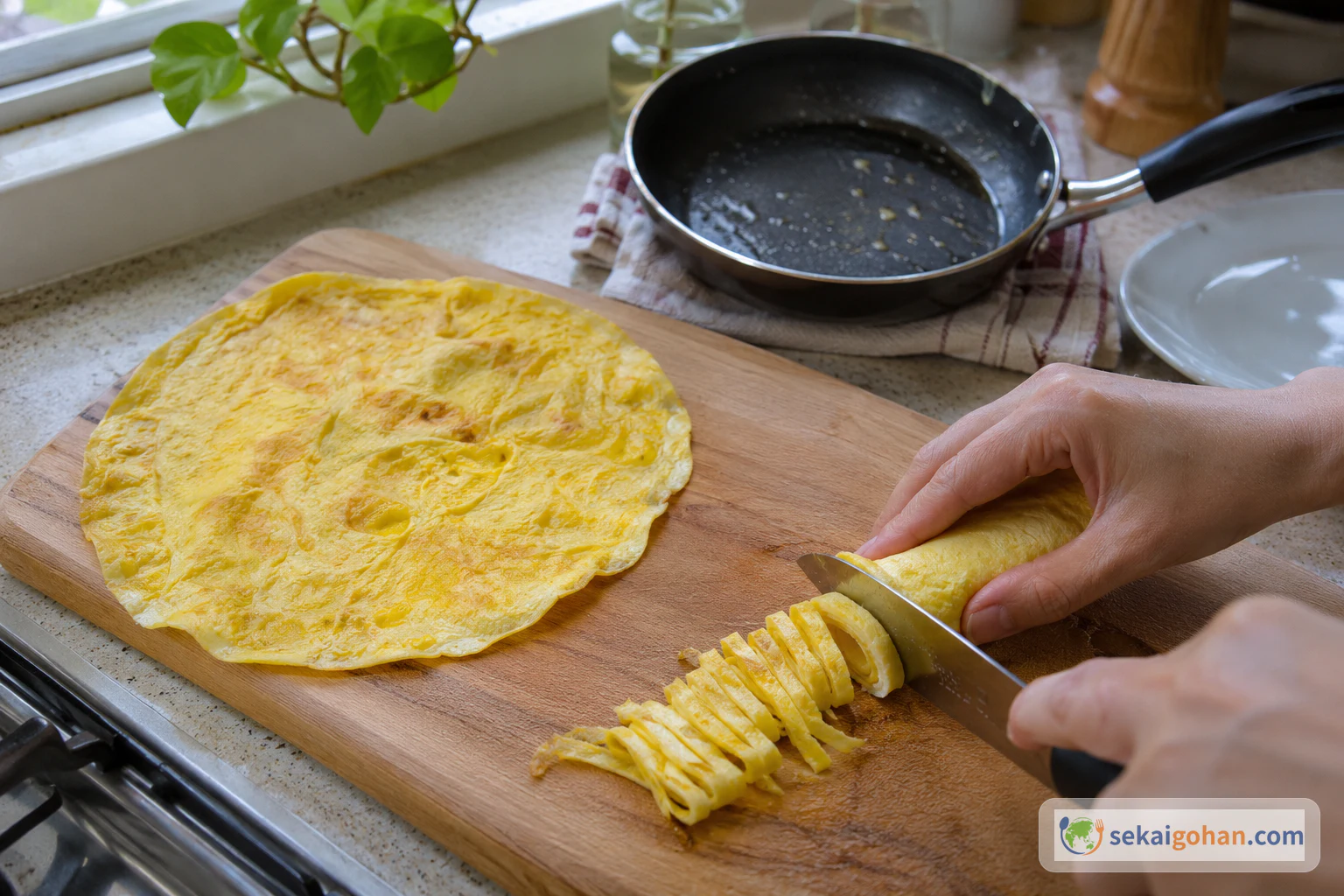
The flavour stands on five things: tamarind for sour, taucheo for salt and ferment, dried shrimp for savoury depth, chilli for heat, and sugar with tomato paste for sweetness. One ½ cup of oil does three jobs: it fries the tofu, a spoonful of it cooks the omelettes, and what is left in the wok fries the paste. The dried shrimp work twice as well, ground into the paste while their soaking water seasons the sauce.
This dish contains crustaceans (prawns and dried shrimp), egg and soy (tofu and taucheo). Some brands of taucheo contain wheat, so read the label if you cook for anyone avoiding gluten.
Equipment
- A wok or a deep, wide pan with room to lift 10½ oz (300 g) of noodles
- An 8-inch (20 cm) frying pan for the omelettes
- A small blender or food processor
- Two spatulas or a pair of long chopsticks
- Kitchen scissors
- A fork
- Kitchen paper
- A large bowl for soaking the noodles, plus small bowls for the chillies, dried shrimp and tamarind
Choosing and Substituting
The three things worth a trip to an Asian grocer or an online order are taucheo, tamarind pulp and dried shrimp, because together they make the dish taste Malaysian. Everything else comes from a supermarket.
| Ingredient | What to buy | If you cannot find it |
|---|---|---|
| Taucheo | Jar or pouch of salted fermented soybeans, sold as taucheo or taucu | Miso or another yellow soybean paste works in a pinch. It is a different salt and sweetness with no whole beans, so add it gradually |
| Tamarind pulp | A brown block of pulp with seeds and fibre | Use 3 tbsp ready-made tamarind paste. Some cooks use lemon juice, which gives a sharper, thinner sourness |
| Dried shrimp | Larger dried shrimp | Some households cook with belacan (shrimp paste) instead, which is louder and more pungent |
| Calamansi | Fresh fruit, or frozen calamansi juice | 2 regular limes; squeeze 1 into the wok and serve the other in wedges |
| Rice vermicelli | Plain, thin, dried bee hoon | Avoid pre-seasoned noodles, especially the curry-dusted kind sold for "Singapore noodles" |
| Dried red chillies | Whole dried red chillies | The same number of fresh red chillies; dried ones taste earthier |
| Firm tofu | Tau kwa or well-pressed firm tofu | Tau pok (tofu puffs), which soak up the sauce like a sponge |
| Garlic chives | Kucai | Chives or spring onions |
| Omelette strips | Thin omelettes | Sliced hard-boiled eggs |
Use tomato paste, not ketchup. The level spoonful is there for colour and a little sweetness, and the sugar and salt amounts are set around it.
Method
Put the noodles in to soak first; that hour is the hands-off time. While they sit, soak the chillies and dried shrimp, make the tamarind water, fry the tofu, cook the omelettes, blend the paste and mix the sauce, so that everything waits by the stove. Once the paste goes into the wok, the rest runs in one stretch without stopping.
Tofu holds water, and wet tofu makes hot oil spit. Pat every cube dry, slide it in away from you and keep your face back from the wok. The prawns go into the wok only partly cooked; before you squeeze in the calamansi, they must be opaque all the way through.
Malay cooks call the moment in step 8 pecah minyak, "the oil breaks". When the oil pulls out of the paste and pools red around it, the water in the onion and chillies has cooked off and the raw, fishy edge is gone. Stop earlier and that harsh, powdery heat goes straight into the noodles, and nothing later in the recipe takes it out.
Soaked rice vermicelli tears when it is pushed around a pan. Slide two spatulas or long chopsticks under the noodles, lift, let them fall back and turn the wok a little before the next lift. It feels slow, but every strand stays long and gets coated.
When It Goes Wrong
| What you see | Why | What to do |
|---|---|---|
| Noodles snap into short pieces and clump | They soaked in hot water, or they were stirred instead of lifted | Next time, soak them in room-temperature water for the full hour. For now, lift gently with two spatulas and stop stirring |
| Noodles still firm after tossing | They need more moisture and time | Add 2 to 3 tbsp shrimp soaking liquid and toss for 3 to 5 minutes more |
| Too salty | Taucheo, dried shrimp and the soaking liquid are all salty already | Add salt only after tasting at step 11, and correct with soaking liquid before reaching for the salt |
| Sourness tastes flat | The tamarind was strained, or the calamansi went in too early | Use the tamarind water unstrained, and squeeze the calamansi in at the very end |
| Prawns still glassy at the end | They cooked only briefly before the noodles went in | Keep tossing over the heat until every prawn is opaque before adding the calamansi |
Serving, Variations and Storage
At the table
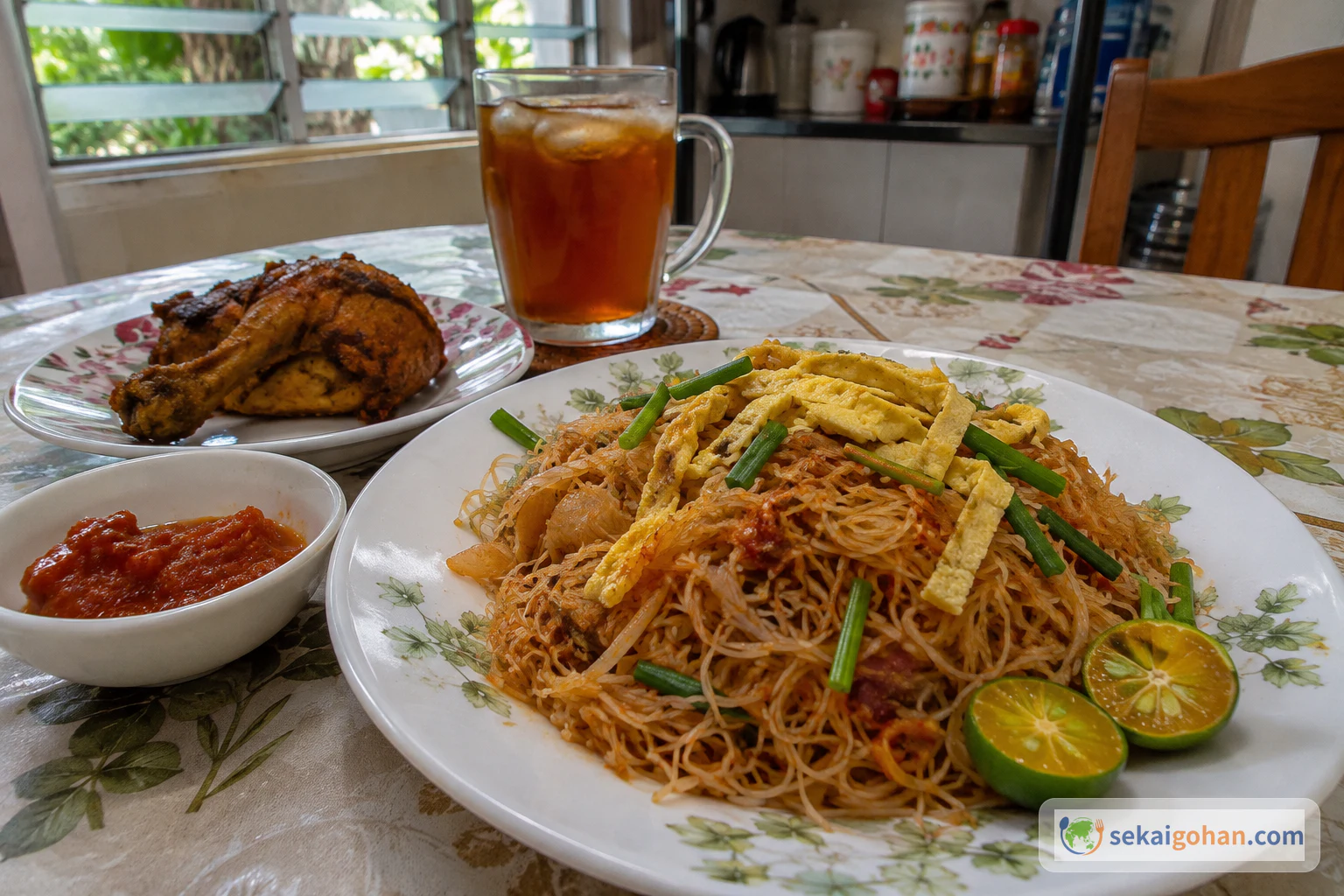
In Malaysia mee siam is a breakfast-to-lunch plate, set out with sambal, egg and a wedge of lime, and sometimes with otak-otak or fried chicken. The sambal from nasi lemak works well next to it, and so does sambal kicap, a chilli soy dip. It also turns up on special occasions.
Variations
- Vegan: leave out the prawns, dried shrimp and eggs, and use 3½ to 5 oz (100 to 150 g) fresh shiitake in place of the dried shrimp. Avoid dried shiitake, which brings a smoky note. The dish turns earthy rather than briny.
- Everyday home version: make it with prawns, fish balls, tofu puffs and omelette, and some cooks swap the tamarind for lemon juice. The sourness turns brighter and thinner.
- Sambal shortcut: replace the chillies, dried shrimp, onion and garlic with 3 tbsp sambal oelek or sambal balado. It saves the soaking and blending, and the result takes on the character of the sambal you buy.
Leftovers
Divide leftovers into shallow containers so they cool quickly, cover them and refrigerate promptly at 50°F (10°C) or below. Eat them within 1 day. Reheat in the microwave for about 2 minutes, stirring halfway, or stir-fry with 1 to 2 tbsp water, until the noodles are hot throughout at 167°F (75°C) or higher. Throw away anything that has sat out too long or seems doubtful.
Frequently Asked Questions
What is the difference between mee siam and mee rebus?
They use different noodles and sauces. Mee siam is thin rice vermicelli flavoured with tamarind and taucheo, while mee rebus is yellow wheat noodles under a thick gravy made with sweet potato. Mee siam is sour and sharp; mee rebus is thick, sweet and mellow.
Can I use fresh rice vermicelli?
Yes. Fresh rice vermicelli needs no soaking, so skip step 1 and add the noodles at step 10. Choose plain noodles, not seasoned ones.
Can mee siam be gluten-free?
The main wheat risk is the taucheo: some brands contain wheat. Read the label on the taucheo, and on miso if you use it as a substitute. The sambal you serve alongside needs the same check.
Do I really need a wok?
You need depth and width more than the wok itself. A wok or a deep, wide pan gives you room to lift 10½ oz (300 g) of soaked noodles with two spatulas. In a shallow pan you end up stirring, and stirring is what breaks the strands.