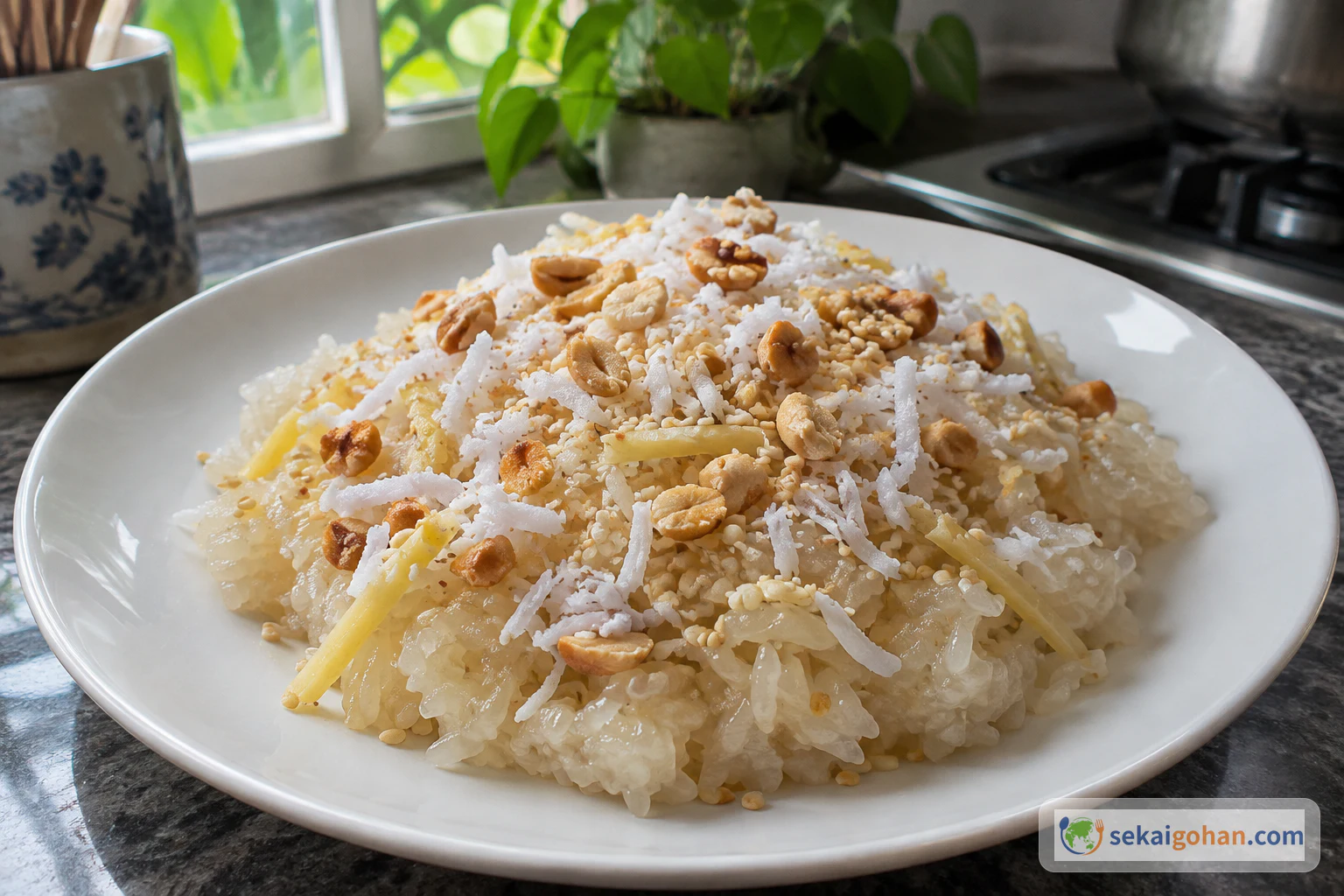
Htamanè: Sticky Rice Kneaded with Peanuts, Sesame and Coconut
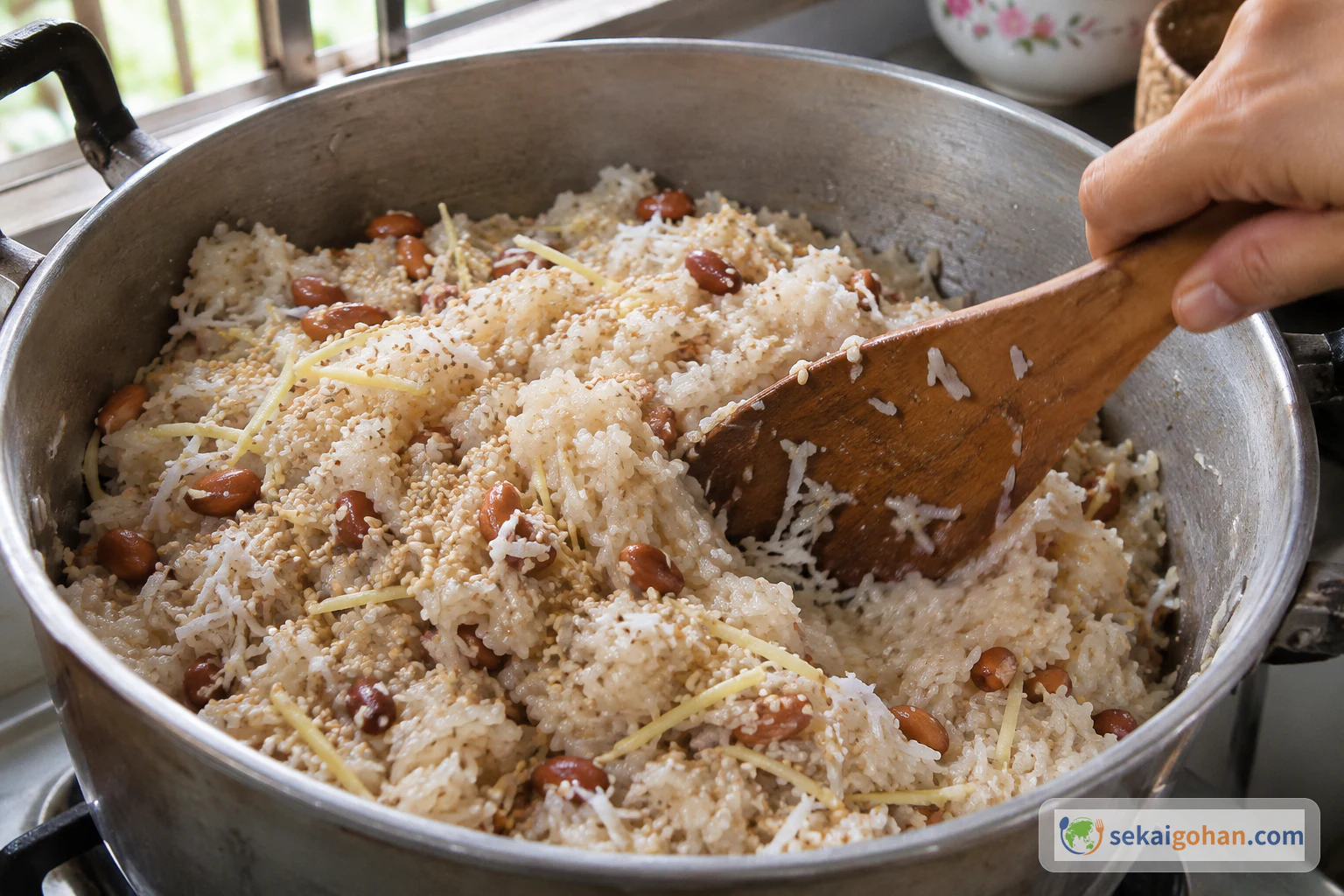
Soak the rice, simmer it with oil and ginger, then keep kneading it with the peanuts, sesame and coconut over low heat. That long kneading is the character of the dish, and it is hard work.
On the full moon day of Tabodwe, Myanmar's Ministry of Hotels and Tourism describes people cooking glutinous rice together. The food is offered at dawn and then distributed to those attending, and there are competitions too. The dish at the center of that day is Htamanè, also spelled Htamane and written ထမနဲ in Burmese.
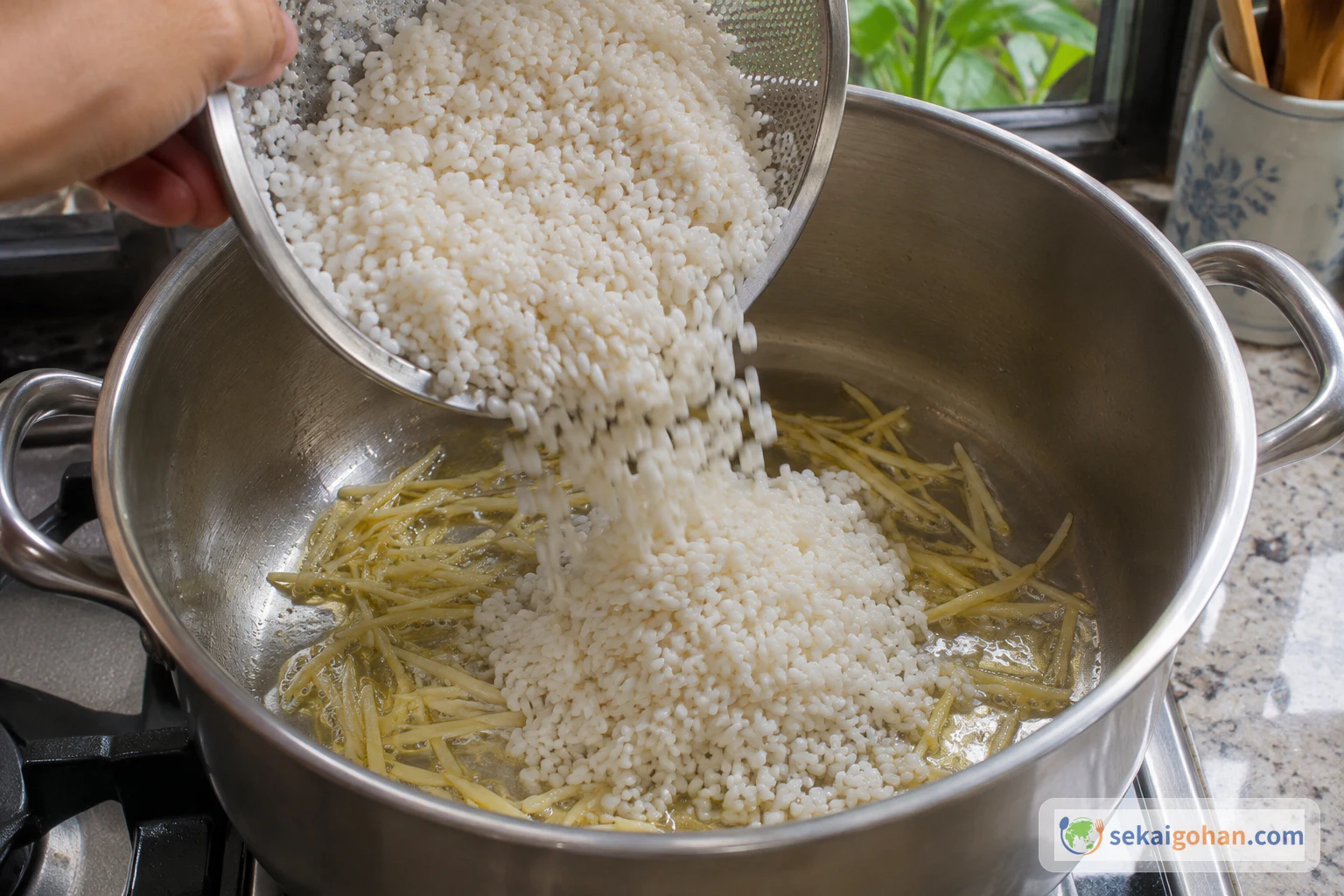
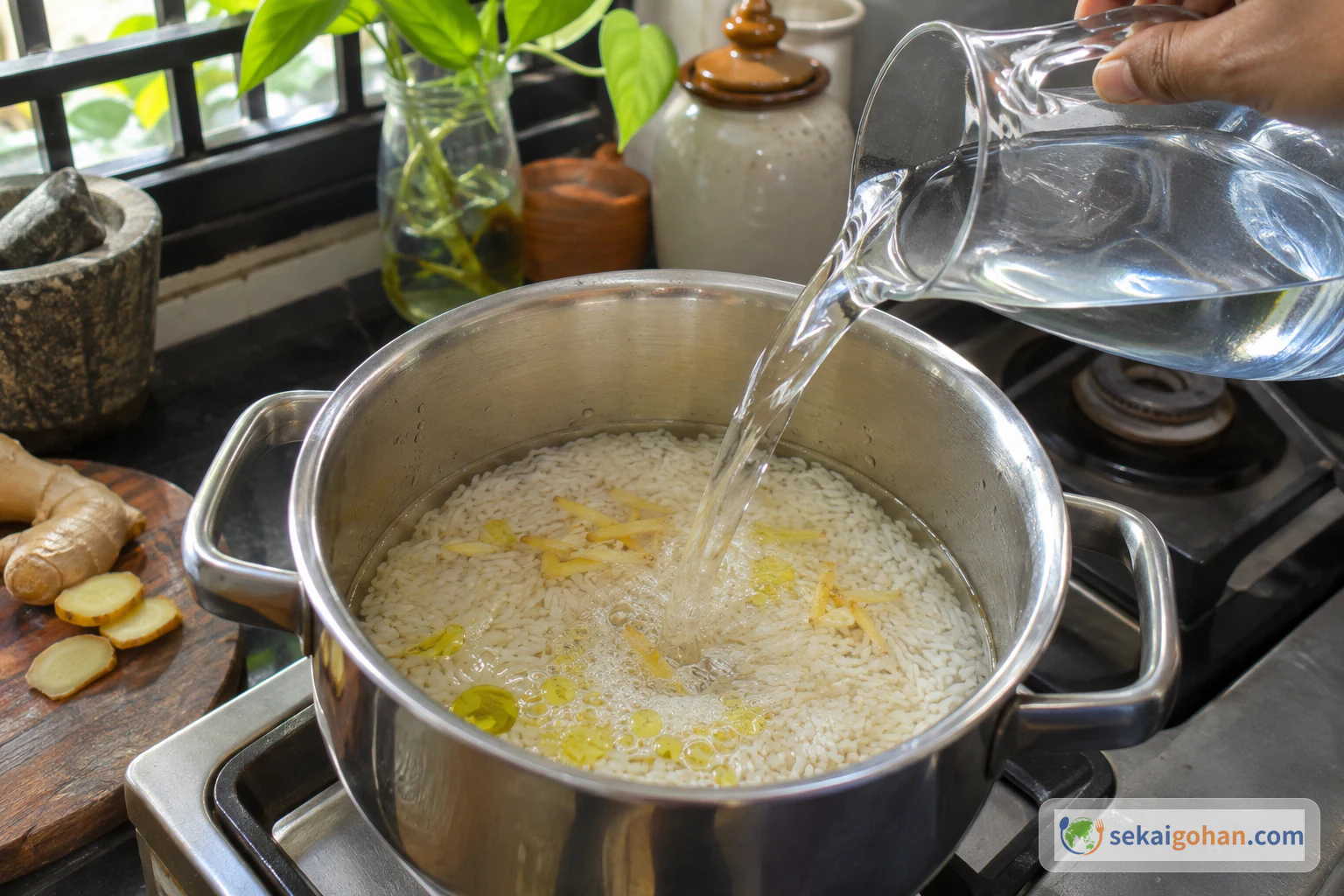
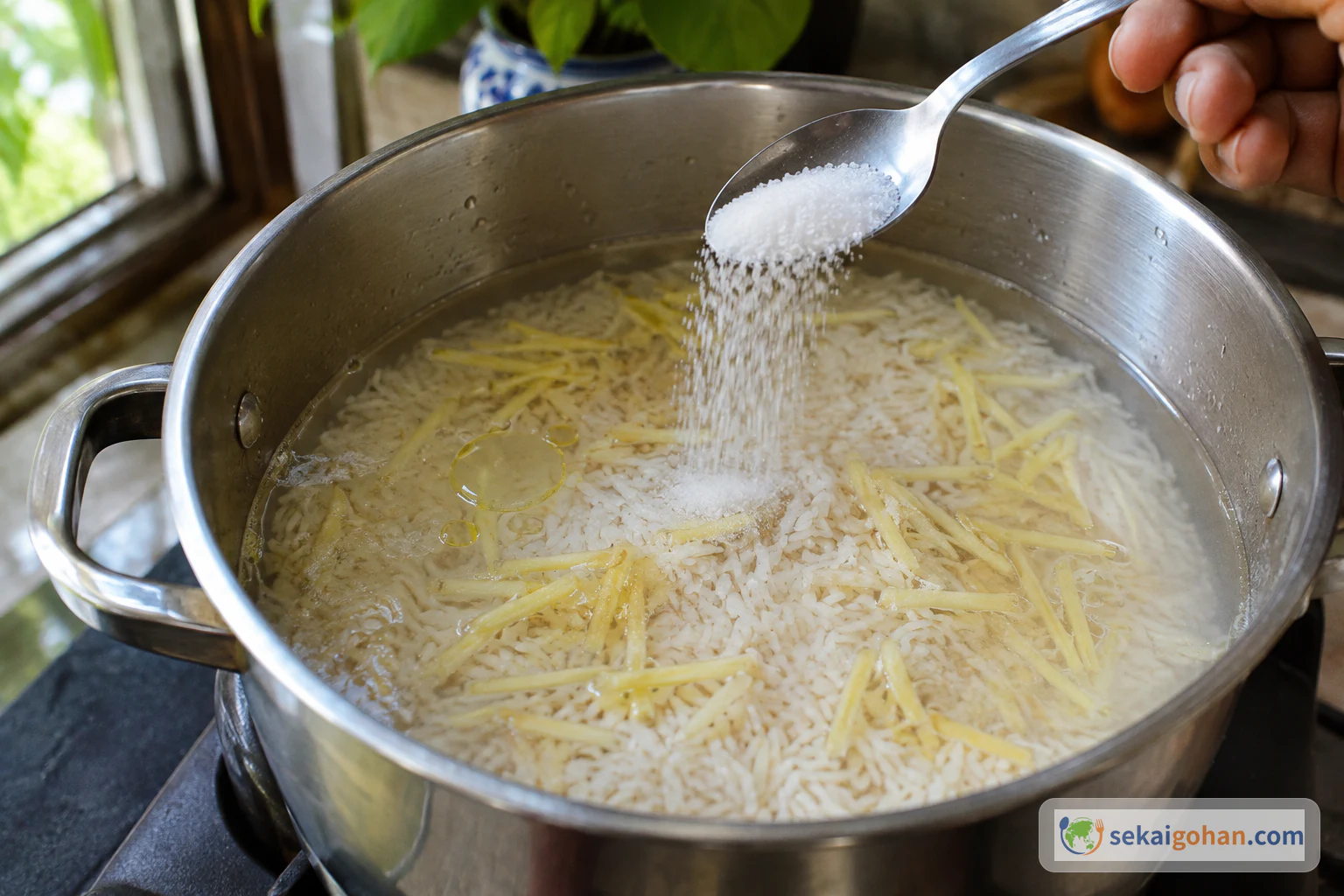
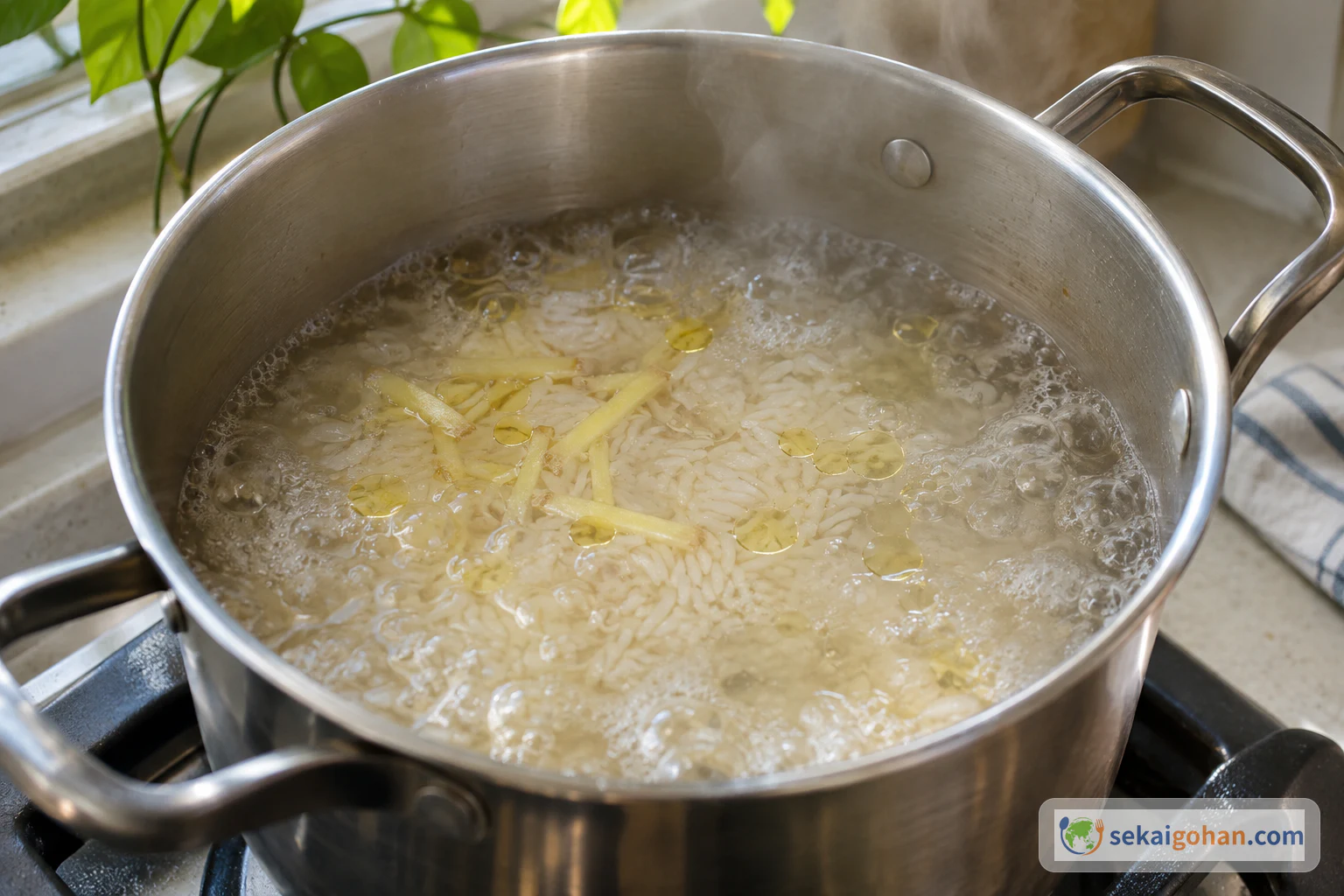
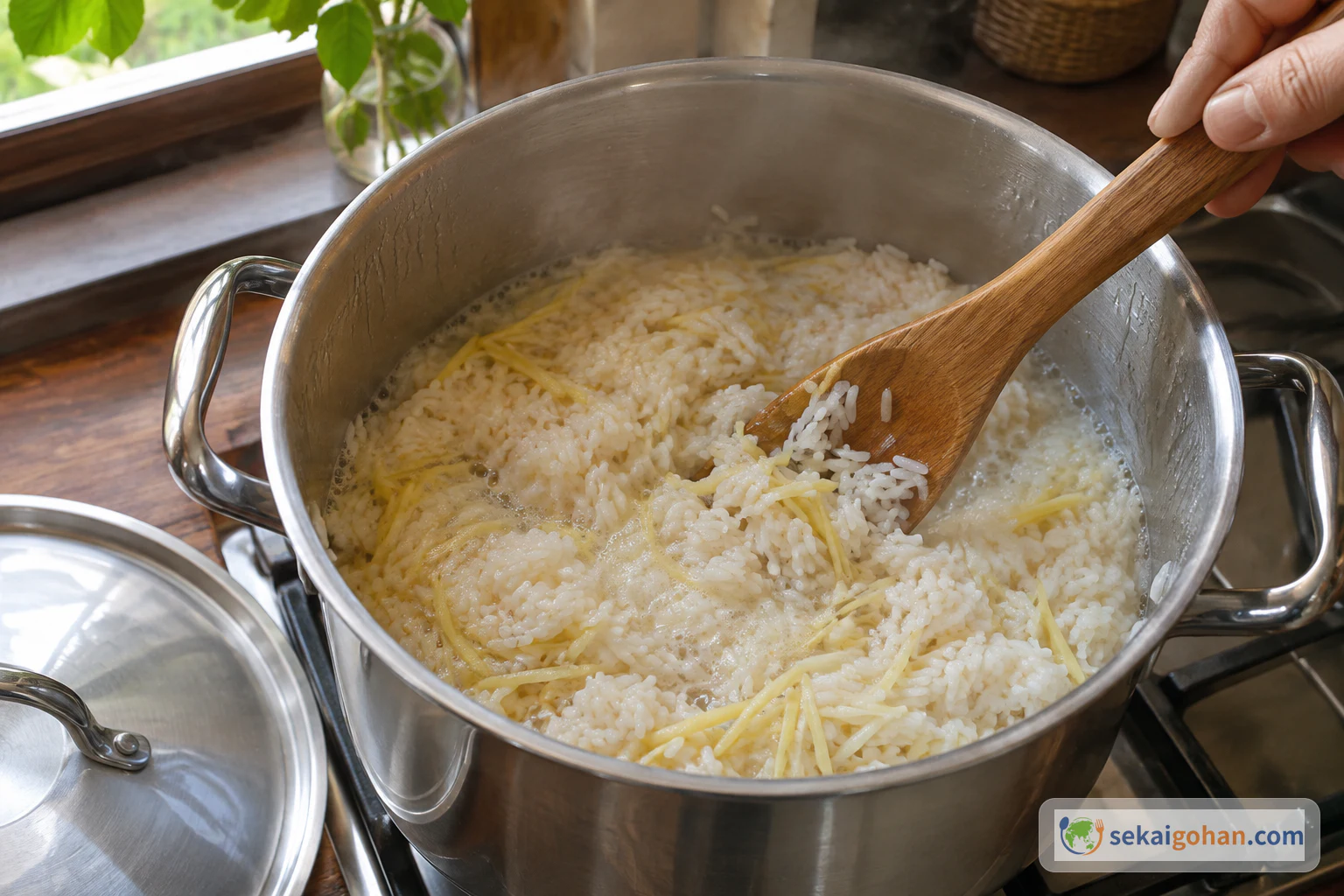
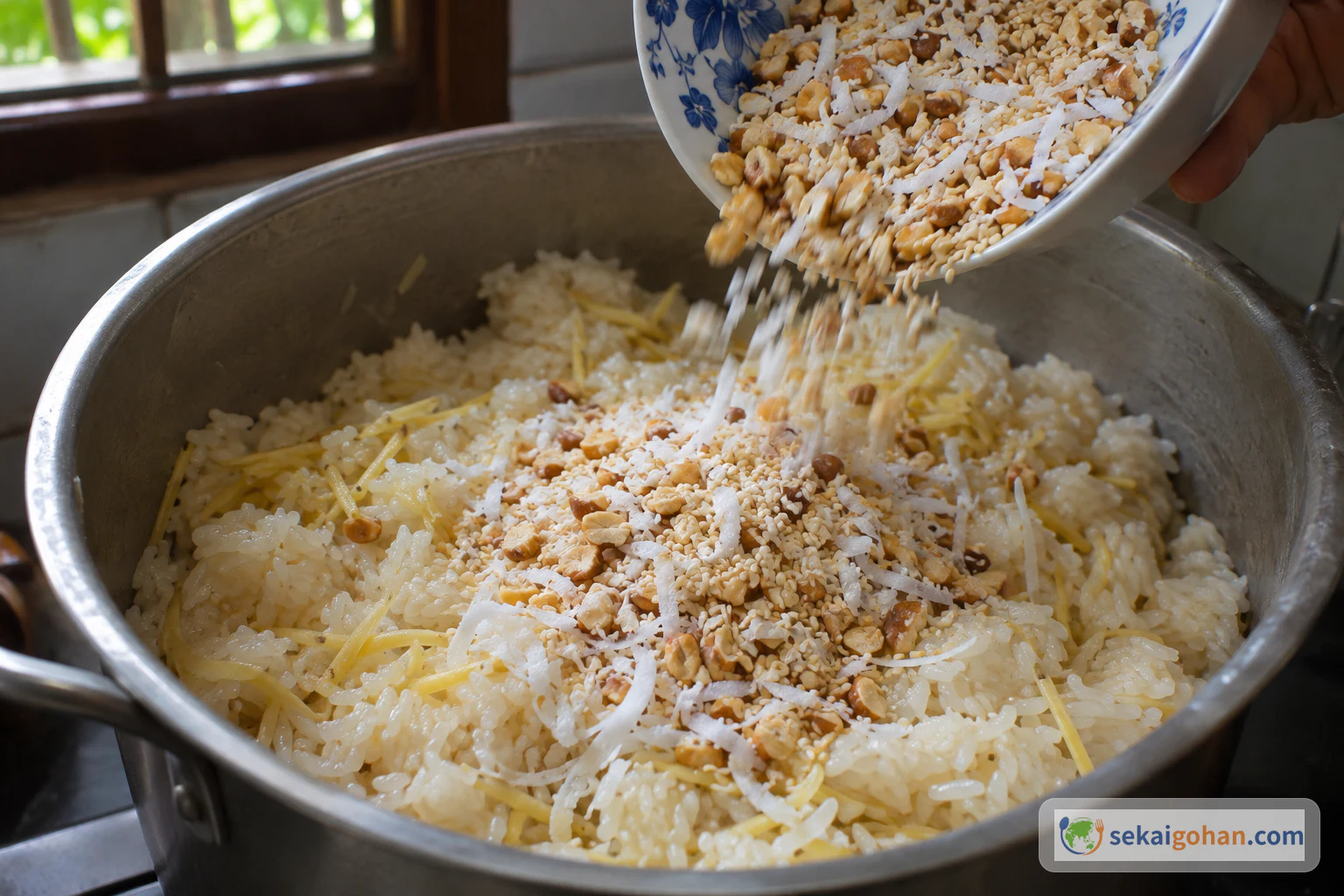
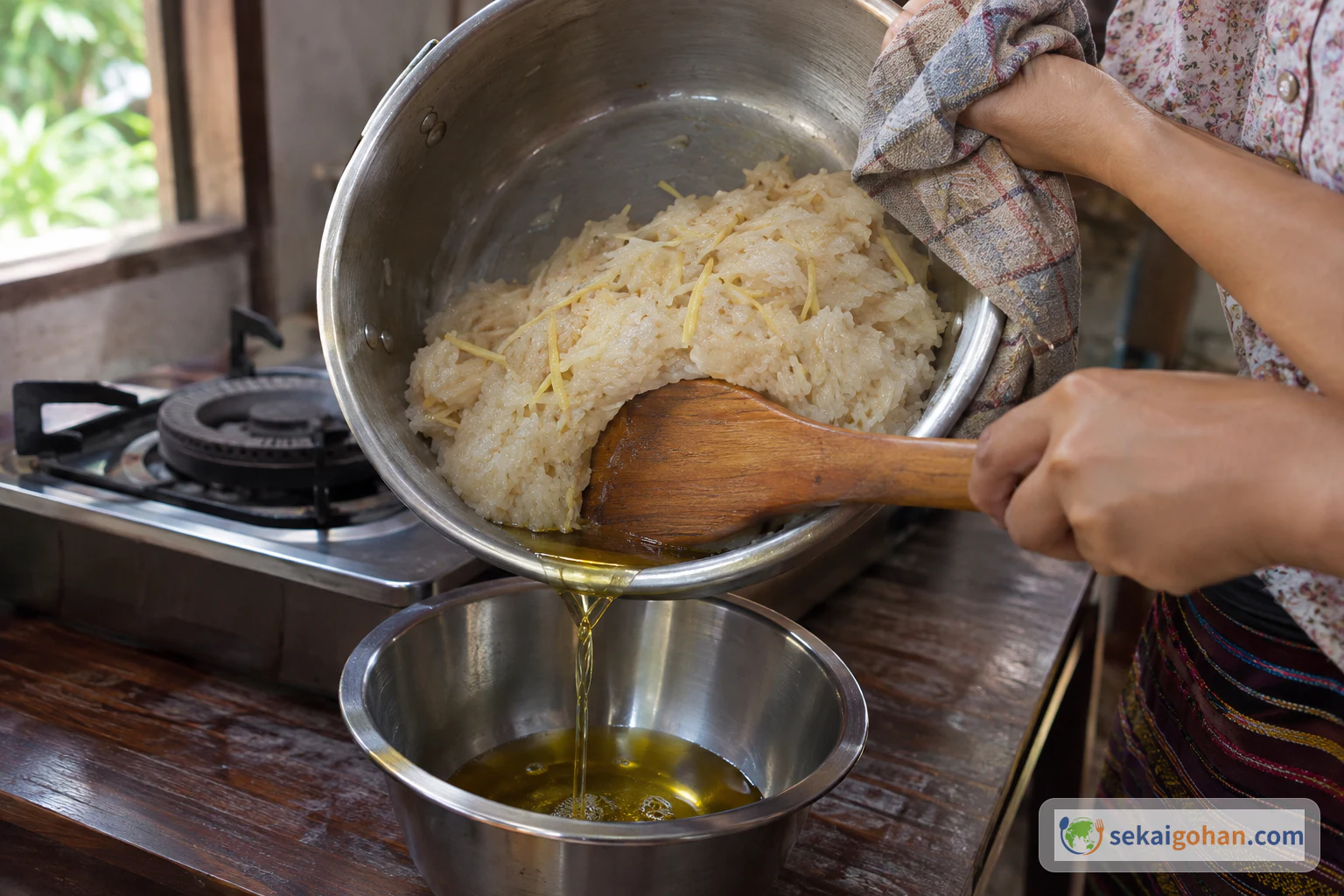
This article moves from the festival to a single home pot. Oil and ginger go in first, then soaked rice, water and salt. Once the rice has simmered, roasted peanuts, sesame seeds and fresh coconut are added, and the mixture is stirred and kneaded with a wooden spatula. More dishes from the country are on the Myanmar page.
About this version
The recipe follows one cookbook: "Htamane / Sticky Rice with Peanuts and Sesame" on p.112 of The Food of Burma (Periplus, 1999), by Claudia Saw Lwin Robert, Win Pe and Wendy Hutton. The imprint of that edition lists the book under both The Food of Burma and The Food of Myanmar.
This recipe has not been kitchen-tested by us. A few limits and editorial choices are worth knowing:
- We compared the recipe through public search-inside excerpts of the 1999 edition, not by reading the whole page. We have not seen the corresponding page of the 2014 Tuttle printing.
- A transcribed copy we also compared matches the amounts and steps, but says "oil" rather than "peanut oil" and "very thin strips" rather than "julienned". We use peanut oil and thin julienned strips.
- The book says the rice is soaked overnight and gives no hours. Soaking it in the refrigerator is our separate general-hygiene choice.
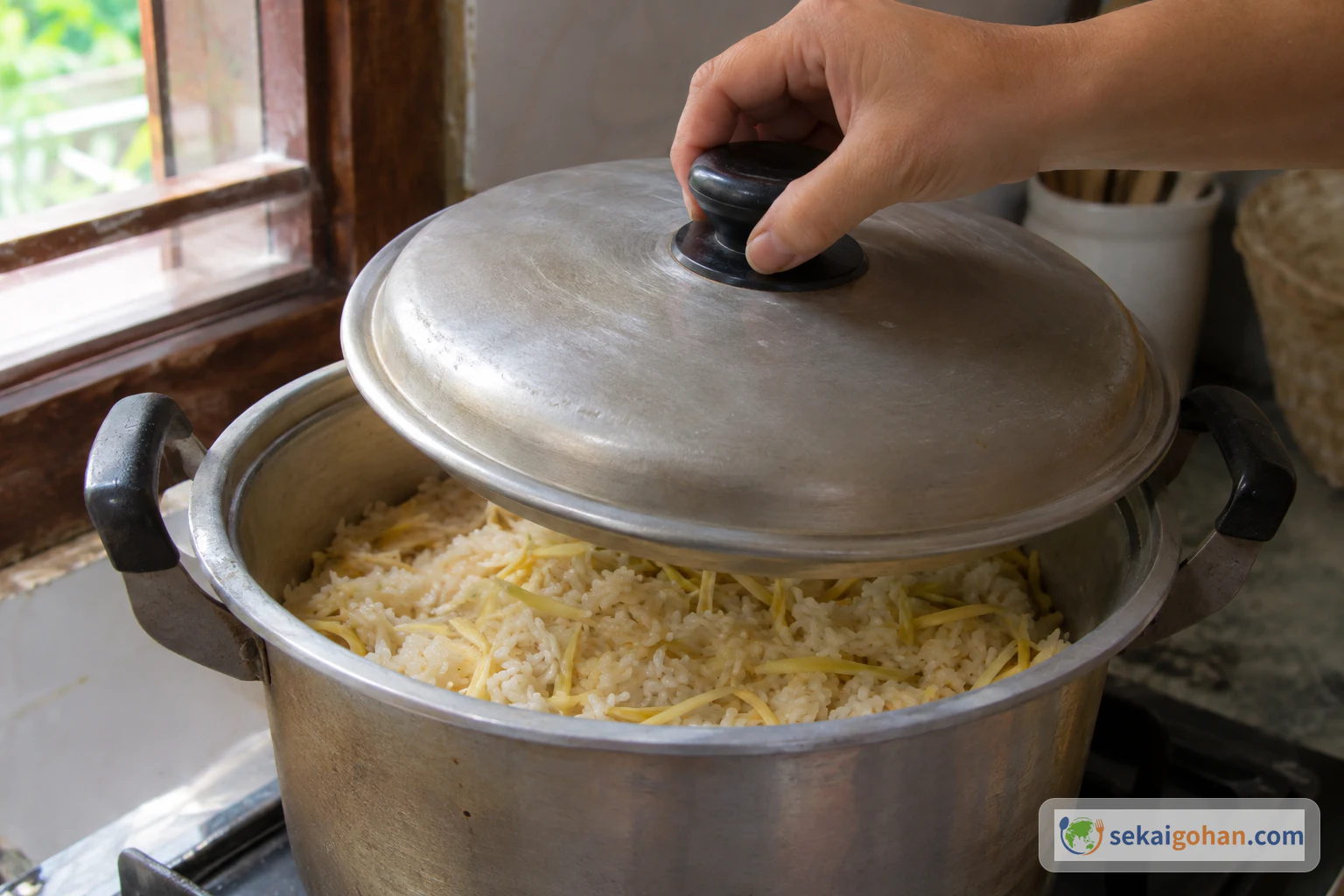
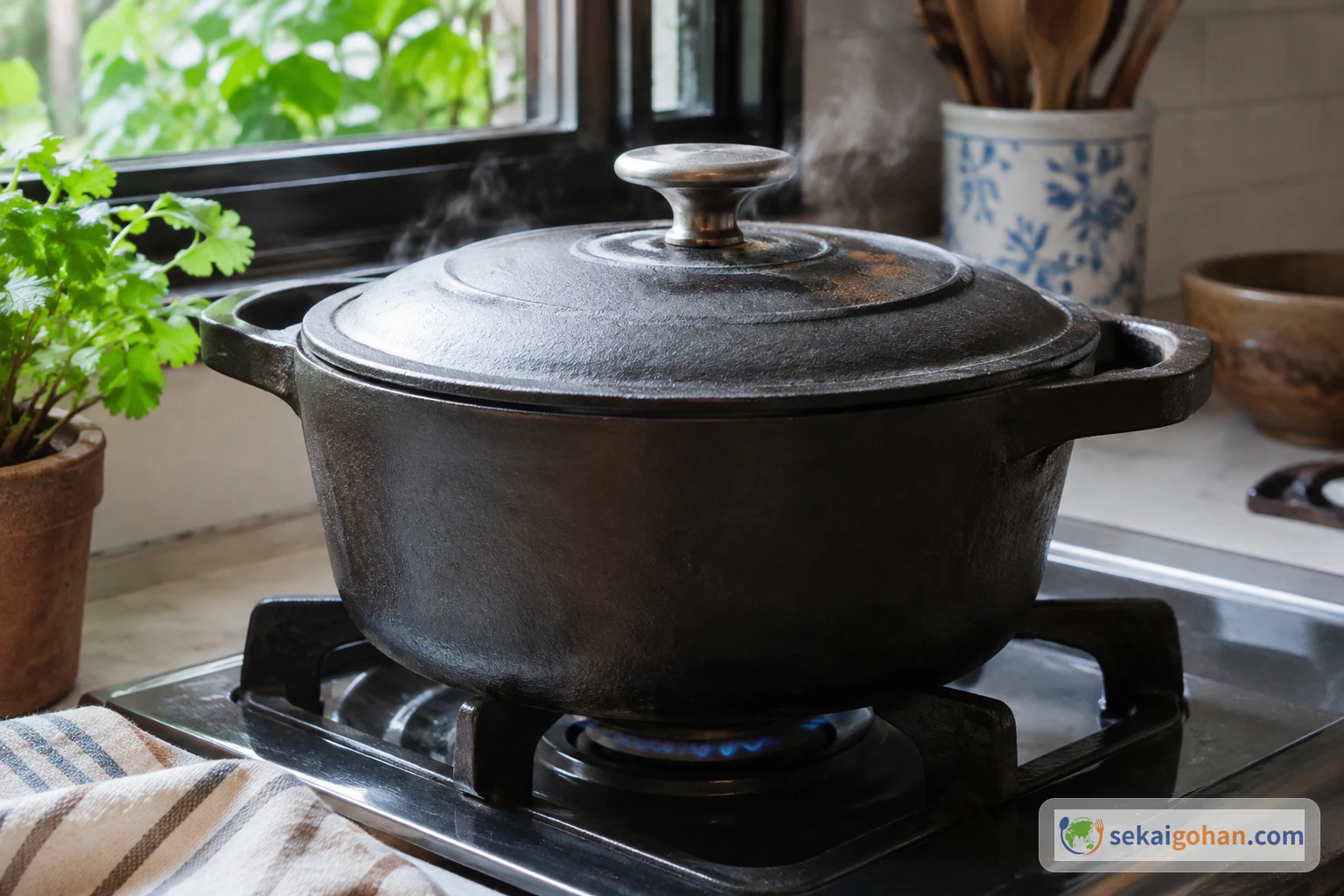
- We did not find a lid mentioned at the start of the simmer. Covering the pot is our inference from the later instruction to remove the lid.
- No yield, total time or storage period is given, so we do not state them.
Ingredients
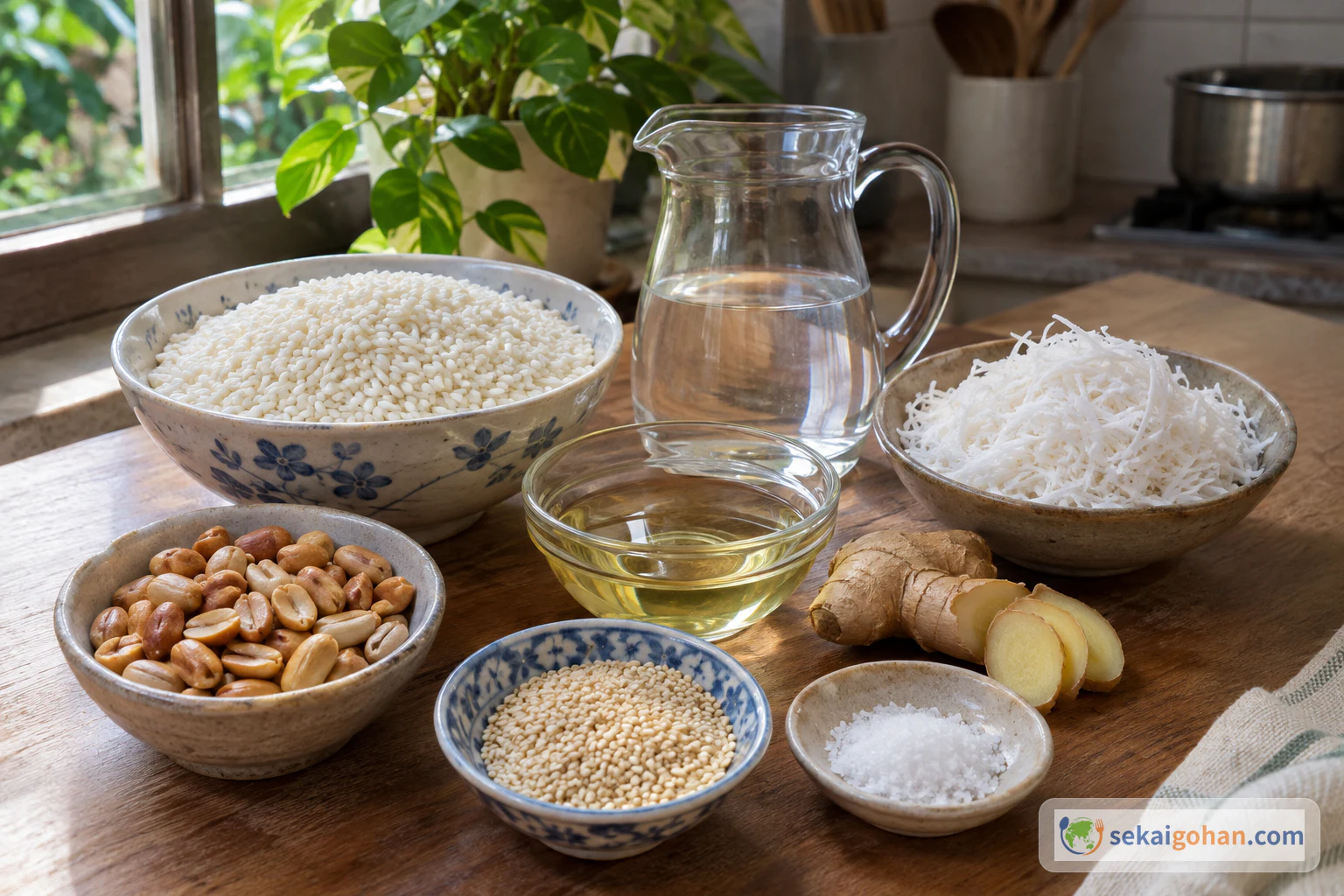
This dish contains peanuts, peanut oil, sesame and coconut. If you are cooking for someone with a food allergy, check each product's label and take care with shared pots, spatulas and boards.
Equipment
- Food-safe bowl for soaking
- Fine sieve and a bowl to drain into
- Wide, heavy pot with a lid
- Wooden spatula
- Separate heatproof vessel for the drained oil
- Plain plate
Choosing and Substituting
- Rice: Choose rice sold as glutinous rice. Japanese glutinous rice (mochigome) is also suitable.
- Oil: Peanut oil is the base here. If you don't have it, a neutral vegetable oil is our editorial suggestion. Sesame oil is not called for.
- Peanuts: Unsalted roasted peanuts are a close match. Chop them coarsely, and don't worry if the pieces are uneven.
- Sesame: Use white or black sesame seeds. There is no separate toasting step.
- Coconut: If fresh coconut is hard to find, frozen fresh coconut is our editorial suggestion. Desiccated coconut is not an equivalent, because its moisture and texture are different.
Method: From Soaked Grains to a Kneaded Mass
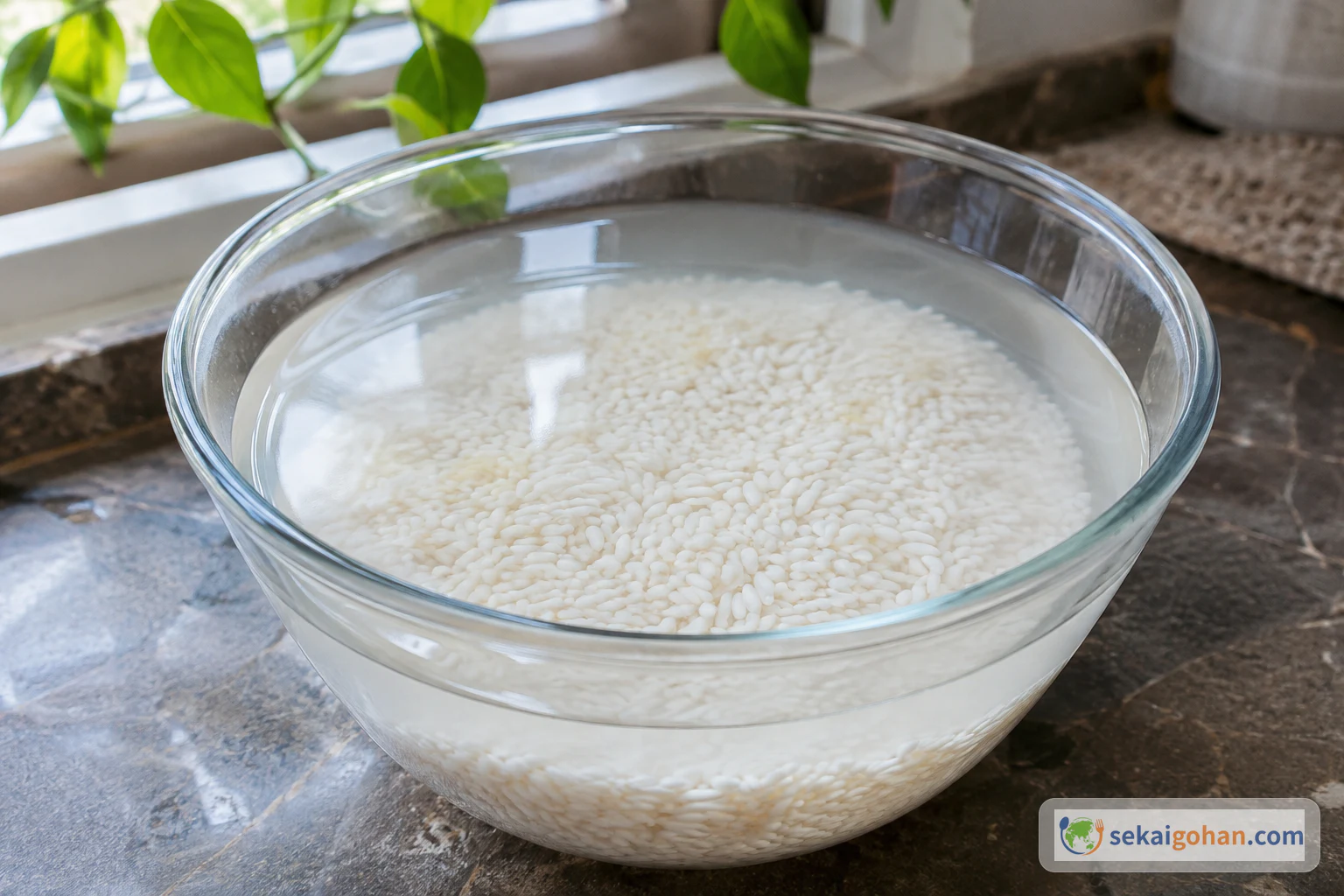
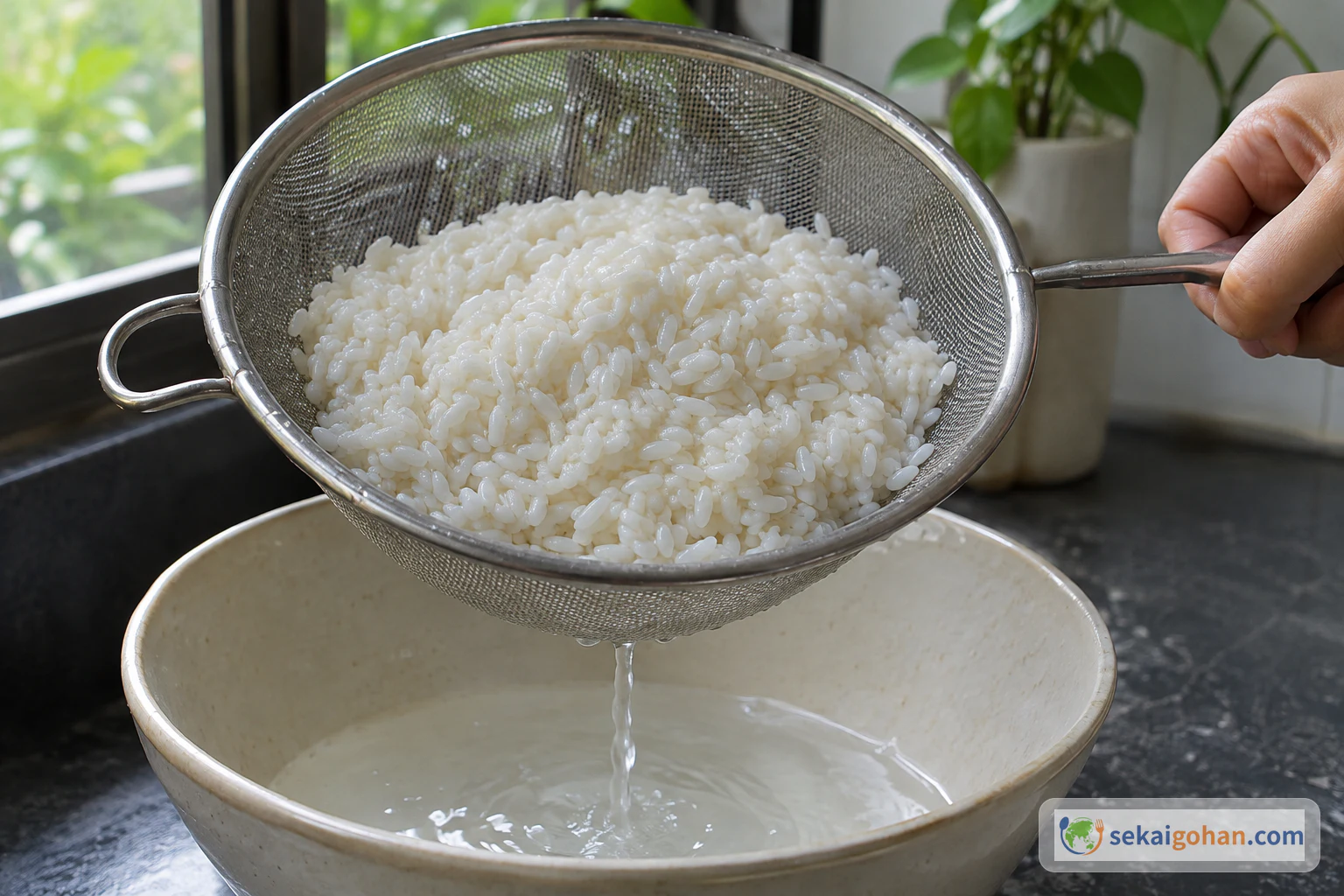
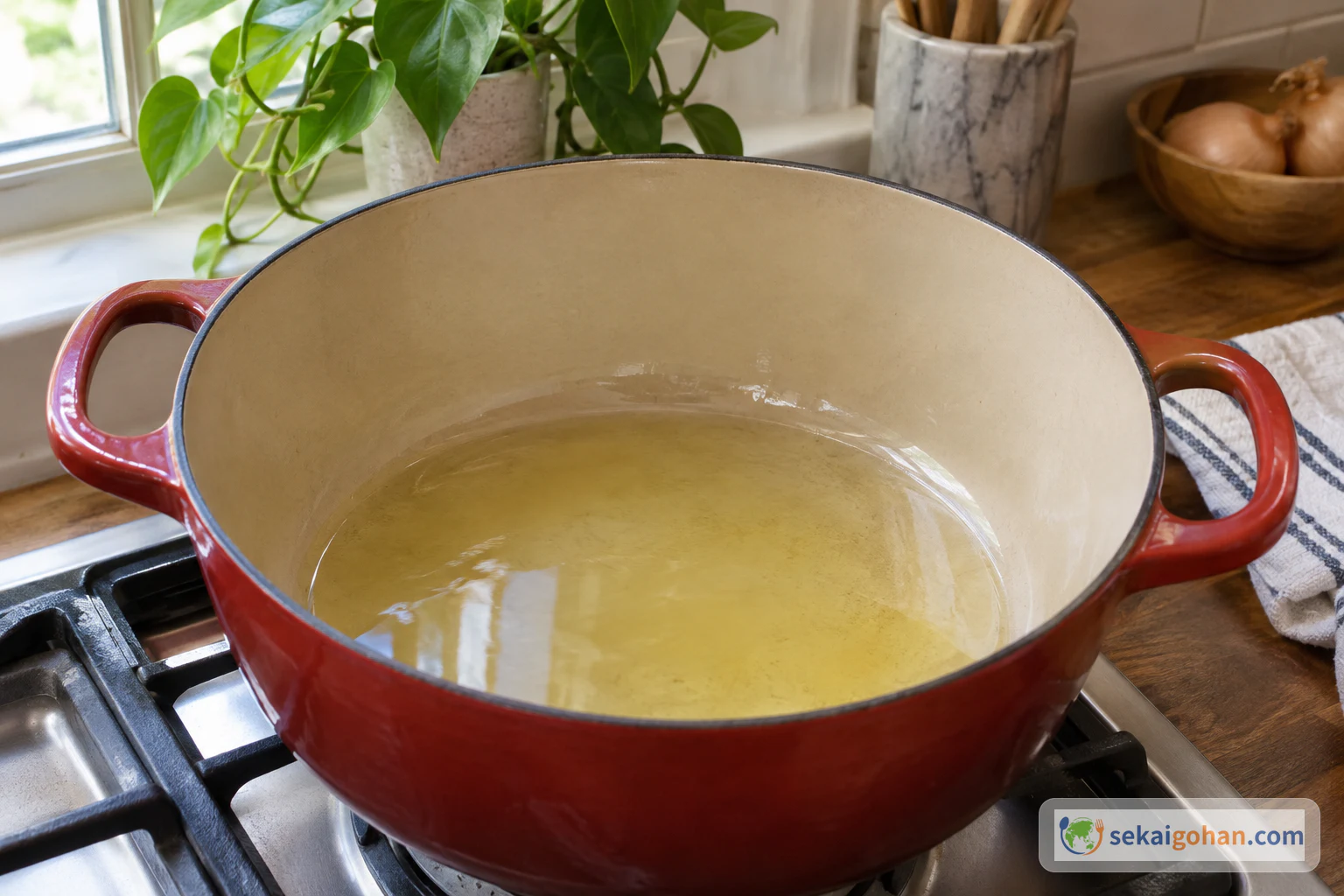
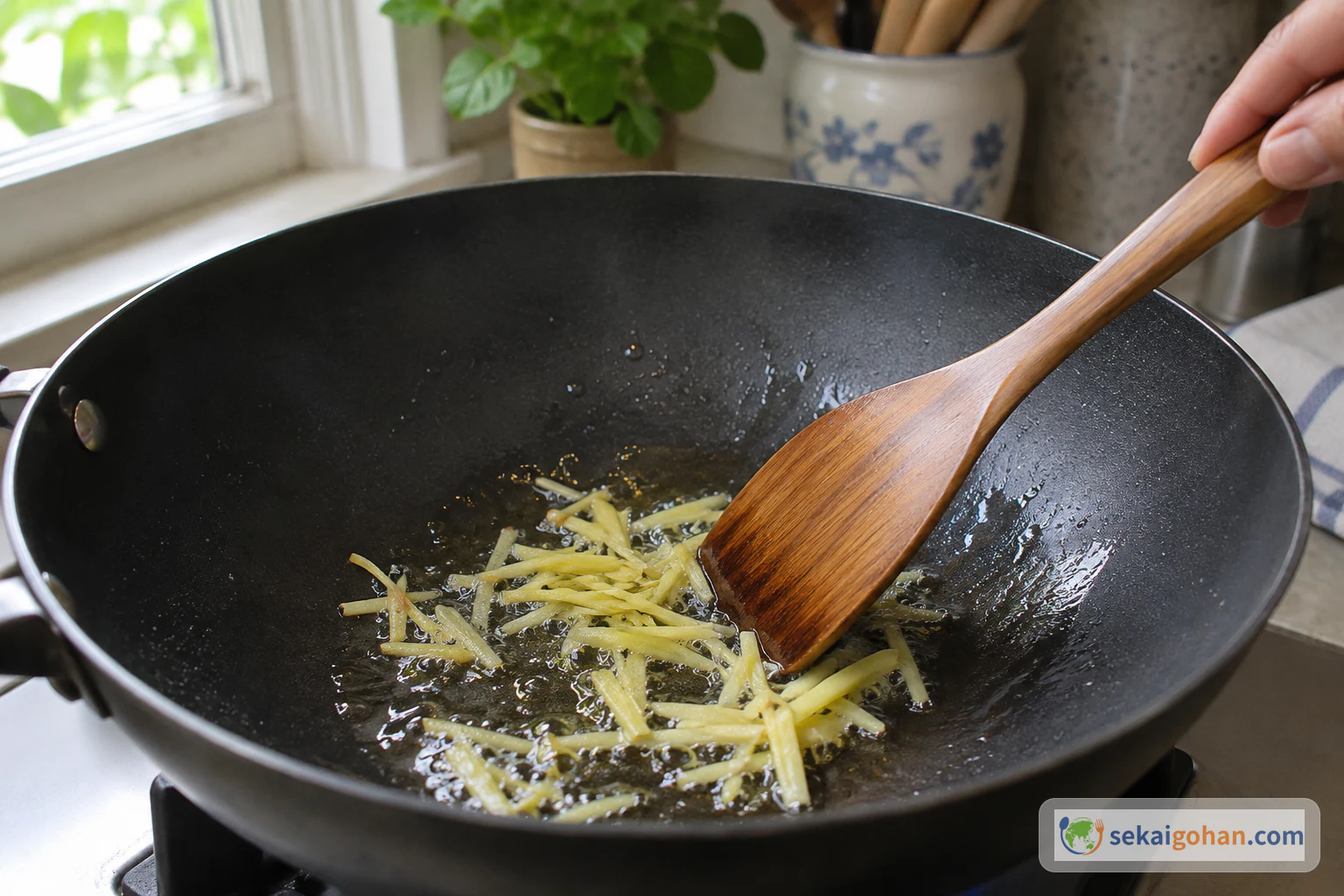
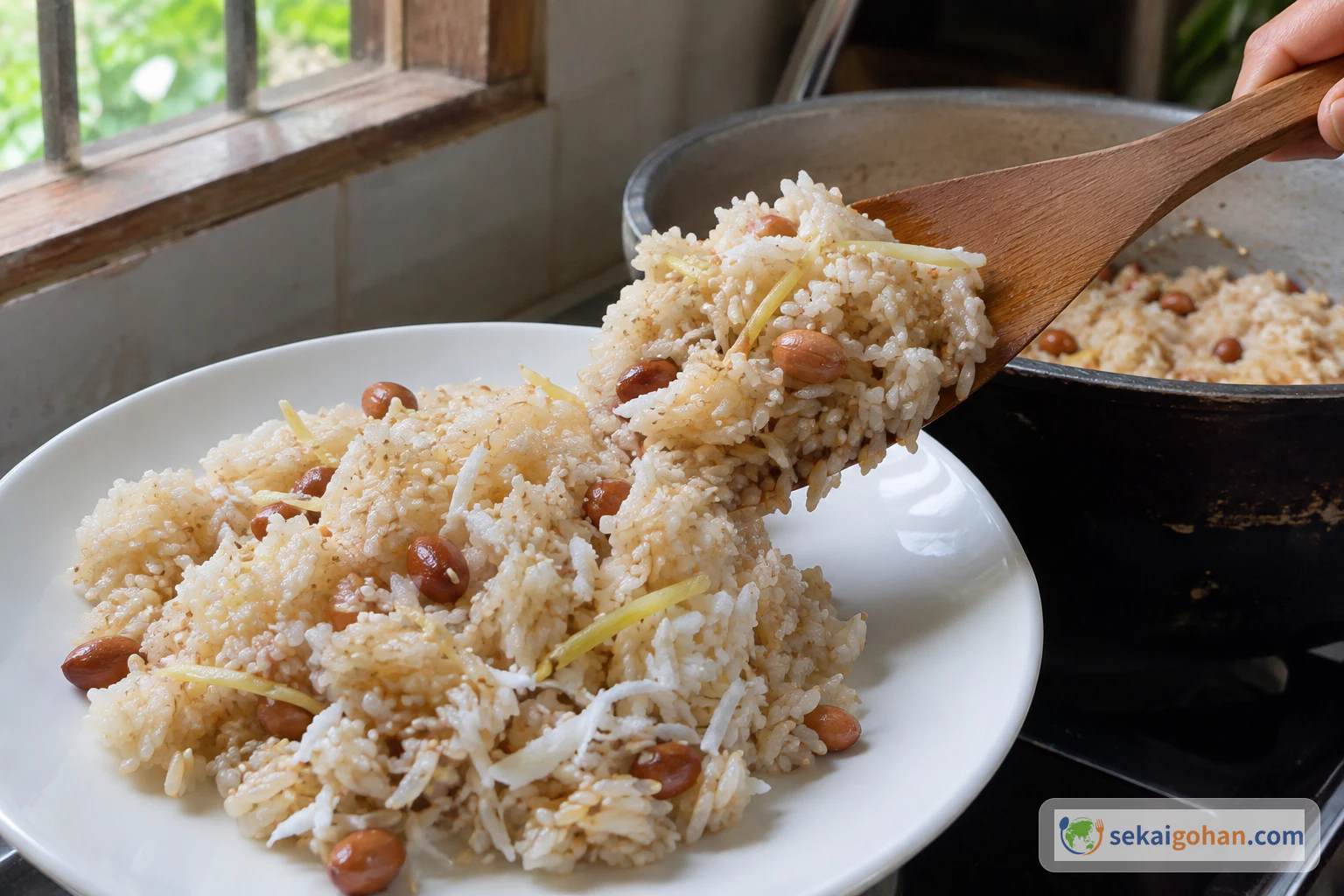
The photographs illustrate each action. They don't prove amounts, elapsed time, temperature or doneness. The cooking times are recipe instructions, and neither they nor the look of the rice guarantee food safety.
Serving
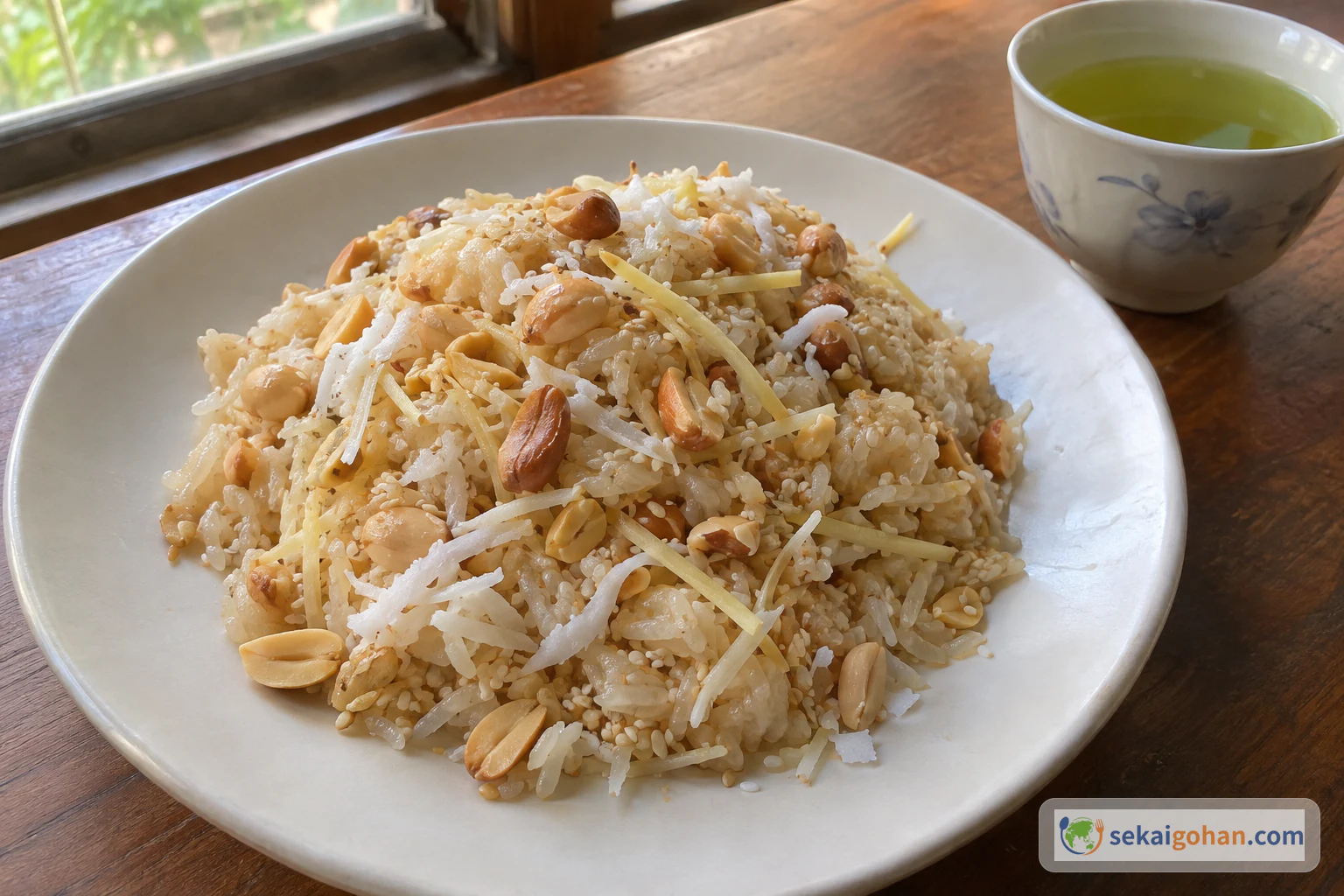
Serve Htamanè on a plain plate, with a cup of green tea alongside if you like. The tea is optional, and the rice needs no extra garnish.
Troubleshooting
These are checks based on the recipe's own instructions rather than results from test batches.
| What you notice | What to check | What to do |
|---|---|---|
| Rice is catching on the bottom of the pan | Heat level and how often the spatula is moving | Keep the heat low and keep stirring and kneading |
| Grains still seem firm during kneading | Whether you are pressing the rice or only turning it | Press and fold the mass against the pot |
| There is visible oil in the pot at the end | This is expected, because the oil stays in the pot until the final step | Tilt the pot and drain what runs off, without squeezing the rice |
| Your arm tires before the kneading is done | The kneading is demanding by nature | If someone else is in the kitchen, take turns |
Variations: How Other Kitchens Make It
Htamanè is not one fixed formula, and this article doesn't claim that its version is the only traditional one.
Moulmein Kitchen, a personal Myanmar-food blog, shares a home method from the author's mother and says it differs somewhat from the traditional large-scale method. That version fries garlic with the ginger, covers the rice and water for 20–25 minutes, and kneads with two spatulas for 15–20 minutes. The blog gives no ingredient quantities.
If you want to try that approach, treat it as a separate recipe. Its garlic and timings are not part of the method above.
Festival and Culture: A Dish Made Together
Myanmar's Ministry of Hotels and Tourism describes the Htamane festival as taking place on the full moon day of Tabodwe, in February, throughout Myanmar. People cook glutinous rice together, the food is offered at dawn and then distributed to attendees, and competitions are part of the occasion.
The cookbook connects the dish to a harvest festival in January or February. It says Htamanè may be shared among neighbors and offered to monasteries, and it warns that the kneading is very tough work. The book itself is a collection of more than 60 recipes gathered from across Myanmar. Its 2014 Tuttle edition credits Claudia Saw Lwin Robert for the recipes, with hotel cooks assisting in the preparation.
These accounts describe a festival and a cookbook, not what every community or household does. The amounts, ingredients and kneading method can differ from one kitchen to another.
Frequently Asked Questions
Is Htamanè sweet?
The cookbook calls it "sweet and filling", yet its ingredient list contains no sugar, and we haven't added any. Don't take any single flavor description as the only correct one.
How many people does this serve?
The cookbook gives no number of servings or finished weight, and we haven't made the recipe, so we can't offer a figure.
How long does it keep?
The cookbook gives no storage guidance, so we don't state a storage period or a safe time at room temperature.
Can I measure with cups instead?
The book pairs grams and milliliters with cups, but the cup fractions are garbled in the scanned text we read. For that reason, we give cups only for the rice and water. The grams and milliliters are the figures to follow, and we haven't added any other conversions.
Is this the same as hsi htamin?
No. Hsi htamin is also made with glutinous rice, but it is a different dish cooked with onion and turmeric. Htamanè is defined by its peanuts, sesame, coconut and kneading.
Sources
- Claudia Saw Lwin Robert (recipes), Win Pe and Wendy Hutton, The Food of Burma: Authentic Recipes from the Land of the Golden Pagodas, Periplus Editions (HK), 1999, p.112, "Htamane / Sticky Rice with Peanuts and Sesame." Basis for the recipe's amounts and method, and for the book's notes on flavor, the harvest festival, sharing, monastery offerings and the kneading. https://openlibrary.org/works/OL6242693W
- Tuttle Publishing, "The Food of Myanmar (9780804844000)." Bibliographic details of the 2014 edition and its recipe and cooking credits. This page does not show the recipe. https://www.tuttlepublishing.com/books-by-country/the-food-of-myanmar-paperback-with-flaps
- Omnivore Books on Food, "Food of Myanmar: Authentic Recipes from the Land of the Golden Pagodas." Identifies the book and describes its scope. This page does not show the recipe. https://omnivorebooks.myshopify.com/products/food-of-myanmar-authentic-recipes-from-the-land-of-the-golden-pagodas-claudia-saw-lwin-robert
- Myanmar Ministry of Hotels and Tourism, "Htamane Festival." The festival date, communal cooking, dawn offering, distribution to attendees and competitions. https://tourism.gov.mm/en/festivals/htamane-festival
- Moulmein Kitchen, "Making the festive delicacy at home - Htamane (အေမ့လက္ရာ ထမနဲ)," 2016. An example of a family home method that differs from the recipe above. https://moulmeinkitchen.blogspot.com/2016/02/making-festive-delicacy-at-home-htamane.html