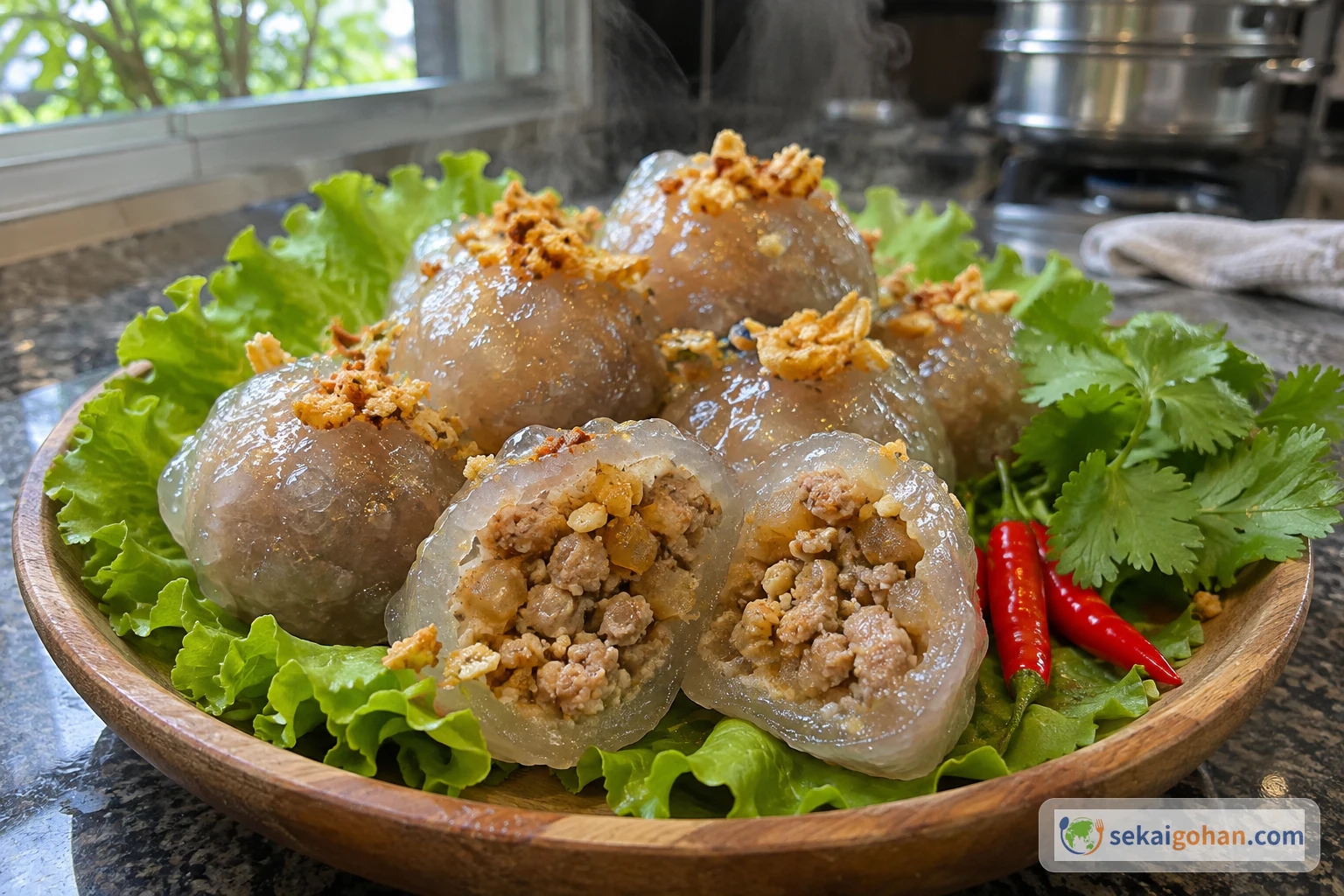
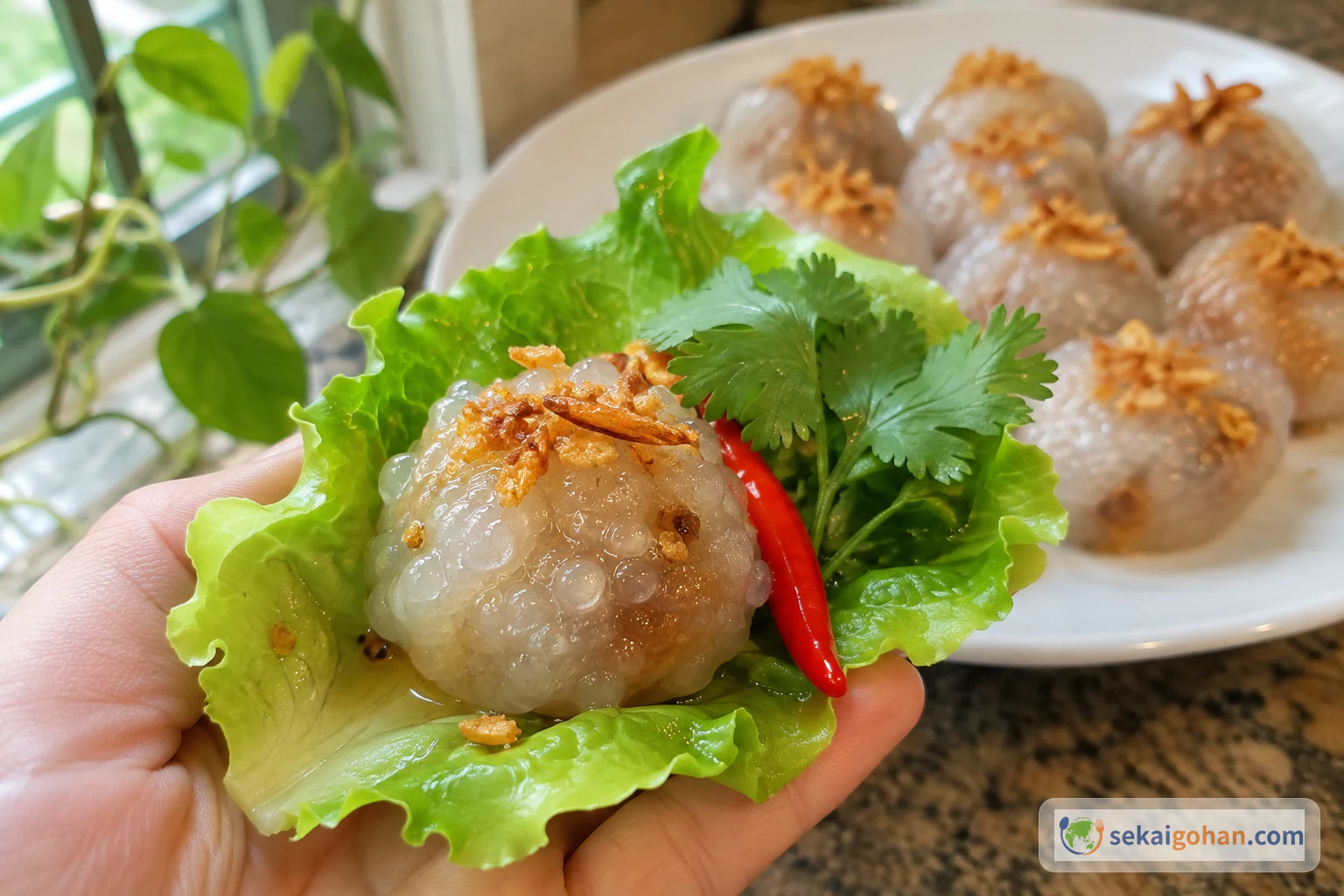
A cool lettuce leaf lies flat in your palm. On it goes one small ball, glassy and faintly pebbled, with a brown filling showing through the skin. Then come a spoon of crisp fried garlic in its oil, a sprig of cilantro and a fresh red chili, and the leaf folds up around all of it. The first bite is soft and springy, then sweet and salty at once from the pork, palm sugar and pickled radish, with crushed peanuts crunching through and the chili flashing at the end. This is sakhu sai mu, a Thai street and market snack of tapioca pearl dough wrapped around a cooked pork filling and steamed until the skin turns clear.
A Market Snack Sold Beside Its Twin
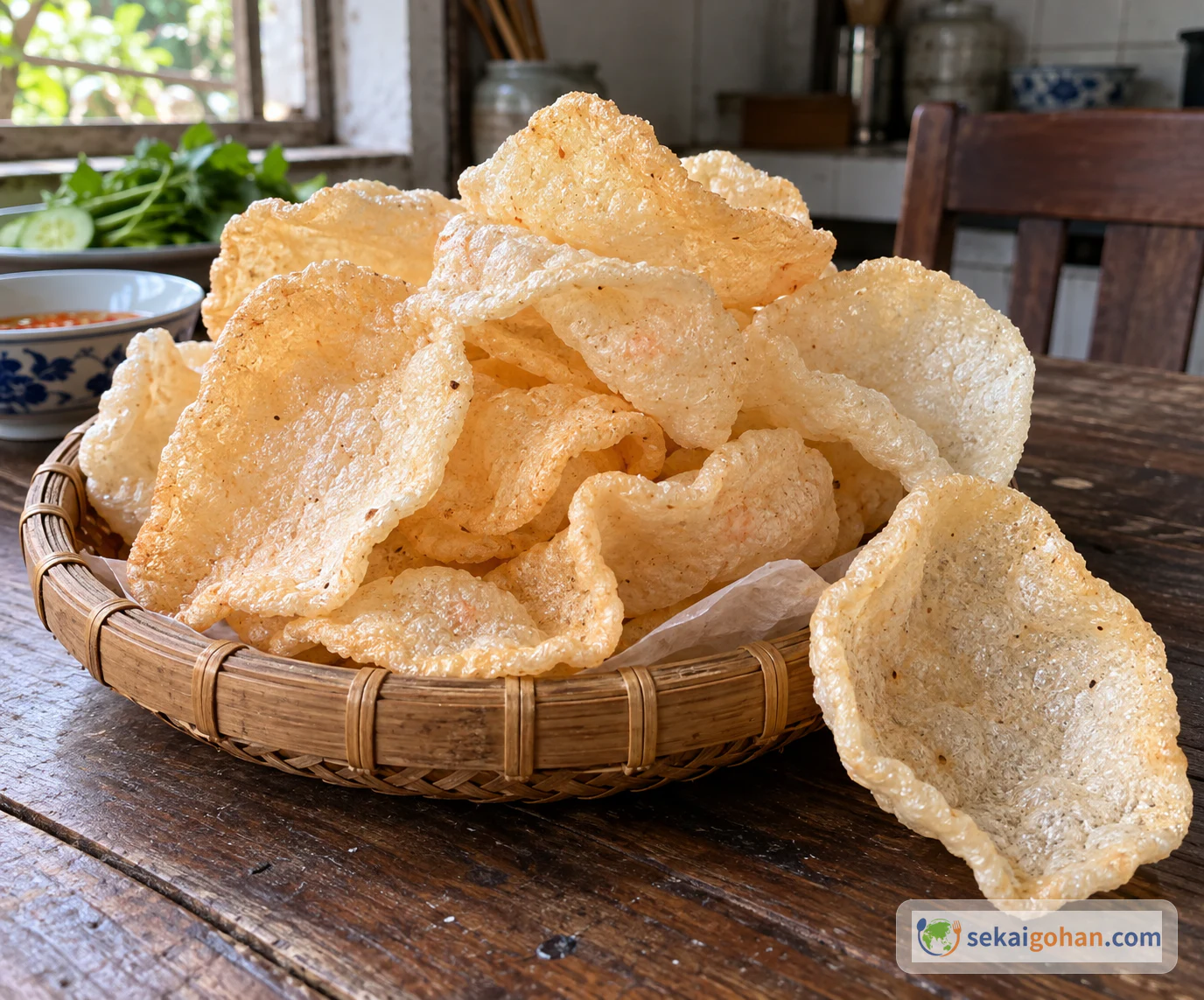
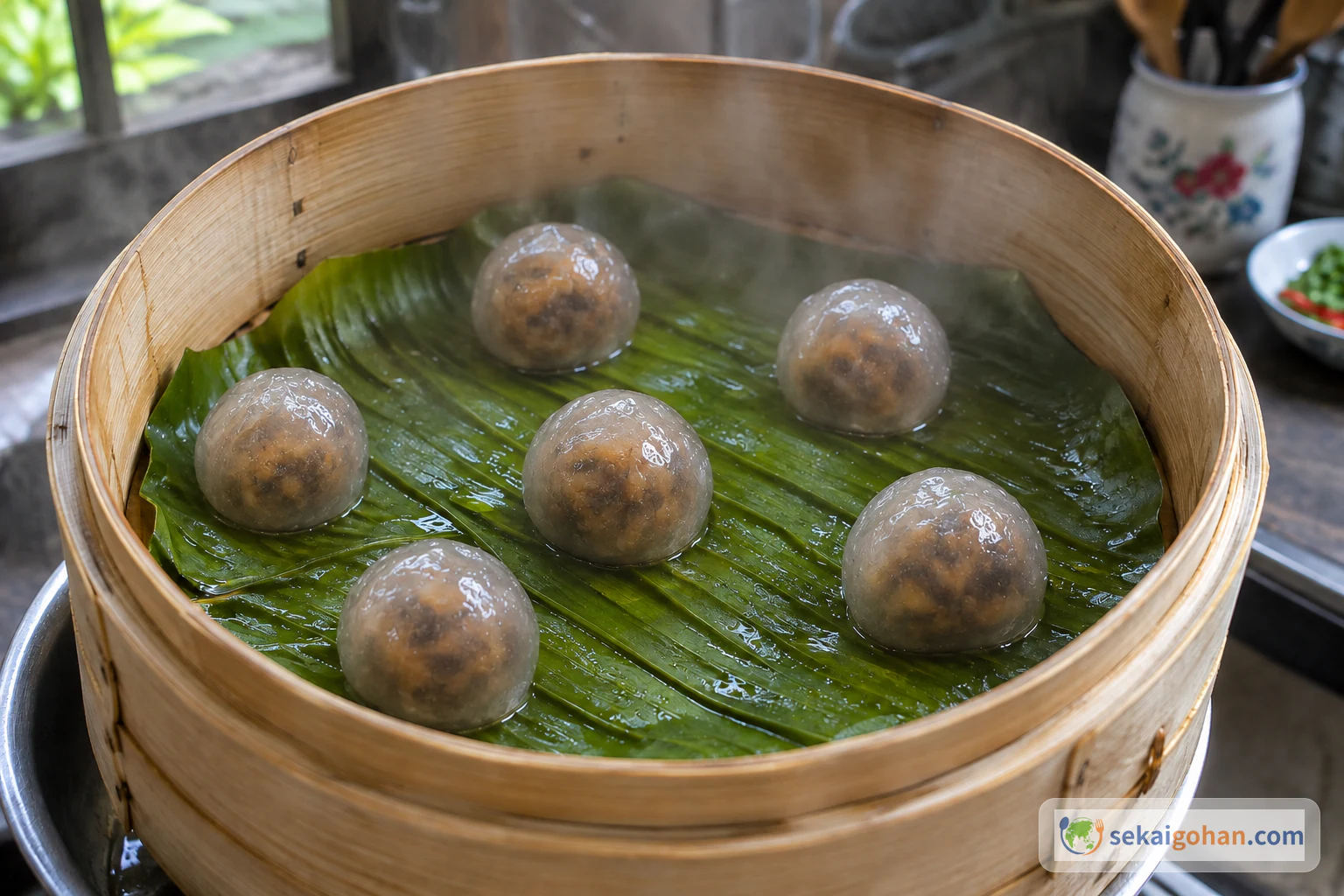
Look for sakhu sai mu at a Thai market and you will usually find khao kriap pak mo right beside it, often packed into the same small box. The two share one filling of pork, sweet pickled radish, palm sugar and peanuts. The difference is the skin. In khao kriap pak mo the filling is wrapped in a skin. In sakhu sai mu it is covered by a dough of tiny pearls that steams from chalky white to transparent, so you can see the filling inside before you bite.
The skin itself tastes of almost nothing, and that decides how the dish works. All the flavour lives in the filling, which is pushed to a clearly sweet and clearly salty balance. One Thai food site calls it a taste of childhood, in the phrase wan wan khem khem, sweet-sweet, salty-salty. Turn the filling down to suit a cautious palate and the whole dumpling goes flat. The lettuce, cilantro and chili are part of the dish, not a garnish; they bring the crunch, freshness and heat that the soft pearl skin cannot.
Sakhu (สาคู) means sago, and sai mu (ไส้หมู) means pork filling. The dumplings were traditionally made with sago, and today small tapioca pearls are the usual choice, still called sakhu in Thai kitchens. In English the name is spelled several ways, including sakhu sai mu, saku sai moo and sakoo sai moo.
How it changes from stall to stall
The filling splits into two camps. Some cooks use sweet pickled radish (chai po wan), while others use salted radish (chai po khem) and lean harder on palm sugar to balance it. Seasoning varies too: some stop at light soy or seasoning sauce, others add oyster sauce. Palm sugar is the usual sweetener, though white sugar turns up now and then.
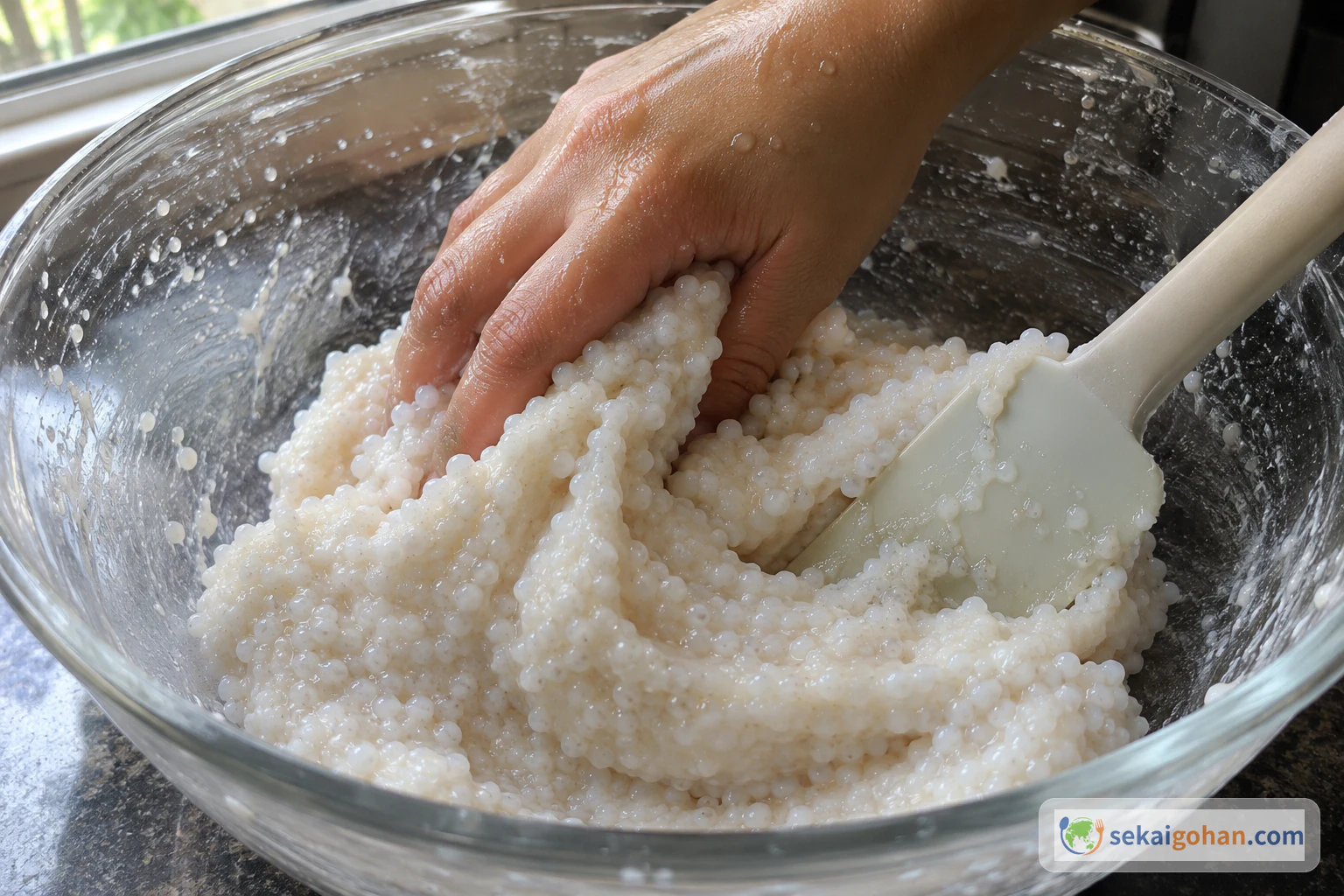
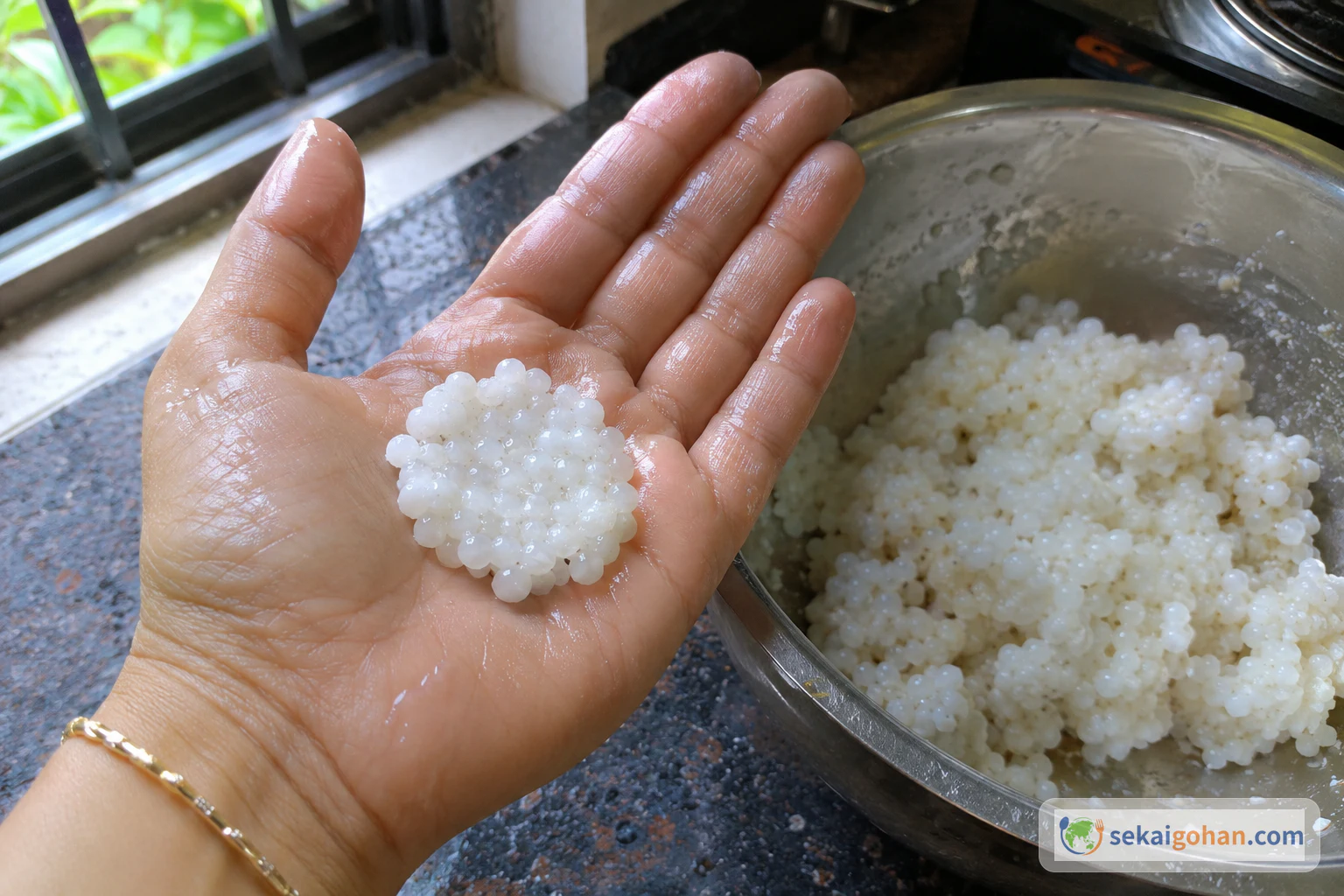
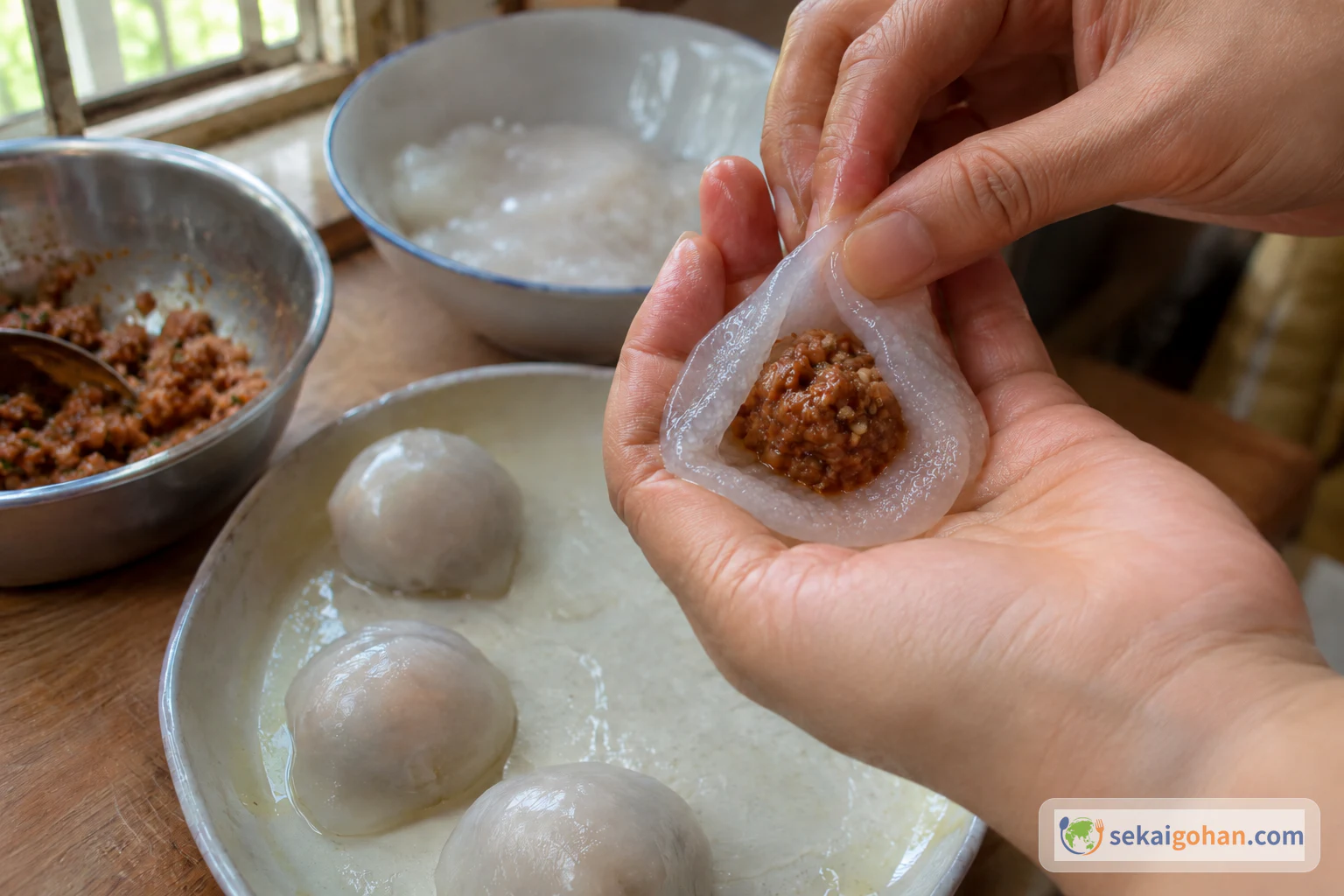
The pearl dough is handled differently as well. Some recipes soak the pearls in cold water, drain them and knead; others pour hot water straight over them instead. At busy stalls the dough is spread on a cloth stretched over the steamer, the filling is set on it and wrapped right there, and the dumplings are sprinkled with water before steaming so the skins don't dry out. Some vendors tint the dough with butterfly pea or roselle water, turning the dumplings blue, purple or pink. Where it was first made is not settled, so this is best read as a dish of Thai markets and home kitchens across the country. For more of the country's cooking, see our Thailand recipes.
Ingredients
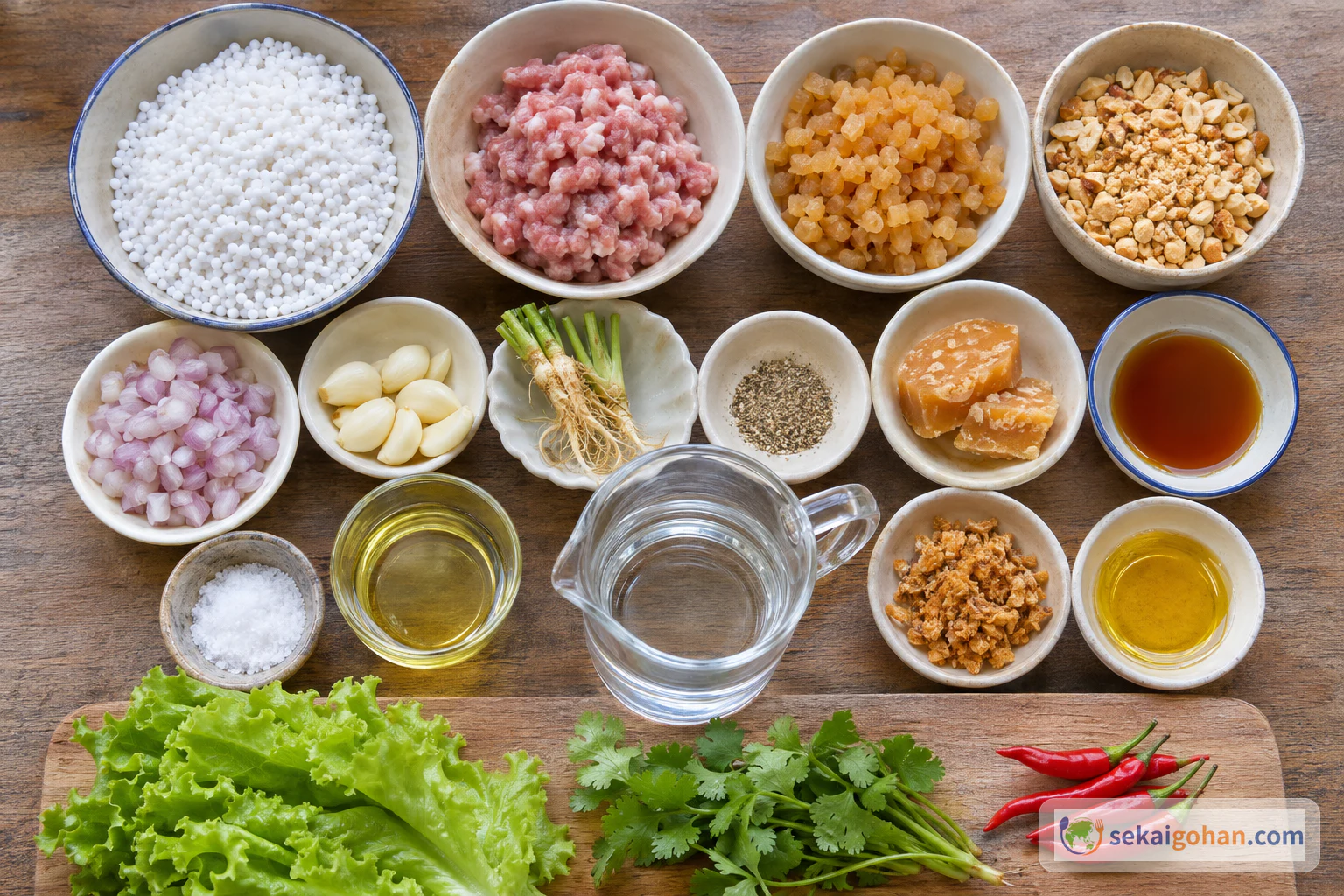
The tapioca and both waters are measured by volume. Measure all three with the same cup, so the ratio of pearls to water stays the one that gives a soft, workable dough.
The filling contains peanuts, and they are part of the dish. Thai seasoning sauce often contains soy and sometimes wheat, so read the label. Tapioca itself contains no wheat or dairy.
Equipment
- Mortar and pestle
- Frying pan or wok and a wooden spatula
- Mixing bowl with a lid or plate to cover it, and a rubber spatula
- Shallow container for cooling the filling
- Bamboo steamer set over a pot of water
- Banana leaf or parchment paper, lightly oiled
- Plate for the shaped dumplings
Choosing and Substituting
A Thai or Southeast Asian grocery, or an online shop, has everything that matters here. Small tapioca pearls are the one ingredient with no workaround; look for bags labelled small sago or small tapioca pearls. Buy sweet pickled radish sold chopped for Thai cooking, and plan to rinse it, because it comes salty. Palm sugar is weighed in grams here and gives the filling its caramel depth. Thai seasoning sauce gives the savoury note, and a bottle from the same shop is the reliable choice.
Some swaps are easy. Ordinary garlic stands in for Thai garlic without changing the dish much; use it as you would any garlic. Cilantro roots are hard to find outside Asian shops, and the pale lower stems of a cilantro bunch give a milder version of the same aroma. Ready-made fried garlic from the grocery saves frying your own and gives the same crisp crown. The peanuts stay; a different nut moves the filling away from the taste people expect.
Method
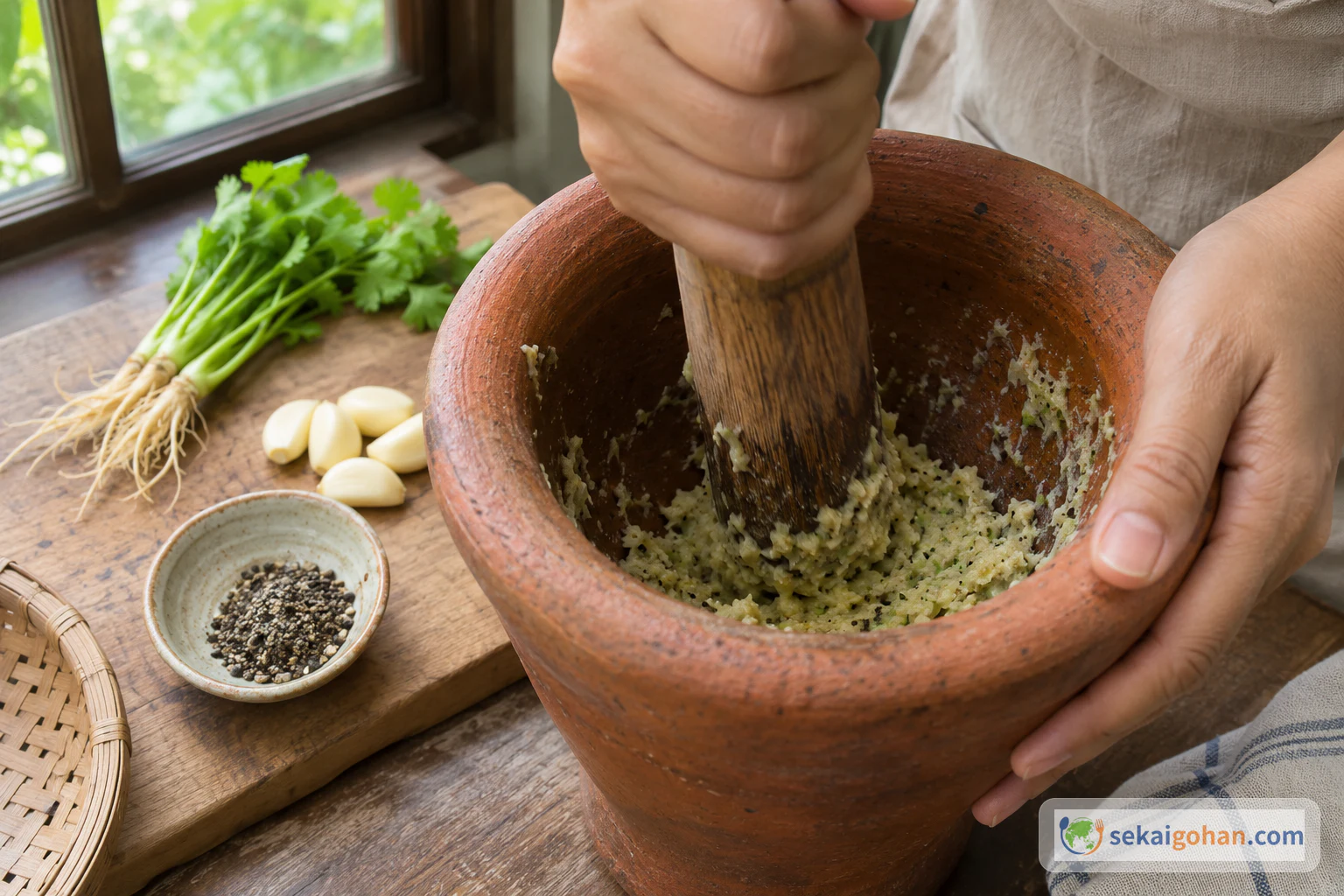
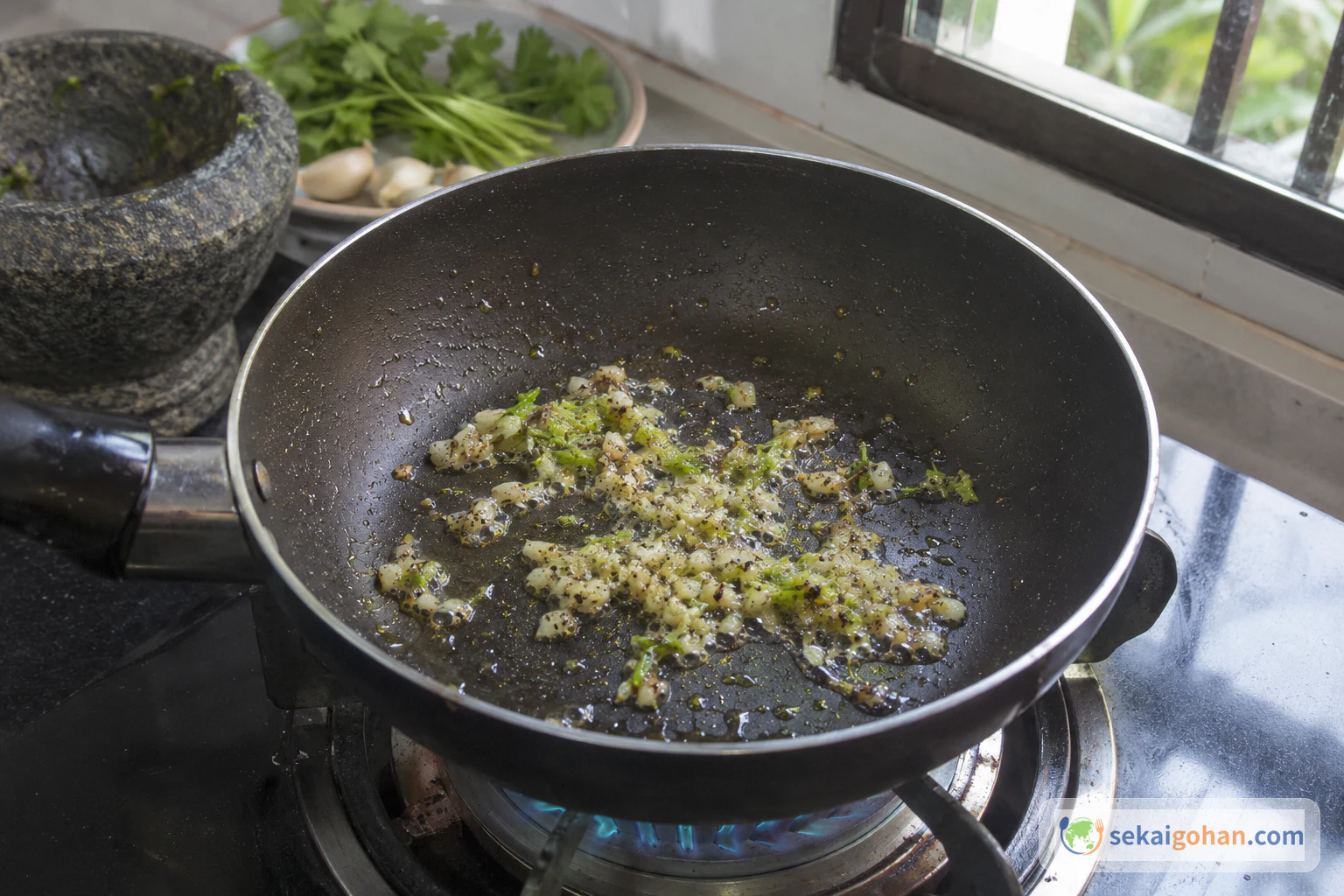
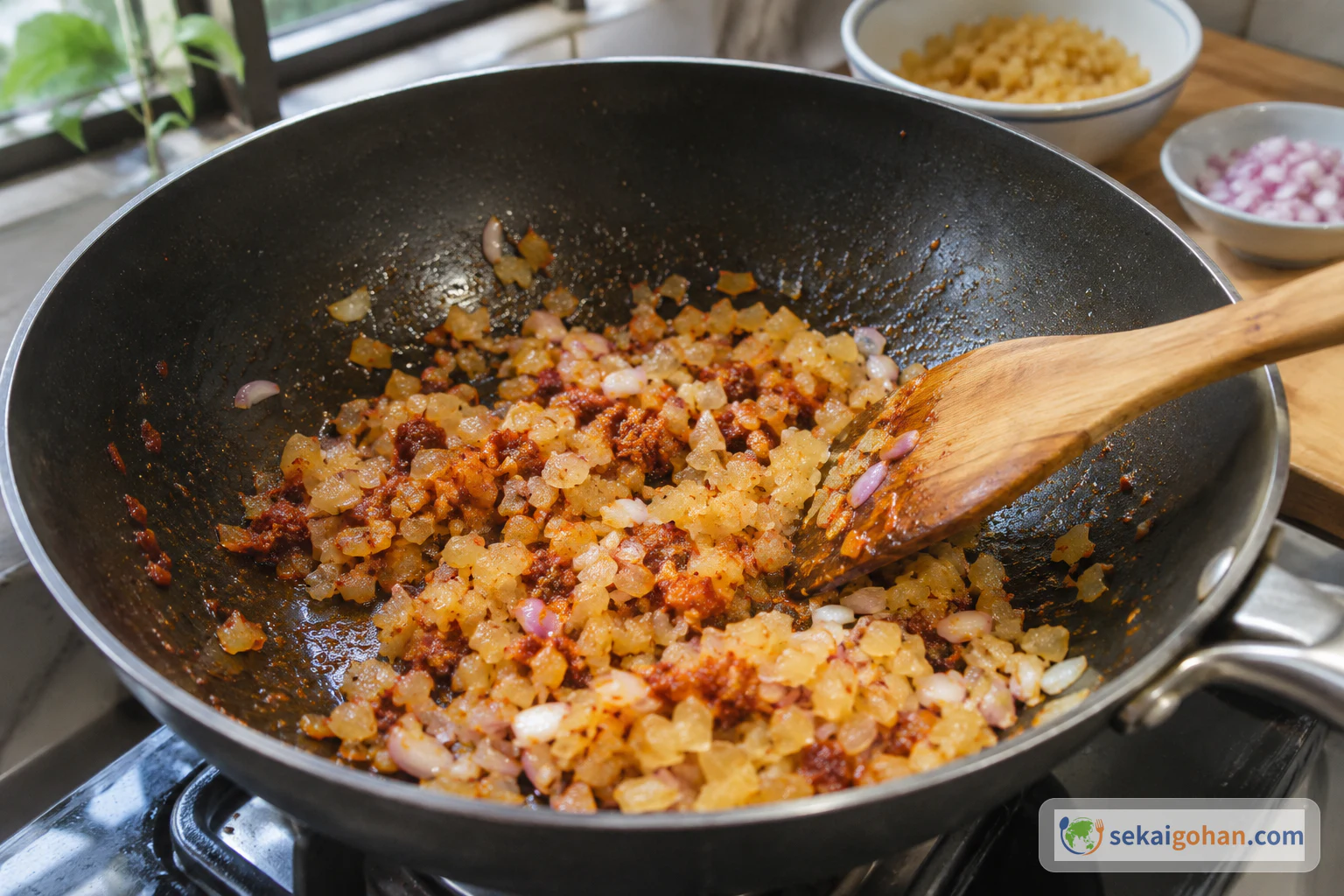
Start the pearls first, because they need a covered rest. While they sit, pound the aromatics, cook the filling and let it cool completely, which is the real hands-off stretch of the recipe. Shaping and steaming go quickly once both parts are ready.
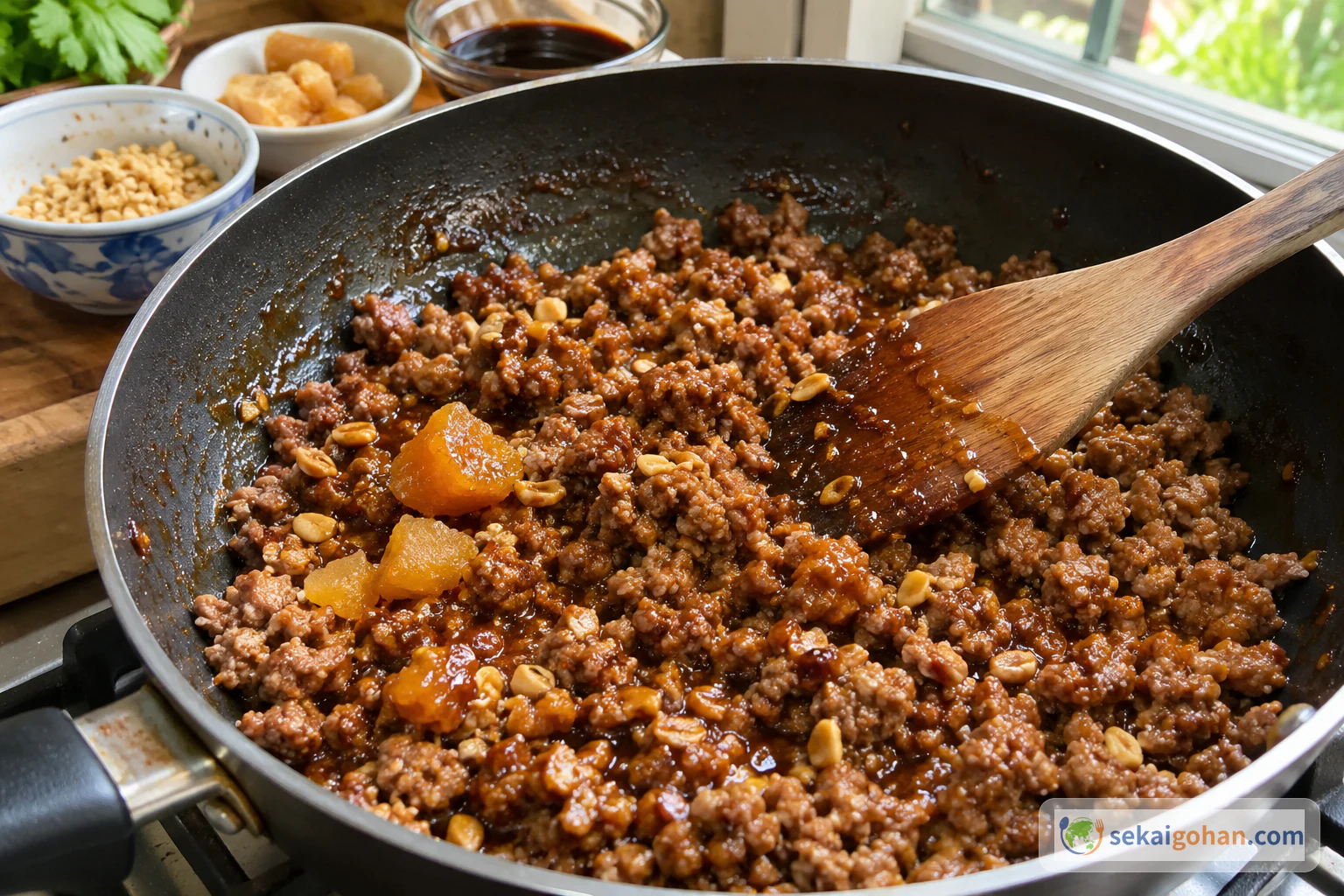
Ground pork is never eaten raw, and it has to be cooked through to the centre. Heat that holds it at 167°F (75°C) for 1 minute kills most of what raw mince carries. Cook the pork fully in the pan with no pink left, then wrap. The steamer sets the skin; it is not what cooks the pork. Take particular care when children or older people are eating.
Taste the filling at the end of step 5. It should be noticeably sweet and noticeably salty on its own, because the pearl skin adds no flavour.
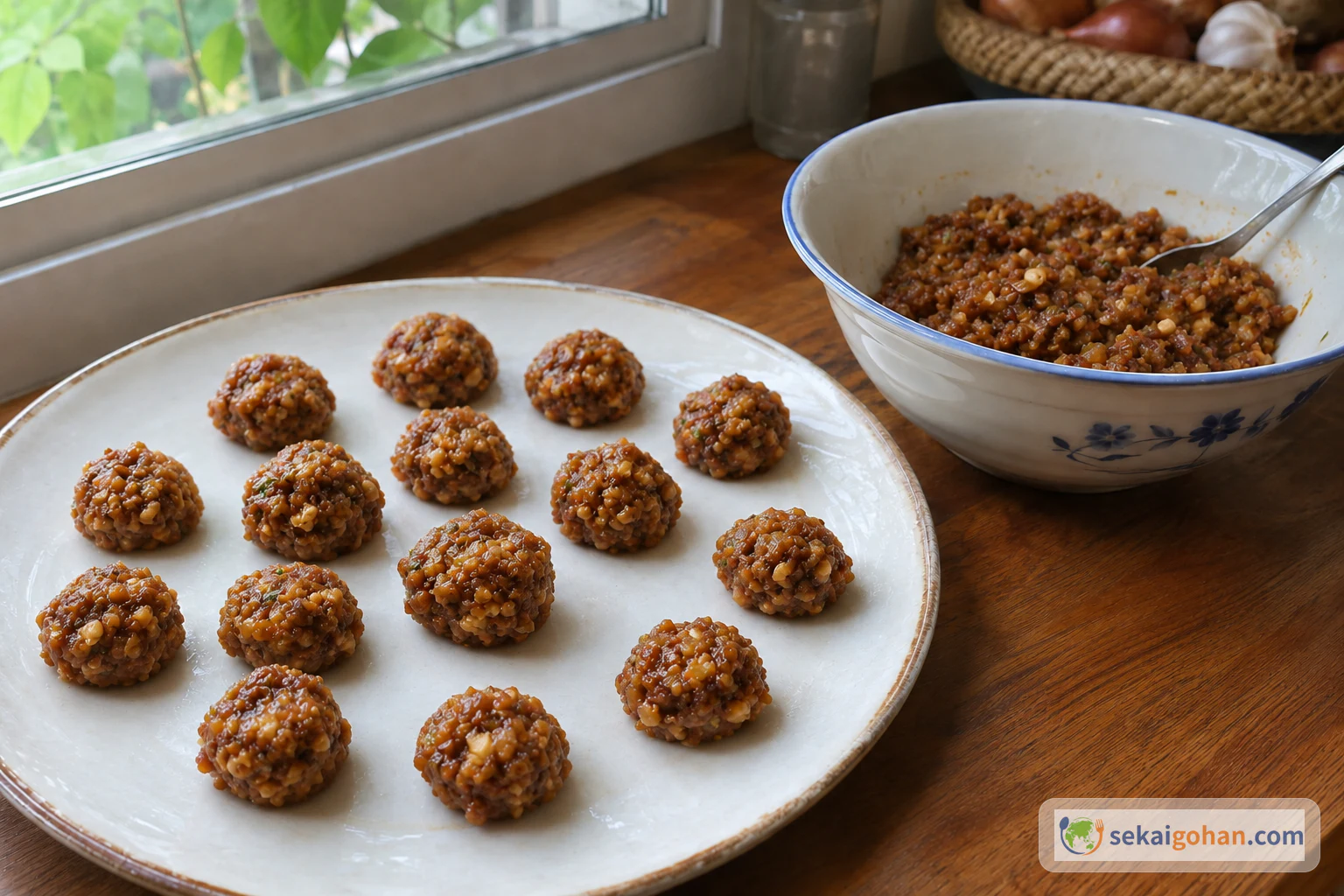
Warm filling softens the raw pearl dough from the inside and makes it gummy before it reaches the steamer. Let it cool all the way.
When It Goes Wrong
| What you see | Why | What to do |
|---|---|---|
| Skins still white after steaming | Not enough steam reaching them, or dumplings packed too tight | Keep steaming within the 10–15 minutes, and space them apart so steam can circulate |
| Dough won't come together | Not enough water reached the pearls | Make sure the ¼ cup kneading water went in and keep kneading |
| Dough dry and crumbling | The pearls were soaked too long | Keep to the 30-minute covered rest |
| Skin tears or turns gummy while wrapping | The filling was still warm | Cool the filling completely before rolling and wrapping |
| Dumplings stick to the steamer | Bare surface or crowding | Oil the banana leaf or parchment and leave space between dumplings |
| Filling tastes flat | Seasoning was cut back | Keep the palm sugar, seasoning sauce and salt as listed |
Serving and Variations
Sakhu sai mu is a snack, the kind bought by the boxful at a market and eaten with the fingers, each one folded into lettuce with a bite of chili. At home it works the same way: a plate of dumplings, a pile of lettuce, a handful of cilantro and a few chilies in the middle, and everyone wraps their own. Serve them soon after steaming, while the skins are soft and springy.
Coloured dumplings
Soak the pearls in butterfly pea or roselle water to turn the skins blue, purple or pink. The taste stays the same, and the colour shows clearly once the skins go clear.
Salted radish filling
Use salted pickled radish in place of sweet, and balance it with more palm sugar. The filling becomes saltier and sharper.
Market-size bites
Make the dumplings tiny, about 3–4 g of dough around 3 g of filling. The filling hits first in such a small bite, and the skins clear in about 5–10 minutes in the steamer.
Cold-soak wrapper
Rinse the pearls, soak them in cold water for 10–30 minutes, drain and knead. Over-soaking makes the dough dry and crumble, so keep to the time.
Frequently Asked Questions
Can I use sago pearls instead of tapioca?
Yes. Sago is the traditional choice, and small tapioca pearls are what most Thai cooks use today, sold under the same name. Either gives a clear, springy skin as long as the pearls are small.
Can I use bubble-tea pearls?
No. This dish needs small pearls. Large boba pearls hydrate unevenly, take longer to cook and leave the skin tough and chewy.
Is the pork safe if the dumplings steam only 10 minutes?
Yes, because the pork is already fully cooked in the pan before it goes into the dough. The steaming turns the skin clear. If any pork still looks pink at step 5, keep cooking it before you move on.
Can I leave out the peanuts?
The peanuts give the filling its crunch and toasty depth, so keep them in. For anyone with a peanut allergy, choose a different dish rather than adapting this one.