Bánh Ít Trần: Soft White Dumplings with a Savory Heart
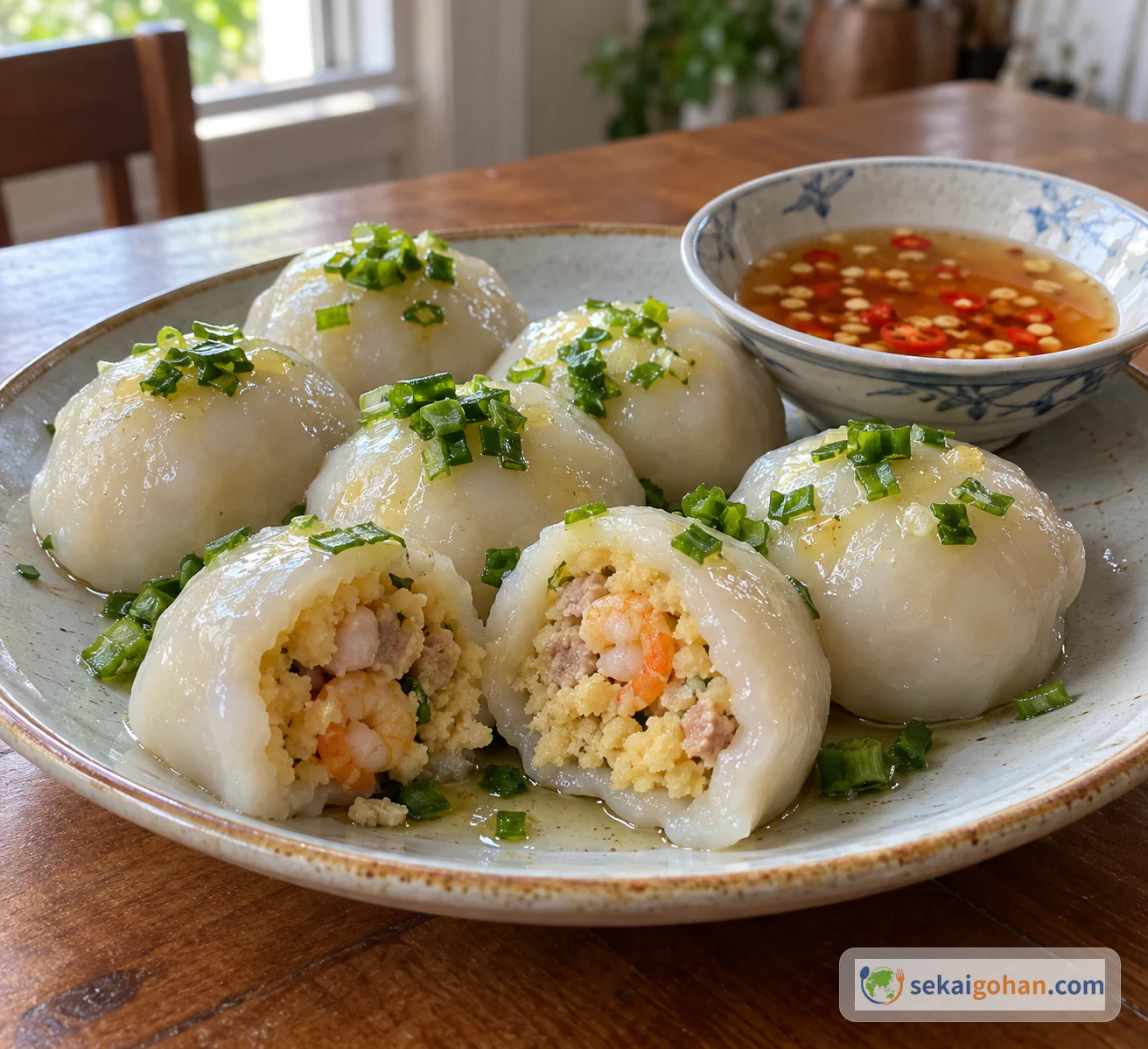
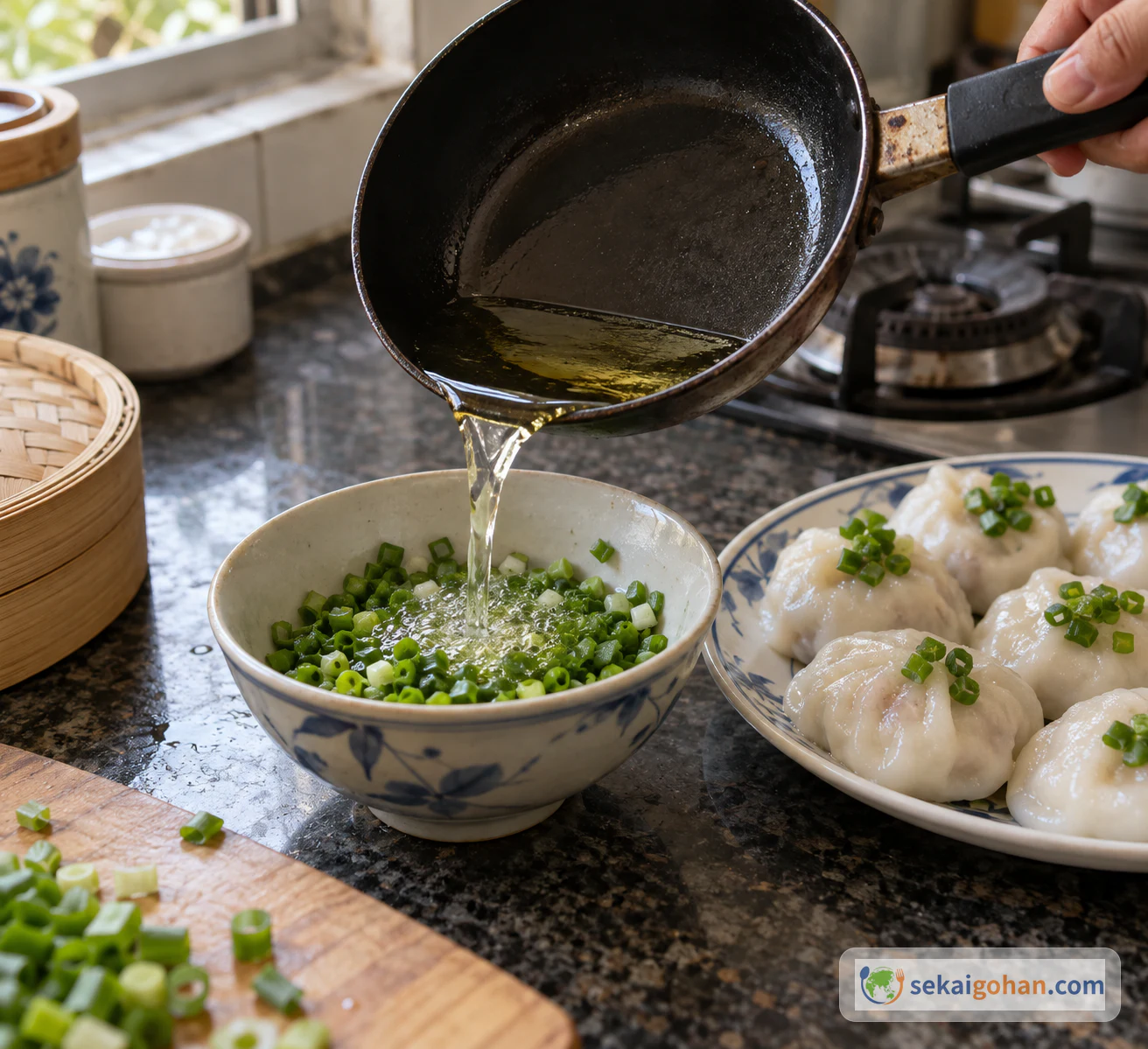
A soft, chewy glutinous rice skin, a savory filling of pork, shrimp and mung bean, and scallion oil on top, with a sweet-sour fish sauce dip on the side. The leaf goes under the dumpling, never around it.
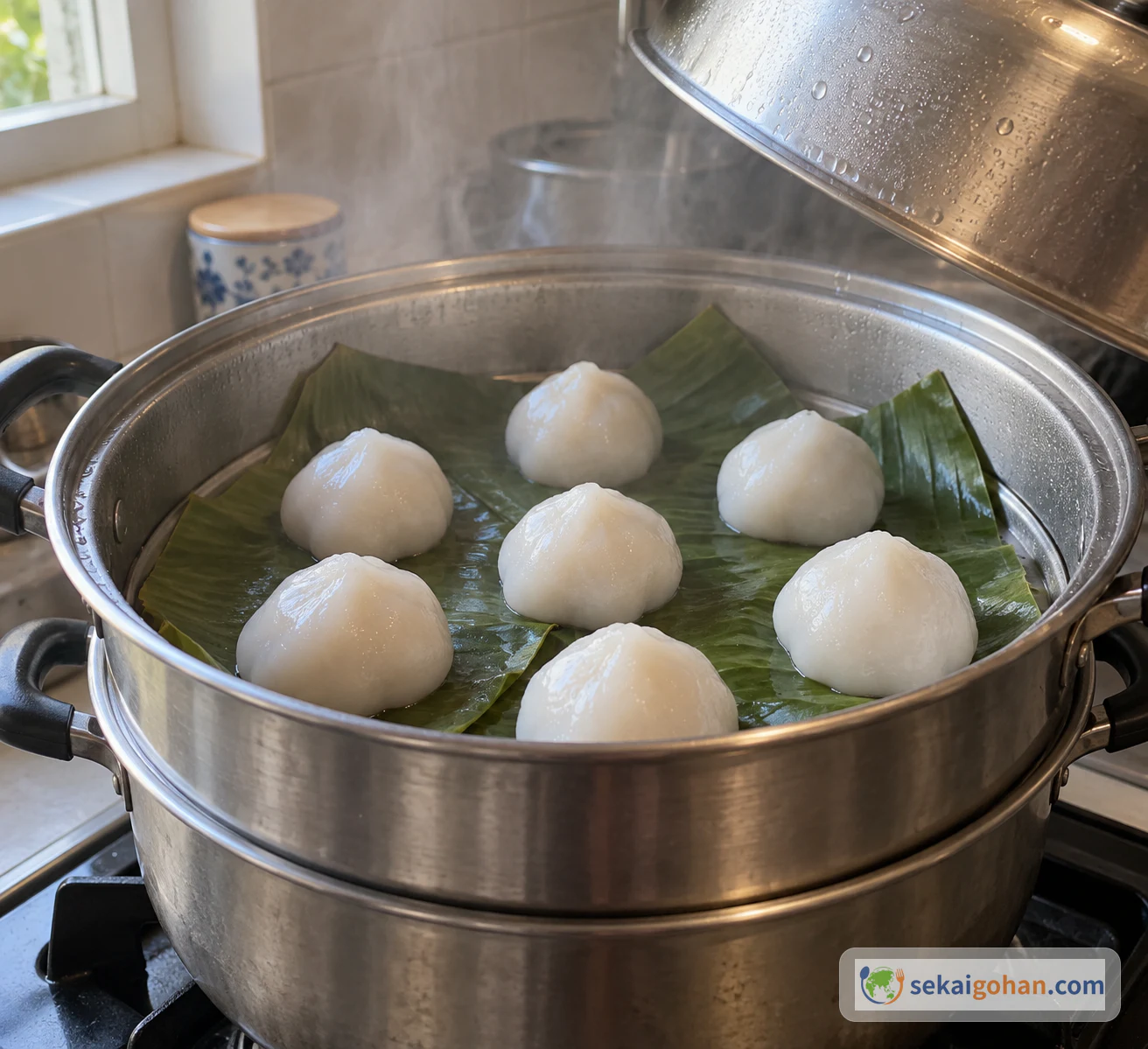
Small and round, these white dumplings go into the steamer bare, resting on a sheet of banana leaf. The seller Bánh Bảo Minh presents bánh ít trần as a dish of Huế and several provinces of central Vietnam, describing a soft glutinous rice dough around pork, shrimp and mung bean, served with a fish sauce dip that is sour and sweet. Scallion oil goes over the top.
We treat trần here as the name for the unwrapped style, which separates this dish from bánh ít, its leaf-wrapped relative. If you are exploring the country's table more widely, you can browse more dishes from Vietnam.
This article follows one set of amounts and steps, from Bánh Bảo Minh. We have not test-cooked this recipe. The filling goes into the dumplings raw, so the roughly 15 minutes of steaming is only a guide. What tells you the dumplings are ready is the temperature at the center, as described in step 6.
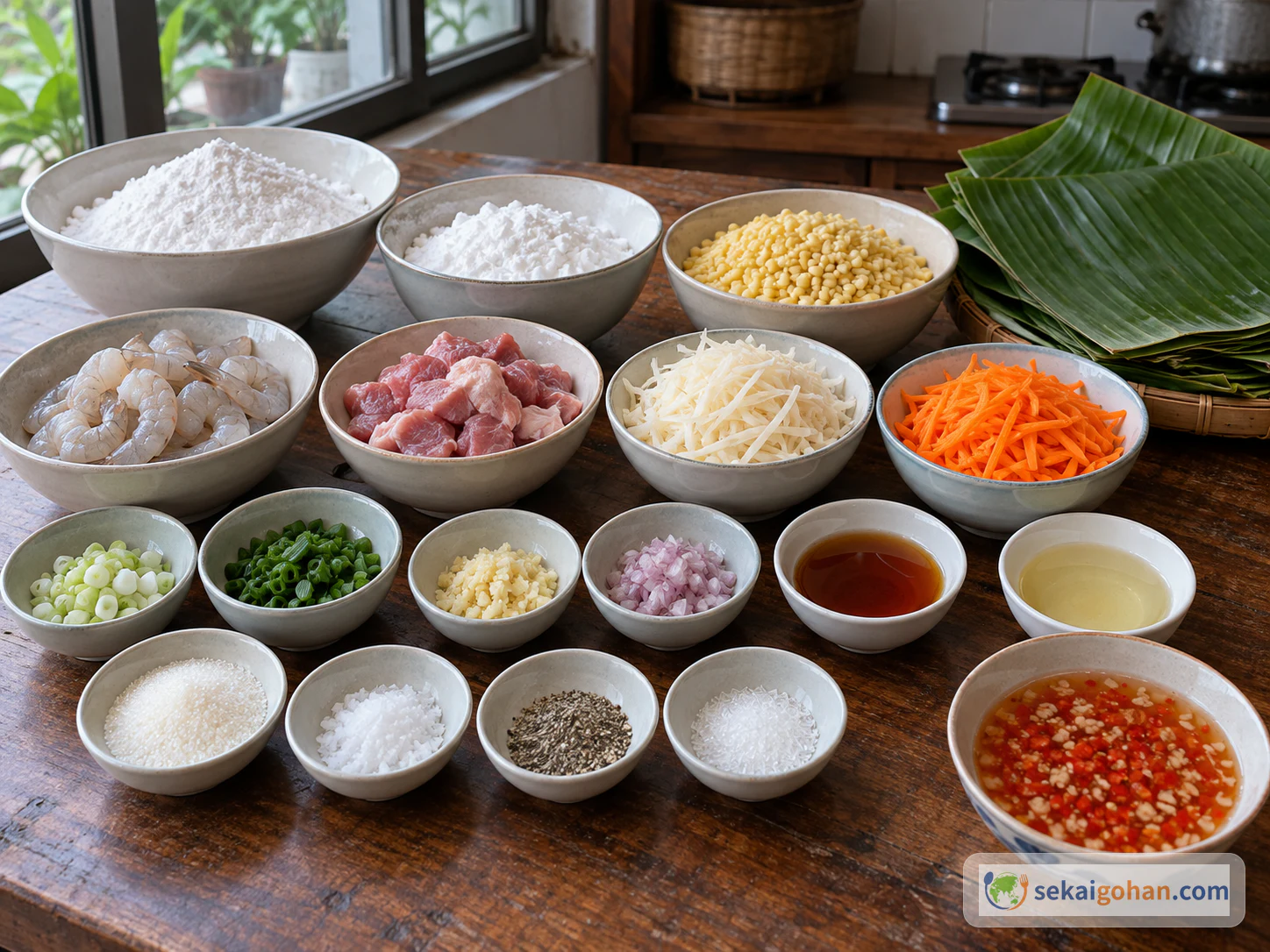
Ingredients: Skin, Filling and Finish
Equipment
- Blender or food processor
- Saucepan
- Frying pan
- Large mixing bowl
- Separate cutting boards and knives for raw pork and shrimp and for everything else
- Steamer, or a pot with a steaming rack that fits
- Banana leaves, to line the steamer
- Cooking thermometer that can read the center of a dumpling
- Small heatproof bowl
Choosing and Substituting
- Glutinous rice flour: Use flour labeled glutinous or sticky rice flour (bột nếp). Regular non-glutinous rice flour is not a replacement, since this flour carries the chew of the skin.
- Tapioca starch: Don't assume potato starch or cornstarch will behave the same way. Leaving out or replacing tapioca starch changes both the texture and how easily the dough shapes, and neither change has been tested.
- Jicama: Daikon is a possible stand-in if you can't find jicama, though it brings a different aroma and moisture level, and it is an untested swap.
- Fish sauce: Soy sauce is a different seasoning, not an equal swap.
- MSG: You can leave it out if you prefer, though the filling will have less savoriness.
- Banana leaves: Food-safe steaming paper can line the steamer instead. It won't pass on any leaf aroma.
This dish contains shrimp and fish sauce. Check the labels on MSG and other seasonings for soy-derived and other allergenic ingredients, since these vary by product.
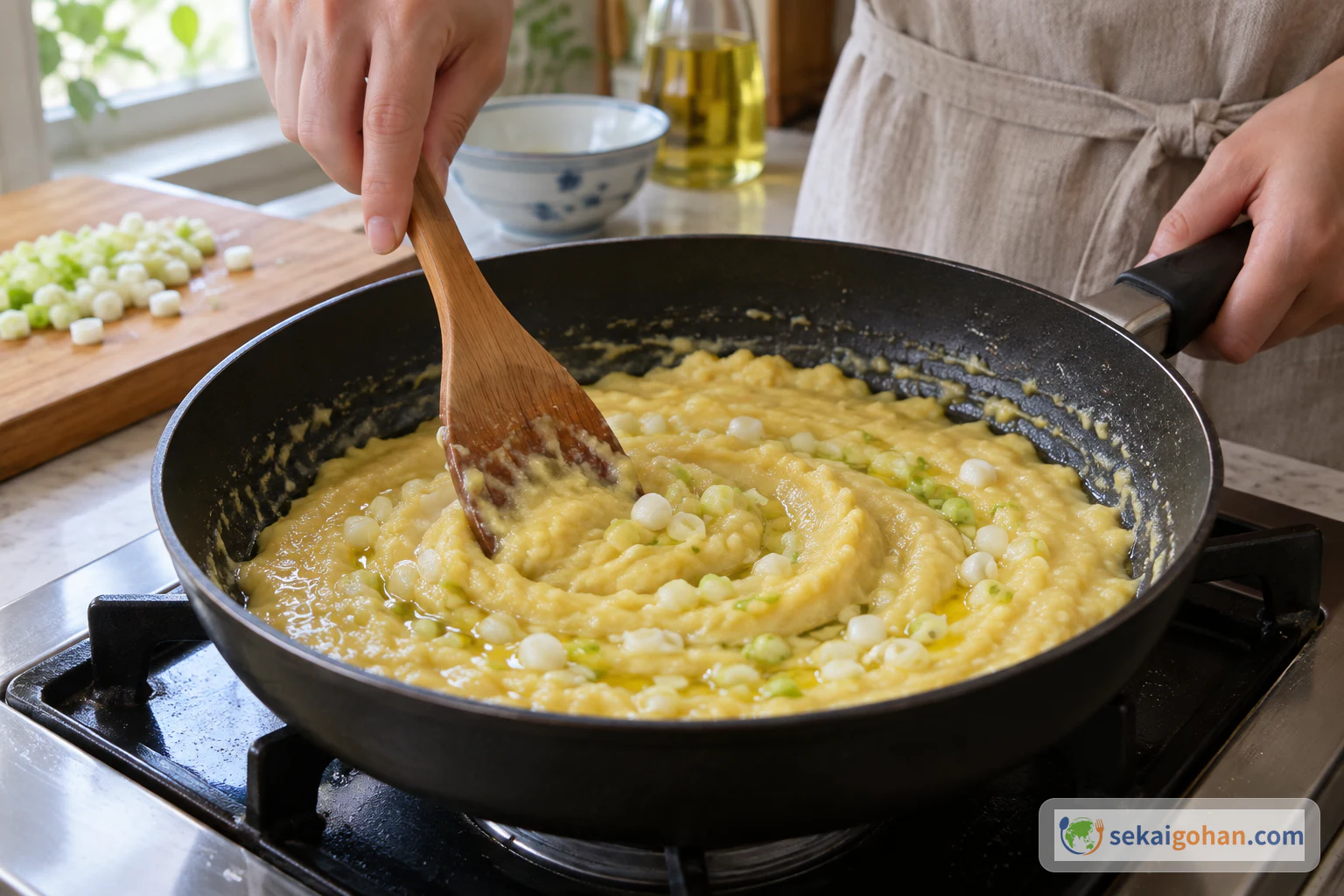
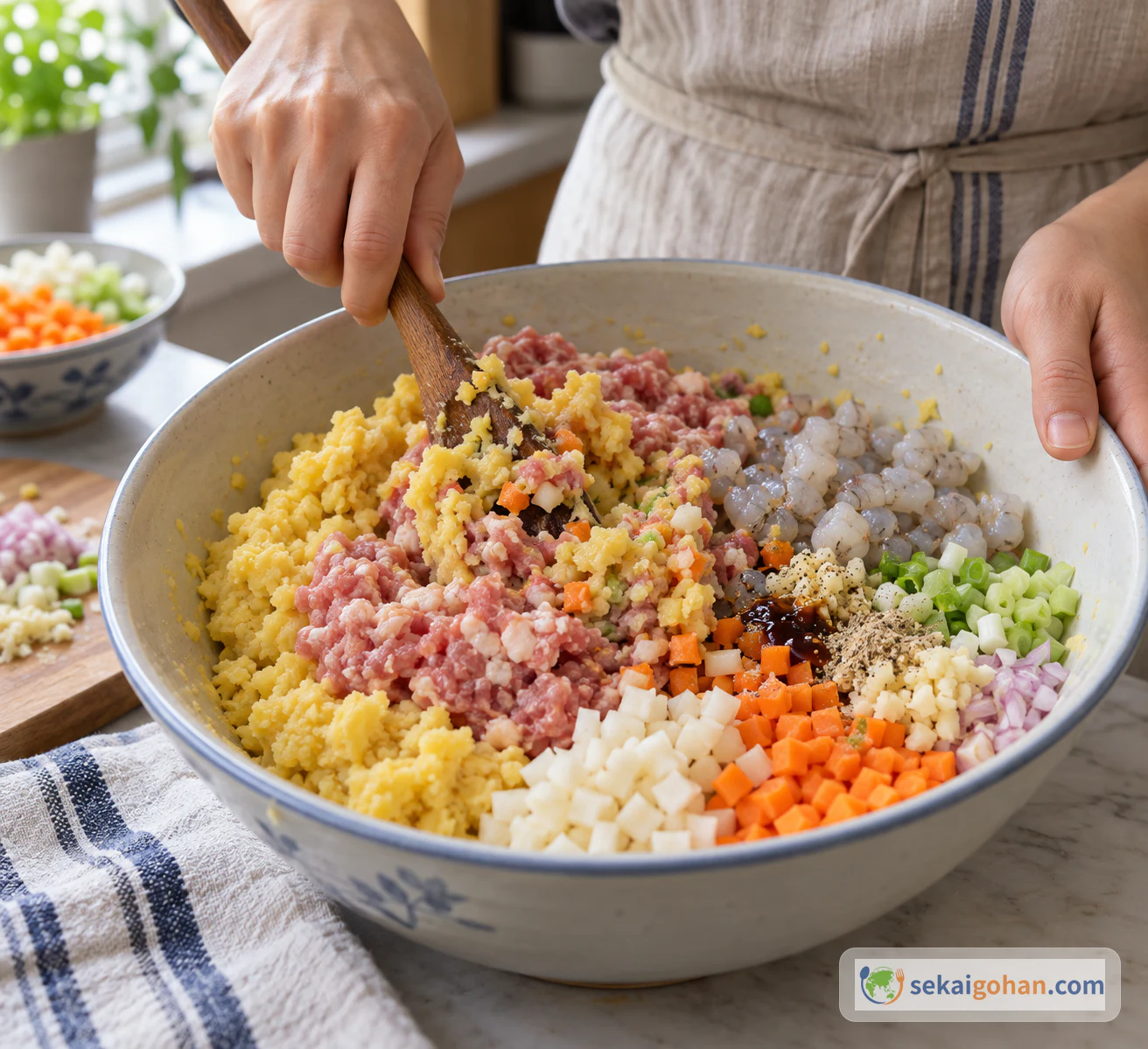
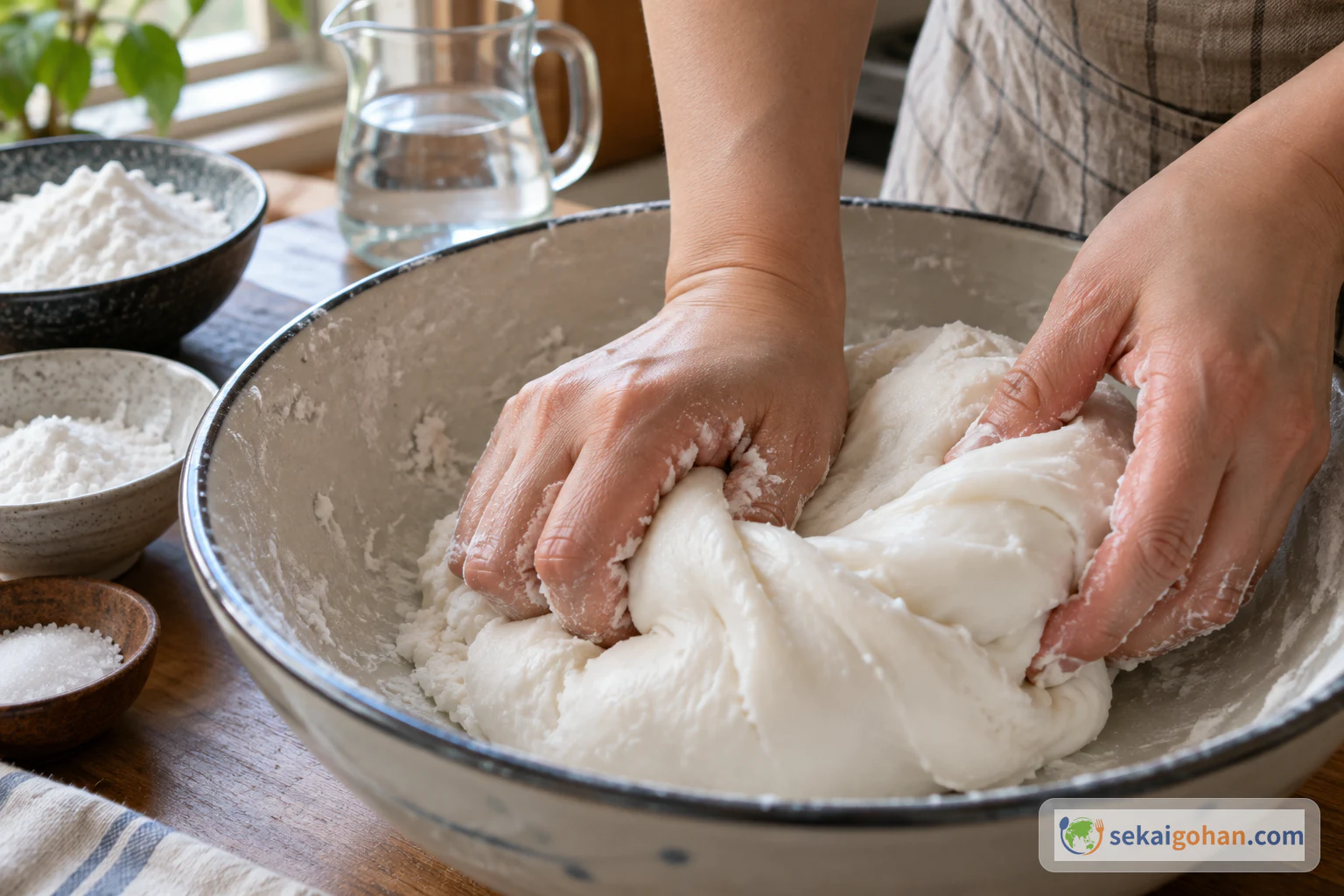
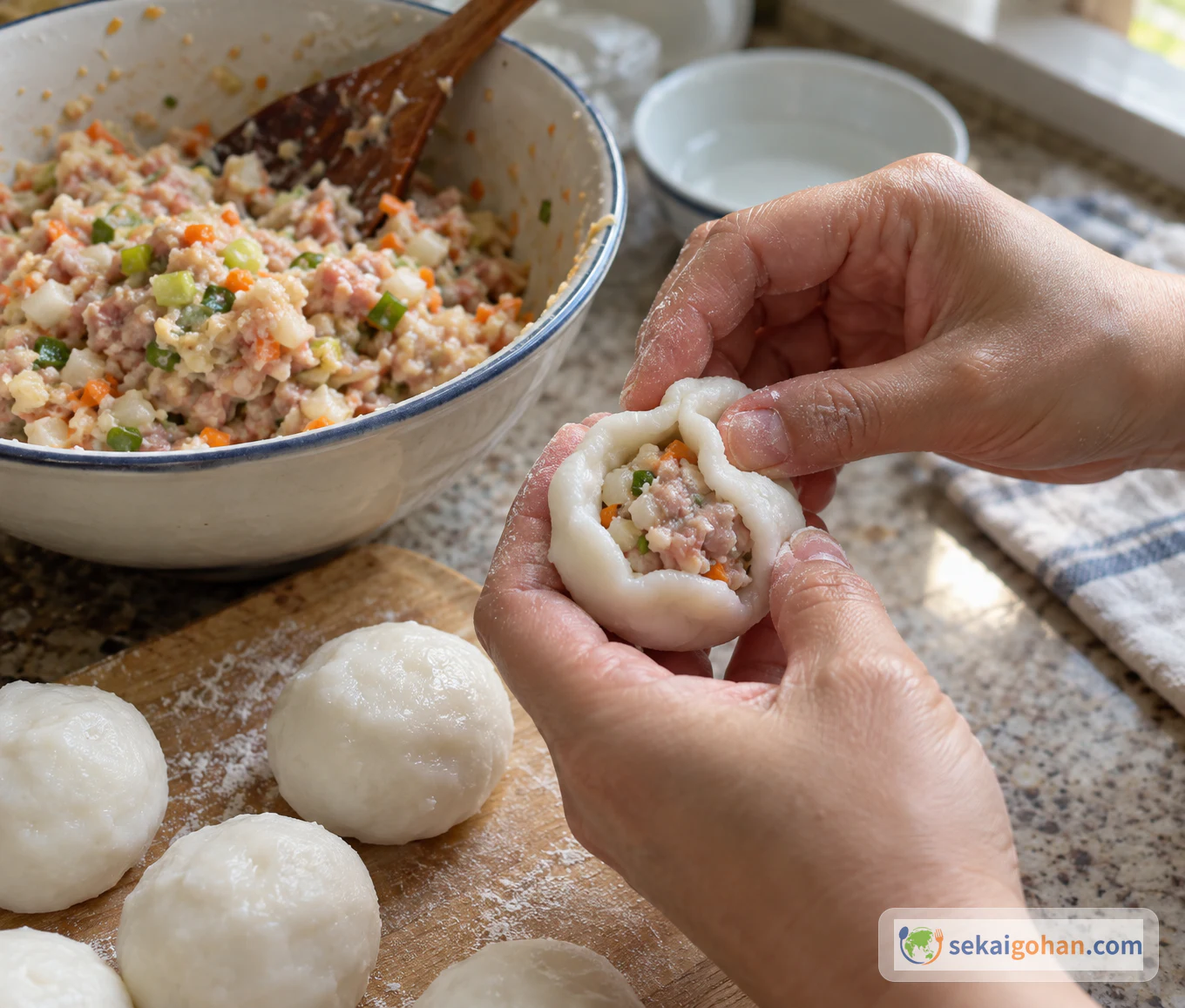
Method: Filling First, Then Dough, Then Steam
Keep hands, bowls, cutting boards and knives that touch raw pork or shrimp away from the vegetables, the dough and the finishing scallions, and wash them well after use. The dumplings are not ready to eat until the center passes the check in step 6.
Serving: Scallion Oil on Top, Dip on the Side
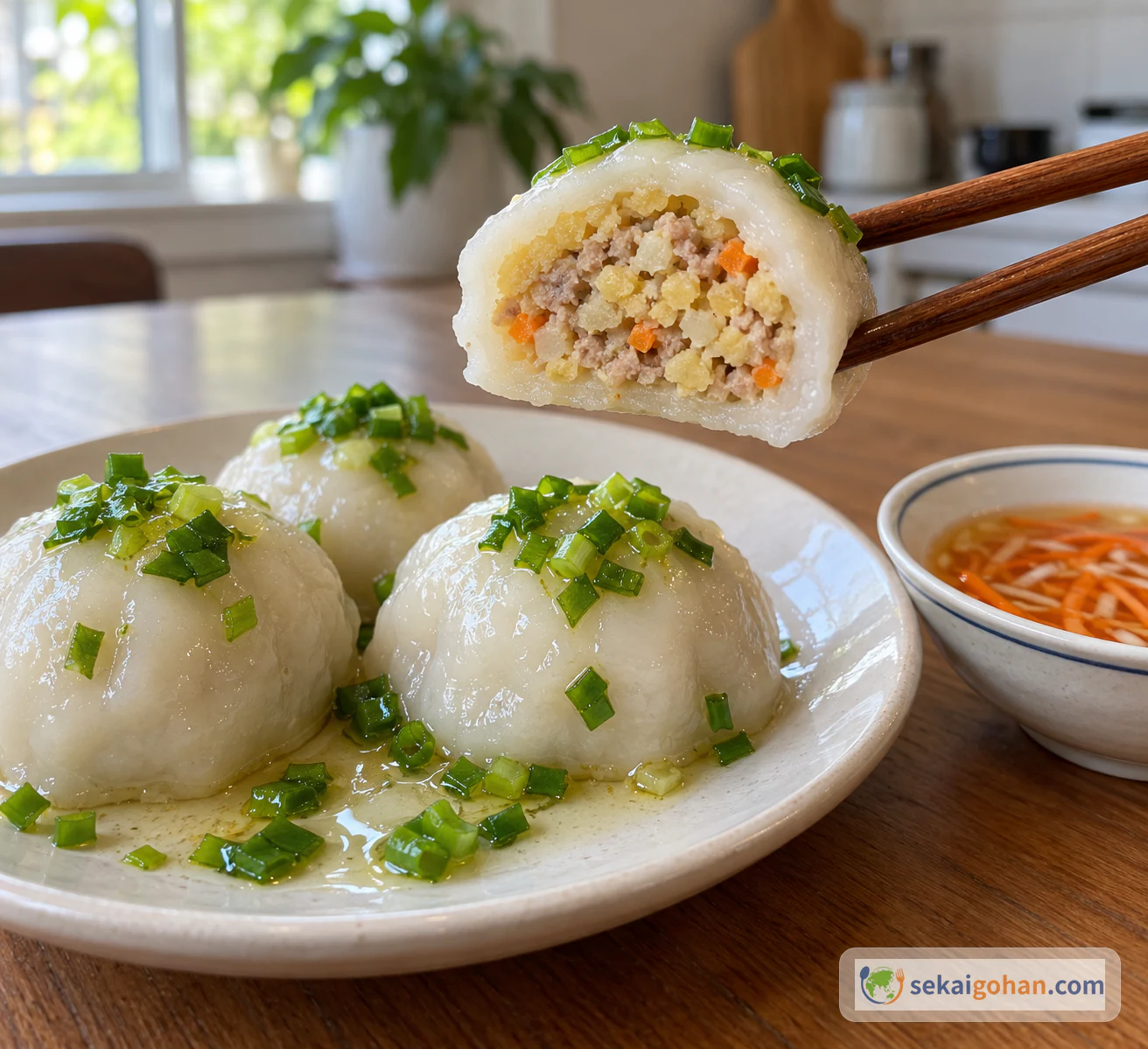
Inside a cut dumpling, expect a fine, even filling with small natural flecks of jicama and carrot, since the pork and shrimp are blended rather than left in chunks. Keep the dip in its own small bowl so each person decides how much to use. If you like some heat in the dip, it is easiest to keep that on the side too, so everyone can adjust their own.
Troubleshooting
| Condition | Likely cause | What to do |
|---|---|---|
| The dough cracks while shaping | The surface has become dry | Dampen your hands slightly rather than adding a lot of water at once |
| The seam opens | Too much filling, or an incompletely closed seam | Use less filling and pinch the seam firmly closed |
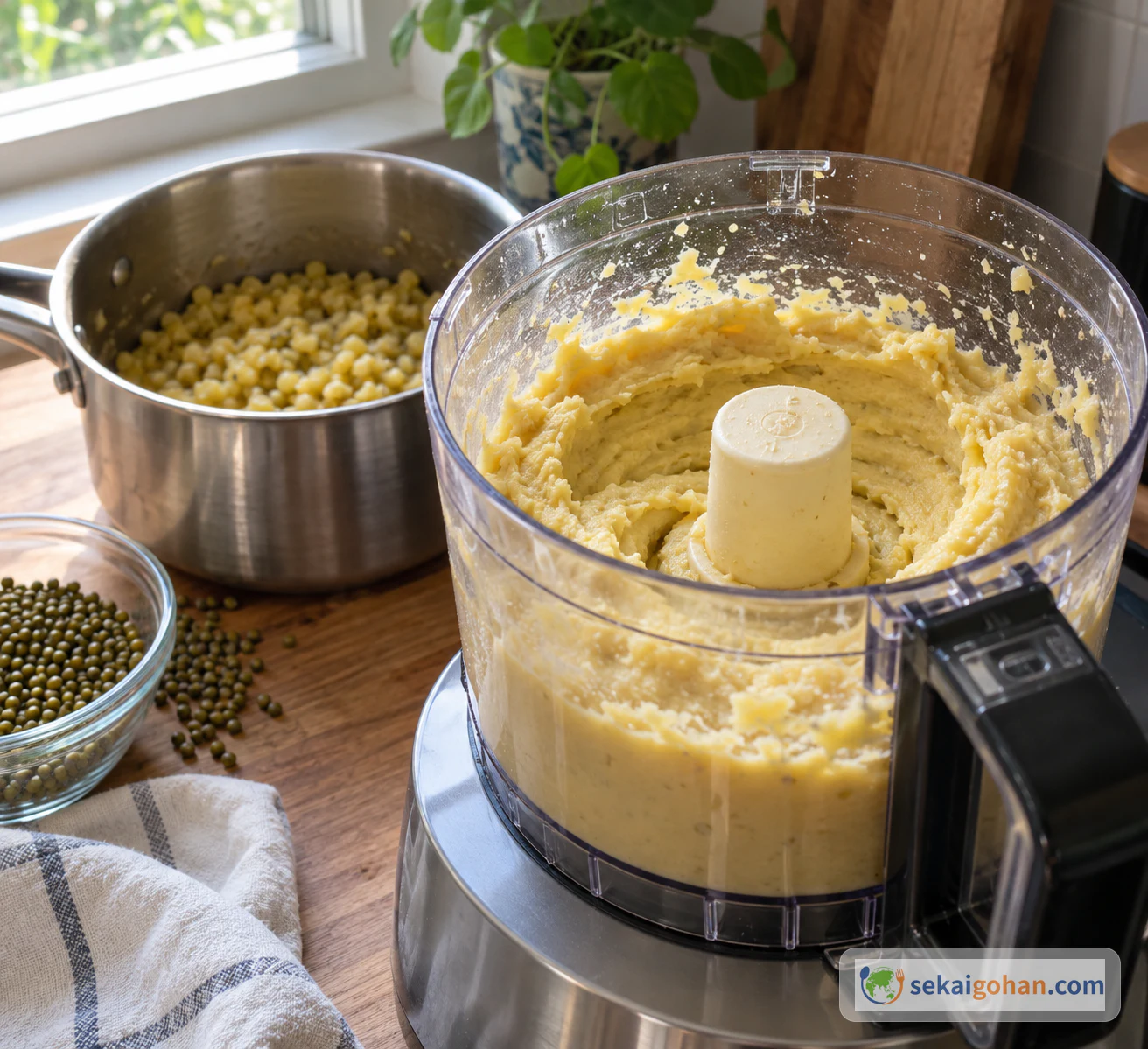
| The mung bean paste is dry | Stirred too long in the pan | Stop as soon as it turns smooth next time |
| Water lands on the dumplings | Unsteady steam or splashing from the pot | Wait for steady steam after the water boils, and keep the dumplings clear of splashes |
| The center is below 75°C after 15 minutes | Large dumplings or weak steam | Cover, steam longer and check again |
| Raw pink remains in the broken-open dumpling | The filling isn't cooked through | Return the dumplings to the steamer, steam longer and check again |
Variations and Background: One Name, Several Dumplings
Other versions of the dish
These are separate recipes with different balances of ingredients, so their amounts and times should not be mixed into the version above.
| Version | What changes | Note |
|---|---|---|
| Purple sweet potato skin (VnExpress Cooking) | Steamed purple sweet potato goes into the dough, adjusted with warm water and rested for 30 minutes. The filling has shrimp, pork belly, wood ear mushroom, glass noodles, carrot and scallion | Steamed about 30 minutes on an oiled banana leaf, using a deepening color as a cue |
| Leftover rice skin (VnExpress Cooking) | Cold cooked rice and glutinous rice flour form the skin, around ground pork, mung bean and wood ear mushroom | A home version with a different aim. Cup measures have no stated size, so we can't convert them |
| Southern style (Vietnam Discovery) | Mung bean, pork, dried shrimp and shallot, steamed on banana leaf and served with scallion oil | Dried shrimp adds a different flavor, but the amount has no unit, so it can't be used as a working recipe |
Huế and central Vietnam
Bánh Bảo Minh introduces bánh ít trần as a specialty of Huế and several central provinces. That is the seller's own description rather than independent historical evidence, and we did not find support for a date of origin, a royal connection or a link to particular celebrations, so we make no such claims. With southern and household versions also in circulation, "Huế-style" here describes how this one version is presented, and doesn't mean it is the only true form.
How this version was put together
The ingredients and steps follow Bánh Bảo Minh's recipe, but several points remain open. It gives no yield and no amounts for the salt in the dough, the oil, the garlic and shallot, or the scallion oil's greens, salt and sugar. It describes the dip without a formula. Because we have not cooked it, we also can't confirm how the 350ml of water behaves in the dough, or how long the raw filling takes to cook through at a given dumpling size.
The center temperature check is our own editorial addition for safety and doesn't come from Bánh Bảo Minh. The 75°C for at least 1 minute (or equivalent) comes from a Japanese Ministry of Health, Labour and Welfare manual for large-scale cooking facilities. It was written for those facilities, and we borrow the same figure here as a benchmark for home cooks.
Frequently Asked Questions
Is this the same as leaf-wrapped bánh ít?
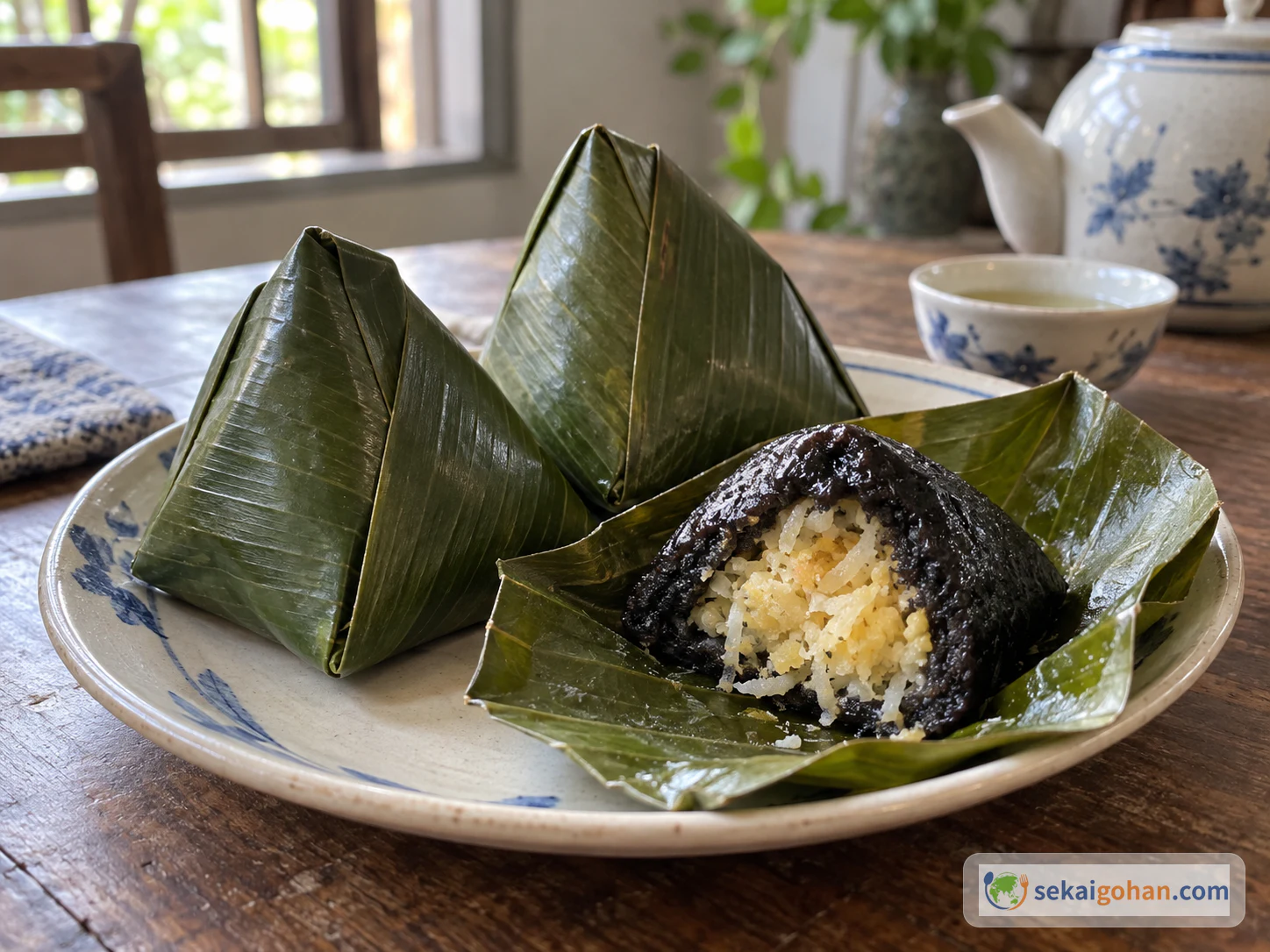
No. Bánh ít trần is steamed without a leaf wrapping, and the banana leaf only lines the steamer. Leaf-wrapped bánh ít is treated as a separate dish, so its ingredients and history shouldn't be carried over.
Is 15 minutes of steaming enough for raw pork and shrimp?
We can't promise that. Bánh Bảo Minh gives about 15 minutes, but we have not test-cooked it, and size and steam vary. Treat the time as a guide and rely on the center temperature in step 6, or on breaking one open if you have no thermometer.
Can I replace tapioca starch with potato starch?
We haven't tested it and don't treat the two as equivalent. Expect the texture and handling of the dough to change if you try it.
How many dumplings does this make?
Bánh Bảo Minh doesn't give a number of dumplings or servings, and we haven't made the recipe to find out, so we don't state one.
What goes in the sweet-sour fish sauce dip?
Bánh Bảo Minh describes the dip but gives no formula, so we don't list one here. Use a prepared sweet-sour fish sauce dip you already trust.
Can I freeze the dumplings or keep leftovers?
Our sources don't confirm storage times or a freezing and reheating method, so we don't give any.
Sources
- Bánh Bảo Minh, "Bánh ít trần – Đậm đà hương vị xứ Huế." The main recipe: ingredients, steps and about 15 minutes of steaming, plus the seller's description of the dish as from Huế and central provinces. https://banhbaominh.com/banh-it-tran-dam-da-huong-vi-xu-hue/
- VnExpress Cooking, "Bánh ít trần khoai lang tím nhân tôm thịt." A purple sweet potato version, used for comparison only. https://vnexpress.net/banh-it-tran-khoai-lang-tim-nhan-tom-thit-4360417.html
- VnExpress Cooking, "Cách làm bánh ít trần dẻo mềm từ cơm nguội." A home version with a leftover rice skin, used for comparison only. https://vnexpress.net/cach-lam-banh-it-tran-deo-mem-tu-com-nguoi-4351110.html
- Vietnam Discovery, "Vietnamese Sticky Rice Dumplings Recipe (Bánh Ít Trần)." A southern-style example with dried shrimp, from a travel information site, used for comparison only. https://vietnamdiscovery.com/vietnamese-recipes/vietnamese-sticky-rice-dumplings-recipe-banh-it-tran/
- Japan Ministry of Health, Labour and Welfare, "Manual for Hygiene Management at Large-Scale Cooking Facilities" (大量調理施設衛生管理マニュアル, notice 生食発0616第1号, June 16, 2017). The basis for confirming a center temperature of 75°C for at least 1 minute, or equivalent. Written for large-scale facilities and borrowed here as a benchmark for home cooks. https://www.mhlw.go.jp/file/06-Seisakujouhou-11130500-Shokuhinanzenbu/0000168026.pdf