Finishing cao lầu as a dry noodle dish
When you lift the drained thick rice noodles into the bowl, the braising liquid left at the bottom just gleams. Pork coated in five-spice and lemongrass, bright green herbs, bean sprouts and fried crisps are layered on top, and you pick it all up with chopsticks. This is not a noodle dish where you drink the broth. A thin film of sauce clings to the surface of the noodles, and you taste the chew and the aroma as you bite.
Cao lầu is a rice noodle dish that represents Hoi An in Quang Nam province, central Vietnam. Thick noodles are topped with pork, leafy greens and herbs, bean sprouts and crunchy fried bits, and a little of the liquid the pork was braised in goes over the top. The local noodles are described in connection with the type of rice, the water and an alkaline water made from wood ash, so it is a dish that is hard to match exactly in a home kitchen.
So the home version narrows what we reproduce to four things: thick, clean-biting noodles, five-spice pork, a small amount of braising liquid left in the bottom of the bowl, and the contrast of herbs and fried crisps. Matching the thickness of the noodles and the amount of liquid first brings the impression closer than chasing the water and wood ash in your own way.
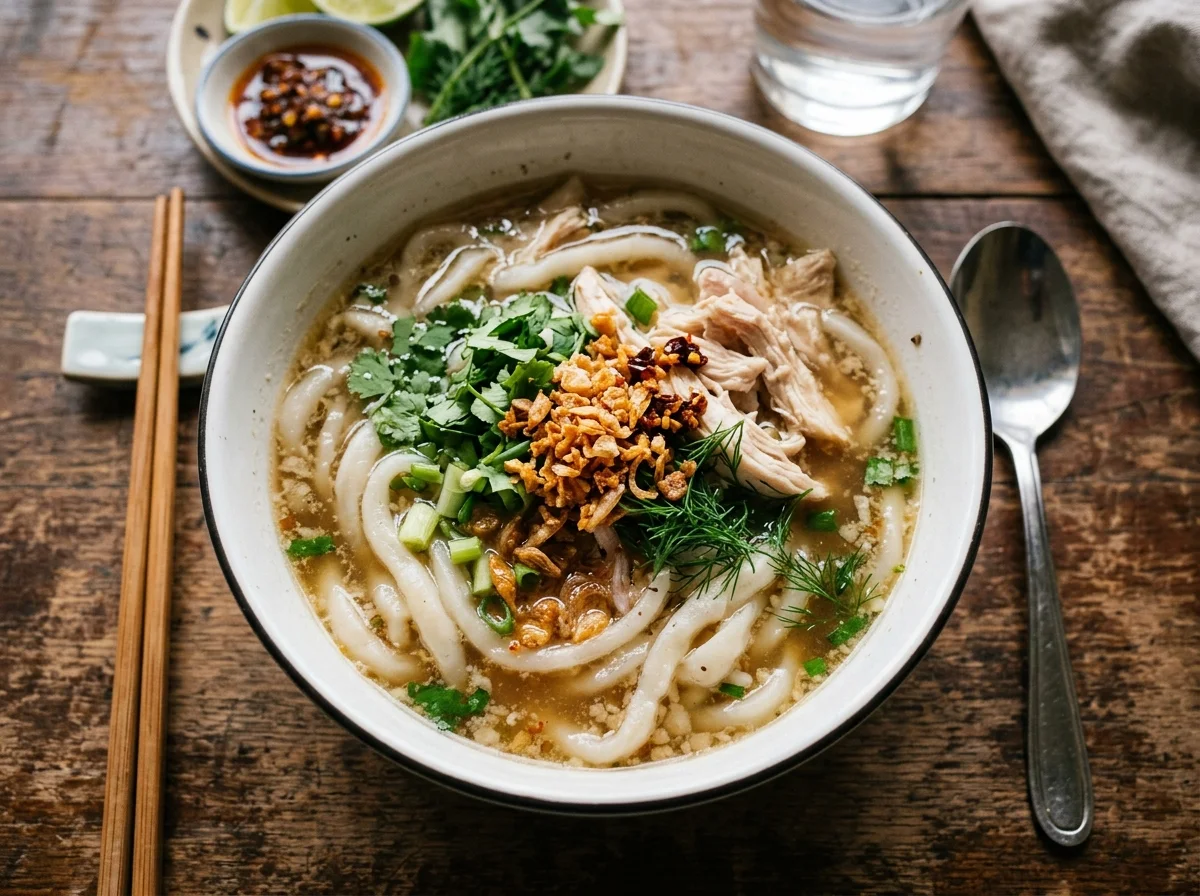
Compared with pho ga (in Japanese), where the bowl is filled with broth, the liquid plays a different role even though both are Vietnamese noodle dishes. Cao lầu is at its best when no liquid pools in the bottom of the bowl as you lift the noodles and toppings together.
Serves 4. Allow 1 hour 30 minutes of preparation including marinating the pork, 1 hour 15 minutes of cooking, and 2 hours 45 minutes in total. The finished bowl has no soup poured in, and each portion gets 2–3 tablespoons of braising liquid. The base is thick dried rice noodles; if you can't find them, thick udon is the substitute.
Ingredients (serves 4)

For noodles, check the package or name for "thick" or "flat" rather than choosing thin dried pho noodles. If you are making this just once, though, thick udon doesn't change the key points of the cooking. If you plan to make it a few times to test the local texture, look for dried noodles whose width and weight you can confirm, and don't force a purchase if only thin noodles are available.
Nuoc mam is Vietnamese fish sauce and nam pla is Thai fish sauce. Both create the saltiness and umami of the dish, but the aroma is not the same. Since this dish uses only a small amount, a bottle you already have is enough: measure 30 ml and don't buy a new one.
Fish sauce, soy sauce and wonton wrappers contain fish, soy and wheat depending on the product. If you have an allergy, rely on the ingredient labels at the time of purchase, including any labels about shared production lines. Marinade that has touched raw pork must not be reused as is for another dish; always bring it to a boil together with the pork before braising.
Method: keep the noodles from overcooking and coat them with a little braising liquid
While the pork braises, wash and dry the herbs, and set out the pot for boiling the noodles and a small pot for the frying oil. The dish is plated while the noodles are hot, so set out the bowls, lettuce, scallions and lime first so the noodles don't soak up extra moisture.
Adjustments for avoiding mistakes
Don't chase the local lye water; match the thickness of the noodles
The noodles of Hoi An's cao lầu are explained in connection with the local rice, the water and an alkaline water made from wood ash. Those conditions affect the color and chew of the noodles, so simply boiling ordinary rice noodles won't match them exactly. Don't dissolve wood ash in water at home or add alkaline agents of unknown origin, because you cannot judge the safety of the material or the concentration.
If you only have thin pho noodles, cook them for the time on the package instead of shortening the time and leaving them hard, and make up the texture with the fried crisps and herbs; it is easier to eat. Look for thick dried rice noodles only if you plan to make this again. For a single batch, finishing it as a "Japanese home version" with thick udon is less likely to break the noodles and keeps the dry-noodle idea intact.
If there's too much braising liquid or it's too salty, bring it back instead of discarding
If the braising liquid is left like a soup, warm it over low heat with the pork taken out. Reduce until the trail of a wooden spatula along the bottom of the pot stays visible for about 1 second, then divide into 2–3 tablespoons per serving.
If saltiness hits first, add water 1 tbsp at a time, warm for 30 seconds and taste. If you add fish sauce because it has become diluted, only the saltiness returns after reducing. If the pork has taken on too much seasoning, boil the noodles unsalted, hold the braising liquid to 2 tablespoons, and serve the lime and herbs separately.
If the pork is tough, add liquid and give it more time
If a skewer catches in the center of the shoulder, this is not the stage for raising the heat and making char. Add 50 ml water, cover, extend over low heat by 10 minutes, and repeat until the skewer goes in without resistance. Even if the liquid has reduced, don't reduce it all the way before the meat is tender.
Pork leg cooks faster than shoulder. Check it after about 30–40 minutes, and when it is tender take it out and adjust only the liquid. Simmering it further after slicing draws out moisture, so slice only after it has rested.
Choose a mortar only if you want to keep some texture in the aromatics
You can make the flavor by chopping lemongrass and chile finely with a knife. A mortar, on the other hand, lets you stop before the fibers are completely crushed and decide by hand whether to keep some texture in the marinade or make it smooth. If you make herb sauces and spice dishes often beyond cao lầu, a granite mortar and pestle is worth considering. If you make this once, or already have a sturdy mortar, a knife is a fine stand-in.
What you can change in a home kitchen
To keep the cao lầu character, you don't need to replace everything with local products. Protect the thickness of the noodles, the aroma of the pork, the small amount of liquid, and the herbs and fried crunch first, then swap in what you can get, and you can tell for yourself what changed.
| What to change | Amount and handling | How the result changes |
|---|---|---|
| Thick dried rice noodles to thick udon | Same amount of udon for 4 servings. Warm only for the time on the package | A wheat aroma and softness come in. The idea of keeping the liquid low doesn't change |
| Pork shoulder to chicken thighs | Use 500 g chicken thighs and start checking the braise at 25–30 minutes | The five-spice marinade suits it, but the pork's richness and the Hoi An classic feel get weaker |
| Fresh turmeric to powder | 30 g fresh to 2 tsp powder | The color stays, but the earthy aroma and bright pungency become lighter |
| Cilantro and Thai basil to shiso or mitsuba | Swap the 50 g of herbs for the same amount | The green aroma becomes Japanese in style. Keeping a little mint helps hold the cooling effect |
| Leave out fish sauce | 30 ml soy sauce, 50 ml dried shiitake soaking liquid and 1 g salt | The seafood umami is gone. Treat it as an alternative preparation for people with fish allergies |
If the noodles stay thin and only the meat is made local-style, it is hard to create the texture of a dry noodle dish. First match the shape of the noodles with thick udon, then check the differences in the order of fish sauce, five-spice powder and herbs, and you won't end up buying too many extra ingredients.
A noodle dish born in a trading port, and its table culture
Hoi An is a town on the Thu Bon River in Quang Nam province, central Vietnam. UNESCO's World Heritage Centre describes it as a trading port that prospered from the 15th to the 19th century, linking East Asia, Southeast Asia and farther regions, with a townscape layered with Chinese, Japanese, European and other influences. The Vietnam Tourism Board's recipe materials likewise link cao lầu to Hoi An's history as an important trading port, introducing it as a dish where Japanese, Chinese and Vietnamese echoes overlap.
You don't need to read this background simply as "mixing foreign dishes." When people and goods move in and out of a port, rice noodles, soy-based seasoning, pork cooking and the use of herbs meet in the same bowl and stay on in a form that suits the local water and ingredients. If you look at cao lầu as a combination of thick noodles, sweet-salty pork, little braising liquid, green herbs and fried crunch, trade history comes back to the decisions made in the kitchen.
There are accounts that the rice, the water and an alkaline water made from wood ash used in Hoi An matter for how the noodles are made. SBS Food's recipe takes dried thick rice noodles as the realistic substitute, noting that it is hard to make the same noodles outside Hoi An. Not being able to reproduce the local conditions at home does not mean the dish loses its value. If you make it so that you know what you kept and what you changed, the process of getting closer to the local plate is part of the pleasure.
In the Vietnam Tourism Board's guide to Hoi An's food culture, besides regional noodle dishes like cao lầu, places that make fish sauce, coffee, rice paper and rice wine, and the organic vegetable village of Trà Quế, are listed as food highlights. Serving plenty of herbs at the end is not just decoration; it keeps the role of ingredients that reach the bowl through the river, fields and markets. When you swap in shiso or mitsuba, don't leave the herbs out: keep the intention of putting a green aroma between the noodles and the pork, and the meaning of the substitution is clearer.
It is sometimes lined up with mì Quảng and pho as a central Vietnamese noodle dish, but what to look for when making cao lầu is not memorizing the type of soup. It is that the thick noodles lift together with the toppings, the braising liquid clings thinly to the surface, and the herbs and fried crisps change each bite. If those four are in place, even a home version with udon keeps track of what dish you are reproducing.
Frequently asked questions
Can I make cao lầu with thin dried pho noodles?
You can, but the springiness of the noodles and the feeling of lifting the toppings together get weaker. If you use thin noodles, follow the package time, don't soak them in water for long once cooked, and start with 2 tablespoons of braising liquid per serving. If you plan to make it again, choosing a flat noodle with some thickness is more effective than going thinner.
If I substitute udon, is it a different dish from cao lầu?
It isn't the local noodle itself, so it's not accurate to call it the same. Because it is hard to fully reproduce Hoi An's noodles with Japanese water and store-bought ingredients, this is a home-version substitute that matches the thickness and the small amount of liquid. If you want to avoid wheat, use thick rice noodles instead of udon and check the ingredient labels on the package.
Will dissolving wood ash in water get me closer to the local noodles?
I don't recommend it. There are sources in which an alkaline water from wood ash appears in the local method, but how to confirm the kind of ash, its concentration and its safety for food at home is a separate problem. Use store-bought noodles and match the thickness, the aroma of the pork, the small amount of braising liquid and the fried toppings.
What if I don't like the smell of fish sauce?
Replace the 30 ml fish sauce in the ingredient table with 30 ml soy sauce, 50 ml dried shiitake soaking liquid and 1 g salt. The fermented seafood aroma disappears, but umami and liquid remain in the braise. If you have a fish allergy, check not just the fish sauce ingredients but the labels on the wonton wrappers and seasonings, and wash equipment thoroughly if it is shared.
Can I store leftover cao lầu?
Cool the pork and braising liquid, divide into shallow airtight containers, refrigerate, and use within 2 days. Keep the noodles, herbs, lettuce, bean sprouts and fried crisps separate and prepare them fresh each time you eat. Reheat the pork and liquid in a pot until hot all the way through, and boil the noodles again. If you reheat noodles that have absorbed liquid as they are, they won't go back to the dry-noodle texture.
Sources
- Vietnam Tourism Board, “Recipes from Vietnam” — Cao Lau Hoi An (p.2), https://vietnam.travel/sites/default/files/2020-05/Recipes%20from%20Vietnam%20Tourism%20Board.pdf (accessed and checked 2 September 2026)
- UNESCO World Heritage Centre, “Hoi An Ancient Town”, https://whc.unesco.org/en/list/948 (accessed and checked 2 September 2026)
- Vietnam Tourism, “7 Things To Do In Hoi An”, https://www.vietnam.travel/things-to-do/7-things-to-do-hoi-an (accessed and checked 2 September 2026)
- Vietnam Tourism, “Top Things To Do In Hoi An”, https://vietnam.travel/things-to-do/top-things-to-do-hoi-an (accessed and checked 2 September 2026)
- SBS Food, “Hoi An noodles (cao lầu)”, https://www.sbs.com.au/food/recipe/hoi-an-noodles-cao-lau/cuslyawb2 (accessed and checked 2 September 2026)