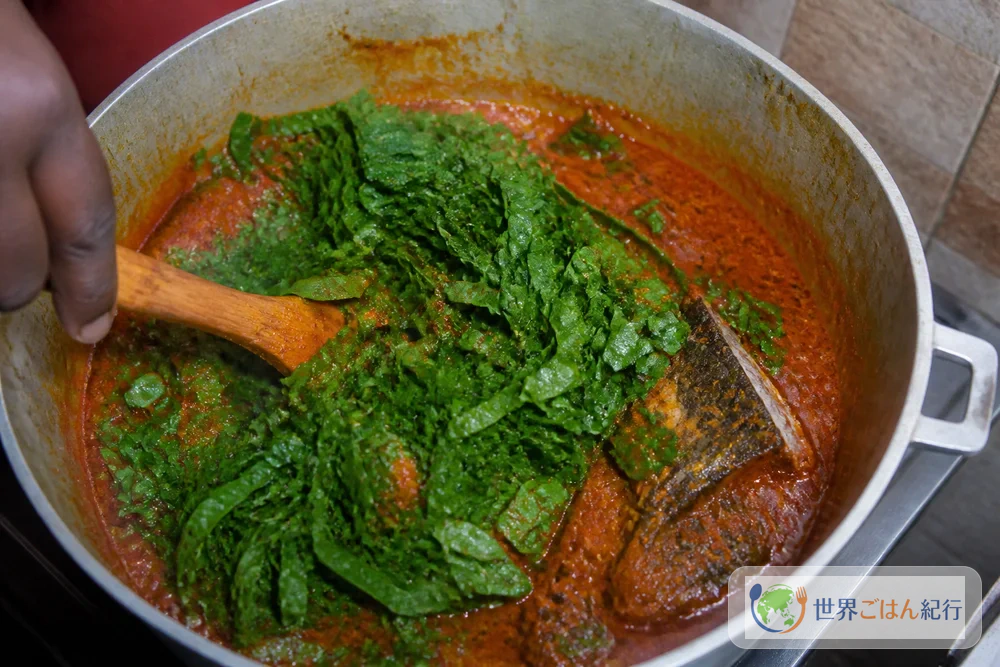
The leaves in the pot turn from green to deep green
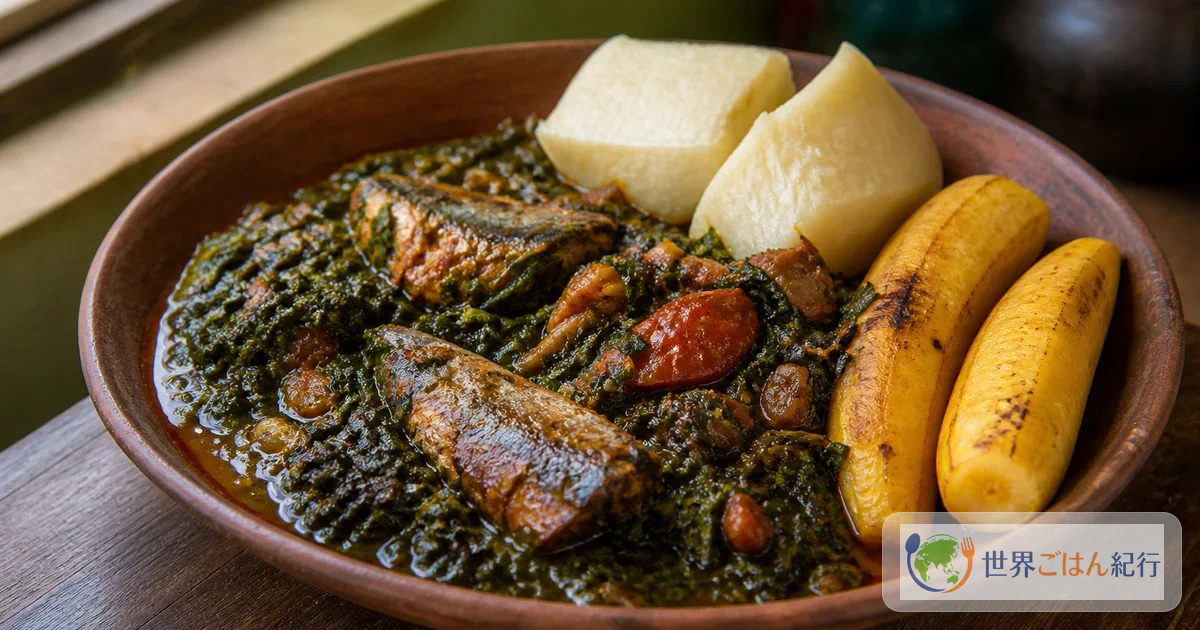
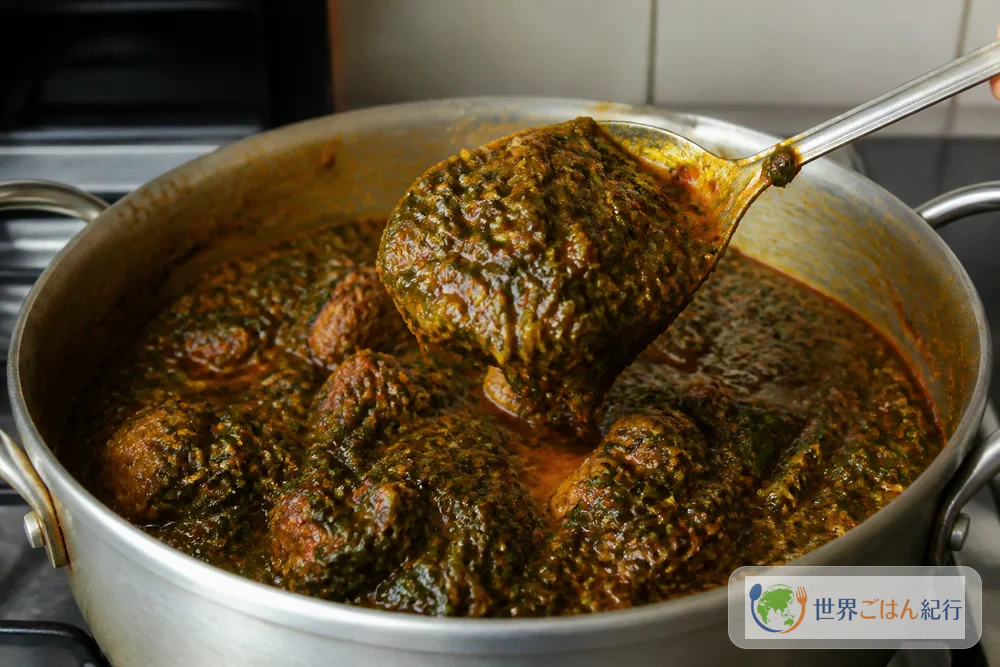
Drop the leaves into a red tomato broth and the color of the pot changes all at once. Bright green leaves sink into deep green, and red palm oil returns to the edge of the pot. When a wooden spatula lifted out brings up broth that clings slowly, thick with leaves and oil, kontomire stew is ready to eat.
In Ghana, kontomire / nkontomire is the name of a leafy-green dish made with cocoyam leaves. English-language recipes sometimes call it palava sauce, but the toppings vary by household, with fish, eggs, snails, mushrooms and agushie (melon seeds), and the name is not fixed either. The core of the taste is the earthy aroma of the leaves, tomato and chili, red palm oil, and the umami of smoked fish or dried shrimp.
If you cook it away from West Africa, use cocoyam leaves sold as food if you can find them, and otherwise replace them with spinach and Swiss chard. Even when you change the leaf, if you keep the aroma of red oil and a thickness that leaves a thin trail on the spoon, the direction of the dish does not drift. Because it is meant to coat boiled yam, plantain, rice, fufu or banku, you finish it a little thicker than a soup.
Guides to Ghanaian food culture explain a way of eating in which a starchy staple is combined with a soup or stew and protein such as fish. Kontomire, too, is a dish for which it is easier to adjust the heaviness and heat if you serve it with a staple to catch it rather than finishing it in the pot alone.
To say "kontomire is a cocoyam leaf stew" is easy to follow, but Ghanaian home cooking changes shape with region, season, and the fish and seeds on hand. The ingredient table is a guide for one pot that is easy to make outside Ghana, and reproduces the taste of households that use agushie with pumpkin seeds.
Regional differences a leaf stew reflects in Ghana
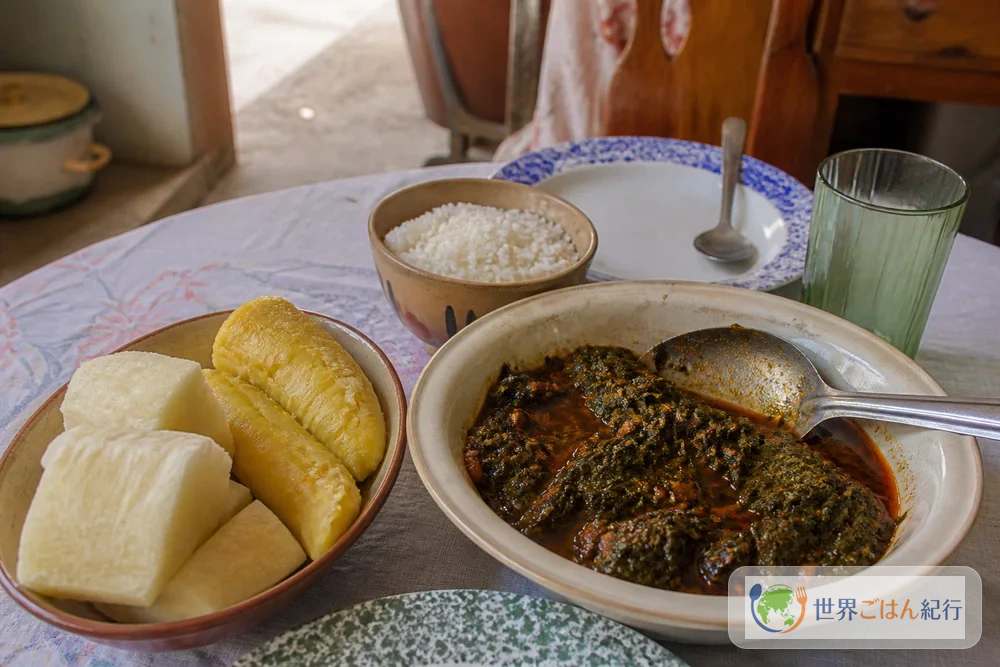
In Ghana's kitchens, differences in climate and crops become differences in dishes. The food culture guide of Ghana's Ministry of Tourism, Culture and Creative Arts explains that plantain, cassava, cocoyam and yam grow in the southern forest zone and are paired with soups made with fish and chili. In town chop bars too, dishes made with these local ingredients are served as everyday meals.
In the regional guides, Brong Ahafo and Bono East are described with ampesi, boiled yam or plantain, and thick soups made with snails and mushrooms. A source introducing the Kwahu region in the east also says yam, cassava, cocoyam, plantain and vegetables are grown there, and describes eating leafy soups with fufu and ampesi. Even for the same "leaf stew," the impression of a plate changes a good deal once the staple and protein served with it change.
On where to grow kontomire leaves, a recipe source featuring a Ghanaian cook says that the soil of the eastern region is good and yields good kontomire. This is not a statistic that represents the whole country but the cook's own view of the ingredient. When you look for leaves, do not think "any taro leaf will do"; choose ones for which edible labeling, origin and preparation instructions can be confirmed.
The Ghana National Commission on Culture also explains that dishes change by region, ethnic group, season and occasion. So rather than memorizing kontomire as one fixed recipe, grasping the relationship among leaf, oil, seafood, seed and staple gets you closer to the way it is eaten there.
Ingredients (serves 4)
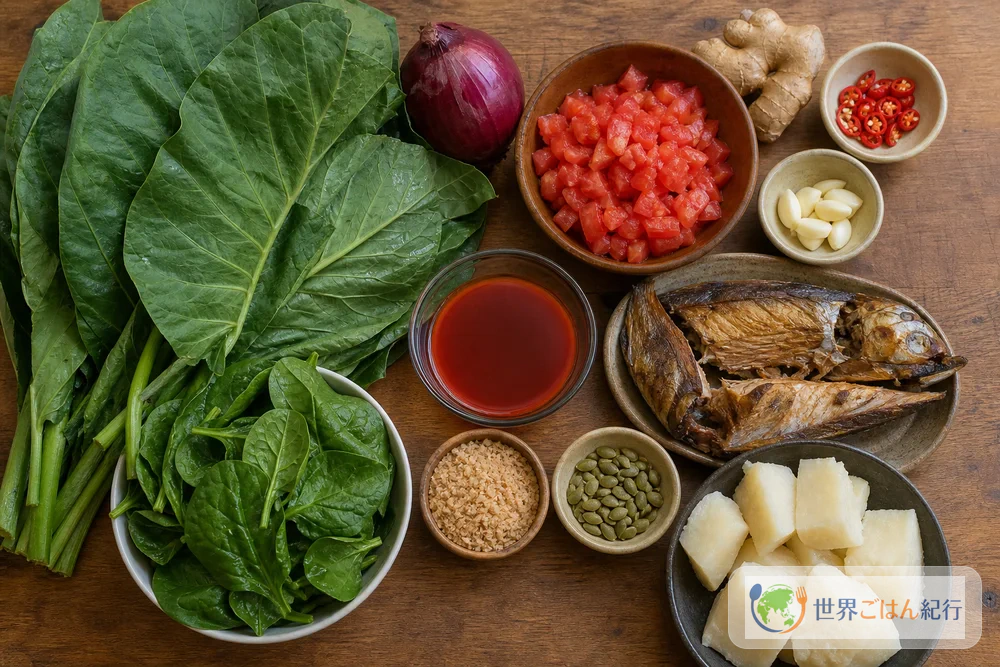
The stew itself serves 4. Serve it with yam, plantain, rice, fufu or banku and you have the Ghanaian pairing of a staple and a stew. If you use cocoyam leaves, be sure to choose ones sold as food.
Do not use cocoyam or taro leaves raw; parboil them and then cook them thoroughly in the stew. Do not use leaves whose kind or variety you do not know, or ones that leave an irritation in the mouth when eaten. Dried shrimp, smoked fish and pumpkin seeds involve crustacean, fish and seed allergens, so check the ingredient labels.
Red palm oil, the axis of the aroma
Red palm oil is not an oil you increase for health, but an ingredient that sets a West African aroma and color between the tomato and the leaves. The first time, keep to 60 ml, and if it does not suit you, replace part of it with rice bran oil. It is worth choosing a product with an edible label whose ingredients and contents you can confirm. On days when you are not buying it to reproduce the aroma, you can make it with regular oil and pass on it, and the dish still holds together.
Method
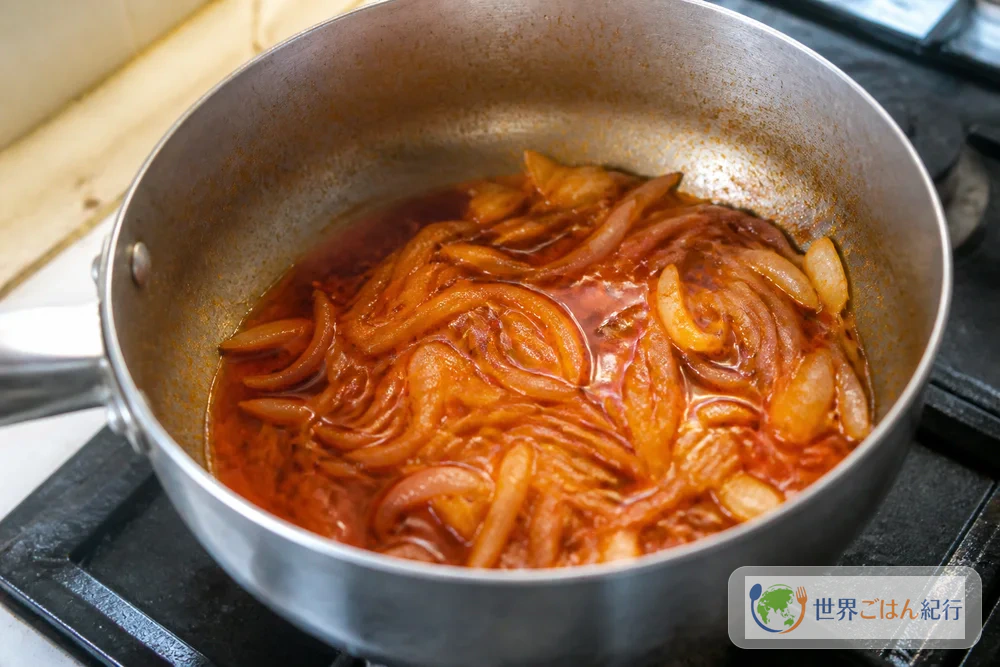
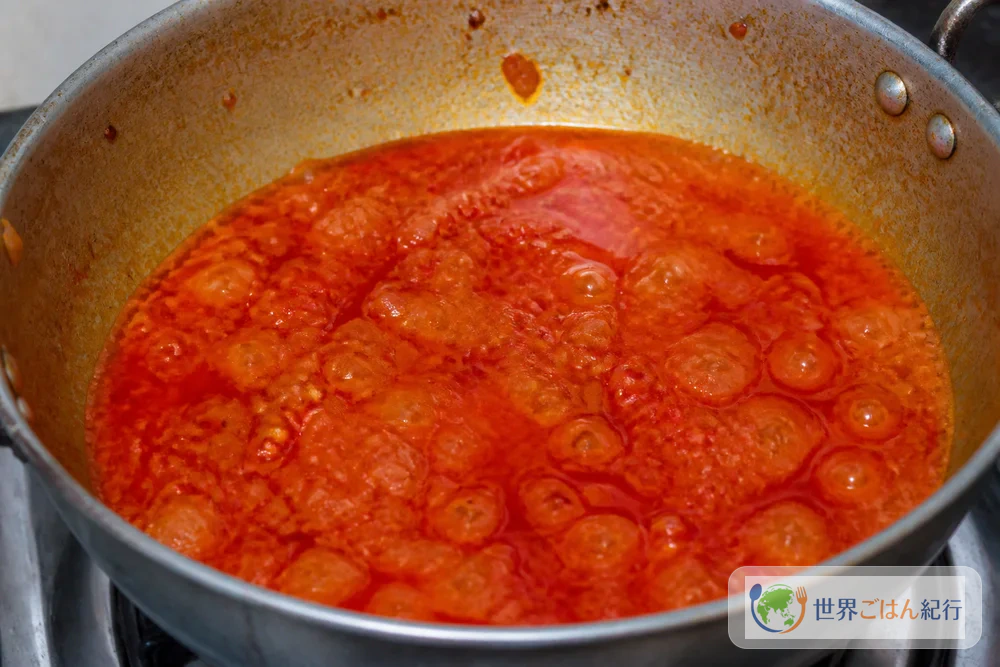
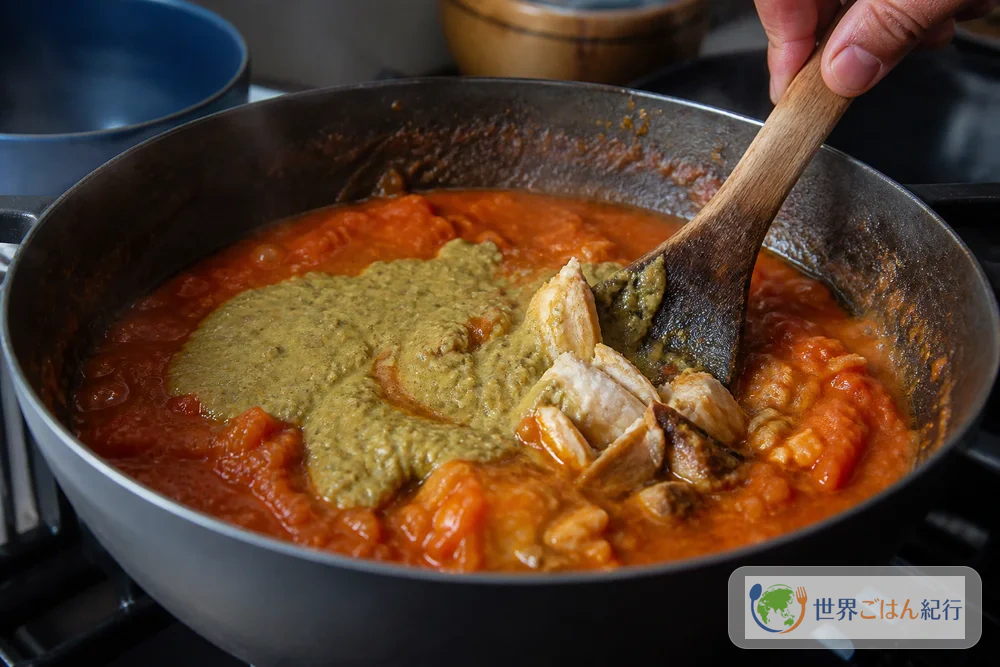
Layer the pot in this order: leaf prep, aromatic paste, oil, tomato, seeds and fish, leaves. If you cook off the water from the tomato first, the stew keeps its thickness after the leaves go in.
Adjusting by the thickness that stays on the spoon
Even only 8 g of dried shrimp sets the umami of the sea between the leaves and the tomato. If you can seldom find the powder nearby and will keep making stews and soups, it is worth buying. Check whether it is uncolored, the contents and the ingredient label. If you avoid crustaceans, or are trying this only once, you can make it with smoked fish alone and pass on this product.
Kontomire changes in ease of eating depending on when you stop the pot. If it stays very liquid, it runs off when set on the staple, and only the aroma of the leaves remains. If you cook it down too far, the saltiness of the red palm oil and dried shrimp comes forward.
If it is watery, remove the lid and cook for 5–8 minutes over low heat. Driving it off quickly over high heat easily scorches the bottom, so drag across the bottom and watch how it closes back. If it gets too thick, add hot water 1 tbsp at a time, stir, and cook 30 seconds before judging. Adding a lot of cold water at once separates the oil and tends to turn the seed paste to grains.
If after parboiling the leaves they still leave an irritation in the mouth, make the tongue sting, or give a bitter unpleasantness different from earthiness, do not hide it with spices or sugar; stop eating. The state of cocoyam leaves changes with type and preparation, so the safe order is to check the taste with spinach and Swiss chard the first time, and then move on to leaves with edible labeling.
If the tomato base tastes too acidic, cook it 3–5 minutes longer over low heat before adding the leaves. If it gets too salty after adding fish and dried shrimp, rather than adding leaves or unsalted tomato in small amounts, adjust the strength of each bite with boiled yam or rice and the outline of the dish is kept.
If the red palm oil trembles quietly on the bottom of the pot and the onion turns translucent, the heat is low. If the bubbles of the tomato base jump high, the heat is too strong. After the leaves go in, keep a heat where only the center of the pot bubbles gently.
Choosing when you swap the leaves
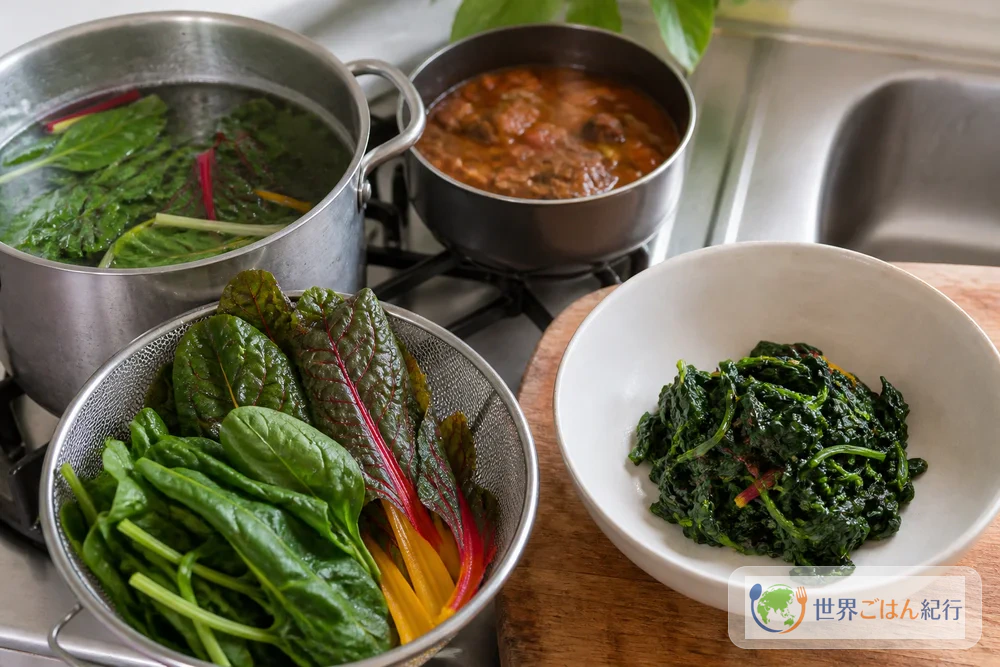
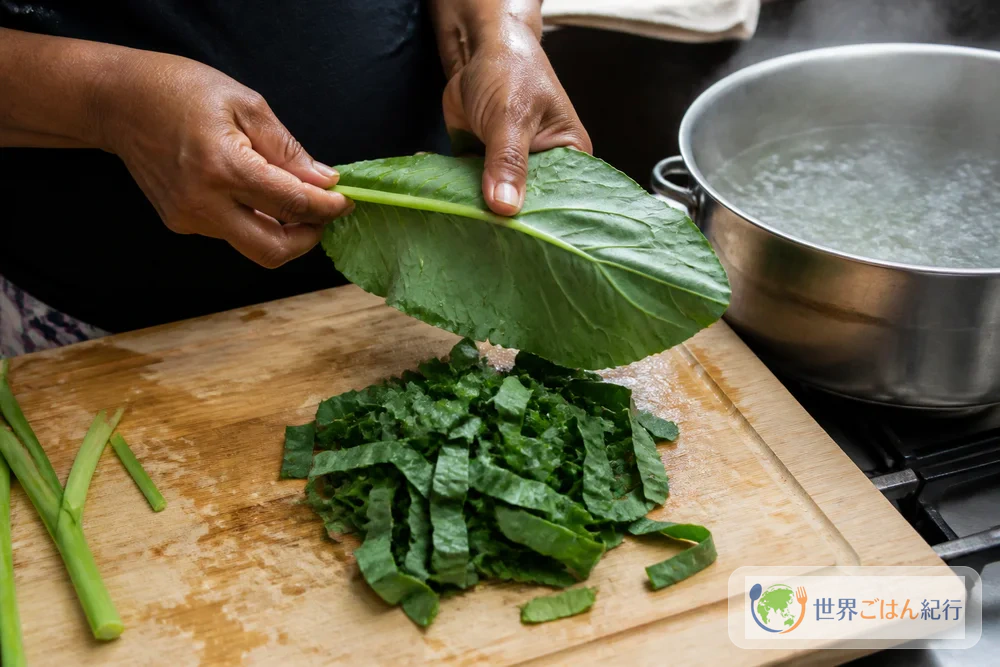
If you choose the substitute for cocoyam leaves by "the body that holds the broth" rather than the taste of the leaf, you do not go wrong. Spinach alone gets too soft, so mix in Swiss chard, which has stalks. If you use komatsuna (Japanese mustard spinach), separate leaves and stalks and parboil the stalks 30 seconds longer first.
| Leaf | Result | Preparation | Suited to |
|---|---|---|---|
| Edible cocoyam leaves | Earthy aroma and a solid presence of leaf | Remove the central rib, parboil 5 minutes, then cook further in the stew | Those who want to try the local ingredient |
| Spinach plus Swiss chard | Lighter green flavor, with both leaf and stalk body | Parboil 30–60 seconds and squeeze out the water | Those who do not want to fail the first pot |
| Komatsuna plus spinach | Less bitterness, with a slightly thinner broth | Cut the stalks small and parboil separately from the leaves | Those cooking only with what the local supermarket carries |
Replacing red palm oil with rice bran oil alone calms the color and lightens the aroma. On days when you want to see the taste of the leaves and fish first, that is fine. Conversely, if you will buy just one ingredient to make a Ghanaian-style plate, choose red palm oil, which is easier to find than the leaves, and start with spinach and Swiss chard for the greens, and you are less likely to waste money.
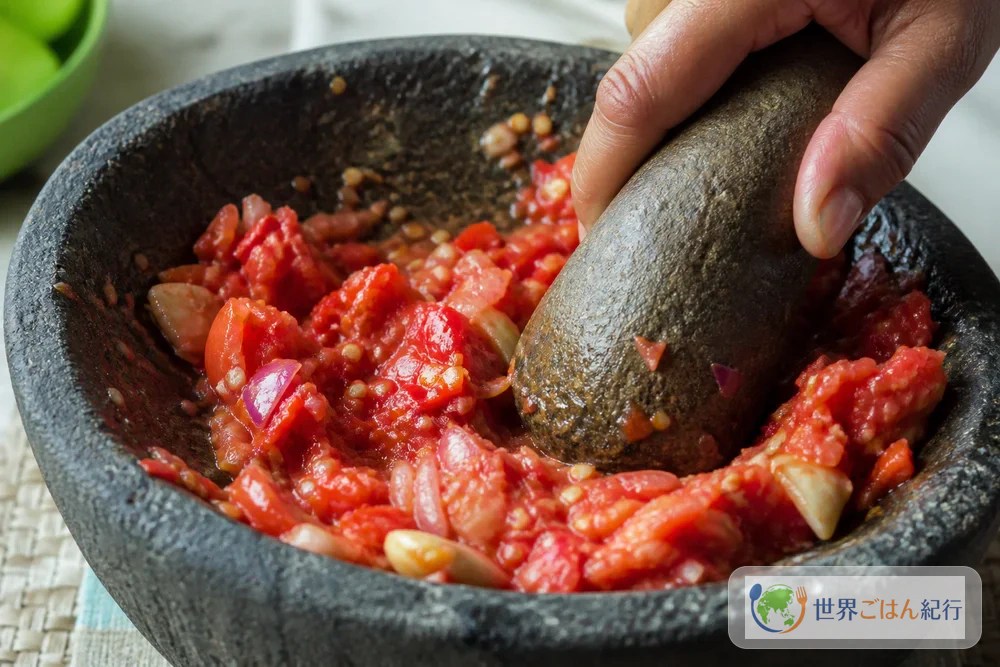
Crushing the aromatics in a mortar gives a coarse grain while keeping the tomato's water. If you also make shito and other leafy soups, a dedicated tool makes sense, but for this once, chopping with a knife and running a blender in 10-second bursts is enough. Check the granite material, what the mortar and pestle set includes, and the weight.
At a Ghanaian table, the staple is the vessel for the stew
The food culture explanation of the Ghana National Commission on Culture organizes dishes as a combination of "a starchy staple, a sauce or soup, and protein." The staple served with kontomire is not limited to one: ampesi, yam, plantain, fufu, banku, rice and others are chosen by the way of eating in each region or household.
If you try it on a plate away from Ghana, begin with boiled taro or yam. A fluffy staple catches the thick broth of leaves and seeds, and the sweetness of plantain rounds off the edge of the chili. With rice, spoon the broth over a little at a time; with fufu or banku, coat small torn pieces of dough with the stew.
Among other Ghanaian dishes, fufu is a soft staple that carries soup, waakye (in Japanese) is a plate of beans and rice with layered accompaniments, and red red is a bean stew served with gari or plantain. Kontomire puts the aroma of leaves and the umami of seafood in front, and you can change the texture by changing the staple.
Storage and reheating
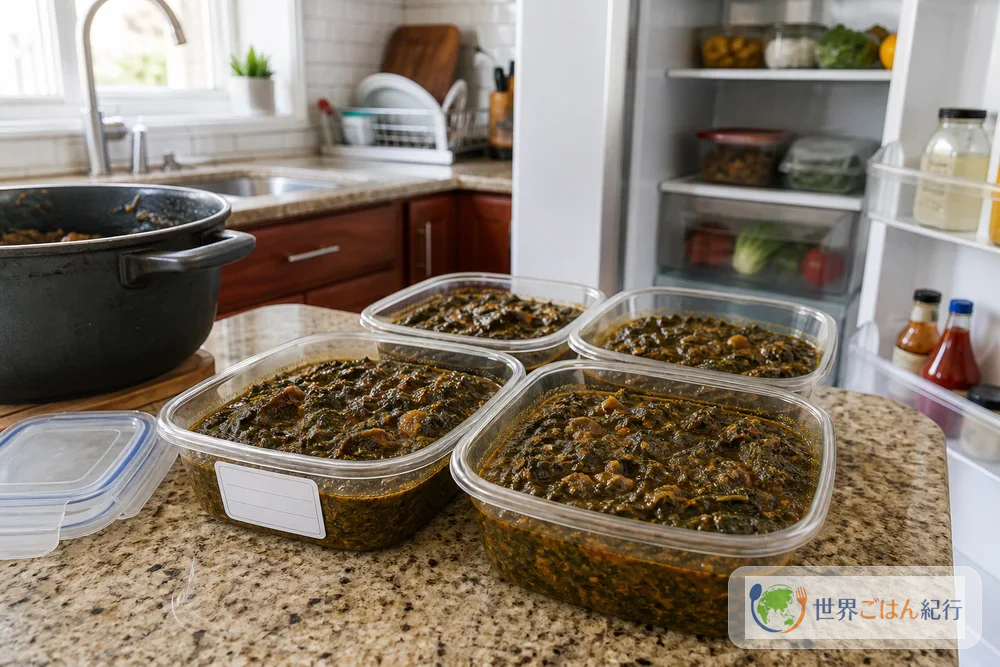
Because it contains fish and leafy greens, do not leave the pot at room temperature after eating. Rather than waiting for the heat to go off in the big pot, divide it into clean shallow containers one portion at a time and move them to the refrigerator early. Japan's Ministry of Health, Labour and Welfare also advises dividing leftovers into shallow containers and cooling them quickly, and not eating anything that has sat too long or looks even slightly suspicious.
Refrigerated, finish within 3–4 days as a guide, and freeze what you will keep longer. Overseas food safety materials give the refrigerator guide for stews with vegetables and meat as 3–4 days and the freezer as 2–3 months, but it changes with the temperature of a home refrigerator and the condition of the fish, so if you put flavor first, using it within 2 days is more pleasant. Freeze in shallow containers, and rewarm from the refrigerator or in a pot rather than thawing at room temperature.
To reheat, use a small pot over low heat and add 1–2 tbsp hot water so it does not scorch. Stop when steam rises from the whole and it is hot through to the center. In a microwave, stir every 1 minute 30 seconds at 600 W and heat well through to the center. The color of the leaves fades a little, but bringing it back gently, rather than boiling hard to drive off water, keeps the fish flesh and the grains of seed.
FAQ
Is it pointless to make it if I cannot get cocoyam leaves?
No. Spinach alone is too soft, so mix in Swiss chard or komatsuna to make up the body of the leaves. The earthy aroma of cocoyam leaves will be weaker, but as long as the red palm oil, dried shrimp, smoked fish and thickness from the seeds remain, you can grasp how the stew is eaten.
If I have no agushie, can I use pumpkin seeds?
Yes. Grind raw pumpkin seeds, dissolve in the same amount of water and add. It will differ from the flavor of agushie, but you can reproduce the toasty quality of the seeds and the thickness that holds the broth. Without the seeds, it is a thin stew of fish and leaves, so reduce the water to finish.
How do we divide the heat in a family?
Halve the fresh chili, remove the seeds and put only the aroma into the pot. For those who like heat, add chopped chili or chili sauce at the table. That is easier to separate the plates of children and those who dislike heat than adding chili flakes to the whole stew afterward.
Do I need a mortar?
You do not. You can make it by chopping finely with a knife and giving the blender short bursts. A mortar keeps the grains of tomato and aromatics more easily and is for people who will also use it for shito and other West African dishes. It takes up storage space, so for this once you can do without buying it.
How long can I eat the stored stew?
Divide into shallow containers, cool quickly and refrigerate, and finish it within 3–4 days. If there is an off smell, stickiness or any change in color, or you are uneasy because it sat long at room temperature, discard it without tasting to check. If you freeze, divide into single portions and heat through to the center when reheating.
The nutrition values are an estimate per serving of the stew itself and do not include accompaniments such as yam, plantain, rice or fufu. The numbers change with differences in dried shrimp, smoked fish and red palm oil products.
Sources
- Ghana Ministry of Tourism, Culture and Creative Arts: Culture: on Ghanaian staples, soups, fish, southern crops and chop bars. Accessed and checked: 2026-08-17
- National Commission on Culture: The Ghanaian Kitchen: on differences in dishes by region, season and occasion, and the structure of staple, sauce and protein. Accessed and checked: 2026-08-17
- National Commission on Culture: Regional Representation and Diversity: on regional staples, ampesi, cocoyam and differences in soups. Accessed and checked: 2026-08-17
- Visit Ghana: The People of Kwahu: on Kwahu's crops, cocoyam, ampesi and leafy soups. Accessed and checked: 2026-08-17
- My African Food Map: Ghana - Kontomire: on examples of dishes using cocoyam leaves, spinach, smoked fish, dried shrimp and egusi, and ingredients of the eastern region. Accessed and checked: 2026-08-17
- PubMed: The effect of soaking and cooking on the oxalate content of taro leaves: on changes in soluble oxalate with soaking and heating of taro leaves. Accessed and checked: 2026-08-17
- Ministry of Health, Labour and Welfare (Japan): Preventing food poisoning at home: on heating food, dividing it for storage, reheating and discarding when anything is wrong. Accessed and checked: 2026-08-17
- FoodSafety.gov: Cold Food Storage Chart: on general refrigerator and freezer guides for stews and leftovers. Accessed and checked: 2026-08-17