
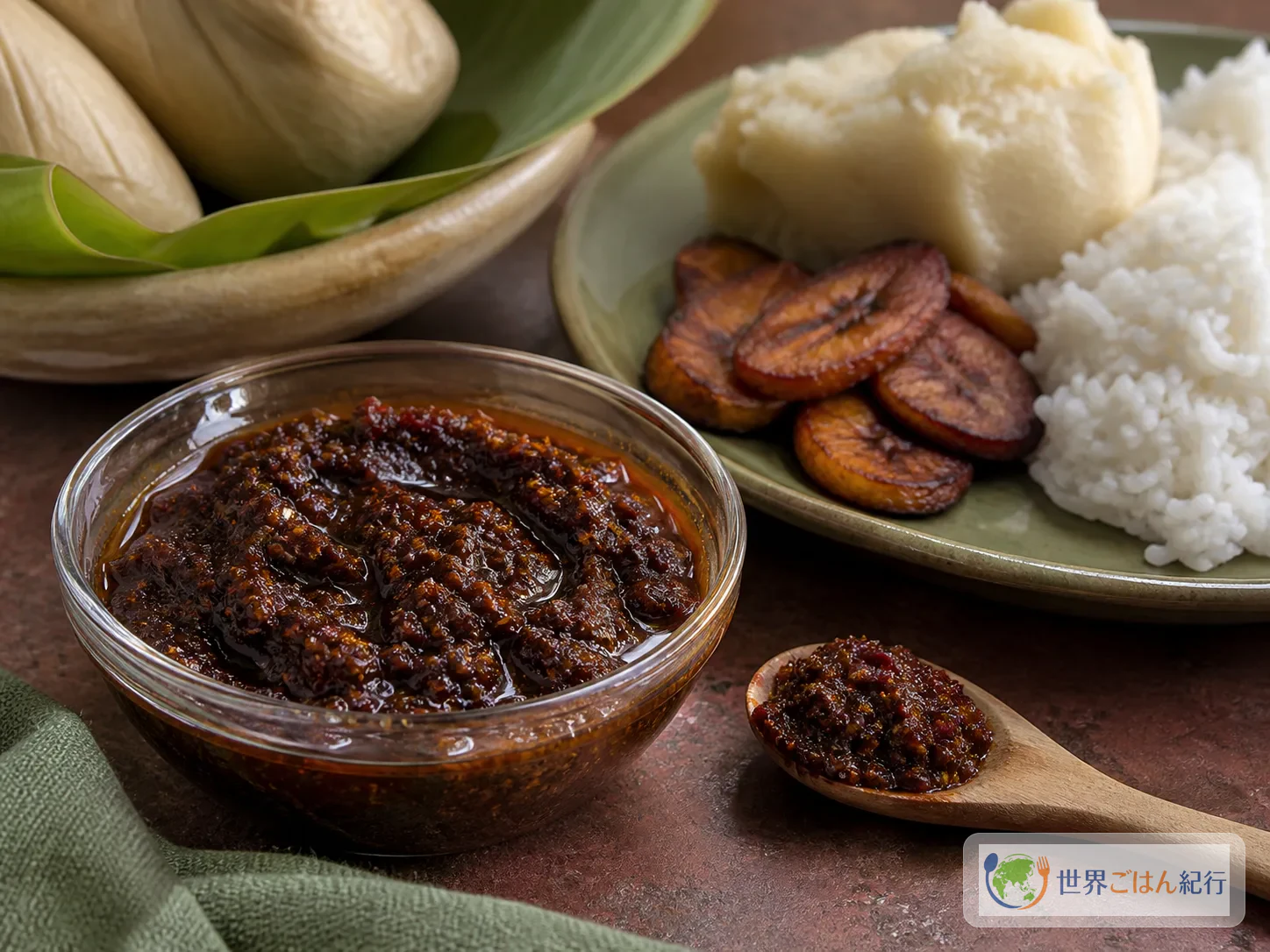
A spoonful of black sauce on white rice
In the skillet, the dried chilies and shrimp give off their aroma first.
Fry the onion and tomato paste in oil, add the red powder and the seafood powder, and the bright color of the pan slowly deepens.
Ghana's shito is not a sauce that only adds heat.
Set beside rice, beans, fried plantain, fish, or a staple made from kneaded flour, it carries the savor of dried seafood, the heat of chili, and the roundness of oil in a single spoonful.
The first time you make it, hearing "cook it down until it turns black," you worry about burning it.
But the black is not only burning.
The black color is not burning; it is the color of moisture driven off while the oil and aroma remain.
Add no fresh tomato, drive the moisture off over low heat, and wait until the oil returns to the surface.
If you keep this order, even a hot sauce does not turn flat.
This blend is a home version that substitutes ingredients available outside Ghana for shito, which varies by region and household in Ghana.
It centers on dried shrimp, and smoked dried fish is added only if you want a smoky aroma.
You can also change the amount of chili to suit who you are serving and how much heat they like.
What shito does on the Ghanaian table
Ghanaian cooking has a way of eating that does not end with putting only a staple on the plate.
The Ghana Ministry of Tourism, Culture and Creative Arts' introduction to food culture describes a meal as combining a staple with a soup or stew and a protein side.
In the south cassava, plantain, maize, and rice support the table, and in the north grains such as millet and sorghum are also important.
Next to that large plate, shito does not replace the stew that stars; it becomes a small condiment for the eater to add heat and savor.
With waakye, the rice and bean dish, shito is served along with egg, fish, and gari.
It also suits staples that catch the sauce, such as banku and kenkey.
A little on fried plantain or grilled fish changes how the sweetness and toastiness show, even with the same sauce.
Rather than remembering Ghanaian cooking as a finished single plate, thinking of it as putting a staple down, adding a stew or fish, and deciding the final strength with shito shows the freedom of the table.
A producer of Ghanaian shito explains that the name shito comes from the Ga word for "pepper," spoken around the Ghanaian capital.
However, it is not a dish whose blend is fixed to one recipe.
In cultural materials and cooking records, dried chilies, onion, garlic, ginger, tomato paste, oil, dried shrimp, and dried fish overlap, and the combination of seafood and spices changes by region and household.
So what matters in a shito for outside Ghana is not gathering every unusual ingredient.
It is using dry ingredients, adding no water, and slowly connecting the aroma in the oil.
Three outlines to keep in a home kitchen
1. Use tomato paste, not fresh tomato
Fresh tomatoes are a delicious ingredient, but in shito they add water.
If you simmer with oil while it is still very wet, only the surface gets hot and the center is slow to dry.
This time we use tomato paste.
It adds acidity and color while letting you cook down with little water.
If you have only fresh tomatoes, fry 150 g finely chopped on their own first, driving off moisture until the track of a spatula does not close at once, and then use them.
Even so, the time to finish extends by about 15 to 20 minutes, so for the first time paste is easier to judge.
2. Crush the dried shrimp and chilies separately
If you make the dried shrimp a complete powder, the savor spreads, but the toasty small grains disappear.
If the chilies are too fine, only the heat may come first.
Coarse powder for the dried shrimp and fine powder for the chilies leaves a wave of aroma in each bite.
Ghanaian cooking records also include a step of grinding the dried seafood separately to keep texture.
If you use a blender, add no water and run it in short 1-second pulses.
3. Watch the oil and bubbles, not the blackness
Turning up the heat blackens it faster, but the onion and seafood scorch from the bottom of the pot.
What to watch is not just color.
At the start of cooking, large bubbles continue and the whole mass shakes in the oil.
Simmered down over low heat, the bubbles get smaller, and a line traced across the bottom of the pot with a wooden spoon stays for a moment.
At the end the oil returns thinly to the surface, and the color changes from reddish brown to dark brown.
Turn off the heat in this state and wait for the color to deepen a notch from residual heat.
Ingredients (about 8 portions)
This is an amount that serves 1 to 2 tbsp per portion.
Shito is used in small amounts, so think of it not as 8 servings but as enough for 8 meals.
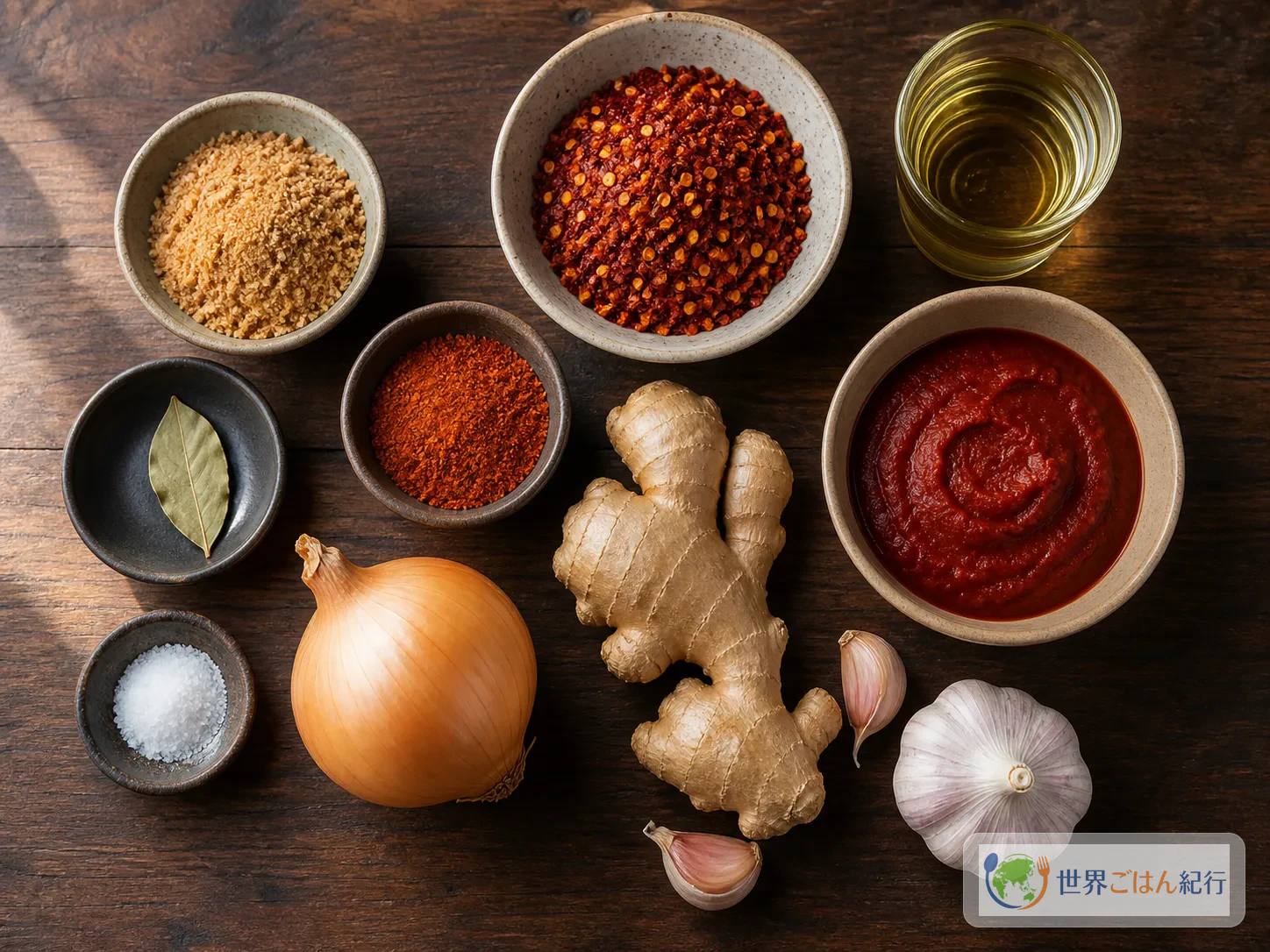
In place of dried shrimp, people who do not eat seafood can use 15 g of dried shiitake powder.
But this does not reproduce the seafood flavor of shito; it is a substitute that changes the direction of the savor.
If you have a crustacean allergy, check not only the product label but also the labeling about the shared production line.
Two ingredients that cause hesitation when shopping
Onion and oil, which you can get at the neighborhood supermarket, don't need special attention.
What is worth seeking out are the dried shrimp that decide the sauce's flavor, and a tool that lets you control how the grains remain.
Dried shrimp are for those who want to add the savor of seafood in one go
With dried shrimp, rather than a hot oil of chili alone, you get depth when it is paired with rice or beans.
Products with large dried shrimp take more effort to break up in prep, but tend to keep the aroma well.
Don't fix on price or stock; check that the ingredient label has no seasoning other than shrimp, and that the net weight allows you to make this recipe's 35 g.
People who dislike the smell of shrimp, or have a crustacean allergy, should not buy it and are safer going to the dried shiitake substitute.
A stone mortar is for those who want to keep grains
Shito can also be eaten as a smooth paste, but leaving small grains of dried shrimp and chilies increases the places where the aroma rises in the oil.
A stone mortar takes longer than a food processor.
In exchange, powder and coarse grains are easy to tell apart in the same vessel, and it keeps you from over-grinding.
The criteria for choosing are a size wide enough to crush dried chilies and dried shrimp separately, and a pestle included.
If you already have a small grinder and a smooth shito is fine, feel free to pass.
Check the granite material, the inner diameter of the mortar, and whether the pestle is included in the set.
Method
Step 1: Drive the moisture out of the dried ingredients (20–30 min)
Spread 30 g of dried red chilies and 35 g of dried shrimp on separate heatproof plates.
In an oven that can be set to 100°C, the guide is 20 to 30 minutes for the shrimp and 15 to 20 minutes for the chilies.
This is not a step for browning, so stop before they turn black.
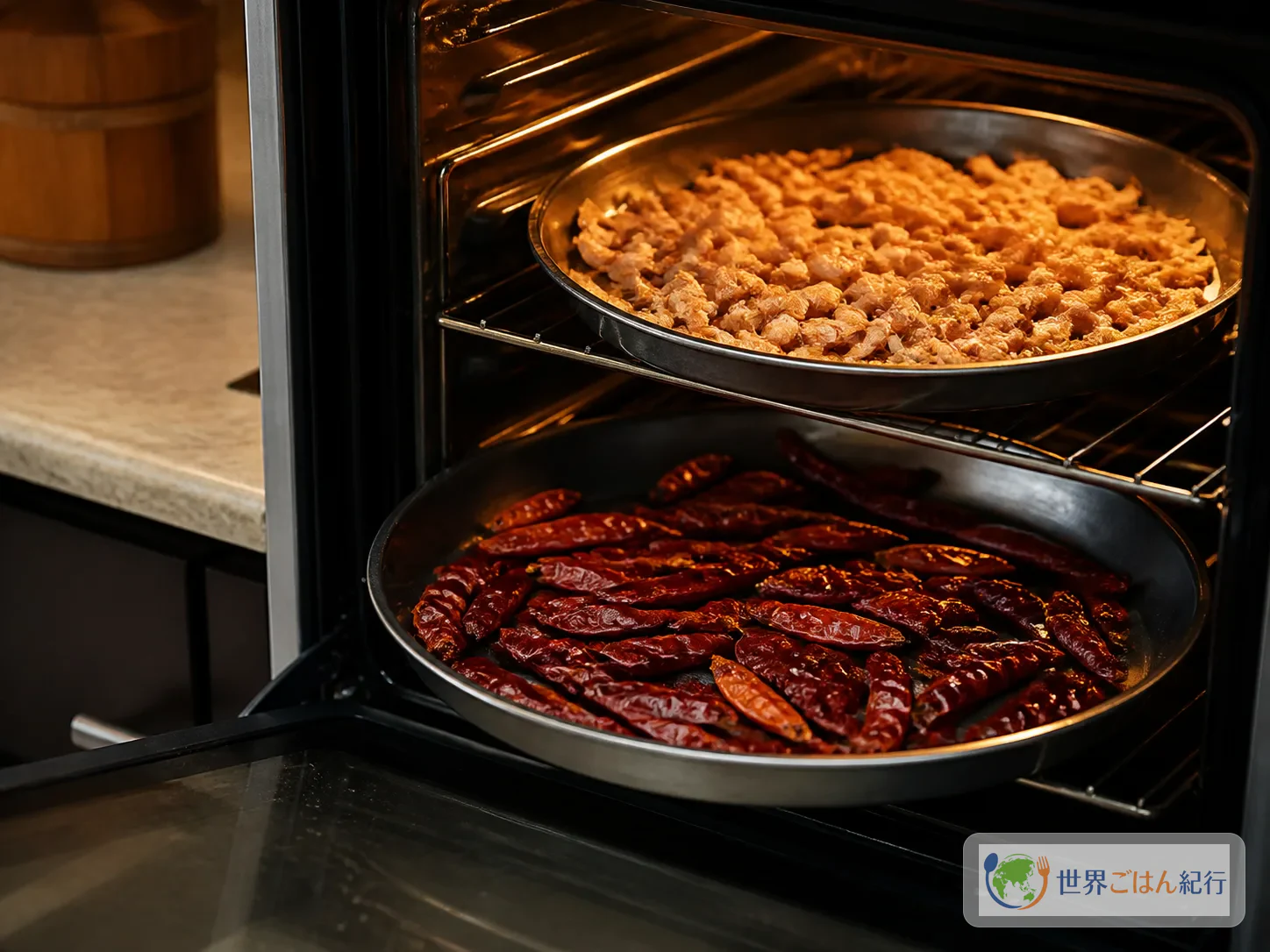
If you have no oven, set an ungreased skillet over low heat and dry the dried shrimp for about 5 minutes and the chilies about 3 minutes, separately.
Turn off the heat before the chilies smoke, and open a window.
The sting of the chilies rides the steam, so keep your face away from the pan.
Step 2: Crush the chilies and seafood separately (10 min)
Remove the stems from the dried chilies and decide how many seeds to keep.
To reduce the heat, remove only half the seeds and put the chilies in the mortar.
Don't make a complete powder; stop when grains of about 1–2 mm remain in the fine powder.
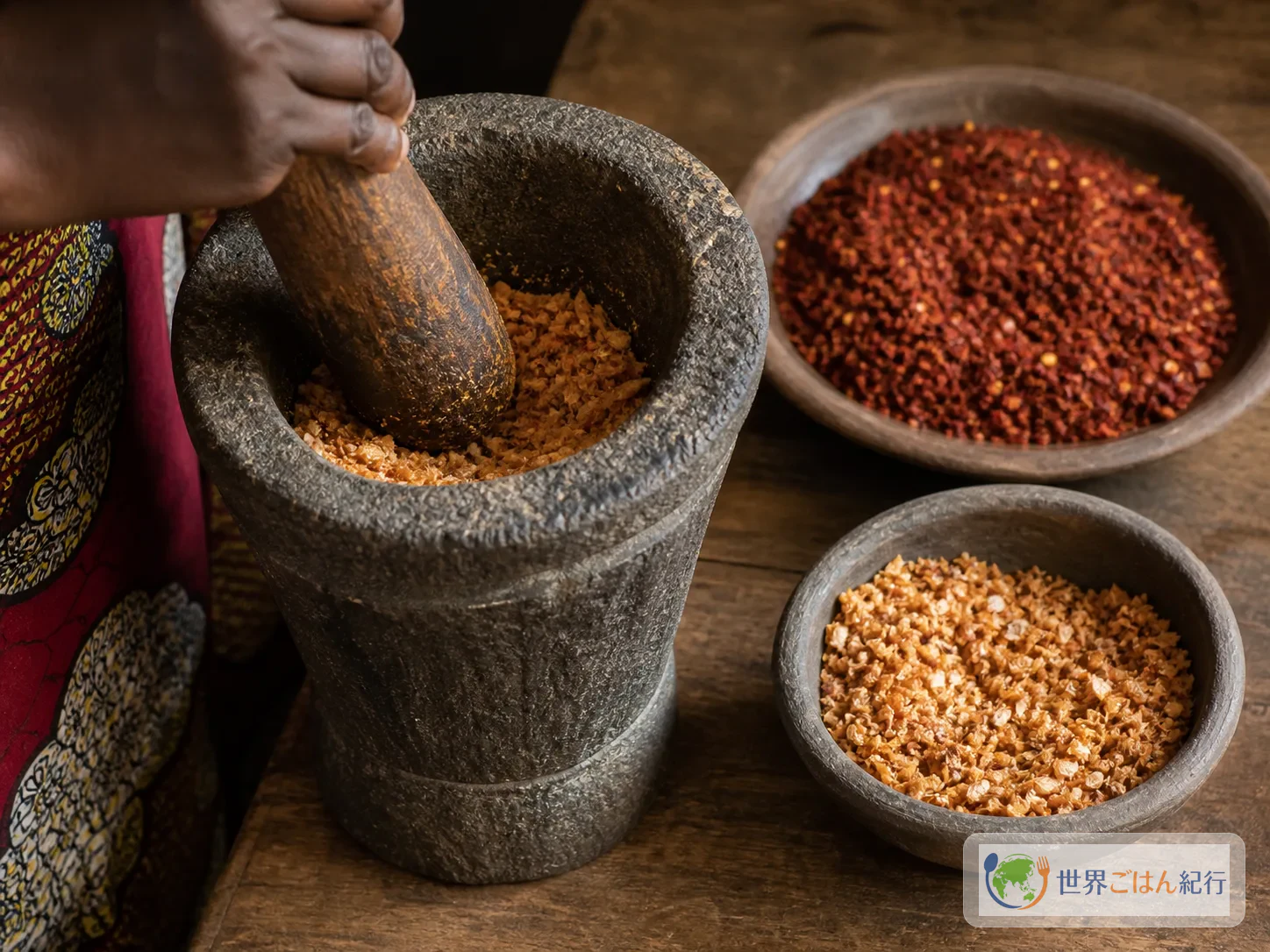
If you have no mortar, put them in a heavy storage bag and crush with a rolling pin.
If you use a blender, don't put the ingredients in all at once; run it 5 to 8 times for 1 second each.
Adding water lengthens the later cooking-down time, so even when the powder won't turn, add 1 tsp of oil, not water.
If you crush the chilies first, the heat remains in the mortar.
If you crush the dried shrimp afterward, choose a tool you can wash with detergent, and wash it with hot water and detergent after use.
Step 3: Build the onion and tomato base (20 min)
Grate 150 g of onion, and grate the 20 g of garlic and 30 g of ginger separately.
Put 250 ml of vegetable oil and the onion in a pot and sauté 10 to 12 minutes over medium-low heat.
Move on when, as you stir with a wooden spoon, no big puddle forms, the onion is translucent, and the bubbles have become fine.
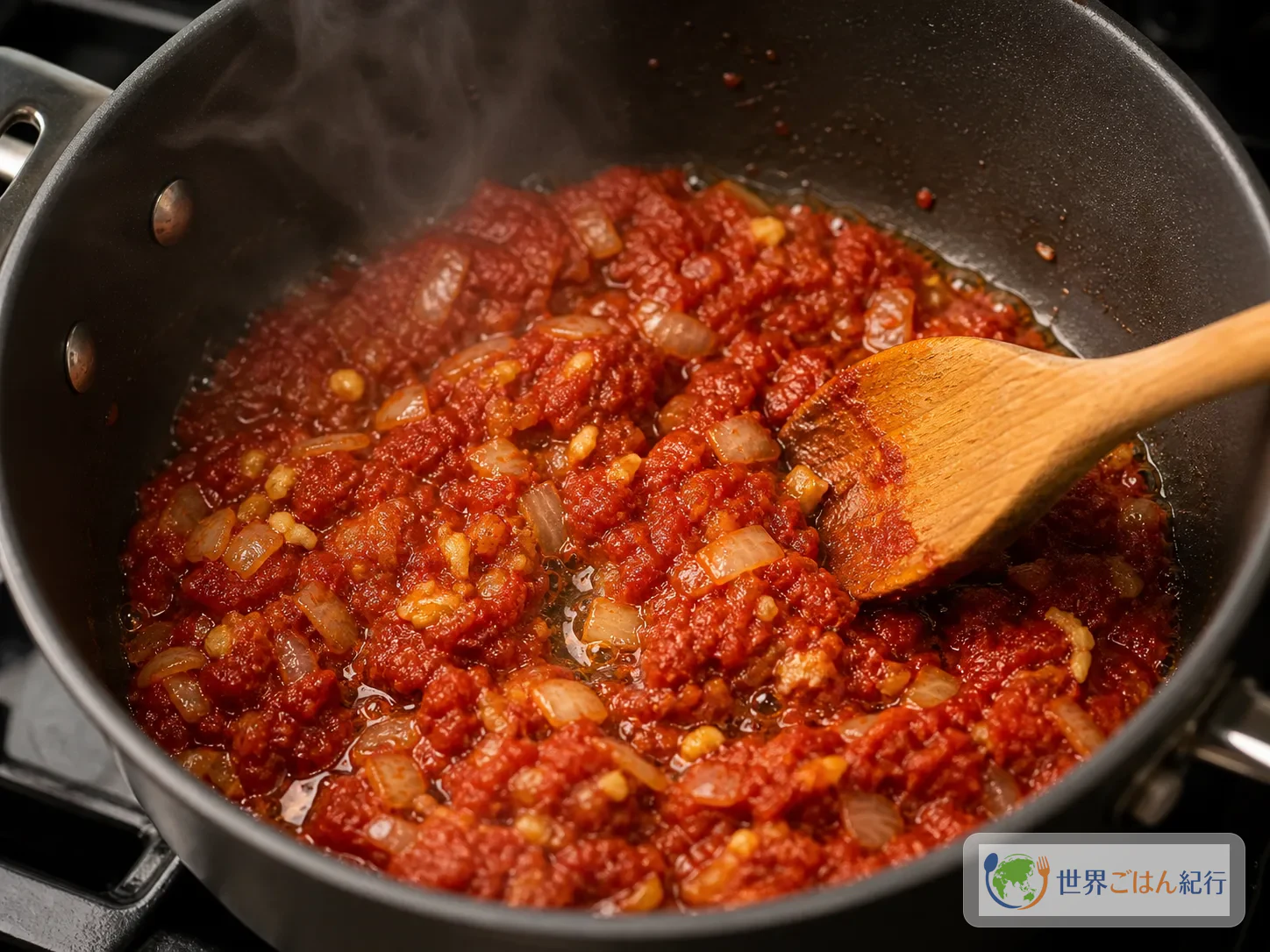
Add the garlic and ginger and sauté 2 minutes, and when the aroma rises add 100 g of tomato paste.
Sauté another 5 minutes, scraping the bottom.
When the red paste has blended into the oil and the track pressed by the spatula stays about 2 seconds, the moisture in the ingredients has dropped.
If you smell burning here, take the pot off the heat at once and transfer only the unburnt upper part to another pot.
Trying to rescue it by pouring in water makes the oil spatter and ruins the sauce's thickness.
Step 4: Add the dried chilies and seafood (5 min)
Lower the heat to low and add the crushed chilies, dried shrimp, and, if using, 20 g of smoked dried fish.
Add 1 bay leaf and 2 g of salt too, and stir the whole thing with a wooden spoon for 3 to 5 minutes.
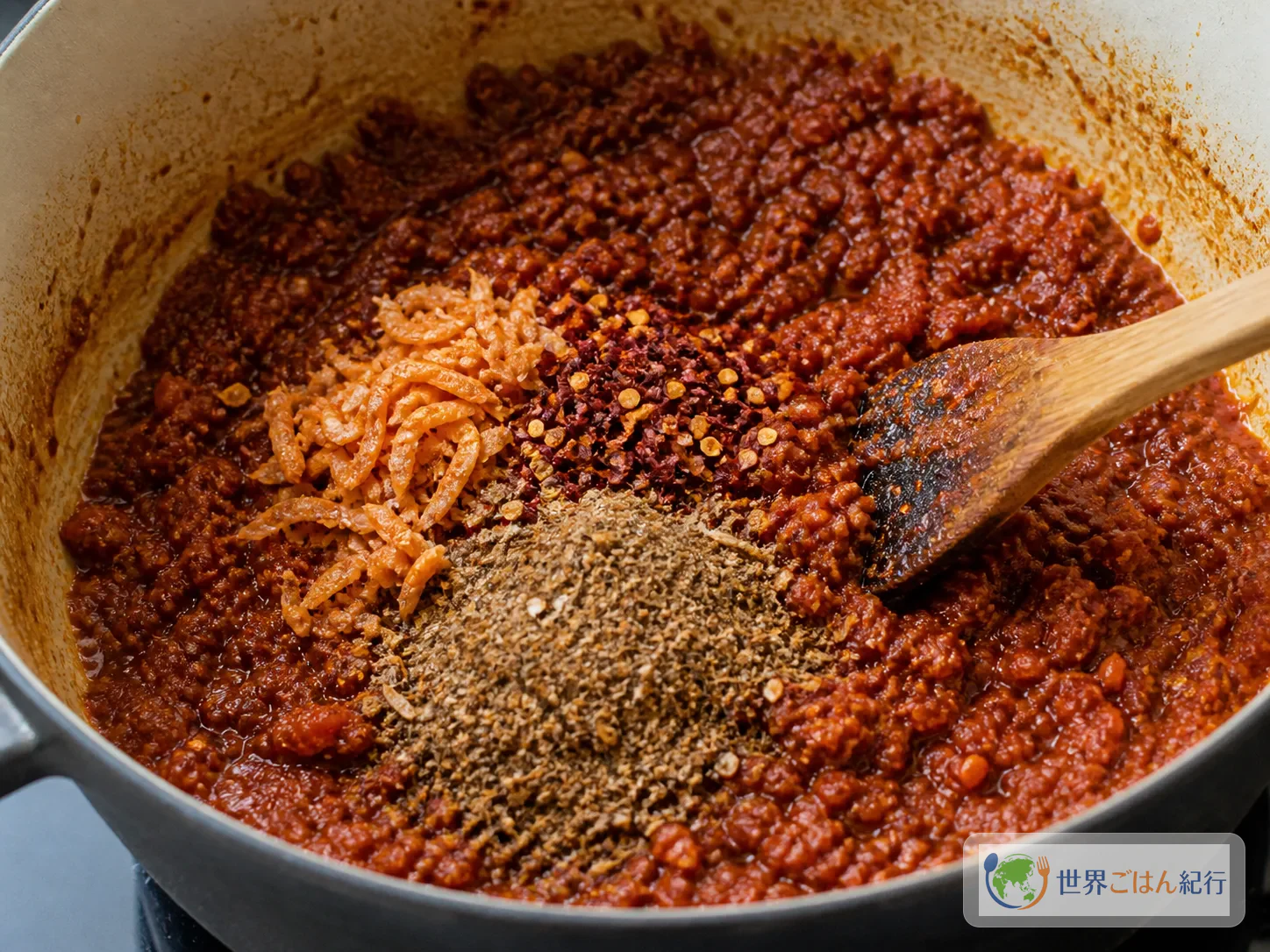
The powder soaks up the oil and gets heavy, leaving thin streaks on the bottom of the pot.
When the powdery look is gone and it has a sticky thickness, the oil and ingredients have come together.
It is fine if the color is still bright at this stage.
If the powder sticks to the bottom of the pot, the heat is too high.
Take the pot off the heat for about 10 seconds to lower the temperature, then return it to low heat.
Step 5: Drive off moisture and cook down until the oil returns (40–50 min)
Without a lid, simmer 40 to 50 minutes over low heat.
Stir every 5 minutes, turning from the bottom, and wait for the first large bubbles to get smaller.
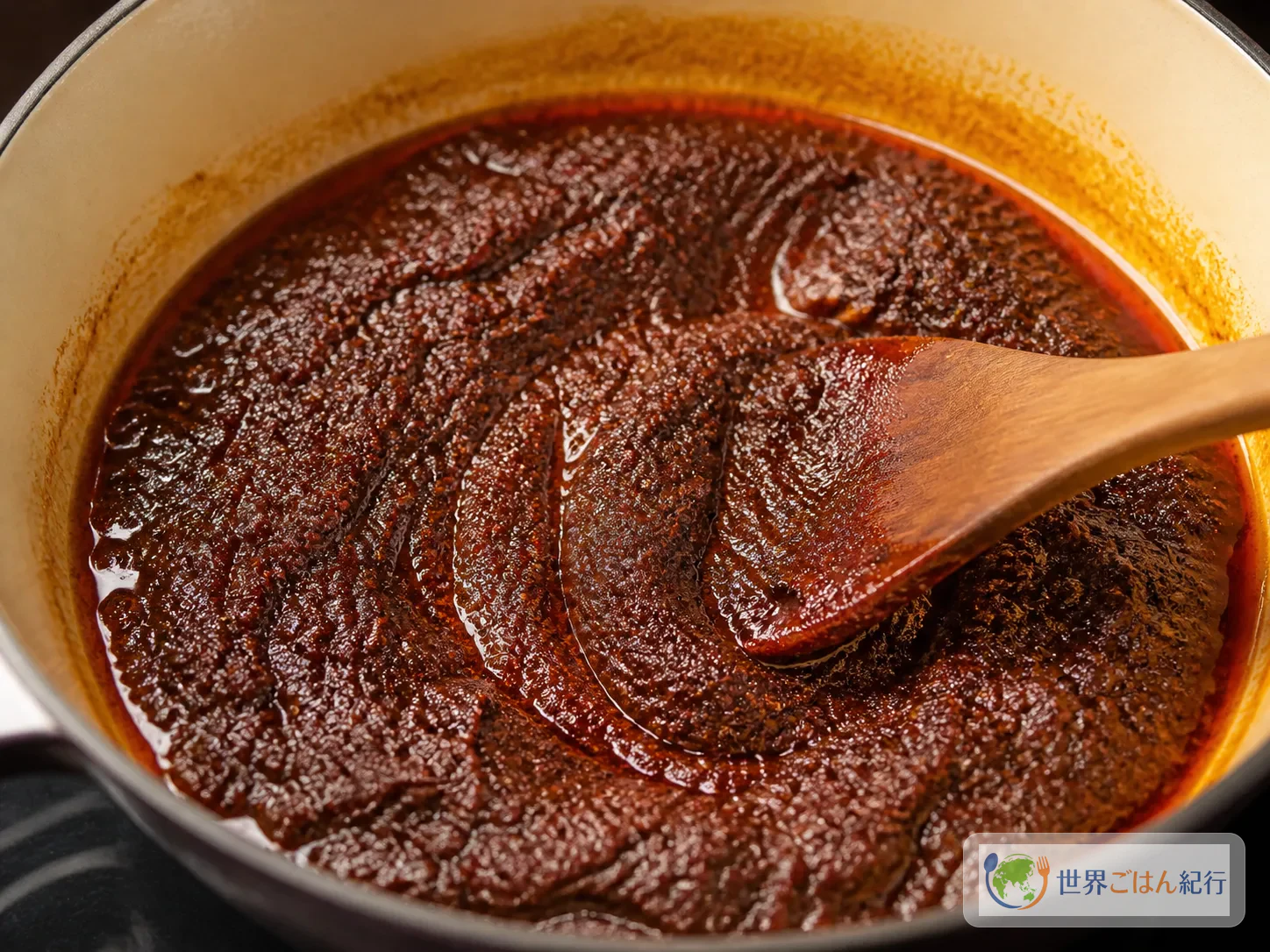
After 30 minutes the color changes from reddish brown to dark brown.
When the line traced across the bottom with a spatula stays 1 to 2 seconds, and when you tilt the sauce the oil flows thinly to the edge, it is a signal that the finish is near.
If the thickness has risen but the grains still remain hard, add just 5 minutes over low heat before turning off the heat.
If after the guide time the bubbles are still large and the sauce flows, add 5 minutes at a time, still over low heat.
Conversely, if black grains increase on the bottom of the pot or a bitter smell appears, don't extend the time; turn off the heat.
Shito continues to deepen in color from residual heat after it leaves the heat.
Step 6: Cool, then portion out (30+ min)
Remove the bay leaf and spread the shito on a shallow metal tray.
Once the heat has gone, move it to a clean, dry storage container in a shallow layer about 1 cm thick.
Dividing it into portions of 1 to 2 tbsp makes it easier to manage how much you use and to take it in and out during storage.
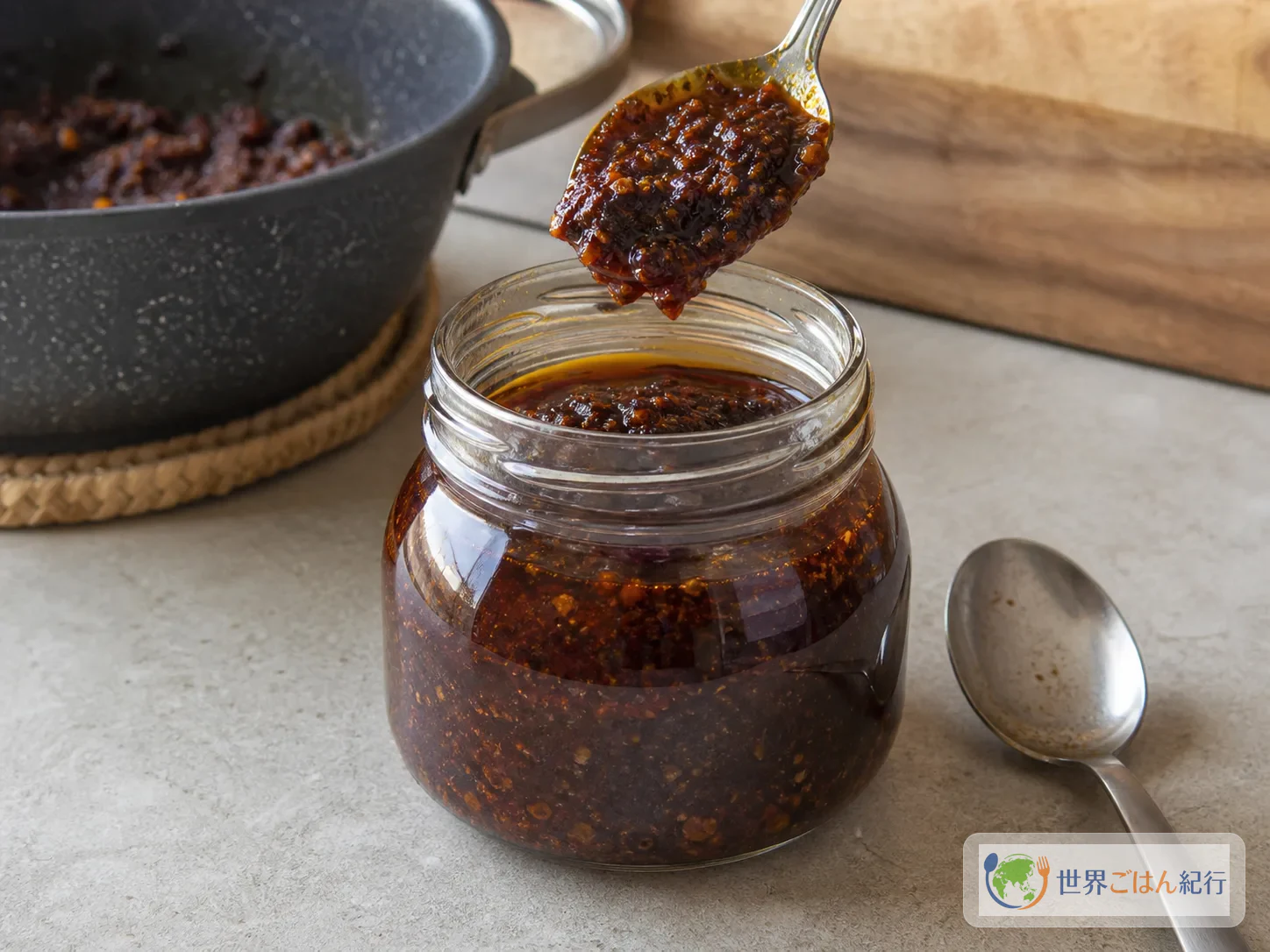
A homemade oil-based seasoning with garlic or chili cannot always be stored safely at room temperature.
Food safety guidance recommends cooling cooked food in a shallow container and refrigerating it within 2 hours.
The same approach applies to shito: once the heat has gone, put it in the refrigerator and use a clean, dry spoon.
At home, use it up within 4 days refrigerated as a guide, and freeze it in single portions if keeping it longer.
The important thing is not to keep leaving it in the large pot at room temperature before refrigerating.
Where it tends to go wrong, and how to fix by state
It won't turn black
Chasing only blackness and raising the heat scorches it from the bottom.
Look at the size of the bubbles, the spatula track, and the return of the oil rather than color.
If it is still watery after 40 minutes, check whether the lid is on, and whether the onion or fresh tomato carried too much water.
Add 5 minutes at a time over low heat, and stop before a burnt smell appears.
It's bitter
You may have burned the chilies or seafood in the drying stage.
If the bitterness is slight, move the clear upper part to another pot, add 2 tsp of oil and 10 g of tomato paste, and simmer 5 minutes.
If burnt grains are mixed throughout, don't try to hide it with sugar.
Eat less of it, and next time lower the temperature and the heat in the drying step, which is more reliable.
It's too hot
Adding water after it's finished ruins its keeping quality and thickness.
Dilute it at the table by combining it with rice, beans, boiled egg, or yogurt, or next time cut the chilies to 15 g and make up the color with 15 g of paprika.
Adding only oil to dilute the heat raises the amount taken at once, so start by serving 1 tsp.
It looks oily
In shito, the oil returning to the surface is not a failure.
But you don't have to pour all the oil onto the plate when eating.
Stir the jar lightly just before use and scoop the sauce and oil together, and it blends into the rice.
Five ways to change the heat and aroma
- Mild heat: Use 15 g of dried red chilies and 15 g of paprika. You keep the color while lowering only the heat of the chilies.
- Stronger seafood: Add 20 g of smoked dried fish to the 35 g of dried shrimp. The fish aroma gets strong, so at first serve just 1 tsp of shito with the rice.
- Enjoy the grains: Make the chilies fine and the dried shrimp a coarseness of 2–3 mm. This is the setup where using a mortar makes the most sense.
- No seafood: Leave out the dried shrimp and fish and add 15 g of dried shiitake powder. It is a different flavor from the seafood shito of Ghana, but it works as a hot oil seasoning.
- Bring the table closer to Ghana: Egg and gari with waakye, fish with banku and kenkey, and a little shito with fried plantain. If you keep the staple mild, the aroma of the sauce layers on top.
On the day you make waakye, serve shito with Ghanaian rice and beans, waakye (in Japanese), and the point of putting the sauce out is clear at once.
For a sour staple such as banku, the oil and dried seafood of shito go well.
If you use sweet plantain, set just 1 tsp beside kelewele (in Japanese) and eat sweetness and heat alternately, and you are satisfied without raising the amount.
Deciding the amount to put on the table
The first time, serve 1 tsp with 150 g of cooked rice.
Even for people used to heat, it is easier to tell the sauce apart by checking the aroma of the dried shrimp first and then increasing to 2 tsp.
Shito suits being placed at the edge of the plate more than being mixed in.
First bite just rice, second bite a little shito, third bite combined with egg or fish.
In that order, you can see not just the strength of the chili but the roundness of the oil, the aroma of the seafood, and the sweetness of the onion.
If several people are at the table, don't mix it into the whole dish from the start; serve it on a separate plate.
Those who feel the heat can decide the amount themselves, and the cook doesn't have to dilute one pot for everyone.
FAQ
Is shito black because it's burnt?
Burning is not the only reason.
The color deepens as the moisture of the onion, tomato paste, dried chilies, and seafood is driven off over low heat and the aroma moves into the oil.
If black grains, a bitter smell, or a burnt taste on the tongue appear, it was overcooked.
Can I make it with fresh tomatoes?
You can, but fry them on their own first to reduce the water.
Used as they are, the cooking-down time lengthens and the oil spatters more easily.
The first time, 100 g of tomato paste makes it easier to judge the bubbles and thickness.
Do I wash the dried shrimp before using them?
Unless the product label specifies a washing method, washing with water puts moisture back into the dry ingredient.
If you're concerned about foreign matter, check the ingredients and condition of manufacture when buying, and remove any by eye just before use.
If you did wash them, extend the drying time in Step 1 and return them to a state where the surface is not damp before crushing.
Can I store it at room temperature?
Do not assume that a homemade oil-based chili sauce can be stored at room temperature.
A combination of garlic, chili, and oil cannot be made safe without controlling acidity and heating conditions.
Let the heat go, refrigerate within about 2 hours, and use it up within 4 days.
Can't I make it without a mortar?
It isn't necessary.
A heavy storage bag and a rolling pin, or short pulses in a blender, can substitute.
But a mortar is convenient if you want to stop while watching the size of the grains.
Can I eat it with a shrimp allergy?
Avoid dried shrimp, dried fish, and commercial shito, and check the ingredient label and the shared production line label.
There is a way to switch to dried shiitake powder, but it won't be the same flavor.
If trying it for the first time, make a small amount in a separate pot to avoid it getting mixed into the family's meal by accident.
Make the first jar, or pass
Shito is not a dish where you buy lots of chilies and compete on heat.
It is a sauce for people who want to layer the aroma of dried seafood a little at a time over white rice or a plate of beans.
Choose the dried shrimp if you want to add the savor of seafood to rice, beans, and fried plantain.
Choose the mortar if you want to keep the grains of chili and shrimp over smoothness.
On the other hand, people who want to avoid crustaceans, can't take on the work of refrigerated storage, or rarely use hot condiments can pass this time.
Once you have the dry ingredients, serve just 1 tsp on your first plate.
The color deepened in the oil, and the seafood aroma that arrives late in the mouth.
Whether you need that at your table, one bite will tell you.
Sources
- Ghana Ministry of Tourism, Culture and Creative Arts: Culture (the Ghanaian table, regional staples, overview of food culture. Accessed and checked 2026-08-05 JST)
- National Commission on Culture: Ghana’s Traditional Foods and Drinks (explanation of regional food culture and its transmission. Accessed and checked 2026-08-05 JST)
- Oh Shito!: Home (a producer's explanation of the name shito, its use as a hot, savory sauce, and regional differences. Accessed and checked 2026-08-05 JST)
- Ghana Cook: Shito (the cooking sequence using dried chilies, dried shrimp, oil, and tomato paste. Accessed and checked 2026-08-05 JST)
- Cultural Survival: Ghanaian Shito (regional differences, the step of crushing dried seafood separately, the idea of driving off moisture over low heat. Accessed and checked 2026-08-05 JST)
- Ghanaian Life: How to Make Authentic Ghanaian Shito Pepper Sauce at Home (supplementary material on home ingredient ratios and the cooked-down state. Accessed and checked 2026-08-05 JST)
- Afri Food Network: Shito Black Pepper Sauce (supplementary material on pairing with Ghanaian staples, ingredients, and steps. Accessed and checked 2026-08-05 JST)
- FoodSafety.gov: Game Day Food Safety Tips (food safety guide for cooling in shallow containers and refrigerating within 2 hours. Accessed and checked 2026-08-05 JST)
- University of Minnesota Extension: Chili oil and oil-based products (the view that oil-based garlic and chili products should be refrigerated and not stored at room temperature without acidity control. Accessed and checked 2026-08-05 JST)



