
Githeri: Chewy Maize Kernels and Beans That Fall Apart Softly
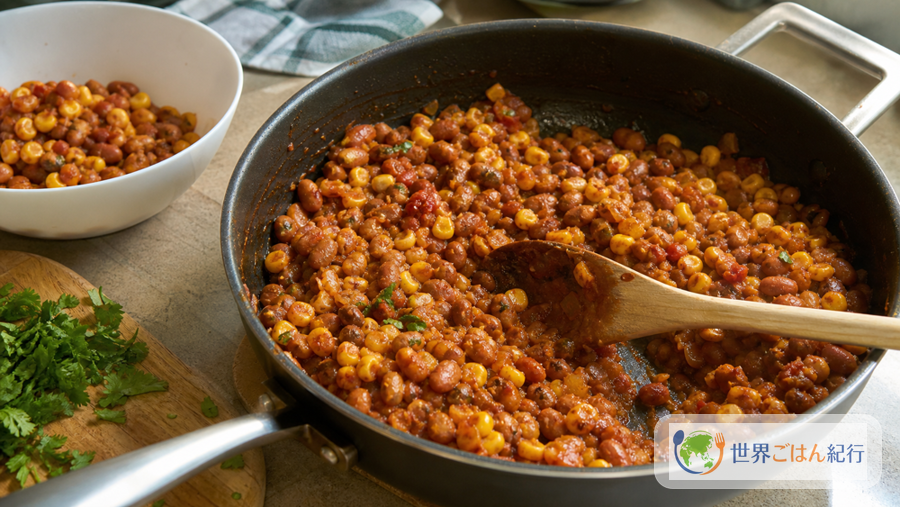
Bring the maize to a kernel you can chew and the beans to soft all the way through. Keep the tomato and spices to just enough to link the two.
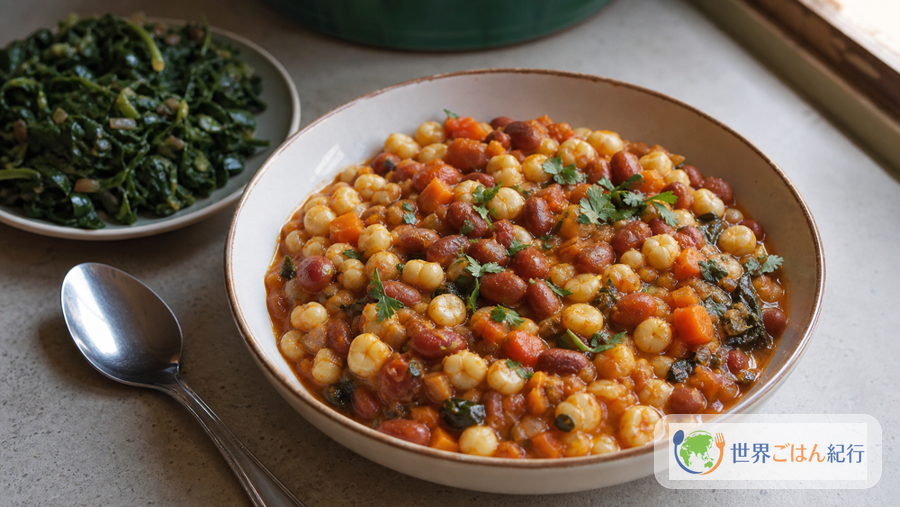
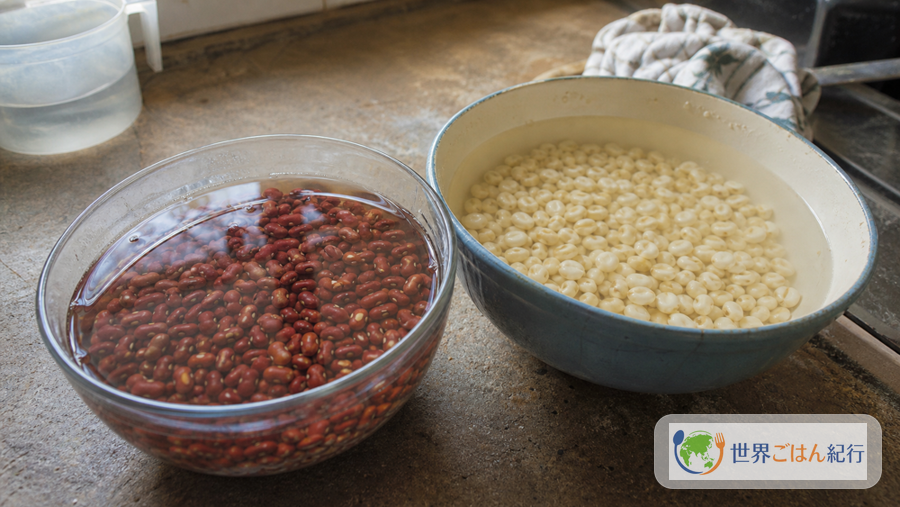
The day after soaking dried beans, the white maize kernels slowly swell in the pot and the skins of the red kidney beans gradually soften. Githeri (Gĩtheri) is a Kenyan dish in which maize and beans are cooked together.
There is a form in which the kernels are simply boiled with salt and eaten as they are, and there is a form in which onion, tomato, potato, greens and meat are added to make each household's own pot. This recipe is a dish for a home kitchen that keeps the bite of the beans and maize while coating them with the sweetness of onion and tomato and the bitterness of greens. Since this is not a dish built on strong spicing, keep the cumin and paprika to small amounts.
If you simply swap in canned sweet corn, the kernels turn soft and the flavor moves toward a different dish. It is hard to find the large-kernel maize used in Kenya every time, so on days when you want chew, choose canned hominy; on days when you have time, choose dried large-kernel maize. If you are cooking this as a side to grilled meat, connect it to nyama choma; if you want to add greens, to sukuma wiki; and if you want to extend to the coconut dishes of the coast, to kuku paka (in Japanese). Even within one country's table, the composition changes.
In English it is written Githeri, and in Kikuyu spelling Gĩtheri. Including the English spelling in a search makes it easier to find information on dried maize and the dish as made locally.
Why One Pot: Central Grains and Beans, a Home Dish Across the Country
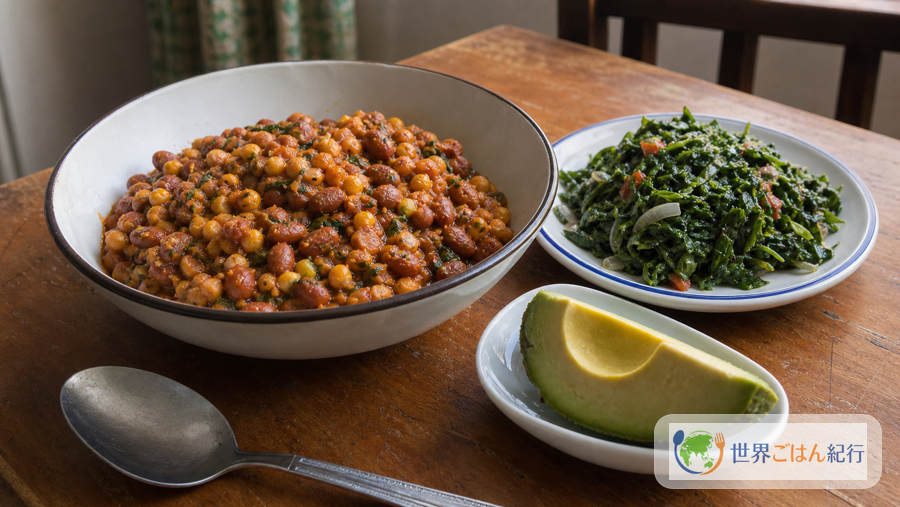
Githeri is a dish that finishes beans and maize in a single pot. Kenyan cooking does not have just one representative dish; the ingredients easily available in a region change the table. The Kenyan government's overseas missions also explain that white maize is ground into flour for ugali and porridge, and is also mixed with beans, potatoes and other vegetables to make githeri.
One clue to the outline of the dish is Githigo, a native maize line kept by the Gikuyu people of central Kenya. According to the Slow Food Foundation's record, its kernels are larger than those of common varieties, and it is described as suited to githeri. The size of the kernel is not decoration: it bears on a texture that can still be eaten together with the beans after long cooking. Rather than increasing the dried beans to make a thick bean stew, keeping a ratio in which the maize kernels remain makes it easier to grasp what githeri is.
In central and eastern Kenya, the names and finished forms widen depending on the kinds of maize and beans, whether the skins are kept, and whether potato or greens are added. If the ingredients are mashed together, you get mukimo, which has a different texture from githeri with its kernels left whole. It is also sometimes presented as a dish eaten at celebrations and family gatherings, and even with the same ingredients, the role of the plate changes depending on whether it is "boiled with the kernels left" or "mashed into one."
At present-day city tables, githeri appears not only as a home staple but also as a side at restaurants that serve traditional dishes. In a study of restaurants in Nakuru County, githeri, a dish of boiled maize and beans, was included on traditional-food menus alongside greens, mukimo and other dishes. Rather than fixing one local flavor, looking at how far greens and meat are added around beans and kernels keeps regional differences intact.
Three axes that change with each household's pot
| Axis | Range seen locally | How to decide when cooking elsewhere |
|---|---|---|
| Maize | Fresh kernels, dried kernels, large-kernel native lines, etc. | For chewy kernels, canned hominy. Sweet corn only if you want to make a sweeter dish |
| Beans | Centered on red kidney beans; kinds vary by region and household | Use dried red kidney beans, whose skins resist tearing, as the base. If canned, keep them from breaking down |
| Ingredients and texture | Onion, tomato, greens, potato, meat. Mash them and it moves toward mukimo | Start by keeping the kernels whole and add the greens last. Potato adds liquid and thickness, so it may be served from a separate pot |
In a 2014 Kenyan household survey, githeri in the surveyed households took about 1–2 hours to simmer and was recorded as a dish boiled and then fried before eating. Some households made a large amount and carried it over to the next day. That a recipe with dried beans takes time is not a failure; it is the very step of bringing beans and kernels to the same softness.
Ingredients and Substitutes: Serves 4, Deciding the Kernel Firmness First
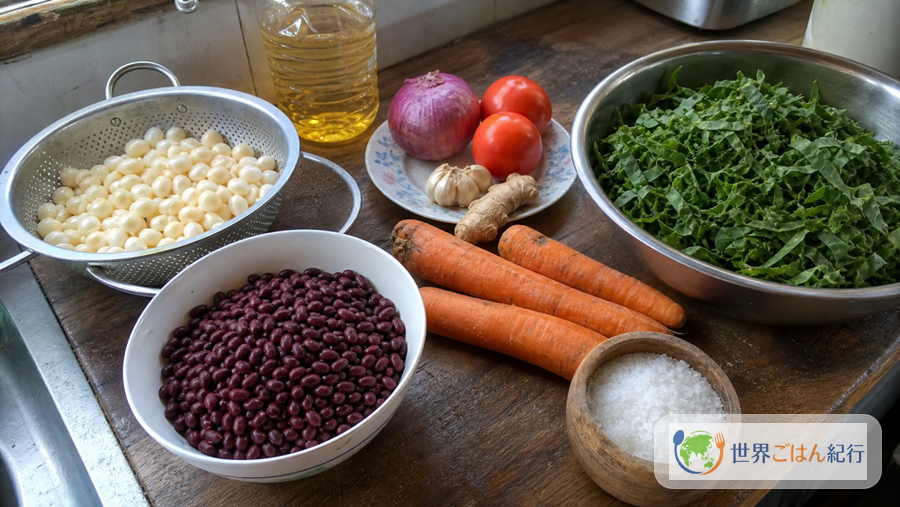
These are the basic amounts using dried large-kernel maize. Dried kernels can be hard to find, so for a first try it is fine to start with the shortcut using canned hominy. If you use dried beans and the soaking and cooking time printed on the bag is longer than in this recipe, follow the bag.
Solid content and salt differ by product among canned goods. For red kidney beans, choose ones whose ingredients are basically beans, water and salt, and use less salt at the end. For hominy, look not for sweet corn cans but for large-kernel processed maize labeled white hominy, golden hominy or mote.
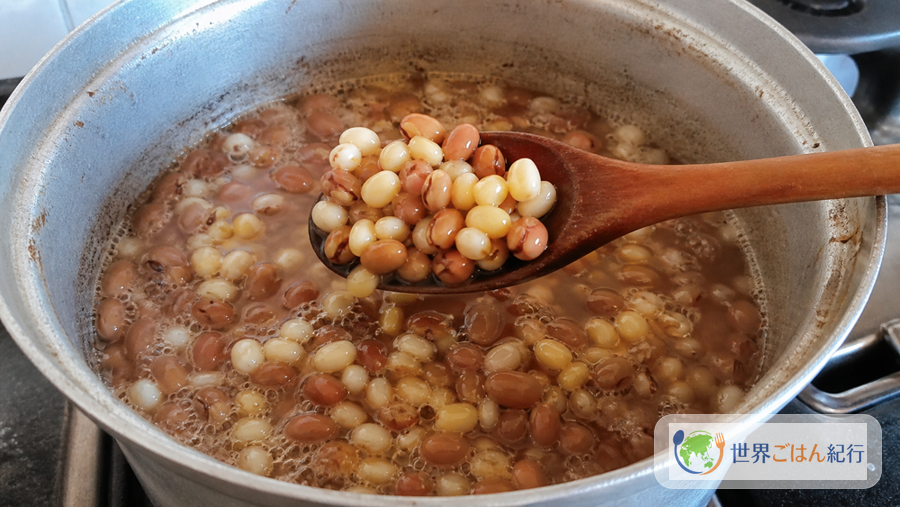
Soak dried red kidney beans for at least 5 hours, discard the soaking water, and boil them in fresh water for at least 30 minutes. Do not eat raw or undercooked beans; cook until they are soft all the way through. For canned goods, discard the liquid and rinse after opening, and heat according to the label. Check not only maize, beans and spices themselves but also the labeling for wheat, milk, soy and so on in canned and processed goods, along with any shared-facility statements.
What to Buy Extra: Hominy Is Not Sweet Corn
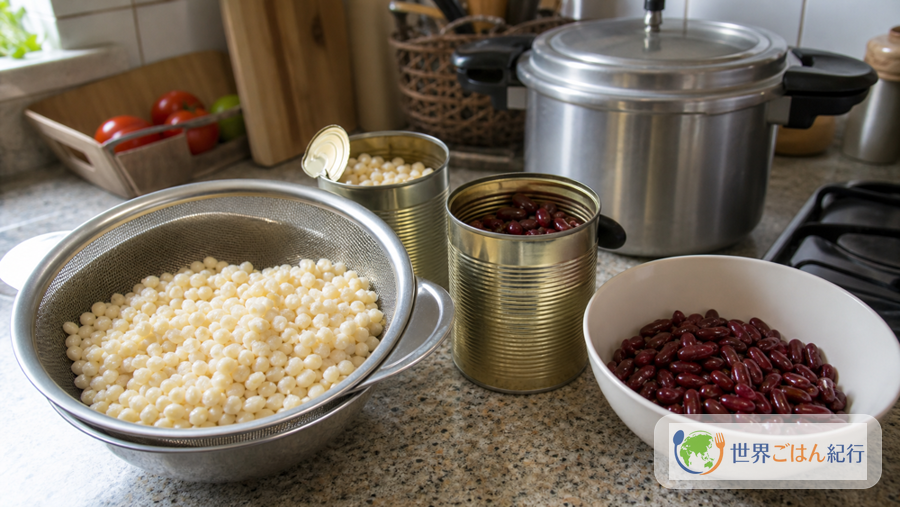
Onion, tomato, carrot and greens that you can pick up at a nearby supermarket don't need any thought about the order of buying. What is worth looking for is hominy, which keeps the white maize kernels large, and a pot that lets you cook dried beans without scorching.
If you choose maize you can chew, not canned sweet corn, the center of githeri remains even when the tomato flavor is kept light. Hominy is not Kenya's Githigo itself; it is a substitute kernel that is easy to get elsewhere. Can size, ingredients and ordering information change by product, so check them when you buy. If you will make it only once, find one can of hominy with a similar kernel at an import grocer and adjust the shortfall with beans and greens; that avoids overbuying.
Pot Size and Heat: Consider a Dedicated Pot Only If You Cook Dried Beans
If you cook dried beans several times a month, choose by depth and heat retention. On days when you shorten the process with canned hominy, or when you are only trying it once, a deep pot you already own is enough.
The dried-bean route for 4 servings uses about 1.8L of water for simmering alone. You can make it in a 22 cm pot with a brimful capacity of 3.3L, but to see the foam at a boil and the movement of the ingredients, don't fill the pot beyond four-fifths. A deep pot or heavy stainless pot you already have is fine, and for the canned-hominy shortcut an ordinary deeper saucepan is sufficient.
A thick enameled cast-iron pot holds its temperature after the heat is lowered, so it is easier to simmer beans without stirring them much. But it is heavy and costly, so it is not a tool to buy for githeri alone. It becomes more useful if you repeatedly cook dried beans, lentils and stews. If you mostly use canned goods, a pot you already own is enough.
Method: Bringing Beans and Kernels to the Same Softness
The dried-bean route starts from step 1, and the canned route starts from step 3. In either case, break open the center of a bean and the core of a maize kernel at the end to check.
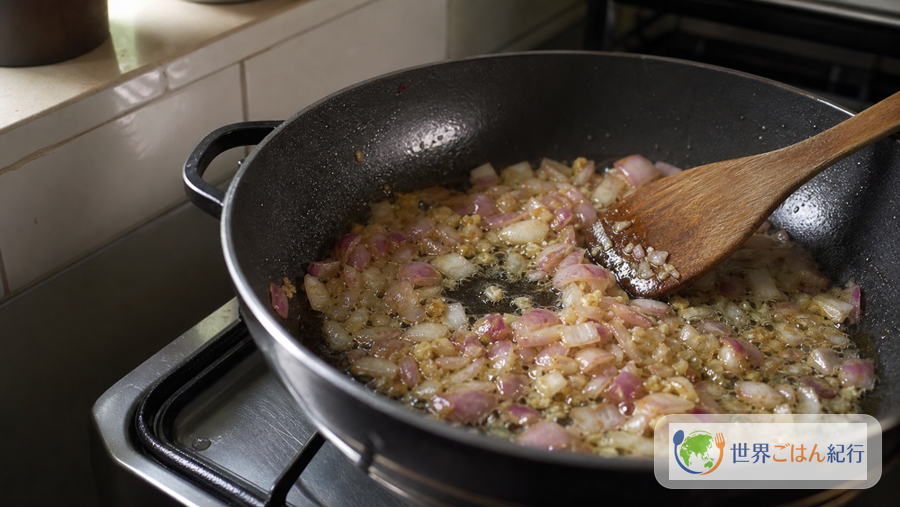
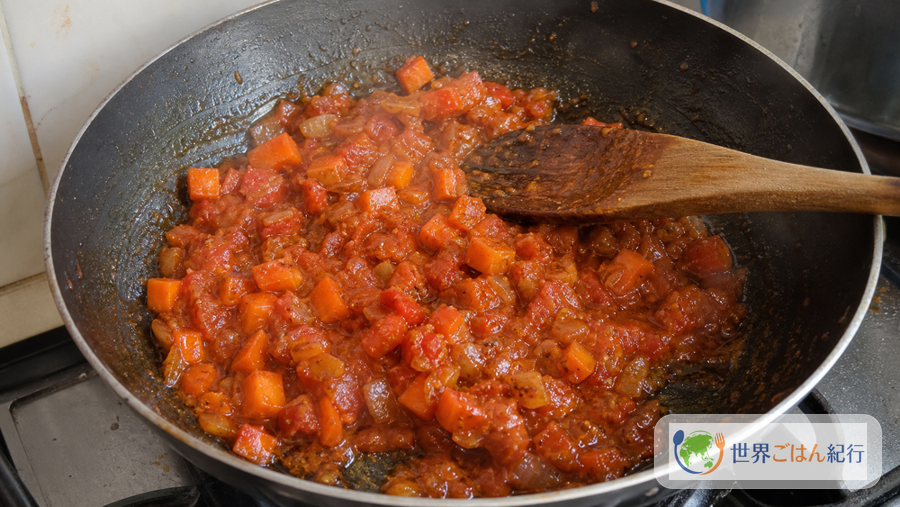
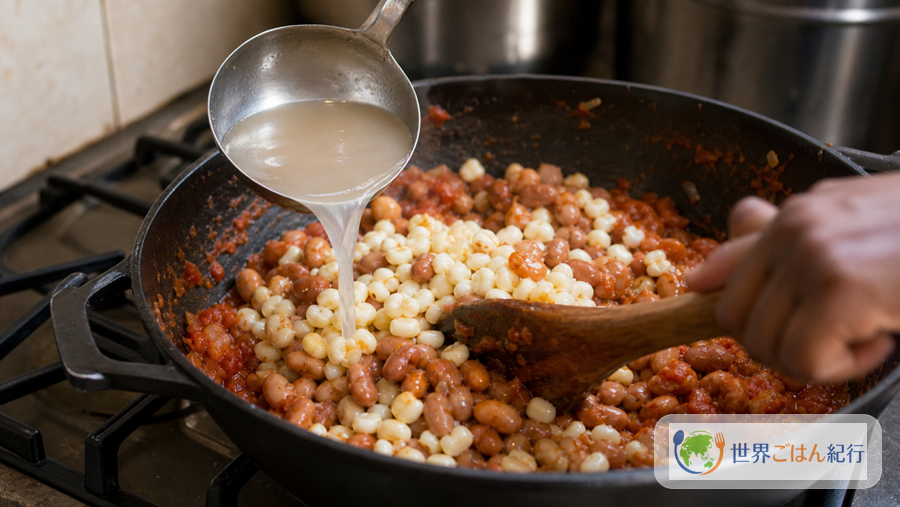
The dried-bean route starts the night before. For the canned route, skip steps 1 and 2 and proceed from step 3, the aromatics. Decide when to turn off the heat not only by the clock but by checking the center of the beans and the core of the maize.
Hard, Thin, Falling Apart: Fixing Mistakes Inside the Pot
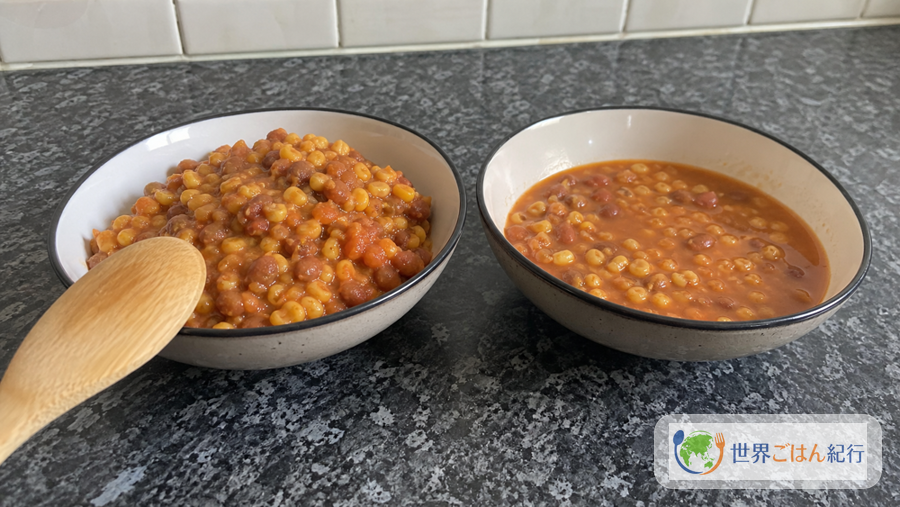
Even when githeri looks cooked, only the centers of the kernels may still be hard. To taste, split a single kernel in half and check the center of the bean and the core of the maize separately.
| Condition | Main cause | How to fix it |
|---|---|---|
| The center of the beans is floury | Too little soaking, ran out of water, not enough boiling time | Add boiling water to the pot to bring it back to a level where the beans are submerged, and extend by 15–20 minutes at a time while keeping it boiling. Never eat red kidney beans while hard |
| Only the maize is woody-hard | Large kernels; beans were taken out first | Set the beans aside on a separate plate, add boiling water to the maize alone and cook for 15 minutes. Return the beans at the end |
| The sauce is watery | All the cooking liquid went in from the start | Take off the lid and cook over medium-low for 3–5 minutes. Mashing in just 2 tbsp of beans binds it without adding flour |
| The bean skins tore | Stirred hard, or the kernels danced at a boil | Stop stirring and just shake the pot back and forth. Let the broken beans thicken the sauce, and spoon the kernels you want whole gently on top |
| Too sweet | Sweet corn was used | Add lime, black pepper and salt in small amounts. Next time use hominy, and add sweet corn only for the last 5 minutes |
| The aroma is flat | Onion undercooked, not enough salt | Add salt a pinch at a time, and warm just a pinch of cumin in a separate pan before mixing it in. Don't add a large amount of raw spice |
When the dried beans stay hard, the priority is to soften the beans alone first, even after the tomato has gone in. Rather than cooking the acidic sauce for long, pass heat to the center of the beans with boiling water and the lid. If it is hard even though you used canned goods, check separately how far the hominy kernels and carrot are cooked, not the beans.
Storage and Reheating: Add Greens the Next Day to Restore Texture
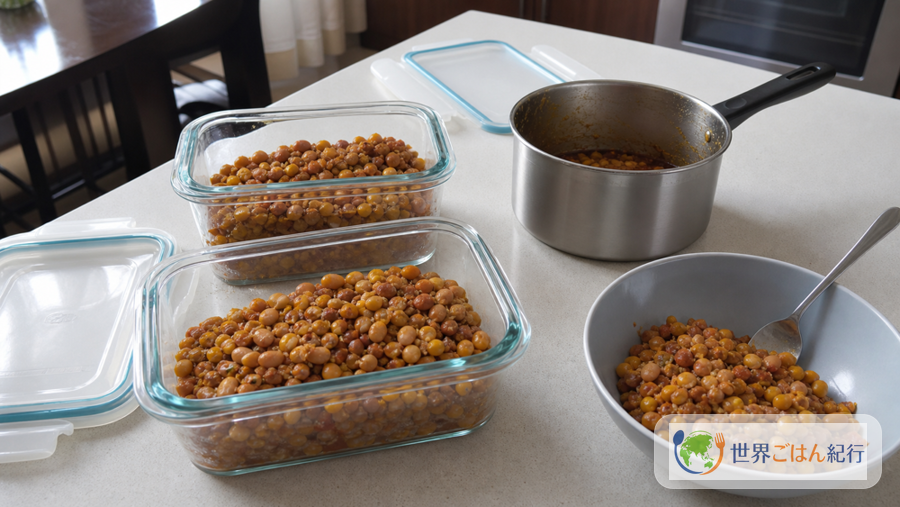
Githeri has little cooking liquid, so as it cools the beans and kernels absorb the moisture and stiffen. Once the heat has gone off, divide it into shallow storage containers; in the refrigerator, keep it for about 2 days. If you freeze it, a guide is about 2 weeks. If you want to keep the color of the greens, freeze it before the greens go in and add fresh greens on the day you eat it.
To reheat, move one serving to a pot, add 1–2 tbsp water or cooking liquid, and heat over medium-low. Turn it once from the bottom in a big stroke and heat until the whole thing steams. Too much water dilutes the flavor of the beans, so start with a small amount. Don't leave the pot out at room temperature long after taking it from the refrigerator, and cool what you keep quickly.
Bringing It Toward a Kenyan Table: The Order for Layering Greens, Meat and Staples
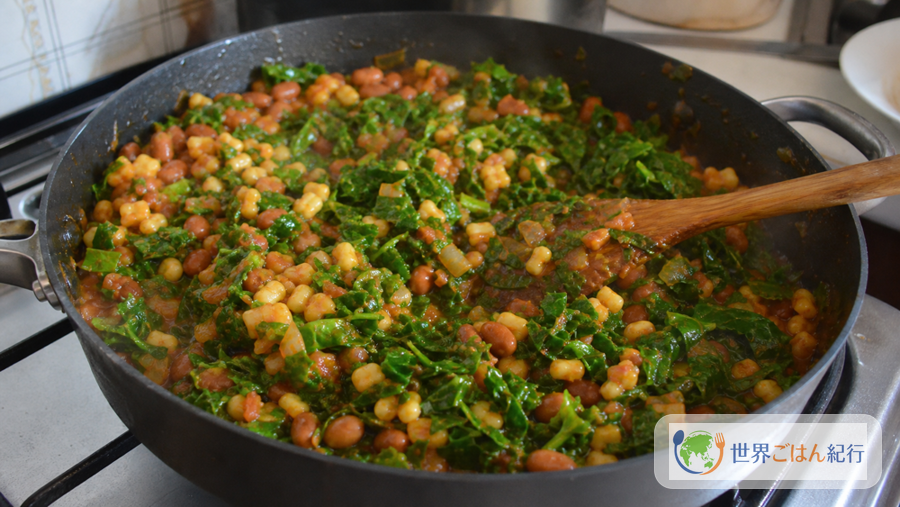
Githeri is a full meal on its own, so when you add accompaniments, divide the weight of the beans and kernels with greens and acidity rather than making the flavor stronger.
Githeri makes a meal with just beans and maize. If you add side dishes, divide the weight of the kernels with greens and acidity rather than making the flavor stronger.
| Occasion | Pair with | Finishing decision |
|---|---|---|
| Weekday lunch or dinner | Sukuma wiki, avocado, lime | Keep the githeri's tomato modest to take in the bitterness of the greens |
| A day you grill meat | Nyama choma, grilled chicken, tomato and onion salad | Keep the githeri lightly salted to take in the fat of the meat |
| A day you layer staples | A little ugali, white rice | Reduce the githeri's liquid slightly, and don't make the staple more than one serving per person |
| A day you want a mashed texture | Potato and greens | Mash about half the kernels in. A different finish from githeri with whole kernels |
As seen in the Nakuru study, restaurants sometimes serve githeri as one dish of traditional cooking, beside greens and mukimo. At home, it is fine to add greens in your refrigerator or yesterday's grilled meat. Not making meat essential is what makes a dish centered on beans and grain easy to handle.
Frequently Asked Questions
Before the questions, check that the center of the beans is not floury and the core of the maize is not woody-hard; that makes it easier to decide on substitutions and reheating.
Can I make it with sweet corn if I don't have hominy?
You can, but you get a sweet, soft, different result. If you use canned sweet corn, cook the beans and sauce first and add the corn for the last 5 minutes; if the sweetness is as strong as sugar, finish with lime and black pepper. If you put priority on the chew of the kernels, it is better to look for hominy.
What changes when I replace dried red kidney beans with canned?
Discard the liquid, rinse with water and skip steps 1 and 2. Add them after step 3, where you cook the aromatics, and warm them for 8–10 minutes in step 5. Because canned goods contain salt, decide the final salt by tasting at the end.
Is there githeri without tomato and spices?
Yes. The core of the dish is maize and beans boiled with salt; onion, tomato, greens, potato and meat are ingredients that households and regions add. If you want to bring it closer to a Kenyan table, keep the tomato flavor light and add greens, so you don't lose the taste of the kernels.
Can a pressure cooker shorten the time?
Even with a pressure cooker, follow the soaking and cooking rules for red kidney beans and the maximum capacity of the product. Don't skip the pre-boil of dried beans by using only a pressure cooker; confirm that the centers of the beans are completely soft. For a first try, an ordinary deep pot is easier to handle because you can change the heat while watching the state of the kernels.
When should I add meat?
Cut grilled beef or chicken into bite-size pieces and add about 100g at the end of step 5 to warm it. Adding raw meat directly to the pot changes how the beans cook and the heating time required, so for a first try it is safer to cook it separately and serve it alongside. On a day when meat is the star, keep the githeri lightly seasoned and place it next to nyama choma, so the outline of the beans and grain remains.
Sources
- Food and Agriculture Organization of the United Nations (FAO) / Government of Kenya, "(Kenya, 2018) Kenyan Food Recipes - a recipe book of common mixed dishes with nutrient value." Checked the bibliographic information of this 2018 Kenyan food and nutrition resource. Accessed and checked: 2026-08-20. https://www.fao.org/food-composition/tables-and-databases/detail/%28kenya--2018%29-kenyan-food-recipes---a-recipe-book-of-common-mixed-dishes-with-nutrient-value/en
- Slow Food Foundation, "Githigo Maize." Checked the Gikuyu of central Kenya and Githigo, the large-kernel maize, and the relationship between githeri and mukimo. Accessed and checked: 2026-08-20. https://www.fondazioneslowfood.com/en/ark-of-taste-slow-food/githigo-maize/
- Kenya High Commission, Kampala, "Culture." Checked that Kenya does not have a single dish only, and that white maize, beans, potatoes, greens and locally available ingredients change the dishes. Accessed and checked: 2026-08-20. https://kenyamissionkampala.ug/culture/
- C. Finocchiaro et al., "Traditional Products and New Developments in the Restaurant Sector in East Africa. The Case Study of Nakuru County, Kenya," Frontiers in Sustainable Food Systems, 2020. Checked the restaurant survey in Nakuru County and that githeri appears on traditional-dish menus. Accessed and checked: 2026-08-20. https://www.frontiersin.org/journals/sustainable-food-systems/articles/10.3389/fsufs.2020.599138/full
- Ipsos Ltd, "Kenya Consumer Segmentation Study: Research Report," Global Alliance for Clean Cookstoves, October 2014. Checked the simmering time of githeri in the surveyed households, the way it is boiled and then fried to eat, and how it is stored. Accessed and checked: 2026-08-20. https://cleancooking.org/binary-data/RESOURCE/file/000/000/339-1.pdf
- U.S. Food and Drug Administration, "Natural Toxins in Food." Checked the lectins in raw or undercooked beans, and the safety note to boil thoroughly in fresh water after soaking. Accessed and checked: 2026-08-20. https://www.fda.gov/food/chemical-contaminants-pesticides/natural-toxins-food
- Wikipedia, "Githeri." Used as supplementary confirmation of the spellings Githeri / Gĩtheri and the names and ways of eating in central and eastern Kenya. The dish's origin and nationwide food culture are not asserted on this page alone. Accessed and checked: 2026-08-20. https://en.wikipedia.org/wiki/Githeri



