
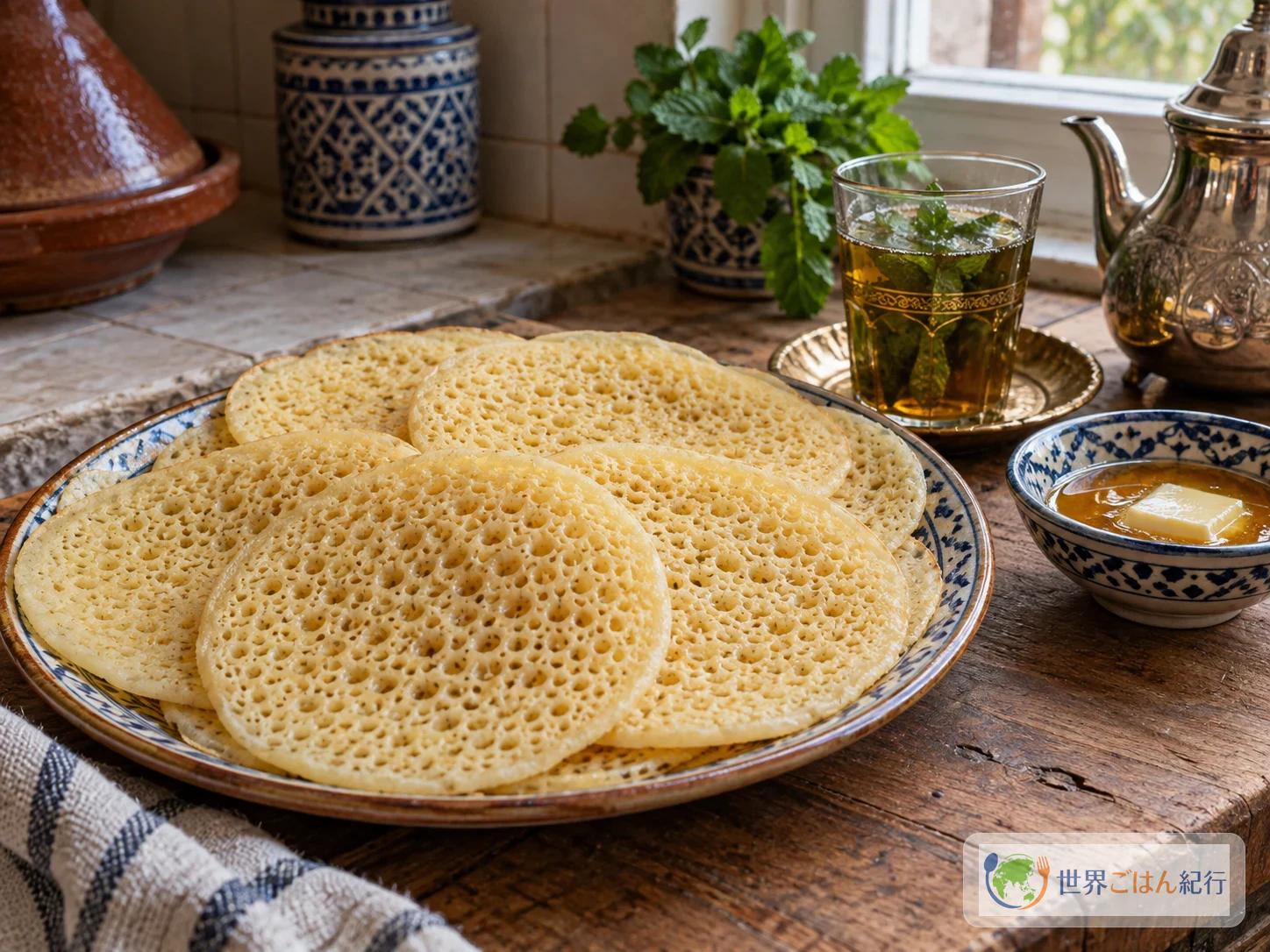
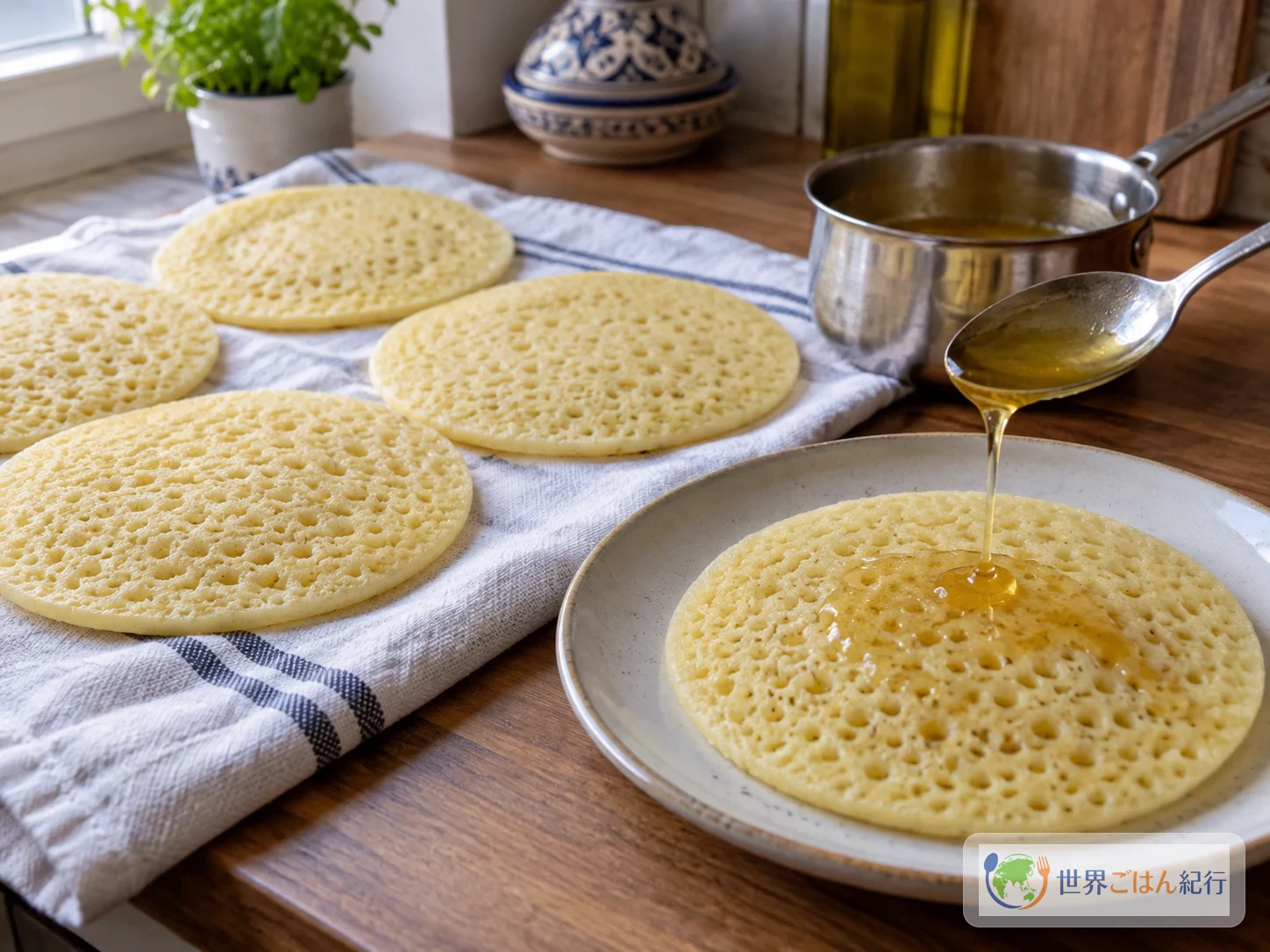
Melted butter and honey are drizzled over a warm baghrir. At a Moroccan breakfast table, the sauce does not just spread across the surface; it is drawn into the tiny holes. The holes that soak up honey and butter are the treat of this dish. Baghrir (also spelled beghrir) is a thin pancake made with semolina and yeast, with a surface packed with holes and a texture like a soft sponge that gives gently when you bite it.
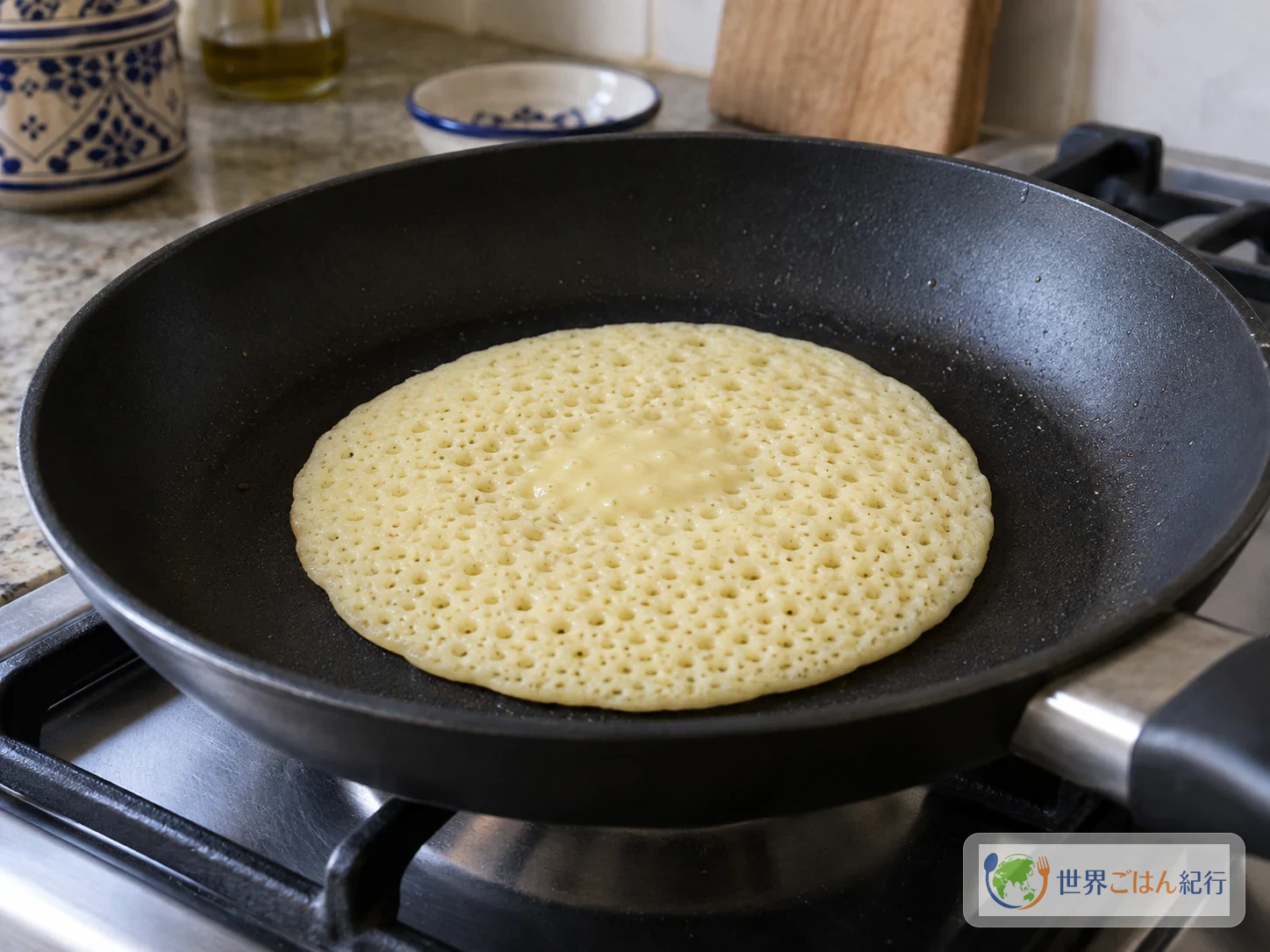
This pancake is normally cooked on one side only. You do not flip it; you cook it patiently until the liquid batter is gone from the surface. Unlike a thick Japanese-style hotcake browned on both sides, it needs a fine-ground flour and a batter that pours freely. Four servings make about 15 pancakes of roughly 12 cm in diameter, though the number varies with size. The guide is 50 minutes of cooking.
A Pancake on Morocco's Breakfast and Festive Tables
Warm baghrir is eaten at Moroccan breakfast and tea time. Some soak it in a sauce of honey and butter mixed together, some serve the sauce in a separate dish, and some serve it with jam. Because the holes hold the sauce well, the batter itself need not be sweet. At home, the sauce can be served on the side, so each person can adjust how much to pour.
It is also a dish tied to family memory. The cook Salima Benkhalti writes that she remembers baghrir as a weekend snack in her childhood, and learned to make it from her aunt Aicha. This is, of course, the memory of her own family. In her recipe the batter rests for more than 30 minutes and is cooked with a small amount of butter. Both the formula and the process differ from the short-rise formula used here.
It also appears at festive tables. Rachida, a writer on Moroccan food, introduces it as appearing at Ramadan and Eid tables as well. Add mint tea or coffee and it also suits tea time. Even without a lavish main dish, a flour-based dish and a small dish of sauce make a reasonably complete table.
In English it is called thousand-hole pancakes, and in French crêpes mille trous. "A thousand holes" does not mean there are exactly 1,000 holes.
The spelling also varies: baghrir, beghrir. When searching for the same dish, Baghrir and Beghrir are the two clues.
Flour Formulas Vary by Household, and So Does the Way of Cooking by Region
For the flour, there are formulas using semolina alone and formulas mixing in wheat flour. The basis of the yellow batter is fine-ground semolina, and the lower the proportion of semolina, the paler the yellow. This time, no spice is added for color. Because each household's flour formula differs, differences in color and flavor can also be enjoyed as the character of that home's baghrir.
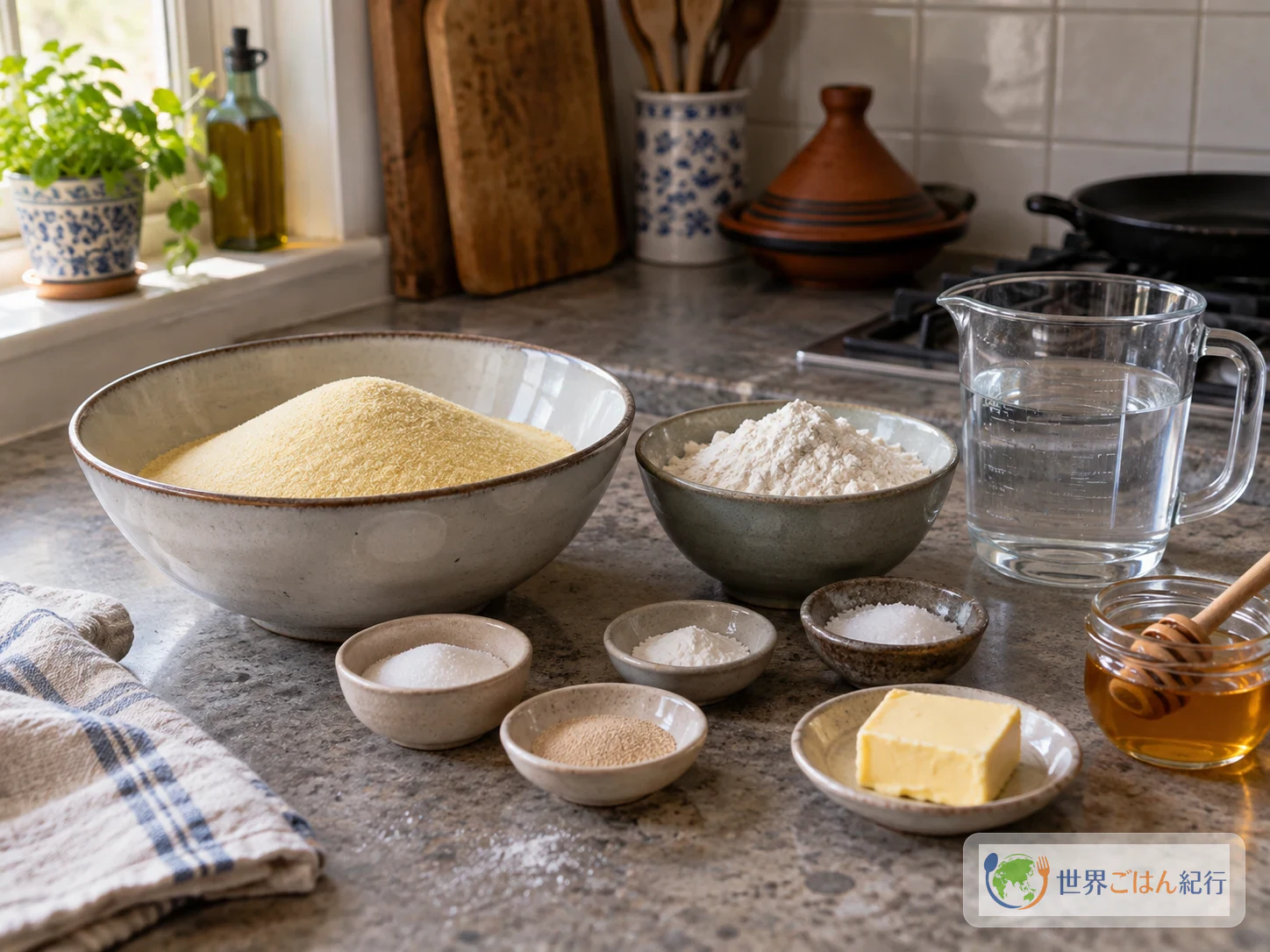
There are recipes that use baking powder alongside to shorten the waiting time. The resting time of a yeast-only formula cannot be transferred to this batter. There are also versions that add egg or milk, but neither goes into this batter. That does not mean the egg versions are fake. The home formula here is 300g fine-ground semolina, 125g all-purpose flour, and 630ml water. When recreating it elsewhere too, rather than comparing results by the depth of the yellow alone, checking what kind of flour the formula uses makes it easier to make. This recipe takes fine-ground semolina as the base and adjusts the white flour part to ordinary soft flour.
It is normally cooked on one side, but in Taste of Maroc's explanation of the dish, it is introduced that in some regions a method of flipping briefly is sometimes called khringos. In some regions it is flipped briefly. However, I have not been able to confirm which regions or since when this method has been used, so I do not go into it here.
Preparing the Flour: Look at the Fineness of the Grain
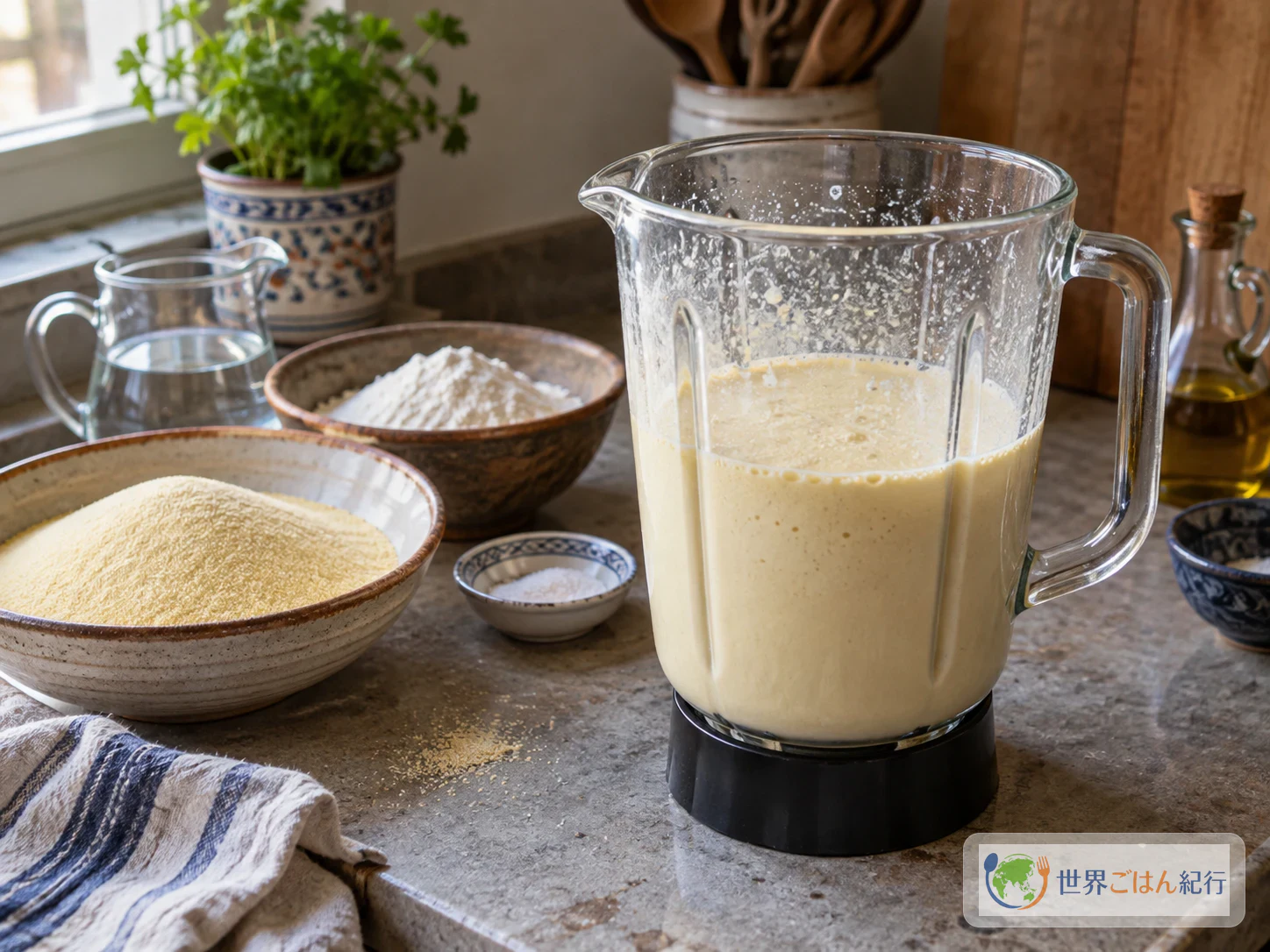
What you need is fine-ground semolina of durum wheat. Couscous, which is processed into grains, is not a substitute for this batter. Look for the plain-named "semolina" through mail order or a baking-supply shop, and check in the product description whether it is fine-ground. I do not go into the stock or prices of specific shops.
For the 125g of white flour, use all-purpose flour that is easy to find. This is a home adjustment and is not the same specification as the all-purpose flour in the original formula. I have not tested a formula in which even the 300g of semolina is entirely replaced with all-purpose flour, so if you want to keep the yellow color and grain flavor, prepare semolina. How much water semolina absorbs varies with coarseness. Check how the batter flows before baking and with the first pancake.
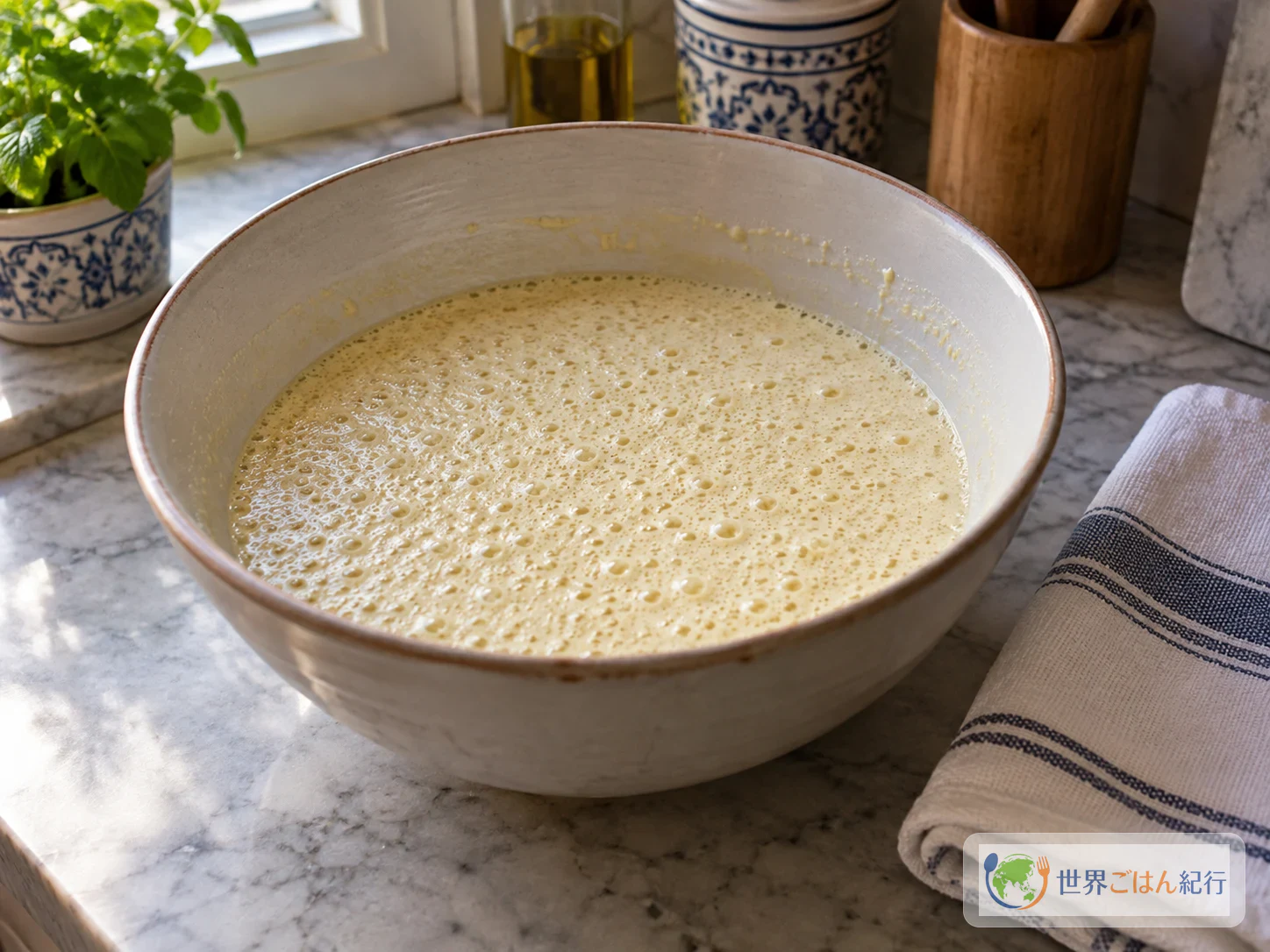
Make the batter smooth in a blender or with an immersion blender. If you already have one, you need not buy another. A small nonstick frying pan is easy to handle, and even with a larger one the batter is poured into the center. The trick is to pour into the center and let it spread naturally, not to swirl the pan to spread it over the whole surface. You do not need to lay down much oil. If leftover batter sticks, wipe it off after it cools.
Ingredients (serves 4)
The guide is about 15 pancakes of about 12 cm in diameter. Do not count one small pancake as a staple portion; share them among the four. The formula is a home version based on Rachida's gram formula, with the white flour replaced with all-purpose flour. The 1g salt, 4g sugar, and 3g yeast are guides that are easy to weigh at home. The amounts of honey and butter are suggestions for dividing among 4 people, so those who want less can serve the sauce on the side.
Use 30 to 35°C as a home guide for the lukewarm water. Do not use hot water. If your yeast product has instructions, follow the package. Before increasing the amount, first measure 630ml properly. Break up lumps of flour in the blender, and strain if any remain.
Method
Count 5 minutes for prep, 15 minutes for resting, and about 30 minutes for cooking the whole batch. This varies with the number of pancakes and the size of the pan. The sign of doneness is cooking until the wetness is gone from the surface. The surface dries while staying yellow, and the underside takes on a light browning. More than the number of holes, check that no liquid batter remains.
If the first pancake has few holes and the batter doesn't spread well, adjust by adding water. Add water 15ml at a time, stir gently, wait a few minutes, and try cooking another. If it is still heavy, add no more than another 15ml. If you add flour or baking powder right away, the formula itself changes, so first adjust with a little water and heat.
If they were cooking well at first but later only the bottoms are scorching, the pan may have become too hot. Take it off the heat for a moment to settle, then lower to medium-low and continue. Do not pour cold water on a hot pan. Handle equipment according to the manufacturer's cautions.
When No Holes Appear, or Only the Bottom Scorches
Possible reasons for few holes are a thick batter, yeast that isn't working, or a pan that doesn't suit. Don't fix on one cause; change one thing at a time and compare against the next pancake. Changing only one item at a time lets you see what worked. If there are plenty of bubbles, look at how the batter flows rather than waiting longer for fermentation. If there are none at all, check the water temperature and the expiry and storage of the yeast.
| Condition | What to check first | What to do for the next pancake |
|---|---|---|
| Few holes and a thick center | Whether the batter flows on its own | Add 15ml water, wait a few minutes, and try |
| Burnt bottom and wet top | Whether the heat is too strong or too much was poured | Lower to medium-low and cook with about 60ml |
| The whole thing is slow to set | Whether the pan is hot | Adjust to medium heat and cook until the wetness is gone |
| Cooked pancakes stick together | Whether they were stacked while warm | Cool in a single layer on a clean cloth |
| Grains of flour stand out | Whether the flour is coarse or there are lumps | Strain the batter and choose fine-ground flour next time |
A pancake that did not get holes cannot later be turned into one full of holes. Don't leave wet batter; cook it through, and think of adjusting with the rest of the batter. If sticking continues in the same pan even after re-blending, try a different nonstick pan. There is no need to buy new dedicated equipment from the start.
Ways to Eat It Besides Honey, and Combinations for the Morning Table
Honey and butter is the basic way. Because the pancake soaks up sauce well, I recommend adding it just before eating. There is also a way of eating it with olive oil or amlou. Treat jam and chocolate spread separately, as modern variations.
| Way of eating | Suggested amount for 4 | Flavor and use |
|---|---|---|
| Honey only | 60g | Skip the butter and add sweetness directly |
| Olive oil | 2 tbsp | Brush a little on each pancake |
| Jam | 80g | A variation that adds fruit tartness without dairy |
| Chocolate spread | 60g | A sweet variation spread thin. Check the ingredients for milk and nuts |
| Plain yogurt and honey | 200g and 40g | The editors' home suggestion. Add just before eating |
Even among breakfast flour dishes, the textures are very different. Msemen, folded in layers and cooked, is made differently from baghrir with its holes, and lets you taste the difference from a layered bread. Couscous, which steams grains, is a different dish from a batter of semolina. Once you understand the choice of ingredients so far, take a look at how flour and grain are used differently.
- How to make msemen (in Japanese)
- How to make Moroccan couscous (in Japanese)
Storage and Reheating
What you store is what has been stored before the sauce is added. Spread in a single layer on a clean cloth to remove the heat, don't leave it long at room temperature, and refrigerate divided into shallow containers. Finishing by the next day is a short home guide, not a guarantee of a safe period. For longer storage, freeze. Put them in a bag separated one by one with paper, and as a quality guide I recommend within 2 weeks. Thaw in the refrigerator or in a microwave.
When warming in a microwave, place 1 or 2 on a heatproof plate, cover loosely, and check at 20 to 30 seconds at a time at 600W. If cold spots remain, add more heating. Reheat stored food to the center, with 75°C or more as the guide. Heating time alone does not guarantee safety. Don't dry it out until scorched, and eat it as soon as it is warm. Do not repeat thawing and refreezing.
Do not give honey or foods containing honey to babies under 1 year. Ordinary cooking or heating does not remove the risk of infant botulism.
Both semolina and all-purpose flour are wheat. The sauce contains dairy. Even though no egg or milk is used in the batter, this is not a dish for people with a wheat allergy. Check the ingredients of the butter and spreads. Discard anything that smells odd, has mold, or whose storage condition is unknown, rather than eating it.
Frequently Asked Questions
Can I make it with pancake mix?
I have not tested a procedure for replacing this semolina, yeast, and leavening formula with pancake mix. The sugar and leavening in mixes differ, so I recommend avoiding a same-amount substitution of mix.
Can I make it without a blender?
An immersion blender can also make it smooth. Use a deep container and follow the device's capacity and instructions. You can also mix with a whisk, but the condition is that no lumps or grains of flour remain. For a first-timer, mixing by machine is easier to manage.
Can I make the batter the night before?
This formula uses baking powder together with yeast and rests 15 minutes. I have not tested an overnight rise. I recommend refrigerating pancakes cooked the day before and warming them when eating.
Does it cook through without flipping?
It is spread thin and heated from one side, waiting until the liquid part of the surface is gone. Watch the wetness of the surface more than the browning. It's important not to take it out just by the color on the bottom. If the top is wet but only the bottom scorches, lower the heat.
Can I eat it with less honey?
The sugar in the batter is only 4g in total. Most of the sweetness is carried by the finishing sauce. You can serve the sauce on the side and adjust the amount, or eat it with olive oil. It does not claim to be sugar-free or to have health benefits.
Nutrition Guide
One serving is one quarter of the whole, including 60g honey and 40g butter. As an approximation including the sauce, it is about 515 kcal, 13g protein, 9g fat, and 96g carbohydrate. It is a guide calculated from general composition values of the ingredients; if you cook 15 pancakes, that is about 3 to 4 per person. The values change with the flour and sauce products and the amount of leftover sauce.
The batter alone is low in fat, and it increases or decreases with the amount of finishing butter. It does not claim any dietary restriction or efficacy.
Sources
- Taste of Maroc — Beghrir – Moroccan Semolina Pancakes — One-sided cooking, differences in formula, ways of eating, and batter adjustment. Accessed and checked: 4 October 2026.
- Salima’s Kitchen — Baghrir (Light Moroccan Semolina Pancakes) — Family memory and the 30-minute rise method. Accessed and checked: 4 October 2026.
- Gâteau et cuisine Rachida — Baghrir, Moroccan Spongy Pancakes — Gram formula, choosing semolina, and the festive table. Accessed and checked: 4 October 2026.
- Ministry of Health, Labour and Welfare of Japan — Give honey only after the first birthday (in Japanese) — Honey caution for infants. Accessed and checked: 4 October 2026.
- Ministry of Health, Labour and Welfare of Japan — Six points for preventing food poisoning at home (in Japanese) — Portioned storage, thawing, and reheating. Accessed and checked: 4 October 2026.



