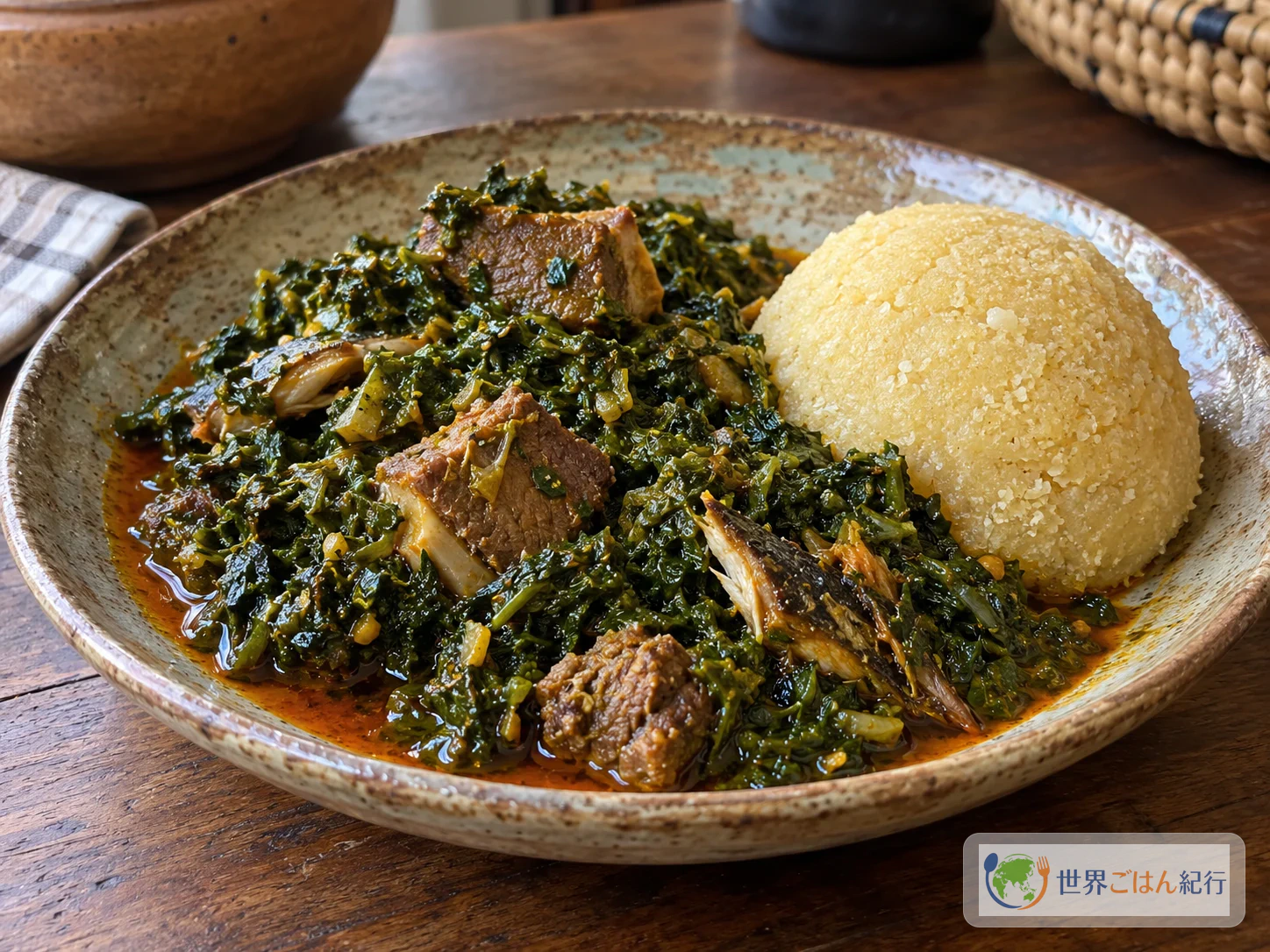
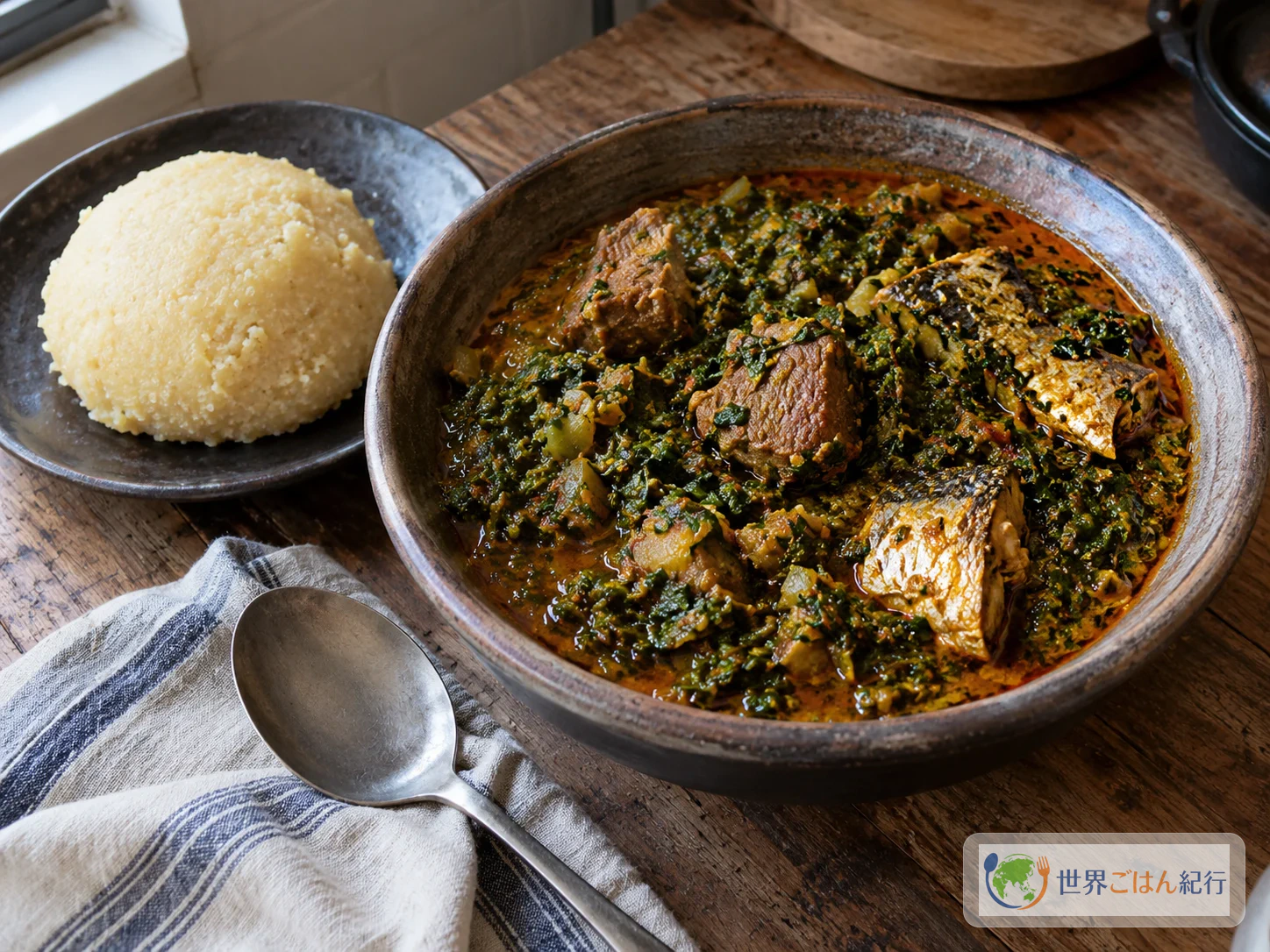
Picture a plate set on a table in southern Nigeria. The green scent of shredded leaves rises, red palm oil shines on the surface of the pot, and beneath it the stock of meat, dried fish and dried crayfish has cooked down thick. What is drawn here is neither a record of a visit nor an account of tasting, but a typical table assembled from sources. Afang soup is known as a dish tied to the Efik people and to Nigeria's Akwa Ibom and Cross River states. At its core are the leaves of afang (okazi) and waterleaf, red palm oil, and layers of meat, dried fish and dried crayfish. It is the way a deep, red-oil broth takes up the aroma of the leaves that gives it a depth beyond a mere green soup.
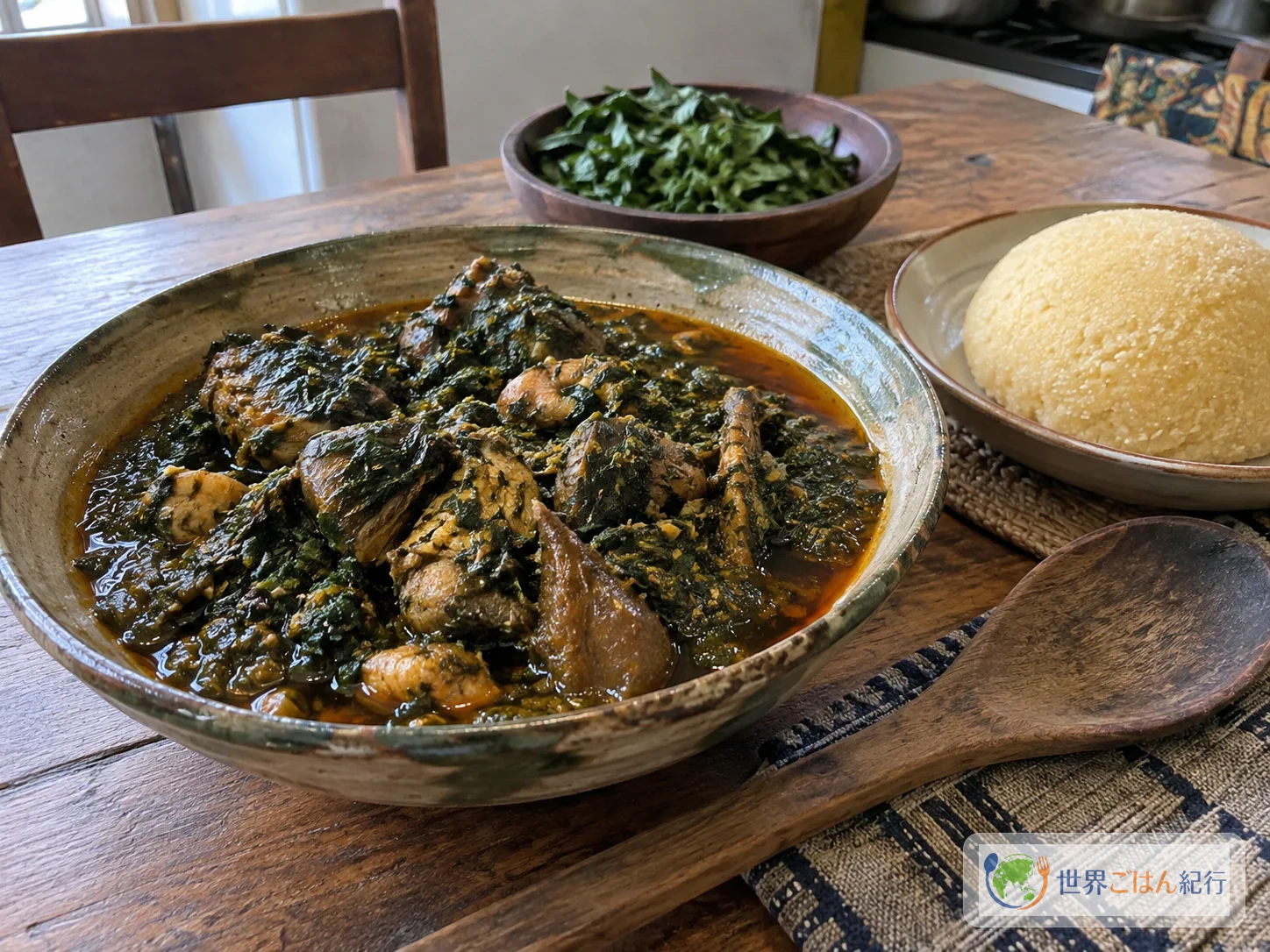
You may be confused by the variation in names when searching. The same plant, Gnetum africanum, is called okazi or ukazi in Igbo-speaking areas and afang among the Efik. Afang and okazi are linked as names of the leaf. The dishes, however, are different: the okazi soup of Imo and Abia states presented by All Nigerian Recipes is distinguished as a dish that adds thinly sliced okazi to egusi soup. What this article covers is the southern Nigerian afang soup with the leaves as the star. Ingredients and procedure change by region and household, so take what is written here as one form among them.
A Forest Vine Becomes a Southern Nigerian Pot
Gnetum africanum is a wild evergreen climbing plant growing in Nigeria's tropical rainforest. The leaves are shredded finely and added to soups and stews. The name changes from place to place: afang and ukasi in Nigeria, eru and okoko in Cameroon, and koko in the Central African Republic, Gabon and the Democratic Republic of the Congo. The leaves are traded in local markets in West and Central Africa and are linked to the livelihoods of people who depend on the forest. Behind the ingredient stand a market and a forest. At the same time, papers on sustainability point out that harvesting by pulling up the plant by the roots can damage regeneration. That does not mean a particular mail-order product can be called good or bad across the board; reading the bag's label and choosing accordingly is the reliable way.
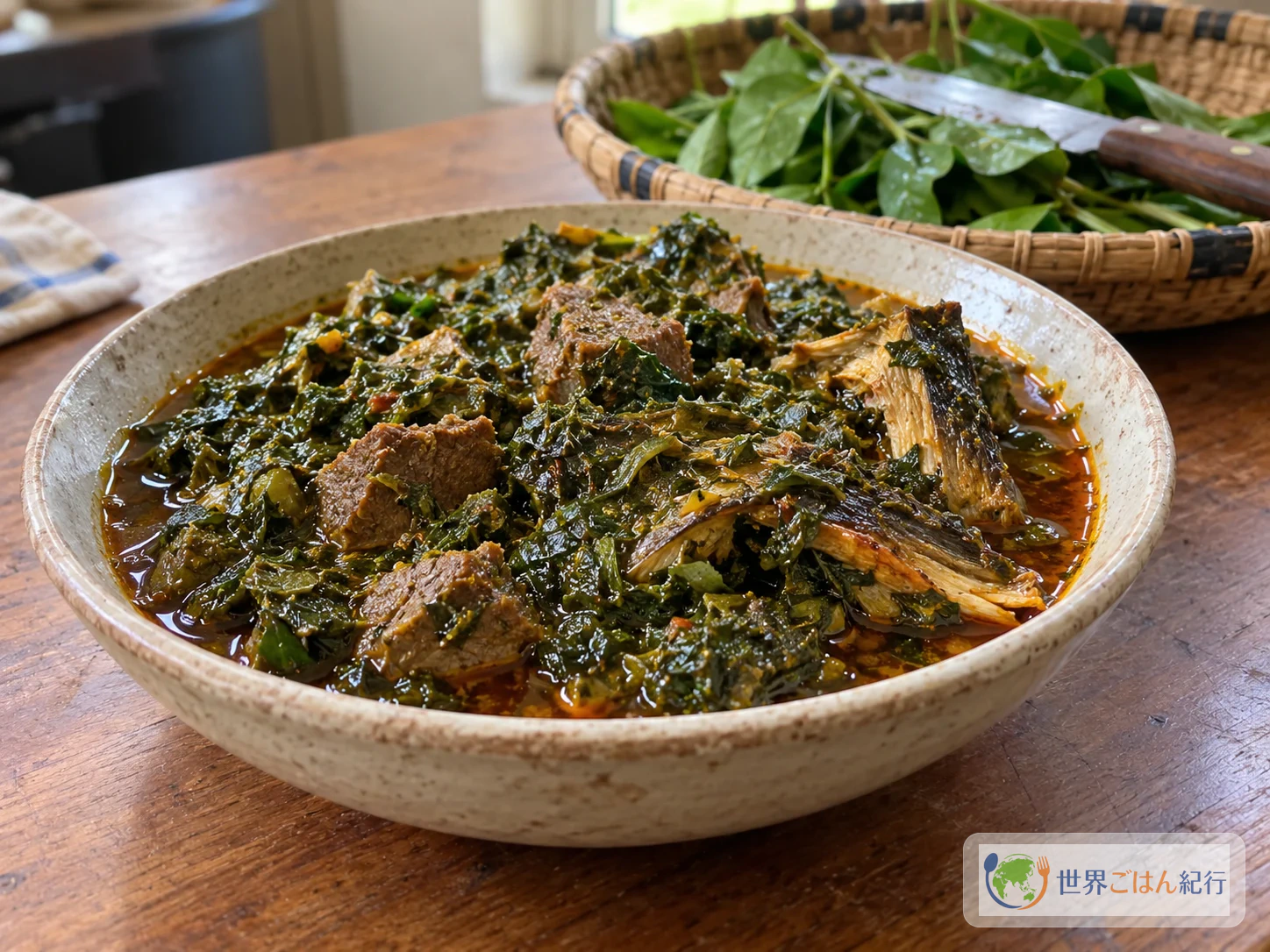
The search terms for Nigeria are Afang, Okazi, Ukazi and Gnetum africanum. In Cameroon it circulates under the names eru and okoko. The name of the plant and the name of the dish are separate, so when you look for it to buy, search not by the dish name but by the name of the leaf, and check the origin and net contents written on the bag's label before choosing.
At a southern Nigerian table, soup comes as a set with a staple. The Nigerian Journal of Nutritional Sciences describes the typical Nigerian meal as a combination of carbohydrate staples such as cassava flour, rice, cocoyam, potato, yam and plantain, with a soup or stew. Local recipes for afang soup also serve it with garri (eba), semolina fufu, amala, cassava fufu and pounded yam. In a home kitchen elsewhere, you can choose plain rice without gathering eba or fufu. The role of the staple, taking up the thick broth, does not change. If you think of it as a dish completed not as a soup but together with the staple, the aim for the thickness of the pot also becomes clear.
Red Oil: Decide Why You Are Buying It Before You Choose
Red palm oil is given in All Nigerian Recipes as 20 to 25 cl in its ingredient amounts, and it forms the base of this dish's color and aroma. Edible labeling, capacity, ingredient list, storage method, price and stock change from day to day, so check them at the point of purchase.
Buying it suits people who want to keep making West African palm oil dishes such as egusi and banga as well as afang. It also suits people who care above all about the color and earthy aroma of the plate. Conversely, people who don't think they can use up the oil with this one dish, or who dislike the aroma of red oil, can pass. If you substitute rice bran oil or the like, you cannot reproduce the color and aroma of red palm oil, and the less you use, the more the impression of the local dish fades. If you can accept it as a different leafy-green stew, that is also a way to choose. Think of it as an oil you buy for its aroma, not its color.
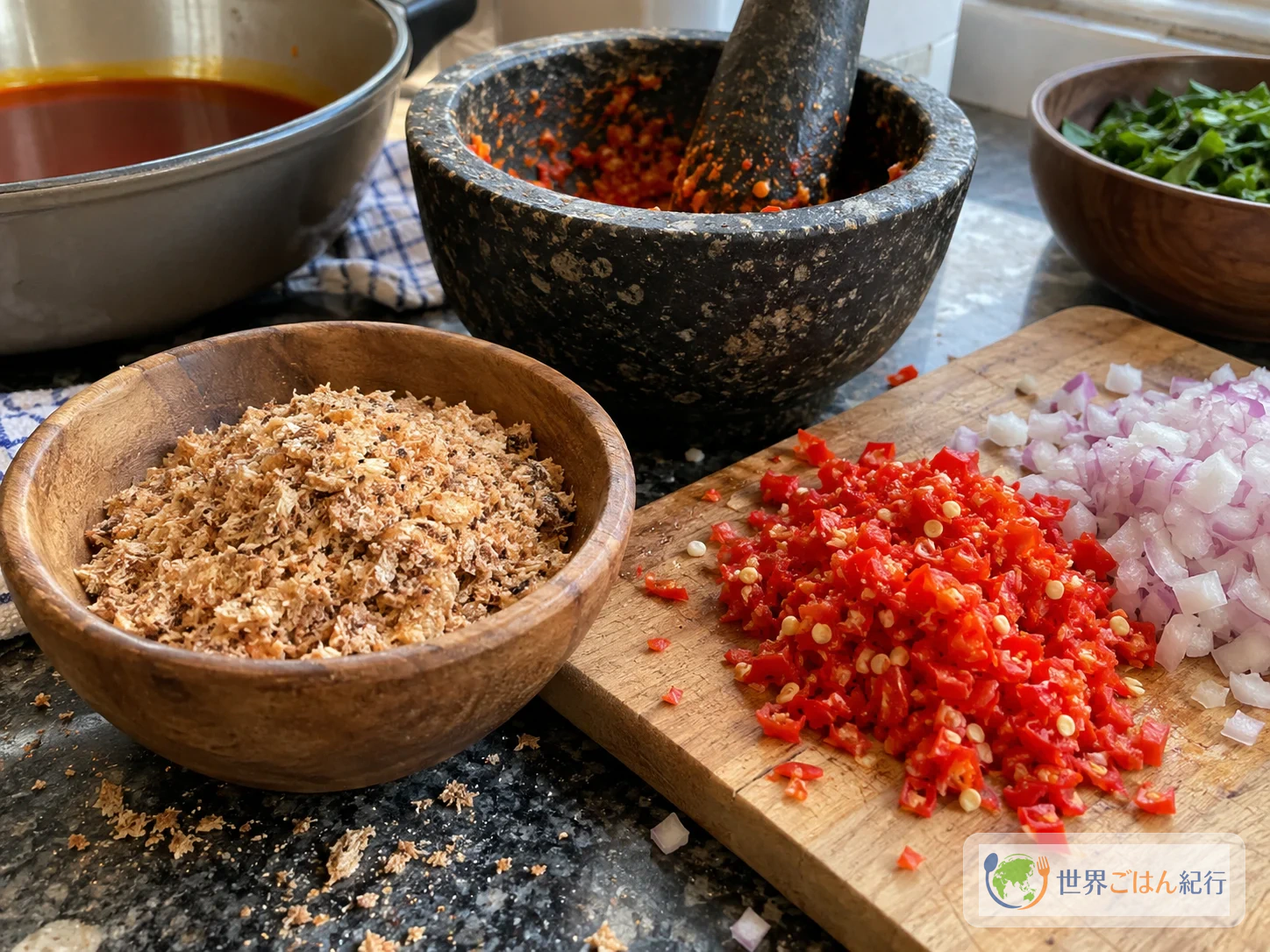
But the star of this article is the leaf of afang (okazi). Buying red palm oil alone will not make afang soup. Without the leaves, the oil alone is not a start, so begin by looking for dried leaves. Relying on the spellings Afang, Okazi, Ukazi and Gnetum africanum, check the rehydration instructions and net contents printed on the bag. Whether to use dried crayfish, stockfish, shrimp and periwinkles should be adjusted to your family's allergies and what is easy to get. There is no need to strain to collect everything.
Ingredients (serves 4): Leaves as the Star, a Small Amount of Broth
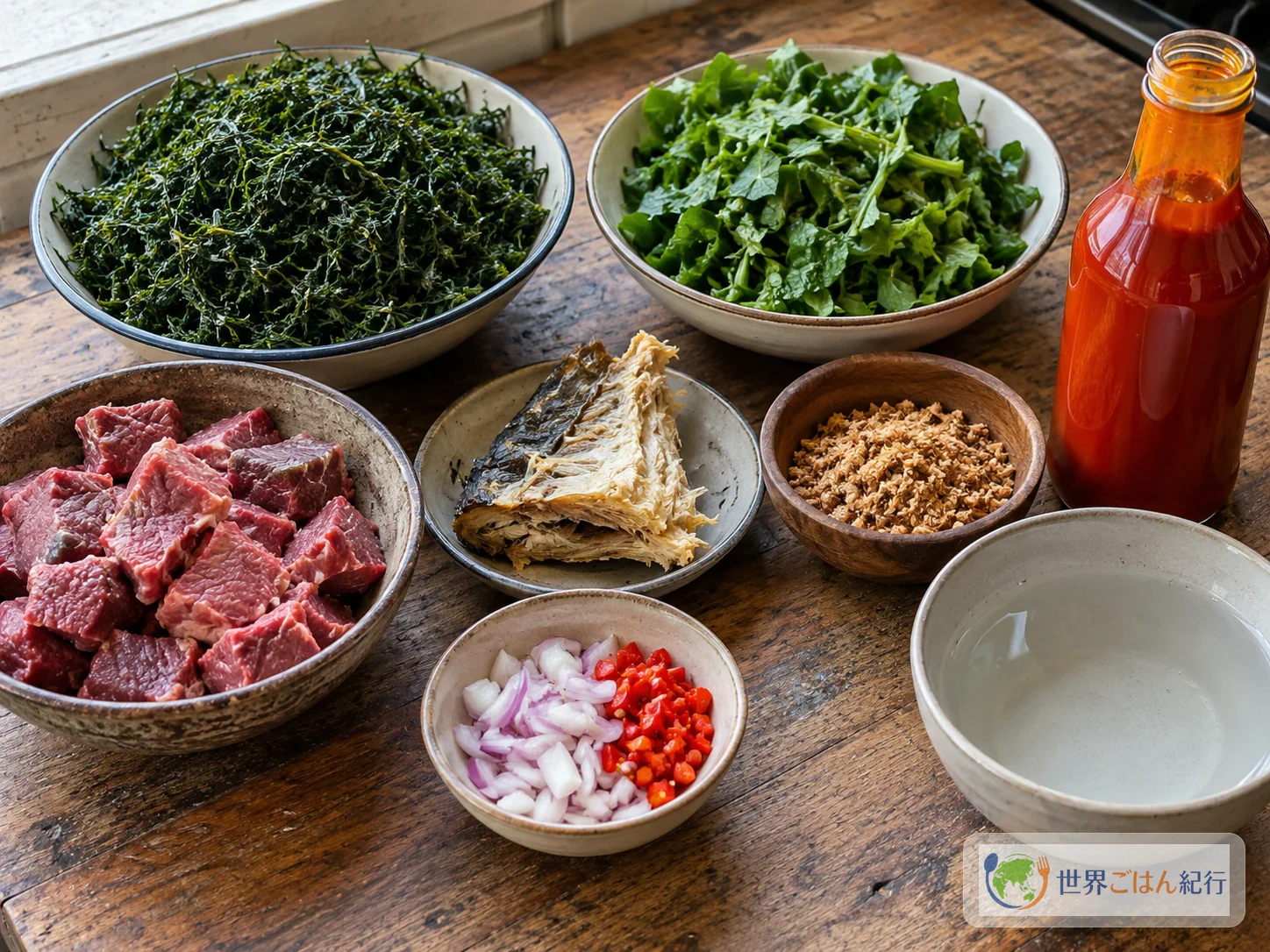
The All Nigerian Recipes benchmark is 400g afang/okazi leaves, 250g waterleaf, 20 to 25 cl red palm oil and 2 tbsp dried crayfish, plus meat, kanda, dried fish, salt, chili and a stock cube. The standardized example in the Nigerian Journal of Nutritional Sciences lists okazi, ugu, waterleaf, Cameroon pepper, stockfish, crayfish, red palm oil, beef, periwinkle, onion and ogiri. The recipe below is an edit of what the two share into amounts for four, and is not the only right answer for any region or household. Securing 400g of leaves first is the first step. Don't add a lot of water from the start; adjust to an amount where the bottom of the pot doesn't dry out too much even after the leaves wilt.
This recipe uses fish, shrimp, sea snails and beef. If you have a crustacean, seafood or beef allergy, check the allergen labeling on the product labels. Don't reuse knives and cutting boards that cut raw meat and seafood on cooked food. For cooking, use the guideline of Japan's Ministry of Health, Labour and Welfare, "the center of the food at 75°C (167°F) for at least 1 minute," as the standard. When serving to children, the elderly or people not feeling well, remove small bones and shell fragments and make sure it is thoroughly cooked. If you need individual allergy accommodation or a medical judgment, consult a professional.
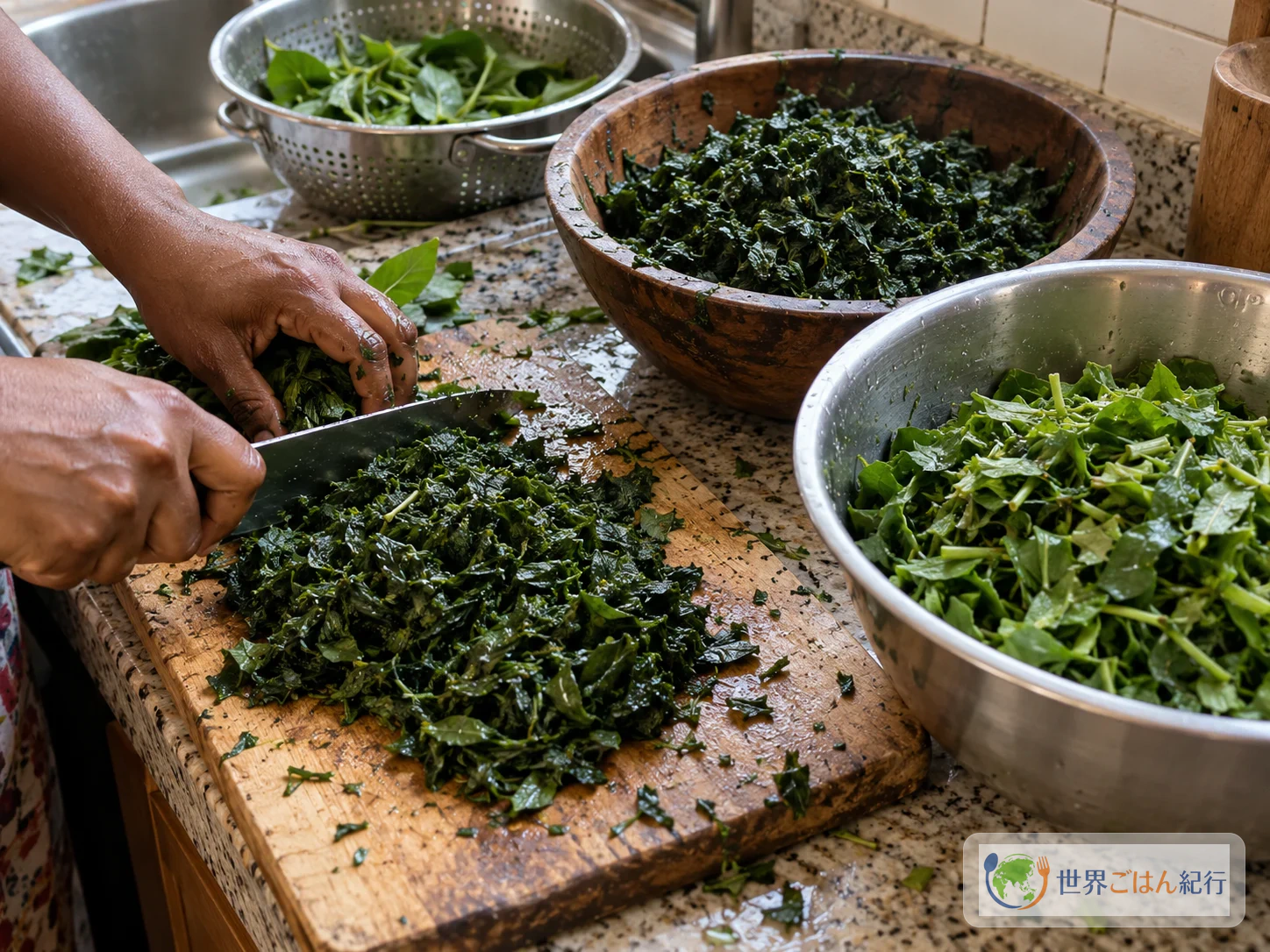
Fresh okazi (afang) is shredded fine as in the local recipe, or blended with a small amount of water. Rehydrate dried leaves as the product label says, and avoid reusing the soaking liquid as the pot's water as a rule. The aim is a state where the fibers of the leaf remain and it clings to the wooden spoon as fine ribbons, not a paste. Make it fine, but not a complete paste is the point.
Method: Watch the Fineness of the Leaves and How the Broth Reduces
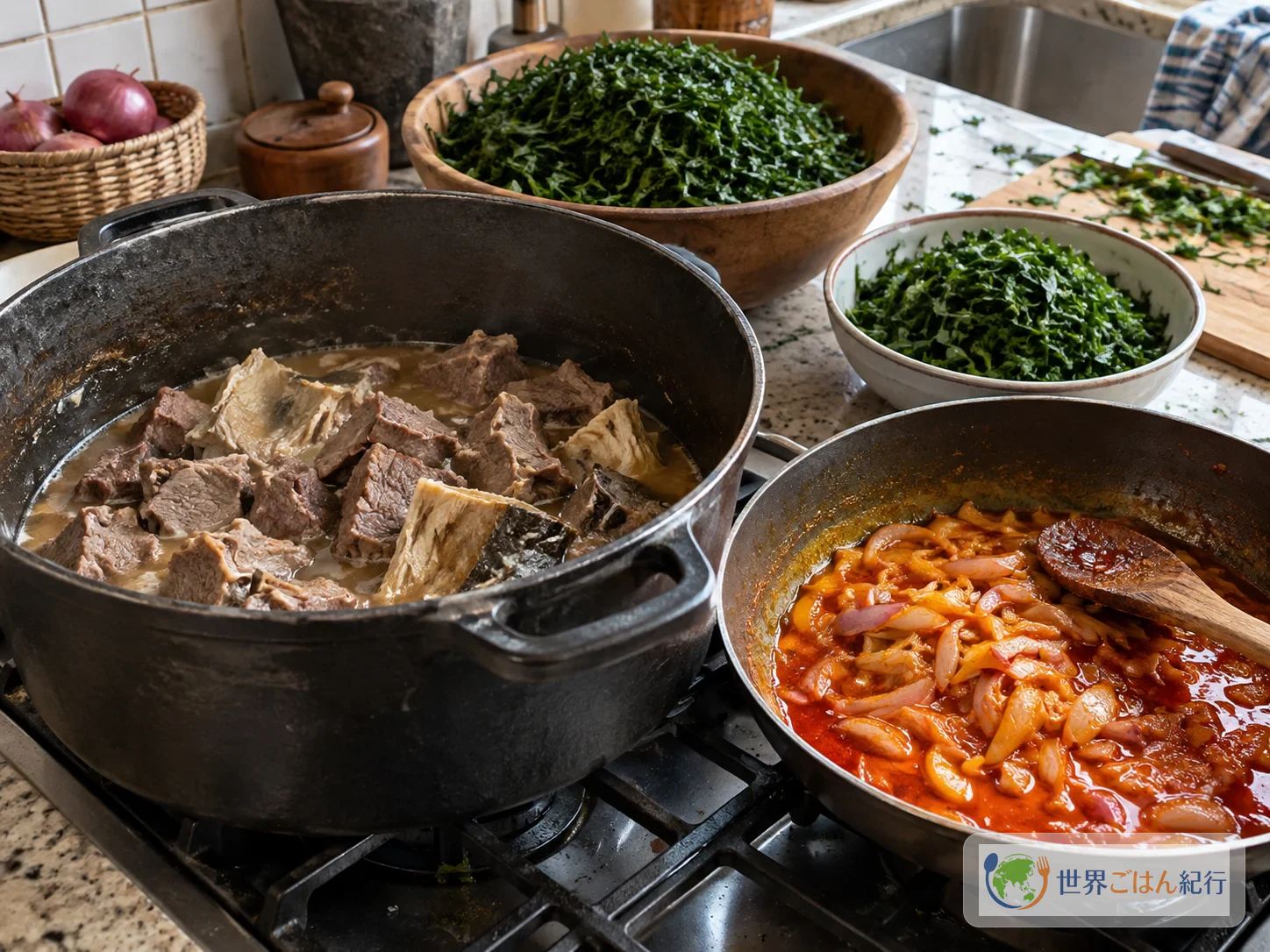
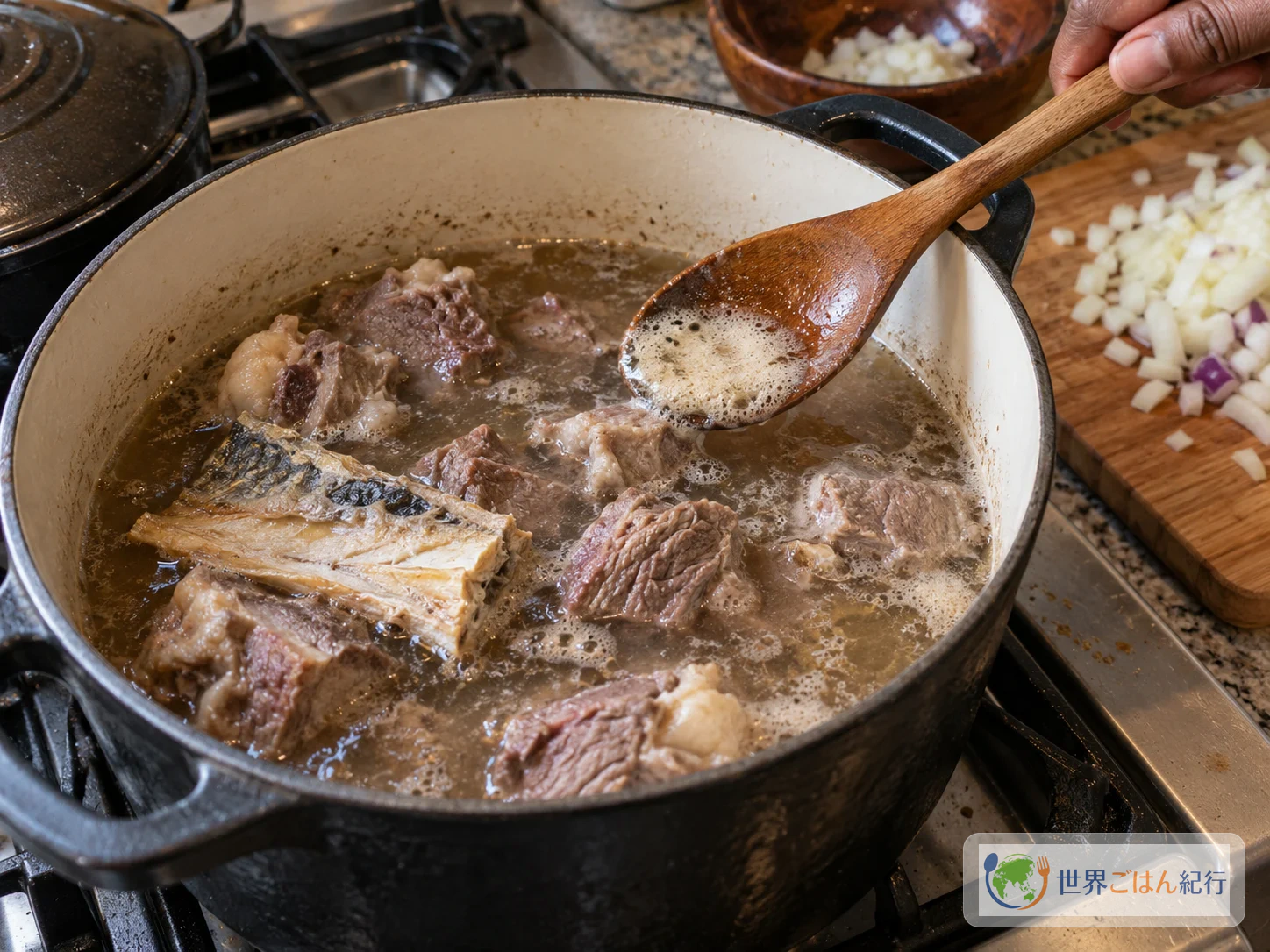
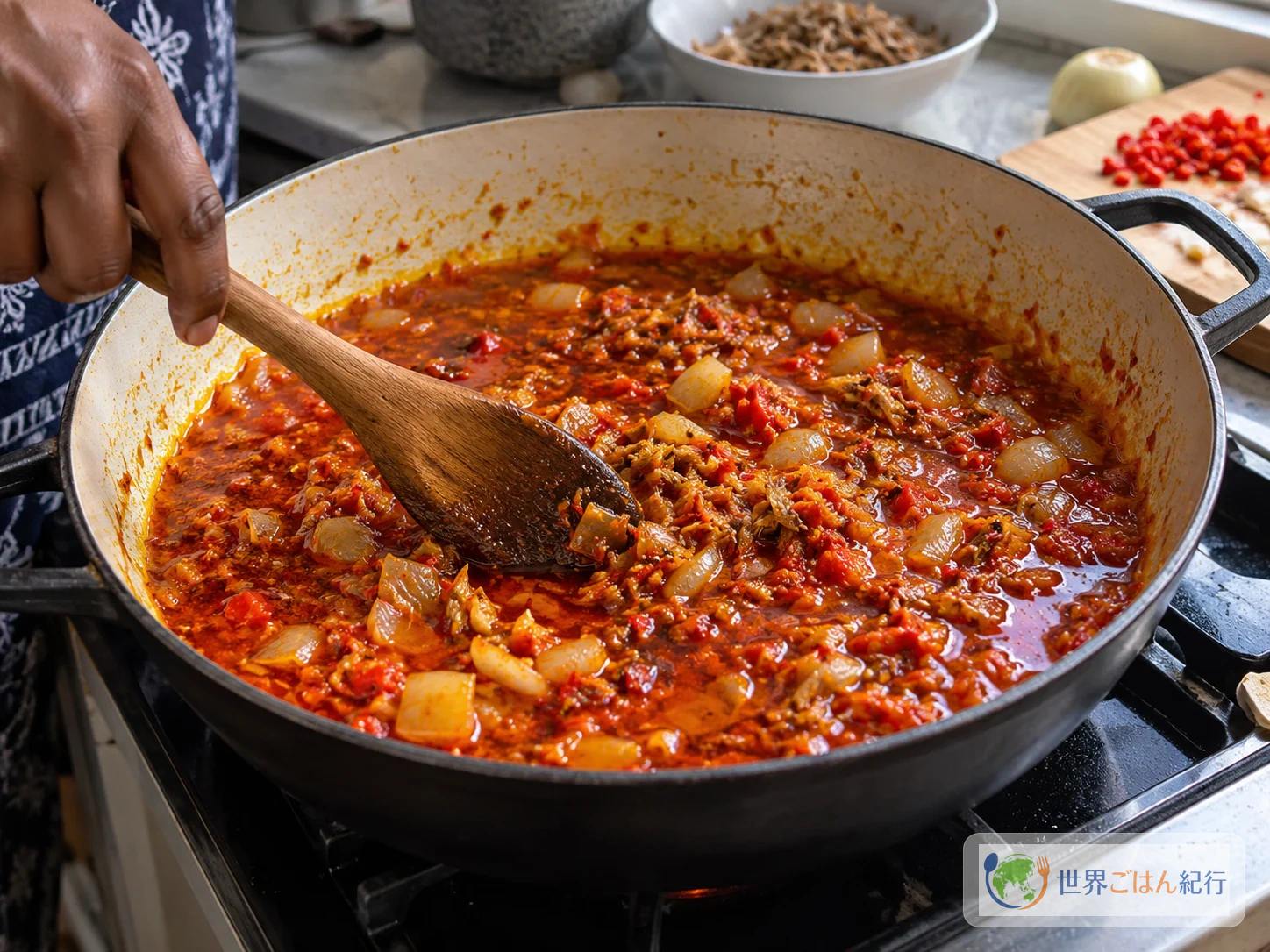
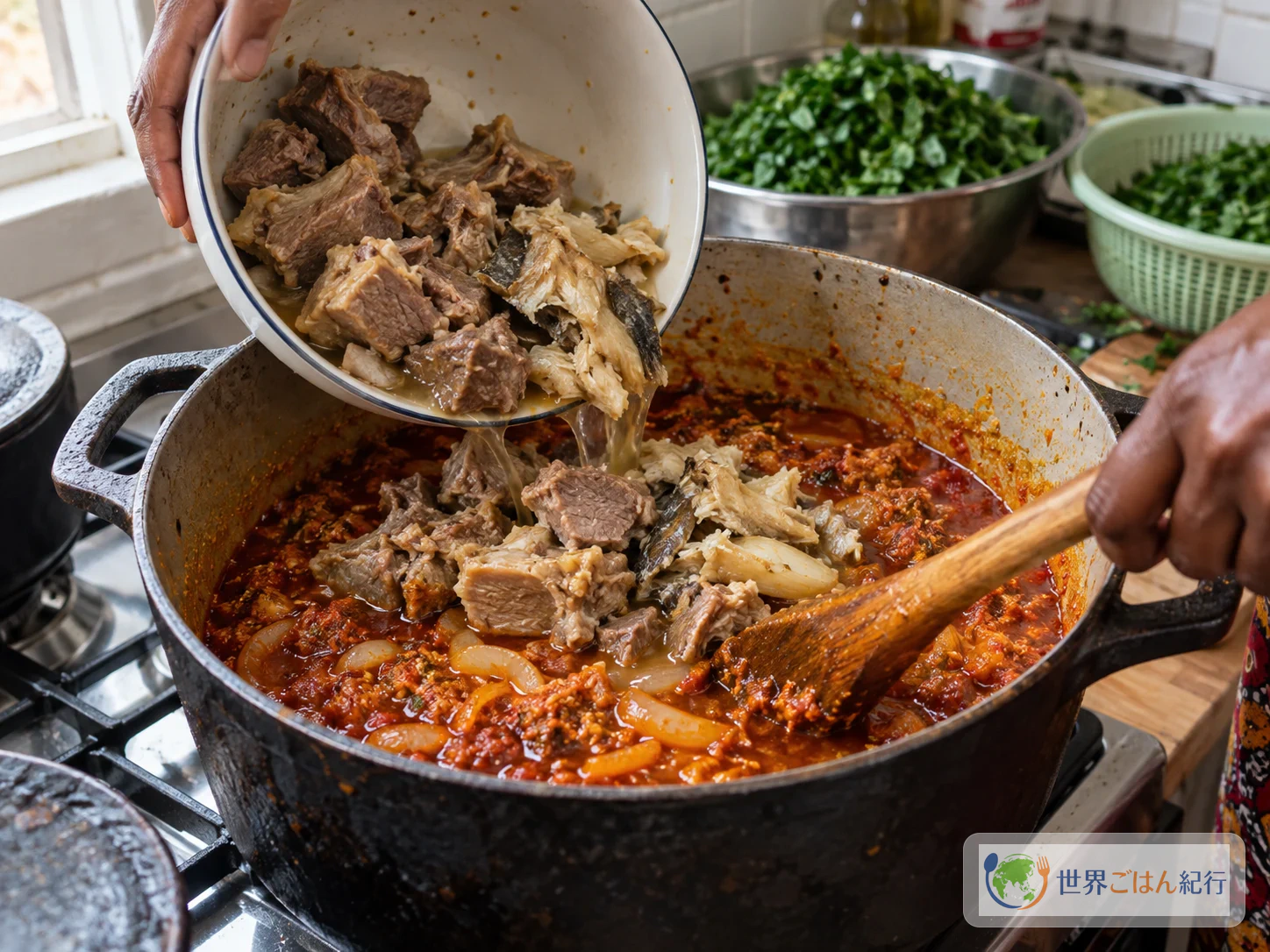
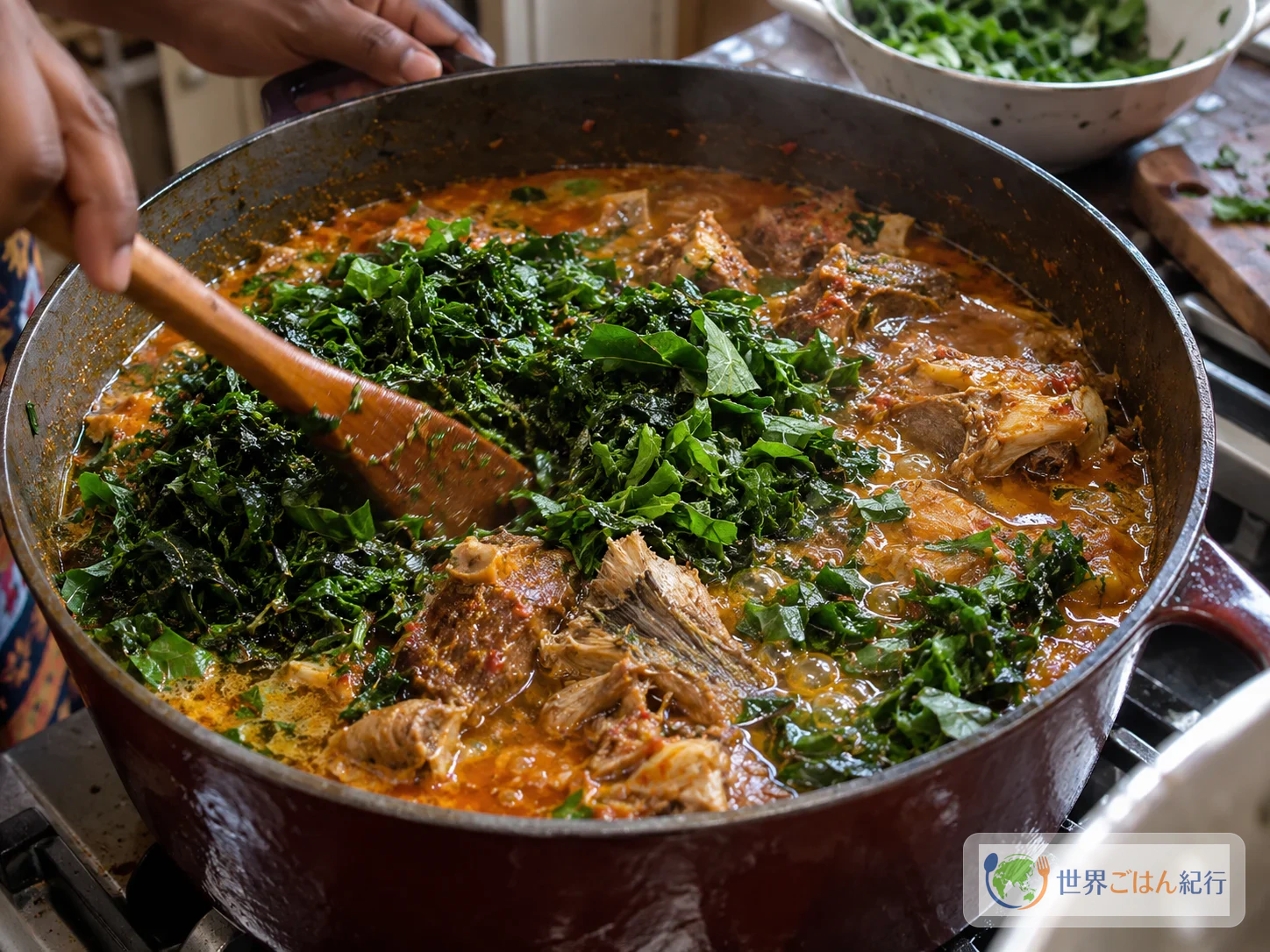
The local recipe runs: simmer beef and kanda in a small amount of water, add dried fish, add red palm oil, dried crayfish and chili, and when it boils add the leaves and periwinkles, adjust the salt and simmer about 5 minutes. The steps below divide this into four stages so it is easy to reproduce in an ordinary pot: pre-simmering, aromatic oil, seafood and leaves. Don't rely only on thermometer figures for the heat; adjust by the fineness of the bubbles, the aroma, the color of the leaves, the trail of the wooden spoon and how much broth remains. Proceed intending to not rush on high heat, and let the leaves stand up at the end.
Adjust the Distance of the Table with Staples and Substitutes
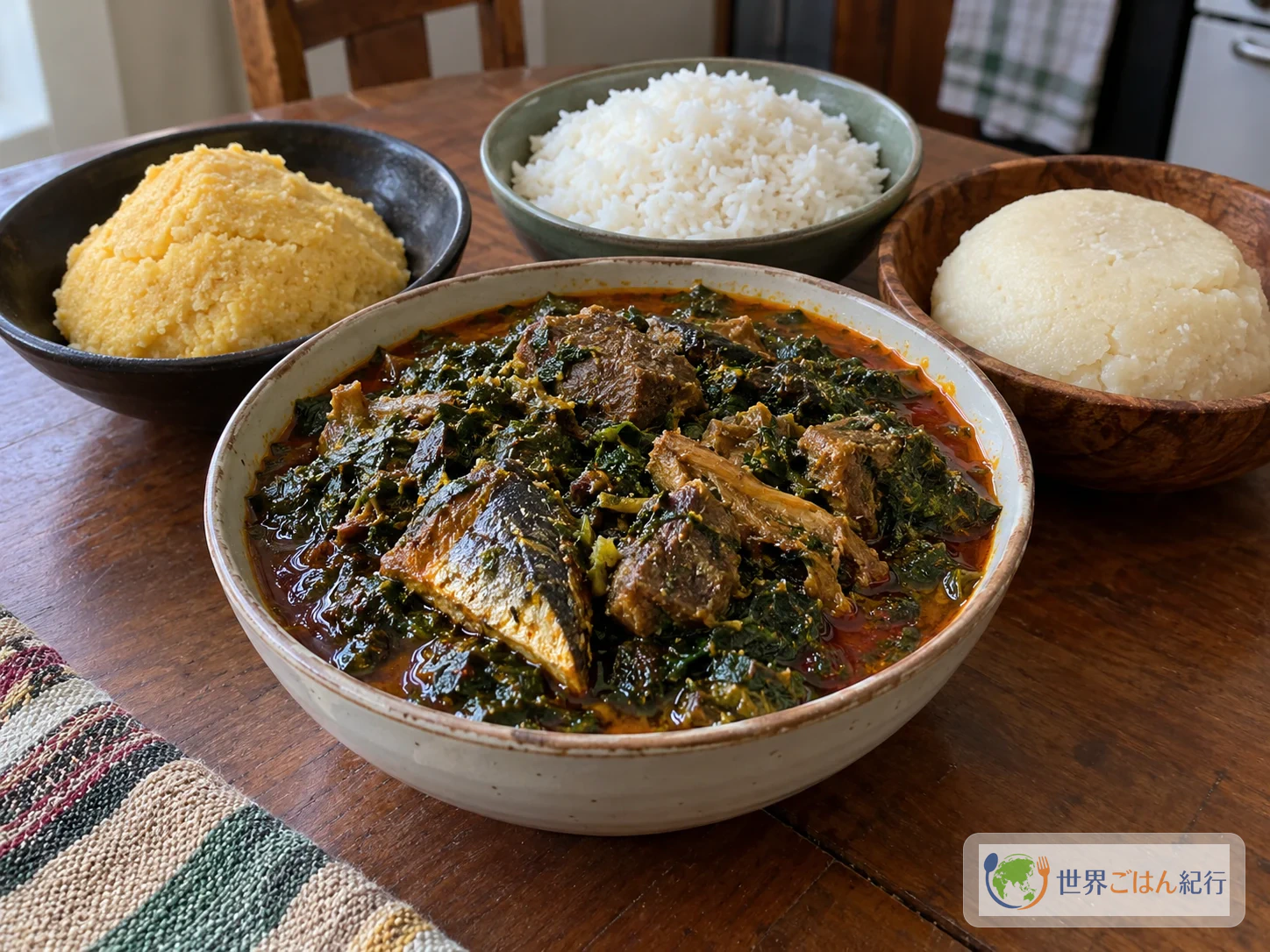
How you choose ingredients changes depending on whether you move toward the authentic flavor or make it casually as a dinner. For waterleaf, the sources name lamb's lettuce as a substitute, and if ease of getting it is the priority you can also make it with spinach, but the moisture, stickiness and aroma change. What you change is the periphery; what you keep are the leaves and the oil. If either the afang/okazi leaves or the red palm oil changes, it moves closer to a different leafy-green stew. Periwinkle, kanda and ogiri can be omitted, but the texture, aroma and saltiness change. The heat is strong at the standard amount of Cameroon pepper, so start with 2 to 5g chili and add later. For the staple, eba or fufu is closer to the local style, white rice suits a weeknight, and in both cases the guide is a thickness that can be scooped up.
| What to change | Closer to authentic | A realistic choice elsewhere | What changes |
|---|---|---|---|
| Waterleaf | 250g waterleaf | 250g lamb's lettuce, or 250g spinach | Moisture, stickiness, green aroma |
| Form of the afang | Fresh leaves, shredded | Dried afang/okazi rehydrated as labeled | Firmness changes with how it is rehydrated. Follow the bag |
| Seafood savoriness | Stockfish, dried fish, crayfish | 70g hard dried fish and 2 tbsp dried shrimp | Strength of aroma and saltiness. Check the small bones |
| Shellfish texture | 80g periwinkle | Omit | The mouthfeel gets lighter. Omission is required for a shellfish allergy |
| Fermented aroma | 15g ogiri | Omit | Less depth of aroma. The pot works without it the first time |
| Staple | Eba, semolina fufu, cassava fufu, amala, yam | White rice, mixed-grain rice | The texture and way of scooping change |
Reading about other dishes that use okazi, and how to make the staples that scoop up thick soup, will also help you see the difference.
Dishes to read next
- Egusi soup (in Japanese): another dish that uses okazi, and how it differs from a pot thickened with seeds
- Banga soup (in Japanese): the next dish to compare southern Nigerian palm oil soups
- Fufu: the texture and method of the staple that scoops up thick soup
Fix Scorching, Thinness and Fishy Aroma Midway in the Pot
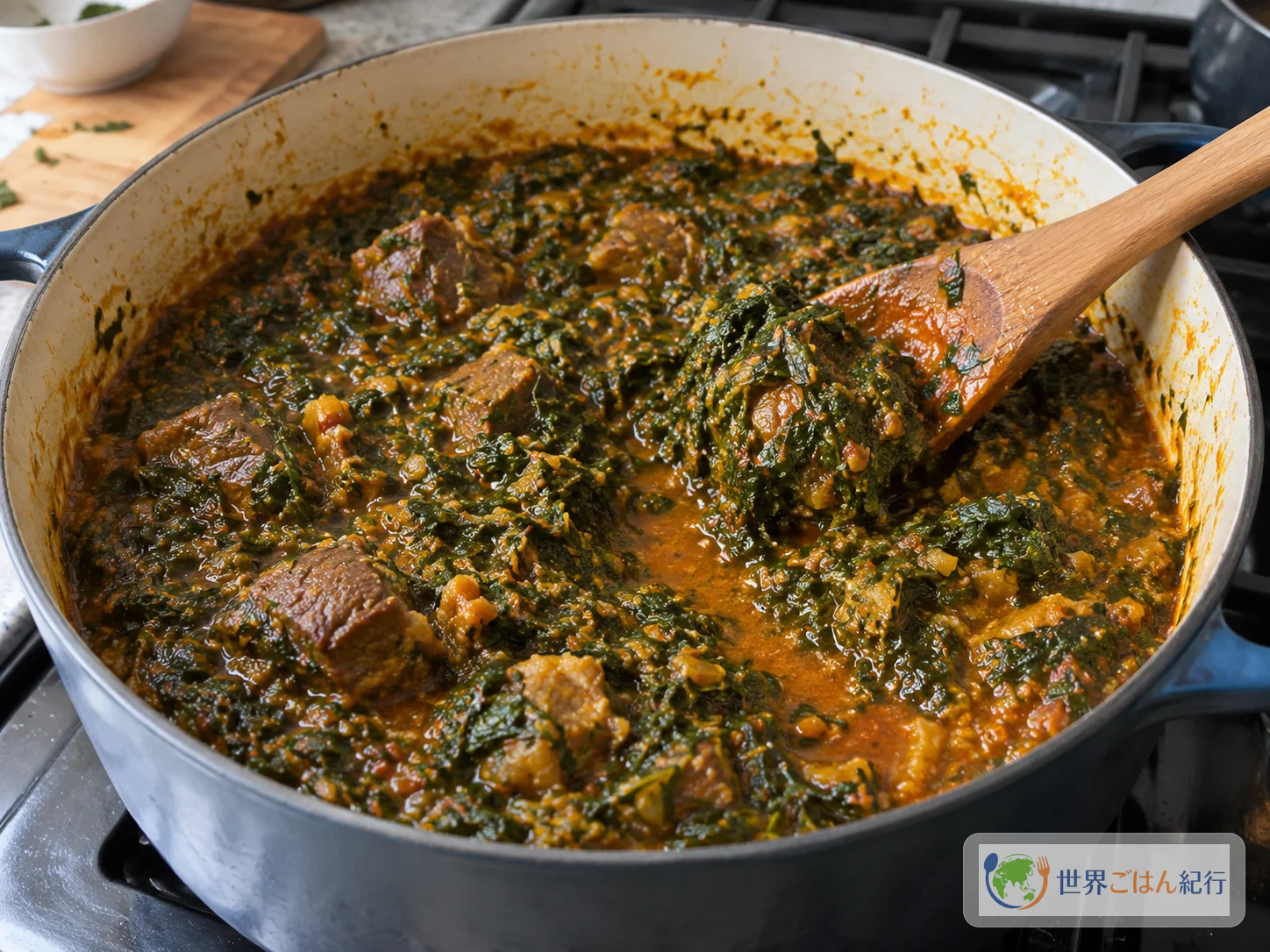
Even if the pot seems off, you can often fix it by tracing the cause from how it looks. Scorching happens when the red palm oil was heated until it smoked, or when moisture was driven off over high heat after the leaves went in. Move the clear upper part to another pot and don't stir the scorched bottom. Wateriness is from the moisture of waterleaf or spinach; take off the lid and reduce it for only 3 to 5 minutes over medium-low heat. Hard leaves are caused by cutting the afang thick or not rehydrating the dried leaves enough. Add 50ml boiling water and check each time, 2 minutes at a time. When the oil is heavy, it is often that red palm oil went in at the upper limit and the broth is small; add boiling water 1 tbsp at a time and let the leaves and meat hold the oil. A fishy aroma that is too strong comes from the dried fish, stockfish and dried shrimp stacking up. Next time, halve the seafood and keep the amount of meat stock and leaves. Don't try to hide it by adding aromatics to this pot. When the taste is thin, don't add salt all at once; reduce the broth first and then adjust 1/4 tsp at a time. If you remember don't stir a scorched bottom, take off the lid for thinness, you won't panic.
| Condition | How to tell | How to fix it |
|---|---|---|
| The bottom of the pot scorched | A bitter smell, a black film on the bottom | Move only the upper part to another pot and restore the thickness with 50ml boiling water. Don't scrape the bottom |
| The broth is watery | The trail of the wooden spoon disappears at once | Take off the lid and cook 3 to 5 minutes over medium-low heat. Stop before the leaves fall apart |
| The leaves are hard | The afang fibers are hard to bite through | Add 50ml boiling water and check at 2-minute intervals over low heat |
| Oil floats on the surface | A thick layer of red oil remains | Add boiling water 1 tbsp at a time and stir, slightly increasing the broth |
| The seafood aroma is strong | Only the aroma of dried fish stands out | Add no more seafood, and adjust with a little hot water while keeping the leaves and beef |
| Too salty | The dried fish, dried shrimp and cube stacked up | Add a little unsalted broth, and if you can add leaves, disperse the salt with shredded leaves |
The way to judge when to turn off the heat is color, thickness and aroma. For color, it hasn't darkened, and the red-orange oil and deep green leaves remain. For thickness, it doesn't fall from the spoon like water but makes a short ribbon as it returns to the pot. For aroma, the red palm oil and the dried fish don't poke out separately, and the green aroma of the leaves is what remains at the end. Even if one of them is lacking, don't extend the simmer too long. The longer it cooks, the more the color and aroma of the leaves drop.
Storage and Frequently Asked Questions
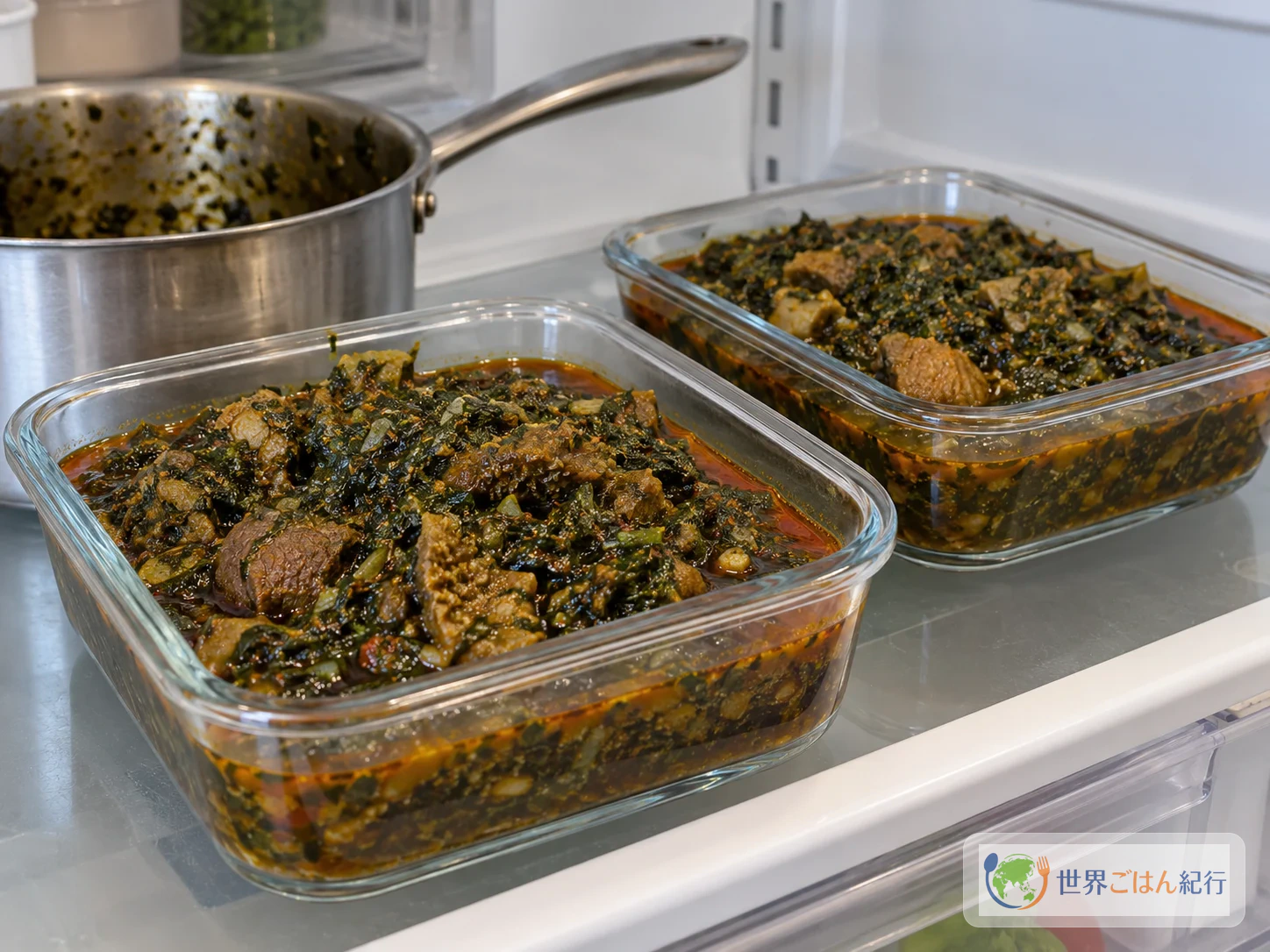
How do I refrigerate and reheat it?
Don't leave it at room temperature long once the heat is off; divide it into shallow containers and refrigerate. Reheat it thoroughly too, to at least 75°C at the center as the ministry's guide says. Avoid leaving it in the pot for a long time, and if you are unsure about the smell or appearance, discard it without eating. The next day the broth will have thickened, so warm it over low heat, adding 1 to 2 tbsp boiling water at a time and stirring. For how many days to keep it, give priority to your household's cooling and refrigeration conditions and the product labels.
Is the dried afang/okazi the same amount as fresh leaves?
Don't mechanically convert 400g of fresh to a weight of dried. Follow the rehydration method and time printed on the bag, check the firmness afterward, and rehydrate more if it is hard. The search terms to look for are "Afang," "Okazi," "Ukazi" and "Gnetum africanum." Don't use the soaking liquid from dried leaves as the pot's water as a rule.
Can I substitute spinach alone for waterleaf?
Lamb's lettuce is a substitute given in the sources, while spinach is a substitute in this adaptation, prioritizing availability elsewhere. Spinach differs from waterleaf in moisture and stickiness, so don't add all 400ml of water from the start; add it while watching. Even with the substitute, as long as the afang/okazi leaves and red palm oil remain, the backbone of the dish is kept.
What if I can't find periwinkles?
You can leave them out. The texture of the shellfish is gone, but it still works as a pot of leaves, meat, seafood stock and red palm oil. If you have a sea snail or crustacean allergy, don't use them. Check for shell fragments and small bones, and remove them when serving to children and the elderly.
Can I make it with the red palm oil cut to 150ml?
You can cut it to 150ml, but it departs from the local recipe's 20 to 25 cl, so the color, aroma and cohesion of the broth weaken. If you switch to a neutral oil such as rice bran oil, you are enjoying a different dish, a leafy-green stew of afang. Remember the thought again: if it's just one dish, pass; if you will make several West African dishes, buy a small bottle.
The nutrition values given in the frontmatter are approximations from dividing this design for four into four equal parts. They change with the product, the amount of oil, the cut of beef, the staple and the salt. Afang and red palm oil are not treated as grounds for health effects. Take the numbers as a guide, and confirm taste and safety by the state of the pot.
Sources
- All Nigerian Recipes "Afang Soup Nigerian Recipe" (accessed and checked: 30 September 2026)
- Nigerian Journal of Nutritional Sciences, Vol. 42 No. 1 "Standardization and Proximate Contents of Selected Commonly Consumed Nigerian Soups and Dishes" (accessed and checked: 30 September 2026)
- Okerulu and Onyema (2015) "Comparative Assessment of Phytochemicals, Proximate and Elemental Composition of Gnetum africanum (Okazi) Leaves" (accessed and checked: 30 September 2026)
- Eugene E. Ezebilo "Conservation of a leafy vegetable important for communities in the Nigerian rainforest" (accessed and checked: 30 September 2026)
- Ministry of Health, Labour and Welfare of Japan, "Preventing food poisoning at home" (in Japanese) (accessed and checked: 30 September 2026)