
Uganda's Katogo, Starting From a Morning Pot
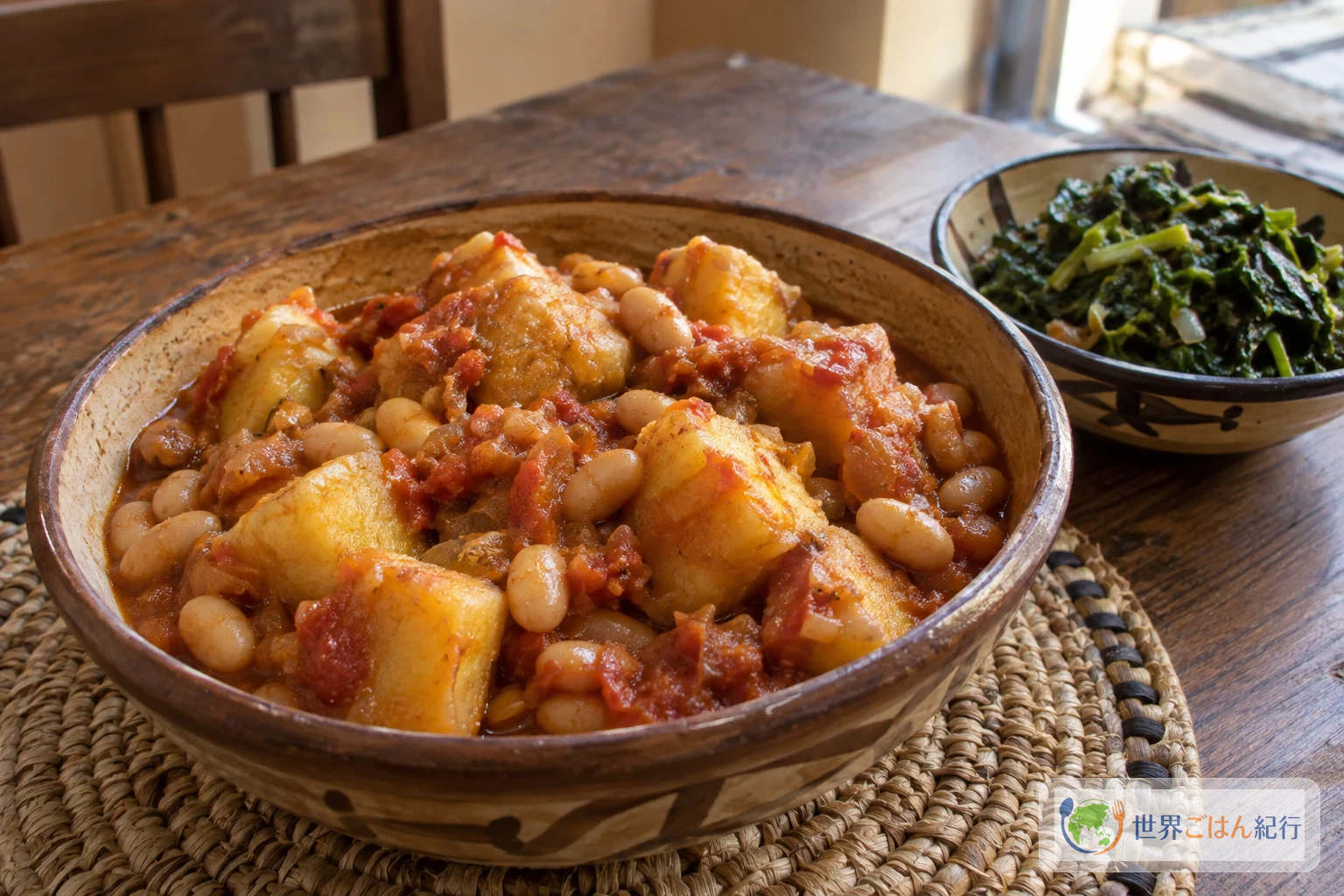
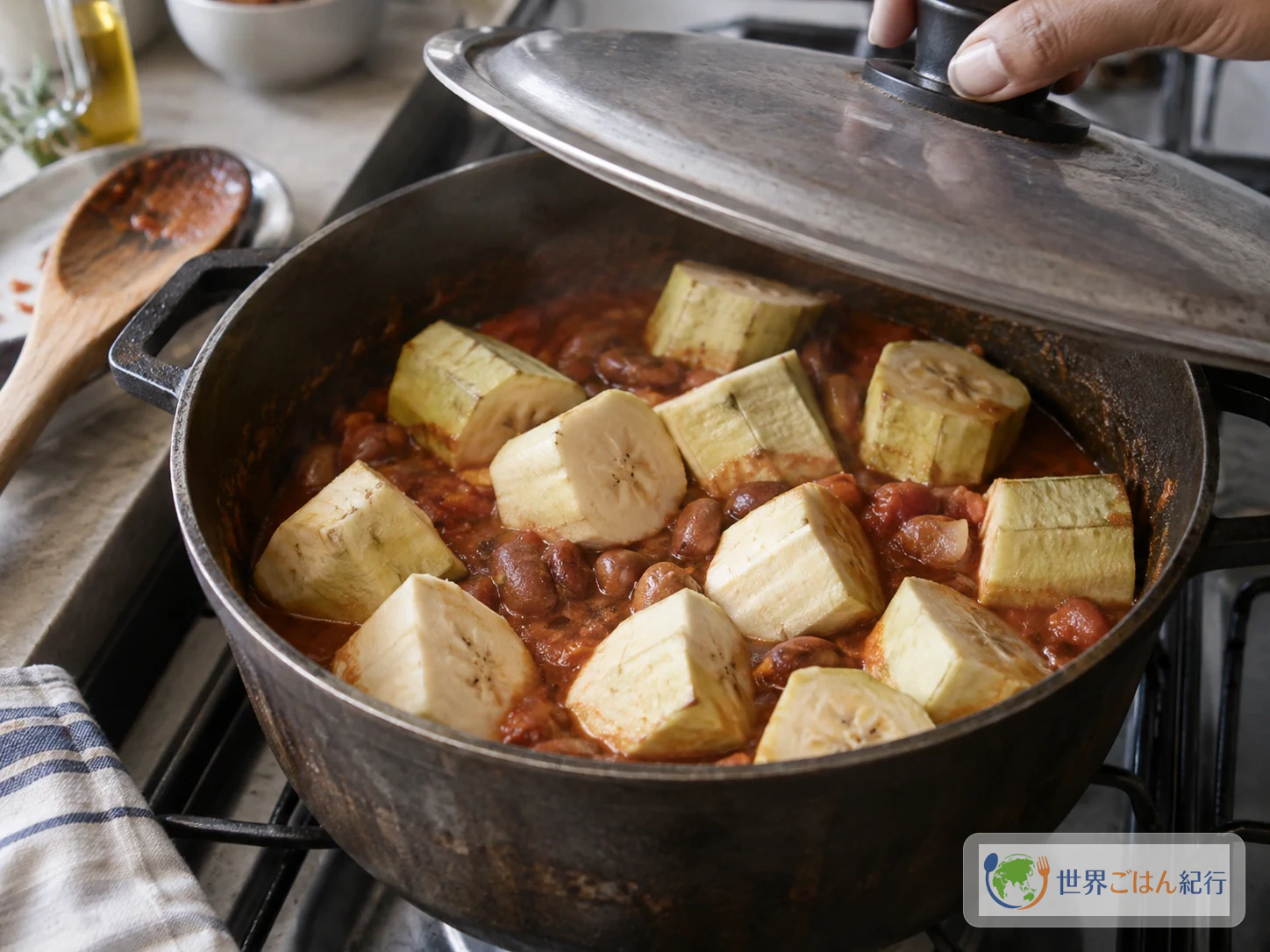
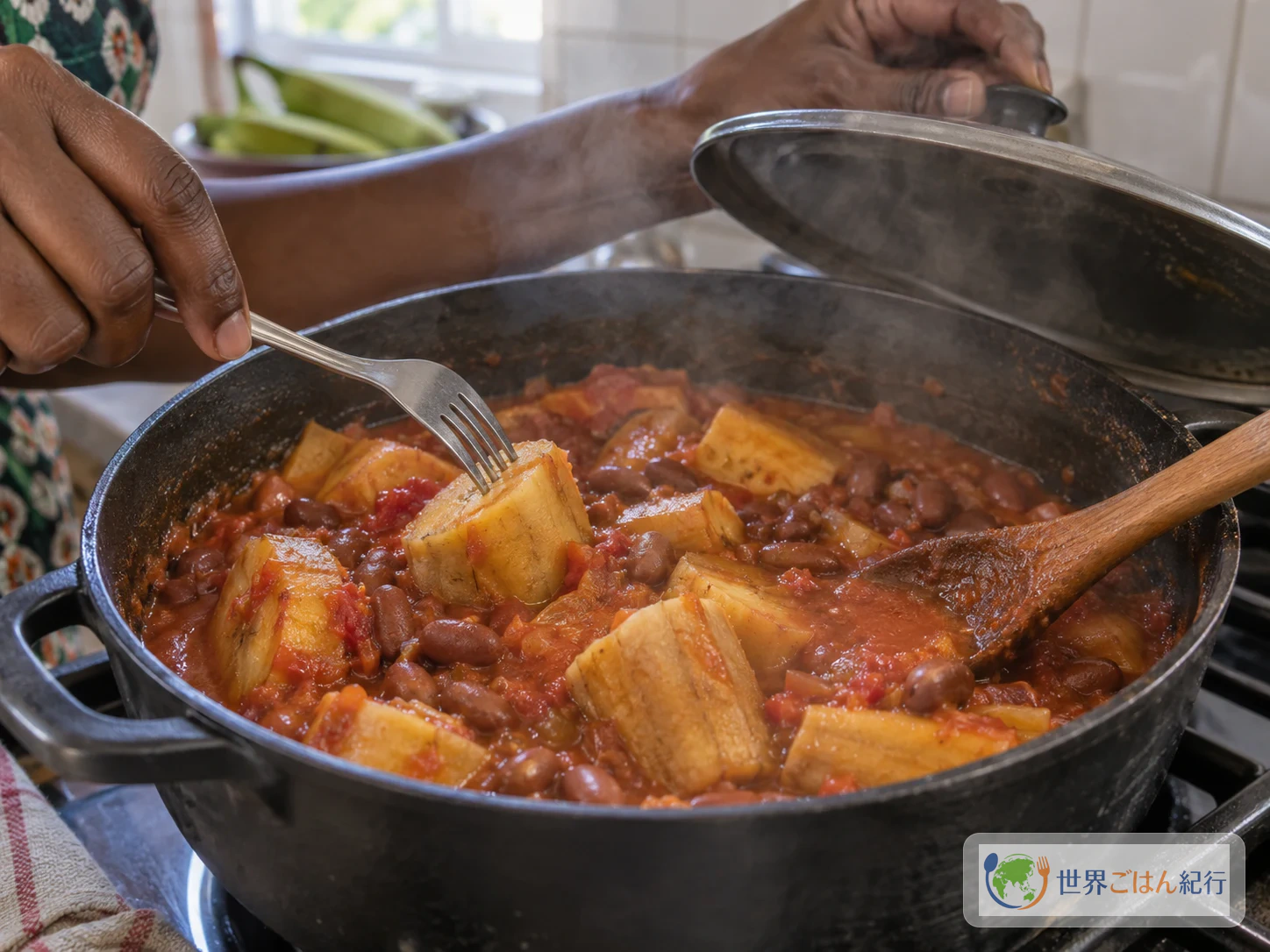
On a Ugandan morning, the lid of a big pot at the back of a canteen is lifted. In the steam you see the pale cut faces of green cooking bananas with their peels removed, a red stew where tomato and onion have melted down, and beans sunk into it. These are firm, floury green bananas, nothing like the sweet ripe dessert banana. The greatest charm of the dish is that the staple and the sauce go into the morning pot together.
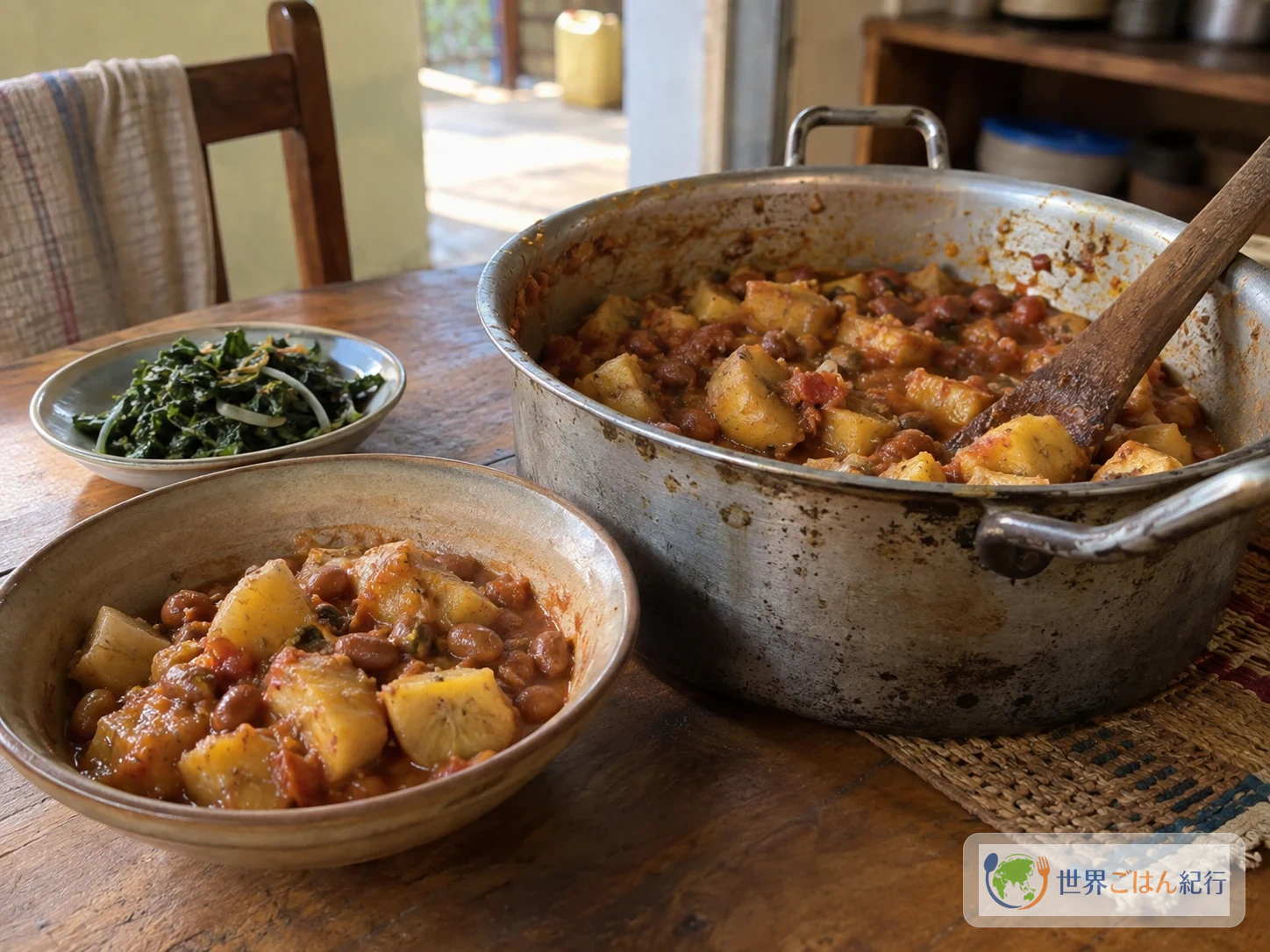
Katogo (Katogo / Katoogo) is a name for a dish that means "a mixed thing." The Daily Monitor explains it as a dish in which the staple and the sauce are cooked in the same pot, with matooke as a common axis. It is often spoken of as a breakfast, especially at tables in Buganda and western Uganda, but it is also a dish spread across the regions of Uganda. In other words, there is no single fixed recipe; it is best understood as a one-pot dish whose ingredients change around matooke.
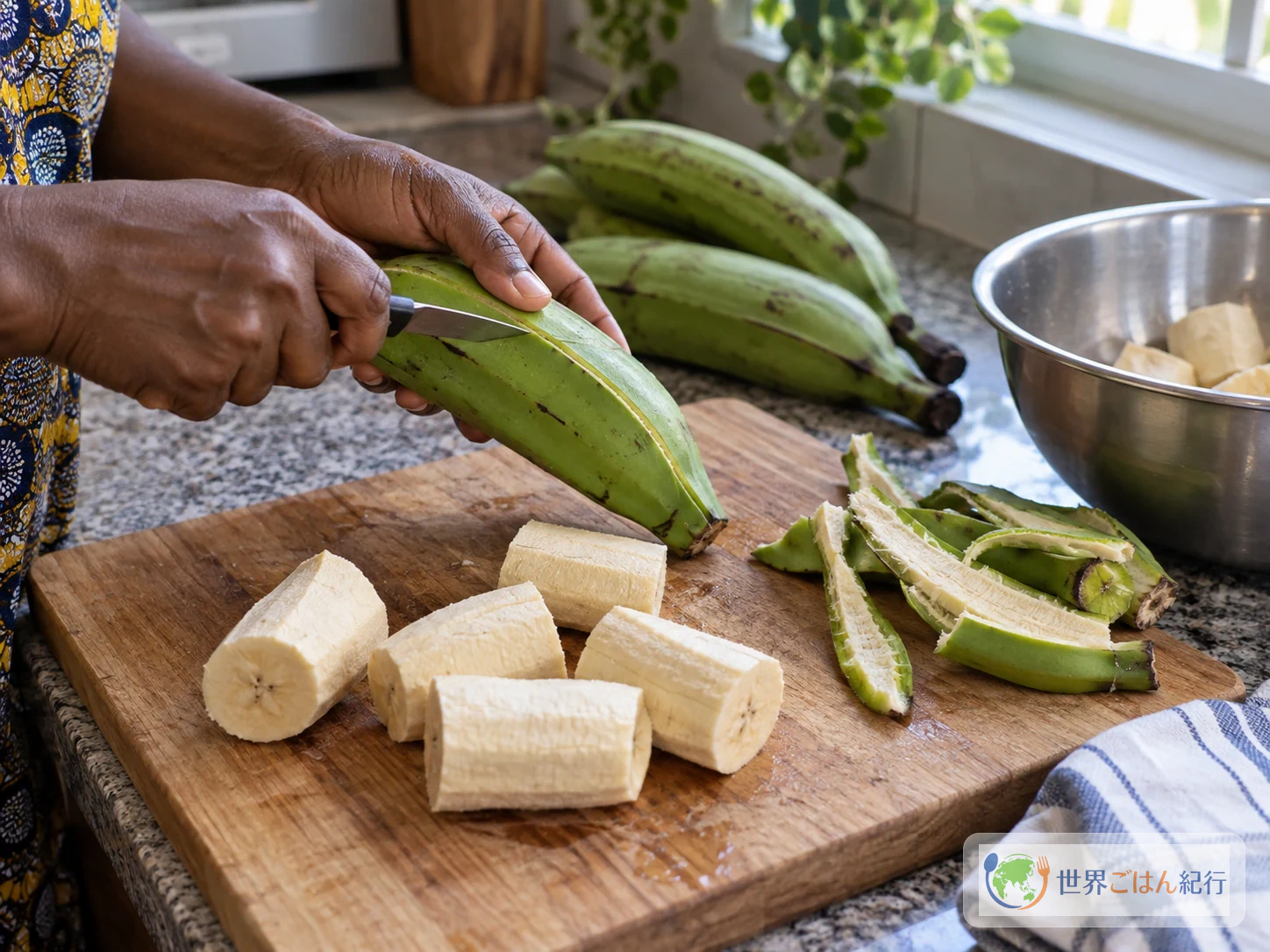
What we make in this article is a katogo with beans for 4 servings. The star, matooke (matooke / matoke), is a green cooking banana, and its use differs from that of the yellow, ripe dessert banana. Look for it under general names such as "cooking banana," "green plantain" or "plantain." Choosing green cooking bananas, not yellow ones, is the entrance to this dish. The recipe is an editorial reconstruction that uses cooked beans to skip the soaking time. If you are curious about matooke as a steamed and mashed staple, take a look at the matooke article too.
Both Katogo and Katoogo are found for the dish name, and both matooke and matoke for the staple. In this article, the dish is written katogo and the staple matooke, with local spellings given on first mention. When searching, trying alternate spellings helps, but a difference in spelling cannot be taken to mean a different dish.
From Buganda Out to the Regions: The Katogo Table
The Masaka City food and culture page lists, as a Buganda dish, katogo that combines matooke, cassava, sweet potato or yam with beans. The Daily Monitor, for its part, places it as the breakfast of Buganda and western Uganda and a dish common to the regions of Uganda. It cannot be said to belong only to Buganda, nor to be exactly the same everywhere. It is a dish whose form changes with the combination of the staple side and the sauce side.
| Combination | Position confirmed in local sources | How it is handled in a home kitchen here |
|---|---|---|
| Matooke + beans | The bean version found on the Buganda food culture page and in local recipes | The main recipe here. Cooked beans reduce the work |
| Matooke + byenda | The Daily Monitor's katogo-byenda. Byenda is a term for offal including tripe and sweetbread | Not mixed into the main recipe; explained in regional differences and the FAQ |
| Cassava / sweet potato / yam + beans | Other staples introduced as Buganda dishes | A separate line for days without bananas. Not treated as the same flavor as the matooke version |
| Matooke + onion, tomato, salt, water, ghee | The simple katogo composition appearing in a matooke cooking article | Ghee can be replaced by vegetable oil. Adding beans gives it substance as a main dish |
Locally, root vegetables other than matooke also serve as the staple side, and the sauce side includes not only beans but meat, groundnuts and leafy greens. The name katogo alone does not fix the ingredients; there is range depending on the household, region and what is available. Even with the same name, the contents of the pot change the look of the breakfast. This time I focused on the combination of cooking bananas and beans, because the materials are easy to gather and the changes in the texture of the bananas and the beans are easy to tell apart.
Let me also touch on the difference from steamed matooke. Matooke is steamed for a long time supported by leaves and stems so the water does not touch the food directly. The Daily Monitor presents a braised katogo as more realistic than a long steaming process when cooking for few people. Katogo is not a dish that reproduces steamed matooke; it is a different method that finishes the staple and the sauce in one pot. You could say it is a dish that chases the fragrance of the leaf versus a dish that holds the pot's liquid. For a dish that wraps meat and sauce in banana leaves, there is another Ugandan dish, luwombo.
Byenda is explained in the Daily Monitor recipe as tripe and sweetbread. The English word offal is a broad term for organ meats in general, so it seems better not to take byenda as the name of a single cut. The main recipe here uses beans, and this article does not go into preparing raw offal or the conditions for selling it.
At the breakfast table, the Daily Monitor presents katogo as a breakfast, and Viva! Uganda shows the bean version as a warm dish. The staple and the main are not split onto separate plates; the stew clings to the cooking bananas on one plate. The staple catching the bean liquid is what is interesting about this dish. But tomato, onion, beans and banana alone are a little heavy, so I composed it so that greens or cilantro are added at the finish.
Ingredients (serves 4)
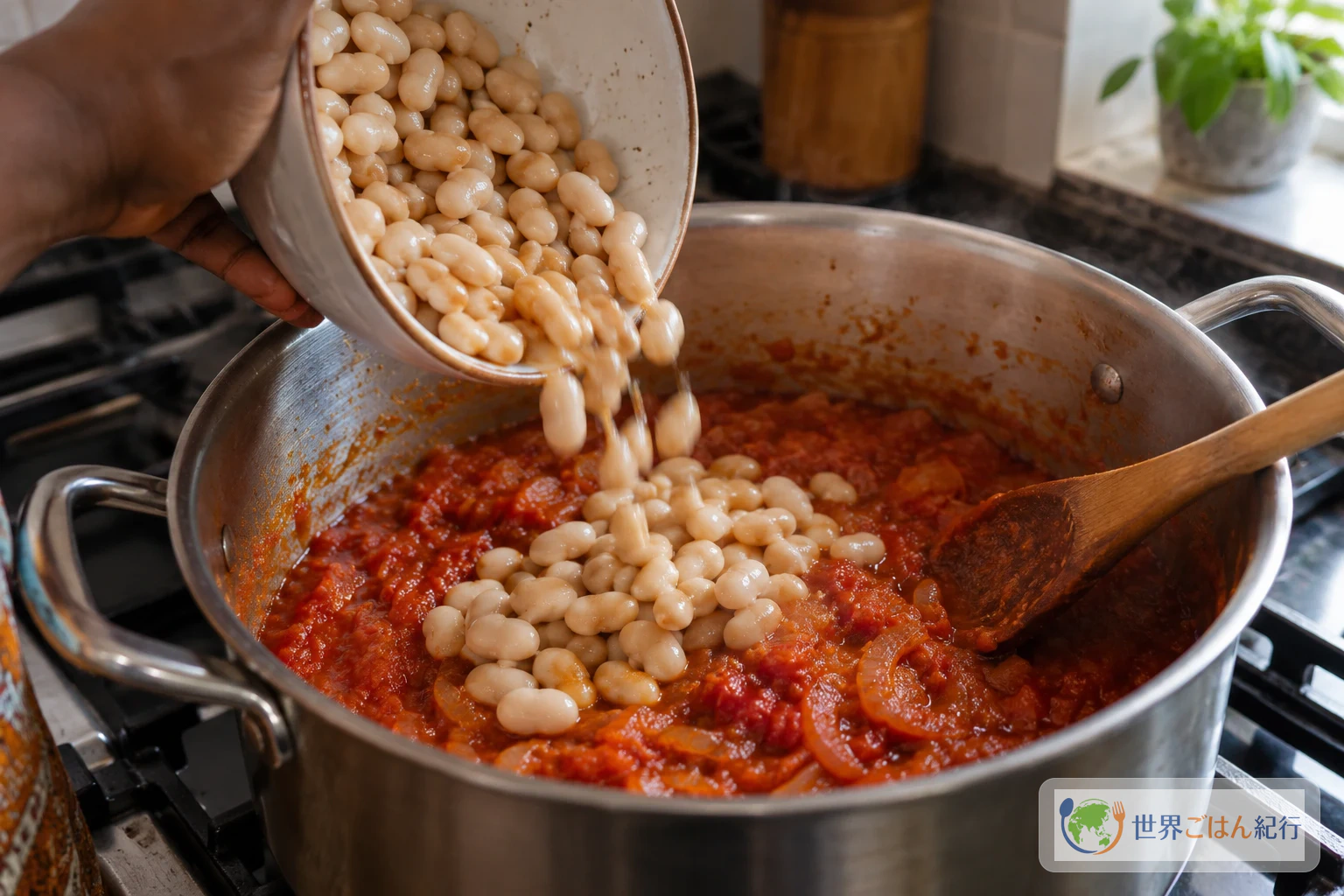
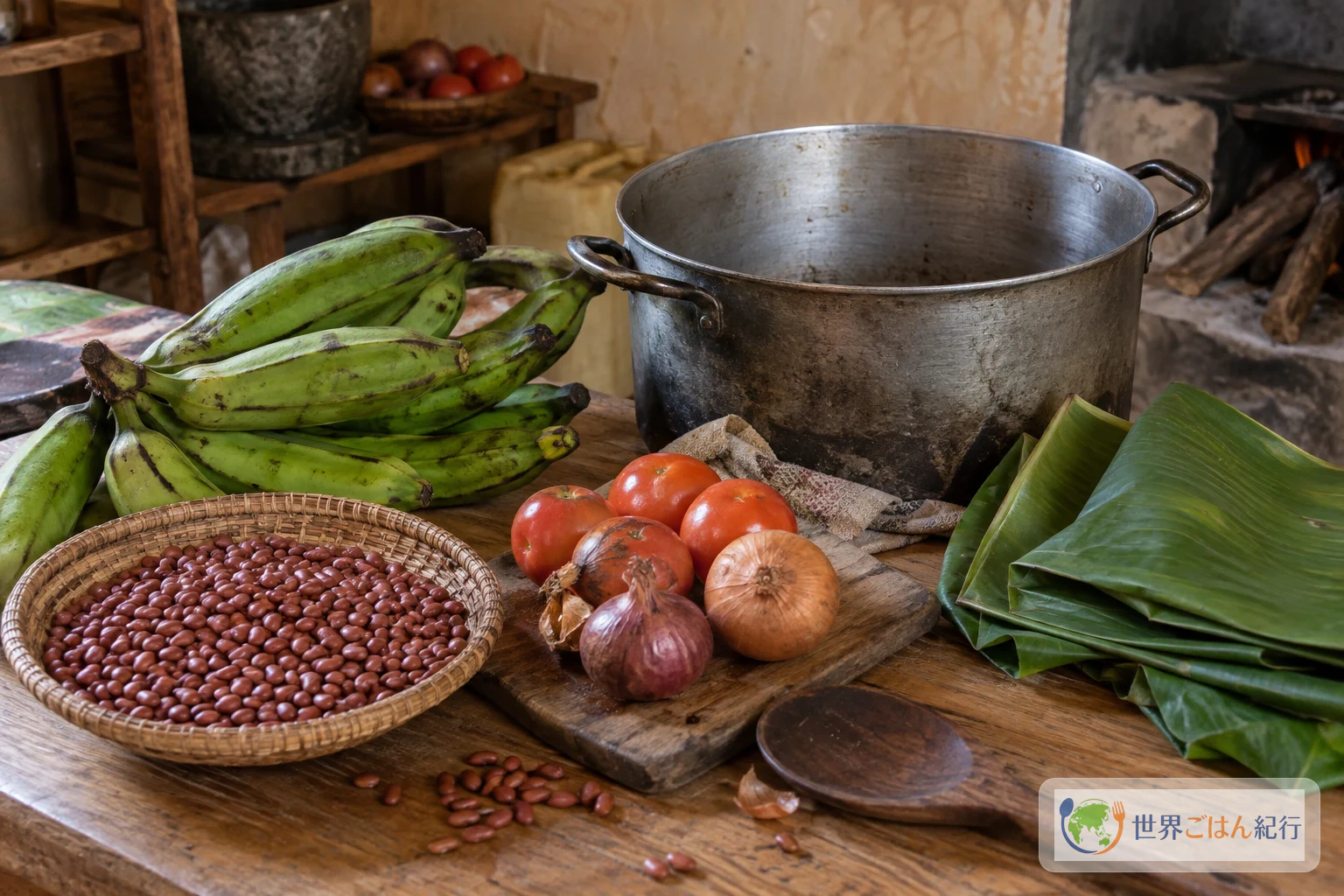
Viva! Uganda's bean version is made of 10 matoke, 500 g of raw beans, onion, tomato, oil, salt and water. The quantities for 4 below are an editorial adaptation of that combination, converted to weight with peel and weight of cooked beans so they are easy to handle at the shop. Do not substitute sweet yellow bananas for green cooking bananas, because ripeness changes both texture and sweetness. Choose cooked beans that are unsalted or low in salt, and drain the canning liquid before using. If you use raw beans, soften them in a separate pot and then bring them into the same steps. Think of the cooking bananas as the thing to track down, and the beans and aromatics as what you gather nearby.
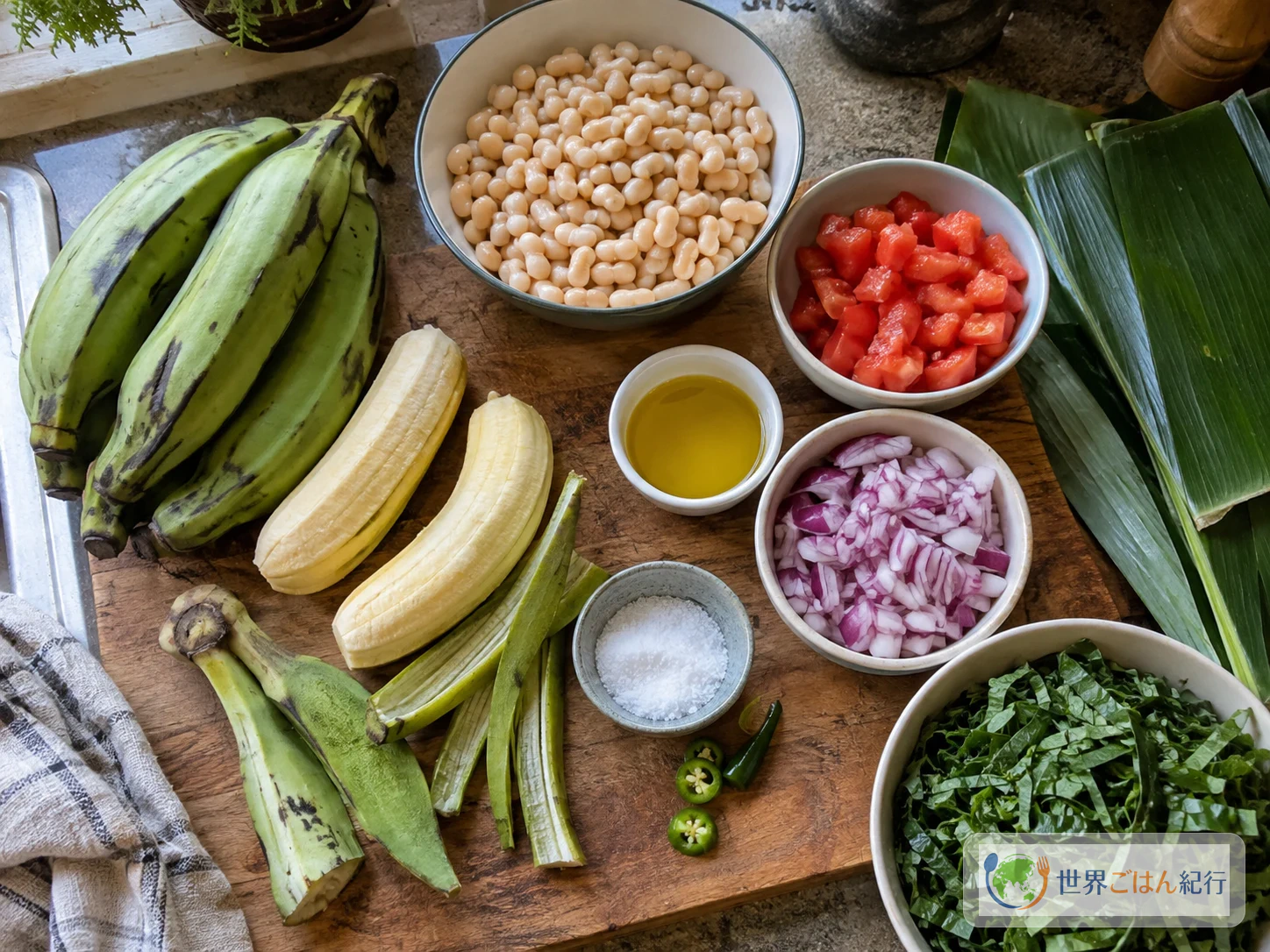
Look for cooking bananas under the general names "plantain" or "cooking banana." Beans, tomato, onion, greens and oil can be ordinary grocery items. Banana leaves are optional, an ingredient for when you want to add fragrance.
It uses beans, so do not serve it to anyone with a legume allergy. Ghee involves ingredient labeling of milk origin, so people avoiding dairy should replace it with vegetable oil and check the product label. For canned or packaged beans, ghee and vegetable oil, look at each product's ingredients and salt content.
Instructions
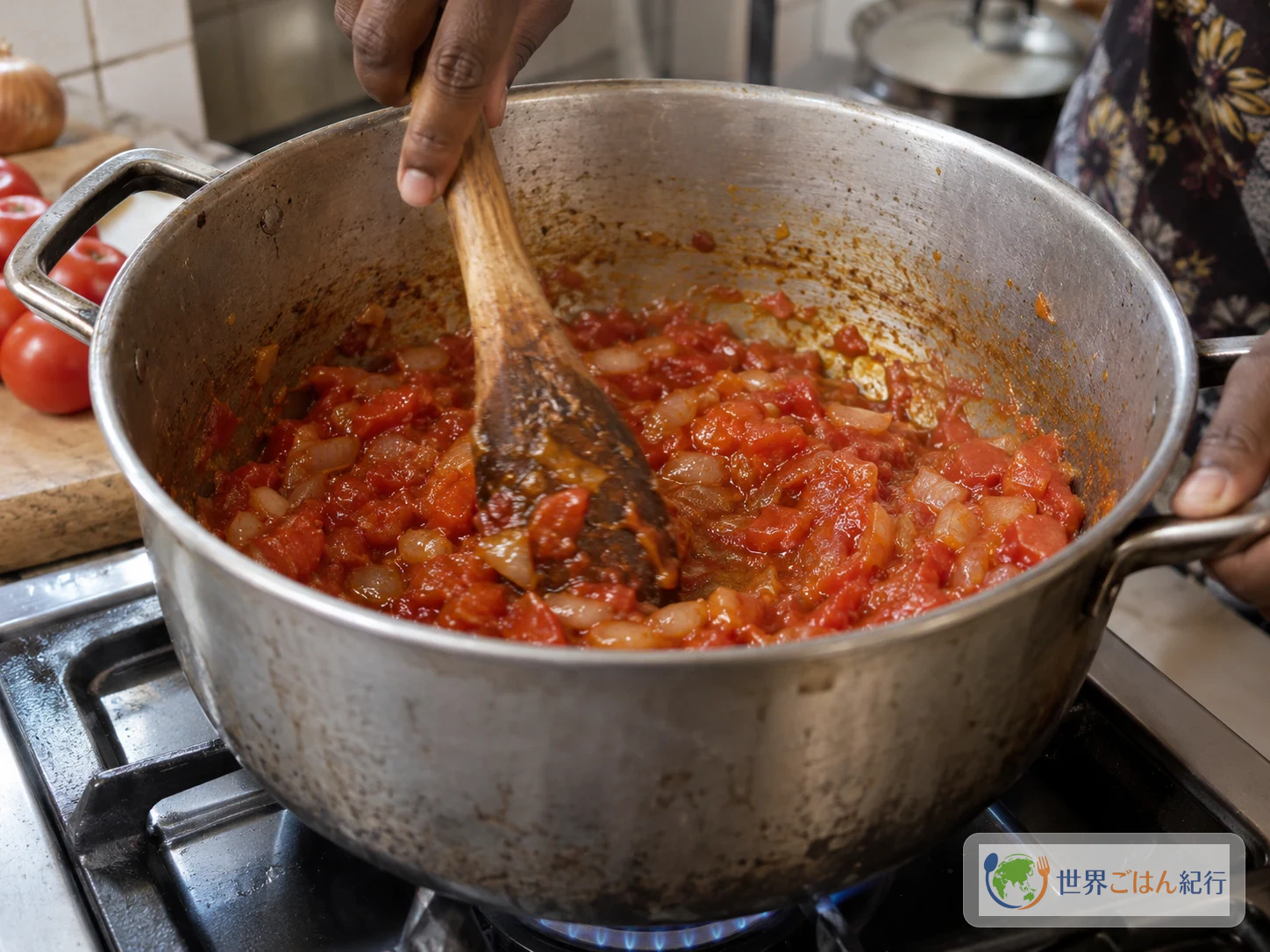
The steps are in 5 stages: preparation, aromatic base, beans, cooking bananas and finishing. Cut the cooking bananas first, make the tomato and onion base, warm the beans first, and then add the bananas. The goal is bananas soft in the center, warmed beans, and a liquid that has thickened while everything keeps its shape. Proceed with the idea of coating, not breaking down.
Three Tips for Restoring Heat and Texture
Three things tend to happen in the pot. When the cooking bananas are hard, check the amount of liquid and the lid, add 50 ml boiling water and cook 10 more minutes over medium-low. When the stew is thin, remove the lid and cook 3–5 minutes over low. Don't stir violently as if to crush the beans. When the bananas have broken down, turn off the heat and don't stir; next time keep the thickness at 4 cm and keep the extra cooking short. What you watch is not the clock but the color, the thickness and how the fork goes in. If you remember that dryness is fixed with boiling water, thinness with the lid off, and breakdown by stopping, you won't panic.
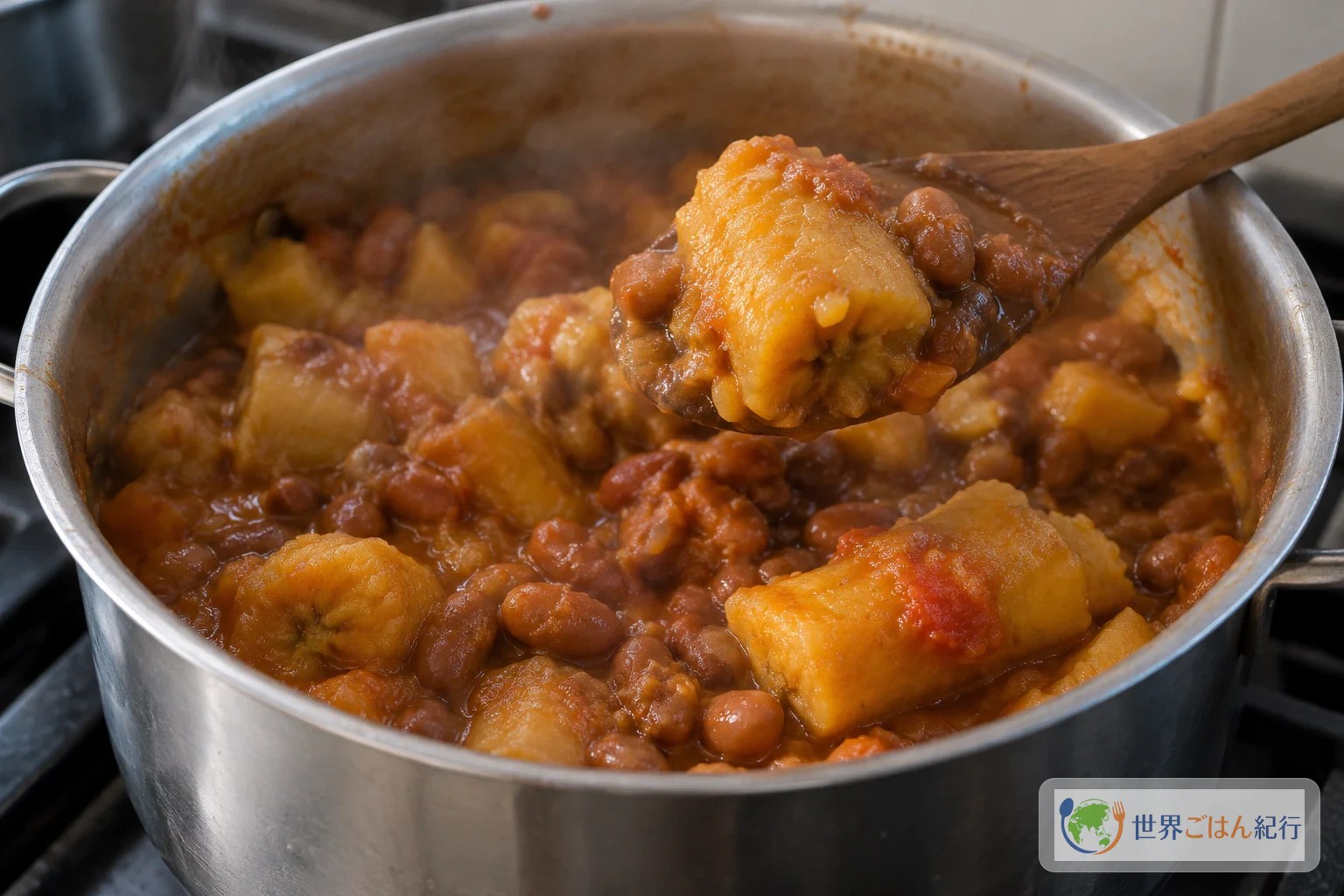
Don't add a lot of water at once; add boiling water 50 ml at a time. Cold water lowers the temperature, so avoid it. Extra cooking with the lid on makes things soft but increases steam and liquid. Extra cooking with the lid off reduces liquid but scorches the bottom more easily, so keep it low and short.
Following the guidance of Japan's Ministry of Agriculture, Forestry and Fisheries, do not leave leftovers in the big pot; divide them into shallow containers and cool them quickly. Refrigerate or freeze promptly, and when eating, reheat thoroughly to the center. Do not judge safety by smell, color or taste alone, and do not eat it if anything seems off. I cannot guarantee how many days it keeps. Give priority to room temperature, the container, the speed of cooling and the labels on the ingredients.
What to Put on the Breakfast Plate
The Daily Monitor treats katogo as a breakfast and shows a composition in which the bean recipe is served with greens and juice. Viva! Uganda also proposes a warm dish with cilantro or greens. The cooking bananas and beans are not split onto separate plates; you spoon up the staple that has taken on the tomato liquid. No staple is cooked separately; breakfast is complete in the pot. For a breakfast, putting the greens on a separate plate and juice as the drink balances the heaviness nicely.
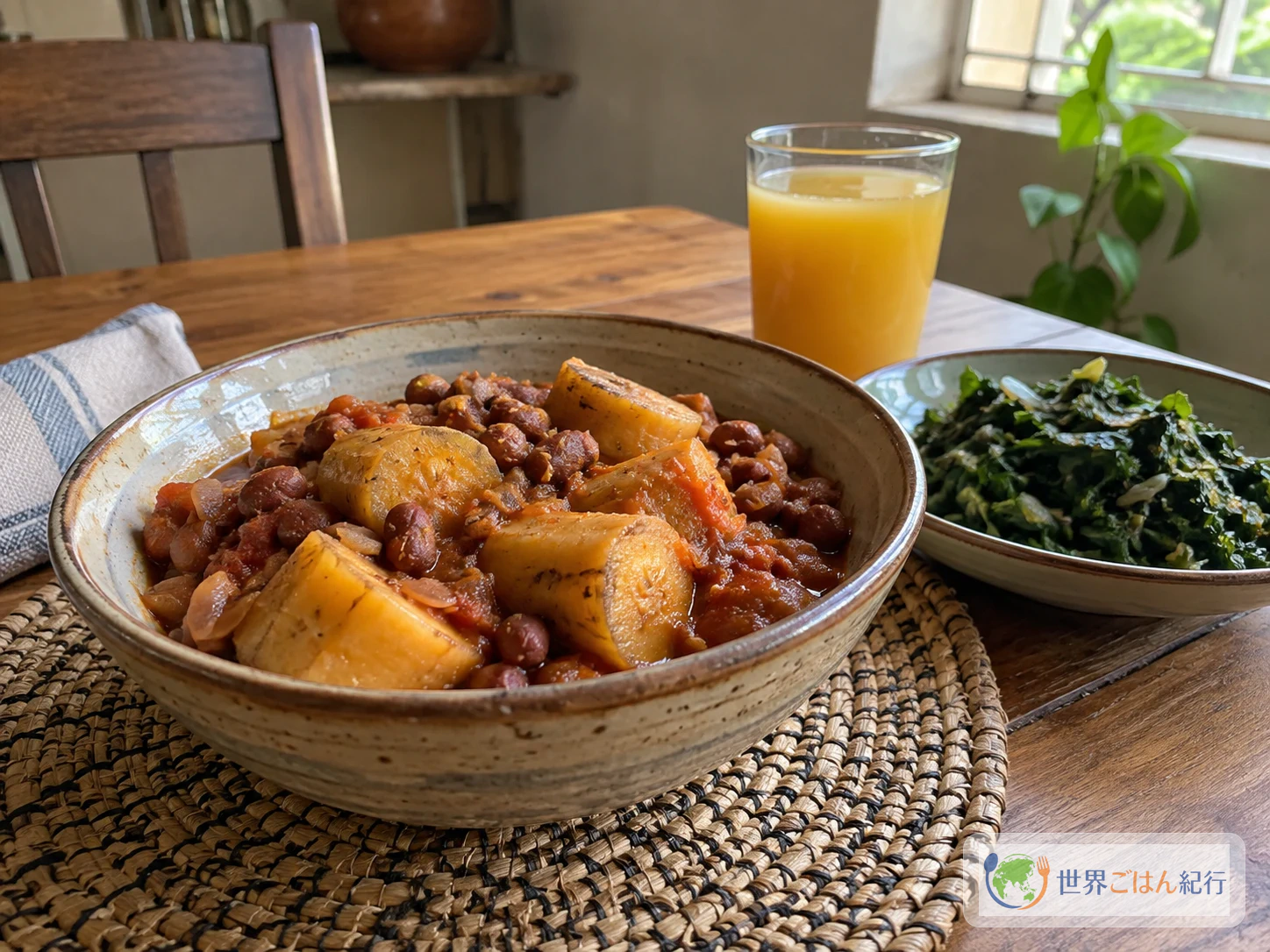
Here are some related Ugandan dishes. Matooke is the steamed and mashed staple side, while katogo is a dish simmered in the same pot as the sauce. Luwombo is a steamed dish that wraps meat or mushrooms in banana leaves, and the use of the leaf differs from katogo. Kikomando (in Japanese) is a street or home snack of chopped chapati with beans, and the form of the staple differs even at the same breakfast. Pot, leaf and chapati: the time of eating and the role differ a little each, and that is the interest of the Ugandan table.
Substitutes, Heat and Storage
What can I use if I can't find matooke?
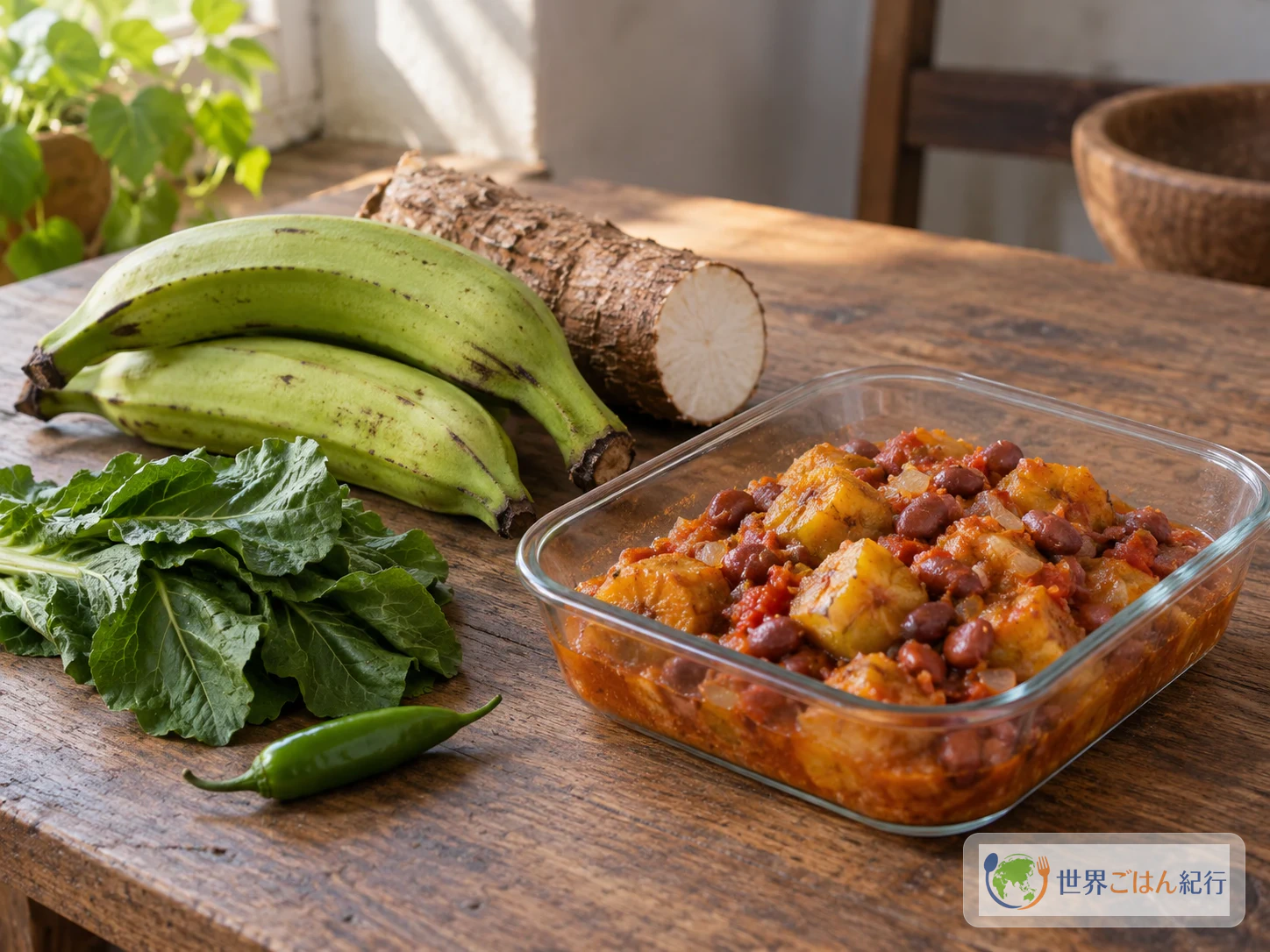
The first choice is green cooking bananas, that is, plantain. Choose firm ones suitable for cooking. Cassava and sweet potato are in fact other variations on the staple side of katogo, but they do not taste the same as the banana version. Yellow dessert bananas are too sweet and soft, so I don't use them as a substitute here. If you have no banana leaves, make the main recipe without leaves. That will not reproduce the leaf's aroma, however.
Is it still katogo if I replace the beans with meat?
In the Daily Monitor's definition, the sauce side extends to meat, beans, peas, groundnuts, leafy greens and others. The byenda version, combining matooke with offal, is a different local composition. If you recreate it, give priority to the labeling of prepared ingredients and the heating conditions. Changing from the bean version here to raw offal changes the simmering time, hygiene management and taste. Don't think of it as a simple swap in the ingredient table.
How do I add heat?
Green chili is an optional item in the ingredient table, one chili of about 5 g at most, added when the tomato goes in. Leaving the seeds in makes it hotter, so for the first time, taste starting from half. Even if you add heat, do not change the ripeness of the cooking bananas, the softness of the beans or the thickness of the stew.
Can I make it ahead?
Cool it briefly, divide into shallow containers and refrigerate or freeze. Do not leave it in the big pot at room temperature. Reheat only what you will eat, in a pot or microwave, thoroughly to the center. Refrigerated, the cooking bananas absorb the stew and become softer than on the first day. The next day, add a little water and warm over low heat. If you are unsure of the storage condition, or anything about the smell, color or taste seems off, throw it away without eating.
Sources
- Get to know what katogo is — Daily Monitor (accessed and checked 1 October 2026. Published 28 July 2018, updated 8 January 2021)
- RECIPE: Enjoy Katogo-byenda for breakfast — Daily Monitor (accessed and checked 1 October 2026. Published 18 June 2010, updated 3 January 2021)
- Hot tips on how to prepare matooke — Daily Monitor (accessed and checked 1 October 2026. Published 25 August 2018, updated 8 January 2021)
- Food and culture — Masaka City (accessed and checked 1 October 2026. Publication date not stated)
- Day 5: Lunch – Katoogo with Beans — Viva! Uganda (accessed and checked 1 October 2026. Published 20 May 2025)
- Nutrition- What is in matooke? — New Vision (accessed and checked 1 October 2026. Publication date not stated)
- Smart ways to use your refrigerator — Ministry of Agriculture, Forestry and Fisheries of Japan (in Japanese; accessed and checked 1 October 2026. Publication date not stated)



