Beijing Zhajiangmian: A Dark Bean-Paste Sauce You Mix Into Noodles and Vegetables Yourself
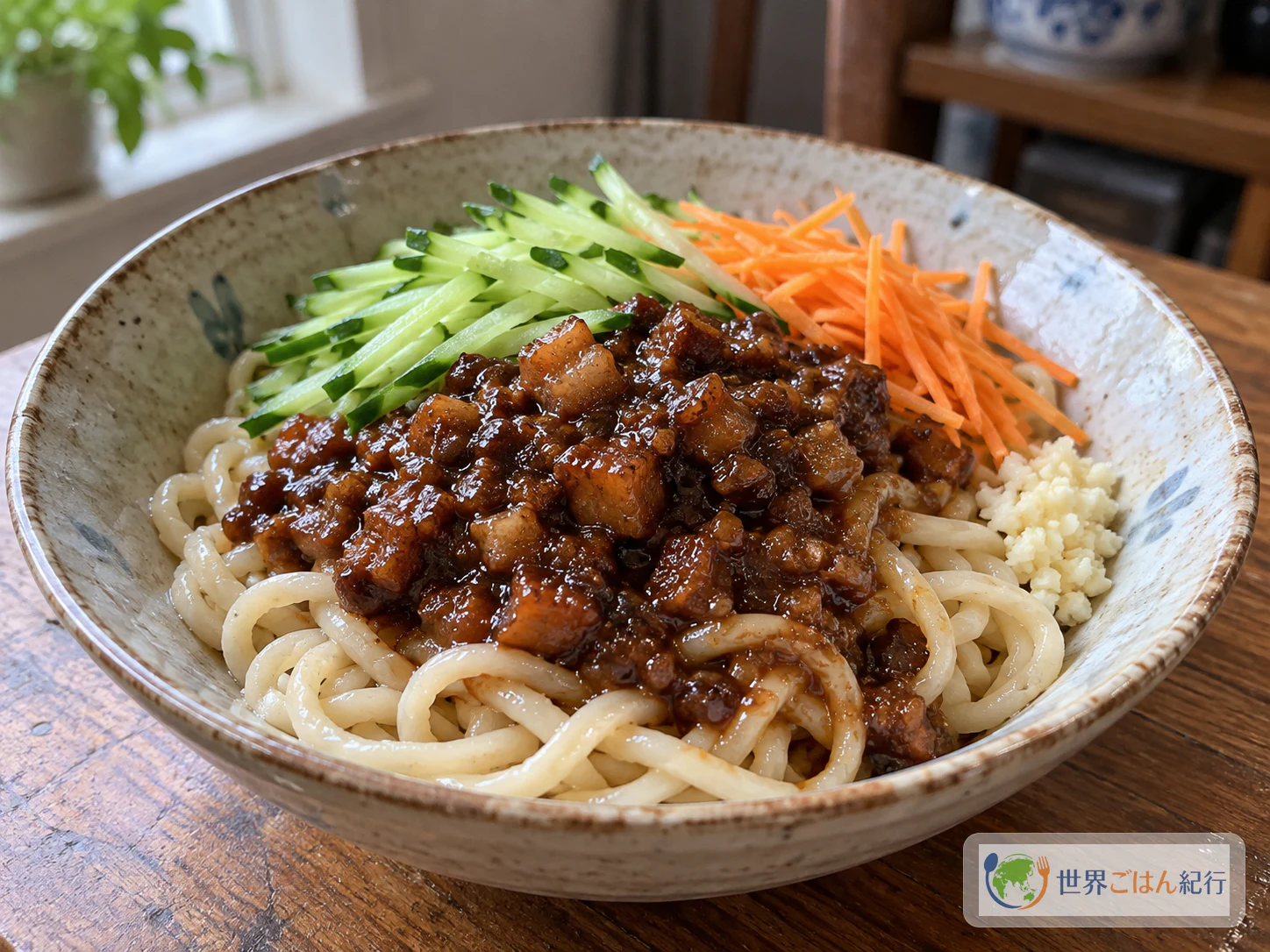
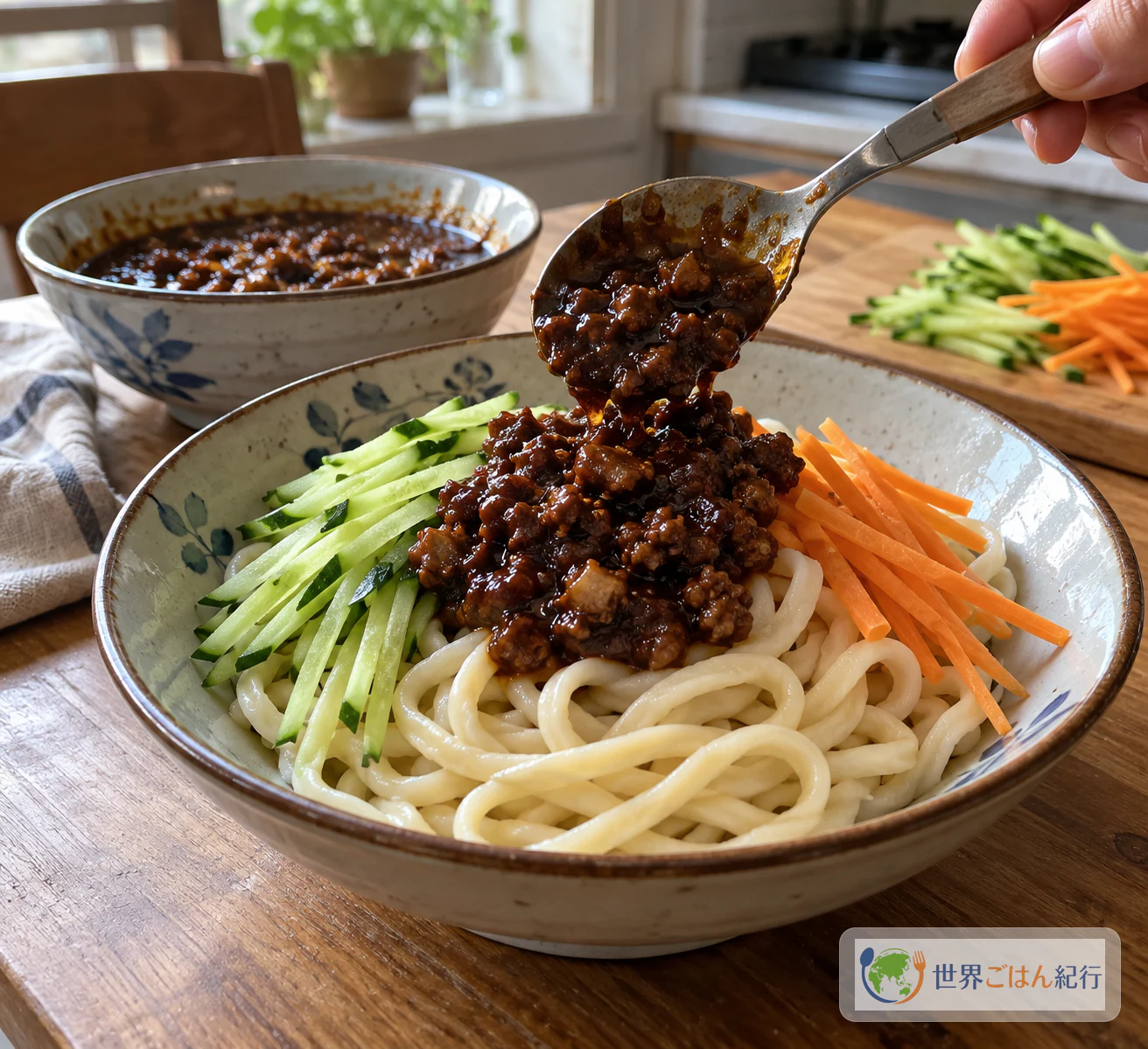
A small spoonful of glossy, deeply savory sauce, thick wheat noodles that can stand up to it, and crisp raw cucumber and carrot to balance the salt. The sauce is strong on purpose; the noodles and vegetables are what bring each mouthful into balance.
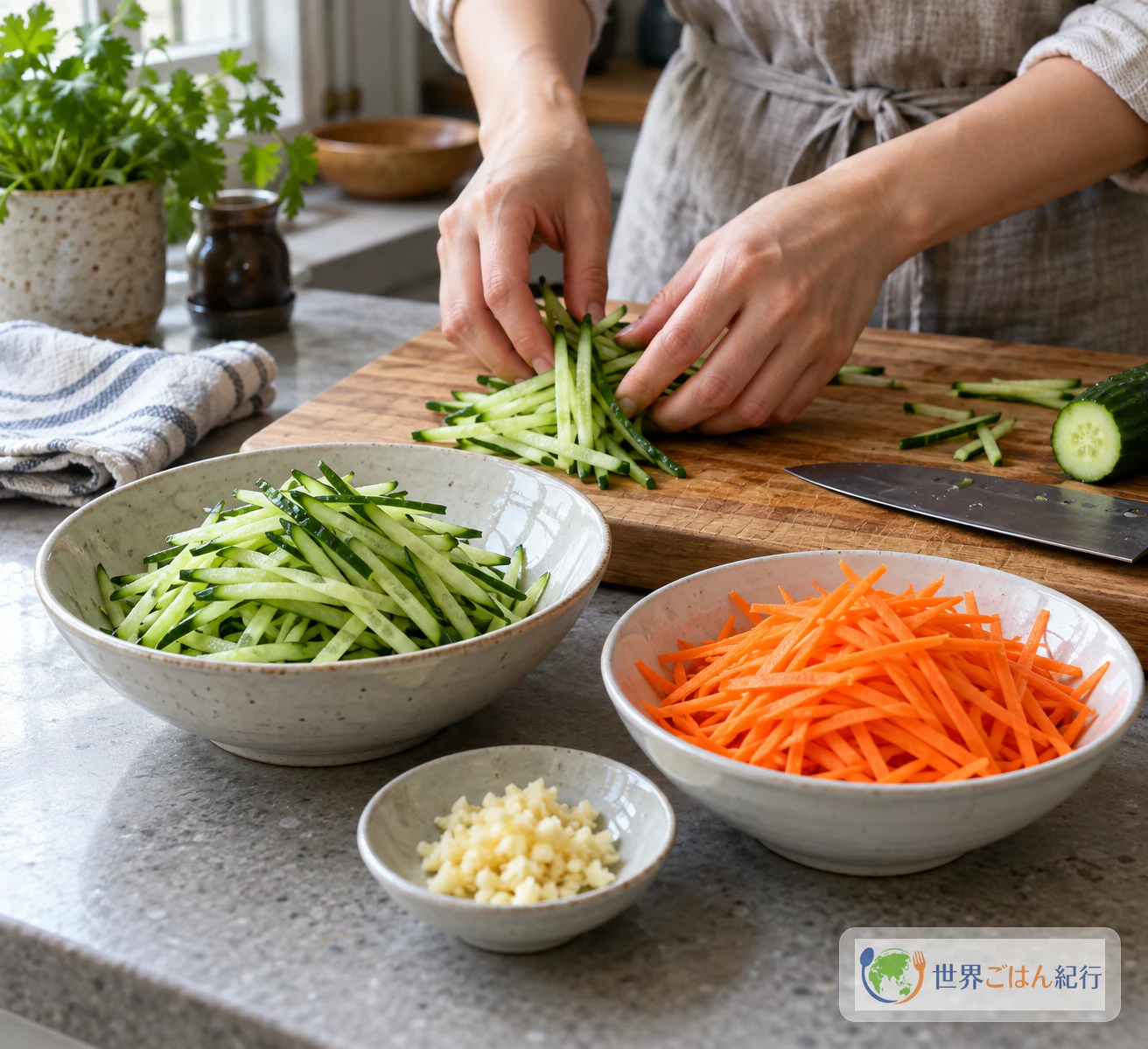
A nearly black-brown sauce of diced pork belly and fermented bean pastes sits on top of a bowl of thick wheat noodles, with thin matchsticks of cucumber and carrot beside it. Nothing is mixed yet. Whoever is eating stirs it all together, pulling the sauce through the noodles and folding in the crunch of the cucumber, and adds more sauce only if the bowl needs it. That is zhajiangmian (炸酱面 in simplified Chinese, 炸醬麵 in traditional, Zhàjiàngmiàn in pinyin), literally "fried sauce noodles."
The Beijing municipal government introduces zhajiangmian as a traditional light meal commonly eaten in Beijing, illustrated with a small hutong eatery near Nanluoguxiang and its noodles. It is an everyday dish rather than a banquet one, and it varies from family to family: The Woks of Life, whose recipe this article follows, notes that Beijing households have their own preferences. So the question this article helps you answer is practical: which pastes to look for, how far to cook the sauce, and how much of it to put on your noodles.
Korean jajangmyeon (짜장면) sounds similar but is a different dish, made with a black bean paste and larger pieces of vegetable. Sichuan zajiangmian (杂酱面), whose name also sounds close, is treated here as a separate dish as well. Everything below is about the Beijing style.
Ingredients: Sauce for 8, Noodles and Vegetables for 4
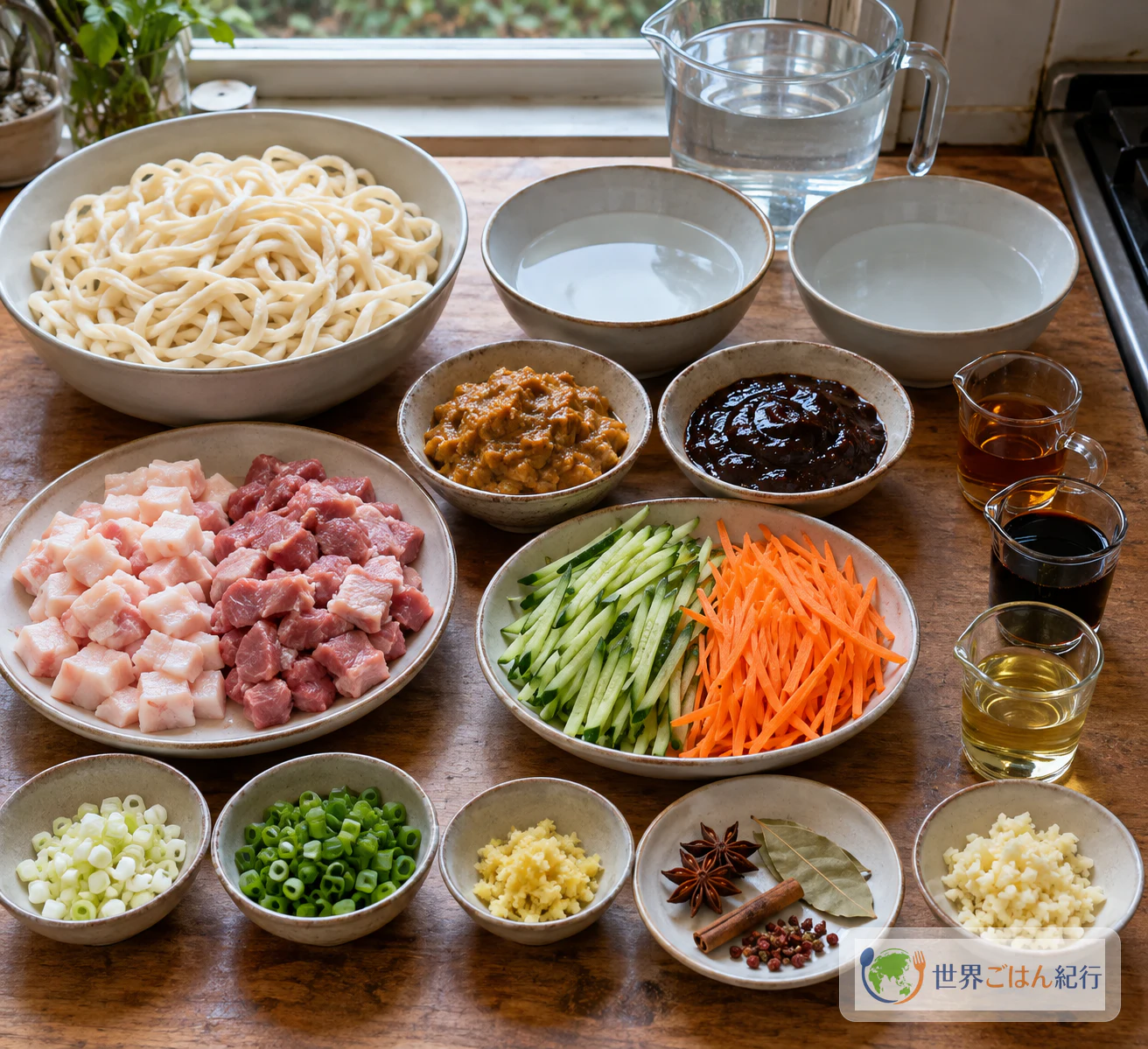
This recipe follows the 2024 updated version of The Woks of Life's Beijing zhajiangmian. One detail matters before you shop: the source lists the sauce as 8 servings, while its recipe note says the noodles and vegetables are for 4. The amounts below keep that difference as it is. You make the whole batch of sauce at once, then add only as much as the 4 servings of noodles need, tasting as you go. Do not pour the whole batch onto the noodles.
Amounts keep the source's US units. Where a metric figure is given, it is either the source's own figure (2 tbsp water = 30 ml, 1/3 cup oil = 80 ml) or a rounded reference (1 lb ≈ 454 g, 8 oz ≈ 227 g, 1 cup water ≈ 240 ml). For home measuring, this article uses rounded editorial measures of 240 ml per cup, 15 ml per tbsp and 5 ml per tsp; these are not all metric values supplied by the source. The heaping tablespoons of bean sauce are not converted.
The source recipe card lists 40 minutes in total, but its individual heating stages alone add up to roughly 39–44 minutes, excluding preparation and noodle cooking. These are source timings, not a tested total; follow the individual stages and doneness checks rather than expecting the whole meal to finish in 40 minutes.
Water for boiling the noodles, and any splash of cold water added while they cook, is working water. It is not taken from the 1 cup of sauce water or the 2 tbsp for the pork.
The bean pastes and noodles contain soy and wheat, and the sauce contains pork. Check the ingredient labels of the products you buy, including the pastes, soy sauce and noodles. Cook the pork until the center reaches 75°C (167°F) for at least 1 minute. Keep knives, cutting boards and chopsticks used for raw pork away from the cucumber, carrot, garlic and the plated noodles.
Choosing the Pastes and Substitutions
Ground bean sauce and tianmianjiang are two different things, and the dish needs both. Ground bean sauce (黄豆酱) is a salty fermented soybean paste; tianmianjiang (甜面酱) is a fermented wheat paste with a sweeter character. The Woks of Life describes a traditional combination of three pastes that also includes dry yellow sauce (干黄酱); the version used here leaves that out and uses two. It is one published home version, not the single authentic Beijing formula.
- Ground bean sauce: Look for a paste whose ingredients show fermented soybeans. Miso is not an equivalent; its salt, sweetness and texture differ. If you truly cannot find ground bean sauce, a fermented soybean paste can stand in, but treat the result as a different sauce.
- Tianmianjiang: Check the label, since products vary. Hoisin sauce differs in sweetness and thickness, so a same-amount swap is not recommended.
- Dark soy sauce: Not interchangeable with ordinary soy sauce. A substitute changes the color and the saltiness.
- Shaoxing wine: If you use a cooking wine instead, check whether it contains salt and keep that in mind when tasting.
- Pork: If you can't find skin-on pork belly, the source allows a fatty cut of pork shoulder. The amount of fat that renders out and the texture of the meat will change.
- Scallions: A long green onion such as Japanese negi can be used as an editorial substitute; the aroma will differ.
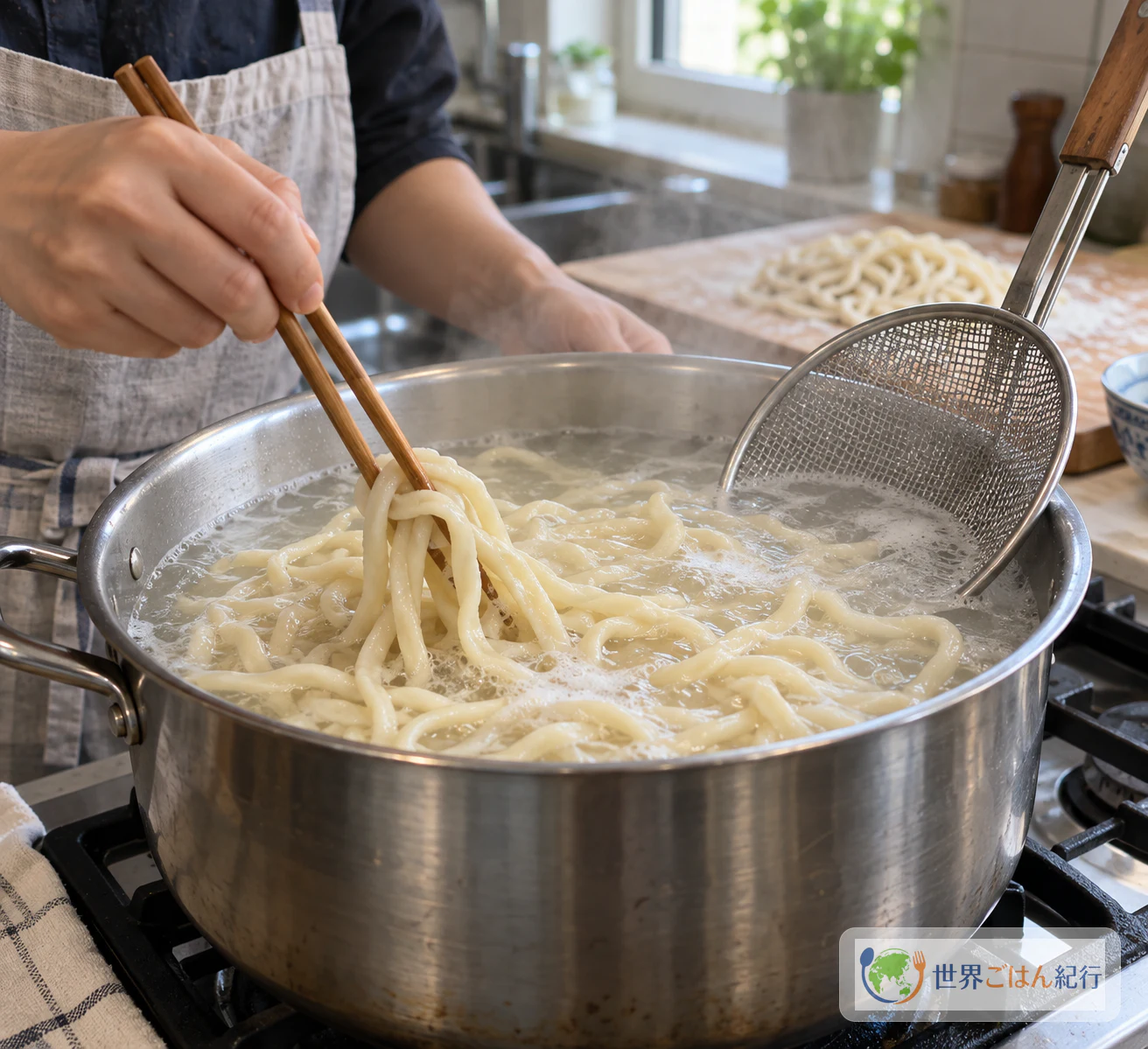
- Noodles: Choose thick wheat noodles, fresh or dried, and cook them according to the package.
Saltiness varies a lot between paste brands. That is why the optional sugar and salt are left out on the first try: taste the finished sauce on the noodles, then decide.
Equipment
- Wok or wide, heavy skillet, with a lid
- Spatula for scraping the bottom of the pan
- Large pot for boiling the noodles
- Instant-read thermometer for checking the pork
- Separate cutting boards and knives for raw pork and for the raw vegetables
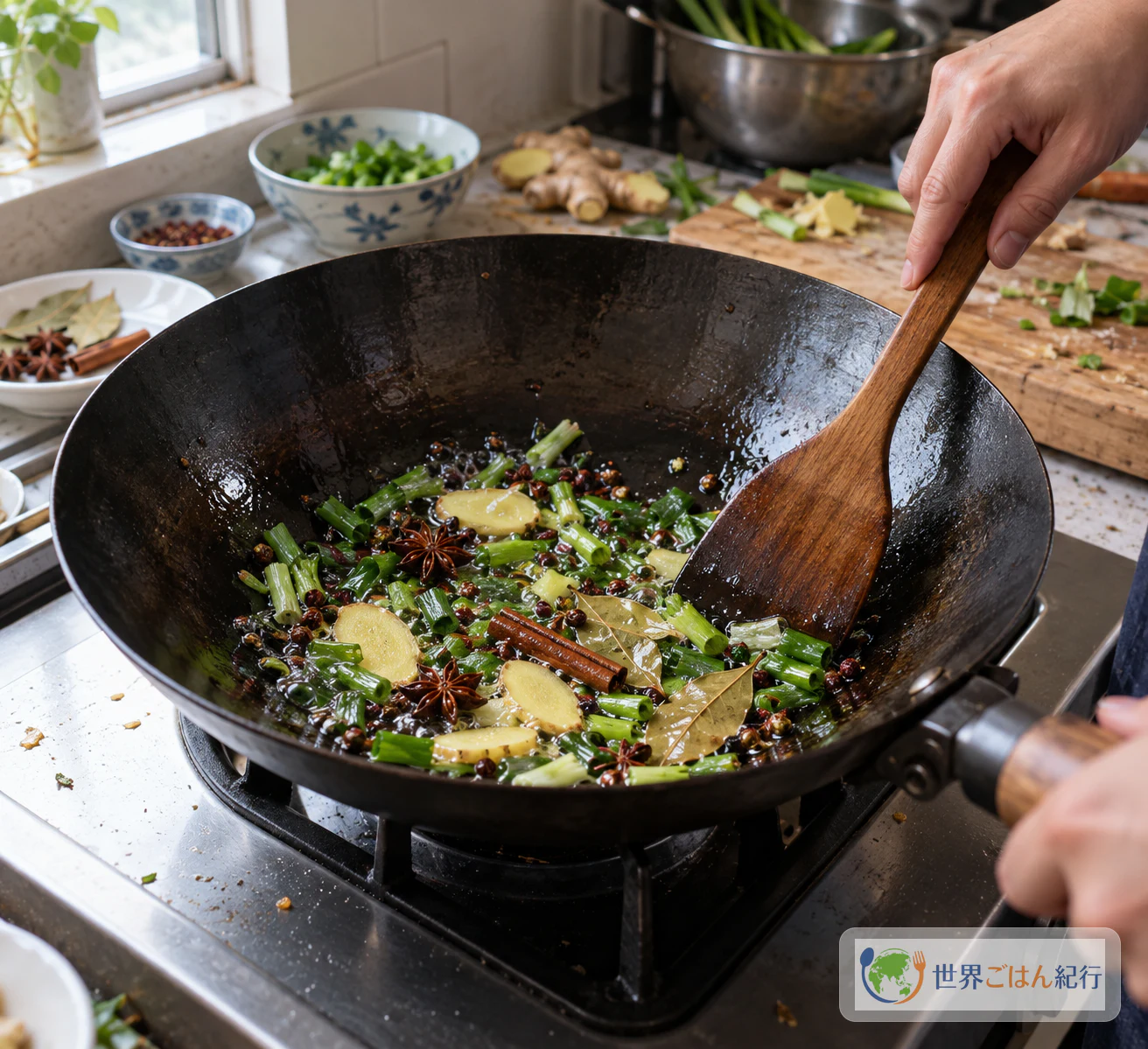
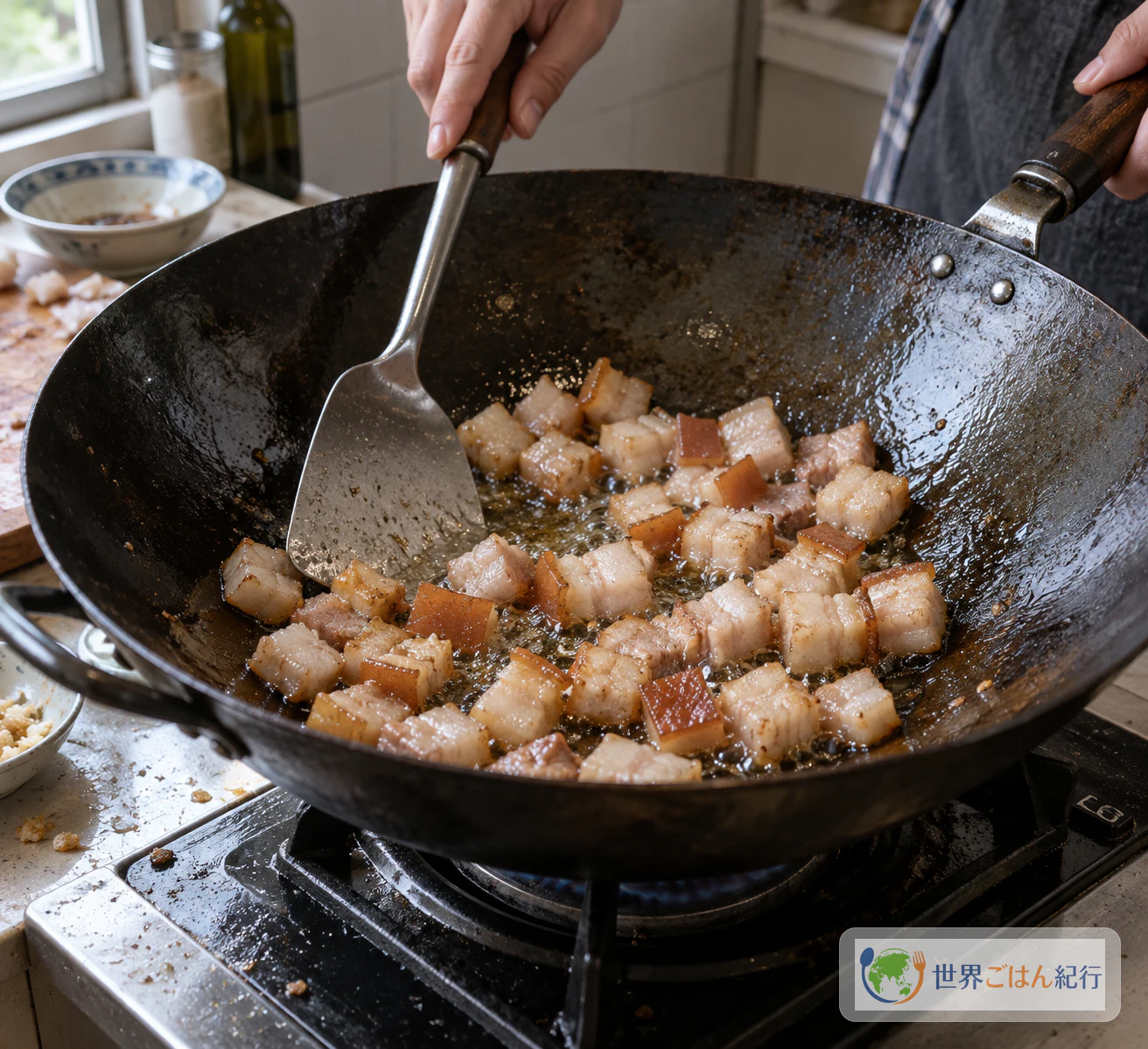
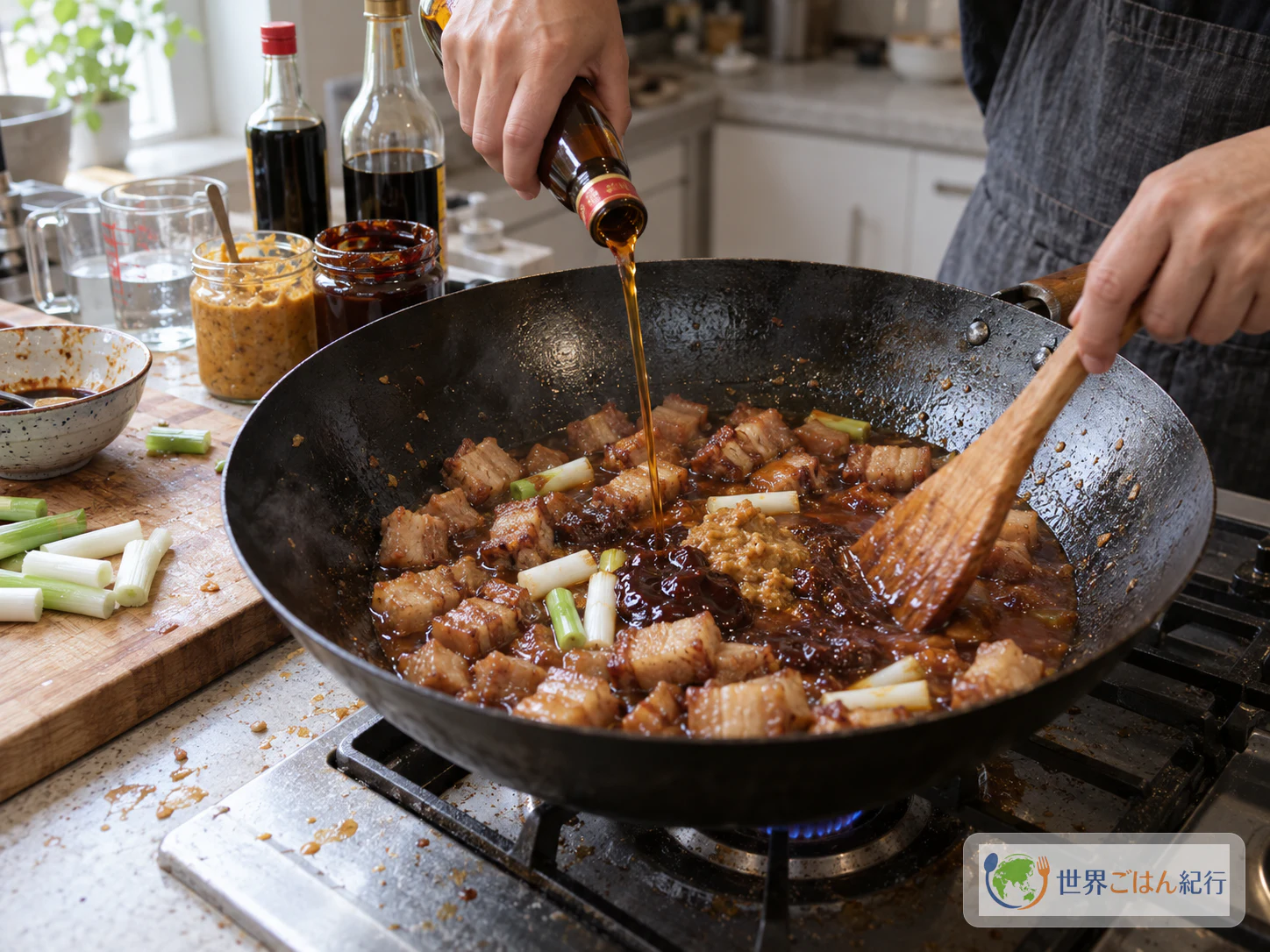
Method: Aromatic Oil, Rendered Pork, a Slow-Reduced Sauce
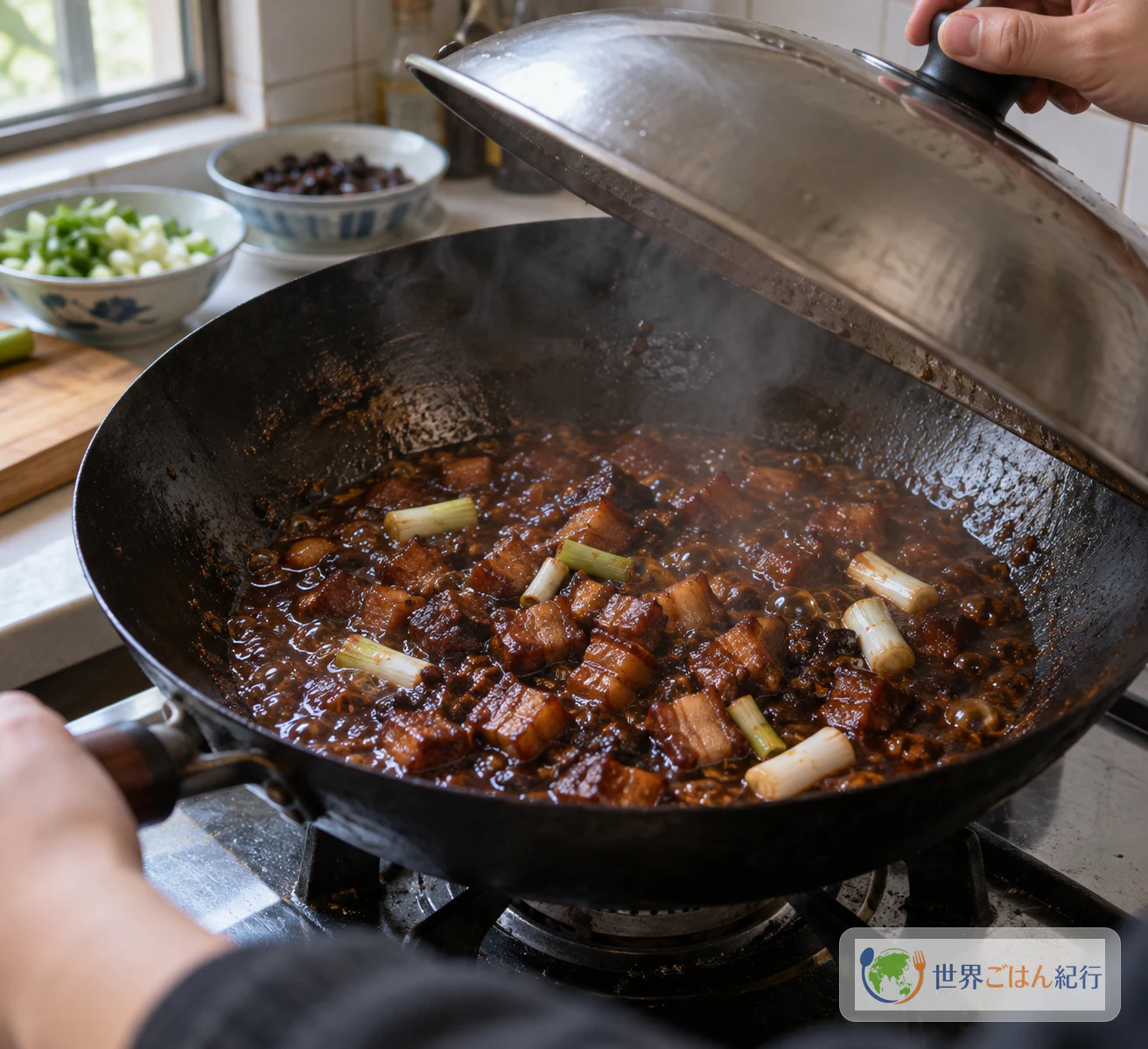
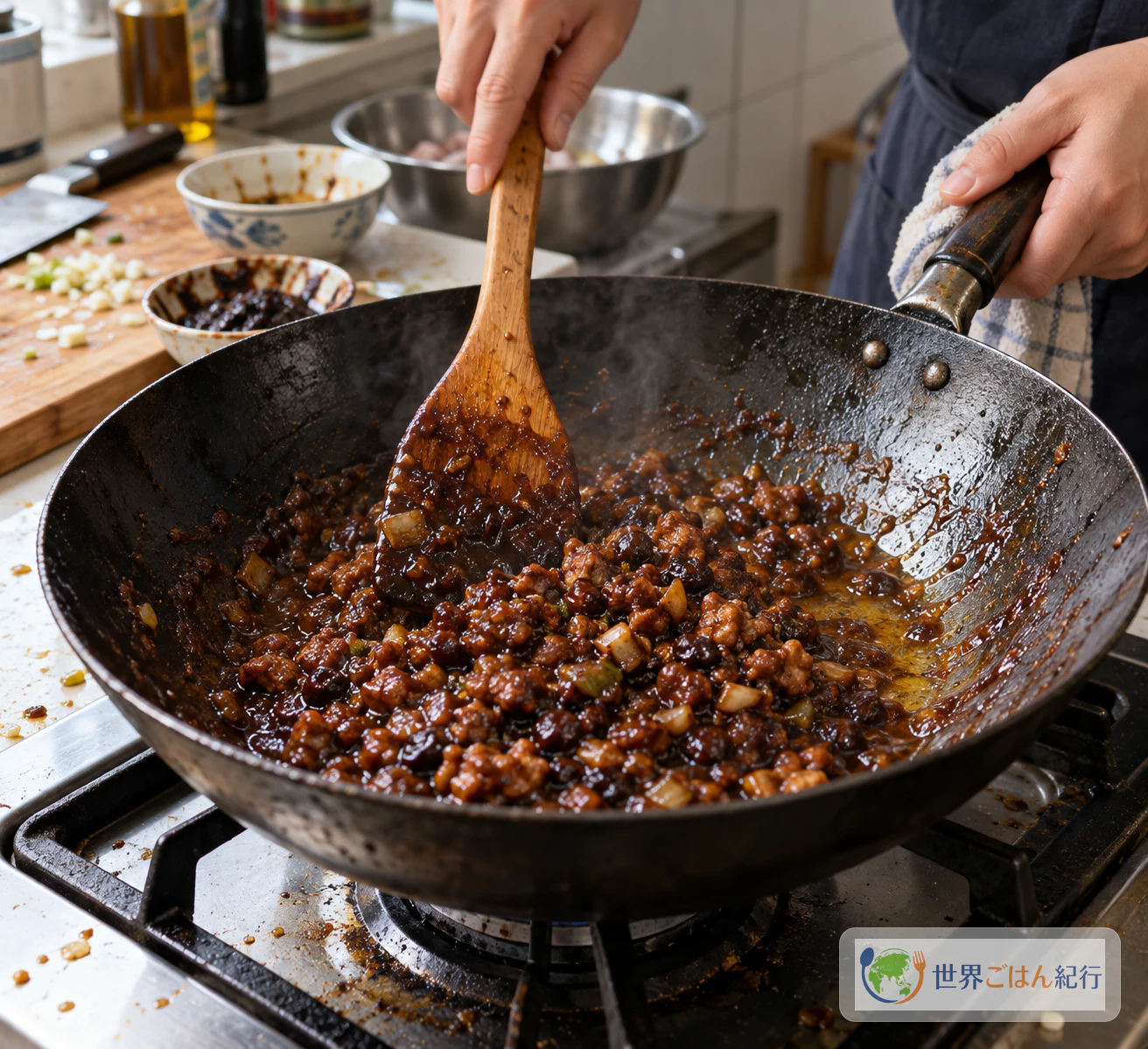
Each stage has its own timing and a visual cue. Go by what you see in the wok at each stage rather than by an overall clock.
Troubleshooting
| Problem | Likely cause | What to do |
|---|---|---|
| The aromatics burned and the oil smells bitter | Oil kept on high heat | Keep it at low heat for the 15 minutes and lift out the scallions before they burn |
| The sauce lacks pork-fat aroma | Pastes added before the fat edges colored | Treat 5–6 minutes as a guide and wait for the lightly golden edges |
| The sauce won't coat the noodles and tastes very salty | Reduced too far | Start checking at 8 minutes and stop as soon as oil shows at the bottom and the sauce coats |
| The sauce is catching on the bottom | Not stirred during reduction | Keep stirring and scraping the bottom of the wok over medium-high heat |
| The bowl is too salty | Paste brands differ in salt; too much sauce | Leave out the salt at first, add sauce gradually, and adjust after mixing with the noodles |
| Noodles drowned in sauce | All the sauce mixed in at once | Never mix the noodles into the whole batch; the sauce is for 8 servings, the noodles for 4 |
Storing the Leftover Sauce
Because the sauce is made for 8 and the noodles for 4, you will have leftovers. The Woks of Life's author writes that the sauce keeps about 10 days in the refrigerator, provided a layer of oil stays on top and you always use a clean spoon. That is the author's own condition-based note, not a guaranteed storage period for every home.
For a safer routine, following Japan's Ministry of Health, Labour and Welfare home food-poisoning guidance:
- Don't leave the cooked sauce at room temperature for long. Divide it into shallow, small portions so it cools quickly, then refrigerate in clean, airtight containers.
- Freeze in small portions any sauce you won't eat soon.
- Use a clean spoon each time.
- Reheat until the whole portion is thoroughly hot, aiming for 75°C (167°F) or above.
Variations
These are separate from the main recipe; don't mix their ingredients into it.
- A Beijing home version from Beijing's tourism site: yellow sauce (黄酱) dissolved in water, Beijing scallion and ground pork, served with cucumber and bean sprouts, garlic and vinegar. Its quantities and method differ from this recipe.
- Long green onion instead of scallions: An editorial swap; expect a different aroma.
- Fatty pork shoulder instead of pork belly: Allowed by the source; the rendered fat and the texture of the meat change.
- A little heat: Offer chili oil at the table rather than cooking it into the sauce.
Korean jajangmyeon is not a variation of this dish; it is a different dish.
Beijing's Everyday Noodles and How Households Differ
Beijing's municipal government presents zhajiangmian as a traditional light meal that is commonly eaten in the city, showing it at a hutong eatery near Nanluoguxiang. A home recipe on Beijing's official tourism site builds the sauce from yellow sauce, ground pork and Beijing scallion, and sets cucumber and bean sprouts alongside.
The recipe in this article comes from a different angle: an updated home recipe written for North American kitchens, using a piece of pork belly, two pastes and an aromatic oil. Its author notes that preferences vary across Beijing households and that the traditional combination includes dry yellow sauce, which this version omits. Read together, these sources point to a dish with a shared shape (a fried paste sauce, wheat noodles and raw toppings) and plenty of room for each household's choices, rather than a single fixed formula.
For more dishes from across the country, see China.
Frequently Asked Questions
Is this the same as Korean jajangmyeon?
No. Korean jajangmyeon uses a black bean paste and larger pieces of vegetable. Beijing zhajiangmian is built on fermented soybean and wheat pastes and topped with raw julienned vegetables.
Can I use miso instead of the bean pastes?
The flavor and saltiness are not the same. Look for ground bean sauce and tianmianjiang first. If you do substitute, accept that you are making a different-tasting sauce.
Should I put all the sauce on 4 servings of noodles?
No. The source lists the sauce as 8 servings and the noodles and vegetables as 4. Add the sauce a little at a time and keep the rest.
How do I know the pork is safely cooked?
The white surface after about 1 minute of stir-frying is only a midway stage. After simmering and reducing, check that the center of the pork reaches 75°C (167°F) for at least 1 minute. Keep raw-pork boards, knives and chopsticks away from the raw toppings and the finished bowls.
Do I need the sugar and salt?
They are optional in the source and left out here. Paste brands vary in salt, so taste the sauce mixed with noodles first and add them only if needed.
Sources
- Beijing Tourism (Beijing Municipal Bureau of Culture and Tourism), "周末在家来碗老北京炸酱面." A Beijing home recipe pairing a yellow-sauce, pork and scallion sauce with cucumber, bean sprouts and other toppings; its units and method differ from the recipe used here. https://www.visitbeijing.com.cn/article/47Qs83GCSeZ
- The People's Government of Beijing Municipality, "Authentic Old Flavor in Beijing." Introduces zhajiangmian as a traditional light meal commonly eaten in Beijing, with a hutong eatery near Nanluoguxiang. https://english.beijing.gov.cn/foreignersinbeijing/beijingthroughforeignerslens/202203/t20220331_2644266.html
- The Woks of Life (Judy Leung), "Zha Jiang Mian (Beijing Fried Sauce Noodles)." Source of the base recipe ingredients, quantities and cooking sequence, with editorial choices and the separate safety guidance identified above; the 8-serving sauce and 4-serving noodle note; household variation in Beijing; the traditional three pastes; the difference from Korean jajangmyeon; and the author's storage note. https://thewoksoflife.com/beijing-fried-sauce-noodles-zha-jiang-mian/
- Ministry of Health, Labour and Welfare (Japan), "豚のお肉や内臓を生食するのは、やめましょう" (Don't eat pork or pork offal raw). Thorough cooking of pork to the center and the 75°C for 1 minute guide. https://www.mhlw.go.jp/stf/seisakunitsuite/bunya/kenkou_iryou/shokuhin/syouhisya/121004/index.html
- Ministry of Health, Labour and Welfare (Japan), "家庭での食中毒予防" (Preventing food poisoning at home). Home guidance on cooking to 75°C for 1 minute, preventing cross-contamination, not leaving food at room temperature, cooling leftovers in shallow portions, and reheating to 75°C or above. https://www.mhlw.go.jp/stf/seisakunitsuite/bunya/kenkou_iryou/shokuhin/syokuchu/01_00008.html