Higashi Is a Category, Not One Recipe
Higashi (干菓子) is the name for a whole family of dry Japanese sweets. The recipe here is for one member of that family, rakugan (落雁). The three-ingredient method below is not a recipe for all higashi.
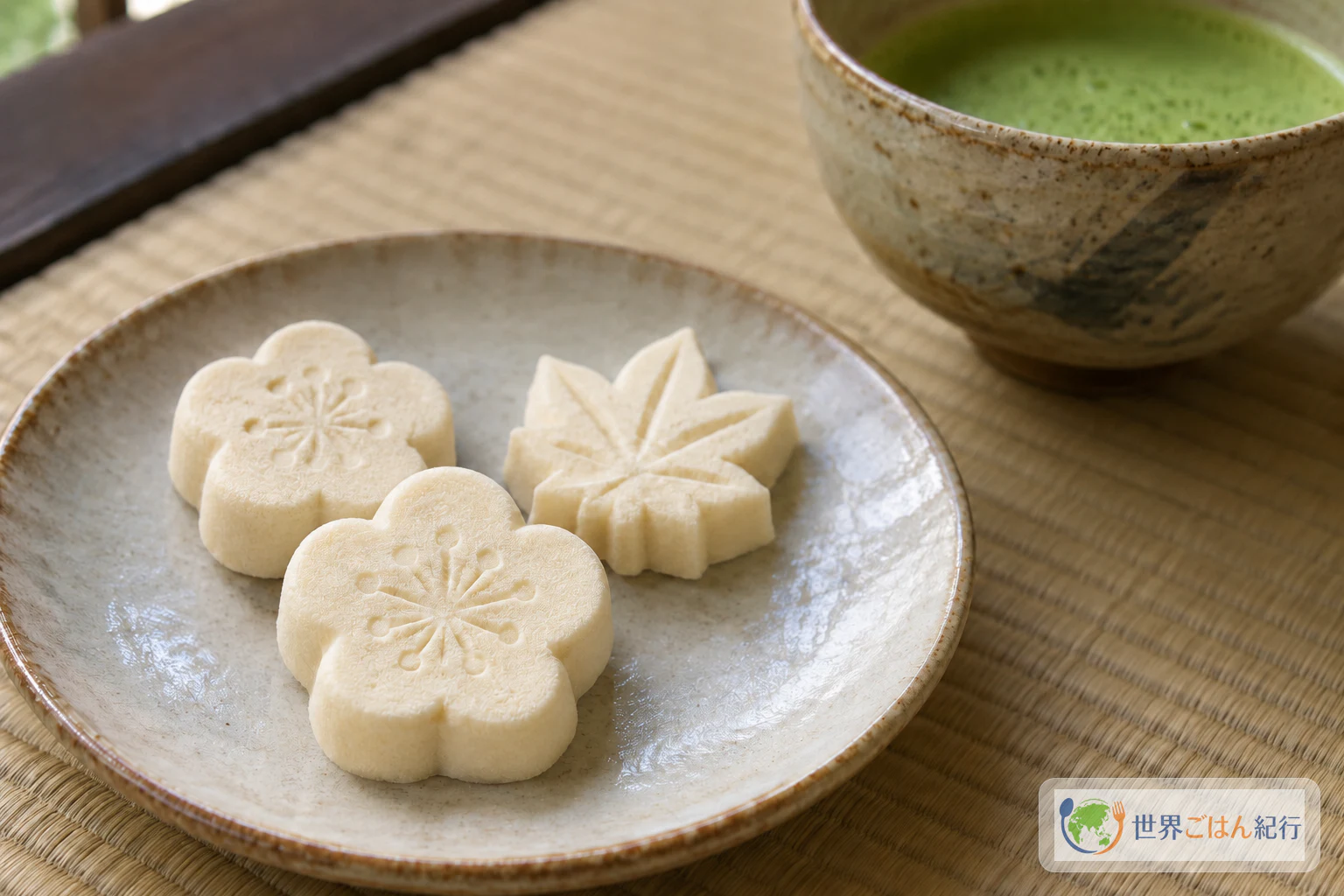
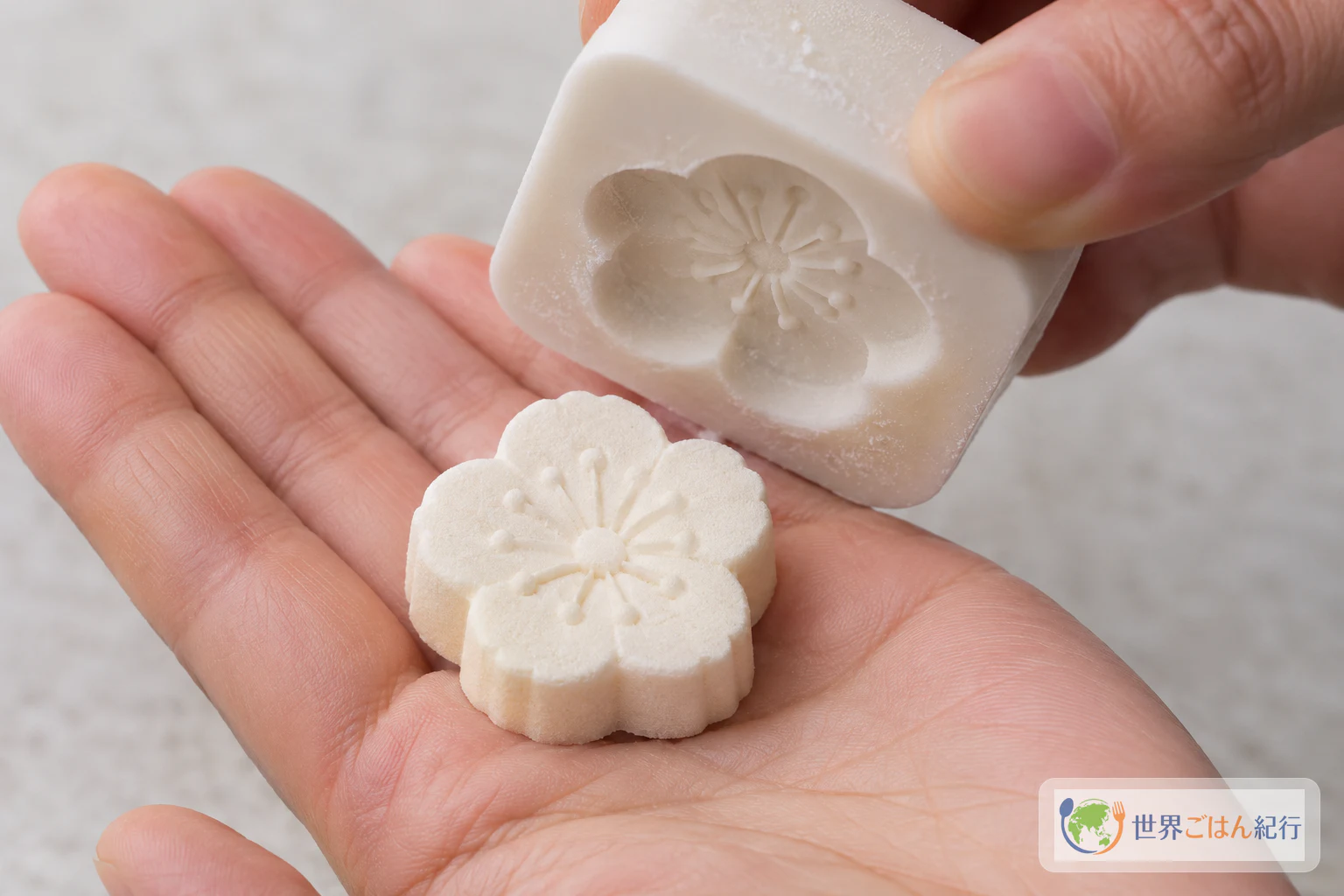
A few pale molded sweets on a small plate, a bowl of thin matcha beside them. That is one familiar picture of higashi. Japanese dictionaries define higashi (干菓子, pronounced "hi-gashi") as confectionery with little moisture. The examples they list are very different from one another: rakugan, konpeito and senbei all belong to it. A 2020 paper in the Journal of Cookery Science of Japan also treats higashi as a general term, with molded sweets such as rakugan and wasanbon as representative forms.
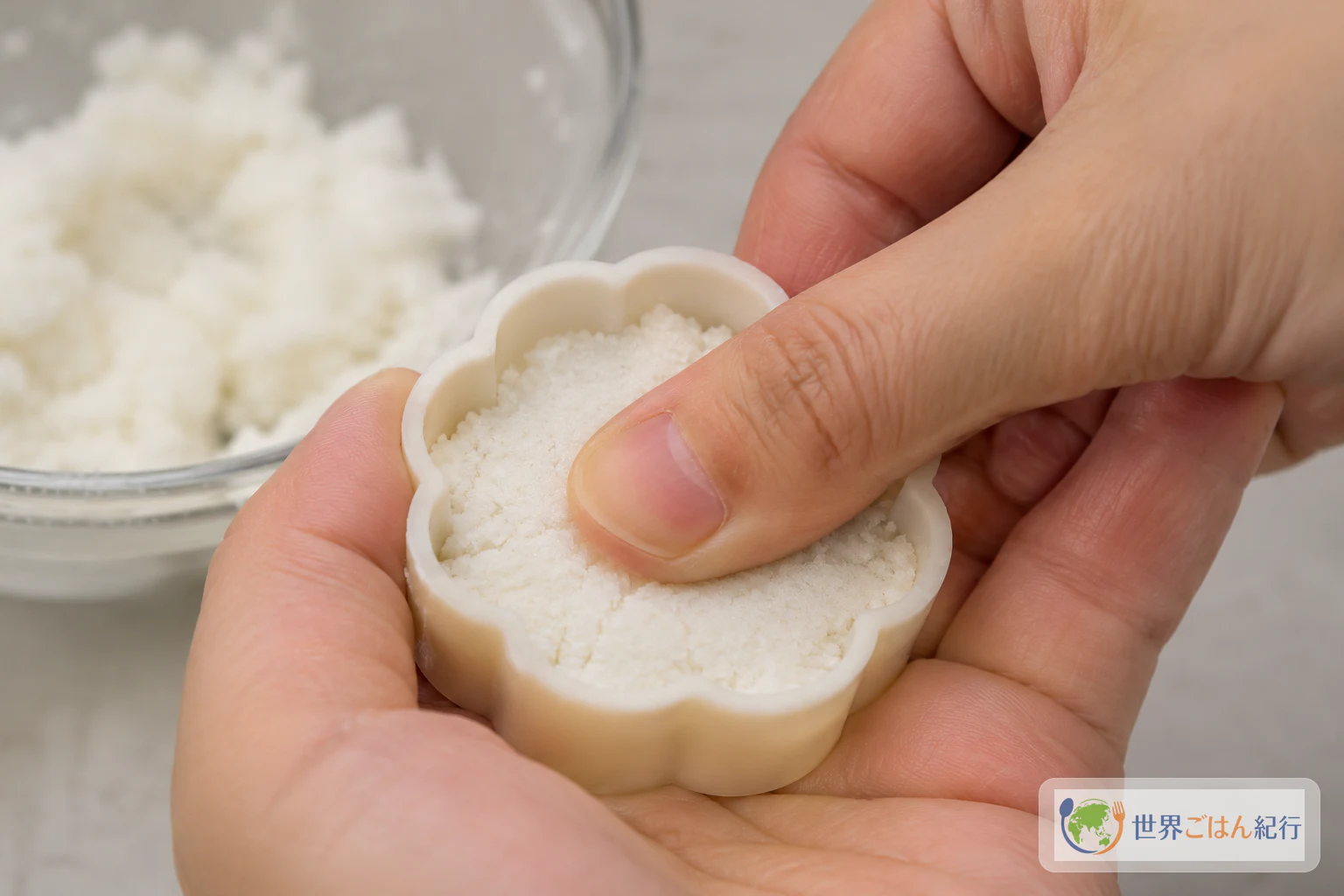
These sweets are made in quite different ways. A sugar crystal sweet like konpeito and a rice cracker like senbei do not share a method with a pressed, molded sweet. So this article gives you one practical example: rakugan, made by pressing a moist mixture of sugar and fine glutinous-rice powder into a mold.
The recipe comes from 「らくがん(落雁)」 on Table for All, the food-allergy care site run by Nippon Ham. The page lists a registered dietitian (野田康子) and a cooking researcher (為後左依) under "supervision and cooperation." It does not name either one as the sole author of the recipe. It is written for 4 servings and uses only sugar, water and mijinko (みじん粉). Sekai Gohan has not kitchen-tested this recipe.
For other dishes from the same country, see our Japan page.
Ingredients
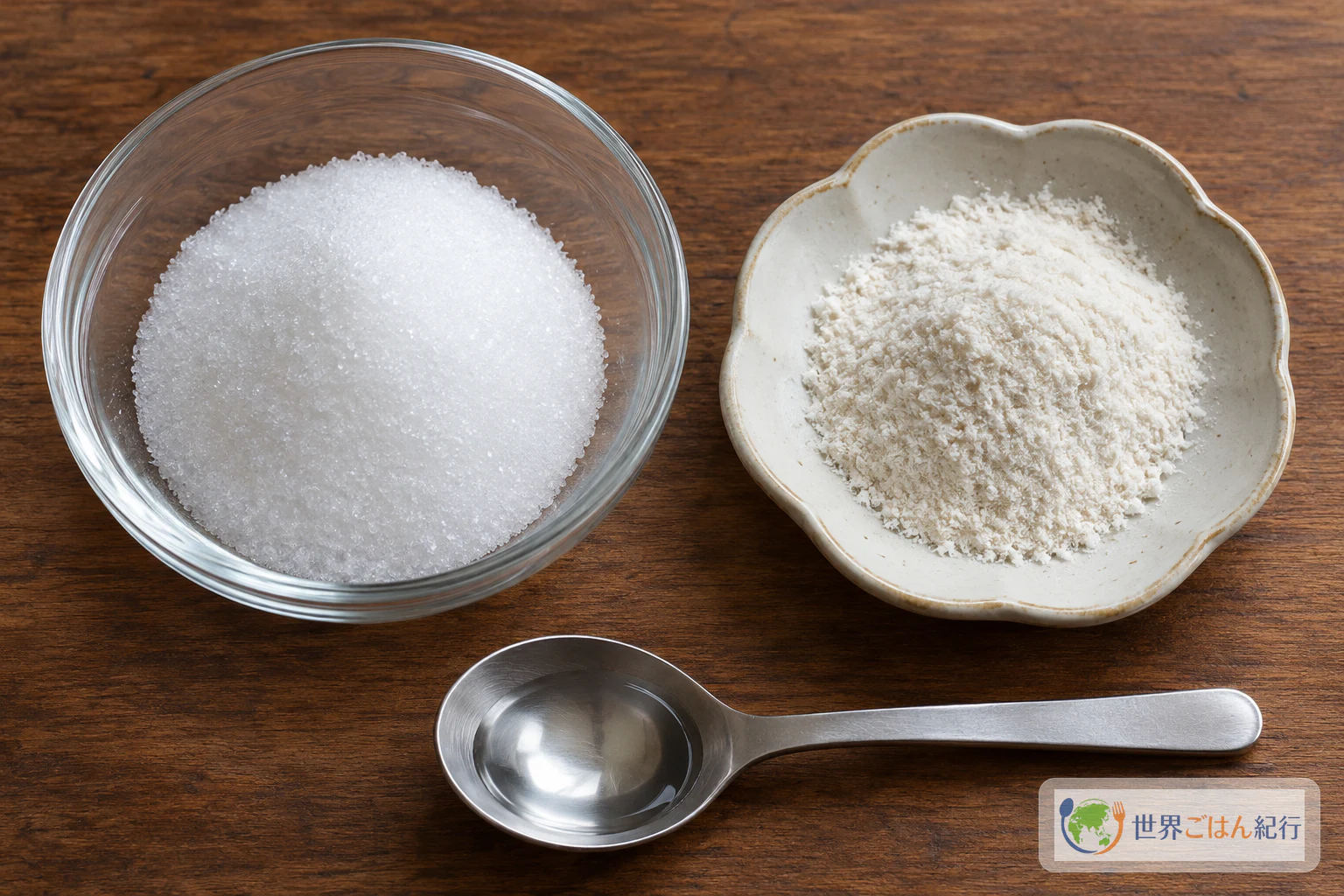
Makes 4 servings.
Equipment
- Mixing bowl
- Kitchen scale
- Measuring teaspoon
- Small confectionery mold
Choosing the Sugar and the Mijinko
Sugar: Use sugar.
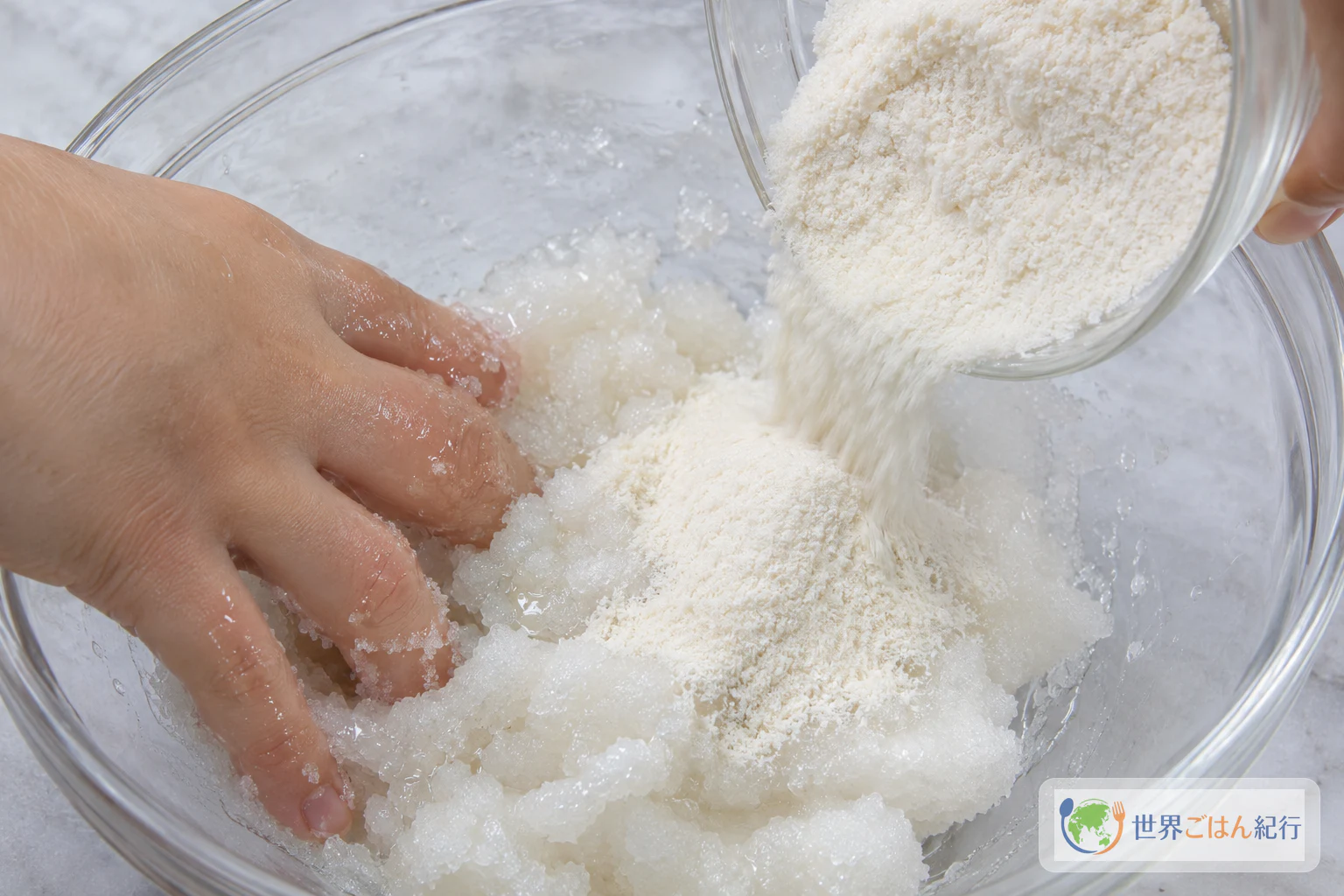
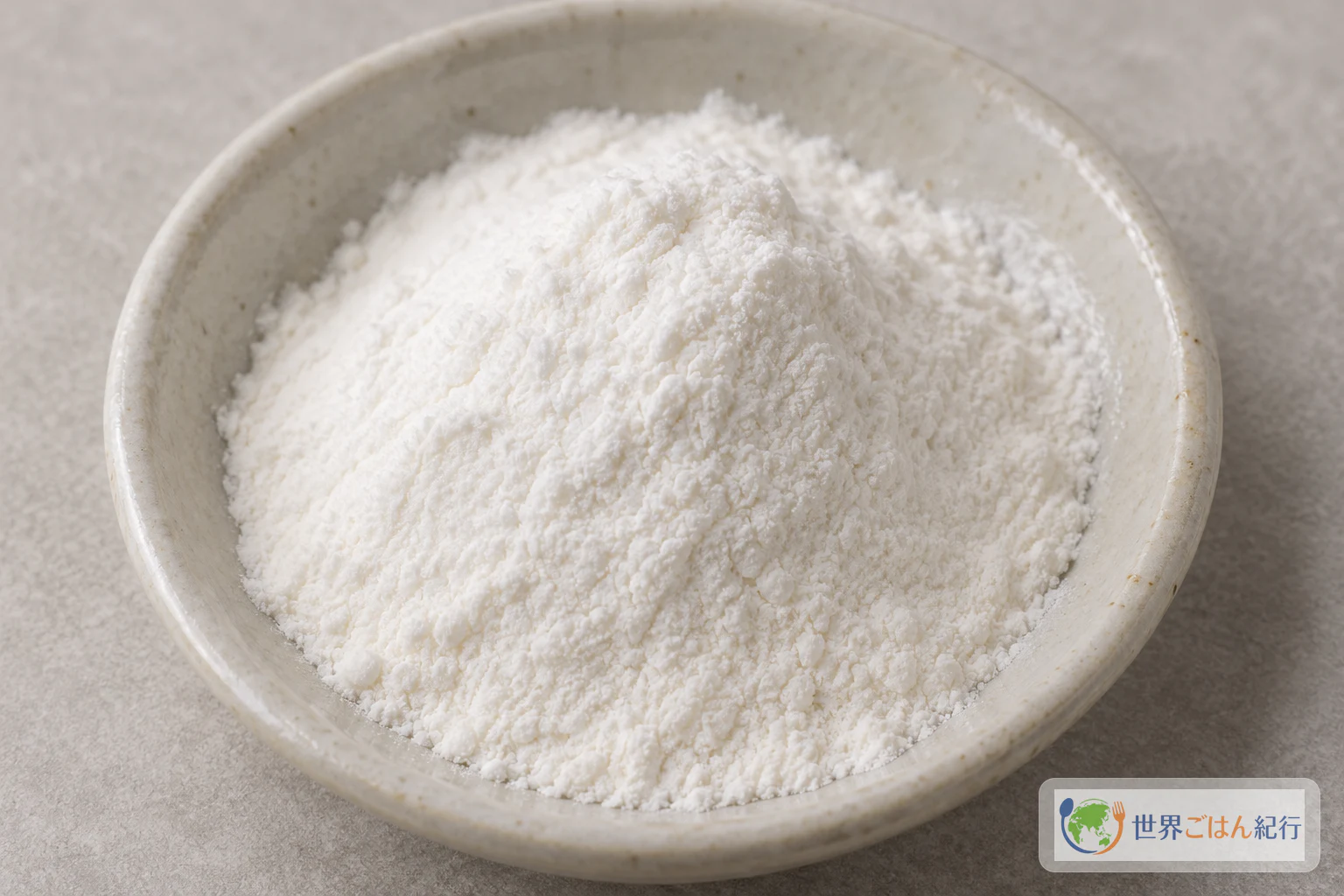
Mijinko: Mijinko is a powder made from glutinous rice, and a fine grind is best. Keep it as its own ingredient. Joshinko (上新粉), shiratamako (白玉粉), katakuriko and ordinary rice flour are different products. None of them is a confirmed substitute for mijinko in this recipe.
Before You Start: How to Read Step 3
The written recipe has three steps. In step 1, you mix water into sugar. In step 2, you add mijinko. Step 3 says to pack "1" into a mold. Read literally, "1" points back to step 1, before any powder has gone in.
From the dish itself and the order of the steps, this article reads step 3 as packing the finished mixture from step 2. That reading is an editorial decision on our part. It is not a correction made by the recipe page.
The method also has no heating step, no temperature, no drying step or time after molding, and no cooling. None has been added below.
Checkpoints and Common Questions at the Bowl
This recipe is short, so most checks come down to the state of the mixture at each step.
| What you notice | What to keep in mind |
|---|---|
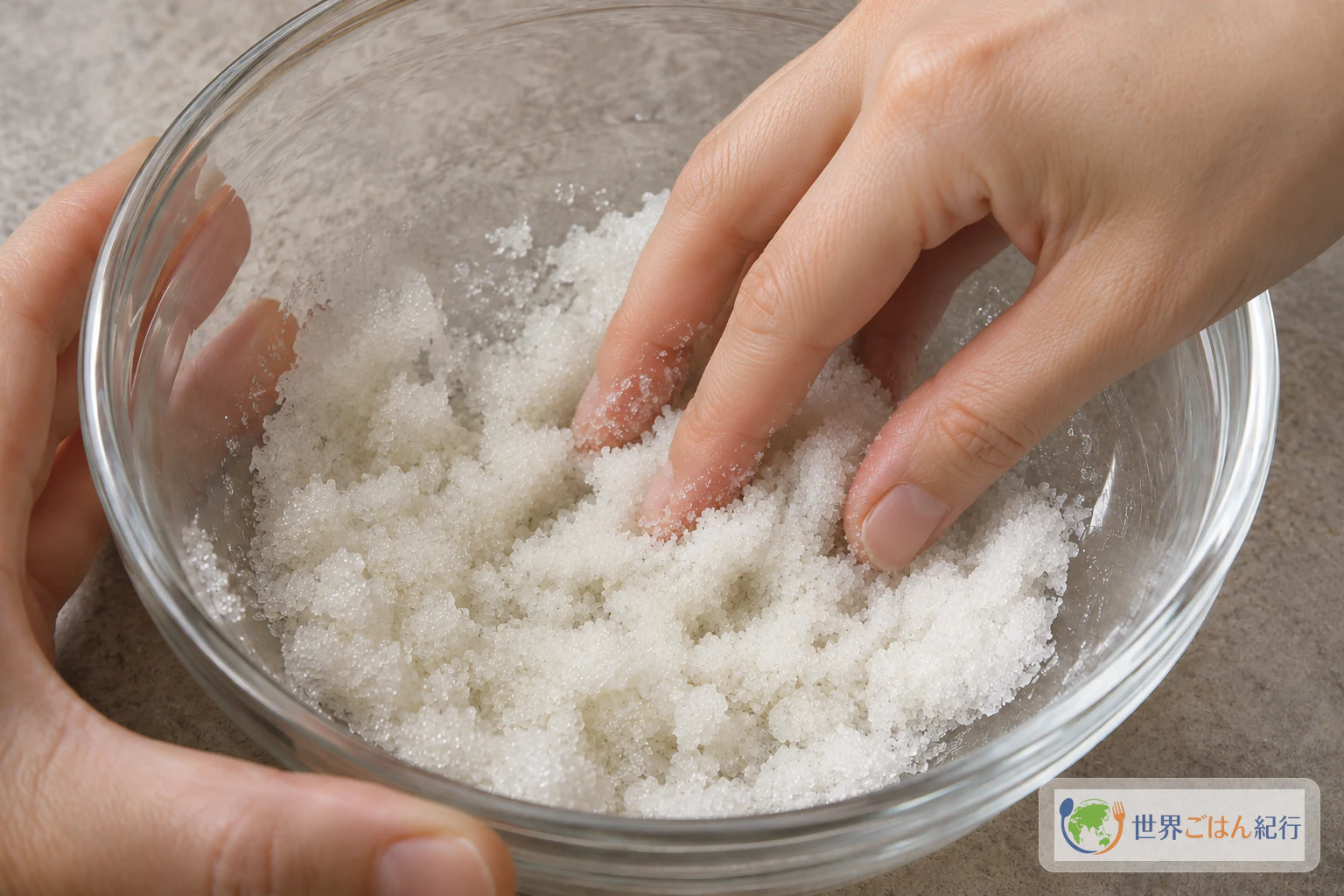
| Some sugar is still dry after you add the water | Keep mixing by hand until all the sugar feels moist, then add the mijinko |
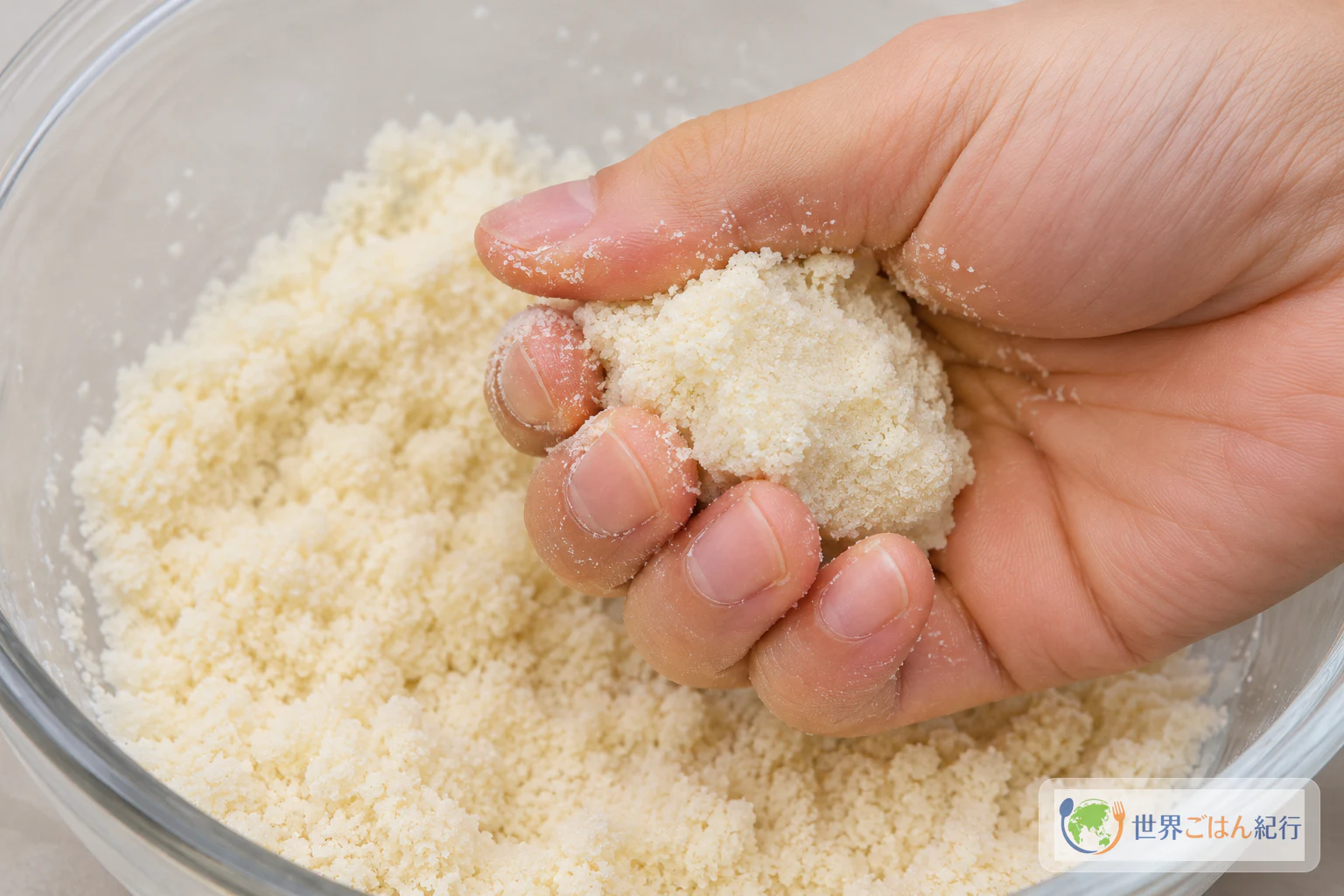
| The mixture falls apart when squeezed | Keep mixing until it gathers in your hand. The recipe gives no extra water or powder amount, so no adjustment is suggested here |
| The mixture is turning into a wet paste or a stretchy dough | That is not the texture described. The target is a mixture that only just holds together when squeezed |
| You want to use joshinko, shiratamako or plain rice flour | These are not confirmed substitutes for mijinko in this recipe |
| You are wondering whether to heat or dry the pieces | This method has no heating step and no drying time after molding |
Other Ways Rakugan Is Made
Rakugan recipes differ from maker to maker. The 2020 Journal of Cookery Science of Japan paper reviews earlier literature and notes that molded sweets of this kind vary in ingredients and method. Kodansha's world-cuisine dictionary describes rakugan as grain or bean powders and sweetener pressed in a mold and then dried. It lists several kinds of powder that can be used.
One example of a different approach comes from the flour miller Hinomoto Cereals Flour Milling. Its rakugan trial formula uses kanbaiko-type rice flour, katakuriko, and a syrup made from water and mizuame. It also adds pressing, scraping and unmolding steps and a one-day drying period. The company notes that its formula may need adjusting for your equipment.
That formula was not used here for three reasons:
- The relationship between its listed water and syrup amounts and the 40 g of syrup used in the method is not explained.
- Its starch amount is given as a range.
- No yield is given.
Keep the two recipes separate. Don't bring that formula's ingredients, syrup or drying time into the three-step recipe above.
Higashi and Tea
The tea descriptions below come from one tea school and one confectioner. They describe those sources' own practice and explanations, not every school, home or region.
The Omotesenke Fushin'an Foundation, of the Omotesenke school of tea, describes formal tea-sweets practice. It also notes that thin tea (usucha) can be served simply with dry sweets. Among dry sweets it lists molded oshi-mono and uchimono, senbei, and aruheito.
The Kanshundo Wagashi Museum glossary, from a Kyoto confectioner, lists wasanbon, rakugan, kizato, aruhe, oshi-mono and tama-mono among dry sweets. It presents them as sweets that accompany tea. Heibonsha's MyPedia encyclopedia also mentions tea and ceremonial use within its entry on higashi.
The range of sweets in these lists matches what the dictionaries show: higashi is a category with many forms. Rakugan is one molded type among them.
Frequently Asked Questions
Is all higashi rakugan?
No. Higashi is the category name for dry sweets. Dictionaries list rakugan, konpeito and senbei as examples. Rakugan is one type, and the recipe here applies only to rakugan.
Can I use another flour instead of mijinko?
No substitute is confirmed for this recipe. The recipe page describes mijinko as glutinous-rice powder and recommends a fine one. It does not say joshinko, shiratamako, katakuriko or ordinary rice flour can replace it. If you can't find mijinko, this recipe has no tested alternative to offer.
How long should I dry the rakugan after molding?
This recipe gives no drying step or drying time. The recipe page calls rakugan a dry sweet, and some dictionary definitions and other producers' recipes include drying. Those do not supply a method for this version, so none is added here.
Does it need to be cooked or heated?
No heating, temperature or cooling step appears in this method. It is mixed by hand, packed into a mold and turned out.
How many pieces does it make?
The recipe is written for 4 servings. It does not give a number of pieces, which will depend on the size of your mold.
How should I store it?
The recipe gives no storage guidance, so none is offered here.
Why does step 3 refer to the mixture from step 2?
The recipe's step 3 says to pack "1" into the mold, which literally points back to step 1. Based on the dish and the order of the steps, this article reads it as the mixture after the mijinko is added in step 2. That reading is our editorial decision, not a change made by the recipe page.
Has this recipe been tested in the Sekai Gohan kitchen?
No. It has not been kitchen-tested by Sekai Gohan. The amounts and steps are taken directly from the Table for All recipe.
Sources
- Nippon Ham / Table for All 食物アレルギーケア, 「らくがん(落雁)」. Supervision and cooperation: registered dietitian 野田康子 and cooking researcher 為後左依. The recipe used in this article: 4 servings, the amounts of sugar, water (1½ tsp / 7.5 g) and mijinko, the three hand-mixing and molding steps, and the description of mijinko as fine glutinous-rice powder. https://www.food-allergy.jp/blog/recipe/content_20140801-01/
- 村上陽子 (Shizuoka University), "Effect of Materials and Methods on Physical Properties of Uchimono Wasanbon," Journal of Cookery Science of Japan, Vol. 53 No. 1 (2020). Higashi as a general term, rakugan and wasanbon as representative molded forms, and variation in ingredients and methods across makers. https://www.jstage.jst.go.jp/article/cookeryscience/53/1/53_18/_pdf
- Shogakukan, Digital Daijisen, 「干菓子」, via Kotobank. Higashi as low-moisture confectionery, with rakugan, konpeito and senbei as examples. https://kotobank.jp/word/%E5%B9%B2%E8%8F%93%E5%AD%90-119060
- TBS Britannica, Britannica International Encyclopedia Small Item Dictionary, 「干菓子」, via Kotobank. Dry-confection types, with rakugan as one molded type among others. https://kotobank.jp/word/%E5%B9%B2%E8%8F%93%E5%AD%90-119060
- Heibonsha, MyPedia, 「干菓子」, via Kotobank. Higashi as dry wagashi, rakugan as one type, and tea and ceremonial use within the entry's scope. https://kotobank.jp/word/%E5%B9%B2%E8%8F%93%E5%AD%90-119060
- Kodansha, 和・洋・中・エスニック 世界の料理がわかる辞典, 「落雁」, via Kotobank. Rakugan as a dry sweet of grain or bean powders and sweetener pressed in a mold and dried, with varied possible powders. https://kotobank.jp/word/%E8%90%BD%E9%9B%81-146991
- Shueisha, imidas 広辞典, 「落雁」. Rakugan as a molded, pressed dry confection of powder and sugar. https://imidas.jp/kojiten/detail/W-41-0-112-06.html
- 木ノ下千栄, 甘春堂 和菓子ミュージアム, 菓子の用語「干菓子」. A confectioner's glossary listing wasanbon, rakugan, kizato, aruhe, oshi-mono and tama-mono among dry sweets, and describing them as accompaniments to tea. https://www.kanshundo.co.jp/museum/yogo/higashi.htm
- Omotesenke Fushin'an Foundation, 「形とふるまい:茶の菓子」. Omotesenke tea-sweets practice, serving thin tea simply with dry sweets, and dry sweets including oshi-mono, uchimono, senbei and aruheito. https://www.omotesenke.jp/list5/list5-3/list5-3-7/
- Hinomoto Cereals Flour Milling Co., Ltd., 「落雁」. A separate producer trial formula with its own ingredients, syrup, pressing steps and one-day drying, described here only for comparison. https://hi-kokufun.com/recipe/rakugan/