Okinawa Soba: A "Soba" with No Buckwheat in the Bowl
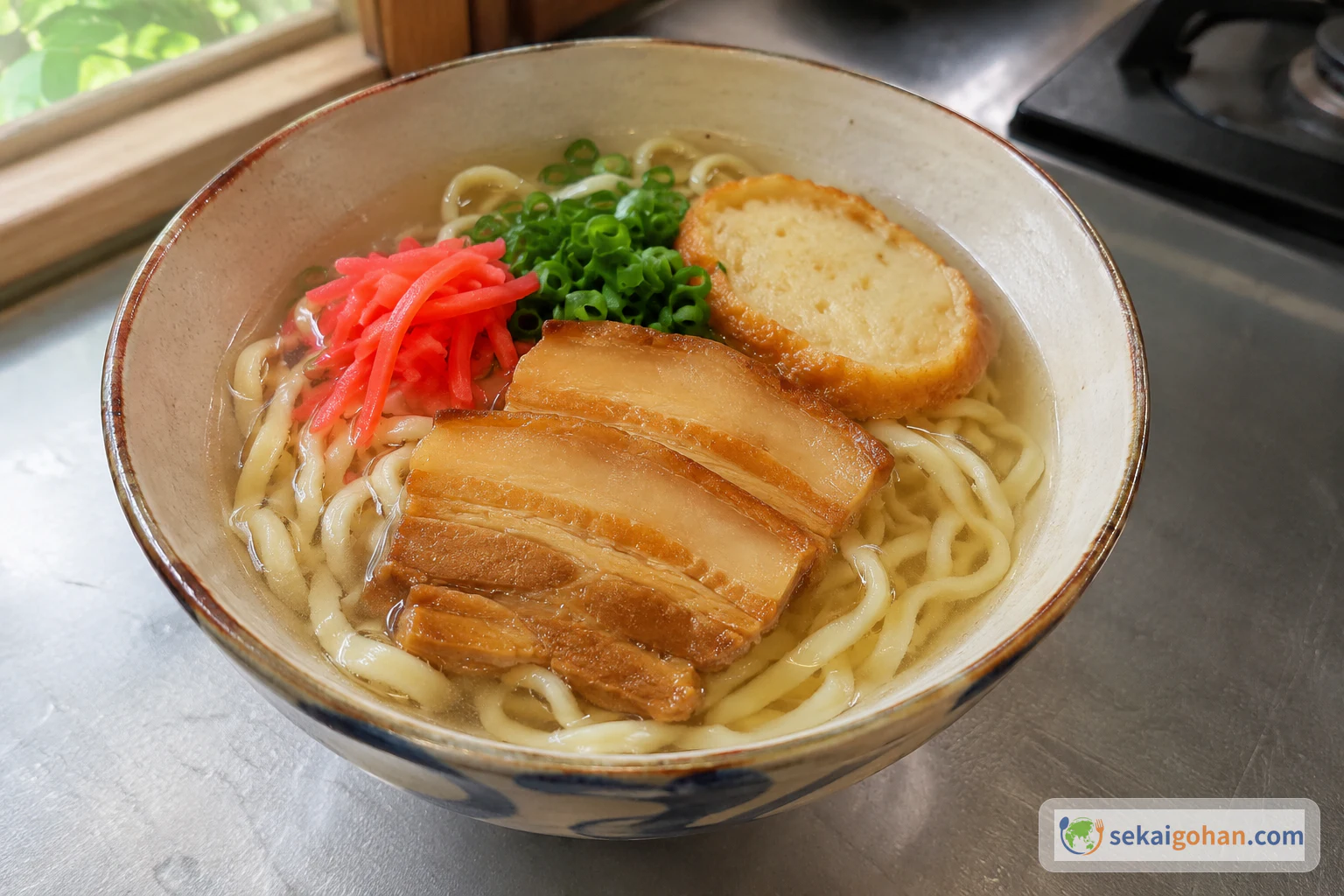
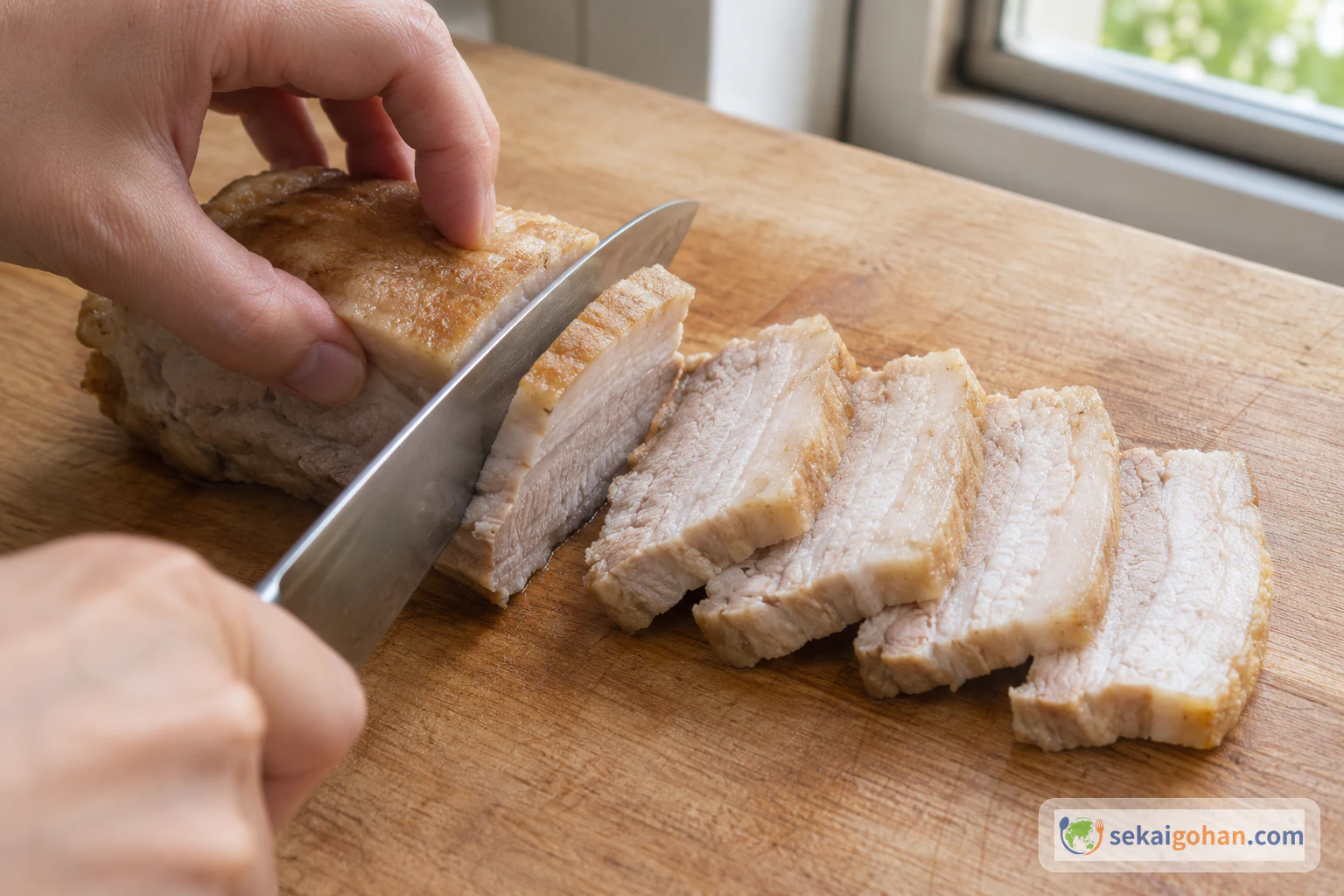
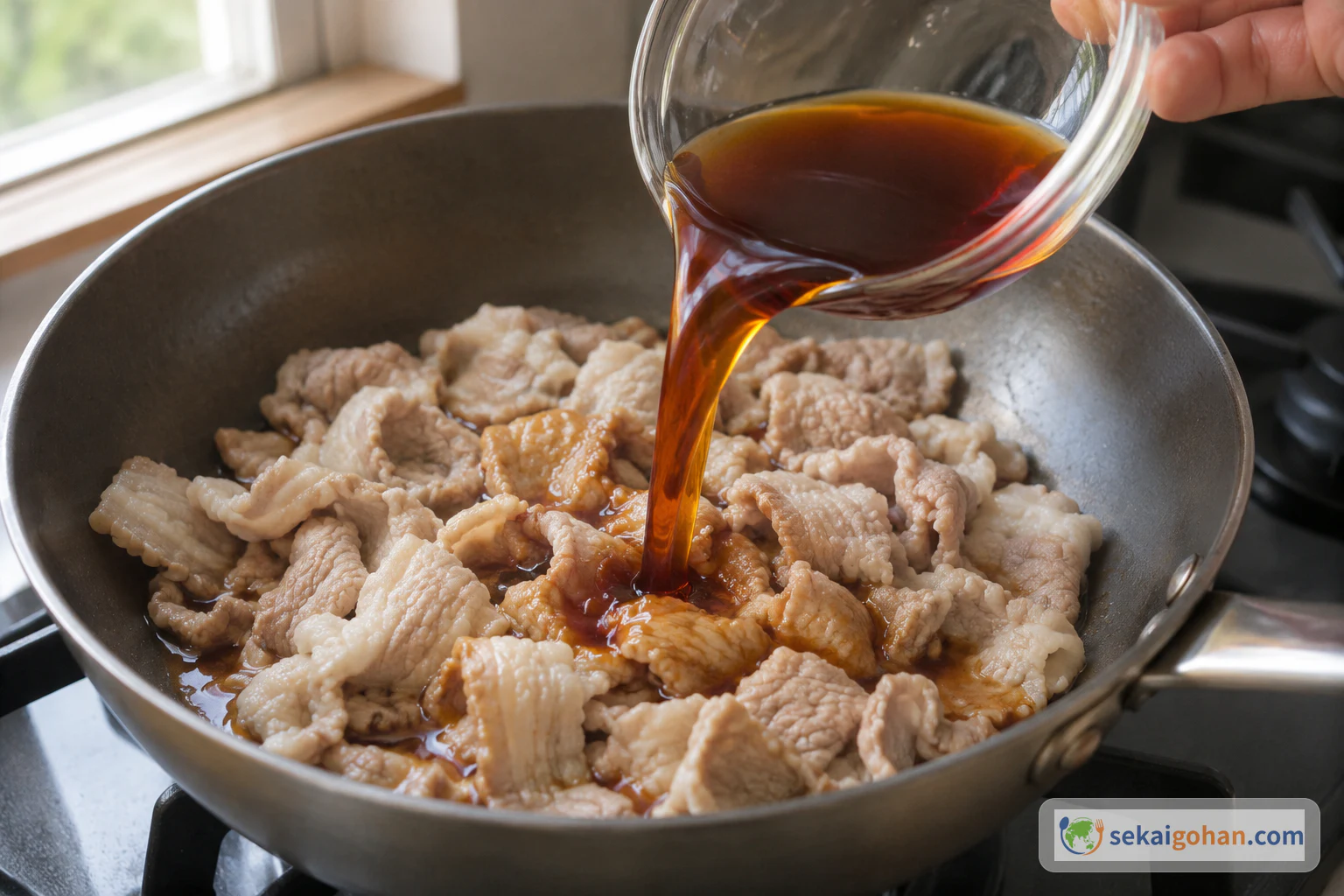
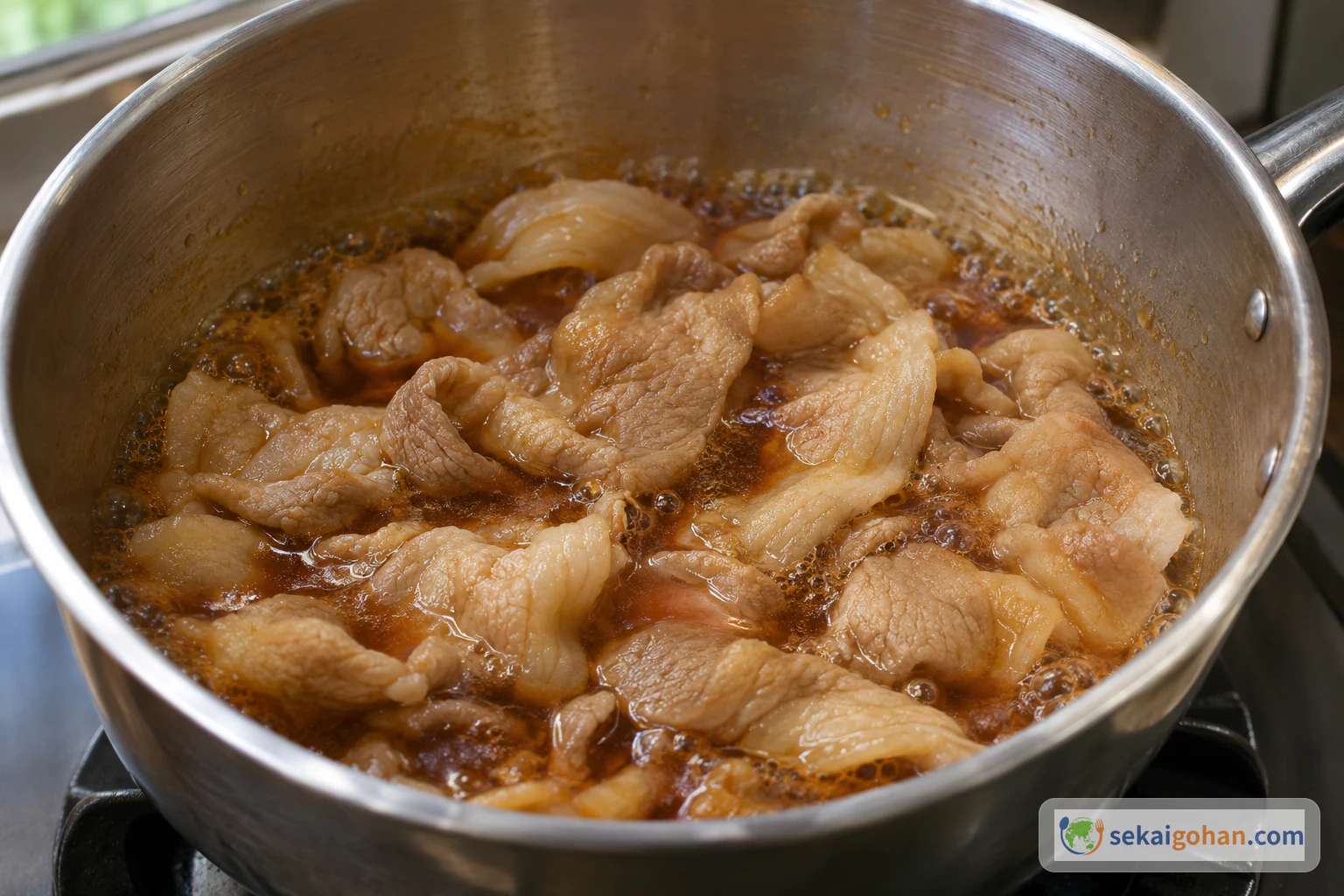
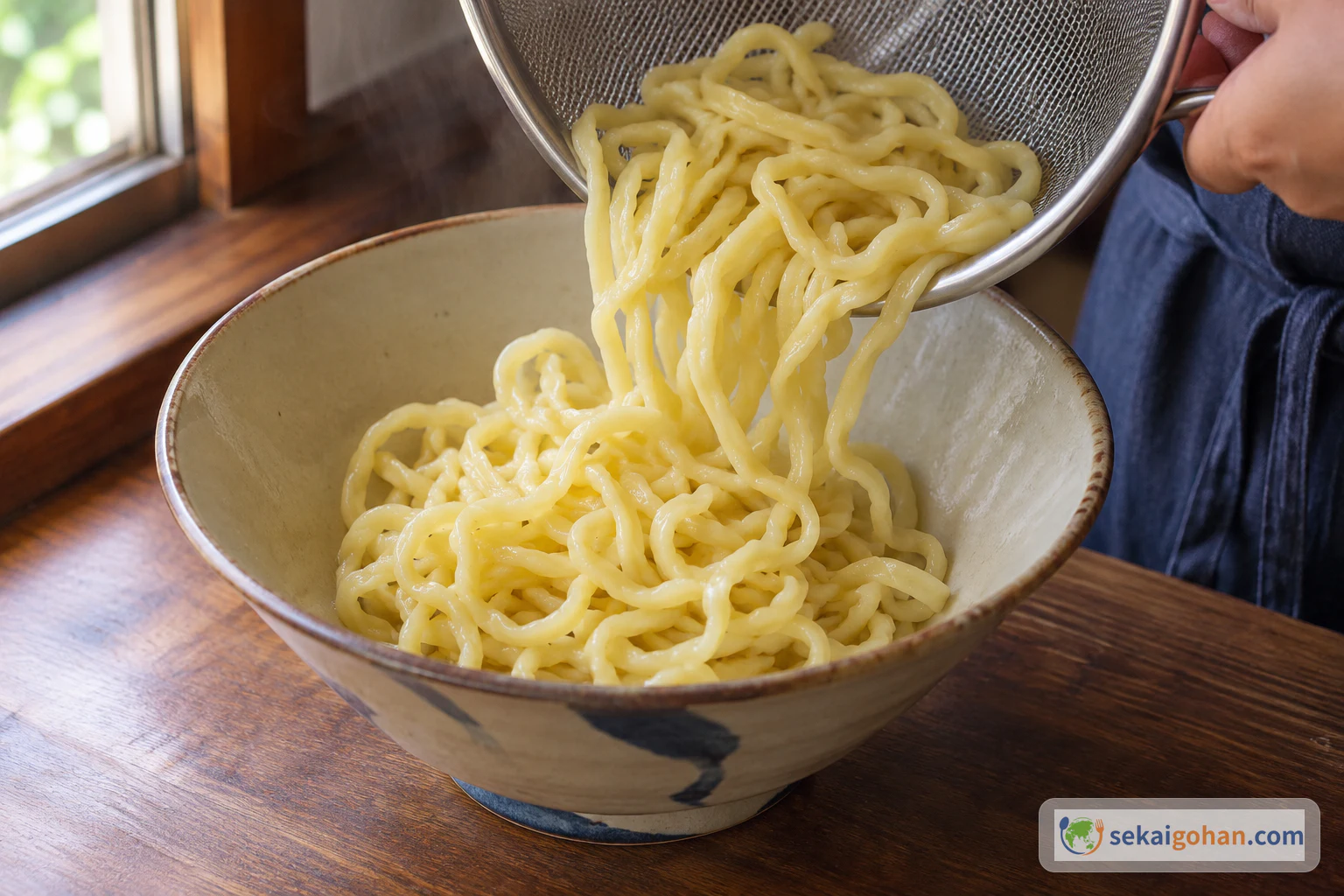
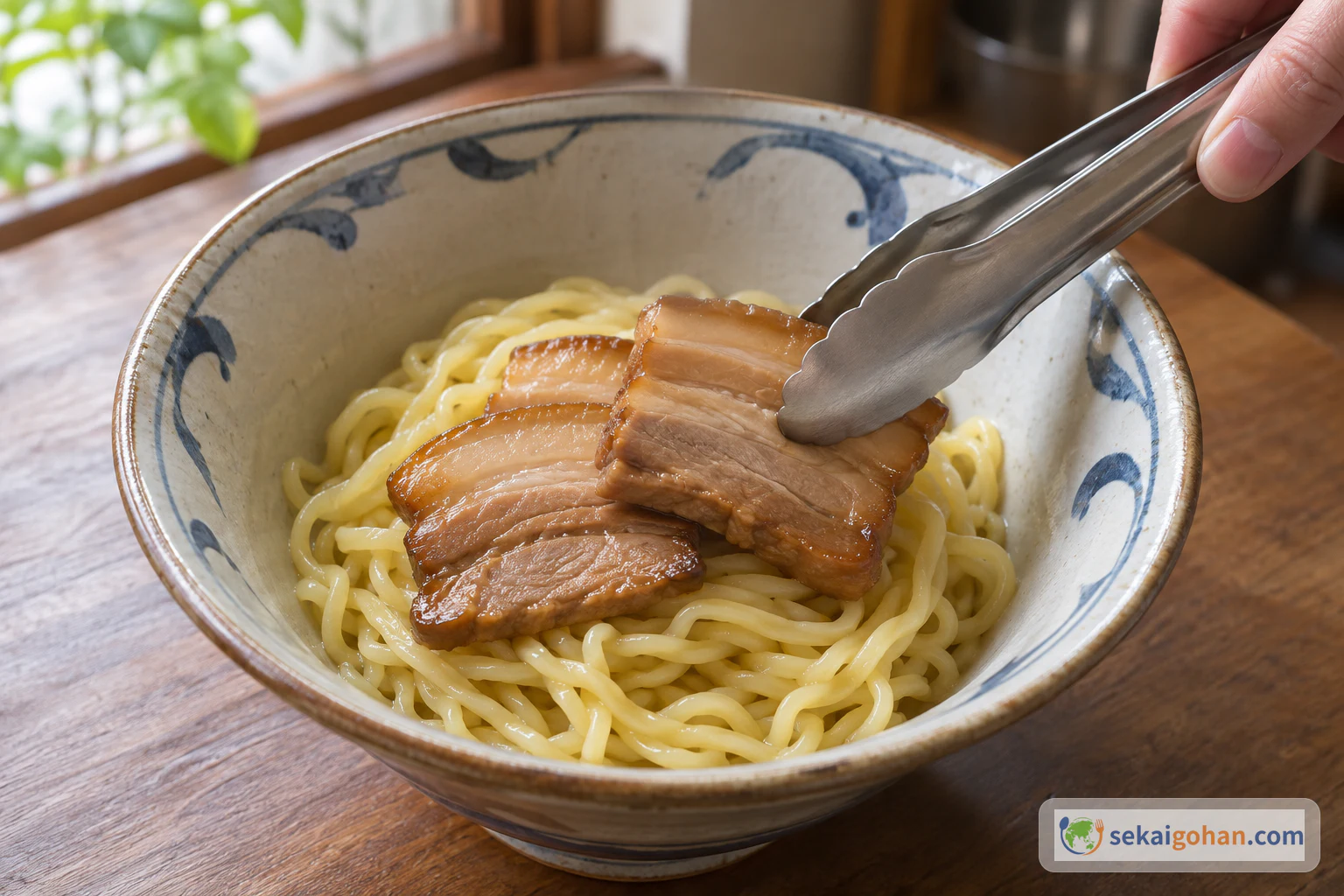
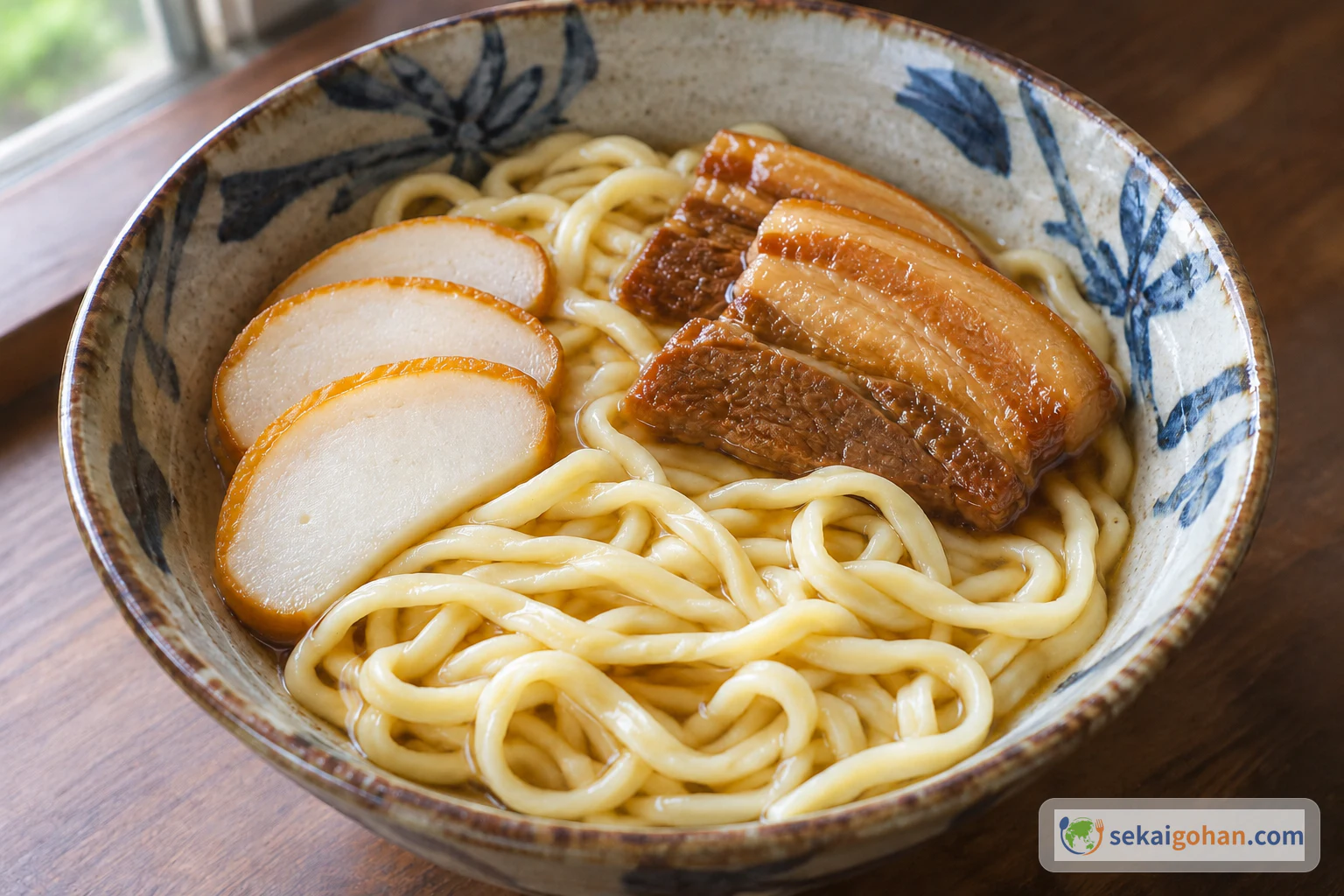
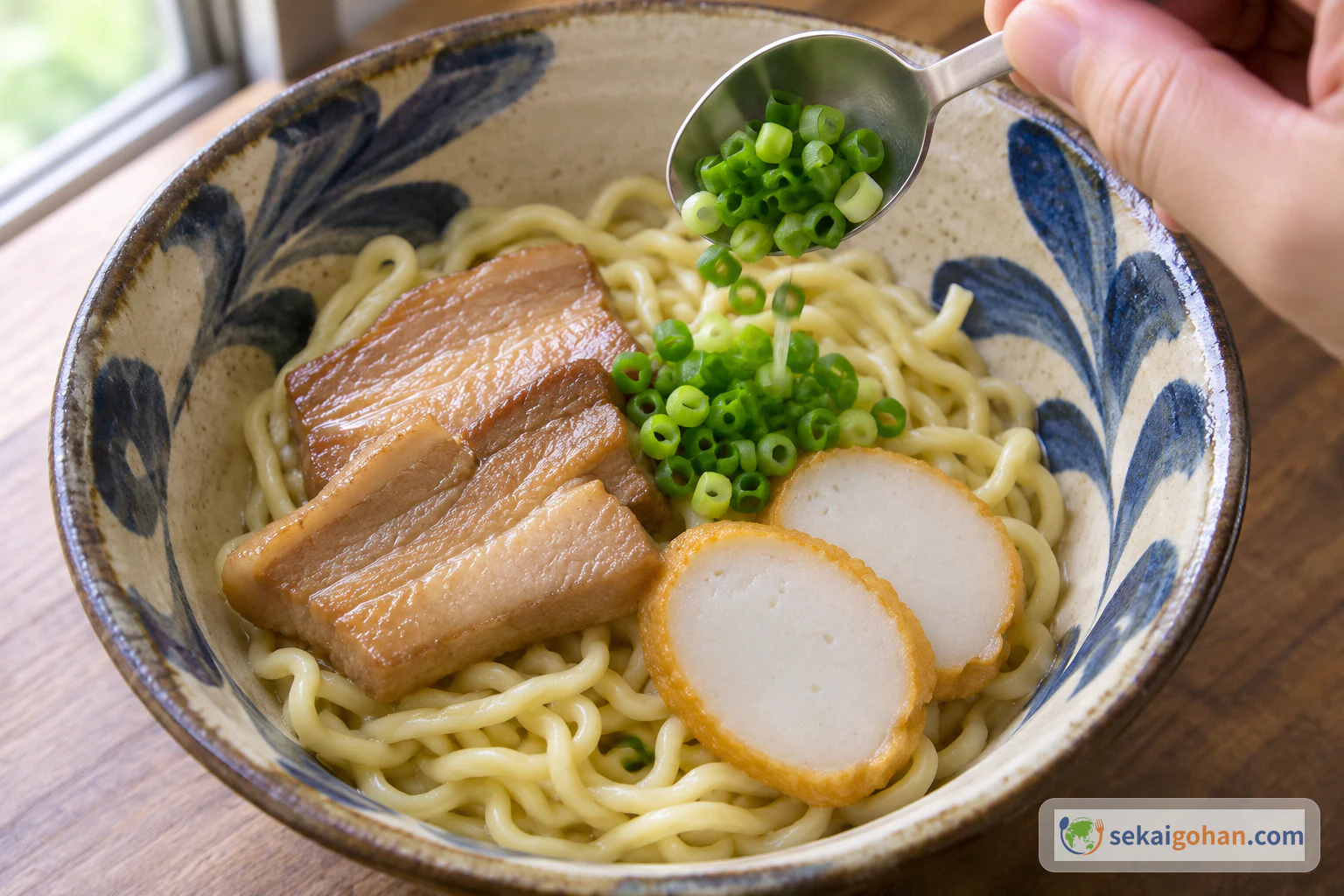
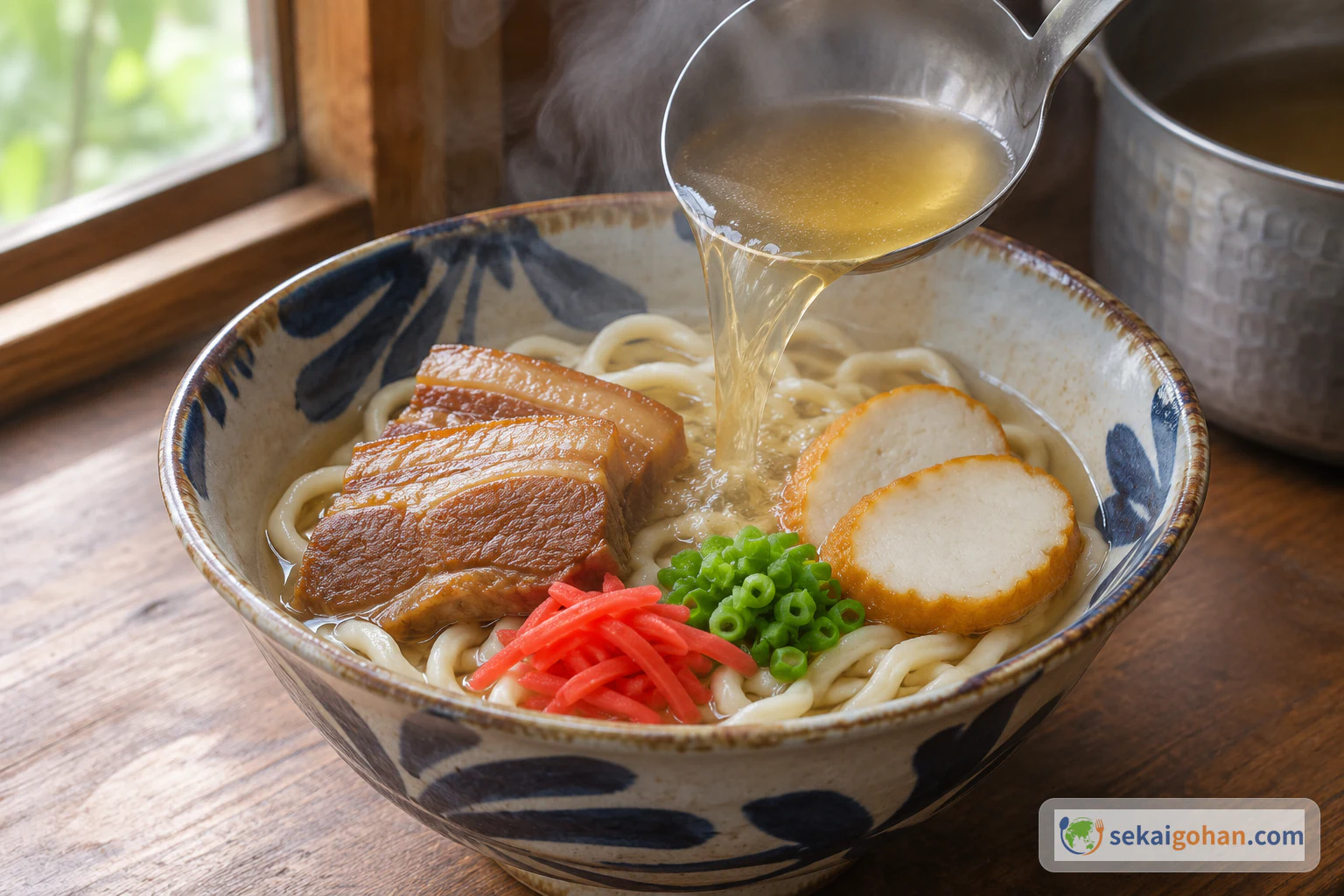
Thick wheat noodles, a broth of pork and bonito stocks, and four toppings: braised pork belly, fried round kamaboko, wakegi and red pickled ginger. Everything goes into the bowl first, and the hot broth goes in last.
The name misleads almost everyone at first. Soba usually suggests buckwheat, but according to Japan's Ministry of Agriculture, Forestry and Fisheries (MAFF), the noodles of Okinawa soba are made with wheat flour and kansui, with no buckwheat flour at all. The broth draws on pork and bonito. MAFF describes the dish as everyday food across Okinawa Prefecture, eaten both at home and in restaurants.
This version is the pork belly bowl published for 5 servings by the Okinawa Dietetic Association. It starts from ready-cooked noodles, so the work goes into the pork and the broth. You can find more dishes from the same country on our Japan page.
We have not cooked this version, measured its temperatures or tasted the broth. The amounts below are written for you to follow and judge in your own kitchen.
What We Added to the Recipe, and Why
The association's page gives the noodles, toppings, braising seasonings and 3 3/4 cups of bonito stock. It lists no amount for the pork stock or for water, and it does not explain how to make the pork stock. Its method simply says to bring the pork and bonito stocks to a boil. Without an amount, the broth can't be reproduced, so we filled that gap as an editorial decision.
The additions:
- Pork stock amount: 3 3/4 cups, equal to the bonito stock. Two other soups from the same association, inamuduchi and nakami soup, each use 2.5 cups of pork stock and 2.5 cups of bonito stock for 5 servings. The Ryukyu cuisine site below uses 2 1/2 cups of each in its nakami soup.
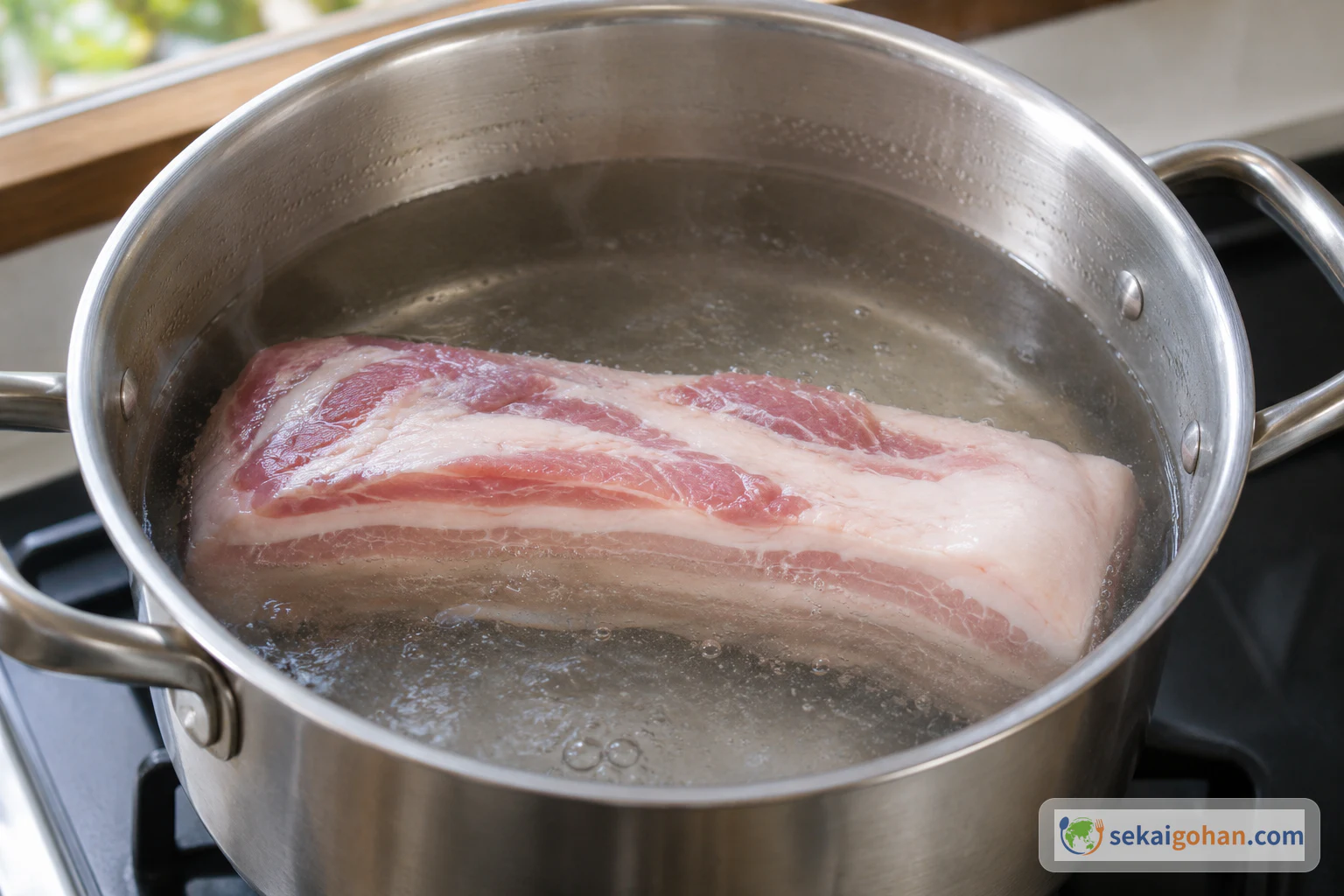
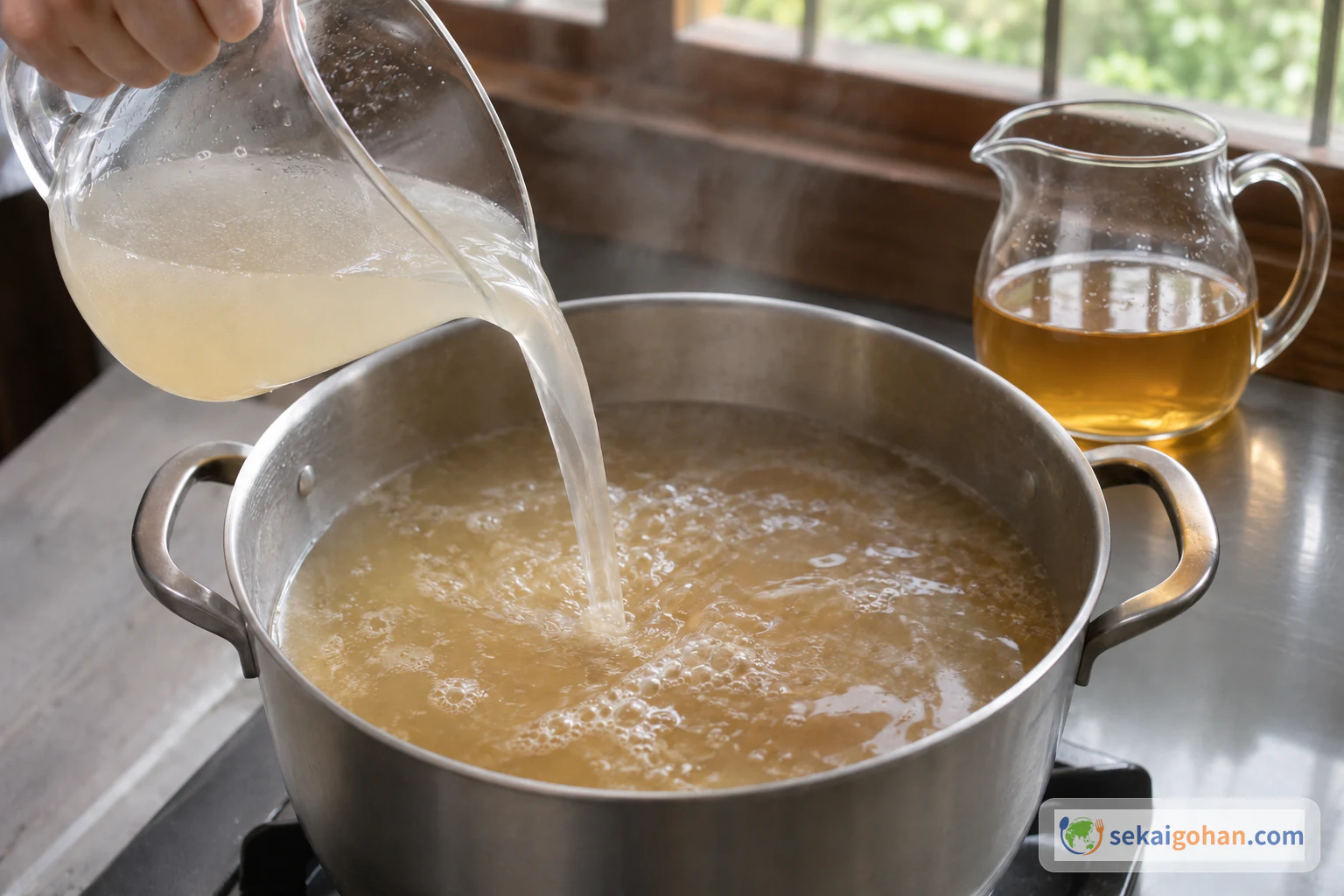
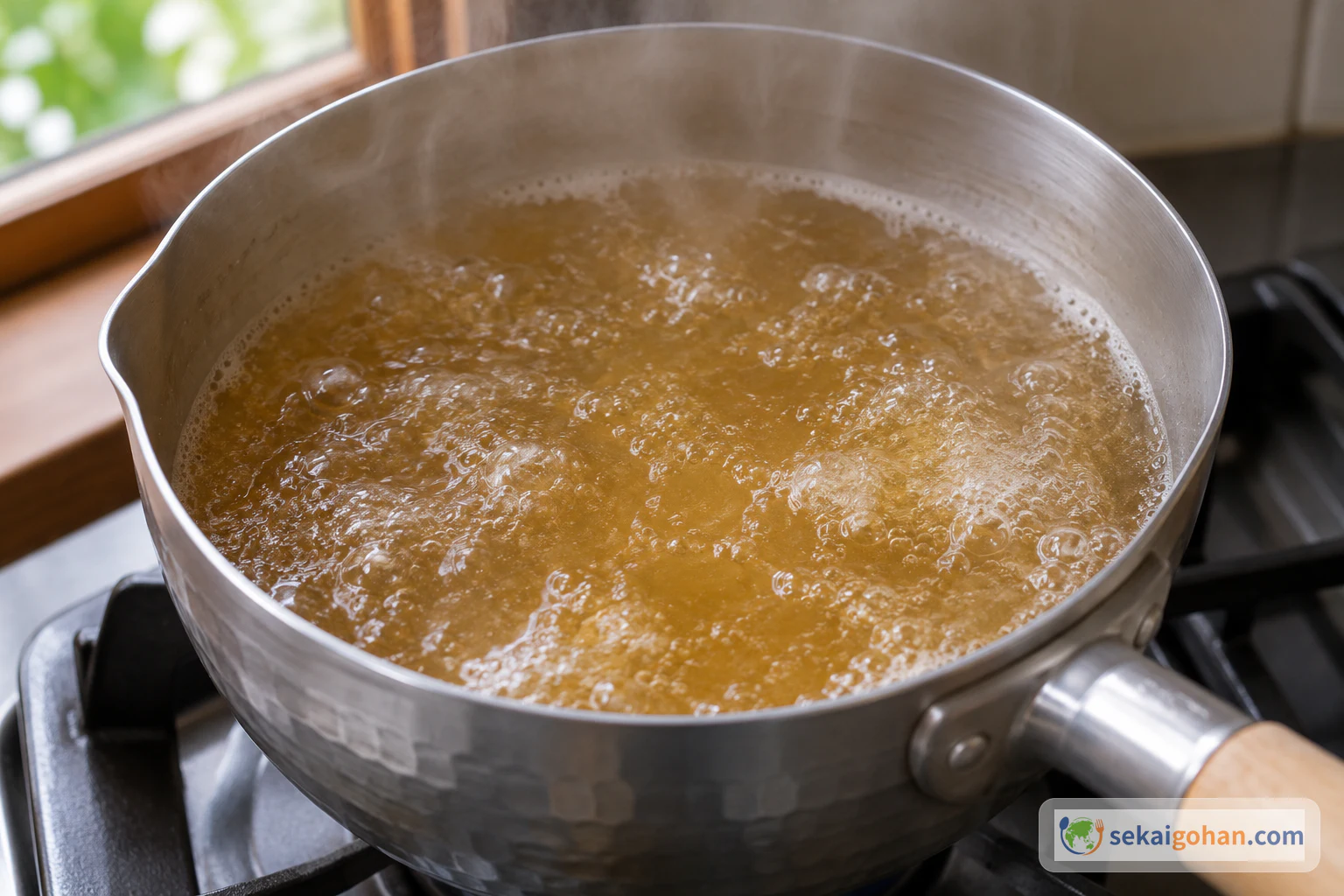
- Pork stock method: we boil the recipe's 400g of pork belly whole, then strain the cooking liquid and use it as the stock. The association does not say to do this; it is our reading. Ryukyu Cuisine's guide says 100g of pork bones or meat yields about 1 cup of stock, so 400g gives roughly 4 cups, although that guide's main example is bones simmered for about 2 hours. A school lunch recipe published by Uruma City also uses skimmed pork cooking liquid as pork stock, for a different dish made with pork shoulder.
- Boiling guide: 40 to 50 minutes, taken from the association's preparation of pork belly for kufa-juushii, a different dish that uses only 100g of meat. Time is only a guide here, and the thermometer decides when the pork is done.
- Bonito stock method: taken from the Ryukyu Cuisine guide.
- Pork weight: we treat 400g as the weight before boiling. The association's page does not say so outright.
The method also runs in our own order of pork, broth, then bowl, split into more steps than the association's four, so the numbering below is not theirs.
The weakest point is the ratio. Equal parts is not backed by any Okinawa soba recipe we consulted, and the two we compared both lean toward pork:
| Recipe | Pork stock | Bonito stock | Note |
|---|---|---|---|
| This article | 3 3/4 cups | 3 3/4 cups | Bonito amount from the association, pork amount added by us |
| Okinawa soba, Ryukyu Ryori no Kihon (supervised by Kayoko Matsumoto) | 6 cups | 1 cup | 5 servings, with homemade noodles, pork bone stock and 200g pork belly |
| Okinawa soba, Cookpad "Chimu Don Don Okinawa" | 2L | 1L | 3 to 4 servings, a 2:1 ratio |
| Kufa-juushii, Okinawa Dietetic Association | 2 cups | 1.5 cups | A different dish |
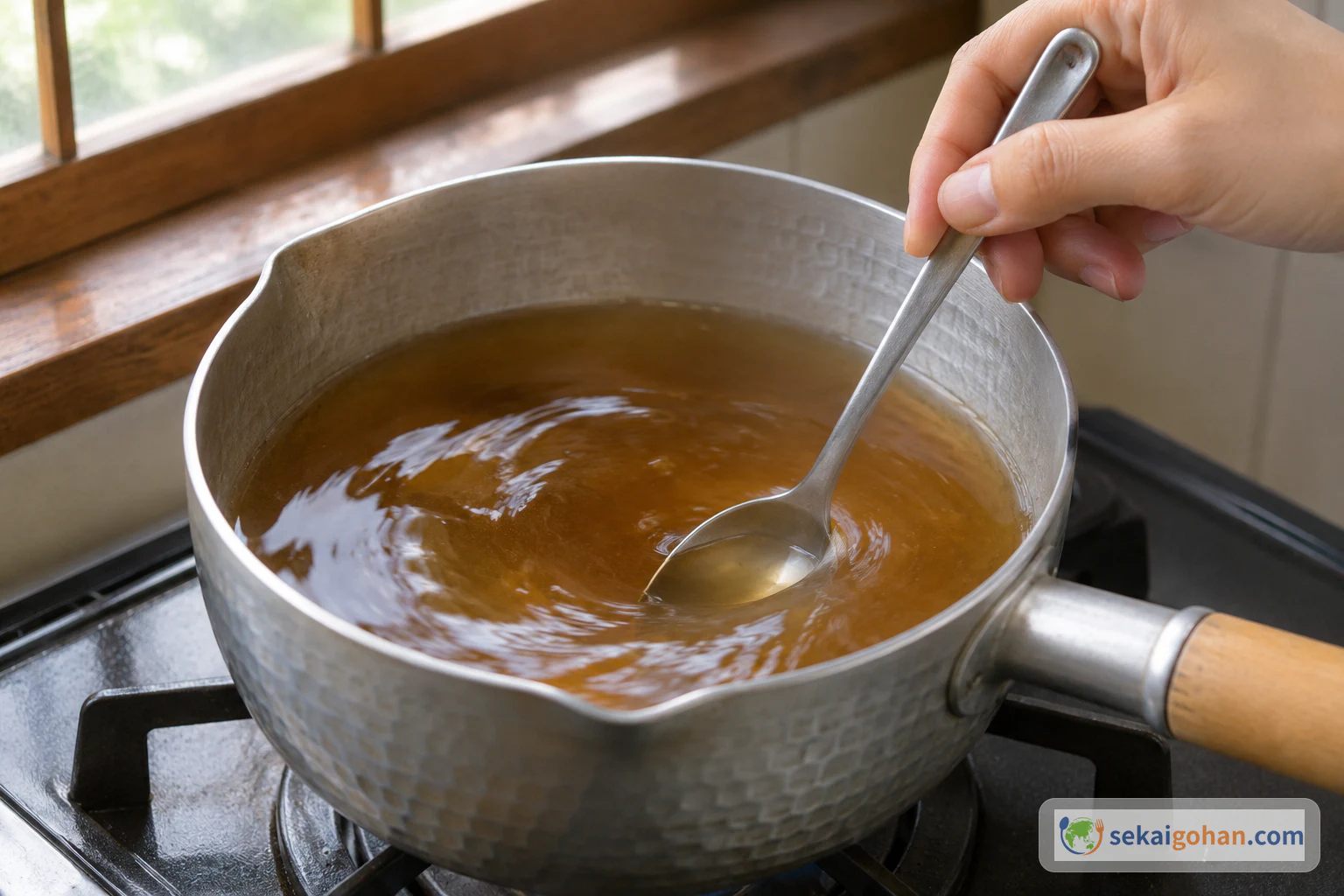
We chose equal parts because it leaves the association's bonito amount untouched and gives a sensible volume of broth: 7 1/2 cups for 5 servings, close to the 7 cups in the Matsumoto recipe. How it tastes is unconfirmed. We did not move any noodle, topping or braising values from these other recipes into this one.
Ingredients for 5 Servings
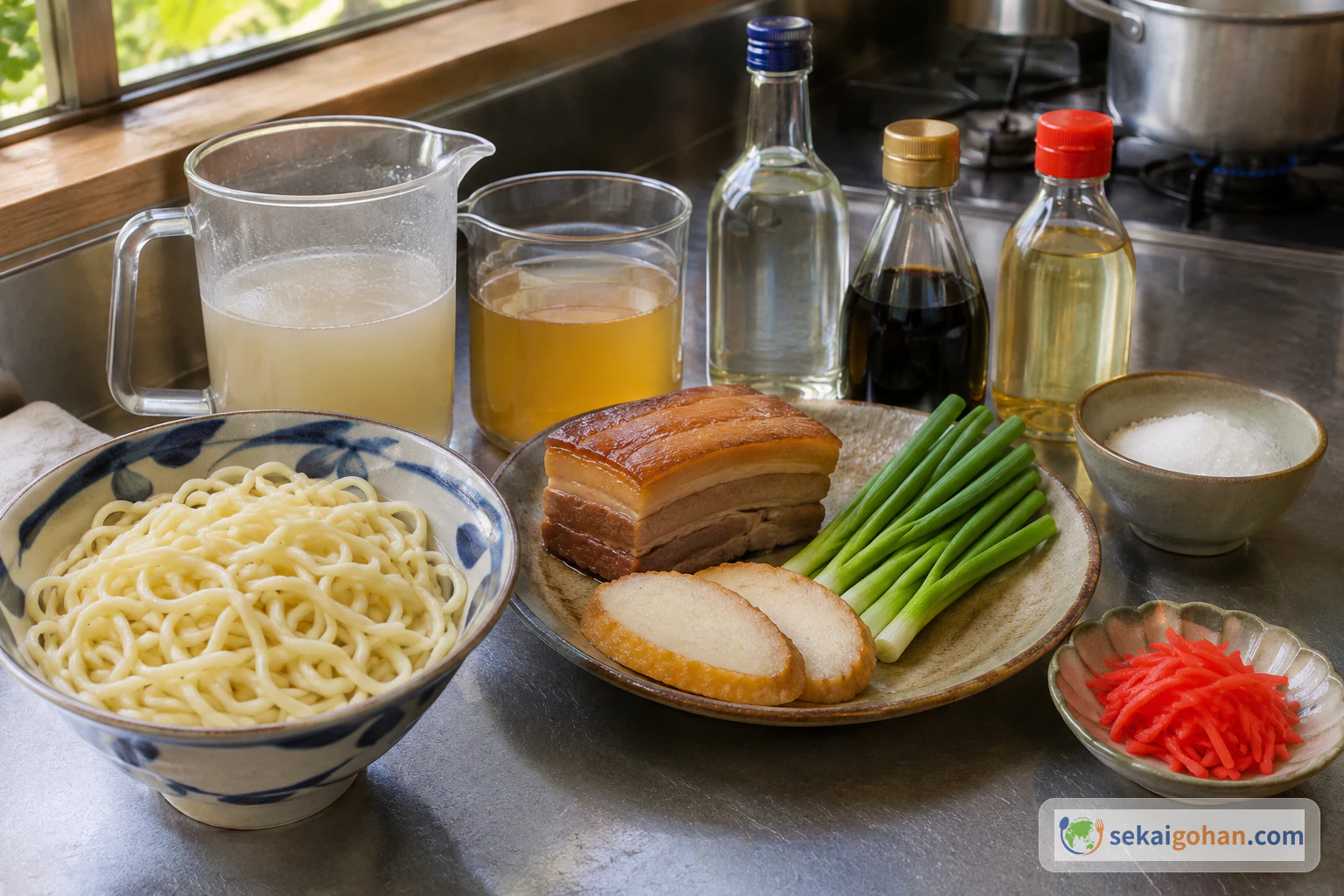
Measure both stocks with the same cup.
Equipment
- Food thermometer
- Deep pot for the pork
- Strainer
- Cloth for straining the bonito stock
- Pot for the bonito stock
- Pot for the broth
- Pan for braising the pork
- Saucepan or pot of boiling water and a strainer for the noodles
- Separate knife, cutting board and tongs for raw pork, and clean ones for cooked pork and serving
- Measuring cup and spoons
- Kitchen scale
- 5 serving bowls and a ladle
Choosing What to Buy
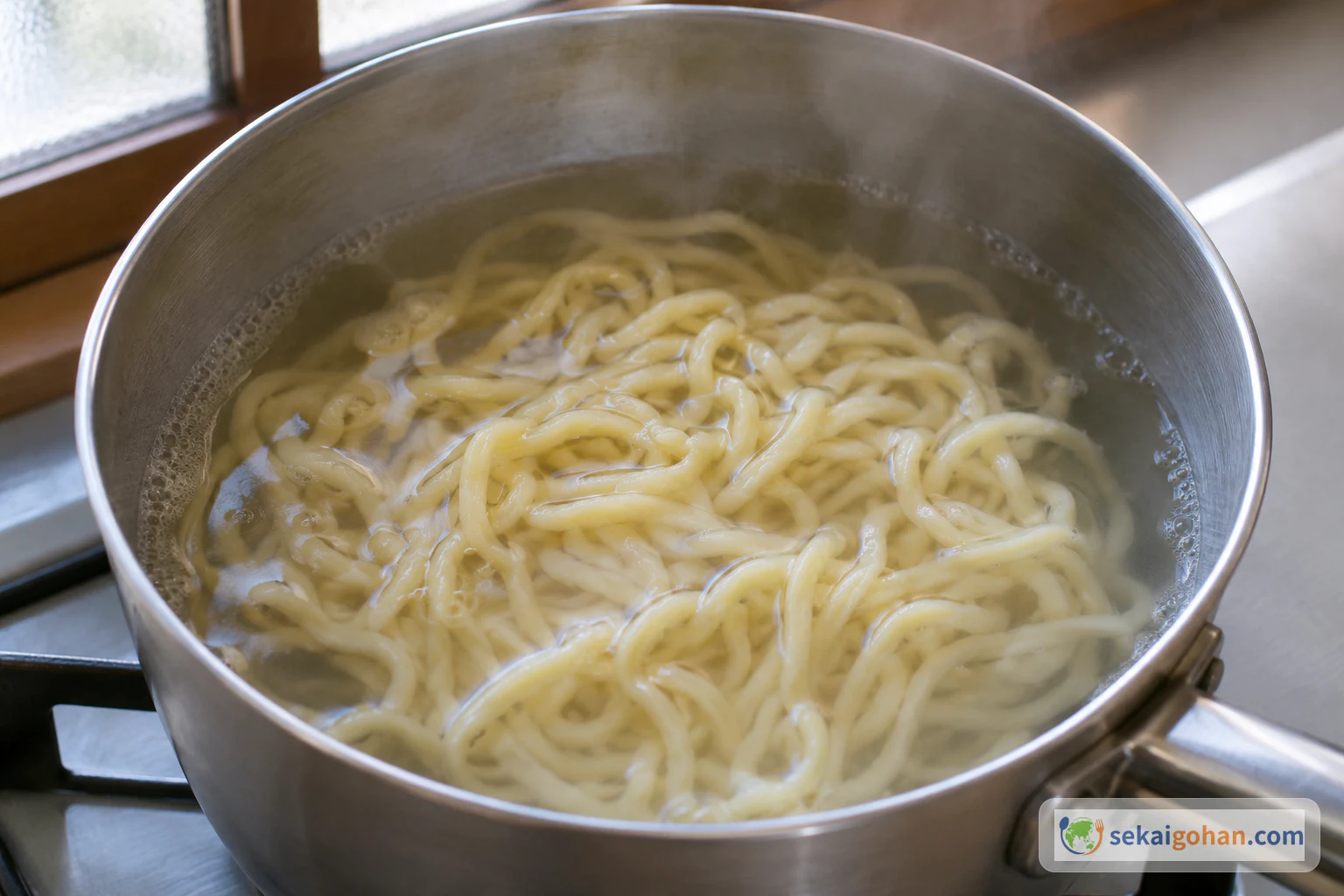
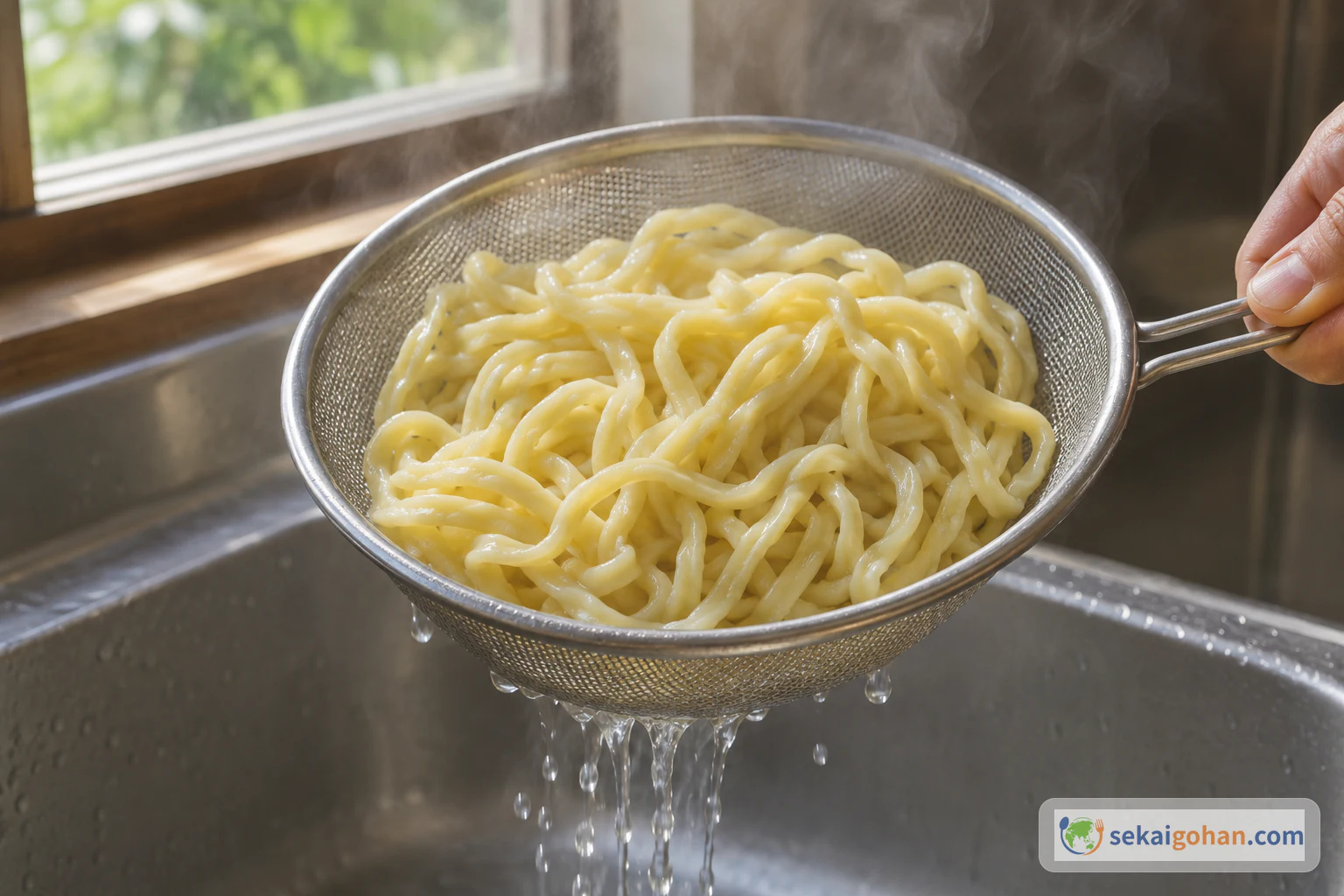
Noodles: the 1kg is the weight of ready-boiled noodles. Don't use 1kg of dried noodles, and don't try to convert the amount by weight. We give no conversion for dried noodles in this recipe.
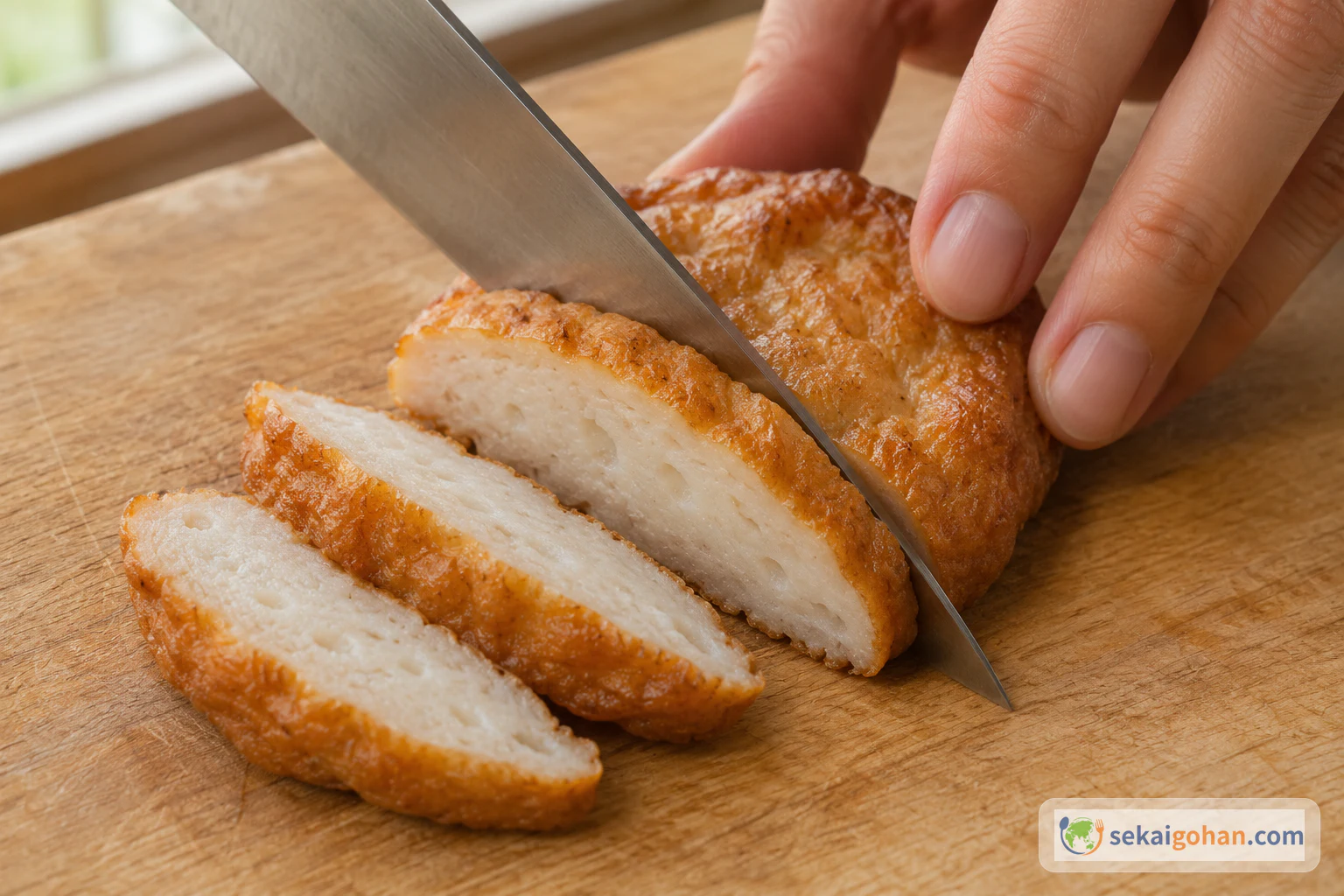
Kamaboko: use fried round kamaboko, browned outside and pale inside, rather than a pink-and-white spiral fish cake.
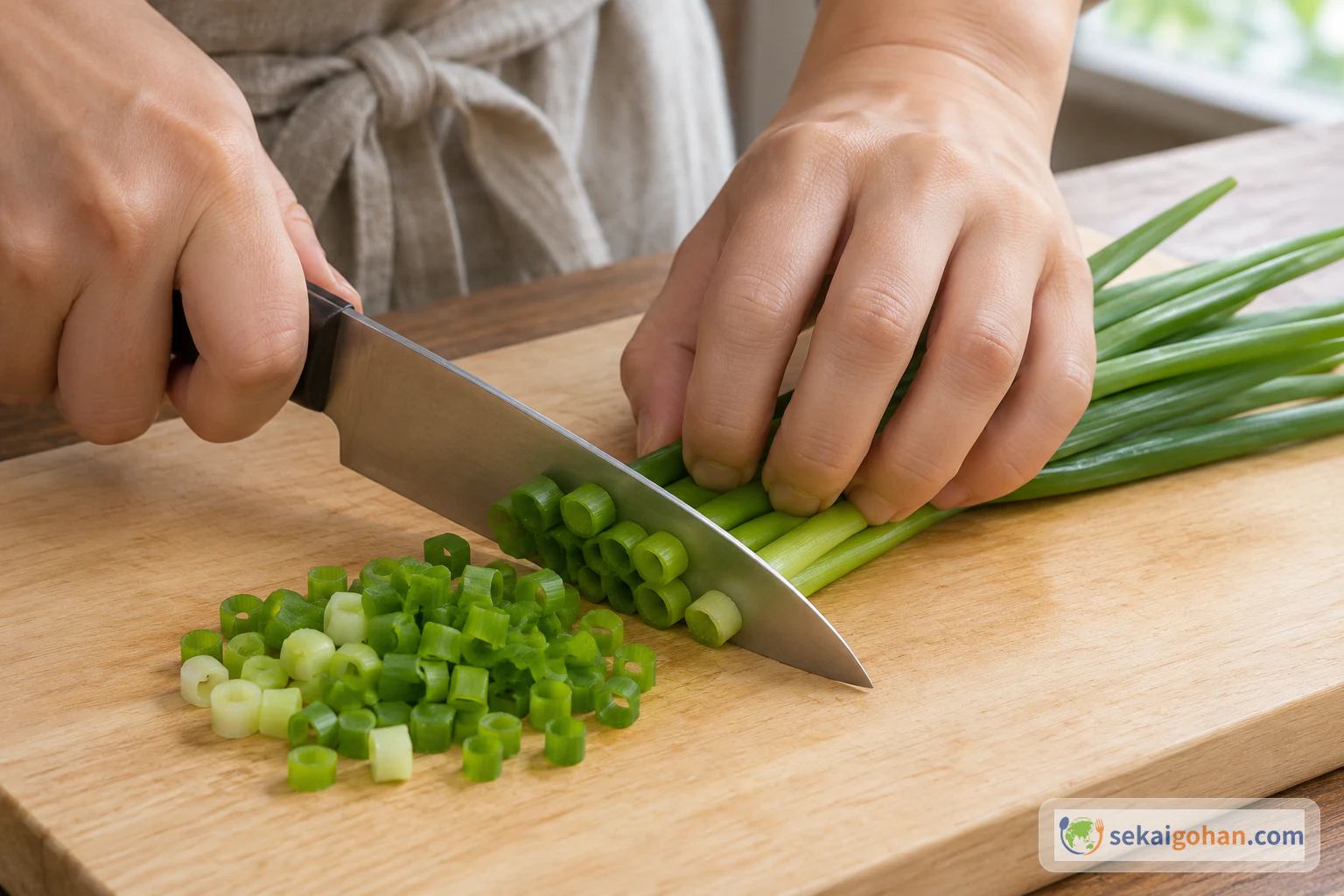
Green onion: wakegi is the topping used. If you can't find it, green onion is a reasonable choice; wash it the same way.
Awamori: this Okinawan spirit goes into the braise, and we make no claim about how much alcohol remains after cooking. See the FAQ if you'd rather not use it.
Allergens: the bowl contains wheat, soy and fish. Check the labels on the noodles, kamaboko and seasonings.
Method: Pork, Then Broth, Then the Bowl
Japan's Ministry of Health, Labour and Welfare advises home cooks to heat meat to at least 75°C at the center for at least 1 minute. Check the thickest part with a thermometer. Boiling time, meat color and bubbling can't confirm this, and neither can the photos below. Keep tools that touched raw pork away from cooked pork and serving tools.
Troubleshooting
| Problem | What to do |
|---|---|
| The pork's center is below 75°C, or hasn't held there for 1 minute | Keep boiling and measure again, even if 50 minutes have passed |
| The pork is sticking out of the water | Add water until it is covered, and keep the lid off |
| You have less than 3 3/4 cups of pork stock | Top up with water to reach 3 3/4 cups |
| You have more than 3 3/4 cups of pork stock | Leave the extra out of the broth so the balance stays as written |
| You only have dried noodles | This recipe gives no conversion, so don't substitute 1kg of dried noodles. Follow a recipe written for dried noodles |
| The broth has gone too salty | Next time, add the salt and soy sauce in smaller amounts and taste between additions |
Variations Across Okinawa
These are different bowls rather than adjustments to this recipe, so we give no amounts for them.
- Pork-only broth: MAFF notes the broth is often made with pork stock alone.
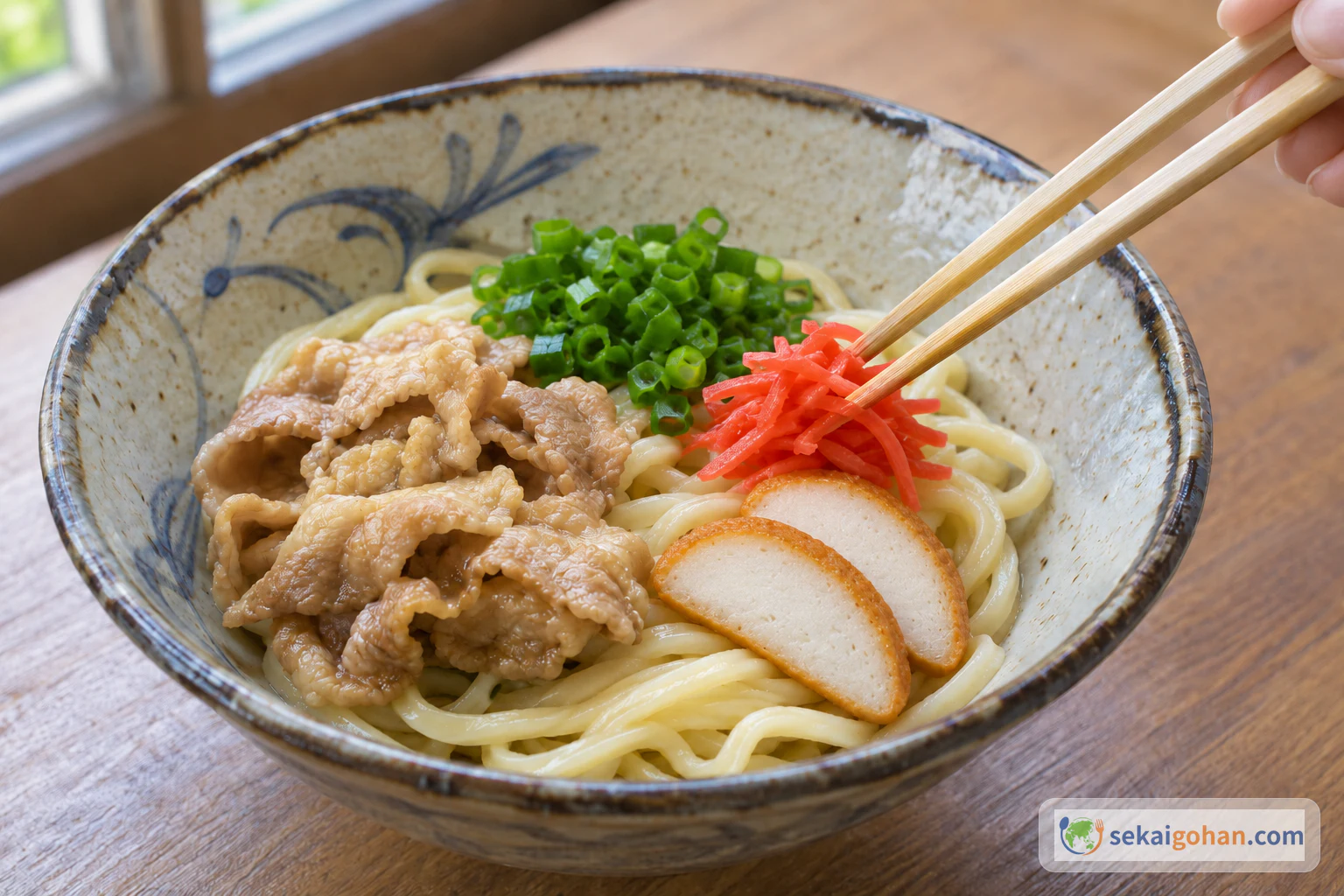
- Soki soba: the topping changes to soki, or pork spareribs. The Japan Maritime Self-Defense Force publishes a separate recipe using cartilage soki.
- Vegetable soba: MAFF mentions soki, cartilage soki and vegetable toppings among more recent examples.
- Miyako soba and Yaeyama soba: MAFF names these as regional styles within the prefecture.
- Koregusu at the table: this condiment of island chilies steeped in awamori is optional, according to MAFF. Add a little at a time to your own bowl.
An Everyday Bowl, and a Name Worth Explaining
MAFF describes Okinawa soba as a dish handed down throughout the prefecture, with thick noodles of wheat flour and kansui. Its broth is built on pork bones and dried bonito, and the standard toppings are pork belly, stick kamaboko, green onion and red pickled ginger.
MAFF also words the dish's beginnings as what is said to have been the start, so we don't present a firm origin story here. Nor is this recipe the one correct version. The same MAFF page publishes a homemade noodle recipe with its own pork thickness and braising liquid, and Okinawa's regional and household bowls differ. This article is one home version built on ready-cooked noodles.
Frequently Asked Questions
Does Okinawa soba contain buckwheat?
By the definition used here, no. The noodles are made with wheat flour and kansui, according to MAFF. Check the label on any noodles you buy.
How is it different from soki soba?
Soki soba is topped with soki, or pork spareribs, rather than sliced pork belly. It needs its own recipe, so don't simply swap the meat in these steps.
Can I swap cooked and dried noodles at the same weight?
No. The 1kg here refers to ready-boiled noodles, and this recipe doesn't convert it to dried.
What size cup should I use?
The Okinawa Dietetic Association doesn't state its cup size. Using the same cup for both stocks keeps the ratio the same. The Ryukyu Cuisine guide, which we used for the water and bonito amounts, defines 1 cup as 200ml. With a 200ml cup you get 750ml of each stock, 1.5L of broth in all, or 300ml per person.
Can I make the pork stock from bones instead?
Yes, as a different method. The Ryukyu Cuisine guide gives 1kg of bones or meat, 10 cups of water plus extra for what boils away, and about 2 hours with the lid off. A Cookpad post under the name "Okinawa Prefecture" gives the same method, although the page doesn't confirm it is an official prefectural account. These steps use the pork belly cooking liquid instead, and we haven't worked bone stock into them.
Can I leave out the awamori?
The Maritime Self-Defense Force's soki soba page notes that its recipe uses mirin and cooking sake instead of awamori. That is a different recipe, so we can't give you tested amounts for this one, and leaving it out will change the sauce.
Why not rinse the pork first?
The Ryukyu Cuisine guide and the Cookpad post both say to rinse meat quickly before making stock. We left this out because the Ministry of Health, Labour and Welfare warns about cross-contamination from raw meat.
Can I judge doneness by time or color?
No. The 40 to 50 minutes is only a guide, and color isn't a measurement. Use a thermometer to confirm at least 75°C at the center for at least 1 minute.
Sources
- Okinawa Dietetic Association, "Okinawa Soba" (沖縄そば), Uchina Recipes. The base recipe: 5 servings, noodles, toppings, braising seasonings, bonito stock amount, and the broth's components and assembly. https://okinawa-eiyo.or.jp/uchina-recipe/%E6%B2%96%E7%B8%84%E3%81%9D%E3%81%B0/
- Ministry of Agriculture, Forestry and Fisheries, "Okinawa Soba, Okinawa Prefecture" (沖縄そば 沖縄県), Our Regional Cuisines. Identity of the noodles and broth, regional styles, standard toppings, everyday role and koregusu. https://www.maff.go.jp/j/keikaku/syokubunka/k_ryouri/search_menu/menu/47_20_okinawa.html
- Ministry of Health, Labour and Welfare, "Food Poisoning Prevention: Cook Meat Well" (食中毒予防:お肉はよく加熱して食べよう). General guidance on heating meat to 75°C at the center for at least 1 minute, and on cross-contamination. https://www.mhlw.go.jp/stf/web_magazine/closeup/08.html
- Ministry of Health, Labour and Welfare, "Do Not Eat Pork Meat or Offal Raw" (豚のお肉や内臓を生食するのは、やめましょう). The advice not to eat pork raw and to cook it through. Its heating figures appear in a section for food businesses, so they are not the home guidance used in this recipe. https://www.mhlw.go.jp/stf/seisakunitsuite/bunya/kenkou_iryou/shokuhin/syouhisya/121004/
- Ryukyu Cuisine training course site, "Recipes" (レシピ|沖縄の伝統的な食文化 琉球料理). Pork stock yield and method, bonito stock method, equal stocks in nakami soup, and 1 cup as 200ml. https://ryukyuryouri.com/recipe/
- Okinawa Prefecture, "Ryukyu Cuisine Transmitters and Masters" (「琉球料理伝承人」及び「琉球料理伝承人宗匠」について). The prefecture's Ryukyu cuisine training course and its link to the Ryukyu Cuisine site. https://www.pref.okinawa.jp/bunkakoryu/bunkageijutsu/1022485/1037795.html
- Cookpad post by "Okinawa Prefecture," "How to Make Pork Stock" (豚だしの取り方). Supporting reference for the same pork stock method. https://cookpad.com/jp/recipes/20578102-%E8%B1%9A%E3%81%A0%E3%81%97%E3%81%AE%E5%8F%96%E3%82%8A%E6%96%B9
- Okinawa Dietetic Association, "Inamuduchi" (イナムドゥチ). Equal pork and bonito stock amounts for 5 servings, in a different dish. https://www.okinawa-eiyo.or.jp/uchina-recipe/%E3%82%A4%E3%83%8A%E3%83%A0%E3%83%89%E3%82%A5%E3%83%81-%EF%BC%88%E7%8C%AA%E3%82%82%E3%81%A9%E3%81%8D%E3%81%AE%E6%B1%81%E7%89%A9%EF%BC%89/
- Okinawa Dietetic Association, "Nakami Soup" (中身の吸物). Equal pork and bonito stock amounts for 5 servings, in a different dish. https://okinawa-eiyo.or.jp/uchina-recipe/%E4%B8%AD%E8%BA%AB%E3%81%AE%E5%90%B8%E7%89%A9-%EF%BC%88%E8%B1%9A%E3%81%AE%E8%83%83%E8%85%B8%E3%81%AE%E5%90%B8%E7%89%A9%EF%BC%89/
- Okinawa Dietetic Association, "Kufa-juushii" (クファジューシー). The 40 to 50 minute guide for preparing pork belly, and a 2 cup to 1.5 cup stock example, in a different dish. https://okinawa-eiyo.or.jp/uchina-recipe/%E3%82%AF%E3%83%95%E3%82%A1%E3%82%B8%E3%83%A5%E3%83%BC%E3%82%B7%E3%83%BC-%EF%BC%88%E6%B2%96%E7%B8%84%E9%A2%A8%E7%82%8A%E3%81%8D%E8%BE%BC%E3%81%BF%E3%81%94%E9%A3%AF%EF%BC%89/
- Uruma City, "School Lunch Recipe: Inamuduchi" (給食レシピ). An example of skimming pork cooking liquid and using it as pork stock, in a different dish. https://www.city.uruma.lg.jp/documents/2540/10katurennresipi28129.pdf
- Ryukyu Ryori no Kihon, supervised by Kayoko Matsumoto, "Okinawa Soba" (沖縄そば). Comparison only: 6 cups pork stock and 1 cup bonito stock for 5 servings. https://okiham.co.jp/ryukyuryouri/recipes/%E6%B2%96%E7%B8%84%E3%81%9D%E3%81%B0/
- Cookpad "Chimu Don Don Okinawa," "Okinawa Soba" (沖縄そば). Comparison only: a 2:1 ratio of pork to bonito stock. https://cookpad.com/jp/recipes/20741226-%E6%B2%96%E7%B8%84%E3%81%9D%E3%81%B0
- Japan Maritime Self-Defense Force, "Soki Soba" (ソーキそば). Comparison only: a cartilage soki version and its use of mirin and cooking sake in place of awamori. https://www.mod.go.jp/msdf/kanmeshi/menu/jp/021/index.html