In the paper bag, the syrup is still moving

Picture a cold day and a paper bag from a street stall cupped in both hands. The smell of oil and cinnamon rises from inside, and when you break off an edge, brown sugar syrup slowly tilts toward the opening. It's hot. Bite now and you'll burn your tongue, so you shift your grip on the bag and wait just a little longer. Hotteok is a snack that asks you to make small judgment calls before you even take a bite.
Hotteok (호떡) is a Korean street-stall sweet: a dough made with wheat flour or glutinous rice flour, wrapped around a sugar filling, then pressed flat and fried on a griddle. The Korea Tourism Organization introduces hotteok as one of Korea's signature street snacks and notes that, when people think of Busan, the version that comes to mind is ssiat hotteok, stuffed with seeds and nuts. Its official food guide also describes fillings that combine peanuts, pumpkin seeds, almonds, walnuts and more.
The hard part at home isn't seasoning. It's "don't tear the dough, melt the sugar in the center, and don't scorch the outside." Knead the dough stiff and it's hard to wrap; get greedy with the filling and syrup leaks the moment it hits the pan. On the other hand, a soft dough with a little glutinous rice flour, pressed slowly, gives you a thin, toasty exterior and a pleasantly chewy, springy interior.
This recipe makes 8 pancakes from bread flour and glutinous rice flour, no hotteok mix required. Rather than copying a Korean street stall exactly, the proportions are set up so that in a home kitchen you can tell "is it cooked," "will the filling flow," and "is this something I'll make again."
If fresh-off-the-griddle texture is your priority, use this method: a yeasted dough that makes 8 pancakes. On days when you only want one or two, or don't feel like getting your hands sticky wrapping filling, a store-bought hotteok mix or frozen hotteok is perfectly fine. A mix handles the proportions and measuring for you; homemade lets you change the flour ratio and the amount of filling. Choose based on how much time you have to wait for them to come off the pan.
From winter street stalls to Busan's seed-filled hotteok

Try to decode the name by intuition and you'll picture the wrong thing. It's more useful to remember hotteok as a light snack: a round dough pressed and fried, with a sweet filling eaten while still hot.
Korea.net, the Korean government's official information site, lists hotteok among the classic winter street snacks: a wheat or glutinous rice dough filled with melted brown sugar or syrup, cinnamon and nuts, lightly fried in oil. Its article on winter street food also describes eating warm, paper-wrapped hotteok on a cold street while it warms your hands.
That handheld warmth fades a bit once hotteok moves to a plate at home. So rather than stacking them on a platter, set each one on its own piece of paper or parchment and eat it once it has cooled slightly; that keeps a little of the street-stall feel. Syrup will drip, so it's thoughtful to put a small plate out from the start.
Regional differences show up in Busan. The ssiat hotteok described by the Korea Tourism Organization adds sunflower seeds, pumpkin seeds and the like to the basic brown sugar filling. The toastiness of the seeds and the stickiness of melted sugar land in the same bite, giving you more to chew than a plain hotteok. It isn't a separate, special dish because of the seeds; think of it as local eating habits layered onto the same street-stall pancake.
Korean street food isn't a single fixed thing. Korea.net's food guide also mentions hotteok fillings made with honey, pumpkin seeds, vegetables or beef. Rather than guarding one sweet filling, the dish uses a dough that can be pressed and fried as a vessel, and has changed what goes inside to suit each place and customer. In your own kitchen, start with brown sugar and cinnamon to learn the texture, move on to the seeded version, then try a savory filling with scallions or kimchi, and you'll see why the variations exist.
Ingredients (8 pancakes, serves 4)

With bread flour alone the dough is springy like bread; add more glutinous rice flour and it gets stretchy and sticky like rice cake. Here, about a quarter of the total flour is glutinous rice flour, so the dough stays easy to wrap while the fresh pancakes have a light chew. The recipe from King Arthur Baking, in the U.S., likewise combines wheat flour with sweet rice flour and wraps a brown sugar filling with walnuts. We checked it against that recipe's ingredient list and adjusted it to an easy-to-handle, water-based dough.
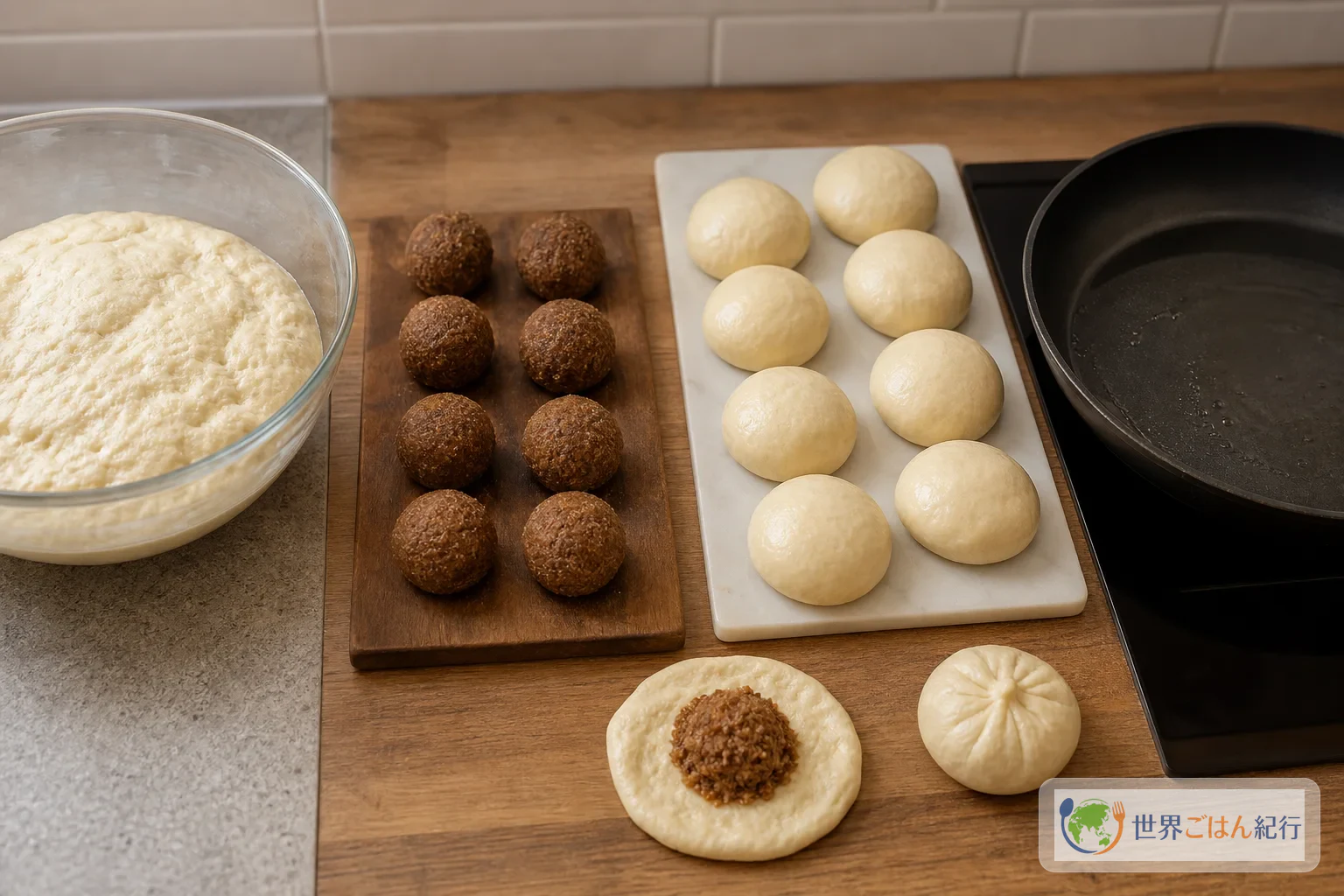
Divide the filling into 8 portions of about 17 g each. More sugar tastes great, but it shifts to the edges as you wrap and tends to run the moment the pancake hits the pan. Stick to 17 g the first time and increase from the second batch on; that's the safe route.
Take care with wheat and nuts. This recipe uses water rather than milk, so there's no dairy in the ingredients, but labeling for bread flour, glutinous rice flour, dry yeast, brown sugar and nuts varies by product. If anyone is allergic to walnuts, peanuts or almonds, leave the nuts and seeds out of the filling and make a "syrup-only" filling by mixing 75 g brown sugar, 2 g cinnamon and 5 g potato starch. Hot sugar still flows even with starch added, so don't increase the amount you wrap.
What's worth having on hand

Flour, brown sugar, oil and nuts come from any ordinary supermarket. The three things that really matter are glutinous rice flour, which changes the texture; cinnamon, which sets the aroma; and a heavy pan that doesn't lose heat as you fry 8 pancakes in a row.
Glutinous rice flour (sold as sweet rice flour, mochiko or shiratamako at Asian grocers) is worth buying if you'd rather adjust the dough yourself than use a hotteok mix, or if you'll also use it for tteokbokki or rice dumplings. If you only want to try hotteok once, or don't want to wait for the dough to rise, a store-bought mix is less wasteful. Check the package for the form of the flour and the ingredient list.
If you already have ground cinnamon, there's no need to buy more. Cinnamon sticks, grated finely just for the filling, give a brighter aroma and are handy if you also use cinnamon for baking or chai.
If you already own a heavy-bottomed skillet, you don't need another. If your thin pan browns the first pancake and leaves the second one suddenly pale, or you plan to fry all 8 in a row, a cast-iron skillet of about 10 inches (26 cm) is a good choice. A pan that's too large lets the oil spread out and makes it awkward to press the hotteok into rounds.
Method: seal in the filling, then press-fry over gentle heat
Watch the syrup, not just the color

Judge hotteok by browning alone, as you would a pancake, and you'll fail. The outside sets first, and the brown sugar melts later. The goal is "thin and toasty outside, hot but not runny in the center." To get both at once, keeping the filling amount and the pressing speed consistent works better than turning up the heat.
If the filling leaks on the first pancake, reduce the filling for the next ones to 12–15 g, and don't touch them for 30 seconds after placing them seam side down. If the brown sugar in the pan is so hot it smokes, turn off the heat and move the pan off the burner. Adding water to hot oil is dangerous, so never try to dissolve the burnt sugar with water. Once the oil has cooled, wipe away the hardened sugar with paper towels.
If you press right after setting them seam side down, the filling escapes through gaps in dough whose surface hasn't set yet. Flip once the bottom is golden, wait about 30 seconds for the surface to firm up slightly, then press. Spread the pressure from the center outward and stop at 9–10 cm (3 1/2–4 in) across. Press too thin and there's no thickness left to hold the syrup.
If the bubbles on the surface puff up large and the thin crust springs back slowly when you lift the spatula, the heat has reached the center. Even if the color is pale, 30 more seconds over low heat with a lid will melt the filling. On the other hand, if the brown sugar starts to smell bitter, it's overcooked. Don't aim for dark brown; stop based on small browned spots at the edges and the aroma.
Ssiat hotteok and savory hotteok

Going Busan-style with ssiat hotteok
The 15 g of pumpkin seeds in this filling is your entry point to trying Busan's ssiat hotteok at home. As the Korea Tourism Organization describes, versions with several kinds of seeds and nuts keep a crunchy bite on top of the brown sugar sweetness. You can swap in 15 g sunflower seeds, but taking the total over 50 g makes the pancakes hard to wrap, so adjust by first reducing the 35 g of walnuts.
Apple and cinnamon
Mix 20 g of apple cut into 5 mm (1/4 in) dice into half of the brown sugar filling for a tangy winter snack. Fresh apple releases moisture, though, so blot it with paper towels after cutting and mix it in just before wrapping. Make a wet filling ahead and let it sit, and it's more likely to break through the dough.
Switching to savory
Korean hotteok also come with vegetable or kimchi fillings. For a savory version, skip the 90 g brown sugar and mix 40 g stir-fried kimchi, 20 g scallions and 30 g soaked, chopped glass noodles, cooking off any liquid thoroughly. It's easier to wrap than the sweet filling, but a hot filling loosens the dough, so let it cool before stuffing 15 g into each. When eating with someone who doesn't like spice, rinse the kimchi lightly in water and check the saltiness before using.
Storing and serving: reviving hotteok you didn't eat hot

Fresh off the pan, the crust is at its lightest; over time the brown sugar hardens and moisture from the dough migrates inward. If you can't finish them the same day, let them cool completely and wrap each one in plastic wrap. They keep about 2 days in the refrigerator or about 1 month in the freezer. For freezing, put the wrapped pancakes in a freezer bag to prevent leaks and drying out.
Rather than microwaving them from frozen for a long time, it's easier to restore the crust if you microwave at 600 W for about 40 seconds, then bake in a toaster oven or a 160°C (325°F) oven for 4–6 minutes. Microwaves vary, so add 20 seconds at a time only if the center is still cold. Brown sugar syrup gets extremely hot, so wait until steam has escaped from the cut edge before eating.
Even when the outside of a hotteok feels lukewarm, the brown sugar in the center can stay scalding hot. Let them sit 2–3 minutes after cooking, and break the first one open to check the inside. Leaving the nuts out of the filling doesn't change the burn risk.
FAQ

Can I make them with bread flour only, without glutinous rice flour?
Yes. If you replace it with 280 g bread flour, the outside will be more bread-like and the chewy, stretchy texture once cooled will be weaker. Add only 200 ml water at first and adjust with the remaining 10 ml as you knead. Flours absorb water differently, so the same 280 g can give a different dough consistency.
How is a hotteok mix different from homemade?
A mix bundles the flour, sugar, yeast and filling, cutting down on measuring and shopping. Homemade lets you change the ratio of glutinous rice flour, the amount of brown sugar and whether to add seeds. If you're chasing street-stall levels of syrup, go homemade; if you just want to try them once, a mix suits you. Choosing a mix isn't cutting corners; it's buying time.
My filling keeps leaking out. Why?
Usually it's one of these: too much filling, a thin seam, pressing right after placing it in the pan, or heat that's too high. For the next one, reduce the filling to 12–15 g, set it seam side down, and wait 30 seconds before flipping. If the leaked brown sugar is burning, turn off the heat, move the pan off the burner, and let the oil cool before continuing.
What if someone has a nut allergy?
Leave out the walnuts, peanuts, almonds and pumpkin seeds and make the filling with only brown sugar and cinnamon. You lose some toastiness, but using 75 g brown sugar mixed with 5 g potato starch helps the filling stay in one place. Also check the labels for shared production lines on the yeast and flour, as well as on any toppings, and avoid shared equipment.
Can I eat cooked hotteok the next day?
Let them cool, seal them, and refrigerate or freeze. The next day, heat them through to the center, then break one open to make sure the syrup isn't too hot. Don't try to save any that have sat at room temperature for a long time or soaked up a lot of oil from leaked filling; it's safer to finish those the same day.
Bringing the Korean street stall home

With hotteok, the order of cooking shapes the result more than any special equipment. Let the dough rise soft. Stop the filling at 17 g. Set them seam side down, let the surface firm up, then press slowly. Once they're out of the pan, wait for the syrup to settle. Even without a Korean street stall's setup, you can get close to a pancake that seals in its syrup.
Whether to buy anything comes down to whether you want glutinous rice flour to change the texture, whether you'll use cinnamon in other baking, and whether you'll fry batches back to back in a heavy skillet. If you'll only use the flour once, already have cinnamon, and your pan holds steady heat, go ahead and make them without buying anything. And if you want to make hotteok again next winter, change up the seeds and set them alongside tteokbokki (in Japanese) and mandu to build up your Korean street food repertoire one dish at a time. On days when you want something more like a meal after a sweet pancake, move on to rolled, portable gimbap (in Japanese) or stir-fried glass noodle japchae (in Japanese), and you'll find the same sesame oil aroma in another form.
Sources
- 韓国観光公社「Griddlecake with Sugar and Seeds Filling(씨앗호떡 / Ssiathotteok)」 (Busan's ssiat hotteok and its ingredients)
- Korea.net「Popular Korean Street Snacks」 (Korean government site. Overview of hotteok ingredients and how it is fried)
- Korea.net「Wintertime street snacks to beat the cold」 (Korean government site. Winter street food and how hotteok is eaten)
- King Arthur Baking「Hotteok(Korean Sweet Pancakes)Recipe」 (cross-checked for wheat flour, glutinous rice flour and rising time)
- 만개의레시피「호떡믹스 없이 만드는 쫄깃한 찹쌀호떡」 (Korean home recipe. Cross-checked for dough consistency, filling amount and press-frying tips)