The story of mapo tofu: Sichuan fragrance behind the red oil
There are evenings when you set a block of tofu on the cutting board and feel your energy drain a little. Tofu is cheap and cooks fast. But made without much thought it turns watery and flat, and it ends up as something you finish by pouring it over rice. Mapo tofu is the dish that pushes that same tofu straight into the starring role. Garlic and ginger go into hot oil, doubanjiang follows, and the kitchen air turns red in an instant. Add the numbing fragrance of Sichuan peppercorn on top and ordinary tofu shows another face.
Mapo tofu (麻婆豆腐 / mapo tofu / mápó dòufu) is the signature tofu dish of Chengdu in China's Sichuan Province. English-language guides to Sichuan cooking describe it as a málà dish, one that combines the heat of chili with the tingling numbness of Sichuan peppercorn. Chinese cooking sites such as The Woks of Life and Omnivore's Cookbook also treat the way you bring out the aroma of doubanjiang, fermented black beans, Sichuan peppercorn and oil as the core of mapo tofu.

Mapo tofu is already at home in many kitchens, whether from boxed sauce kits or neighborhood Chinese restaurants. To get closer to the Sichuan style, though, you steer away from a sweet, miso-heavy stir-fry and hold on to five things: warm the tofu without breaking it, fry the meat until crisp, fry the doubanjiang in oil, let the Sichuan peppercorn stand out at the end, and do not set the thickness in one go. Keep these five in mind and the outline of the dish becomes clear.
This article builds a mapo tofu for an ordinary home stove, using ingredients you can gather at a supermarket or an Asian grocery. If you like dishes that pair aromatics and ground meat with rice, like gapao or nasi goreng, mapo tofu is a natural next plate. For the same Sichuan málà in fish and broth, shuizhu yu (boiled fish in chili oil) is another candidate. You slice the fish on the bias and pour hot oil over Sichuan peppercorn and chilies, so the pot needs a different kind of watching from mapo tofu, where you finish without breaking the tofu. On a day when you also want a mild Chinese vegetable dish on the table, Buddha's Delight, layered with mushrooms and napa cabbage, makes a side that contrasts with the red oil of Sichuan.
The Sichuan backbone stays, but the heat is set to a level a home table can finish. For your first batch, start with 2 tbsp doubanjiang and 1 tsp Sichuan peppercorn. You can add heat later, but it is hard to take saltiness and numbness back down.
Ingredients (serves 4): gathering them from a supermarket and an Asian grocery
Mapo tofu needs tofu, ground meat, aromatics, fermented seasonings and Sichuan peppercorn. The biggest question is how authentic to go with doubanjiang and Sichuan peppercorn. For a first try, a supermarket doubanjiang works. But if you want to change the shape of the flavor, Pixian doubanjiang and whole Sichuan peppercorns are the two things worth buying once.

This recipe contains soy (tofu, doubanjiang, fermented black beans, sweet bean sauce, soy sauce), pork, and depending on the product, wheat. Doubanjiang, sweet bean sauce and fermented black beans differ in ingredients by manufacturer, so if you have an allergy, always check the label. The numbness of Sichuan peppercorn is a different thing from the heat of chili, so use less the first time.
Pixian doubanjiang is a fermented broad bean and chili paste that originates in Pixian (Pidu District) near Chengdu in Sichuan. Bon Appetit's guide to doubanjiang also presents it as a foundation seasoning of Sichuan cooking. Supermarket doubanjiang is easy to handle, but some products have added sweetness or garlic. Read the ingredients and choose one built on broad beans, chilies, salt and a fermented aroma, and it will taste more like mapo tofu.
If you want to change the aroma, look first at doubanjiang and Sichuan peppercorn. Once bought, both are reusable in twice-cooked pork, dan dan noodles, mouthwatering chicken and mapo eggplant.
Buy Sichuan peppercorn whole rather than ground, then lightly toast and grind it just before use for a stronger aroma. If numbness is not for you, rather than cutting the amount, serve it on the side at the end so everyone at the table can adjust.
A wide-bottomed wok or a deep skillet makes it easier to keep the tofu intact and bring the sauce together at the end. In a small pan, the corners break every time you turn the tofu.
Method: coating the tofu in red sauce without breaking it
Mapo tofu cooks in a short time, but it is not a dish to rush. Once it is on the heat, things move fast, so set garlic, ginger, green onion, seasonings and the starch slurry within reach before you begin. If you open the refrigerator mid-stir-fry, the doubanjiang scorches or the tofu overcooks.
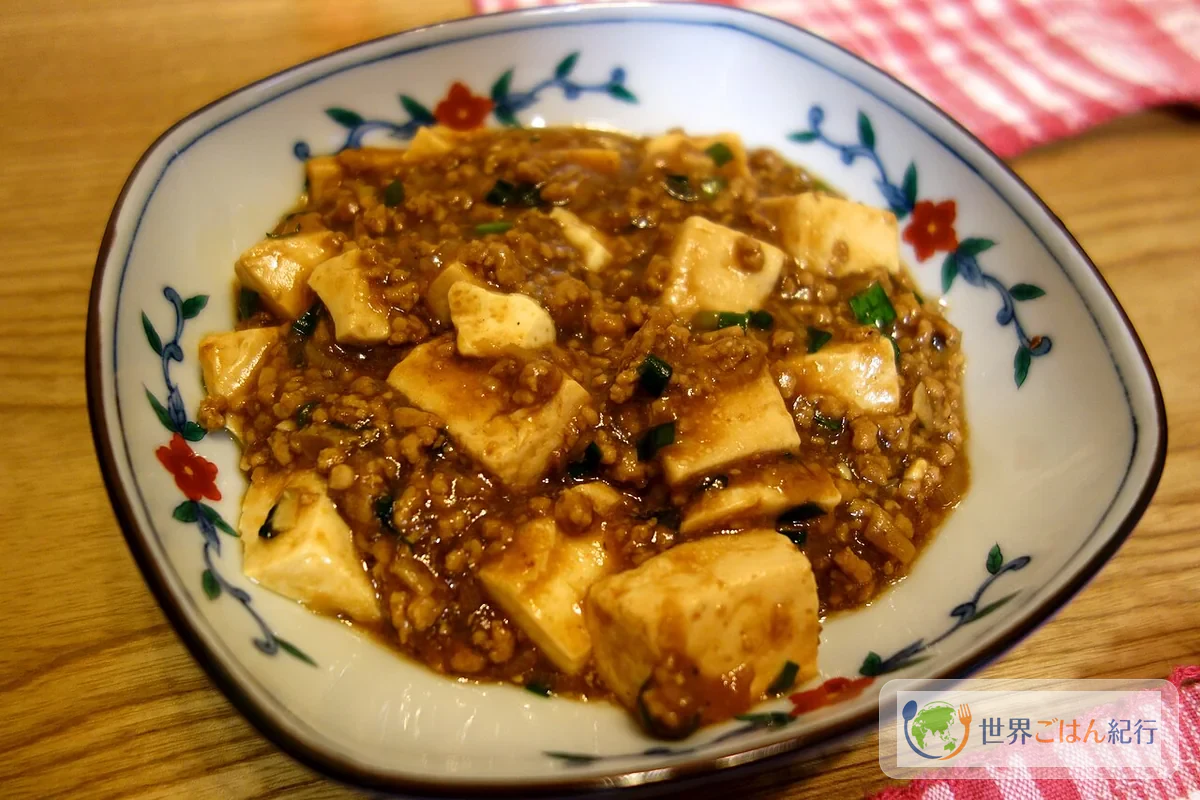
The Guardian's recipe in the style of Fuchsia Dunlop also describes warming tofu in salted water before using it. Rather than draining the tofu until firm, warming it and letting the excess water settle gets you closer to the soft Sichuan texture.
Cooking tips: think of málà and aroma separately
When you aim for a more authentic mapo tofu, simply adding heat is the wrong move. The interest of Sichuan cooking lies where the fiery heat of chili, the numbness of Sichuan peppercorn, the umami of fermented seasonings, the high serving temperature and the softness of tofu overlap. The phrase often used to describe Chinese cooking, "numbing, hot, scalding, fresh, tender, fragrant, crisp", does not simply mean extremely spicy.

Put doubanjiang straight into the stock and only the saltiness comes forward. Fried in oil, its fermented aroma and the red color of the chili move into the oil. Wait here until the oil is clear and red, and the aroma of the finished dish changes.
Ground meat fried only until it turns pale loses to the softness of tofu. Sear it a little first and make the grains small and savory, and you get a contrast when you eat it with the tofu.
Add all the starch at once and the sauce suddenly sets, turning jelly-like only around the tofu. Add half, let it bubble, and add more if needed. In two additions, less water seeps to the bottom of the plate.
Simmer it from the start and you get numbness but a blurry aroma. Put half into the oil and sprinkle half at the end; at home, this split is easy to manage. If someone at the table does not like heat, serve the finishing peppercorn on the side.
More doubanjiang raises the salt as well as the heat. On days you want more heat, add chili flakes or chili oil rather than more doubanjiang. On days you want less, use 1.5 tbsp doubanjiang and increase the sweet bean sauce by 1 tsp, and it becomes easier to eat.
Where it goes wrong: fix it by the state of the pan
Mapo tofu is easier to fix by looking at the state of the pan than at the type of seasoning. Doubanjiang scorches easily right after it goes in, and the temperature drops easily after the tofu goes in. At the starch stage, a few dozen seconds decide between a light sauce and a heavy one. When you measured exactly as written and the result still differs, the cause is often heat level, pan size, the water in the tofu, or the saltiness of the doubanjiang.
| State of the pan | What is happening | How to fix it on the spot |
|---|---|---|
| The oil does not turn red and only the paste feels heavy | The doubanjiang was not fried in oil long enough | Fry 30 more seconds over medium-low heat until a thin red oil shows on the pan bottom |
| The sauce is too salty | The doubanjiang or fermented black beans are salty | Add 2–3 tbsp water and do not add soy sauce. Next time use 1.5 tbsp doubanjiang |
| The tofu breaks | Stirred too much with the spatula, or the tofu was cold | From here on, shake the pan to move the sauce. Next time warm it in salted water first |
| The sauce is heavy | Too much starch went in at once | Add 2 tbsp water or stock at a time and loosen it by shaking the pan over low heat |
| The Sichuan peppercorn is bitter | Toasted too long, or simmered too long | Hold back on the finishing peppercorn. Next time stop at 1 minute over low heat and sprinkle at the end |
The hardest thing to fix in this table is saltiness. Heat can be added later with chili oil or chili flakes, but saltiness from too much doubanjiang can only be diluted with water. On a first try, go light on doubanjiang and add expression with the final Sichuan peppercorn and chili oil, and you are less likely to fail at a home table.
Variations and substitutions: from milder to meatless
Once you know how the core flavor is built, mapo tofu is easy to adapt. Change the heat, the meat, the firmness of the tofu or the added vegetables, and you can steer it toward a weeknight dinner or a weekend Chinese menu. Whatever you change, keep three things: fry the doubanjiang in oil, warm the tofu before adding it, and set the thickness at the end.

A milder home version
Use 1 tbsp doubanjiang and 1 tbsp sweet bean sauce, and leave out the chili flakes and chili oil. Sprinkle only 1/3 tsp Sichuan peppercorn at the end. It drifts away from the Sichuan style, but for children or family who do not like heat, this proportion is realistic. Add chili oil and peppercorn only to the adults' portions after serving.
Meatless mushroom mapo
In place of ground pork, rehydrate 4 dried shiitake and chop coarsely. Use the soaking liquid as part of the stock. Omnivore's Cookbook's vegetarian mapo tofu also builds umami with dried shiitake and their soaking liquid. You lose some of the savory sear of the meat, but the fermented aroma of doubanjiang and fermented black beans keeps it satisfying.
Firm tofu for less breaking
If silken tofu breaking worries you on a first try, firm tofu is fine. Firm tofu takes on flavor less readily, so cut it a little smaller, 1.5 cm cubes, and simmer for 5 minutes. You lose some silken smoothness, but firm tofu is easier to handle for packed lunches and make-ahead meals.
Moving on to mapo eggplant and mapo glass noodles
With the same sauce, add pan-fried eggplant for mapo eggplant, or rehydrated glass noodles for mapo glass noodles. Eggplant soaks up oil, so use a little less doubanjiang than for tofu. Glass noodles absorb liquid, so add 100 ml more stock and make the thickness lighter.
Serving with something other than rice
White rice is the classic partner, but mapo tofu clashes with a strongly aromatic rice dish like biryani. Salted plain rice, steamed greens, a vinegared cucumber salad and an egg soup suit it well. If you carry leftover rice into the next day, Chinese home-style fried rice (in Japanese), with its egg and scallion fragrance, links the table with a lighter rice dish than the red oil of mapo tofu. If you serve it over noodles, thick udon or yakisoba noodles hold the sauce better than thin Chinese noodles.
Storage and shopping: keeping it good until the next day
Mapo tofu is best freshly made, but it keeps well until lunch the next day. Tofu releases water when it chills, though. To store it, do not leave it long at room temperature after finishing; once it cools down a little, move it to a clean container and refrigerate. Plan to finish it by the next day.

When reheating, the microwave alone can leave the center of the tofu cold while only the sauce gets hot. Move it to a small pot or skillet, add 2 tbsp water and warm it over low heat. If the sauce has loosened, add just 1 tsp of starch slurry. The aroma of Sichuan peppercorn fades easily, so sprinkling a little after reheating brings it back.
It does not suit freezing. The texture of the tofu turns spongy and becomes something different from the Sichuan softness. If you freeze it anyway, treat it as a mapo meat sauce rather than trying to restore it as a tofu dish. Crumble the tofu and spoon it over rice, toss it into fried noodles, or bind it with egg; making it into a different dish is more satisfying.
On shopping, once you gather doubanjiang, Sichuan peppercorn and fermented black beans, the next time is lighter. If you cannot find fermented black beans, you can serve the dish without them at first. In authentic English-language recipes, though, fermented black beans are often used, and the aroma of fermented black soybeans gives the sauce depth. If you find them at an Asian grocery, buy a small bag and store it refrigerated.
If you are buying mapo tofu seasonings for the first time, you do not have to gather them all at once. Setting priorities keeps jars you cannot finish from piling up in the refrigerator.
| Order to buy | Ingredient | Why buy it | Other dishes it works in |
|---|---|---|---|
| 1 | Doubanjiang | The center of the fermented aroma and heat of mapo tofu. Substituting tends to make a different dish | Twice-cooked pork, dan dan noodles, mapo eggplant |
| 2 | Sichuan peppercorn | Creates the Sichuan "numbing". Even a small amount changes the impression | Mouthwatering chicken, quick-pickled cucumber, a finish for fried chicken |
| 3 | Fermented black beans | Adds the fermented umami of black soybeans to the sauce | Stir-fries with black beans, steamed fish, stir-fried greens |
| 4 | Shaoxing wine | Rounds the smell of the meat and adds a Chinese aroma | Dumpling filling, fried rice, braised pork belly |
| 5 | Wok or deep skillet | Lets the tofu simmer without stacking. Easier to thicken too | Stir-fries, glazed dishes, saucy Chinese dishes |
Conversely, sweet bean sauce can be approximated to some extent with red miso and sugar. Any chili oil you already have is fine. On a limited budget, putting your money into doubanjiang and Sichuan peppercorn does the most to bring back the mapo tofu character. If you decide before buying "what will I use this for next", mapo tofu does not end as a one-off event and becomes a small Sichuan staple.
Doubanjiang can also add heat to nasi goreng, but its aroma differs from Indonesian sambal. Sichuan peppercorn can be used in small amounts in mouthwatering chicken, dan dan noodles and quick-pickled cucumber. If the seasonings you bought do not stop at mapo tofu, they are more likely to become kitchen staples.
Background: from a working people's dish in Chengdu to a world classic
The name mapo tofu has a slightly vivid origin. English articles such as China Daily and The World of Chinese tell of a woman surnamed Chen who ran a shop near Wanfu Bridge in Chengdu during the Qing dynasty. "Ma" means pockmarked and "po" means an older woman, and the tofu dish she made came to be called Chen Mapo Tofu, according to the account.

Rather than reading this origin as a mere old tale, it is a clue to the character of the dish. Mapo tofu has been described not as a court dish but as a dish for working people, one that moves rice along with tofu and a little meat. Tofu is cheap, and the meat can be small. Yet doubanjiang, fermented black beans, Sichuan peppercorn and oil give strong aroma and satisfaction even from small amounts. That is a well-made idea for home cooking too. Porters carrying loads near the market, people wanting something hot on the way home from drinking, people who want to get through their midday rice fast: think of it as a dish that reaches the stomachs of such people, and the quantity of red oil and the reason to serve it scalding hot both come into view.
English-language guides to Sichuan cooking often treat mapo tofu not only as the symbol of "spicy Chinese food" but as a dish that shows the complexity of Sichuan cuisine. Serious Eats' introduction to Sichuan cuisine also explains that Sichuan cooking is not just málà but has a wide range of flavors: sour, sweet, salty, fermented and smoky. Mapo tofu does not become authentic just by adding more chili either. Doubanjiang takes the saltiness and fermented aroma, fermented black beans the depth of black soybeans, Sichuan peppercorn the numbness that carries up into the nose, the meat a savory graininess, and the tofu the heat and softness. If any one of them is too strong, it may look as forceful as the restaurant version, but you tire before you finish a bowl of rice.
In Japan, the spread of mapo tofu owes much to Chen Kenmin, a Sichuan-born chef. For home cooks there, the heat and aroma were adjusted, and a sweeter mapo tofu with strong sweet bean sauce and garlic took hold. That is part of Japanese food culture in its own right. When you move toward the Sichuan style, on the other hand, the white of the tofu, the red oil, the numbness of the peppercorn and the savoriness of the meat separate clearly. When you recreate it in a home kitchen, you do not need to make everything local. What to protect: fry the doubanjiang in oil, let the Sichuan peppercorn stand out at the end, finish the tofu hot. What can be swapped: the kind of meat, the firmness of the tofu, the upper limit of the heat.
There are regional differences too. Some cooks let the Sichuan peppercorn speak clearly, as in Chengdu restaurants, while Chinese restaurants in countries of immigration may dial back the heat and put the softness of the tofu and an easy-to-eat meat sauce forward. The sweeter mapo tofu that took root in Japanese neighborhood Chinese restaurants, even though it has moved away from Sichuan málà, makes sense as a home dish to eat with white rice. So this article does not deny regional differences; it clarifies the order of aromas to bring back when you aim for the Sichuan style.
The point of cooking at home is not only to reproduce a restaurant's heat. Lower the heat while keeping the Sichuan peppercorn aroma. Use firm tofu so it breaks less. Cut the soy sauce to match the saltiness of the doubanjiang. The strength of a home kitchen is being able to make these adjustments. If restaurant mapo tofu is a finished product, home mapo tofu is a dish whose landing you decide according to your family's tolerance for heat and the tofu in the refrigerator. Put white rice, greens and a light egg soup beside it, and you see not only the flash of Sichuan cooking but also its strength in returning to an everyday table.
FAQ
Because mapo tofu uses simple ingredients, small differences show in the result. These are the points that tend to puzzle home cooks.

Q1. Can I substitute miso if I do not have doubanjiang?
A direct swap is difficult. Doubanjiang has not only heat but also the fermented aroma of broad beans and chilies, saltiness and the color of red oil. If you really have none, approximate it with 2 tsp red miso, 1 tsp soy sauce, 2 tsp chili oil and a little chili flakes. Think of the result as a miso mapo, not a Sichuan one.
Q2. Which is right, silken tofu or firm tofu?
For a soft mouthfeel, silken tofu. If you put resistance to breaking first, firm tofu is fine too. With silken tofu, warm it in salted water and shake the pan instead of stirring with a spatula. With firm tofu, cut it a little smaller and simmer 1 minute longer.
Q3. Do I have to use Sichuan peppercorn?
Without it you still get something mapo-tofu-like, but the "numbing" element typical of Sichuan cooking is weaker. If you dislike it, do not put it into the oil at the start; serve a very small amount on the side at the end. If you only want the fragrance, lightly toast the grains and sprinkle through a tea strainer to control the amount.
Q4. The starch makes lumps.
Stir the slurry again right before adding, lower the heat a little, and pour it in while the sauce is not boiling hard. After it goes in, do not stir hard right away; shake the pan to spread it throughout, and let it bubble for about 30 seconds. Adding it in two portions instead of all at once reduces failures.
Q5. What side dishes go well with it?
White rice, a vinegared cucumber salad, stir-fried greens and egg soup are easy to pair. Mapo tofu is spicy and oily, so the sides suit a cold, sour note or a light soup. If you expand it into a Chinese menu, let mapo tofu be the star and do not stack too many heavy fried dishes like dumplings or fried chicken, or the meal will wear you out.
At the table: keep the aroma over the heat
The shortcut to a more Sichuan-style mapo tofu is not adding more chili. Warm the tofu so it breaks less. Fry the meat until a little crisp. Fry the doubanjiang and fermented black beans in oil. Let the Sichuan peppercorn stand out at the end. Add the starch slurry in two parts. Keep to this order, and even a home mapo tofu has distinct aroma and texture.

The first time, go light on the heat and see how the aroma comes out. The saltiness of doubanjiang, the numbness of Sichuan peppercorn and how easily tofu breaks vary with the product and the pan. Once you are used to it, adjust a little at a time: use Pixian doubanjiang, grind whole peppercorn, switch to ground beef, make it meatless with mushrooms. You end up with a mapo tofu from your own kitchen, not one that only chases restaurant flavor.
If, with the first bite over rice, the tofu is hot, the oil is red and the Sichuan peppercorn drifts softly up, you have succeeded. On a day when you want to taste the doubanjiang and Sichuan peppercorn combination with thinly sliced beef and napa cabbage instead of tofu, go on to Sichuan shuizhu niurou (boiled beef in chili oil) and the difference in how it is cooked will be clear. The tofu in your refrigerator stops being a thrifty ingredient and becomes the star that gives the middle of the week a small lift.
Sources
- Omnivore's Cookbook. "Authentic Mapo Tofu." https://omnivorescookbook.com/authentic-mapo-tofu/ (accessed 2026-05-05)
- Omnivore's Cookbook. "Vegetarian Mapo Tofu." https://omnivorescookbook.com/vegetarian-mapo-tofu/ (accessed 2026-05-05)
- The Woks of Life. "Mapo Tofu." https://thewoksoflife.com/ma-po-tofu-real-deal/ (accessed 2026-05-05)
- The Guardian. "How to make mapo tofu - recipe." https://www.theguardian.com/food/2026/jan/18/how-to-make-mapo-tofu-recipe (accessed 2026-05-05)
- China Daily. "Mapo tofu - Chen Mapo's tofu." https://www.chinadaily.com.cn/food/2012-03/09/content_14800649.htm (accessed 2026-05-05)
- The World of Chinese. "A Classic Dish: Mapo Tofu." https://www.theworldofchinese.com/2015/09/mapo-tofu/ (accessed 2026-05-05)
- Serious Eats. "More Than Mala: A Deeper Introduction to Sichuan Cuisine." https://www.seriouseats.com/what-is-sichuan-szechuan-chinese-cuisine (accessed 2026-05-05)
- Bon Appetit. "For Jing Gao, Doubanjiang Is a Pantry Nonnegotiable." https://www.bonappetit.com/story/doubanjiang (accessed 2026-05-05)