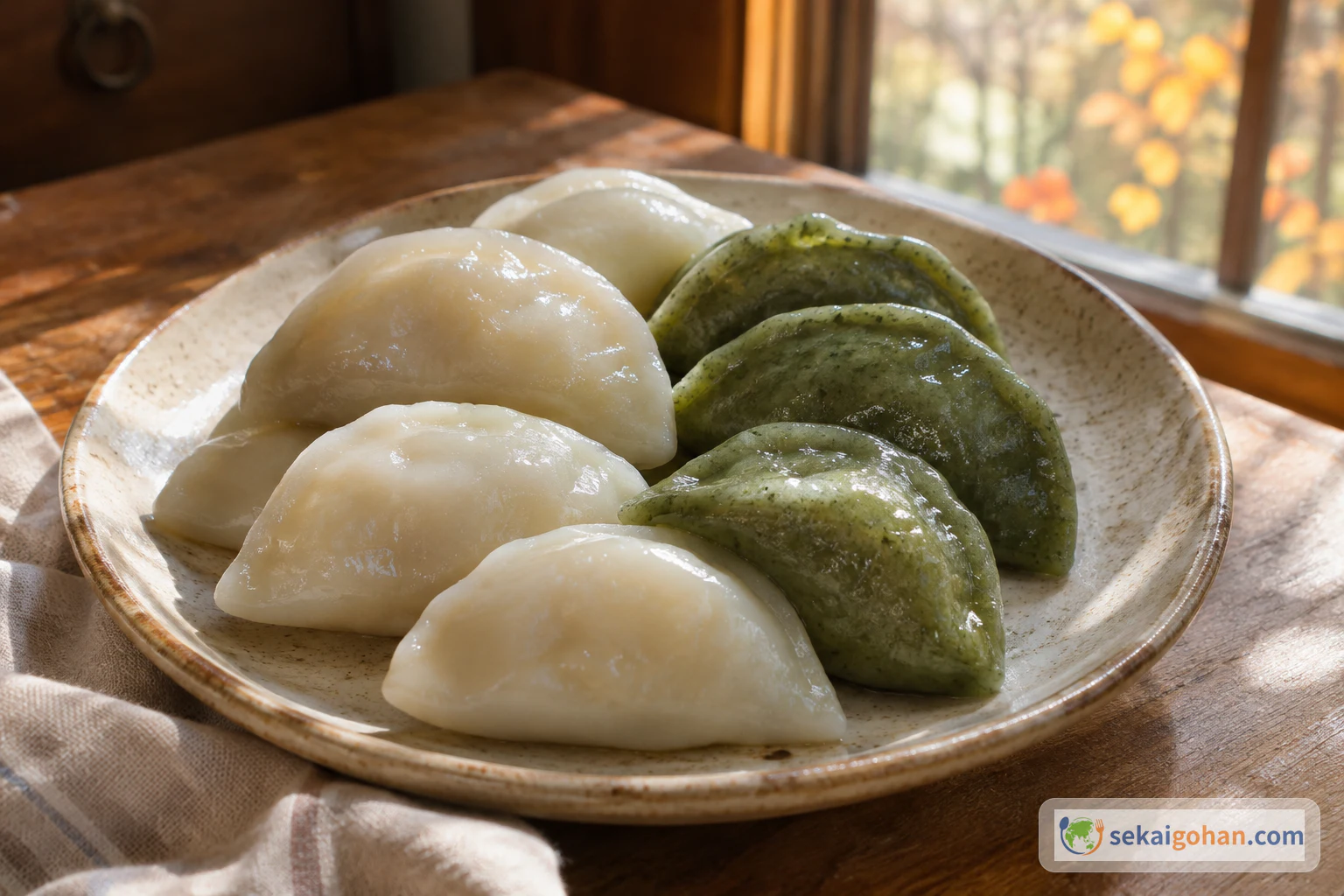
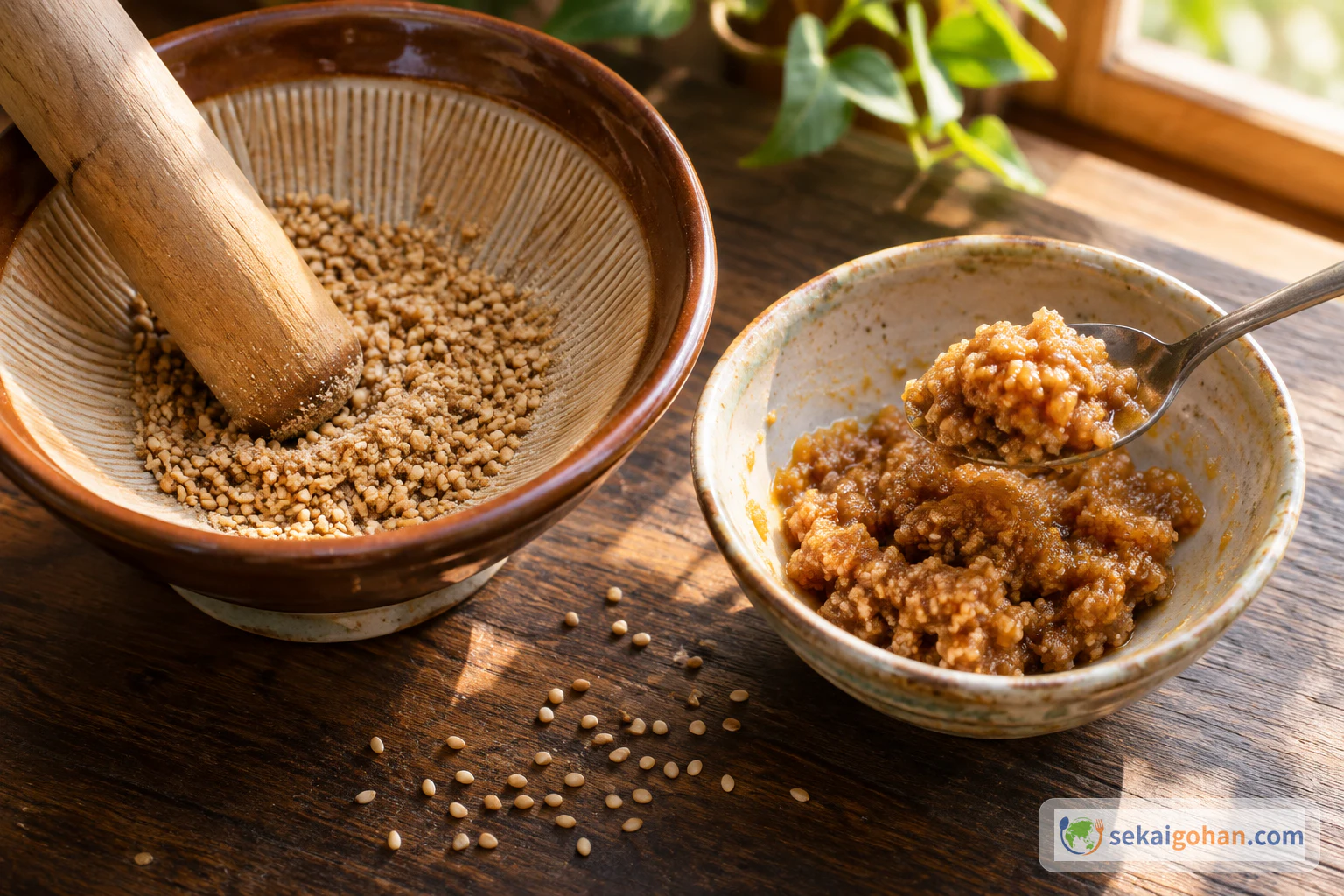
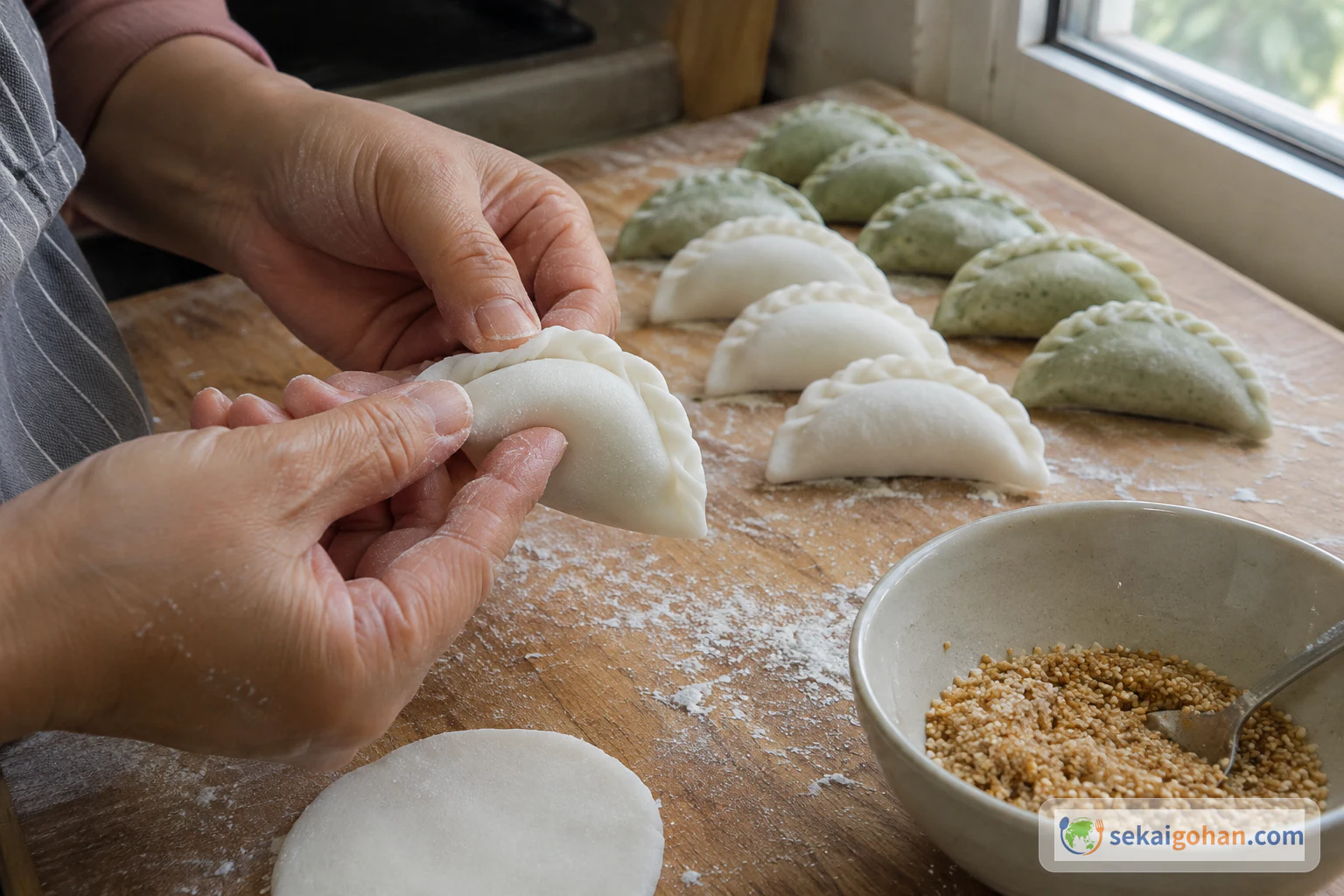
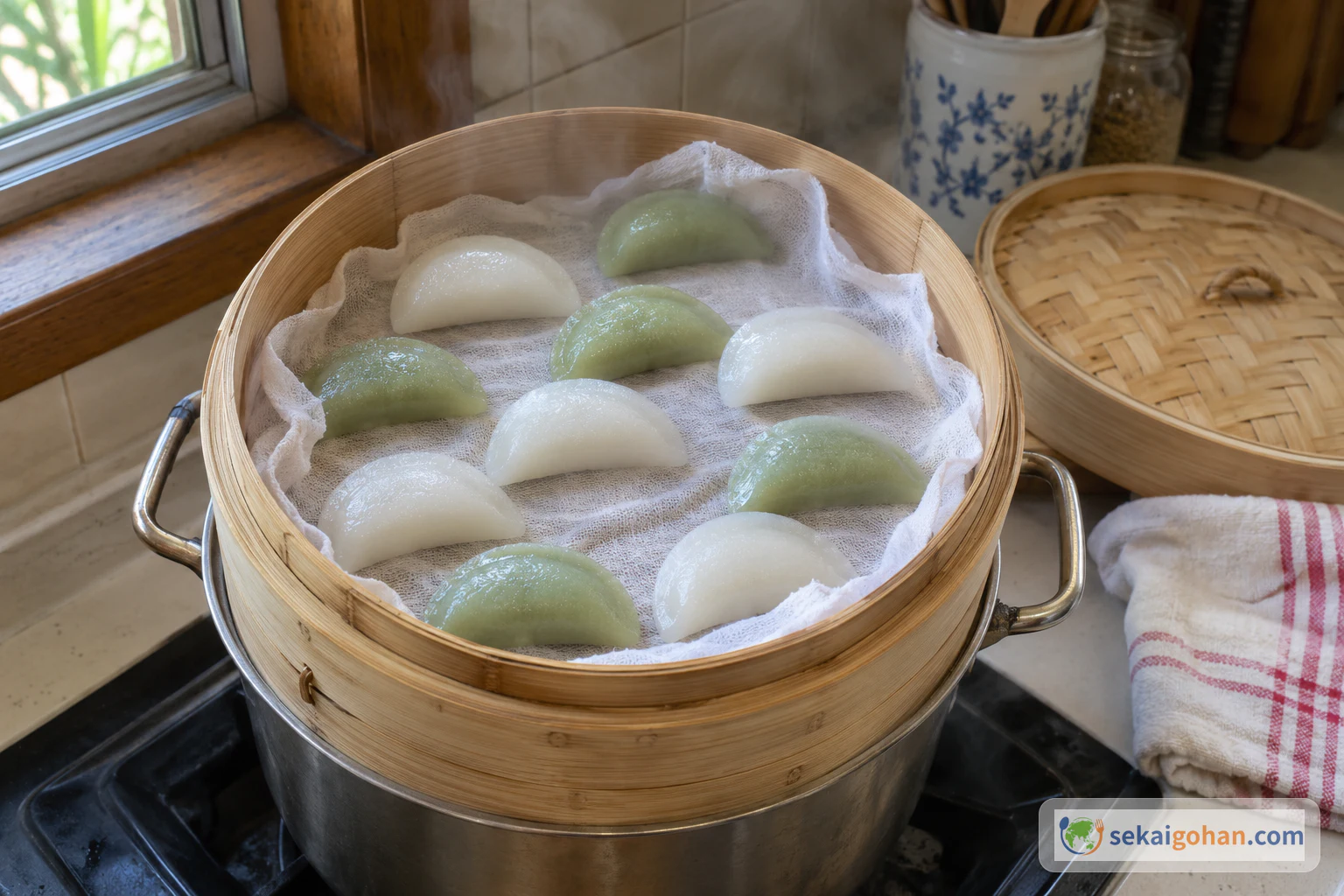
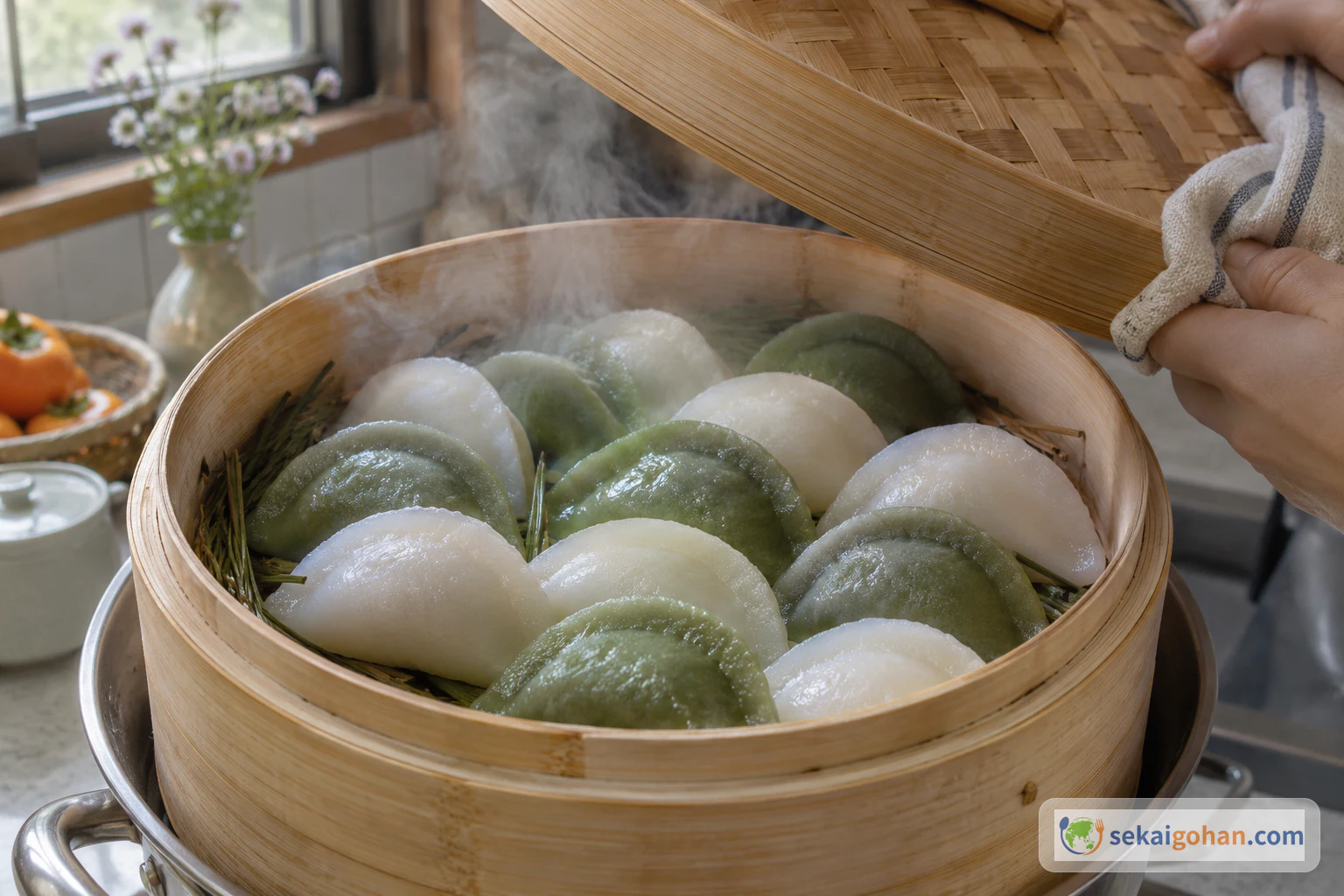
When the steamer lid lifts, a cloud rolls off and the half-moons underneath have changed. The chalky white of raw rice dough has turned faintly glassy, and if the basket was lined with pine needles, the whole kitchen smells of resin. Songpyeon (송편) are small Korean rice cakes made for Chuseok, the autumn harvest holiday. Each one is pressed by hand into a crescent around a filling of coarsely ground toasted sesame, sugar and honey. The dough is made from nonglutinous rice, so the bite is soft with a gentle spring, firmer than mochi, and then the sesame gives way, nutty and sweet, held together by the honey.
Half-Moons for the Harvest Moon
Chuseok falls on the 15th day of the eighth lunar month, which lands between mid-September and mid-October. In the old pattern of the holiday, the year's new rice was kneaded into songpyeon, the cakes were set out for the ancestral rites, and the family went to visit the graves. Making them is group work. The dough and filling are quick; the shaping is slow, so the people who have come home for the holiday gather around the board and fill and pinch them together, one small crescent at a time.
Song (송) is the pine, for the needles the cakes are steamed on, and pyeon (편) is rice cake. The dough is made from nonglutinous rice flour kneaded with hot water, which puts songpyeon in a different family from the sticky glutinous rice sweets of Japan.
The shape carries the meaning. Across East Asia, the autumn moon is honored with food: China has round mooncakes, Japan has spherical tsukimi dango. Korea chose the moon that is still growing. A half-moon is read as something on its way to fullness, a sign of growth and moving forward. A legend explains it with a prophecy: in 656, in the reign of King Uija of Baekje, a turtle shell was found inscribed "Baekje is a full moon, Silla is a half moon," and the half-moon cake spread from there. It is a story, told as one.
Where songpyeon began is not settled. Wrapped grain cakes in early Chinese cooking are counted as possible ancestors, and so is a millet cake filled with red beans from the Goryeo period, by which time this kind of cake had likely become common. Rice cakes also marked other days of the year. On the 15th day of the first month, households tied ears of grain to a pole and stood it at the gate; on Junghwa-jeol, the first day of the second month, they made rice cakes from that grain and gave each servant as many as their age. The day was called servants' day, and the cakes were age cakes.
How the half-moon changes around the country
The basic idea holds everywhere, a rice dough wrapped around a filling and steamed, but each region bends it. Seoul makes five-color songpyeon (오색송편). In Gyeongsang the dough takes arrowroot (칡) and the cakes are made large. Chungcheong works pumpkin into the dough, Gangwon uses potato, and Jeolla adds ramie leaf (모시), which keeps the cakes soft for longer. Jeju has wandu-kong songpyeon, flat, round and filled with beans, a different form altogether that only shares the name.
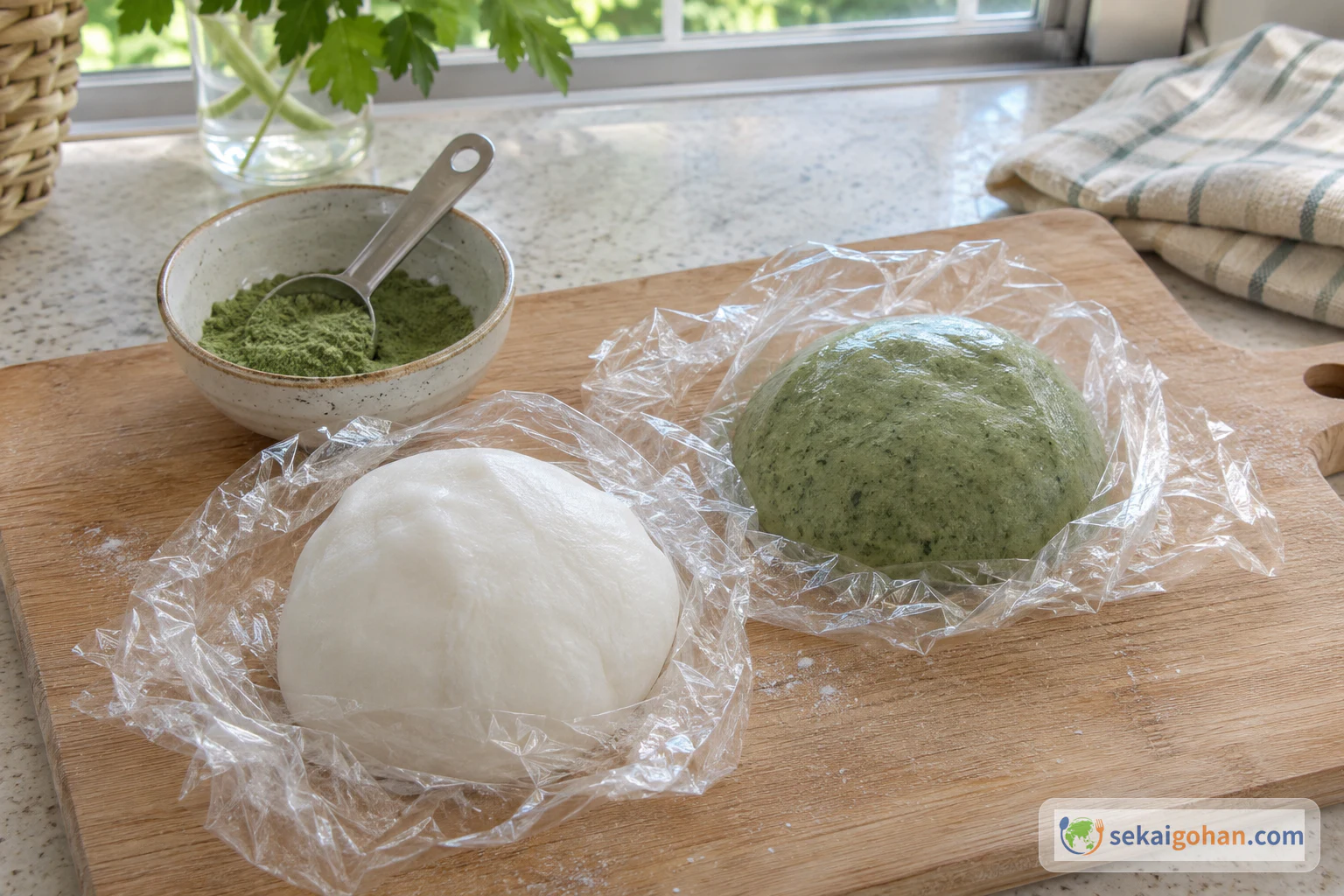
Fillings vary as much as the dough. Red bean, sesame, jujube and pine nut are all classic, and some carry a meaning: sesame and oil for abundance, red bean to keep bad luck away, chestnut for strength and endurance. Mugwort songpyeon (쑥송편) has leaves worked into the dough, and songgi songpyeon (송기송편) uses the inner bark of the pine. This recipe makes one white batch and one mugwort batch with the sesame filling. One family's saying is that if you shape pretty songpyeon you'll have a pretty daughter, which says plenty about how much care goes into the pinch.
For more of the country's cooking, from everyday stews to festival plates, see the Korea page.
Ingredients (makes 16 pieces)
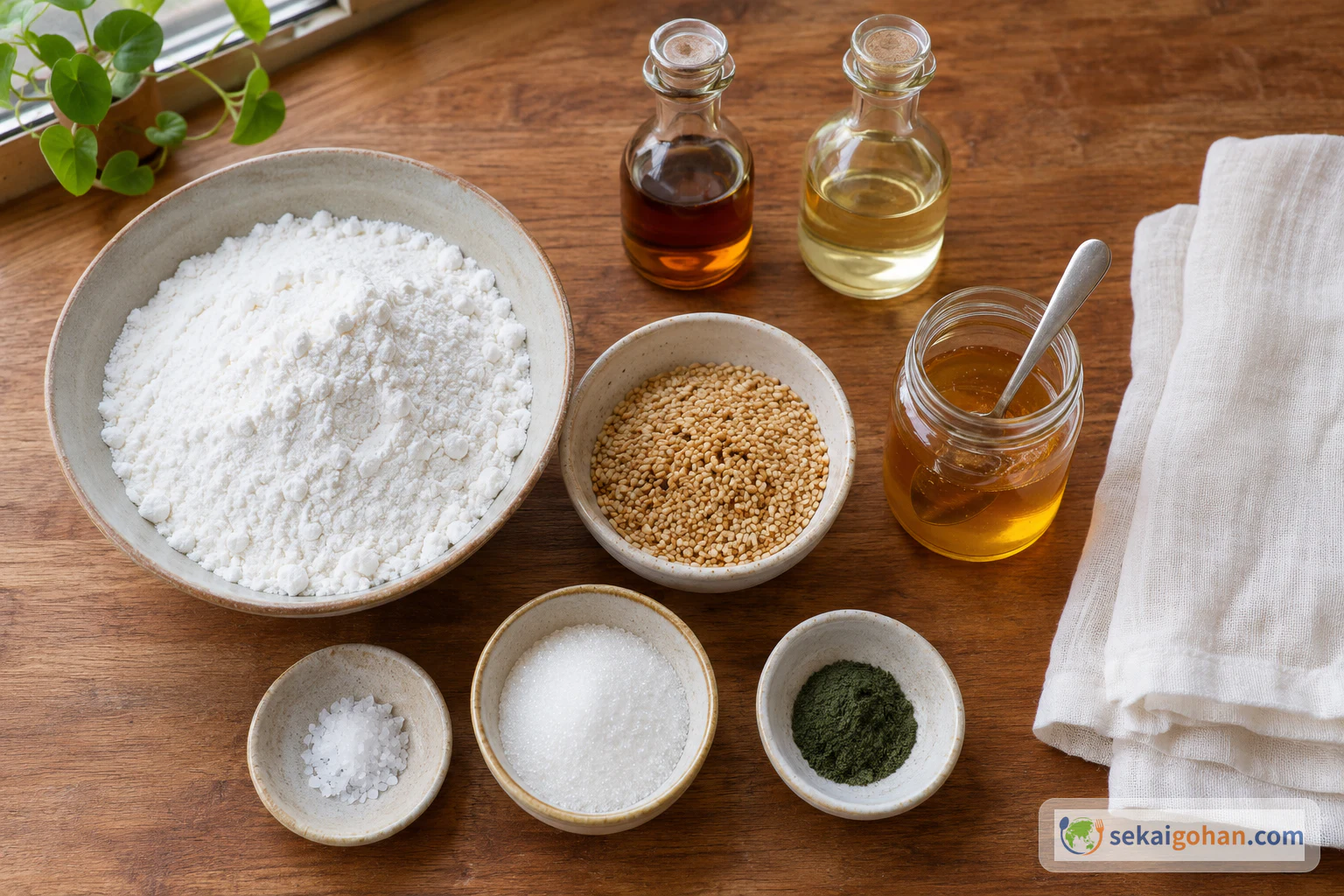
The rice flour is split into two batches of 1 cup each, one white and one colored with mugwort. The sesame filling is made once and serves both.
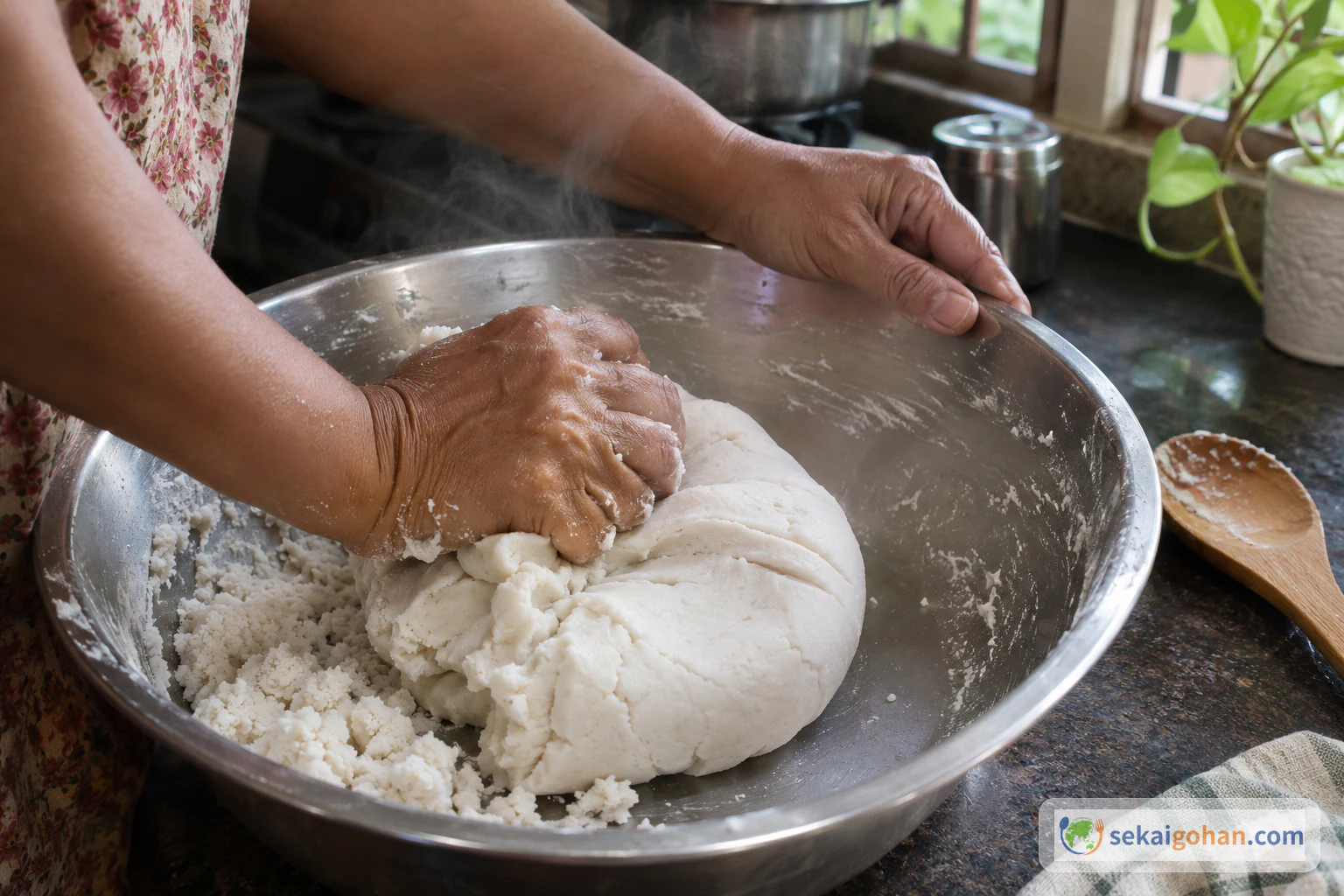
Frozen wet rice flour is sold frozen. Take it out of the freezer the day before so it is half-thawed and breaks up easily; hot water then reaches every grain instead of skating over frozen lumps.
Sesame is in the filling and the finishing oil. Honey must not be given to babies under one year old. The recipe itself contains no wheat, egg or milk, but check the labels on the mugwort powder, toasted sesame, sesame oil and honey for any of these.
Equipment
- Two wide mixing bowls and chopsticks for stirring in hot water
- Plastic wrap
- Mortar and pestle
- Steamer (a bamboo steamer over a pot works well)
- A clean cotton cloth, dampened, to line the steamer, or 6 oz (170 g) food-safe pine needles
- A second clean kitchen towel to wrap the steamer lid
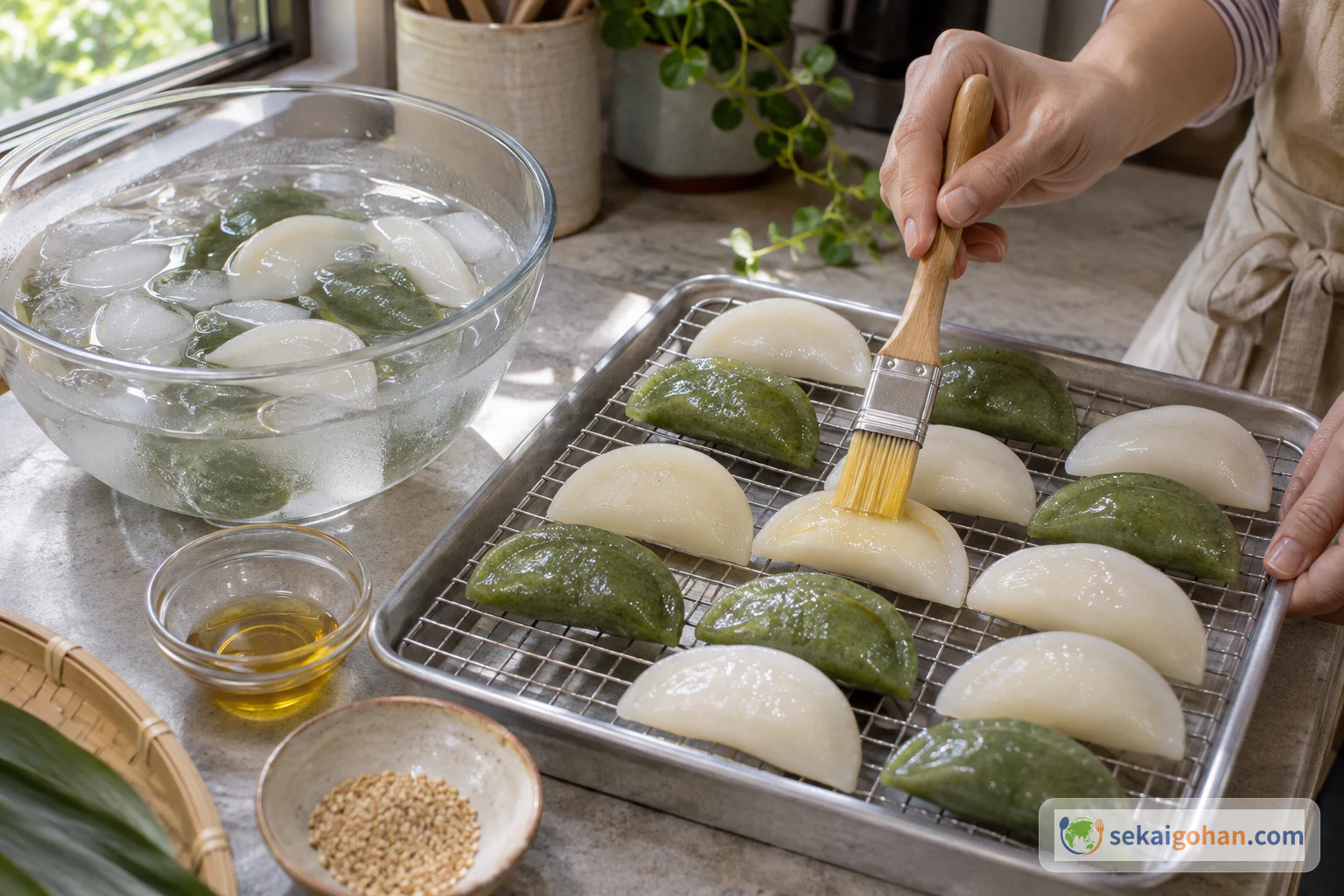
- A bowl for ice water and a colander
- Pastry brush
Choosing the Flour, the Color and What Goes Under the Steamer
The flour decides everything. Korean grocers sell frozen wet-milled short-grain rice flour (습식 쌀가루, often labeled ssal-garu) in the freezer section, already soaked, milled and slightly moist. That moisture is built into the water amounts above. Dry rice flour absorbs water differently, so it cannot be swapped cup for cup.
If you can't find wet flour, the closest by grain is Japanese joshinko, a dry flour milled from nonglutinous rice. Start with the same weight per dough, 120 g, and add hot water 1 tsp at a time until the dough reaches earlobe softness. Joshinko also turns sticky and springy when kneaded with hot water, which is exactly what this dough needs.
Leave glutinous rice flours on the shelf. Shiratamako, mochiko and other sweet rice flours are made from glutinous rice and produce a stretchy, chewy cake instead of songpyeon's soft spring. Japanese dango flour blends glutinous and nonglutinous rice in its own ratio and lands somewhere in between.
| Choice | What it does |
|---|---|
| Wet-milled rice flour | The texture songpyeon should have; worth tracking down |
| Joshinko | Same grain, drier flour; water is found by feel |
| Glutinous rice flour, mochiko, dango flour | A different, stretchy cake; skip |
| Mugwort powder | Pale green and grassy; pumpkin or purple sweet potato powder work the same way for color |
| No coloring | All white; the recipe is unchanged |
| Pine needles | Resin aroma in the cakes; only food-sold needles of known origin and species |
| Damp cotton cloth | No pine aroma, but the method works unchanged |
Never use pine needles gathered from hills or the wild. Pine trees may have been sprayed with pesticide to control pine wilt disease, and you can't tell which ones were treated. Use only needles sold as food whose origin and species you can confirm. If you can't, line the steamer with a damp cloth.
Method: Knead, Fill, Pinch, Steam
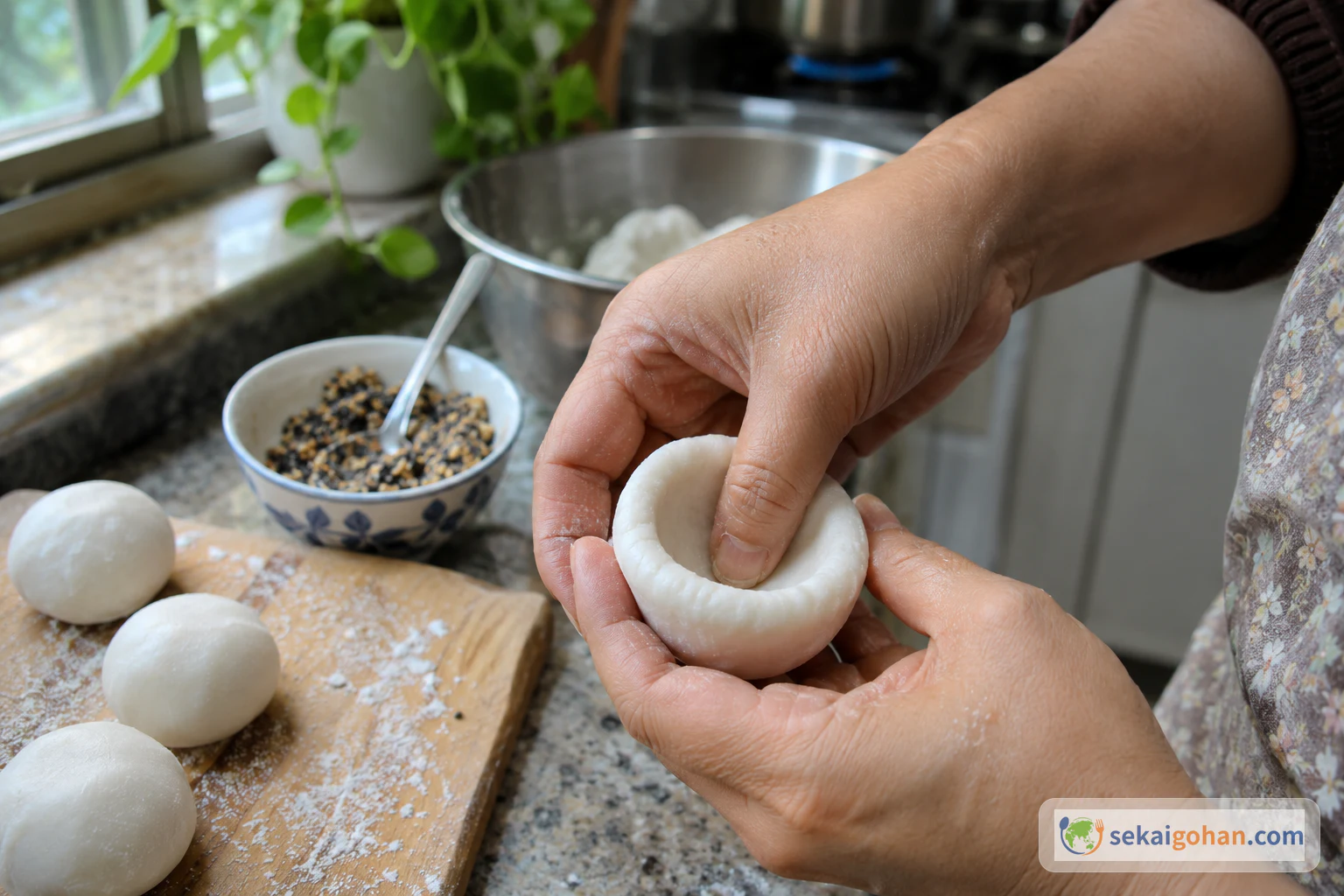
Make the white dough first, then the mugwort dough, and let both rest for 20 minutes; the sesame filling fits into that rest. Shaping is where the time goes, so set up a board with the dough, filling and a teaspoon within reach before you start rolling. Steaming and finishing are fast, and the cakes are best eaten soon after.
Don't taste the raw dough or the filled cakes before steaming; rice dough is eaten only once it is cooked through.
When It Goes Wrong
| What you see | Why | What to do |
|---|---|---|
| The dough cracks at the edges while you shape | Rice dough dries fast in open air | Keep unused dough wrapped. Knead in hot water 1 tsp at a time until it is back to earlobe softness. If it still cracks, roll the rest into plain balls and steam them unfilled |
| Filling bursts through the seam in the steamer | Air trapped inside, or too much filling | Squeeze the air out as you seal and keep to 1 tsp of filling |
| Wet dents or pale spots on top after steaming | Condensation dripped from the lid | Wrap the lid in a clean towel before the next batch |
| Surface stays opaque and sticky, center doughy | Not enough steam or not enough time | Keep the water at a full boil and steam the full 18–20 minutes; check for a translucent surface |
| Pieces stick together after steaming | They touched in the basket, or the oil was skipped | Space them apart in the steamer and brush every piece with the oil mixture |
Serving, Variations and Keeping
At the table
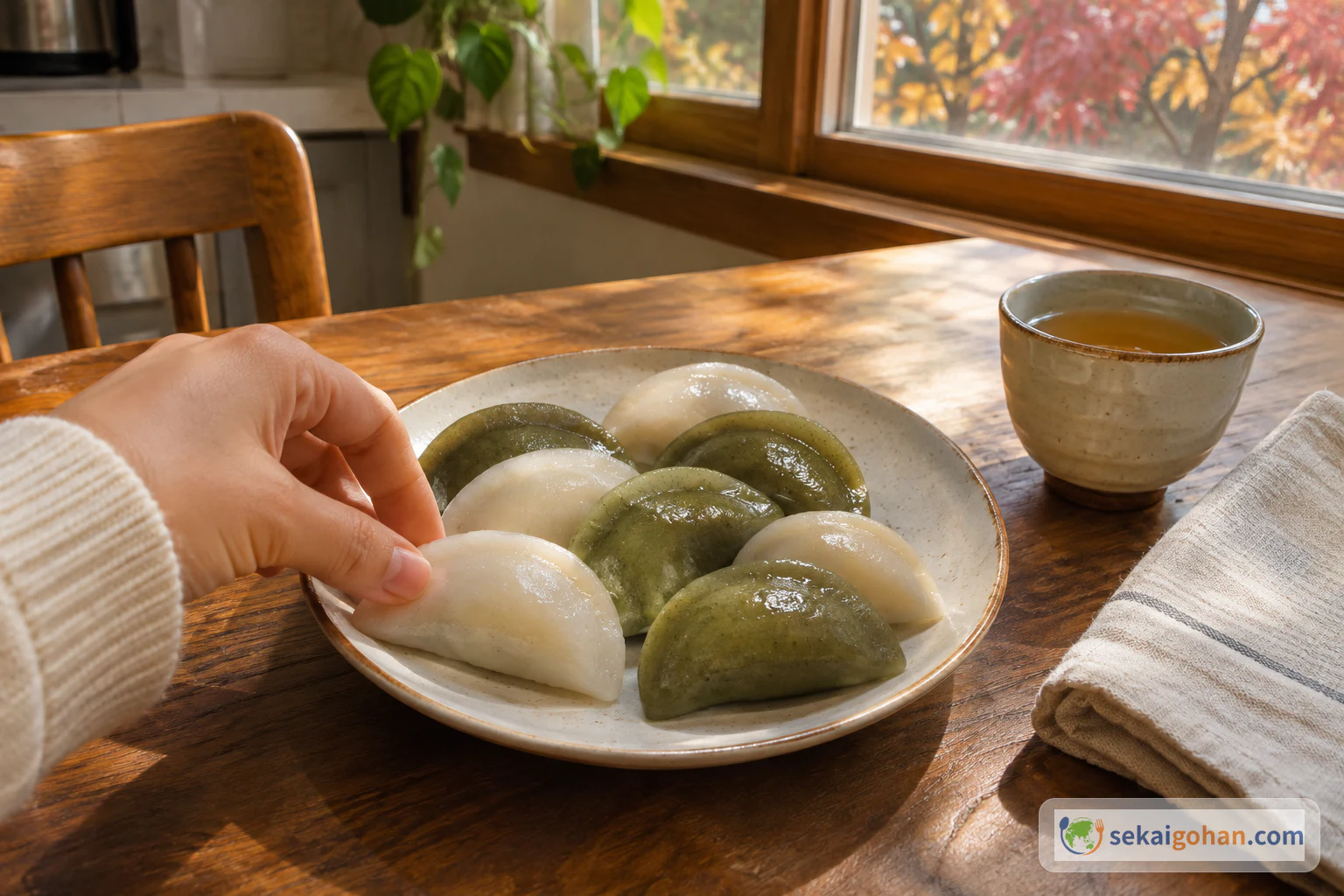
Serve songpyeon warm or at room temperature, piled on a plate in the middle of the table so everyone can reach in. A cup of tea goes well alongside, and on a holiday table they sit happily next to sikhye or another rice cake such as injeolmi. Eat them with your fingers; the oil keeps them from sticking to your hands.
Variations
- Pumpkin songpyeon (호박송편), the Chungcheong style: swap the mugwort powder for pumpkin powder. The color turns warm yellow, and the powder takes up water differently, so add the hot water 1 tsp at a time until the dough feels right.
- Three or five colors: add a batch for each extra color, each one 1 cup (120 g) of rice flour, ⅛ tsp salt, 1 tbsp of coloring powder (pumpkin, mugwort or purple sweet potato) and 2½–3½ tbsp (37–52 ml) of hot water. Each extra cup of flour needs its own filling: ¼ cup (30 g) toasted sesame, 1 tbsp (12 g) sugar and 2 tsp (10 ml) honey.
- Red bean filling (팥송편): swap the sesame for sweetened red beans, sweetened to taste. The filling turns soft and earthy instead of crunchy.
Raw or undercooked beans contain lectins that can cause vomiting and diarrhea. Soak beans in water for at least 5 hours, then cook them completely until soft before making any filling.
Keeping
Songpyeon are at their best the day they're made. Cooked cakes should not sit out: eat them within 2 hours, and steam again thoroughly any that have stood at room temperature longer than 2 hours. To keep them for the next day, cool them quickly within 2 hours, put them in a sealed container and refrigerate right away; don't leave them on a sunny balcony, where the temperature climbs. The fridge firms the texture, so steam them again thoroughly before eating. To keep them longer, freeze them in a single layer and steam them again before eating.
Frequently Asked Questions
Can I steam them for 15 minutes and let them sit?
That is another home method: 15 minutes of steaming, then the heat off and the lid on for 3 more minutes. Steamers, batch sizes and dough thickness all vary, so judge by the cake rather than the clock. When the surface is translucent and springs back, they're done; if it still looks chalky, keep steaming.
Can I make them all white?
Yes. Make the second cup of flour exactly like the first, with ⅛ tsp salt and 2–3 tbsp of hot water. The color only changes the look and aroma, and the method stays the same.
Why does songpyeon firm up as it cools when mochi stays soft?
Nonglutinous rice starch contains amylose, which sets firm as it cools and gives a pleasant spring. Glutinous rice is mostly amylopectin and changes less when cold. That firming is why fresh songpyeon are best and why a second steaming brings cooled ones back to softness.