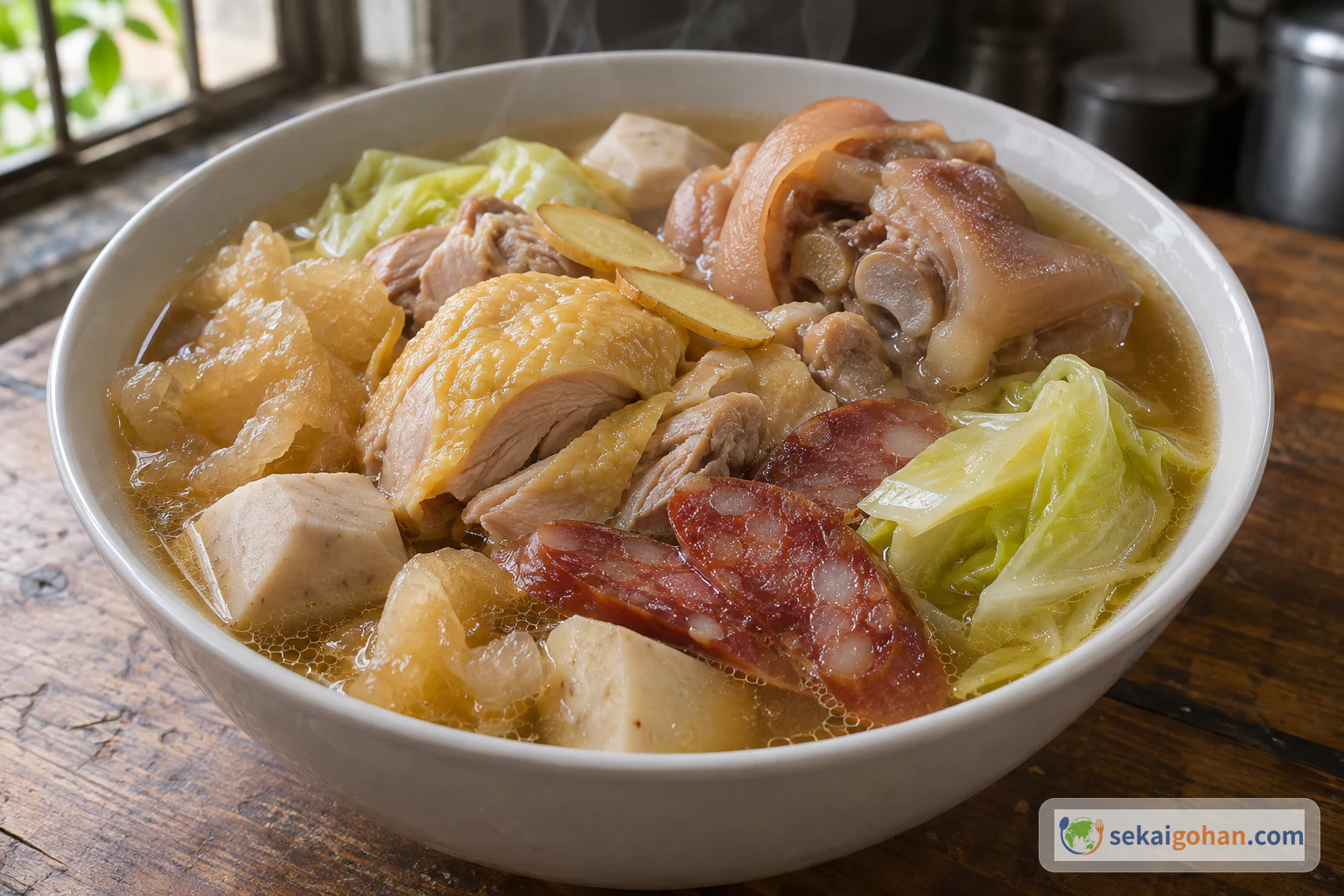
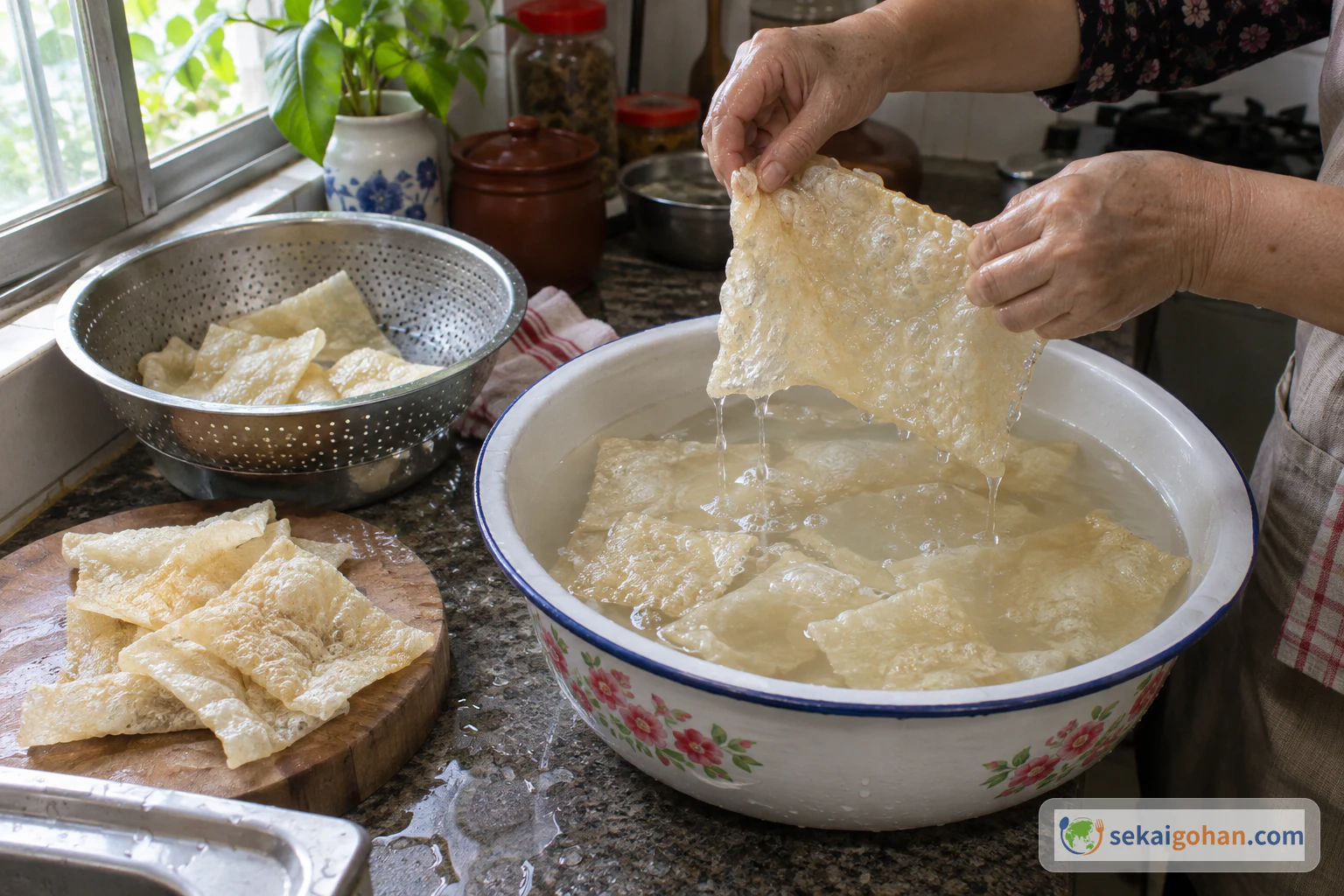
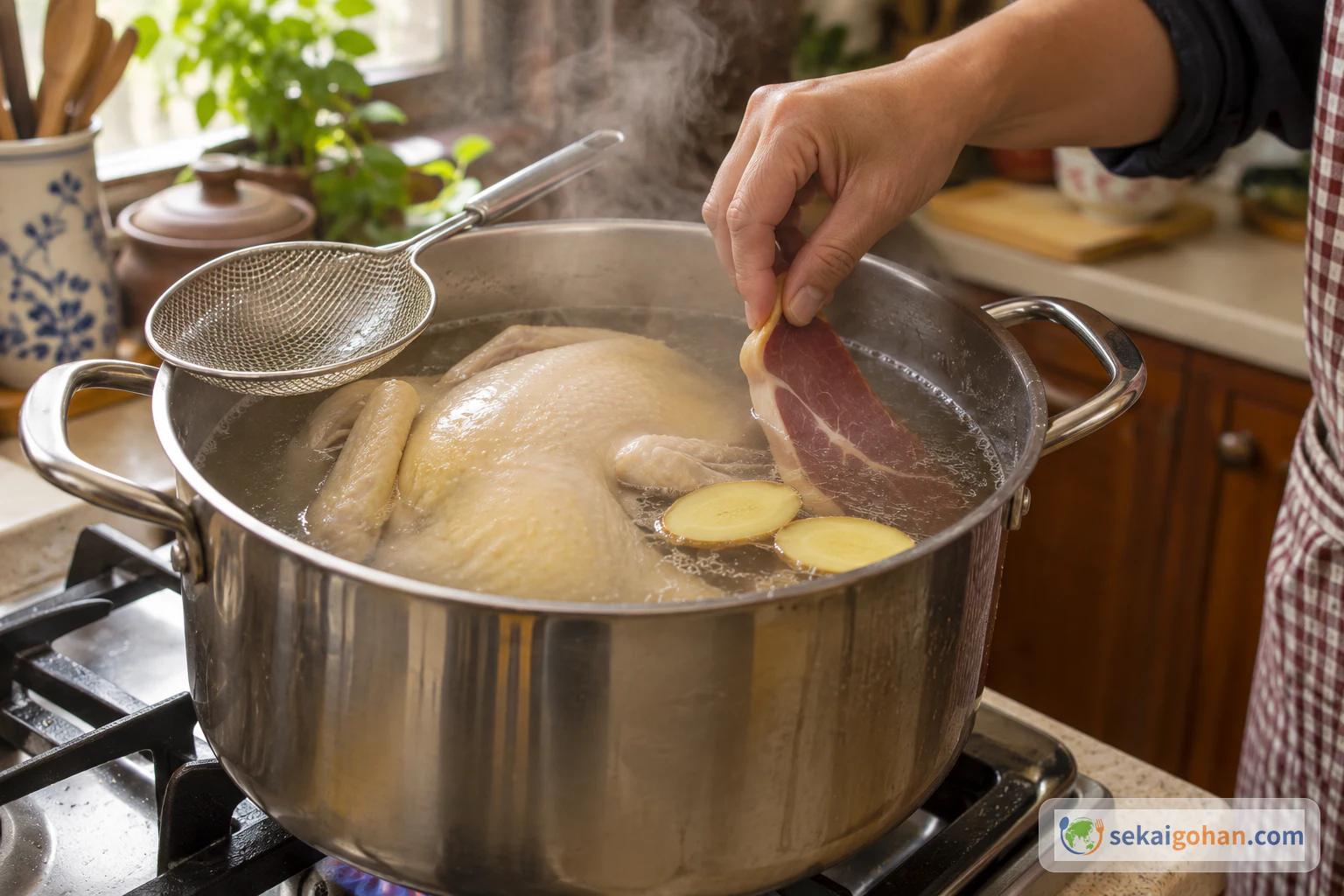
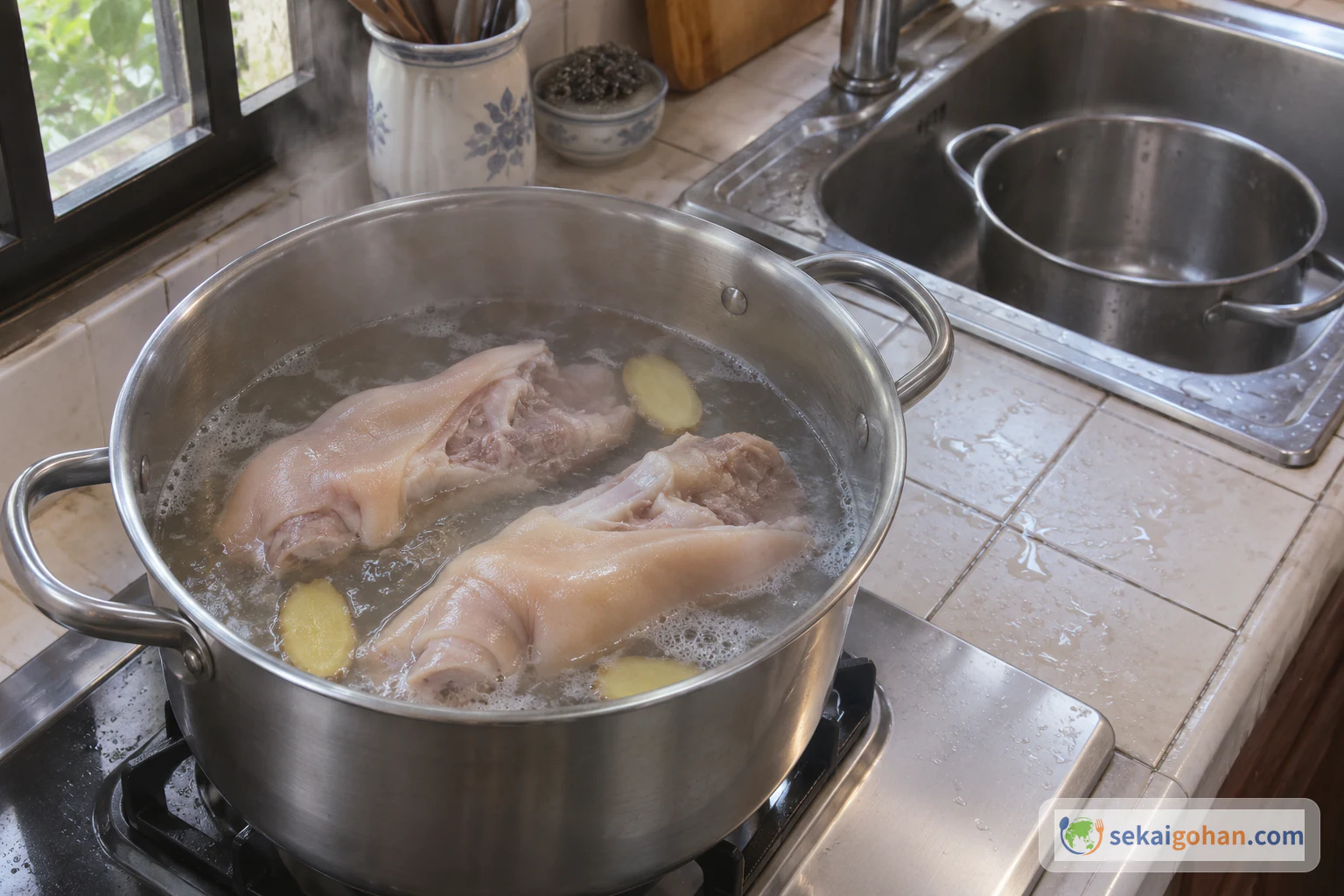
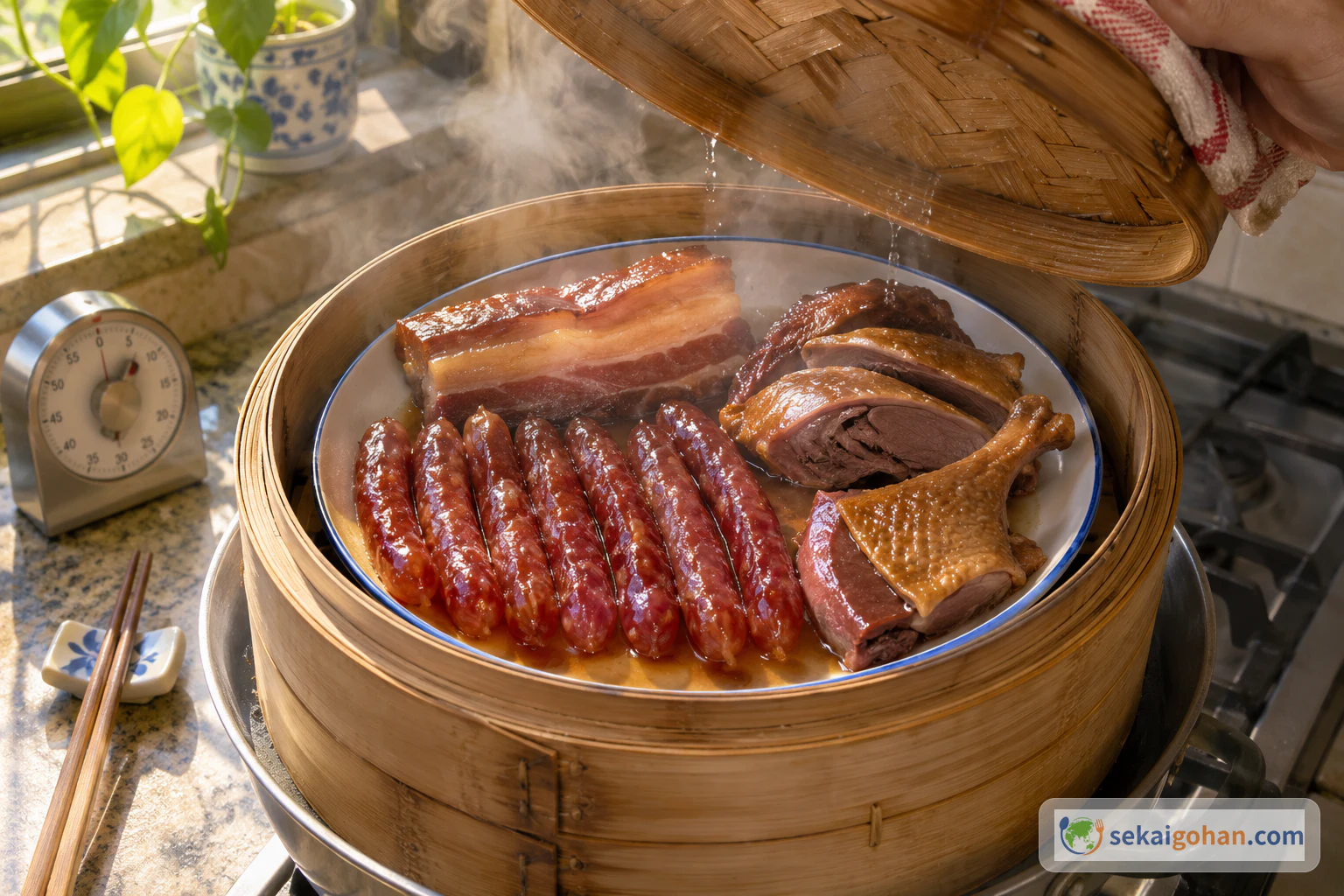
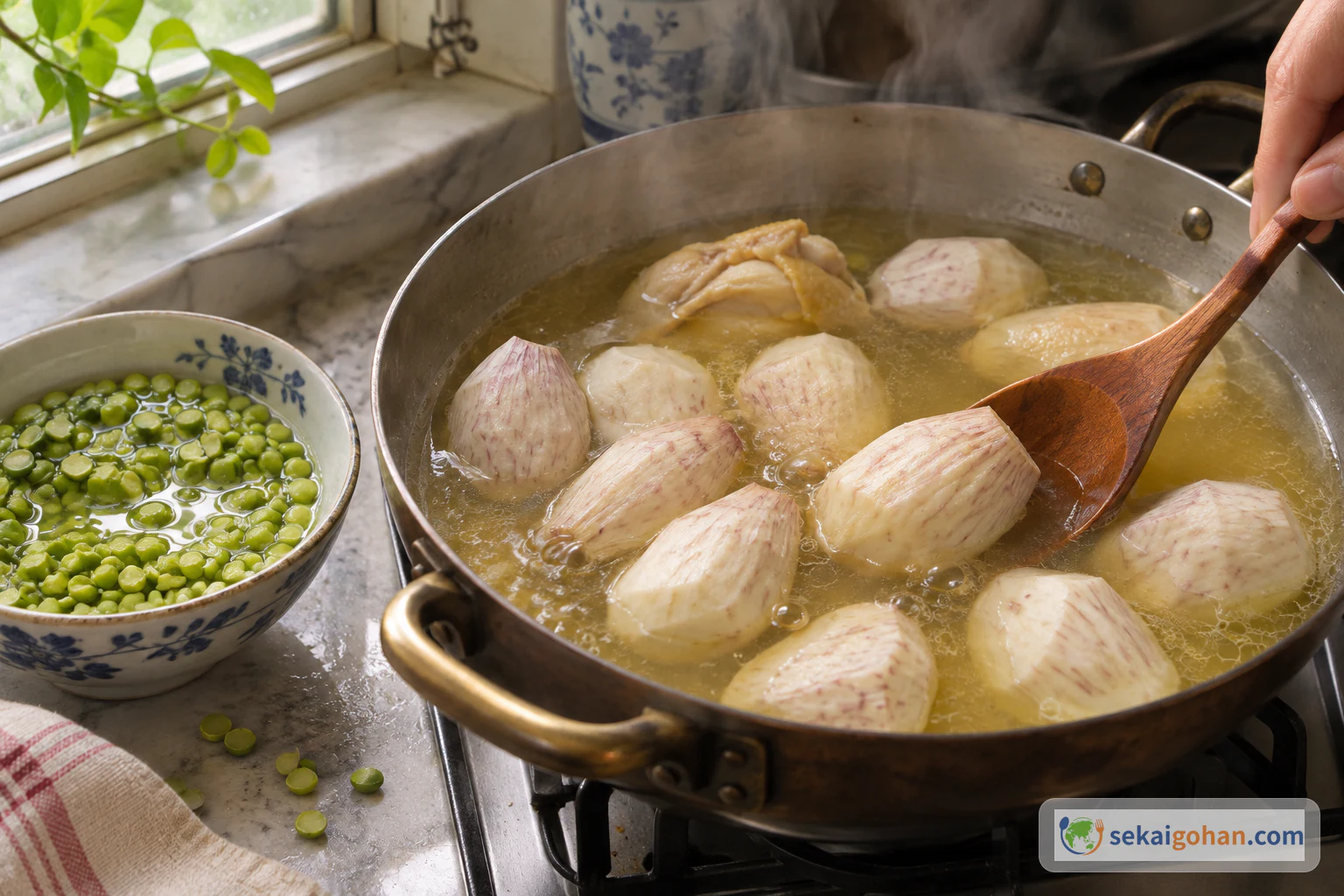
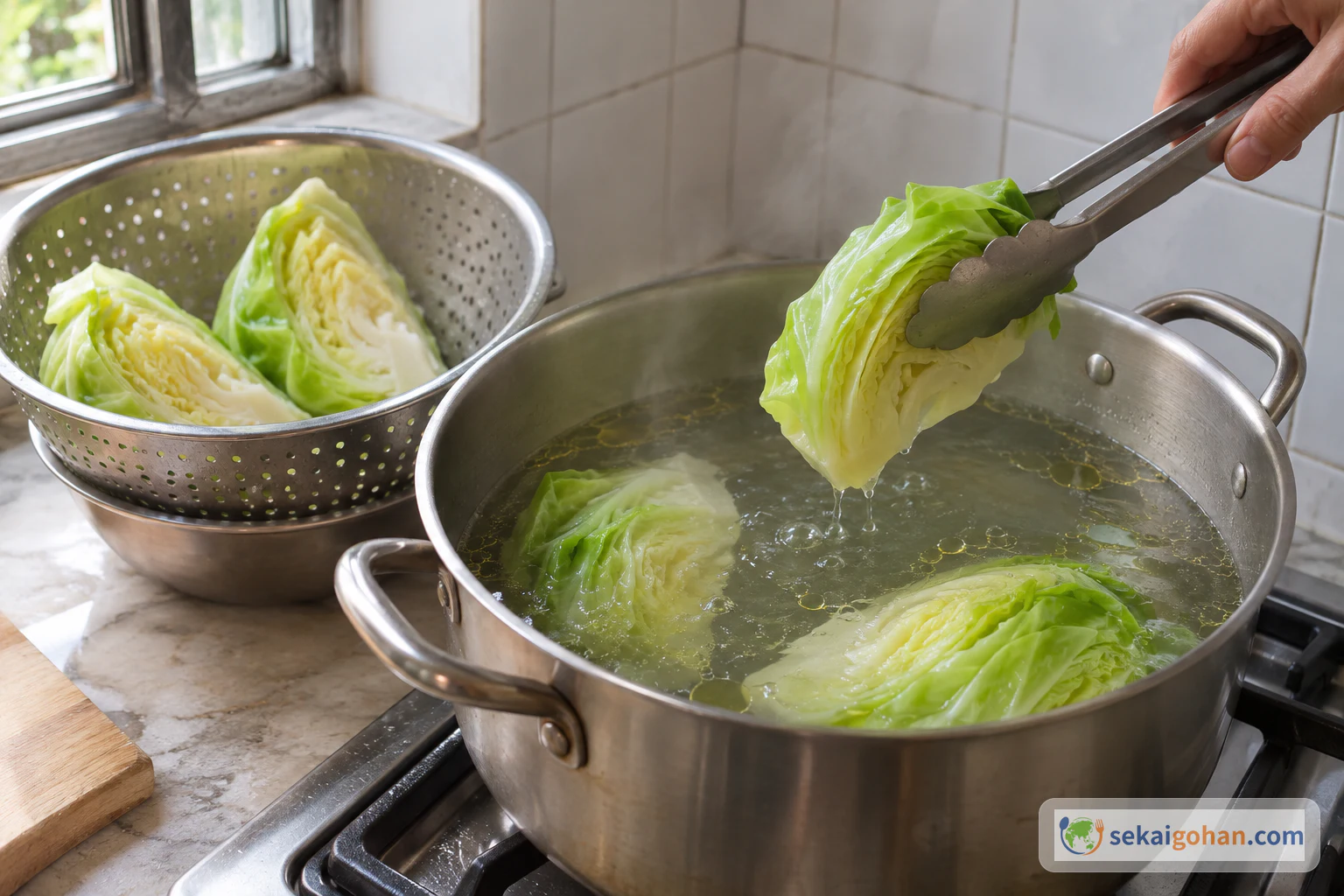
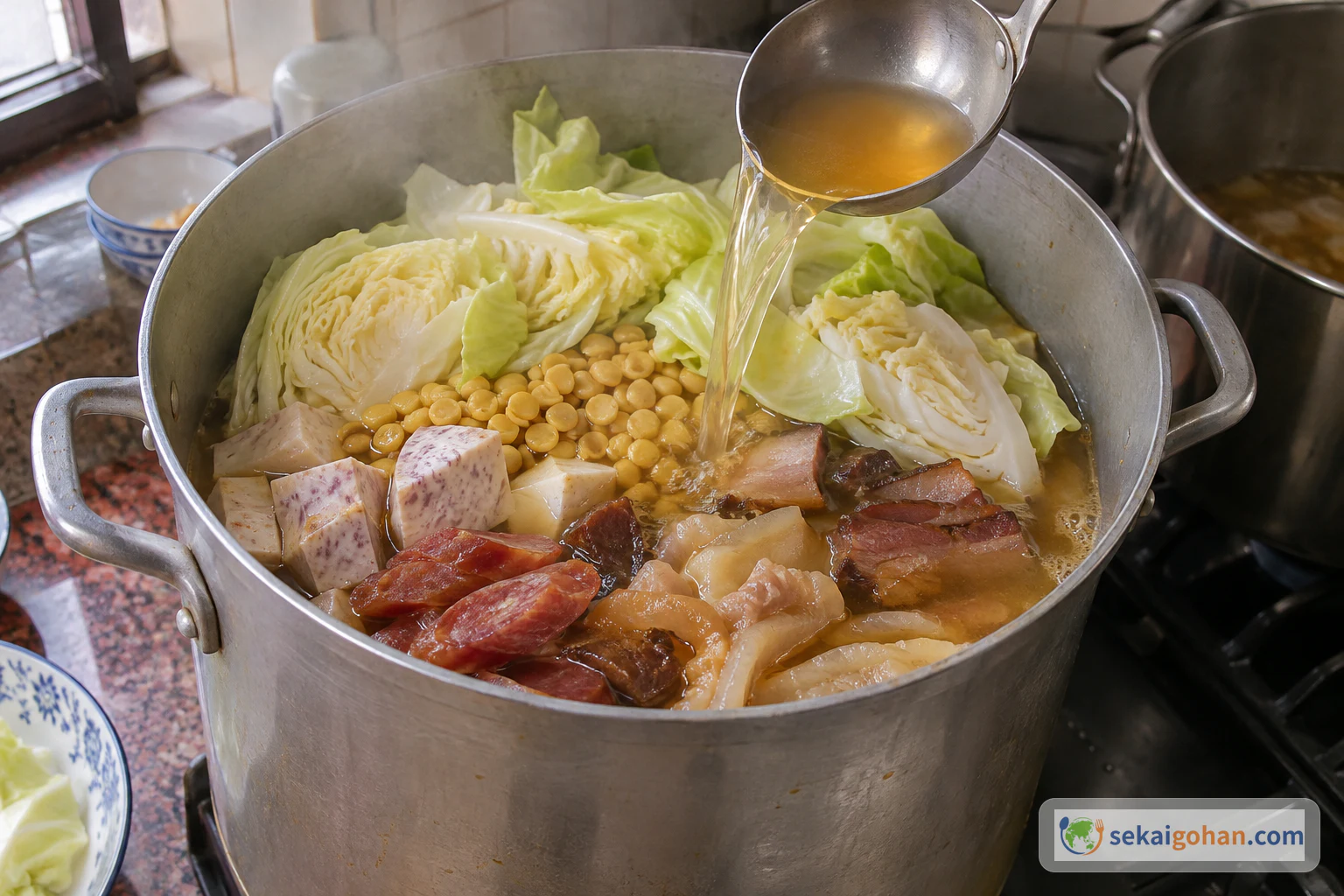
The trotters are already at the bottom of the big pot. Carved chicken, ham, glossy slices of lap cheong and smoked goose, and squares of softened pork skin go on top of them, then pale yams, and the cabbage wedges go on last. Then two broths go in together: the clear chicken stock and the ginger-scented liquid from the trotters. Steam rolls up, and the kitchen smells of smoke and fat. That pot is tacho, the Macanese Christmas stew. It tastes deep and salty-sweet from the Chinese cured meats, with a sticky richness from trotters and pork skin, and it goes to the table with plain white rice.
A Portuguese pot filled from a Cantonese larder
Where it comes from
Tacho, also called chau chau de pele, is usually traced to the Portuguese cozido, the boiled dinner of meats and vegetables. It belongs to the same family as the French pot-au-feu and the New England hotpot. In Macau the Portuguese idea stayed and the larder changed. Chinese cured sausage took the place that chouriço has in a Portuguese pot, and fried pork skin, pele (kohn chee pei in Cantonese), came in. The skin is what gives the stew its other name. A few cooks treat tacho and chau chau de pele as two separate dishes and say a true tacho also has iame chicu yams, beans and fish maw. That line is not settled, and some sources use the two names for the same pot.
Tacho sits among the signature dishes Macau names for Macanese cooking, next to porco balichão tamarindo, galinha à africana, capela and bicho bicho. If you are cooking your way through the city's table, there are more dishes from Macau to try.
In Portuguese, tacho is a cylindrical cooking pot, usually metal, wider than it is tall, with handles. In everyday speech the word can also mean food, or a cook. Its origin is obscure. One Macau cook explains the name as "big plate," which does not match the dictionary meaning.
Christmas, once a year
In Macanese families of Portuguese descent, tacho is Christmas food. Turkey can be missing from the table, but the tacho is always there, and it is cooked once a year. That rhythm explains the scale. A whole chicken, two trotters, a whole smoked goose and eight sausages are a gathering's worth of meat, and the work is spread over several pots before everything meets in the biggest one.
Every family's pot
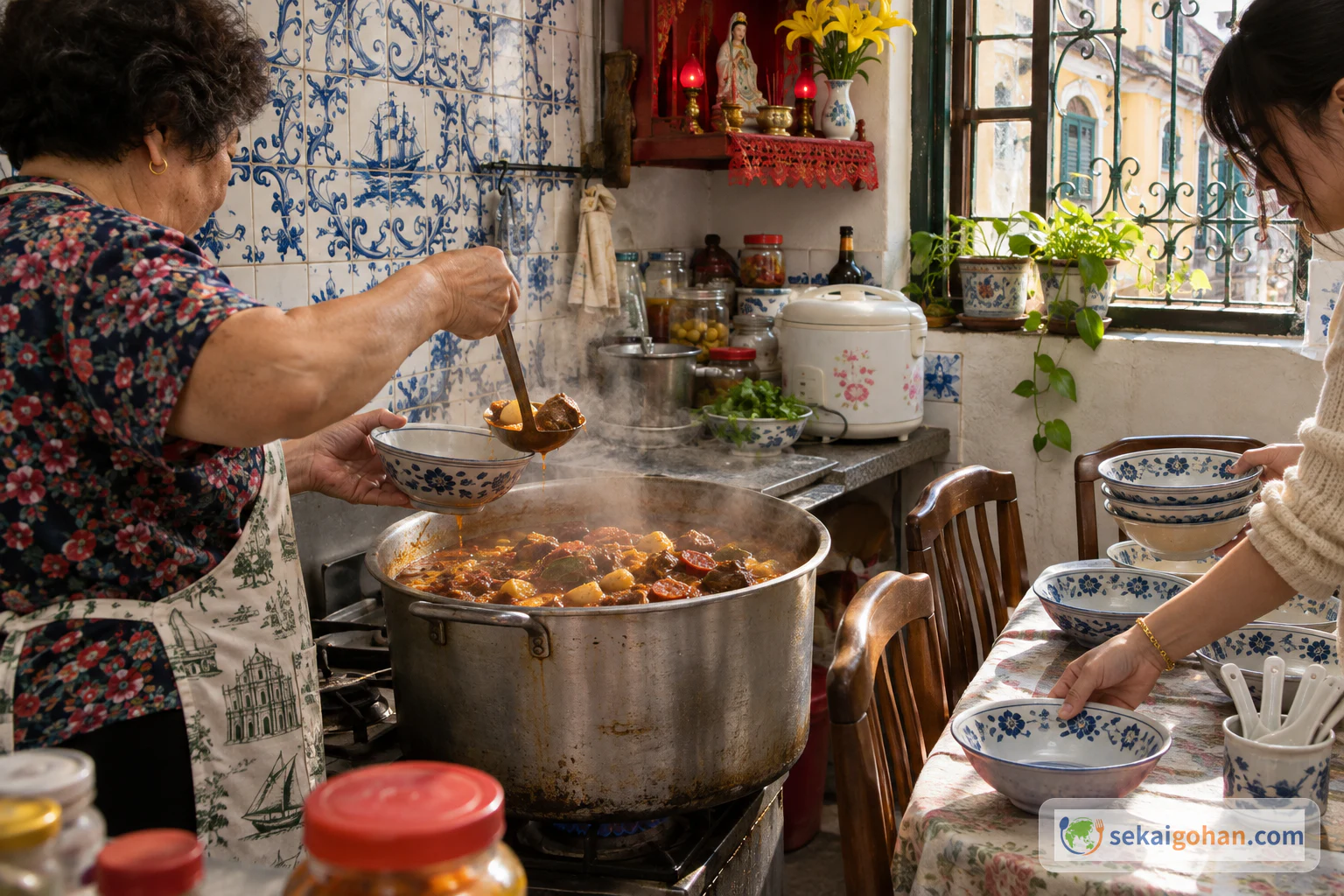
Every household's tacho has its own character, shaped by the version it inherited. The shared core is stewed chicken, pig's trotters, salted duck leg, sausage, fried pork skin and cabbage. Around that core the pot changes. Some families add spare ribs and beef, dried shiitake, black wood ear, Swiss chard and glass noodles. Others simmer beef tendon for hours alongside a ham hock, corned beef and chouriço sutate. Families living abroad make it with pork shank, pork chops and salted pork and leave out Portuguese chouriço altogether. The pork, the Chinese cured and smoked meats, the chicken and the cabbage stay. What changes is which meats go in and whether peas, noodles or mushrooms join them. The version below keeps chicken, trotters, goose, cured meats, small yams, cabbage and split peas. That recipe also does not say where the split peas go when the pot is assembled, so here they go in with the yams.
Ingredients
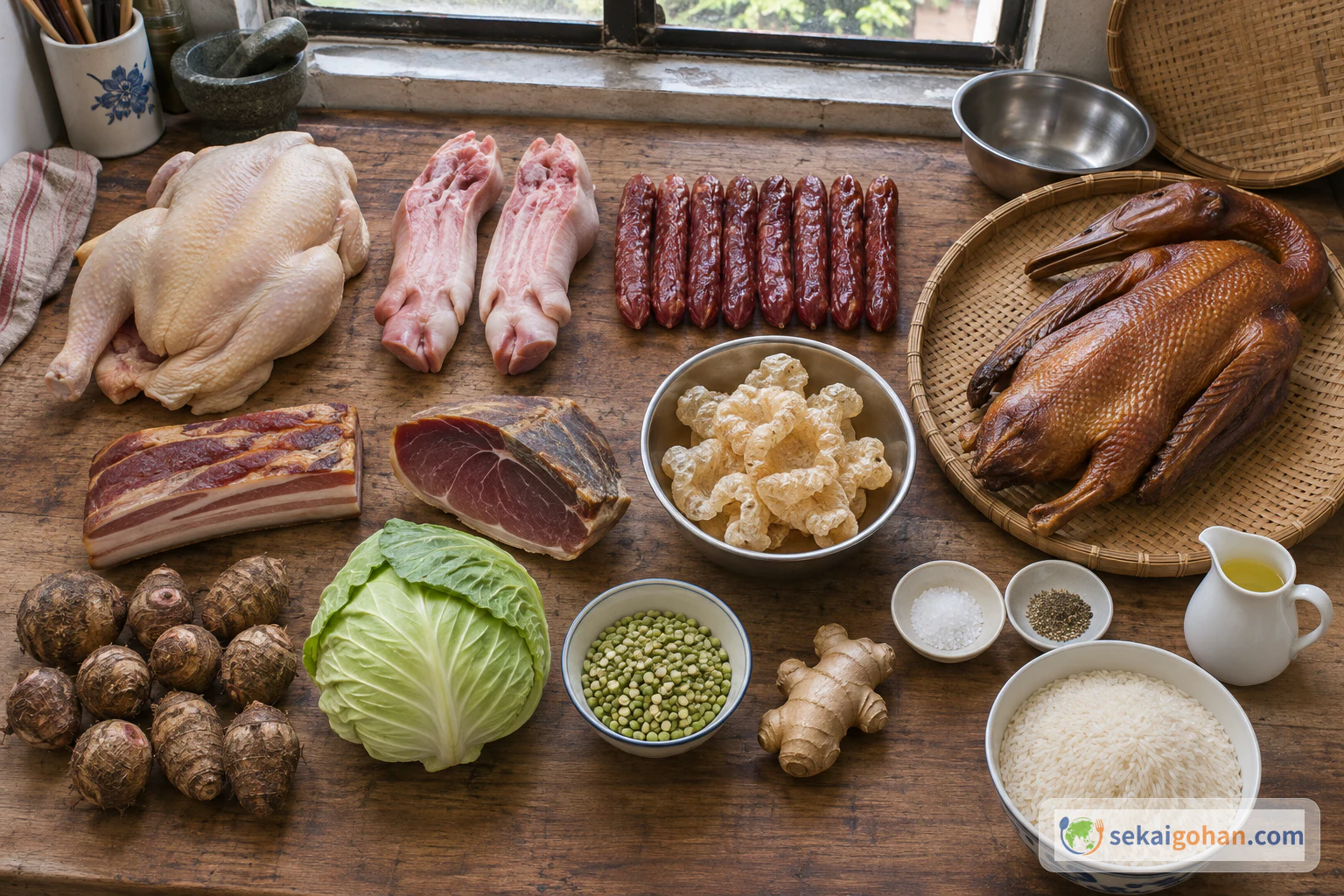
This dish contains pork and chicken. Balichão is made from krill, so treat it like shrimp and other crustaceans. Lap cheong, lap yuk and Chinese ham often contain additives such as wheat, soy or sulfites; read the label on each product you buy.
Equipment
- A very large pot, 8½ quarts (8 L) or bigger, for the final assembly
- A large pot for poaching the whole chicken
- A second pot for the trotters
- A pot for blanching the pork skin, yams and cabbage
- A steamer with a lid (bamboo steamer or steaming rack)
- An enamel or heatproof plate that fits inside the steamer
- A large basin for soaking the pork skin
- Bamboo skewers
- A slotted spoon or skimmer
- An instant-read kitchen thermometer
- Deep bowls for serving
Shopping and substitutions
Most of the shopping happens in one stop at a Cantonese or Chinese grocery, in the shop or online. Lap cheong, lap yuk, Chinese ham and fried pork skin are usually sold side by side there. Pig's trotters come from a butcher. Plan on using two or three shops, and keep the swaps below in mind for whatever is missing.
| Ingredient | What to look for | If you can't find it |
|---|---|---|
| Lap cheong | Cantonese cured sausage | Don't use ordinary coarse pork sausage. The sweetness and aroma come out completely different. |
| Smoked goose | Whole smoked goose from a Chinese butcher | Smoked duck or Cantonese cured duck legs. Some Macanese families use smoked duck leg, so the flavor stays close. |
| Chinese ham | Chinese ham, for example Jinhua ham | A bone-in Chinese-style cured ham. It is very salty, so keep it at 7 oz (200 g). |
| Lap yuk | Cantonese cured pork belly | Thick-cut bacon plus a little salt. The flavor turns more Western. |
| Pele | Dried fried pork skin, sold in sheets or bags | Some countries ban it under quarantine rules. Never import raw pork skin yourself. |
| Small yams | Small, slightly astringent yams of Chinese origin; the exact variety is not settled | Small taro, which you boil in its skin and peel the same way. It makes the stew sweeter and stickier. Nagaimo and other long yams are too watery and slick and fall apart. |
| Split peas | Dried green split peas | Whole dried green peas, scalded more briefly so they don't break up. |
| Balichão | A Macanese fermented krill relish, hard to find | Filipino bagoong alamang, or Thai kapi. Both are very salty, so use only a little. Leave it out if you have none. |
The things that make it taste of Macau are real lap cheong and the fried pork skin, plus a broth from a whole chicken. Swap those and you have a different stew. You can replace the goose with duck or use taro for the yams and still have a recognizable tacho.
Method
Tacho is a dish of separate preparations that come together at the end. The chicken pot, the trotter pot and the steamer each run on their own, so get the pork skin soaking first and keep two burners going at once. Keep both broths. They become the cooking liquid. If you split the work over two days, cool each part, cover it and refrigerate it promptly, then assemble and simmer the next day.
After handling raw chicken or trotters, wash your hands, then wash the knife and cutting board and pour boiling water over them. Cook the chicken and trotters until the center, including the meat next to the bone, reaches 167°F (75°C) for at least 1 minute. If you stop partway through, put everything in the refrigerator. Don't leave it at room temperature.
When it goes wrong
| What you see | Why | What to do |
|---|---|---|
| The pork skin is tough and chewy | It wasn't soaked and blanched enough | Wash it twice in lukewarm water and blanch before it goes in. Dried skin needs a longer soak. |
| The chicken falls apart | It was cut while hot | Cool it completely before carving. |
| The stew smells of pork | The blanching water from the trotters was kept | Always throw out the 5-minute blanching water and simmer in fresh water with ginger. |
| The broth is too salty | The cured meats released their salt, or the liquid reduced too far | Add hot water to loosen it, and season only at the end. |
| The bottom has scorched | The heat was too high under a crowded pot | Keep it on low. If the pot has a thin base, turn it lower still. |
| The peas have dissolved | They were cooked too long beforehand | Only scald them, and add them with the yams. |
Serving, variations and storage
At the table
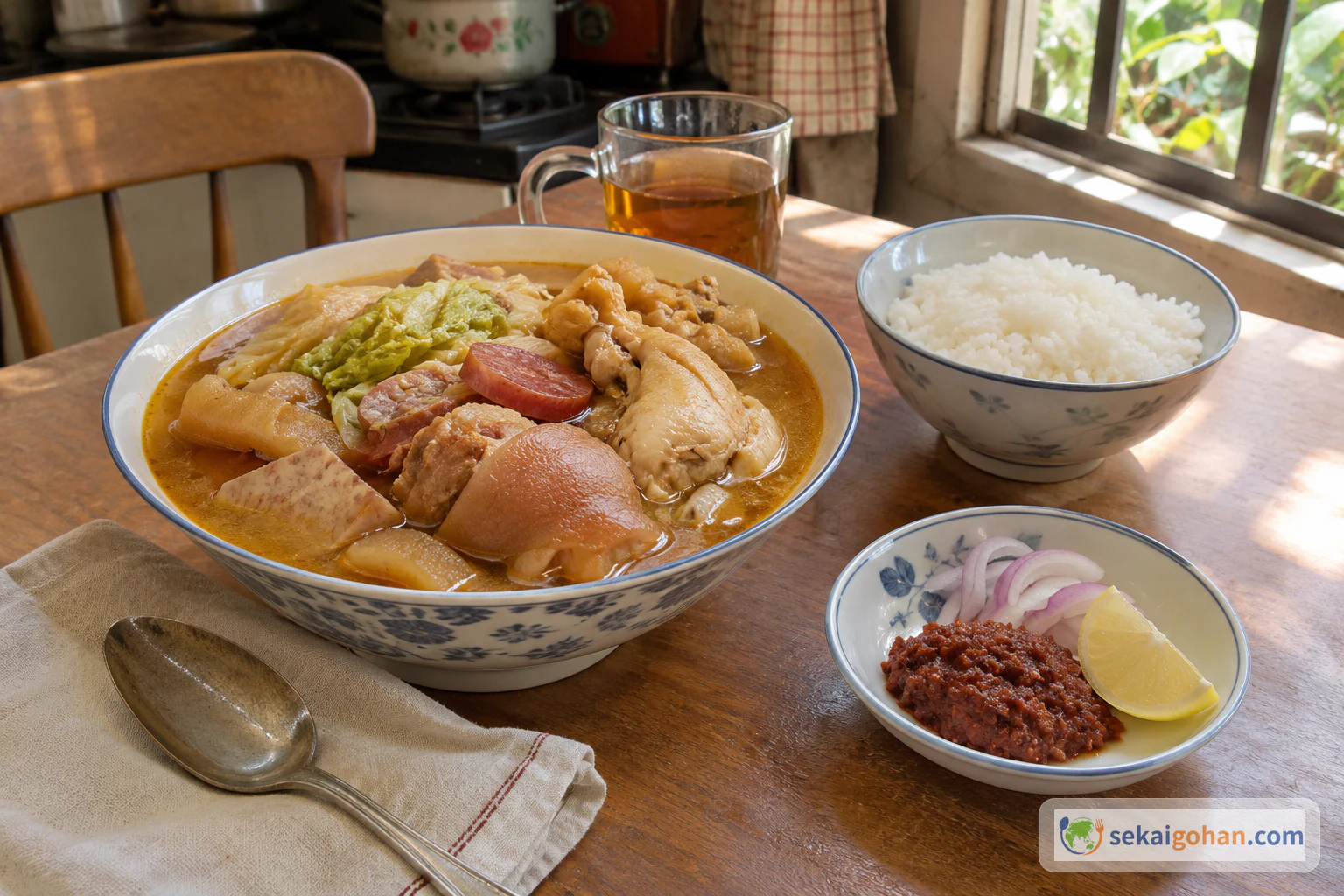
Serve tacho hot. Ladle it into deep bowls with plenty of broth over each portion. Put white rice cooked without salt beside it. The plain rice balances the salty, smoky meats. If you have balichão, put it on a small saucer with a wedge of lemon and some thin slices of onion, and let everyone take a little.
Balichão is salted, fermented krill and is eaten raw as a condiment, with a strong smell. Use only a little because it is very salty. If raw fermented foods worry you, stir a small amount into your hot bowl, or fry it into balichão frito with lard and onion before serving.
Balichão is an uncooked, fermented condiment. Buy only a product sold as food and serve it in a clean dish with a clean spoon. Pregnant women, older adults, small children and anyone with a weak immune system should skip it or use the fried version. If it smells off, shows mold or has changed color, throw it away.
Variations
- Smoked duck for the goose. Duck legs or a smoked duck are a close swap, in smaller pieces.
- Small taro for the yams. Treat them the same way, boiled in the skin and then peeled. The stew turns sweeter and a little stickier.
- Bone-in chicken thighs for the whole bird. Use about 3 lb 5 oz (1.5 kg) when a whole chicken is hard to find. The broth comes out thinner than one made from a whole bird.
- Leave out the peas, or add glass noodles. Without peas the broth stays clearer. Glass noodles, as some families add them, soak up the broth and make the pot more filling.
Leftovers
Cool the leftovers, divide them into shallow containers, cover them and refrigerate at 50°F (10°C) or below. Store the vegetables separately from the meat, because they spoil and turn sour if left in the broth. This is spoilage. No step in this dish is meant to ferment. Reheat until the meat reaches 167°F (75°C) or above and the broth comes to a boil. Use low heat so nothing scorches. Each time you reheat, add some fresh cabbage or a few steamed sausages. Throw out anything that has been kept too long or seems off in any way.
Frequently asked questions
Can I cook everything in one pot?
No. The trotters need their first water thrown out, and the chicken broth is better kept clean by itself, so they need separate pots. Steaming the cured meats keeps their fat and shape in a way boiling would not. Everything comes together in one pot only at the end.
Can I do the preparation a day ahead?
Yes. The pork skin, chicken, trotters, steamed meats, yams and cabbage can all be prepared the day before. Cool each part, cover it and refrigerate it promptly, and keep both broths covered in the refrigerator too. The next day, layer the pot, pour in the broths and simmer until everything is steaming hot.
Where do the split peas go?
The published recipe prepares the peas but does not say when they join the pot. Here they are scalded and added with the yams when the pot is layered. If you would rather leave them out, the broth stays clearer.
Why is the rice cooked without salt?
The ham, lap yuk, sausages and goose already season the broth heavily. Plain rice soaks up the broth and evens out each mouthful. Salted rice makes the meal too salty.