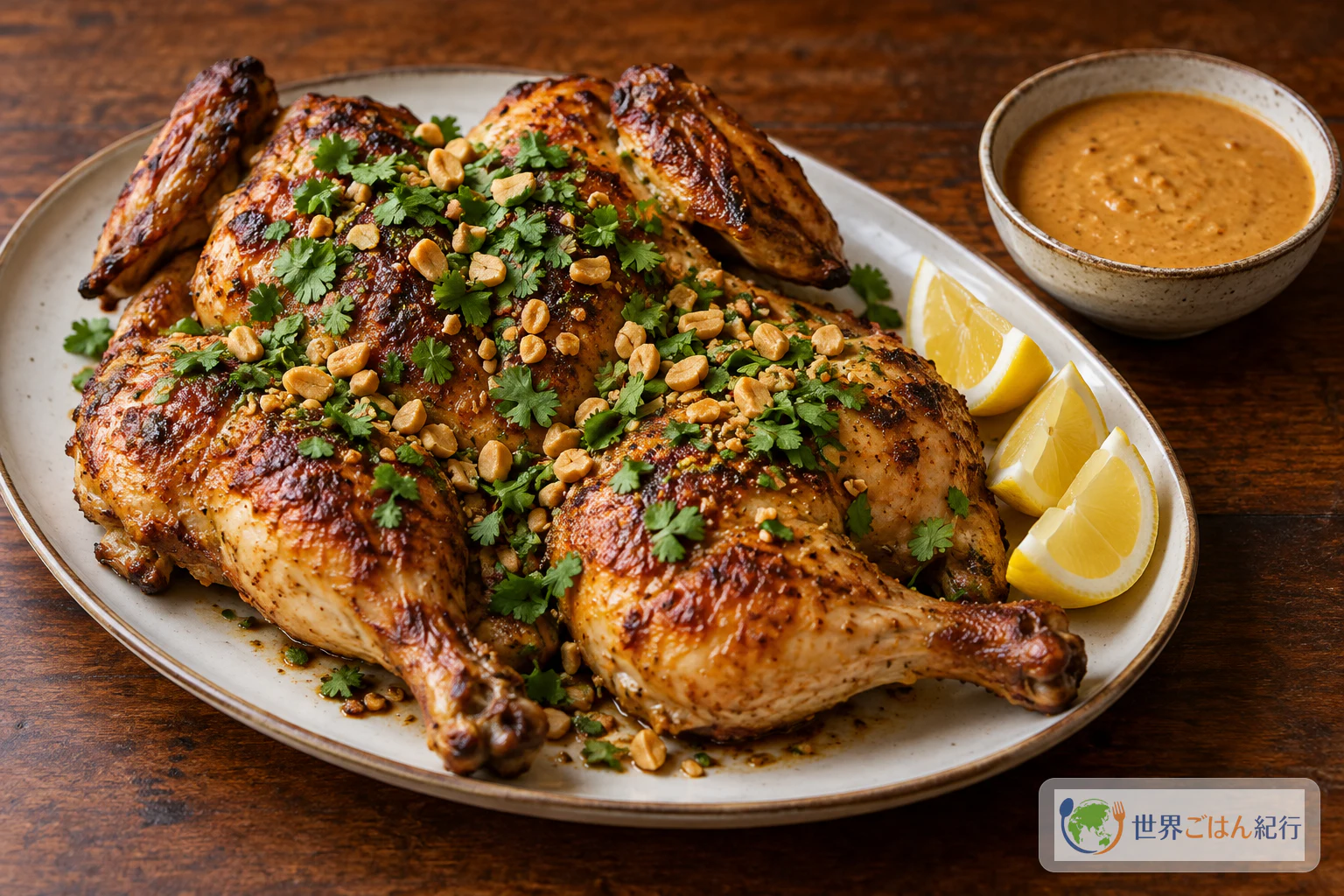
African Chicken: A Macanese Roast with Its Sauce on the Side
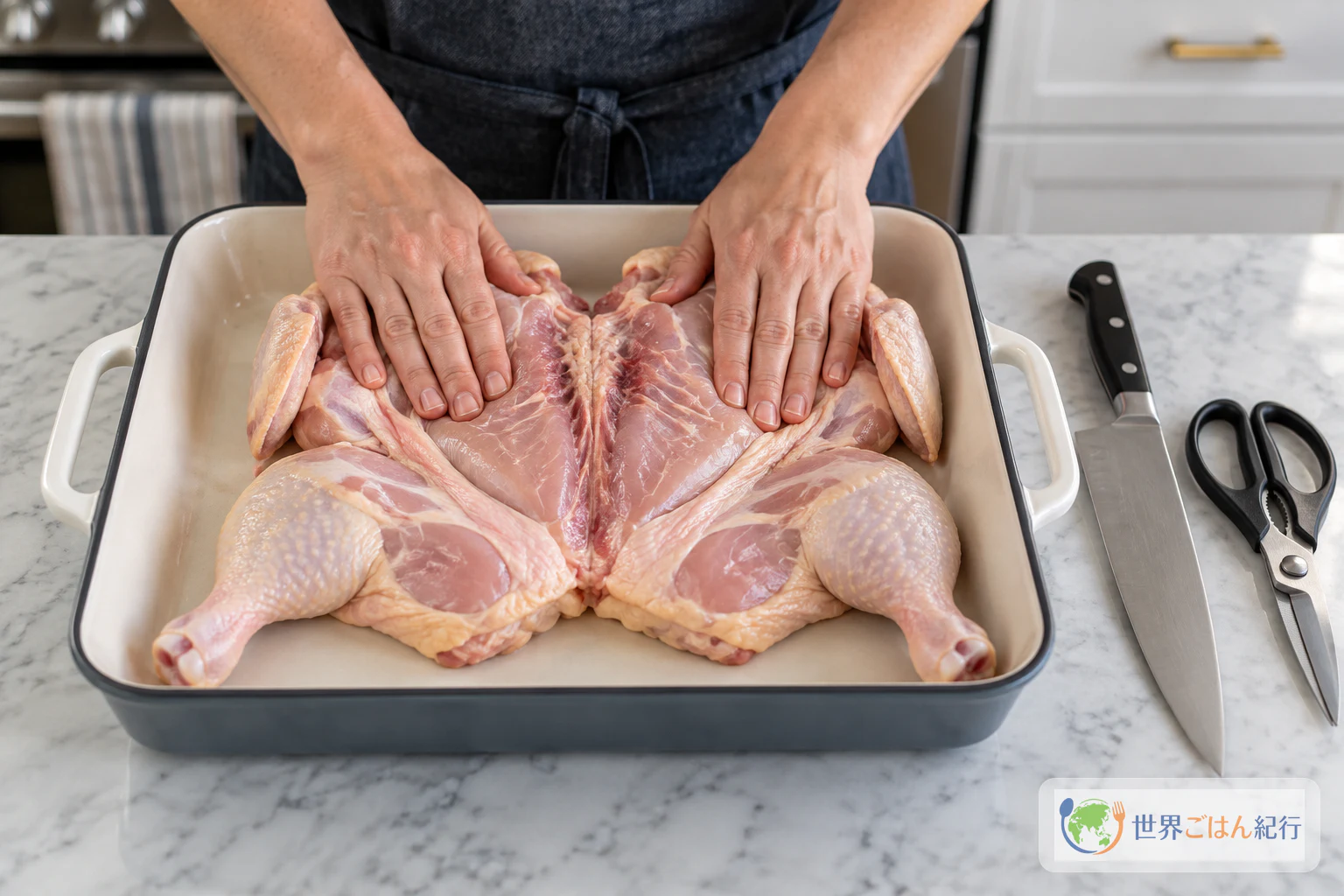
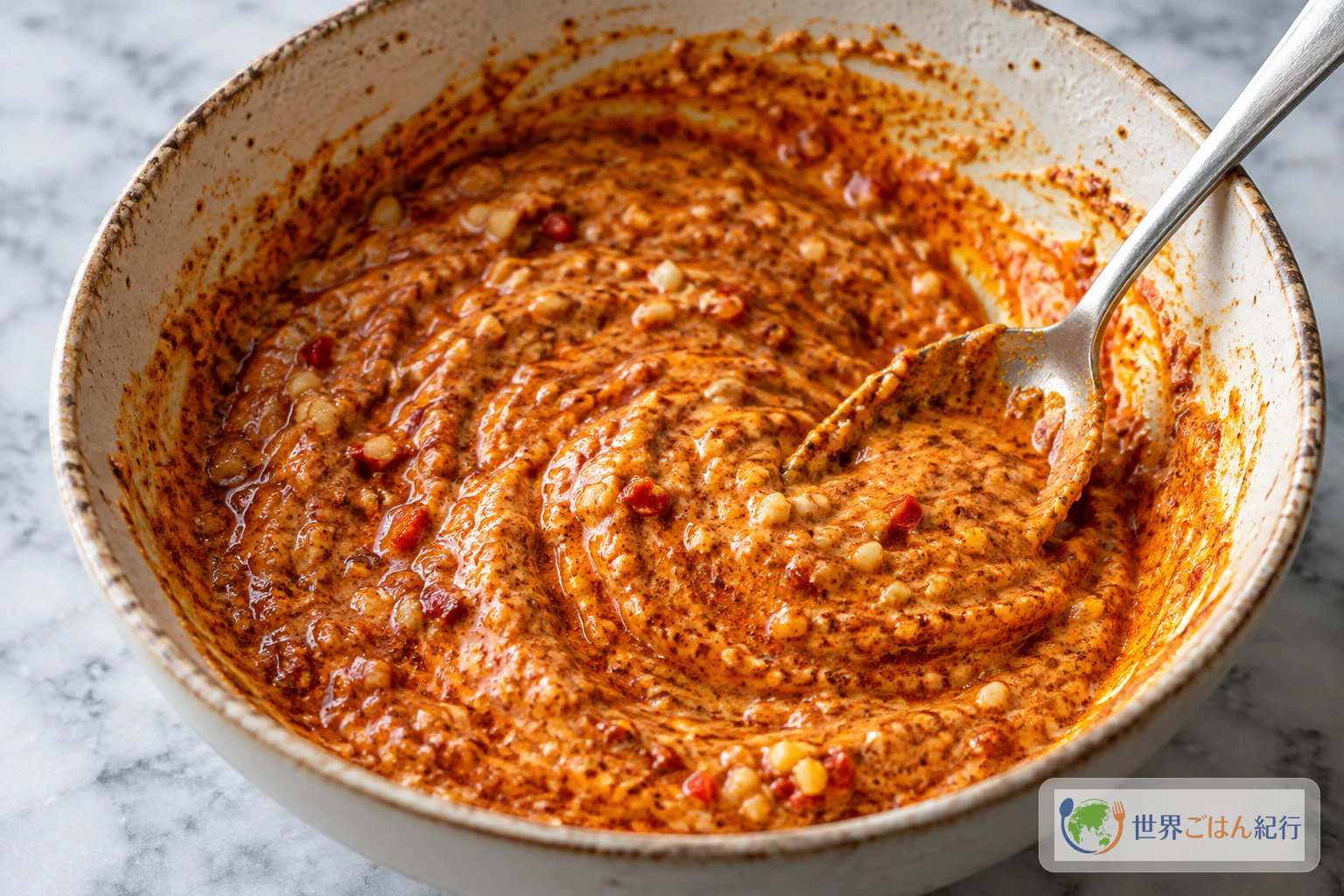
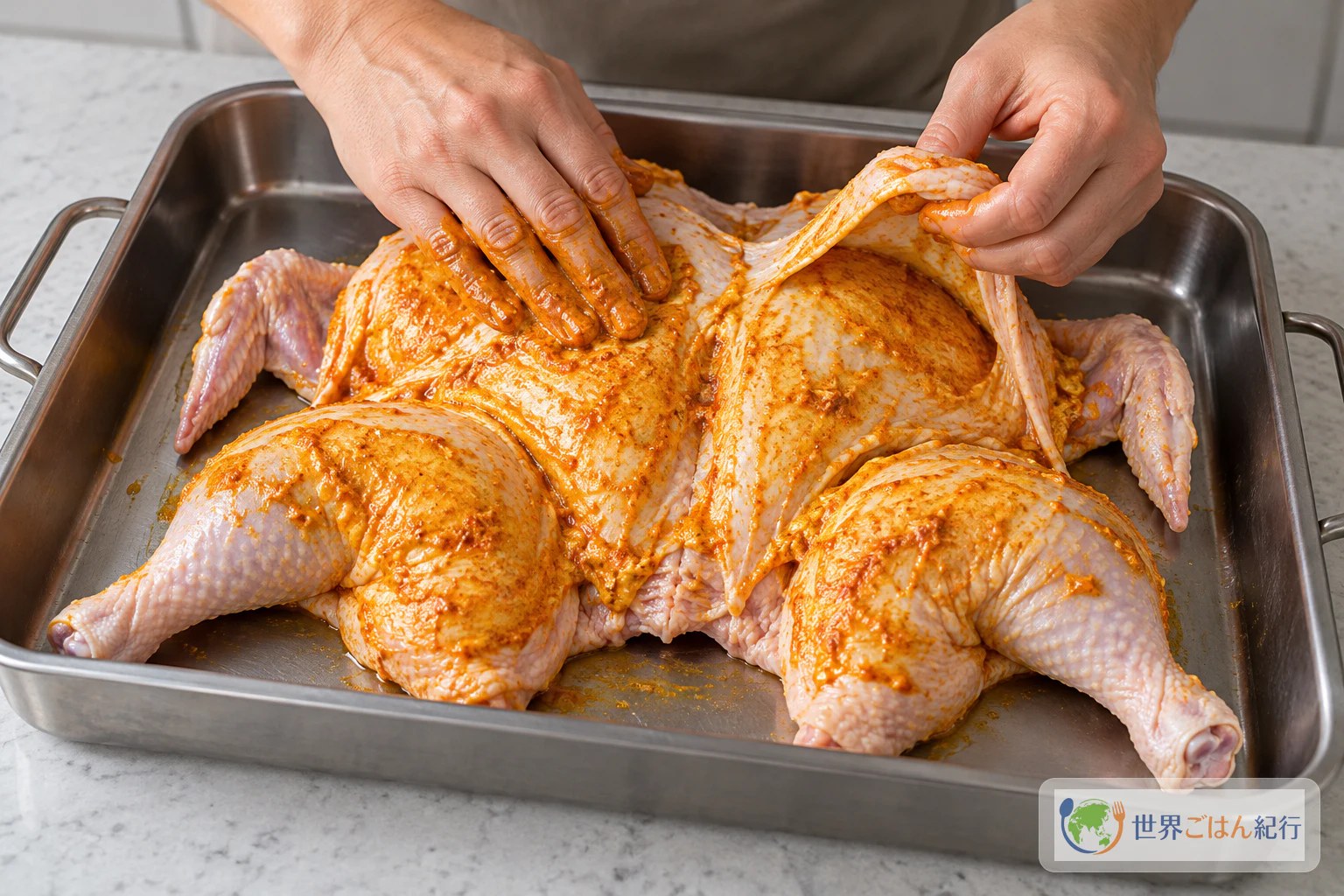
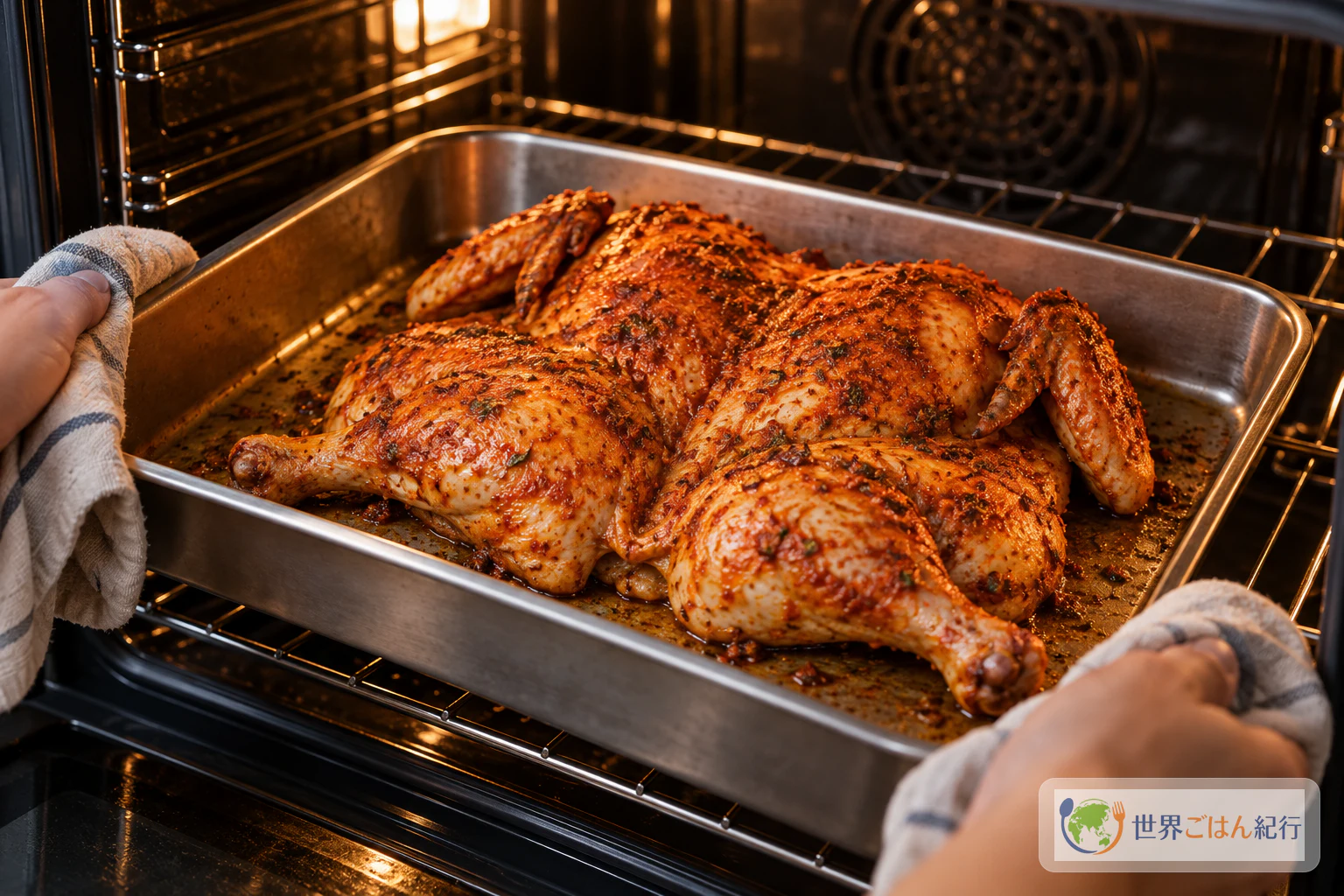
The chicken is a whole bird, opened flat, coated in a yogurt marinade colored with turmeric and paprika, and roasted. The rich sauce of peanuts, coconut milk and red chili is served separately rather than brushed onto the chicken.
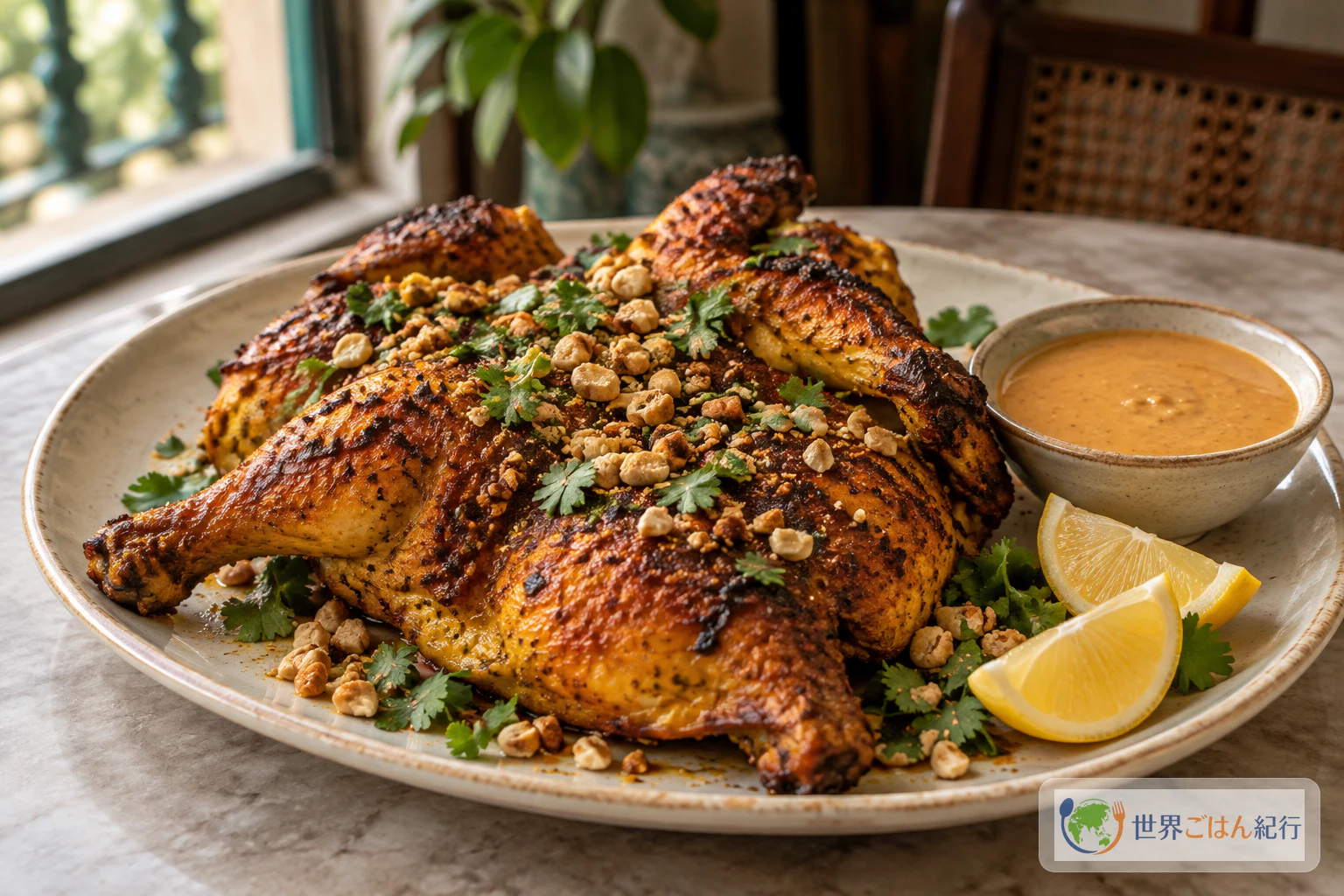
A whole chicken lies flat on the platter, its skin deep red-gold from paprika and turmeric, scattered with chopped cilantro and coarsely ground honey-roasted peanuts. Lemon wedges sit beside it, and a small bowl holds a smooth, pale orange sauce of peanuts and coconut milk. This is Galinha Africana, also written Galinha à Africana, known in English as African chicken.
Despite the name, this is not a general "African" dish. It is known as a dish of Macanese cuisine, the cooking of the Macanese community of Macau. It is also not the same dish as Galinha Cafreal, which is described as Mozambican, or as Portuguese piri-piri chicken, and this article does not treat them as interchangeable.
There is no single standard recipe. Versions differ from restaurant to restaurant and household to household. The version here follows António M. Jorge da Silva's Macaense Cuisine: Origins and Evolution (International Institute of Macau, 2016), in which the author presents his own attempt to recreate the dish associated with the chef Américo Ângelo. It is one recreation, not the only authentic formula.
We have not test-cooked this recipe. The heat of the chilies, the thickness of the sauce and the roasting time depend on your chilies, the size of your chicken and your oven, so treat the times below as guides and use a thermometer to decide when the chicken is done.
Ingredients (6 servings, as in the source)
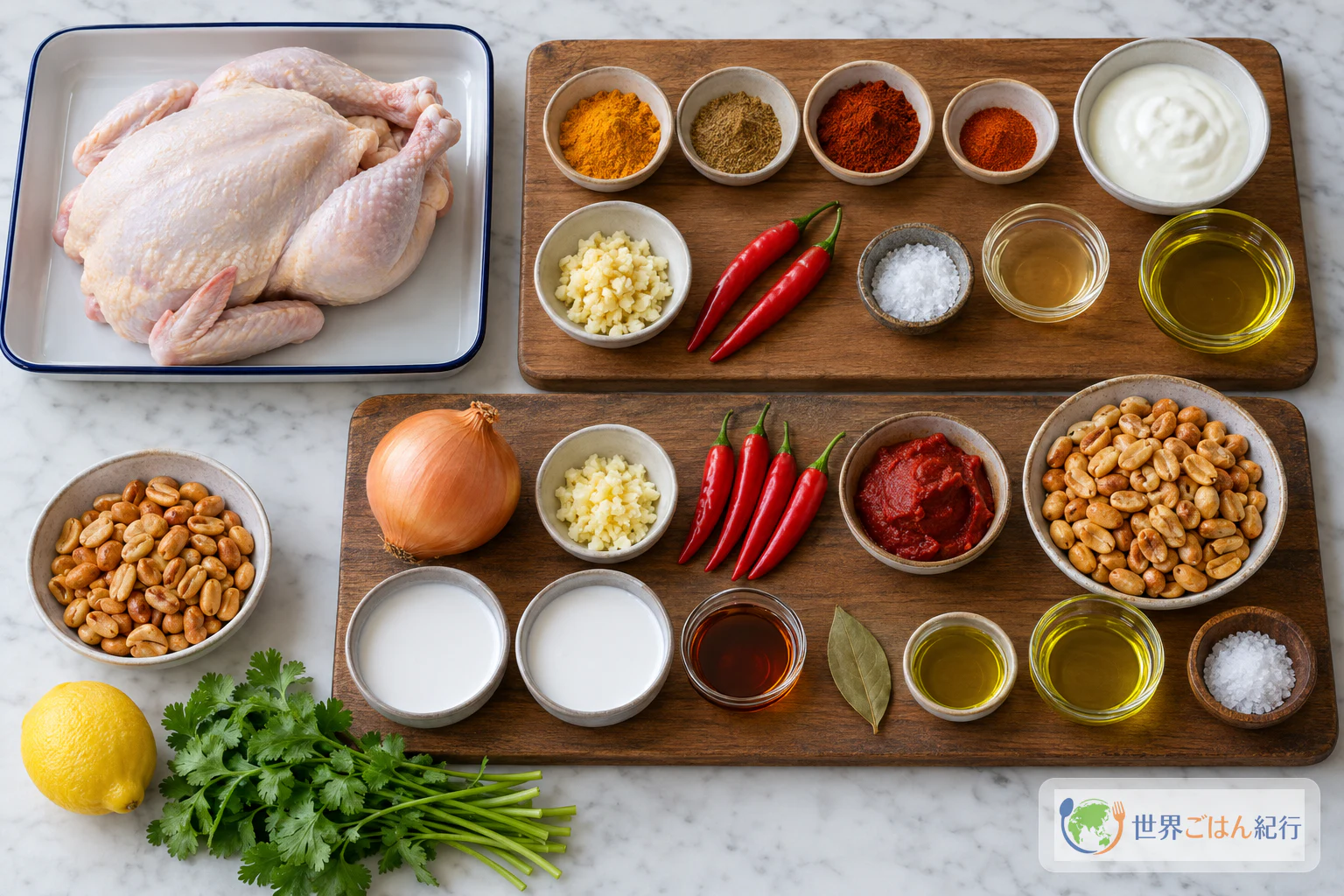
The amounts below are the source recipe's own, in its own units. The book does not give a weight for the chicken. Peanuts, olive oil and coconut milk each appear in more than one role, so each use has its own row.
Equipment
- Kitchen shears or a boning knife, for opening the chicken
- Oven-safe metal roasting pan
- Saucepan
- Blender
- Instant-read thermometer
- Clean disposable paper towels
- Cutting board, containers and utensils kept only for raw chicken
Measuring, Choosing and Substituting
The source uses cups, tablespoons and teaspoons. The conversion table printed in the book mixes values (1 cup as 250 ml, 1/2 cup as 118 ml, 1/4 cup as 59 ml), so it does not settle a single cup standard, and this article does not label the source's cups as US cups. For working through the steps, this article uses 1 cup = 240 ml, 1 tbsp = 15 ml and 1 tsp = 5 ml as an editorial choice. On that basis, 1/2 cup is 120 ml and 1/4 cup is 60 ml. These are volumes, not weights.
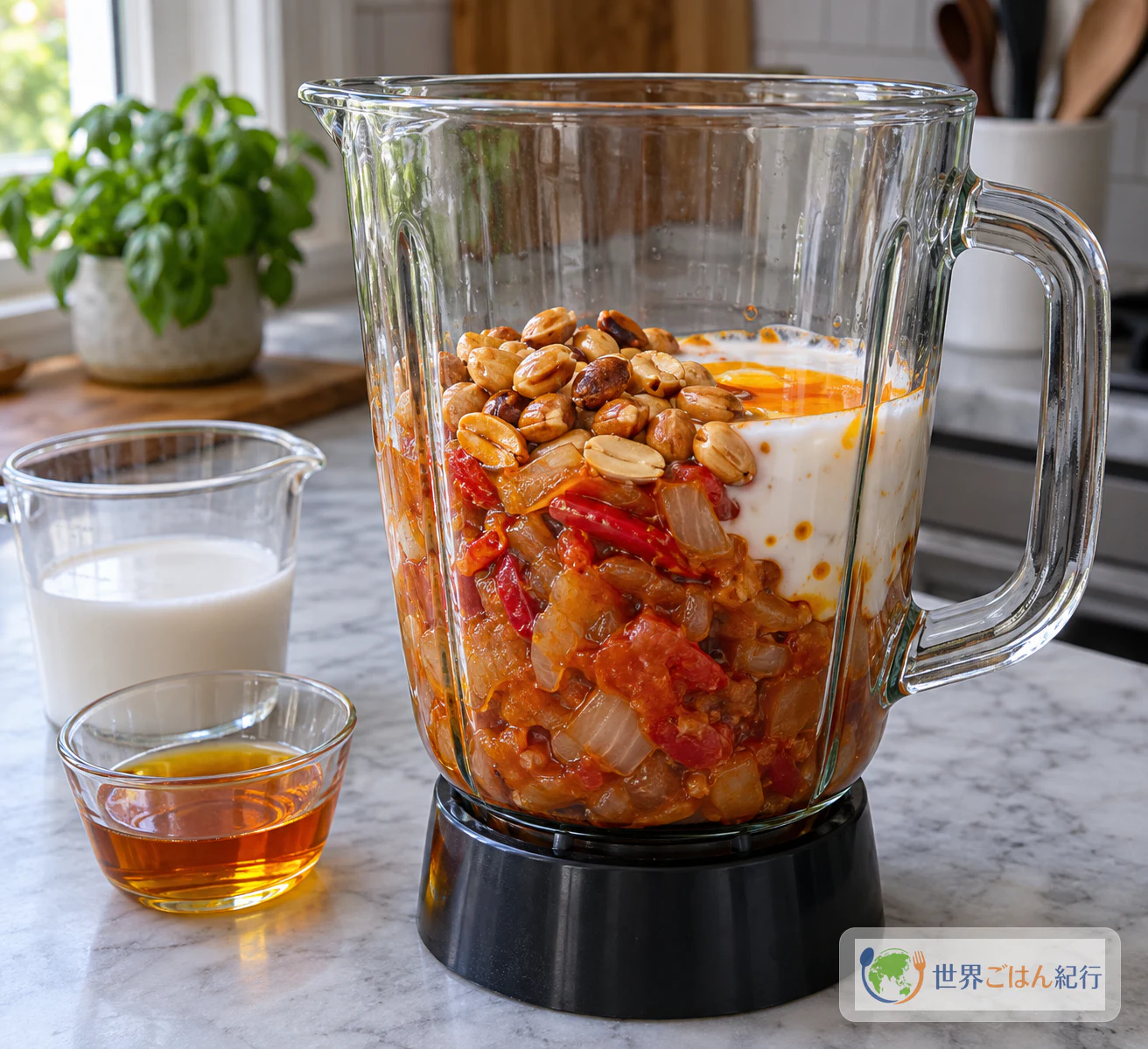
Two oils, two jobs. The marinade's 1/4 cup of olive oil goes only into the marinade. The sauce's 1/4 cup is the only oil for the sauce. The source says to sauté but does not say how much of the sauce oil to use for it, and it adds olive oil again at blending. This article therefore splits the sauce oil into about 15 ml (1 tbsp) for sautéing and about 45 ml for blending. That split is an editorial choice, not the source's instruction, and it means no extra oil is added.
Two portions of peanuts. The 1 cup of honey-roasted peanuts goes into the sauce; the 1/2 cup is coarsely ground and scattered on top at the end.
Olive oil. The source calls for Portuguese olive oil. An ordinary extra-virgin olive oil can be used, with some difference in flavor.
Chilies. The heat of the finished chicken and sauce depends on the type and number of red chilies you use. Choosing milder chilies or fewer of them makes the dish less hot, but the exact effect is not measured here.
What is not a substitute. Leaving out the coconut milk or the peanuts takes the dish away from this version. That is a different recipe, not a substitution.
This recipe contains peanuts, milk (yogurt) and chicken. Honey-roasted peanuts are a processed product, so check the label for any other ingredients. Because the peanuts are honey-roasted, do not serve this dish to infants under 1 year old; honey should not be given to babies under one, and ordinary heating or cooking does not remove that caution.
Method: Make the Sauce First, Then Marinate and Roast
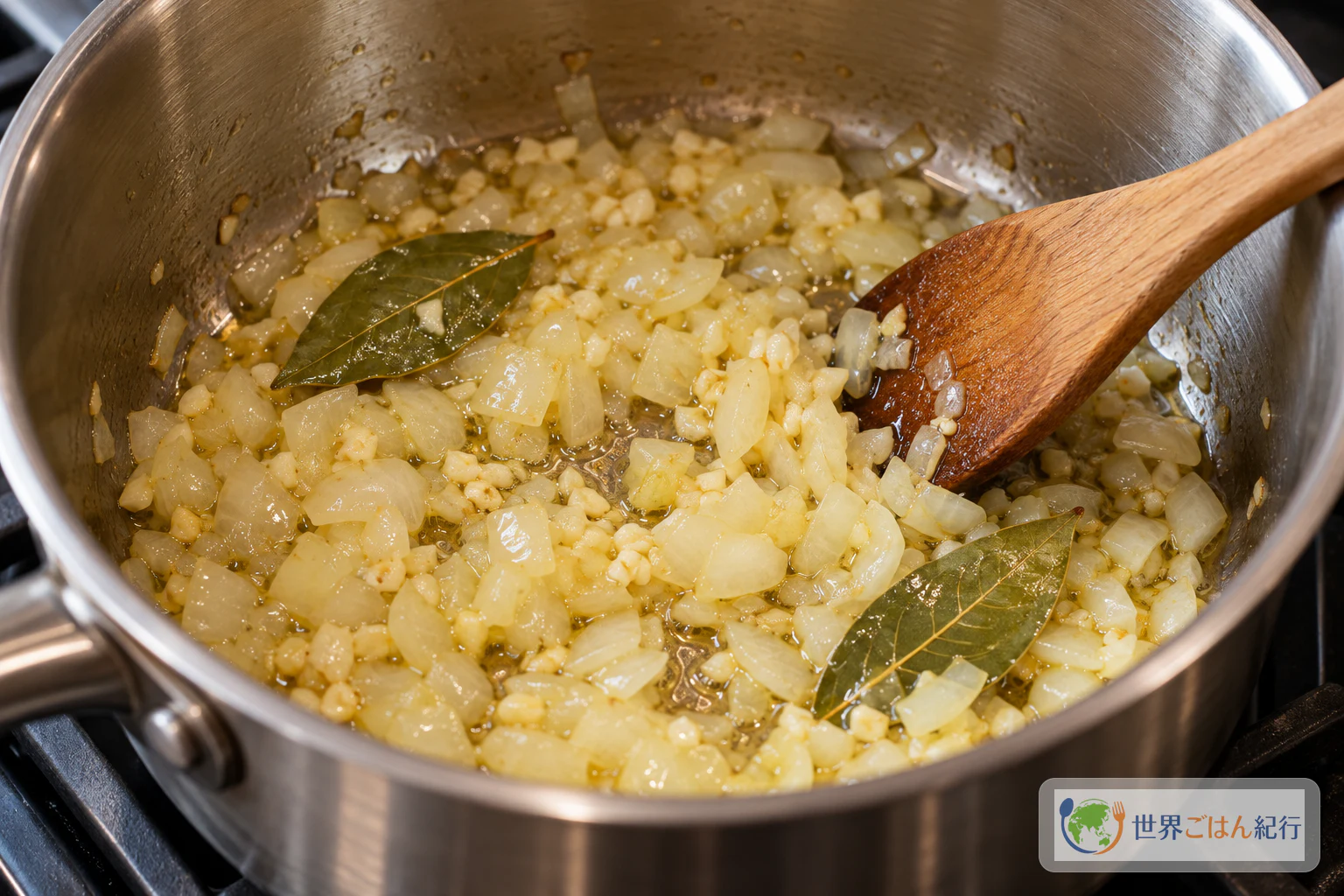
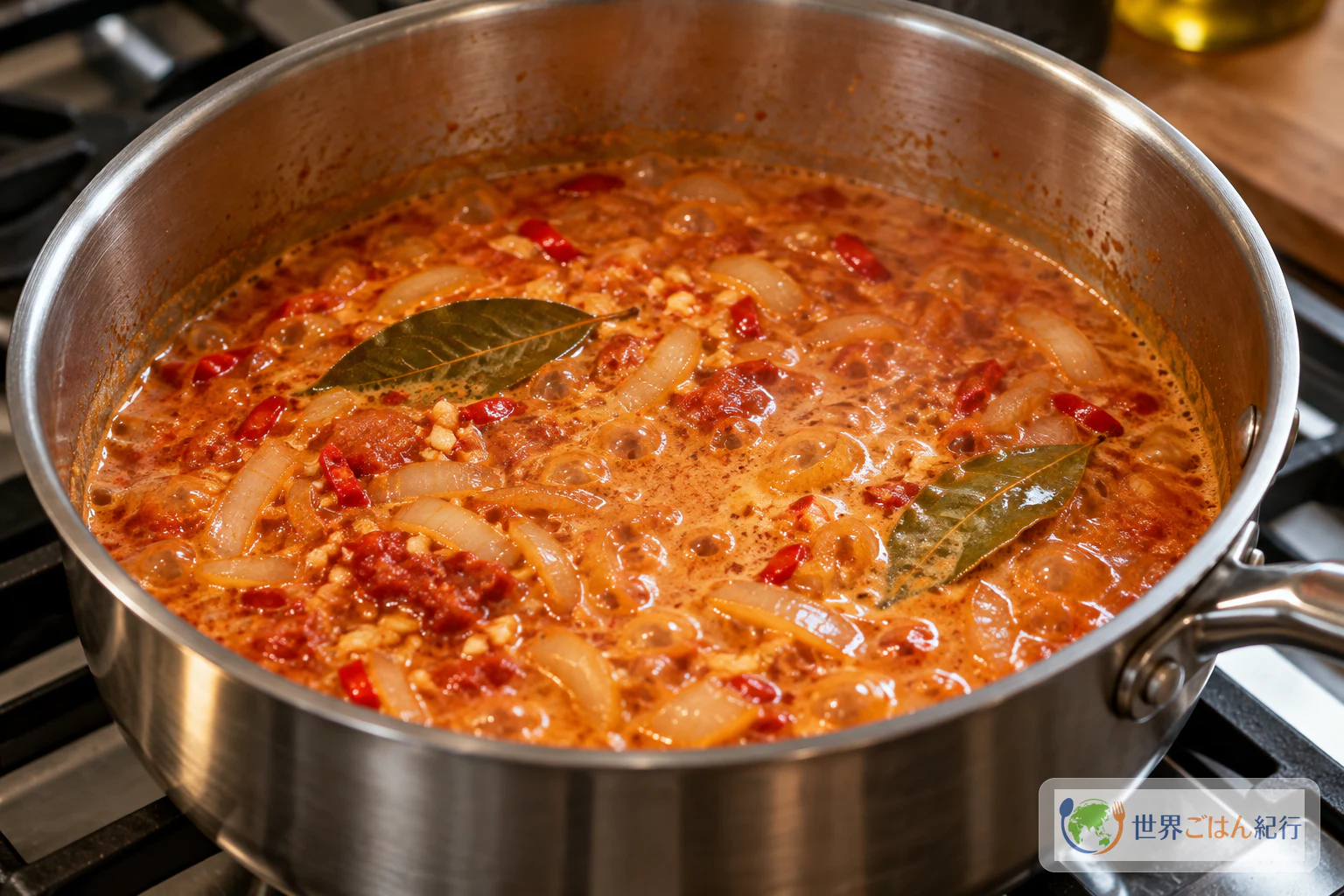
Steps 1–3 make the sauce, which is served on the side. Steps 4–5 prepare and marinate the chicken for at least 3 hours, preferably overnight. Steps 6–8 roast and finish. The sauce never goes onto the chicken during roasting.
Keep the board, containers and utensils used for raw chicken separate from those used for other foods, including the finished sauce. Wash your hands and tools after handling raw chicken. Do not use the dishes or tools that touched raw or marinated chicken for the cooked chicken, and do not mix leftover marinade into the sauce, which is served without further heating.
Troubleshooting
| Situation | What to check or do |
|---|---|
| The skin is well browned at 45 minutes but the thickest part is below 75°C | Keep roasting and recheck until the center reaches at least 75°C for 1 minute. Color is not a doneness test |
| The skin starts to tear while you apply the marinade | Lift it only slightly and work the marinade underneath; there is no need to pull the skin away from the meat |
| The sauce is still hot when you are ready to blend | Wait for it to cool first, and stay within the blender's temperature and capacity limits |
| Leftover marinade in the bowl | Discard it. Do not add it to the sauce or use it as a dip |
| The dish was hotter than you wanted | Next time, adjust the type and number of red chilies; heat varies with the chilies used |
Divide any leftovers into clean, shallow containers, cool them quickly and refrigerate. As a general guide, reheat to 75°C or above. No safe keeping period is established for this particular recipe.
Variations Within This Recipe
Chicken thighs instead of a whole bird. The source offers 8 chicken thighs as an alternative to a whole chicken. It gives no separate roasting time for them, so use the same thermometer check: at least 75°C at the center for 1 minute.
The source's serving suggestion. In the method, da Silva suggests serving the chicken with grilled tomatoes and diced potatoes boiled with turmeric. The ingredient list gives no amounts for these, so they are not part of the recipe above; treat them as a serving idea rather than something to measure from this page.
Other Macanese versions. Recipes in Macau differ. An article from the American Historical Association reproduces a separate home version from Annabel Jackson's Taste of Macau, with a different formula. It is a different recipe, so its amounts are not mixed into this one.
Where the Dish Comes From, and What Is Uncertain
Galinha Africana is known as a Macanese dish. The name is used in Macau for several different preparations, and writers describe different ways it has been served. Research on Macanese cuisine notes that several versions exist today, including ones with peanuts and tomato.
Its origin is not settled. One widely repeated account says the dish was created by Américo Ângelo, a chef at the Pousada de Macau, and another links it to travel to Portugal's African colonies. Connections to Mozambique and Goa are also discussed. Both the culinary-history research and the cookbook treat these as stories told about the dish rather than established facts, and no firm date or birthplace is given here.
Da Silva himself writes that every restaurant's recipe differs and presents his version as one attempt to recover a lost taste. Annabel Jackson's research also cautions against confusing Macanese African chicken with Galinha Piri Piri. Reading the dish as a Macanese preparation with its own history keeps it distinct from the dishes its name might suggest.
Frequently Asked Questions
Is African chicken an African dish?
No. Galinha Africana is known as a dish of Macanese cuisine in Macau. Stories link its inspiration to Portugal's African colonies, and connections to Mozambique and Goa are discussed, but these are theories, not a settled origin.
Is it the same as piri-piri chicken or Galinha Cafreal?
No. This article does not treat it as the same dish as Portuguese piri-piri chicken or Galinha Cafreal, which is described as Mozambican.
Why doesn't this recipe wash the chicken, when the source does?
Washing raw chicken can spread contamination to the sink and nearby surfaces. This article replaces the source's washing step with patting the chicken dry using clean disposable paper towels. That is an editorial change, not the original method.
Will 45 minutes at 425°F be enough?
The source gives 45 minutes as a guide, but it does not state the weight of the chicken, and ovens differ. Use a thermometer in the thickest part and make sure it reaches at least 75°C for 1 minute; roast longer if needed.
Should the sauce go on the chicken before roasting?
No. In this version the chicken is roasted with only the spiced yogurt marinade, and the peanut-coconut sauce is served separately at the table.
Does simmering the Madeira for 2 minutes remove the alcohol?
That is not guaranteed. The sauce is simmered for about 2 minutes after boiling, which does not ensure the alcohol is gone.
Can babies eat this?
Do not give it to infants under 1 year old, because the honey-roasted peanuts contain honey. Cooking does not remove that caution. The dish also contains peanuts and milk (yogurt).
Sources
- António M. Jorge da Silva, Macaense Cuisine: Origins and Evolution, International Institute of Macau, 2016, pp. 126–128 (online transcription, Macau Virtual Library). The recipe's ingredients, amounts, method, 6-serving yield and roasting instructions; the author's statement that recipes differ by restaurant; and the uncertainty of the creation story and the Mozambique / Goa links. https://www.macaudata.mo/showbook?bno=b001162
- Isaac Boqiao Yan, "Macanese Galinha à Africana – Time Traveling to Portuguese Colonial Africa from Macao," Perspectives on History, American Historical Association, 2023-07-12. The dish's place in Macau, its different serving formats, the multiple origin stories, and a separate home recipe attributed to Annabel Jackson. https://www.historians.org/perspectives-article/macanese-galinha-africana-time-traveling-to-portuguese-colonial-africa-from-macao-july-2023/
- Annabel Jackson, Classifications and Representations of Macanese Cuisine: from Domestic, doctoral thesis, Goldsmiths, University of London, 2023. The dish as Macanese, reservations about the Américo Ângelo origin story, the variety of current versions, and the distinction from Galinha Piri Piri. https://research.gold.ac.uk/id/eprint/34016/1/ICCE_thesis_JacksonA_2023.pdf
- Ministry of Health, Labour and Welfare, Japan, "Campylobacter food poisoning prevention (Q&A)" (カンピロバクター食中毒予防について(Q&A)). Heating chicken to at least 75°C at the center for 1 minute or more, avoiding raw or undercooked chicken, and separating raw-chicken tools and containers with handwashing and tool washing. https://www.mhlw.go.jp/stf/seisakunitsuite/bunya/kenkou_iryou/shokuhin/syokuchu/campylobacterqa.html
- Ministry of Health, Labour and Welfare, Japan, "Preventing food poisoning at home" (家庭での食中毒予防). Home heating to 75°C for 1 minute or more, preventing cross-contamination, cooling leftovers quickly in shallow portions, and reheating to 75°C or above as a guide. https://www.mhlw.go.jp/stf/seisakunitsuite/bunya/kenkou_iryou/shokuhin/syokuchu/01_00008.html
- Ministry of Health, Labour and Welfare, Japan, "Give honey only after age one" (ハチミツを与えるのは1歳を過ぎてから。). Not giving honey or foods containing honey to infants under 1, and that ordinary heating or cooking does not remove this caution. https://www.mhlw.go.jp/stf/seisakunitsuite/bunya/0000161461.html