
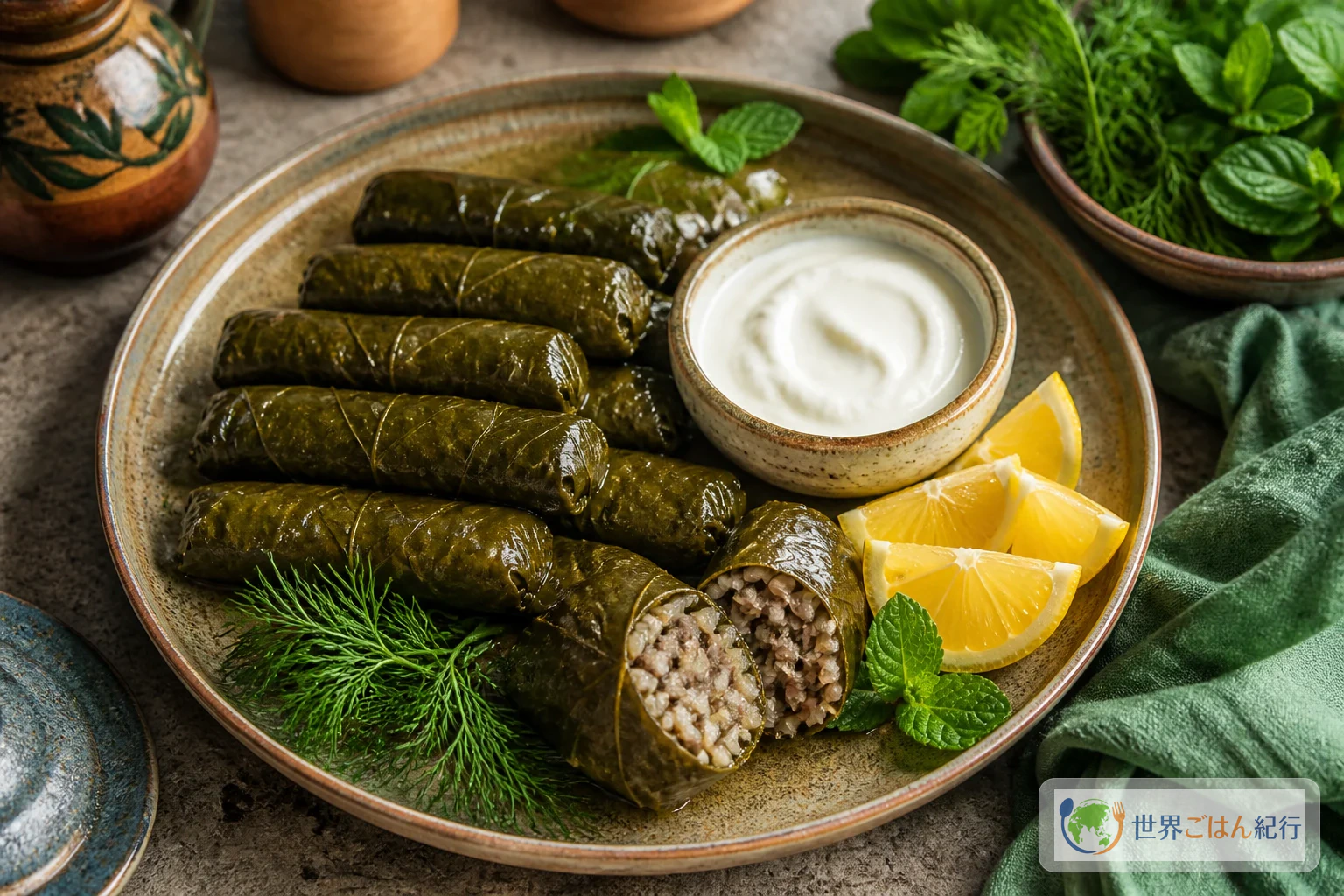
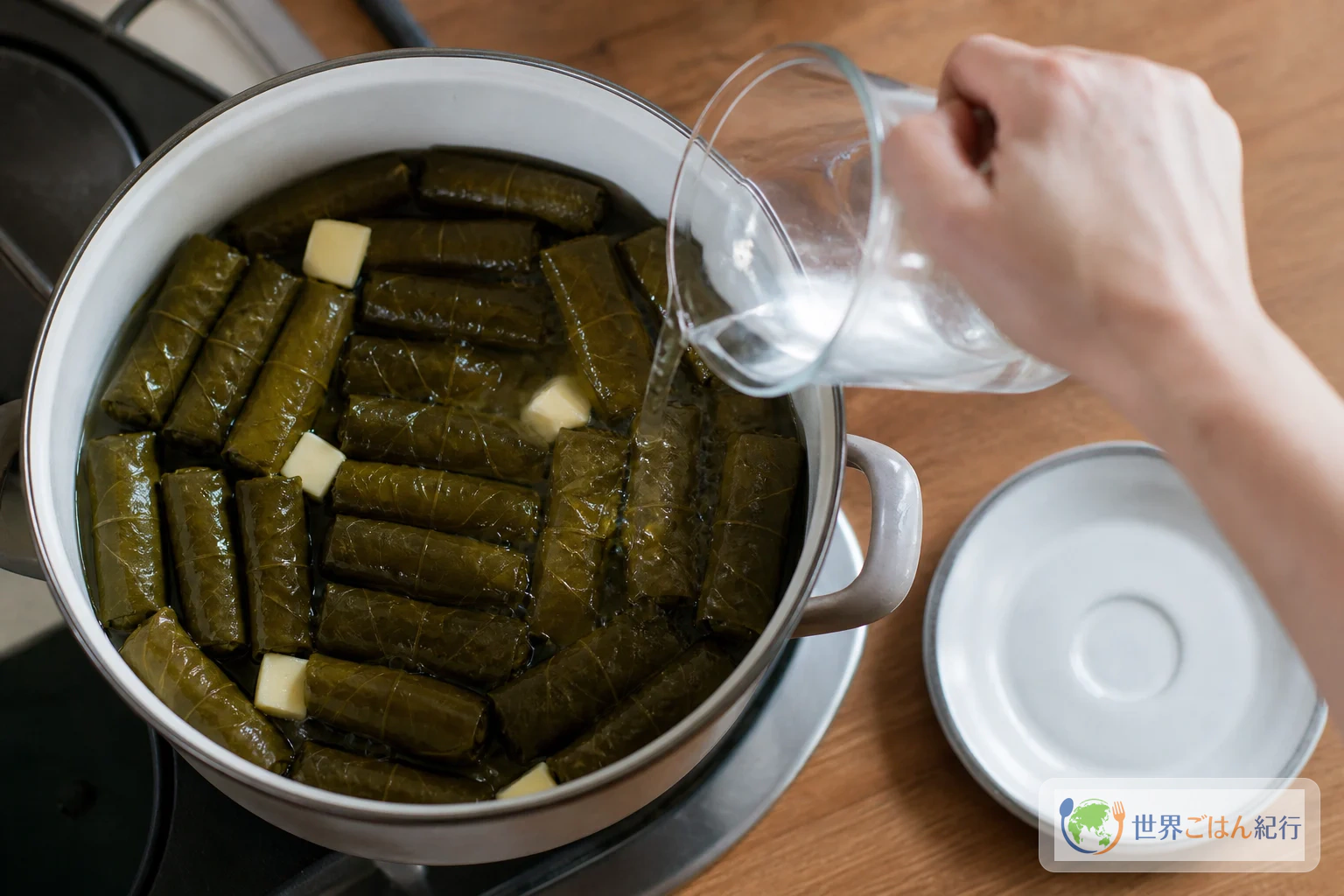
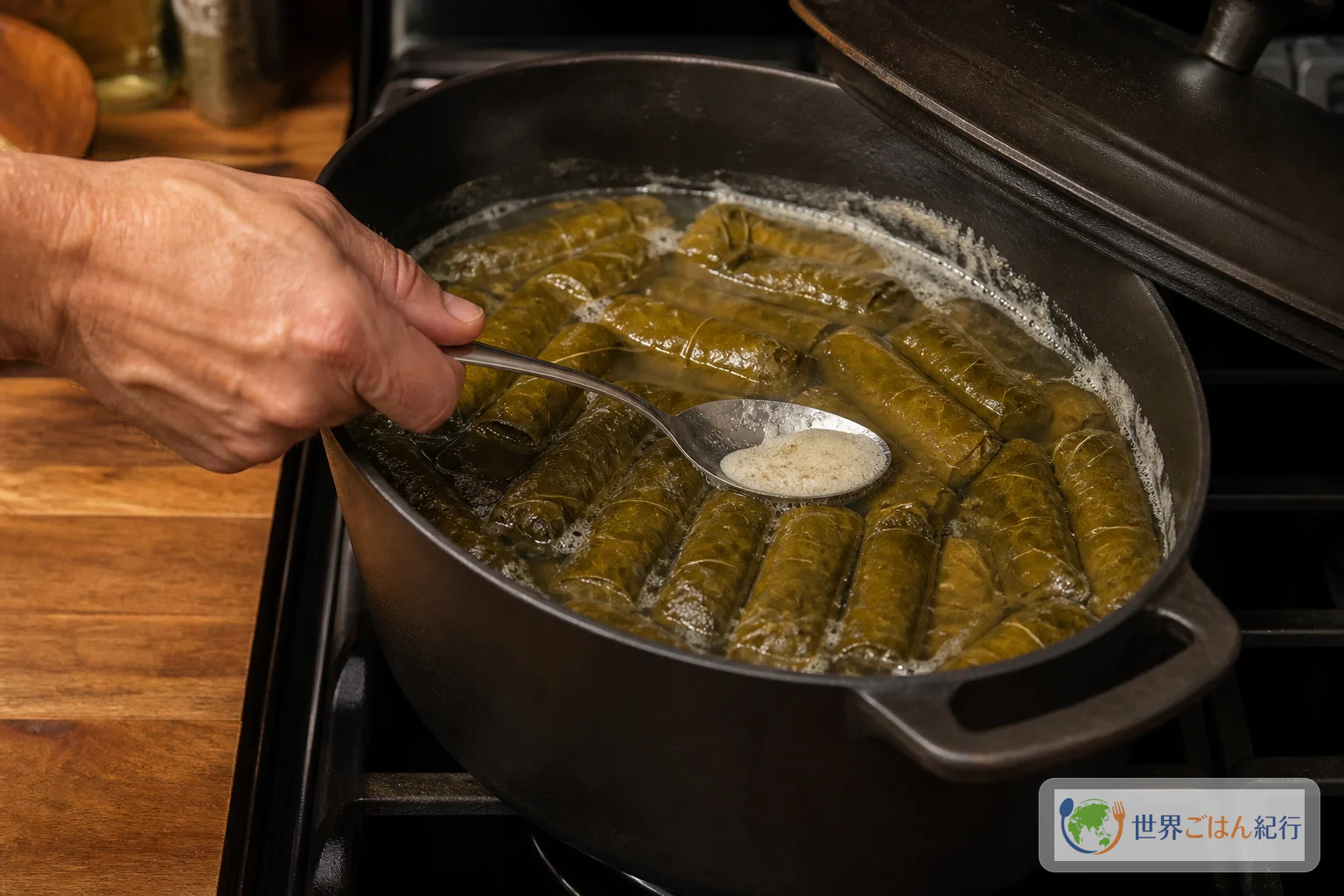
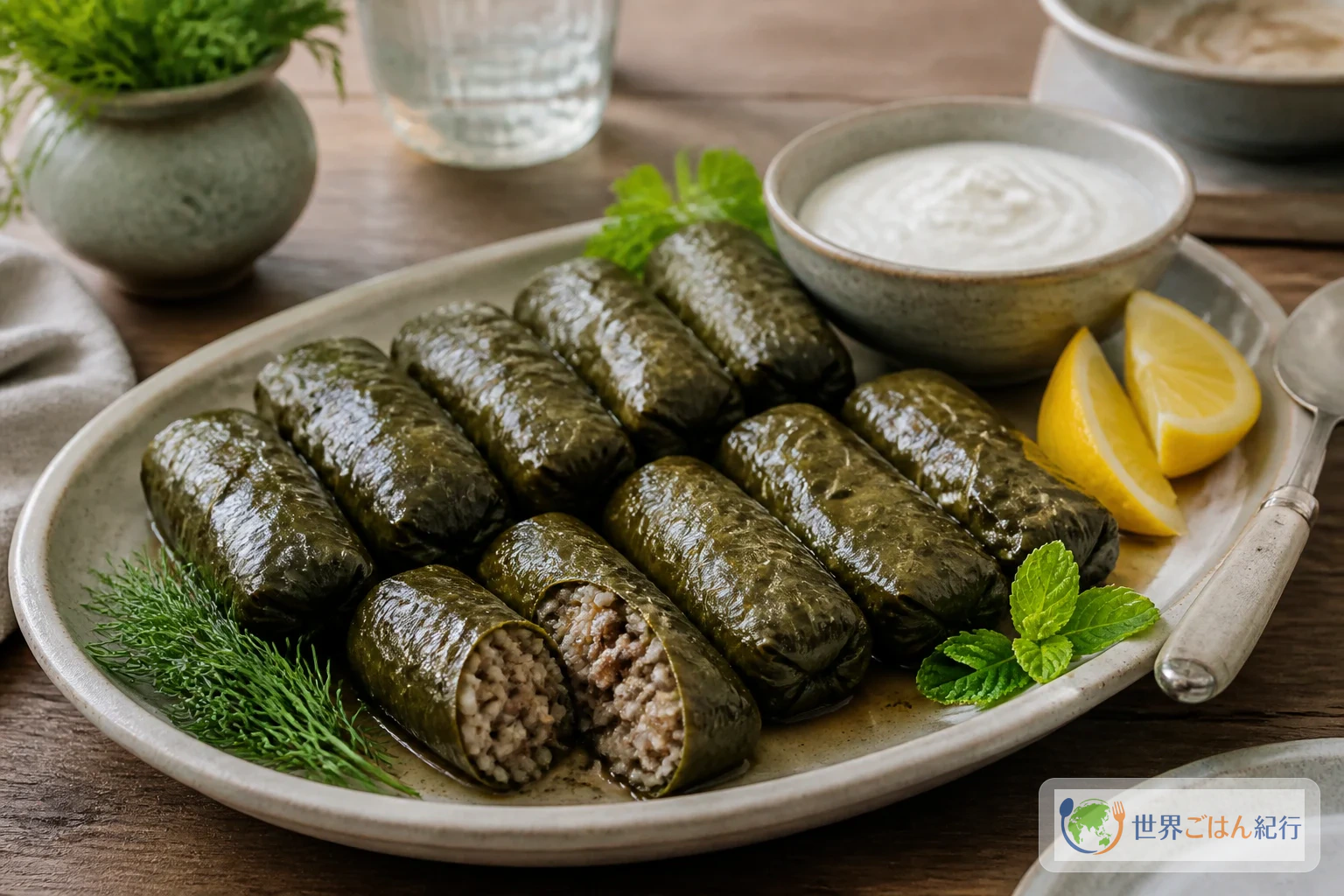
Slide the lid aside and the green scent of grape leaves reaches you first, followed by lamb fat melted into the cooking liquid. Lift a roll with chopsticks or a fork and the leaf holds, while the rice inside, soaked with meat juices, falls apart gently. Azerbaijan's yarpaq dolmasi looks like nothing more than meat and rice wrapped in a leaf, but the saltiness of the leaves, the tightness of each roll and the liquid level in the pot all change how it turns out.
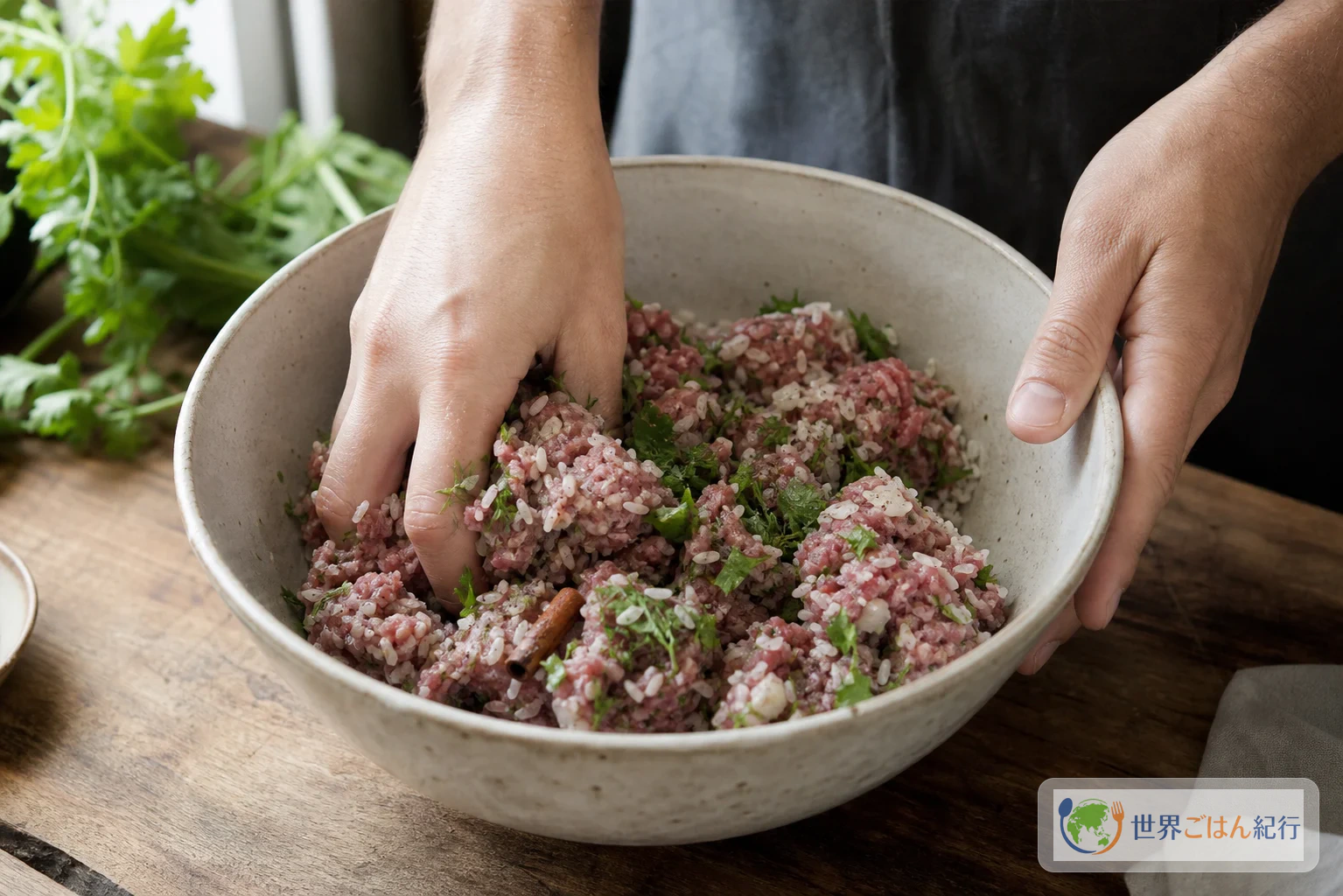
Dolma is the name for dishes in which ground meat, rice and the like are stuffed into leaves, vegetables or fruit. In the grape-leaf dolma presented by Azerbaijan's official tourism board, lamb or beef, rice, onion, cilantro, dill and mint are rolled up in leaves and simmered slowly with butter or oil and water. It doesn't lean on meaty richness alone: the green edge of the herbs and the plain yogurt served alongside balance the fat.
In 2017, UNESCO inscribed Azerbaijan's "Dolma making and sharing tradition" on the Representative List of the Intangible Cultural Heritage of Humanity. The listing doesn't prove a single origin for dolma; it recognizes how the way of making it, and the customs around sharing it, have been passed down at family and community gatherings. This recipe is written for a home cook, using jarred or brined grape leaves and simmering about 50 rolls in one pot. Ground lamb gives a deeper aroma if you can find it, but mixing in ground beef still gives you a good roll. What matters most is not desalting the leaves too much, and leaving room in each roll for the rice to swell.
Where dolma comes from, and how the leaves change by region
Azerbaijani dolma isn't limited to the grape-leaf roll. The government portal's introduction to the country's food culture also lists "three sisters" dolma, with eggplant, tomatoes and peppers stuffed together; versions wrapped in cabbage leaves; versions using sorrel, linden or quince leaves; and onions, apples or quinces stuffed whole. Which leaf and which filling go together shifts with the season, the weather, where people live and each family's habits. As for the name, UNESCO explains that it comes from a word in the Turkic languages meaning "to stuff."
| Form / name | How it differs by region or at the table | How to approach it at home |
|---|---|---|
| Yarpaq dolmasi | The basic form: meat, rice and herbs wrapped in grape leaves. The tourism board's home recipe uses this combination | With jarred leaves you can make it year-round. A good first pot |
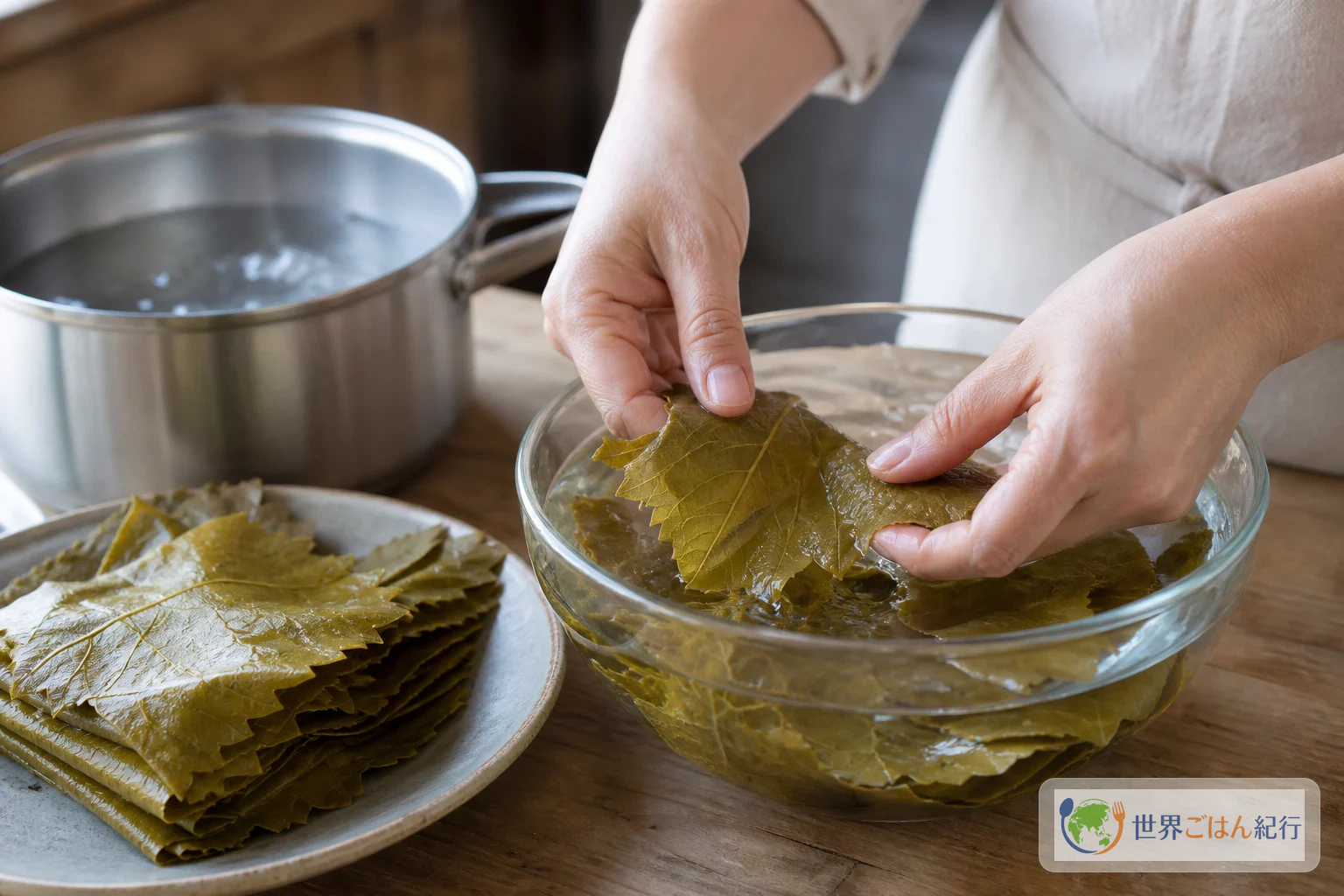
| Mil-Mughan yarpaq dolmasi | Described as using fresh leaves in summer and brined leaves in winter, with the winter leaves giving a deeper flavor | Blanch fresh leaves briefly; rinse brined leaves under running water to adjust the salt. Keep the seasonal difference through how you treat the leaves |
| Dopu dolmasi | In Shaki, dolma is presented as cooked in a clay pot called a "dopu" | No clay pot needed: a heavy pot with a tight lid and a plate on top keeps the liquid steady |
| Three sisters dolma | A vegetable version with eggplant, tomatoes and peppers stuffed side by side | It cooks differently from grape-leaf rolls. Try it next, as a separate dish |
| Dolma in cabbage, sorrel and other leaves | Leaves other than grape leaves become the wrapper depending on season and region | Cabbage has no salt and a different thickness. Change the blanching time and the amount of liquid |
What stands out in the Mil-Mughan description is treating leaves as a preserved food. Instead of waiting only for fresh summer leaves, brined leaves are carried into winter pots, giving the same dish a seasonal depth. When you use jarred leaves, don't think of them as a mere stand-in for fresh ones; treating their saltiness as part of the dish brings you closer to how it's eaten in Azerbaijan.
Shaki's dopu dolmasi is an example of the vessel itself carrying the memory of the dish. A Shaki cooking experience shows how to make dolma with grape leaves, meat, rice and herbs in a dopu. Even without a clay pot, the structure, layering the rolls, trapping the steam and simmering over low heat, carries over well to a heavy home pot.
Ingredients (serves 4, about 50 rolls)
Have 50 medium jarred or brined grape leaves ready. Leaves labeled "grape leaves" or "vine leaves" that can be opened out one at a time are the easiest to roll. If you use fresh leaves, choose young ones without tough veins, and always blanch them before using.
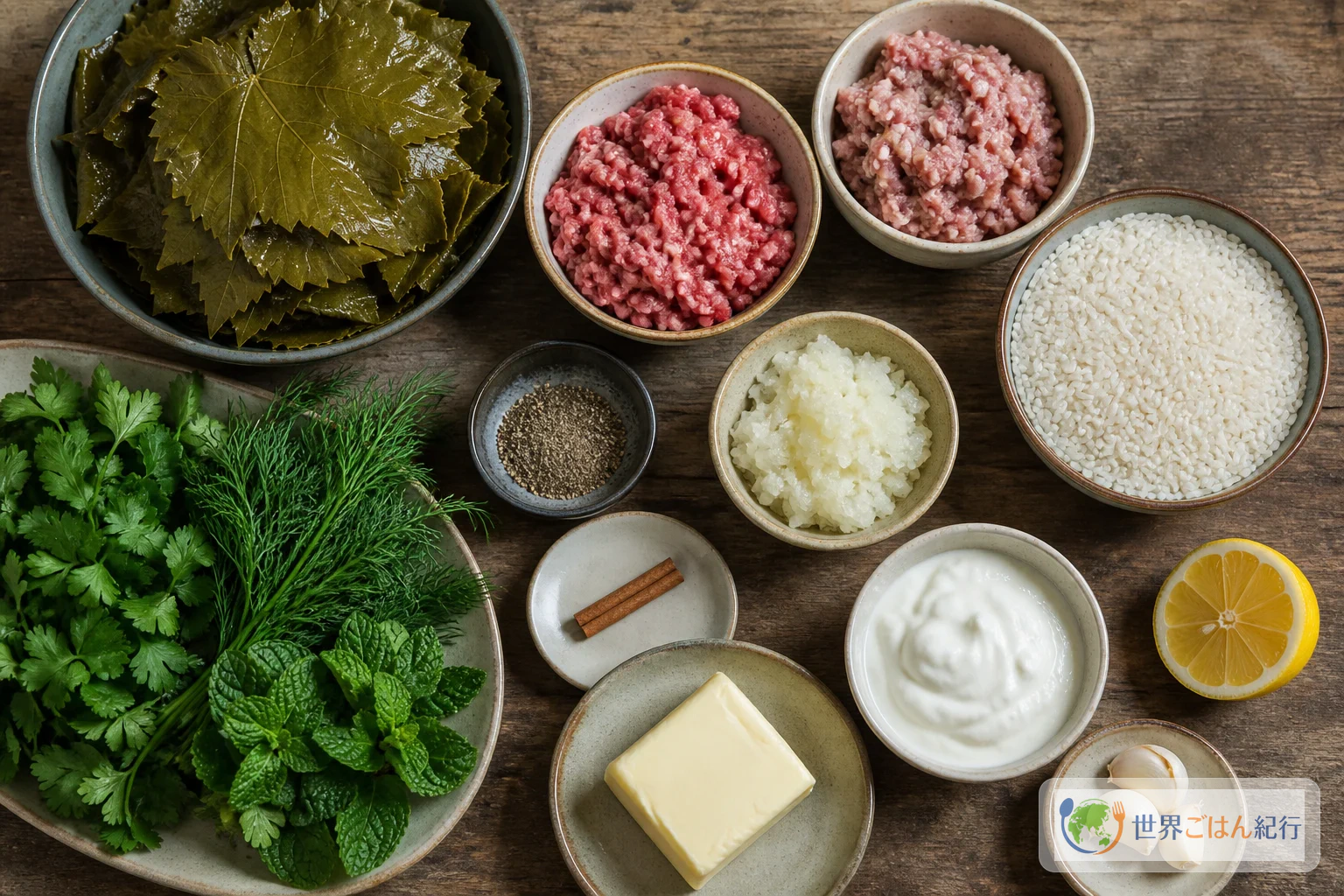
Cinnamon is one of the aromatics listed among dolma ingredients on the government portal. Since it isn't an essential ingredient in every family's version, keep it to 0.5 g the first time. If you use ground cinnamon, choose one that contains nothing but cinnamon.
Allergies and food safety
The yogurt contains dairy. Serving bread adds wheat, so if needed, skip the bread and serve just the dolma and yogurt. Keep cutting boards, bowls and utensils that touched raw meat separate from those used for serving. Cook ground meat all the way through; Japan's Ministry of Health, Labour and Welfare gives a guideline for home cooking of 75°C (167°F) at the center for at least 1 minute.
Method
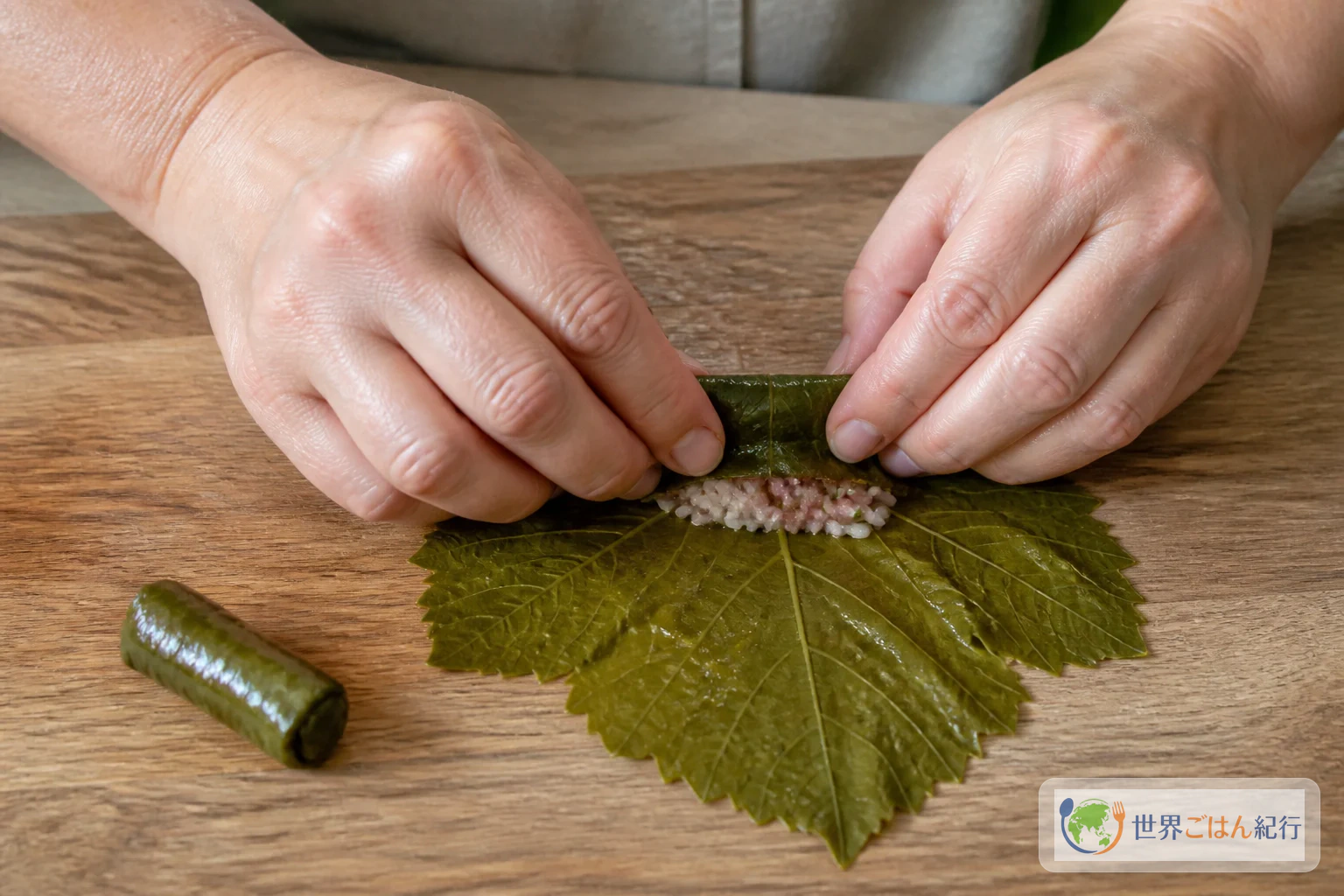
Keep some salt in the leaves, and leave a finger's width of room in each roll. Follow these two rules and the cooking liquid won't turn bland, and the rice is less likely to burst through the leaves.
4 fixes for torn leaves and hard rice
For a small tear, fold the torn part inward before rolling. Don't force a badly split leaf; wrap another leaf around the outside instead. If a roll comes undone after going into the pot, don't poke it back into shape; put the heatproof plate back on and continue on low heat for 15 minutes, and it will hold its shape better.
Most likely the rolls were overfilled, or the seam was facing up. Don't take the lid off to fix them; add 50 ml boiling water, weight them with the plate and continue on low heat for 20 minutes. Next time, reduce the filling from 15 g to 12 g and always place the seam down.
Rinsing cooked dolma with water washes away the aroma and the meat juices. Serve 50 g unsalted yogurt per person and a few drops of lemon to soften the edge of the salt. Next time, soak the leaves in water for 10 minutes and lower the salt in the filling from 6 g to 5 g.
If the rice is still hard, add 50 ml boiling water to the pot, cover and simmer over low heat for another 15 minutes. If plenty of liquid remains but the rice is still hard, the heat was probably too low: raise it for just 2 minutes until the surface bubbles gently, then return it to low.
What to put on the table, and substitutes
In the Azerbaijan tourism board's recipe, dolma is served with bread and plain or garlic yogurt. Bread is there to catch the juices, but rice-filled dolma is a meal on its own, so skip it on days when you don't want another starch. If you want more herbs, scatter just 15 g chopped cilantro and 10 g dill on the plate to add freshness without masking the filling.
Switching from lamb to beef softens the lamb-fat aroma and brings the sweetness of the meat forward. It's a practical substitute when you can't use lamb, but keeping the grape leaves, herbs and yogurt preserves the character of dolma. You can replace cilantro with parsley if you dislike it, but leaving out the dill and mint at the same time flattens the layers of aroma into one. In that case, keep the 20 g parsley and 25 g dill, and eat it with yogurt rather than adding more lemon.
On days you can't find grape leaves, you can use the outer leaves of a cabbage, boiled for 2 minutes with the thick ribs shaved down. Cabbage leaves are thicker and lack the tang of brined leaves, though, so make about 20 larger rolls and start checking the leaves' tenderness at 70 minutes of simmering. This isn't a perfect replica of grape-leaf dolma; it's a way of bringing the same structure, filling wrapped in leaves and cooked in a pot, into a home kitchen.
If you buy whole cinnamon and black pepper, breaking them by hand is enough for the amounts here. There's no need to buy a spice grinder just to make dolma once. If you also use whole spices in meat dishes, bean dishes and baked goods, a grinder that handles whole spices and has a removable, washable container is easy to work with.
Azerbaijani dishes for a dolma day
Part of what makes dolma interesting is that its food culture doesn't end with what's inside the leaf. UNESCO's listing explains that the skill of making it and the act of sharing it have been passed down within families and communities, and that, as a dish for special occasions and gatherings, it has been tied to hospitality and solidarity. Rather than rushing to finish one portion, see it as a dish made together: one person opening the leaves, another placing the filling, another packing the rolls into the pot. Then the number 50 starts to make sense.
The range of dolma presented on the government portal also keeps it from becoming one fixed recipe. Some days the tang and salt of grape leaves take center stage; other days the sweetness of vegetables or the seasonality of the leaves does. Start with yarpaq dolmasi from this recipe, then move on to piti (in Japanese), known as Shaki's pot stew; lula kebab (in Japanese), meat shaped around skewers; and qutab (in Japanese), herbs and fillings wrapped in thin dough. You'll see how the same country's table changes with the vessel and the way the fire is used.
FAQ
Q1. How much should I desalt jarred grape leaves?
After rinsing them twice under running water, taste one; if the leaf's salt isn't strong enough to clash with the salt in the filling, it's ready to use. Only soak them in water for 10 minutes if they're still too salty. Leaving them in water too long also washes out their aroma, so decide by taste rather than by a fixed time.
Q2. Can I make it with only ground beef if I don't have lamb?
Yes, with 500 g ground beef. Very lean beef tends to turn firm when cooked, so if yours is lean, add 10 g beef suet. Switching to pork changes both the fat and the cultural basis of the dish, so if you want to make it as Azerbaijani dolma, beef is the easier choice.
Q3. I don't like cinnamon or mint. Can I leave them out?
You can use 0 g cinnamon. Leaving out the 15 g mint makes the aroma lighter, but with 30 g cilantro and 25 g dill still in, the filling works. Rather than dropping all three herbs at once, leave out only the one you dislike and adjust the strength of the herbs with yogurt.
Q4. How should I store and reheat leftover dolma?
Don't leave leftovers sitting in the pot at room temperature; transfer them to clean, shallow containers in single portions and cool them quickly. Don't keep refrigerated dolma for long either; eat it as soon as you can. To reheat, arrange the rolls in a heatproof dish, add 2 tbsp of the cooking liquid or water, cover, and heat until the center reaches at least 75°C (167°F). If anything seems off in smell, sliminess or taste, throw it away.
Q5. If I use cabbage instead of grape leaves, does it cook in the same time?
No. Blanch the leaves for 2 minutes until they bend easily, then simmer about 20 rolls for 70 minutes and check. Cabbage is thicker than grape leaves, so even if the center of the filling has reached 75°C (167°F), the leaves may still have some bite. Don't scale up to 50 at once; making a small batch makes it easier to adjust the liquid and heat.
Sources
- UNESCO, “Dolma making and sharing tradition, a marker of cultural identity” https://ich.unesco.org/en/RL/dolma-making-and-sharing-tradition-a-marker-of-cultural-identity-01188 (accessed and checked 26 August 2026, JST)
- Azerbaijan Travel, “Dolma” https://azerbaijan.travel/dolma (accessed and checked 26 August 2026, JST)
- Azerbaijan.az, “Stuffed grape leaves” https://azerbaijan.az/en/related-information/288 (accessed and checked 26 August 2026, JST)
- Azerbaijan Travel, “Culinary traditions of the Mil-Mughan region” https://azerbaijan.travel/culinary-traditions-of-the-mil-mughan-region (accessed and checked 26 August 2026, JST)
- Azerbaijan Travel, “Culinary masterclasses: dolma” https://azerbaijan.travel/culinary-masterclasses-dolma (accessed and checked 26 August 2026, JST)
- 厚生労働省「家庭でできる食中毒予防の6つのポイント」 https://www.mhlw.go.jp/stf/seisakunitsuite/bunya/kenkou_iryou/shokuhin/syokuchu/01_00006.html (accessed and checked 26 August 2026, JST)


