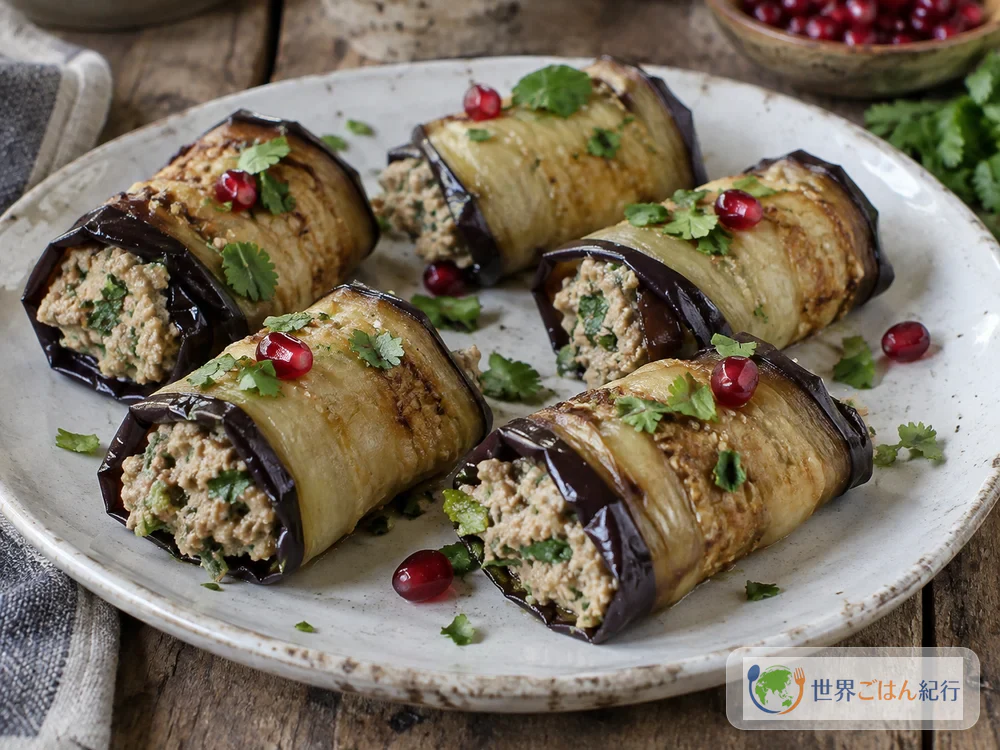
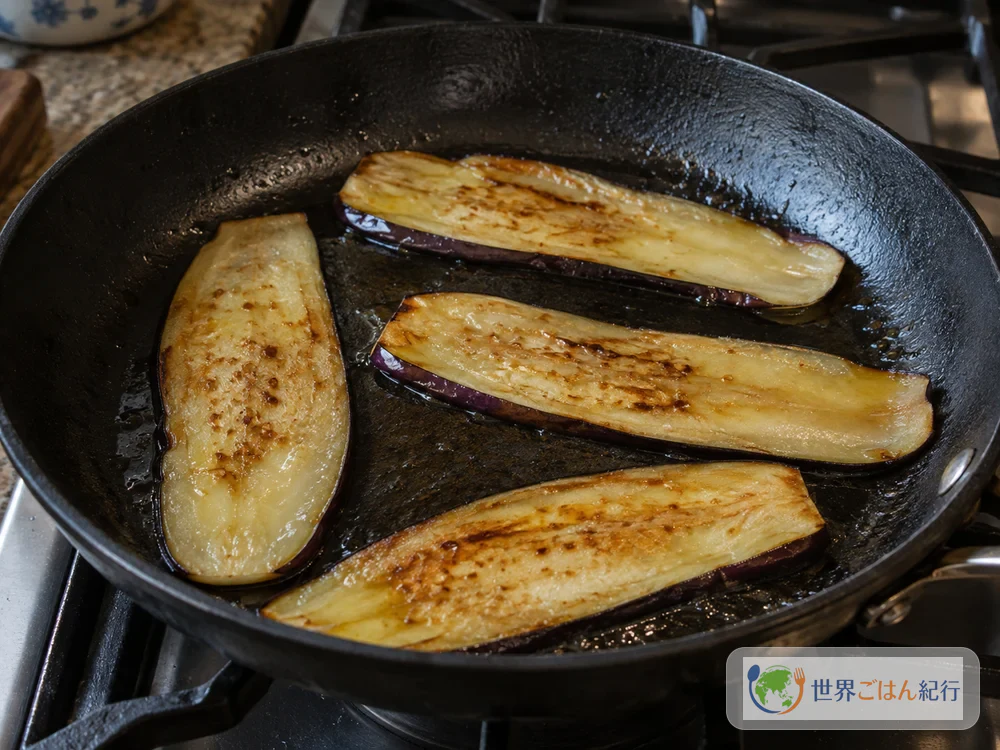
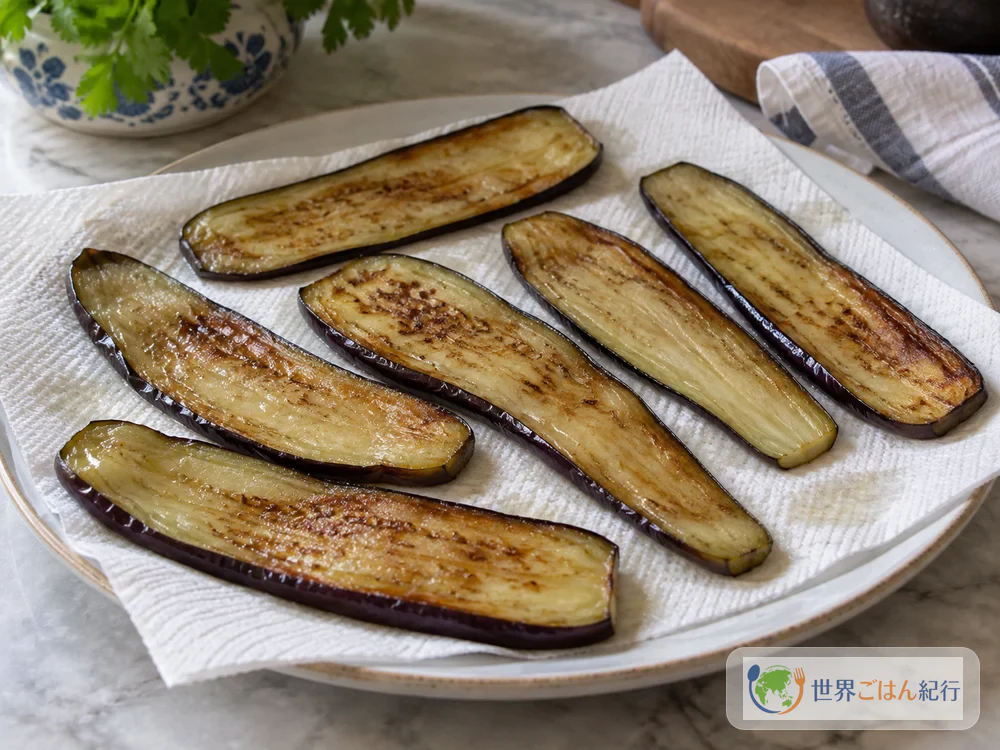
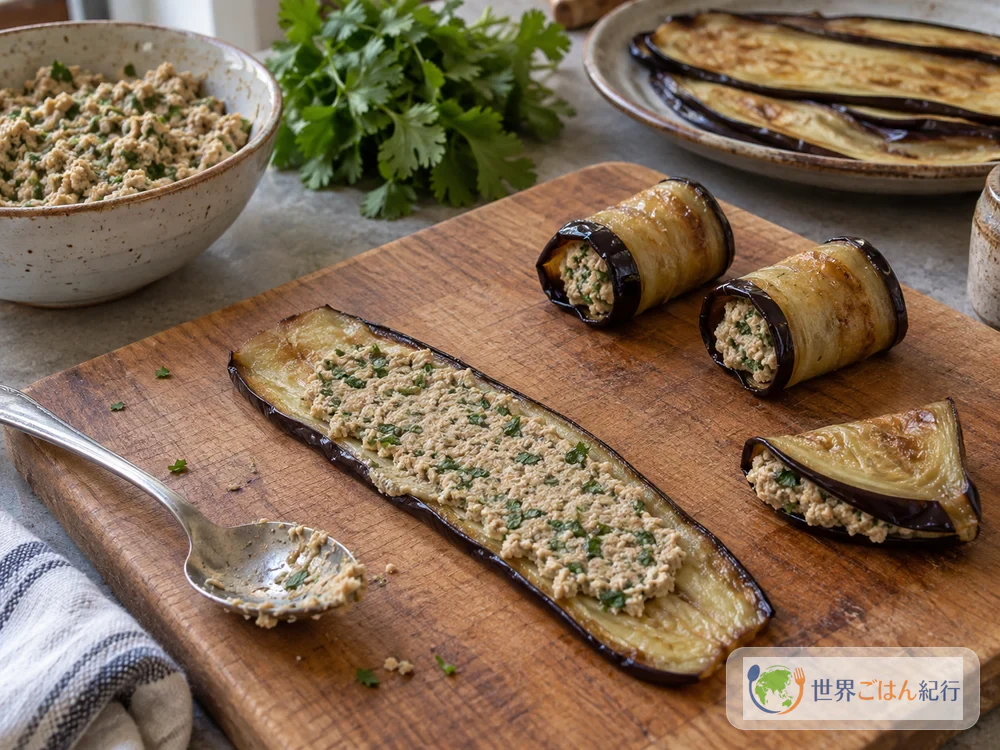
A summer home kitchen: lengthwise slices of eggplant sizzle in the oil and turn golden, while walnuts grind in a mortar beside them with a rough scrape. Add the garlic and vinegar, and the scent of the paste rises. Badrijani nigvzit (ბადრიჯანი ნიგვზით), eggplant rolls with walnuts, is a favorite summer appetizer in Georgia: fried eggplant, soft all the way through, wrapped around a spiced walnut paste thick enough to stay put. Pomegranate seeds cut through the richness of walnut, garlic and vinegar. It is served chilled, so you can make it well ahead of mealtime.
Badrijani nigvzit on the Georgian table
In Georgia, this eggplant dish is a home dish and a summer appetizer, served as one of several dishes in a meal. Picture a table with bread, other vegetable dishes and many small plates, where the cold eggplant is one plate on the table. Bite in, and behind the soft eggplant come the aromas of finely crushed walnut, garlic and vinegar, one after another.
The dish is just eggplant, walnuts and vegetable oil, with no meat, fish, egg or dairy. On Lenten tables it is stretched into a meal with salad and potatoes.
The look and flavor shift by region. In a seasonal blend from Imereti in the west, the aroma of fresh coriander is prized. Some versions put onion or green chili in the walnut paste, and some use fresh herbs while others lean on dried spices. At home, keep the leaves sold as cilantro and the ground coriander made from the seeds as two separate ingredients: using leaf and seed separately is the foundation of this dish's aroma.
You'll find other cold walnut appetizers at the same table. In spinach pkhali (in Japanese), chopped vegetables and walnuts are mixed together instead of the vegetable wrapping the paste, so the method and amounts differ.
Ingredients (serves 4)
This is a home blend adjusted to 1 lb (500 g) edible eggplant and 5.5 oz (150 g) walnuts. The number of rolls depends on their size, so don't aim for a set count; think of it as an appetizer for four to share. It is a four-person amount set by weight. Don't put in all the oil at once; divide it among the frying rounds.
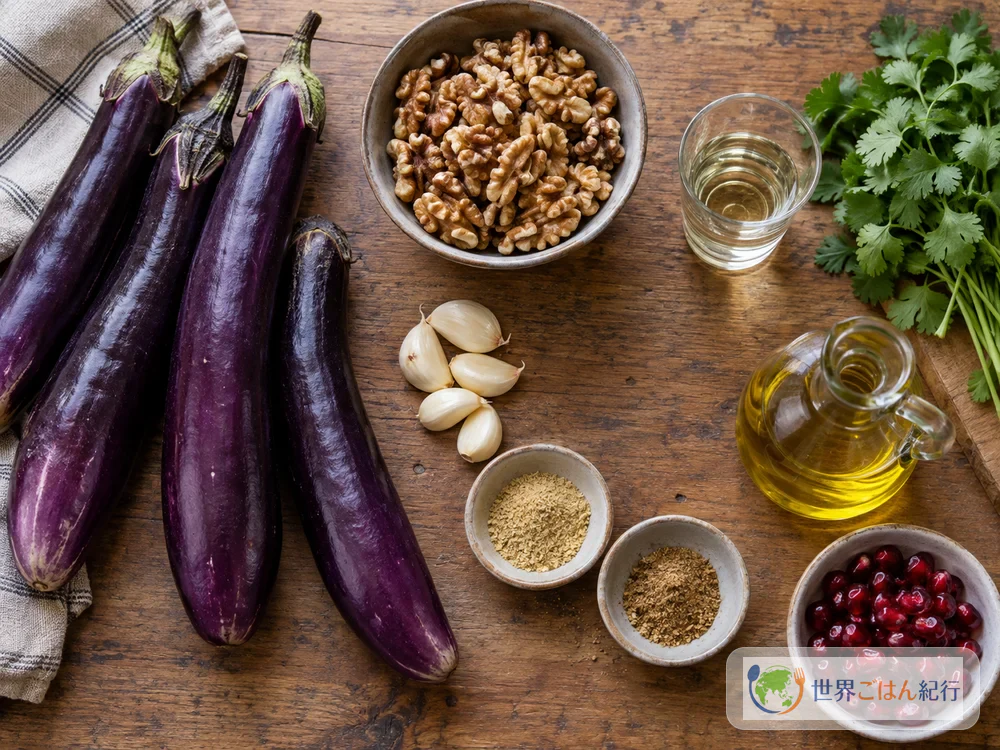
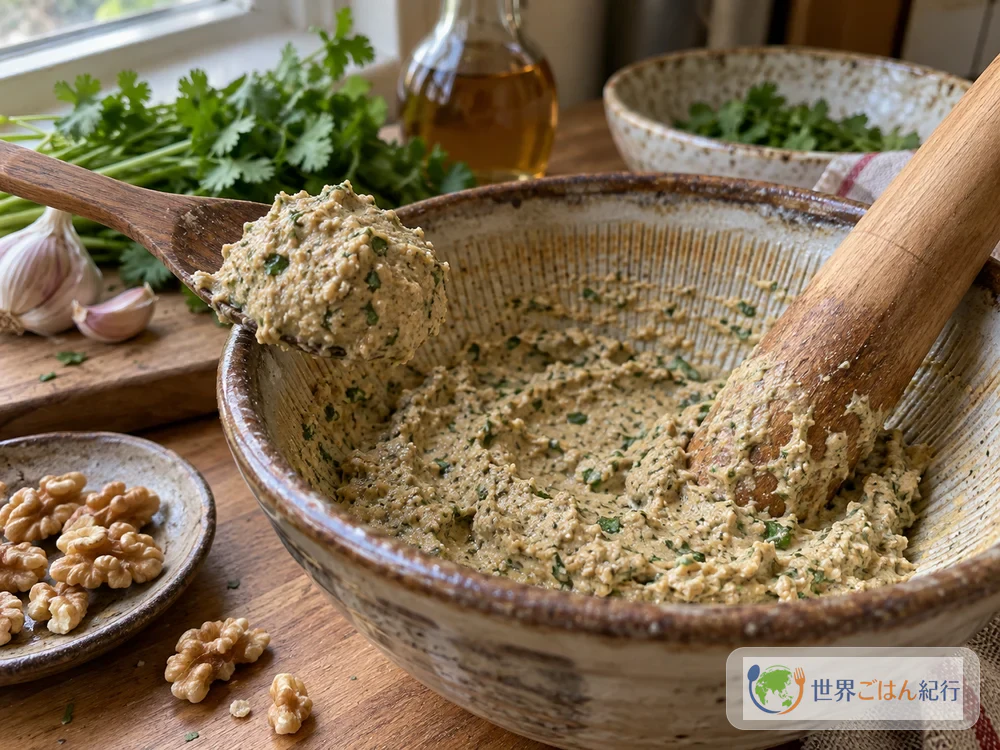
Start with 3 tbsp (45 ml) water. Measure up to 1 tbsp (15 ml) extra separately and add water 1 tsp (5 ml) at a time. The aim is a paste you can spread with a spoon that doesn't run off the eggplant. How it comes together depends on how finely you grind the walnuts and how much vinegar you add, so don't put in all the water at once. Even if you skip the pomegranate, keep the vinegar in the paste. A mortar and pestle is enough. A food processor works for a large batch, but for this amount it isn't needed.
Choosing eggplant, walnuts and spices
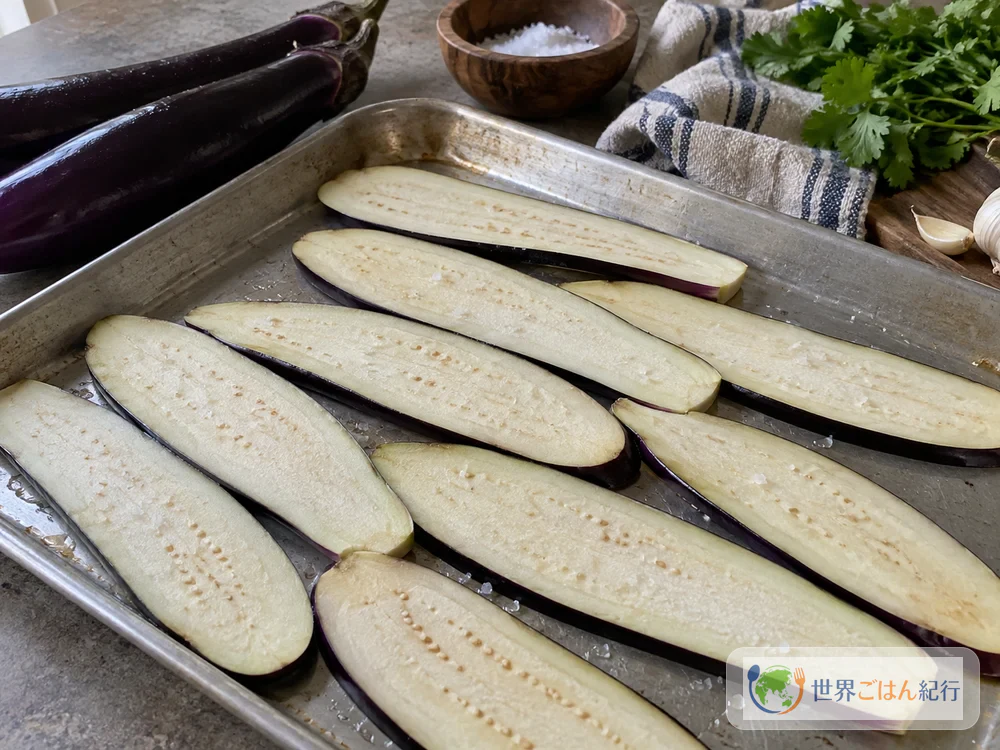
Long, slender eggplants are the easiest to roll, but ordinary eggplant works too if you can cut it lengthwise into slices about 0.25 inch (5 mm) thick. Thicker slices take a long time to soften; thinner ones get holes or tear. Since the number of slices depends on size, go by weight, not count. A large round eggplant makes wide slabs, so after frying, divide them across the width or fold them in half.
For the walnuts, use unsalted, unflavored roasted ones. Whole or broken pieces are both fine, since they get ground fine for the paste. Salted or sugared snack nuts would throw off the seasoning, and roasting them further or scorching them changes the aroma.
Blue fenugreek, called utskho suneli (უცხო სუნელი) locally, meaning "foreign spice," is made from ground seeds and pods. Some recipes use it, while others use a mix with ordinary fenugreek, which smells different. This recipe uses 1/4 tsp ordinary fenugreek powder; if you have blue fenugreek powder, use 1 tsp of that instead, not both. When ordering online, check the type and the powder labeling: powder or seeds, blue or ordinary. Whole spices need to be ground fine in a mortar or spice mill before they go in.
Look for ground coriander and fenugreek by their generic names in the spice aisle or at online spice sellers. Choose ground coriander made from the seeds; fresh cilantro leaves can't replace the powder in the same amount. If blue fenugreek is hard to find, the blend with a small amount of ordinary powder works well.
Some local walnut dishes also add dried, ground petals of edible marigold. Here, the paste is simply walnuts, garlic, two spices and vinegar.
Method
While the eggplant salts, make the walnut paste. Frying takes about 25 minutes in 2 to 3 batches in a skillet around 10 inches (26 cm). Time depends on the number of slices and their thickness, so check that the center is soft at the end of each round. Don't take them out by color alone. Checking the browning and the softness is the key to this dish.
If the paste pushes out at the end of the roll, don't push it back in. Open it up, remove some, and spread it thin again. With short eggplants, switch to folding in two. Don't slice the eggplant too thin to get more turns of the spiral. Put the eggplant's softness and the paste staying on it ahead of the shape.
Wipe the liquid left after salting off both sides well. Don't heat the oil until it smokes. Don't toss the eggplant in from a distance; set it gently on the surface of the pan. Don't pour water into the pan while hot oil is in it. When you move on to cooling the eggplant, turn off the heat and set the hot pan somewhere stable.
Fixing a loose paste or hard eggplant
Before rolling, you can still easily adjust both the paste and the eggplant. Check separately before wrapping: does the eggplant bend, and does a mound of paste hold its shape on the spoon? That way you can tell the causes apart. If the center of the eggplant is still white and hard, fry it 1 to 2 more minutes per side over lower than medium heat until the center is soft.
| Problem | Likely reason | How to fix it on the spot |
|---|---|---|
| The paste runs and falls off the eggplant | Water added all at once, walnuts coarse | Wait 5 minutes and check. If it still runs, finely grind 10 g more unsalted walnuts and mix in |
| The paste is crumbly and won't spread | Not enough water, large walnut grains | Grind further, then add water 1 tsp (5 ml) at a time, up to 1 tbsp (15 ml) extra |
| The eggplant is oily | Added a lot of oil while frying | Lightly press the surface with fresh paper towels rather than thinning the paste with vinegar |
| It tears when rolled | Too thin, too much paste | Fold one intact slice in two. Serve torn ones with paste layered on the plate instead of rerolling |
| The garlic is strong | Amount of raw garlic and individual variation | Next time reduce from 6 g to 3 g; chilling won't remove the bite |
When the paste is stiff, add water, not vinegar, 1 tsp (5 ml) at a time. Adjust acidity and thickness separately, so they don't rise and fall together. Rice vinegar smells different from white wine vinegar, but at 1.5 tbsp (20 ml) it works as a home substitute. Adjust the salt after tasting the fried eggplant and the paste together.
Serving badrijani nigvzit and variations
Serving and pairing
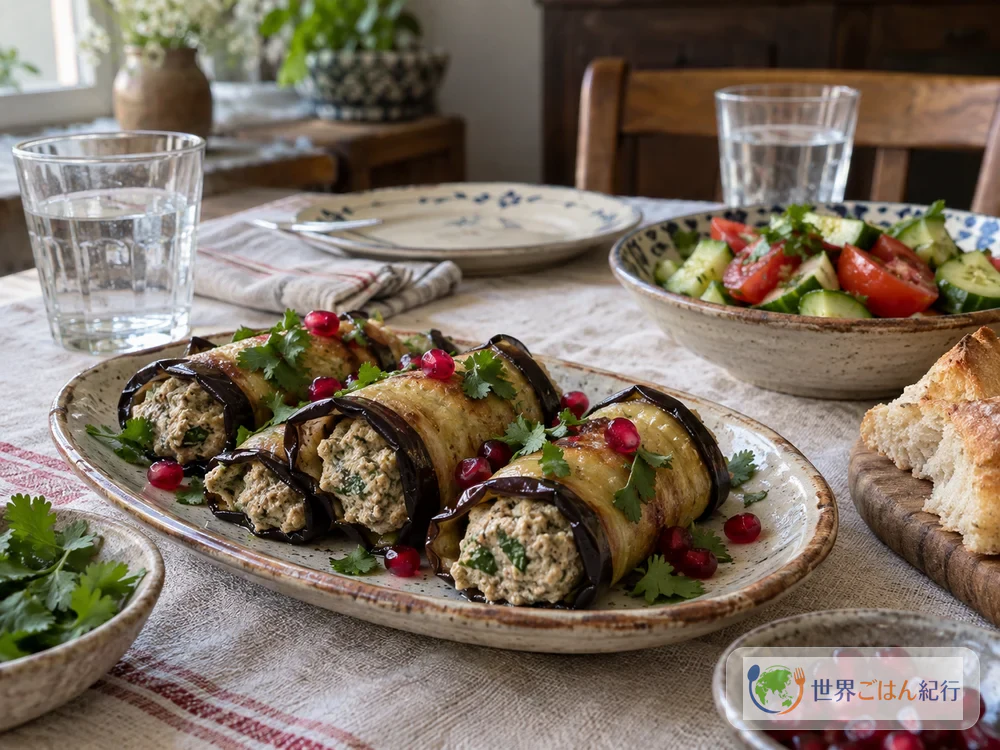
Serve the rolls as a cold appetizer alongside warm dishes and bread; a cold appetizer and a warm plate side by side give the meal a pleasant rise and fall in temperature. With fat from the walnuts and the frying oil, this isn't a light vegetable-only dish, so share it with a sour small dish and a staple. For a warm bean dish to go with it, try lobio, the red bean stew (in Japanese).
When plating, scatter just a little pomegranate rather than mixing it through. Go for a presentation where the eggplant shows: the paste wrapped inside, with the red of the seeds and the green of the herbs on top.
Shapes and flavor variations
Spread the eggplant with walnut paste, then fold it in half or roll it up. Small late-autumn eggplants can also be fried whole. Don't worry if the spiral isn't neat; it still makes a good dish. With short eggplants, folding in half is the easier shape.
Folding suits short eggplants and rolling suits long slabs; whatever the shape, the combination of eggplant and walnuts stays the same.
| The plate you want to make | Change for four servings | What changes |
|---|---|---|
| Short eggplant folded in half | Ingredients as they are. Spread the paste on half and fold | No seam to make, easy to keep it thin |
| More herbs | Cilantro in the paste from 10 g to 20 g | Adds leaf aroma |
| Add mint | Add 3 g chopped mint to the paste's 10 g cilantro | Adds a fresh note that differs from the basic blend |
| Swap in lemon sourness | Replace 1.5 tbsp (20 ml) white wine vinegar with 1.5 tbsp (20 ml) lemon juice | Changes to a citrus aroma. Check the thickness starting from 3 tbsp (45 ml) water |
| Make it with parsley | Parsley instead of 10 g cilantro in the paste, 3 g parsley for garnish | For people who avoid cilantro; the aroma differs from the local one |
Whole eggplants can also be baked soft in the oven, peeled, drained and mashed into the walnut paste. Without the rolling, the mixed form is a different plate with a different texture, and the frying times for sliced eggplant don't carry over to the oven.
Nutrition
The nutrition values cover only three ingredients: 1 lb (500 g) edible eggplant, 5.5 oz (150 g) roasted walnuts and 2 oz (60 g) vegetable oil. For the whole batch: 1691 kcal, protein 27.4 g, fat 6 oz (163.7 g), carbohydrate 1.5 oz (43.1 g), fiber 22.3 g. One serving is a quarter of the whole, about 423 kcal. This is an approximation from the three base ingredients; garlic, vinegar, herbs, spices and pomegranate aren't counted.
The oil figure uses blended oil and assumes all 2 oz (60 g) is eaten, though some stays on the pan and paper. Walnut and oil amounts strongly affect the fat and energy figures, and substitutes or extra walnuts change them too. Staple and main are calculated separately, so bread and a main dish aren't included.
Frequently asked questions
Can I make it a day ahead and refrigerate it?
Yes. Cool the cooked eggplant spread out in a shallow layer, then put the assembled rolls in a clean covered container in a refrigerator at 0 to 5°C (32 to 41°F). Refrigerate within 2 hours of cooking. Eat within 48 hours of refrigerating, and bring to the table only what you will eat. The vinegar doesn't make it safe at room temperature, and the overall 2 hours 15 minutes includes 60 minutes in the refrigerator, not on the counter.
Can I freeze it and keep the rolled shape?
Freezing changes the moisture and shape of the eggplant, so the texture won't match a fresh batch; it's better to make an amount you can finish from the refrigerator. If you do freeze it, divide into portions after cooking, cool, then seal and freeze promptly. Thaw in the refrigerator and eat within 24 hours once fully thawed.
Can I make it without fenugreek?
You can, but the spice aroma will differ from the basic blend, and doubling the coriander won't make up for it. For easy shopping, the blend with 1/4 tsp ordinary fenugreek powder is the place to start.
Can I swap the walnuts for another nut?
Trying another nut for flavor and cooking safely for someone with a walnut allergy are entirely different matters. For someone who can't eat walnuts, another nut or sesame may not be safe either: ask what they can eat and choose a different dish. Check labels, utensils and even garnish ingredients, and never serve the same eggplant with only the walnut paste removed.
This dish uses walnuts. Don't serve it to someone with a walnut allergy. Cooking at home doesn't remove the allergy risk, and swapping in other nuts or sesame isn't safe. Ask the person what they can eat, and prepare a different dish if needed. Wash a mortar, pestle or work surface that has handled walnuts so no traces remain before using it for someone with an allergy. Check the ingredient and precautionary labels on products too.
Serve with clean utensils, and don't return leftovers from the serving plate to the storage container. Don't store it in a way that lets it sit at room temperature to meld the flavors. Take out only what you will eat, and keep it at the refrigeration temperature and time. A plant-based or vinegar-containing dish still needs refrigeration.