


Add the Eggs Once the Tomato Moisture Is Gone
Picture it: early evening, onion softly sizzling at the bottom of the pan, a sweet smell rising from red and green peppers. Just after the tomatoes go in, the pan is like a red soup. You want to add the eggs, but it is too soon. Run a wooden spoon across the pan, and when water no longer flows back over the bottom, add the cheese and eggs. That is when mish-mash turns from "scrambled eggs with vegetables" into a moist, composed dish.
Add the eggs only once the red juices have become a sauce. That is the first judgment to learn when making mish-mash.
Mish-mash (Миш-маш in Bulgarian) is a Bulgarian home dish of tomato, pepper, onion, white salty cheese, and egg. The Plovdiv University introduction to Bulgarian food lists this combination as a popular summer dish. English-language recipes present it variously as breakfast, lunch, a main, or a side, so when it is eaten and how it is plated are not fixed.
196 flavors and Travel Food Atlas both give a version with roasted peppers and one with peppers simmered raw. Even under the same name, the pan looks different depending on whether you bring forward the roasted aroma or keep the green note.
What to protect in a home kitchen is not more ingredients but the order. Soften the peppers and tomatoes first, cook down the liquid, check the saltiness of the cheese, then add the egg. Push through at high heat to the end and the egg turns crumbly; stop too early and red water collects at the bottom of the plate. Roast only the red ones or not, buy feta or not, use the pan you already have: there are not many places to hesitate.
In English too, "mish-mash" is explained as something close to "a jumble of things." Travel Food Atlas does not pin down the dish's origin either. We do not assert an origin from the sound of the name alone, and treat it as a dish with room for each household's proportions.
Ingredients and Substitutes (serves 4)

The authentic white salty cheese is sirene. "Bulgarsko byalo salamureno sirene" entered the EU's PDO (Protected Designation of Origin) register in 2023, and the official specification defines it as a cheese ripened in brine from fermented milk. The texture when heated and its use in mish-mash are also given in the specification.
Sirene and feta play a similar role, but they are not the same cheese. If you cannot find sirene, use a salty feta. Cheeses that differ in moisture and saltiness, such as cream cheese or mozzarella, blur the dish's outline.
Vegetables and eggs
The tip is not to decide the salt first. The saltiness of sirene and feta varies greatly by product, and salt added while sauteing the vegetables cannot be taken back. Season a little stronger if serving with bread, lighter if eating it on its own, and you can adjust at the end.
Shopping Notes: Cheese, Paprika, Pan
Onion, tomatoes, peppers, and eggs can all come from the supermarket. What is worth hunting for elsewhere is the salty cheese that is hard to find nearby and a spice to help with out-of-season peppers. For equipment, if you already have a heavy frying pan, buy nothing more.
If you need white cheese, add feta
What is worth buying is the saltiness and texture that are hard to substitute. It is not sirene itself, but a white feta ripened in brine brings you close to the saltiness and the crumbly way it breaks up when mixed with eggs and vegetables. If you already have a salty white cheese at home in sufficient quantity, there is no need to buy more. When shopping, first check that it is a 200 g pack and a refrigerated product.
Use paprika as an aroma helper
If red peppers are in season and fragrant and sweet, you do not need paprika powder. Use 1/2 tsp only when making it in winter with imported peppers, or when you want to bring the red aroma slightly forward over the vegetable aroma. If you buy it, choose a sweet one; smoked paprika leans toward a different dish, so skip it the first time. Check that it is plain paprika powder rather than smoked.
Use the frying pan you have
Mish-mash cooks off the moisture of the vegetables, so a pan with a thick bottom is less likely to deliver sudden heat. But no special tool is needed. With a pan around 26 cm you can go from onion to egg in one pan. If you only have a small pan, do not stack the vegetables too deeply; cook down in two batches.
Method: Roast, Cook Down, and Stop the Eggs at the End
For peppers there is a method of sauteing them raw and a method of roasting them first and peeling. For ease of judgment at home, this recipe roasts only the red peppers and adds the green ones raw. Red is sweet, green keeps a slightly green aroma. Put both in the same pan and the pepper's own greenness remains behind the sweet aroma. If making it with all raw peppers, skip step 1 and cook 5 minutes longer in step 2.
Three Ways to Read When It Is Done
Moisture is not removed but made into a sauce
The purpose of cooking down the tomato is not to make the liquid disappear entirely. Take it to the thickness where the spoon trace remains and the red sauce clings to the vegetables. A thin ring of oil at the bottom is the signal to go on to the eggs. If you dry it too much, the eggs turn crumbly the moment they go in, so cook off moisture without drying out the pan completely.
Cheese adds saltiness and texture
Sirene and feta are not materials to melt into a uniform sauce. Coarsely crumbled lumps should remain here and there, giving the softness of the eggs a core of saltiness. Crumbling too finely tends to make the whole dish salty, so keep chunks of about 1 cm.
Turn off the heat a little before it looks finished
If you turn off the heat after the eggs are completely dry, they will be hard by the time you plate. The time to stop is when you press the bottom of the pan with the wooden spoon, no liquid flows in, and a thin sheen remains on the surface. Even if you prefer soft eggs, raw parts can remain. If children, older people, or pregnant people will eat it, put safety above moistness: heat the center of the egg dish to 71 degrees C, or cook until the yolk and white are set.
With only roasted peppers it tastes sweet and round; with only raw peppers, the green aroma and bite remain. For the first time, the split used here, roasting only the red, is easiest to handle. On a day without time to roast, cut everything 5 mm thick and extend the saute time in step 3 to 10 minutes in total.
For Variation, Do Not Add Too Many Main Ingredients
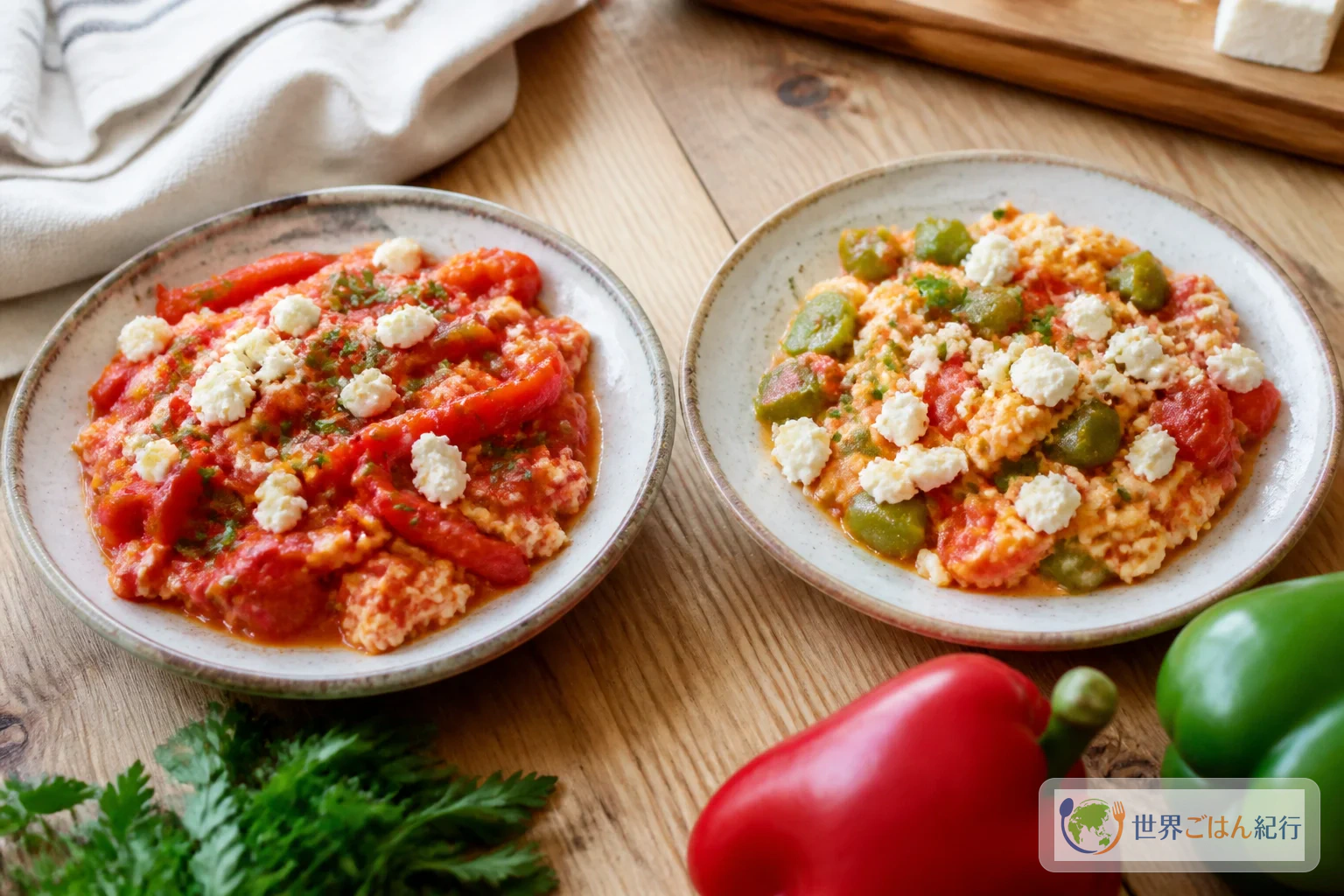
If you add one thing, add only one main ingredient. As 196 flavors presents both roasted and raw pepper versions and Travel Food Atlas touches on variations with carrots and meat, mish-mash is a dish a household can move around. But the more you add, the harder it is to read the tomato moisture and how the eggs set.
Adjust moisture for the season's tomatoes
Fully ripe summer tomatoes bring natural acidity and sweetness. For watery varieties, remove a little around the seeds before cutting into 1.5 cm cubes to shorten the cooking down. With winter tomatoes, adding 1/2 tsp sweet paprika supplies the backbone of aroma.
Add a little eggplant
Cut 1 eggplant (about 100 g) into 1 cm cubes and saute with the peppers. It holds moisture, so heat it for about 5 minutes, until the surface wilts, before adding the tomatoes. Too much moves it from an egg dish toward a vegetable stew, so 100 g is the limit.
Serve heat separately with green chili
Rather than mixing heat through the dish, slicing a green chili thin and putting it on the table lets each person adjust the spiciness. It also keeps the gentle flavor that suits Bulgarian home cooking.
Fewer eggs for a vegetable dish
Reduce the eggs to 4 and the feta to 150 g, and the acidity of the vegetables comes forward. Good for a lunch with bread, or as a side next to a meat dish. If it feels watery after reducing the eggs, extend the cooking down after adding the tomatoes by 2–3 minutes.
If adding meat, cook it separately
There are home versions that add ground meat or sausage, but sauteing it with the vegetables from the start makes the dish heavy with fat and liquid. If you add it, cook 150 g in a separate pan and combine it at the same time as the final eggs. If you keep the center of the dish on vegetables and cheese, it is satisfying without meat.
Background: Bulgaria's Table Linked by White Cheese
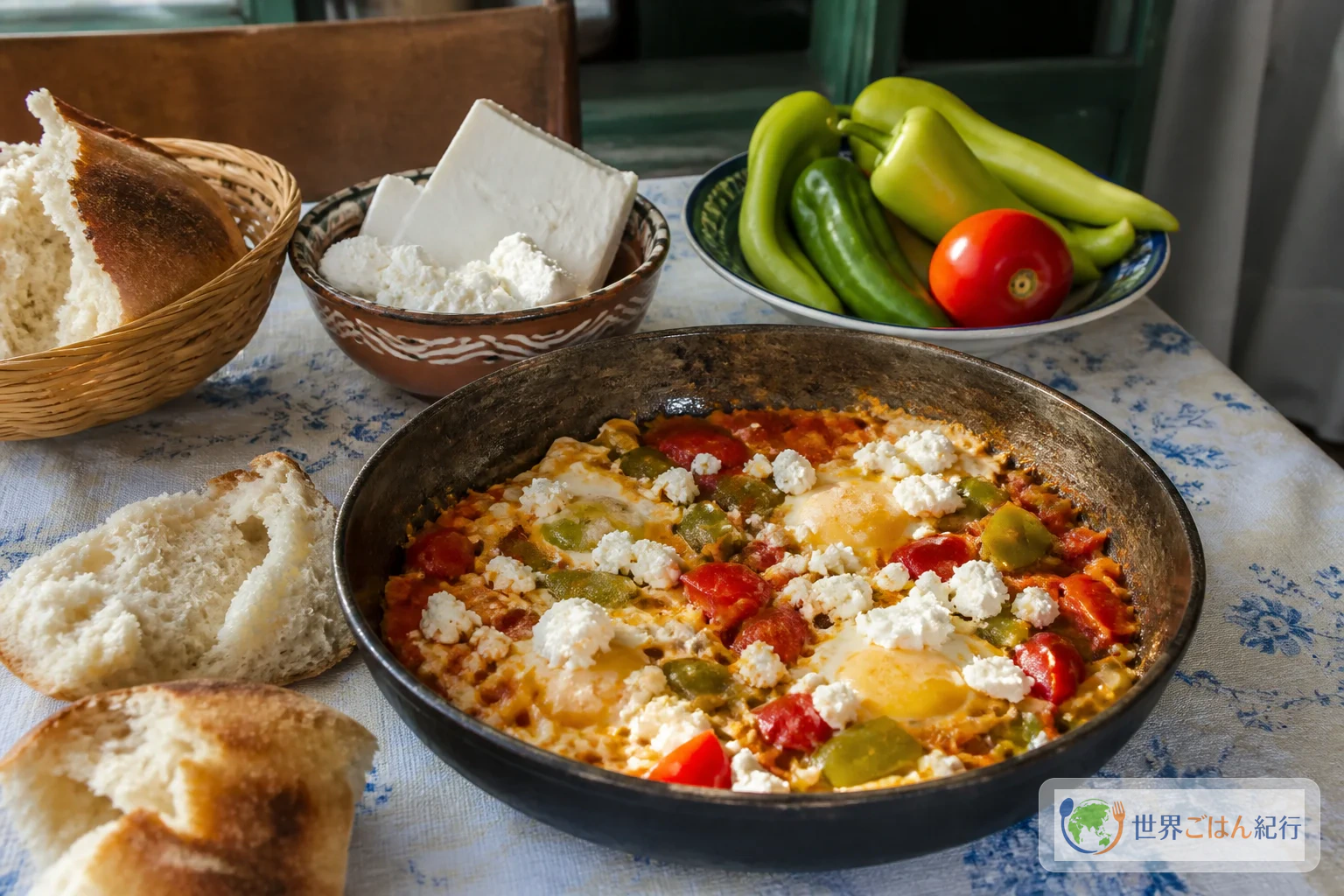
Introductions to Bulgarian food stress vegetables such as tomatoes and peppers, herbs, fruit, and dairy, and also touch on bread, sweets, and dishes shared with neighboring Turkey and Greece. In that context mish-mash is introduced as "a popular summer dish." Putting seasonal vegetables in a pan and bringing them together with eggs and cheese makes it closer to a plate that works in a hot-season kitchen than to a dish of special ceremony.
White cheese is not a side but a pillar of the flavor. Sirene is not just "white cheese." The EU's official specification defines Bulgarian white brined cheese as a food made through fermentation and ripening in brine, with saltiness and a lactic flavor. In 2023 the name "Bulgarsko byalo salamureno sirene" was entered in the PDO register, and the specification also records its texture when heated and its use in mish-mash, shopska salad, banitsa, and others. Even if it comes out delicious with feta, not claiming it is the same as sirene is a substitute that respects the ingredient.
When thinking about regional differences, it is better not to hurry into definitive statements about differences on a map. Among the recipes we could check, there are methods that roast and peel the peppers and methods that cook them raw. Whether the eggs are stopped soft for breakfast or set firmly for a main or side, and whether carrot or meat is added, also vary. This is not evidence for any one regional division, but it does show that this is a dish that can move to suit a household.
When making it elsewhere, roast only the red peppers and add the green raw, and you keep both a sweet aroma and a green aroma in one pan. If you cannot find sirene, use feta, and use sweet paprika only to help when seasonal vegetables are weak. Rather than replacing the original name with another dish, keeping the saltiness of the brined cheese, the moisture of the vegetables, and the order of bringing it together with eggs at the end is the shortcut that fits your shopping situation.
Compared with neighboring dishes, mish-mash differs from Greek salad (in Japanese), where white cheese and vegetables are enjoyed raw: here heat and egg bring it together. If you want to look at a table of baked goods, go to khachapuri, which can use white cheese; if you want to compare simmering vegetables in tomato and oil, go to fergese (in Japanese), and the closeness and differences of the Balkans become visible.
Storage and FAQ
Can I refrigerate it?
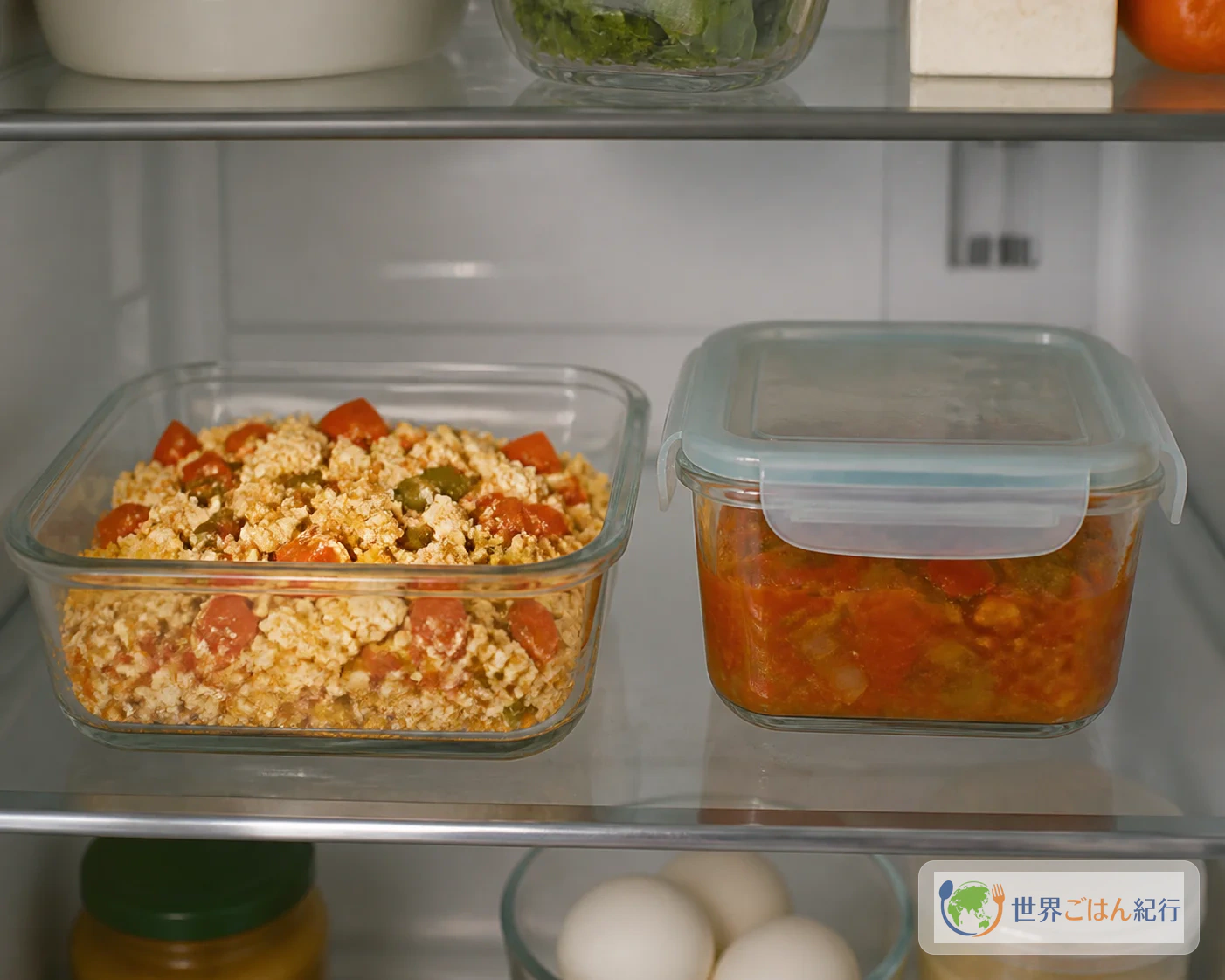
After cooking, move it to a shallow container within 2 hours, sooner in a hot place, and refrigerate. FoodSafety.gov gives 3–4 days as the refrigeration guideline for egg dishes, but the texture of eggs and cheese in this dish drops quickly, so at home plan to finish it in 2–3 days. Take only what you will eat into a small pot and heat thoroughly to the center, stirring. Freezing tends to break the texture of the eggs and cheese, so for make-ahead, store the vegetable base before adding the eggs.
Can I substitute something other than feta?
A salty white cheese works, though the texture changes. Watery cottage cheese should be drained in a colander for 10 minutes and used at around 150–200 g. Mozzarella is mildly salted and stretchy, so it is lower in priority as a substitute for mish-mash.
The tomato water will not cook down.
Remove the lid, return to medium heat, and check every 2–3 minutes. If the pan is small, the tomatoes are cold, or the vegetables are piled too deep, the moisture is slow to leave. If it looks about to scorch, lower the heat and move to a wider pan. Cooking down after adding the eggs makes the eggs set too much and hard to recover.
Is it good for breakfast?
Yes. Cut the vegetables the night before and on the day only saute and add the eggs, and a 45-minute dish shortens to around 25 minutes. But avoid leaving the finished dish with eggs for a long time and finish it just before it goes to the table.
What do I serve with it besides bread?
Sliced bread, roasted potatoes, or white rice all work. A little sour salad keeps the saltiness of the cheese and the oil from lingering heavily. Do not add too many sides; arrange so that the red vegetables and white cheese show, and that is enough.
Sources
- Plovdiv University International Relations Office, "Bulgarian Cuisine" (accessed and checked 2026-08-05): ingredients of mish-mash, its place as a summer dish, and a description of Bulgarian cuisine including vegetables, dairy, and bread
- 196 flavors, "Mish-Mash: Traditional and Authentic Bulgarian Recipe" (accessed and checked 2026-08-05): roasted pepper and raw pepper versions, ingredients, and order of cooking
- Travel Food Atlas, "Bulgarian Mish Mash Recipe" (accessed and checked 2026-08-05): cooking down moisture before adding the eggs, its place as a main or side, and household variations
- European Commission, "Commission Implementing Regulation (EU) 2023/1571" (accessed and checked 2026-08-05): EU PDO registration of "Bulgarsko byalo salamureno sirene"
- European Commission / Official Journal of the European Union, "Bulgarsko byalo salamureno sirene" (accessed and checked 2026-08-05): production, ripening, and heating properties of Bulgarian white brined cheese and its use in mish-mash
- FoodSafety.gov, "Salmonella and Eggs" (accessed and checked 2026-08-05): guideline of heating egg dishes to 71 degrees C, refrigeration after cooking, and avoiding room-temperature holding
- FoodSafety.gov, "Cold Food Storage Chart" (accessed and checked 2026-08-05): refrigerated storage guideline for egg dishes


