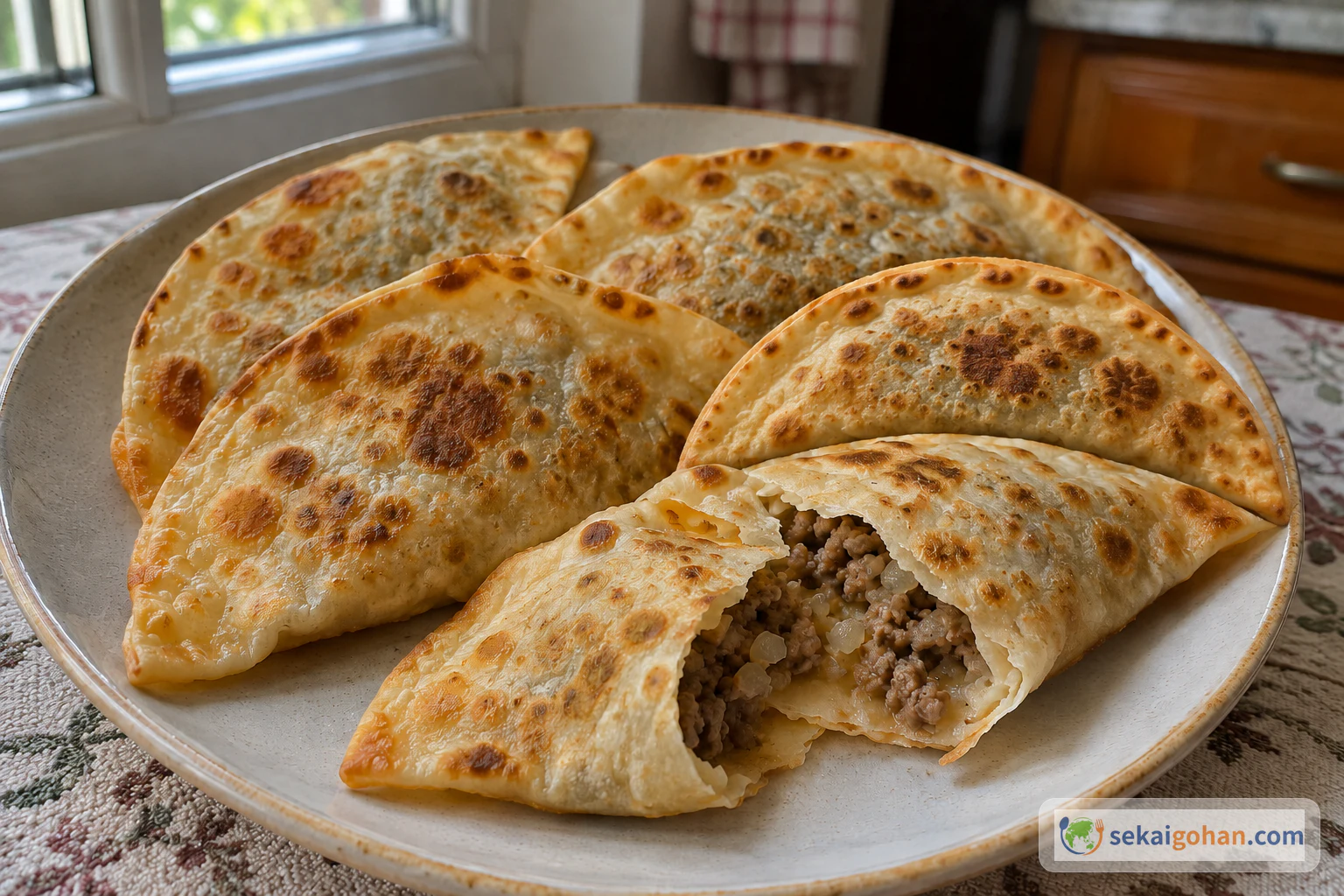
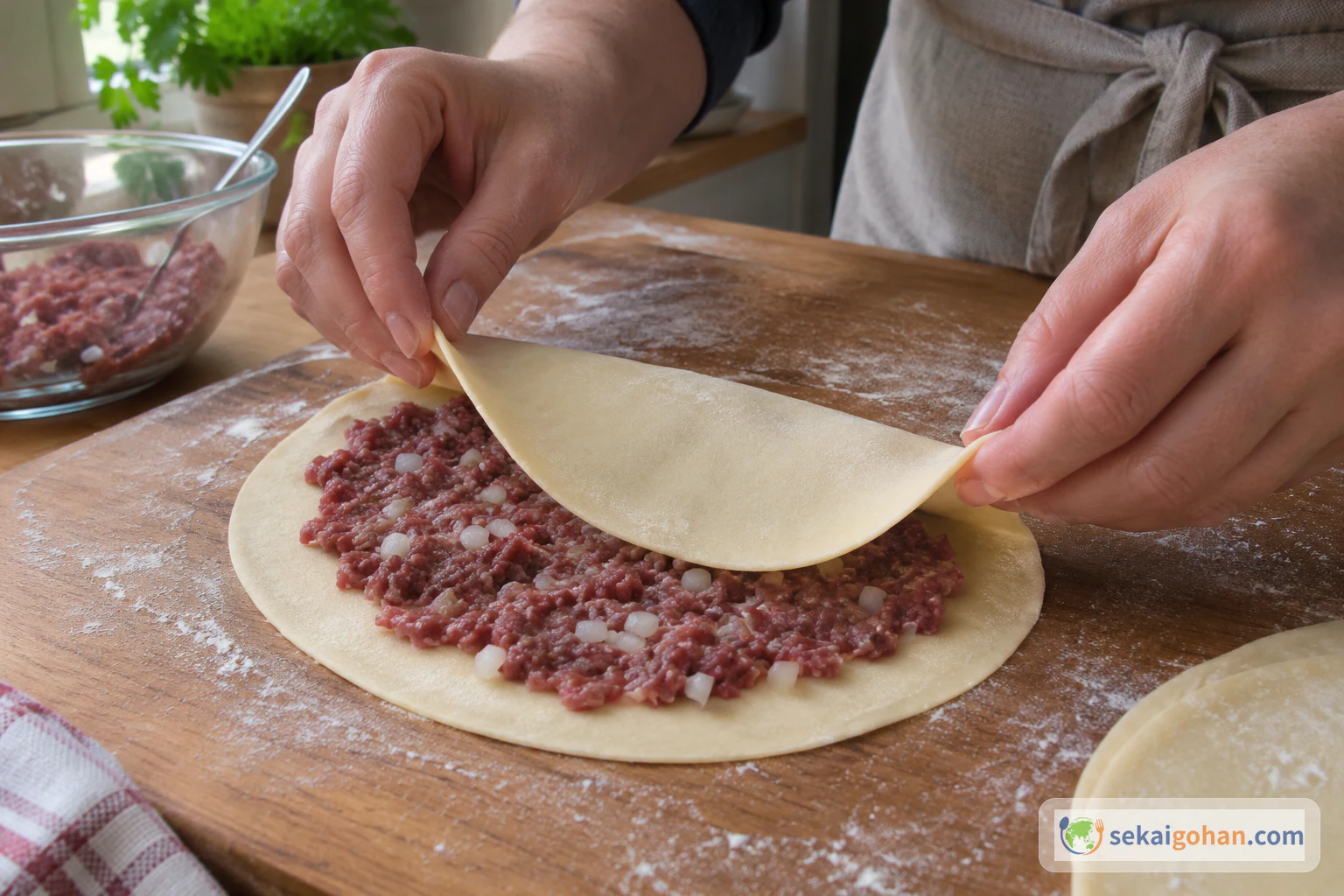
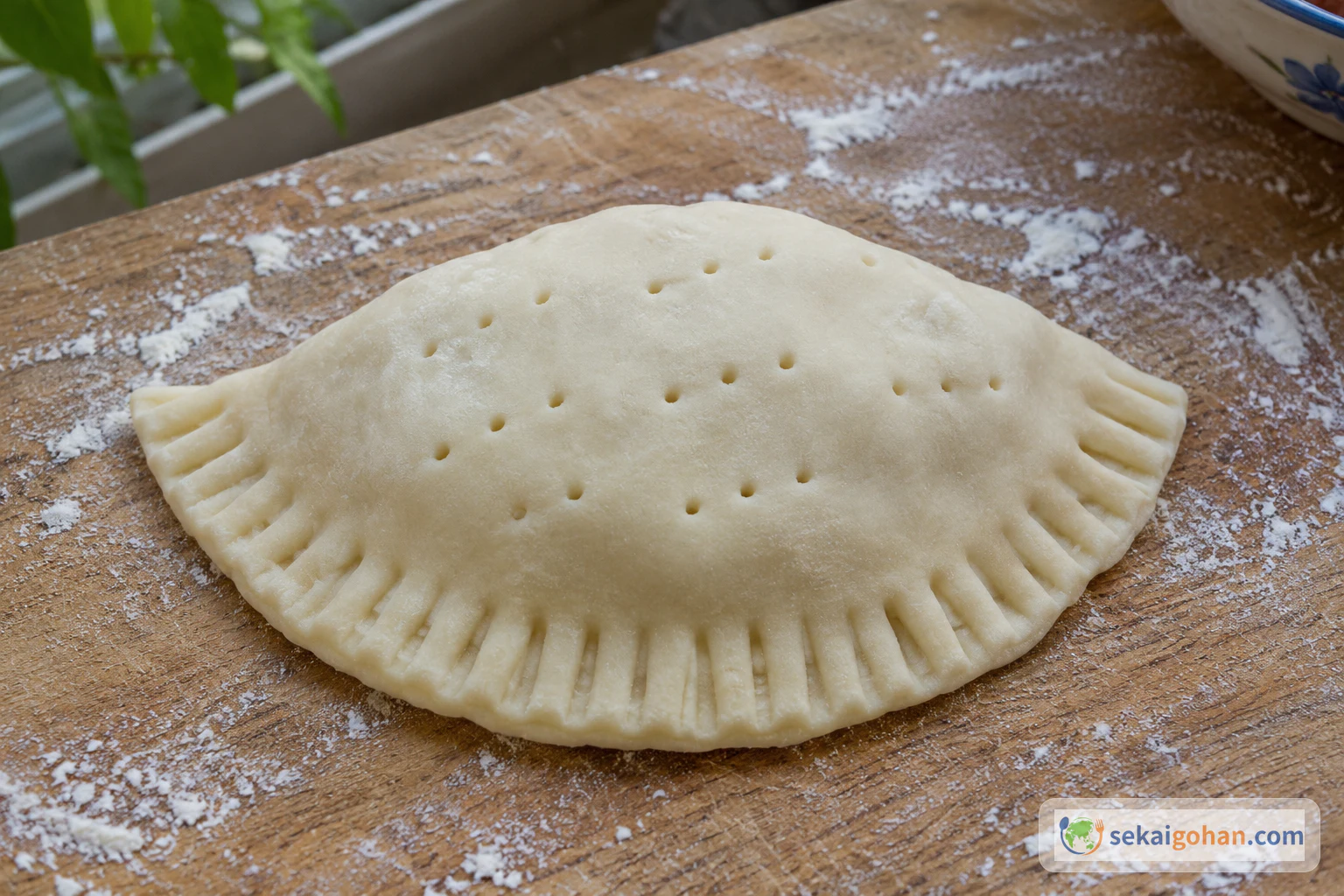
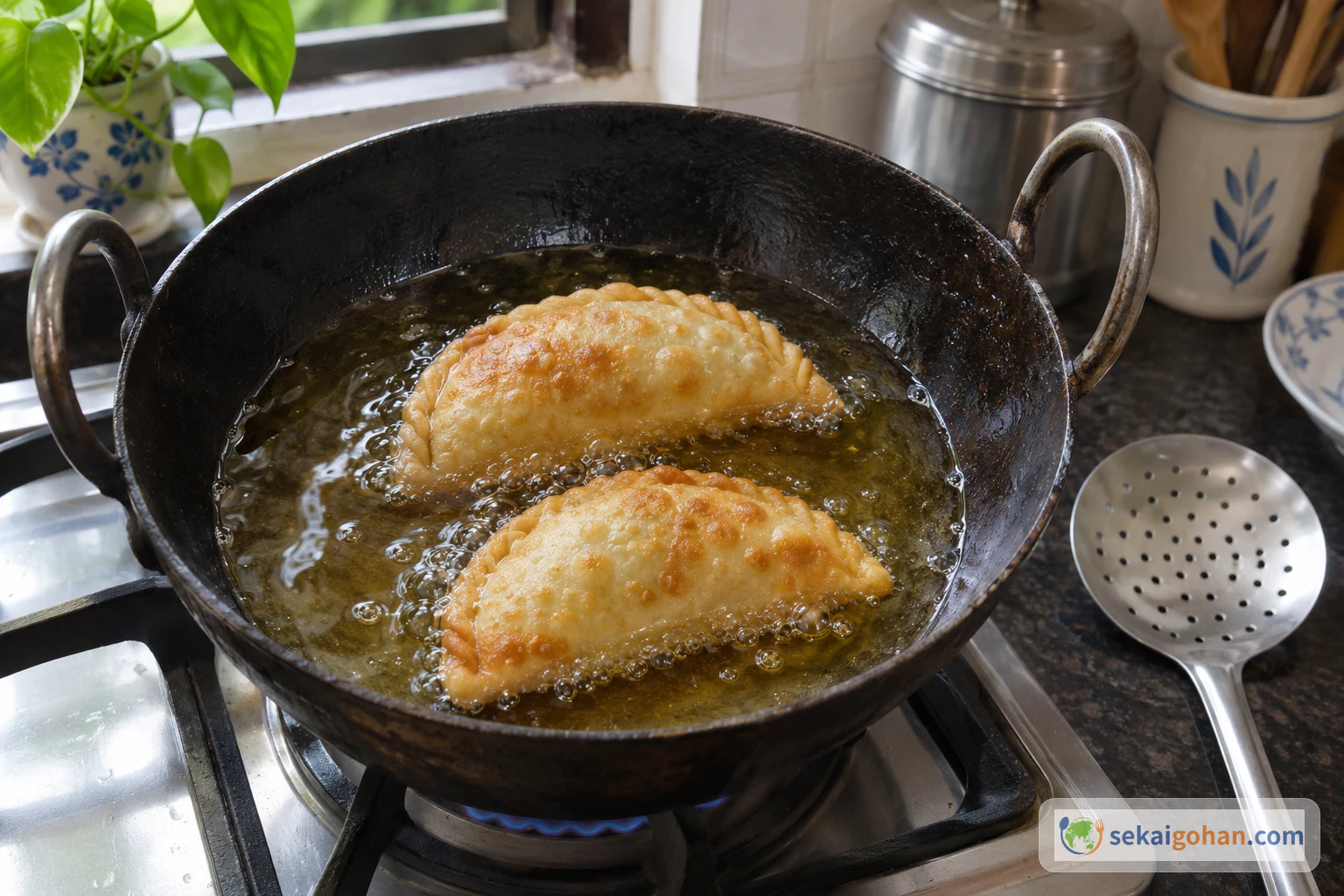
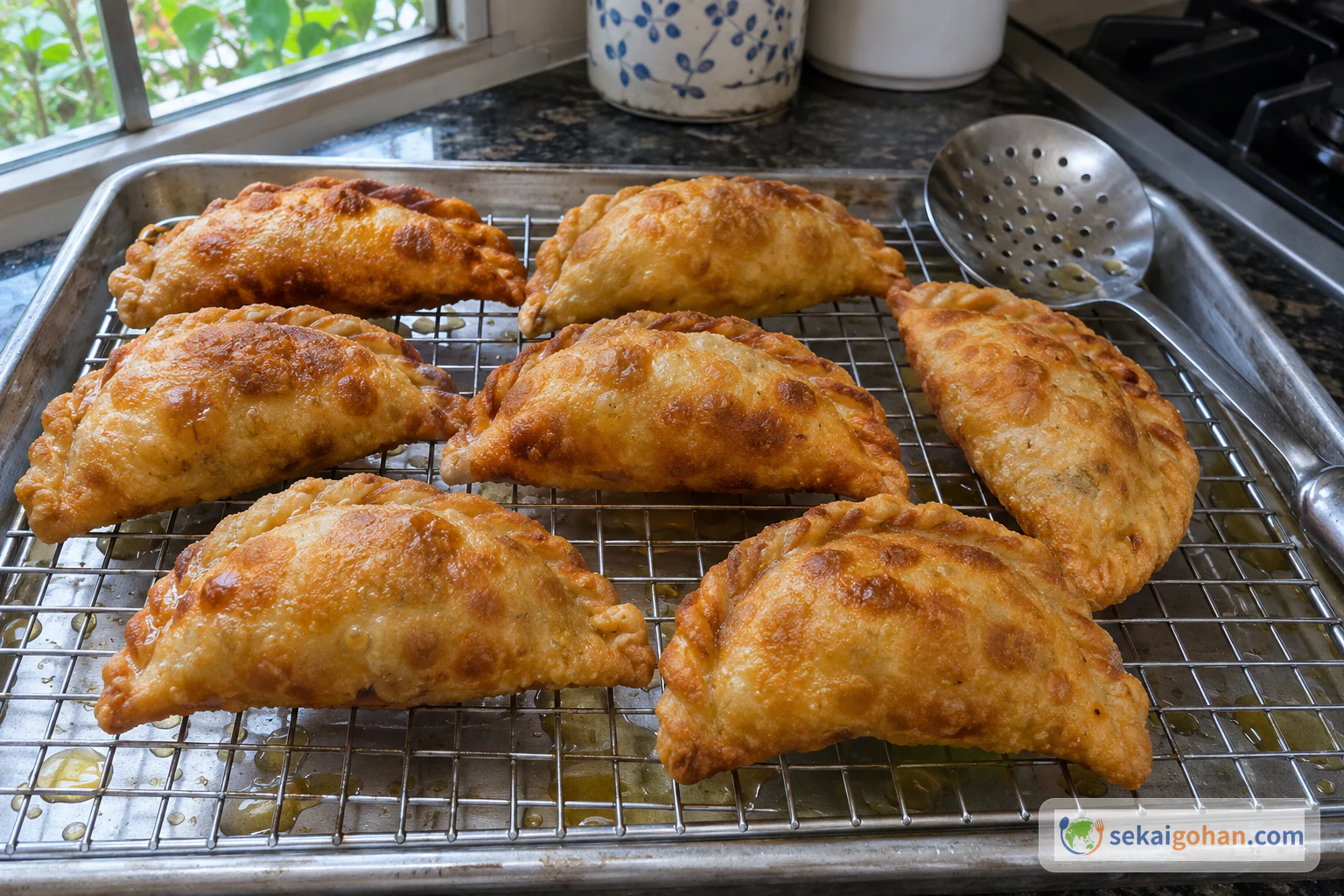
Two pale half-moons slide into the oil and a ring of fine bubbles rises around their edges at once. Steam escapes through the little fork holes on top, and within a minute or two the rims begin to turn gold. Gutap is the half-moon pie of Turkmenistan: a thin wheat dough folded over raw beef or lamb with onion, black pepper and a pinch of red chili, then fried until the shell blisters and crisps. Break one open and the meat inside is juicy and peppery, the onion soft and sweet. In Turkmen homes and cafés it comes to the table hot, with a pot of black or green tea.
A Half-Moon Pie from a Country That Loves Frying
Gutap looks much like the Russian cheburek: a round of dough folded in half, sealed with a pressed edge, cooked until golden. The filling changes with the season and the household. Chopped meat and onion is the everyday version. In spring, gutap is often filled with greens such as spinach, dill and green onion. Mushrooms, pumpkin and potato fillings all have their place too.
How it is cooked changes as much as what goes inside. Turkmen cooks fry gutap in a pot of oil on the stove, bake it in an ordinary oven, or bake it against the walls of a tamdyr, the clay oven also used for bread. Fried gutap is the best-known form, and baked gutap is common as well; though one traveler's account says baked gutap is the more common form in Turkmenistan itself. Baked gutap tends to be larger, often stuffed with meat, potato or fragrant pumpkin, and it is thinner and lighter than other Turkmen pies, the kind of thing eaten as a light snack.
Bread, oil and smoke
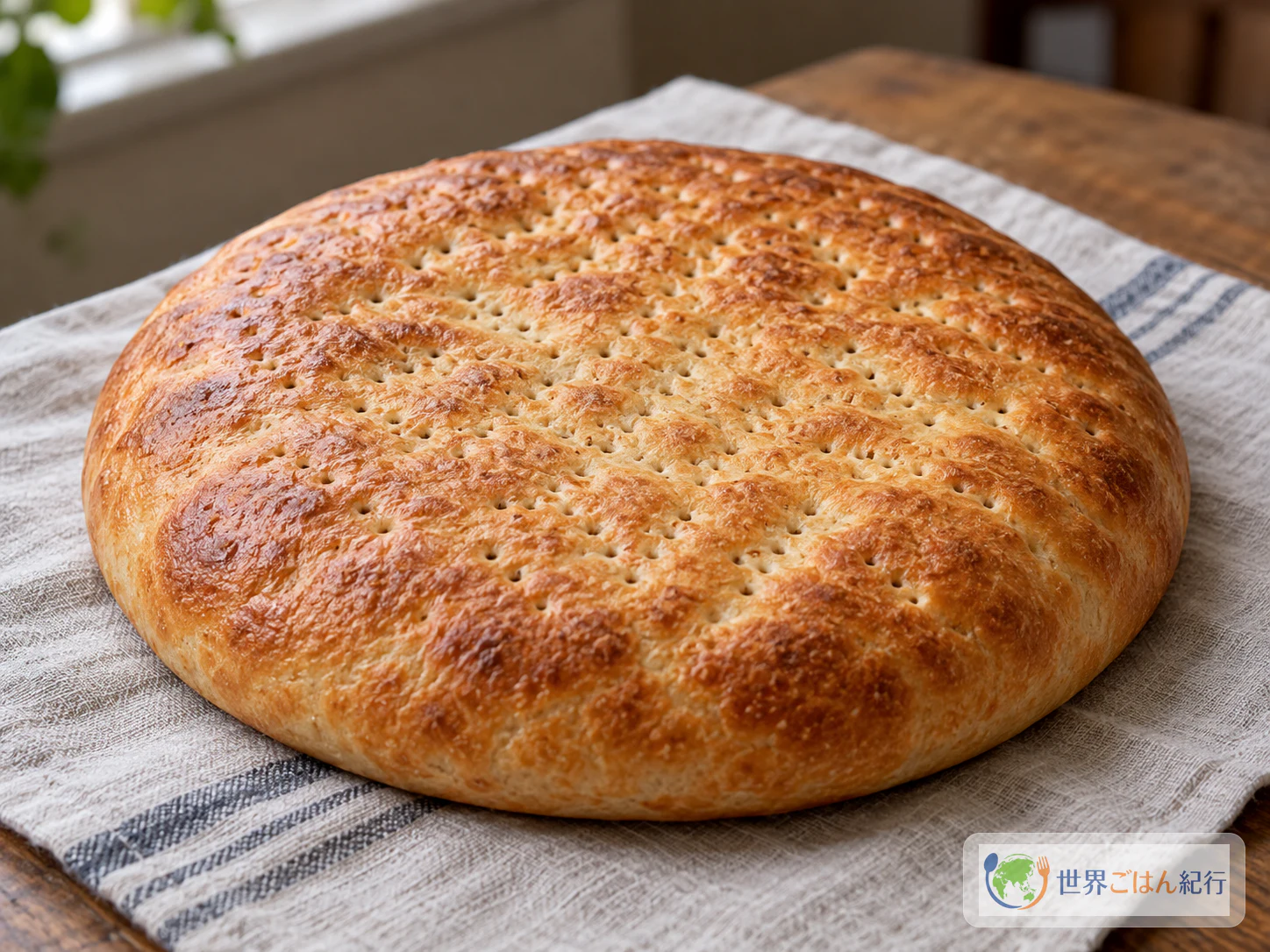
Flour sits at the center of the Turkmen table. At the Russian Bazaar in Ashgabat, stalls are stacked with churek, the flat everyday bread, and with gatlama, a dough rolled thin, brushed with fat, folded into layers and fried in the fat of fat-tailed sheep. Frying is a favored technique in Turkmen cooking, and festive tables carry fried dough sweets such as peshmeh. One writer on Turkmen food passes on a saying that misfortune burns away with the smoke of the frying pan. Gutap belongs to this family of fried and baked doughs. You can read more about the country's food on our Turkmenistan page.
Street stalls are rare in Turkmenistan, so gutap is eaten sitting down: in cafés, in restaurants and at home, with tea poured alongside. Its closest relative is Azerbaijan's qutab, which shares the name and the half-moon shape but takes another road. Qutab dough is rolled to about 1 mm, cooked on a dry saj griddle and finished with butter, sumac and yogurt. Turkmen gutap stays a little thicker, is fried in deep oil, and needs nothing on top.
The dish is written gutap or gutab in English. Because it resembles the Russian cheburek, the fried version is often called cheburek too.
Ingredients (makes 8)
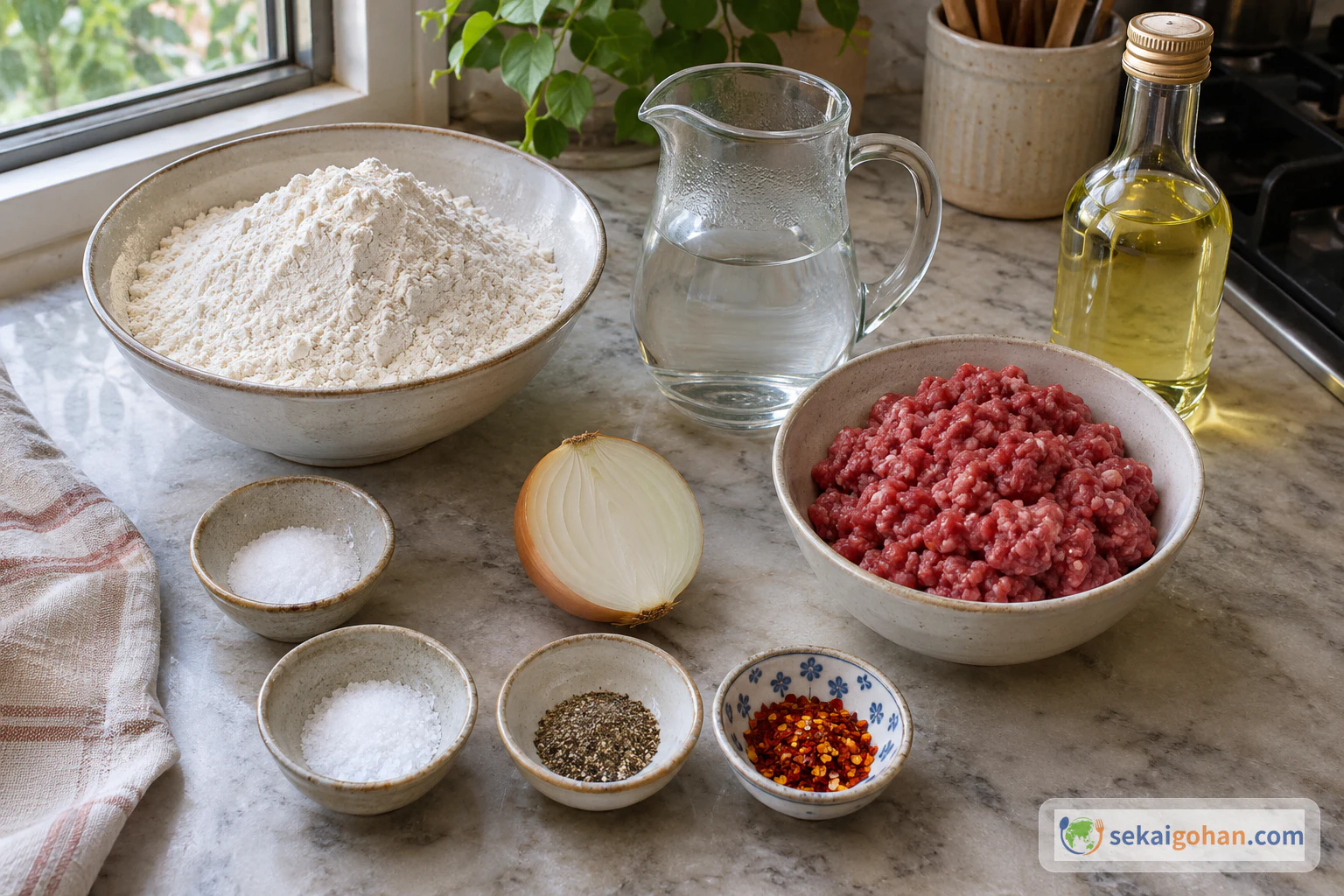
Choose one filling, meat or spinach. Each is complete on its own for one batch of dough. The dough holds no egg and no oil, only flour, warm water and salt, which keeps it pliable and lets it fry crisp.
The meat filling is generous for 8 pastries at 1 tablespoon each. Shape what is left into small meatballs or fry it as a quick stir-fry, cooking it through.
Gutap contains wheat in the dough, and the spinach filling contains wheat as well. The meat filling contains beef or lamb. Check the label of your frying oil if you avoid particular oils.
Equipment
- Large mixing bowl
- Rolling pin and a board for rolling
- Kitchen cloth or towel to cover the dough
- Fork for sealing and pricking
- Tray lined with a cloth for the shaped pastries
- Deep heavy pot or deep heavy skillet that holds oil at least 1½ inches (4 cm) deep
- Frying thermometer for the oil, and a probe thermometer for the meat
- Slotted spoon
- Wire rack over a tray, or paper towels
- Splatter screen
- For the spinach filling: a saucepan, a skillet and a wooden spatula
Choosing and Substituting
Every ingredient here is in an ordinary supermarket. The one thing worth seeking out is ground lamb, which a butcher or an import grocer carries; it gives the stronger, more local aroma, while beef is milder and easier to like. Mixed ground meat works as well.
| Swap | What it changes |
|---|---|
| All-purpose flour for soft flour | The dough rolls fine, with a slightly firmer bite after frying |
| Rice flour for wheat flour | Does not work; the dough will not stretch or seal |
| Hot water for warm water | The dough turns slack and hard to roll; keep it lukewarm |
| Lamb for beef | A deeper, gamier flavor; add a little more black pepper |
| New-season onion for regular onion | More juice; chop it and squeeze out a little of the water |
| Komatsuna or sorrel for spinach | Works in the same way; squeeze it just as hard |
| Ground red chili for flakes | Same gentle heat; leave the chili out entirely and the pie still tastes right |
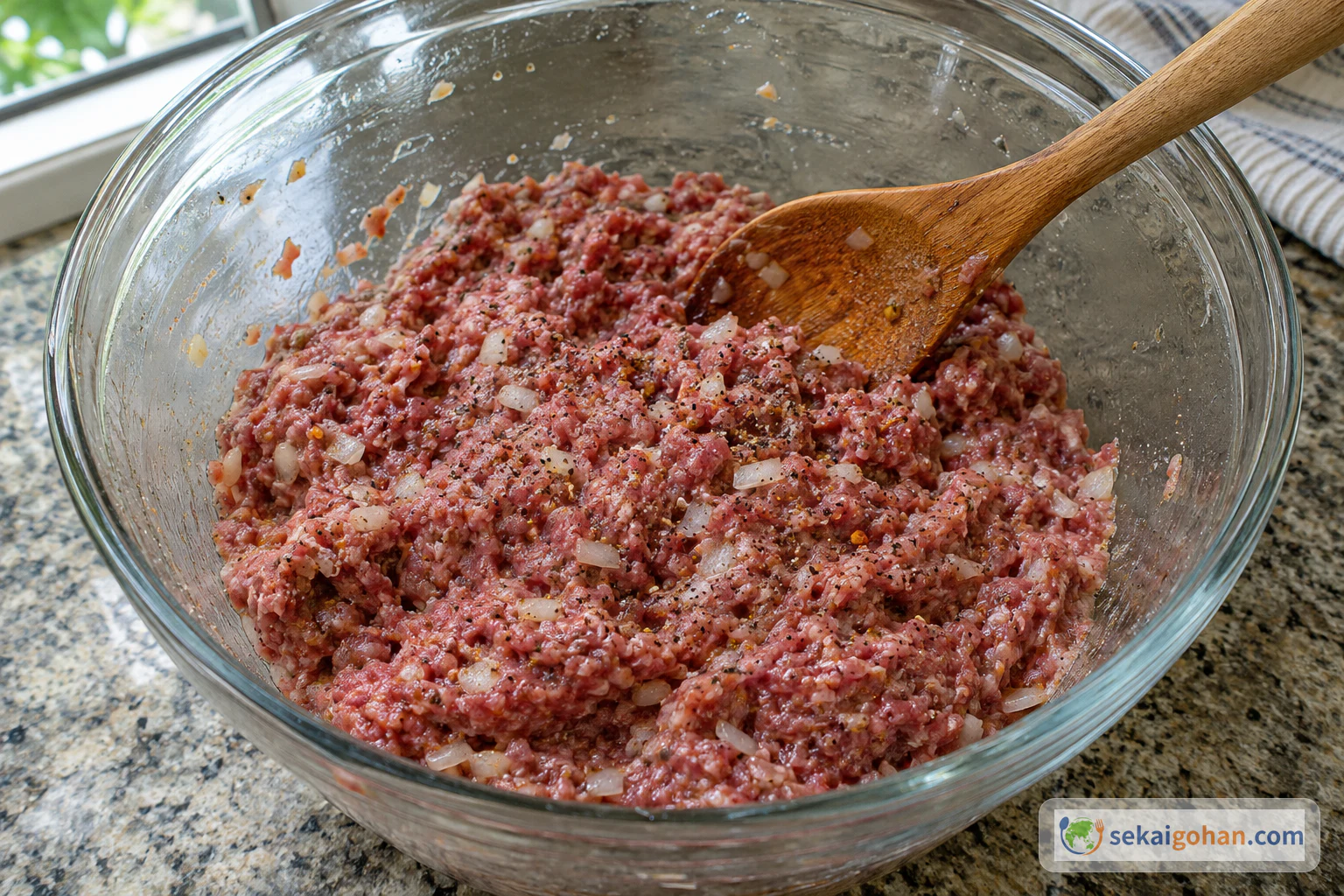
Chop the onion finely. Large pieces poke at the thin dough and tear it during folding and frying. Pick a pot narrow enough that 1½ inches (4 cm) of oil does not take a vat: an 8-inch (21 cm) pot takes about 1½ quarts (1.4 L), a 9½-inch (24 cm) pot about 2 quarts (1.8 L). If the oil runs short, use a smaller pot and fry in more batches.
Method
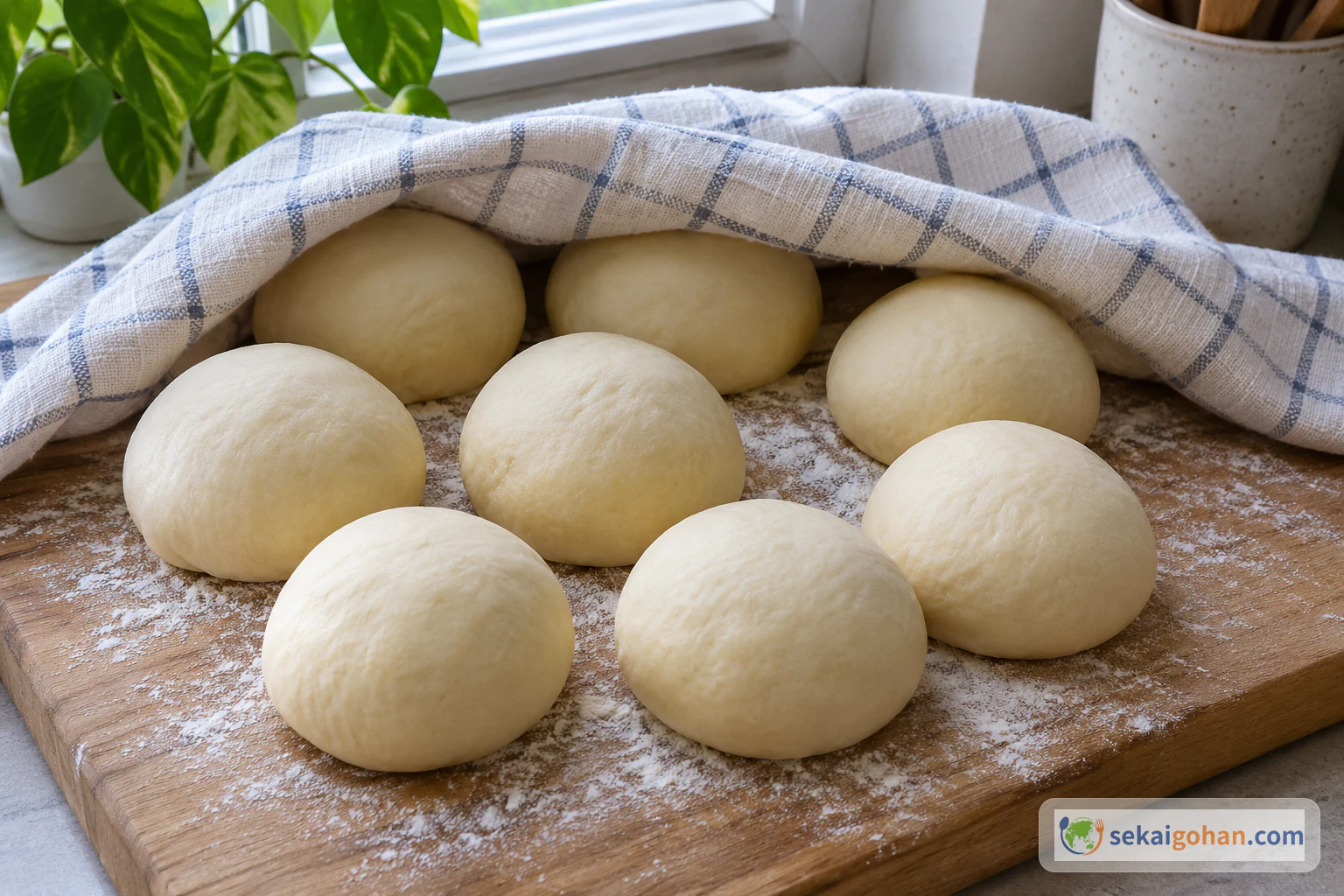
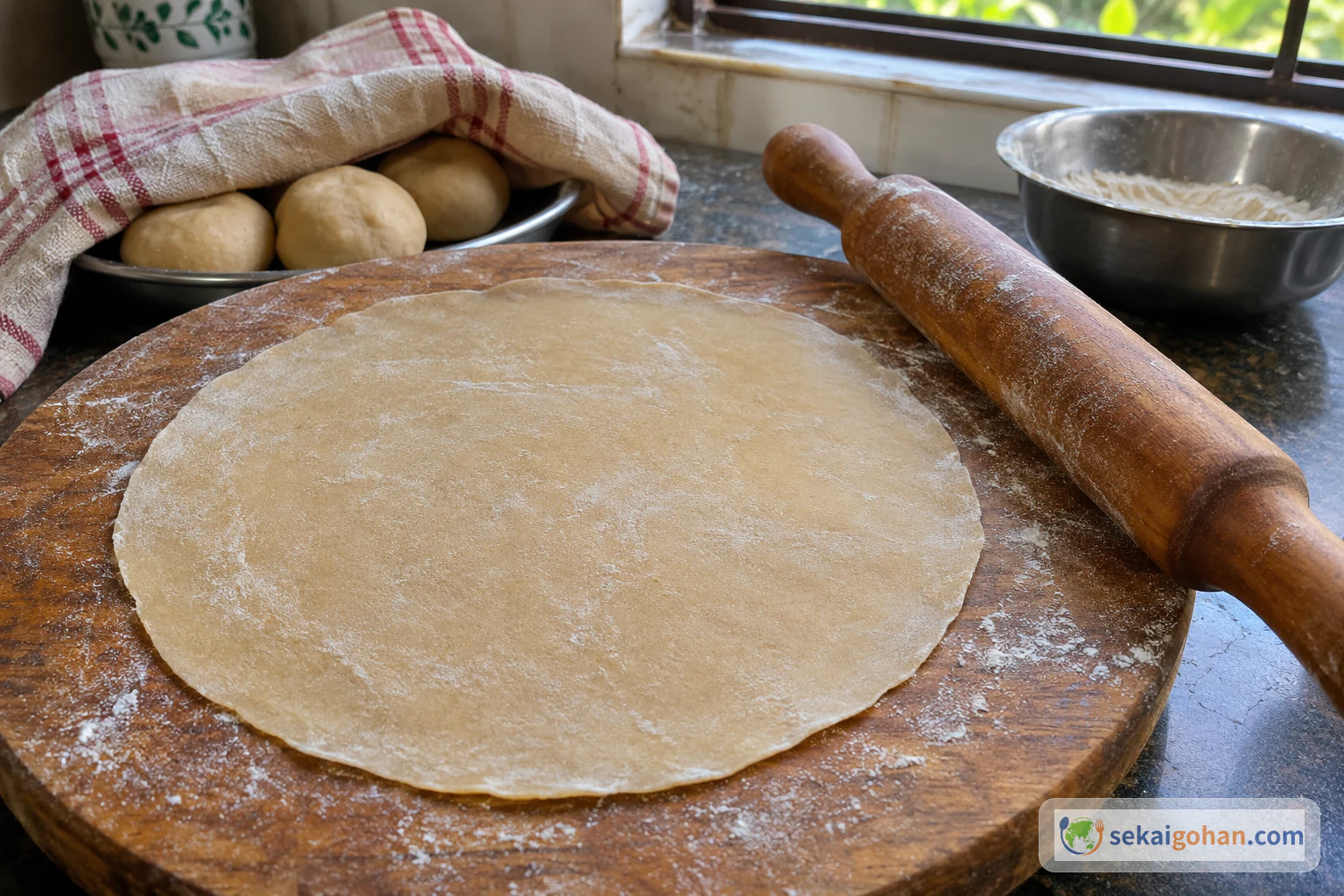
Make the dough first; while the dough balls rest, mix the filling. The spinach filling takes longer than the meat, since the spinach is blanched and cooked with toasted flour. Shape all eight pastries before you heat the oil, because the frying goes fast and needs your full attention at the stove.
When It Goes Wrong
| What you see | Why | What to do |
|---|---|---|
| The pie tears or opens in the oil | Wet filling, a loose seal or dough rolled too thin | Squeeze the filling drier, press the fork hard along the edge, stop rolling at 4¾ inches (12 cm) |
| The oil spits and splatters | Water in the filling or on the dough, or the top was not pricked | Prick every top, keep the filling dry, add only two at a time |
| Red meat in the center | Oil too hot, so the shell browned before the inside cooked, or the pie is too thick | Hold the oil at 340–355°F (170–180°C), lower the heat slightly and fry longer, break the first one open to check |
| Greasy, heavy pies | Oil too cool, or too many in the pot | Fry two at a time and let the oil reheat between batches |
| Hard, thick edges | The seam was folded over itself in layers | Leave the ⅜-inch (1 cm) border clear and simply press it flat with the fork |
Serving, Variations and Storage
At the table
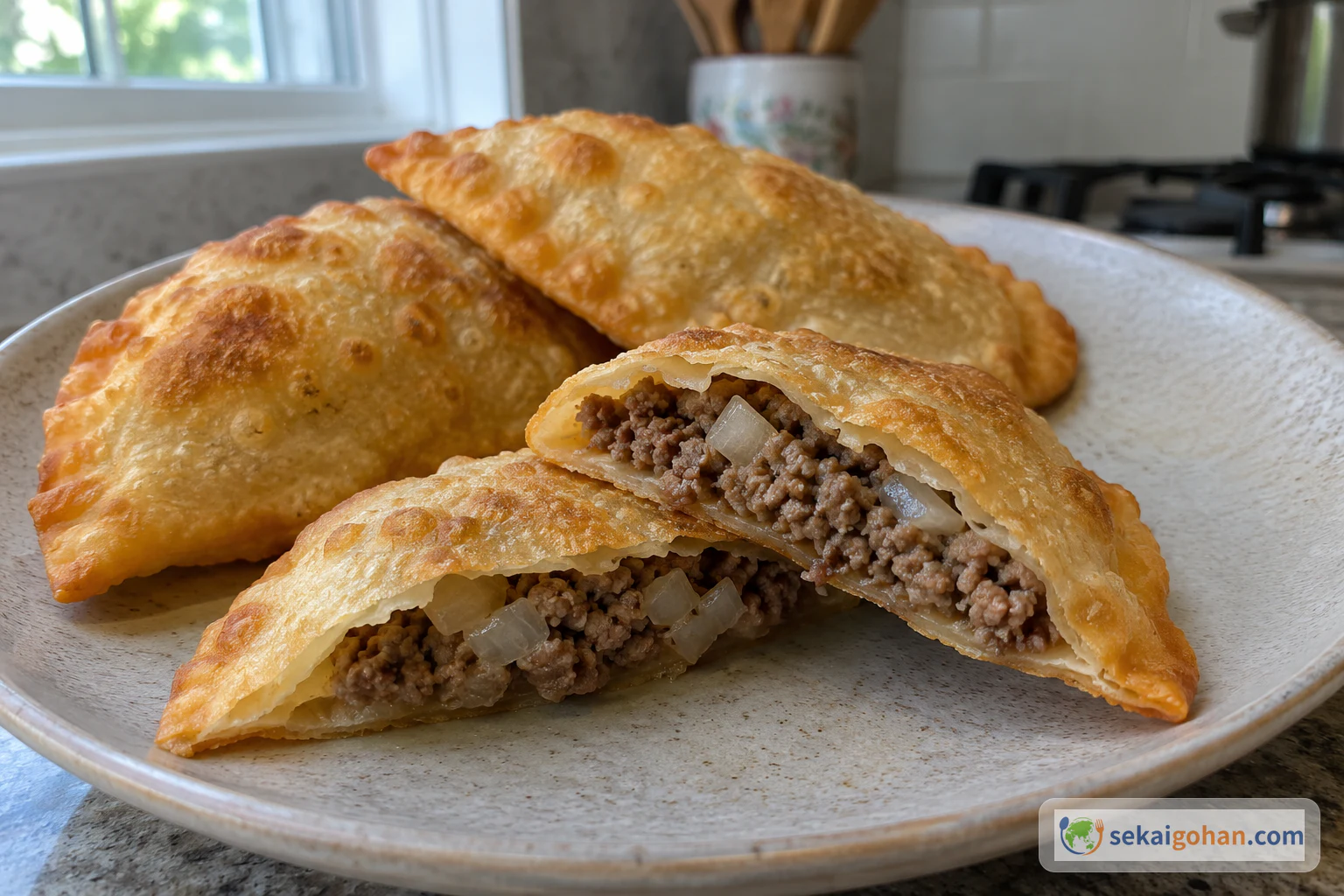
Serve gutap hot, piled on a plate, with a pot of black or green tea; tea runs through every Turkmen meal and the two belong together. Gutap is a light snack, eaten seated rather than on the move. Break one open at the table and the steam carries the pepper and onion straight up.
Variations
- Lamb. Swap the beef for ground lamb for a stronger, more local flavor, and add a little more black pepper to match it.
- Pan-cooked gyzzyrma gutap. For a version with far less oil, use a separate recipe instead of the dough above: a dough with 2 tbsp vegetable oil that makes 10 pies, rolled to 8 inches (20 cm), filled with 3 tbsp of a meat filling made with 6 tbsp water, and cooked in a skillet, turning once, until both sides are browned. The oil in the dough keeps it soft through dry heat.
- Pumpkin (kädili gutap). Cook 2.2 lb (1 kg) butternut squash with 1 onion, 5 tbsp vegetable oil, ¼ tsp salt and ¼ tsp black pepper, then mash it. Make a dough of 1 lb 2 oz (500 g) flour, 1¼ cups (300 ml) warm water, 1 tsp salt and 2 tbsp oil, roll 8-inch (20 cm) rounds, fill each with 4 tbsp, prick, and brown on both sides in a skillet. This makes 10, and the sweetness settles once they have cooled.
- Egg dough or mushrooms. Some cooks knead egg into the dough with hot water. For a mushroom filling, replace half the meat with chopped mushrooms.
Storage
Let leftover gutap cool, wrap each one separately, and refrigerate or freeze. Reheat them just before eating in a dry skillet or a toaster oven until they are hot all the way through and the shell crisps again.
Frequently Asked Questions
Can I fry with less oil?
Keep the depth at 1½ inches (4 cm) and use a smaller pot instead, still frying two at a time. Shallower oil leaves one side unfried, and the pie tends to break when you turn it. A narrow pot cuts the amount of oil sharply while keeping the depth.
Can I grate the onion instead of chopping it?
Yes. Grated onion blends into the meat and never pokes through the dough. It releases more juice, so mix well and make sure no water pools in the bowl before you fill.
Can I bake this dough instead of frying it?
This flour-water-salt dough dries out and turns hard under dry heat. For baked or pan-cooked gutap, use the dough with oil from the gyzzyrma version and roll it to 8 inches (20 cm). Fried and baked gutap are made with different doughs for that reason.
Is pumpkin gutap vegetarian?
At home it is, when you cook the squash in vegetable oil. In Turkmen cafés and restaurants, pumpkin gutap is sometimes cooked with meat fat, so vegetarians should ask for it made without.