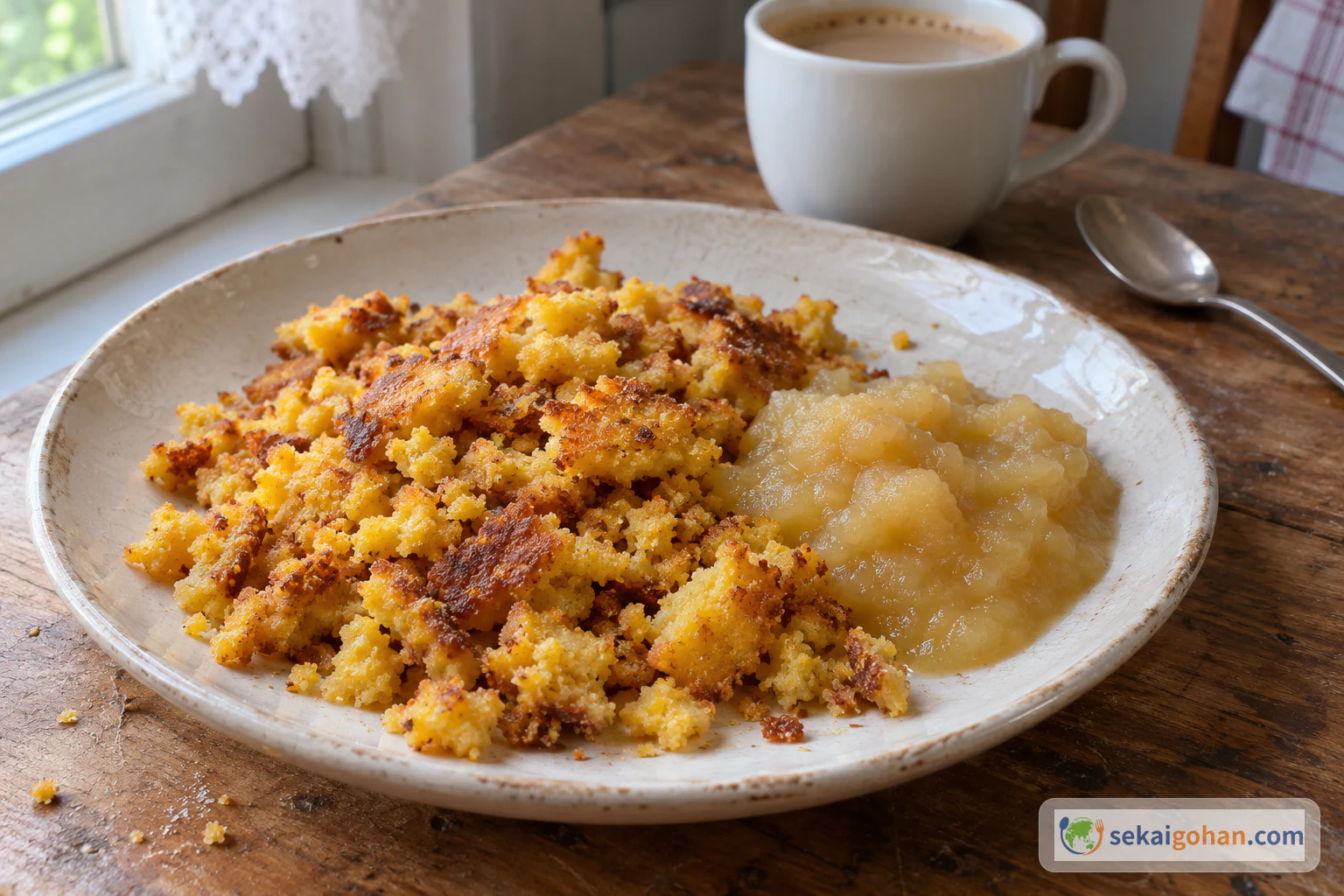
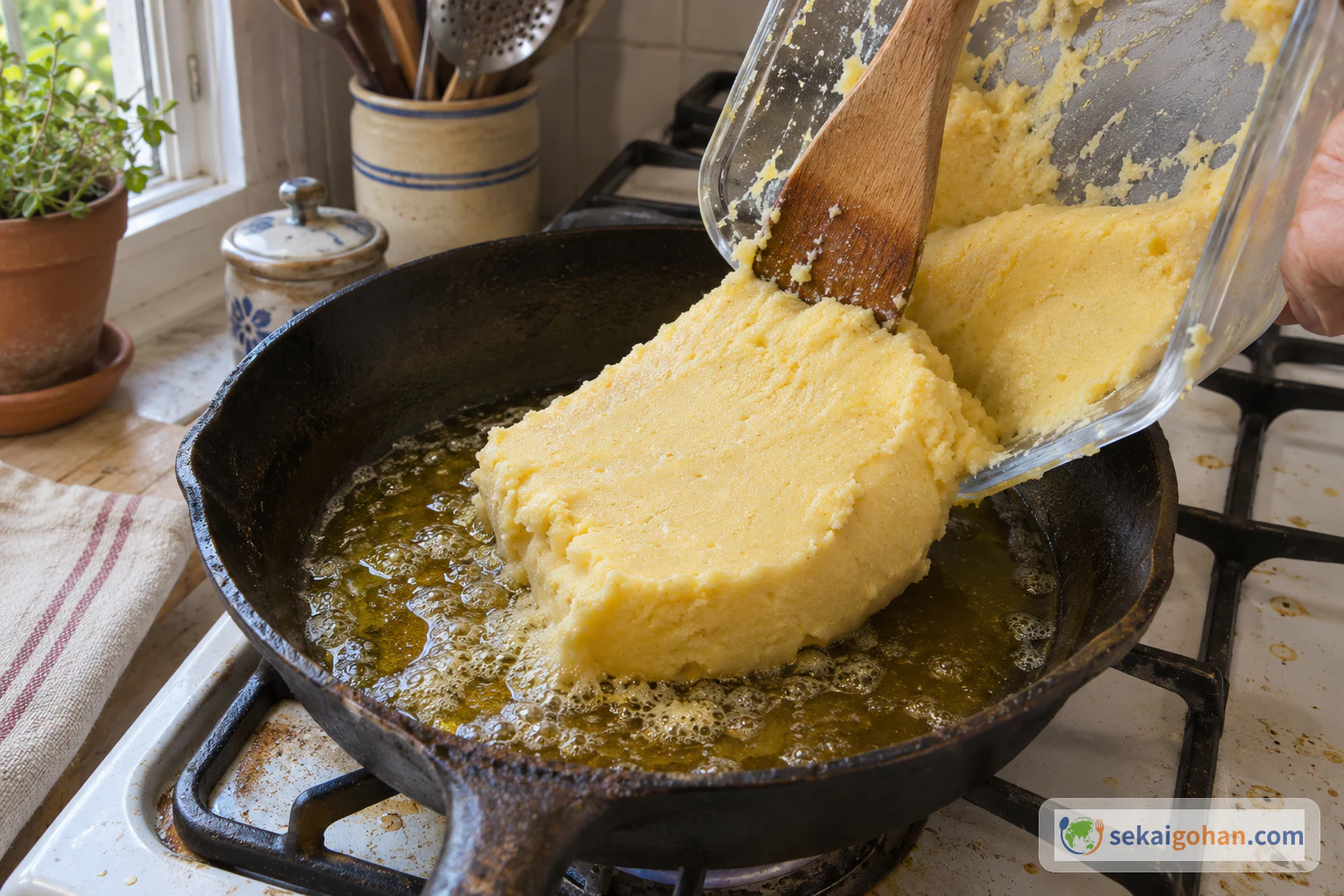
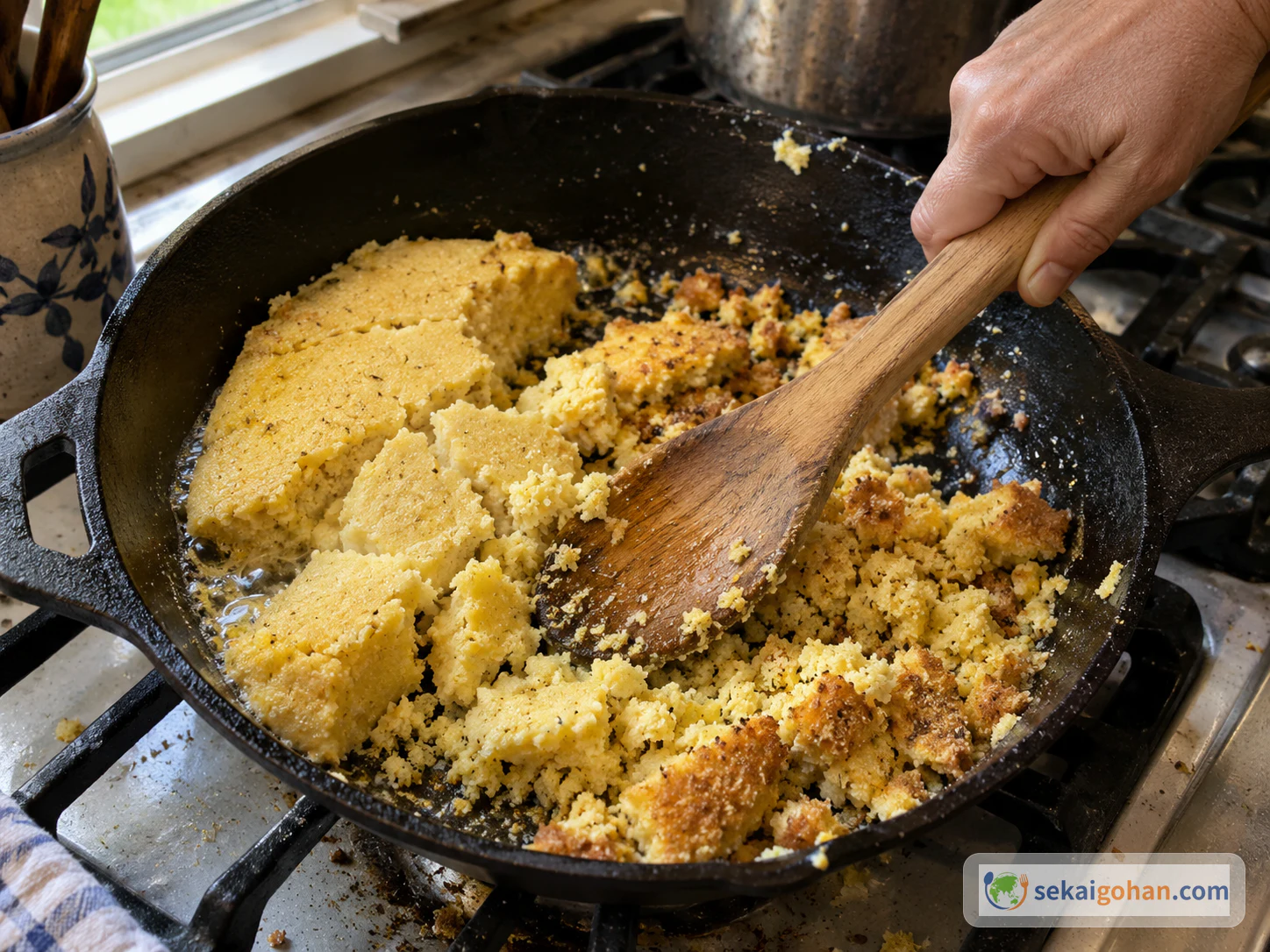
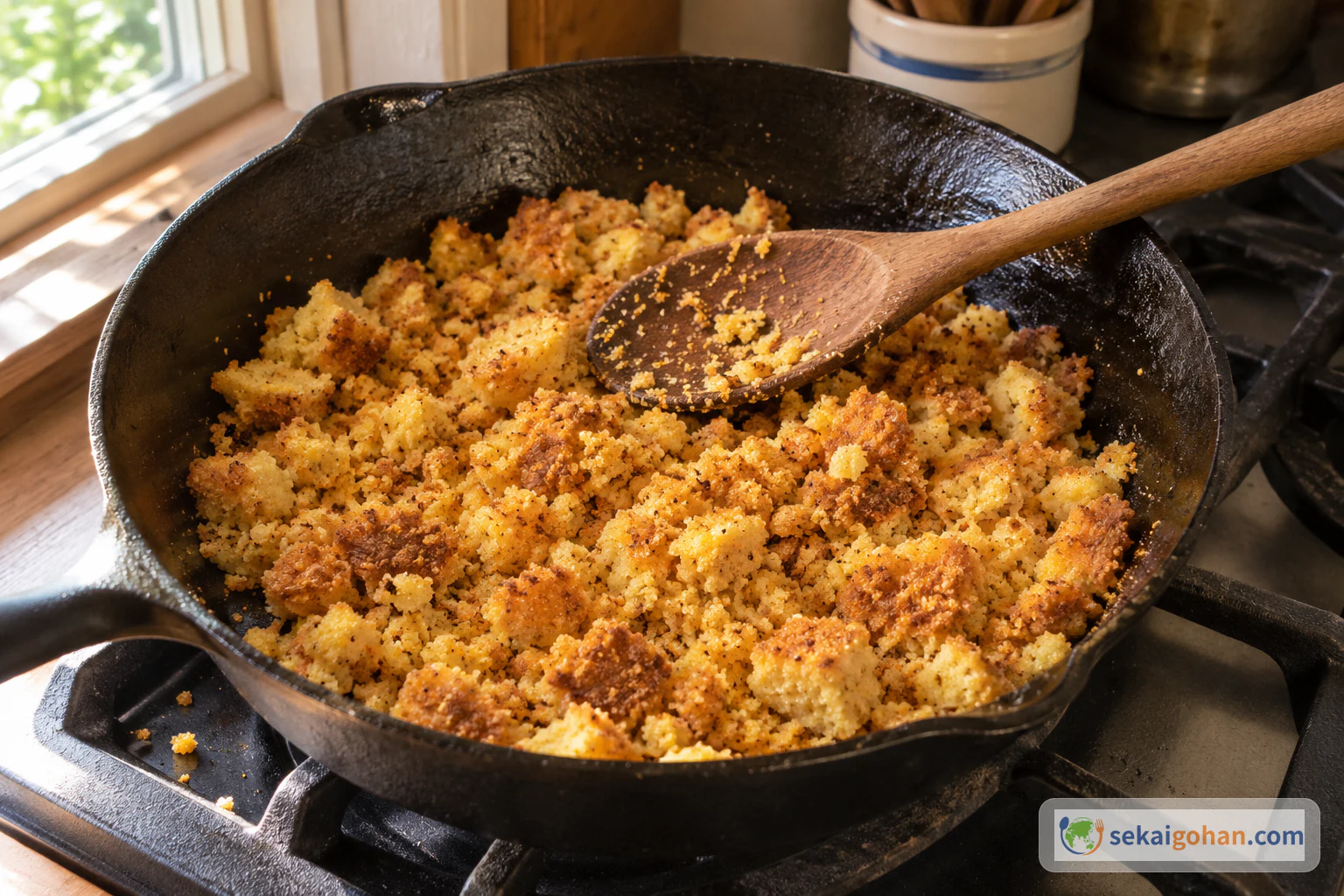
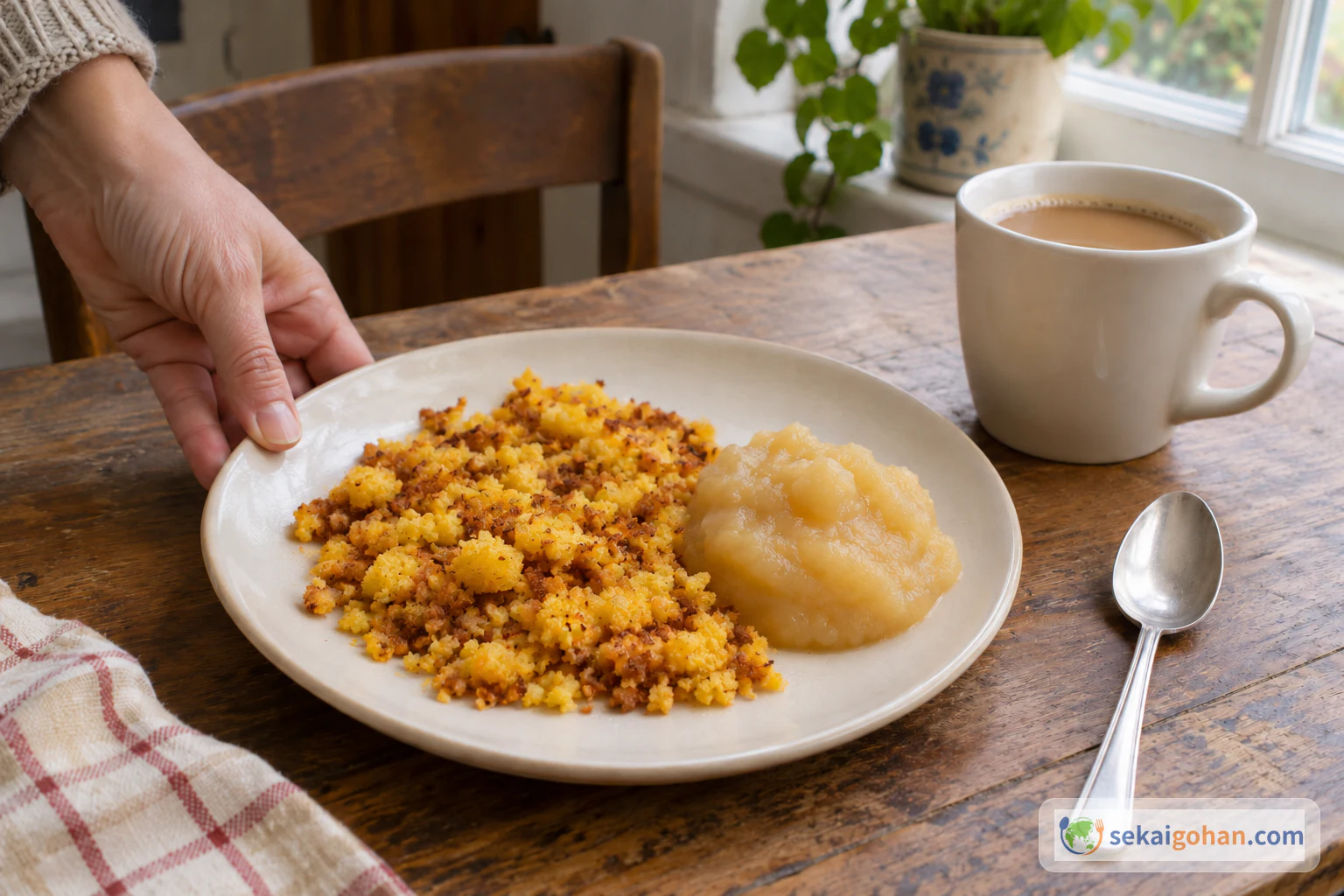
The cold porridge slides into the hot butter as one pale slab, and then the wooden spatula comes down on it. Press, drag, turn, press again. The slab cracks into lumps, the lumps into uneven crumbs, and the pan slowly fills with small golden grains that smell of browned butter and toasted corn. That is Riebel, the corn dish of the Rhine Valley in Vorarlberg, the far western corner of Austria. White coarse corn grits are cooked in milk and left to set, then fried and broken up until every crumb is crisp outside and soft within. It tastes sweet and plainly of corn, and it comes to the table with a spoonful of apple sauce and a cup of coffee.
A Breakfast Named After a Hand Movement
The name is the method. Riebeln means to press and rub something apart, and that is exactly what the spatula does in the pan: it pokes, presses and divides the set porridge until it falls into round, browned, irregular grains. In Vorarlberg the dish is written Riebel; across the river on the Swiss side it is Ribel, and in the dialect of the high valleys it becomes Riibel. Some households call it Stopfer or Pflutta, and in the Montafon valley it goes by Brösel.
Elsewhere in Austria, a close relative is called Sterz or Türkensterz, because corn was long known as Türken, "Turkish" grain. Corn reached the Rhine Valley by way of Italy, where it was called gran turco, and the name travelled north with it. Polenta, Moldovan mămăligă and East African ugali all start the same way, with corn cooked into a porridge, and there they stop. Riebel goes a step further: the porridge is chilled, then fried and broken into crumbs, and that step gives it a texture none of its cousins have.
On the Swiss side, "Rheintaler Ribel" (also Türggen Ribel) has been a protected designation of origin since 2000. The name protects the milled corn, not the cooked dish: a white to beige product with a sweet, pronounced corn aroma, milled and packed inside the protected area.
How corn overtook spelt
Corn appears in the Rhine Valley records from the middle of the 17th century. In 1650 it turns up in the income of the parish priest of Balgach, on the Swiss bank level with Dornbirn, and in 1682 several farmers in Hohenems paid their tithe in "tirckhisch Korn". By around 1800 it had overtaken spelt, until then the main grain of Vorarlberg, and through the 19th century corn was the most important staple grain of the valley. Planting peaked in 1869 at 1,832 hectares, centred on the Dornbirn district.
The corn was white, and that mattered. White cornmeal mixed into wheat flour could hardly be told apart from it, which made the white kernels prized. The local landrace is a late-ripening flint corn with long cobs and beige-white kernels; it tolerates cold, needs a much longer season than other varieties, and the warm autumn föhn wind helps it ripen. Farmers grew it among cabbages and beans, picked it by hand, tied the cobs in twos and threes and hung them to dry, then milled them in three grades of coarseness: for porridge, for fried Riebel and for bread.
From the farmhouse breakfast to today
Until about the 1970s, Riebel was the food of poor and farming families, eaten mostly for breakfast. It was filling, meatless and cheap. The porridge was cooked the evening before, covered and left overnight, and in the morning it was fried in butter or lard for up to an hour. Coffee went with it, and in leaner times that meant unsweetened malt coffee; some people dunk their Riebel straight into the cup. Mountain huts still serve it for breakfast with cinnamon, brown sugar and freshly cooked apple sauce, and at home it is now just as often a midday or evening meal.
The fields shrank through the 20th century. On the Swiss side, Riebel corn covered only about 4 hectares by 1997. In Vorarlberg there was a last revival for home use after the Second World War, until grain from eastern Austria became easier to get after the 1955 State Treaty. By 2005 the province grew 42 hectares of grain corn, 365 tonnes, almost all of it for animal feed, and Riebel corn survived on a scattering of small plots. Around that time a grower in Lauterach began replanting the old variety, and others followed. The white Vorarlberg Riebel corn is now on the Ark of Taste list of endangered foods, and the lower Rhine Valley is the only place north of the Alps where this corn is grown for Riebel.
One name, many pots
Every valley has its own pot. Some cooks use a great deal more milk for the same grits, some less, and plain water or half water, half milk has long been used too. In the Bregenzerwald some households mix wheat semolina in with the corn and cook the whole thing in the pot, pushing hollows into it and filling them with butter again and again until a large amount has gone in. The recipe below is the classic Vorarlberg one and one of the lightest: a spoonful of fat for frying, and the crumbs taste mostly of corn and milk.
Ingredients (serves 4)
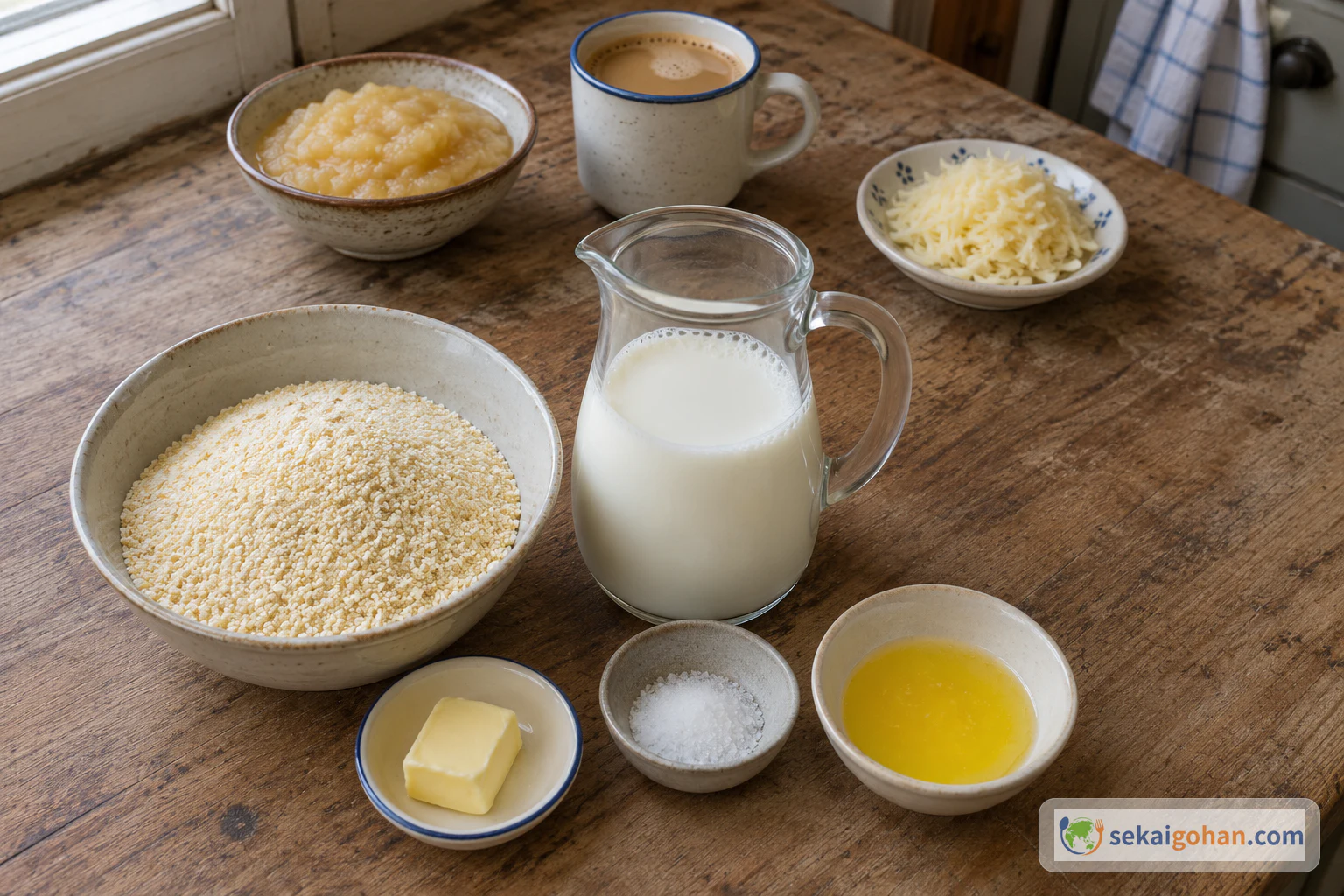
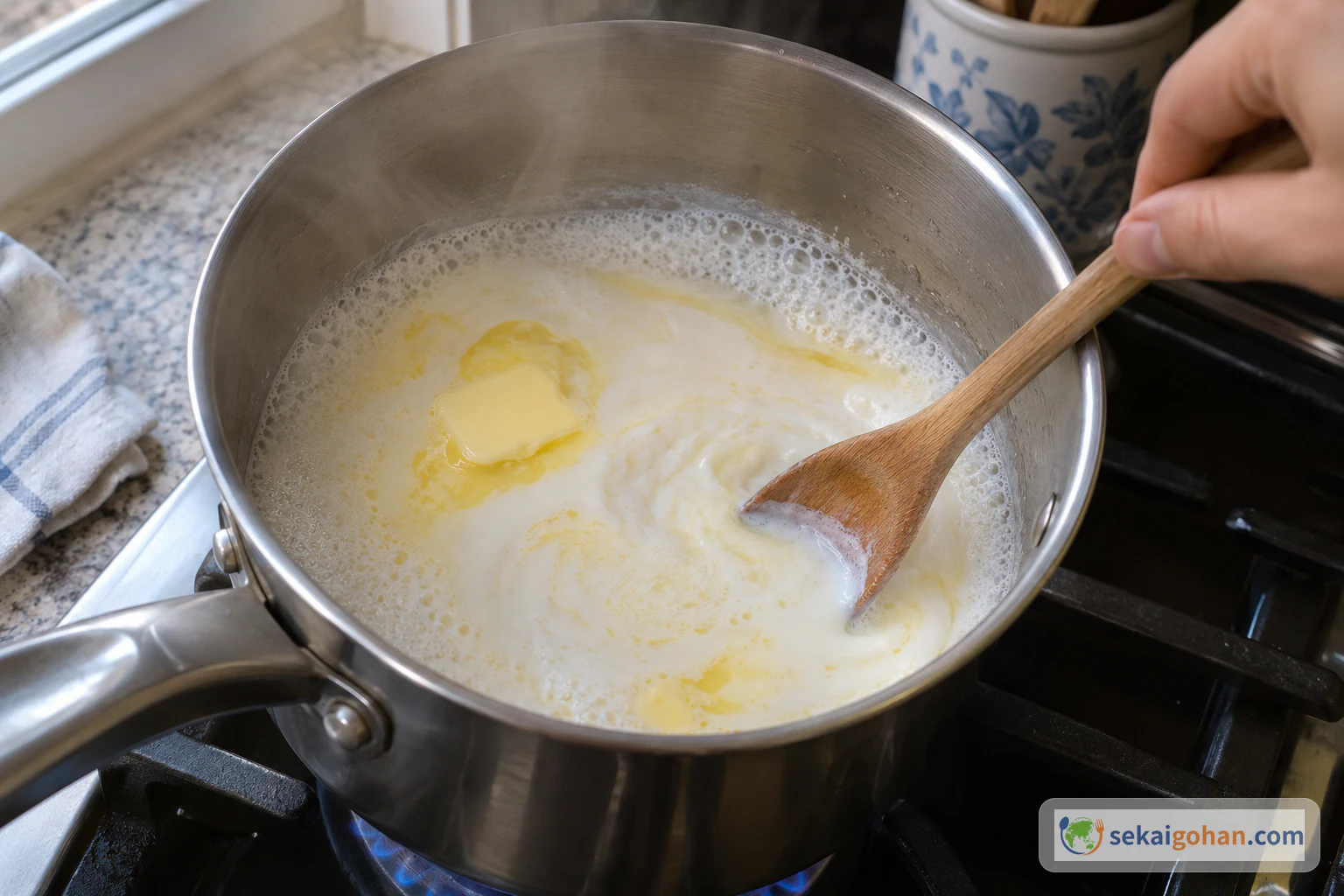
The butter goes into the boiling milk and disappears into the porridge. The clarified butter is for the pan, where it can take long, gentle frying without burning. Keep them separate; using plain butter for frying browns faster and needs closer watching.
Riebel contains milk in the milk, butter and clarified butter, and more with the cheese version. A version made with corn grits only is gluten-free; versions that mix in wheat semolina contain gluten, so check the grits label. Anyone allergic to corn should avoid the dish. Check the labels on clarified butter, cheese and jarred apple sauce as well.
Equipment
- Heavy 2-quart saucepan with a lid
- Cast-iron or heavy 9½-inch (24 cm) skillet
- Broad, flat wooden spatula
- Shallow container with a cover for chilling (two for a larger batch)
Choosing Grits, Milk and Fat
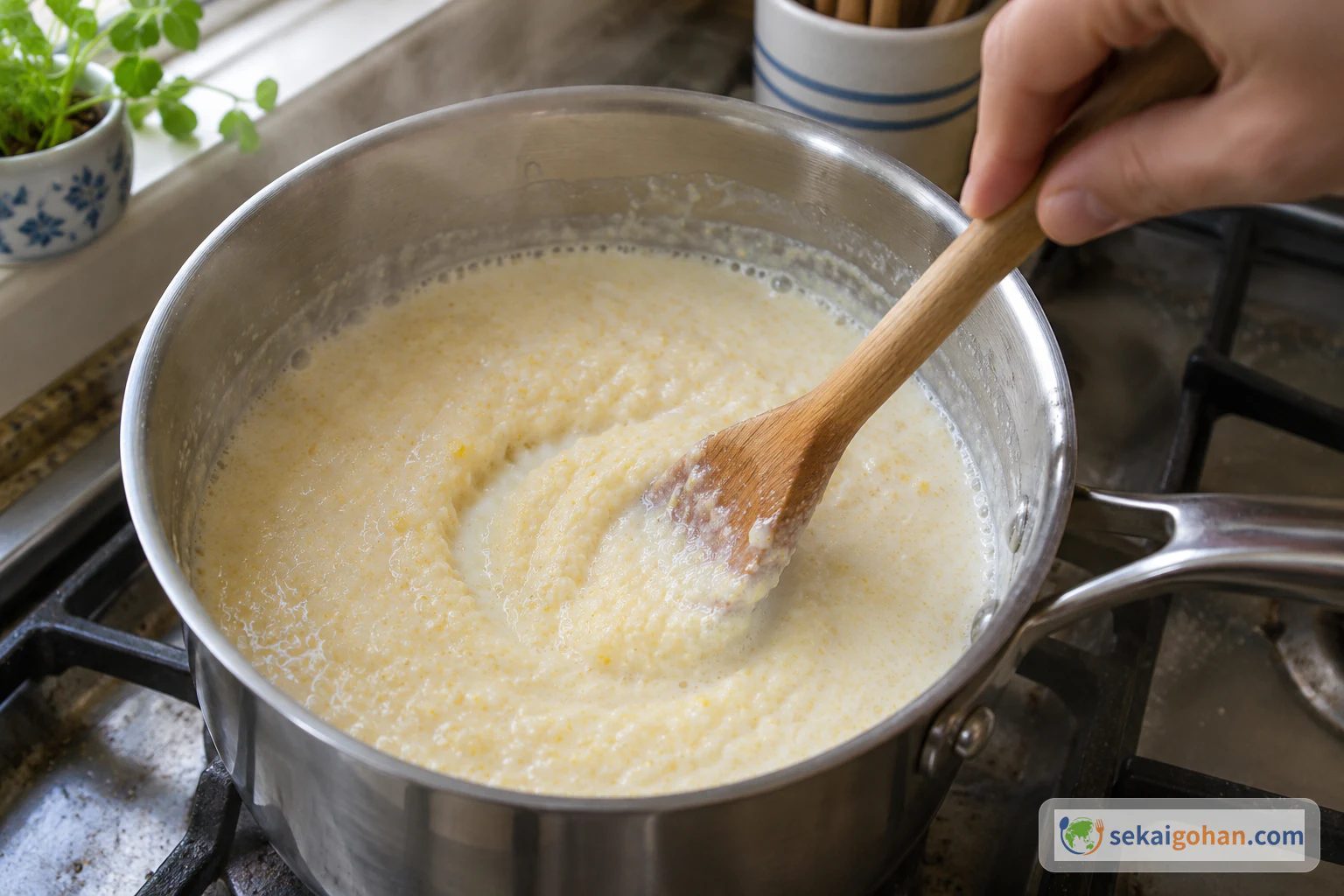
The one thing to get right is the coarseness of the grits. White Riebel corn grits are the real thing; if you cannot find them, coarse corn grits or a polenta labelled coarse will do. The coarse grain is what lets the porridge fall apart into crumbs.
| Swap | What changes |
|---|---|
| Yellow coarse polenta instead of white Riebel grits | Works well; the crumbs turn yellow and taste a little sweeter |
| Instant or fine polenta | Avoid it; it is finely milled and usually precooked, and it smears instead of breaking into grains |
| Two parts milk to one part water | Lighter and less rich |
| Salted butter in the porridge | Adds salt on top of the salt; stay with unsalted |
| Ghee for Butterschmalz | The same clarified butter; no change |
| Unsalted butter plus a little neutral oil for frying | Close enough; burns more easily, so keep the heat low |
| Unsweetened apple purée | A good stand-in for Austrian Apfelmus |
| Any hard Alpine-style mountain cheese | Fine for the cheese version; it should melt and string |
Keep the coarse grits, the salt in the milk and the slow frying, and the dish tastes of the valley wherever you cook it. The exact Vorarlberg corn and Butterschmalz are the parts you can let go.
Good grits feel like fine sand with distinct grains, not like flour. If the bag in your hand feels powdery, keep looking.
Method
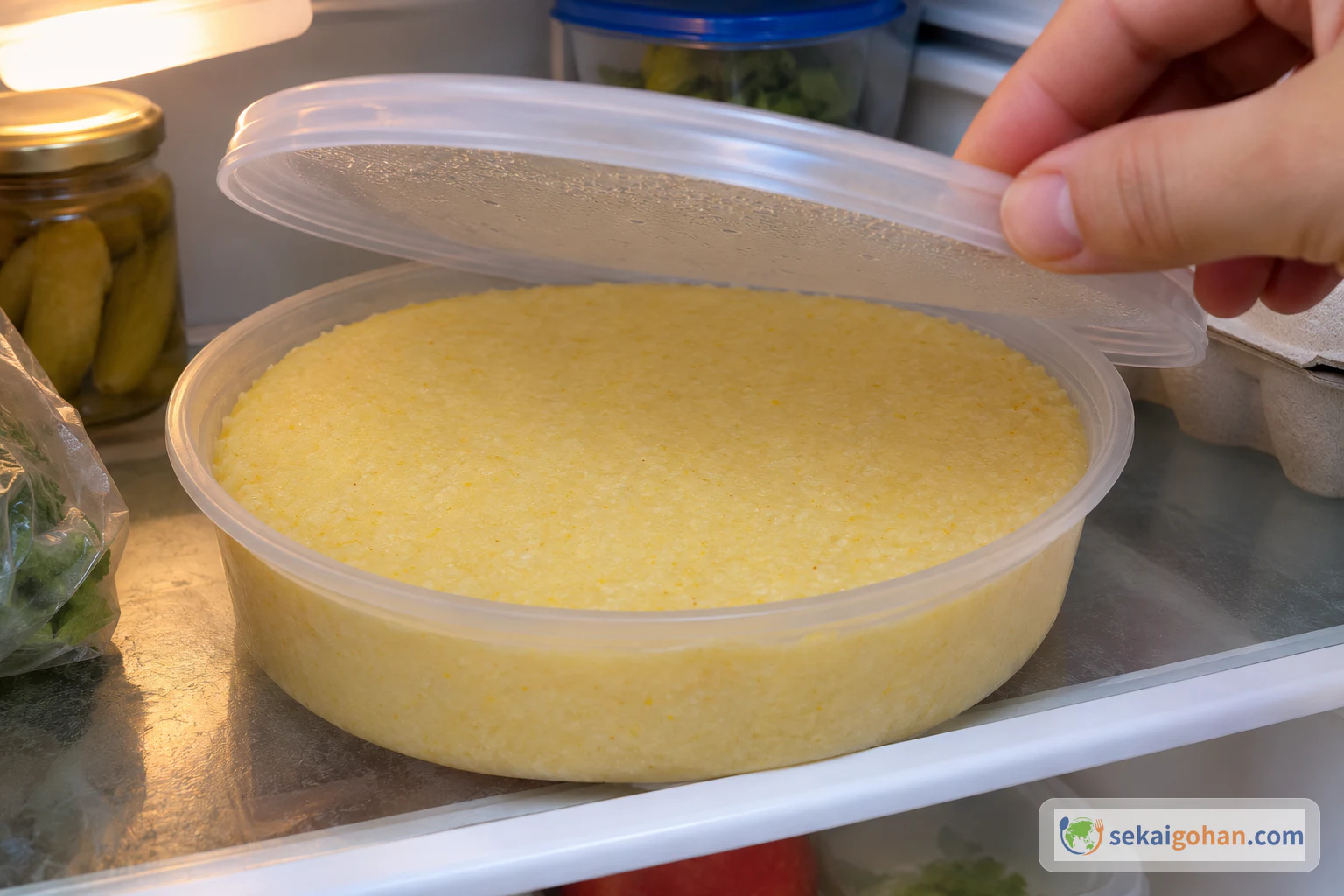
The porridge comes first, and it needs time to set, so make it in the morning for supper or the evening before for breakfast. The chilling is all hands-off. The frying is where your attention goes: 30 to 40 minutes of steady, gentle turning and pressing at the stove.
The old farmhouse pot stood covered overnight in the kitchen. At home today, the porridge goes into the refrigerator. Bacillus cereus survives cooking temperatures and can multiply quickly within hours as cooked food cools at room temperature, forming a toxin that reheating does not destroy. Do not leave cooked porridge unrefrigerated for hours. Keep the fridge below 41°F (5°C), split a large batch between two containers, and get the porridge below 44.6°F (7°C) within 2 hours.
Stirring only pushes the porridge around. Pressing down with the broad face of the spatula and dragging it is what splits the porridge into grains, and doing it every time you turn gives smaller, crisper crumbs.
When It Goes Wrong
| What you see | Why | What to do |
|---|---|---|
| The porridge smears into a soft, fried mash instead of crumbs | Not chilled long enough, or too little pressing | Chill until cold and firm right through; press and turn more often |
| Crumbs stick to the bottom of the pan | Heat too high or too little fat | Lower the heat, add a little clarified butter, scrape under the crumbs each time you turn |
| The crumbs are dry and fall to dust in the mouth | Too little fat, or fried too long | Slide a little butter under the crumbs at the end; use more frying fat next time |
| The taste is flat | The salt went in late or not at all | Salt belongs in the boiling milk; rescue the plate with grated cheese or a little sugar |
| Dark, bitter crumbs | Heat too high, or the pan was left alone | Stop at yellow to light brown; stay at the stove through the frying |
| Lumps of dry grits in the porridge | Grits went in too fast without enough stirring | Rain them in slowly while stirring constantly |
Serving, Variations and Leftovers
At the table
The everyday plate is Riebel with apple sauce or compote and a cup of coffee. Put sugar and cinnamon on the table too: sprinkled over the crumbs, they meet the tartness of the apple and push the plate toward dessert. A wedge of Vorarlberg cheese on the side works for anyone who wants their breakfast less sweet.
Variations
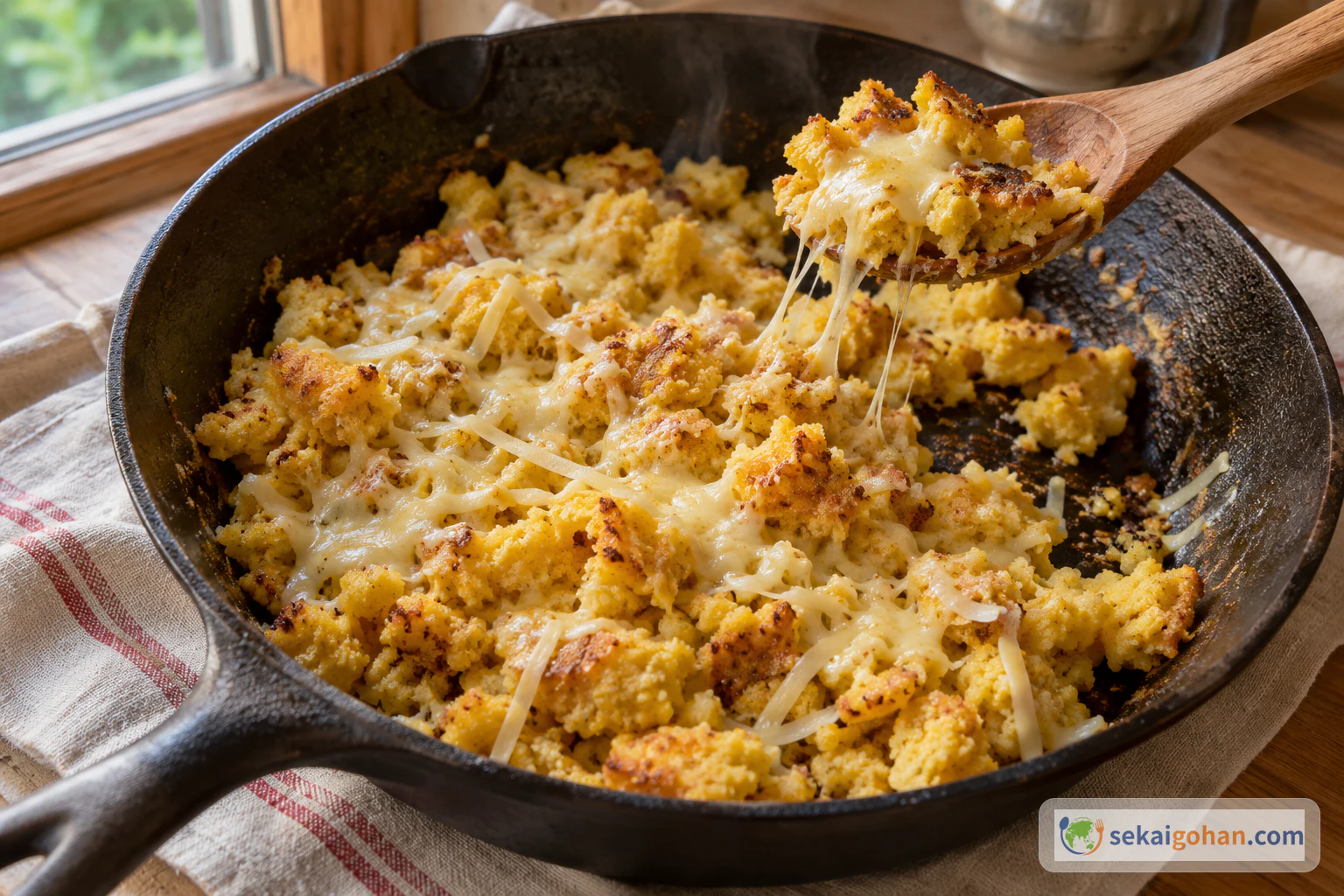
- Kääsriibel, with cheese. Scatter coarsely grated mountain cheese over the hot crumbs in the pan. It melts into strands that cling to the grains, and the salt and richness make a savoury plate for people who do not want sweet in the morning.
- With mushrooms. Fry mushrooms together with the crumbs. They bring savoury depth and turn Riebel into a main dish.
- Valley versions. Households in the high valleys make Riibel with cream, potatoes, apples or cherries cooked in, or serve it with the browned butter residue scraped from the bottom of the pan.
Leftovers
Cool leftover Riebel quickly, refrigerate it promptly in a covered container, and eat it the next day. Reheat it in a pan until every part is hot, above 158°F (70°C) throughout; a microwave heats unevenly. Throw away any Riebel or porridge that has stood at room temperature.
Frequently Asked Questions
Can I use water instead of some of the milk?
Yes. A mix of two parts milk to one part water is a classic choice, and water alone or half water, half milk has long been used in the valleys too. The more water, the lighter the porridge and the less rich the crumbs.
Can I skip the chilling and fry the porridge warm?
Warm porridge smears in the pan; cold, firm porridge breaks into grains, so chill it for this version. Some Bregenzerwald households do cook Riebel in one go in the pot, working a large amount of butter into it until it breaks up, but that is a much richer dish with a softer texture.
How much fat is right?
This version uses very little, so the crumbs come out light and dry with a clean corn taste. More butter or clarified butter makes them moister and helps them hold together, at the cost of that lightness. Add it a spoonful at a time during frying until the crumbs have the texture you like.