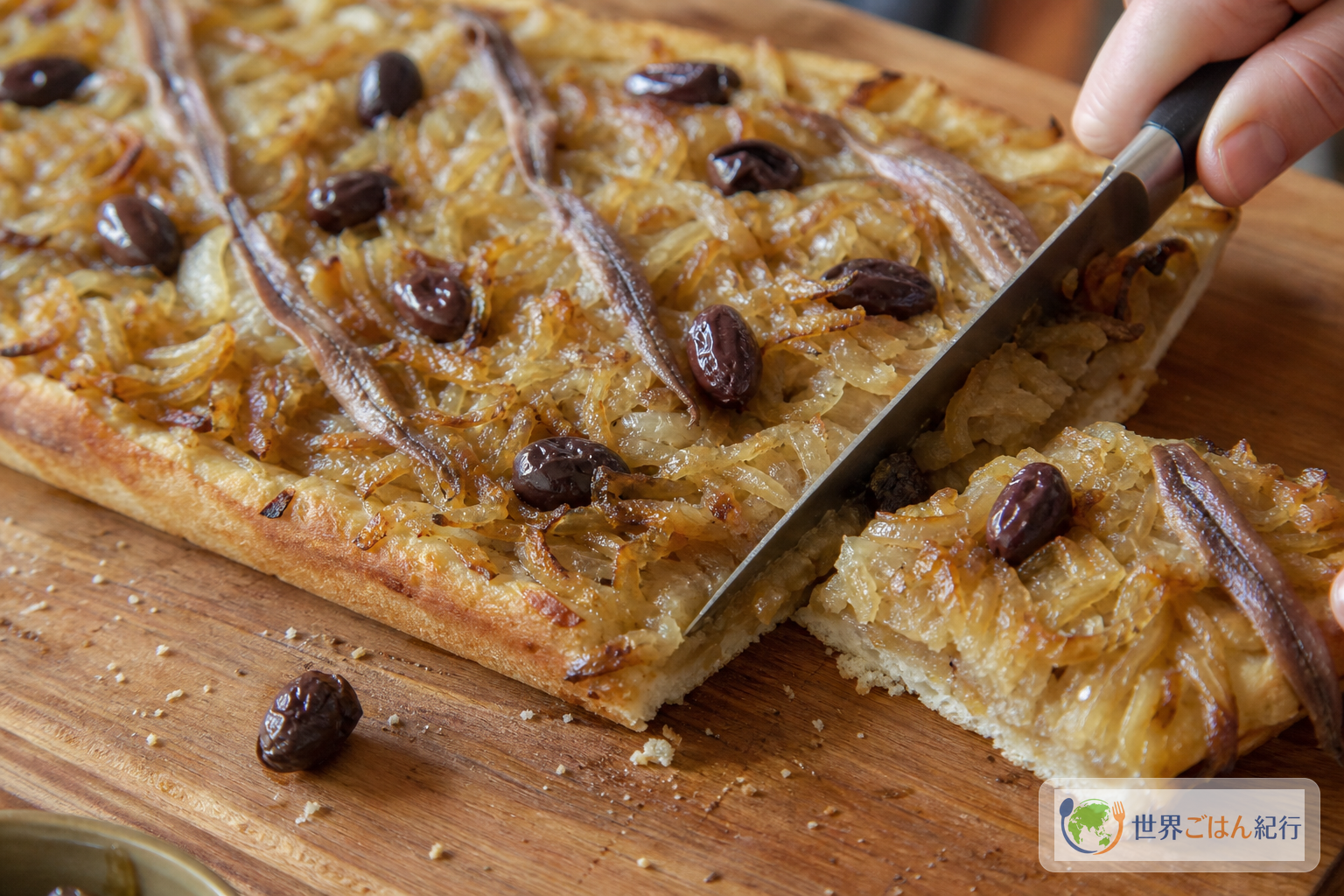
Onions sinking into sweetness: a slice of morning in Nice
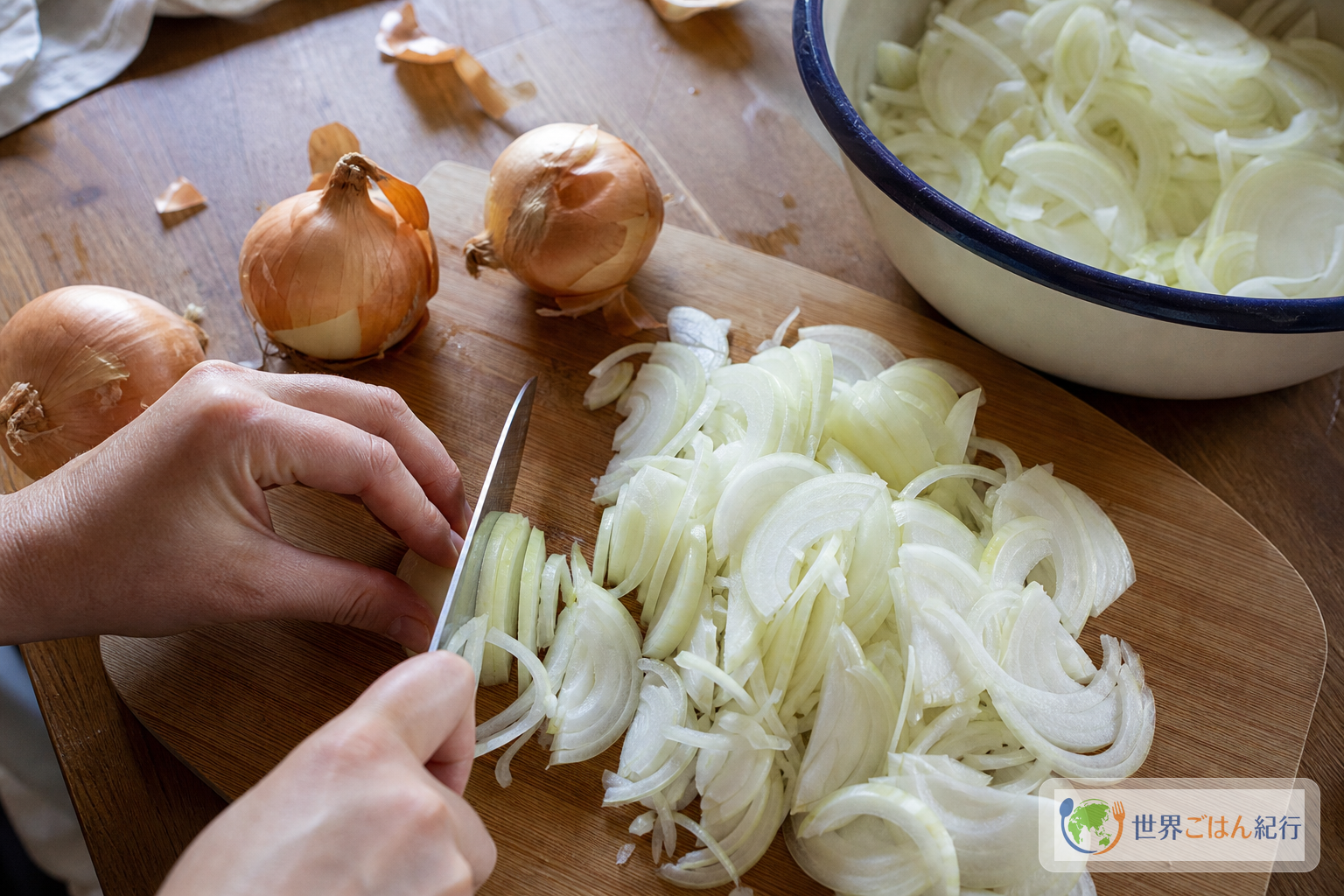
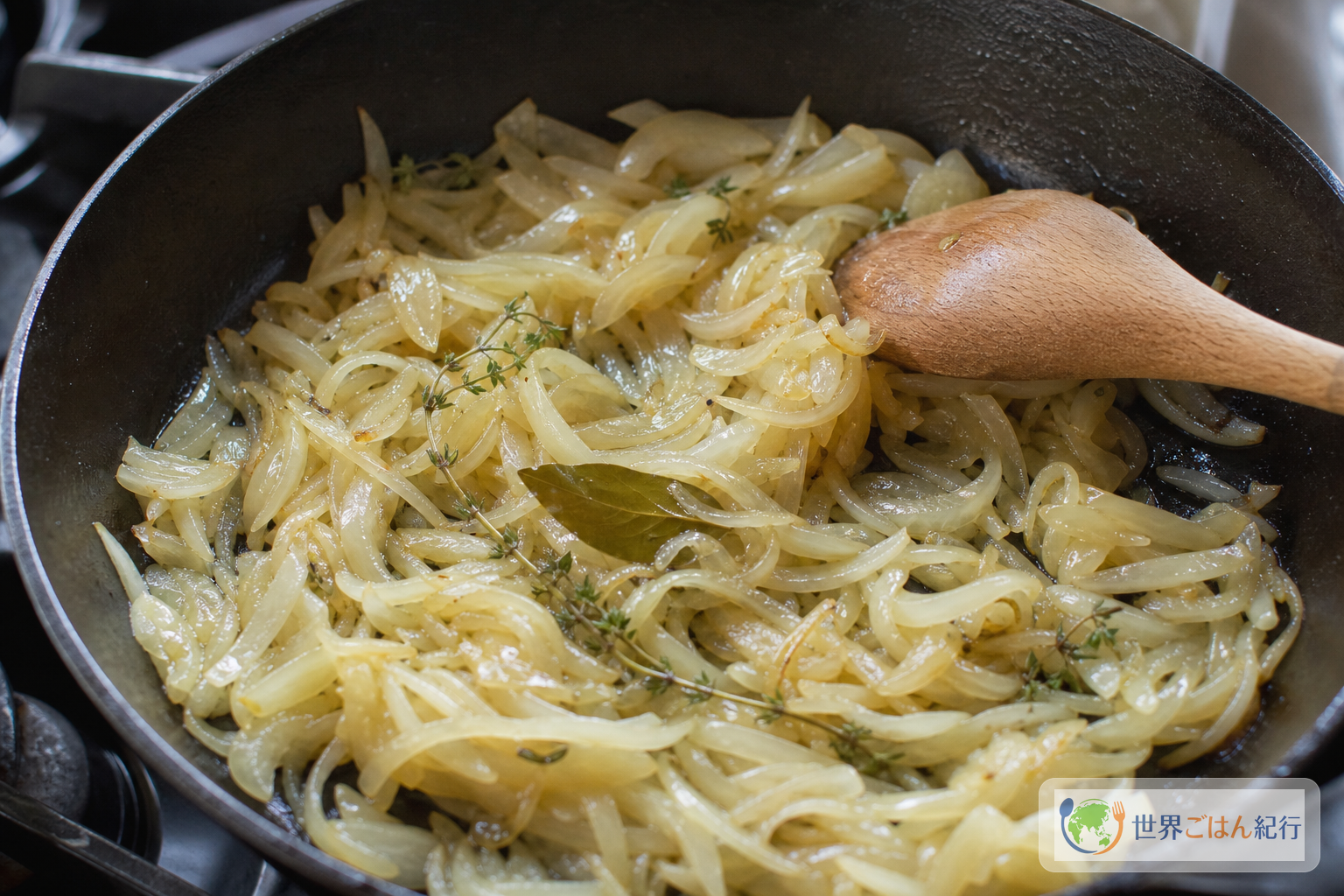
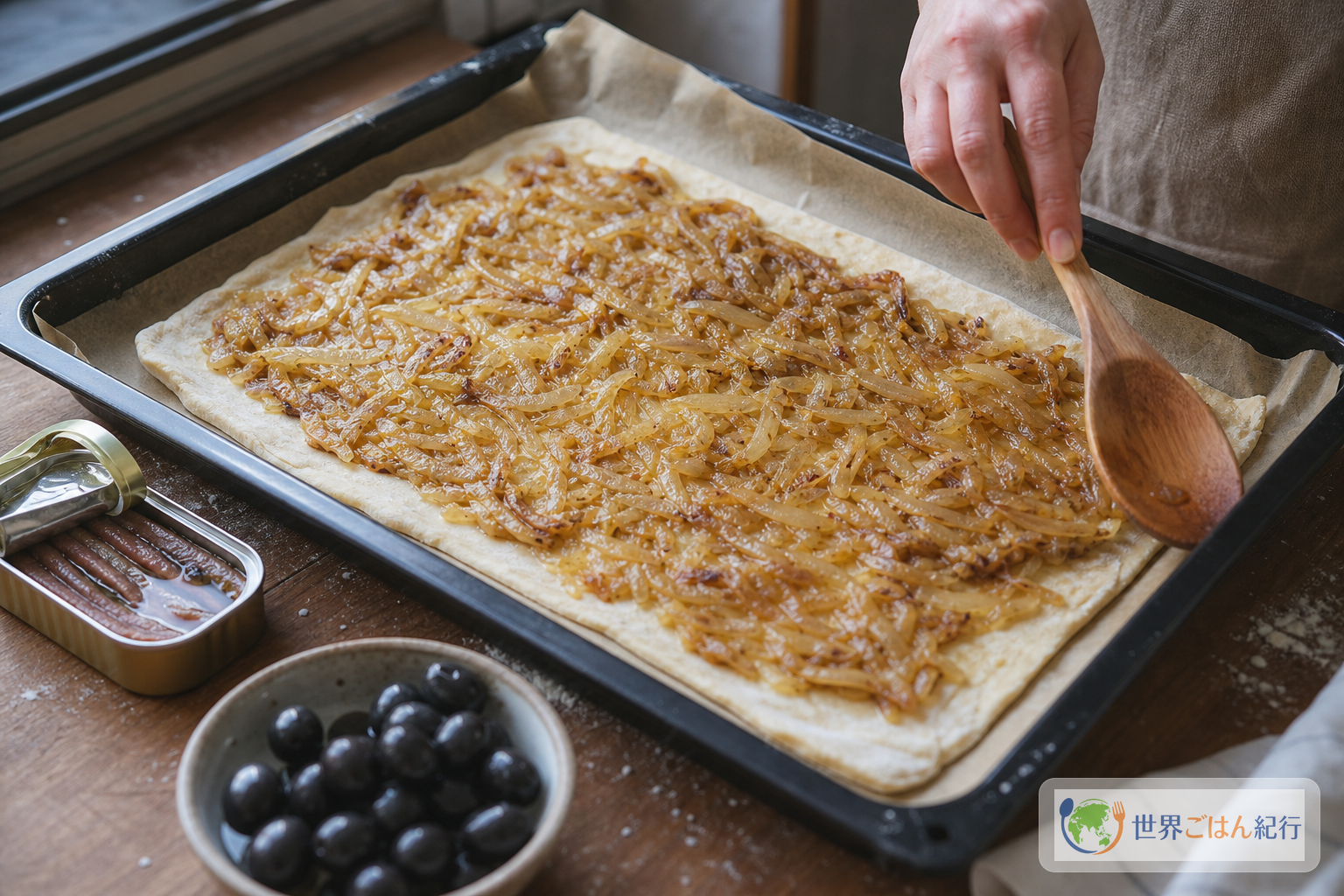
Slice onions thin and let them go slowly translucent in olive oil, and the air in the kitchen leans a little toward the seaside. The bread dough is still pale, the tin of anchovies only just opened. But when you push the onions aside with a wooden spoon and a sweet juice is left on the bottom of the pan, half of this dish is already decided.
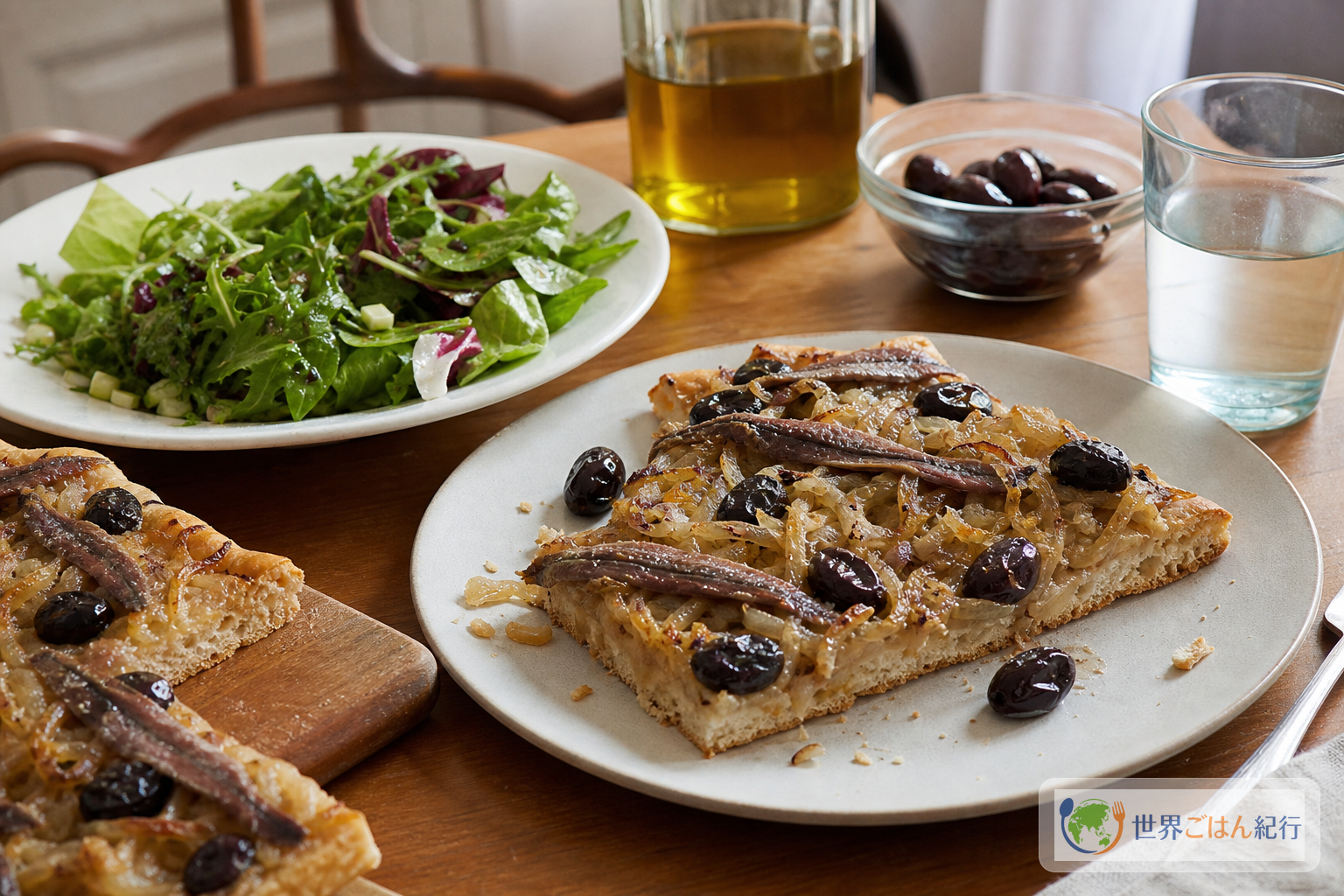
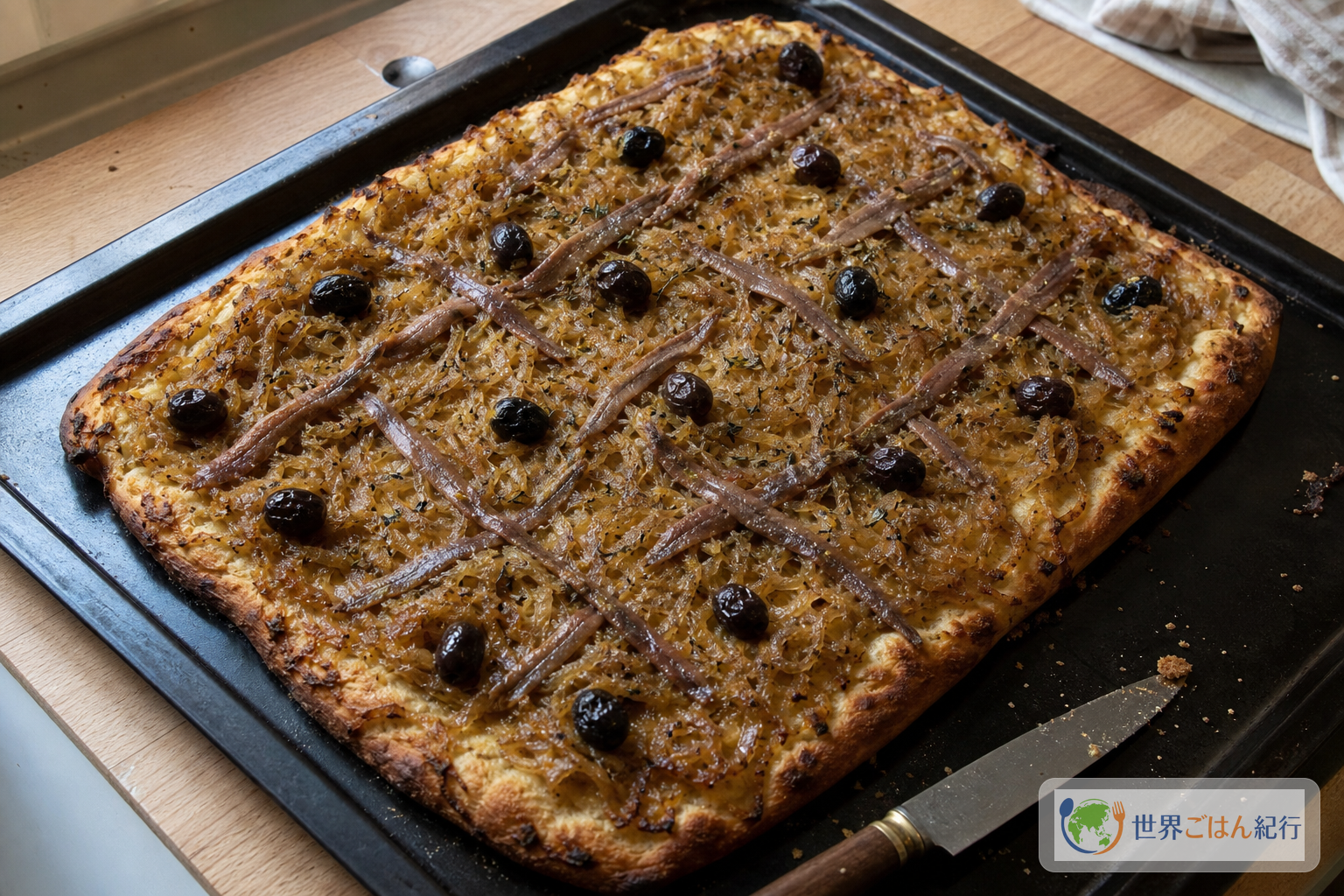
Pissaladière is a flat bread dish topped with onions, anchovies and black olives, loved in Provence in southern France, especially around Nice. It looks like pizza, but it is not a dish that leans on tomato sauce or cheese. The onions, piled thick, are the star; the anchovies and olives draw lines of salt across them.
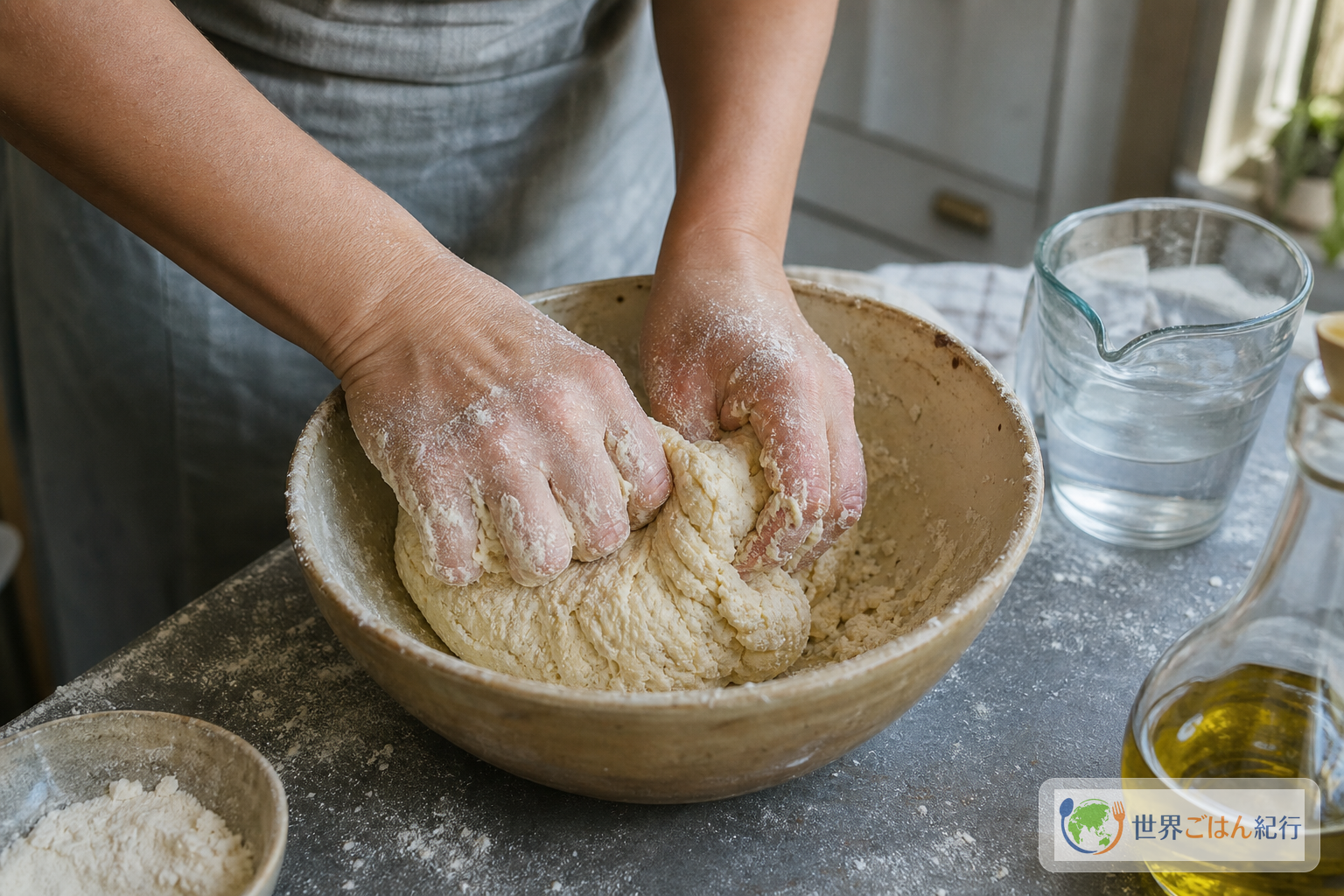
Here, the quantities are set for a home kitchen, and the dough, the heat for the onions, the placement of the anchovies and the choice of black olives are each explained separately. A store-bought pizza dough can get you close, but try making the dough from flour at least once. The soft, puffy base that catches the oil from the onions is the pleasure of this dish.
Pissaladière is not a dish where you scorch the onions for a toasty flavor. The core is 30 minutes or more over medium-low to low heat, taking the onions from translucent to pale amber. Anchovies are very salty, so go easy on the salt in the onions, and don't desalt the black olives too much, so they keep their edge.
Background: a southern French snack raised by bakeries and markets
The name pissaladière still carries the shadow of pissalat, the Niçois word for a salted fish preparation. Pissalat is a fish condiment made by curing anchovies or small fish with salt and herbs, and in homes today it is usually replaced by salt-packed anchovies or anchovy paste. So pissaladière is less an "onion tart" than a port-town preserved-food dish in which the salt of fish tightens the sweetness of onions.
The food culture of Nice is not closed in on the sea. Vegetables from the hills, olive oil, salt-cured fish, the dough of the bakery and the focaccia culture of neighboring Liguria all overlap. In English and Spanish food writing, pissaladière is placed somewhere between pizza, focaccia and tart, but to keep it faithful to the place, don't drop the thick layer of onions, the bread dough, the anchovies and the black olives. Adding cheese or tomato makes it easier to eat, but moves it toward a different Mediterranean bread.
There are regional variations. Around Menton there is the tomato-based pichade and talk of tarts without anchovies, and on the Italian side in Liguria there are related dishes called piscialandrea and sardenaira, which lean on tomato and garlic. Rather than mixing all these neighbors together, it keeps the flavor clearer to focus first on the Niçois framework: pile the onions thick, leave out tomato sauce and cheese, and let anchovies and black olives work, even in small amounts. Keep to that and ordinary supermarket onions still give you the feel of a southern French snack.
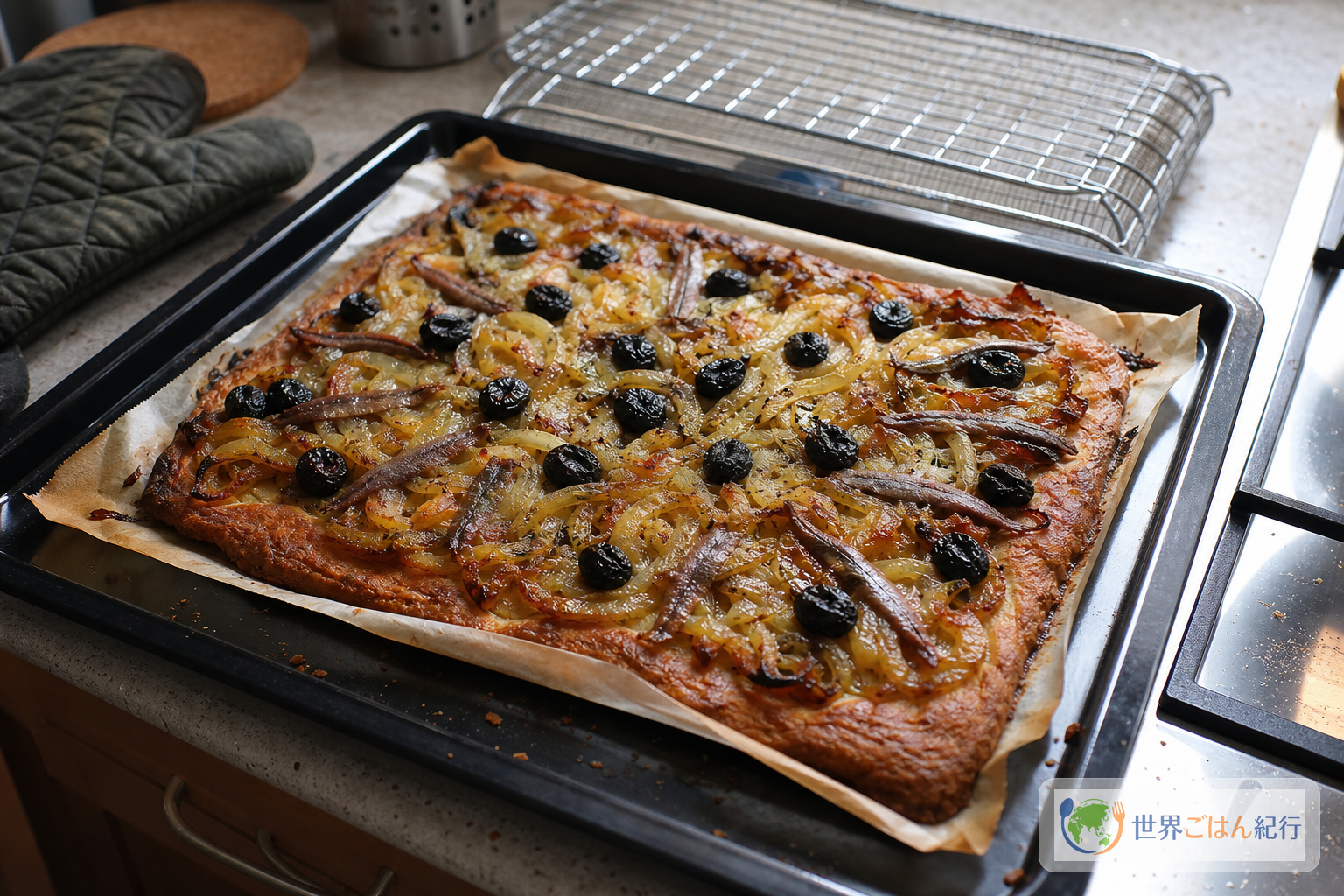
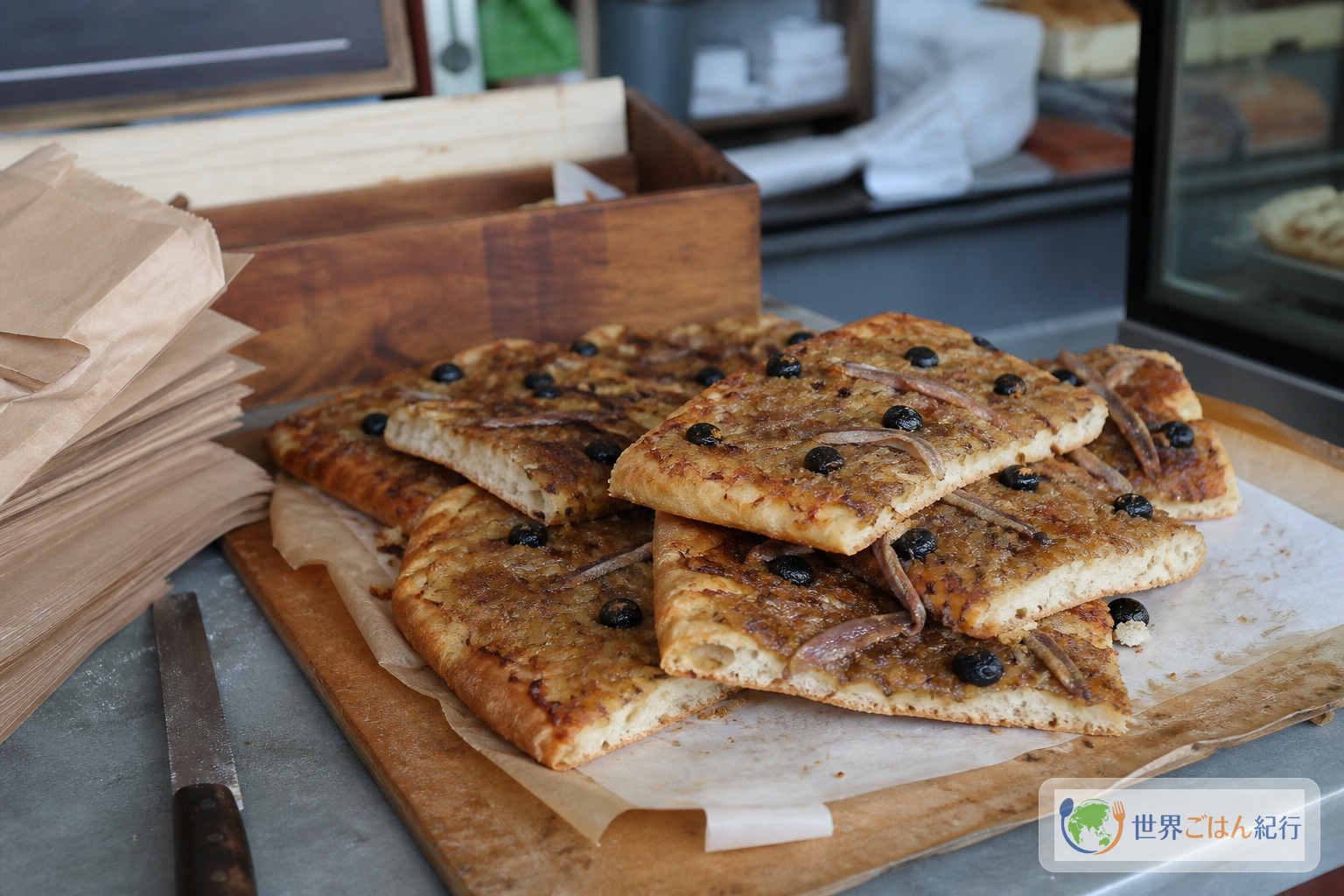
Seen as a market food, pissaladière is baked large in one piece and handed over cut into portions. Rather than a grand finish on a plate, what matters is a thickness you can hold in one hand on paper, a moisture level at which the onions don't spill too much as you walk and eat, and a bake that leaves the dough moist with oil even when cold. At home too, aiming for the stretchy cheese moment of a hot pizza throws the dish out of focus. Letting it sit 5 minutes after baking, and cutting once the oil from the onions has settled into the dough, gives the calm of a Niçois snack.
The dish is easy to make in a home kitchen because you don't need to buy lots of special meat or seafood; the cooking of the onions creates the satisfaction. But with so few ingredients, there is little room to hide. Onions cooked over high heat to dark brown turn into sweet jam, and too many anchovies make a salty deli item. Place the dough, the onions, the salt of the fish and the bitterness of the olives each half a step restrained, and it doesn't tire you as you keep eating.
At the table: not a hot pizza, but a slightly settled snack
Making pissaladière at home, it is easy to think of it as a "southern French pizza," cut it hot out of the oven and go looking for a substitute for cheese and tomato sauce. But the pleasure of this dish is not cheese stretched by heat; it is the sweetness of the onions and the salt of the fish, nearly cool, slowly loosening in the mouth. Picturing a table around Nice, it is closer to cut pieces set beside a starter, a light lunch or an evening drink than to one large pie in the middle of a plate.
So at home you don't need to build it heavily like a main course. At lunch, a leafy salad and cold water; in the evening, white wine or sparkling water and a few not-too-salty olives pull it together. For a table with children or someone who dislikes the smell of fish, put fewer anchovies on half of the tray and scatter finely chopped black olives on the other half. Sharing the onion layer and adjusting only the fish salt seat by seat is less forced than pressing the same taste on everyone.
To bring it to a gathering, bake it, cool it completely, cut it into 5 cm squares and layer paper between them. A base that isn't damp matters more than warmth. If you can't reheat it where you are going, cook the onions slightly firmer and bake 1 minute longer to dry the base well. By the time you eat it, the oil from the onions has gone back into the dough and the corners of the anchovies are rounded.
If you bake in the morning for lunch, cooling before cutting helps most. Stack it while still steaming and the steam from the onions goes back into the dough underneath, leaving the base you worked on pale and damp. Move it to a rack or wooden board for 10 minutes, and cut once the steam on the surface has calmed. If you wrap it in paper, don't seal it tight on every side; leave a small route for air. This is about texture more than looks.
Reading it as a Niçois snack: lunch made of bread, oil and salted fish
Niçois snacks are less about tying things together with showy sauces than about making lunch from bread, olive oil, vegetables and salted fish. Pissaladière is the side of that tradition that uses fire: onions sweetened over low heat, then put on dough and baked briefly at high temperature. On the no-fire side are dishes like pan bagnat, where bread soaks up tomato juice and olive oil. Both share the idea of not treating bread as a mere base. The bread takes the oil and vegetable juices and carries the salt of the fish, which is why lunch works with so few toppings.
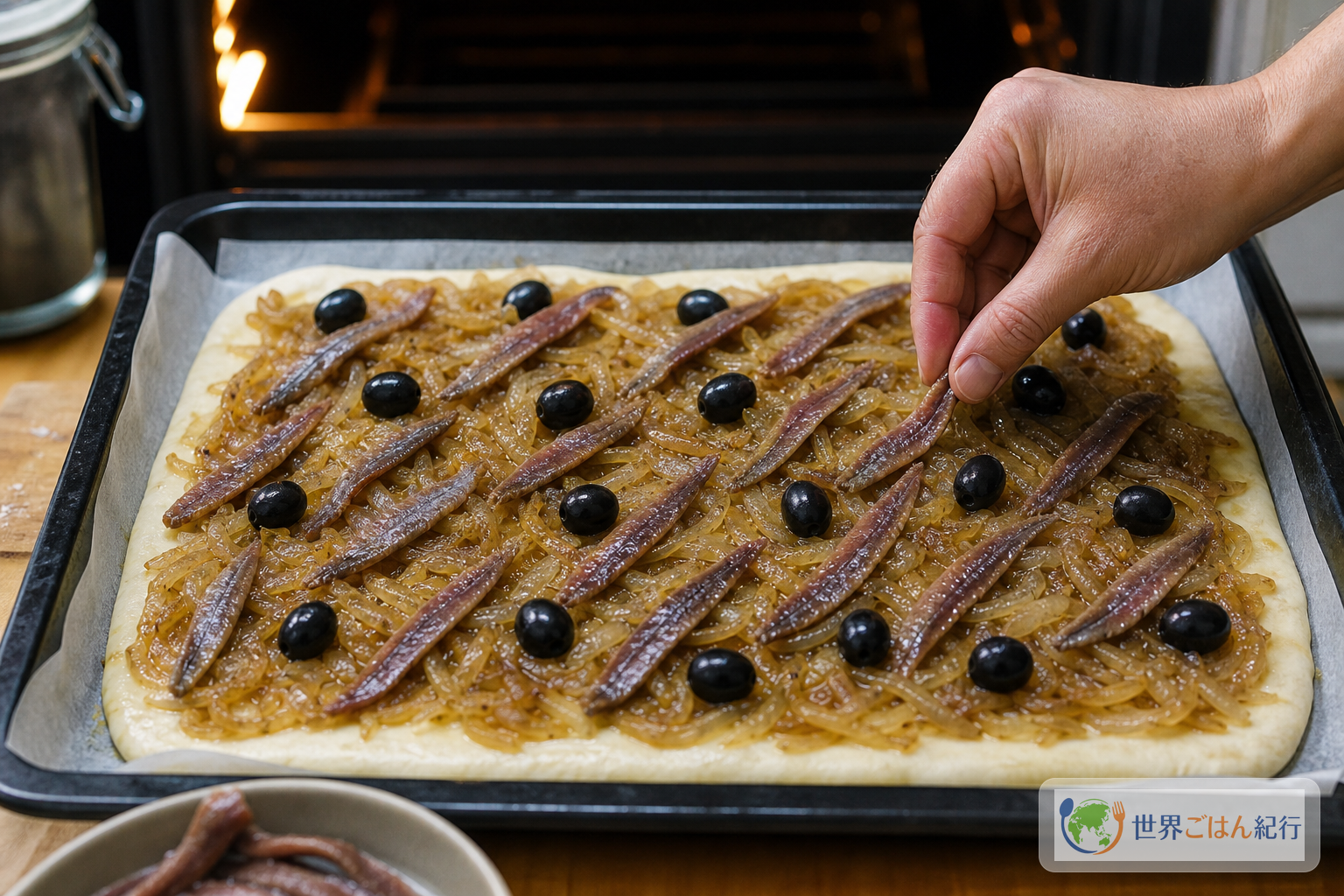
Once you hold that, your priorities at home change too. Rather than adding fancy cheese, don't scorch the onions. Rather than treating olives as black dots for decoration, treat them as a salty ingredient. More anchovies do not make it closer to the original; lay them as lines so that the sweet side of the onions remains. The Niçois character comes less from listing ingredients than from how oil and the water of vegetables are passed into the bread.
Compared with other Mediterranean bread dishes, Italian panzanella is a cold plate where hard bread soaks up the juice of raw vegetables, and Greek dakos is a plate where dry rusk is revived with tomato and oil. Pissaladière adds the step of sweetening onions over fire. So, depending on what you have, choose panzanella for a summer lunch, dakos on a day with lots of tomatoes, and pissaladière on a day you want to cook onions slowly. Putting a cold dish and a baked dish side by side keeps Mediterranean snacks from tasting too much alike.
Carrying follows the same thinking. Seal it hot and the steam from the onions softens the base. Cool it fully before wrapping it in paper, and use a container with a lid that has a little room, and the base is less likely to turn sticky. It is hard to move a dish eaten on a seaside bench into a lunch box unchanged, but if you keep the core — bread that has absorbed the oil, cooled and carried — it works for weekend potlucks and make-ahead lunches too.
If pan bagnat wets the bread with tomato juice and olive oil, pissaladière moves the oil and sweet water of onions into baked dough. What is interesting in both is that bread is not a dry platform. When recreating it, decide first which ingredient moistens the bread and which places the salt, and you avoid adding extra toppings. In pissaladière, the moistening is done by the onions and oil, and the salt is placed by the anchovies and olives. Keep that division and the core of the flavor stays even with a home oven and baking sheet.
Ingredients (serves 4)
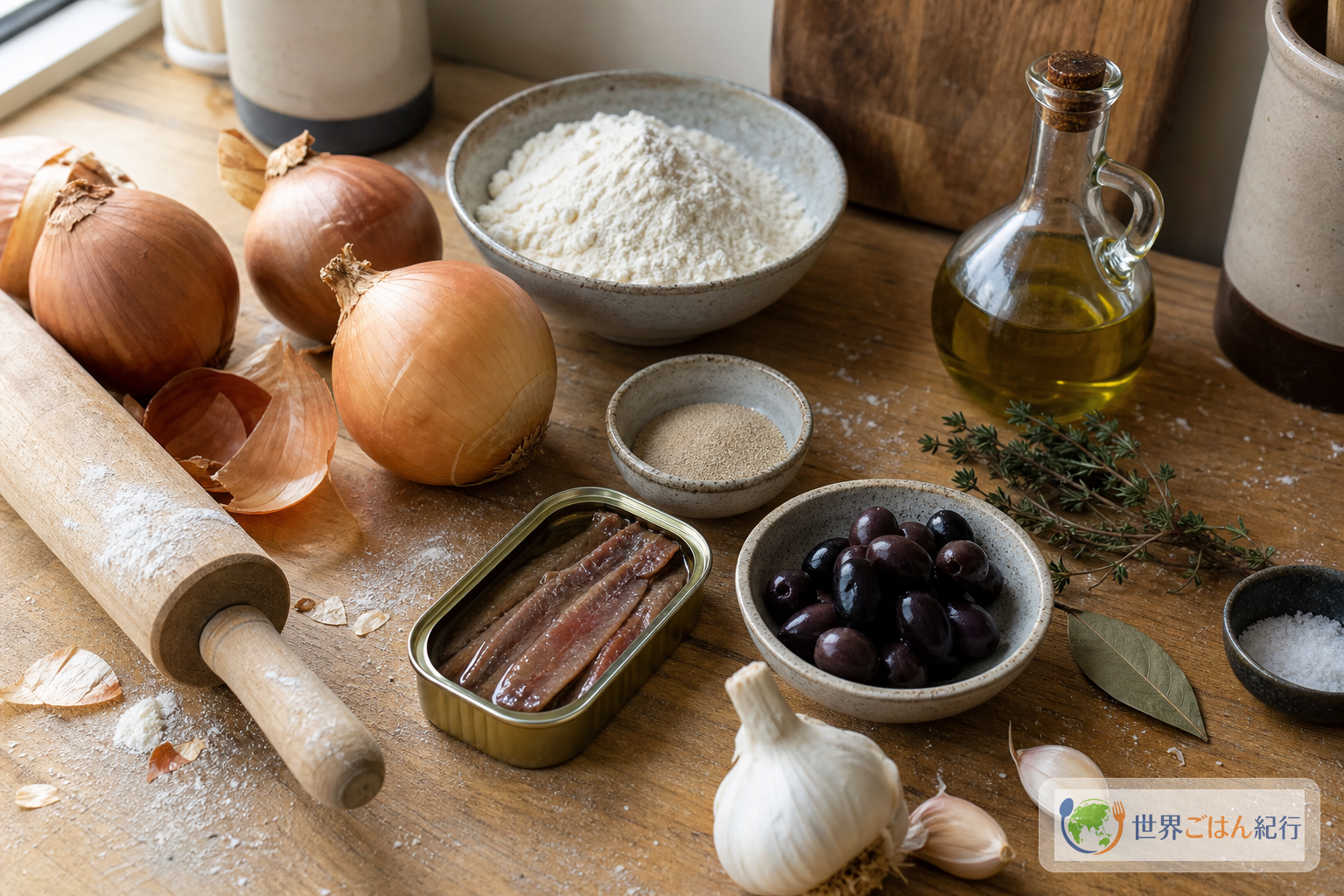
This fills one baking sheet of about 30 cm × 24 cm: 4 servings as a light lunch, about 6 as a starter. Onions shrink a great deal when cooked, so don't reduce them even if they look like a lot; that's what makes it pissaladière.
700 g of onions feels like a lot, but after cooking they take less than half the volume. If you reduce them on a first try, stop at 600 g and roll the dough slightly smaller to match. If you spread reduced onions across the whole sheet, parts of the dough go dry and only the salt of the anchovies stands out. The anchovies are given as a range of 10 to 12 fillets, but with a very salty brand, 8 is enough.
This recipe uses wheat and fish. Anchovies are high in salt, so if you are limiting sodium, start with half the amount. Without fish, black olives and a little capers can supply the salt, but as a dish name it becomes pissaladière-style.
Shopping: ordinary onions, and the tools worth looking for
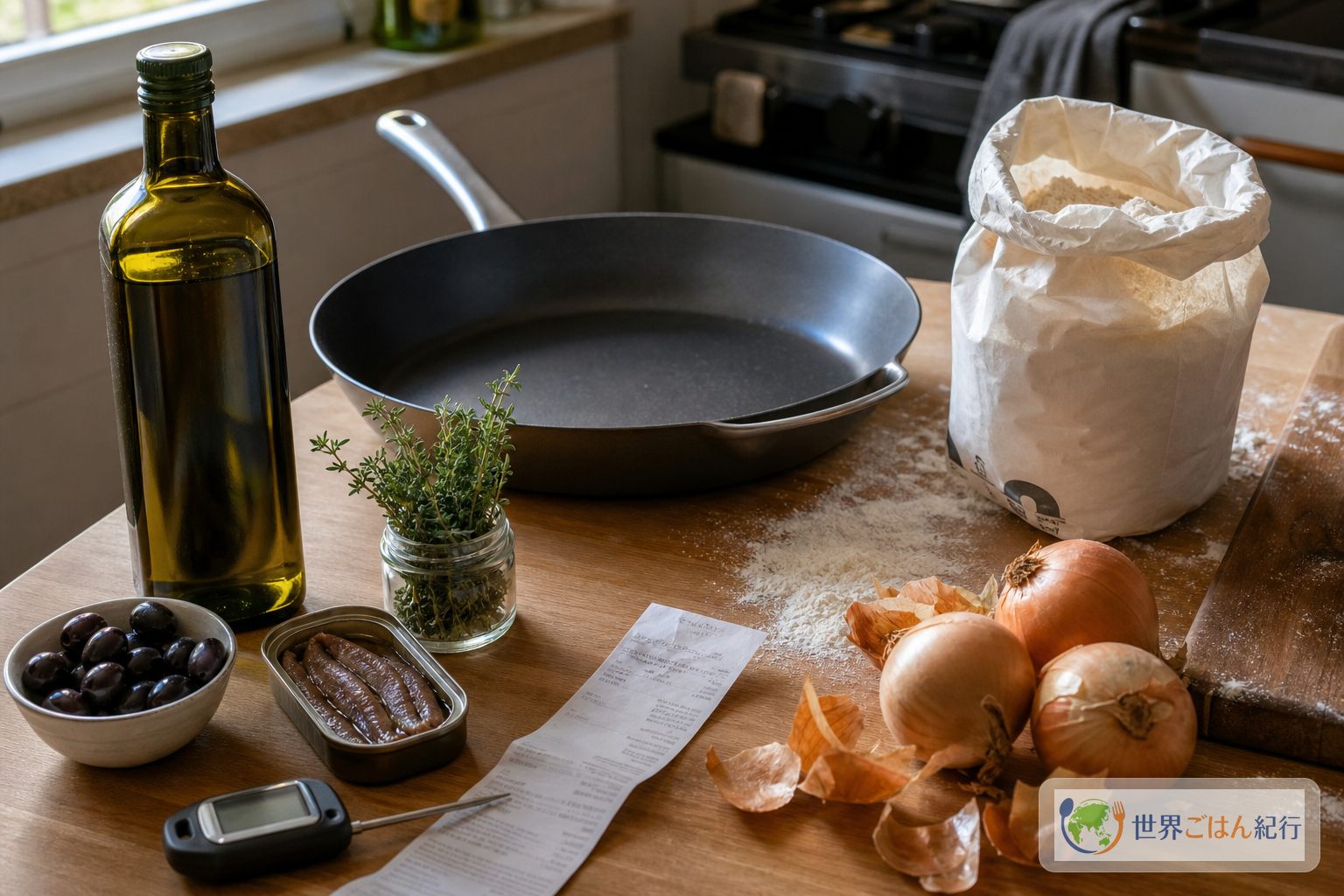
Onions, flour, anchovies and black olives can all be bought at an ordinary nearby grocery to start. What is worth considering beyond that is a fragrant olive oil, a rolling pin for stretching the dough thin and even, and a thermometer to check the lukewarm water and the baking temperature. For anchovies and black olives, saltiness matters more than brand, so try a small pack first, and if one is too strong, reduce the amount during the process.
On the other hand, onions, bread flour, dry yeast, tinned anchovies and tinned black olives are less likely to fail if bought fresh nearby than if assembled at a high price online. Choose onions that are heavy, with dry, tight skins. Anchovies should have oil that isn't cloudy. If the black olives have a weak brine aroma, blot off the water before using and add a pinch of salt if needed.
Choose anchovies that keep the shape of the fillet and whose oil doesn't smell oxidized. Cheap tins of finely broken anchovies can be used, but it is hard to adjust placement before baking and the salt tends to collect in patches. For black olives, Niçoise is ideal if you can get it, but pitted black olives are enough for a home version. If the brine aroma is weak, blot the water with paper, toss the olives with 1 tsp olive oil and a little black pepper, and leave for 5 minutes before topping; this removes the watery taste of the tin.
When in doubt while shopping, choose the onions first, then the anchovies, and last the olives. In a season when onions are sharp and watery, cook them 5 minutes longer to drive off the water. If the anchovies are a strong brand, don't pack them densely in a lattice; tear them thin and leave gaps. If the olives are weak, rather than adding more, blot the water and make up the aroma with black pepper. Absorbing the character of what you bought in the process means you don't need to hunt for the same brand every time.
Olive oil is both the fat for cooking the onions and the aroma dripped on at the end. One with greenness and roundness is easier to use than one with strong bitterness.
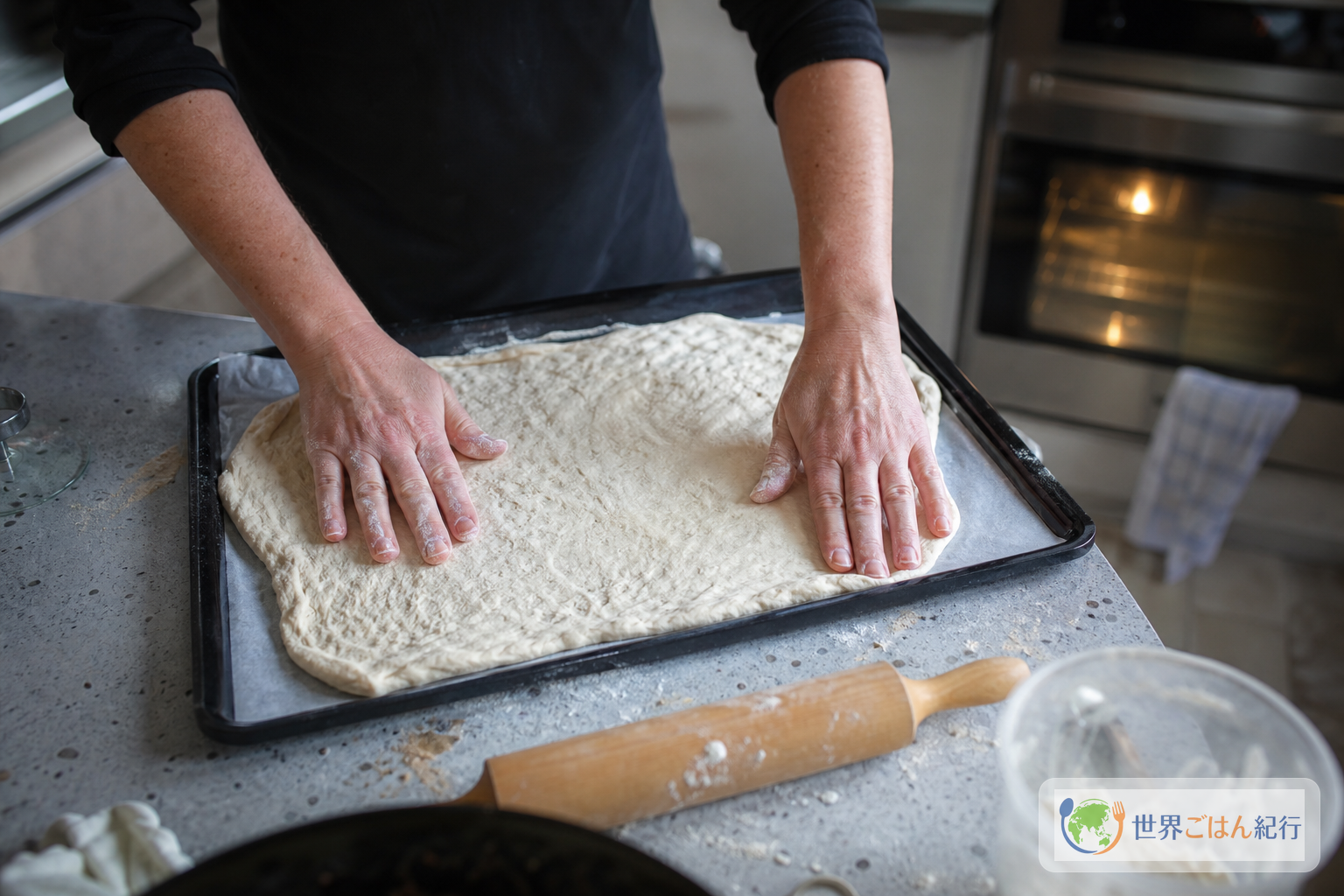
When you stretch the dough over the whole baking sheet, by hand alone the center tends to stay thick. A rolling pin of about 30 cm makes it easier to even out the center while leaving only the edge a little thicker.
You can judge lukewarm water by finger, but on a day when you aren't used to fermented dough, a thermometer removes doubt. Hotter than 35 to 38°C tends to slow the dry yeast.
Instructions: flat-baked, without scorching the onions
If you cook the onions while the dough rests, the overall waiting time is shorter. Think of the onions as "driving off water and sweetening" rather than "adding color," and they are less likely to go wrong.
What goes wrong: fix the onions, the base and the salt separately
Failures of pissaladière rarely have a single cause. Rush the onions into scorching and they turn bitter; if the base of the dough stays white it can't hold the oil; put on too many anchovies and the sweetness of the onions disappears. Rather than fixing it after looking at the finished tart, it is easier to recover by checking during the process where it is likely to fail.
| Condition | Main cause | Fix |
|---|---|---|
| Onions are bitter | Heat too high, edges burnt black | Remove the black parts, cook another 100 g of fresh onion over low heat for 10 minutes and mix in |
| Onions are watery | Cooked too briefly, juice left in the pan | Add 5 to 8 minutes over low heat, until the trail left by the spoon stays visible |
| Base is white and damp | Dough too thick, weak heat from below | Next time roll to 5 to 7 mm in the center. While baking, add 2 minutes on the lower rack |
| Too salty | Salt of anchovies and olives stacked | Cut smaller pieces and serve with salad or a boiled egg. Next time reduce to 8 anchovies |
| Strong fishy smell | Anchovies covered the whole surface, overbaked | Place in diagonal lines and leave the sweet side of the onions. Avoid adding anchovies after baking |
| Dough is hard | Under-proofed, lukewarm water too hot | Keep water at 35 to 38°C and extend the rest up to 45 minutes |
| Toppings fall off when cut | Cut without resting, onions thin all the way to the edge | Rest 5 to 10 minutes after baking. Leave 1 cm at the edge and build thickness in the center |
If it tastes too salty fresh from the oven, don't decide right away that it has failed. Resting just 5 minutes lets the oil from the onions settle into the dough and rounds off the salt of the anchovies a little. On the other hand, if the base is still damp when cold, reheating helps: 5 minutes in a toaster oven at 180°C (350°F), removing the foil for the last 1 minute, restores the base without over-browning the edge.
Substitution table for staying close to the original in a home kitchen
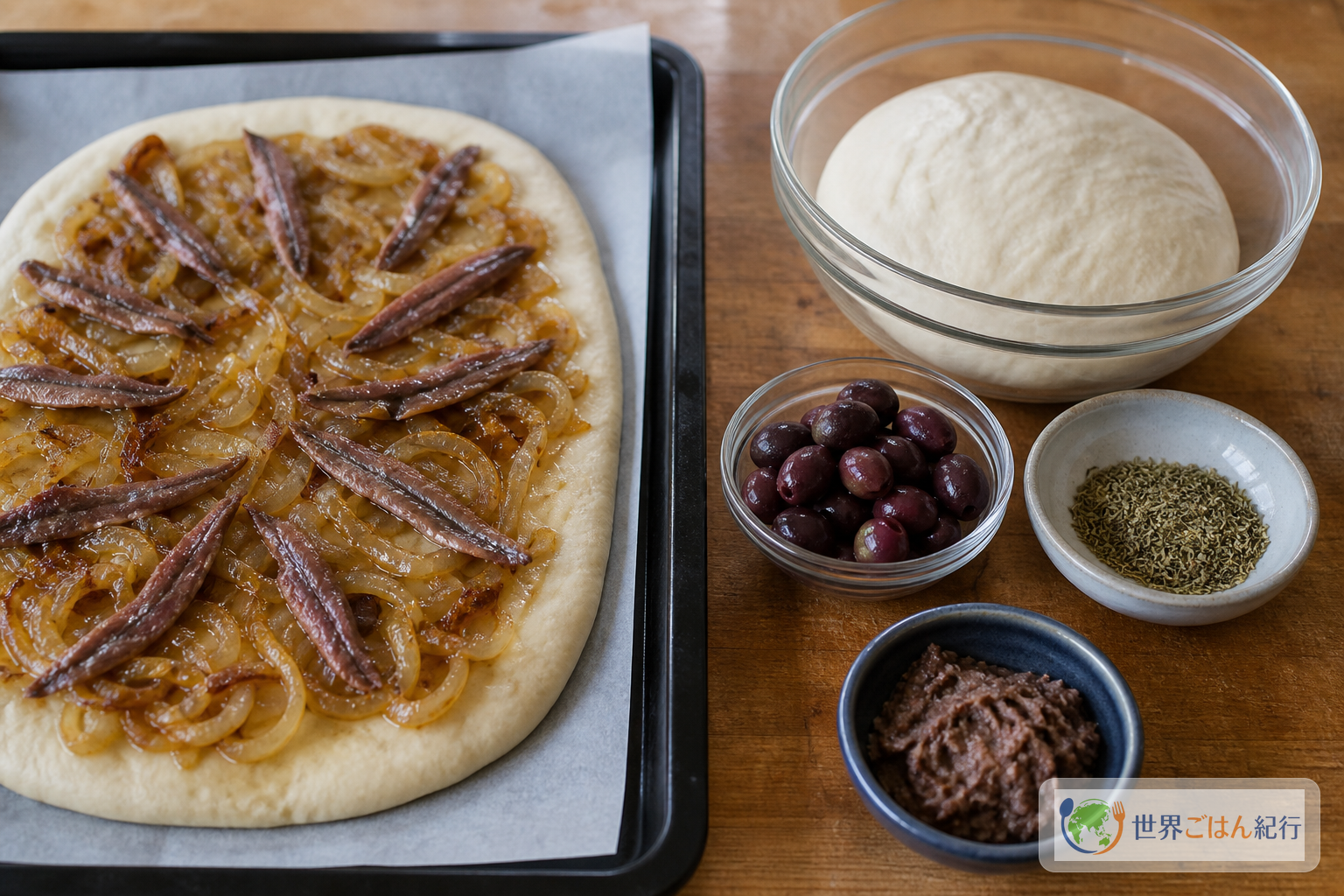
You don't need to bring everything close to local ingredients. Rather, deciding what to protect lets ordinary supermarket ingredients still come together as pissaladière.
| Where you hesitate | Closer to the original | Practical solution | What to protect |
|---|---|---|---|
| Dough | Bread dough, or close to focaccia | Store-bought pizza dough is fine. Puff pastry leans toward a different dish | No tomato sauce or cheese |
| Onions | Lots of sweet white onions | Ordinary yellow onions are fine | Don't scorch; pile them thick |
| Fish salt | Pissalat or salt-packed anchovies | Oil-packed anchovies, a little paste | Go light on the salt in the onions |
| Black olives | Niçoise or small black olives | Pitted black olives, a little kalamata | Blot dry and keep the saltiness |
| Herbs | Thyme, bay, Provençal herbs | Dried thyme, bay leaf, a little mixed herbs | Don't overdo it |
| Baking | High-heat bakery oven | Home oven at 220°C (430°F) | Don't finish with the base still white |
Made with puff pastry it becomes a light starter. The oil from the onions goes into the layers and it leans toward a crisp tart, so it is a different thing from bread-dough pissaladière. On a day when you want to save time, stretching a store-bought pizza dough thin keeps the outline of the dish better.
On a day when someone in the family dislikes anchovies, putting them on only half is the most practical. Without fish, add a few more black olives and mix 1 tsp chopped capers into the onions to create points of salt. In that case it is more honest to think of it as "pissaladière-style."
If your oven is small and can't bake 30 cm × 24 cm in one piece, splitting the dough in two is more stable. Forcing it thick in one piece tends to leave the center of the base white and steamed by the oil from the onions. If you split it in two, spread half the onions on each and start checking at 14 to 16 minutes. Smaller tarts get more toasty edge, so they are in fact easier to handle for a potluck.
Serving, storage and FAQ
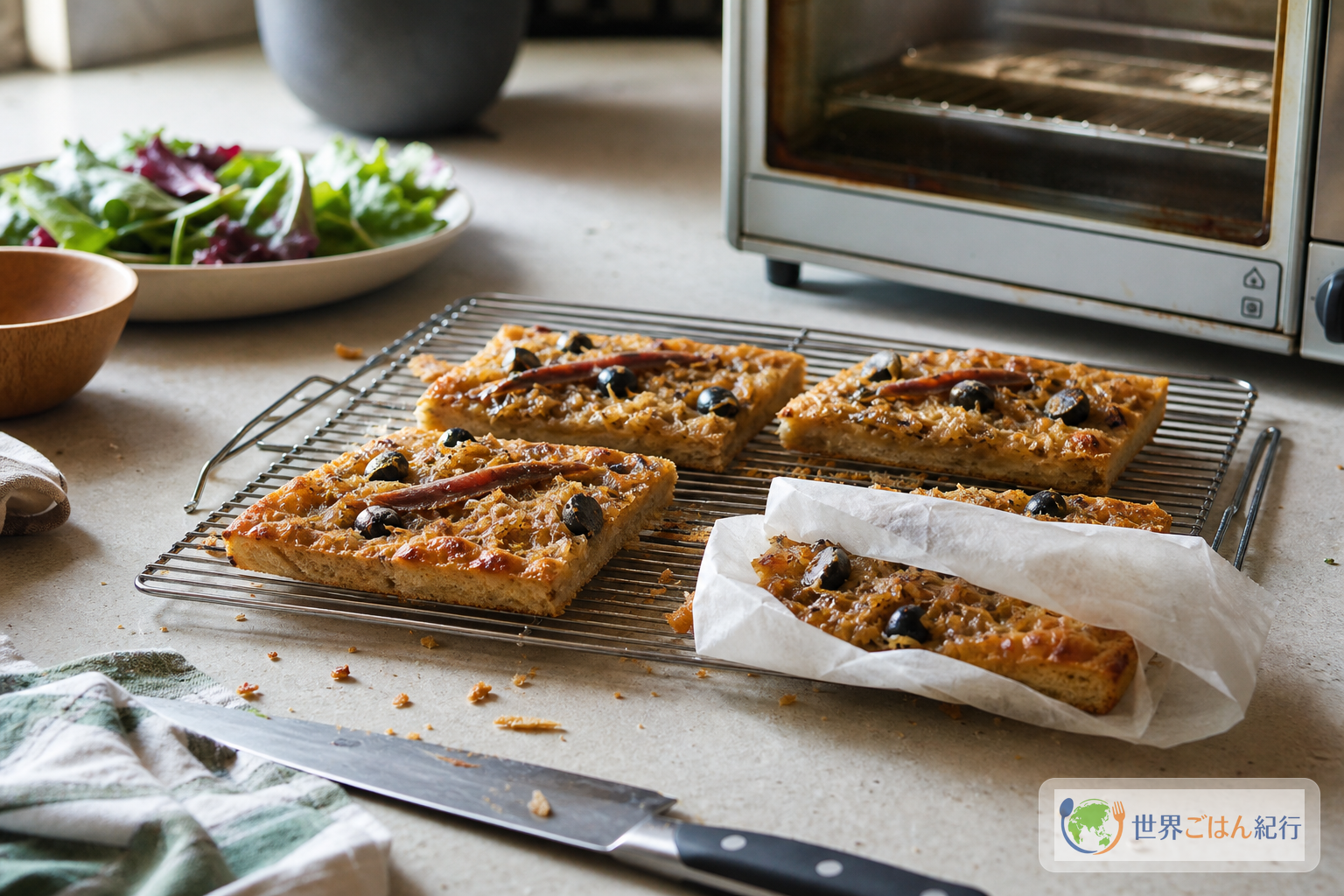
Pissaladière shows its outline better when it has cooled a little than when rushed hot. A leafy salad, white wine and cold water alone make a lunch. For more southern French seafood, bouillabaisse fits; to lead into meat-and-vegetable stews, pot-au-feu (in Japanese) and garbure go well. To continue with Mediterranean bread or rice dishes, you can move to Spanish fideuà and paella valenciana, or for a cold starter to gazpacho.
For storage, cool it fully, wrap each piece in paper, and keep in an airtight container in the refrigerator for about 2 days. Reheat in a toaster oven at 180°C (350°F) for 5 to 6 minutes. A microwave alone softens the dough again and dampens the base with the water of the onions, so if you use one, heat for just 20 seconds and then move to the toaster oven.
For a potluck, it looks better not to stack the cut pieces. If you must, put baking paper between layers so the anchovies don't stick to the dough above. Straight from the refrigerator the oil is hard and the sweetness of the onions is closed. Bring it to room temperature 20 minutes before eating, and the oil loosens and the corners of the salt round off a little. On a hot day, don't leave it long at room temperature; take it out just before eating.
Can I make it without anchovies?
You can, but the direction of the flavor changes. Adding a few more black olives and mixing 1 tsp chopped capers into the onions makes points of salt. The fishy aroma goes, so serve it as pissaladière-style to avoid misunderstanding.
Can I make it with store-bought pizza dough?
Yes. Stretch the dough thin to 5 to 7 mm and leave only the edge slightly thick. A sweet pizza crust overlaps with the sweetness of the onions, so a simple bread-dough type is easier to match.
How far do I cook the onions?
Not to a dark brown caramel color. Translucent to pale amber, so that when pushed aside with a wooden spoon they slowly flow back. A few scattered brown spots are fine, but if black scorch spreads, bitterness comes through.
Can I freeze it?
Yes. Wrap baked and cooled pieces one by one and freeze for about 2 weeks. Don't thaw; heat in a toaster oven at 160°C (320°F) for 8 to 10 minutes, covering with foil if it is about to scorch.
What if I don't like olives?
Halve the amount and scatter them chopped so each bite speaks less loudly. Leaving out all of them removes the points of salt and bitterness, so add a few more anchovies or just a few capers to balance.
Sources
Consulted to check the dough, the cooking of the onions, the background of pissalat and related dishes on the Ligurian side. The article adjusts quantities and steps to what is easy to reproduce in a home kitchen.
- The Guardian | How to make the perfect pissaladière
- La Cucina Italiana | How to Make the Pissaladière of Nice
- EL PAÍS | Pissaladière, la hermana provenzal y fácil de la pizza
- Le Monde | Nice, a new promenade for foodies
- Food & Wine | Look for This Label for Authentic Fare at Restaurants in Nice, France