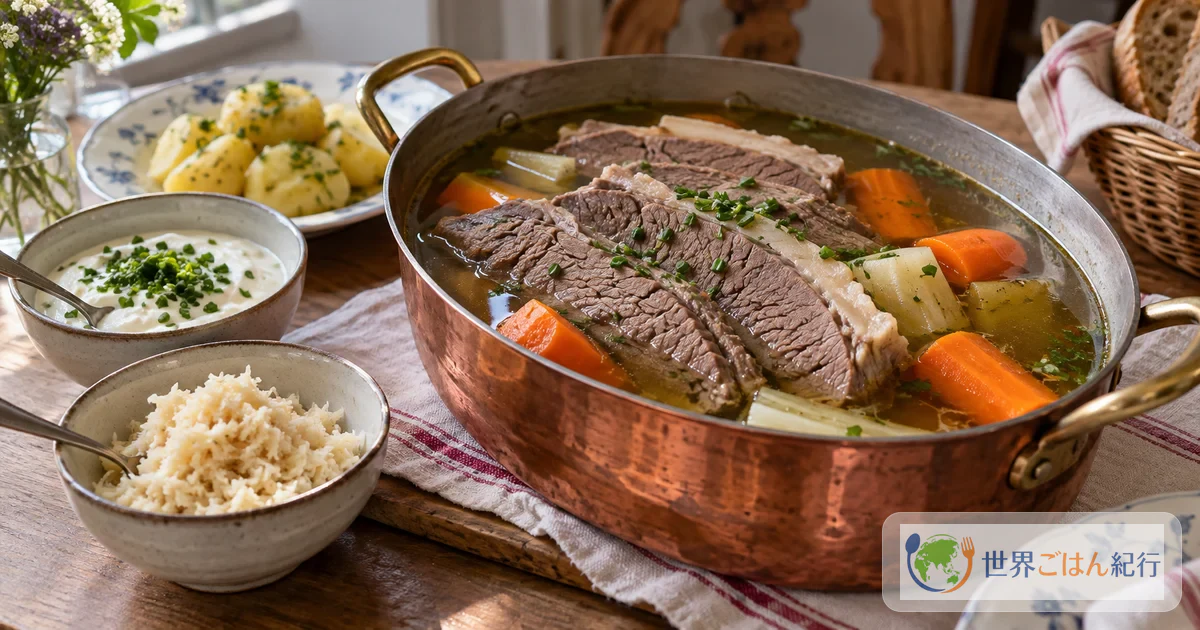
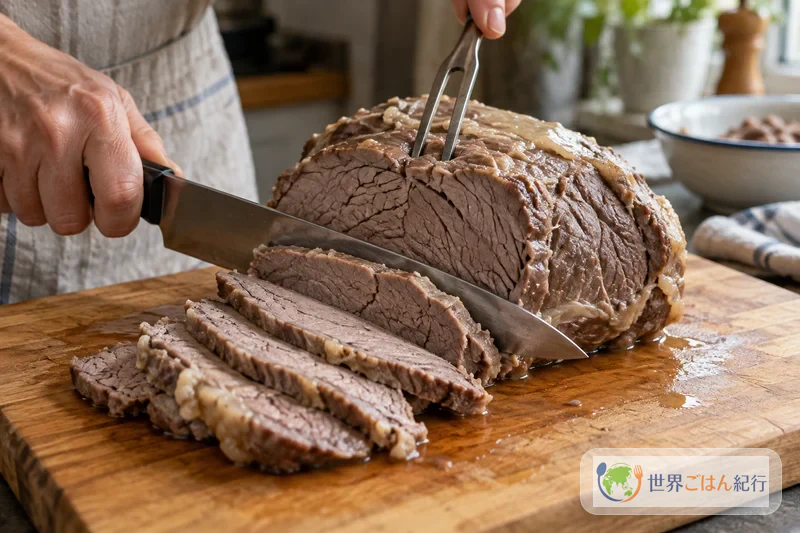
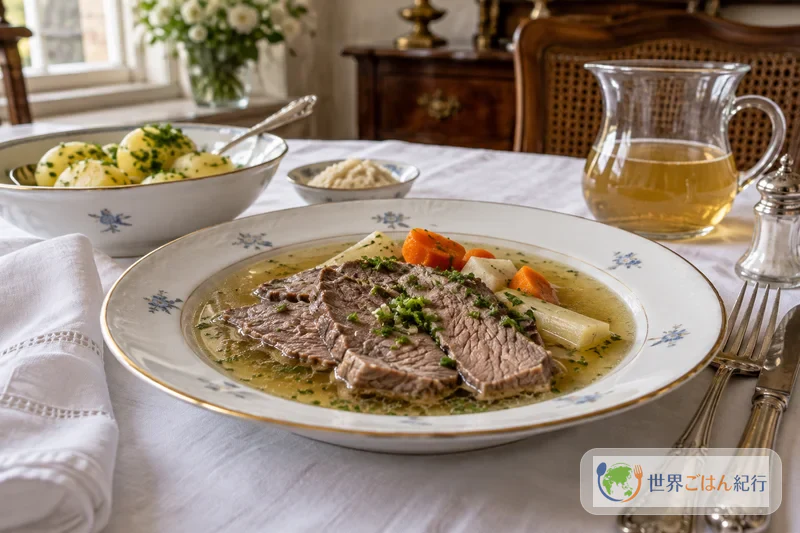
Order tafelspitz at one of Vienna's old restaurants, and it may come to the table in the steaming pot itself. First comes the amber, clear beef broth. After you finish it, the beef that was simmering in the pot is cut thick and eaten with a sharp grated apple condiment and a sour cream chive sauce. Tafelspitz is a Viennese beef dish in which you taste the broth and the meat in one sitting.
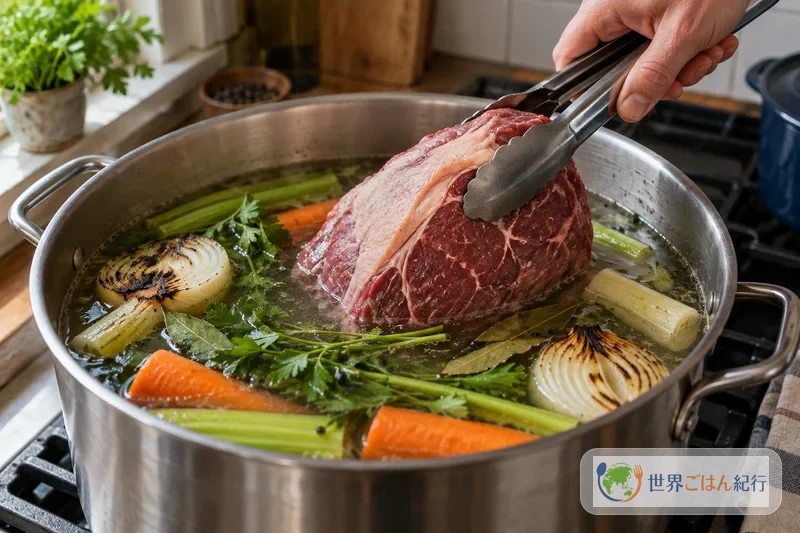
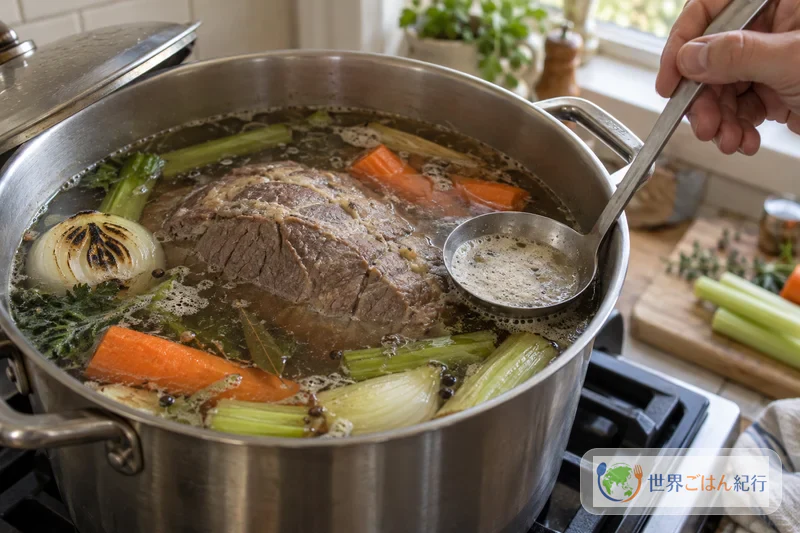
The method is surprisingly simple: a single piece of beef is simmered with aromatics for nearly 3 hours, without boiling. There is no browning and no reducing of a sauce. That is why a heat that never boils largely decides how clear the broth is.
The Emperor's Table and the Legend of Sacher
Viennese people have long had a relationship with beef. According to the traditional food database of Austria's Federal Ministry of Agriculture, beef was an important food for townspeople from the end of the Middle Ages. In the mid-16th century, hundreds of thousands of cattle raised on the Hungarian plains were reaching Vienna. In an age without railways the cattle were driven on foot for days, and even when they had grown thin on the way they were regarded as good animals for fattening. In the 19th century the livestock market at St. Marx came to consolidate Vienna's meat supply.
Boiled beef was a staple of the court table by the 1830s. Emperor Franz Joseph I was known to love the dish, and a 1912 waiter's handbook states: "Good boiled beef is never missing from His Majesty's private table." From there it spread to townspeople's homes and restaurants and became a dish everyone in Vienna ate, regardless of rank. The name "Tafelspitz" is said to first appear in a recipe collection of 1911.
A legend connected with Hotel Sacher surrounds the birth of tafelspitz. Franz Joseph ate very fast, and under court custom, when the emperor finished eating, the other guests also had to stop. For the officers who left court still hungry, Anna Sacher is said to have prepared a dish that could simmer for a long time. Hotel Sacher tells this story as part of its history, but the Austrian ministry's database presents it only as a "legend."
The name "Tafelspitz" was originally the name of a cut of beef: part of the hind leg or round of a young bullock, marked by a thin layer of flavorful fat along the upper curve. That cut itself became the name of the dish. In Vienna, the cuts of beef for boiling each have fine names, and besides Tafelspitz, names of cuts for boiled beef such as Hieferscherzel, Kruspel and Kavalierspitz are in use.
After the Second World War the culture of boiled beef declined for a while, but from the 1950s several restaurants revived the tradition. Today it is a signature dish of restaurants serving traditional Viennese food, well known to tourists too.
Ingredients (serves 6)
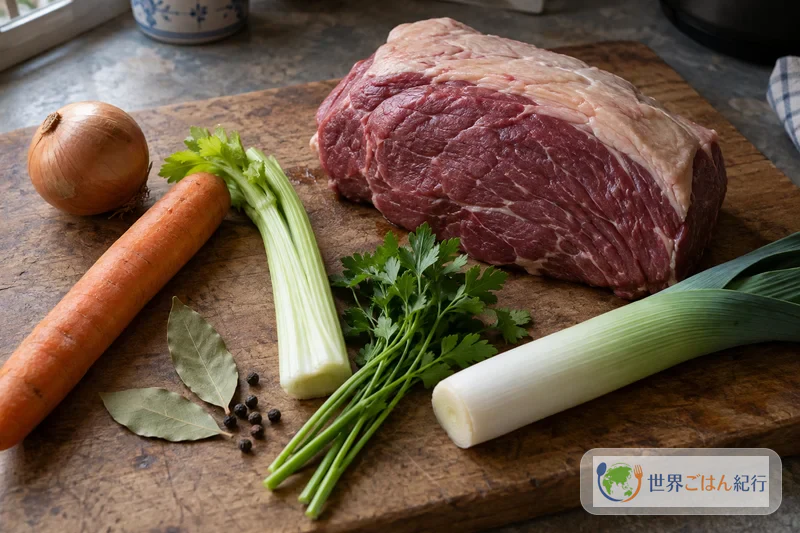
In Vienna, tafelspitz uses part of the beef round. At a butcher, the closest cut is the rump cap, the end of the rump, sometimes sold as a piece with its fat layer. If you cannot find it, beef round or a piece of shank also works. Shank has a lot of sinew, so long cooking melts the gelatin to a silkiness and adds richness to the broth. With any cut, do not trim off the fat layer.
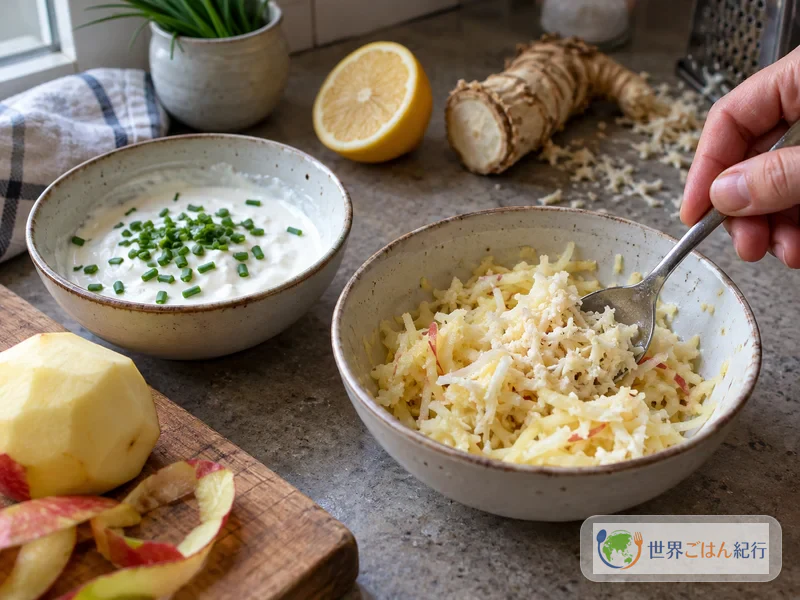
Fresh horseradish is sometimes available as whole root from import grocers, produce shops or online. It is sharpest at the moment of grating and loses aroma over time, so ideally grate it just before eating. Prepared horseradish can substitute, but its heat differs by product, so add a little at a time and taste.
How to Make Tafelspitz
Prep is about 20 minutes and simmering is 2 1/2–3 hours. Simmering takes almost no attention, so make the Apfelkren and chive sauce in the last 30 minutes.
If you also want to eat the aromatic vegetables, prepare separate carrots and celery from the ones in the pot and add them to the pot only for the last 45 minutes or so. Vegetables put in from the start give up all their flavor to the broth over 3 hours and turn limp.
The meat is easier to slice thin when cold. If you cook it the day before, take the meat out of the broth, wrap it tightly in plastic and refrigerate, then slice when serving and warm it in hot broth. Not letting the broth boil again when reheating keeps the meat moist.
Grating horseradish releases a strongly pungent compound that stings eyes and nose. Keep your face away and work with ventilation. The Apfelkren contains no wheat or the like, but the sour cream in the chive sauce contains milk.
Starting with the Broth: The Viennese Way of Eating
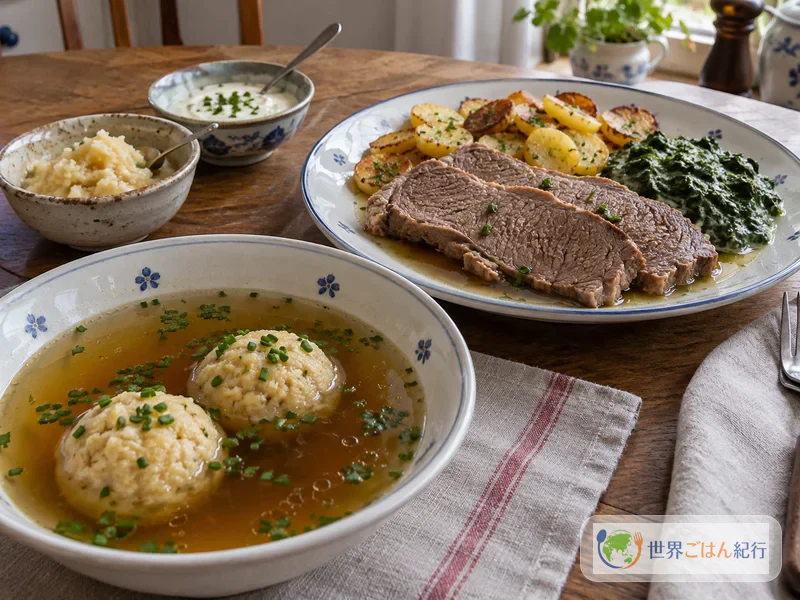
Tafelspitz is like making two dishes at once. First the broth, then the meat. In a recipe from the Austrian National Tourist Office, semolina dumplings (Grießnockerl) or thin strips of crepe (Frittaten) float in the broth, with chopped chives, served as a starter. In a home kitchen, floating thin strips of omelet or crepe gets close to the feel of Frittaten.
The sides on the meat plate are also nearly fixed in Vienna: Apfelkren of apple and horseradish, Semmelkren of bread and horseradish, chive sauce, Rösterdäpfel (pan-roasted sliced potatoes), and creamed spinach or dill-flavored green beans. Austrian public broadcaster ORF's recipe also lists creamed spinach and roast potatoes as traditional sides. You need not have everything: with just Apfelkren and chive sauce, the Viennese table feel is plenty.
Dishes that boil beef with aromatics the same way exist across Europe: French pot-au-feu (in Japanese), Italian bollito misto. Germany's neighboring Swabian Gaisburger Marsch is likewise a beef broth with potatoes and Spätzle. Eating them side by side shows how distinctive the Viennese style is, serving the broth first and eating the meat with condiments.
FAQ
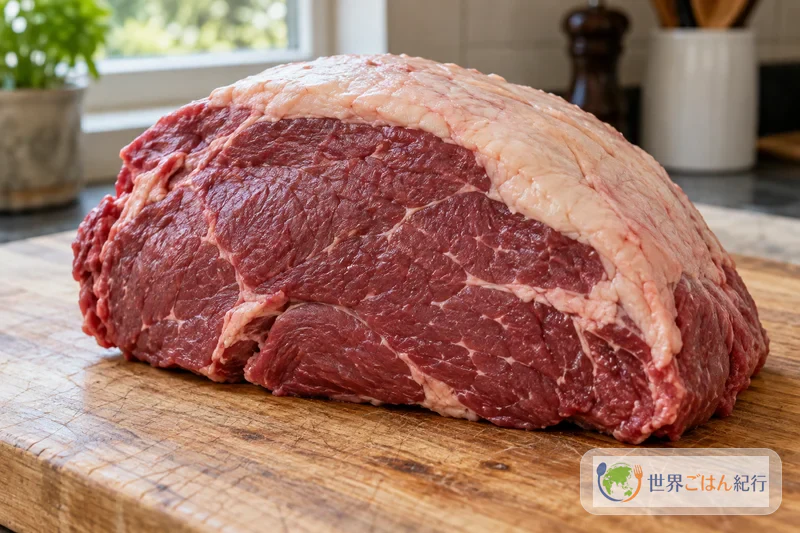
What cut should I use if I cannot find rump cap?
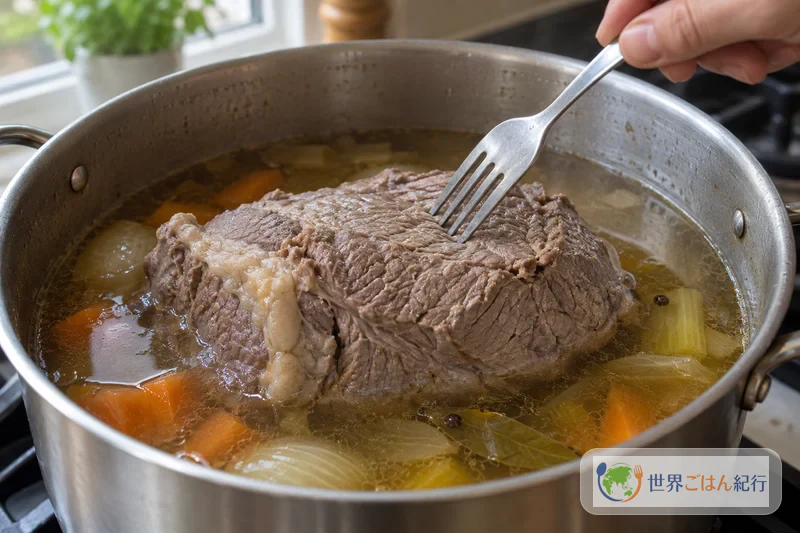
Beef round, shank or chuck in a single piece works. Shank has a lot of sinew, so with long simmering it becomes tender and adds richness to the broth. For a leaner cut, shorten the simmering and stop when a fork slides in.
My broth went cloudy.
Boiling hard mixes scum and fat into the broth and clouds it. Next time keep the heat low enough that the surface barely trembles and skim often. Cloudy broth also clears somewhat when strained through a sieve lined with paper towels.
What should I do with leftover meat and broth?
Do not store the meat soaked in broth; wrap it in plastic, refrigerate and eat it soon. Soaking in broth actually makes the meat dry. Keep the broth refrigerated in a separate container, and when reheating, heat it thoroughly through.
Can I make the Apfelkren ahead?
Made the day before, the horseradish's heat weakens a little. If you make it ahead, keep it in an airtight container in the refrigerator and add a little more horseradish just before eating to bring the aroma back.
Sources
- Österreichisches Bundesministerium für Land- und Forstwirtschaft, Klima- und Umweltschutz, Regionen und Wasserwirtschaft, „Tafelspitz" (Traditionelle Lebensmittel). Accessed and checked 22 October 2026. https://www.bmluk.gv.at/themen/lebensmittel/trad-lebensmittel/speisen/tafelspitz.html
- Österreich Werbung (austria.info), Renate Wagner, „Tafelspitz". Accessed and checked 22 October 2026. https://www.austria.info/de-at/rezepte/tafelspitz/
- ORF, „Silvia kocht": Gekochter Tafelspitz mit Schnittlauchsauce, Apfelkren und Semmelkren. Accessed and checked 22 October 2026. https://extra.orf.at/rezepte/silvia-kocht/gekochter-tafelspitz-semmelkren-apfelkren-schnittlauchsauce102.pdf
- Angelika Kreitner-Beretits, Vienna Sunday Kitchen, „Tafelspitz Schritt für Schritt". Accessed and checked 22 October 2026. https://www.vienna-sunday.kitchen/tafelspitz-schritt-fuer-schritt
- Hotel Sacher, "Tafelspitz." Accessed and checked 22 October 2026. https://www.sacher.com/en/tafelspitz/