Dill Rising in the Steam: A White Nordic Salmon Soup
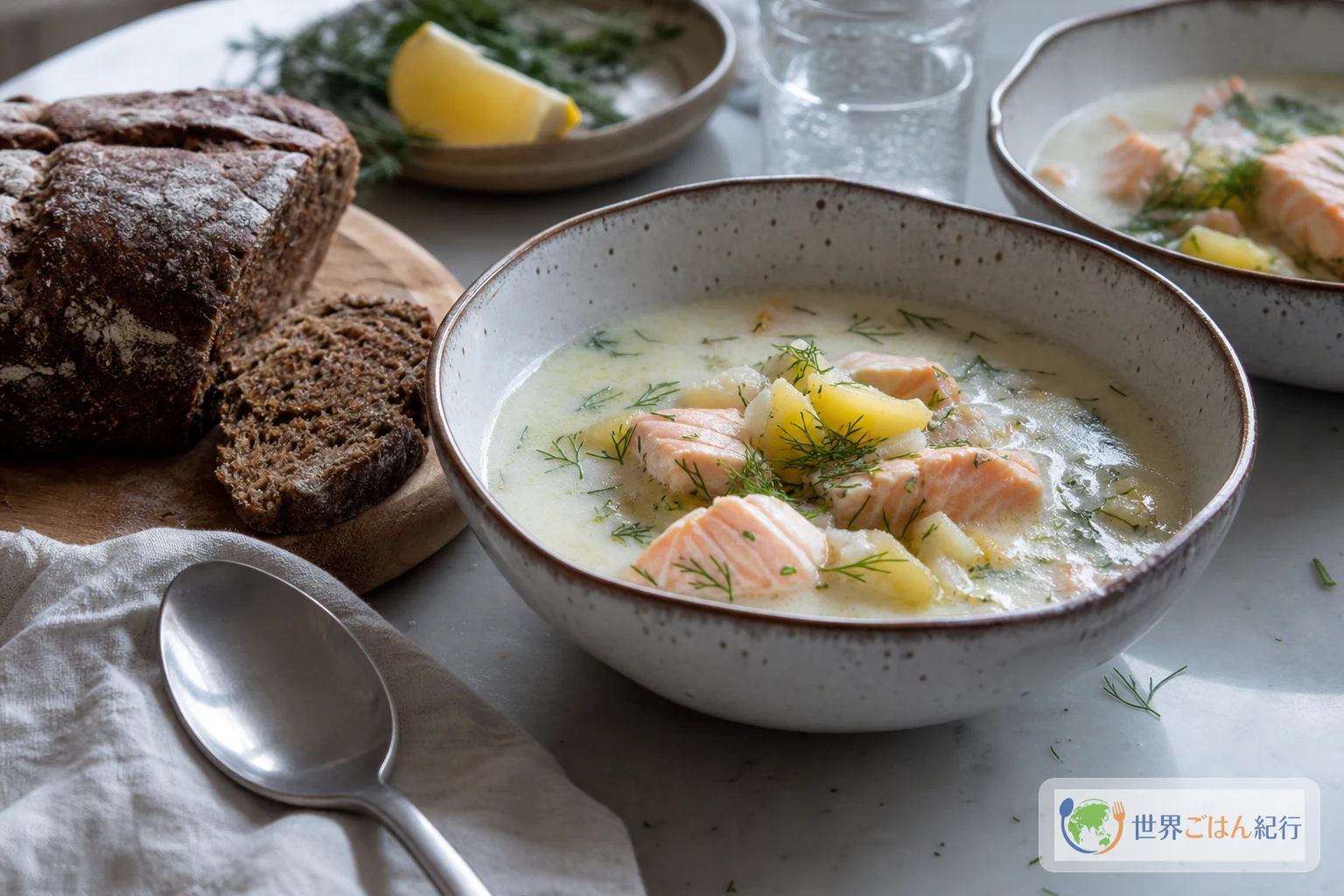
On a cold day, the sound of cut potatoes dropping into the pot is oddly calming. Add the salmon, scatter dill at the end, and the aroma is neither a familiar miso soup nor a stew. It leans a little north. Lohikeitto is a creamy salmon soup loved as Finnish home cooking.
Look only at the ingredients and it is salmon, potato, carrot, leek, and cream, all easy to buy. But handle it carelessly and the salmon turns dry and tough, the cream separates, and the whole thing drifts toward "stew with salmon in it." What makes it Finnish is to avoid simmering the fish for long, to let the dill stand up at the end, and to tighten the sweetness of the dairy with allspice or white pepper.
This article compares Finnish supermarket recipes, a dairy producer's home recipe, and the national tourist board's food introduction, and scales them to quantities you can make from ordinary supermarket ingredients. For another Finnish dish, karjalanpiirakka (Karelian pasties, in Japanese: karjalanpiirakka) goes well, but for a first time, lohikeitto alone is plenty. Serve it with rye bread and wipe up the white soup left in the bowl for a satisfying Nordic lunch.
In Finnish, lohi is salmon and keitto is soup. In English it is often introduced as Finnish salmon soup. Homes and restaurants vary: more milk, more cream, more vegetables. A common form combines salmon, potato, carrot, leek or onion, and dill.
Lohikeitto Is a Fish Dish You Do Not Simmer
The most important thing in lohikeitto is to treat the salmon as the star. Unlike beef stew, it does not get better with long simmering. Soften the vegetables first, add the salmon last, and cook it briefly over low heat. K-Ruoka's home recipe also boils the potatoes first, then adds salmon and cooks only briefly and gently. Valio's recipe likewise adds the cream near the end and leaves the dill for the finish.
These are the points to keep in a home kitchen.
| What to watch | The Finnish way | How to do it at home |
|---|---|---|
| Salmon | Large cubes that keep their presence | Use cooking-grade fillets, not sashimi-grade. Remove skin and bones |
| Dairy | Milk or cream to make it white | About 150 ml of cream (around 35% fat). For a lighter soup, half cream and half milk |
| Aroma | Plenty of dill | Fresh dill first. If you cannot find it, freeze-dried dill makes up for it |
| Spice | Some homes use maustepippuri, or allspice | 6 whole berries, or no more than 1/8 tsp ground |
| How to eat | Served with rye bread | Dark bread, rye bread, or whole wheat bread. Better with bread than rice |
Not thickening it like a stew is also a key point. Too much flour dulls the salmon's fat and the green fragrance of dill. When you lift a spoonful, it should be a thin white soup with the potatoes slightly breaking down and large pieces of salmon left.
Ingredients (serves 4)

This dish uses fish and dairy. Avoid it if you have a fish or milk allergy. If you serve rye bread, watch for wheat and rye as well.
What to Look for When Shopping

Salmon, potatoes, and cream are easy to find at a nearby supermarket. What is worth adding is dill, allspice, and an instant-read thermometer so the fish does not get tough. Dill in particular decides the impression of lohikeitto. Replace it with parsley and you have a different soup, so keep the dill aroma, even if it is dried.
If you cannot find fresh dill, use freeze-dried dill to finish. Dried dill loses its aroma when simmered, so add it after turning off the heat.
The maustepippuri you see in Finnish recipes is allspice in English. It is not black pepper. A small amount tightens the sweetness of the cream and gives the warm aroma of a soup from a cold land.
For salmon, being able to check the core temperature steadies the result at once. The conservative target is 63 degrees C. If you serve it to small children, older people, pregnant people, or anyone with health concerns, it is safer to confirm with a thermometer before plating.
Method
Once the salmon is in, do not let the surface of the pot boil hard. Cook the vegetables first and add the fish and cream near the end, and the salmon stays tender in the white soup.
Where It Goes Wrong
Lohikeitto is easy, but most failures happen when the heat is too high. Handle the fish so that it seems to swim quietly in the pot.
| Problem | Why it happens | Fix |
|---|---|---|
| Tough salmon | Boiled hard after adding the fish | Cook the vegetables first. Cook the salmon 4–5 minutes over low heat and stop by checking the core temperature |
| Separated cream | Boiled after adding the cream | Add it off the heat. Reheat over low heat and stop before the edges start bubbling |
| Flat flavor | Not enough salt and aroma | Add salt a little at a time, add dill at the end, and a little white pepper |
| Confectionery aroma | Too much allspice | No more than 1/8 tsp ground. Use whole berries and remove them at the end |
| Potatoes dissolve | Simmered too long at the start | Bring to about 80% done in around 12 minutes and keep it short after adding the salmon |
Even if it tastes thin at first, do not reduce it to thicken. Lohikeitto is a thin soup. Building definition with salt, dill, and white pepper is closer to the Finnish way than adding body.
Substitution Table for Cooking Outside Finland
The things that are hard to find are leek, dill, fish stock, and rye bread. You can make it without all of them perfectly, but deciding what to protect keeps the flavor from scattering.
| Finnish ingredient | Substitute | Adjustment |
|---|---|---|
| Leek | White part of a Japanese long onion | Use less of the green part because the aroma is strong. Do not brown |
| Fresh dill | Freeze-dried dill | Do not simmer; add at the end. Start with a little less |
| Fish stock | Unsalted seafood stock, or water with a stock pack | If the Japanese-style stock is strong, hold back the kombu and add white pepper |
| Heavy cream | Half milk, half cream | Lighter but less rich. Adding 5 g butter makes up for it |
| Rye bread | Whole wheat bread, dark bread | Avoid sweet bread. Lightly toasted goes well |
Once you are used to the Nordic pairing of dairy and fish, move on to rye bread culture such as Danish smorrebrod or a white-fish dish like Icelandic plokkfiskur, and the way people eat in cold regions starts to connect. For a comparison of cream stews, Belgian waterzooi (in Japanese) is in a similar spot.
Storage and Reheating
Once it has cooled slightly, move it to a shallow container and refrigerate. Plan on the next day, and two days at most. Freezing is not recommended because the texture of the potatoes and cream suffers. Frozen potatoes turn mealy, and the soup separates easily after thawing.
Reheat in a small pot over low heat. Do not boil; warm it while gently stirring the bottom of the pot. Salmon toughens easily when reheated, so if you use a microwave, heat at 600 W for 1 minute, stir, then add 30 seconds at a time. A little more dill just before eating keeps it from feeling heavy even the next day.
If only a small amount is left the next day, add a small amount of boiled short pasta for lunch. Boiling it down would break up the salmon, so cook the pasta separately and combine in the bowl.
How to Eat It and What to Serve
Lohikeitto sits between a main dish and a soup. On a Japanese table, bread, a sour salad, and lightly pickled cucumber are enough to round it out. It is not bad with white rice, but the aroma of stock and dairy tends to lean toward Japanese food. Eating it with bread first shows the outline of the dish.
What is easy to picture in a Finnish canteen or home is one bowl of it at lunch with bread, and that is that. For dinner in a Japanese home, it is more natural to center the meal on the hot soup and add sourness and grain, rather than lining up many small dishes as with grilled fish. For a weekend, cut the vegetables at lunch and, in the evening, only add the salmon and cream; the fish will not be overcooked.
| Pairing | Why it works |
|---|---|
| Rye bread | Takes up the white soup and the salmon fat |
| Pickled cucumber | Cuts the heaviness of the cream |
| Boiled egg | Adds volume for dinner |
| Karjalanpiirakka | Makes the table Finnish throughout |
| A little lemon | Use only when the salmon fat is strong |
| Occasion | How to put it together |
|---|---|
| Weekday dinner | Lohikeitto, whole wheat bread, pickled cucumber |
| Weekend lunch | Lohikeitto, karjalanpiirakka, hot tea |
| Next-day lunch | Reheat the leftover soup over low heat and combine with separately boiled short pasta in the bowl |
| Starter for guests | Serve in small bowls with plenty of dill and thin bread on the side |
If you bought a lot of dill, use the leftovers in a butter for bread. Mix 2 tsp chopped dill and a pinch of salt into 30 g room-temperature butter and spread it thinly on rye bread. Adding aroma on the bread side lets you eat it more lightly than adding more butter to the lohikeitto itself.
Frequently Asked Questions
Can I use salmon flakes or salted salmon?
We do not recommend it. Salmon flakes are salty and oily and leave no texture of flesh. Salted salmon is usable, but soak it in water for about 10 minutes first to remove salt, and hold off on seasoning the soup until the very end. For a first time, fresh salmon fillet is the safest.
Can I make it with milk only?
You can, but the roundness typical of lohikeitto is a little weaker. If using only milk, increase the butter to 20 g, add the milk after turning off the heat, and warm over low heat. Boiling makes it separate easily, so be careful.
I do not like dill.
You can halve the amount and mix in a little chopped parsley. But leaving out dill entirely makes it much less like Finnish salmon soup. Starting with a small amount of dried dill gives a gentler aroma than fresh dill.
Is allspice required?
No. It is still lohikeitto without it. But a small amount tightens the sweetness of the dairy and gives the warm aroma of Nordic home cooking. If you use ground, start with a really small amount.
Can I make it ahead?
You can make it for the next day. Salmon and cream do not like reheating, so if possible make only the vegetable soup part the day before and add the salmon and cream on the day you eat it, for the best result. If you store the finished soup, keep it refrigerated for up to 2 days and reheat over low heat.
Is sashimi-grade salmon better?
Not necessarily. Since it is cooked, a fresh cooking-grade fillet is enough. Sashimi-grade is expensive, and a very fatty cut can make the soup heavy. Choose a thickness that can be cut into 3 cm cubes after skin and bones are removed.
Sources
- K-Ruoka, "Tillinen lohikeitto" https://www.k-ruoka.fi/reseptit/tillinen-lohikeitto
- Valio, "Lohikeitto" https://www.valio.fi/reseptit/lohikeitto/
- Visit Finland, "Finland's traditional and iconic foods" https://www.visitfinland.com/en/articles/finlands-traditional-and-iconic-foods/variants/variant-1/
- FoodSafety.gov, "Cook to a Safe Minimum Internal Temperature" https://www.foodsafety.gov/food-safety-charts/safe-minimum-internal-temperatures