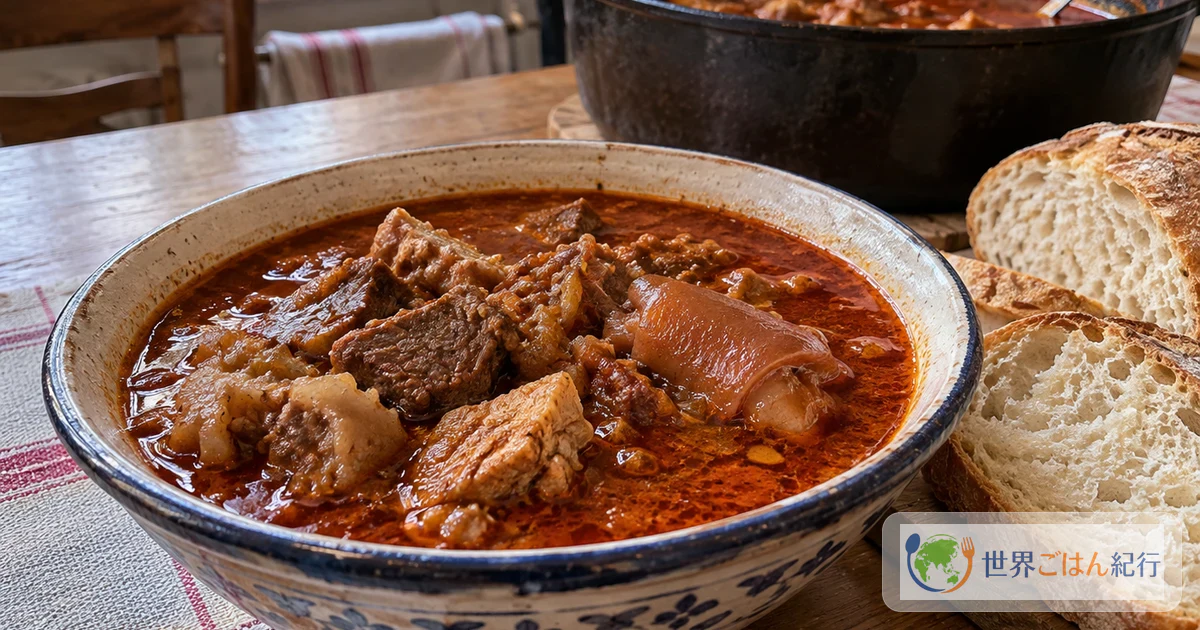
"Picked fish," loved on an island in the North Atlantic
What comes to mind when you think of Icelandic food? Hákarl, the fermented shark. Svið, the singed sheep's head. Both are startling. But the food Icelanders actually eat day to day is gentler and warmer. That's plokkfiskur.
Translated literally, the name means "picked fish." Fiskur means "fish," and the dish is made by flaking boiled fish apart as if picking at it with your fingers. Boiled cod and potatoes are roughly broken up and mixed together, then finished with onion and butter. That's it. It's utterly simple: a homey dish of a North Atlantic island that fills up hard-working people with everyday ingredients.
Literally "picked fish." A home-style fish stew of boiled cod or haddock and potatoes, roughly flaked and brought together with onion, butter and milk. It's classically served with sweet dark rye bread spread with butter, and you can also find it at diners and restaurants in Reykjavík.
Search for "plokkfiskur recipe" or "Icelandic fish stew" and plenty of recipes turn up. This article draws on that body of recipes to show how to make an authentic plokkfiskur with ingredients from an ordinary supermarket. It's a humble Nordic home-style dish, in the same family as Norway's fårikål (in Japanese).
Ingredients (serves 4)
This dish contains fish (cod), dairy (milk and butter) and wheat. For a dairy allergy, oat milk and olive oil can substitute, though you'll lose the richness of the butter. Swapping the flour for potato starch brings it closer to gluten-free, but the texture will be slightly different.

Cooking tips
Butter forms the backbone of plokkfiskur's flavor. Choose a flavorful salted butter or cultured butter. Topping it with a pat of butter at the end, or spreading the rye bread on the side generously with butter, brings you closer to an Icelandic table.
Mash them completely and it turns into baby food. Leave too many big chunks and it doesn't come together. The ideal is about 70% broken down and 30% left as chunks. Pressing roughly with the back of a fork is plenty. Because some coarseness remains, you get to enjoy the textures of both fish and potato.
Lightly salted cod is convenient because you can use it as is, but since it already contains salt, cut the salt in the seasonings by half. Always taste at the end and add more a little at a time if needed. Too much salt at the start can't be undone. Just like Moldova's mămăligă (in Japanese), the simpler the dish, the more the seasoning decides everything.
Variations
Gratin style (oven-baked)
Transfer the plokkfiskur to a baking dish, top generously with cheese (Gruyère or Gouda), and bake in a 200°C (400°F) oven for 15 minutes, until the top is golden brown. Baked versions topped with cheese or béchamel sauce turn up in Iceland too, and it's perfect for a weekend dinner.
Salmon version
Use 400 g fresh salmon instead of cod. The salmon's fat adds richness to the sauce for a more luxurious result. In Iceland, besides cod, haddock is often used, and some people make it with salmon. Like Indonesian nasi goreng (in Japanese), dishes that make the most of seafood flavor exist all over the world.
Japanese-style twist (miso plokkfiskur)
Replace half the 200 ml milk (100 ml) with dashi, and stir in 1 tbsp white miso at the end. Switch to unsalted butter. Miso and cod are a natural match. Serve it with rice instead of bread and it fits right into a Japanese-style meal. It's a pairing that suits two island nations that both eat plenty of fish.
Cream cheese version
Reduce the milk to 100 ml and add 100 g cream cheese instead. The result is thick and rich. It's also great spread on bread like a dip.

The story behind the dish
Potatoes come to the island of dried cod
To understand Icelandic food culture, you need to know how harsh the island's environment is. It lies between 63 and 66 degrees north, and in midwinter Reykjavík gets only about 4 hours of daylight. There's little land suited to growing grain, and people relied on fish from the sea and sheep.
Ever since people settled here from Norway and elsewhere in the 9th century, cod has sustained life on the island. But in medieval Iceland, the star wasn't salt cod; it was stockfish (skreið), dried in the cold wind. In the Middle Ages, dried cod became the island's signature export. Salt cod (saltfiskur), salted and then dried, became the biggest export only in the 19th century, when fishing from decked sailing vessels spread. Cod's impact on world history is told in detail in Mark Kurlansky's nonfiction book Cod: A Biography of the Fish that Changed the World (1997).

The first confirmed record of potato growing dates to 1758, at Bessastaðir, where the president's residence stands today. After the famine that followed the great eruption of the late 18th century (the Laki eruption), potatoes gradually spread along with vegetable gardening, and today they're so familiar that they appear alongside almost every meal. Cod and potatoes, onion and milk: plokkfiskur, which fills up working people with nothing but familiar ingredients, is a humble home-style dish that could only come about once those island ingredients were all in place.
The Cod Wars and a fishing nation
You can't tell Iceland's history without the Cod Wars. Three times, in 1958, 1972–73 and 1975–76, Iceland extended its fishing zone, to 12, 50 and then 200 nautical miles, clashing fiercely with Britain. For a country where, from 1881 to 1976, seafood made up 80–90% of exports, the fishing grounds were life itself.
In 1976, Iceland broke off diplomatic relations with Britain and hinted at closing NATO's Keflavík base. In the end, Britain recognized Iceland's fishing rights within the 200-mile zone, and the conflict ended. For this country, cod is both a fish for the table and a fish bound up with the nation's history. Just as Lebanese hummus (in Japanese) is tied to the pride of the Lebanese people, a nation's story is layered into its everyday food.
Geothermal bread and plokkfiskur
The classic accompaniment to plokkfiskur is a sweet, dark rye bread, rúgbrauð. In Icelandic, brauð means "bread" and rúg means "rye." It has a dense crumb and is such a sweet bread that it can almost feel like cake.
In hot-spring areas such as Laugarvatn, you can still see the traditional method of putting the dough in a metal container, burying it in the hot ground near the springs, and baking it with geothermal heat for about 24 hours. The real thing is hard to find outside Iceland, so substitute pumpernickel or a dense rye bread, warm it and spread it with butter before serving, and you'll be closer to an Icelandic table.
Þorrablót, the midwinter feast
Every year from late January into February, Iceland holds a midwinter festival called Þorrablót. Þorri is the name of a month in the old calendar that falls in midwinter, and is also said to personify winter. The festival, which faded after Christianization, was revived during the 19th-century national movement.
On the table are hákarl (fermented shark), svið (sheep's head), liver sausage and blood sausage, and harðfiskur (dried fish). Dried fish eaten spread with butter is a fitting dish for the island of stockfish. Plokkfiskur isn't one of these feast dishes; it's an everyday home-style dish. Today you can also eat it at diners and restaurants in Reykjavík.
Plokkfiskur in Iceland today
The basics are cod or haddock, potatoes, onion and milk. In recent years you'll also see twists that add curry powder or cheese, or bake it topped with béchamel sauce. Families disagree on the fish, with both haddock fans and cod fans. A local English-language paper even reported that Guðni Jóhannesson, president from 2016 to 2024, names plokkfiskur as a favorite food. The fun of this dish is that every household has its own version.
Nutrition (per serving, of 4)
Plokkfiskur comes to 380 kcal per serving, with 28 g of quality protein from the cod. Fat is a modest 14 g, most of it milk fat from the butter. The carbohydrates in the potatoes provide energy and keep you full. Cod also contains vitamin B12 and minerals such as selenium.
| Nutrient | Amount |
|---|---|
| Calories | 380 kcal |
| Protein | 28 g |
| Fat | 14 g |
| Carbohydrates | 36 g |
| Fiber | 3 g |
| Sodium | 620 mg |
Cod has long been valued in the Nordic countries as a protein source from the sea. Per 100 g it has around 20 g of protein and less than 1 g of fat. Add the carbohydrates from the potatoes and the fat from the butter, and with rye bread on the side, one bowl makes a satisfying meal.
Dishes to make alongside
- Smørrebrød (in Japanese) - Buttered rye bread from the same Nordic table.
- Fårikål (in Japanese) - Norway's humble stew of lamb and cabbage.
FAQ
Answers to questions that come up when making plokkfiskur for the first time.
Q1. Salt cod, lightly salted cod or fresh cod: which should I use?
Lightly salted cod is the easiest option, if you can find it. It needs no soaking and has good flavor. If you use salt cod (such as the imported kind sold for bacalhau), soak it in water for about 24 hours to remove the salt first. Fresh cod has a clean flavor, so season it carefully.
Q2. What potato variety is best?
Floury potatoes such as russets work well. They break up easily and blend with the sauce. Waxy potatoes hold their shape and don't fall apart, so use them when you want a chunkier texture. Portuguese caldo verde (in Japanese) is another dish where the way the potatoes break down shapes the result.
Q3. Can I make it ahead?
Yes. It keeps for 3 days in the refrigerator. The flavors meld and it's even better the next day. When reheating, add 2–3 tbsp milk to bring back the creamy texture. It can be frozen for up to 1 month, though the texture of the potatoes changes a little. After thawing, add some milk and reheat.
Q4. What can I serve if I don't have rye bread?
Whole-wheat bread or toast is fine. Toasted baguette works too. In Iceland the classic is rúgbrauð, a sweet dark rye bread, but it's hard to find elsewhere, so a dense rye bread such as pumpernickel makes a good substitute. It's also surprisingly good with rice.
Q5. Can I feed it to kids who don't like fish?
Plokkfiskur is a great dish for kids who don't like fish. Cod has little fishy smell, and wrapped in potatoes and butter, the fish flavor becomes gentle. Top it with cheese and bake it gratin-style to make it even easier to love.
More European dishes
If plokkfiskur caught your interest, try other European home-style dishes that make the most of simple ingredients. From the frigid Nordic countries to the Mediterranean, there are dishes whose simplicity is exactly what gives them depth.
- Caldo verde (in Japanese) --- Portugal's green soup. A national soup with the same potato base
- Fårikål (in Japanese) --- Norway's lamb and cabbage stew. Another humble Nordic home-style dish
- Cepelinai (in Japanese) --- Lithuania's potato dumplings. An Eastern European classic starring potatoes
- Karjalanpiirakka (in Japanese) --- Finland's rice pies. Also regarded as a Nordic national dish
If you're interested in Mediterranean Europe as well, try these.
- Moussaka (in Japanese) --- Greece's eggplant and ground meat bake. Similar thinking to the gratin-style plokkfiskur
- Pašticada (in Japanese) --- Croatia's braised beef. A home-style dish representative of Adriatic food culture
Sources
Recipes and cooking methods
- The Reykjavík Grapevine (2019). "Food Of Iceland: Plokkfiskur." Checked 2026-10-22 --- Ingredients (cod or haddock, potatoes, onion, milk), serving with rye bread, modern variations
- Arctic Adventures. "Icelandic Food Recipes: Plokkfiskur." Checked 2026-10-22 --- Traditional method using cod or haddock, pairing with sweet rye bread
Culture and history
- EBSCO Research Starters. "Cod Wars." Checked 2026-10-22 --- Dates of the Cod Wars, seafood's share of exports, the 200-mile zone
- Matarauður Íslands. "Potatoes." Checked 2026-10-22 --- History of potato growing in Iceland
- Guide to Iceland. "Þorrablót: Celebrating Iceland's Midwinter Feast." Checked 2026-10-22 --- Timing, dishes and 19th-century revival of Þorrablót
- Salisbury, V. (2017). "What, Exactly, Is Volcano Bread?" AFAR. Checked 2026-10-22 --- Rye bread baked for 24 hours with geothermal heat at Laugarvatn
- Neðstikaupstaður (Westfjords Heritage Museum). "Saltfish in the Bottom." Checked 2026-10-22 --- How dried, salted cod became the biggest export
- Kurlansky, M. (1997). Cod: A Biography of the Fish that Changed the World. Walker & Company. --- Cod and the history of the North Atlantic