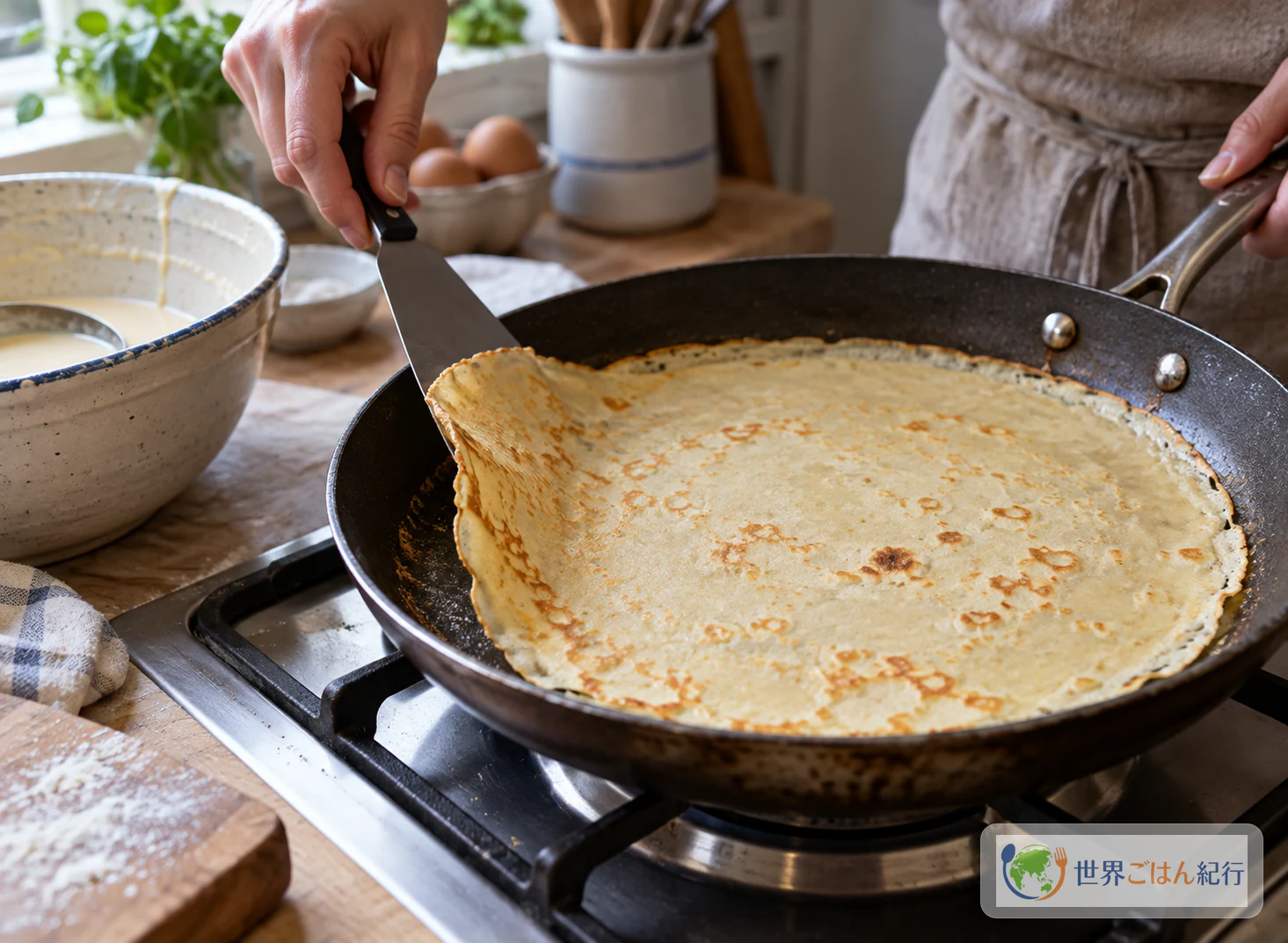
French Crêpes: A Stack of Thin Pancakes Everyone Finishes Their Own Way
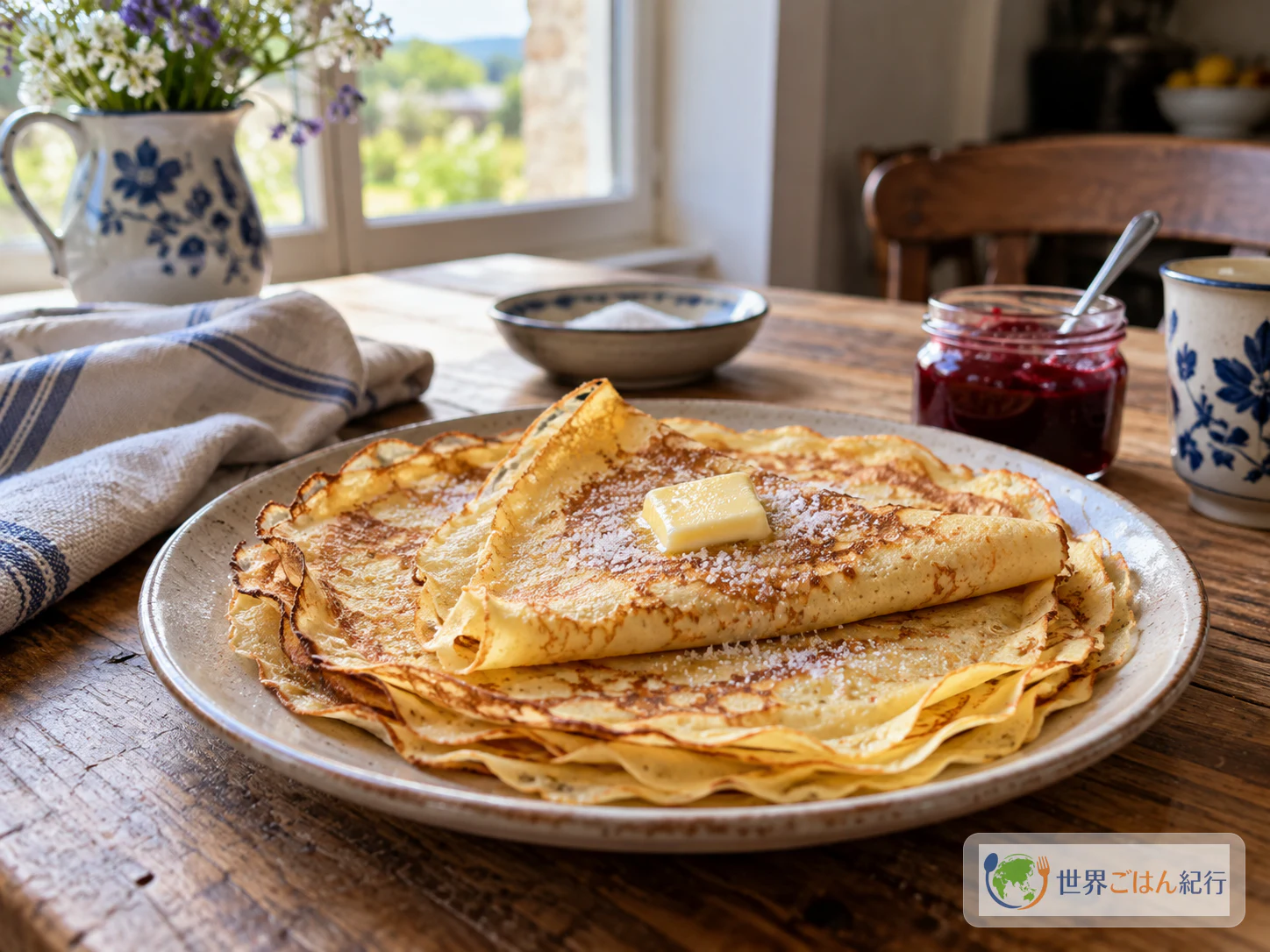
A thin, even layer of batter that sets with a dry, lifting edge and a lightly colored underside. Keep the batter simple so that butter, sugar or jam can do the talking at the table.
Friends drop by in the afternoon, a pan stays warm on the stove, and thin crêpes pile up on a plate one after another. Someone reaches for butter and sugar, someone else for a jar of jam. The French home cook Géraldine of La Cuisine de Géraldine describes crêpes in just this setting: an afternoon snack for when friends gather. That is the spirit of this recipe. The crêpes themselves are plain, and each person decides how to finish theirs.
This article covers a basic French wheat-flour batter made with flour, milk and eggs, the judgments that help you cook it thin in an ordinary frying pan, and some of the ways crêpes are eaten in Brittany. Buckwheat galettes are a different batter, so they appear here only as a comparison, not mixed into the recipe.
The formula follows Géraldine's basic recipe, which she says makes about 16 crêpes. Treat that as the source's yield, not a promise: how many you actually get depends on your pan and how thinly you spread each one.
Ingredients: A Basic Batter of About 16 Crêpes
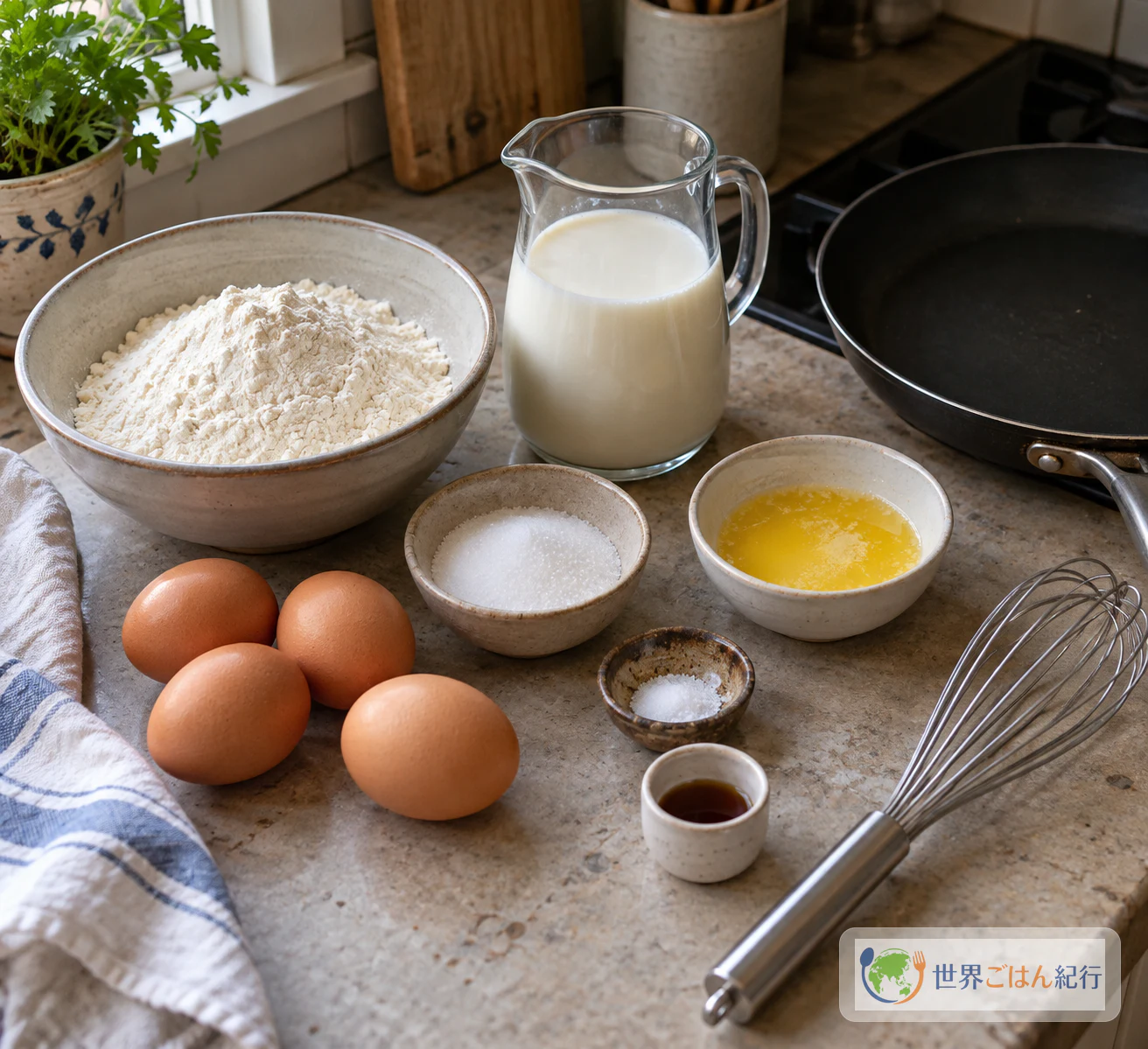
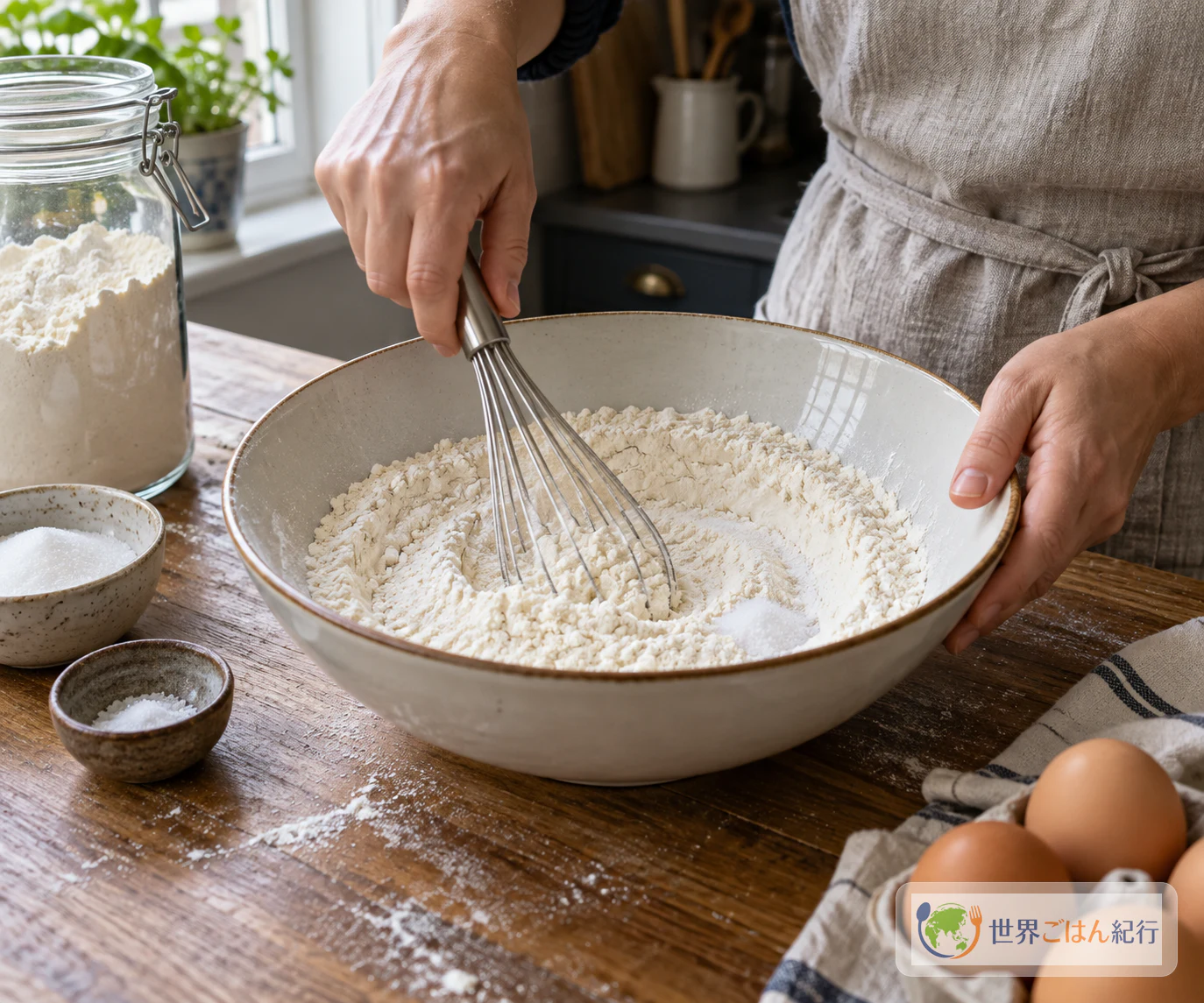
Everything in the batter comes from an ordinary supermarket. The sugar is measured in tablespoons.
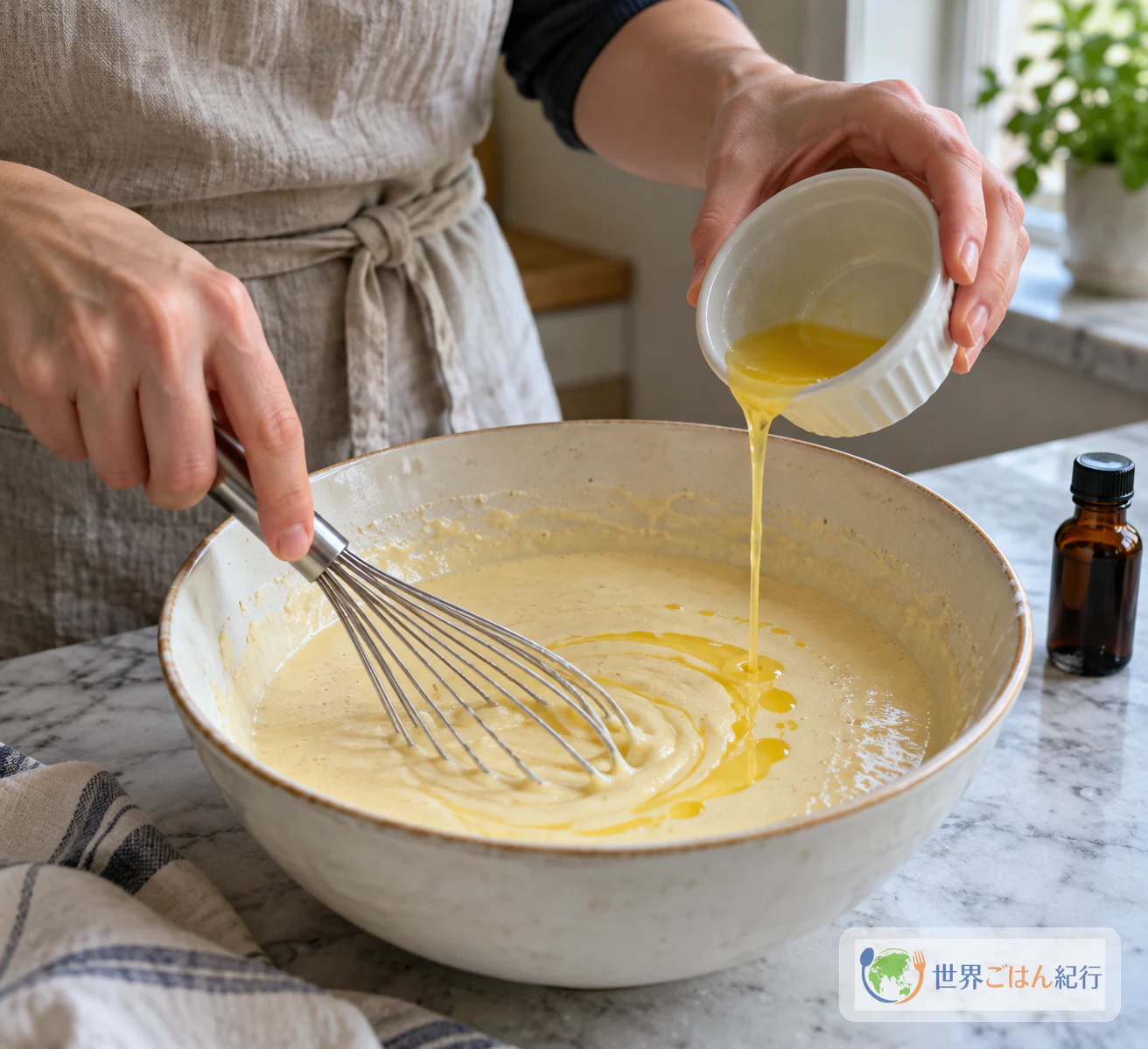
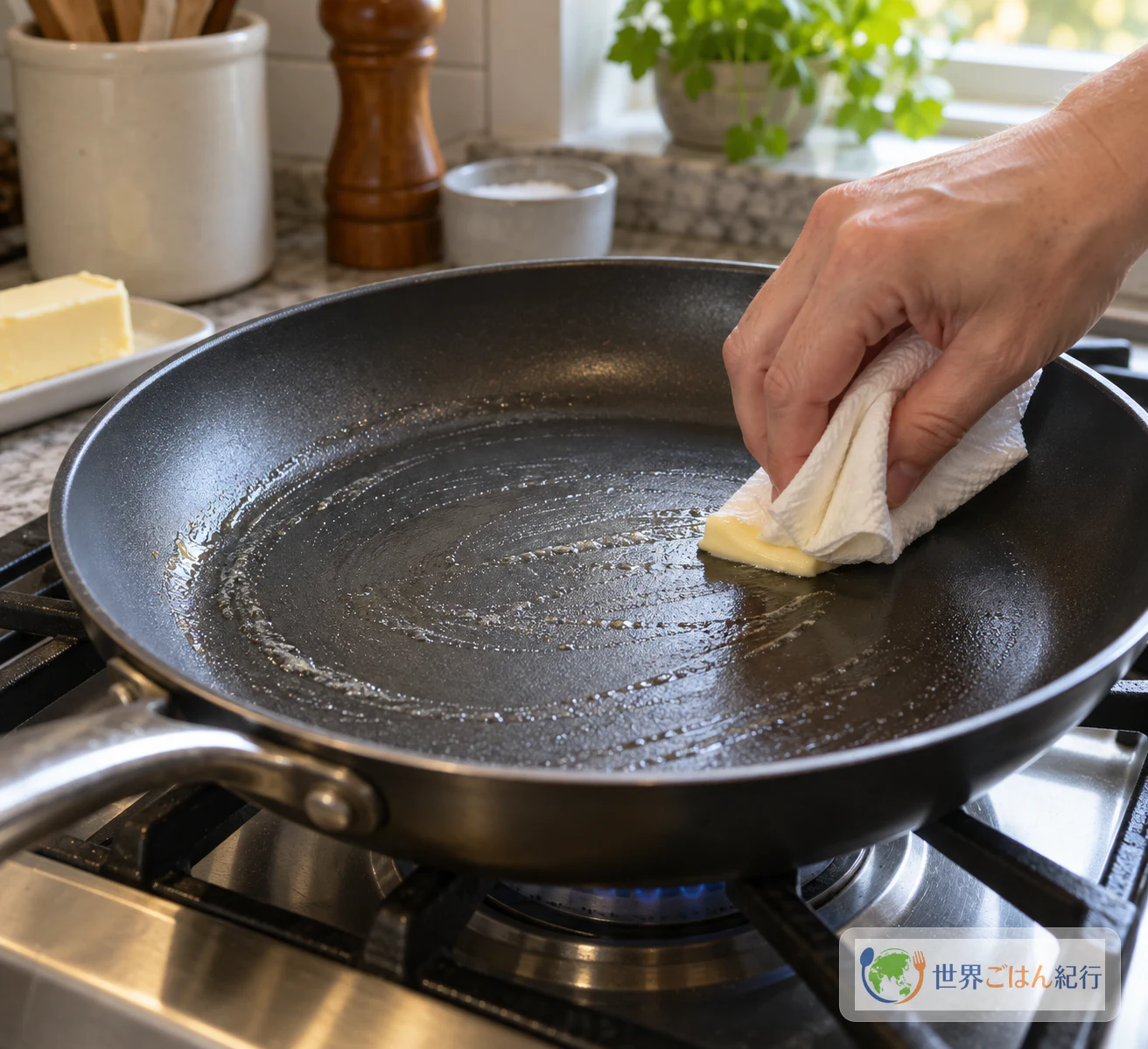
The 30g of butter in the batter is not the same as the thin film you wipe on the pan, nor the butter you might add at the table. Keep them separate when you shop and measure.
Géraldine lists rum, vanilla or orange flower water as optional aromas, 1 tsp of one of them. This recipe uses vanilla. If you prefer rum or orange flower water, use it in place of the vanilla rather than adding several together. Rum contains alcohol, so skip it or stay with vanilla when cooking for children or anyone who avoids alcohol.
Butter, sugar and jam for serving, and anything to drink alongside, are table options, not extra batter ingredients.
Use all-purpose flour. If you cook in Japan, ordinary cake flour (hakurikiko) is a practical choice, but it has not been tested against this formula and is not the same as French flour. Whatever flour you use, cook one test crêpe and adjust the batter from there.
This batter contains wheat, eggs and milk. Gluten-free flour or plant-based milk is not a straightforward substitution for this recipe: changes such as plant milk also affect texture, and those versions are not covered here. If you use rum as the aroma, the batter contains alcohol.
Equipment
- A large mixing bowl and a whisk
- A frying pan, roughly 22–24cm across
- A ladle
- A thin spatula for turning
- Folded paper towel for greasing the pan
- A fine sieve, only if you need to rescue lumpy batter
- A plate for stacking the cooked crêpes
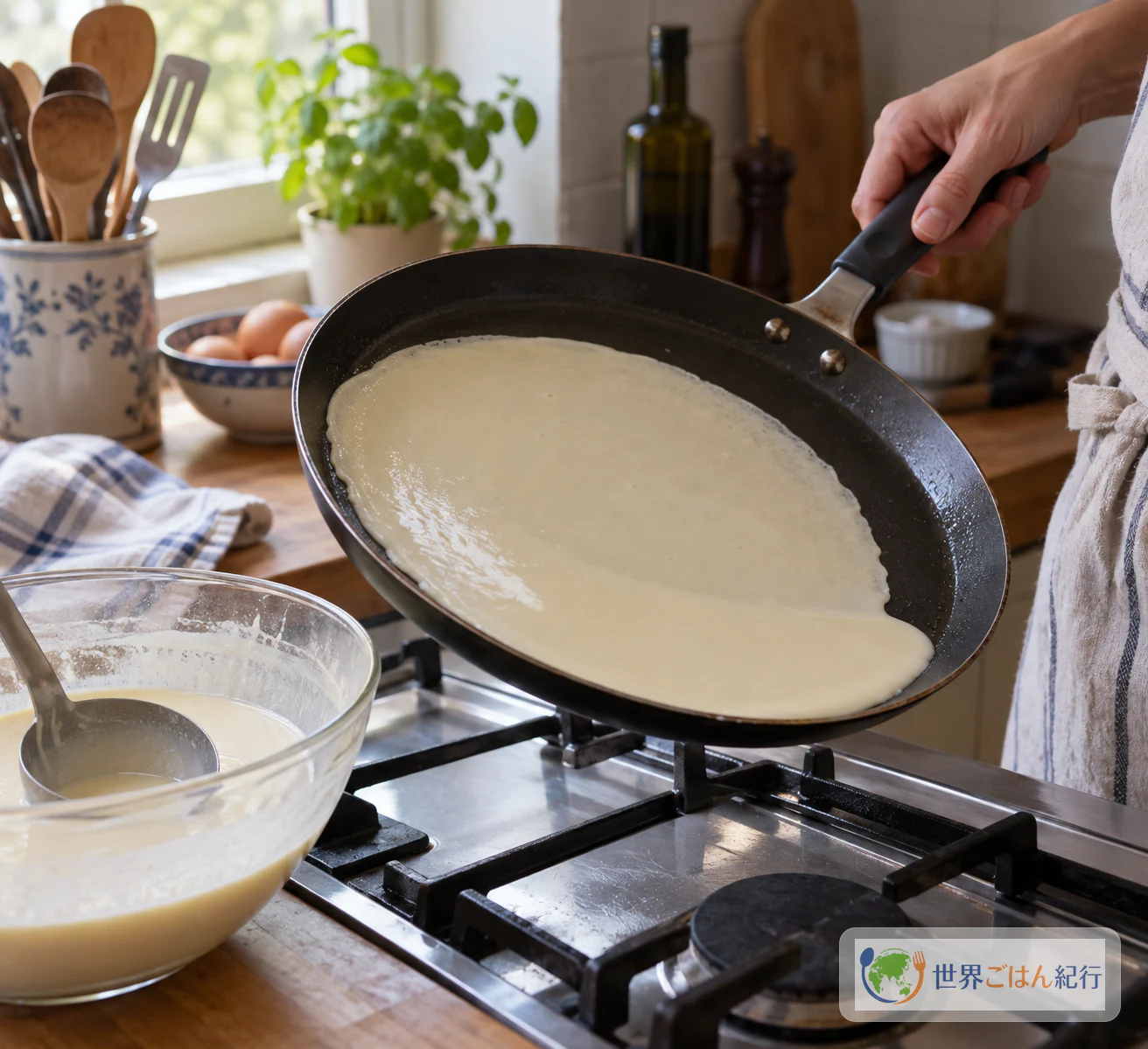
In Brittany, crêpe makers use a billig (a flat cast-iron griddle), a rozell (a tool for spreading batter into a circle) and a spanell (a spatula for turning), as the Brittany Tourism board describes. None of these is necessary at home. A regular frying pan and a tilt of the wrist do the job.
Method: A Smooth Batter, a Proper Rest, and Thin Crêpes
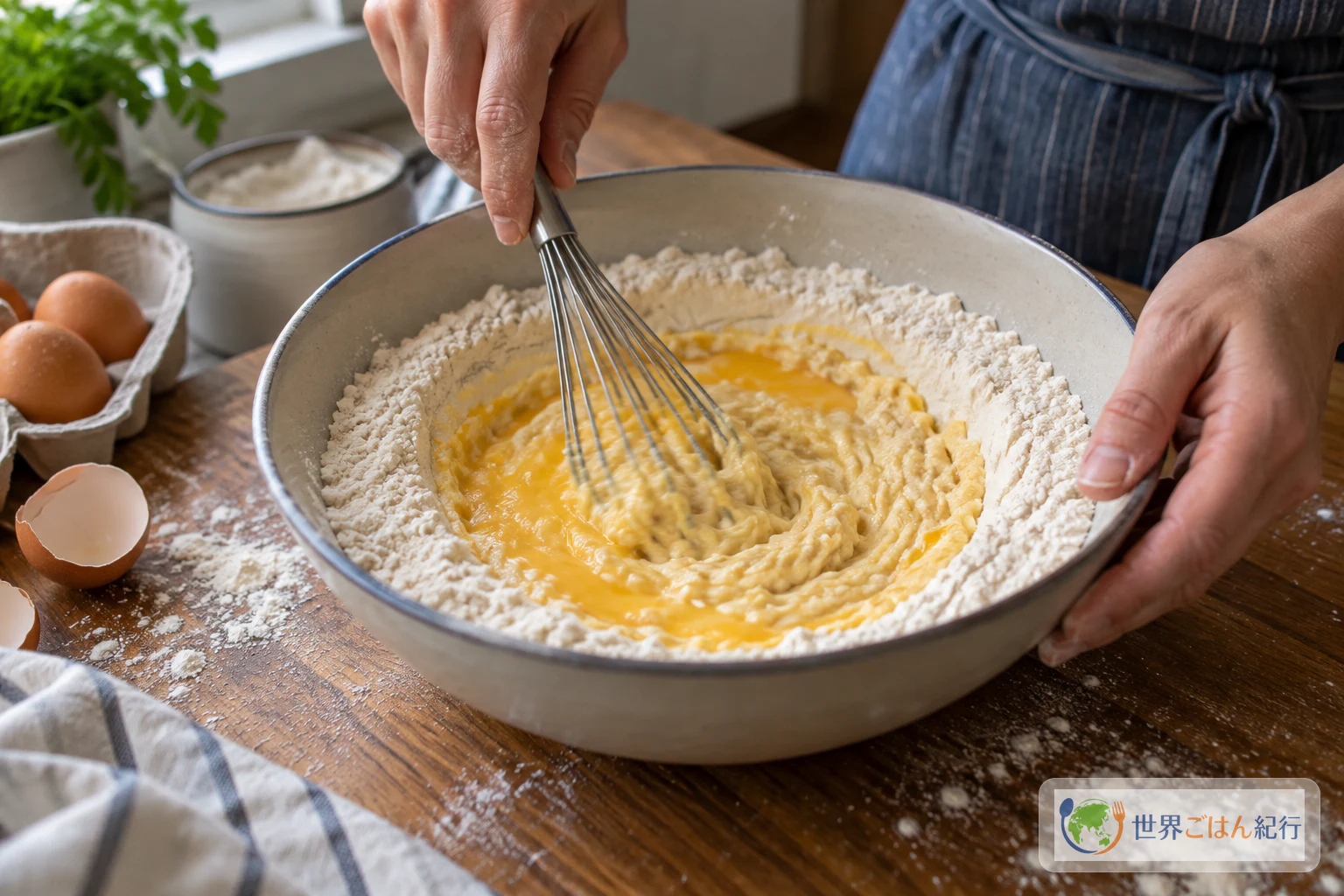
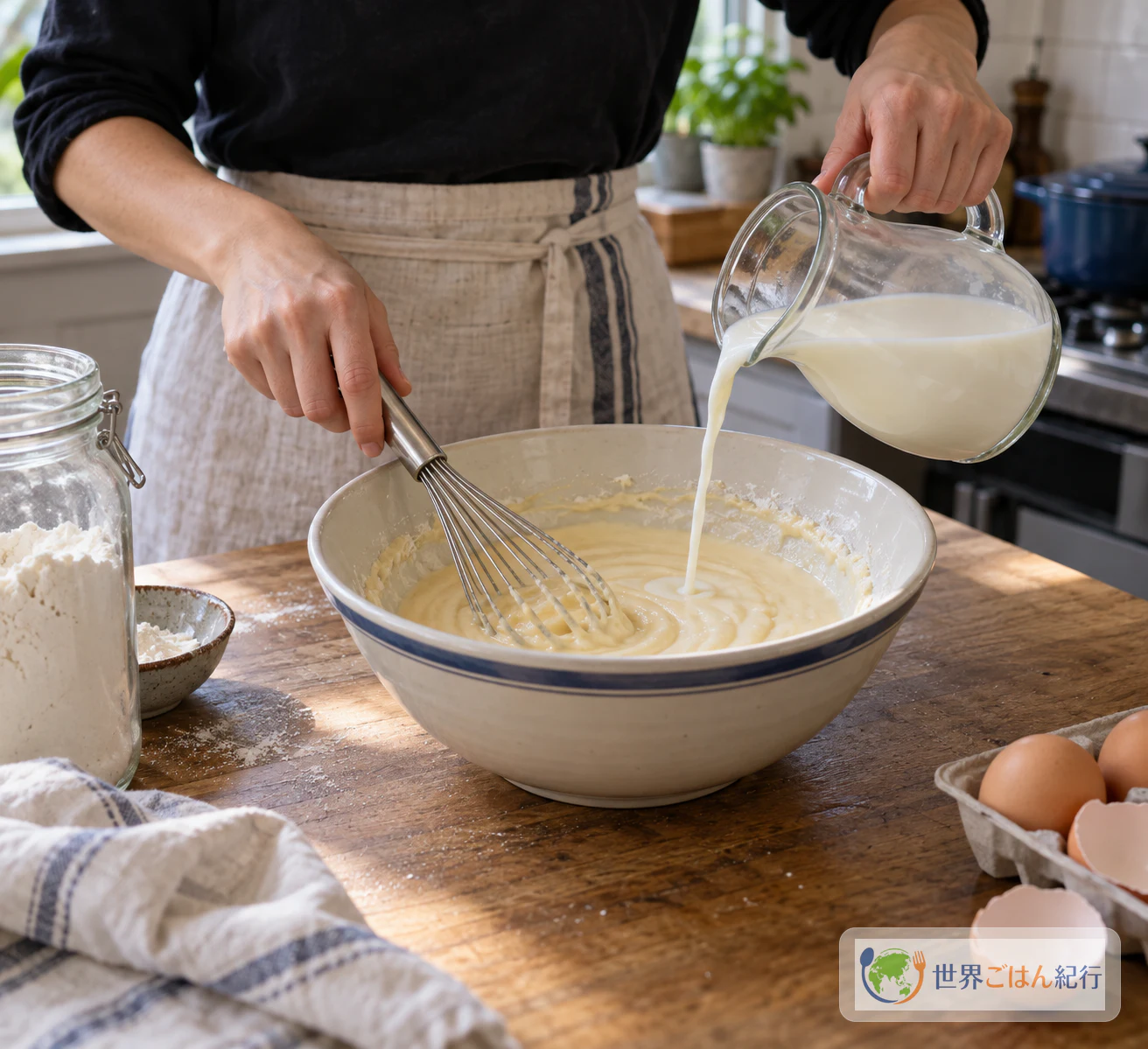
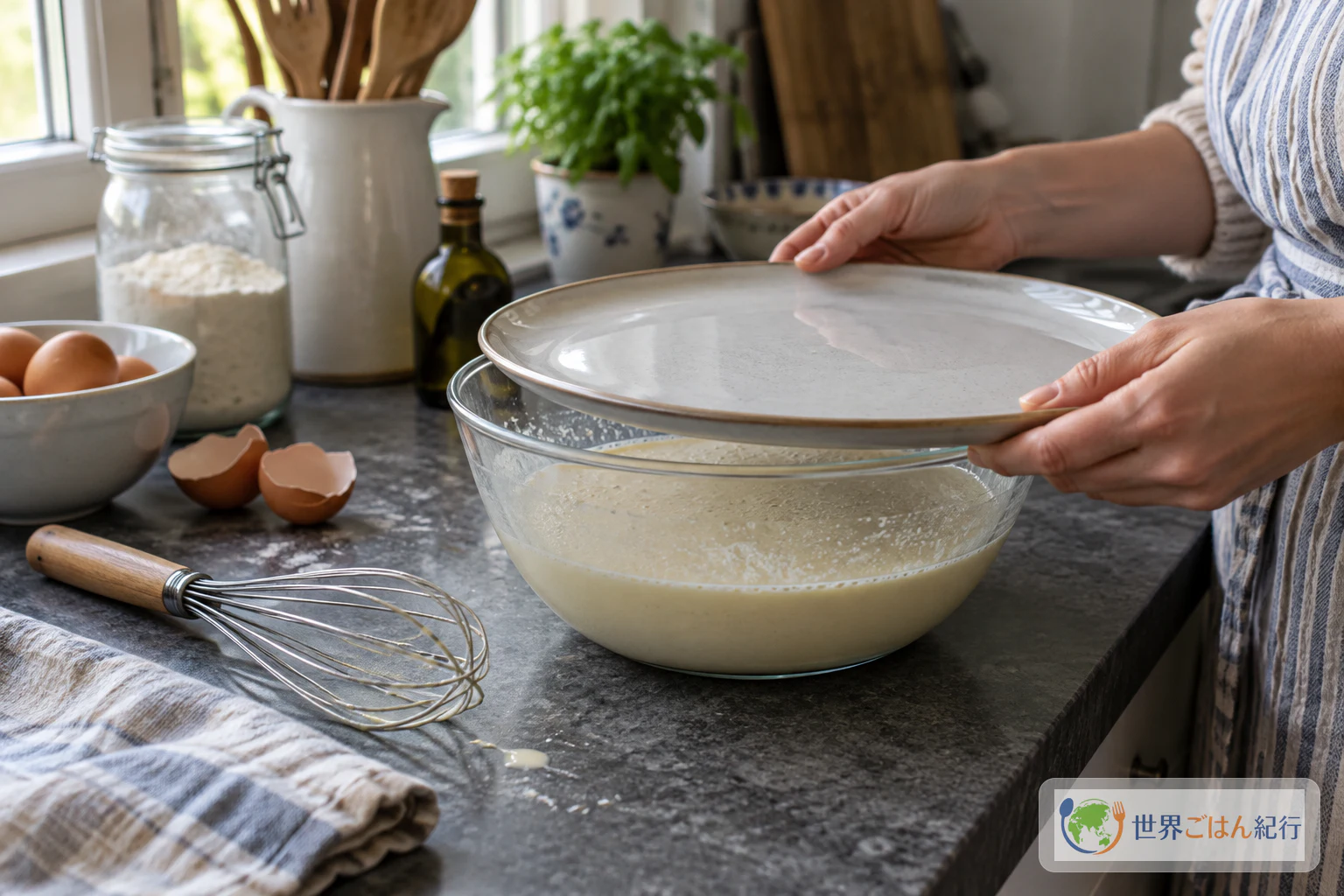
Mixing the batter is quick, but it then needs at least 30 minutes covered in the refrigerator, or about 2 hours if you have time. Cooking happens one crêpe at a time. If each crêpe takes roughly 2–3 minutes, a full batch of about 16 could take something like 32–48 minutes at the stove. That is a rough, untested estimate, separate from the resting time, and your pan and heat will change it.
A short listed cooking time should not be read as the time needed to cook the whole batch. Cooking all the batter one after another always takes longer. Use the look and feel of each crêpe, not the clock alone, to decide when it is done.
Troubleshooting: Lumps, Thick Crêpes, Holes and Dark Spots
| Problem | What to check | How to fix it |
|---|---|---|
| Lumps in the batter | Milk added too fast, or flour not drawn in gradually | Next time, add milk in small portions and mix from the center outward. For now, check after resting and strain through a fine sieve |
| Batter too thick to spread | Flour absorbing more liquid, larger amount poured | Before the next crêpe, whisk in a little more milk at a time and check the flow again. Don't add a lot at once |
| Holes or tears | Lumps, pan temperature, amount poured | Look at these one at a time: strain any lumps, adjust the heat, then adjust how much you pour. There is rarely a single cause |
| Crêpe browns too fast or too dark | Pan too hot | Lower the heat slightly, or lift the pan off the burner for a moment to let it settle. A batter with sugar may color more readily |
| The first crêpe is uneven | Pan not yet settled, unsure how much to pour | Treat the first crêpe as your test. Use it to set the heat and the amount of batter for the rest |
How to Eat Them: Start with Butter and Sugar
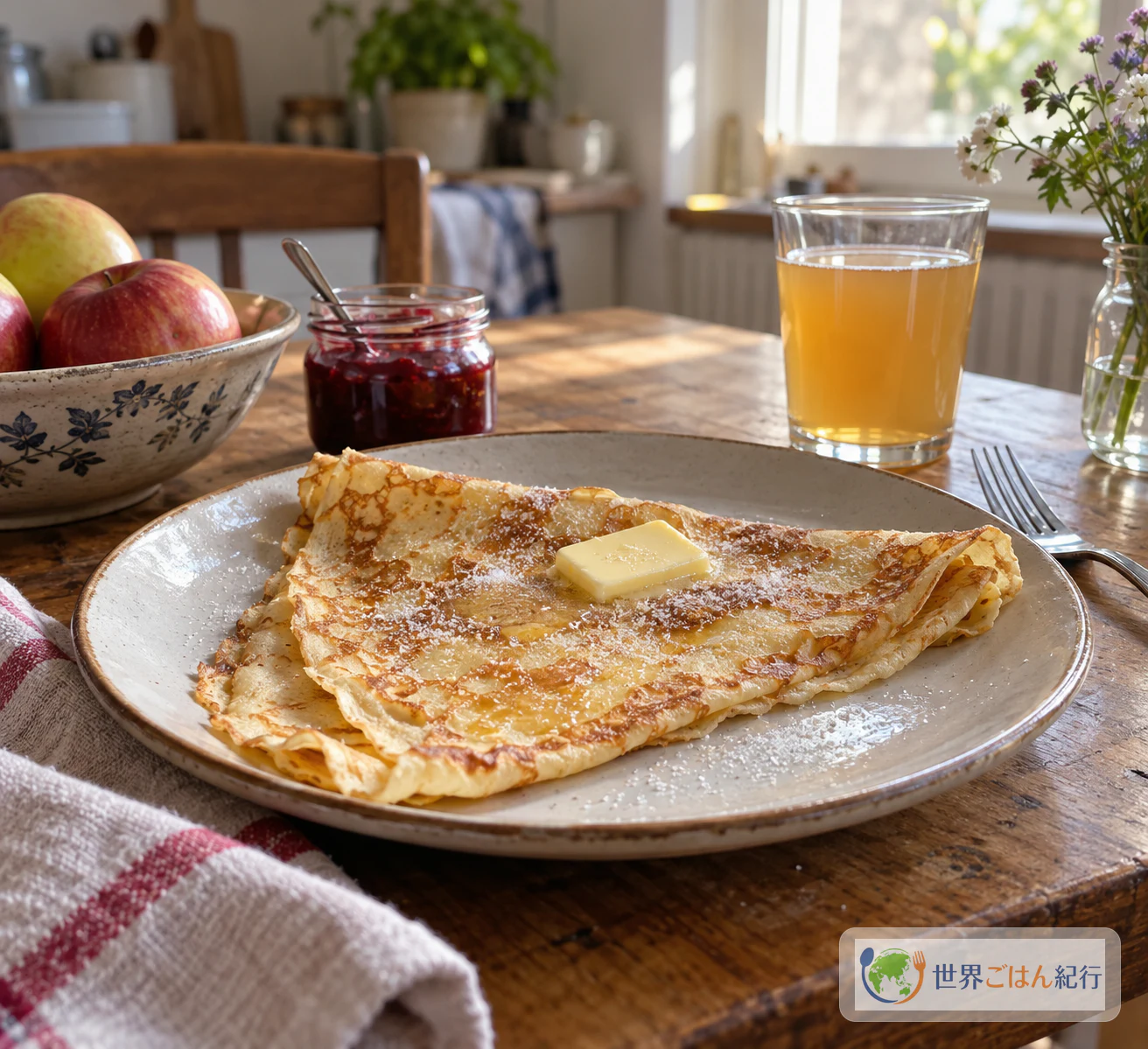
The Brittany Tourism board presents butter and sugar as the combination that lets you really taste the crêpe itself. From there, the same source mentions jam, caramel and baked apples. Set a few of these out and let everyone choose. Jam is easy to find anywhere and adds a little fruit acidity; just don't treat it as a special regional tradition.
In Brittany, cider belongs to the region's table, and France's official tourism site mentions it alongside galettes. For anyone who doesn't drink alcohol, or for children, something like apple juice works well at the table too. That is simply a practical choice, not a local tradition. None of these pairings is a fixed set that every Breton household serves.
Variations Worth Trying
- Leave out the sugar. Géraldine notes that sugar is optional and a matter of taste. Without it, the crêpes are less sweet and easier to pair with savory fillings. The batter is otherwise unchanged.
- Butter and sugar. The plain classic, described by Brittany Tourism as the way to judge the crêpe itself.
- Jam. Convenient and bright with fruit.
- Salted butter caramel. Sweetness with a touch of salt, a combination closely associated with Brittany.
- Compare with a buckwheat galette. A galette uses a different batter, built on buckwheat and usually aimed at savory meals. A galette complète with egg, ham and cheese is a well-known example. Making one side by side shows how two thin pancakes can differ in flour, name and use. This recipe does not swap buckwheat into the wheat batter.
Crêpe or Galette? Names That Change Within Brittany
Brittany is a natural focus for crêpe culture, but crêpes are eaten well beyond it, and this article doesn't claim a single place of origin. Even inside Brittany, the names don't follow one rule. According to the Brittany Tourism board, in western Brittany both wheat and buckwheat pancakes may be called crêpes, while in the east the savory buckwheat ones are called galettes. So "crêpe means sweet and wheat, galette means savory and buckwheat" is a useful tendency, not a law that holds across France. The same source also notes that there are schools where crêpe specialists teach the craft.
Chandeleur on February 2
In France, February 2 is Chandeleur, a day when families and friends gather to eat crêpes. France's official tourism site describes it as falling 40 days after Christmas. The same source gives several accounts of why crêpes are eaten that day and where the custom comes from; none of them is settled history, so it's best to enjoy the date as a habit of the table rather than look for one true origin.
For more dishes from the same country, browse recipes from France.
Frequently Asked Questions
Can I cook the batter without resting it?
This recipe recommends at least 30 minutes in the refrigerator, and about 2 hours if you have time. Recipes differ here: the Julia Child recipe published by the Los Angeles Times calls for at least 2 hours, while Chef Damien's recipe on 750g rests the batter for 1 hour. Rest the batter covered in the refrigerator, not at room temperature.
Can I make the batter unsweetened?
Yes. The sugar is optional, so you can leave it out for a less sweet batter that suits savory fillings. Keep in mind that this is still a wheat crêpe; a Breton buckwheat galette is made from a different batter.
What is the difference between a crêpe and a galette?
Broadly, crêpes tend to be wheat-based and galettes buckwheat-based and savory, but usage varies even within Brittany. In western Brittany buckwheat pancakes may also be called crêpes, while in eastern Brittany savory buckwheat ones are galettes. There is no single nationwide definition.
Do I need a crêpe pan?
No. The billig is a specialist Breton griddle, and a home cook doesn't need one. A wide frying pan works, as long as you grease it thinly and tilt it to spread the batter.
Can I store leftover crêpes or batter?
The sources used for this recipe don't give reliable guidance on storing the batter or cooked crêpes, so this article doesn't suggest storage times or temperatures. The recipe is written to be enjoyed freshly cooked, when the crêpes are at their most fragrant and tender. Remember too that the batter's refrigerator rest is part of the method, not a storage period.
Sources
- La Cuisine de Géraldine, "French Crêpes (Easy & Foolproof Recipe)." The basis for this recipe: about 16 crêpes, flour 250g, milk 500ml, eggs 4, butter 30g, sugar 2 tbsp, a pinch of salt, an optional aroma of rum, vanilla or orange flower water, at least 30 minutes' refrigerated rest, cooking over medium heat, the afternoon-snack setting, sugar as optional, and the note that changes such as plant milk affect texture. A home cook's recipe, not the only traditional formula. https://lacuisinedegeraldine.fr/en/crepe-batter-basic-recipe
- Brittany Tourism, "The crêpe." Covers the regional differences in what is called a crêpe or a galette within Brittany, eating crêpes with butter and sugar, caramel, jam and baked apples, the roles of the billig, rozell and spanell, and schools where crêpe specialists teach. Not used for ingredient quantities. https://www.brittanytourism.com/matching-what-i-want/food-drink/brittanys-specialities/are-you-a-crepe-expert/
- France.fr (Atout France), "2月2日はクレープの日Chandeleur(シャンドルール)" (February 2 is crêpe day: Chandeleur). Covers the custom of eating crêpes with family and friends on February 2, its timing 40 days after Christmas, the several accounts of its origin, and galettes and cider at the Breton table. Origin accounts are not treated as established history. In Japanese. https://www.france.fr/ja/article/2102_chandeleur/
- 750g / Chef Damien, "Crêpes maison." Used only as a comparison: a richer recipe with a 1-hour rest and about 1 minute of cooking per side. Its quantities are not used in this recipe. https://www.750g.com/crepes-r32849.htm
- Los Angeles Times / Cindy Dorn and Julia Child, "Crepes." Used as a comparison: a different formula with a rest of at least 2 hours, spreading the batter thin and turning by the edge and underside color, about 60–80 seconds for the first side and about 30 seconds for the second, and adding liquid when the batter is too thick. Its quantities are not used in this recipe. https://www.latimes.com/recipe/crepes