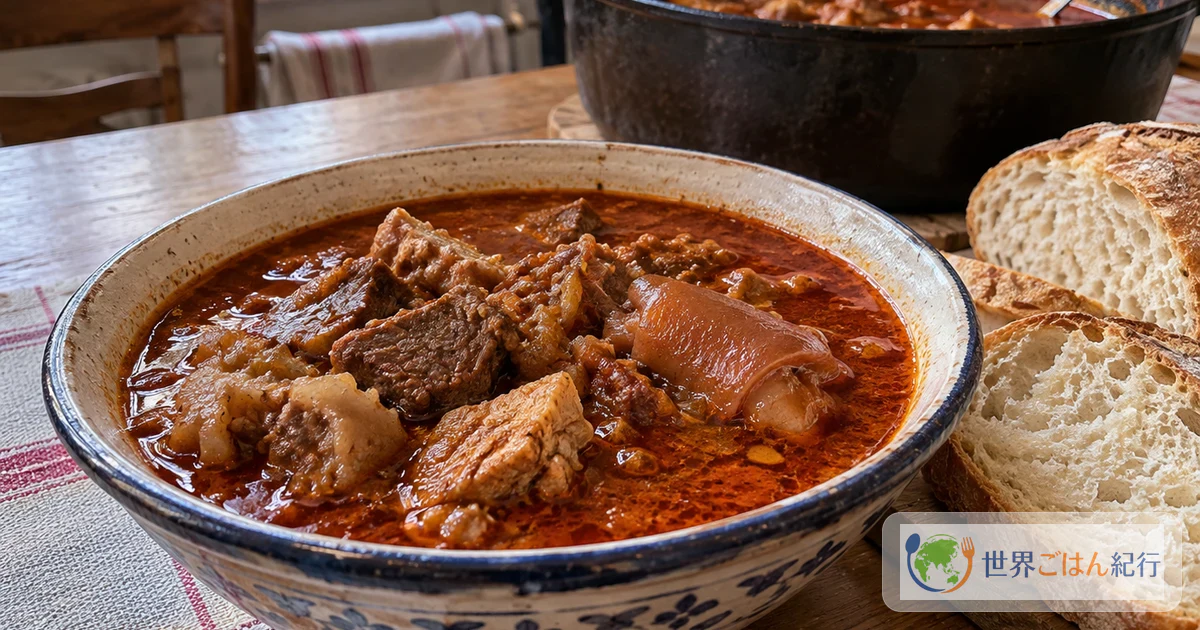
Aromas that spread from a big pot by the lake
Beside the board where you've chopped the mushrooms, dry rice goes into the pan with a small, gritty rustle. The moment you pour in white wine, steam rises, and when the porcini soaking liquid joins, the air of the kitchen deepens a little, like a mountain inn. You don't stand at the pot for long, but the aroma changes each time the rice absorbs liquid, which makes it a different pleasure from ordinary cooked rice. Risotto alla ticinese is the rice dish that carries that aroma to the tables of Ticino in southern Switzerland.

Ticino is the Italian-speaking part of Switzerland, and its cooking is close in air to Lombardy and northern Italy. Polenta, chestnuts, Merlot, the simple eateries called grotti, and risotto. It is less a dish carried in under a silver dome than one that suits a family lunch, a village festival, or an outdoor pot at carnival.
Locally, short-grain rice such as Loto, Carnaroli and Arborio is used, finished with white Merlot wine, mushrooms, porcini, butter and cheese. What goes alongside is luganighe, or the slimmer luganighetta, a pork sausage. This article uses Carnaroli, dried porcini, ordinary mushrooms and a dry white wine, all easy to get in a home kitchen. The sausage is treated as an accompaniment, and in the risotto itself the star is how the rice is cooked and its aroma.
It does not assume local Loto rice or Ticino Merlot; it keeps three things: don't wash the rice, add hot broth a little at a time, and take it off the heat to join the butter and cheese. Rather than reproducing the ingredients perfectly, it favors the all'onda texture that slowly spreads on the plate.
Story and background: Ticino's rice and festivals
Ticino risotto is a Swiss dish with one foot in northern Italy's rice culture. This region on the south side of the Alps shares language and table with neighboring Lombardy, and rice, polenta, mushrooms, cured pork and Merlot connect naturally in daily life. The Ascona-Locarno tourist office says that in Ticino, risotto is often eaten at family lunches, in restaurants and at village festivals, and that every household makes it differently. There are versions golden with saffron, versions with mushrooms, even ones with tomato or zucchini, so it is less a fixed recipe than a pattern for how to eat the local rice.
One of the ingredients supporting the local character is Loto rice, grown in the Maggia river delta. According to Ascona-Locarno, rice grown entirely in Switzerland began there in 1997, and the Loto variety is sown in spring and harvested in autumn using dry-field cultivation. But the history of eating risotto in Ticino is much older, and rice had long come from neighboring Italy. In other words, this dish is not a new specialty built on local rice alone, but one that settled where flows of rice across the border, home pots and big festival pots overlapped.
At village festivals there are scenes in which risotto for hundreds is made in a huge pot. The more people gather around the pot, the more the dish becomes a "place" rather than "a plate." Serve it with luganighe, pour red or white Merlot, and eat while the rice still ripples loosely. A Japanese kitchen cannot reproduce all of that atmosphere, but there are lines to protect. Warm the rice in fat without washing it. Add hot broth, not cold water. Use the mushrooms as the foundation of the aroma and finish off the heat to emulsify. Hold these and you get not a Western-style rice porridge that only borrows the place name, but a risotto a little closer to the Ticino table.
There are regional differences too. Combinations of white Merlot, red Merlot, saffron, mushrooms, cheese and sausage vary by home and restaurant. Since Ticino Loto rice and luganighetta are not reliably available outside the region, Carnaroli and a coarse sausage stand in. On the other hand, dried porcini, hot broth and the finish of butter and cheese are parts best not substituted too much. Decide first where to hold the line and where to compromise, rather than collecting every ingredient. That judgment is what lands this dish as home cooking.
Ingredients: assembling them in a home kitchen

This recipe uses dairy, alcohol, chicken-based broth and a pork sausage. The wine is cooked, but alcohol cannot be reduced to absolutely zero. For children and anyone who wants to avoid alcohol, leave out the white wine and add 1 tsp lemon juice to 100 ml broth to supply the acidity.
Risotto is a dish in which liquid reduces as the rice absorbs it. A commercial bouillon made as directed can end up too salty. Start with it a little weak to drink as is, and decide the salt at the finish.
What is worth looking for when shopping
Ticino Loto rice is not reliably available outside the region, so first choose Carnaroli. You can practice with ordinary short-grain rice, but with a rice whose grains don't break down easily, the difference between al dente and all'onda is easier to see. If you stretch just a little on the rice, it is easier to tell whether a failure came from heat control or from the stickiness of the rice.
Use saffron in small quantity, for its aroma rather than its color. Turmeric can give yellow, but the dry floral scent that remains deep in rice and butter is a different thing. Even in the Ticino style, how saffron is used differs by household and restaurant, so don't overdo it; a pinch is enough. Let it soak into a small dish of liquid before adding, and the color will not stain only one part of the pot but spread softly through the whole.
The finish of risotto changes with the surface area of the pot bottom. In a deep pot the rice piles up; in a thin skillet the liquid evaporates suddenly. A heavy sauté pan around 24 cm lets the layer of rice spread and makes the last wave movement easier to produce. Stroke the bottom with a wooden spoon and a path shows for just a moment. The idea is to choose a tool that makes that small sign easy to catch.
Method: finishing the rice like a wave
Risotto is not a dish where you rush to drive off the liquid. Watch how fast the rice absorbs, and proceed one ladleful at a time. Keep the broth steaming in a small pot alongside, and the rice pot at a simmer over medium to medium-low heat. If the sound gets loud, liquid is short; if the bubbles vanish and it is too quiet, the heat is too low. When in doubt at the pot, biting a grain of rice is the quickest check.
If you serve a grilled sausage, cook it in a separate skillet before finishing the risotto, about 6 minutes over medium heat, until hot through the center. Serving it alongside rather than mixing it in keeps the aroma of the rice from becoming heavy.
What to protect and what to compromise on in a home kitchen
If you try to solve all of Ticino's character by shopping, it quickly becomes difficult. It is not realistic to gather Loto rice, Merlot bianco, luganighetta and the local cheese all at once. For home cooking, separating priorities steadies the plate.
| Local element | Home version | Judgment |
|---|---|---|
| Loto rice | Carnaroli, Arborio | Prefer a short-grain rice whose grains don't break down easily. With Japanese rice, stir less often |
| Merlot bianco | Dry white wine | Red Merlot muddies the color easily. For a home version, white is easier to handle |
| Porcini | 15 g dried porcini | Even a small amount, the soaking liquid is the axis of the aroma. Without it, it drifts toward an ordinary mushroom risotto |
| Luganighetta | Coarse sausage served separately | Don't mix the meat into the rice; add saltiness at the side of the plate |
| Big-pot risottata | Heavy sauté pan | Even if a pot for hundreds is impossible, make a layer of rice in a shallow wide pan |
If you want to use red wine, don't make all of it red; start by mixing only 2 tbsp into the white. Red Merlot can bring out a Ticino-like aroma, but in a home pot the color goes dull and can overlap with the brown of the mushrooms. On a day when you want a yellow saffron risotto, use white wine; on a day you want a stronger meat accompaniment, a little red wine. A split about like that is easy to manage.
Also, if you add too much porcini, the aroma comes before the rice. 15 g dried looks small, but with the soaking liquid it is enough. You can make it with button mushrooms alone, but mixing in a little shimeji or maitake builds layers of aroma even from ordinary supermarket mushrooms. Conversely, if you cut the cheese and butter too far, the final emulsion is weak and it drifts toward plain mushroom porridge.
What went wrong and how to recover

| Problem | Cause | What to do on the spot | Prevention next time |
|---|---|---|---|
| Thick hard core in the rice | Heat too high and only moisture left, broth cold | Add 50 ml hot broth and extend 2 minutes at a time over medium-low heat | Keep the broth steaming hot beside the pot |
| Sticky and heavy | Over-stirred, grains broke | Add 2 tbsp hot broth, take off the heat and stir in a spreading motion | Move only the bottom once every 30–40 seconds |
| Watery and runny | Too much liquid at the end, not rested | Warm 30 seconds over low heat, then turn off and rest 1 minute | Stop a little loose before the finish |
| Wine is harsh | Under-reduced | Reduce 1 minute over medium heat and add a little broth | After adding the wine, wait until the acid's edge rounds out |
| Mushrooms are watery | Not sautéed quickly over high heat, so they steamed | Drive off the liquid on the bottom of the pan before adding to the risotto | Don't pile the mushrooms; cook until they soften |
| Cheese turns oily and separates | Added while still on the heat | Turn off the heat, add 1 tbsp hot broth and shake quickly | Always mantecare off the heat |
Rather than ending a failure at "the flavor was blurry," look at it in terms of temperature, moisture and the state of the grains, and the next plate changes considerably. Risotto in particular shifts its expression in the last 3 minutes. If the rice feels hard, don't hurry to high heat; add hot liquid in small amounts. If it stiffens, loosen it with broth, not water. Decide the salt last, after the cheese goes in. It is a dish with room to be fixed in the pot, so it goes better if you don't rush to call it done.
Serving, storage, and the next day

Risotto alla ticinese is best the moment it is poured onto the plate. The rice keeps absorbing liquid after it's served, so begin the mantecatura once everyone who will eat is at the table. As accompaniments: a grilled coarse sausage, a salad of light leaves, and firm bread. Eat a bite of sausage and scoop up rice right after, and the saltiness connects just right with the mushroom aroma. It is a dish with a lot of cheese, so keeping the starter from being too heavy makes it easier to finish.
To store it, don't keep the finished risotto warm; spread it in a shallow container to let the steam go, and refrigerate once the heat has gone off. Treat it as good until the next day. Reheating in the microwave alone tends to harden it, so return it to a pot, add 3 to 5 tbsp broth or water, and loosen it over low heat. It won't return completely to the original all'onda, but it is plenty good for lunch.
Leftover risotto is actually more fun when fried. Shape cold risotto into flat rounds about 2 cm thick, dust lightly with breadcrumbs, and pan-fry 3 minutes per side over medium heat. When the surface is golden and the middle is hot, you have a simple fried risotto. It isn't a Ticino dish itself, but the day after, when the rice has absorbed the moisture, it holds shape more easily, and it is tastier than trying to force it back to the first day's texture.
To make something next, start with how to make risotto (in Japanese) to compare the rice basics, and the feel of mantecare and all'onda will sort itself out. To widen the table with another Swiss dish, raclette, eaten with melted cheese, and Basler Läckerli, suited to after the meal, also go well. On a day you want to see the difference between rice dishes, compare it with paella Valenciana (in Japanese), in which you don't stir and let the bottom of the pan brown, and it becomes clear that risotto is "a dish that brings the rice close to a sauce."
FAQ
Q1. Can I make it with Japanese rice?
You can, but it turns sticky easily, so don't wash the rice and stir less. Don't add too much broth at once; add the next only after the rice peeks out. Pre-washed (musenmai) rice has less surface starch and is a little disadvantageous for the risotto's emulsion.
Q2. Should I use red Merlot wine?
Locally it is tied to Merlot culture, but in a home version a dry white wine is easier to handle. Red wine deepens the aroma, but the color tends to dull, and the yellow of saffron and the brown of the mushrooms can muddy. If you use it, try starting from 2 tbsp.
Q3. Is it not authentic without luganighetta?
The risotto itself can be made without it. Think of luganighetta as an accompaniment that adds satisfaction and saltiness to the plate; a coarse sausage grilled separately and served alongside is enough. Mixed into the rice, the meat's fat spreads through everything and the aroma of mushrooms and saffron gets heavy.
Q4. Can I leave out the porcini?
Without it, it moves closer to an ordinary mushroom risotto than a Ticino one. Dried porcini give a strong aroma through the soaking liquid even in a small amount, so 15 g is worth using. On a day you can't get them, sauté the fresh mushrooms harder and increase the white pepper a little at the finish.
Q5. Can I make it ahead?
The finished dish does not suit making ahead. If you must shift the timing, stop the heat at the 80% stage when the rice is still a little firm, spread it in a shallow container and cool it. Right before eating, return it to the pot, add hot broth, and finish in 3 to 5 minutes.
Sources
- Ascona-Locarno Tourism. "Ticino risotto tradition." https://www.ascona-locarno.com/en/what-s-on/stories/risotto (accessed 2026-07-09)
- La Cucina Italiana. "How to Make Mushroom Risotto." https://www.lacucinaitaliana.com/italian-food/how-to-cook/how-to-make-mushroom-risotto-easy (accessed 2026-07-09)
- Wikipedia. "Risotto alla ticinese." https://en.wikipedia.org/wiki/Risotto_alla_ticinese (accessed 2026-07-09)
- Wikipedia. "Risotto." https://en.wikipedia.org/wiki/Risotto (accessed 2026-07-09)