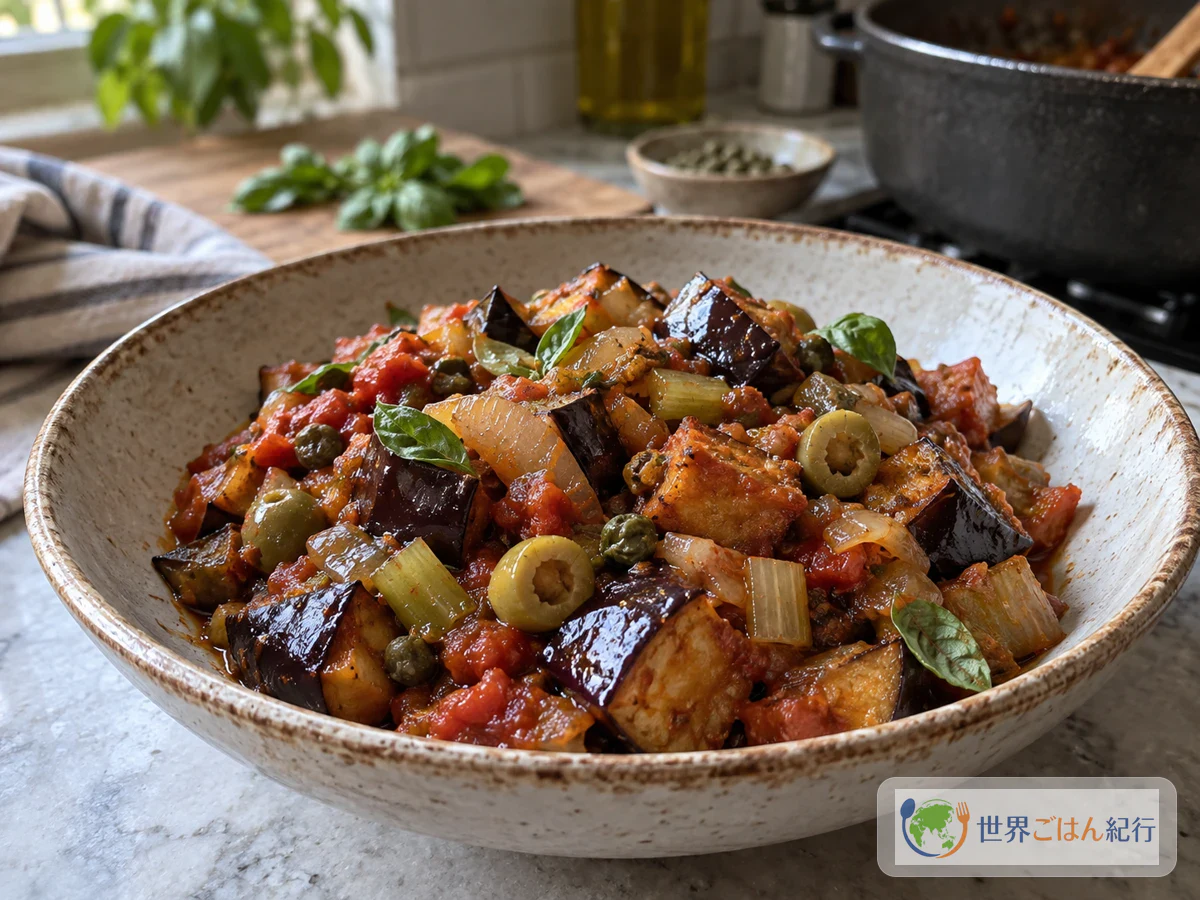
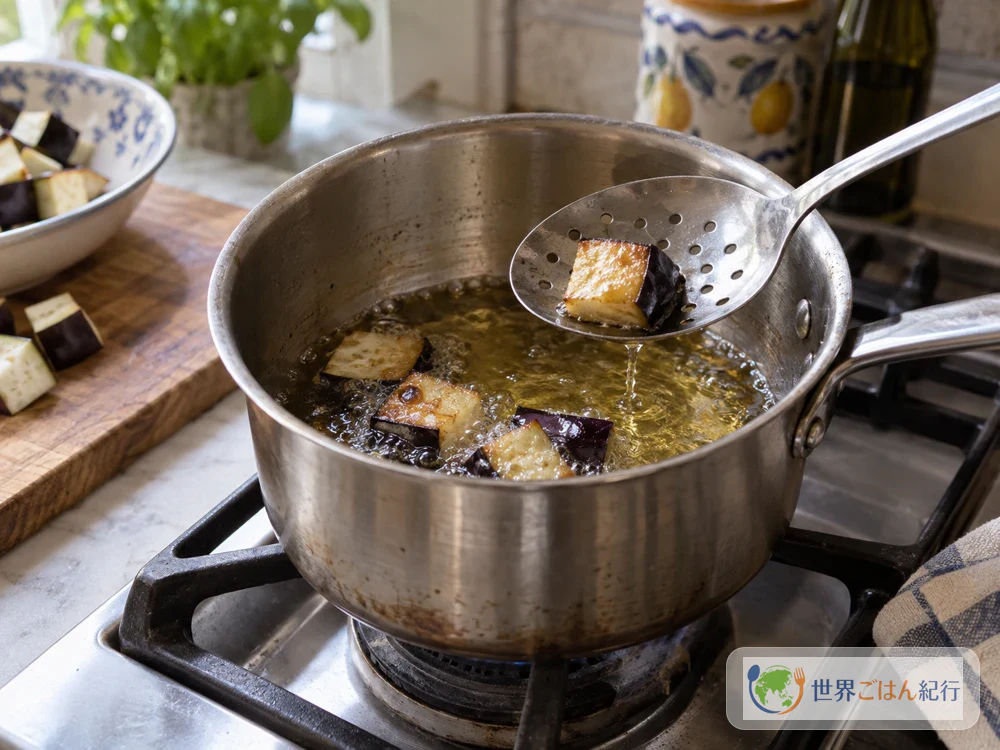
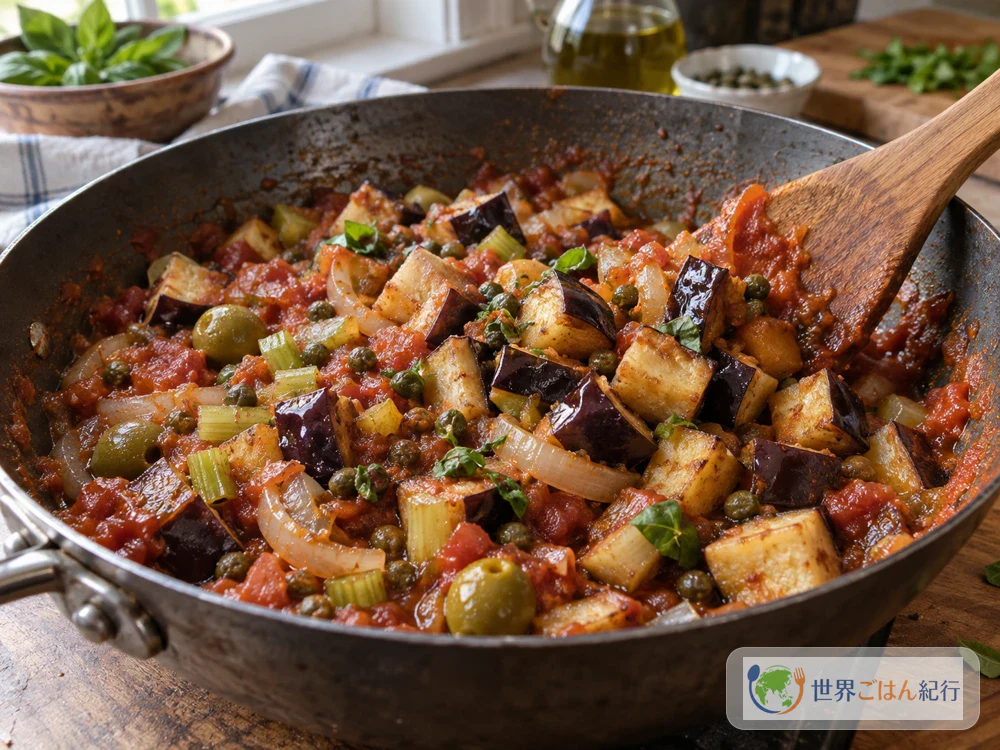
Fried eggplant, just lifted from the oil, with its edges still sharp. From a pot with red tomato and green olives, steam rises carrying the sharpness of vinegar.
Caponata is a sweet-and-sour vegetable dish from Sicily. Fried eggplant, celery, onion, tomato, olives, and capers are brought together in one pot. The method differs from a dish where tomato simply simmers, and the center of the flavor is the sweet-and-sour. The eggplant is not stewed but softened in oil and then added, so the meeting of fried eggplant and agrodolce is the high point of the dish.
The dish finished in a hot pot is traditionally eaten as a cold appetizer. You can enjoy it at the temperature it has right after you take out what you will eat, but leaving it at room temperature for a long time is not advised. The recipe in this article serves 4, and is good on bread or as a side for fish or meat. It can be made with ordinary eggplant and jarred capers. Frying the eggplant separately is the heart of the dish: 20 minutes of prep, 40 minutes of cooking, and a guide of 60 minutes in the refrigerator for the flavors to blend, about 2 hours in all. The chilling time varies with the container and the refrigerator.
On the Sicilian table, sweetness and sourness share one plate
It is a dish loved on Sicilian summer tables. The deep purple of eggplant, the red of tomato, and the green of olives all go on one plate. A sweet-and-sour vegetable appetizer, it is served in small amounts on small plates, with bread, or beside grilled meat or fish. The basic home mix introduced in this article contains no meat, fish, or dairy. That does not mean, however, that every region's or every restaurant's caponata is free of animal ingredients.
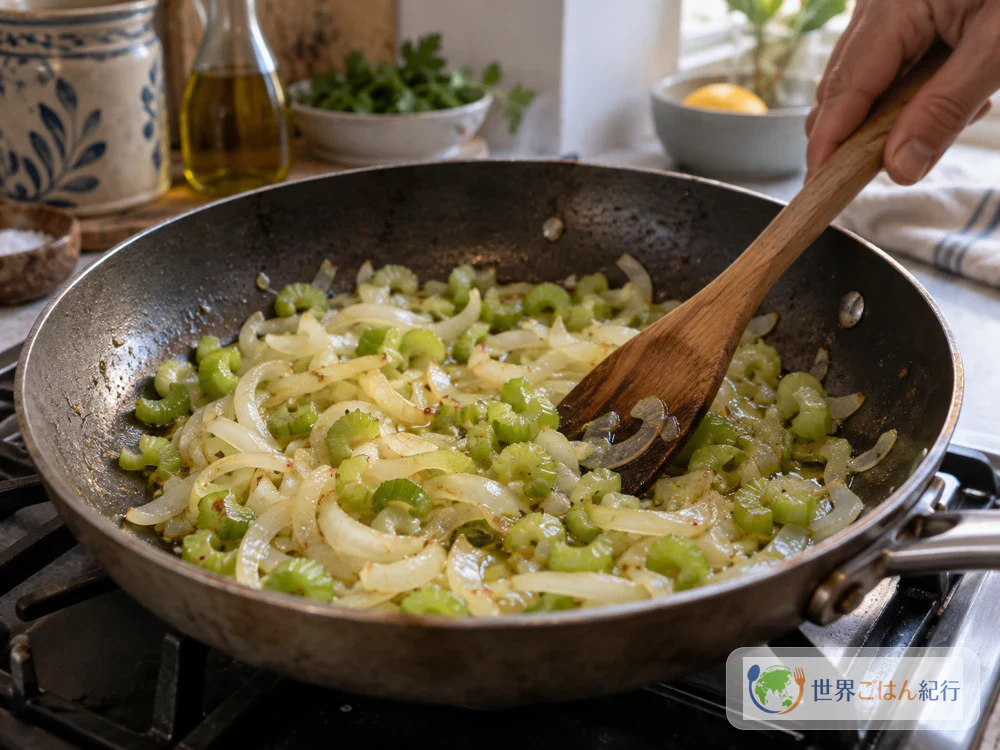
What is interesting is that the eggplant and celery do not end up equally soft. The eggplant is fried separately and then combined with the sauce, so it softens while keeping the shape of its corners. The celery is cut 5 mm wide and cooked in the onion-and-tomato sauce, so it keeps more bite than the eggplant. This contrast of soft eggplant and crisp celery keeps it from getting tiresome as you eat. For seasoning, use the saltiness of the olives and capers first and keep the finishing salt to 0–1 g. It is also important not to push the sweetness with sugar alone.
There is a theory about the name that involves fish. Visit Sicily says the word comes from capone, meaning mahi-mahi (dolphinfish) in parts of Sicily. The theory is that common people replaced a sweet-and-sour fish dish eaten by nobles with eggplant. That is only an account of the etymology, though, and not an established fact that tells us who devised it and when. Taking it that way lets you come back to the pot comfortably when you taste caponata as a vegetable dish today.
Besides the capone theory, GialloZafferano also presents a theory linking it to the Latin caupona, meaning a tavern. There are several theories for the name, and you cannot settle on any one.
In other regions, peppers and nuts join
Move to another town on the island and the contents of the plate change. What is listed here are representative examples based on Visit Sicily's regional introduction, and not a mix that every household in that town uses. Read with the assumption that even within one town, homes differ.
Palermo has a simple form, and in Catania red and yellow bell peppers are used. In some regional versions, garlic and potatoes also go in. In Trapani, peppers are combined with toasted almonds, but nuts are not essential to every mix on the island.
| Region | Differences in ingredients described | How to think of it when trying at home |
|---|---|---|
| Palermo | A relatively simple combination of vegetables | Make the basic eggplant, celery, and sweet-and-sour first |
| Catania | Red and yellow bell peppers. In some, garlic and potatoes | For color, sauté bell pepper separately |
| Trapani | Bell peppers, vinegar, toasted almonds | Adding nuts just before eating keeps their crunch |
| Agrigento | Roasted peppers, honey, garlic, chili, nuts, raisins, and others | When you increase sweet ingredients, reduce the sugar |
That does not mean you need to put every regional ingredient in the same pot. The basic recipe in this article contains no nuts, raisins, or peppers. First enjoy the texture of the eggplant and celery, the saltiness of the capers, and the combination of vinegar and sugar. Add one ingredient at a time. Adding honey or raisins increases the sweetness, and adding nuts increases the crunch. None of these combinations is the single orthodox mix that carries a region's name.
Agrodolce is a word meaning "sweet and sour," and in cooking refers to a seasoning that combines vinegar and sugar or the like. In caponata, the vinegar is added at the final sauce stage so that the eggplant is not simmered for long. There is no single ratio common to all regions.
Ingredients (serves 4)
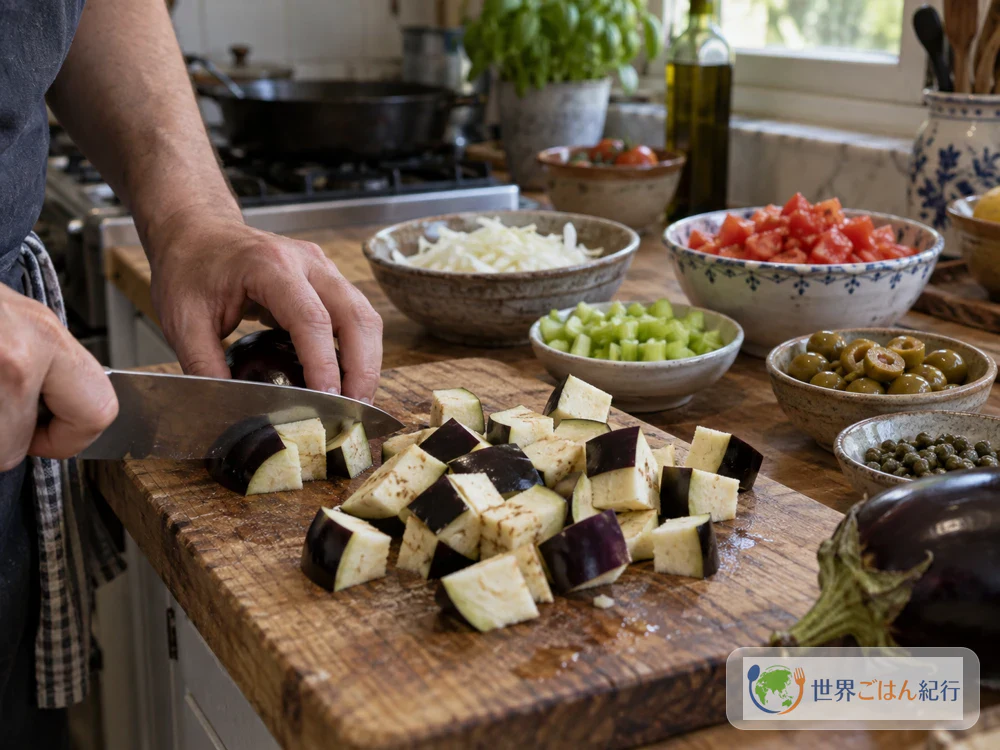
This mix is adjusted for a home kitchen. The eggplant is 500 g edible portion, weighed after removing the stems. The celery, 150 g, is also weighed after removing the strings. Do not decide quantities by the number of eggplants or stalks of celery; always weigh them. Leave the eggplant skin on. For frying, use a pot about 20 cm across with some depth, and for the sauce a skillet of about 26 cm. An ordinary pot and skillet will do.
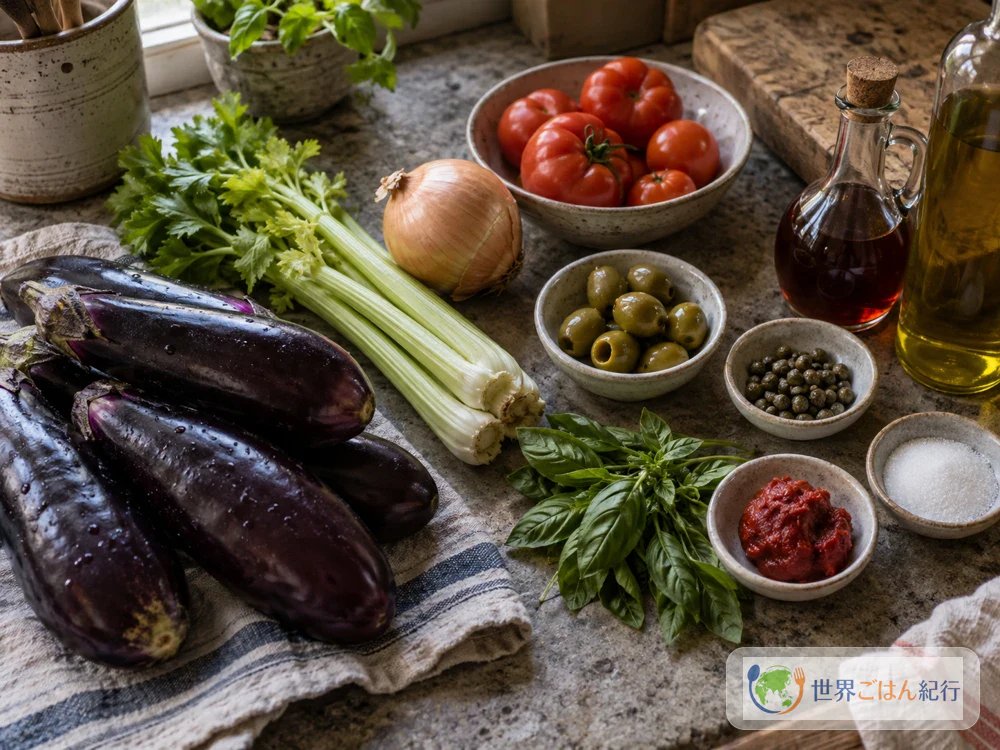
Choose capers by distinguishing between vinegar-packed and salt-packed. Drain vinegar-packed ones; desalt salt-packed ones as the label directs and then weigh. Do not put the packing liquid into the sauce. If you measure the liquid from vinegar-packed capers in place of the 30 ml for the sweet-and-sour, the amounts of vinegar and salt change.
When substituting distilled white or rice vinegar, start with 20 ml. After finishing the sauce, add 5 ml at a time, up to about 30 ml at most. The aroma and acidity of vinegar vary by product, and it does not give the same fragrance as white wine vinegar. Rather than increasing the vinegar from the start, topping up little by little after reducing is less likely to fail.
Wash the vegetables and basil under running water before cutting. Use clean tools, and keep them apart from the cutting board used for raw meat and fish. The basic mix contains no dairy, egg, wheat, or nuts, but check the allergen labels of jarred ingredients and seasonings. Serving with bread adds wheat and other allergens, and the nut variations add nuts. Choose ingredients to suit the food allergens you personally need to avoid.
How to make it
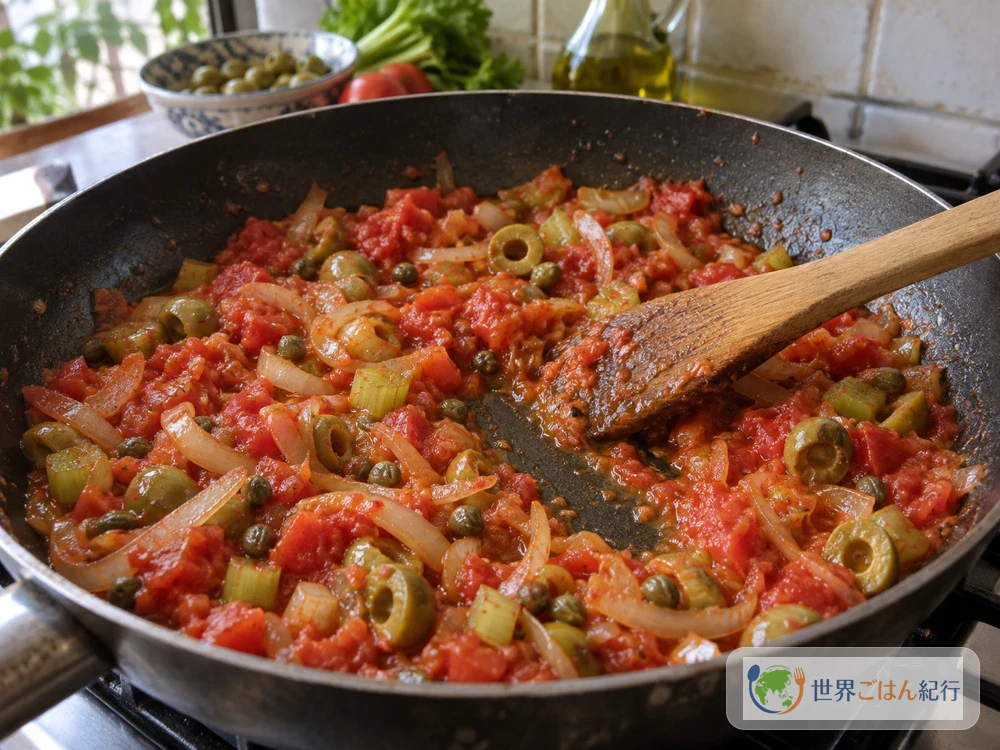
The work divides into two parts: frying the eggplant and making the sauce. Prep is a guide of 20 minutes and all the heating 40 minutes, though they increase or decrease with your equipment and how much you fry at once. The key is to reduce the sauce first. In a soupy pot the eggplant will break down. The 60 minutes of refrigeration in step 6 is a guide for blending flavors; the time it takes to cool to a safe temperature varies with the container and refrigerator.
If greasiness bothers you, first review temperature and quantity. Fry the eggplant in small batches and bring the oil back to temperature before adding the next. Do not keep topping up the oil so the eggplant soaks it up. If oil is floating on the surface of the sauce, skim off a small amount from the surface before combining with the eggplant. Do not fix wateriness by adding oil.
To keep the soft corners of the eggplant, set the eggplant aside while you reduce the sauce, and combine after turning off the heat. Once it is in, turn it from the bottom with the spatula rather than stirring in small motions. Eggplant that has broken down will not regain its corners however long you cook it.
Take great care with the frying oil. Add wiped-dry eggplant in small amounts, and never put wet tools or water into hot oil. Do not step away from the pot while frying. If the oil smokes, turn off the heat at once. Handle the oil after cooking only once it has cooled. Also, even with the sweet-and-sour, this is not a food that can be kept at room temperature. Observe the refrigeration conditions after cooking.
Fixing sourness, greasiness, and broken eggplant
The aroma of the sweet-and-sour seems strong in a hot pot. Taste after letting it cool a little. If the acidity is too strong, stir 2 g sugar at a time into the sauce before adding the eggplant and dissolve it over medium heat for 30–60 seconds. A total addition of 6 g is the upper guide. After the eggplant is in, soften it in how you serve it, for example by adding a little cooked tomato. Simmering a long time to remove the acidity makes the eggplant break down.
| Problem | Likely cause | How to fix, or what to do next time |
|---|---|---|
| Sauce is watery | Tomato has a lot of water, finished with the lid on | Before adding the eggplant, take off the lid and reduce 2–3 minutes at a time over medium-low heat |
| Eggplant is greasy | Fried too much at once, oil temperature dropped, not drained enough | Spread on a rack to drain. Next time fry in small batches and bring the oil back to temperature |
| Too salty | Saltiness of olives and capers and added salt stacked up | Stop adding salt. Combine with unsalted cooked vegetables or bread |
| Vinegar is too sharp | Sauce was heated too briefly, vinegar was increased all at once | Before the eggplant goes in, heat 30–60 seconds more over medium heat and taste |
| Eggplant breaks down | Cut too small, kept cooking after adding | It will not return to its shape. Eat it on bread, and next time cut 2.5 cm cubes and combine at the end |
Adding a lot of vinegar or sugar when it is too salty does not reduce the salt. Either simmer plain vegetables separately and combine, or eat it little by little with bread or an unsalted main dish. The rule is to add salt last, in small amounts. If you add vinegar because it seems greasy, the sweet-and-sour ratio goes off too. Review how you drain the oil first. When a scorched smell has spread through the whole dish, do not try to hide it with seasoning; avoid mixing in the scorched parts.
On bread days, and on days to add vegetables
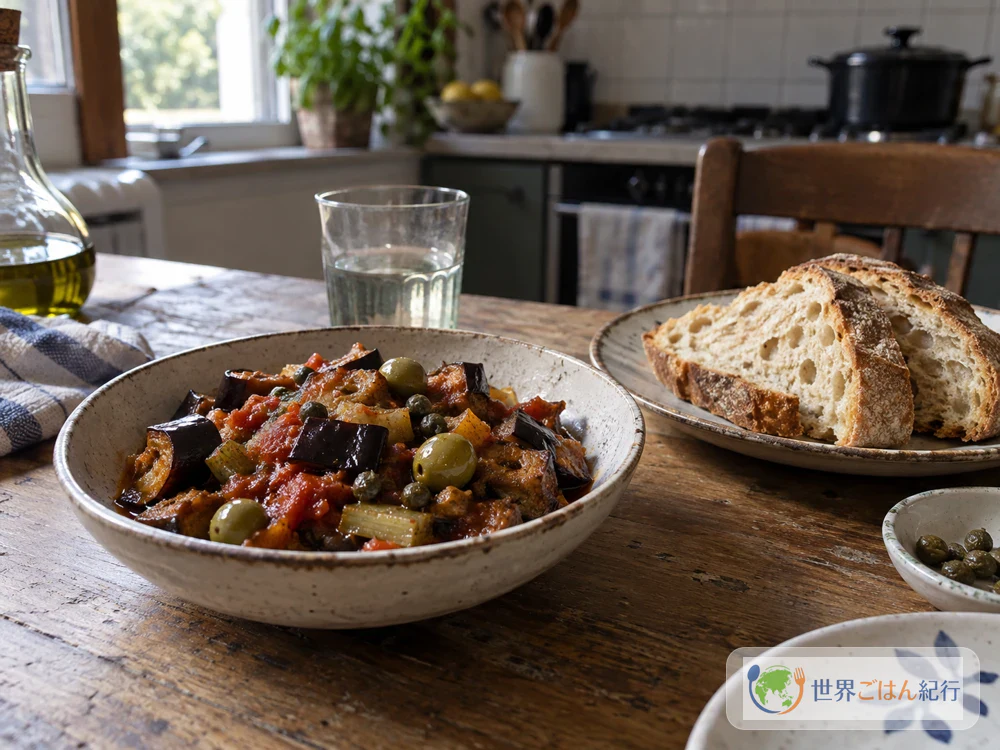
Rather than a heaping plate, taking a little onto a small dish and enjoying it with bread is the more fitting way to eat this dish. It is also served beside grilled fish or meat. Putting cold caponata on warm bread brings out the contrast in texture. Try it a little at a time on bread. Prepare the bread separately from the ingredient list. Serving it with rice is a home adaptation; it is not presented as a traditional Sicilian way to eat it.
Once you are used to the basic flavor, adding ingredients is also fine. The following table gives home adaptation amounts to add to the basic 4 servings, and is not a regionally orthodox mix. Cook bell peppers separately, and if you add raisins, reduce the sugar. Do not scorch nuts, and check the allergen labels. Remember to reduce the sugar when you add sweet ingredients. Do not make several changes at once; proceed while checking the difference from the basic sweet-and-sour.
| Variation | Change from basic 4 servings | Change in texture and flavor |
|---|---|---|
| With bell pepper | Cut 100 g red or yellow bell pepper into 2 cm cubes, take 5 g from the sauce oil, sauté over medium heat 5–6 minutes, then go to step 4 | Adds color and the sweetness of the vegetable |
| With almonds | Coarsely chop 15 g unsalted almonds, toast over low heat 2–3 minutes, and add just before eating | Toastiness and crunch. Do not scorch |
| With raisins | Soak 15 g raisins in 30 ml water for 10 minutes, drain, and go to step 4. Reduce the sugar to 10 g | Adds the sweetness of fruit |
| A little heat | Remove the seeds from 1/4 red chili, sauté with the onion in step 3, and take it out at the finish | A touch of heat in the aftertaste. Omit for children |
| Roast the eggplant in the oven | Skip the frying oil, toss 500 g eggplant with an extra 30 g olive oil, and roast at a preheated 220°C for 25–30 minutes, turning once | A home adaptation with a stronger roasted taste than separate frying. Also check softness at the center |
If you are curious about the next dish, how about a detour to a vegetable dish from another land? Panzanella, which tosses tomato and vinegar with bread without heating, is a Tuscan dish in contrast to the fried-eggplant caponata, and lets you enjoy the texture of bread and raw vegetables. Bagna cauda, with vegetables dipped in a warm sauce, leads to a Piedmontese table different from a cold appetizer.
- How to make panzanella
- How to make bagna cauda (in Japanese)
Storage and frequently asked questions
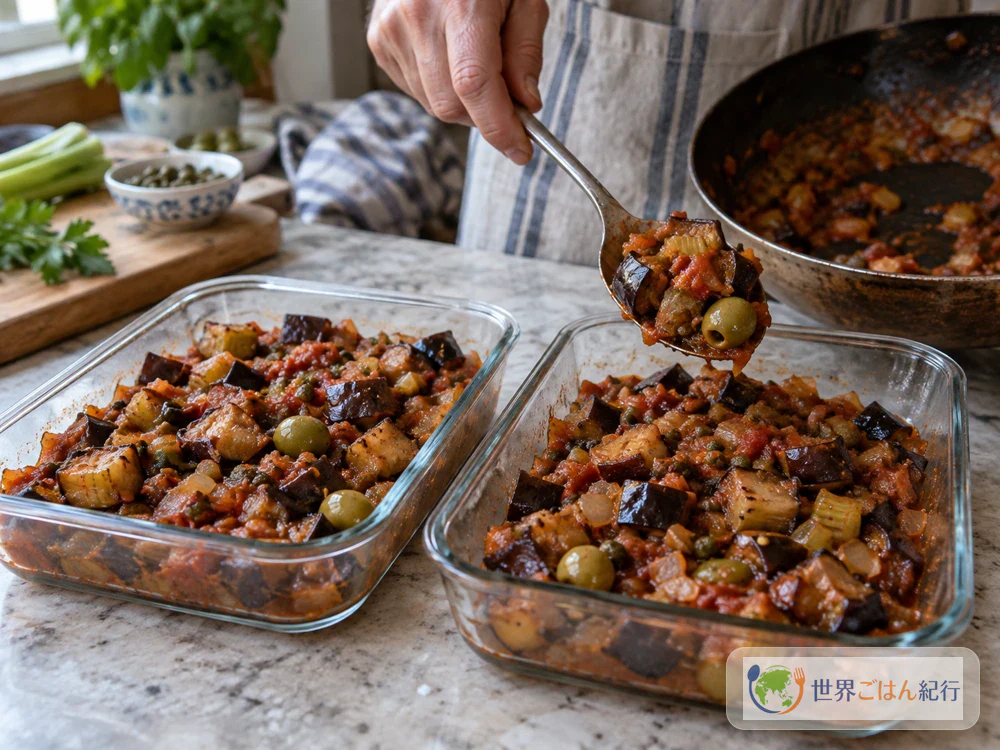
Caponata is a dish whose flavors blend in the refrigerator. The enjoyment of next-day deliciousness depends on cooling it safely and storing it at 4°C or below. After cooking, divide it shallowly and refrigerate promptly, and at home finish it within 2 days as a guide. This does not guarantee that 2 days is safe, however. Keep the refrigerator at 4°C or below, and take out only what you will eat with clean tools. A strong sweet-and-sour does not extend how long it keeps.
Avoid anything that has been at room temperature for more than 2 hours in total, or more than 1 hour in an environment above 32°C. Do not eat food that has fallen outside safe storage conditions. Safety cannot be judged by smell or appearance alone. There is also no need to bring it to room temperature for a long time before eating. Take out only what you will eat.
Can I eat it cold?
You can eat it cold straight from the refrigerator. The bread can be warm. If you prefer a texture closer to room temperature, take out only what you will eat at one time and bring it to the table at once. Do not leave a large platter out for hours.
Can I freeze it?
If freezing at home, do it on the day of cooking: cool it safely, portion it, seal it, and put it in a freezer at -18°C or below. The quality guide is within 2 weeks, which is the editorial team's conservative estimate. Thaw it in the refrigerator and finish what you will eat early. Do not thaw at room temperature. The eggplant and celery soften and release water, so try freezing only a small amount the first time. The texture cannot be guaranteed.
What if I have no capers?
Capers are an ingredient of the basic mix. Having them for the first time makes it easier to confirm the combination of this dish. If you cannot get them, leave them out and increase the olives from 80 g to 100 g as a home adaptation. The distinctive fragrance of capers cannot be reproduced, though. Chopped pickles in the same amount give a different aroma and acidity, so it is not the same flavor. Decide any added salt by tasting at the end.
Should I salt the eggplant before frying?
Local introductions include both a step of salting and leaving it for 1 hour and a step of cutting and frying as it is. Salt treatment is not regarded as required in every mix. The home process in this article is to cut, wipe dry, and fry right away. If you add a separate salting step, wash off the salt and be sure to dry it thoroughly. Never put wet, rinsed eggplant into the oil. This is a separate matter from the points about storage and desalting.
How far can the nutrition numbers be relied on?
The nutrition values given are approximations for the full 4 servings. They were calculated from 500 g eggplant, 150 g celery, 150 g onion, 200 g tomato, 80 g olives, 15 g tomato paste, 20 g sugar, and 70 g of oil consumed. The oil consumed assumes 30 g sautéing oil and 40 g absorbed by the fried eggplant, and is not a value measured by actual cooking. The full 300 ml of frying oil is not included. Olives are approximated by stuffed olives in the food composition table. Small amounts of capers, vinegar, and basil, as well as bread and the variations, are excluded. Divided into 4, one serving is about 260 kcal, about 2.5 g protein, about 21 g fat, and about 20 g carbohydrate. It varies with how much frying oil is absorbed and with the products used, so do not use it for precise nutrition management.
Sources
-
Visit Sicily — Caponata — regional differences, the etymology theory involving fish, preparation. Accessed and checked 7 October 2026.
-
GialloZafferano — Caponata (Eggplant salad) — ingredients, the steps of frying separately and the sweet-and-sour, refrigeration, several etymology theories. Accessed and checked 7 October 2026.
-
Italia.it — Sicily, the whole world in a mouthful — the summer table and Sicilian food culture. Accessed and checked 7 October 2026.
-
FoodSafety.gov — 4 Steps to Food Safety — washing, preventing cross-contamination, shallow containers and refrigeration temperature and time. Last reviewed 18 September 2023. Accessed and checked 7 October 2026.
-
MEXT Standard Tables of Food Composition in Japan: eggplant, raw — used for the nutrition estimate of main ingredients. Accessed and checked 7 October 2026.
-
MEXT Standard Tables of Food Composition in Japan: celery, raw — used for the nutrition estimate of main ingredients. Accessed and checked 7 October 2026.
-
MEXT Standard Tables of Food Composition in Japan: onion, raw — used for the nutrition estimate of main ingredients. Accessed and checked 7 October 2026.
-
MEXT Standard Tables of Food Composition in Japan: red tomato, raw — used for the nutrition estimate of main ingredients. Accessed and checked 7 October 2026.
-
MEXT Standard Tables of Food Composition in Japan: stuffed olives — used for the nutrition estimate of main ingredients. Accessed and checked 7 October 2026.
-
MEXT Standard Tables of Food Composition in Japan: tomato paste — used for the nutrition estimate of main ingredients. Accessed and checked 7 October 2026.
-
MEXT Standard Tables of Food Composition in Japan: white sugar — used for the nutrition estimate of main ingredients. Accessed and checked 7 October 2026.
-
MEXT Standard Tables of Food Composition in Japan: olive oil — used for the nutrition estimate of main ingredients. Accessed and checked 7 October 2026.